One example of climate change directly impacting higher education

Climate change has fallen away from public attention this season, given the demands of other issues.  I’m still tracking it, though, with an eye towards its impact on higher education, the subject of my next book.  In that vein, today I’d like to draw your attention to one story.

The United States Army Corps of Engineers just published a plan to help protect Florida’s Miami-Dade county against water damage cause by climate change: increasing storms and rising sea levels of up to three feet by 2080.

It’s an ambitious plan, covering more than 100 square miles:
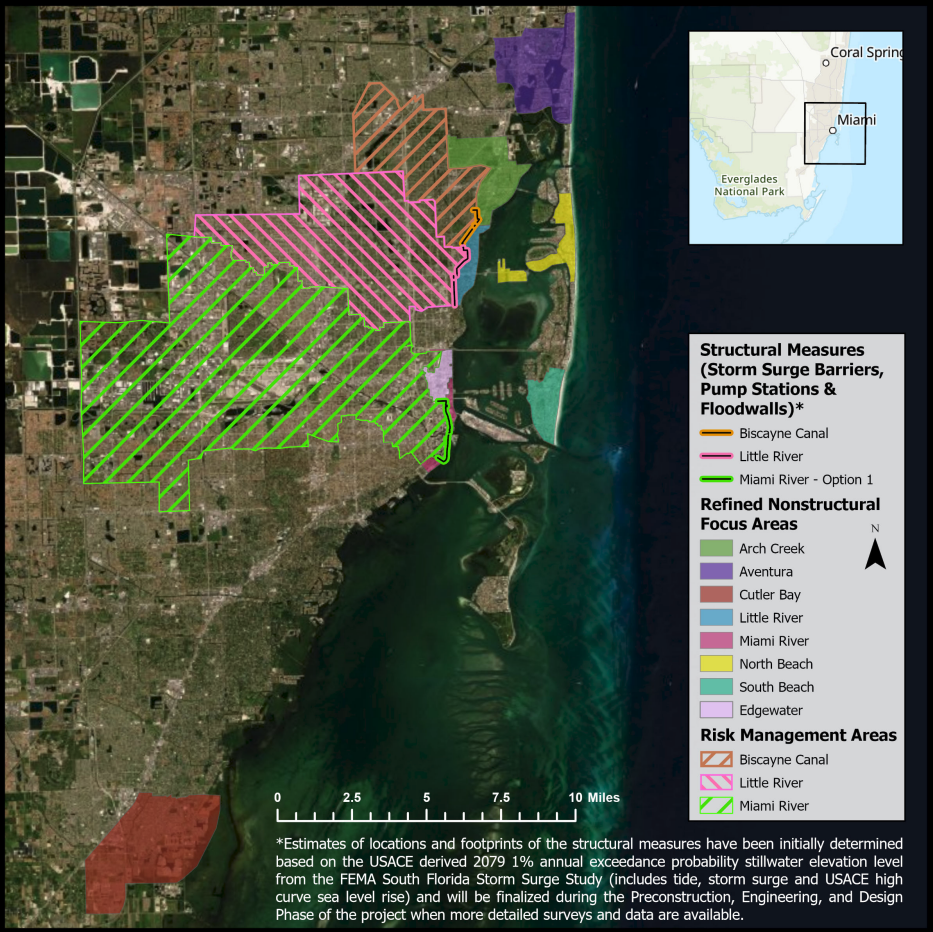
Miami-Dade Corps of Engineers mitigation plan 2020

There are several interesting details about the plan in terms of climate mitigation.  For example, it’s a second version plan, reduced from the first.  It

walks back some of the costs and solutions the Corps had previously proposed — most notably, the notion of buying out hundreds of homes and turning them into parks or open spaces.

That helped drop the total proposed cost down to a projected $4.6 billion, instead of the $8 billion price tag on the September version of the plan.

This means the structure, if built successfully, will only protect against some water damage, not all:

[T]his plan is only designed to block storm surge from a 1 in 100 year storm surge event by 2079, with the extra storm surge that comes with the three feet of sea rise by then. Thomas Ruppert, a coastal planning specialist with Florida Sea Grant, pointed out that won’t do anything to protect homes and streets from the tidal floods that are already becoming more common and worse.

There is also the political ruckus involved in some of the construction, which requires “easements and land purchases for the walls and flood barriers, which the Corps expects to be a $405 million expense.”

My focus here is not on Florida politics, as fascinating as they can be, but on higher education.  What does this plan tell us about climate change and campuses?

I haven’t started my mapping work yet (mapping campuses which are most in danger of rising seas, desertification, or expanding prairies), but I can use Google Maps to find colleges and universities in the Miami area:
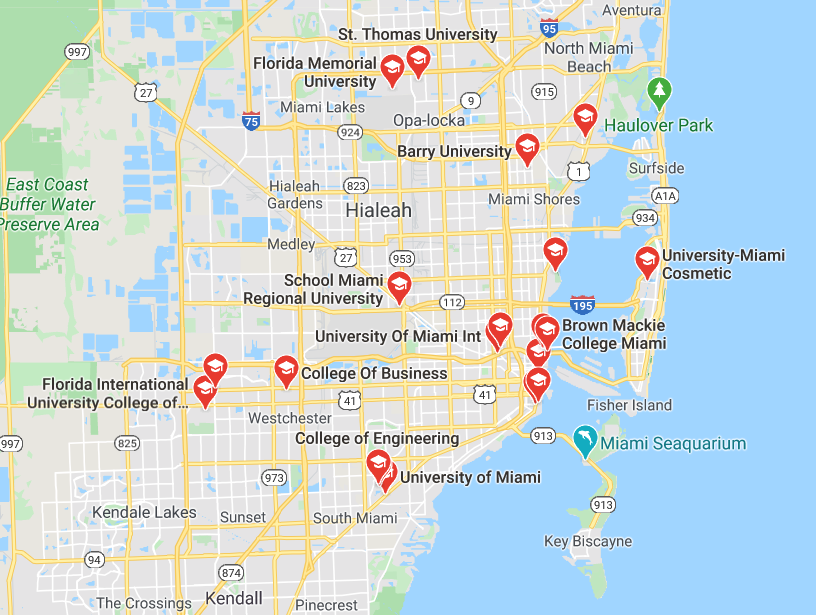
Miami colleges and universities

I count Barry University, Carlos Albizu University, Florida Memorial University, Florida National University, Johnson and Wales University, Miami Ad School, Miami Dade College, Miami International University of Art & Design, Nova Southeastern University, St. Thomas University, Talmudic University, and the University of Miami.  Some of these have more than one campus in the Miami area.

I think the one farthest from the sea is FIU’s College of Law, which looks about 10 miles from the waters.  Nearest are – well, a bunch.  Let me zoom in:

Miami colleges and universities around Biscayne Bay

So right away, at first glance, we can see a group of colleges and universities in physical danger from the oceanic effects of climate change for the rest of this century.  Some would be swamped by sea level rise.  All will face risks and damage as hurricanes and other storms, worsened by climate change, slam into the county.

Notice that I wrote “oceanic effects of climate change.”  Think about temperatures as well.  Miami usually hits in the upper 80s and low 90s during summer, although humidity makes it much worse.  Those temps have been rising of late.  As the 2000s wear on and heat increases, Miami’s colleges and universities will have to work harder to cool their building interiors, which is both expensive and an additional call on electrical resources.  Will they reconfigure campus buildings to reduce these costs, an investment against the Anthropocene?

Which brings us to campus responses.  In my Universities on Fire plan I offered an outline of possible strategies and reactions.  Let’s work through them.

Uprooting the campus. How will Miami campuses rethink their physical plants?  If they plan to remain in the area, what kinds of protection will they need against rising waters and temperatures?  How will designs for new buildings and renovations of old ones change to meet these needs?  Should schools reconfigure transportation to block vehicles powered by fossil fuels?  Should food services source more locally and/or increase vegetarian/vegan offerings?

Or is this all too much?  One option would be to relocate out of Miami-Dade and set up shop in a safer location.

Doing research in the Anthropocene. Some faculty at each of these ocean-facing campuses already conduct research in relevant areas – hydrology, civil engineering, environmental sociology, earth science, etc.  Perhaps these colleges and universities will increase that research through hiring, promotion, and support.

Teaching to the end of the world. Some of these campuses offer classes in relevant fields.  Will enrollment in those area rise in parallel with the ocean?  Maybe one or more schools will decide to take advantage of their position and expand offerings.  We could see an undergraduate certificate or grad program in climate change mitigate appear, with part of the attraction being able to work right at the coal face or ground zero of the Anthropocene.

Town, gown, deserts, and rising sea levels. I mentioned city and county politics up above, and really don’t know anything about the particulars.  Would campuses have to pay for part of the Corps’ work?  What kinds of political tension could open up as city, county, college, and university policies diverge?  What are the options for student service learning on this topic: working on seawalls?

Academia versus the world. As the crisis builds, what role will Miami area faculty, staff, and students play?  Would students – for example – lobby for the city’s airport to cut back flights (after COVID, of course) to reduce emissions?  Or would campuses open up as climate sanctuaries as refugees appear, driven from points south as temperature rises lash those nations?

Worst case scenario. The plan I linked to assumes a sea rise of up to three feet by 2080.  What happens if that’s too optimistic?  Are Miami colleges and universities considering how their plans have to change if climate change speeds up, due to any number of factors?

To repeat: I’m not an expert in Miami’s higher education ecosystem. I’ve read about some of the institutions and know some folks at a couple of campuses, but that’s about it.  I don’t think I’ve set foot on any of them.  Heck, I’ve only visited Miami a few times.

That said, the Corps’ report gives us an example of a group of colleges and universities in the very teeth of climate change.  Think about other areas worldwide where academia is physically situated within miles of rising seas – or expanding deserts, or widening prairies, or where temperatures can rise to dangerous levels.

How will academia respond?  This may be our greatest strategic challenge for the rest of the 21st century.

(thanks to Steven Kaye)

Posted in climatechange | 1 Comment

Looking ahead to fall 2020

We’re now one week into June.  In higher education this means two unequal things: first, summer classes are under way, like mine.  Second, fall term planning is proceeding, which is a much larger affair.  Since we’re in the year of the Murder Hornets EbolaCOVID-19 pandemic, that work is much more intense.  The situation is also incredibly fluid.

Let me combine some current developments with a look ahead to create glimpses of what autumn 2020 might look like in colleges and universities.  Keep in mind my three scenarios:

Bryan_3 COVID scenarios_WSJ

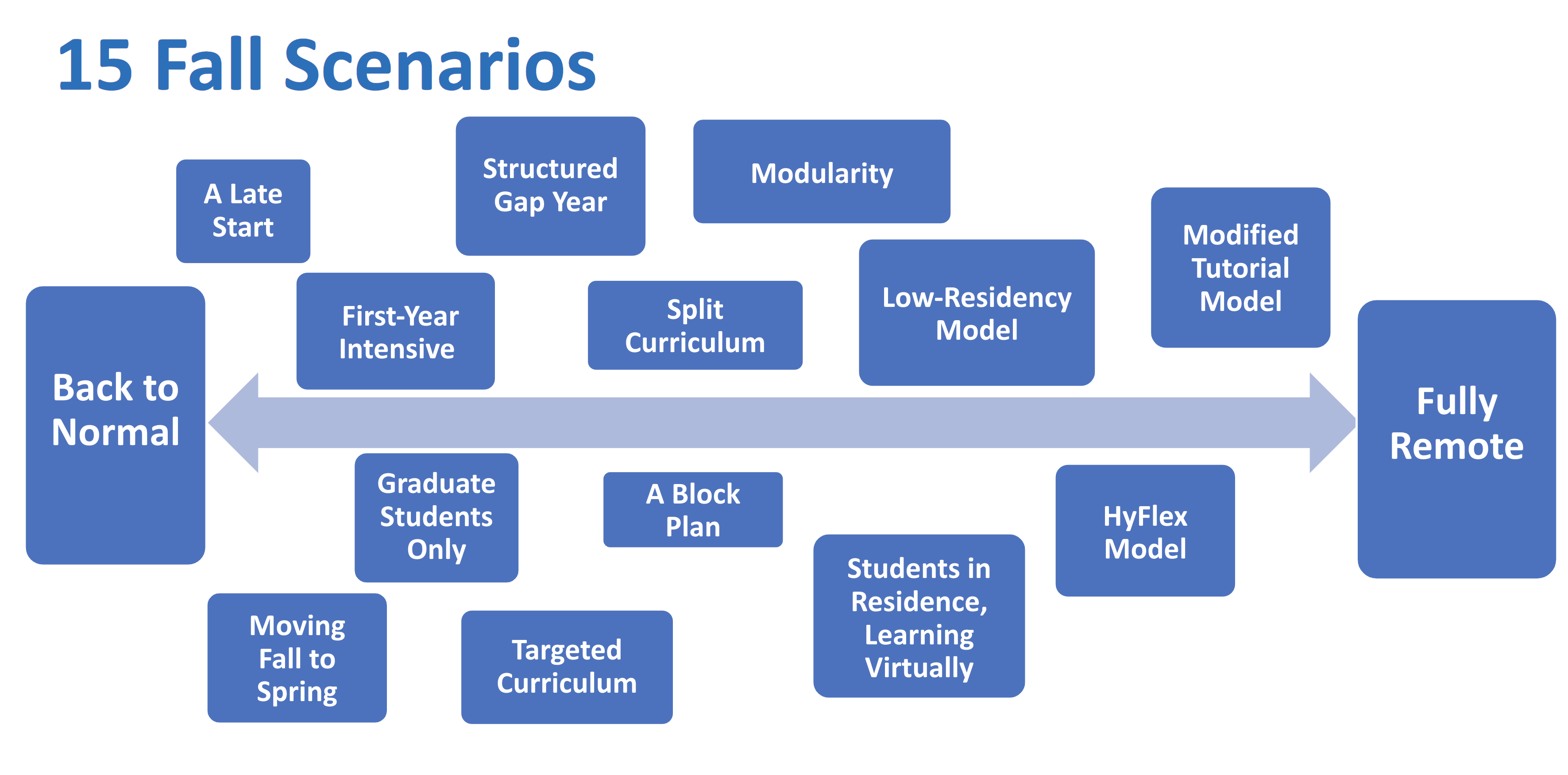
…as well as the 15 from Eddie Maloney and Joshua Kim:

15 Fall Scenarios Graphic

Overall, there’s uncertainty over the financial picture.  More colleges are offering tuition breaks, obviously to win more enrollment from people reeling from a terrible economic/medical shock.  In fact, many campuses are anticipating an enrollment decline this fall, like Detroit area community colleges.  Various commentators in and outside of academia argue that tuition is too high for online teaching.

College towns and other areas that depend on campuses for business are expecting a significant economic hit this fall.  Towns around campuses that offer big sports teams are worried about an economic blow if students – and games – don’t return in numbers.

On the other hand, enrollment could tick upwards, according to Moody’s, for the traditional reason: people seeking to improve their labor market standing when unemployment is high.  Interestingly, Moody’s also thinks that even if student numbers rise, revenue will decline.  I can’t see the report, but IHE account mentions some important details: possibility of a mid-term new infection surge; hits to other income streams; families down-shifting away from more costly campuses as they grapple with their own financial stresses.

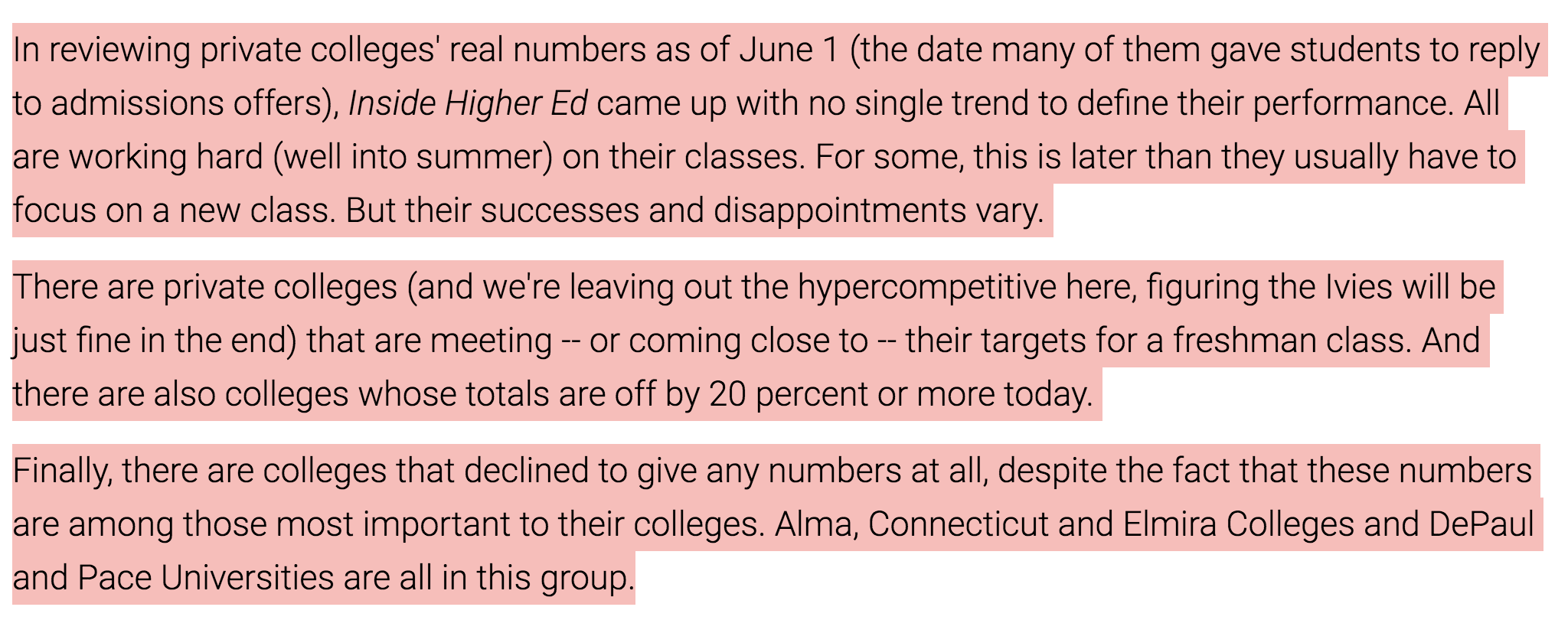
Inside Higher Ed looked into small, private college enrollment data and found a mixed picture, as of June 1:

IHE private college enrollments 2020 June 8

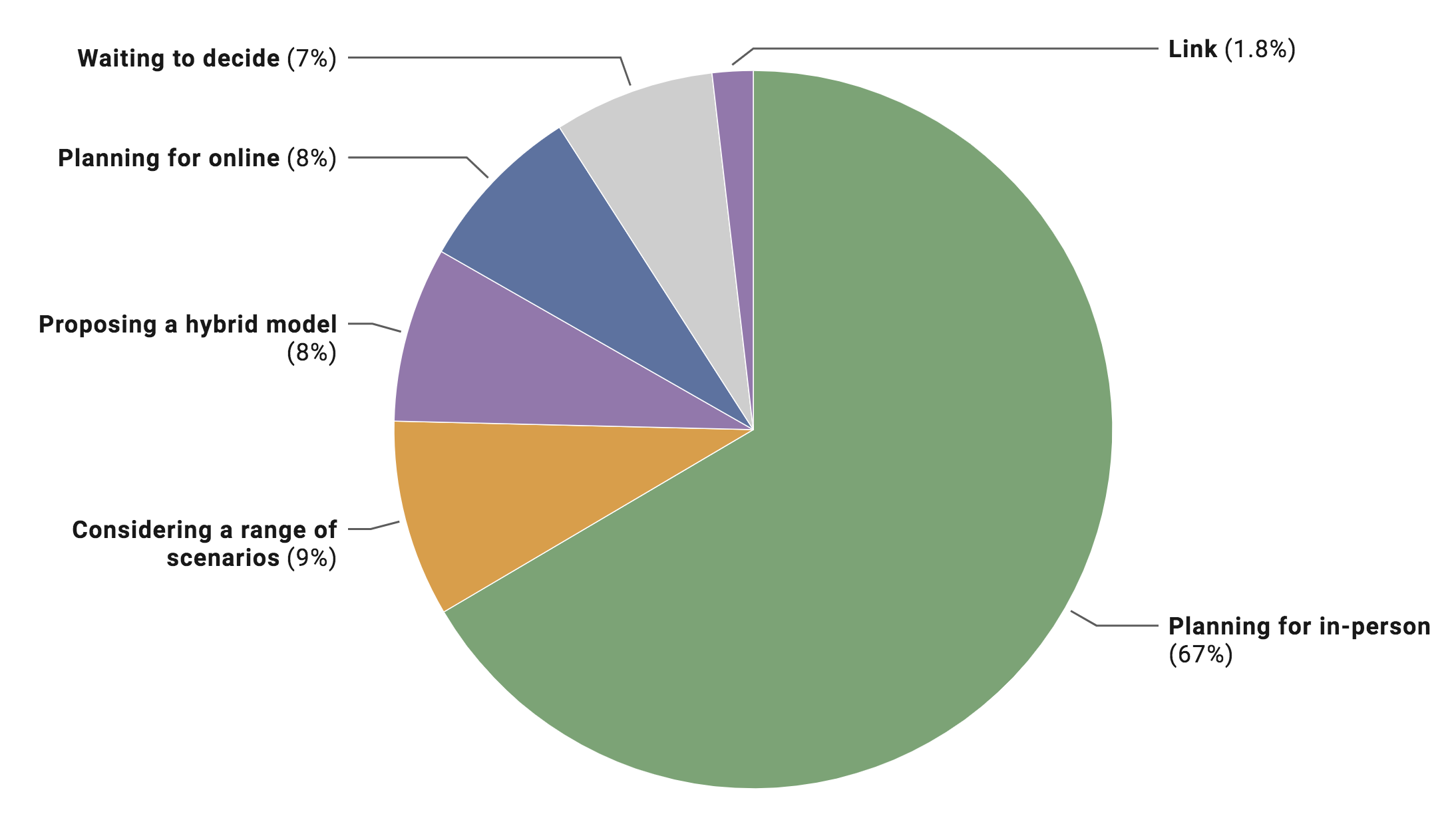
POST-COVID CAMPUS What about the institutions hoping to resume in-person education this fall?  Two-thirds are preparing for this, according to the Chronicle of Higher Education’s running survey:

campuses planning on f2f 2020 June 7_Chronicle

So how to do it?  One way might involve suspending some key student activities.  Brown University, still hoping to open up, is also cutting back some athletics.

Another is to reorganize campus spaces.  I’ve heard from several professors and administrators that they are considering putting up tents to house outdoor classes, where students and faculty members could be safely separated.  This obviously makes more sense in warmer climates, unlike, say, New England or the upper Midwest.  Additionally, discussion during a Senate hearing last week saw the idea of repurposing other campus spaces for instruction, including staff and faculty offices unused by those working remotely.

Otherwise opening up for in-person education entails extensive medical testing and contact tracing, both of which run the possibilities of being expensive and not working effectively. (This Chronicle article gives a good overview.)  Research universities like Brown or Michigan sometimes have such capacities in-house, as when they maintain their own hospitals.  Some campuses lack that capacity, and that’s why some of those are partnering with local, independent medical organizations.

Any campus may find the need to expand digital surveillance of students.  As I’ve said before, holding in-person campus experience this fall will likely involve a heavy layer of medical supervision and testing, which might not go over well.  Back to that Chronicle piece:

There is evidence that relying on phone-tracking devices is not popular with Americans, even during a pandemic. Surveys conducted since March by Beth Redbird, an assistant professor of sociology at Northwestern University, show that only 15 percent of Americans agree that the government should use GPS monitoring to track people who have tested positive for the coronavirus. Support is higher among whites than it is among blacks, Latinos, and Asian Americans, she said.

The New York Times hosted an interesting discussion about how to return to in-person education, and I recommend reading the whole thing.  In addition to what I’ve noted so far, discussants touched on:

  • the possibility of setting up students into groups for testing and potential containment
  • implicit tensions with unionized workers – not faculty members, but low income cleaners and cooks
  • limits on testing: number of kits, how to implement
  • problems reconfiguring sit-down dining for safe delivery or pickup

There seems to be ongoing demand from (some) colleges and universities for immunization – not against COVID-19, but against lawsuits from people unhappy with their response to the pandemic.

On the graduate school front, several research universities are cutting back on enrolling new graduate students.  The explicit goal here is to focus resources on supporting currently enrolled students.

Dalton Conley, Henry Putnam University Professor of Sociology at Princeton and director of graduate studies in the department [:”W]e’d rather focus on taking care of students we’ve already brought into the Princeton community rather than the theoretical idea of students who potentially might come.”

This can play out through some interesting micropolitics:

Iddo Tavory, associate professor of sociology at NYU and the program’s director of graduate studies, said his department “actually considered completely canceling a cohort, but we felt that we have to balance our commitment to students with our commitment to actually allowing people to pursue Ph.D.s.”

The department also floated the idea of offering graduate students additional, need-based funding. Tavory said students generally opposed this notion, arguing that it could pit them against each other and that need may be hard to quantify. And so the department agreed on what he called a “hybrid model” of reduced admissions for three years.

COVID FALL In contrast, some campuses and programs are planning on being online this fall.  Harvard announced six of its grad programs would be online.  Why might this matter?  First, American higher ed has long had a bad case of Harvard envy or Harvard centrism.  We tend to pay outsized attention to this one campus out of 4400 or so.  Second, these are graduate schools, which are often easier to shift online.

At the same time, “Canadian [universities] for the most part seem to be opting for an online semester for the latter half of 2020,” according to Alex Usher.

Otherwise, signs are more speculative.  Some liberal arts campuses have launched online curricula regarding COVID-19. The University of Mary Washington is running an online class on the pandemic this month.  Whitman College made its spring COVID classes publicly available now.  This might be steps towards online classes for the fall or spring 2021.

TOGGLE TERM As per usual over the past two months, few institutions have made open statements about following this path.

An Emory University professor called for changing up the academic year in a way that allows faculty and students to chose which terms they want to be online versus in person. “Teaching in the fall semester would be completely, or mainly, online, with in-person instruction returning in the spring and summer semesters.”  As a result,

This decision would dramatically thin out the population on campuses in the fall and would buy institutions time to prepare for a return to residential learning in the spring: retrofitting buildings, implementing new public health technologies, stockpiling testing kits and other supplies, developing policies for social distancing, and training faculty and staff members on how to implement them.

Yet Toggle remains the plan that nobody can mention.

That’s what things look like from June 8th, 2020.  What else are you seeing, readers?

(thanks to Madeleine St. Amour for her relentless coverage)

Posted in coronavirus, higher education | 11 Comments

Special COVID-19 Future Trends in Technology and Education report

It’s the first week of the month, and so it’s time for what’s become a 2020 tradition.  Today I’d like to share a special edition of my Future Trends in Technology and Education (FTTE) report.  It’s a COVID-19 and higher education report.

FTTE logoWith this special open edition I’m continuing what I started in April and continued in May.  If people think it’s useful, I’ll keep doing so every month until the pandemic ends in some way.  Let me know what you think.

Some background: for nearly ten years FTTE has appeared each month, covering nearly 100 trends impacting colleges and universities.

It isn’t normally free.  Each report takes a lot of work to produce, so FTTE has been subscription based since 2018.  But the coronavirus crisis is extraordinary, and I hope FTTE research can be useful to some people in and around academia.  Not everyone can justify or afford the subscription, I know well, especially as the economy sags into recession and worse, so you can now access this one for free.

It isn’t the full June 2020 report.  It’s just the content that bears on COVID-19, which turns out to be about 80% of the whole thing.  So it’s nearly the entire report.

This special report is not only free, but also open.  I’m publishing it under a Creative Commons CC-BY 4.0 license, so you can do whatever you like with it.  Copy and paste it, take out and use the chunks you like, insert pages into a PowerPoint presentation, set it to music, embed bits in a role-playing game, whatever your heart desires… so long as you reference the report’s name and me as its creator.

There isn’t any DRM.  There aren’t any restrictions or requirements of any kind.

Now, if you value the report and have there wherewithal to support FTTE research, I’d greatly appreciate it if you could contribute to its sustainability in this crisis.  If you can, head to the FTTE site and subscribe.  If you prefer, join the supportive crowd on Patreon.  Whichever way you like, as an independent futurist in an economic crisis, I’d be very grateful.

Click here to download the pdf.

Posted in FTTE report | 1 Comment

A wave of American protests: where are we headed?

What happens next in America, after the events of the past few days?

Personally, I have followed developments with a mix of horror, dismay, admiration, and dread.  I have not participated in face to face protests, from fear of COVID-19 infection.

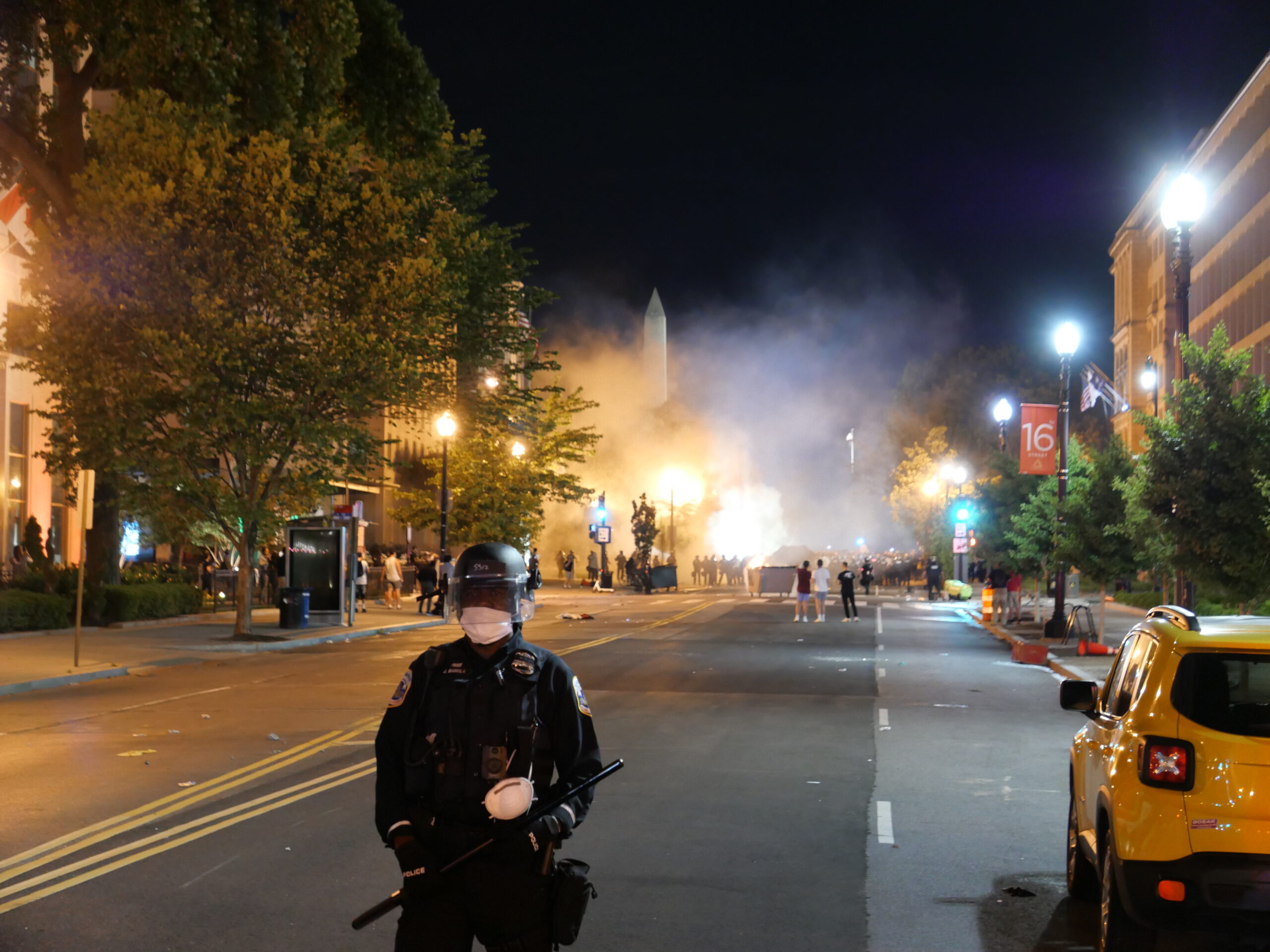
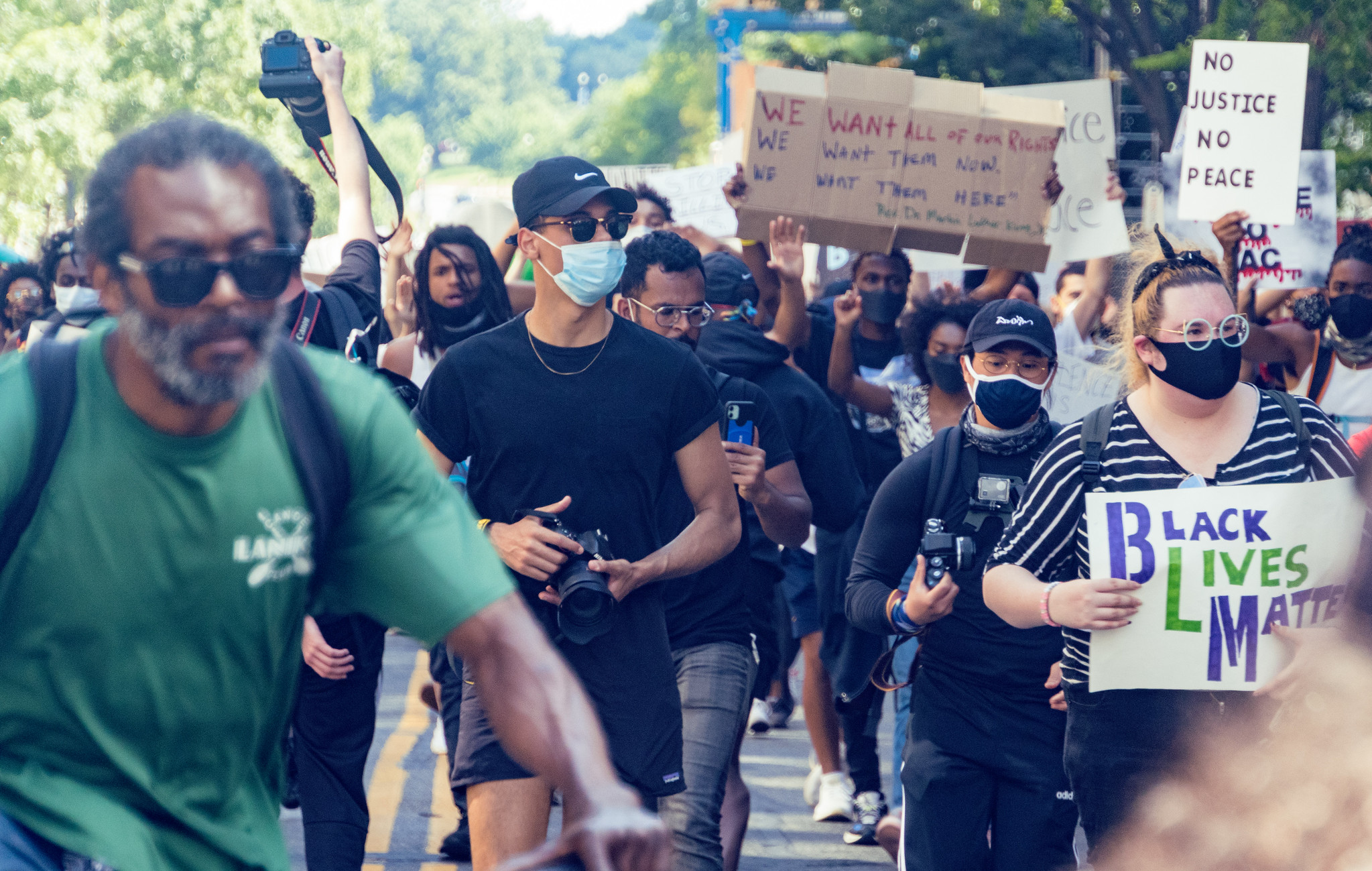
George Lloyd unrest DC susanmelkisethian

Yet I don’t want to talk about my personal reactions in this post.  Instead, I’d like to host a space here for thinking together about what recent events (the Amy Cooper video, the killing of George Floyd, rising protests) mean, especially for the future.  I’ll start by adding some futurist-oriented observations, linked out to supporting materials and really aimed at the short term.

One big caveat: this is a developing story, and we’re in the middle of it.  So it’s hard to get good information and tempers will be raging.  We’re still in the early first draft stage of history, and I’m uncertain about a lot of information.

Another: most of this post is analytical, intellectual grappling with the dynamics of the present situation.  I’m not writing about my emotional response here.

So: the possibility of national unrest is something I’ve been tracking for a while.  Back in late 2016 I asked about how American could enter into civil unrest.  I raised two then-current crises (deportations, the Dakota pipeline) as possible grounds for broader revolt or chaos; neither turned out to be so.  Then I added a third,

the growing public division over policing.  On the one side are civil libertarians, Black Lives Matter, and people temporarily horrified by videos of police doing horrible things.  On the other are the police, Blue Lives Matter, and people who feel the thin blue line needs our support to stamp out anarchy.  Trump’s support for increased stop and frisk might become a national movement to increase police power, given the enormous successes Republicans have had in winning state and national power.

And I asked: “Will Americans stick to social media as our sole weapon in resistance, or will some in this exceedingly well-armed nation resist violently?”

In 2018 I returned to the topic, critically viewing my 2016 post.  One commentator argued that police oppression of people of color was one way for unrest to build.  David was prescient.  Now we see that area in sharp focus.

To begin with, there doesn’t seem to be an organization that can hold and build upon the antiracist insurgency. The Democratic party appears to be too large, inflexible, and focused on November.  Some parts of it will try, which basically means folding this week’s energy into the Biden campaign. Some state and city parties and/or local nonprofits may push for police reform (especially Minnesota), including demilitarizing police forces. I’m not sure what Black Lives Matter will do as an organization at this point: if it’ll grow into something larger, or another group will step up/appear. It’s possible the activism we just experienced will drain into the sands, especially given so many competing demands on Americans’ time and attention (pandemic, national election, recession shading into depression, etc.).

George Lloyd unrest_Eytan

Getting tough on crime: Trump and the GOP now have a gift, handed to them in part by tv news.  The specter of dangerous and violent criminals allows them to run their classic, reliable tough-on-crime playbook, amplified by the War on Terror’s additional apparatus (surveillance, fusion centers, a public used to a certain post-9-11 degradation in civil liberties).  Trump tweeted that he was declaring Antifa a terrorist group, but apparently things don’t work that way.

Democrats may try to echo or outdo the GOP on this, following the centrist path laid down by Bill Clinton in the 1990s, so we could expect some politicians or pundits to denounce looting and violence.  Taken together 2020 might represent another ratcheting up of policing in America.  Alternatively, we could see progressive approval of destructive acts as justifiable or revolutionary, following some interpretations of urban uprisings in the 1960s… which would then almost certainly elicit condemnations and more calls for law and order.

Policing and the military: if unrest continues after last night, the military’s role could expand. The Trump administration could easily push for more deployments, ostentatiously landing troops in Minneapolis or Atlanta, while doing more surveillance.

George Lloyd unrest_SWAT tank_Becker1999

I do wonder if journalists will become more critical of policing, given the spate of incidents like this one:

Technology: given the crucial role played by smartphones and social networks in sparking these events, some on the right, maybe joined by some on the liberal side, may push against Silicon Valley, building on the recent techlash. They can reprise familiar charges (addiction, privacy) and ramp them up by accusing them of causing social unrest, driving property damage, and even enabling injury and murder.  Facebook may come in for particular scrutiny, given its CEO’s recent comments about Trump’s comments. Legacy media will probably join in. Certain forms of surveillance (drones) could add to the case.  Ultimately, we could see a classic technopanic.

Conspiracy theories: these are already blossoming, and will probably grow. I’ve seen stories about false flag attacks, the hidden hand of China and/or Russia, Trump secretly staging unrest, child soldiers in Atlanta, etc.  Some Minnesotan elected officials blamed swarms of outside agitators, an argument with a long and often bad history in the United States; that seems to have been debunked, but the theory could easily persist. Some of these may have grains of truth in them. Some state governments have called out the National Guard.

On the right, I’m seeing a few things. First, charges of lawlessness being the key to the whole story (can share a link if needed), leading to law and order (as above). Second, *some* role of fringe extremist groups (Proud Boys, Boogalooians), but it’s hard to tell how that played out in reality. Since most are really cosplayers, how many sat things out? Those who did, what do they take away from the experience, and what to do next? Third, expect demonization of whatever liberal/left group is handy – ACORN, Antifa, the Sanders campaign. Fourth, some may combine the Floyd protests with COVID-19 by focusing on blue or blue-ish states and cities where both occur in greater numbers: New York, California, Oregon, Washington state, Washington DC, and so on. They can charge those regions and polities with incompetence, being too PC, ignoring traditional values, being filthy, etc. (Cf my March post about a “blue pandemic”.)

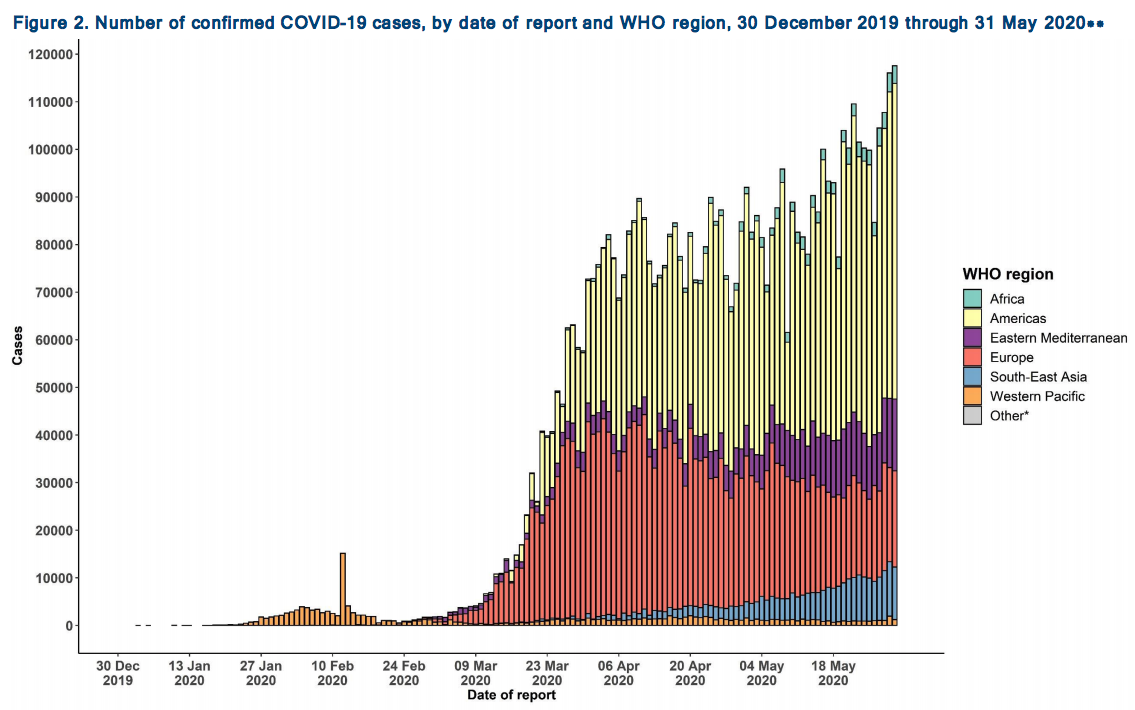
Speaking of the pandemic: biologically – and nearly nobody’s talking about this, which is fascinating – I can’t see how the unrest wave won’t spark at least a bout of new COVID-19 infections. You’ve got hundreds, thousands of people interacting closely, and often hollering or otherwise exerting in ways splendidly designed for sharing the virus. Check back in two weeks for numbers and maybe a couple of superspreaders.  Meanwhile, the global pandemic continues to spread:

coronavirus epidemic curve 2020 May 31 WHO

From the last WHO situation report.

For those who think the Trump era is about fascism, you should watch for pitched, chronic battles between groups (not individuals) here. Look for (say) Atomwaffen and some Antifa brawling in LA with injuries and deaths, then each group growing and hardening, followed by escalating violence. We haven’t seen this yet, but it’s a crucial condition for fascism in at least two 1930s situations (Germany, Italy) plus, at a far greater level, Spain.

On education: we’re in the summer period now, when very few students are in class.  Some staff are working, while others are not.  Faculty may or may not be on campus – most likely not.  What do this string of events mean for academia?

This is a time for some academics to fulfill their public education/public intellectual role.  Social media is the ready route, as are engagements with traditional media outlets.  Meanwhile, some faculty are doubtless thinking about how the Floyd protests might impact their fall classes.  Some classes and programs are automatically engaged, from African American studies to Homeland Security.  Staff may also follow similar lines, considering everything from residence life programming to library displays and professional development (what remains of it).

And that’s where I’ll pause for now.  Readers, I hope you are all safe in this moment.  What do you all make of this?

(photo credits: DC street by Susan Melkisethian; marching crowd by Ted Eytan; armored officer and Columbus SWAT by Becker1999)

Posted in futures | 8 Comments

American higher education enrollment declined again – *before* the pandemic hit

National Student Clearinghouse Research Center logoThe number of students enrolled in American colleges and universities declined in spring 2020, according to a new report from the National Student Clearinghouse Research Center.  And this was before the COVID-19 pandemic struck.

This enrollment downturn is no mere blip, but part of a long-running and very important trend.  I have been tracking this trend since 2013 when it began to appear in data.  Year by year, semester by semester, total enrollment has ticked down. This most recent NSCRC report compares spring terms against spring terms.  (For some of my previous spring enrollment posts: 2013, 2015, 2016, 2017, 2018.)

NSCRC estimates that “[o]verall postsecondary enrollments decreased 0.5 percent or 83,803 students from spring 2019… All institution sectors experienced enrollment declines…”  Spring 2020 saw 17,458,306 students, compared to 17,542,109 in spring 2019 and  17,839,330 in spring 2018.*  For contrast, in 2011 enrollment stood at 19,610,826; 2020 is about 89% of that.

The report breaks this down by sector, each of which declined:

enrollment 2016-2020 spring_NSCRC

The public sector enrollments (two- and four-year colleges combined), which enrolled nearly three quarters of all postsecondary students, fell by 1.3 percent (163,964 students), compared to 1.9 percent (244,376 students) reported last year.

…the largest drop [was] in the public two-year sector (-2.3%), followed by the private for-profit four-year and private nonprofit four-year sectors (-1.9% and -0.7%, respectively).

I want to emphasize that all sectors declined, since a common way to dismiss this data is to characterize it as driven by for-profits (which many in non-profit education dismiss or disdain).  None dropped as steeply as for-profits, but all did.

There are several additional findings in the report that I wanted to share.  For example, the gender breakdown of students remains where is has been in recent years, with a clear majority of women (10,228,973 to 7,229,333).  By my count women are about 59% of students, with men down to around 41%.  A reminder: this is a historic and now sustained reversal of previous American higher ed enrollment.

I was also struck by the countervailing trend of increased enrollments in some campuses through dual enrollment programs:

As opposed to the overall declines, dual enrollments grew at an unprecedented rate of 6.9 percent or 46,737 students to 722,843 students. Over 70 percent of dual enrollees were in a public two year institution…

Note the role of community colleges here.  (Alas, most higher ed discourse will ignore them.)

Differences by state are also useful.  The largest enrollment declines came from Alaska (-9.8%), Missouri (-4.9%), Vermont (-4.9%), Montana (-4.3%), and Pennsylvania (-4.0%).  Rare increases for total enrollments within a given state occurred in Arizona (4.3%) and New Hampshire (3.5%), both homes to major online programs, plus Utah (3.2%) and Kentucky (1.9%).

Leading courses of study remain the same as they have been for several years, in the NSCRC framework.  At four-year colleges and universities the top three, with one million + students majoring in each, are: Business, Management, Marketing, and Related Support; Health Professions and Related Clinical Sciences; Liberal Arts and Sciences, General Studies and Humanities.  In a second stratum, with around half a million majors each, are: Biological and Biomedical Sciences; Engineering; Computer and Information Sciences and Support Services; Psychology; Education; Social Sciences.

At two-year campuses the leading major is Liberal Arts and Sciences, General Studies and Humanities, followed by Health Professions and Related Clinical Sciences then Business, Management, Marketing.

What does all of this mean?

I don’t want to overstate the report.  Many of these declines are small, in the 0.5-4% range.  I don’t want to leave the impression that this is a shocking new thing.  Instead, it’s another step in a persistent trend.  This is an incremental story, with impacts that can build up.

If enrollment continues to decline – independent of COVID-19 –  we will see gradually increased financial stresses on colleges and universities that depend on tuition and fees – i.e., nearly every single one.

Remember that American higher ed enjoyed a generation of continuous enrollment growth, circa 1982-2012.  Many, many habits, plans, strategies, and expectations grew from that.  Those can be painful to revise or break.

I’d also like to note the possibility that America might revise its cultural agreement on the idea that everyone needs more post-secondary schooling.   Enrollment continuing to ratchet down could cause a rethink.  I am waiting for this to pop up in national or state election campaigns, especially during the fall.

How does COVID-19 enter into this?  Basically, the pandemic could exacerbate the enrollment decline trend at a macro level, with some variability depending on institution.  As I and others have said, it seems likely that the pandemic will further depress total enrollment for fall 2020.

Now, fears of this can drive colleges and universities to take bold measures.  Hence the fervent calls to “re-open” campuses, even without reasonable chances of controlling infections.  At the most fundamental, at worst it means administrators disagreeing with Tressie McMillan Cottom’s observation:

https://twitter.com/tressiemcphd/status/1254505454178234368

Because enrollment pressures, driven either by this long-term trend or the short-term pandemic, do present some institutions with existential possibilities.

What are you seeing in your institution, or in your area?  Friends from beyond the United States, what do you make of this?

*NSCRC says this data is pre-COVID and campuses migrating online: “this edition of the Current Term Enrollment Estimates should be viewed as a pre-shutdown, start-of-term baseline that does not reflect any effects of the pandemic on enrollments.”

Posted in coronavirus, enrollment | 11 Comments

Some of my upcoming live video events for this summer

As spring turns to summer, I’d like to point you all to a series of live video events/webinars I’m hosting or guests in over the next two months.

All of these are free:

May 26, 2-3 pm EDT: how can liberal arts colleges survive, change, and thrive in this crisis? I join Dr. Christopher Sessums, director of academic affairs at D2L , in a video conversation titled “Reimagining Liberal Arts Colleges: Why It Matters Now More Than Ever.”  Thanks to D2L for hosting this event.

May 28, 2-3 pm EDT: does meritocracy still work, or does higher education reinforce privilege?  We will explore this idea with Daniel Markovits, professor of law at Yale University and author of The Meritocracy Trap: How America’s Foundational Myth Feeds Inequality, Dismantles The Middle Class, And Devours The Elite.  (Future Trends Forum)

June 4, 2-3 pm EDT: looking to fall 2020 higher education plans with Phil Hill, publisher of the PhilOnEdTech blog and Partner at MindWires, LLC.  Lately he has been blogging and consulting about the impact of COVID-19 on higher education. (Future Trends Forum)

June 11, 2-3 pm EDT: exploring the changing experience of students with professor Sonja Ardoin, (Future Trends Forum)

June 25, 2-3 pm EDT: a conversation with professor Brian Beatty, the inventor of HyFlex, to learn and explore that much talked about digital pedagogy. (Future Trends Forum)

July 2, 2-3 pm EDT: how will changing demographics transform higher education?  A conversation with Darrell Bricker and John Ibbitson, authors of the recently published book Empty Planet: The Shock of Global Population Decline. (Future Trends Forum)

July 8, 1-2 pm EDT: Black Lives Matter and the challenges for the future of higher ed, with Terri E. Givens, founding CEO of The Center for Higher Education Leadership. (Future Trends Forum)

July 30, 2-3 pm EDT: we explore how to improve online education with professor James Lang, author of Small Teaching (publisher; our bookstore) and co-author of Small Teaching Online (publisher; bookstore).  Lang focuses on “small, manageable changes we could make to our teaching that would have a significant positive impact on student learning.” (Future Trends Forum)

More events are in the pipeline!

Posted in Future Trends Forum, videoconferencing | 2 Comments

Responding to Scott Galloway’s pandemic reflections

People have been asking me to respond to NYU professor Scott Galloway‘s interview on how COVID-19 will change higher education. I appreciate the request, and now finally have a few minutes to share some reactions.

There is also a recent Galloway video on related points, apparently, but it is locked behind a paywall I cannot access.  Similarly there are some Business Insider pieces, also paywalled, and so I can’t speak to them here.

GallowayIn the interview with James Walsh  – that we all can read – Galloway makes some key arguments:

  1. The value of higher ed will decline as people perceive wholly online education to be of lower quality than in-person.
  2. Enrollment will drop, hitting non-elite institutions the hardest.
  3. Many campuses will not close in 2020-2021, but will cling to life.
  4. Elite universities will partner with the world’s biggest companies.
  5. ” ” ” expand massively online.
  6. Governmental support will not return to 20th century (higher than now) levels.
  7. Liberal arts colleges will be attended mostly by children of rich families.
  8. A national service initiative (Galloway offers “Corona Corps” as a name) would be a good thing.
  9. Online learning will improve, especially in terms of technological platforms.

It’s a very snappy and entertaining interview.  As befits a marketing professor, Galloway offers some quotable lines:

There will be a lot of zombie universities.

[U]niversities [ha]ve all adopted this narrative of “This is unprecedented, and we’re in this together,” which is Latin for “We’re not lowering our prices, bitches.”

We get a lot of ego gratification every time our deans stand up in front of the faculty and say, “This year, we didn’t reject 85 percent of applicants; we rejected 87 percent!,” and there’s a huge round of applause. That is tantamount to the head of a homeless shelter bragging about turning away nine of ten people who showed up last night.

The interview is also a good example of what I mentioned earlier in the pandemic, of faculty criticizing online learning in a way that discourages enrollment. For example,

I can’t tell you the number of people who have asked me, “Should my kid consider taking a gap year?”

What do you tell them?
I tell them it’s a great year to take a gap year.

So what do I make of all of this?

I think some the ideas are sound: campus enrollment being hammered, students taking gap years, some zombified colleges and universities, state support declining.  I’ve made many similar points.

A CoronaCorps could work well.  I doubt the Trump administration has the combination of vision and administrative skill to fire one up, especially in this election season, but I can imagine some state governments (think New York, Michigan, California) doing so.

Liberal arts colleges becoming the province of elite families?  There’s historical precedent for this.  Some LACs are effectively that right now.  I can imagine colleges feeling the budget squeeze and deciding to reduce Pell Grant admissions.  But I also know liberal arts leaders who believe in social justice, and might have the fundraising power to make it happen.

Partnerships with Apple et al?  It’s possible.  There are precedents, like Apple joining up with Ohio State University and with Tennessee State.  But those are for limited programs, not the kind of strategic fusion or acquisition I think Galloway has in mind.  Moreover, I’m not sure Silicon Valley will view higher ed as profit centers in 2020, not without the firms taking a big hand in redesigning universities from top to bottom – something nearly all would resist.

In the middle of the interview Galloway argues that higher ed’s main value is credentialing, not learning.  The thing is, this is a long-standing argument.  One popular nickname is “the sheepskin effect.”  Probably the most well known exponent is Bryan Caplan, who was a great Future Trends Forum guest:

As ever with discussions in higher ed, I wish people would cite sources, or at least describe their interventions in a way that admits other folks have been discussing those ideas for a while.

One problem I see with this series of arguments is that it assumes a nearly perfectly economical understanding of higher education.  As Anthony Moretti puts it,

Students are expected to enter these mega-universities simply to become tools for capitalism. Galloway says nothing about college graduates being better citizens, becoming a volunteer soccer coach or bolstering democracy. Nope, it’s all about money, money, money.

There is no room for other motivations for students, faculty, parents of younger students, administrators, or government leaders.

This leads to a second problem: curriculum.  Do Facebook et al need the full university’s offerings, from computer science to French and anthropology?  Again, Moretti says it well:

Where does the writer, the sculptor, the historian, the journalist, the nurse and other students not in the business or STEM fields fit in this environment? Perhaps more importantly, how do some of those fields — which require intense face-to-face instruction — thrive? Or will those degrees be atrophied until they die in this education/technology arrangement?

I can imagine a putatively pro-liberal education company like Apple supporting the full course catalog and research agenda, either because they see all of that as constituting the luxury experience, or because they agree with the liberal arts case for preparing students.   But I can also imagine them ruthlessly cutting class offerings and the research agenda back to a narrow pipeline that serves them directly.  It’s not clear which model Galloway has in mind.

The biggest criticism I have of the interview is that it’s not really about American higher education, but just a handful of elite universities.  Listen to which ones get named: MIT (repeatedly), Berkeley, Oxford*, University of California (I think Galloway means the system, not a single campus), University of Texas (ditto), Stanford, Amherst, Dartmouth, University of Pennsylvania, Harvard, UCLA.  Galloway himself teaches at NYU.  Pepperdine and Boston College appear, but only to be knocked down the reputational scale.

In other words, the interview doesn’t address the overwhelming majority of American higher education.  Community colleges literally do not appear in the conversation, yet they number about one-third of United States campuses and teach around one half of our students.  State universities also count for about one third of the lot, and they aren’t all Berkeleys.  For-profits, of which there are almost 1,000, receive no mention.

Galloway and Walsh emphasize the value of a residential experience, which I certainly appreciate, having enjoyed it myself as a student (University of Michigan) and professor (Centenary College of Louisiana).  But that’s only a slice of American higher ed, something like 20% of students actually living on site.   In an MSNBC interview Galloway focused on 18-21-year-olds, who do constitute a majority of enrolled students, but there are a lot of adult learners as well.

At one point Galloway observes that “the coronavirus is forcing people to take a hard look at that $51,000 tuition they’re spending.”  A good and telegenic point… except the supermajority of colleges and universities don’t charge that much.  (I think that’s NYU’s tuition, according to a quick Googling)

Is this because the recorded conversation fits that lamentable American habit of assuming Harvard stands in for the whole sector?  Or does that focus follow from a truly apocalyptic vision?  The subtitle of the piece – “a handful of elite cyborg universities will soon monopolize higher education” – suggests MOOC-hype-like devastation, that the MIT crowd will stand alone after state universities, for-profits, and community colleges perish.  I know, I know all too well that authors don’t usually get to pick published titles for their articles, and interview subjects even less so, but this bit of subtitle actually connects with exchanges in the discussion.  In a CNN clip Galloway paints a portrait of higher education as institutionally conservative and massively overpriced, therefore due for a reckoning.

So does professor Galloway expect the number of American campuses to drop from 4400 or so down to around one hundred?  If not, how will the non-Stanfords fare?  Will they also partner up with Microsoft and IBM?  Will their non-Latinate tuitions drop?  How will the experience differ across institutional types and geography?  How does academic research change?

An MSNBC interview sheds some light on these questions.  There Galloway forecasts threats to 1,000 lowest-ranked schools (a “death march”) and sees 500 to 1000 of them closing within the next five years.

I am also curious about how elite universities will grow their online enrollment.  In the conversation the marketing professor offers this vision:

technology will expand their enrollments and they will come back stronger. In ten years, it’s feasible to think that MIT doesn’t welcome 1,000 freshmen to campus; it welcomes 10,000.

How would that work?  Recent history offers countervailing evidence, as the MOOC revolution largely failed to successfully scale.  Meanwhile, the campuses that do enroll tens of thousands online are not the elites.  Instead they are Arizona State, Liberty, and Southern New Hampshire; Lee Gardner described them last year as mega-universities.  Will the pandemic vault, say, edX or Stanford over these currently successful online enterprises?  What programmatic, technological, and pedagogical transformations are required to yield that result?  How can they succeed where MOOCs fell short, and so what the elites so far have not done?

I’d be delighted to discuss these questions and more with professor Galloway, either on Twitter, this blog, or the Future Trends Forum.  And I am eager to hear everyone else’s thoughts as well, as always.

*Naming Oxford one time is the only sign I can find that the interviewer and interviewee are thinking outside of the US.  Otherwise this seems to be really about American higher ed.

(thanks to Brian Pech, Steve Hargadon, Bill Meador, Luba Vangelova, Steve Kaye, Steve Worona, and Robert Gibson for nudges; thanks also to Rob on Twitter for a key pointer)

Posted in coronavirus, future of education | 26 Comments

Webinars that don’t suck – part 2

How can we offer webinars and live video events that aren’t terrible?

Recently I returned to this topic and wrote about the vital importance of participants’ and presenters’ presence.  Today I’d like to add a second point in this series: getting participants to do stuff.

sponge_jellyzYou see, a presentation is all about presenters doing stuff: speaking, sharing slides, showing videos, asking and answering questions. Hosts also do things throughout a session: introducing, summing up, cutting off longwinded commentary, fixing tech issues. One characteristic of bad video events is that hosts and presenters get to have all the fun, while presenters don’t get to do anything besides absorb what’s being thrown at them, soaking up content passively.*
(I would like to use the word “interactivity” here, because it makes sense, but misuse and overuse have drained that one of its power.  There have been too many years of “interactive DVD menus.”  Notice how the most interactive media form in the world – gaming – usually avoids the word?  Still, think about the word without its recent decline.  Literally it means to act between or among.  One etymology finds “acting upon or influencing each other” dating back to 1832, and that also makes sense.  Webinar participants should act upon each other and presenters.  They should be able to influence each other.  We need to bring “interactivity” back.)

When I’ve made versions of this pro-interactivity argument in the past, some folks have objected, saying that some of their presentations were really all about transmitting content.  That was the point.  Audience interaction was fine, but should appear later, through a different medium, like email.

I take that point – but if that’s what your presentation is essentially about, then don’t do a videoconference.  Share slides in pdf form.  Record audio and post to Soundcloud.  If you want more visuals, fire up a screencast app or go whole hog for a video.  This is a category problem, confusing an asynchronous presentation with a synchronous platform.  (I’ll post more about this at another date.) Synchronous presentations must have audience interaction built in.  If that doesn’t occur, they will suck.

So how do we arrange for audiences to actually do stuff?

There are many ways. There are many tools, depending in part on which video platform you use and how administrators configure it.

Chat is one of the easiest interaction tools.  Participants can respond to the presentation, share resources, socialize, criticize, joke, work out ideas, share URLs, and more.  Presenters and hosts can easily engage with this venue.  Within a synchronous environment chat can act somewhat asynchronously, since participants can write to points raised earlier, or anticipate topics to come.

Some platforms offer an alternative to chat, usually named something like Q+A.  As with chat, this is simple text entry.  Unlike chat, there’s some structure to it.  In several platforms, depending on settings, a participant’s Q is invisible to the rest of the audience.  In Zoom, there’s a ranking option which lets everyone vote up questions. Some of these have formal answer functions which either turn off a question (it’s been taken care of) or transfer it to another local, such as a different tab.

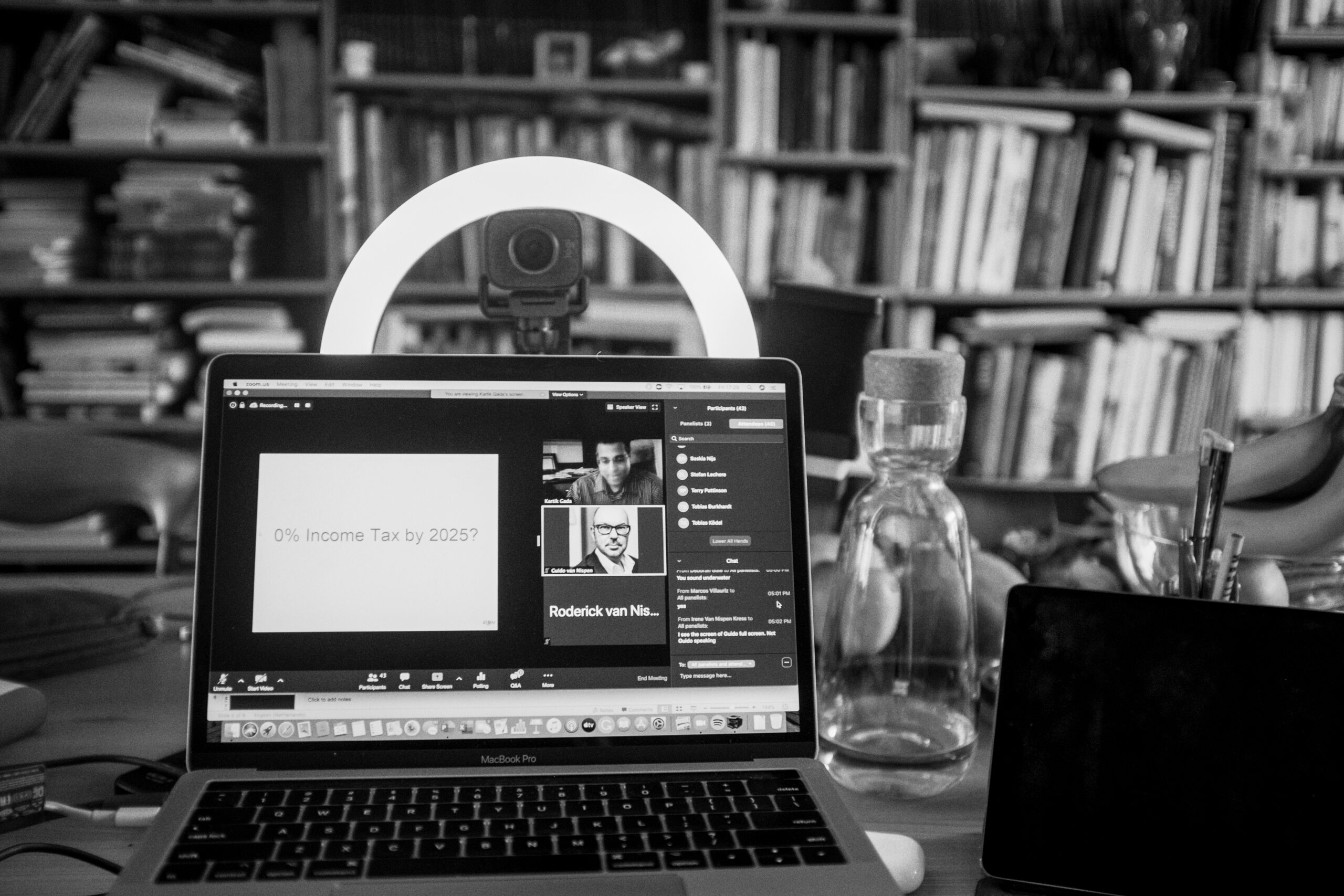
webinar _ Guido van NispenPolling is probably the easiest doing stuff tool of all.  Presenters and/or hosts can ask a question of the audience and take responses through simple, single clicks, or through chat.  Well formed polls can deeply engage participants.
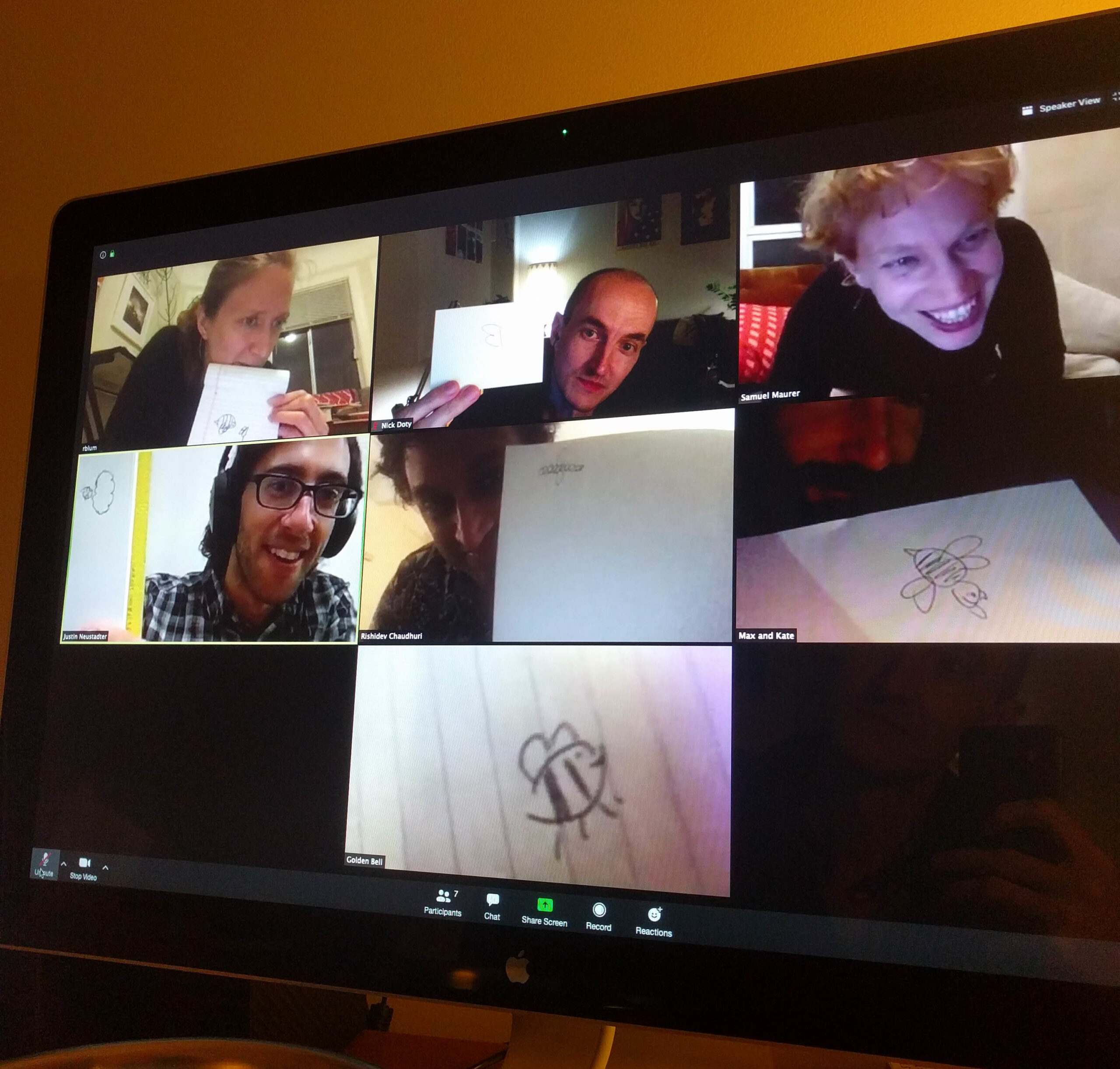
White boards are not the most widely used videoconference tool in the world, from what I’ve seen, which is too bad.  They can be a fine way for participants to change up their normal participation by using the mouse (or stylus or finger, depending on device) to draw instead of typing through a keyboard.  There’s a measure of potential embarrassment as the results can be goofy, cryptic, or hilarious, but good moderation turns that into a strength by helping participants relax (to some degree) with each other.  As I’ve mentioned before, white boards are easy to use and fun ways for the audience to brainstorm, connect with each other, get creative, reflect, and even – gasp – have fun together.  Howard Rheingold and Nancy White are great at this.

Small group work can be useful.  That is, by default a webinar space is for the entire audience, which could number in the dozens, hundreds, or thousands.  Software can break that down and out, shifting the social dimension from large to small.  For example, Shindig parcels the audience into rooms of around 18-20 people.  Users can jump between these rooms easily, but chat is usually confined to individual spaces.  Adobe Connect and Zoom support breakout rooms in different ways.  In a related way, Shindig also lets participants form into small (2-5 people) clusters.

Why is this useful?  Because a crowd of 120 or 1300 can be daunting, while a “room” of 2-4 is much less frightening, basically.  It’s much easier for many people to share thoughts in such a setting.  Presenters and moderators can assign small groups to fulfill certain tasks, then bring the results back to the whole, which can add to the collective’s understanding.

There are also options outside of a given video platform.

  • For years Twitter has become a popular backchannel for live venues, including online ones.  Hosts and presenters just need to share a hashtag and participants might follow.  As with webinar chat, a Twitter conversation can involve questions, resources, off topic rambling, socialization, etc.  (Although I do remember several poor webinars where the Twitter talk was mostly complaints about the presentations and technology…) Yes, there are limitations and challenges here, including trolls, confusion with other people using the same hashtag, and more.
  • Shared Web documents let participants collaboratively comment on a pre-generated document.  Moderators and presenters can populate, then link to wikis, Google Docs, and whiteboards.  (For example, students in my summer seminar just played a tabletop game through a shared Jamboard) The web annotation tool Hypothesis can play a very similar role here.
  • I’ve heard people call for using Mastodon as a backchannel, but haven’t experienced it myself.  Technically, it’s easy.

So much for tools.  How do we use them?

Many answers can be found in the pedagogy literature.  Asking specific questions, getting students to talk with each other (rather than through the instructor), think/pair/share exercises, meta reflections, and more can be used in webinars.  Educational technology literature is also full of exercises and techniques for productive student participation; these, too, can be repurposed for live video events.

Just before an event begins can be an awkward moment.  People settle in and aren’t quite sure what to do.  They can be quiet as a result.  I like to break the ice in two ways.  First is to point to content-related interaction.  That is, if there’s a Google Doc or wiki for folks to use, I encourage them to dive in.  I introduce all interaction venues.  Second, I ask non-content-related questions, just to get people involved.  These can be introductions aimed at quick (i.e., NOT academic) answers, observations about the time of day, complaints about the weather, warnings about impending cat visits: anything that puts people at ease, while inviting them to participate.

Zoom playfulness Nick Doty

It can be fun for folks to draw on paper and share results.

Once the webinar begins, I’m fond of asking questions throughout a presentation, not just at the end.  Some of them are polls with snap answers, which I repeat back to the audience as it helps me better understand them and their thinking.  Some are short reflections on what I’ve just presented – i.e., which of these two models works best in your situation?  The answers are useful, but so is the practice of participants expressing themselves.  Even goofy or light questions encourage the audience to be active.

Some of these questions are decision gates.  How participants answer can shape the next few minutes of the webinar.  For example, if we’ve just covered three topics, the audience can vote on which one needs more time.  As moderator or presenter I sometimes ask if we need to pause and better explain a point; chat, Twitter, etc. flow can hint at the need for this.

During a session I always monitor the backchannel, no matter if I’m moderator, presenter, or participant.  This gives me a read on the group.  I respond whenever and wherever I can, through chat, over on Twitter, or, hopefully, out loud.

Throughout I try to boost the signal of people who might need it.  This can be underrepresented populations in general, participants who seem new to the event, or folks whose comments are interesting but didn’t get picked up by others in the audience.

When time opens up for broader conversation, as during a final Q+A phase or with a panel when the moderator runs out of questions, I like to run through the entire body of participant contributions so far, looking for leading themes and the questions which seem most likely to spur further conversation.  If I’m moderating or presenting I repeat or paraphrase these.

The approaching end of a webinar offers many additional interaction prompts.  Just pointing out that the termination is in sight can coax some to share their questions or comments before they lose the opportunity.  It’s also a time for summing up, including asking the audience what they see as the major themes or outstanding questions from the session.  In the Future Trends Forum I, as moderator, use the last 15 minutes to ask guests (and participants) to think about the future of whichever topic we’ve been exploring.

Now, given this range of interaction options, why do so many webinars fail to take advantage of them?

One reason is that a platform’s technology can make it difficult, either through its architecture or settings.  I’m sure readers can recall webinars with chat turned off, Q+A responses from others hidden, or white boards not available.  A host or presenter might not be responsible for those decisions, but feel constrained to follow them.

Another is inherited habits from 20th century broadcast media with its assumption of passive audiences.  Yes, there’s a tradition of fans pushing back to make their own content, but that occurred outside of the immediate mediate experience, often separated greatly by time, and most consumers didn’t participate.  As I’ve said before, the tv news expectation of people lecturing or arguing in from of an invisible, inarticulate audience is one that influenced a great number of people.

A third is that live interaction doesn’t work for everyone.  In 2018 Peter Hess commented on one of my post’s about this, arguing that asynchronous interaction – like a blog post comment! – was better suited to some people’s comfort levels.  This is an important point and a clear limitation to the kinds of interaction I describe here.  I’m going to follow up in a later post about after-event interaction.

One more reason is that presenters and hosts might not know how to work with these tools.  I’ve been in far too many webinars where polls were given and results displayed, then… nothing happened as a result.  Hosts and presenters didn’t thank folks for their responses, nor did they respond to them (“Fascinating to see so many of you clicked ‘fish’ rather than ‘1815.’ I wonder if this has to do with…”). If chat has no impact on a presentation, it’s at best irrelevant and at worst busywork.  An event’s leaders need to not only encourage participation, but also to take it seriously in ways that show participants that their contributions are valued and meaningful.

Now although this isn’t a webinar, but a blog post, it’s only appropriate to ask: what do you think?

(photo credits: sponge by jellyz; black and white webinar by Guido van Nispen; Zoom goofiness by Nick Doty)

*Somewhere I read someone saying that the ideal tv audience is like a potato: kept in the dark and covered in manure.  I thought it was William Gibson, but I can’t find the passage anywhere.   Urban Dictionary has an entry for “mushroom management” which applies, as does Oxford Reference, but neither lists a source. A Facebook friend dug up a Michigan use from the early 1970s.  Does this ring a bell for anyone?  (thanks to Tom Tobin)

Posted in videoconferencing | 2 Comments

Meanwhile, a demographic update

While COVID-19 roars through the world, it’s important to track significant non-pandemic developments.  Today I wanted to share a demographic update.

Readers know I spend a lot of time analyzing how population trends change, exploring how that could impact higher education.  This week the CDC published its latest data on American birthrates and more.

Key points:

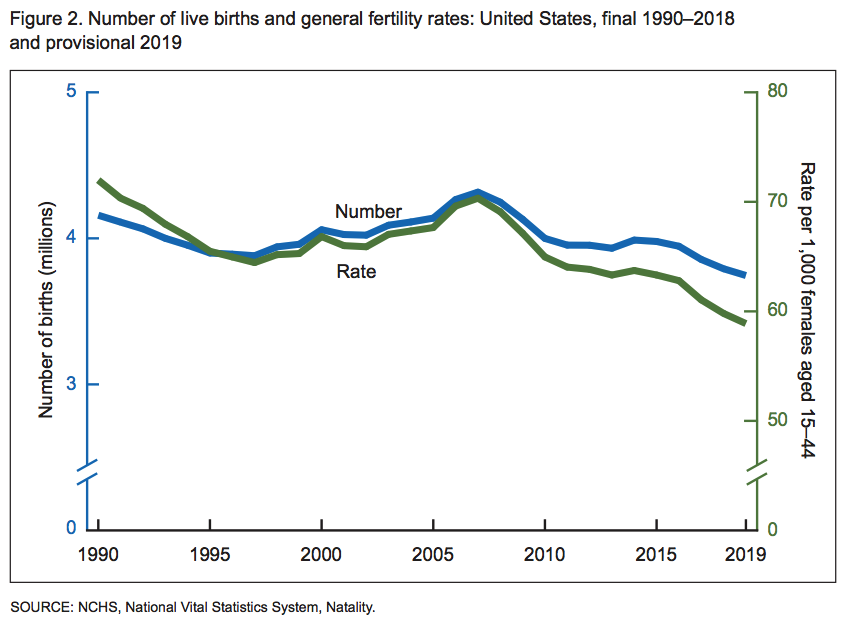
First, birthrates continue to tick down:

The provisional number of births for the United States in 2019 was 3,745,540, down 1% from the number in 2018 (3,791,712)… This is the fifth year that the number of births has declined after the increase in 2014, down an average of 1% per year, and the lowest number of births since 1985.

You can see an overall drop since 1990 in this chart:

birth rates in US 1990-2019_CDC

As Janet Adamy puts it, “The data are the latest sign of how American childbearing, which began declining during the 2007-09 recession, never fully rebounded when the economy bounced back.”

Second, American birthrates are below “replacement level”:

The TFR in 2019 was again below replacement—the level at which a given generation can exactly replace itself (2,100 births per 1,000 women). The rate has generally been below replacement since 1971 and consistently below replacement since 2007…

That’s 1.7 per woman, according to Adamy, or less than the 2.1 needed for two humans to reproduce themselves.  What does that mean?  Without immigration, the American population would shrink.

buy silagra online buy silagra no prescription generic

  (Something few people discuss.)

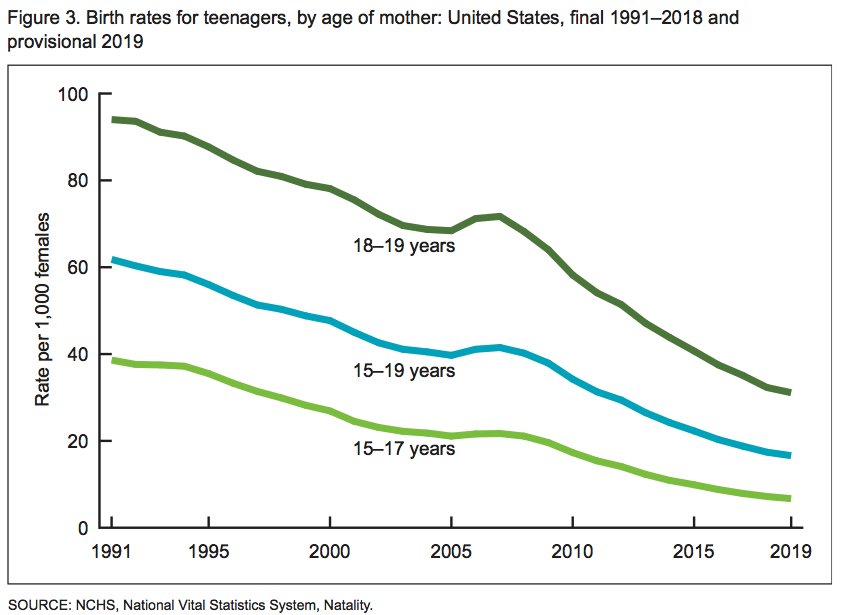
Third, teen pregnancy continues to plummet, “reaching another record low for this age group”:

birth age US 1991-2019_CDC

Fourth, racial differences are slight but consistent with historical patterns.

White births remain the largest, followed by Hispanic, then black, then Asian children, with Native American and Pacific Islanders far behind:

births by race 2018-2019-CDC

Non-white births (1,710,141 total, by my count) are nearly at par with whites (1,914,141).

And:

the number of births declined 1% for non-Hispanic black and non-Hispanic Asian women and 2% for non-Hispanic white and non-Hispanic AIAN women from 2018 to 2019… The number of births rose 3% for non-Hispanic NHOPI women, but was essentially unchanged for Hispanic women from 2018 to 2019.

buy avanafil online buy avanafil no prescription generic

Why does this matter for higher education?

As I and very few others have said for years, the declining birth rate means changes to the K-12 pipeline, yielding a small population for traditional-age higher ed.  This could spur further inter-institutional competition, and also add incentives to cut education programs, especially in certain states.

Note the point about immigration alone keeping the US population from flat-out shrinking.

buy vidalista online buy vidalista no prescription generic

  Think of how much American colleges and universities rely on international students, and this sector’s role in turning those students into residents and citizens.

Note, too, the racial dynamics.  Nonwhite births are nearly even with whites; with people of color emigrating to the US, you can see the minority-majority nation taking shape.  Extrapolating further, you can see campus populations shifting.  The Hispanic/Latinx population remains the second largest and the largest minority.

buy bactroban online buy bactroban no prescription generic

Don’t miss the teen birth story, which is huge.  Some readers might recall panicked news stories and anxious politicians back in the 1980s and 90s, all anxious about “kids having kids.”  Well, for a variety of reasons, we seem to have made enormous progress in solving that problem.  I rarely see anyone mentioning it – which is a shame, since it looks like a good, positive story.

What does that matter for higher ed?  Among other things it means more young women have access to colleges and universities, as their academic careers haven’t been put on hold by childbirth and mothering in high school.  I also wonder how that feeds into cultural changes around gender roles.

There’s also the problem of people having children in their 20s.  Back to Adamy’s article:

“There are a lot of people out there who would like to have two children, a larger family, and there’s something going on out there that makes people feel like they can’t do that,” said Melanie Brasher, assistant professor of sociology at the University of Rhode Island, who studies fertility.

Part of that “something” can be student loans.  I am still waiting for pro-natalists to start attacking higher ed.

This CDC data is another counterargument to the old but still ongoing argument that humans are making too many children.  The US, like every other nation that went through development and modernity, just keeps producing fewer babies.  The Population Bomb never detonated.  Now, some might argue that the human race has too many people for the planet to support, even after we bent the population curve.  That’s a separate argument from the “stop having babies” line.

Overall, this is important research.  It’s nothing sudden or shocking, but rather confirmation of long-running trends that reshape American society and higher education.

(via Wall Street Journal)

Posted in demographics | 6 Comments

Talking about COVID-19 and higher education with the Wall Street Journal

The Wall Street Journal just published a video essay about the impact of COVID-19 on higher education.  It’s based on conversations with me.

buy levaquin online buy levaquin no prescription generic

Bryan_3 COVID scenarios_WSJ

We touch on Academia Next, scenarios, and more.

Watch the video carefully, as WSJ did some fine work.

buy udenafil online buy udenafil no prescription generic

  There is excellent videography/curation, animation, editing, and more.

buy tadalista online buy tadalista no prescription generic

  Overall, it’s a very good example of how to make an argument, or tell a story, through digital video.

Be sure to catch the lovely book animation starting around 2:00.

buy azithromycin online buy azithromycin no prescription generic

Academia Next floating text WSJ

Posted in coronavirus, interviews | 1 Comment