Liberal arts colleges look to fall 2020

How will American higher education take shape this fall?

(UPDATED August 27)

I’ve been exploring that question since COVID-19 roared out of Hubei province.  I’ve addressed it at a systematic level and by examining several institutions’ strategies.  Today I’d like to focus on one sector of American academia, a small but influential one: the liberal arts world.

I’m going to set aside the definitional question of “what is a liberal arts campus?” for now.  These institutions – typically colleges, although some are styled universities – tend to focus on residential undergraduate education, have a low student:instructor ratio, encourage interdisciplinary study, are small, are usually private, and have a high level of student support.  They also tend to call themselves liberal arts institutions.  That’s enough to get us started.

How are they planning their fall semesters?

Here I’d like to outline some trends I’m seeing across a range of these campus.

tl;dr version – they are the Post-Pandemic Campus, COVID Fall, Toggle Term, Blended Post-Pandemic Campus and COVID Fall, transformed calendar, changed course loads, interdisciplinary, online COVID-19 classes, faculty dissent, and student dissent.

Caveat 1: remember that their size and creativity means liberal arts colleges and universities are capable of rapid development and change.

Caveat 2: I’m not saying these plans are unique to “LACs.”  Ideas circulate across the full institutional ecosystem.

Caveat 3: this post describes a single moment in time, within a very flexible situation.  Some campuses, like Knox College, haven’t committed yet to fall plans.  Much could conceivably change over the next month and a half.

I’ll start with my three scenarios for a fall academy, then move on from there.

The Post-Pandemic Campus Some campuses plan on reopening for in-person education, either for their entire population or most of it, such as Hampshire College, Middlebury College, Lawrence University, and  Colgate University.

One example is St. Olaf College, which will welcome back their community in person.  The school requires students to take a detailed pledge.  Furman University is also inviting students back with a pledge.

Another example can be found in Colby College.  To be sure of community safety, they will offer pandemic testing.  A lot of pandemic testing:

[I]n addition to required face coverings, social distancing, limited visits to campus and travel restrictions for faculty, staff and students, Colby will test people several days before they come back to campus and retest them three times during each of their first and second weeks.

“Every week thereafter we will test them at least twice. We’re going to do 85,000 tests in the first semester alone, which is pretty close to what the entire state has done for over 1.3 million people since the beginning of this pandemic, and we’re going to do that our population of only 3,000 over the fall semester,” [Colby College President David Greene] says.

The cost for that: $10 million, according to one account.  Robert Kelchen sees this as “Colby is swooping in to spend millions on testing to woo students.”

https://twitter.com/rkelchen/status/1278316060735913985?ref_src=twsrc%5Etfw%7Ctwcamp%5Etweetembed%7Ctwterm%5E1278316060735913985%7Ctwgr%5E&ref_url=https%3A%2F%2Fbryanalexander.org%2F%3Fp%3D22078preview%3Dtrue

In contrast Colorado College will offer, but not mandate, testing.

Rollins College will host students again, but warns them that not all classes will be face to face:

This fall, we will leverage videoconferencing software to engage students both in and out of the classroom. All students will need a videoconference-capable device (e.g., laptop with camera, tablet, smart phone) and some type of headphones or earbuds that include a microphone for classes. This solution will allow both in-person and remote students to actively and equally participate in class with their faculty and—importantly—with each other.

Vassar College welcomes students back to campus, but apparently not to town, at least for a time: “Phase 2: Confirming Community Standards (August 31–September 25)”

…Students living in campus housing will be expected to remain on campus during the academic semester. With very limited exceptions, such as medical care, off-campus student travel is not permitted. [emphasis in original; thanks to Bill Owens for the pointer]

Middlebury College student and keen observer of the pandemic Benjy Renton was entertained by one college’s admonition:

COVID fall: In this scenario campuses are wholly online or nearly so.  Few instances appeared in May and June, but they have started cropping up this month, likely driven by the current infection surge.

One example is Pomona College, which announced plans for an online COVID fall term. Its announcement is sober, even elegiac, arguing that the current pandemic is likely to persist and make in-person campus life too risky, especially given infection rates in the immediate vicinity.  Therefore the college aims for this:

Strengthening and refining our remote education

 Taking steps to support students in challenging situations, promote educational equity and reduce financial strains

Preparing the campus for the more realistic possibility of at least some students returning to Pomona for spring semester

The president showcases some examples of appealing online teaching work:

Professor of Environmental Analysis Marc Los Huertos is one of a number of faculty members developing a mix of synchronous and asynchronous resources that will permit students to engage on their own schedules. Professor of Music Genevieve Lee and others in the department are working with ITS to provide their students with microphones, WiFi hubs and additional technologies to improve the audio experience on Zoom. Professor of Physics Janice Hudgings is busy reinventing her Modern Physics laboratory to permit students to develop their own experiments using everyday objects.

Nearby Scripps College, Occidental College, and Soka University are also heading back online, and for similar reasons.  Scripps also hopes to return to in-person in spring 2021.

In Pennsylvania, Dickinson College announced its fall term would be online, as did Lafayette College.  Rhodes College in Tennessee announced the same, hoping for an in-person spring 2021.  Mount Holyoke College moved online in August as did Ithaca College and Kalamazoo College.

Grinnell College will hold the first half of fall term online.

Toggle Term This scenario posits a campus ready to switch between online and in-person education as the situation calls for it.  As I’ve said previously, few schools are willing to pronounce publicly that they are considering such, but we can find hints when we look carefully.  For example, Hamilton College offers a pointer in  this direction with its advice to students: “We strongly recommend all students minimize the possessions they bring to campus in the fall (we suggest two suitcases and a tote).”

Vassar College published a similar notice:

Please pack light for the Fall 2020 semester. This will facilitate an easy move-in process and swift move-out, if public health conditions require students to leave campus prematurely.

Franklin and Marshall College offers a similar caution with more detail, under an appropriate header:

Closing Campus as Necessary

We aim to be on campus from the beginning of classes on August 26 and on-campus residence halls will close at Thanksgiving (November 20, 2020), and students will work from home for the rest of the fall term. Residence halls will also close at any time that the College decides it must close. Students who decide to return to campus must have an exit plan if they are living in on-campus residence halls. In other words, if the College must quickly close due to an outbreak or for other reasons, we will not house students for any extended period of time (absent temporary isolation/quarantine before departure). As part of your preparations, please consider limiting the number of items you bring to campus. [emphasis in original]

That calls to mind the rapid exfiltration of students off campus in March, and the problem of personal belongings.  (We experienced this in our family, as Owain left the University of Vermont in a hurry, and we had to do a second trip to get his remaining stuff.)

Colgate describes its flexibility and offers a good how to teach remotely site for faculty, but stops short of a full Toggle:

The Task Force on the Reopening of the Colgate Campus, along with the staff of the University’s Emergency Operations Center, is therefore developing a comprehensive series of plans to help mitigate transmission and impacts related to COVID-19. We have built-in flexibility to permit faculty and students to continue remote instruction if desired or needed. Further, the University has prepared for the likelihood of new cases of COVID-19 presenting on the campus by identifying student isolation and quarantine spaces.

(See also “Changed calendar” below)

Blended Post-Pandemic Campus/COVID Fall I’ve mentioned previously that a fourth scenario is appearing, one that blended the wholly open and the entirely online scenarios.  The rhetoric is interesting, emphasizing openness and downplaying the online bit (Mount Holyoke College titles their fall announcement “The Plan to Open the Gates”) (then moved online), but the blend is there once you look into the texts with care.

We can see one such liberal arts blend in Amherst College.  They are currently planning on a semi-open fall semester:

we can adhere to the best public health guidance and offer an excellent educational experience to students who are on and off campus if we bring approximately 1,200-1,250 students to campus in the fall. This represents just over 60 percent of our total enrollment and between 70 and 75 percent of those who indicated interest in returning to campus for their studies.

It’s an interesting mix of students:

we will give priority to all first-year students, all transfer students, all sophomores, any seniors who are scheduled to graduate at the end of the fall semester, and seniors who are returning to campus after spending the fall and/or spring term of the 2019-20 academic year studying abroad. In addition, two categories of students may petition to study on campus: senior thesis writers whose work requires access to campus facilities or materials that would otherwise be unavailable; and students whose home circumstances impede their academic progress.

Bowdoin is doing something similar: “We will have some students back in the fall, but not all students.”

The group on campus will be: our new first-year and transfer students; students who have home situations that make online learning nearly impossible; a very small number of senior honors students who cannot pursue their pre-approved projects online and require access to physical spaces on campus, and can do so under health and safety protocols; and our student residential life staff.

Also similar is Swarthmore College, which gives certain populations “the option to return to campus this fall: First-year students Sophomores Incoming transfer students Resident Assistants.”  They show their math for how this aims at a certain population density:

we have determined that we can accommodate approximately 900 students on campus this fall. Typically, we have about 1,500 students on campus. That 900 figure is based on factors such as the number of rooms available to house all students in single bedrooms, the ratio of students to bathrooms in the residence halls, necessary cleaning protocols, our capacity to observe physical distancing in our dining facilities, and our ability to reserve housing spaces in the event that students need to be quarantined and isolated.

Smith College will primarily house first-year students.  Union College also emphasizes housing first-years, but gives others the choice of in-person or online.

Carleton College is bullish about the proportion of students who will appear in person (“We expect 85% of our student body to return to Northfield in the fall”), but is planning for a blended term:

No student will be required to return to campus in order to continue their Carleton education this fall, and no faculty member will be required to teach in person…

We will offer a hybrid curriculum. Some classes will be offered in person, some will be offered online, some will utilize both in-person instruction and online engagement, and some will be “mixed mode” classes with some students online and some in person. These varied delivery methods are necessary in order to manage classroom spaces and accommodate students and faculty who are working and studying remotely. All students should expect to take some online courses—including those living on campus.

Colby College will offer both in-person and online options this fall, but hasn’t specified which populations or what proportions of the community will take which choices, as far as I can make out.  College of the Holy Cross is similar.

Wellesley College offers an interesting twist, with one population dwelling there in the fall, and the rest in spring, swapping roles over the course of the academic year:

first-years and sophomores will be invited to campus this fall and will study remotely in the spring; juniors and seniors will study remotely in the fall and will be invited to campus in the spring.

Transformed calendar Many liberal arts campuses, and many beyond that sector, will end in person education with the Thanksgiving week, sending students home to study for exams and work on final projects remotely (example: Colby).

Beloit College went further.  Back in April they split their semesters into smaller pieces, giving them more flexibility to adjust to circumstances.

We’ll divide each term in the 20-21 academic year into two Mods, each containing two courses.

Instead of taking four courses at one time, students will do intensive work in two subjects, with a visible horizon. Courses will be designed to respond to evolving social and environmental factors, allowing students and faculty to pursue opportunities in a range of settings—in person, in the field, and on digital platforms. With more flexibility in their days, students will be able to engage in other life-changing experiences, from internships to trips, service learning to group projects.

Other campuses are now doing something similar.  Bates College offers semesters that “will comprise two 7.5-week modules, with students typically taking two classes at a time,” as is Mount Holyoke.

Changed course loads At least one campus, Davidson College, has redefined the number of classes a student must take to be counted as enrolled full time.  There are some interesting details:

During the 2020-2021 academic year, a full course load will be defined as at least three courses per semester.

The number of courses required for graduation – currently 32 – will be reduced for members of the Classes of 2021 through 2024. The requirement will be 31 courses for students enrolled for one semester of the coming academic year and 30 courses for those enrolled during both semesters.

This change may reduce enrollments in some courses, so the minimum class size for the 2020-2021 academic year will be reduced from four to two.

We could see this as an effort to reduce stress on students suffering from the manifold pressures of COVID-19.

Interdisciplinary, online COVID-19 classes Some liberal arts institutions are teaching the pandemic, and doing so in classic ways.  These classes are multidisciplinary and taught right to the moment.

Whitman College offered one in the spring, taught by instructors in biology, English, communications, physics, history, and more.  This included a bunch of lectures, which are now accessible online (one article about it). Oberlin offered one twice, from May through June, taught by “faculty members in biology, mathematics, politics, comparative American studies, cinema studies, economics, psychology, and rhetoric and composition…”

Manhattanville offers a summer class right now, or coming up fast, for incoming students.  Faculty are drawn from (among others) psychology, nursing, literature, international studies, art history, and sports studies. (one account) The University of Mary Washington – that unusual thing, a public liberal arts university – also taught/teaches a summer seminar on the pandemic.  Topics include biology, policy, communication, elections, climate change social justice, art, literature, chemistry, geography, history, and finance. Professors of communication and math facilitate.

Tuition cuts One financial anxiety looms across all of higher education: the fear that students and others will perceive online education as of lower quality, and will request – or demand – a price reduction.

Williams College got ahead of that demand, and its peers, by announcing a 15% tuition price cut for their blended, online and offline academic year.

In recognition of the extraordinary circumstances and of this academic year and the uncertainty we face in the year ahead, the total cost of attendance has been reduced by 15%. Tuition, room, and board for the 2020-2021 academic year will be $63,200.

Rollins College is offering a rebate for virtual classes:

For students who elect to attend all classes virtually, they will receive a grant of $2,500. Should all students need to move to virtual learning due to the virus, the grant will be pro-rated and awarded to all students.

Occidental is offering $1500.  I haven’t seen any other liberal arts campuses follow suit – so far.

Faculty dissent Unsurprisingly not all faculty agree with each of these administrative decisions.  One example comes from Middlebury College, which plans on opening up for in-person education after a supportive faculty vote, and where a group issued this statement calling for an online experience instead.

I appreciate how they pitched their argument in scenario terms:

We see four basic scenarios for how the fall might play out:

  1. In-person fall: We reopen campus for the majority of students and, having exercised widespread diligence and made broad investments in health and safety precautions, we are lucky enough to get to Thanksgiving without a significant outbreak.
  2. Mid-semester shutdown: We reopen campus for the majority of students, but despite our best efforts, there is an outbreak that causes us to shut down campus early, sending most students home, disrupting the semester and potentially infecting many students, employees and community members.
  3. Last minute abort: On June 22, we announce plans to reopen campus for the majority of students, but by the time that students would be due to arrive, conditions have changed locally, and/or outbreaks have emerged on other campuses that repopulated earlier than we do, resulting in our cancelling plans to bring students back at the last minute.
  4. Planned remote: We proactively plan to teach remotely, allowing only a small number of students on campus who would not otherwise be able to safely and effectively participate in remote learning if they were off campus.

We think scenario 4 of a remote semester is what we should plan for now.

Note that the authors link to another liberal arts institution’s expression of faculty critique, one from Macalester College’s biology department.

Journalists have covered professors willing to protest, either openly or with anonymity.  An art historian at Presbyterian College told NBC News of fearing for her safety.  The New York Times introduced and concluded an article on “Colleges Face Rising Revolt by Professors” with words by, and a photo of, a liberal arts college professor:

“Until there’s a vaccine, I’m not setting foot on campus,” said Dana Ward, 70, an emeritus professor of political studies at Pitzer College in Claremont, Calif., who teaches a class in anarchist history and thought. “Going into the classroom is like playing Russian roulette…”

[W]hether to go back into the classroom to teach is a hot topic among the faculty. “Nine out of 10 are worried,” he said, especially with the recent rise in cases in California.

Student dissent Liberal arts students may argue that their campus has followed the wrong policy.  Macalester College students recently launched an online petition urging an online fall term.  Since I started assembling this post, the petition’s authors suspended it in response to the recent ICE ruling on international students.  (I’m watching for more to appear here.)


What can we observe from these varied plans and trends?

It’s clear that the unevenness of COVID-19’s spread drives some decisions.  Southern California is currently a hotspot, so its campuses see themselves at greater risk.  In contrast Colgate justifies its actions by referencing New York state’s governmental policies and the central part of that state’s epidemic status.

These campuses deeply value in-person education.  You can see that in how presidents sadly announcing holding online semesters and in the Middlebury group’s frustration at what they see as the safest option.

There is a great deal of creativity at work in these decisions.  The range of plans and options, especially in details (which classes to invite back? how much testing is right?) speak to an intellectual ferment – as well as a dynamic scheduling, as these strategic decisions are occurring quickly, while in the midst of serious challenges.

You can see that intellectual strength and speed in how some of these schools quickly created classes about the pandemic.  Recall, too, how those are seriously interdisciplinary in nature.  It’s also visible in research about the pandemic’s impact on campuses co-authored by one liberal arts college economist.

Students play a key role in these plans.  Amherst begins its announcement by thanking and reflecting on student survey results.  Swarthmore’s recognizes “significant input from faculty, staff members, and students serving on various working groups…”  The Smith announcement also emphasizes students right from the start:

Throughout the spring and early summer of 2020, staff, students and faculty across the college worked to construct a plan for Smith’s response to COVID-19—a plan with health and safety, students’ education and the Smith experience at the center.

Again, this is a flexible situation with many possibilities of change before fall term starts.   There is more to say, especially about public health policies and campus finances.  I’ll update this post as more stories and announcements come in, and perhaps launch a new one once enough time passes or things change significantly.

Liberal arts colleges and universities on this post:

Amherst College
Bates College
Beloit College
Bowdoin College
Carleton College
Colby College
College of the Holy Cross
Colgate University
Colorado College
Davidson College
Dickinson College
Franklin and Marshall College
Furman University
Grinnell College
Hamilton College
Ithaca College
Kalamazoo College
Knox College
Lafayette College
Lawrence University
Macalester College
Manhattanville College
Middlebury College
Mount Holyoke College
Oberlin College
Occidental College
Pitzer College
Pomona College
Presbyterian College
Rhodes College
Rollins College
Scripps College
Smith College
Soka University
St. Olaf College
Swarthmore College
Union College
University of Mary Washington
Vassar College
Wellesley College
Whitman College
Williams College

(many thanks to Greg Diment for helping organize this post; thanks to Jim Wald, Off the Silk Road, Cheryl Orosz, Roberto Greco, and Todd Bryant and more for tips and reflections)

Posted in coronavirus, higher education, liberal education, scenarios | 2 Comments

COVID-19 guts the middle: Matt Reed on higher ed, the economy, and the pandemic

How will the pandemic reshape higher education?

Matt “Dean Dad” Reed offers an intriguing model in a new column.  He posits that American colleges and universities are vulnerable to COVID-19 in a way that echoes the shape of the modern economy: strong at the ends, but weaker in the center, like the shape of a dumbbell.

Let me break down the argument and pull out some highlights.

dumbbells_atelier_tee

To begin with, Reed is one of my favorite higher ed writers.  His focus on community colleges is sorely needed and much appreciated.  He also writes from an administrative perspective in a thoughtful and funny way, reflecting his experience at multiple institutions.  You can see that in his 2017 appearance on the Future Trends Forum:


Reed begins this new column with a bit of economic history, explaining some ways by which the American economy changed over the past 70 years.  He accurately notes the transformation of management, the great oil shocks, the decline of unions, and tax revolts.  The arc was one of a shift from post-WWII managerial capitalism to shareholder capitalism.

Then Reed reminds us of how much American academia changed in this period, and how it echoed the economic transformation.  To begin with, he observes that the 1960s was “the formative era for much of public higher education,” adding this astonishing statistic: “In the 1960’s, community colleges were established at an average of one per week for the entire decade.”  (How often is that raised in conversations about the history of higher ed?)

More:

In their internal organization, colleges very much resembled General Motors, circa 1965.  They had pyramidal hierarchies, in which moving up relied on a tricky combination of fitting in and standing out.  They strongly favored white men.  They had internal job security, based on relative insulation from the market, but remarkable insecurity about promotion.  Unions thrived, at least relatively.  They broke education into credit hours that could be assembled and reassembled like so many interchangeable parts.  They produced ever-greater numbers and levels of credentials that were built to be legible to HR departments in companies organized the same way.

However, when the economy started changing circa 1980, academia lagged:

Meanwhile, higher ed just kept chugging along, playing by midcentury rules.  It became somewhat more open to people who weren’t white men, and it experimented with a few innovations, but the basic structure remained.  It just got bigger, until it didn’t.

(Here I disagree somewhat.  Yes, many aspects of US higher ed show the mid-century imprint, from the stable elites to the persistence of college sports to the idea that more people should go to college.  I love reminding audiences of this. But I would draw attention to the adjunctification of the professoriate, which clearly tracks the casualization of labor generally, including the sharp decline of unions.  I also wonder how the expansion and professionalization of “administration” – i.e., staff – fits in.)

Some of you have heard me say a version of Matt’s paragraph.  One reason higher ed is in trouble is because so much was designed in and for the 1960s, and hasn’t caught up that it’s 2020.

But now COVID-19 might end the lag.  Reed asks: “I’m wondering if the pandemic is higher ed’s version of the 70’s oil shocks.”  Readers know that I agree about the potential dangers COVID presents to higher ed.

Matt generously credits Kevin Carey (another guest!) and myself for inspiring this train of thought, finding that the middle of American academia is most vulnerable.  He summarizes our discussion thusly:

the economic effects of the pandemic will be hardest on the middle tier of colleges.  Elites, they suggest, will be fine; they have the resources to ride it out, and they trade on exclusivity.  Community colleges are about access and affordability; they’re the Honda Civics of higher ed.  There’s always a market for that.  But middle-tier colleges – four-year schools in non-metro locations with local or regional reputations and high tuition — may face widespread closures.  They were fragile before the pandemic, often offering discount rates of 50 percent or more; the pandemic simply removed what little cushion they had left.

(I would take care to say that those middle-tier schools include both private colleges and public universities.)

Reed takes this further, looking ahead:

In a sense, higher ed is adjusting to fit the economy again.  An economy with a big middle produced a higher ed system with a big middle.  A barbell-shaped economy is producing an education system in its image.  The pandemic, like the oil shocks, is an accelerant, speeding up trends that were already happening.

To the extent that this diagnosis is correct, continuing to talk about higher ed as if it exists outside of the economy, or of politics, is self-defeating.  We academics, whether we think of it this way or not, have been in the business of producing a middle class for a country that no longer wants one.  That’s not sustainable.

“We academics, whether we think of it this way or not, have been in the business of producing a middle class for a country that no longer wants one” – what a powerful, challenging, even damning statement!

At a conceptual level there’s an interesting topic to explore here, how higher education and the society it’s embedded within follow homologies.  When does a campus look like its region?  How should a university echo its nation?  There are arguments and models on all sides.  For example, the idea that campus populations (students, faculty, administrators) should echo national demographics in certain ways (race, gender) is predicated on homology.  Housing socially unusual or marginal domains of thought on campus, from high energy physics to Byzantine art, is based on the opposite.

Reed sees colleges and universities following macroeconomic structures in their surrounding world.  At a microeconomic level this is actually quite typical, if we think of community colleges shaping curricula to prepare graduates for the economic needs of the local community (hence the name), or universities with a regional/national/international carefully tracking labor force demand for graduates with degrees in law, petroleum engineering, or Russian language.  But the macroeconomic argument sees campuses as akin to cities, communities organized in a certain locality yet intertwined with the broader ways people work and spend.  According the hollowing out of the American middle classes should eventually have echoes in academia.  (Ditto my earlier example of casualized labor)

It’s a fascinating line of thought to pursue.

Back to Matt’s main point: what does this dumbbell shape mean for the future of higher education?  Should governments, nonprofits, philanthropies, and foundations direct resources to supporting the middle of America’s academic ecosystem, rather than its elite or base?  Is this where companies should consider partnerships and gifts?


Meta note: this conversation might be an interesting, small example of how we can use the web in 2020.

First, I wanted to thank Matt for crediting one of my blog posts, and linking to it in fine web style.  (This is still not a universal behavior, alas.)

Second, Inside Higher Ed posted Matt’s column sometime yesterday morning.  I would have encountered it in my daily research trawl, which includes mandatory reading of both IHE and the Chronicle.  I also might have found it from the direct link to one of my posts.  But what actually caught my eye first was Matt tweeting at me.

Third, I could have responded with one or more comments on the Inside Higher Ed page, but that site turned off comments last month (which I think was a mistake and a sadness), so I am replying here instead.  I don’t know how it will connect with the IHE staff and readership.

Fourth, this conversation crosses an interesting range of web-based tech.  Matt Reed published to the open web, although without a Creative Commons license and no comments allowed.  He links to Kevin Carey’s article, which is behind a Times paywall, so not accessible to many readers. It also lacks a commenting feature. Next, discussion ripples across Twitter, which is openly viewable, but part of a giant and problematic enterprise.  Then I weigh in here from the open web.   The discussion does flow across these different levels.

Overall, consider this exchange a short story of how the web evolves in 2020.

(dumbbell photo by Terence Faircloth)

Posted in coronavirus, discussions, economics, higher education | 23 Comments

ICE rules against international students taking online semesters, gestures towards one academic future

ICE logoThe United States Immigration and Customs Enforcement (ICE) agency issued a new policy about international students which could have significant impact on the new academic year.  International student access to American higher education and some campus’ financial sustainability each took a hit.

ICE’s Student and Exchange Visitor Program (SEVP; also SEVIS) now blocks certain international students from taking classes.  Short version: if their program is entirely or mostly online, these would-be learners can’t reside in the US.  As The Hill Puts it, “international students in the U.S. whose schools switch to online classes for the fall semester will have to leave the country or risk violating their visa status.”  One international student labels it: “mass deportation plain and simple”.

https://twitter.com/George_Scott_96/status/1280387067462074369

According to the official ICE statement,

Nonimmigrant F-1 and M-1 students attending schools operating entirely online may not take a full online course load and remain in the United States. The U.S. Department of State will not issue visas to students enrolled in schools and/or programs that are fully online for the fall semester nor will U.S. Customs and Border Protection permit these students to enter the United States. Active students currently in the United States enrolled in such programs must depart the country or take other measures, such as transferring to a school with in-person instruction to remain in lawful status. If not, they may face immigration consequences including, but not limited to, the initiation of removal proceedings. [emphasis in original]

Hybrid learning might be acceptable:

Nonimmigrant F-1 students attending schools adopting a hybrid model—that is, a mixture of online and in person classes—will be allowed to take more than one class or three credit hours online. These schools must certify to SEVP, through the Form I-20, “Certificate of Eligibility for Nonimmigrant Student Status,” certifying that the program is not entirely online, that the student is not taking an entirely online course load this semester, and that the student is taking the minimum number of online classes required to make normal progress in their degree program.

This was an issue in spring, during that rapid migration online, but ICE then quickly offered temporary policies allowing international students to stay.  This week’s decision undoes those policies.

So why does it matter?

The ICE decision will make would-be international students’ lives more difficult.  Some have made plans to live in America during 2020-2021.  If they return to their home nations, matching up schedules for live video sessions can be a bear.  As Allen Orr of the American Immigration Lawyers Association notes in Inside Higher Ed’s article,

“You are discontinuing whatever you may have already been in. You might have already had a lease,” he said. “Even if these colleges have school online, some places may be in different hours and different time zones.”

Irina Manta argues that should a Toggle Term scenario occur (campuses switching from mostly in-person to entirely online, a la March 2020) international students will have new worries.  “This could throw international students into a chaotic situation where their status remains unclear or where they have to scramble to attempt returning to their countries when travel may or may not be possible.”

At the strategic level, recall that international student became significant enrollment sources for American colleges and universities.  Should that number drop as a result of ICE’s decision, the financial blow may be severe for some institutions, especially those already bearing up under myriad other pressures.

It may also enter the balance as administrations consider options for fall classes.  It’s incentive to reopen for in person instruction.  As one observer put it,

“If you are worried about COVID and not reopening too soon, you should be VERY worried about this,” [Immigration lawyer Greg] Siskind tweeted. “Schools WILL be opening this fall that otherwise would have kept classes online because of ICE’s decision.”

Economically, enough international students staying home could hurt economies adjacent to colleges and universities.  This would represent fewer students renting apartments, buying food, getting computers repaired, etc.

Politically, this strikes me as a Trump administration move aimed at stoking anti-academic and anti-international fervor among voters and donors.  It may gratify some in that campaign to see colleges and universities suffer a bit.  It may also be aimed at irritating China, the leading source of international students on American campuses, and the subject of what looks like an emergent cold war.  Further, it could fit in with the Trump argument that America is doing fine under the pandemic, and more enterprises should open up for business as usual.

From a futures perspective… back in 2019 I presented two scenarios for international education to a Berlin event.  They are actually pretty simple.  One, Planetary University, sees accelerated transnational education, with students, faculty, and staff crossing national borders.  In contrast, National College is concerned with local and, well, national concerns.  Its population is local and its curriculum reflects that.

This week’s ICE move is another datapoint for National College, at least in the United States.

There is opposition, of course.  The Inside Higher Ed article I linked to up above contains statements by critics.  #StudentBan is trending on Twitter.  An open letter against it has 1100 signatures, last I checked.  A petition on the White House website has nearly 70,000 signatures.  Jesse Stommel asks academics to act within institutions:

Perhaps that opposition will amount to a datapoint in favor of Planetary University.

EDITED TO ADD: MIT and Harvard filed suit against the ICE ruling, as did the state of California.

In the meantime, I’m worried about all international students hoping to study with American colleges and universities.  Including some of my students.

(thanks to ODLearn for the nudge)


Posted in coronavirus, future of education, scenarios | 9 Comments

When will campuses end in-person instruction this fall? How about August or September?

As of this writing a majority of American colleges and universities appear poised to resume in-person education this fall, as we last saw.   That fits with my Post-Pandemic Campus scenario.  I do think I’ve demonstrated that “in-person” isn’t an accurate phrase for the actual nature of plans, which are “a mix of online and face-to-face,” but that’s not what I wanted to write about today.

Instead, I’d like to explore fall 2020 from another angle based on a different scenario.  In April I offered the Toggle Term scenario to describe a semester which alternates between online and in-person education, toggling between Post-Pandemic and COVIC Campuses. No institutions are publicly proclaiming that Toggle is in their plans now, but I suspect it’s widely in play in terms of internal contingency planning.

Bryan_3 COVID scenarios_WSJ

How might a Toggle take place?  And when?

Rather than brood about this by myself, I put this question out as a poll to several audiences last week.*  It’s a very basic kind of crowdsourcing.  I posed the same question and offered the same answers (slightly edited to fit formatting requirements) on Facebook, LinkedIn, and Twitter:

When do you think the majority of American colleges and universities will decide to move most (or all) instruction online again?

A) Before fall term (in July or August)

B) Right after fall starts (September)

C) Later in the term, Novemberish

D) They will not – in 2020.

Here’s how they responded.  I’ll share how people voted as well as some of the comments they shared.

tl;dr – the consensus settled on around August-September for throwing the online switch.

To the polls!

On my LinkedIn post 151 people voted, with these results:

coronavirus academia open fall 2020_LinkedIn poll

July-August and September are in a nearly dead heat.  Together they represent three quarters of the responding population.

17% put the Toggle in November, possibly when many schools have already vowed to move to online instruction (i.e., final exam prep and final project consultations).  Less than 10% saw “face to face” continuing through December 2020.

A former student of mine at Georgetown, Sandy Lee, offered this insightful forecast:

My logic is that even if the health situation gets worse over the summer and fall, the unis that have decided to operate in person (until Thanksgiving) will not switch to fully online learning and remove students from the dorms again given the backlash from spring. Those who have already made the decision by now (July) for in person learning cannot afford again to refund students and change student plans.

Over on Facebook, my audience offered more qualitative commentary than quantitative votes, which fits that social group to a T.  Some key ideas appeared:

  • Campuses are waiting for state guidance or simply orders
  • Community deaths will drive action, as might massive infections
  • The likelihood of geographical variation across the US, especially by state

Some commentators also broke from thinking about what was likely to occur in favor of what they preferred to see: a shift online sooner rather than later.

Here’s how they voted, when they decided to:**

open up fall 2020 poll_FB_chart and rows

There were fewer quantitative responses than we saw on the LinkedIn one, but the results are actually fairly similar.  Again the July – September votes dominate.  Again only a few saw “in person” running through December.  November ran a little higher, over 10%, but not much more than that.

How did the Twitter poll go?

coronavirus academia open fall 2020_Twitter poll

(You can see I had to offer shortened options, given character limits.  So I left out the names of months, but I think the ideas came through.)

As with the Facebook poll, September leads.  The July-September combination is roughly the same as the other two, totally nearly 71%.  Again under 10% saw face to face proceeding through December 2020.

There were some very thoughtful comments in response.  John Warner observes: “When it becomes clear what F2F is going to be like, enthusiasm among students will decline.”

Laura Gibbs notes that her institution seems to have boxed itself into face-to-face:

Chris Heard offers several good cautions, including a reminder about sunk costs:

Then Ed Garay offers this advice:

“>> Redesign NOW for quality mostly-asynchronous #onlinelearning #blendedlearning!!”

So, overall, what do I make of this polling/crowdsourcing exercise?

On the first glance, it looks fairly decisive, with a clear majority seeing a toggle thrown before October. Massive majorities don’t see American higher ed doing “in person” in December.

Now, I should issue a bunch of caveats.  The n of this sample is puny, just a few hundred.  I haven’t done any serious statistical work on the results.  There are all kinds of biases, as most Facebook respondents see themselves in a friendly relationship to me, more or less.

But it’s still useful.  The three populations are quite different, from what I’ve seen, with little overlap.  LinkedIn and Twitter contacts usually know me professionally, so there’s some relevant expertise behind those responses.  Further, and best of all, I think, are those qualitative responses, the hesitations, skepticism, hopes, advice, and analyses.

I’d love to repeat this survey at a larger scale.  Or shift its focus from fall 2020 to spring 2021.

And now the polls re-open for a second round, aimed just at you, dear blog reader.  When do you think American higher ed will throw the switch in fall 2020, if it will?

*Timing: you can see some of these polls are still open now, thanks to timeline constraints of each platform.  Since nearly all of the votes thundered in in a hurry, followed by a faint trickle afterwards, I’m comfortable ending the polls now.

**Facebook didn’t offer a neat visualization, unlike Twitter or LinkedIn, or I just couldn’t find one.  So I totaled up the results, pasted them into a Google Sheet, and had it cough up a pie chart.


Posted in coronavirus | Leave a comment

My Patreon supporters are awesome

As we approach 2020’s midpoint, I wanted to take a moment to thank the fine people who support my work on Patreon.

As an independent futurist, I can only do this work with the help of kind supporters.  111 folks now contribute each month to help me research the future of higher education.

buy tadalafil online buy tadalafil no prescription generic

Some of them contribute $10 or more each month, and so I memorialize and celebrate them with this Living Wall of Credits:
Patreon wall of credits 2020 June 18

It means so much when people around the world take time to reach out like this.  It’s enormously validating.  And I both enjoy and appreciate the conversations we have on the Patreon site.

buy clomid online buy clomid no prescription generic

  Patreons give excellent feedback on my new ideas and raise great topics.

buy neurontin online buy neurontin no prescription generic

  It’s a fine network.

Not everyone can do this, especially those in nations and areas hit so hard by the COVID recession/depression.

buy vidalista online buy vidalista no prescription generic

  I  appreciate very much the circumstances and kind notes  some have sent, which mean a great deal.

Join these fine Patreons if you’re able!

Posted in personal | 2 Comments

Another campus announces a mixed fall term: the University of Michigan

UM sign _Ken LundAnother major American university announced its fall plans.  This time it’s the University of Michigan, and that institution is opting for a combination of in-person and online education.

First I’ll explore the announcement (the “CAMPUS MAIZE & BLUEPRINT”), then I’ll connect it with some other themes.

In full disclosure: I have three degrees from Michigan.  Met my wife and had our first children there.  So I may have some biases, not to mention heaps of nostalgia.

The announcement

According to president Mark S. Schlissel, fall 2020 is going to be a mix of in-person and online classes for the Ann Arbor campus.  That is, it will neither be wholly online nor entirely face-to-face, but a hybrid, driven at least in part by student choice:

Courses will be offered in formats that include in-person, remote and mixed instruction depending on curricular needs…

Although not all courses will be available in every format, most students will be able to choose whether to return to Ann Arbor for a hybrid learning experience or study from home in a fully remote mode…

Students aren’t the only ones with decision making power on this score.  It seems that faculty and staff as well can choose to work remotely: “We’re continuing to develop plans to protect vulnerable members of our community – and will encourage students and employees with high levels of risk to teach, learn and support our mission remotely.”

(That is, if I read “employees” correctly as “faculty and staff.”  However, the next sentence might mitigate that interpretation, or at least suggest a world of unfolding micropolitical struggle: “Schools, colleges and units will work with individuals to every extent possible to address their concerns.”  “possible” does a lot of work there.)

The hybrid model is so time-consuming, so resource-demanding, so onerous, and possibly so dangerous that Michigan decided not to host a presidential debate this October.

The announcement has an important detail about class scale, setting up three tiers based on size:

Generally, large classes will be held remotely, small classes will be held in person, and medium-size classes will be a hybrid of the two. This and other means can be used to diminish classroom density.

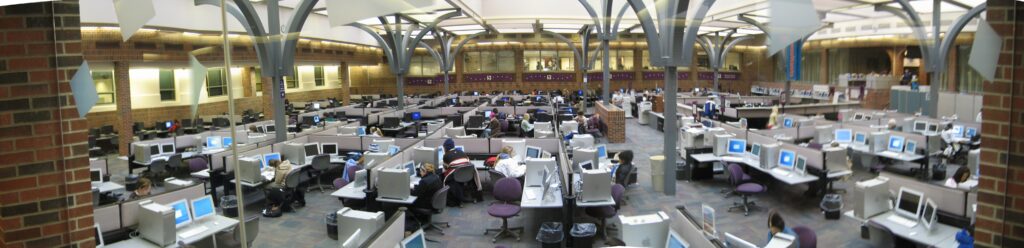
UM Fishbowl full of computers_Carl BErger

I spent an awful lot of time working on old Apple computers here in the 1990s.

In person classes will end with Thanksgiving, following a national pattern.

The university offers a range of support services, along the lines we’ve seen from other campuses of late:

We will provide support for our public health-informed semester through several of our central resources for students or faculty, including our Center for Research on Learning and Teaching, Center for Academic Innovation, Services for Students with Disabilities, and Information and Technology Services. For faculty, this includes course design assistance and recommendations, workshops, help with creating instructional communities, and additional programs that support the quality of a U-M education…

Michigan Housing will set aside living spaces to quarantine and care for those with significant exposures to others diagnosed with COVID-19, as well, to isolate those diagnosed with this infection who cannot return home to recuperate.

The statement lists a battery of public health measures familiar to anyone following this story for the past month:

Our plan to conduct an in-person semester relies on basic public health strategies including social distancing, minimizing out-of-area travel, wearing face coverings, washing hands frequently, symptom screening, clinical testing, contact tracing and quarantine that add up to a highly effective way to limit spread of this illness, allowing students to pursue their Michigan education.

In terms of governance, it looks like a fairly decentralized plan: “Decisions about which courses and sections to offer in which formats will be made by schools, colleges and departments to fulfill their unique educational needs.”

There is a lot of conditional and hedging language in the statement.   For example, this admission that plans are open to revision:

Please note, however, that major changes in conditions could mean we have to adjust parts of our plan. We will remain agile and ready to adapt as needed because we have seen how quickly circumstances can change.

Left unsaid: the fate of Michigan football, one of the very few university sports teams that actually makes serious money.

What does this mean for the rest of us?

UM is a huge, wealthy, and elite institution, but, like Harvard, it is just one of more than 4,000 American colleges and universities.  What does its planning mean for the rest of academia?

It embodies trends I’ve been tracking.  To begin with, it’s another hybrid of the Post-Pandemic Campus and COVID Fall scenarios (click through if you’re unfamiliar with them). I traced some examples of this hybrid recently.  Strategically, a hybrid can make a lot of sense.  It reduces chances of infection by lowering the in-person population density, while improving enrollment numbers by appealing to those who really want to be on site.

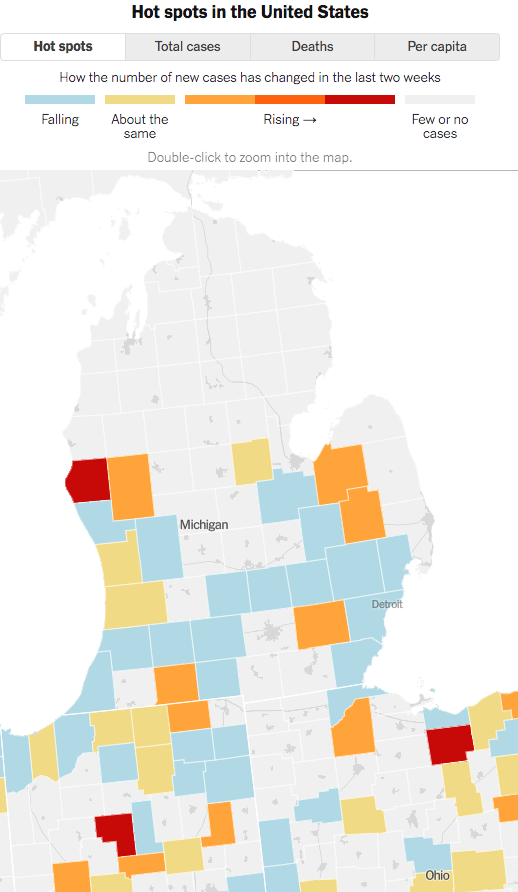
There is also a nod to a possible Toggle Term scenario in that hedging statement.  U of M attracts students (and faculty and staff) from around the world, which opens up all kinds of pandemic possibilities.  There is also the possibility of local infections spreading from across the state of Michigan, or from Ohio.  Consider today’s county-level snapshot, with hotspots to the west and south (New York Times):

coronavirus Michigan spread by county 2020 June 23_NYT

Or perhaps the Detroit area will flare up again.  Once an infection takes hold and spreads, even through a relatively low density population, it might be a good time to throw the switch.

On the class scale system: this recalls what we’ve seen from Penn State and Rice but with a third layer.  I think many campuses are working through this now, trying to pick levels beyond which online online is best.

Overall, these trends seem to be rising.  They have limits, of course.  The overwhelming majority of campuses lack not only Michigan’s financial heft (about $12 billion) but also its prodigious computing might.  UM is also very large in terms of population and spatial area; its plans might not fly for a small school.  And every academic institution has its own confluence of tradition, local situation, strategic mindset, and more.

One media note: what Michigan is doing is planning for a hybrid term.  That is not what media coverage describes.  Instead I’m seeing misleading headlines proclaiming simply “open,” like this one:

University of Michigan will offer in-person classes for fall semester

Or this, from the Detroit Free Press:

U-M to bring students back to campus for fall

It seems like news media have a hard time presenting the hybrid scenario.  They look like they prefer a simple binary, as my old friend and fellow Michigan alum Rob Henderson observed.   Either the Post-Pandemic Campus or COVID Fall scenarios, and no space for connecting them.

(thanks to Rob Henderson for the link; UM sign photo by Ken Lund; Fishbowl photo by Carl Berger)

Posted in coronavirus, higher education | 11 Comments

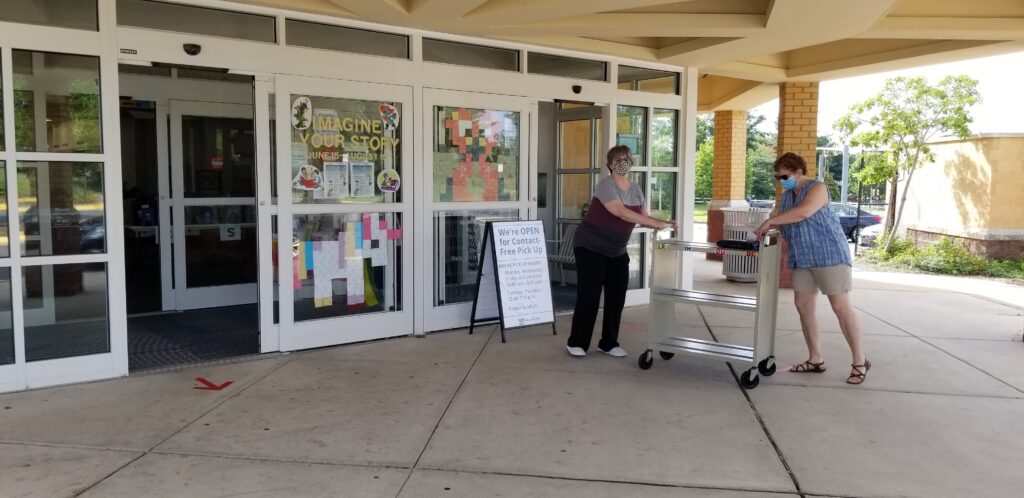
A public library system resumes some operations

Our local public libraries shut down in March because of the pandemic.  They remained closed until this past week, when they partially opened for curbside pickup.

buy clomid online buy clomid no prescription generic

Here I offer a glimpse of how it worked.  My goal is partly to keep documenting parts of the COVID-19 experience, as well as to show how libraries are evolving.  I haven’t heard from many other folks who have tried it out.  I did take a lot of photos.

I learned about the partial opening from a mass email announcement, plus excited comments from my fellow library fan daughter, Gwynneth.  The way the new process is supposed to work is that patrons* find and reserve books, DVDs, and other materials through the system’s web-based catalog.  If they own a copy and it’s there, staff grab the materials, check them out, and set them aside in labeled bags.  The library then emails the patron to give them a 24-48 hour window to visit in person and to pick up their items from tables in the library lobby.

They call it “Contact-Free Pick Up service.” I have now run through this process twice.

buy flagyl online buy flagyl no prescription generic

tl;dr – it works.

On Monday I requested five books (history, literature, science fiction).

buy stromectol online buy stromectol no prescription generic

  For the next two days I checked on my account.  Each item had a status which changed over time, including “Shipping” and “Processing.”

On Wednesday morning an email arrived.  It reiterated the new process, listed all of the system’s libraries and their business hours, told me which books were ready, and gave me 24-48 hours to haul myself over and grab the goods.

buy xenical online buy xenical no prescription generic

  The email also told me what to do for each tranche of the library system: ping them if the books were at a neighborhood branch, or just come on over if a regional library held them.

As soon as I could I drove over to the Bull Run Regional Library – and driving is weird to me now, since I have scarcely driven anywhere since February.  Traffic in the Manassas area has picked up and was close to pre-pandemic levels.

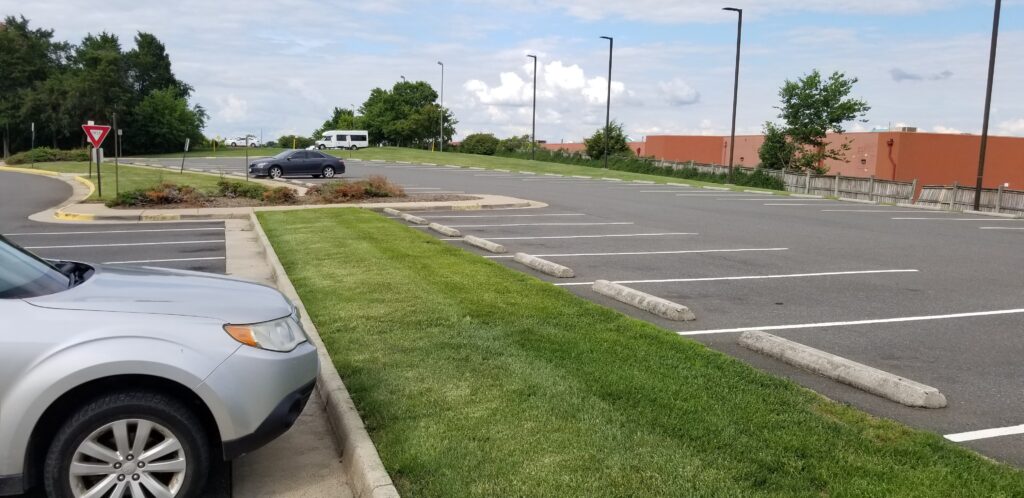
The parking lot was almost perfectly empty.

Bull Run Library book pickup_parking lot

That’s our car on the bottom left.

I masked up and walked over.  I was surprised to see a librarian and patron – both masked – talking with each other over a cart outside the front door.

It turns out that during that hour librarians were busy working in the lobby, adding and rearranging bags and their materials.  They assigned one of their number (on the left, above) to run interference between patrons and materials, parking lot and lobby.  We were to tell the interface librarian our name, and she would hunt the bag(s), then wheel it/them out on a cart (as seen above).

I told the librarian my name.  Into the library she went.  In under a minute she brought me two bags on the cart.  I asked her more questions, then headed to the car to stash my treasure and drive home.

Bull Run Library book pickup_book haul

On Friday another email arrived, informing me that one more book was ready to be picked up.  Again I drove over.  Traffic was the same (almost pre-pandemic) as was the parking lot (empty).  I masked myself and walked over.

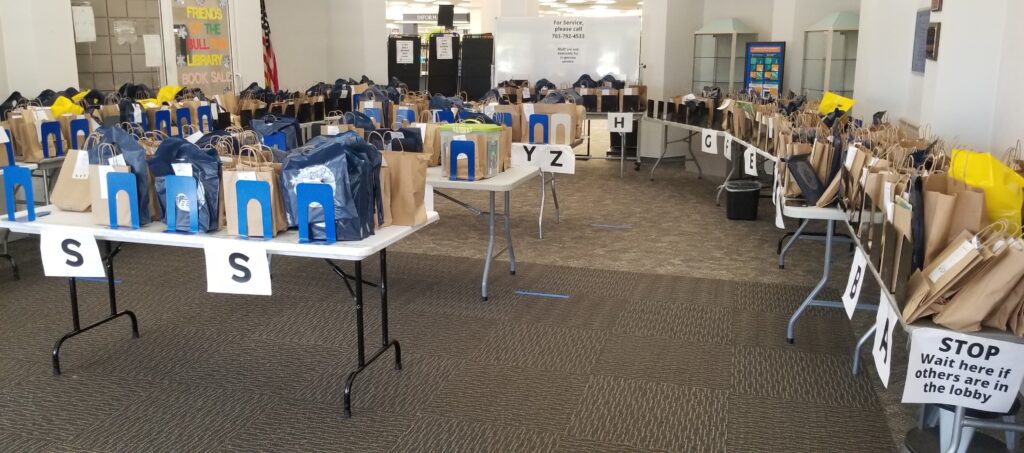
This time there was no interface librarian.  The library door opened up and let me into the lobby.  No other person was in sight.  Now I could see tables covered with bags.

Bull Run Library book pickup_lobby with bags

I hunted for my bag, but it wasn’t there.  As I rummaged, thinking someone moved or misfiled it, another patron came in.  They were swift, finding and grabbing their bag then exiting in just a few seconds.  They were masked.

Still no luck for me, so I called the help line (you can almost see it on the central white board in the picture above).  They told me to wait for a minute.  Then a masked librarian appeared, bag in hand and apology ready.  It turns out the A-B table was just too crowded for the number of items needed.  In fact, nearly all of the tables looked crammed.

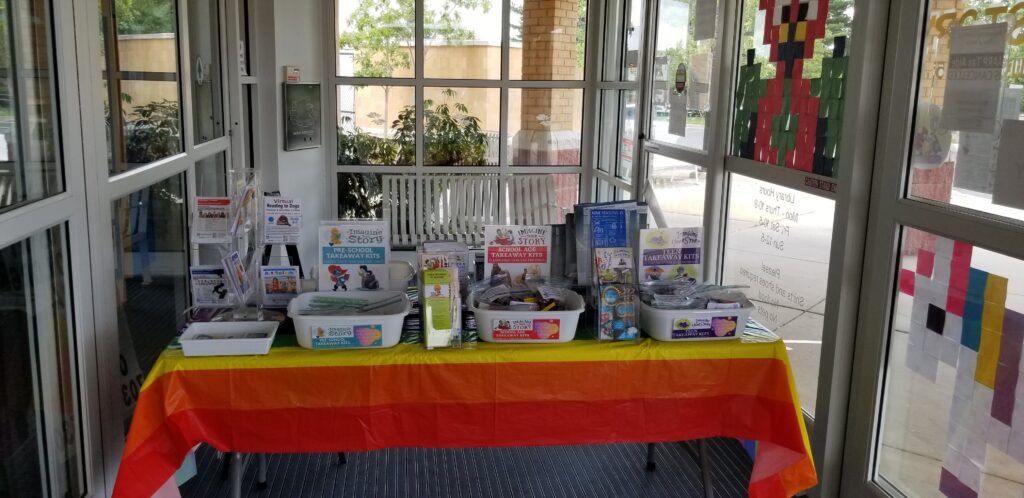
I thanked her.  She complimented me on my Lizzie Borden Bed and Breakfast shirt, then I left, taking my latest goodie with me.  On the way out I noticed a table in the front door space, filled with free stuff for folks to take.

Bull Run Library book pickup_antechamber

What can I deduce from this experience, besides the fact that Chuck Wendig really knows how to write a thriller?

First, I am reminded that public librarians are heroic public servants who can adapt to circumstances.

Second, I learned from this Twitter thread that “Contact-Free Pick Up service” is much better than opening up the rest of the library.  Seriously, read that horrific account to see some ways things can go very badly.

Third, look at those tables again.  Note how many items are there.  It’s a good example of how many people still really want libraries for the physical materials they preserve and render access to.  Even after more than a decade of workable ebooks and streaming media, even during a global pandemic, plenty of us still want to borrow books and more from libraries.

That’s it from my week’s experience.  What’s the public library situation where you are?

*”Patron” is the word used exclusively through this library system, as far as I can tell.  I haven’t heard “user” or any other term.

Posted in libraries | 4 Comments

Towards fall 2020 in higher education: what an “in person semester” really means

American higher ed is moving ahead with fall 2020 planning.  Let’s check in with current developments and see what they suggest for the next academic year.

As a frame I will reiterate my three scenarios for fall term.  Last month I found them still in play.  The Post-Pandemic Campus was the most popular, while some schools were opting for COVID Fall.  Nobody publicly avowed a Toggle Term plan, but I found evidence that at least some members of campus communities were preparing for it.

As of Juneteenth, that pattern continues.  Also, two of those scenarios are quietly blending into one, for a good number of campuses.  Read on:

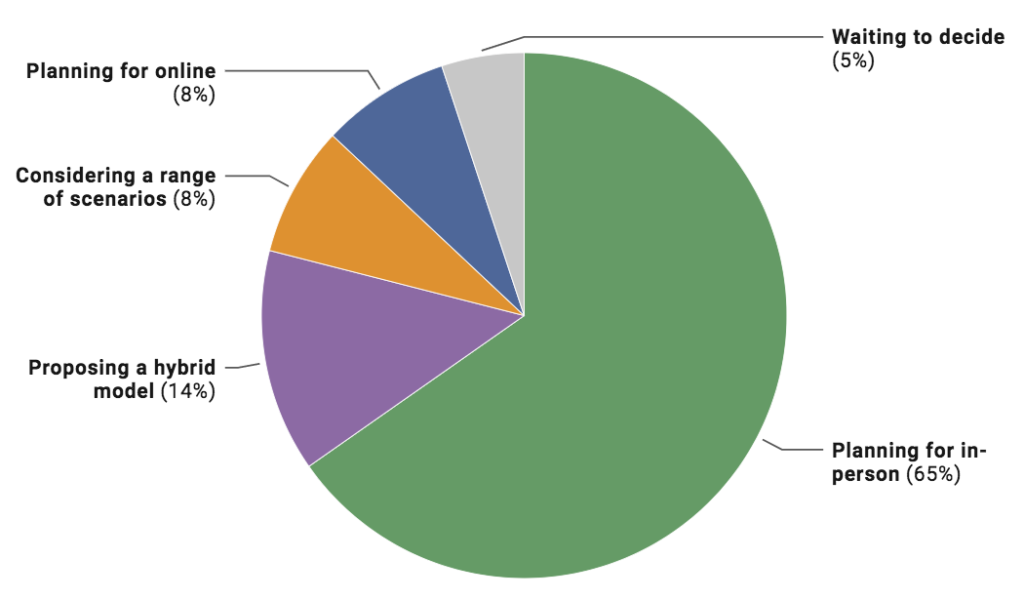
Post-Pandemic Campus It looks like a majority of American institutions are opting for some form of reopening this fall (more on “some form” below).  The Chronicle of Higher Education’s running total claims almost 1,000 campuses, or about 23% of the nation’s ecosystem.  Out of those 65% have said they’ll resume in-person instruction this fall:

coronavirus fall plans 2020 June 19 Chronicle

Examples are easy to find, like a recent statement from Rice.  High Point will open in July.  Penn State announced an in-person fall, which means creating a campus that’s one part higher ed experience plus one part medical state:

Individuals will be required to wear masks and follow social distancing procedures on campus. Back in May, Barron said Penn State had already acquired 500,000 masks and 2,500 hand sanitizer stations to place across its locations.

All students who’ve exhibited coronavirus symptoms or were exposed to the virus are asked to take precautionary steps before coming back, including self-quarantine and seeking testing. Penn State is also building “capacity” to isolate and quarantine “impacted individuals” to deliver medical care.

Note that some faculty are publicly criticizing the move for (among other things) not offering enough protections for either faculty or students.

American University is opening up, but creating different ways for faculty and staff to work:

Departments will work with HR to classify faculty and staff into three groups based upon university needs and job functions: 1) full presence on campus with modified work schedule, 2) partial presence on campus with telework, or 3) full telework. Faculty and staff will be notified of their status by the end of July.

Sweet Briar College “plans to offer in-person instruction in fall 2020 on our safe and spacious campus.”  Already low student numbers makes this easier to accomplish.

George Washington University’s plan is quite comprehensive, from changing classroom size and campus shuttle ridership to changing up water systems.  Start with page 5 to get the outline.

COVID Fall.  Very few campuses are proclaiming a wholly online semester, because (among other reasons) they fear losing enrollment.  Yet it seems like many are quietly planning on the possibility.

For example, George Washington University:

Our planning efforts, collectively our Back to Campus initiative, are comprehensive, and address the modifcations necessary to our on-campus lives in the context of our new COVID-19 reality. They are inclusive, considering the needs of all of our students, faculty and staff. And they are anticipatory, accounting for the many unknowns through multiple scenarios. While our primary scenario involves most students attending on-campus in the fall, we are also planning for an equally high-quality online fall and a hybrid fall, which would include a mixture of online and in-person learning. [emphases added]

Toggle Term This is the least popular scenario in terms of public statements.  But I think many campuses are exploring it – quietly, under the radar – as they try to anticipate lawsuits pandemic possibilities.

For example, listen to Georgetown University’s official letter to its grad students:

Most graduate classes will have a hybrid format, which would allow students to participate both in-person in campus classrooms and on-line. This will provide the full schedule of curricular offerings to students who can return to campus in the Fall as well as those whose return might be delayed due to health, travel or other restrictions. The hybrid approach would also allow for a transition between in-person and on-line instruction during the semester if the public health situation shifts or if required by individual circumstances. Faculty are structuring their graduate classes so that students will meet the same curricular goals whether online or in-person. [emphases added]

Or look deeper into the American University statement: “Classifications may change during the fall as conditions in the region and on campus change. Faculty and staff will be notified of any changes.”  Conceivably those conditions may improve, and lead to more AU staff on campus.  They could also go the other way and lead towards some part of a COVID Fall scenario.

Now that these scenarios are becoming more real every week, we notice a classic dynamic which occurs in this process: combining scenarios.  Futurists are familiar with this in every scenarios exercise, wherein a participant will find elements of two or more narratives that they like and seek to snap them together like so many Legos.  This is terrific, pedagogically, by the way.  It’s a great sign of people using scenarios to think in more complex, creative, and ambitious ways.

So now I’m seeing campuses proclaim re-opening, but at the same time offering online options.  It’s really a blend of online and in-person.  In fact, it seems that “reopening” is really a code for “open face to face and also online at the same time.”  “In person” doesn’t actually mean what it says.

Look back at the Penn State opening story or their official announcement.  “Penn State plans to resume on-campus work and learning in fall semester” goes the headline.  And yet, as we learn further down the announcement,

Delivery of the curriculum will occur through a highly flexible mix of in-person, remote and online instruction throughout the semester, with all classes of more than 250 students delivered online and/or remotely.

That means some learning will be in person while some will be online.  So this isn’t an either-or situation but a both-and one.  Since that statement Penn haa openly announced a formal program for returning students to take classes entirely online.  First-time students can begin without setting foot on a PSU campus through their Start at Home program.

Furthermore, there will be local variations in that state:

Given Pennsylvania’s county-by-county approach to managing the pandemic, the status of each Penn State campus may vary, particularly for those that may be located in an area of the commonwealth where various restrictions remain in place or may subsequently be put in place due to the number of COVID-19 cases in that region.

Consider the Sweet Briar statement, which includes this line: “We can offer hybrid or remote instruction to any student who needs it.”  So that college is offering in-person, hybrid, and remote education at the same time.  No word on remote faculty or staff that I could find.

Or look closely at the Rice University announcement.  Classes will meet in person… unless they don’t.  First, “Courses with enrollments of 100 or more will be offered only online.”  I don’t know Rice well enough to figure out what proportion of the course catalog this covers.  It’s at least significant enough to merit a public statement.

But wait, there’s more, as the commercial used to say.  Or less:

Courses with enrollments of 50 – 99 will default to being offered online only; however, a number of instructors have expressed a desire to accommodate these larger classes and still preserve a significant in person experience. For these courses, the instructor should make a request to their chair to offer the course in dual format utilizing a plan that caps individual in-person class meetings at 50 persons…

So any class over 50 students may also be “online online.”  Some of those will be divided in some way (multiple sections?  one in-person and the rest online?).  And there are clear plans for having students meet with each other when the professor appears online:

Other than large classes that are moved only online, all courses normally assigned a room will be assigned a room so students can gather even if the instructor is present remotely in order to better facilitate student interactions…

Purdue has won a lot of attention as a leader in the opening up space, but while they plan on having people on campus, they are also doing something different:

Classrooms and residence halls will drop to 50% capacity in the fall, while 30% of university staff will work remotely during the fall semester, which will run from Aug. 24 to Nov. 24 without any breaks.

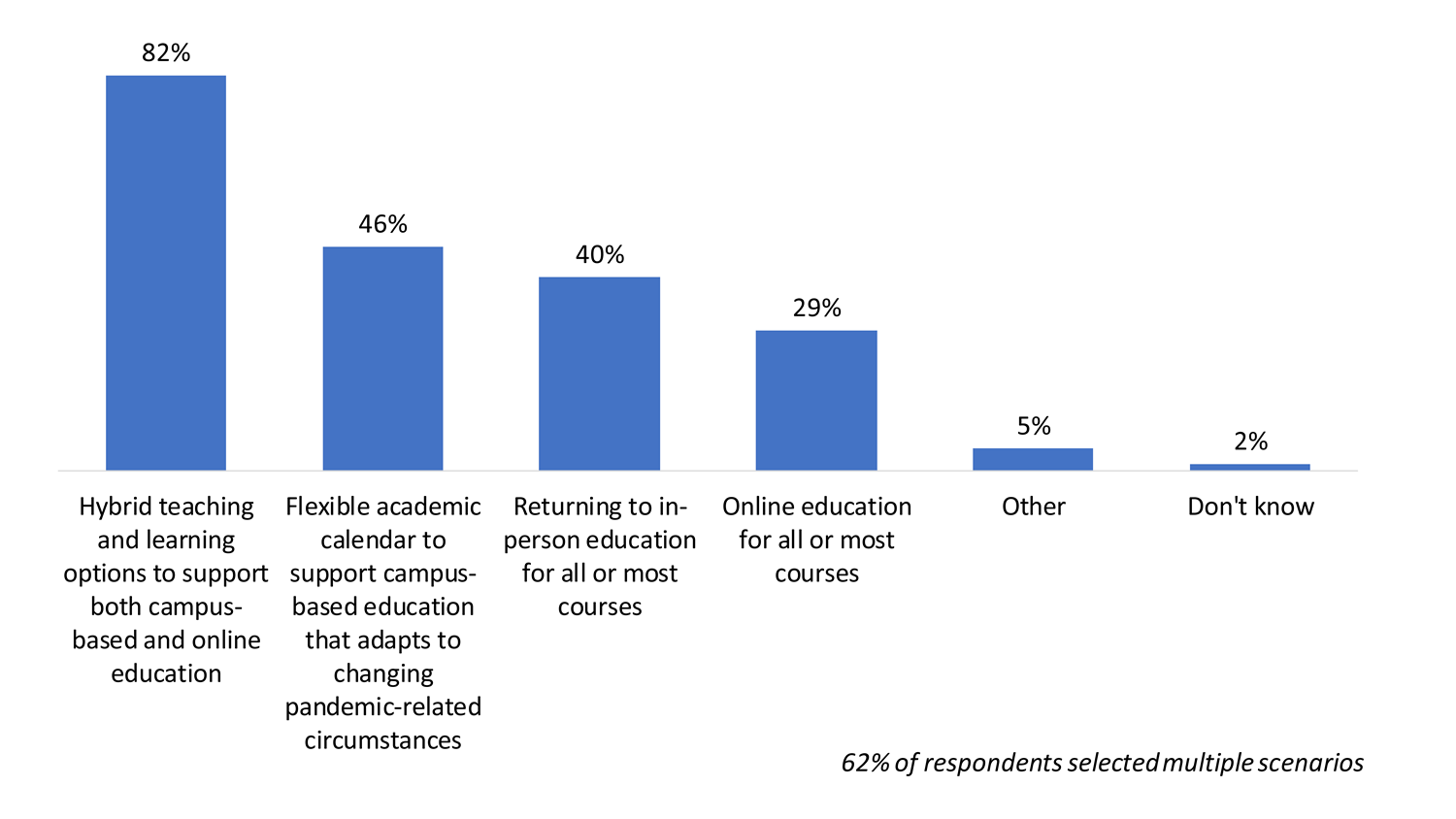
This “‘in person’ really means a blend of in-person and online” meme isn’t just something coming from presidents, provosts, and deans.  A recent EDUCAUSE poll finds that more than 4/5ths of campus IT departments are planning on some kind of blended fall:

Bar chart illustrating teaching and learning scenarios guiding fall planning

So as we look to fall semester 2020, two our our April scenarios are clearly in play, led by Post-Pandemic Campus.  A fourth scenario, found at the intersection of two of April’s, is a hybrid where “in person” really means “a mix of online and in person.”  That is now very active as well, once you look closely.

That joined-up scenario needs a name.  Is “hybrid” sufficient?  “Amphibious Autumn”?

NB: all of this post describes planning at the present. Plans tend to change when they hit reality.  How might these alter if the pandemic picks back up?

The World Health Organization just announced that COVID is “accelerating” worldwide:

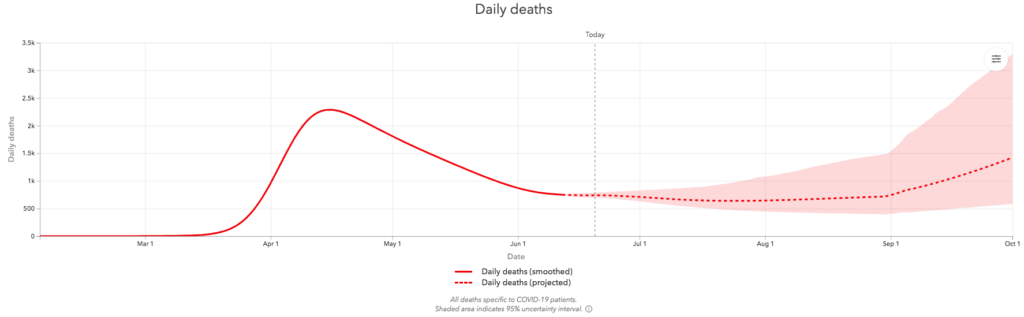
Here’s today’s forecast for American COVID-19 deaths, including historical data for the year up until today:


coronavirus US daily deaths Mar 1-Oct 1_2020 June 20_IHME

Do you see the rise starting around September 1, as classes resume?  It seems pretty clear that if such a mounting death toll occurs, an increasing number of students (plus faculty and staff) will seek to study and work remotely with their “in person” campuses.  And if infection rates rise past a certain point, especially on or immediately next to a campus, the Toggle Term scenario will become increasingly plausible, perhaps even required.

(thanks to Tom Haymes and University Business for links and ideas)

Posted in coronavirus, scenarios | 17 Comments

Harvard considers an online fall semester for undergraduates

One American university just offered a suggestion that its undergraduate experience may be online this fall.

Harvard by new-york-cityHarvard College professor and Dean of Undergraduate Education Amanda Claybaugh emailed her faculty to share her thinking and plans for the rest of 2020.  It’s a fascinating short document, and one I’d like to discuss here.

The dean leads with a crucial point: “it seems likely that, under any scenario, most of our instruction will be online.”

This is different from most other recent pronouncements from campus leaders. Claybaugh isn’t calling for an entirely online term – note that “most.”  She’s certainly not anticipating a wholly or mostly in-person experience.  And she isn’t calling for either a balanced blend of online and in-person, nor a HyFlex experience.

What is the dean’s rationale?

because of the impediments our international students will face returning to campus, because of the risks our immunocompromised students and faculty will face returning to the classroom, and because of the difficulty of holding in-person classes while still conforming to guidance from public health authorities.

All of which makes a great deal of sense. International students: that’s about 1/5th of the student body. Immunocompromised members of the community: ditto.  Having classes in person without spreading COVID: the same.

How will Harvard accomplish this?  Claybaugh outlines three support strategies.

First, changing up the instructor/student ratio: “Sections will be capped at twelve students, and graduate students will be trained to provide additional support for online teaching.”

Second, expanded faculty development:

All faculty are expected to attend trainings this summer… Consisting of four one-hour live sessions, along with materials to review in advance, these trainings will offer concrete guidance on adapting courses to remote teaching. Faculty will finish them with a redesigned syllabus and Canvas site.

Note that attendance at these trainings isn’t optional, but “expected.”

Third, “[p]roviding support for course redesign…”  Instructors “can consult with staff at the Bok Center, and they can also hire graduate students to work on this over the summer.”

There is also a technological note:

We will continue to use Canvas, Zoom, and Panopto, but we recognize that certain courses (language courses, lab courses, course that rely heavily on the blackboard) might have additional needs. We’ll be working with chairs to determine what other technologies we should invest in.

That’s a curiously limited set of just three technologies.  Apparently supporting the huge range of other tools is the province of individual departments.  I note the emphasis on blackboard (whiteboard?) needs.

Harvard by Little Koshka

Why does all of this matter?  Harvard is, after all, just one out of 4400 or so American higher education institutions.  It is literally extraordinary due to its superlative reputation, wealth, and network.

Yet much of American higher ed, and a great deal of the discourse around it, pays inordinate attention to Harvard.  That university’s every curricular twitch, its program decisions, statements from its faculty are magnetic to academia.  So, first off, statements like Claybaugh’s are likely to be more influential than those from a given state university.

Second, the dean’s points may actually be applicable to other institutions.  Think of this line again, about why Harvard might be mostly online: “the difficulty of holding in-person classes while still conforming to guidance from public health authorities.” If Harvard finds this challenging, with about $5.5 billion in income and its $40 billion endowment, what does that say about the remaining 99.9+% of American higher education?

I don’t want to freight this one email with too much meaning.  It is, after all, just one message.  WBUR points out (without linking, alas) that a parallel communication with a different call is in play:

Another email circulating among some faculty says should the college allow undergraduates back to campus, the current plan would have them take their classes over Zoom from their dorm rooms since there are not enough larger classrooms to provide sufficient social distancing..

That’s closer to what I’ve heard from other campuses.  Claybaugh’s email offers a different take.  I wonder how many colleges and universities will be inspired or nudged towards holding a mostly or entirely online fall term because of it.  Perhaps this is the starting gun for a race.

(photos by new-york-city and Little Koshka; link via WBUR)


Posted in coronavirus | 10 Comments

Seven years later: Bryan Alexander Consulting in 2020

Seven years ago Ceredwyn and I launched Bryan Alexander Consulting. From the start we’ve been open about the practice, sharing our plans, operations, strategies, and questions with you all.*  Now it’s time for an update.

BAC logoIf you’re new to BAC, it’s a small consultancy focused on the future of higher education.  We help clients (colleges, universities, associations, nonprofits, governments, businesses) grapple with where academia might be headed.  To this end we conduct and share research through a variety of channels, while also offering consulting on spec.

2019-2020 has been a wild year.  The first part, from June 2019-February 2020, proceeded pretty much along the lines we expected from the previous year.  I conducted and shared research in person through speeches, presentations, workshops, and consultations across the United States plus Europe.  That research appeared as well in the FTTE report.  I honed the research by blogging (here) and also by sharing questions and thoughts across various social media platforms.  Meanwhile, I taught graduate classes at Georgetown University: one in the summer, two in the fall, and one in spring.

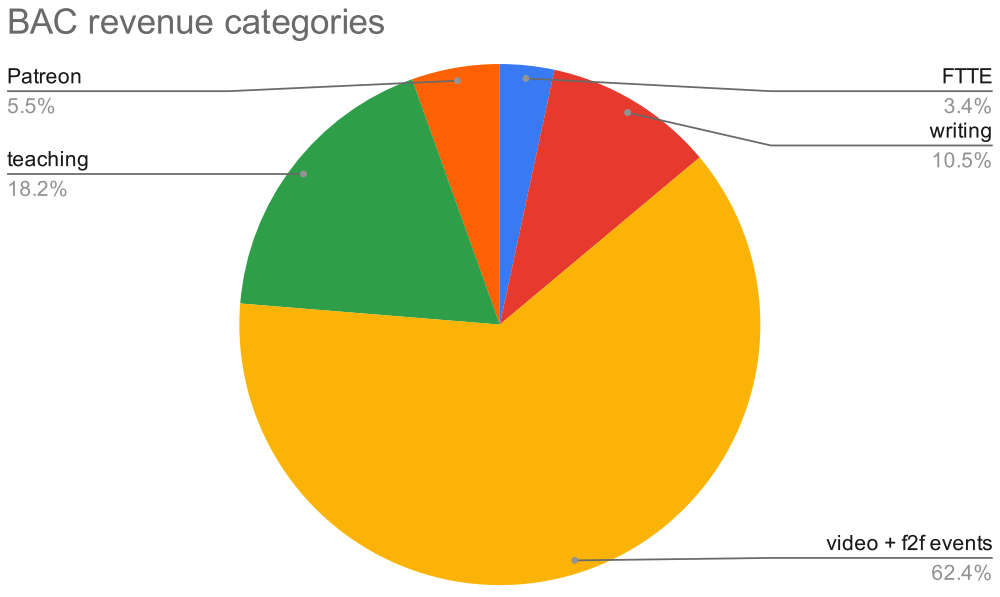
Financially, BAC’s revenues came mostly from speaking and consulting engagements, followed by teaching, some online work, FTTE subscription, then Patreon support and book royalties.  In 2019 the balance looked roughly like this:

BAC revenue 2018-2019

In January 2020 my newest book, Academia Next, appeared.  Sales were brisk (thank you, readers!) but royalties aren’t scheduled to reach BAC operations until next fiscal year, so I’m leaving them off of this post.

In February we passed a Future Trends Forum milestone of four years of continuous programming. The Forum is and always has been free to all.  It is not a revenue generator.

Meanwhile, FTTE and Patreon subscriptions were ticking upwards in January and February of 2020.

Things were humming along.  Living in the Washington, DC area made a huge difference, especially in terms of bandwidth (yes!), travel, and access to all kinds of organizations and people.

Then COVID-19 struck the world.

And everything went up in the air.

Like most other organizations, BAC was hit hard.

buy metformin online buy metformin no prescription generic

 In April I continued this open practice by sharing how BAC was grappling with the shock then.  Let me expand on that and update you.

To begin with, my face-to-face work evaporated in a couple of weeks.  Nearly every single speaking gig, consult, and workshop went away as organizations canceled in-person events.  A handful shifted online but at very reduced rates.  My several-times-a-month drives to Dulles, National, Union Station, or points north shuddered to a stop.

I’m not sure if folks fully understand what an attack on BAC that was.  Unless we changed things up drastically and fast, that was a death blow to the business.

At the same time BAC suffered from a weakness.  We are very small, a literally mom and pop outfit.  In the United States it is the giant enterprises that tend to survive COVID-19, while the smaller ones – lacking scale and reserves – go under.  Remember, too, that we are independent.  No institution backs us.  No deep pocketed supporters or generous family members here.  We’re on our own without a net.

So in the face of that extinction event we thought hard and pivoted, as they say.  We made two decisions.

First, to make COVID-19 the top research priority.  I already was paying attention, both as a forecaster and by tracking it starting when the virus first surfaced in Hubei province.  In March I made it the leading topic.  I set up a research strategy and pursued it consistently.  I shared everything I found, trying to improve the quality of discussion while also getting feedback to improve the research.  Soon I moved to producing futures work for higher education during the pandemic.  I threw myself into creating the first major documentation of higher education’s shutdown in March.

Note that none of that work paid anything.

buy finasteride online buy finasteride no prescription generic

  Indeed, it was a lot of time to expend during a business collapse. But it was vital to do that work.  People in the higher education space needed it very much.  And I couldn’t do my non-pandemic work without taking into account COVID’s impact.

Second, if face-to-face was done for the short term, we’d leap entirely online.  So in a matter of weeks we built an online business based on live video events, or webinars.  At no point did I stop working or go into a planning retreat; this was all done on the fly, the proverbial aircraft built in mid-flight.  This strategy rested on the years of practice and reputation I’ve accumulated in hosting events.  I reached out to potential partners of all kinds: friends, journalists, campuses, businesses, governments, nonprofits.  I rebooted the Forum’s scheduled programming in favor of a COVID emergency topic, hauling in the best guests I could find for months.

In March and April I offered up to eight video events per week, mostly gratis, using just about every video platform I’ve heard of.

buy lexapro online buy lexapro no prescription generic

  The intent was to convene conversations about the extraordinary transformation academia was undergoing, and also to demonstrate it was possible to do so in a way that didn’t narcotize audiences.  And it was to prove to prospective clients that BAC had that capacity.

After a frantic few weeks positive results gradually started to trickle in, even as discontent over bad videoconfencing rose worldwide.  Several organizations partnered with me so that we could offer events together.  Each partnership differed in some ways, as in who would handle registration, which technology to use, or how to craft and host recordings.  Overall, each one worked, yielding successful events and satisfied clients.

Since that manic spring hosting video events has become a key part of the business.  Apparently we’ve proven that we can do this well.

Meanwhile, on another front, several entities approached me to write for them.  Articles, white papers, research work – the forms differed, but the practice was similar at root.  None required in-person meetings.  This represents another service BAC provides, one we’ve offered previously, but is now picking up.

To sum up: right now, in June 2020, BAC is essentially a virtual business.  Our offerings are digital, either synchronous (webinars), asynchronous (writing), or combinations thereof (teaching).

Taken together, here’s how 2019-2020 worked in terms of revenue, combining pre-pandemic and viral times:

BAC revenue streams 2019=2020

You can see the growth of video, although it’s combined with f2f.  Writing is significant, as is teaching.  Patreon still isn’t there yet.

At the same time business expenses remained about the same as 2018-2019.  Thankfully we didn’t face any medical or other household emergencies.  Being under lockdown paid off on all measures.

What do we anticipate for BAC in 2020-2021?

More virtual events are in order.  I’m reaching out to more prospective partners.  I may also hold some special webinar events on key topics; I’m not sure if those will be free or accessible for a fee.

buy tadora online buy tadora no prescription generic

  I also hope to buttress this part of the business with an ebook on webinars.  I really hope we can keep this service going.

I hope to keep teaching at Georgetown, because I love it.

Bryan hand on chin

We have some overdue items.  Lots of web work needs to be done, including refreshing the BAC website, upgrading the FTTE site, and launching a real Future Trends Forum site.  The long-promised podcast is in preproduction now, so hopefully we can finally get it off the ground.

Three last notes.

First, seven years!  BAC is nearing a decade in age.  That’s a bit breathtaking to think of.  It’s longer than I spent doing a PhD.  Longer than I’ve had with some other jobs.    And June 2013 was… a very different time.

Second, we make this work by working with great clients.  We are grateful for the partnership of each and every one.

Third, if you like this work, and you like the openness with which we conduct it, please consider supporting us.  Engage BAC for our services.  Subscribe to FTTE.  Support us on Patreon.  As an independent futuring group in chaotic times, we cannot do this alone.

*Previous BAC reflections can be found here: 2019, 2018, 2017, 2016, 2016, 2015, 2014, 2013.

Posted in Bryan Alexander Consulting, coronavirus | 4 Comments