
While COVID-19 roars through the world, it’s important to track significant non-pandemic developments. Today I wanted to share a demographic update.
Readers know I spend a lot of time analyzing how population trends change, exploring how that could impact higher education. This week the CDC published its latest data on American birthrates and more.
Key points:
First, birthrates continue to tick down:
The provisional number of births for the United States in 2019 was 3,745,540, down 1% from the number in 2018 (3,791,712)… This is the fifth year that the number of births has declined after the increase in 2014, down an average of 1% per year, and the lowest number of births since 1985.
You can see an overall drop since 1990 in this chart:
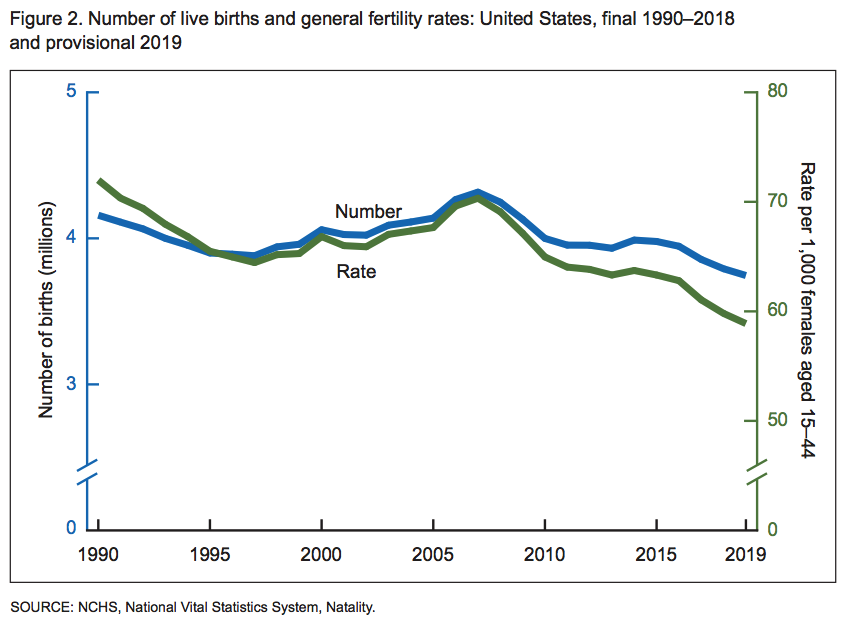
As Janet Adamy puts it, “The data are the latest sign of how American childbearing, which began declining during the 2007-09 recession, never fully rebounded when the economy bounced back.”
Second, American birthrates are below “replacement level”:
The TFR in 2019 was again below replacement—the level at which a given generation can exactly replace itself (2,100 births per 1,000 women). The rate has generally been below replacement since 1971 and consistently below replacement since 2007…
That’s 1.7 per woman, according to Adamy, or less than the 2.1 needed for two humans to reproduce themselves. What does that mean? Without immigration, the American population would shrink.
(Something few people discuss.)
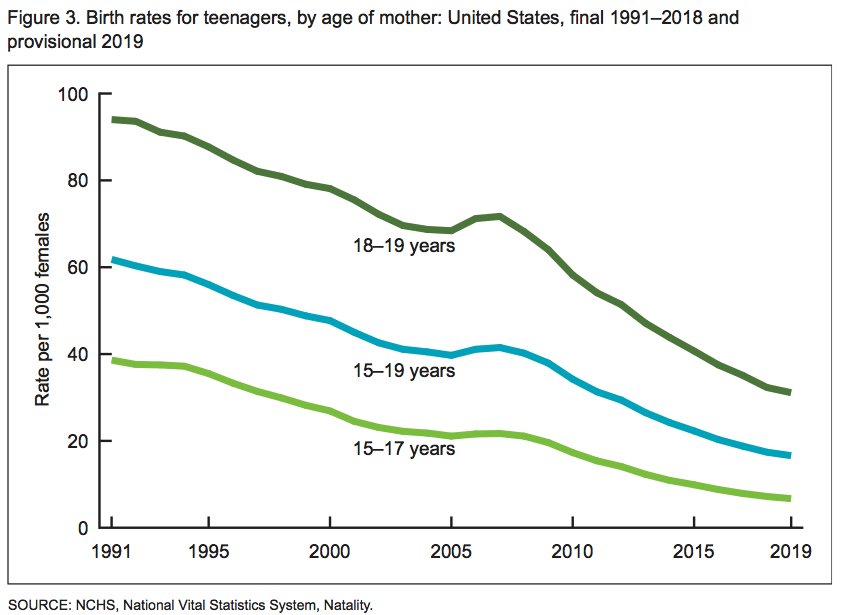
Third, teen pregnancy continues to plummet, “reaching another record low for this age group”:
Fourth, racial differences are slight but consistent with historical patterns.
White births remain the largest, followed by Hispanic, then black, then Asian children, with Native American and Pacific Islanders far behind:

Non-white births (1,710,141 total, by my count) are nearly at par with whites (1,914,141).
And:
the number of births declined 1% for non-Hispanic black and non-Hispanic Asian women and 2% for non-Hispanic white and non-Hispanic AIAN women from 2018 to 2019… The number of births rose 3% for non-Hispanic NHOPI women, but was essentially unchanged for Hispanic women from 2018 to 2019.
buy avanafil online buy avanafil no prescription generic
Why does this matter for higher education?
As I and very few others have said for years, the declining birth rate means changes to the K-12 pipeline, yielding a small population for traditional-age higher ed. This could spur further inter-institutional competition, and also add incentives to cut education programs, especially in certain states.
Note the point about immigration alone keeping the US population from flat-out shrinking.
Think of how much American colleges and universities rely on international students, and this sector’s role in turning those students into residents and citizens.
Note, too, the racial dynamics. Nonwhite births are nearly even with whites; with people of color emigrating to the US, you can see the minority-majority nation taking shape. Extrapolating further, you can see campus populations shifting. The Hispanic/Latinx population remains the second largest and the largest minority.
Don’t miss the teen birth story, which is huge. Some readers might recall panicked news stories and anxious politicians back in the 1980s and 90s, all anxious about “kids having kids.” Well, for a variety of reasons, we seem to have made enormous progress in solving that problem. I rarely see anyone mentioning it – which is a shame, since it looks like a good, positive story.
What does that matter for higher ed? Among other things it means more young women have access to colleges and universities, as their academic careers haven’t been put on hold by childbirth and mothering in high school. I also wonder how that feeds into cultural changes around gender roles.
There’s also the problem of people having children in their 20s. Back to Adamy’s article:
“There are a lot of people out there who would like to have two children, a larger family, and there’s something going on out there that makes people feel like they can’t do that,” said Melanie Brasher, assistant professor of sociology at the University of Rhode Island, who studies fertility.
Part of that “something” can be student loans. I am still waiting for pro-natalists to start attacking higher ed.
This CDC data is another counterargument to the old but still ongoing argument that humans are making too many children. The US, like every other nation that went through development and modernity, just keeps producing fewer babies. The Population Bomb never detonated. Now, some might argue that the human race has too many people for the planet to support, even after we bent the population curve. That’s a separate argument from the “stop having babies” line.
Overall, this is important research. It’s nothing sudden or shocking, but rather confirmation of long-running trends that reshape American society and higher education.



“There are a lot of people out there who would like to have two children, a larger family, and there’s something going on out there that makes people feel like they can’t do that,” said Melanie Brasher, assistant professor of sociology at the University of Rhode Island, who studies fertility.
If that’s so, shouldn’t it be reasonably easy to demonstrate a difference in birth rates between the U.S. and high income countries where young people don’t have those concerns?
Yes, and I would guess those concerns don’t play out too strongly, since birthrates are low in countries with fantastic social services.
According to https://www.census.gov/popclock/, the US birth rate is higher than the death rate (1 per 9 s compared to 1 per 12 s) and the immigration rate is well below both (1 per 47 s). Based on this data, the effect of declining birth rates has not kicked in yet, and when it does, immigration will have to increase dramatically to make up the difference.
My suspicion is that Census has been overestimating immigration for some time. I haven’t confirmed that with research.
Agreed that the birth rate change’s impacts haven’t fully kicked in yet. Mid-century is where some estimates land. It takes time.
“Don’t miss the teen birth story, which is huge. Some readers might recall panicked news stories and anxious politicians back in the 1980s and 90s, all anxious about “kids having kids.” Well, for a variety of reasons, we seem to have made enormous progress in solving that problem.”
You casually say “for a variety of reasons”. Can you break out the reasons? Is it that we are encouraging responsibility and helping them understand the impact of getting pregnant? What about the increase in abortions over those decades? Would be interesting to see the impact for each of the various reasons.
It wasn’t so much casual as not having enough time.
So, let’s see:
-improved and extended sex ed
-greater access to reproductive information, practices, and services, inc. abortion
-steady state pressure