Launching my new class on gaming, design, and education

Tonight starts the first class of my new seminar on gaming, design, and education.  Georgetown University’s Learning, Design, and Technology program is the seminar’s home.

In this post I’d like to introduce the class.  I’d love to hear your thoughts, as while this is by far not the first time I’ve taught about gaming, it’s the first time I’ve had a whole semester to focus on that topic.  Suggestions are welcome.

Here’s the class description:

This class explores the intersection of gaming, education, design, and technology. We will explore both digital and tabletop games as students play, study, and build them, combining scholarship, creativity, and reflective analysis. This approach lets us explore a series of major themes, including: the nature of games; storytelling; access and accessibility; interactive design; how we learn through games. The class structure combines hands-on work (and play), discussion, computer-mediated conversation, and presentations.

The syllabus:

May 18

  • introduction to the class: logistics; classroom democracy; cocreating rules of the road; meta design aspects
  • introduction to gaming: history and theory
  • games: Keep Teaching; The Thing From the Future
  • technology: download and install Steam
  • writing in Canvas: student self-description character sheets, 1

May 20 Tabletop gaming

May 25 – Memorial Day

May 27 Role-playing games

  • readings: Dyson et al, “The effect of tabletop role-playing games on the creative potential and emotional creativity of Taiwanese college students”; Fuist, “The Agentic Imagination: Tabletop Role Playing Games as a Cultural Tool”
  • writing in Canvas: responses to readings
  • student self-description character sheets, 2
  • games: either Dungeons and Dragons or Fiasco

June 1 Computer gaming

  • technology: Twine (download and install)
  • readings: TBD

June 3 Education and gaming

June 5: final project pitch due

June 8 Education and gaming

June 10 Gaming and design

June 15 Design for education and gaming

June 17 Storytelling and games

  • readings: Eric Gordon et al, “Civic Creativity: Role-Playing Games in Deliberative Process”; Alexander, “Gaming: Storytelling on a Small Scale” and “Gaming: Storytelling on a Large Scale”, from The New Digital Storytelling, pp 97-127.
  • games: The Thing From the Future; TBD

June 22 Student topic picks

  • readings, games, technology to be collectively determined by students

June 24 Student topic picks

  • readings, games, technology to be collectively determined by students
  • student project presentations

July 3: final projects due

What are those student presentations, you ask?  Final projects are educational games, either tabletop or digital, accompanied by explanatory essays.

I’m very excited about this class and its potential.  I’m very grateful to the LDT program for hosting it. I hope the students learn a lot, stretch themselves, and have fun.

(thanks to John Farquhar and others for asking)

Posted in gaming, teaching | 21 Comments

Two competing visions of fall higher education, plus a ghostly third

Oxford Christ Church College_Judy DeanWhat will fall 2020 look like in higher education?

I’ve been exploring this topic for months.  In April I published three scenarios for colleges and universities may approach the fall 2020 semester in the wake of COVID-19, based on different ways the pandemic might play out, which were posted in March.  I followed those up with real world examples of each scenario, as different institutions subsequently issued announcements about their plans.

Let’s see how things are playing out now, in the middle of May.

To recap, the three fall scenarios are:

  1. The Post-Pandemic Campus.  A college or university deems the pandemic to be over, or managed, or about as dangerous as the winter flu, and so opens up for face-to-face education and activities.* (I posted some problems with this here.)
  2. COVID Fall.  A campus plans on an online fall term, seeing the pandemic as too dangerous and/or not being able to administer appropriate countermeasures.
  3. Toggle Term.  Campus leaders are ready to toggle between online and in-person education depending on conditions.

Post-Pandemic Campus Since I last posted, more American colleges and universities have announced plans to open up.  The Chronicle has one list with about 13% of the US sector; out of that, about 70% are saying they expect to resume face-to-face instruction.

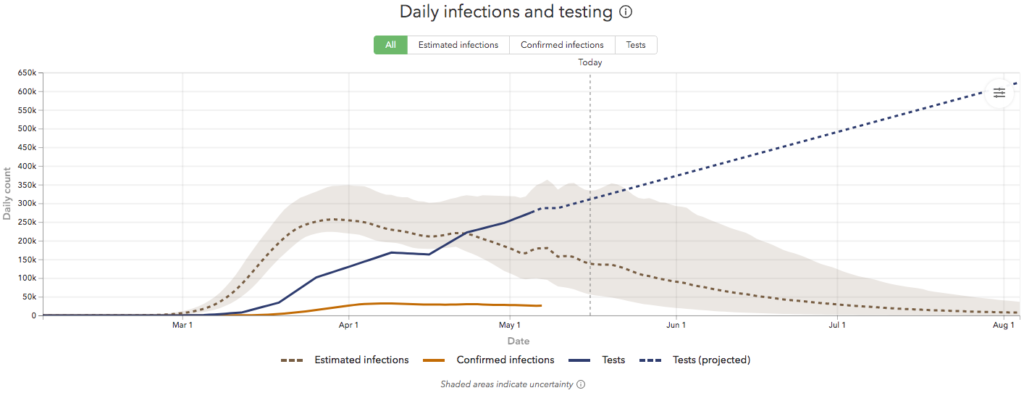
A key assumption in this scenario planning is that the American COVID-19 pandemic peaks sometime this summer, then drops.  We can see evidence for that belief in the latest IHME projections, for infections:

coronavirus US infections testing 2020 Mar1-Aug1_-recorded May 16-IHME

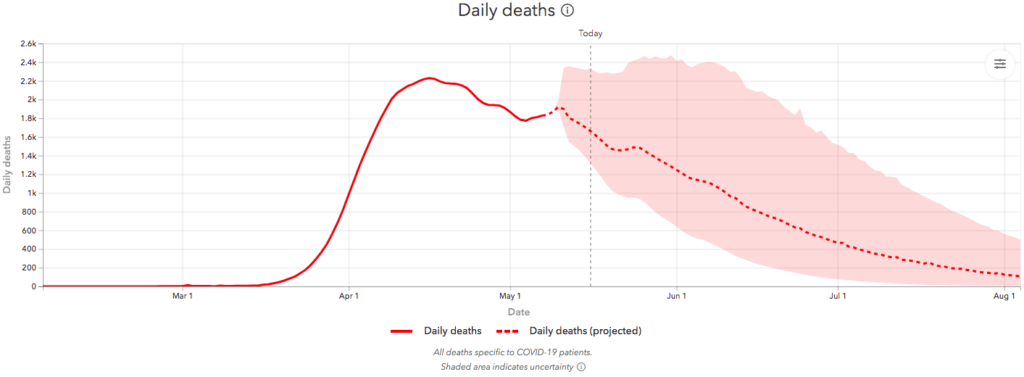
And a similar patterns for deaths:

coronavirus US deaths 2020 Mar1-Aug-1 -recorded May 16-IHME

There are other assumptions, leading with: that students will enroll in greater numbers for face-to-face classes than online ones.  In some cases, campus leaders may see in-person operation as the only alternative to shutting down forever.

My assumption is that many of these cases, if carried out, will involve serious shifting in resources.  More resources to certain academic programs (allied health care), more to certain administrative units (IT, academic computing, marketing, enrollment) – and fewer to others.  A net loss, overall.

COVID Fall In contrast, other institutions find taking most or all of their mission online is best.  They may largely be motivated by a desire to reduce infections, injuries, and deaths, fearing that in-person operations are just too dangerous.  There are many examples of this train of thought.

The most prominent recent example of COVID Fall has been the 23-campus California State University system, which will teach online this fall.

…so we can find examples of my first two scenarios.  The third, Toggle Term, has been harder to find in the real world.

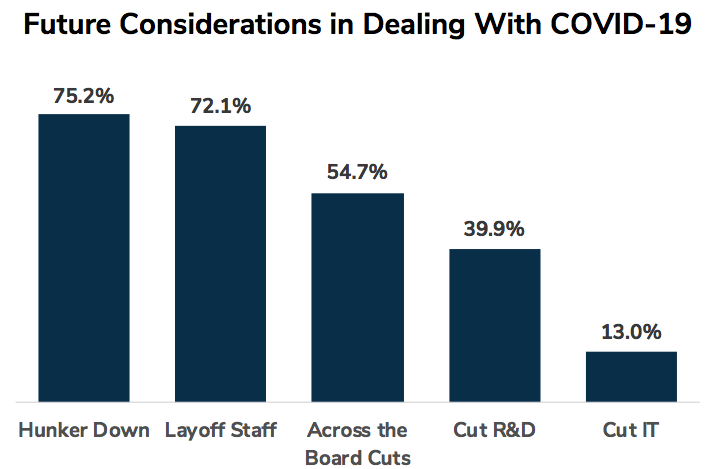
Yet on-campus planning may actually be headed that way.  Campus IT is preparing for Toggle Term in terms of HyFlex and other modes, according to a new EDUCAUSE poll.  Here is what respondents are gearing up to do:

fall 2020 tech prep by IT_EDUCAUSE

Community college dean Matt “Dean Dad” Reed (and excellent 2017 Future Trends Forum guest) posited a version of the Toggle Term, with a clear sequence:

one possible scenario has us off-campus in September and maybe October, and then having the option to return to campus after that. In anticipation of that scenario, a proposal making the rounds is to post “remote live” classes (synchronous online) for the fall with classrooms tied to them. The courses would be held at set times remotely until we get the all clear, at which point they’d move to campus for the rest of the semester. (Asynchronous online classes would remain as they are.)

“In other words, the proposal is the mirror image of the spring. Instead of starting on campus and then moving off, we’d start off-campus and move on.”  The column’s commentators did not approve, mostly.

To sum up: at least two of these scenarios are in full swing.  COVID Fall is a viable option and the Post-Pandemic Campus leads the way.  In contrast Toggle Term seems to be a hidden third choice, a ghostly option now, at least in public.  Few want to mention it, but campus IT looks ready to roll it out.

Let’s see how colleges and universities continue down the path for fall 2020.

(Oxford photo by judy dean)

*Several readers have taken issue with the term “post-pandemic,” arguing that it diminishes the reality of a dangerous virus.  To explain: I use this term to describe someone’s mindset, where they see COVID-19 as no longer in emergency mode.  These people may think the pandemic phase is over, in that the virus has been controlled. Or they find that while other regions may suffer, they themselves are not in danger.

This is a question of perception.  With that scenario title I am not describing biological reality, but the viewpoint of certain people.

buy fluoxetine online buy fluoxetine no prescription generic

Again, I am describing someone else’s attitude.  Not my own.

Posted in coronavirus, scenarios | 24 Comments

Webinars that don’t suck – part 1

We are now immersed in more videoconferencing than ever before.

buy grifulvin online buy grifulvin no prescription generic

We spend more minutes and hours every day in video chats and webinars, thanks to COVID-19. Zoom, Facetime, WebEx, Skype, Adobe Connect, Google Hangout, Adobe Connect, Shindig, Amazon Chime, and others soak up more and more of our time, depending on our jobs and life circumstances.

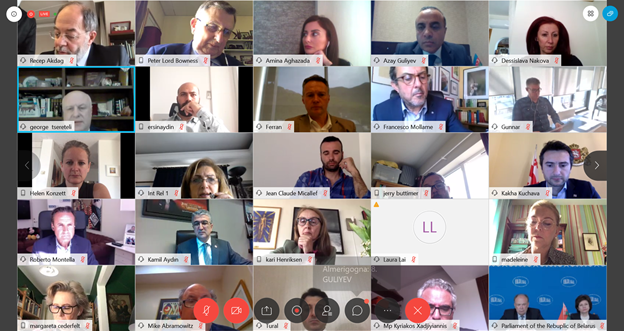
webinar- OSCE Parliamentary Assembly

And yet so many of these experiences are dissatisfying or worse.  I hear from people on a daily basis about webinars that just… suck.  They tell me about videoconferences that fail, video chats that abhor personal connection, live events that were not only not lively but should have been canned.  I’ve experienced the same, like webinars where most of the Twitter talk is about how bad the session is.

We really need to do better.

Some of my readers may recall that I’ve addressed this in the past.  In 2017 I wrote up some thoughts about what makes for a fine video presentation.  In 2018 I offered a model explaining two types of webinars, and how to use each to the fullest.  In 2019 I invented webinar bingo. On a practical level I’ve been leading or helping lead all kinds of live video events, like some of my classes (when I travel, or during pandemic) and the Future Trends Forum, trying to make them the best possible experiences.

So let’s revisit the topic.  How can we make webinars that don’t suck, when we really need them to be good?

I’m going to write a series of posts on this, and also make some other things, depending on time.  What I’d like to focus on today is where I see the most crucial point of how to make video events happen in non-terrible ways: personal presence.

Think of it this way.  Someone can stream or download video or audio content pretty much on demand, depending on bandwidth, licenses, paywalls, device compatibility, etc.  It’s up to them (within those limitations) when and how to consume the stuff you’d like them to experience.  The creator is separated in time from their audience.  Audience members are also, usually, removed from each other, especially at scale.  We each download, stream, and play separately.  This is timeshifting, an asynchronous way of taking it all in.

It’s actually an old, old form, predating the digital world by centuries and millennia.  We experience content in the forms of videotapes, audio cassette tapes, vinyl records, graffiti, and letters.

buy singulair online buy singulair no prescription generic

  That’s the whole history of print: books, newspapers, magazines, broadsides, journals. Each separated readers/listeners/viewers from their creators.   Often those consumers consumed at different times and at different paces.  This form has all kinds of affordances and challenges depending on the medium and how we use it.  There are whole bodies of knowledge about how this works.

A webinar is something very different.  Participants choose to gather at an exact time to be with each other – for various reasons and to various degrees of intensity, to be sure.  This is a synchronous activity, the simultaneous, live sharing of content and experience.

It’s also not a new thing.  It’s predated by live broadcast tv and radio, most recently.  Other instances include stage plays and concerts, readings and meetings, by the tradition of oral storytelling.  By in-person teaching and social learning.  Again, there are whole bodies of knowledge about how this works.

A live video event fits in the second category, obviously.  In order for it to not suck such an event must embrace its unique conditions and affordances.  And to do so we can’t just focus on the content transmitted.  We have to pay attention to the social context: the combination of audience and presenter(s).

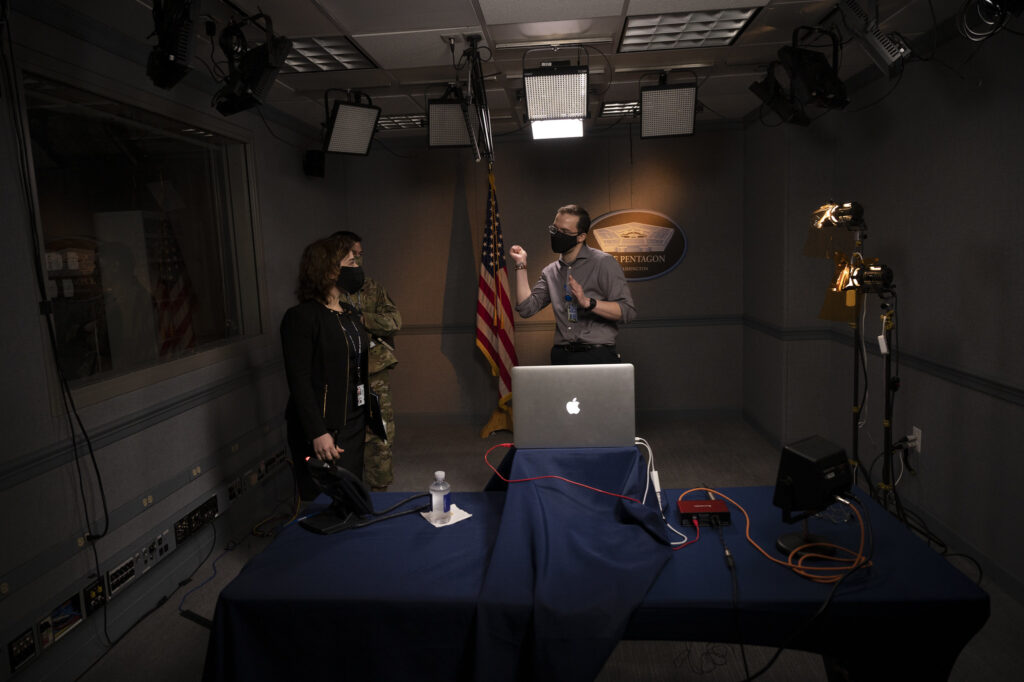
webinar prep US Sec Def

To begin with, organizers, presenters, and facilitators have to honor the commitment expressed by each other and especially the so-called audience.  It might sound cheesy, but these are gifts of precious time and attention.  It’s rude not to recognize them as such.  It’s also counterproductive to not try engaging an audience, obviously.  A live video event has to recognize those gifts and reciprocate as fully as humanly and technologically possible.

Looked at one way, this is a type of personal care.  It requires attending to the other.  It is also an expression of trust in each other.  Audience and presenters alike trust that everyone will pay attention and be heeded in return.

Such an attitude is especially vital in a time of planetary crisis, when participants are under all kinds of stress and even horror.  We really need to show that we can trust and care for each other.  Failing to do so is worse than rude.

There are dozens, maybe hundreds of techniques and tips for demonstrating and embodying such reciprocal attention, which I’ll go into in later posts.  Here I want to discuss some principles behind them for webinar organizers.

  • Hail and recognize every participant.
    buy amitriptyline online buy amitriptyline no prescription generic

      This can be done out loud just to note presence: “Hello, Joshua!  Glad to see you.”  It can be done by chat – assuming people use it, and they should.  I like to invite people to use text chat right away through a light or even silly exercise, such as asking them to describe their weather or current beverage.  This welcome folks to contribute – to be seen and acknowledged, even in a slender way.  We can build on that.

  • Ask questions and make the answers count.  Questions have a special tug on our minds.  They make us try to reply.  That’s why rhetorical questions are effective, and why storytellers like to ask the audience things.  “Now why do you suppose the villain did that?”  Presenters and facilitators can ask things out loud or on video, then make sure we all can see/hear the replies.  We can do this via chat as well.  Polling can be good for this if the answers appear, and if the program takes them seriously.  Answers are the population expressing itself.  They deepen the event’s social sense.
  • Use audio.  Our voices are such powerful instruments.  We might dislike the sound of our own.  In my digital storytelling teaching experience, people often dread recording themselves.  But most other people tend to find someone else’s voice a deeply suggestive marker of personality.  StoryCenter refers to this as “the gift of voice,” a term I like.  Think back to the power of radio (theater of the mind!) or today’s second wave of podcasts.  That little trickle of sound carries so, so much presence.  Presenters should speak.  And as much of the audience as possible.
  • Use video.  Every week I’m shocked or amused by video events that don’t show videos.  Of people, that is – most will at least screen PowerPoint slides.  But a disturbing/funny number of webinars refuse to show live video of people.  If audio is a powerful way to make people present, video is even more so.  Even thumbnail, Brady Bunch style windows give us a sign that there’s actually a person there.
  • Dive into video.  There are limits to those thumbnail, Brady Bunch style windows.  In my Forum work I love “bringing people on stage,” using Shindig to expand that video feed so a person becomes much more present.  You can see a person’s face, some of their body, and their environments. I think this gives as a better sense of individual presence. Years ago, when I worked for NITLE, we partnered with LifeSize, who pushed for maximum size video displays (hence the name).  I liked that impact, and always wanted more.  Webinars and live video events should maximize video representation of presenters, guests, facilitators, participants – everyone!  (Of course there are limitations, which I can speak to, if anyone likes: bandwidth, environment, privacy, etc.)
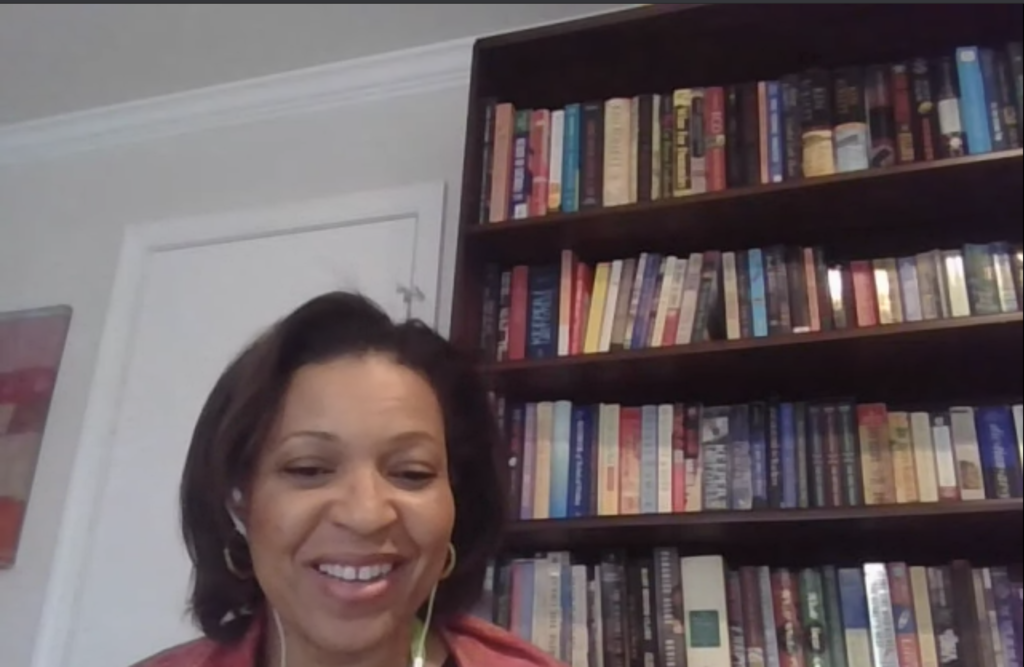
webinar - Kim Hurtault-Osborne,

Kim Hurtault-Osborne, Executive Secretary for Integral Development (SEDI)

  • Share space.  In audio and video we are not just faces and (parts of) bodies.  We inhabit spaces when we participate in a webinar.  Representing those spaces deepens our sense of a person.  Think of what a person’s office tells you about them – the toys, the art, that coffee cup, the particular view from a window.  Or what a living room adds to a persona.  Or a kitchen, train station, car.  Think, too, of what microevents show, as when a pet climbs into view or a child runs through a background.  Video shows these details, and we can make a webinar dwell in those spaces.  The simple act of looking into a presenter’s study makes them more present to us.  Facilitators can bring these details out by drawing attention to them out loud or via text: “Nice painting!” “Oh, what’s the puppy’s name?” “Is that actually sunlight in Seattle?”  Audio doesn’t show such details… except when it does.  We can hear the blurp of a coffee maker, the soft meow of a kitten.  And people can describe – either out loud or via chat – details of their environment.  “Yes, it is snowing again.  In May.  Welcome to the north country.”  “Ooof.  That cat looks light, but when she’s resting on your arms while you try to type…”

So why don’t we do these things?  Why do so many webinars suck?

One reason is that the technology can get in the way.  Some platforms, like WebEx or On24, are focused mostly on sharing slides.  That makes sense, of course, since PPT is a constant in the world, like hydrogen or stupidity.  It takes work to add on the rest of what makes webinars good.  Other tools, like Shindig, Zoom, or Google make it easier for people to present themselves.

Moreover, getting a video platform to work isn’t easy for everyone.  Just getting the basics going can take work, and that can mean saving people’s representation for later.  On top of that, some folks are uncomfortable speaking aloud around a group they might now know, and video can be that much more awkward.

Another reason is that some television trains some of our habits and expectations.

buy lasix online buy lasix no prescription generic

  Most news interviews or talk shows involve two to four people, utterly lacking meaningful audience participation beyond laughter and boos.  Many of those interviews are also based on a pugilistic model, more about scoring rhetorical points and less on supporting and drawing out guests’ thinking.  I usually avoid tv news, but am familiar with the expert panel mode: a reporter asking 2-4 people their opinions.  We can see their faces and, to a lesser degree, their spaces, and certainly hear them.  But there is no audience participation.  It’s essentially a kind of asynchronous presentation, crammed into a synchronous box.

Once we recognize these reasons for bad webinar practice, we can get past them.

To sum up: webinars work better the more participants experience each other as human beings.

More to come.

(photos by OSCE PA, US Secretary of Defense, OEA – OAS)

Posted in coronavirus, videoconferencing | 15 Comments

Transforming the professoriate: this week in the Chronicle of Higher Education

This week I’m doing several things with the Chronicle of Higher Education.

buy nolvadex online buy nolvadex no prescription generic

  They focus on how college and university faculty roles may change as a result of the coronavirus.

First, today the Chronicle published my article “How the Coronavirus Will Change Faculty Life Forever.”  This is some forecasting about how teaching, research, service, the job market, professional development, and more could be transformed after a COVID-19 year.

buy lipitor online buy lipitor no prescription generic

  It’s also the kickoff for another publication, a faculty handbook for surviving the pandemic.

It starts with a touch of design fiction:

It is January 2021, and you are getting ready to begin the new semester.

Fall term was a wild ride, as Covid-19 continued to rack the nation. The pandemic roared through and receded in repeated cycles of infection, relative safety, and reinfection as death tolls rose. During viral lulls, campuses welcomed back students and faculty and staff members, then sent them off campus again as infections and death rates soared. HyFlex term, some called it, a blending over time of face-to-face and digital-learning experiences. Meanwhile, colleges froze or cut spending while the economy staggered through on-again, off-again recessions.

Fall was also your first semester teaching at Tweed College.

buy strattera online buy strattera no prescription generic

After winning that rarest thing over the summer, a job offer, you gladly moved cross-country. You coped with the problems of taking such a complex step in an era of temperature checks at roadblocks and social distancing with movers. It was a whirlwind of unpacking and teaching, committees and departmental meetings.

buy amoxil online buy amoxil no prescription generic

You learned a thousand operational details while trying to keep your research going, your family afloat, and your sanity intact … and all with the novel coronavirus gnawing at our lives.

At last, the winter break gave you a welcome respite, badly needed downtime, and some hours to plan ahead. You are starting the spring semester afresh and with new perspective. What will the new year hold for you?

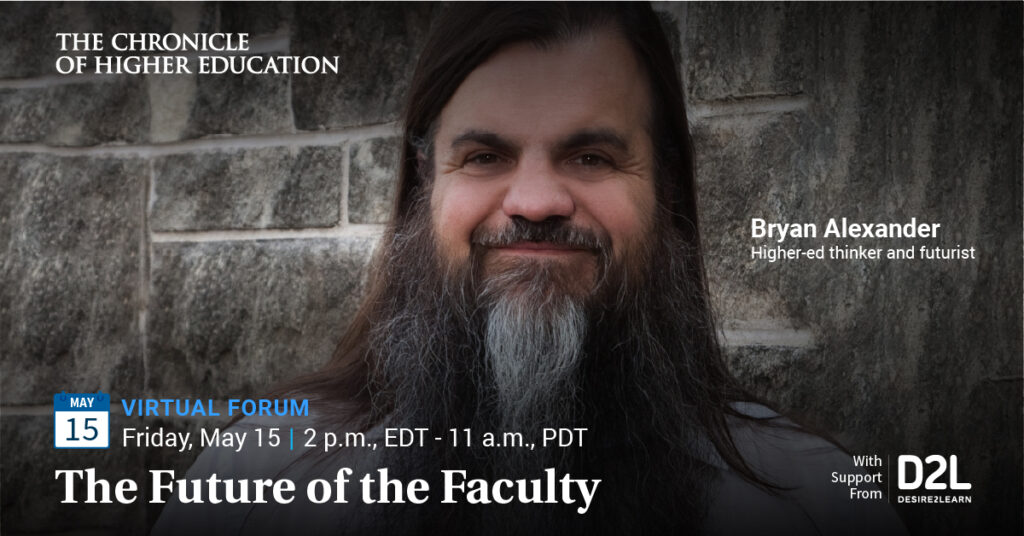
Next, this Friday, May 15th, I’ll be a guest on a Chronicle video discussion.  You can register for the 2-3 pm EDT session here.

Chronicle Future of Faculty banner

I’ll be interviewed by my friend and excellent editor Ian Wilhelm.

From the official description:

This virtual forum will speculate on what faculty life, work, and careers will be like in 2021:
– How will financial pressures impact academics?
– How will teaching and research be altered due to our new remote lives?
– How do you navigate the challenging academic job market, whether you’re a newly minted PhD or a senior scholar?

Please join us.  If you can’t make the live session, let me know here what topics or questions we should address.

I’m delighted that the Chronicle is hosting my writing and conversation this week, and appreciated their editing and hosting.

Posted in coronavirus, interviews, videoconferencing, writing | Leave a comment

A special FTTE COVID-19 report, free and open

Today I’d like to share a COVID-19 and higher education report with you.

FTTE logoIt’s a special edition of my Future Trends in Technology and Education (FTTE) report.  FTTE appears each month, covering nearly 100 trends impacting colleges and universities.

It isn’t normally free.  Each report takes a lot of work to produce, so FTTE has been subscription based since 2018.  But the coronavirus crisis is extraordinary, and I hope FTTE research can be useful to some people in and around academia.  Not everyone can justify or afford the subscription, I know well, especially as the economy sags into recession and worse, so you can now access this one for free.

It isn’t the full May 2020 report.  It’s just the content that bears on COVID-19, which turns out to be about 89% of the whole thing.

buy amoxil online buy amoxil no prescription generic

  So nearly the entire report.

buy wellbutrin online buy wellbutrin no prescription generic

This special report is not only free, but also open.  I’m publishing it under a Creative Commons CC-BY 4.0 license, so you can do whatever you like with it.  Copy and paste it, take out and use the chunks you like, insert pages into a PowerPoint presentation, set it to music, embed bits in a role-playing game, whatever your heart desires…

buy sildalis online buy sildalis no prescription generic

so long as you reference the report’s name and me as its creator.

There isn’t any DRM.  There aren’t any restrictions or requirements of any kind.

Now, if you value the report and have there wherewithal to support FTTE research, I’d greatly appreciate it if you could contribute to its sustainability in this crisis.  If you can, head to the FTTE site and subscribe.  If you prefer, join the supportive crowd on Patreon.  Whichever way you like, as an independent futurist in an economic crisis, I’d be very grateful.

Click here to download the pdf.

With this special open edition I’m continuing what I started in April.  (Just made sure to add the CC license this time.) If people think it’s useful, I’ll keep doing so every month until the pandemic ends in some way.  Let me know what you think.

Posted in coronavirus, FTTE report | Leave a comment

Problems planning for a Post-Pandemic Campus this fall

How will campuses try to return to face-to-face education?  What does it mean now to plan for a Post-Pandemic Campus this fall?

In April I published three scenarios for colleges and universities may approach the fall 2020 semester in the wake of COVID-19, based on different ways the pandemic might play out.  I followed that up with real world examples of each scenario, as different institutions subsequently issued announcements about their plans.  To recap, they are:

  1. COVID Fall: today’s “remote instruction” continues and develops for the rest of calendar 2020.
  2. Toggle Term: campuses are ready and able to switch between online and in-person instruction as circumstances change.
  3. Post-Pandemic Campus: colleges and universities return in the fall to the traditional face-to-face mode after COVID-19’s danger has ebbed to a certain level.

Thinking about the Post-Pandemic Campus option, how can a campus make that work?  What does one need to do to convince people that it’s safe to return to campus?

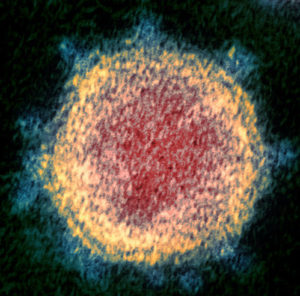
COVID-19 single virusSo far – looking at UVM, Baylor, Purdue, etc. – opening up campus seems to include a mix of practices.  Social distancing is on tap, such as configuring spaces (classrooms, libraries, dorms) to encourage people to separate.   Some proclaim they will operate a lot of testing, although not all do this, and it is not clear that enough testing materials will be available – for many tests – for every campus in time for classes.  Various forms of serious or “deep” cleaning are available, as is some type of surveillance and contact tracing.  Medical staff will grow.  I haven’t heard many mention maintaining a campus perimeter with temperature checks, but I can imagine more than a few attempting this, flaws and all.

I’m getting more worried about this the more I learn about plans and project what they might look like. Here are some reasons why.

One problem is financial pressure, as I’ve explained previously.  State governments will likely cut appropriations to public universities. Enrollment is likely to decline for many institutions.  While some may enjoy growth (think of community colleges online and medical programs), but generally forecasts are nearly unanimous in seeing a drop down compared with fall 2019.  At the same time, many costs will go up. All of these measures I noted above will cost money. So campuses in general may tend to have less revenue and higher budgets.  How will they pay for this?

Another is the likelihood that some people will refuse to go to freshly reopened campuses. Think about students (and parents of traditional-age ones) for whom safety has always been a big concern when considering which campus to attend. Will colleges and universities convince all students that their physical plant is safe?  Will every student believe that the campus  community won’t infect them?

Think, too, about faculty and staff who fear getting ill on campus, especially if they’re older and/or have COVID-19-relevant health problems (hypertension, obesity, diabetes, COPD, etc). How many faculty members, librarians, senior administrators, and custodians will refuse to set foot on campus and risk their lives?  As one professor said, quoted in Colleen Flaherty’s excellent Inside Higher Ed piece:

“I don’t want to think about face-to-face teaching the hordes of students I usually teach until there is a vaccine,” [Alice Pawley, associate professor of engineering education at Purdue and incoming chair of the campus’s chapter of the American Association of University Professors] said, guessing that students have similar health concerns.

How many will shun the physical space because they don’t want to risk bringing infection home to their loved ones and neighbors?  Remember that, as of this writing, no vaccine is available, nor any effective therapy.  How will institutional governance, policy-making, and operations respond when staff and faculty members want a say in the conditions under which they’ll be working if they are expected to work in person next fall.

Let’s assume some faction of campus communities will insist on working and/or studying remotely. If a campus agrees to this (and not all will, not for all jobs), there are extra costs for making it work: financial, reputational, in terms of governance, etc.  Put another way, unless a college or university can someone bring everyone back and also support neither remote work nor remote instruction, we should expect fall 2020 classes and other campus functions to be dual purpose, prepped for both online and in-person modes – simultaneously, plus with room for individuals to switch between them as circumstances change (micro-versions of my Toggle Campus scenario).   Remember that a campus has to do all of this with fewer resources and lot of pressure.

All of the preceding is about preparations before fall term – i.e., over the next few months. Once the semester gets going, what happens when an infection occurs on campus? How many people (students, faculty, staff) will choose to leave the physical area? Will the campus decide to quarantine individuals in certain space, or instead send everyone home again, a la March 2020 and the Toggle Term plan?

Once again, costs will go up, including financial and reputational ones. How often will faculty senates call for no-confidence votes?  Would an administration face student protests for failing to keep them free of coronavirus?  Besides infections, how many students will feel that this online/toggled experience is substandard, and will then either withdraw or request (or sue for) tuition cuts? In that case, how many politicians, governments, foundations, public figures will join them? Recall that fall 2020 is the climax of a very contentious election season, meaning tempers will be high.  This could feed on itself, as the spectacle of students disliking fall 2020 education, criticism of same appearing, lawsuits and protests against tuition and fees could further depress enrollment.

Will academics and academia-adjacent people increase that negative perception? A good number of faculty, staff, and others think online edu is inferior to in-person and will say so, publicly and privately, and some at length. Will administrators tell them to stop, in the name of preserving their shared institution?  I can image legal actions around libel and academic freedom.

In their widely circulated letter Irina Mikhalevich and Russell Powell go further still in imagining the impact of infection on campus:

Imagine the human cost and disruption of but a single case: one COVID-positive student would require the quarantine of every student and instructor that the student came into contact with over a period of two weeks, as well as those with whom those individuals interacted. Even if the student did not infect anybody else, hundreds of students and dozens of faculty and staff would be forced to self-quarantine and their classes and work moved online mid-stride.

How will a campus community respond to its first COVID-19-caused death, either among that population or caused by infection from it?  Consider all of the preceding possibilities, intensified.  We can add to that lawsuits, calls for investigations, wrangling with state and federal authorities, politicians and other public figures calling for campuses to be shut down, and more.

Moreover, the very act of organizing a college or university against COVID-19 could impose other costs.  Imagine a fall semester on a campuses that feels like military-medical encampment, with pervasive testing, security patrols, plexiglas shields in all kinds of places, and sporadic quarantines. Classrooms, libraries, sports stadia, and other buildings could have barriers erected to separate people. I wouldn’t be surprised to see temporary buildings (trailers, tents) in place for handling spatial overflow. It’s sounds like an intense, grim place.  People studying and/or working their may well get depressed, and some decide to withdraw.

I also wonder about the cultural politics of implementing a Post-Pandemic Campus. For example, to the extent that party affiliation sometimes drives different responses to the crisis, different campus populations can express their politics through medical measures, especially as the election heats up – i.e., ostentatiously refusing to wear masks or going after people who don’t.  From another angle, which people will shame or be shamed for not wanting to be on campus? Will some criticize the desire for remote study/work as wimpy, unmanly, too intellectual, or unpatriotic? Will others charge off-campus connections are unsupportive of a college or university or fraternity or profession in its respective time of trial?  From another angle, will critics charge those who prefer to work and/or study on campus with cruelty, arrogance, thoughtlessness, or privilege?  What happens to a sense of community when people tear at each other along these lines?

Let’s conclude by looking further ahead.  If some or all of these possibilities occur on a fall 2020 campus, what kind of spring 2021 semester do they help create?  Will a community come together during these stresses, achieving a good spirit of mutual aid and support, as Rebecca Solnit documents we can in her extraordinary 2010 book Paradise Built in Hell?  Or will colleges and universities reach 2021 financially, physically, and culturally drained?  How many Post-Pandemic schools will be compelled to return to remote instruction, or shut down temporarily or permanently?

My point in this post is not to urge campuses away from the Post-Pandemic scenario.  Instead, I’m trying to help the higher education community think through what implementing it might look like, so we can make better plans and decisions.  It will not be easy.


Posted in coronavirus, higher education, scenarios | 5 Comments

The first wave of pandemic cuts to colleges and universities

April is the cruellest month

-TS Eliot, 1922

In March – which feels so long ago –  I described various ways the pandemic could injure higher education’s finances, pushing some colleges and universities to make painful cuts, while others stepped closer to the abyss.

It wasn’t the most imaginative or counterintuitive forecast I’ve ever written.  And now we see the first wave of COVID-19 cuts in higher education.

They occur across the United States, hitting every kind of campus, from well-endowed research universities to state universities, liberal arts colleges, and community colleges.  The cuts take a range of forms, from layoffs to furloughs to compensation reductions:

  • Antioch College furloughed 27 staff and cut hours and/or compensation to others.
  • Atlantic Cape Community College laid off about 100 staff who could not work remotely.
  • Bob Jones University furloughed an unspecified number of staff.
  • Boston University laid off more than 1600 student workers.
  • Bristol Community College laid off 136 part time workers.
  • Drew University furloughed some staff.
  • Guilford College furloughed 166 people, or “[s]lightly more than half of the college’s 250 non-faculty employees.”
  • Harvard University froze all kinds of raises and projects, while cutting the salaries of its president, VP, and provost.
  • Johns Hopkins University announced a series of cuts, including this strategy: “divisional leaders will exercise their discretion and have to consider furloughs or layoffs when necessary to meet their financial and strategic objectives in such a constrained budget environment…”  They may face a $375 million deficit this fall.
  • Kent State University called for a 20% budget cut, which will be carried out by “reducing operating budgets by 20%, enacting a hiring freeze, postponing new campus construction projects, … reducing spending on athletics,” and cutting senior administrator salaries.
  • Keuka College furloughed an undetermined number of staff while issuing wage cuts.
  • Lake Superior State University will apparently commence layoffs.
  • Lewis-Clark State College ended around 16 staff positions and is working on cuts to faculty.
  • Marquette University furloughed around 250 staff, notably those who could no longer work remotely.
  • Merrimack College laid off 30 staff.
  • Oakland University cut salaries of several senior administrators.
  • Ohio University announced it would lay off 140 staff.  “This (is) our first significant personnel reduction,” [Carly Leatherwood, a university spokesperson] said.”
  • Portland State University will furlough 106 staff.
  • Rochester Institute of Technology will furlough some staff and “is prepared to introduce a salary reduction program.”
  • Rutgers, State University of New Jersey, cut senior administration compensation and signaled it would hire fewer adjuncts this summer and fall.
  • Smith College cut or requested voluntary cuts to some senior administrators’ compensation.
  • Southern Oregon University furloughed 395 staff.
  • Syracuse University cut some staff compensation and froze merit pay increases.
  • Union College furloughed 30% of its staff.
  • The University of Akron announced plans to cut academic programs and student athletics.
  • The University of Alaska will furlough 166 administrators.
  • The University of Arizona announced furloughs and pay cuts to a range of employees.  It also withdrew financial aid packages to grad students.
  • The University of Kentucky furloughed 1700 staff, nearly all in medical care.
  • The University of Louisville furloughed “some employees and will institute pay cuts for those earning at least $100,000…”
  • The University of Massachusetts Medical School furloughed 100 staff.
  • The University of Michigan called for cuts to senior administrator compensation as well as voluntary staff furloughs, based on expecting at least a $1 billion loss.
  • The University of Missouri laid off more than 40 people, mostly in their hospital.
  • The University of Montana laid off 63 staff (although the headline says “furlough”).
  • The University of New Haven cut staff and faculty compensation, furloughing some.
  • The University of Oregon laid off 282 people.
  • The University of Rochester announced it would cut some senior administration compensation and furlough some staff.
  • The University of Tulsa furloughed a number of staff, focusing on those who cannot work remotely.  UT also had its senior leaders have their compensation hit by “a reduction of the equivalent of two weeks of our salaries…”
  • Several University of Vermont senior administrators saw compensation or support cuts.
  • The University of Wisconsin system will furlough staff and also laid off some number of student workers.
  • Valparaiso university furloughed 200 staff and encouraged faculty to take salary cuts.
  • Western Michigan University laid off more than 200 staff.

Also:

  • The National Governors Association and New America published a guide on how states can handle college and university closures.
  • The majority of campus presidents in an AAC&U poll said they expected to cut staff:

coronavirus college president opinions_AACU 2020

  • Vermont State Colleges’ chancellor tried to consolidate campuses, but was driven to resign instead.

I have come across other accounts of impending cuts that I can’t cite here – yet – because they were shared with me in confidence and have not been publicized.

A few reflections on this list: faculty members have largely been spared.  Cuts have fallen on staff instead.  There are few signs of structural or programmatic change.  Many of these are temporary measures.

Have you seen others to add to this list?  Is this something I should make a point of tracking?  And what do you think of the steps taken so far?

(thanks to Michael Nietzel, Stephen Jacobs, Tony Moretti and many others)

Posted in coronavirus, higher education | 35 Comments

My new book project begins: Universities on Fire

I’ve just signed a contract with Johns Hopkins University Press for my next book.  The complete manuscript of Universities on Fire: Higher Education in the Age of Climate Crisis is due in late 2021, aimed at a 2022 publication.

The title should give you a sense of the project, as will my blog posts on the topic.  Here’s a short description:

Universities on Fire explores the future of higher education during an age of unfolding climate crisis. Current studies have traced the likely implications of anthropogenic climate change across a range of domains, from agriculture to policy, urban design, technology, culture, and human psychology.  However, few have explored how climate change can reshape colleges and universities.  Universities on Fire addresses this by connecting climate research to a deep, futures-informed analysis of academia.  It starts with a small focus, a given campus, then gradually expands its view to the level of how academia as a whole interacts with civilization’s broadest movements.  

fire

Here’s the proposed table of contents:

  1. The heat is on. A quick summary of what we understand about climate change means, and the scope of this book: to the year 2100, all of global higher education. A note on method: horizon scanning and trend analysis, relying on simulations and scenarios.  A sketch of campuses as institutions in the midst of great what: which populations will engage in what ways with climate change?  The theme: climate change will literally reshape many institutions.
  2. Uprooting the campus. Colleges and universities rethink their physical plant.  Campus buildings and grounds will be rethought, revamped, and possibly replaced in the pursuit of carbon neutrality, mitigation, and adaptation, at times responding to immediate physical changes to their environment.   On-site transportation, the academic calendar, campus power generation, food, sanitation, financing, and off-site travel are up for transformation.  Campus IT and inequities among academic populations receive special attention.  Ultimately some campuses will choose to relocate away from endangered sites, leading to a potential Great Academic Migration.
  3. Doing research in the Anthropocene. Each academic discipline faces the possibility of great change in this period in response to climate-related demands both from within their professional population and from the broader world.  We consider individual fields within the natural sciences, the social sciences, the humanities, and the arts.  Some are likely to grow, such as environmental studies, climate science, computer science, agriculture, civil engineering, and meteorology.  Others may drop away or transmute into something very different, like petroleum engineering.  Still others may see their subjects change as the crisis unfolds, such as allied health care, law, museum studies (how to preserve or document endangered sites?), economics, or political science. Each may extend themselves transdisciplinarily to grapple with climate change, and new interdisciplinary fields will appear.
  4. Teaching to the end of the world. The structure of education is likely to shift as the world becomes more uncertain.  A 60-year curriculum now means considering teaching how to survive or address civilizational crises.  Collaborative teaching across campuses can power new concentrations.   Student life, internships, and career planning have to  be reconsidered.  Faculty may adjust their pedagogies accordingly – a shift to more project-based learning, for example, with an emphasis on climate topics.
  5. Town, gown, deserts, and rising sea levels. Colleges and universities are embedded in local communities whose political pressures, social structure, and material conditions will change as the Anthropocene progresses.  Town-gown relations may become more fraught with political clashes between the two, new regulations (either from climate change mitigators or deniers), and climate gentrification.  Are new connections between post-secondary and secondary schooling possible?
    buy xifaxan online buy xifaxan no prescription generic

      How should campuses respond to locally-arrived climate and climate-driven refugees?  When should institutions contribute materially or intellectually to local climate change efforts, such as building seawalls?

  6. Academia versus the world. Campuses are also subject to an extent to national policies and political movements.  How should academia respond when a nation or society mandates carbon neutrality, adopts a circular or degrowth economy, advances a reduction in births?  How does a campus conduct digital work if broader networks degrade, or if policies compel a retreat from carbon-intensive technology?  To what extent can academics serve as public intellectuals to shape these debates? Should we participate in projects like the doomsday seed vault or offer campuses as climate sanctuaries? Should academics organize globally to help mitigate or adapt to climate change?  Can academia take a leading role on the world stage?
  7. Worst case scenario. How does academia fare in more dire climate conditions than those assumed in the preceding chapters, such as those driven by sudden ice sheet collapse, the release of large amounts of clathrate methane, the trans-Atlantic thermohaline circulation ceasing, the Amazon rainforest reverting to savannah, or temperatures rising 3-5 degrees by 2100 or sooner?  How does the campus physical plant, its research and teaching missions, town-gown relations, and campus-world connects change in ways other than those we have explored thus far, especially when pressures are even more intense and the situation more chaotic?
  8. What is to be done? We assess practical responses and strategies for the present by surveying contemporary programs and strategies from around the world, starting by acknowledging the vast amount of academic climate research and the growing amount of climate classwork.  Study groups, teach-ins, and political groups are organizations with ample precedent. Professional development opportunities for staff and faculty exist. There are campus leadership commitments and alliances. A rising number of students, faculty, and staff will seek to take steps for their institutions.  All campus and academia-adjacent populations can play a role.

A note about timing:  I pitched this book over winter, when the Wuhan infections were just starting to get attention.

It may seem counterintuitive to address climate change when COVID-19 is such a dire and present threat.  I do not discount the pandemic in the slightest.  However, the climate change threat is also present and far more deeply embedded in planetary systems.  It will continue to build during and after the pandemic wreaks havoc on civilization.  COVID-19 will strain social and academic resources, weakening them as we turn to address climate change.  Yet if we respond thoughtfully to the virus, we may be better positioned to guide academia through the Anthropocene.  We may develop more effective collective action mechanisms, a greater appreciation for science, and a stronger sense of higher education’s role within the larger world.

At the same time academia faces other challenges, including those outlined in the author’s previous JHUP book: financial sustainability, declining state and public support, the adjunctification of the professoriate, enrollment issues (both overall as well as for specific programs).  For reasons of space Universities on Fire cannot devote a full treatment to each of those, and we should defer readers to Academia Next.  The new volume will, however, place academia’s responses to climate change within that broader and active context throughout.

buy prednisone online buy prednisone no prescription generic

Two more notes:

This is my second book with Johns Hopkins.  In late 2017 they signed me up to write Academia Next.  They were and are terrific to work with. I’m delighted they let me back in the house for another round.

And I’d like to make the writing of this one as public and social as I can.

buy desyrel online buy desyrel no prescription generic

  As with Academia Next I hope to try out arguments, ideas, and visuals with audiences along the way.  I’ll keep blogging on the topic as my research and writing proceed.  I do plan on inflicting the work on my long-suffering Georgetown students and colleagues.  And I have some creative ideas for doing this work in the open, including gaming and some various technologies.

buy glucophage online buy glucophage no prescription generic

Thank you, my readers, for your engagement on this topic, the largest one I have ever tackled.  I would love to hear from you about points you’d like me to address, research I especially need to heed, and ways of doing this work in public.

There’s much more to come.  I am very excited to get writing!

Posted in climatechange, writing | 16 Comments

Early signs of fall 2020: three paths, three scenarios for higher education

Several days ago I posted a set of scenarios for how higher education might function during this upcoming fall semester, depending on how the coronavirus pandemic develops.

One of the scenarios, COVID Fall, imagines today’s “remote instruction” continuing for the rest of calendar 2020.  Another, Post-Pandemic Campus, envisions colleges and universities returning in the fall to the traditional face-to-face mode after COVID-19’s danger has ebbed to a certain level.  A third, which I called Toggle Term, described campuses being ready and able to switch between online and in-person instruction as circumstances changed.

That post elicited a lot of attention, from plenty of good comments to NPR appearances (1,2) and a Wall Street Journal interview (forthcoming), which suggests – unsurprisingly – that planning for fall 2020 is top of mind for people thinking about colleges and universities. The broad range of responses also suggests that the situation is wide open, even chaotic.

Since then several stories have appeared which look to me like cases of campuses planning on fulfilling these scenarios, or at least very early signs thereof.  Let’s look into them.

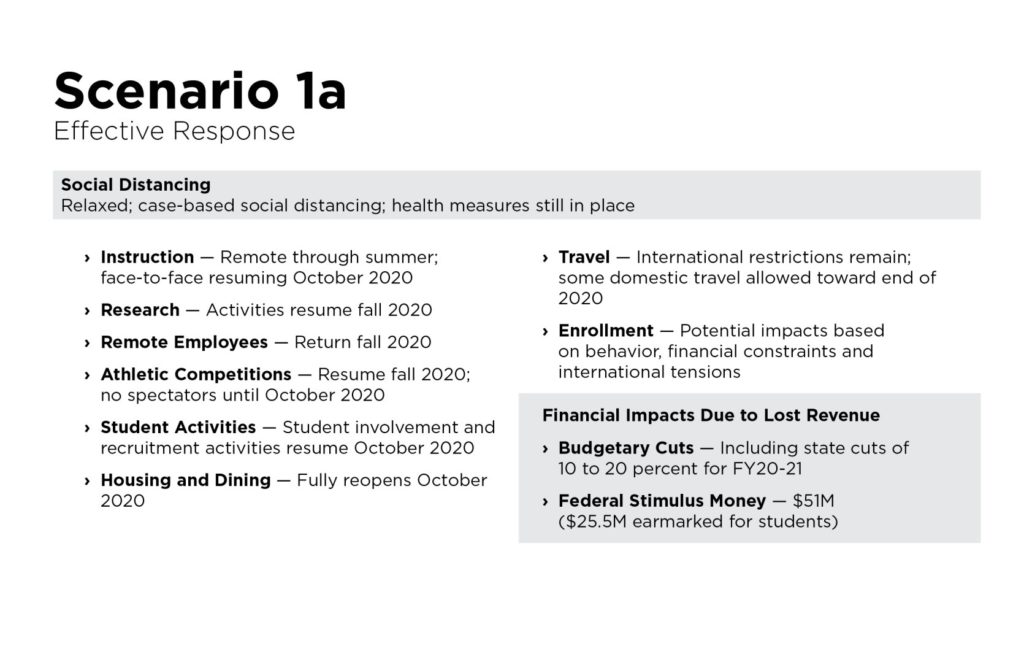
Post-Pandemic Campus The University of Central Florida created several scenarios for fall 2020.  Two of them describe face-to-face campus activities resuming that semester:
UCF fall scenario 2020 1
UCF fall 2020 scenario 1a

Along those lines, last week Purdue University’s president stated that that campus will offer an in-person fall term.

Fall 2020 will not be a re-run of fall 2019, since administrators plan on paying attention to infection’s possibilities.  Initial tactics discussed include:

spreading out classes across days and times to reduce their size, more use of online instruction for on-campus students, virtualizing laboratory work, and similar steps.

We will look to protect the more vulnerable members of our community by allowing (or requiring, if necessary) them to work remotely…

an indefinite prohibition on gatherings above a specified size, continued limitations on visitors to and travel away from campus, required use of face coverings and other protective equipment, frequent if not daily deep cleaning of facilities…

Testing and surveillance are also likely:

We intend to know as much as possible about the viral health status of our community.  This could include pre-testing of students and staff before arrival in August, for both infection and post-infection immunity through antibodies.  It will include a robust testing system during the school year, using Purdue’s own BSL-2 level laboratory for fast results.  Anyone showing symptoms will be tested promptly, and quarantined if positive, in space we will set aside for that purpose.

We expect to be able to trace proximate and/or frequent contacts of those who test positive.  Contacts in the vulnerable categories will be asked to self-quarantine for the recommended period, currently 14 days.  Those in the young, least vulnerable group will be tested, quarantined if positive, or checked regularly for symptoms if negative for both antibodies and the virus.

There is a philosophical approach behind these initial plans:

a return-to-operations strategy is undergirded by a fundamental conviction that even a phenomenon as menacing as COVID-19 is one of the inevitable risks of life.  Like most sudden and alarming developments, its dangers are graphic, expressed in tragic individual cases, and immediate; the costs of addressing it are less visible, more diffuse, and longer-term.  It is a huge and daunting problem, but the Purdue way has always been to tackle problems, not hide from them.

“one of the inevitable risks of life”: the pandemic is not something extraordinary but is instead just another thing we have to worry about.  That view echoes some current Republican opposition to lockdown measures.

Brown University’s president offered a similar call for in-person classes to resume this fall semester.  As with Purdue, there are several measures on the table:

Testing is an absolute prerequisite. All campuses must be able to conduct rapid testing for the coronavirus for all students, when they first arrive on campus and at regular intervals throughout the year….

Testing and tracing will be useful only if students who are ill or who have been exposed to the virus can be separated from others. Traditional dormitories with shared bedrooms and bathrooms are not adequate. Setting aside appropriate spaces for isolation and quarantine (e.g. hotel rooms) may be costly, but necessary. It will also be necessary to ensure that students abide by the rigorous requirements of isolation and quarantine.

IT plays a key role:

Traditional contact tracing is not sufficient on a college campus, where students may not know who they sat next to in a lecture or attended a party with. Digital technology can help. Several states are working to adapt mobile apps created by private companies to trace the spread of disease, and colleges and universities can play a role by collaborating with their state health departments and rolling out tracing technology on their campuses.

Such measures raise a different philosophical problem than the one Purdue’s president introduced. What happens to student privacy and freedom of movement?  President Paxson has an answer:

Aggressive testing, technology-enabled contact tracing and requirements for isolation and quarantine are likely to raise concerns about threats to civil liberty, an ideal that is rightly prized on college campuses. Administrators, faculty and students will have to grapple with whether the benefits of a heavy-handed approach to public health are worth it. In my view, if this is what it takes to safely reopen our campuses, and provided that students’ privacy is scrupulously protected, it is worthwhile.

She also clearly rejects the Toggle Term scenario, stating that Brown’s

plans must be based on the reality that there will be upticks or resurgences in infection until a vaccine is developed, even after we succeed in flattening the curve. We can’t simply send students home and shift to remote learning every time this happens. Colleges and universities must be able to safely handle the possibility of infection on campus while maintaining the continuity of their core academic functions.

William Jewell College made a similar announcement.  “[I]t intends to reopen campus for in-person classes on Aug. 26.”  There will be testing, and “[u]pon request, students will be given private residence hall rooms at no extra cost.”  There are also some differences from Brown and Purdue.  For one, WJC is outsourcing some of their strategy:

The College partnered with MRIGlobal, international biorisk experts highly skilled in identifying and containing outbreaks. MRIGlobal has reviewed Jewell’s safety practices and will train faculty, staff and students on the best protocols for the current health care climate. Headquartered in Kansas City, MRIGlobal will conduct biological cleanup if anyone on campus is diagnosed with the coronavirus.

The college will also link up with a nearby entity:

Jewell already collaborates closely with health care teams and administrators at Liberty Hospital—just three miles from campus—and will continue to work closely with Liberty Hospital to ensure that students have access to quality health care.

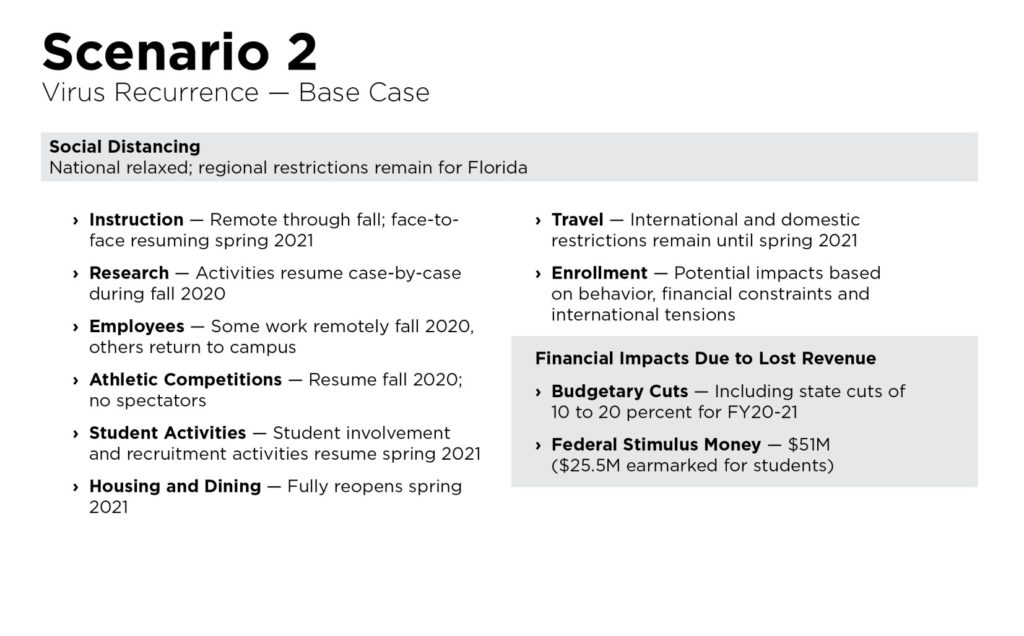
COVID Fall One of the aforementioned UCF scenarios forecasts online education running through December 2020:

UCF fall 2020 scenario 2

Another, worst case scenario, pushes remote instruction through summer of 2021:

UCF fall 2020 scenario 3

San José State University looks like it’s planning on fulfilling at least scenario 2, with fall 2020 classes to be entirely online.

“It is probably a bit over-used to call it the “new normal,” but I am not sure higher education, in the near or long-term future, will look the way it did a year ago,” SJSU Provost Vincent J. Del Casino Jr. said in a letter Wednesday. “The best option, for now, based on what we know is to plan that the majority of our courses — particularly lecture courses — will be fully online.”

Toggle Term In a campus town hall Cal State Fullerton (CSUF)’s provost announced plans for that institution to begin fall 2020 entirely online, but to plan on switching back to in-person education.  “Cal State Fullerton plans to start the fall semester with virtual classrooms and will gradually ease restrictions when it is safe to do so, officials said…”

When making the decision to reopen, the university will heed the advice of state officials, the Chancellor’s Office, the Orange County Health Agency and Centers for Disease Control and Prevention…

Plans echo those from Purdue and Brown above:

As for plans to gradually open the 40,000-student campus, the university must be able to ensure adequate physical and social distancing and also take into account that there could be spikes of the virus in the future that would require flexibility, she said.

Johns Hopkins University also hinted at a toggle term:

We are understandably committed to the expeditious resumption of our university’s various activities. But the timing and the extent of that resumption must in the first instance be guided by the health and safety of our faculty, staff, students and patients. This will doubtless mean that some activities are resumed before others. It will also mean that the resumption of these activities will require all of us to be flexible and open-minded in how we work in, and contribute to, the university. We may need to stagger work hours and shifts, limit the density of occupants in certain spaces, and limit exposure of some employees over others (for example, those who are more at-risk for serious health consequences from COVID-19). We also need to accept that the re-emergence of infection in certain populations may require a return to self-isolation. [emphases added]


Some reflections on these announcements and cases:

My intuition is that some of these statements are trial balloons, lofted to elicit reactions sooner rather than later.  I like the way UCF carefully considered multiple possibilities.

Geography may play a role in which schools decided to resume in-person classes, as Lilah Burke observes:

One reason for the differences in messaging might be location. Fullerton and San José are in some of the most populous metropolitan areas in the country. West Lafayette, Ind., and Liberty, Mo., are much less dense…

“A residential campus like the University of Idaho that’s in a fairly isolated location depends so much on really bringing students to that location,” [Chuck Staben, former president of the University of Idaho] said. “They’re going to try very hard to have a face-to-face semester.”

Party politics can shape these decisions – a likelihood that may increase as the 2020 elections heat up.  Burke links academia to state and national politics:

With governors sometimes taking radically different approaches to the virus response, it’s possible that the politics of a state could affect its opening. Southern states with Republican governors, such as Georgia, have been pursuing aggressive reopening plans in the hopes of limiting economic damage.

It’s possible that Purdue’s president, Mitch Daniels, is making this statement for non-academic political reasons.  Daniels was Indiana’s Republican governor for two terms, and these remarks could be aimed at the current open-the-economy tendency within the GOP.   Perhaps he’s angling for a position of some kind in the Trump administration. (I’d love to hear from more Indiana folks on this)

Tony Moretti compares the Purdue and Johns Hopkins announcements very well, and I’d like to build on that post.  Each offers a different kind of American cultural politics.  JHU emphasizes care and caution, while Purdue stresses boldness and a can-do attitude.  JHU doesn’t want to lose a single person, but Purdue seems close to be willing to accept some casualties.

It’s almost a question of style.  Purdue is “sober about the certain problems that the COVID-19 virus represents, but determined not to surrender helplessly to those difficulties but to tackle and manage them aggressively and creatively.”  In contrast, JHU:

Time, as well as the development of sound and reliable data and the tremendous expertise of public health colleagues, will allow us to make more accurate assessments of the risks of various courses of action. This means that our decision-making needs to be measured and evidence-based. We will take decisive and urgent actions today in order to manage our risks, but we also want to see how the pandemic develops over time, to gauge the effectiveness of our efforts towards resumption of work, and then, on the basis of this information, to make sure that we are neither under- nor over-reacting to the pandemic.

The pair come close to the liberal and conservative models George Lakoff identified.  In that view liberals speak from a metaphorical set based on supportive, nurturing, open families, while conservatives prefer the stern parents in traditional gender roles.  All that’s needed for Baltimore and West Lafayette to fit the picture is more family language.

Last note: these are early days yet.  Campus leaders are struggling to make decisions in a very uncertain situation, buffeted by a set of complex and growing forces.  Being open about process and options can blow back, as we saw when Boston University ran an article on very sensible fall plans for that campus, only to have media outlets misread it.  I suspect senior administrators are consulting very intensely and watching each other for signals of decisions to come.

Have you seen any other examples of colleges or universities following these three scenarios?

(thanks to Tyff, Lindsay Ellis, and Tony Moretti)

Posted in coronavirus, scenarios | 9 Comments

Higher education in fall 2020: three pandemic scenarios

How will the pandemic change higher education?

I’ve been exploring and researching this for months now on this blog, with the Future Trends Forum, on Twitter, with my Patreon supporters, through a series of interviews and webinars, and more.  For today’s post, I’d like to build on that work to offer some scenarios for how higher education could develop by fall semester 2020.

The main driver shaping each one is three models of the pandemic itself.  In late March I published a set of scenarios for how COVID-19 could play out.  They included:

  1. The Hubei Model: A Single, Short Wave
  2. Viral Waves: Long Duration, Uneven Impacts
  3. The Long Plague

The titles are fairly explanatory.  Each one differs in terms of length, shape, casualties, and overall impact. For more background you can read the post.

What might higher education look like in each different pandemic future?  I suggest:

  1. The Post-Pandemic Campus
  2. COVID Fall
  3. Toggle Term

Caveats: in this post I am exploring future possibilities.  I am not endorsing any particular analysis, political party, or course of action.  I am also not assessing relative likelihood of these scenarios.

My primary target is United States academia, because of circumstances.  Yet I think what follows can be applied to most nations, with some tweaking depending on local circumstances.

Each of these scenarios is a sketch.  I try to cover as much institutional ground as I can, touching on curriculum, research, libraries, sports, etc.  If you can think of an academic aspect I’ve missed – excellent!  The comment box is yours.  The idea of these scenarios is not to be the final word, but to spark thought.

I: POST-PANDEMIC CAMPUS

In fall 2020 the great pandemic has largely passed.  Government after government has published figured showing infections and deaths dropping down to or below acceptable flu levels, after spikes and crises in springtime.  Economies and civic life are rebounding as people increasingly return to face-to-face activities, albeit not to pre-COVID extent.  It is a time of rebuilding and some reflection.
Boyle After the plague

Colleges and universities have re-opened for in-person classes and research.  The CDC has issued cautious guidance allowing this; state health authorities have published similar if varied notices. Students, staff, and faculty have returned, albeit in lower numbers than before.

The reason for those lower numbers is that some people are not wholly convinced COVID-19 has passed.  Some do not trust various authorities: WHO, national governments, national health authorities, science, mass media.

Others are skeptical that campuses are safe.  They point to conflicting scientific reports about the ability of the virus to life on physical surfaces.  They worry about social networks, knowing well how readily students network with each other: stock figures here include Liberty University transfer students and the notorious spring breakers.  They consider and share stories of coronavirus infections on campus or among campus populations in early 2020, as well as well intentioned acts like one college opening its residence halls to infected homeless people.

Colleges and universities  – especially those with large residential student populations – go to great pains to assuage these concerns.  They station expanded security forces around a perimeter, checking any person who would set foot within with forehead thermometers.  Schools publish detailed accounts of how thoroughly they have cleaned every single campus space, from libraries to classrooms and especially dorms.  They share safety certificates issued by various medical authorities.  They maintain infection-tracking databases of each student, staff member, and professor, and do not publicize the contents or their conclusions.  Some campuses publish detailed augmented reality content aimed at attracting tech-interested folks to return.

This is not entirely successful.  Some students, staff, and faculty prefer to work from home (and there is a flurry of legal and policy action around this preference).  The great migration online from February-May established that this could be done successfully, at least to a minimal baseline.  As a result every campus activity simultaneously blends face-to-face with online presence.  Each on-site seminar, lecture, staff meeting, interview, faculty senate, football game, theatrical performance, and presentation is paired with video screens, microphones, cameras, and text chat for remote participants.  There is no settled name for this practice, but people try all kinds of terms: bimodal, blended, amphibious.

Research is similarly bimodal, as not all researchers and support staff are willing to return to labs and libraries.  Resources are allocated differently than they were in 2019, as pandemic and recovery fields are deemed more urgent.  Digital work of all kinds is on the rise, from telepresence manipulation to analyses of big data.

Pedagogy is more blended than ever, as a given class tends to contain a mix of in-person and remote students and faculty members.  A wide range of pedagogical practices are in play, from asynchronous LMS discussion to live video discussion and virtual reality explorations.  Some faculty work to expand their abilities in this hybrid space, while others fall back on pre-plague habits.

Enrollment in classes and majors has changed somewhat since 2019-2020.  The full range of medical fields is more popular.  Business and economics are even more popular than ever, given the needs of rebuilding nations.  Political science and government enjoy larger enrollments given the extensive concerns about surveillance, governance, and geopolitics.  Classes about COVID-19 or about pandemics in general see higher numbers, from history to literature and anthropology.

Some staff enjoy greater respect than they once held.  IT, instructional design, and academic computing staff are quietly lionized for their heroic work.  Librarians impress by their ability to work from within or beyond their building’s walls.

Depending on campus culture, some faculty members have become stars for their ability to teach in 2020’s new environment.  Students and/or administrators may showcase them.  Alternatively, or at the same time, some professors may be celebrated for their return to form in face-to-face class.

The combination of these changes means colleges and universities are suffering a financial hit as compared with calendar 2019.  Springtime’s sudden migration online, refunds, deep cleaning, expanded security etc. all added costs.  Overall enrollment is down (depending on the campus) and some discount their tuition, cutting revenue back.  Institutions try all kinds of strategies to stay afloat: early retirements, flatlining professional development, hiring and/or firing adjuncts, increasing student workers, furloughs, cutting maintenance, suspending retirement payments.  Academic program prioritization exercises and the occasional declaration of financial exigency enable administrations to remove tenure-track faculty.  State governments urge some campus closures and/or mergers.

Liberal arts colleges welcome the change back to face to face experience, as they were often predisposed against remote instruction.  Public universities struggle to balance drops in both enrollment and state support, then struggle to transform their curricula in a hurry.  In contrast community colleges pivot rapidly to the pandemic curriculum; some enjoy rising enrollments where and when unemployment runs high.  Some research universities are able to bank on their role in addressing the pandemic through R&D plus local medical support.

II: COVID FALL

In autumn 2020 COVID-19 still ravages nations.  There is no sign of a vaccine on the horizon.  No effective therapy has been devised beyond keeping infected people as comfortable as possible while their body struggles.  New outbreaks occur worldwide.  The total number of cases is upward of 500 million and the death toll stands somewhere between 1 and 4 million, although numbers are contested and variable.  The global economy is in a depression, even including nations relatively free from the pandemic.

Nations and communities differ on how they are handling the pandemic politically, socially, and culturally.  Some governments are heading towards collapse, unable to organize relief.  Others are heading towards or have achieved authoritarian powers, conducting massive surveillance, and using both digital technologies and analog force to control their populations.  Old and new religious movements have gained adherents, while science’s reputation sinks by the week.
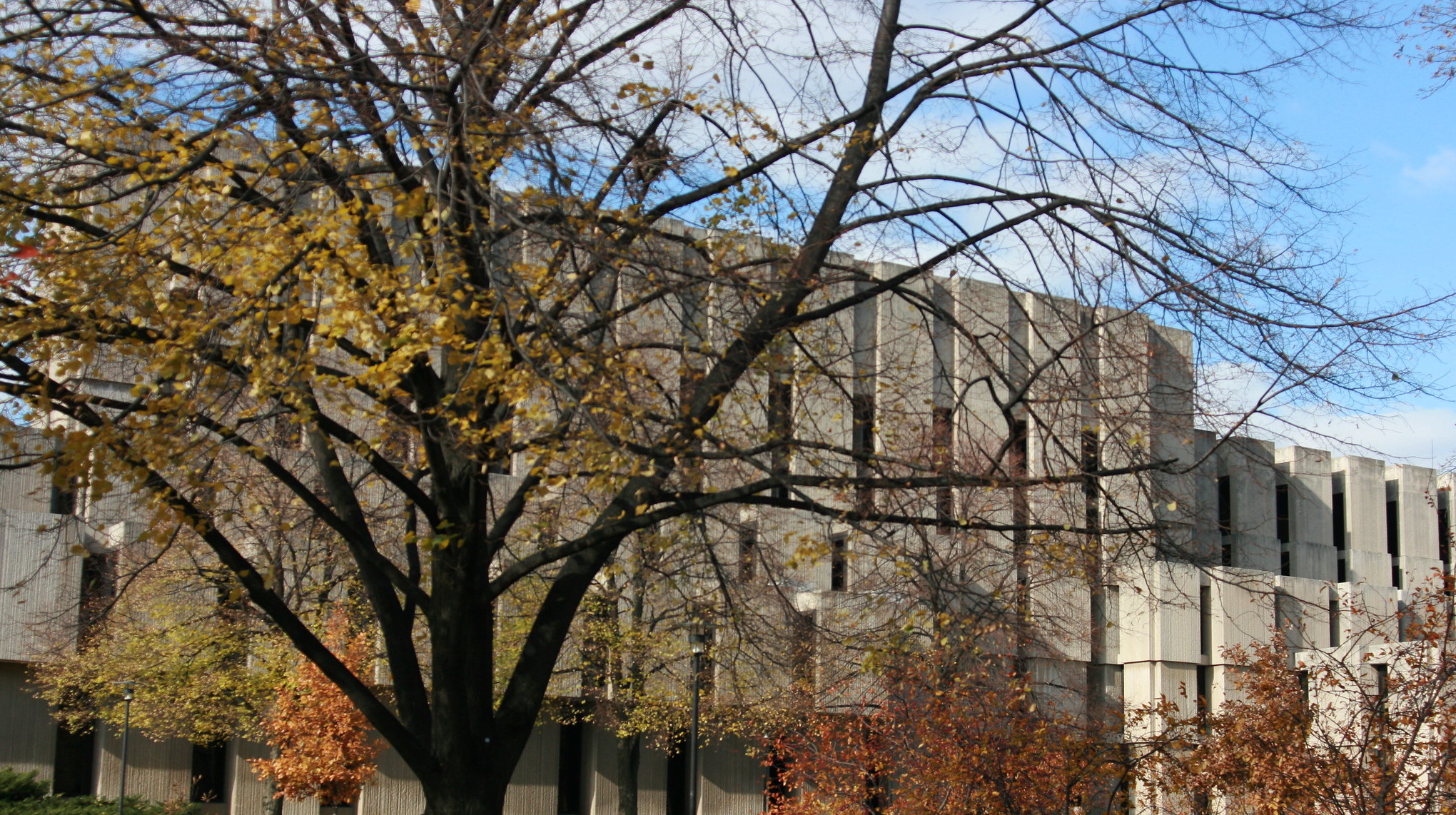
campus autumn Quinn Dombrowski

Higher education is entirely online in this scenario.  Classes, student life, research, and service all occur digitally.  Orientation, Greek life, sports, glee club are online.  So are advising, counseling, internships, and career placement.  Paracurricular centers – writing labs, quantitative literary centers, research help, etc. – all have a digital presence.

Research is entirely online, with varied impacts depending on discipline and institutional type.  Many humans find themselves thrown on which physical texts they have immediate access to, along with the digital world.

Pedagogies vary across institutions, academic units, and instructors.  One school of thought calls for choosing technology based on student inequalities, so advises using asynchronous, low-bandwidth tools, including email, texting, mailed CDs and DVDs, along with print materials.  Opposed to them is a practice based on using technology to maximize interpersonal presence.  These faculty and support staff prefer synchronous and rich media experiences: high definition video, videoconferencing, virtual and extended reality.  Between these two poles stretch a wide range of practices.

Post-secondary curriculum has changed significantly since winter 2019-2020.  The pandemic drives the lion’s share of offered classes, majors, and enrollment.  Medical, premed, allied health, and public health are at the center of most campus catalogs.  Economics and politics follow closely, gaining as their respective fields of study degrade in the world.  Some faculty members and department leaders in other fields strive to partake of this shift, offering classes, minors, majors, certificates, and courses of graduate study that link their intellectual domains to COVID-19: pandemic studies, anthropology of plagues, plague literature, epidemics in history, plagues in Italy then and now, etc.

fernsIn contrast, all other fields tend to shrink, partly due to students voting with their feet.  Partly this is due to a powerful sense of national urgency, expressed through state governments, activist trustees, and a range of funders: grant agencies, foundations, philanthropic individuals, the most influential alumni.

A more powerful reason driving universities and colleges to rearrange their curricula is because most campuses are suffering badly from financial stresses.  I’ve articulated the reasons for this previously.  They include the many impacts on a campus from a generally rotten economy, higher costs from making the transition online, losses from lower enrollments, and possible tuition cuts.  In emergency mode many colleges and universities will see pivoting to a COVID curriculum as a survival path. Other departments can experience personnel cuts, mergers with other departments, or being simply closed as this academic program prioritization proceeds.

Colleges and universities will try other methods to raise funds.  Given unused campus spaces, they may offer buildings for emergency purposes and for fees.  Some may organize inter-campus collaborations to share resources of all kinds, from operational services to digital collections and classes.  Enterprising campuses may offer their digital capacities to help other schools or organizations.

There may well be fewer colleges and universities by December 2020 as some see their economic viability dwindling.  Mergers – which are really acquisitions – will be floated.  Multi-campus systems and state governments can press for consolidations.  Closures will occur.

Town-gown relations can be very stressed in this scenario.  Rising dislike of science can play out with local resentment of scientific faculty.  Economic crisis stokes jealousy in both directions.  Cultural differences can become flashpoints.

Liberal arts colleges struggle with what they see as inferior or dematerialized instruction, and develop what they deem a uniquely liberal arts approach to the COVID fall term.  Public universities struggle to survive; those with advanced online learning capacity are better positioned.  Community colleges follow a similar pattern, depending on how much online teaching they can offer; some enjoy rising enrollments where and when unemployment runs high.  Research universities focus attention on their role in addressing the pandemic through R&D plus providing some local medical support.

III: TOGGLE TERM

In this scenario fall 2020 is marked by rapidly succeeding viral waves.  A country or region can be relatively free of COVID-19 for a time, then the pandemic roars back, driven by mutation or a new infection vector.  Nations and cities toggle between states of lockdown and openness, depending on their sense of epidemiological data and practical feasibility.  Economies are chaotic as market prices and supplies fluctuate.
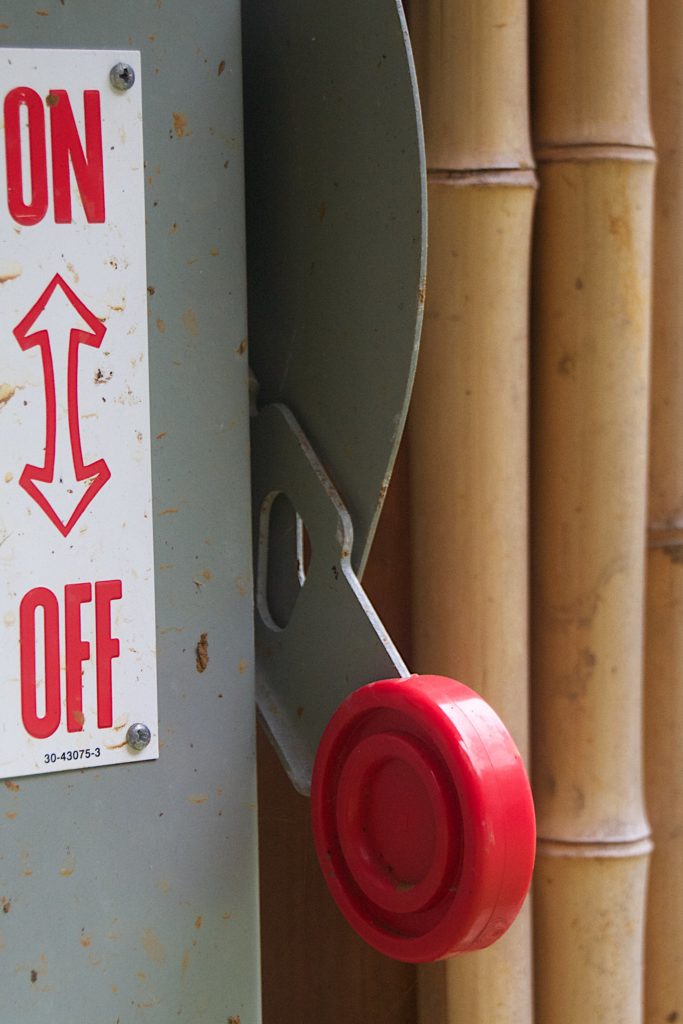
on off switchColleges and universities are now in perpetual crisis mode.  Their leadership teams scan pandemic news minutely, aided by their medical faculty, looking for signs of when they can welcome their community back on site, and when to send them away and flip the switch to entirely online work.

Curricula have shifted towards the pandemic as in our previous two scenarios, but with a greater emphasis on organizational transformation and crisis management.

Classes now exist in a kind of double life, as faculty have created both online and face-to-face materials and plans for the entire semester.  Lectures are prerecorded when possible, either for classic flipped classrooms or for remote instruction.

Campus services are similarly structured.  Libraries, academic advising, mental health counseling, wellness centers, financial aid, bursars, work/study, career services and more are all ready to engage the community through in-person or on-line services.

IT departments work at a fever pitch.  They must be ready to respond to very fast demands for changing delivery modes.  Academic computing and instructional design staff work constantly with faculty to help maximize the pedagogical affordances of both modes.

Not all members of a campus community can toggle back and forth in their own lives.  Some students decide to stay at home and engage remotely, while others manage to live on campus housing in quarantine circumstances.  Some faculty and staff prefer to work from home.  The end result by semester’s end is closer to the bimodal form we saw in scenario 1.

Toggling back and forth can be exhausting to all involved.  Calls to pick one and stick with it will rise.

Town-gown relations are actually quite close in this scenario, as both entities experience the same toggle process.  Universities and local authorities cooperate in this ongoing disaster management process.

Liberal arts colleges experience the toggle as a swap between two very different qualities of experience, preferring the in-person form.  Public university systems pool resources and expand their collaborative planning, achieving something close to “systemness.”  Community colleges focus their work on online teaching, but arrange syllabi to take advantage of in-person learning to do hands-on work.  Research universities focus on what they discover in the medical world, as well as their analyses of organizational transformation in this extraordinary time.


What do you make of these scenarios?  How do you see your institution or yourself in each one?

(academic building photo by Quinn Dombrowski; on/off switch by Alan Levine)
Posted in coronavirus, future of education, scenarios | 35 Comments