How important is higher ed to Americans?

What do Americans think about higher education?

buy doxycycline online buy doxycycline no prescription generic

  According to a new Gallup poll we value it a bit less than we recently did.

For anyone involved in or thinking about higher ed, this is important data.

To begin with, the big picture:

Americans view college edu_2013-2019

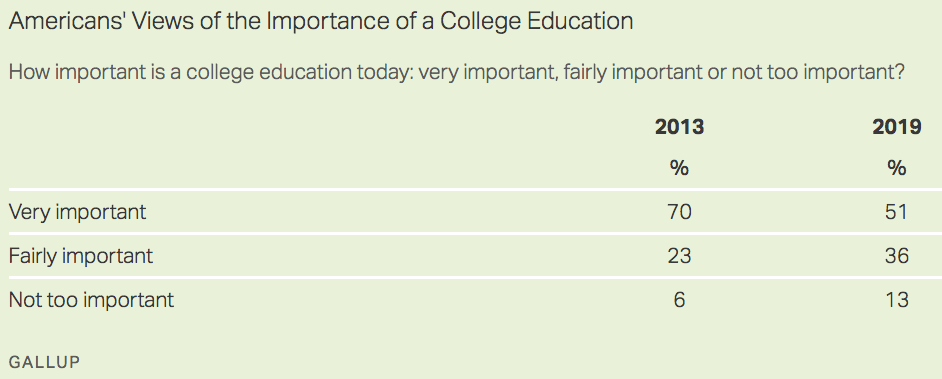
Note that this is partly – mostly – a shift from “very important” to “fairly important,” which isn’t the same as saying “it’s not important.”  That said, “not too important” more than doubled.

buy zydena online buy zydena no prescription generic

  It started small, but isn’t invisible, about one seventh or one eighth of the nation.

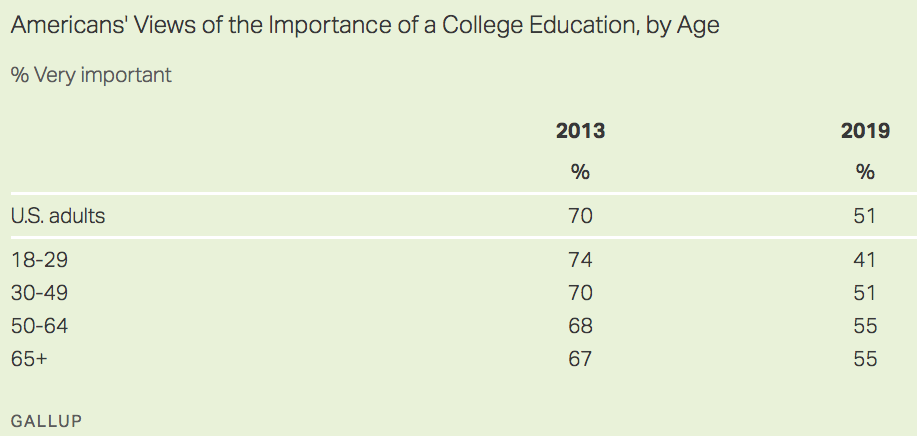
Changing attitudes are especially pronounced by age.  Note the massive drop by people under 30:

Americans view college edu_2013-2019 by age

Gallup observes: “younger adults are now less likely than middle-aged adults and seniors to consider college as very important, whereas the different age groups held similar perceptions in 2013.”

It’s interesting to square this with the way that older folks tend to be more conservative.

At the same time there are also strong differences by race and gender.

buy caverta online buy caverta no prescription generic

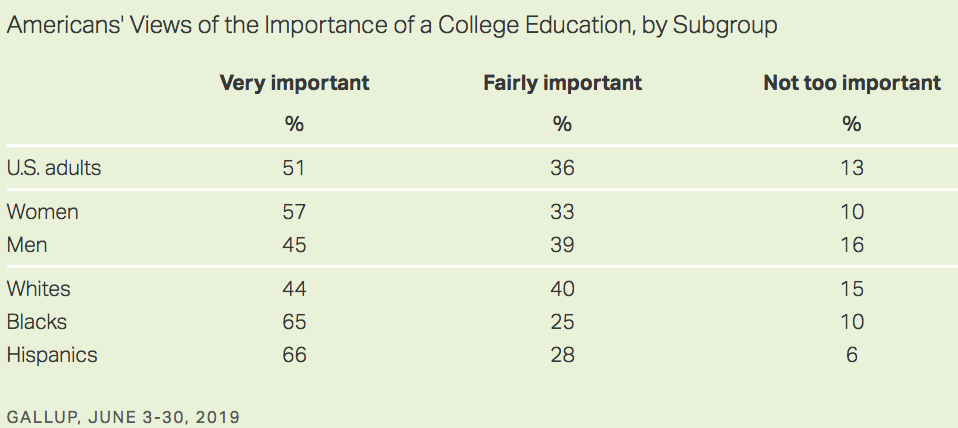
   It tends to be white males who are really losing faith, while more women and especially blacks and Hispanics still see value:

Americans view college edu_2013-2019 by gender and race

On the gender drop, “In 2013, 75% of women and 65% of men said a college education was very important.”  And about 1/6th of men see higher ed as “not too important.”

On race, things are consistent over time:

The differences in importance by race/ethnicity are generally consistent with 2013 measures, in which black and Hispanic adults were more likely than whites to view a college education as very important.

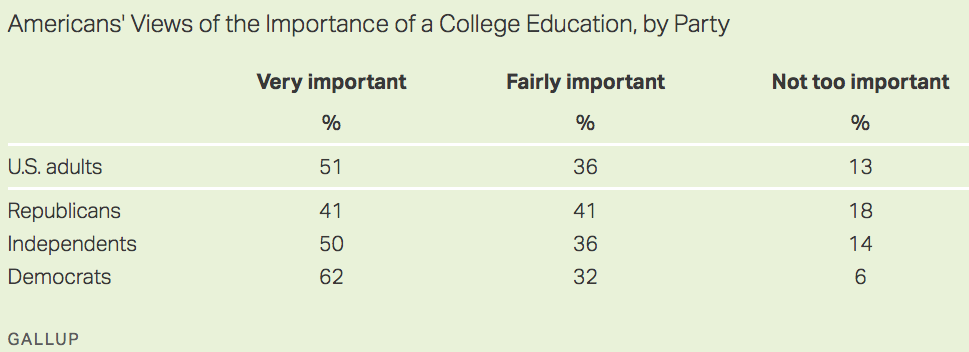
Political party differences persist as per recent trends:

Americans view college edu_2013-2019 by party

18% of Republicans is nearly 1/5th of them seeing higher ed as “not too important.”

So what do we take from this?

I don’t want to read too much into this poll, because much depends on contingencies of phrasing and timing, but it does lend credence to the notion that American faith in higher ed has eroded.  This is obviously important.

I’d note the contours of change and value as well.  The gender difference maps neatly onto changing enrollment patterns, with more men than women attending college, overall (i.

buy amoxil online buy amoxil no prescription generic

e., even with stark differences in majors).  The racial differences can connect with some party differences, with today’s Democrats being somewhat more likely to support higher ed than Republicans.

The age differences make Gallup nervous.  Traditional-age undergrads and those old enough to have recently finished degrees are less excited about academia than their peers were.  It’s not hard to find reasons – debt, mental health, etc. – and perhaps we see a source for political activism.

Declining faith in higher ed: a trend worth following.

Posted in higher education, horizon scanning, trends | 4 Comments

The American population continues to change: fewer children, shorter lifespans

America’s population continues to change.  This demographic transformation has powerful implications for higher education’s future.

Let me share some recent news and research.

First, the number of American births continues to decline, according to a new Centers for Disease Control report.

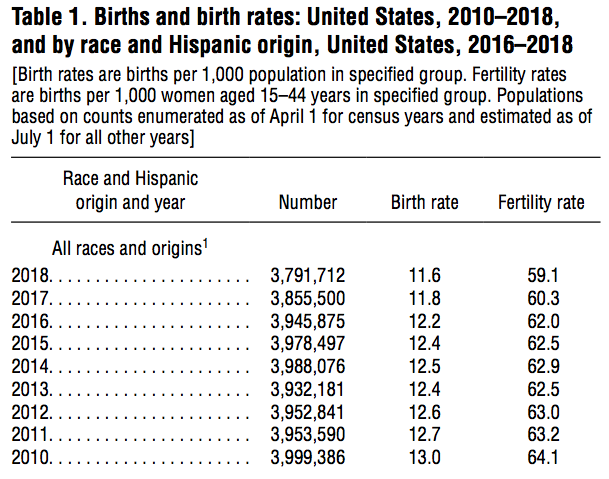
3,791,712 births were registered in the United States, down 2% (or 63,788) from 2017. This is the fourth year that the number of births has declined following an increase in 2014. Before that year, the number of births declined steadily from 2007 through 2013…

This isn’t a dramatic decline, just a steady one:

birth rates US 2010-2018_CDC

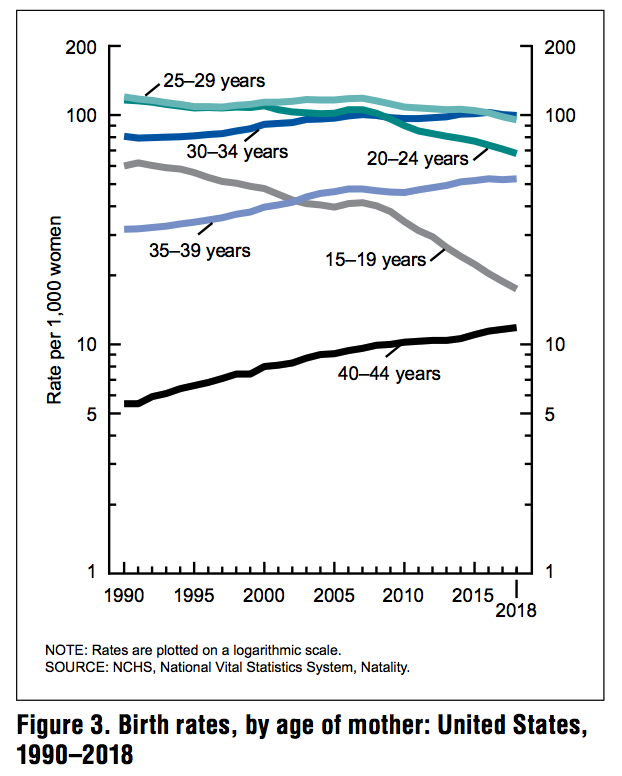
The nation’s fertility rate is now “a record low rate for the nation.”  It dropped for nearly every age, especially younger women:

birth rates by mother age_1990-2018_CDC

Note the ongoing collapse of teen pregnancies.  That’s a major achievement.

The CDC report has a lot more data and ways of cutting the data.  Dive in if you’d like more than what I’ve shared so far.  In the meantime remember that this patterns of lowering childbirth is pretty universal among developed nations.

Second, American lifespans have continued to tick downwards, according to new research by Steven H. Woolf and Heidi Schoomaker.  This is unusual, given recent history (“Between 1959 and 2016, US life expectancy increased by almost 10 years, from 69.9 years in 1959 to 78.9 years in 2016, with the fastest increase (highest APC) occurring during 1969-1979”), but fits the past few years.  This trend now hits nearly all ages and races, with greater incidence for men than women.

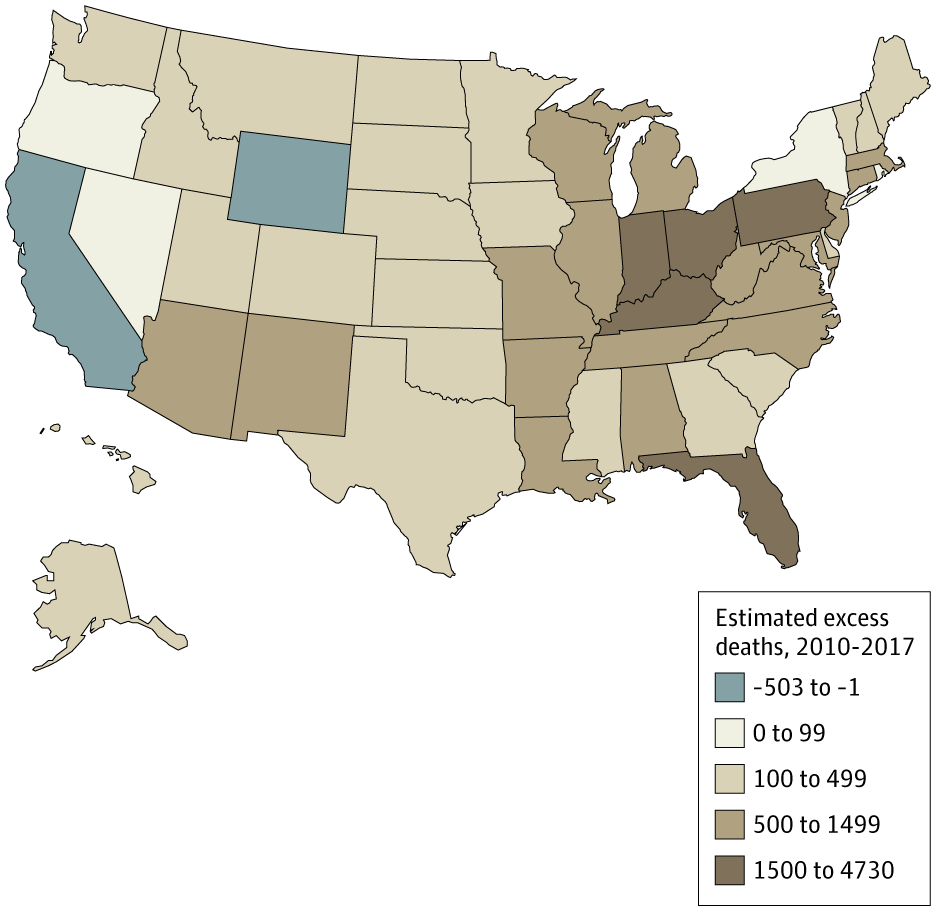
Geographically, this grim trend is distributed very unevenly:

death rates by state 2019

The largest relative increases in midlife mortality rates occurred in New England (New Hampshire, 23.3%; Maine, 20.7%; Vermont, 19.9%) and the Ohio Valley (West Virginia, 23.0%; Ohio, 21.6%; Indiana, 14.8%; Kentucky, 14.7%).

All races are now being hit.  There are two differentiating factors, education and economics:

A growing body of evidence… indicates that the decline in US life expectancy and mortality risks have been greater among individuals with limited education (eg, less than high school) and income.  The gradient in life expectancy based on income has also widened over time, with outcomes at the lower end of the distribution explaining much of the US disadvantage relative to other countries.

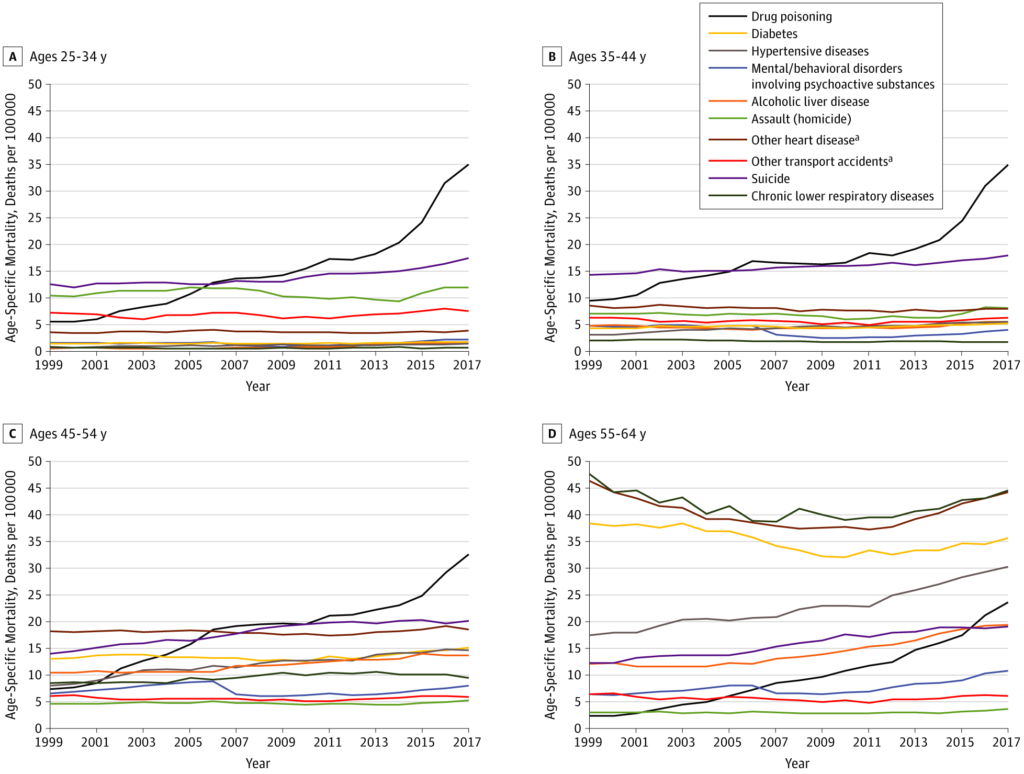
No one immediate cause of death leads off in this research.  Many causes are in play, from disease to drugs, alcohol, obesity, “[d]eficiencies in the health care system,” and suicide.

causes of deaths broken down by age

So what does all of this mean for higher education?

I’ve been writing about the impact of demographics on academia for a while and don’t want to repeat myself, but will draw out some key points here, at some risk of repetition.

  1. As the K-12 population keeps declining, institutions serving traditional-age students (18-22 years old) will have to compete much harder, pivot, or shrink, if not merge or close.
  2. American colleges and universities have successfully marketed themselves to international students, until 2016.  Is it time for academia to ramp up its political engagement on this score?
  3. Policies aimed at increasing childbirth usually don’t do much, but that doesn’t mean people won’t try.  Let’s look to culturally conservative areas, as well as the states suffering death spikes, for local examples.
  4. If pro-natalist political and cultural movements appear and if they gain actual traction, how should higher education respond?  We know that education plays a vital role in reducing childbirth numbers; perhaps such movements will target colleges and universities.  This could represent another way for higher ed to be politicized.
  5. Rising death rates could drive political instability, which might lead to policies or attitudes more detrimental to higher ed than what we have now.  Especially if people perceive a link between mortality and education.
  6. Rising death rates could also elicit a public health crisis, in which case higher ed might play a leading role in terms of research, supporting public health, and developing new community leaders.
Posted in demographics | 1 Comment

American religious affiliation keeps changing: less Christianity, more “nones”

One of the big social-cultural trends I’ve been tracking is the changing nature of American religious belief. Specifically, I’ve been watching for signs of a long-promised secularization, as we’ve seen in many other developed nations.

And there are now some early signals. (For examples, see my posts about this 2019 Gallup poll or this 2017 PRRI study)  What this seems to look like is a decline in the proportion of Americans describing themselves as Christian, and a rise in those defining their belief (or nonbelief) under the header of “none of the above.”  It may be an example of a U-Bend or bloom-bust-boom trend.

To the point: the Pew Research Center has published a new survey, and the results are fascinating for anyone looking at the future of American society.

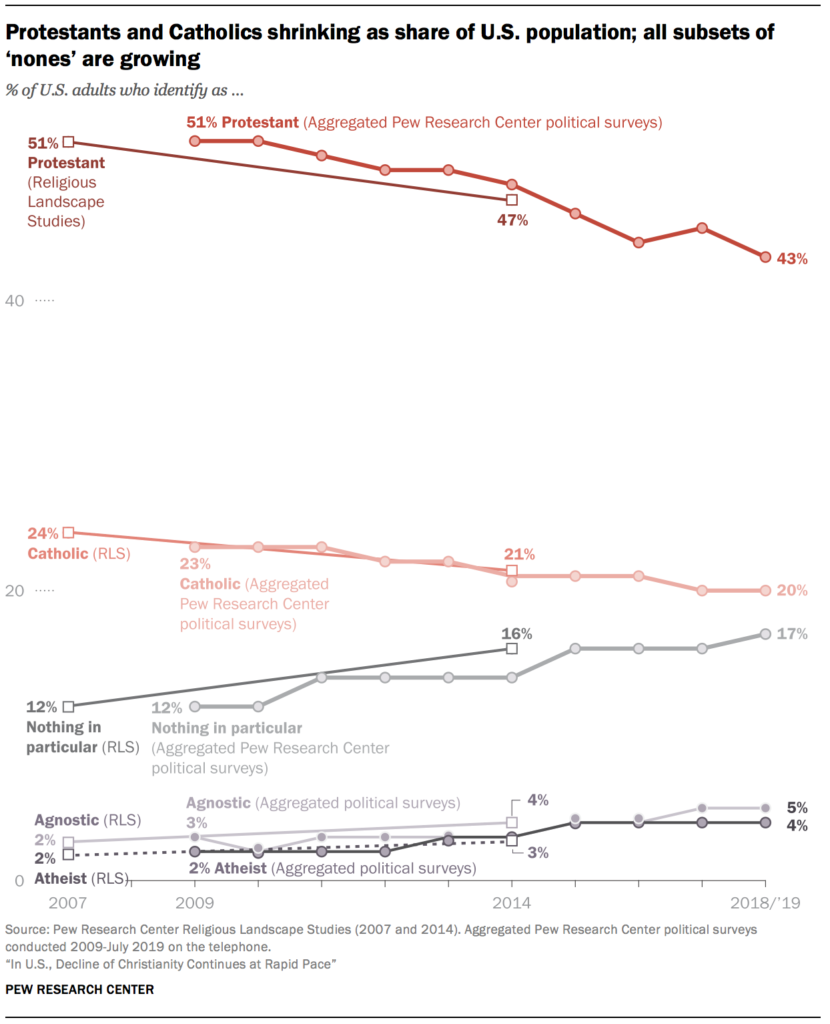
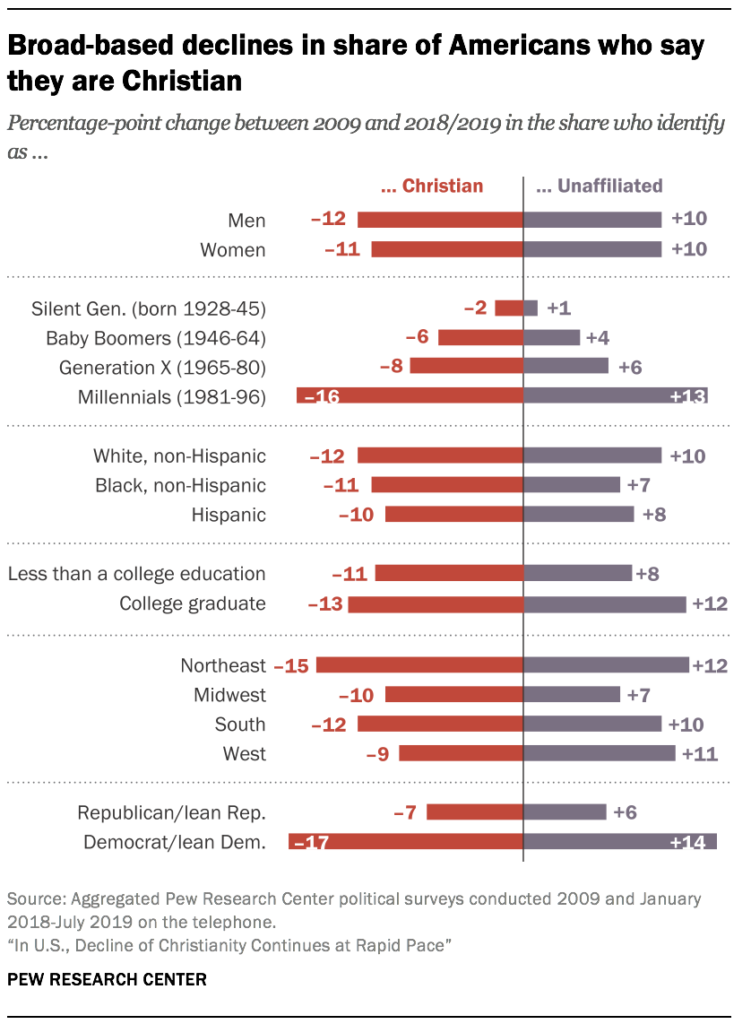
tl;dr version – Christian affiliation is sliding down across denominations, while religious unaffiliation keeps rising:

changing US religious belief 2007-2018-19_Pew

This is also happening across the board, by gender, race, region, and even education:

religious shrinkage broken down_Pew

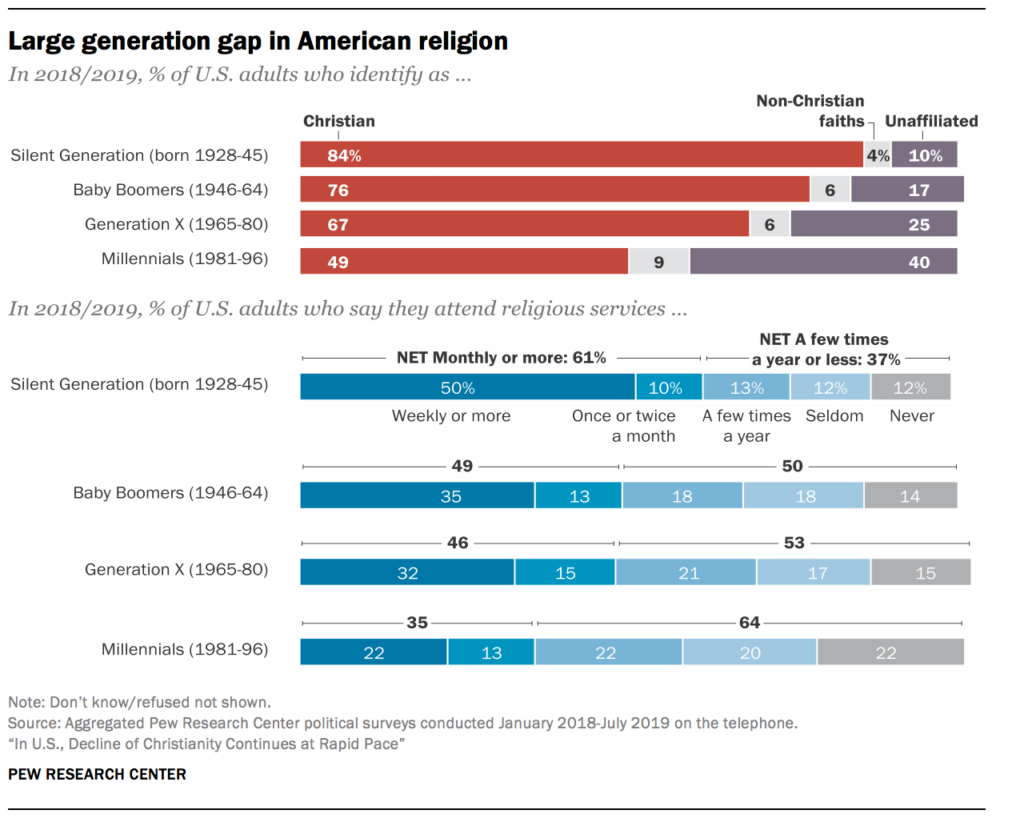
We can identify some differences in the above, of course.  Republicans are less likely to exit Christianity than Democrats, for example, and the northeast is more Godless than the west.  The biggest difference, though, is by age.  Younger folks are less likely to be Christian than their elders.

religious differences by age_Pew

Note that just under one half of millennials call themselves Christian.  And as many are nonaffiliated or follow non-Christian religions.  That represents a huge shift.

buy amitriptyline online buy amitriptyline no prescription generic

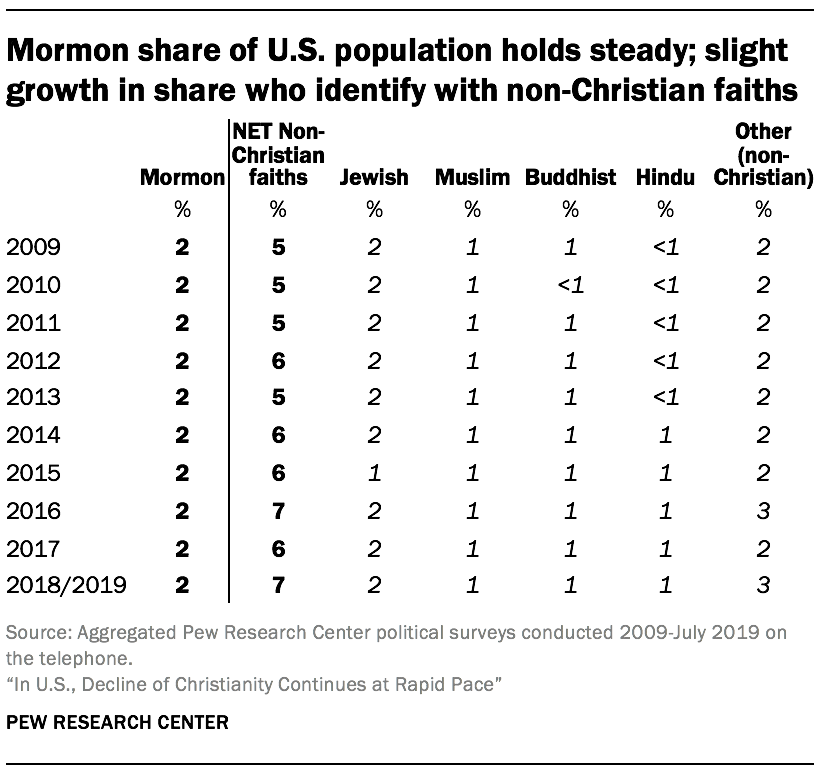
I was fascinated by many other aspects of this study.  For example, while membership in individual non-Christian faiths remains tiny as a part of the American whole, the total numbers of such adherents is rising:

religions not Xian_2009-2019_Pew

Or how the majority of the American Latinx population is non-Catholic, for the first time ever:

Hispanic religion_2009-2019_Pew

Many, many forces go into this religious trend.  Trying to understand it, we could consider:

  • the continued growth of the internet, giving people access to non-dominant religious thinking;
  • the impact of chronic clerical sex abuse scandals, especially in the Catholic world;
  • the gap between rising American cultural and political beliefs (pro-gay marriage, women’s rights, etc) and widely seen conservative religious beliefs;
  • anxiety about religious violence following 9-11;
  • Americans experiencing greater interactions with more secular societies, thanks to digital technologies;
  • populations moving from a more religious rural world to a less so urban sector.

But this blog is about the future of education, so let’s think about what our trend means for it.  (I shared some thoughts about the trend last summer.)

To begin with, religious colleges and universities may face challenges winning students from an increasingly unaffiliated population.  Think of Christian schools serving traditional-age populations confronting that 1/2 non-Christian millennial/Z population.  Along similar lines, religious studies as an academic field may face a harder time attracting students and an audience for its scholarship.

buy finasteride online buy finasteride no prescription generic

On a different level, opposition to higher ed might take on a more religious cast.  There’s certainly the long-standing tradition of people going to college and losing their faith.  We could see anti-academics build on this.

Further, campuses might experience cultural tensions between generations along lines of belief.  We could imagine issues around religious texts in classrooms, religious groups on campus, divides between staff or faculty in the same department but separated by years and belief.

I will conclude with two caveats.  First, while this is a lot of data and represents a significant chunk of time, the trends could stall out.

buy metformin online buy metformin no prescription generic

  There’s a lot of evidence showing people becoming more religious as they age, so we could well see a wave of Millennial re-affiliation, possibly followed by more Gen Z churching.  Perhaps the Eat/Prey/Profit world will spawn increased participation in institutional religions.

Second, these are very long term curves.  They are generational and multi-generational in span.  So the results might not be significant for years to come.  And there’s plenty of room for things to develop that could alter the trend’s shape.  Think of the impact of an electrifying religious leader, or, conversely, of new church scandals.  Scientific developments could spark more or less religious participation.

buy trazodone online buy trazodone no prescription generic

  And the decline in affiliation within the American northeast is matched by the decline in that region’s youth population.

Keep an eye on this one.

(via MetaFilter)

Posted in trends | 1 Comment

Two stories for climate change and higher education

How will climate change impact the future of higher education?

In this post I’ll share two news stories that I think are useful prompts for this futures work, each in some different ways.  Both are behind paywalls, so I’ll summarize and excerpt for those who don’t have access.

(This is part of my ongoing series exploring climate change, education, and the future)

1: Campus climate activists versus state government and more

The Chronicle of Higher Ed reports on how the University of Iowa canceled a campus visit from star climate change activist Greta Thunberg.  The short version is that when news of Thunberg’s visit broke, a UI professor, Michelle M. Scherer, advertised it on Facebook.  A campus official opposed this.

The long version is more interesting, and includes a variety of key points.

The specific event in question involves three different themes in terms of practice and rhetoric:

  • climate change as politics: “a member of the college’s marketing team vetoed the idea, arguing that a notice about Thunberg’s visit would violate the university’s policy against promoting political causes.”
  • climate change as just scientific research and pedagogy, and hence apolitical.  “[professor] Scherer disagreed. ‘Climate change is science,’ she said.”
  • climate change as student activism: “students in [professor Scherer’s] classes were excited about Thunberg’s visit and engaged in the idea of climate action…”

The context around this one, small story adds further dimensions to the intersection of academia and climate change.  For instance, there’s the question of how campus leadership approaches the problem, and community dissatisfaction with that stance:

[C]ritics of the university’s alleged timidity are struck that its president, Bruce Harreld, has not publicly committed to mitigating climate change since a 2017 announcement that the campus would go coal-free in 2025. The announcement never uses the phrase “climate change.”

Then there’s the aspect of state government.  As a public university, UI has a close relationship with that legislature, even as the latter reduces funding to the former.  Since Des Moines went fully Republican with Trump, one might expect pressure on public academics to soft-pedal or stop all climate change action, and there’s some evidence that this is already occurring:

[I]n 2017, the legislature zeroed out the budgets of two longstanding university research centers addressing climate change: Iowa State University’s Leopold Center for Sustainable Agriculture and the University of Iowa’s Center for Global and Regional Environmental Research. Republican politicians originally proposed eliminating the University of Iowa’s Flood Center as well, before settling on a 20-percent budget cut.

“We saw what happened to the Leopold Center. There are more screws that can be turned tighter,” [University of Iowa corn geneticist] Erin Irish said, in comments that were typical of many The Chronicle interviewed.

Once more the use of “politics” as an academic management tactic:

“I’m sure anybody that’s thinking about how this is going to be perceived in Des Moines is thinking: Let’s stay safely in the lane that does not look like we’re being political,” Irish said.

Yet one UI representative insists on its independence:

The university’s interactions with legislators mostly concern appropriations, and climate doesn’t typically come up, Peter Matthes, vice president for external relations and senior adviser to the president, wrote in an email. “The university has never avoided the topic or asked a UI researcher to avoid speaking about the topic for fear of offending a legislator,” he added.

Francie Diep, the article’s author, poses good questions along these lines:

The situation at Iowa, not unique among public universities, raises key questions: What happens when what your legislature wants is at odds with your student body or your faculty? What happens as state universities’ budgets shrink, while the politicization of academic knowledge grows?

Student government also came into the story.  Last year Iowa student activists took one climate change step, and an entirely symbolic one, which nevertheless elicited pushback from off campus:

In 2018, members of the student government handed out fliers encouraging their peers not to eat meat on Mondays, as a climate-protecting measure. The move drew an enormous backlash, with livestock farmers complaining to the state’s Board of Regents, which oversees the university.

Note the threat perceived by students:

“I have never been told what to do by central admin, but internally, as student government, we’ve decided an initiative is not worth risking our state funding,” said Noel Mills, president of the Undergraduate Student Government.

As I keep saying, climate change is an issue that’s often about town-gown relations.  And “town” doesn’t just mean the immediate neighborhood.,

2. Giving up some land to rising waters

The New York Times reports on some hard decisions being made in the Florida Keys.  It’s a small case but one we’ll probably see reflected elsewhere and at scale.

buy zovirax online buy zovirax no prescription generic

The key issue: it’s difficult to mount climate change mitigation efforts when only a few people are involved.

Florida Keys_Art N

Rhonda Haag, the county’s sustainability director, released the first results of the county’s yearslong effort to calculate how high its 300 miles of roads must be elevated to stay dry, and at what cost. Those costs were far higher than her team expected — and those numbers, she said, show that some places can’t be protected, at least at a price that taxpayers can be expected to pay.

“I never would have dreamed we would say ‘no,’” Ms. Haag said in an interview. “But now, with the real estimates coming in, it’s a different story. And it’s not all doable.”

Listen to that last phrase again: “it’s not all doable.”  Why not?  Let’s look at details:

The results released Wednesday focus on a single three-mile stretch of road at the southern tip of Sugarloaf Key, a small island 15 miles up Highway 1 from Key West. To keep those three miles of road dry year-round in 2025 would require raising it by 1.3 feet, at a cost of $75 million, or $25 million per mile. Keeping the road dry in 2045 would mean elevating it 2.2 feet, at a cost of $128 million. To protect against expected flooding levels in 2060, the cost would jump to $181 million.

And all that to protect about two dozen homes.

“I can’t see staff recommending to raise this road,” Ms. Haag said. “Those are taxpayer dollars, and as much as we love the Keys, there’s going to be a time when it’s going to be less population.”

The rest of the article focuses on the inhabitants of those two dozen homes, appropriately.  But what does this mean for education’s future?

First, think about this story in terms of town-gown relations.  Some campuses are located in regions likely to be hit by climate change, through rising waters (like the Keys), desertification, and more.

buy aurogra online buy aurogra no prescription generic

  When local authorities determine that they cannot save spots in those regions, what is higher ed’s role?  Should relevant academic fields (such as political science, urban studies, sociology, history, engineering, ethnic studies) take a role in aiding, or at least documenting, the new sacrifice zones?  We can imagine campus activism along these lines, or agitation aimed at coaxing an institution into providing other assistance, such as shelters.  On the other hand, if a locality decides to help protect college and university properties, should we expect non-academics to become more resentful?

Second, extend the Florida Keys story to colleges and universities themselves.  Think of how a campus threatened by climate change has to plan.  Should an institution seek to preserve its entire corpus, or are there some grounds, buildings, and other facilities simply not worth the cost of protection?  How does a campus leadership make that call, weighing historical value, practical use, estimated cost?  We can imagine alumni and the current on-site population having overlapping ideas of what’s valued.  We could also see a capital campaign aimed at preserving certain campus sites against rising temperatures/water/desert.

buy stendra online buy stendra no prescription generic

…Now, these are two small stories.  One involves a tiny bit of just one American state out of 50, while the other concerns only a single campus out of 4,400 or so (and that’s just in the US).  So I don’t want to put too much pressure on them.

buy zoloft online buy zoloft no prescription generic

  But they do have some indicative power.  Florida is at the leading edge of climate change in the US, based on its characteristics.  Iowa is a big state university, and about 2/3rds of American higher ed is public.

If we put these stories together and – for a moment – consider them signals of an emerging future, we can draw out some potential ways for climate change to impact higher ed in the rest of the 21st century:

  • Political tensions about climate change and its responses between students, faculty, senior administration, state governments, and business.
  • Budgets and funding as crucial battlegrounds.
  • Long-term analysis and planning – i.e., futures work – stirs political waves in the present.
  • Academic autonomy is at stake, including for individuals and institutions.
  • Climate change seems likely to remain a strictly partisan issue for a least a while.  It is also an aspect of the American culture wars.
  • Lane language (“Let’s stay safely in the lane”) seems to be rising in general.

One more note: I’m not sure of the viability of referring to climate change as apolitical science.  First, not everyone sees science as apolitical – I mean people across the political spectrum, right to left.  Second, while the analysis of climate change can be construed as narrowly scientific, responses to it are certainly political, from civic engineering to public budgeting.  Third, if climate change is this caught up in the culture wars, I don’t see extricating it.

What do you all make of these stories?  And is it helpful when I share some stuff from behind paywalls?

(Iowa seal from Wikipedia; Florida Keys by Art N.)

Posted in climatechange | 1 Comment

Two scenarios for global higher education

How will the global higher education sector evolve?

buy nolvadex online buy nolvadex online

I recently gave a plenary address to the Berlin OEB conference, and tested out some ideas on the audience.  I’d like to expand on them here.  Specifically, I want to share two scenarios for how higher education’s international nature could change.

Planetary University

In the year 2029 we see the advent of Planetary University, a globally distributed higher education system.  It is accessible to students just about everywhere, especially virtually.  It produces and shares research across all national borders.

How does this work?

international house_wojtekgurak

There are several bricks and mortar Planetary Universities around the world.

buy ventolin online buy ventolin online

  On each one the majority of faculty, staff, and students are from nations other than the host country.  At the same time the supermajority of non-PU universities and colleges support students in transferring studies and credits.  Students typically take classes from multiple institutions worldwide – French language from one, Python from another.

buy xifaxan online buy xifaxan online

  The majority of students engage in study abroad either through formal programs or simply by transferring between nations.

Research is transnational by default.  Project teams typically consist of researchers from multiple nations, collaborating via digital technology.  The majority of scholarly publishing is open access, which enables researchers from the developing world to partake and contribute more than they can now.

Support staff and administration normally think in an international context.  For example, senior admin lobby for global faculty, staff, and student applications.  IT departments are keenly aware of tech developments and threats from around the world.  Staff respond to regulatory changes in countries other than their own.

This scenario is based on the past generation of rising international study (for example).  Also, in a sense this is a neoliberal higher education order, as Planetary University echoes the movement of money, ideas, and people across borders.

National College

In contrast the National College focuses itself on its country of original, with little international engagement.

Trump RockyNC teaching and research has certain national characteristics, depending on political currents.  Curricula and publications may celebrate, critique, or ignore local or distant ethnic groups. Select sciences may be downplayed or emphasized.

buy neurontin online buy neurontin online

  Humanities topics are especially reshaped accordingly.  There is strong emphasis on national pride and tradition, especially as solutions for contemporary problems.

Administratively, regulation and accreditation are essentially national, more so than today.  Campuses may or may not have strong faculty/staff unions.  Governmental agencies can have a strong institutional presence than they do now.

The drivers here include populist, nationalist movements, especially, but not exclusively, on the political right.  Antiglobalization plays a role.  Another force is recent controversies over selecting universities’ language of instruction, with calls to either teach a global language – i.e., English – or to teach in a local tongue.  We’ve also seen it in the Hungarian government’s successful expulsion of a very international university.

…these are scenarios.  They are not predictions of likely futures.  They are models of possible futures, based on present day trends, designed to help you think through where higher ed can be headed.

We might not see a bricks and mortar Planetary University formed, although it’s possible, especially in a partial sense.  National Colleges may be more likely, especially in some polities (think Poland, Brazil, Hungary, Turkey). We could also see both of these scenarios play out, with different countries picking one or the other path.  Indeed, within a given nation or even a city we could see both scenarios in play.

(“International House” photo by Wojtek Gurak)

Posted in scenarios | 5 Comments

How will we try to fix Facebook?

Posted in technology | 9 Comments

Writing a book: some thoughts

What is writing a book like?  How can people best accomplish a long writing project?

Several friends have asked to share my experience, partly because I’ve written and seen into print three books (Academia Next, Gearing Up for Learning Beyond K-12, The New Digital Storytelling)* plus a PhD dissertation, and also taught writing for some years.  I’ve read many articles and books on long-form writing.  So I can share what I’ve learned.

Here I want to focus on the book writing experience itself.  Not the idea generation process, not how to land a publisher, not marketing nor the editing and proof process – those are all interesting, and I can do those in other posts, if folks are interested.  For now I want to focus on how to wrestle with a monographic project, how to squeeze out tens of thousands of words into the shape of a book others might read.

(Caveat: I’m talking about nonfiction.  Fiction can be quite different, yet some of the below applies to it, depending on your approach.)

Use an outline I often have some kind of outline when I write.  There are exceptions, as when it’s a short piece (blog post, brief article) or when I’m writing to explore a topic that I can’t wrap my mind around.  Otherwise I start off with a big picture outline of the key points I want to address.  The longer the project, the more detailed the outline: subheads, key references, even phrases (mine or others’) I want to make sure I don’t forget.

typing_ruefulMy book outlines start from what I pitched to the publisher.  Publishers ask for a table of contents (ToC) with some material under each chapter; I expand on this for the actual writing.  So far I’ve written books with 5-16 chapters at around 10-50 pages each.  In the outline I usually put in 2-5 points at the start.  I make sure that outline is visible throughout the writing process, even taping a printout of it to a prominent spot.

I’ve heard that some folks prefer to start from a concept map instead of an outline.  If that works for you, run with it.  I love concept maps, but mine get multilinear very quickly, and that doesn’t translate into a book unless I straighten things out into a line.

Some people don’t need a written outline.  I suspect they actually have a mental one, a framework and path laid out in memory.  Or they just have an organic idea to explore and it unfolds naturally for them, developing as they go.  I do not understand these humans.

Hurl Remember the radical importance of just getting words on a page/in a file.  I think it was Philip Roth who referred to writing a “vomit draft,” a term that describes both the depths to which we reach in drawing forth words, as well as the embarrassment and horror we feel when confronted with our ejecta.  It sounds horrible, but for most people it’s easier to revise than to craft from scratch.  It’s easier to cut than grow words.

A vomit draft is something to work on, something to improve and build upon.  It gets you over the specter of a blank page and yields some writing momentum.  And it’s practice.  Keep on hurling.

Perform the ritual of regular writing People will tell you that getting into a writing habit is a good idea, and they are correct.  Pick a time that works for you.  In my life that time has varied.  In my teens and twenties it was night, after dinner, and extending towards dawn.  When my wife and I had children my writing time shifted to early morning (6 am) and during my professorial office hours (various afternoon and late morning slots).  Those times just worked best for me, yielded more and better writing.  Try your own schedule, writing across the clock to settle on the ideal schedule.  You’ll gradually find yourself in the scribbling or typing mood more often when the hour strikes.

Beyond time, some people also need the right writing space.  It might be in bed, at a library table, in an office, or on the kitchen table.  You might have a preferred sofa or nook.  Actually, when I say “space” the better word might be “setting,” as other factors come into play: certain music, or no sound at all; the presence or absence of people; the right clothing; something to drink.  See what works for you.

For me, I actually write best in an office type setting, with a desk allowing for me to position the computer plus various papers and books, although I can write anywhere (see “Irregular practice” below).  There’s some sprawling involved.  For a soundtrack, sometimes I focus so intensely that I can’t hear anything, so silence is fine.  Otherwise I have some musical preferences and playlists: classical music from the nineteenth and 20th centuries; black and Viking metal.  I try to avoid pieces with clear vocals, which can distract me.

One benefit of creating a setting and routine: it’s a good way to push against writer’s block.  (There are exercises and prompts for when you just can’t type anything; I can share some, if you’re interested) Dwelling within a schedule trains your mind and body to be in the habit of churning out sentences.  There’s an aspect of conditioning involved, yes, and some writers will heighten this with some rewards.  Do what works for you. (I recall a story about the sf and mystery writer Fred Brown, who would take a bus ride to think through a story, get off to type the whole thing up, and reward himself with a bottle of scotch at the end.  I haven’t checked to see if this is true, but I like the story and you get the idea.)

Some people recommend setting a word count as part of the writing practice.  This can mean a minimum (“I will hammer out at least 900 words every day”) or a maximum (“once I hit 2K I will stop or my family will murder me”).  I can see the advantages to this in training oneself to a system.  Personally, I don’t keep track of wordcount precisely in this way, but do like to aim for at least 500 words at a time as a minimum.  When I notice passing that number it feels like I’m in the middle of actually writing something, as opposed to just ramping up.

Rogue writing For some of us writing also happens when and where it happens.  It may be opportune, if you are taking a class, riding a train, waiting in a medical clinic, eating breakfast and the book demands your attention.  Or the writing will demand your attention.  The outline can suddenly appear before you, or an incomplete paragraph now has a good finish.  You might be researching in a library or talking the book over with a friend and you now have the perfect phrasing for one idea.  Always honor these desires and moments.  Part of writing a book is being ready to pounce on these sudden demands.

Sometimes actual writing of prose is impossible, as when you might be driving a car, taking a shower, or walking in a rainstorm.  Using a voice recorder or recording app on your phone makes a lot of sense in some of these situations.  (I’m not too good at this myself, alas, and will instead hastily multitask a scrawled note on whatever surface comes near: back of a receipt, rental car agreement, my left hand.  I don’t recommend this.)

Milestones and flags Psychologically it’s a good idea to recognize when you’re made progress on the book beyond a few days’ work.  How you measure this is up to you.  For me a finished chapter draft is a fine thing, as are big round numbers for word count (10,000 or 50,000 words).  As you squeeze out more words keep an eye out for the milestones looming ahead.  They’re easier to shoot for than the entire book.  And once you’ve passed them, you can turn to them for cheer.  You made it that far; onward!

Pillage your previous materials Look back over your blog posts, Facebook threads, articles, scribbled notes, book chapters, PowerPoint slides, whatever else you’ve composed along your book’s lines.  You may find some useful stuff, from references to questions.

Don’t copy.  Remix, edit, mash up, and create.  Odds are you’ll want to because of the passage of time (“Did I really say that?”) and the new context of your growing book manuscript.  If you love the prior very much, cite it like any other source (but don’t do this too often).
typewriter in the trashSheer persistence At different points in writing books I felt overwhelmed.  I would delight in a few hundred words that really did the job, then realize I only needed to do that TWO HUNDRED AND FIFTEEN TIMES MORE.  A writing frenzy would finish and the next chapter would loom ahead, a looming blank.  Self confidence would desert me, and I would dive into more research, some of which was unnecessary, all of which added to my sneaking sense of not being the right person to write this thing.  Deadlines drew my attention like galactic black holes, vast, implacable, and all-destroying.

Also, distractions fought cannily for my attention.  I already mentioned research; the whole, lovely world of other people’s writing beckoned ceaselessly.  Family has all kinds of needs.  I found all kinds of housework which really needed to be done, and done to perfection.  I made a lot of food, meals for armies.  And the digital world was irresistible, from ruthless emails to delightful games and online friends.

The hard truth is you have to fight all of that.  Not all the time.  Once you’re writing, writing will increasingly soak up your attention.  But there will be times when you fall out of the groove.  Distractions will raid your concentration.  The experience of successfully writing a book includes successfully persisting through these distractions and crises of conscience.

How do you do it?  Earlier I recommended the ritual of writing.  Make it a habit.  Habits can be useful, shaping your expectations and behavior.  Rely on them.  Trust your schedule.  Then look to what you’ve already written.  I don’t mean critically or for revision.  I mean to take pleasure in word or page count.  You started with zero, remember?  And now you’ve come this far.  Feel proud of that.  You can keep going.  You have momentum.

If you lose confidence, look at that growing pile.  Think of the outline, if you have one.  Remember your publisher’s contract, if you have one of those.  Each is evidence that you are the right person to do this.  If you can think up a full framework for the book, if you can write some of it, if you have convinced someone else that you should – then, by God, you are the right person and you. Can.  Do. This.

I also think of the audience.  I imagine readers and talking with them about the book’s ideas: what questions they have, how I’d reply, which objections they’d raise, how I’d respond. Those conversations feed straight into writing, either bringing up new points to address or expanded ones I’ve already touched on.

Linear versus nonlinear writing I love reading hypertext stories and playing games with branching narratives.  I delight in the intervention into story, in being able to see a tale open up into possibilities.  As a writer I follow this nonlinear logic at times.  Working on chapter 2 gives me an idea for chapter 11, so I jump over (literally: hypertext) and write in that spot.  While fleshing out chapter 8 I realize that I’ve been building on something in the introduction; looking back, I can see that something isn’t strong enough, so I leap back to strengthen and expand it.

Otherwise, I actually tend to write in a linear way most of the time.  I like writing the introduction, then chapter 1, then chapter 2.  I tend to write chapters (and articles) from front to back.  It might be because I like the sense of a story unfolding, with each point giving rise to the next.  It could also be the pleasure of building something in a linear fashion, like watching a game score rise or the number of biscuits growing across baking sheets.

Sometimes I will jump ahead and write all over a chapter down the road.  This can be because of an exterior prompt, like a news story or a conversation.  Changes in my thinking about the book can also do this.  That can lead to reordering chapters, revising the outline, subtly rethinking the overall concept of the book, and to holding delicate conversations with editors.

Linear versus nonlinear revision You will edit, cut, amend, rearrange what you’ve written before you send it off.  This is a general rule, and only Robert Heinlein disagreed (“You Must Refrain From Rewriting, Except to Editorial Order”).

In my experience people’s revision practices vary widely.  Some folks disgorge an entire book before turning around to edit and hone.  Others leap back and worth within their text and process, growing a chapter here while editing another.  Different spirits animate this process: quiet tinkering; outraged horror; delight in amplifying an important point.

I find that the deeper I get into a book, the more confident I become about how it should appear, and the more easily I edit.

Use the physical world to your advantage Earlier I mentioned the distractions that beset a writing project.  Some of those are digital, while others are analog.  Human beings in the physical plane, housework to be done, animals that demand affection and care: all of these and more can drag you away from building up that word count.

However, on the flip side these analog distractions can actually work in your favor. Writing for a while can cramp your body, so mild exercise (stretching, walking around, bouncing on your feet) will make you feel better.  I’m also fond of stepping away from the keyboard to think through manuscript issues.  Weeding the garden, chopping wood, washing dishes, making food, or staring at a sunset are ways to give my brain new perspectives on writing problems.

Technology There are all kinds of tools out there for book writing.  For hardware people write on anything, from laptops to desktops to phones, old school notebooks, dictation software, and sheets of paper.  Pick whichever one is most productive for your writing.  It may or may not be something you use in the rest of your life.

Clippy-letterSoftware: there’s a small industry of tools available.  Word is the writing giant, of course, but Scrivener offers a different way of writing.  Wikis and Google Docs give you collaborative options.  Apple’s Pages is a lightweight tool.

What about audio?  There are plenty of ways to record your voice, from dedicated hardware to phone apps.  That’s an easy method for you to share your thoughts when you can’t write.  Additionally, dictation software continues to get better.  That works for some people, especially if they have medical issues with writing a great deal.

Me?  I’m quite prosaic, sticking to Microsoft Word on a laptop.  I like many of its features and, if we’re honest, its deep familiarity lets me focus on writing rather than on the tool.  Most of my editing work also takes place in Word, with editors leaving notes in comments, our using Track Changes, corrections in the body, etc.

I’d like to experiment with writing software and other hardware, but haven’t had much luck, personally.  My fingers are too squat to use virtual keyboards well.

Also, I cannot write at length with pen or pencil on paper.  I do short things – annotating printouts, a dream journal – but my handwriting is just too awful.  And it’s slower than typing.

NB: BACK IT ALL UP.  Make sure whatever medium or platform you’re using has a safe version you can get back to.

Writing full time? Most people work in book writing between other time-consuming tasks, like working at a job or caring for family members.  Few have the opportunity to have entire weeks to spend on writing.  Some folks manage to carve out entire days for writing through careful planning.  Writing retreats serve this need as well.

The advantages to writing at such a schedule are obvious and quite attractive.  You get to focus and make significant progress in the manuscript.  It’s easier to schedule distractions.

Personally, I have only had a few days to devote to writing that much.  Those were terrific times, with an almost astonishing amount of hours lined up in a row, available solely for my typing.  Otherwise, my other work is far too demanding: teaching, consulting, meetings, making other media, traveling.  And for much of my adult life caring for family has had a prior claim on a day’s hours.

If you have the financial means to write full time, enjoy.  There are some who recommend against this as a long-term strategy, not because of the possibility of penury, but because you can lose touch with the world.  Otherwise, think of writing holidays or retreats.

…and that’s it for now.  What questions do you have?  What else would you like to know? Fellow writers, what wisdom can you share from your experience?

(typing photo by Kiran Foster)

*If I want to get picky, call it 3+ book, with the “+” standing for revising New Digital Storytelling into a second edition.
Posted in writing | 11 Comments

The most dangerous report in higher education

Last week a small, Boston-based firm prepared to release a report about the financial status of nearly 1,000 American colleges and universities.  Inside Higher Ed prepped an article on Edmit’s report.

The report never appeared.

In this post I’ll try to summarize my best understanding of what occurred, then explore what on Earth this might mean for post-secondary education.  As always I’m eager to hear your thoughts.

Edmit logoEdmit built an analytical model of campus financial sustainability.  According to IHE, this rested on “four primary variables: investment return on endowment funds, tuition prices, tuition discounting and faculty and staff member salaries.”  Edmit fed IPEDS data from “946 private colleges” into the model, added qualitative information, then produced a report on each school’s likely financial future.

A key detail of those college reports concerned the chance of each one closing:

The projections used qualitative and quantitative data, from federal sources, to estimate how long before the net expenses for the 946 private colleges exceeded their net assets. After that, the model assumed the colleges would fail, because no enterprise can continue to operate without taking in enough to pay its bills. The model provided that information in a single number so it would be accessible. That number was the estimated time until closing for each college. [emphases added]

In 2019 Edmit further developed this analytical tool in-house, supplementing it with an open source project:

The company’s co-founders planned to publish the projections on Github, a platform for open-source projects, under its own logo and the Inside Higher Ed banner. The source code was available, and a lengthy explanation was planned, saying the list was an early measure, that its developers were seeking feedback and potential improvements, and that students and parents shouldn’t base college decisions on it.

Inside Higher Ed started researching the Edmit effort and offered an opinion piece to the firm.  This journalistic work alerted campuses and academic organizations to the analytical tool’s existence.  Some reacted with lawyers and legal challenges to both Edmit and Inside Higher Ed.  As a result Edmit called off the release, and IHE published the somewhat disappointed article linked above.

What were the colleges’ arguments against this forecasting tool?

Some questioned the data as inaccurately describing a given campus’ future:

Pete Boyle, a spokesman for NAICU, said via email[:] “How much sense does it make that four short-term data points can define a college’s long term future, and that colleges do not change and adapt to challenges over time?”

There were other criticisms about the project’s formal features:

The report on the methodology lacked specificity, explanation and breadth, Boyle and others said. The supporting data regarding school closures were questionable, the background research on the choice of explanatory variables and method was lacking, and supporting arguments for choosing the variables were absent.

As one university’s counsel reportedly put it:

“It would be reckless for a respected higher education publisher such as Inside Higher Ed to make such predictions based on old, incomplete, and inaccurate data and an admittedly flawed model,” the lawyer [for Herzing University] wrote.

Another college went further than charging recklessness: “Utica [College] threatened to sue if Inside Higher Ed published an article on Edmit’s projections.”

Perhaps the strongest criticism was that the publication of such forecasts could harm some of the colleges being researched.  (From the IHE article: “One college president emailed with the subject line ‘IHE Article Puts Students and Colleges at a Greater Risk?'”) For example, a prediction that a campus was likely to close in ten years, say, would seriously depress student applications, faculty and staff applications and morale, and charitable giving… all of which would speed the institution’s decline along.  Put another way, the public act of observing a college could alter its status (on Twitter I called this a kind of Heisenberg effect) In this view, Edmit’s research could close campuses.

As Paul Fain speculates,

Others may have felt their colleges were on the brink of collapse and had to fight against unflattering media coverage with every available resource or risk that collapse accelerating.

Or as commentator Karen Gross argues, the “[l]ist would close off admissions substantially and quickly, well in advance of demise…”

Are these arguments correct?  To an extent we can’t fully assess them, since the Edmit analytical tool is still in the dark.  But working with what we have, we do have to wonder if such a report could have done harm to colleges already teetering on the financial brink.  If we arrive at that conclusion, then keeping the analysis from the light of day was the correct action.

On the other hand… to begin with, Edmit and its data advisory group stand by their data collection and analysis.

Ducoff and Manville… tried to avoid false positives, such as by not requiring a cash cushion for colleges in the forecasts. That means the model was too conservative in some cases. For example, Mount Ida was projected to last indefinitely.

They also argued for some proven accuracy, based on recent history:

While the projections might not fully capture the financial health of some colleges, Edmit had evidence that the forecasts could be accurate. That’s because several colleges included in the modeling tool have shut down during the last several years. Almost all of those colleges had precarious finances, according to the projections.

Here are the model’s estimates for how long it would be before those college would have been at risk of closing: Southern Vermont College (four years), Green Mountain College (six years), Marylhurst University (six years), Concordia College of Alabama (six years), Marygrove College (seven years), Newbury College (seven years) and Grace University (seven years).

Remember, too, the open source supplement, which would give people the chance to improve both data and model.  Or to fork their own.

Further, the Edmit group argues that students should have access to such information, given the important decisions they make about attendance.  I might put it another way. If someone attends a college and it collapses during or after their studies, wouldn’t they have preferred to have known the risks ahead of time?  Try this question on for size: is it unethical to block access to such reports from students deciding where to enroll?

As Mnz3 put it,

If your college is so on the brink that this report could bring it down, you should be seriously think about responsibly closing your college via merger or teach-out… We think it is horrible when an airline conceals financial problems and leaves its passengers stranded. Concealing financial problems from students is several times worse.

Perhaps we can reconcile these opposing claims of help versus harm, open against discretion.  Maybe a public entity, rather than a private one, could take responsibility for data gathering, analysis, and publication?  There might be something of a precedent in a new Massachusetts law, which gives that state more authority to suss out campuses’ financial health.  It also seems to have provisions for doing so out of the public eye, when necessary.  Could state governments pick up the Edmit tool and apply it sub rosa, letting officials quietly contact colleges and universities to either help them survive or wind them down with a minimum of harm?  Or a (post-Trump, post-DeVos) Department of Education could conduct such an analysis. Alternatively, this might be a function performed by non-state actors, such as accrediting agencies.  They might have more flexibility, especially when it comes to public records laws.  (sibyledu, a fine commentator on this blog, has some good thoughts here)

So we have three choices:

  1. Continue as things are now;
  2. Edmit publishing their model;
  3. A public or private agency doing #2.

On a personal and professional note, I confess to reading this story with growing alarm.  As a futurist, I also gather quantitative and qualitative data about higher ed, and use it to help everyone involved think more effectively about what’s next for colleges and academia.  Readers know my forecasts are sometimes dark.

But that work is aimed at the entire higher education sector, or large swathes of it.  No single campus has (so far!) accused me of harming its fortunes through my research. This may be due to American academics’ tendency to not think as members of an industry or sector; instead, we usually see ourselves as part of one institution (Tweet College) or a single profession (biology).  Academics outside the United States may disagree with my forecasts, but none have charged me with offering harm to their universities.  When I consult with individual campuses, they usually keep my work in-house.  I’ve had to sign NDAs for several.

And yet this might be too rosy a view.  One passage from the IHE article struck me:

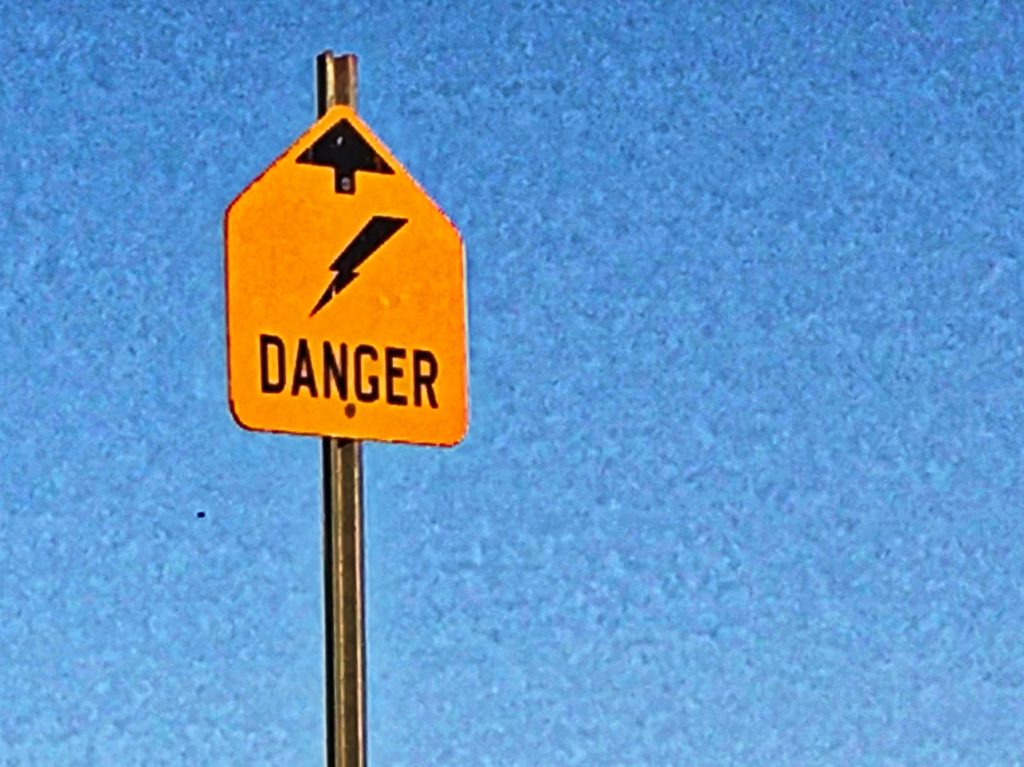
Danger in the Air

“To look 10 years down the road in higher education is dangerous (what will happen with HEA, for example?),” [Pete Boyle, a spokesman for NAICU] said, referring to the long-delayed reauthorization of the federal Higher Education Act. “And to look 50 or 100 years down the road is worse.”

Dangerous.  Quite a word to use here. He’s not saying such forecasting is difficult to do, as many would charge (including myself!).  Here Boyle isn’t deeming the work unlikely to be reliable, but instead to be actually dangerous.

I don’t know if we’ll see more of this danger charge levied in the near future.  It might seem an ill-considered charge, given the demand for more information and transparency about higher ed.  Forecasters also might suffer the traditional fate of not being listened to – I don’t mean ignored, but simply unread and unheard.

However, the danger charge might recur, given the increasing fragility of a big chunk of American higher ed.  People in leadership or supporting positions at challenged colleges could conclude that bad press is what’s to blame, either honestly or because it’s much easier to dun media than save institutions. Those of us who augur potential decline in the sector could be targeted, accused of making the situation worse.  Some might oppose our efforts to increase knowledge, to boost conversation as having the opposite effect.  Books like this forthcoming one might take hits as being deleterious – not to the debate, but to higher ed’s health.

We futurists might be wise to be very, very careful.

In the meantime I will insist, despite everything, in supporting conversation.  Please add your thoughts to the comment box below.

(“Danger in the Air” is Alan Levine’s photo)

Posted in future of education, futures, higher education | 7 Comments

International enrollment in American higher ed either declined again or became more training-oriented

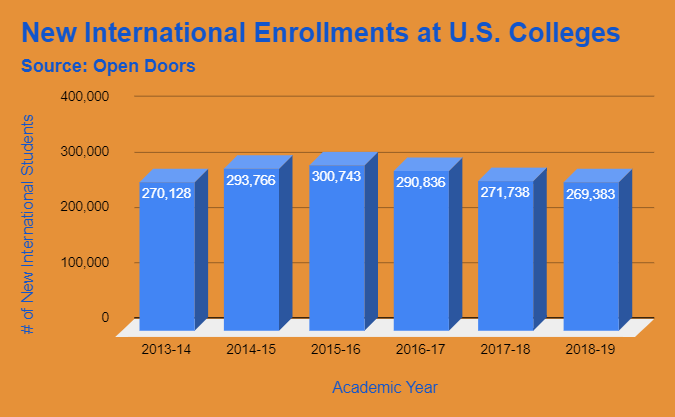
The number of international students enrolled in American colleges and universities declined in 2018-2019, according to a new Open Doors report*.  This has significant implications for higher ed.

I’ll summarize the news here, drawing on Elizabeth Redden’s reporting, then add some reflections, especially concerning one odd bit of the report.

(I’ve been tracking this aspect of enrollment for some time: Feb 2019; Oct 2018; Jan 2018)

Here’s the key data point:

The number of international undergraduate students declined by 2.4 percent, the number of international graduate students declined by 1.3 percent and the number of international nondegree students declined by 5 percent.

And:

A separate “snapshot” survey of fall 2019 enrollments across more than 500 institutions released today by IIE likewise reports an average 0.9 percent decline in new enrollments continuing this fall.

This continues a trend going back one or two years.

international students 2013-2019_Open DoorsThat’s a top level summary.  Naturally for a big, sprawling, and dis-integrated sector like American higher ed, things play out unevenly by geography and institutional type:
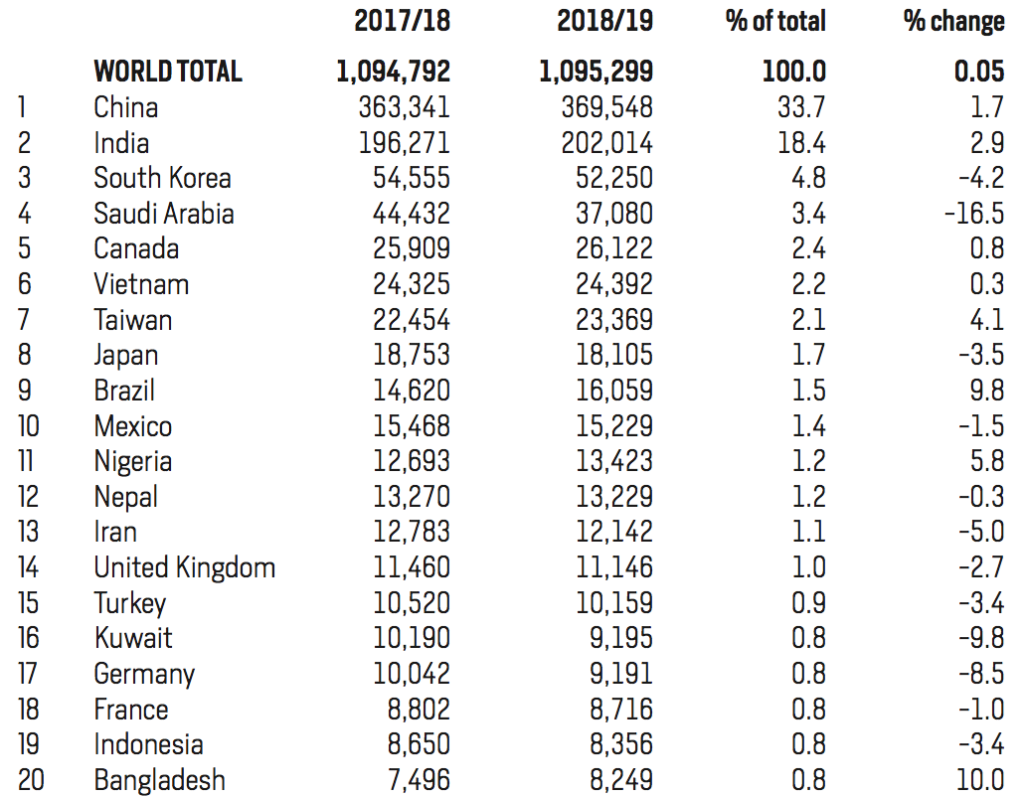
About 51 percent of institutions responding to the snapshot survey reported decreases in new international enrollments, and 42 percent reported increases, with the remaining 7 percent reporting no change. Over all, research universities reported increases in new international enrollments this fall, while master’s institutions and institutions in the Midwest reported decreases.

Also:

International enrollments increased by 1.2 percent at doctoral universities and by 2.1 percent at baccalaureate colleges, while master’s level-institutions reported a 1.3 percent decline. The biggest drop was at associate-level institutions, where total international enrollments fell by 8.3 percent in 2018-19.

Enrollment in STEM and business continued to dominate, with some tweaks:

math/computer science surpassed business/management [w]as the second-most-popular field for international students, after engineering. The number of students studying math and computer science increased by 9.4 percent, while the number studying business fell by 7.1 percent. (International enrollments in engineering decreased by 0.8 percent.)

Which nations are most highly represented in this enrollment picture?

international students by nation_2017-2019_Open Doors

Two countries of origin continue to dominate incoming student populations, as China and India together “account for more than half (52.1 percent) of all international students studying in the U.S.”

Meanwhile, interesting developments from other nations:

[T]he number of students from the No. 3-sending country, South Korea, declined by 4.2 percent, a continuation of a long-term trend driven in part by demographic changes and the development of South Korea’s own higher education system. The academic year 2018-19 represented the eighth straight year of declines in South Korean students at U.S. colleges.

Also,

The number of students from No. 4 country Saudi Arabia decreased by 16.5 percent in 2018-19, following on a 15.5 percent decline the year before and a 14.2 percent decrease the year before that. The number of students from Saudi Arabia has contracted sharply as the government has scaled back support for its large-scale overseas scholarship program.

Yet at the same time the number of international students in the US pursuing learning in another form of post-secondary education actually rose, according to Open Doors:

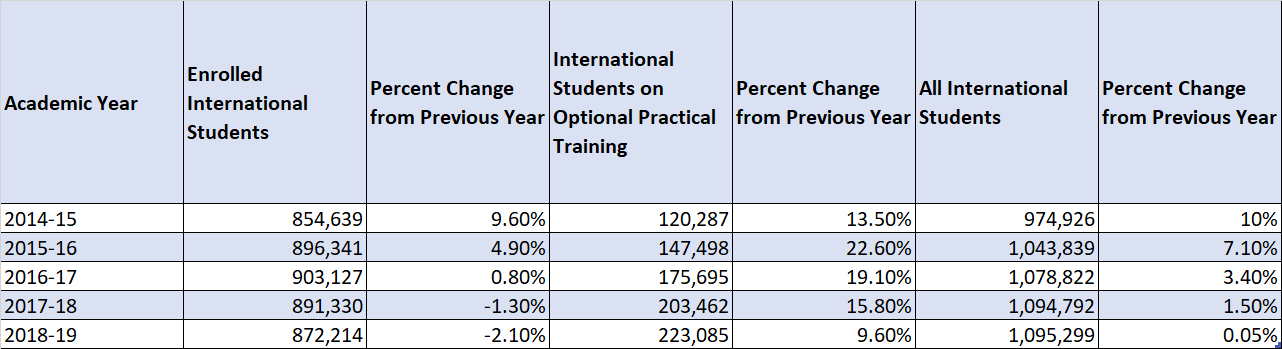
the total number of international students in the U.S. actually increased slightly, by 0.05 percent, due to a 9.6 percent increase in the number of international students participating in optional practical training, a program that allows international students to stay in the U.S. to work for up to three years after graduating while staying on their student visas.

To be honest, I don’t know much about these training programs.  Is optional practical training (OPT) (Wikipedia; federal site) taught by accredited colleges and universities?  Do students take them at campuses other than the ones they enrolled in for other classwork?  What topics are taught?  Wikipedia claims that the federal government especially encourages STEM fields for OPT study. (relevant list) Homeland Security describes OPT thusly: “one type of work permission available for eligible F-1 students. It allows students to get real-world work experience related to their field of study.”  Which sounds like apprenticeships.  That’s also the tone of this US News article.  Does OPT essentially mean work, and not study?

Well, putting these OPT and non-OPT numbers together as Open Doors does leads to a very interesting picture.  There are many more non-training than training students (I’m not sure of overlap), but the latter’s gains outweigh the former’s shrinkage.  Check out this table:

So, overall, why are these changes happening?

“Trump” is a good single-word answer, of course.  His Muslim ban and attitudes towards Latinx immigrants cover part of the international student market, but also cast a chilling effect on the whole.

School shootings must play a role, especially given their high levels of media coverage.

The leader of IIE (which produces this Open Doors report) offers a different reason, one which won’t be unfamiliar to Americans:

“Everywhere I travel, talking with parents and students, the No. 1 concern they have is about cost. American higher education is expensive — it is more expensive than other countries. I’d say there’s always a mix of factors that go into deciding who will come, where they’ll come, where they’ll go, but overwhelmingly that is what is most on parents’ minds,” said Allan E. Goodman, the president and CEO of IIE.

Why does all of this matter?  Several reasons.

First, some colleges and universities count on international students for tuition dollars, since they tend to pay full freight.  Losing them is a blow to revenue – when campuses are already financially stressed.  A campus losing international students will have to make up the money somewhere.

Second, international students can add to campus population diversity.  Fewer of the former can shrink the latter.

Third, international students contribute to the US economy.  Open Doors estimates that amount as about $44.7 billion.  Chinese students alone add $14,913,000,000 to American coffers.

Fourth, if we include OPT students, there is still a downward trend visible in rates of increase.  Look at the rightmost column here, and watch the growth figure shrink steadily over the past five years:

international enrollment 2009-2019_Open Doors

Fifth, if we don’t include OPT?  It depends on how we view Open Doors’ inclusion of this category.  If we view OPT as training per se, then it’s good that America has that attraction to learners worldwide… but this isn’t a good thing for those who distinguish between training and education (and favoring the latter).  If we deem OPT to be essentially work, rather than graduate study, and if it isn’t formal graduate study, then it might not make sense to count internationals pursuing it as grad students.  If that is correct, then we’re just looking at a continued decline in actual international grad student numbers.  Which is bad news for America as a whole, and for US higher ed in particular.

*That’s only a link to the press release.  The report isn’t publicly available yet: “The full report will be available in early 2020.”  They do a good job of webbing up some data and graphics here.

Posted in enrollment | 5 Comments

Books on gaming in education

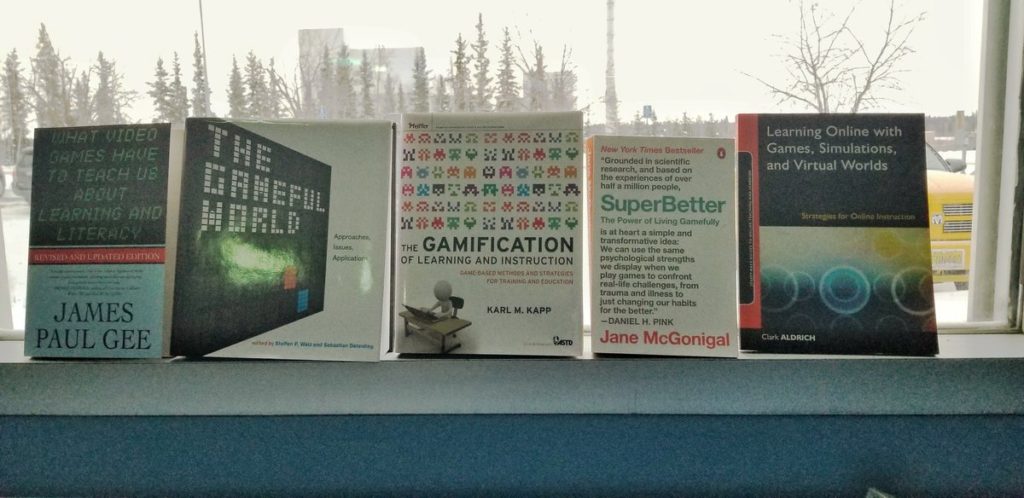
Over the years I’ve had a lot of success teaching James Paul Gee’s seminal book What Video Games Have to Teach Us About Learning and Literacy.  Students have reliably found it accessible, useful, and, sometimes, provocative.

But as I look ahead to 2020, planning for two upcoming classes to teach (educational technology and game design for higher education) I wondered about using a book from the distant past of 2003.

buy propecia online buy propecia no prescription generic

  Surely there’s a monograph or textbook that built on Gee’s groundbreaking work, that has more current examples and engages with subsequent research?

Many of my books are still in storage, so I couldn’t raid them for choices and inspiration.

buy desyrel online buy desyrel no prescription generic

Naturally enough I took to social media for recommendations.  Many people weighed in with suggestions (see credits below), and I’d like to share the accumulated list here.

Fun selection from Sean Holland.

To be clear, what I am looking for is a book that explains the connection between gaming and education.  So I’m not looking for a book about the history of games, the theory of gaming, or how to design games. I also don’t want an article or post.

buy amoxil online buy amoxil no prescription generic

  I want a book-length exploration of that intersection powerful enough to energize and inspire my grad students.

buy strattera online buy strattera no prescription generic

Here’s the list.  I’ll add more as folks supply titles.  Want me to add purchasing links?


Matthew Barr, Graduate Skills and Game-Based Learning: Using Video Games for Employability in Higher Education. (Palgrave, 2019)

Ian Bogost, How to Do Things with Videogames. (University of Minnesota Press, 2011)

_____, How To Talk About Videogames. (University of Minnesota Press, 2011)

Sharon Boller and Karl M. Kapp, Play to Learn: Everything You Need to Know About Designing Effective Learning Games. (Association for Talent Development, 2017)

Matthew Farber, Gamify Your Classroom: A Field Guide to Game-Based Learning. (Peter Lang, 2014)

James Paul Gee, Good Video Games and Good Learning: Collected Essays on Video Games, Learning, and Literacy. (Peter Lang, 2007)

Lindsay D. Grace, Doing Things with Games: Social Impact Through Play. (Taylor and Francis, 2019)

Yasmin B. Kafai and Quinn Burke, Connected Gaming What Making Video Games Can Teach Us about Learning and Literacy. (MIT Press, 2016)

Myint Swe Khine, Learning to Play: Exploring the Future of Education with Video Games. (Peter Lang, 2010)

Eric Klopfer, Jason Haas, Scot Osterweil and Louisa Rosenheck, Resonant Games: Design Principles for Learning Games that Connect Hearts, Minds, and the Everyday. (MIT Press, 2018)

Colleen Macklin and John Sharp, Games, Design and Play: A Detailed Approach To Iterative Game Design. (Addison-Wesley, 2016)

Jane McGonigal, Reality is Broken: Why Games Make Us Better and How They Can Change the World.  (Penguin, 2011)

Karen Schrier, Knowledge Games: How Playing Games Can Solve Problems, Create Insight, and Make Change. (Johns Hopkins, 2016)

____, Learning, Education and Games: Learning, Education and Games:

  • Volume One: Curricular and Design Considerations. (Carnegie Mellon ETC Press, 2014)
  • Volume Two: Bringing Games into Educational Contexts. (Carnegie Mellon ETC Press, 2016)

Katie Salen Tekinbaş and Eric Zimmerman, The Game Design Reader A Rules of Play Anthology. (MIT Press, 2005).

Nicola Whitton, Digital Games and Learning: Research and Theory. (Routledge, 2014)

_____, Learning with Digital Games: A Practical Guide to Engaging Students in Higher Education. (Routledge, 2009)

_____, Using Games to Enhance Learning and Teaching. (Routledge, 2012)

(thanks to Sean Holland for the book collection photo; thanks to Ian Bogost, Michaekl Greer, Trent Hergenrader, Sean Holland, Stephen Jacobs, Rolin Moe, Rikke Toft Nørgård, D’Arcy Norman, Jake Orlowitz, Andrew Peterson, Andy Phelps, Ruben Puentedura, Anne-Marie Scott, stabi, and George Station for conversation and contributions)

Posted in gaming, teaching | 2 Comments