What is writing a book like? How can people best accomplish a long writing project?
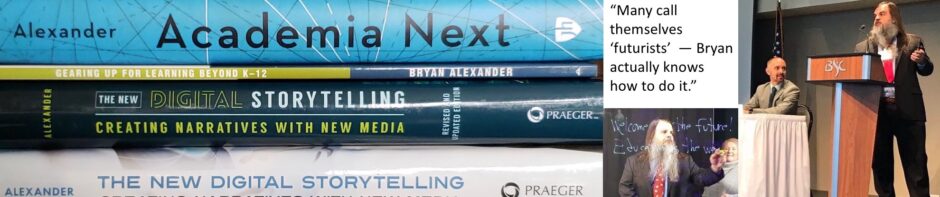
Several friends have asked to share my experience, partly because I’ve written and seen into print three books (Academia Next, Gearing Up for Learning Beyond K-12, The New Digital Storytelling)* plus a PhD dissertation, and also taught writing for some years. I’ve read many articles and books on long-form writing. So I can share what I’ve learned.
Here I want to focus on the book writing experience itself. Not the idea generation process, not how to land a publisher, not marketing nor the editing and proof process – those are all interesting, and I can do those in other posts, if folks are interested. For now I want to focus on how to wrestle with a monographic project, how to squeeze out tens of thousands of words into the shape of a book others might read.
(Caveat: I’m talking about nonfiction. Fiction can be quite different, yet some of the below applies to it, depending on your approach.)
Use an outline I often have some kind of outline when I write. There are exceptions, as when it’s a short piece (blog post, brief article) or when I’m writing to explore a topic that I can’t wrap my mind around. Otherwise I start off with a big picture outline of the key points I want to address. The longer the project, the more detailed the outline: subheads, key references, even phrases (mine or others’) I want to make sure I don’t forget.
 My book outlines start from what I pitched to the publisher. Publishers ask for a table of contents (ToC) with some material under each chapter; I expand on this for the actual writing. So far I’ve written books with 5-16 chapters at around 10-50 pages each. In the outline I usually put in 2-5 points at the start. I make sure that outline is visible throughout the writing process, even taping a printout of it to a prominent spot.
I’ve heard that some folks prefer to start from a concept map instead of an outline. If that works for you, run with it. I love concept maps, but mine get multilinear very quickly, and that doesn’t translate into a book unless I straighten things out into a line.
Some people don’t need a written outline. I suspect they actually have a mental one, a framework and path laid out in memory. Or they just have an organic idea to explore and it unfolds naturally for them, developing as they go. I do not understand these humans.
Hurl Remember the radical importance of just getting words on a page/in a file. I think it was Philip Roth who referred to writing a “vomit draft,” a term that describes both the depths to which we reach in drawing forth words, as well as the embarrassment and horror we feel when confronted with our ejecta. It sounds horrible, but for most people it’s easier to revise than to craft from scratch. It’s easier to cut than grow words.
A vomit draft is something to work on, something to improve and build upon. It gets you over the specter of a blank page and yields some writing momentum. And it’s practice. Keep on hurling.
Perform the ritual of regular writing People will tell you that getting into a writing habit is a good idea, and they are correct. Pick a time that works for you. In my life that time has varied. In my teens and twenties it was night, after dinner, and extending towards dawn. When my wife and I had children my writing time shifted to early morning (6 am) and during my professorial office hours (various afternoon and late morning slots). Those times just worked best for me, yielded more and better writing. Try your own schedule, writing across the clock to settle on the ideal schedule. You’ll gradually find yourself in the scribbling or typing mood more often when the hour strikes.
Beyond time, some people also need the right writing space. It might be in bed, at a library table, in an office, or on the kitchen table. You might have a preferred sofa or nook. Actually, when I say “space” the better word might be “setting,” as other factors come into play: certain music, or no sound at all; the presence or absence of people; the right clothing; something to drink. See what works for you.
For me, I actually write best in an office type setting, with a desk allowing for me to position the computer plus various papers and books, although I can write anywhere (see “Irregular practice” below). There’s some sprawling involved. For a soundtrack, sometimes I focus so intensely that I can’t hear anything, so silence is fine. Otherwise I have some musical preferences and playlists: classical music from the nineteenth and 20th centuries; black and Viking metal. I try to avoid pieces with clear vocals, which can distract me.
One benefit of creating a setting and routine: it’s a good way to push against writer’s block. (There are exercises and prompts for when you just can’t type anything; I can share some, if you’re interested) Dwelling within a schedule trains your mind and body to be in the habit of churning out sentences. There’s an aspect of conditioning involved, yes, and some writers will heighten this with some rewards. Do what works for you. (I recall a story about the sf and mystery writer Fred Brown, who would take a bus ride to think through a story, get off to type the whole thing up, and reward himself with a bottle of scotch at the end. I haven’t checked to see if this is true, but I like the story and you get the idea.)
Some people recommend setting a word count as part of the writing practice. This can mean a minimum (“I will hammer out at least 900 words every day”) or a maximum (“once I hit 2K I will stop or my family will murder me”). I can see the advantages to this in training oneself to a system. Personally, I don’t keep track of wordcount precisely in this way, but do like to aim for at least 500 words at a time as a minimum. When I notice passing that number it feels like I’m in the middle of actually writing something, as opposed to just ramping up.
Rogue writing For some of us writing also happens when and where it happens. It may be opportune, if you are taking a class, riding a train, waiting in a medical clinic, eating breakfast and the book demands your attention. Or the writing will demand your attention. The outline can suddenly appear before you, or an incomplete paragraph now has a good finish. You might be researching in a library or talking the book over with a friend and you now have the perfect phrasing for one idea. Always honor these desires and moments. Part of writing a book is being ready to pounce on these sudden demands.
Sometimes actual writing of prose is impossible, as when you might be driving a car, taking a shower, or walking in a rainstorm. Using a voice recorder or recording app on your phone makes a lot of sense in some of these situations. (I’m not too good at this myself, alas, and will instead hastily multitask a scrawled note on whatever surface comes near: back of a receipt, rental car agreement, my left hand. I don’t recommend this.)
Milestones and flags Psychologically it’s a good idea to recognize when you’re made progress on the book beyond a few days’ work. How you measure this is up to you. For me a finished chapter draft is a fine thing, as are big round numbers for word count (10,000 or 50,000 words). As you squeeze out more words keep an eye out for the milestones looming ahead. They’re easier to shoot for than the entire book. And once you’ve passed them, you can turn to them for cheer. You made it that far; onward!
Pillage your previous materials Look back over your blog posts, Facebook threads, articles, scribbled notes, book chapters, PowerPoint slides, whatever else you’ve composed along your book’s lines. You may find some useful stuff, from references to questions.
Don’t copy. Remix, edit, mash up, and create. Odds are you’ll want to because of the passage of time (“Did I really say that?”) and the new context of your growing book manuscript. If you love the prior very much, cite it like any other source (but don’t do this too often).
 Sheer persistence At different points in writing books I felt overwhelmed. I would delight in a few hundred words that really did the job, then realize I only needed to do that TWO HUNDRED AND FIFTEEN TIMES MORE. A writing frenzy would finish and the next chapter would loom ahead, a looming blank. Self confidence would desert me, and I would dive into more research, some of which was unnecessary, all of which added to my sneaking sense of not being the right person to write this thing. Deadlines drew my attention like galactic black holes, vast, implacable, and all-destroying.
Also, distractions fought cannily for my attention. I already mentioned research; the whole, lovely world of other people’s writing beckoned ceaselessly. Family has all kinds of needs. I found all kinds of housework which really needed to be done, and done to perfection. I made a lot of food, meals for armies. And the digital world was irresistible, from ruthless emails to delightful games and online friends.
The hard truth is you have to fight all of that. Not all the time. Once you’re writing, writing will increasingly soak up your attention. But there will be times when you fall out of the groove. Distractions will raid your concentration. The experience of successfully writing a book includes successfully persisting through these distractions and crises of conscience.
How do you do it? Earlier I recommended the ritual of writing. Make it a habit. Habits can be useful, shaping your expectations and behavior. Rely on them. Trust your schedule. Then look to what you’ve already written. I don’t mean critically or for revision. I mean to take pleasure in word or page count. You started with zero, remember? And now you’ve come this far. Feel proud of that. You can keep going. You have momentum.
If you lose confidence, look at that growing pile. Think of the outline, if you have one. Remember your publisher’s contract, if you have one of those. Each is evidence that you are the right person to do this. If you can think up a full framework for the book, if you can write some of it, if you have convinced someone else that you should – then, by God, you are the right person and you. Can. Do. This.
I also think of the audience. I imagine readers and talking with them about the book’s ideas: what questions they have, how I’d reply, which objections they’d raise, how I’d respond. Those conversations feed straight into writing, either bringing up new points to address or expanded ones I’ve already touched on.
Linear versus nonlinear writing I love reading hypertext stories and playing games with branching narratives. I delight in the intervention into story, in being able to see a tale open up into possibilities. As a writer I follow this nonlinear logic at times. Working on chapter 2 gives me an idea for chapter 11, so I jump over (literally: hypertext) and write in that spot. While fleshing out chapter 8 I realize that I’ve been building on something in the introduction; looking back, I can see that something isn’t strong enough, so I leap back to strengthen and expand it.
Otherwise, I actually tend to write in a linear way most of the time. I like writing the introduction, then chapter 1, then chapter 2. I tend to write chapters (and articles) from front to back. It might be because I like the sense of a story unfolding, with each point giving rise to the next. It could also be the pleasure of building something in a linear fashion, like watching a game score rise or the number of biscuits growing across baking sheets.
Sometimes I will jump ahead and write all over a chapter down the road. This can be because of an exterior prompt, like a news story or a conversation. Changes in my thinking about the book can also do this. That can lead to reordering chapters, revising the outline, subtly rethinking the overall concept of the book, and to holding delicate conversations with editors.
Linear versus nonlinear revision You will edit, cut, amend, rearrange what you’ve written before you send it off. This is a general rule, and only Robert Heinlein disagreed (“You Must Refrain From Rewriting, Except to Editorial Order”).
In my experience people’s revision practices vary widely. Some folks disgorge an entire book before turning around to edit and hone. Others leap back and worth within their text and process, growing a chapter here while editing another. Different spirits animate this process: quiet tinkering; outraged horror; delight in amplifying an important point.
I find that the deeper I get into a book, the more confident I become about how it should appear, and the more easily I edit.
Use the physical world to your advantage Earlier I mentioned the distractions that beset a writing project. Some of those are digital, while others are analog. Human beings in the physical plane, housework to be done, animals that demand affection and care: all of these and more can drag you away from building up that word count.
However, on the flip side these analog distractions can actually work in your favor. Writing for a while can cramp your body, so mild exercise (stretching, walking around, bouncing on your feet) will make you feel better. I’m also fond of stepping away from the keyboard to think through manuscript issues. Weeding the garden, chopping wood, washing dishes, making food, or staring at a sunset are ways to give my brain new perspectives on writing problems.
Technology There are all kinds of tools out there for book writing. For hardware people write on anything, from laptops to desktops to phones, old school notebooks, dictation software, and sheets of paper. Pick whichever one is most productive for your writing. It may or may not be something you use in the rest of your life.
 Software: there’s a small industry of tools available. Word is the writing giant, of course, but Scrivener offers a different way of writing. Wikis and Google Docs give you collaborative options. Apple’s Pages is a lightweight tool.
What about audio? There are plenty of ways to record your voice, from dedicated hardware to phone apps. That’s an easy method for you to share your thoughts when you can’t write. Additionally, dictation software continues to get better. That works for some people, especially if they have medical issues with writing a great deal.
Me? I’m quite prosaic, sticking to Microsoft Word on a laptop. I like many of its features and, if we’re honest, its deep familiarity lets me focus on writing rather than on the tool. Most of my editing work also takes place in Word, with editors leaving notes in comments, our using Track Changes, corrections in the body, etc.
I’d like to experiment with writing software and other hardware, but haven’t had much luck, personally. My fingers are too squat to use virtual keyboards well.
Also, I cannot write at length with pen or pencil on paper. I do short things – annotating printouts, a dream journal – but my handwriting is just too awful. And it’s slower than typing.
NB: BACK IT ALL UP. Make sure whatever medium or platform you’re using has a safe version you can get back to.
Writing full time? Most people work in book writing between other time-consuming tasks, like working at a job or caring for family members. Few have the opportunity to have entire weeks to spend on writing. Some folks manage to carve out entire days for writing through careful planning. Writing retreats serve this need as well.
The advantages to writing at such a schedule are obvious and quite attractive. You get to focus and make significant progress in the manuscript. It’s easier to schedule distractions.
Personally, I have only had a few days to devote to writing that much. Those were terrific times, with an almost astonishing amount of hours lined up in a row, available solely for my typing. Otherwise, my other work is far too demanding: teaching, consulting, meetings, making other media, traveling. And for much of my adult life caring for family has had a prior claim on a day’s hours.
If you have the financial means to write full time, enjoy. There are some who recommend against this as a long-term strategy, not because of the possibility of penury, but because you can lose touch with the world. Otherwise, think of writing holidays or retreats.
…and that’s it for now. What questions do you have? What else would you like to know? Fellow writers, what wisdom can you share from your experience?
(typing photo by Kiran Foster)
*If I want to get picky, call it 3+ book, with the “+” standing for revising New Digital Storytelling into a second edition.



Bryan…thank you for writing about the book writing process. To quote a Nobel Laureate, “every one of them words rang true”.
And you’re on the other side of one!
Hi Brian! All excellent advice. I particularly like the one about creating a ritual. There’s no substitute for sitting down and writing. In the romance world, those of us who write without a full plot outline are called “pantsers”- as in, flying by the seat of one’s pants. Probably this is true in other fields as well. But whether you know where you’re going or are finding it out as you progress, if you don’t put words down, you won’t get there.
In grad school I had a professor who wrote a page a day, longhand, and produced about a book a year. I often think of his model. I can’t do it, but I think about it. 🙂
One page a day is solid. Ray Bradbury did something like that his entire life.
Pantsers… I envy them. And I do like writing as exploration. I just don’t get how to do that at book length, esp. nonfiction.
I actually think it’s like programming. You have some functionality you want to deliver, and many process threads that need to all come together at the same time to deliver that functionality; you’re probably not going to worry too much about every little thread (won’t you probably re-use code to draw a dialog box?) but you have to shape the overall thing to get where you want to go. You may find out as you go that what you thought would go HERE needs to go HERE and is blue instead of green. 🙂
Nice to know your experiences and views. I am currently in the phase of practicing writing skills. I do this in private. I have a bunch of relatives to whom I write emails on various topics in my native language. English has been the working language through my career. So I had actually lost touch with my native language. A search for the appropriate word has often been critical to convey the right idea. My desire is to write about science in layman’s terms. On some days the flow comes naturally and I am proud of my writing. Whether others read it or not, I myself read these pieces a few times. On many days it still looks like ‘the hurl’! That is when it gives me the opportunity to practice editing.
If some topic is well known to me, it does not seem to trigger the urge to write. It is often some new topic that I read recently, that triggers me into sharing the idea. I add the necessary background science to make it understandable to my mixed audience. In this part I try to embellish the content with some humor or quotable quotes. When I tread on the new concept that excited me, I carefully word them in as simple terms as I can. Some times I feel I may have completely misrepresented the idea. That goads me into reading up some more information around the topic, till I have obtained enough clarity to make it simple.
I guess I will now shift from email to close relatives, to a blog platform for a larger circle of friends and acquaintances. The target audience is laypersons who may not have a lot of science knowledge. The target language is my native language.
To get thoughts gather momentum, I find early mornings to be the best. I do not undertake writing when the thinking process is busy. Unfortunately I may not be capturing some nuggets of thought for future use. Most of my writing are short length, blog post sized. Often I hear people complain these are a bit too long. So writing in a concise manner is one of the challenges I am fighting. Your post encourages me to write in longer formats, such as a book. That seems to be the logical thing to do when long writing is my natural style.
Sowmyan, thank you for sharing details of your practice. Fascinating point about being easier to write on topics you are learning.
Write a book! Go on!
PS: which language are you writing in?
Thanks Bryan for every one of your awesome ideas esp. using tech tools for writing. Creative writing in VR is something I tried this week using Oculus Rift in AltSpace. One instructor led the session using a story prompt, then participants typed their lines using laptops and shared by reading their 2-3 minute writing in the VR writing room. For one hour about four of us were virtually engaged in the process, only interrupted by lifting our headsets to type out our story lines on our laptops. Then simply going to a virtual desktop in the VR space and reading what I typed. It sounds complicated but it really wasn’t . I ended up writing in the virtual writing room much longer than I expected too. It was incredible! I never would never thought this was possible before yesterday. Maybe someday this is will be added to your tech tools? Thanks again for your inspiration!
Wild, Roxann! Was that one single, shared virtual desktop?
I’m so glad to learn of your future-oriented explorations.
I can visualize you teaching a futures course in VR :). Maybe in the near future? The entire setup cost was lower than I expected. The Oculus Rift headsets are now more affordable and a savvy consumer can find a VR ready laptop. And I’ve seen more libraries purchasing VR systems too. This first experience was truly academic VR. It’s definitely a new immersive exploration of peer collaboration and feedback too.
Fascinating – and something to shoot for.