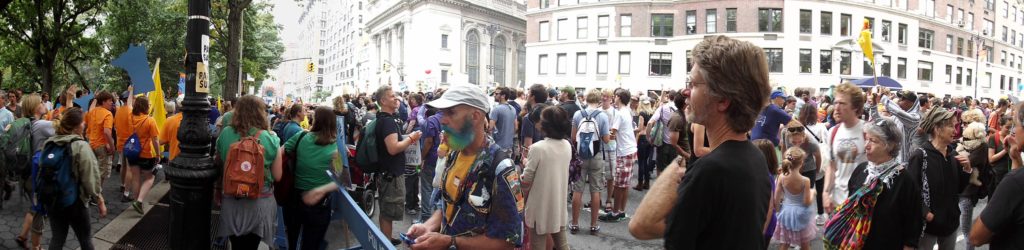
The future of education and climate change: part 7

Over the past few weeks I’ve been blogging about the impact of climate change and higher education (posts 1, 2, 3, 4, 5, 6; all here).  Today I’d like to expand on points from post #4, about the relationship between…

Campuses and the rest of the world in a climate crisis (continued)

Relationships between universities and the business world can become strained or broken, depending on carbon politics.  For example, we’ve seen divestment campaigns for nearly a decade, with students and faculty urging their campus to withdraw funds from certain carbon-focused companies (“By September 2019, a total of 1,100 institutions and over 58,000 individuals representing $11 trillion in assets worldwide had been divested from fossil fuels.”)

fossil fuel divestment_Wikipedia

That’s a start.  This desire to pry campuses away from carbon investment can extend to other enterprises and sectors. Will public attention embarrass wealthy universities into divesting from climate change related projects?  For example, one campaign is pressuring Harvard to step away from land speculation in the Amazon area?  Listen to the connection:

Land speculation by pension funds and endowment funds, such as TIAA and Harvard University, is stimulating land grabbing and causing displacement of rural communities and environmental destruction. These corporations promote extensive mono-cropping of agricultural commodities, which cannot be sustainable. This agricultural system is based on chemical inputs and fossil fuels, constituting a major cause of climate change. The main area targeted by this process, the Cerrado (Brazilian savannah), is a unique ecosystem because of its rich biodiversity, river springs and rain cycles, which are connected to the Amazon and the Central-South regions of the country.

This could extend pretty far.  Think of other, carbon-involved or -dependent industries: airlines, plastic manufacturing, chemical production, or parts of agriculture.

From another approach, will members of a college or a campus itself join lawsuits like this one against Exxon?

Exxon Mobil Corp was sued by Massachusetts for allegedly hiding its early knowledge of climate change from the public and misleading investors about the future financial impact of global warming, two days after a trial started on similar claims in New York.

If we follow a path of escalating outrage towards the petroleum extraction world, such lawsuits should proliferate, as will campus interest in engaging with them.

Beyond the business world, academia’s relationships with governments can also become challenging in the age of climate crisis.  For example, a state could compel campuses to adjust their carbon footprint, as Larry Smarr, Jerry Sheehan, and Tom DeFanti noted in 2009:

the category of regulated entities will likely include colleges and universities, many of which are essentially small cities, especially those that have their own power plant to generate heat and/or electricity. Specifically, any higher education institution that generates over 25,000 mTCO2e will be subject to the EPA reporting and regulation requirements under the proposed Waxman-Markey cap-and-trade bill and may have to purchase emission permits.

This can play out in many ways, such as adding another issue for colleges and universities to lobby their states about, or shifting local power generation to other means (wind, solar, etc).  The opposite could also happen, should local, state, or national governments pursue policies against climate change mitigation.

Let’s step back a bit to view the problem from an even higher level. How will higher ed respond to problems facing general infrastructure?  In the face of Berkeley shutting down because of raging fires, Jeffrey Market observes:

https://twitter.com/JeffreyM_PhD/status/1188936010333331457

“We’re not at all prepared for our core technologies to regress like this…” That’s a powerful phrase, elegantly capturing one way climate change can press on civilization.  Always-on electricity gives way to intermittent power and then to no charge at all.  Modern air conditioning fails in favor of hand powered fans.  It’s like something from Phil Dick’s great novel Ubik (1969). How many colleges are prepared to handle such a regression along infrastructure’s developmental track?  There’s a very practical level to this, which we touched on in parts 2 and 6, but there’s also a strategic aspect, as campus seek to maintain themselves according to 21st century standards.  In addition there’s a mental health aspect, as a population accustomed to the hope of accelerating progress is confronted by the reality of regression.

Scaling up a bit higher, we can ask: will higher education respond to the crisis in anything like a timely fashion?  Maybe not. Marcus Barber thinks academia isn’t going to respond, being caught in a kind of institutional inertia.

Universities… had a chance 15 years ago when action was needed. They’ve done nothing in reality and only now starting to get on board, years after the broader community started to take decisive action…

After all, academia worldwide is generally famous/notorious for not being able to change quickly.

Tom Haymes has higher hopes for higher ed.  He sees us reframing higher education in order to meet a civilizational threat, and in so doing we will have to “rethink some of our basic priorities and approaches to teaching and learning.” This includes a larger emphasis on critical thinking, plus:

…the tools of creative problem-solving, which is based on a foundation of critical thinking. They are the tools of design, iteration, and experimentation, which are based on a scientific approach.

To his credit, Tom has redesigned his own teaching (government) along these lines.  And this lets us see the connections between the micro and macro, a given classroom instance and global trends.  How many other educators have made that link in their own work?  How many staff have done so?  How many students, trustees, alumni, and legislators?  Bridging that tremendous gulf between planetary crisis and immediate campus action may be what defines academia’s next generation more than anything else.

Posted in climatechange | Leave a comment

Another academic merger; another college exits Vermont

Another higher education merger just hit the news.  Marlboro College (in southern Vermont) will merge with Emerson College (of Boston, Mass.) over the next eight months.

This is a fresh story, so my post is a hot take based only on initial signals and my previous analysis of Marlboro.  But I’ll try to draw out some salient elements.

The gist: it seems like Marlboro will transfer “the school’s endowment and real estate holdings in southern Vermont over to Emerson College.”  Those are worth about $40 million US (“roughly $30 million endowment and $10 million in land and buildings”).  Marlboro will shut down operations at the end of spring term 2020.   After that point students who were taking classes at Marlboro will transfer to Emerson, taking classes in:

Emerson’s Liberal Arts and Interdisciplinary Studies program, where Marlboro students will be enrolled and tenured and tenure-track Marlboro faculty will teach. The program will be renamed the Marlboro Institute for Liberal Arts and Interdisciplinary Studies at Emerson College.

It looks like only Marlboro’s tenure-track faculty will move to Emerson.  According to a local paper, “[a]dministrative and support staff are not part of the proposed alliance…”  They will just lose their jobs:

“A proposal was made but it turned out to not be credible,” [Marlboro’s president] said.

“Trustees will be collaborating with the administration to develop severance packages that demonstrate the College’s gratitude,” wrote Quigley and Marlboro College Board Chairman Richard Saudek in a letter published on the college’s website.

Readers may recall I’ve written about Marlboro before.  It attempted a merger with Bridgeport University (Connecticut) this past summer. That fell apart in September.

What does this story mean for higher education’s future?

Caveat: this is just one (1) small datapoint, and Marlboro represents a very narrow stand of American higher education (very small, private, liberal arts).

First, identity remains crucial in this process, as in every academic merger.  Listen to Marlboro’s president:

“It preserves our identity through renaming Emerson’s Institute as the Marlboro Institute for Liberal Arts and Interdisciplinary Studies, continues our pedagogy and commitment to progressive education by bringing our faculty to the Emerson campus, and provides extraordinary educational opportunities for our students with an alliance partner where there is a clear alignment of values, culture and purpose.”

Second, it’s still early days in the story. Both colleges’ trustees have to approve the process.  So, as with Bridgeport, the thing could still fall apart.  (Interestingly, the merger news doesn’t appear anywhere on Emerson’s front page as of this afternoon.  Contrast that with Marlboro’s:

Marlboro front page-Emerson

Emerson Emerson Emerson Emerson Emerson Emerson

)

Moreover, it’s not clear that “merger” is the right word. Emerson College’s official announcement page and video doesn’t use the merger word at all, preferring instead to speak of “an extraordinary alliance.”  An Emerson press release also scrupulously avoids using the m-word.  Marlboro’s announcement only mentions m_rg_r once, referring otherwise to a partner/partnership (four times) and alliance (2x).

Other terms might be better.  We could think of Emerson as a white knight, saving (some of) a struggling college.   An Inside Higher Ed commentator described the plan as Marlboro is “being gifted” to Emerson.  Otherwise, given the huge disparity in relative sizes – Emerson has 4,446, or whom 3,813 are undergraduates, while Marlboro enrolls only 150 – perhaps a better term appears in the business world’s language: acquisition.

Third, did you catch the $10 million in land and buildings?  Remember that real estate plays a key role in mergers.  For struggling campuses, that might be one of the leading benefits they can bring to negotiations.  Think of it this way: every academic merger story is ultimately a real estate deal.

Fourth, some will see this as another negative mark against the future of liberal arts campuses.  Alternatively, it’s another blow for the very small, very rural American college.  Note the way Marlboro explains their actions:

The challenges facing small liberal arts colleges are acute and will only intensify in the coming years. Unfortunately, Marlboro’s ongoing budget deficits are only a preview of the difficulties ahead, as the number of students in the region declines precipitously over the next decade.

i.e., familiar stuff for my readers.  But Marlboro’s statement immediately continues with a specific point about how these trends pressed hard upon them:

It has been sobering to watch a number of our neighboring schools make excruciating decisions to close in the face of these insurmountable challenges, something that our accreditors have watched with alarm. The accreditors have shown concern with Marlboro’s own sustainability since 2015, and their oversight has increased dramatically as our neighbors have closed.

See that?  Don’t forget the vital role that accreditors play in higher ed.

Fifth, this is bad news for Vermont.  Already three campuses have closed in just the past year (Southern Vermont College, the College of St. Joseph, and Green Mountain College), while Vermont Law detenured most its faculty members.  Losing a fourth college is not a good sign for the state’s viability.  Indeed, looking ahead, Michael Horn offered this glum take:

(That would be Middlebury College.)

Ellen Nuffer reminds us of the social, economic, reputational, and human cost to Vermont:

Overall, I can’t shake my sense that American higher ed is overbuilt, and that we are now scrambling to redesign the sector to make sense of a different world.  Closures, mergers, and whatever the Marlboro-Emerson story is are key steps along that path.

More as I get it.  Do any of you have insights into this story, or thoughts about mergers in general?

(thanks to Jenny Darrow)

Posted in higher education | 18 Comments

The future of higher education and climate change, part 6: California on fire

For two weeks I’ve been blogging about possible futures for higher education in an era of climate crisis (all posts found here).  I wanted to take this post to address what looks like an early example of climate change hitting academia, and hitting it hard.

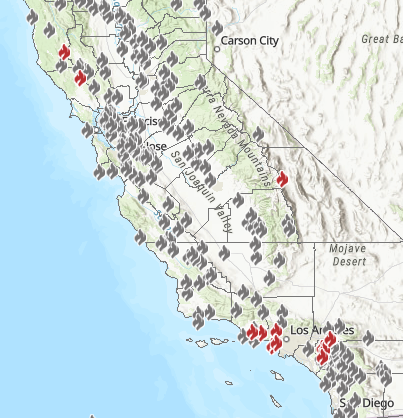
California fires, 2019Let’s start from the assumption that climate change bears at least some causal responsibility for this month’s California wildfires.  Changing temperatures and weather patterns have led to a drier season than normal, leading to larger and more destructive firestorms.

How have they hit Californian colleges and universities?  What can we learn from this experience?

Elin Johnson has an excellent account at Inside Higher Ed.  Read it, of course, but here I’ll extract some of what seem like key institutional actions to me.

Offering social services Colleges and universities may choose to provide non-academic support.  For example, counseling: “When it reopens, [Santa Rosa Junior College] will be offering mental health services and support groups for students and employees impacted the situation.” Or providing food and space: “Humboldt has opened the doors of its dining hall, the Jolly Giant Commons (the J), to students, staff, faculty and their families to eat for free during the shutoff… On Sunday night… they served 1,500 people.”  Or medical supplies: “San Francisco State provided faculty and students with masks for the poor air quality…”

Repairing the campus physical plant Damages must be repaired, of course.  For example, “[Sonoma State University in Rohnert Park  associate vice president for strategic communications Paul] Gullixson…  noted that Sonoma State will need to do a lot of cleanup regarding landscaping due to the high winds.”

Relocating members of the campus community Not every student can relocate themselves away from campus and to safety.  For example.

Sonoma State evacuated those who live on campus. Around 3,000 students of 8,000 enrolled live on campus at Sonoma State and have had to find housing elsewhere… For those few dozen students who had not gone home or could not find housing nearby, Sonoma State provided space in their workforce housing facilities.

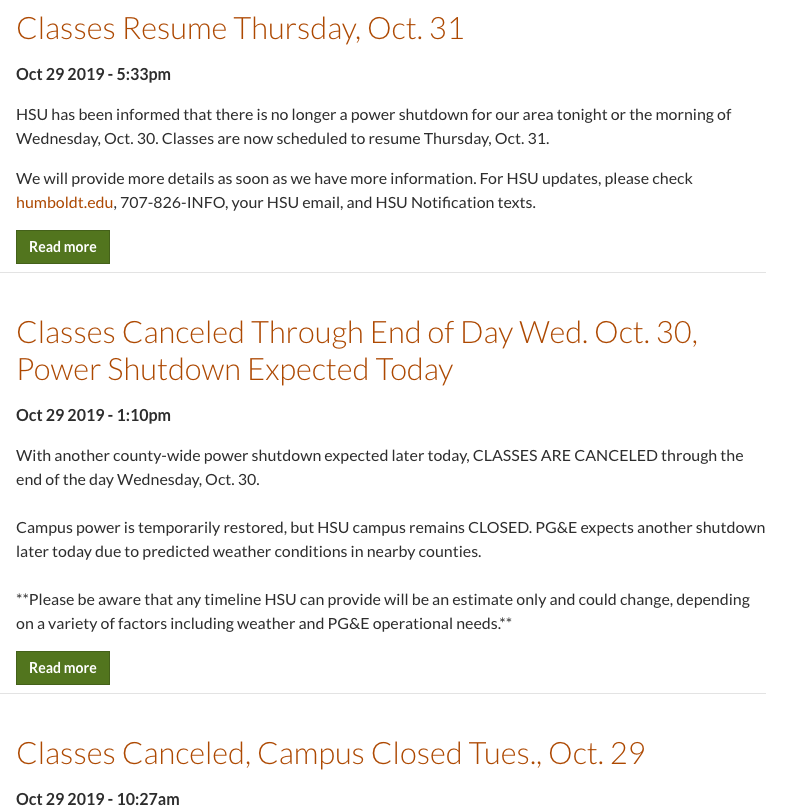
Adding new communications Emergency communications are challenging now, as so many platforms are available and none is universal.  The web might be one of the best options:  “Humboldt has created its own page on its website exclusively meant to update community members on the power outage situation.”

Humboldt State closure notes

Suspending research work Some research effort depends on high levels of infrastructure support.  Without that support: “Power outages earlier this month threatened research projects at the University of California, Berkeley,”

Suspending certain services and activities Some institutions paused some offerings: “The unhealthy air quality in the area has led to Mills [College] canceling outdoor classes like physical education and closing the pool.” Nearby, “San Francisco State’s Estuary & Ocean Science Center activities and field trips were canceled.”

Modifying the academic calendar Every climate crisis incident can mean delays to intensely structured academic schedules.  For example, “Mills officials… have built flexibility into their academic calendar in case they need to add seat time to the semester…”

Using digital tools Beyond purveying announcements, digital technology can help campus communities continue their work when people are no longer colocated.  “Chinyere Oparah, provost and dean of faculty at Mills College in Oakland… noted that the increasing use of digital tools has made adaptability smoother.”

There is also the problem of competing technologies.  NPR reports that helicopter pilots are trying to avoid drones.

Working with local public services Campus don’t always act on their own.  For example, “Mount Saint Mary’s Chalon campus was evacuated by the Los Angeles fire department…”

Closing campuses temporarily This happened across the state:

  • “The University of California, Berkeley, canceled its Monday daytime classes…”
  • “UCLA announced Monday that it was canceling classes…”
  • “Sonoma State University in Rohnert Park closed through at least today…”
  • “Humboldt State University in Arcata will be closed through Tuesday…”
  • “Santa Rosa Junior College announced closures through Wednesday due to impacts from the Kincade fire such as ongoing evacuations and power outages.”
  • “San Francisco State University’s… Romberg Tiburon campus closed due to Marin County power outages.”

Note that reasons for closures were various, including fire damage, electrical power cuts, and dangerous air quality.

Coping with knock-on effects It’s not always a simple case of cause and effect.  Notice what led Sonoma to evacuate some of its population: “the university’s water-pumping mechanism was impacted by the power outage, which meant their fire-suppression capabilities were restricted…”  Bad weather->electrical outage->internal fire-fighting is weakened->student evacuation.  What other causal chains should we anticipate?

Collaborating with other colleges and universities It seems obvious, but isn’t easy to do, so it’s good to see inter-campus aid occurring.  “Gullixson painted a picture of campuses coming together and supporting each other, saying that Chico State, San Francisco State and others have reached out offering their support.”


What can we learn from all of this?

First, the California fires story shows us a range of actions that colleges and universities can take, from closing to collaborating, offering mental health and evacuations.

Second, many of these are costly.  Campuses may be advised to put money away for such incidents and to draw on insurance.

Third, campuses need flexibility and vision in dealing with such climate threats.  The pressure may be simple of complex, and hit different institutions in different ways.  We have to be ready to change operations just about anywhere in the full range of college and university functioning.  We also should be ready to collaborate.

Fourth: communication is vital.  I’ve been hearing negative reports of California’s utility failing to convey correct information in a timely way; this is inexcusable.

Fifth, and related: I’m unclear about how each of these campuses reacted in terms of governance and populations.  Which offices and people organized those actions and reactions?  What was the faculty role?  How informed and empowered were students?

Keep an eye on how academia scrambles to deal with the climate crisis.  It isn’t going to get easier.

Final note: all best wishes to everyone hit by these fires.

Posted in climatechange | Leave a comment

Talking about futurism as a career

Way of the FuturistThis week I had the good fortune to be interviewed by Brian Nelson for his Way of the Futurist podcast.

Our focus was on the futures or forecasting profession: how we got into it, how we make it work.

buy xenical online buy xenical no prescription generic

  It was fun comparing our respective careers, as well as dwelling on our main topics of interest (me: education; him: blockchain).

I appreciated that professional focus.  It’s one perhaps I should say more about.

buy valif online buy valif no prescription generic

It was also fun being two Br*ans.

buy azithromycin online buy azithromycin no prescription generic

  Between he and I is about one average head of hair…

buy tadasiva online buy tadasiva no prescription generic

Thank you, Brian.  Much appreciated!  Have a listen, folks.

Posted in interviews, podcasts | 1 Comment

The future of higher education and climate change: part 5

What will climate change do to higher education?  How will academia respond?

Last week I offered a series of blog posts starting to explore this enormous question (1, 2, 3, 4).  I wanted to get my thoughts down and explore where they were headed.  Readers responded, from Twitter to Mastodon, email to Patreon.  Thank you all.

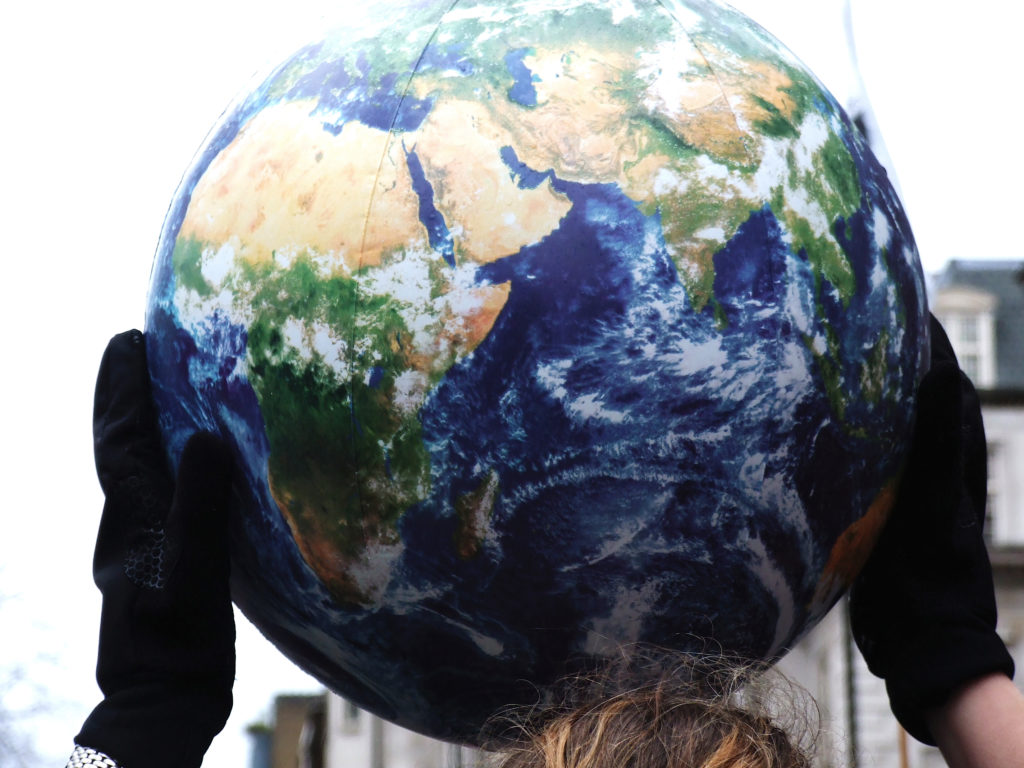
Earth in hands_lewishamdreamerIn this post I’d like to engage with those comments, and also develop some points I’ve thought about since the original four posts.  Here I’ll address three of the categories I floated (campus populations; physical plant changes; academic mission transformed).  In the next post I’ll write about the fourth (campus and the rest of the world).

1: Which populations are involved with this topic?

We discussed students, faculty, staff, and people working adjacent to academia (trustees, legislators, relevant business leaders, nonprofits, etc). We should add one more small but significant population to emphasize: financial managers in charge of institutional investment.  They may come under pressure to divest from certain industries and enterprises.  This has already begun with oil companies, and could extend to entities deemed to be accelerating climate change: car companies, airlines, bitcoin exchanges.

buy cipro online buy cipro no prescription generic

2: Changes to the physical plant of a campus

This month’s California firestorm and associated power blackouts suggest some campuses may want to reexamine their electrical backup plans (by the way, who’s covering the impact on higher ed?). That is, as climate change continues and causes greater numbers of extreme weather, colleges and universities are at greater risk of being knocked offline and out of power.  Is everyone prepared with the right mix of generators, surge protection, cancelation policies, etc?  There should be opportunities for businesses and inter-campus collaboration to assist.

Beyond fire is the problem of water.  A recent Army War College report argues that access to potable water will be a rising problem worldwide, if unevenly.   Do all campuses have reliable water supplies, including for protracted crises?  To what extent are bricks and mortar institutions ready to transform their buildings and grounds to retain and store water?

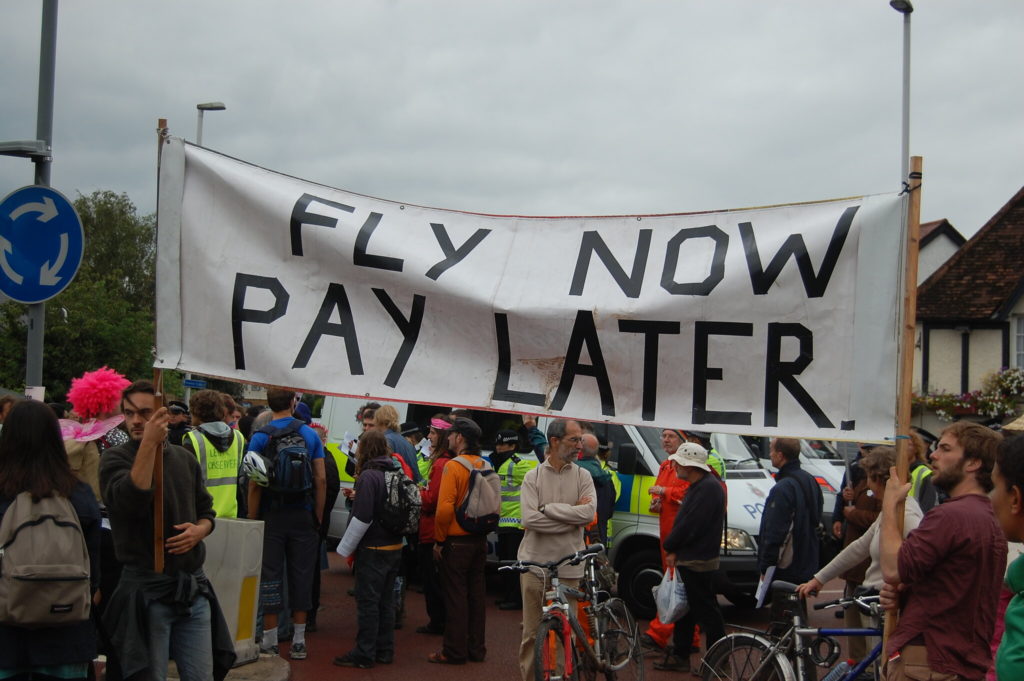
Technology: last week I discussed a two-part question.  On the one hand, will institutions turn towards more digital work in order to avoid carbon-burning transportation?

fly now pay later_nez

On the other, will campuses decrease or block use of digital tech they deem to carry too high a carbon cost?  To that problematic I’d like to add another.  Will some new technologies use less electricity than current ones, thereby driving adoption?  I’m thinking of some 5G possibilities (Huawei is bullish) as well as self-driving cars (which might be more fuel-efficient than humans, if we deploy them correctly).

3: Climate change and the academic mission

How will academia’s teaching and research missions change during a long-term climate crisis?  People were especially interested in this theme.

It seems easiest to include climate-related topics within currently existing classes.  Maria Anderson mentioned statistics instructors using climate change examples in homework, examples, and tests.  We can readily imagine similar examples popping up in engineering, literature, history, political science, sociology, and other fields.

Others cited climate themed classes.

buy zovirax online buy zovirax no prescription generic

  For example, in a blog comment Vivian Forssman referred to Canadian classes:

My project in British Columbia involves 7 universities who are developing non-credit courses that are being offered to working professionals, on their roles, responsibilities and professional actions re climate adaptation and community resilience.

(Vivian also wants to network: “I’m keen to connect with others who are focused on curricular responses to climate change.

buy doxycycline online buy doxycycline no prescription generic

“)

At a larger scale we’re seeing the appearance of linked classes.  Georgetown University now has a climate change undergraduate curricular pathway.  On the graduate level, climate change masters degrees are appearing (here are ten examples).

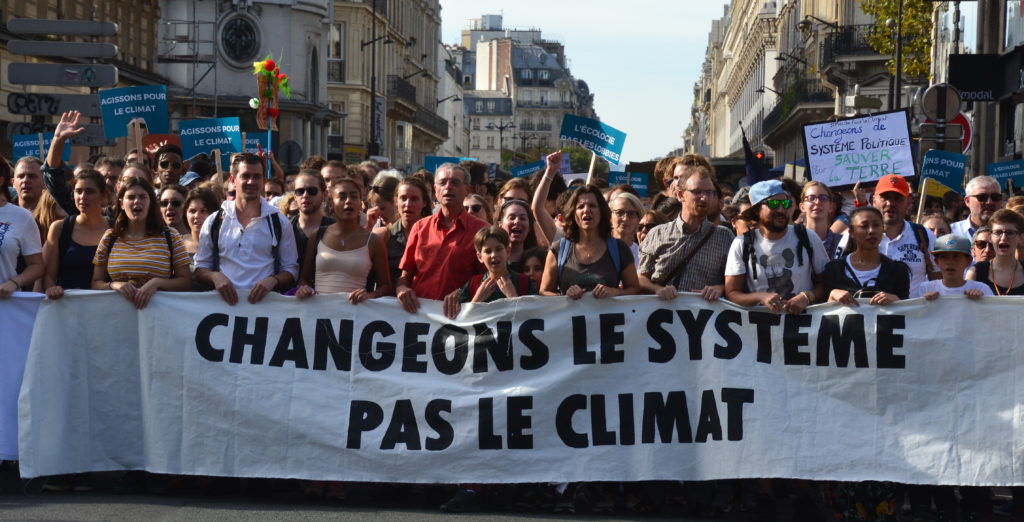
Change the system not the climate_jmenj

Meanwhile, as colleges and universities seek to prepare students for work, to what extent will climate change shape career options?  For example, campuses might emphasize educating students for green jobs.  They could also create or hone paths to professions most likely to be in demand as the climate crisis expands, such as:

  • firefighter
  • electric engineer (coping with stresses to power grids and stations)
  • Arctic studies, as polar regions lose ice and open up
  • agriculture (rising stresses to food systems)
  • disaster manager (obviously)
  • the full range of allied health, as human wellness comes under multiple threats
  • nuclear engineering, as existing power plants come under pressure or as some areas push for atomic energy as an alternative to oil and coal

How will disciplines fare that cannot clearly prepare students for climate crisis careers?  This question will become especially salient if that crisis drives increasing financial pressure on colleges and universities.

On a related note, will demand for military personnel rise in the face of growing political instability?

buy aciphex online buy aciphex no prescription generic

  Or might it decline under a combination of federal budget cuts and automation?  Think of the implications for military history, for campus ROTC programs, the number of veterans who are students, and teenagers choosing between the military and college.

On the student life side, we should expect at least some changes to campus food culture.  We could see a larger shift to vegetarian or vegan dietary choices than we’re already seeing, as well as reliance on plant-based meat alternatives.  Student activism could drive this, as well as staff and faculty pressure.

Study abroad: will campus programs seek to avoid areas under increasing climate pressure, as governments issue climate danger warnings?  Or, in contrast, will some universities develop thematic study abroad programs aimed precisely at those areas?  For the latter, imagine Climate Crisis Study Abroad programs, combining humanitarian work (a la Peace Corps) with relevant academic study (area studies, engineering, etc).  Alternatively, if academics decide that long-haul air travel is bad for climate change mitigation, we could cut back on study abroad, perhaps replacing it with sustained virtual work or limiting destinations to areas accessible through low-carbon transportation (i.e., train from Paris to Eastern Europe or Chicago to Mexico).


In the next post I’ll follow up with the fourth category, campuses and the rest of the world.

(thanks to Esty on Mastodon, my Georgetown seminar students, and my wife for further discussion)

(photo credits: Earth in hands by Jasn; fly now, pay later by nez; let’s change the system, not the climate by Jeanne Menjoulet)

Posted in climatechange | 2 Comments

5 AIs in Search of a Campus

How might AI appear on campus?

Last week I published a very short article in EDUCAUSE Review where I tried to imagine how this could play out.  I wanted to try a new approach to the topic, and I also wanted to get readers using their imagination, so I came up with different characters or archetypes for different AI functions.

To be clear, I’m looking ahead several years.  While there are some early stage versions of these characters in operation now, they haven’t really reached archetype status yet.

I wanted to give each a recognizable, easily understood name.  The first four are ones a campus would invite, while the fifth is one that appears on its own:

5 AIs in Search of a Campus

Tutor – software that teaches students directly.

Headmistress – organizes student data and publishes reports to various instructors and staff.

Manager  – gathers data and gives input on campus HR issues, from staff management to faculty hiring/promotion/tenure.

Muse – any AI that assists any member of the campus community in creating stuff, from essays to performance art.

Danger – when AI becomes a threat to some or all of the campus community.  Headmistress, Manager, Muse, and Tutor can each become Danger.

Please note that these are heuristics, small tools to think with about the future of AI and higher education.  They aren’t flat-out predictions.  Other character types will likely appear, including sub-types from these five (I initially had a sixth, called The Spy; that’s one of Danger’s).  And not all institutions will host the full quintet.

I also recognize the risk (even unto Danger) of humanizing the inhuman.  We humans can anthropomorphize almost anything, and lose sight of the thing’s nature.  When it comes to AI we can inaccurately project our mental and emotional operations onto that mix of hardware and software.  I wanted to run that risk in this article for the purpose of helping us imagine a different future, and to think about education and AI in creative ways.

In short, my goal was to spur futures thinking.  Please have at it!

PS: points to the first person who gets the title’s reference to classic American literature.

(thanks to Teddy Diggs and the rest of the very fine EDUCAUSE staff for publishing the article)

Posted in storytelling, writing | 7 Comments

The future of higher education and climate change: part 4

Here I’d like to continue this week’s series of posts on higher ed, the future, and climate change.  (Previous posts concern campus populations, campus facilities, and the academic mission.)

4. Campus and the off campus world   

Colleges and universities are not alone in climate change mitigation and adaptation, of course. As noted earlier, many other entities are likely to be involved, stakeholders and academically-adjacent sectors: businesses (publishers, ed tech companies, consultant), associations, nonprofits, governments, and local communities.  Public climate change efforts can be available to, or collaborate with, academic institutions, like this Maryland educational project.  Connections to local religious organizations can work in certain situations, like this Vermont instance.

Campuses can act as local anchors for discussion and action.  As a Second Nature report put it,

Can serve as ‘hubs’ in their local communities for creating, testing, and disseminating knowledge about regional climate projections and adaptation strategies, and should work directly with their local communities to explain the science and implement solutions.

Schools can also contribute to local area mitigation projects, such as building, expanding, or simply maintaining solar, wind, and hydro power generation.   Depending on the area, academics might contribute to larger projects: sea barrier walls, offshore wind or solar platforms, geothermal plants, the redesign or creation of new housing.

Academia-community relations in the age of climate emergency can take many other forms.  We could consider campuses as refuges during extreme weather, or campus community members seeking shelter in the community. Local politics might turn against a school perceived as doing too much for climate mitigation, or too little.  Town and gown can each offer economic support for the other’s work in addressing climate mitigation or adaptation.  Which will support climate refugees who seek to enter the area, and which will ward them off?

Campus activism should continue to have a mixed connection to the rest of society.  Student mobilizations can bridge to the community and also elicit its opposition.  Faculty and staff movements present similar possibilities, which suggests further pressure on academic freedom.  Conflict will occur between groups both on and off campus.  For a small example, consider this response to the September 23rd climate action in Washington, DC:


At a larger, geopolitical level, it’s possible that a transnational effort to resist or mitigate climate change could arise.  It could take the form of previous global mobilizations, like the 20th century’s grand alliances in the Cold War and two World Wars, or a more active United Nations, or shape into something new.  If this occurs, what role could academia play?  Will researchers commit to assisting UN 2.0 (or whatever it is called) as a WWII-style case of patriotic duty, or will the new authority contract with individual scientists, along the lines of American universities in the Cold War?  What role might academics play in driving the creation and development of such a transnational organization?  Conversely, what impact will academics have who oppose large scale efforts?  The border between campus and world is, of course, porous.

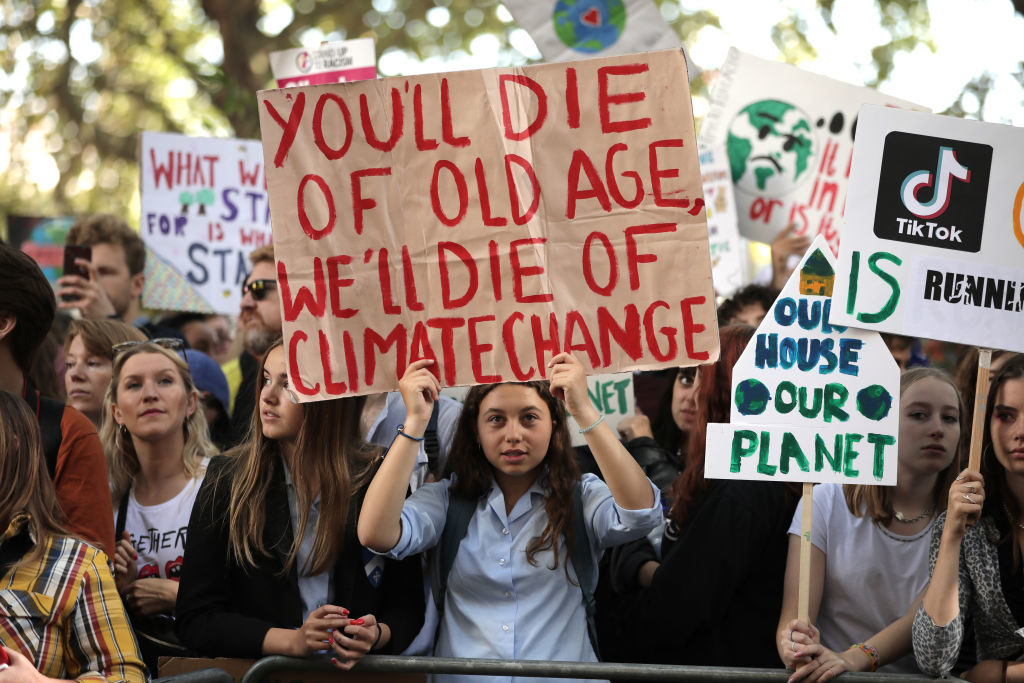
Social changes can exert other pressures on academia.  For example, an intergenerational aspect is surfacing now in some political arguments around climate change, which could also roil higher education.  Some younger protestors are using this slogan:

sign: you'll die of old age; we'll die of climate change

Along similar lines Elizabeth Merritt charges our time with temporal colonialism, referring to our practice of dumping present-day bad energy policies onto future generations.  In other words, intergenerational conflict could escalate.  How can campuses respond?  Will traditional-age undergraduates become more active, even insurgent?  Should we reform our institutions to more seriously account for their downstream impacts?

Another form of social change could strike academia powerfully.  Climate change should drive population movements as people relocate away from regions afflicted by flooding, drought, desertification, food supply collapse, bad governmental responses, and so on.  Some academics will research and/or teach this topic, from history to sociology, ethnic studies to political science.  Campuses may confront the option of welcoming refugees academically: hiring exiled faculty and staff, teaching the climate-driven homeless (and should the former teach the latter online? if so, how?).  They will also face the humane option of hosting people without an academic framework.  Naturally, opposition to supporting climate migrants can take the form of hard-headed economic decision-making, practical politics, or bigotries by race, class, region, and religion, to various degrees of openness.  History teaches us that such struggles certainly occur within academia; again, recall that our boundaries are porous.

Another macro dimension could also loom very large.  One explanation for the climate crisis sees a certain economics as responsible, a capitalism that views environmental costs as externalities undemanding of serious treatment.  In response some on the resurgent left call for expanding state efforts into escalating forms of socialism.  Given the dependence of many universities on some form of governmental support, said support could change or come with additional strings.  Increased taxation might target the wealthiest institutions, or depress giving to colleges and universities from the wealthiest families.

Some arguments go still further in their desire to redesign the human economy.  There is a call for a circular economy, one focused on suspending GDP growth, extensive recycling, and diminishing consumerism.  More strongly, others call for a degrowth agenda, either as a powerful solution to excessive carbon generation or as a way to reduce the excessive wealth of certain nations or regions.  Such deep changes to the global economy would bring about a range of novel pressures on higher education, from its funding and sustainability models to its research and curricula.

Now, the economy could well change drastically without climate change.  In this timeframe – remember, out to around 2080 – we could see the various forces lumped under the Fourth Industrial Revolution complete their work.  AI, robotics, commodity genetic engineering could drive several different futures.  Peter Frase has offered some groundbreaking scenarios along these lines:

  • a post-scarcity world, possibly as far as “fully automated luxury communism”
  • ever-widening income and wealth inequality
  • a world with stalled growth, but less inequality (think the 20th century’s second world)
  • higher inequality and brutal hierarchy

We could add to this other possibilities:

  • a world where more of our goods and services are less materially based (cf Andrew McAfee’s new book)
  • the Singularity, but all bets are off there

Naturally, each of these can be unevenly present or coexist in different forms.  The point being that such deep macroeconomic changes intersect with the climate crisis.  Those intersections are beyond the scope of today’s post, but I can return to them.

We should also anticipate political and cultural reactions against climate change mitigation, beyond what we see now.  It’s hard to say how long today’s climate change deniers will continue to play a significant role in decision-making.  The belief may age out over time, if its adherents tend to be of retirement age, or persist via intergenerational transmission, aided by wealthy funders.  A very different problem occurs when we imagine the difficulty in maintaining such strategic effort over a generation or two.  Humanity has been able to conduct such operations only rarely.  We can lose interest or change our minds as multiple factors come into play over decades, including competing interests: wars, religious movements, economic crises, diseases, not to mention black swans.  We should also expect a “boy who cried wolf” effect to occur regularly in years without major disasters or dramatic milestones.  This could happen at all scales, from the small (a city, a community) to the largest (the globe).  In short, academia may find itself out of step with the times, and taking flack for persisting with that climate stuff when the world has moved decisively on.  (Perhaps some will turn to Isaac Asimov’s Foundation sequence for some solace.)

In short: many challenges of medium to enormous scale.  Campuses may navigate increasingly difficult social and political waters.

(thanks to John Kellden for a pointer; thanks to Tom Haymes for reading; many thanks to my Patreon supporters for thoughtful conversations)

Posted in climatechange | Leave a comment

The future of higher education and climate change: part 3

In this post I continue my series on higher ed and climate change.  Here are the previous posts: 1, 2.

3. On campus: the academic mission

Academic research can play many roles in transforming higher ed in the age of climate crisis.  To begin with, university scholarship can contribute to the entire process of civilizational response, offering improved knowledge of the event, providing mitigation options, and helping us reflect on our experience.  Many fields are involved, starting with the Earth sciences, oceanography, meteorology, and agriculture, obviously.  Others can offer their particular benefits: the psychology of climate change; the sociology of how societies transform or maintain; the literature and other cultural artifacts of the process; the political and governmental dimensions of adaptation; the micro- and macroeconomics; computer science for handling simulations and sensor data; etc.

When it comes to academia’s teaching mission, at the top level we may see academia reconsidering the purpose of education.  To what extent is it to prepare people, including young people, for a world redone by climate change?  Will colleges and universities conceive of the goal of teaching to prepare students to mitigate carbon-fueled disasters?

buy grifulvin online buy grifulvin no prescription generic

In terms of academic programs, curricular changes seem likely.  Certain programs will draw greater numbers of students, resources, and attention, like climate and Earth science, computer science (simulation), oceanography, certain area studies.  New courses, minors, and majors seem likely to appear.  Imagine a climate change finance class or a climate mitigation macroeconomics sequence in business or econ, for example.  New programs and degrees seem likely to appear: a bachelor’s in climate change studies, a master’s in climate mitigation, etc.  Indeed, we should not be surprised to see climate-focused schools (graduate or under-) appear within universities, or to see something like Climate Change College appear, perhaps online.

There should be a drive from many faculty to revise their current courses to include climate change topics.   Literature classes may include more writing about climate change, historians include articles or books about climatological variation in their topics, and philosophers introduce mitigation and climate knowledge problems for students to explore.  This can take the form of new degrees, majors, minors, core classes, classes required for majors, and electives.

buy forzest online buy forzest no prescription generic

And we should expect some of those to be mocked on-campus and nationally, both by traditional and new media.

Changing curriculum and research will not come easily.  Obviously there are questions of funding as well as politics, both national and local.

buy amoxil online buy amoxil no prescription generic

  We should also expect political arguments within campuses, as different schools of thought clash.  For example, science studies and Earth science faculty might disagree about fundamental problems.  The generation of nuclear power is quite divisive in some nations.  What one group of faculty, staff, and students celebrate as necessary and innovative large-scale geoengineering can appear as a neocolonial recrudescence to others.

How will the method of teaching change? We could expect more distance learning and other forms of remote collaboration, as travel becomes more challenging through flightshaming, taxes, or infrastructure disruption.  The nature of climate change activism might also spur pedagogical experiments, like this use of gaming to teach the topic at the University of Chicago.  Interdisciplinary topics might elicit alterations to how we teach and support instruction.  Will cultural changes brought about by climate change responses drive new pedagogies?  Could we see, for example, a turn to heutagogy?

…and on to the next post, which concerns higher education and the rest of the world.

(thanks to John Kellden for a pointer; thanks to Tom Haymes for reading; many thanks to my Patreon supporters for thoughtful conversations)

Posted in climatechange | 4 Comments

How will higher education respond to climate change? Part 2

This post continues my series on higher education and climate change.  Here’s the first post; more are coming over the course of this week.

On campus: the physical institution

One of the major areas these decision-makers will have to work through is how colleges and universities can make their facilities more sustainable.  We have already seen early examples of this, with new buildings constructed along less energy devouring lines (i.e., LEED certified and NetZero), some local production of solar and wind power, and growing local produce.  Some Nigerian universities now create their own power from solar and refuse-derived fuel (RDF) gasification plants.

Campuses could go further and discourage use of gas-burning cards through shrinking parking spaces, turning lots and garages to other purposes, like greenspaces, maker hubs, and offices. Schools can offer more charging stations for electric cars, and support more mass transit options.  Some will have to make walking easier and safer: more paths, pedestrian bridges, better lighting.  New buildings will look and function differently than the ones we are accustomed to as they use less carbon in their construction and operation.

The physical plant will change.  Campus appearances as a whole will change, as will our lived experience of those spaces.  Academic aesthetics will therefore change, as what we value shifts.  How much heat does a Georgian building waste?  Are numerous solar panels and tall wind turbines attractive for academic grounds?  Are vines the best plant to grow across a facade?  Is a Passivhaus appealing as a place for people to study and live?  Will we expect gentle streams along which students might wander to come equipped with low head hydropower turbines?  How many gardens, how many compost piles will we deem acceptable for university grounds?  How many lawns should we allow, and how many turn to other uses: vegetables, trees, solar collectors?

I can imagine campuses reducing their digital work in order to draw down their carbon footprint.  The most energy intensive services should be the first to be restricted.  That could include videoconferencing and immersive VR/AR/MR, in which case distance collaboration could shift to less carbon-intensive forms (think discussion board).  Or campuses could get seriously retro and ask people to connect primarily face-to-face, preferably after traveling in a low-carbon way: train, blimp, or slow boat to campus and stay there.

IT departments will be under enormous pressure as their institutions grapple with climate change.  They will have to support increasing amounts of remote interaction while not using too much carbon.  Cloud computing should come in handy, especially for disaster-prone areas.  Policies to discourage paper printing may succeed as academic populations become more concerned about the problem.  As 3d printing grows more attention will be aimed at making that more sustainable – i.e., reducing power drains, recycling feedstock, reducing the number of objects printed.

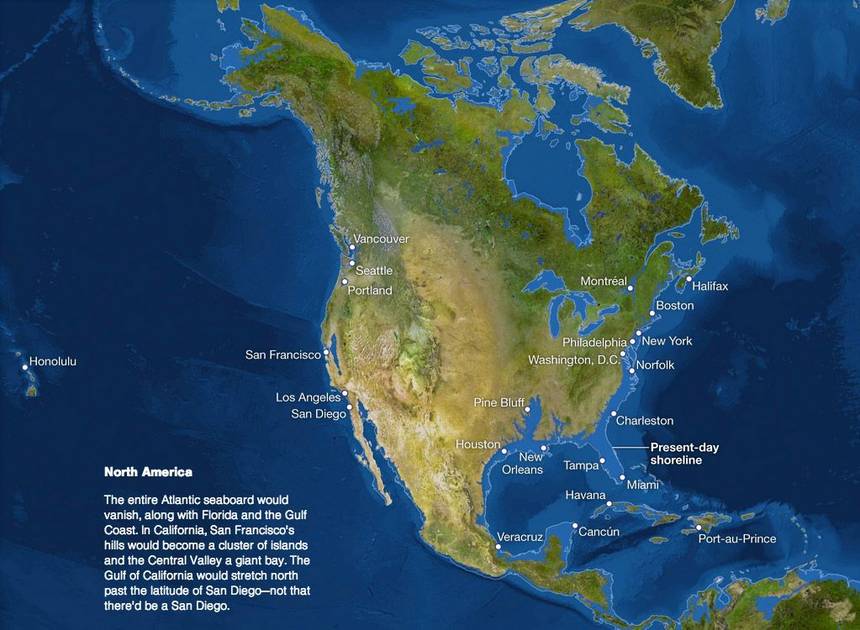
Further, some institutions may consider relocating inland and/or upwards and/or north as part of what some observers have dubbed The Great Climate Exodus.  As temperatures and sea levels rise, certain area may become untenable, in the eyes of campus leaders: coastlines, zone prone to aridification.  For example, one view of coastline changes in North America:

north-america-sea-level-rise-cities.jpg.860x0_q70_crop-scale

Think how many colleges and universities line those freshly indundated coasts.

Or consider the distribution of colleges and universities across these other, challenged areas:

So where will the Great Academic Migration take us? Inland is an obvious direction, away from threatened coasts.  This could drive schools to formerly less desirable lands, like Appalachia or the midwest.  Colleges and universities may also seek altitude, so look to mountains: the Cascades, the Rockies, or, once more, to Appalachia.  North may be a good direction, heading away from rising heat and growing deserts: the upper midwest, upper New England, the Dakotas.  Will United States institutions seek Canadian grounds?  Conversely, climate-threatened lands owned or occupied by institutions may drop in value.  This could be a boon for those who pay property taxes of various sorts, or gut a school’s ability to get financing.  Think of the impact on campuses seeking strategic partnerships, with climate crisis situation playing a key role in negotiations.

Consider these projections of changes to Europe, and recall the distribution of universities across those nations:

Consider southeast Asia:

What I called the Great Academic Migration looks like a planetary event.

The financial demands of climate change response can become complex as well as enormous.  Campuses confront significant new charges for operations and physical plant revamping.  Classic means for fundraising will be available, if perhaps stressed due to the general crisis: fundraising; bonding; tuition and fee increases; lobbying for increased public support.  What kind of new financial instruments will appear, aimed for just this kind of capital need?  Further, how will insurance companies react?  They will certainly provide policies against climate stresses.  They could also alter fees and payouts to incentivize campus behaviors.

That’s a kind of normative approach to financial needs, but not all times will be that stable.  Add to the mix chances of recessions or depressions, some driven or deepened by climate events.  We should also assume the other fluctuations afflicting higher ed economics: enrollment changes, reputational hits, etc.

Will campuses be able to make the necessary business and political cases to support this?  What kind of assistance can they expect from local governments and nonprofits?  How many businesses will spring up to assist campuses in climate change adaptation?  Which NGOs will work along these lines? At least one nonprofit is presently campaigning to get 30 colleges and universities receiving all of their energy from renewables. These organizations’ interactions with campus populations can become fractious or complex.

Other strategic dimensions appear, the further we look into the topic.  We could imagine campuses competing with each other on their climate change engagement.  There are already lists of “most sustainable colleges,” like this one.  Universities could showcase new buildings and academic programs aimed at various aspects of the climate crisis to attract students, faculty, staff, and funding.  Perhaps a climate change arms race will succeed the amenities competition.

Beyond competition is another driver for campus investment in the climate crisis: the possibility of getting caught unprepared.  Shawna Brandle reflected on the experience of one CUNY campus in the (literal) wake of Hurricane Sandy:

The specter of climate-change-driven  outages and damage can drive leadership to take strategic steps.

…and more blog posts to come, including connections between climate change and the academic mission, then intersections with the rest of the world.

PS: greetings to students in this class,

(thanks to John Kellden for a pointer; thanks to Tom Haymes for reading; many thanks to my Patreon supporters for thoughtful conversations)

Posted in climatechange | 5 Comments

How will higher education respond to climate change? Part 1

How will higher education change in the age of climate crisis?

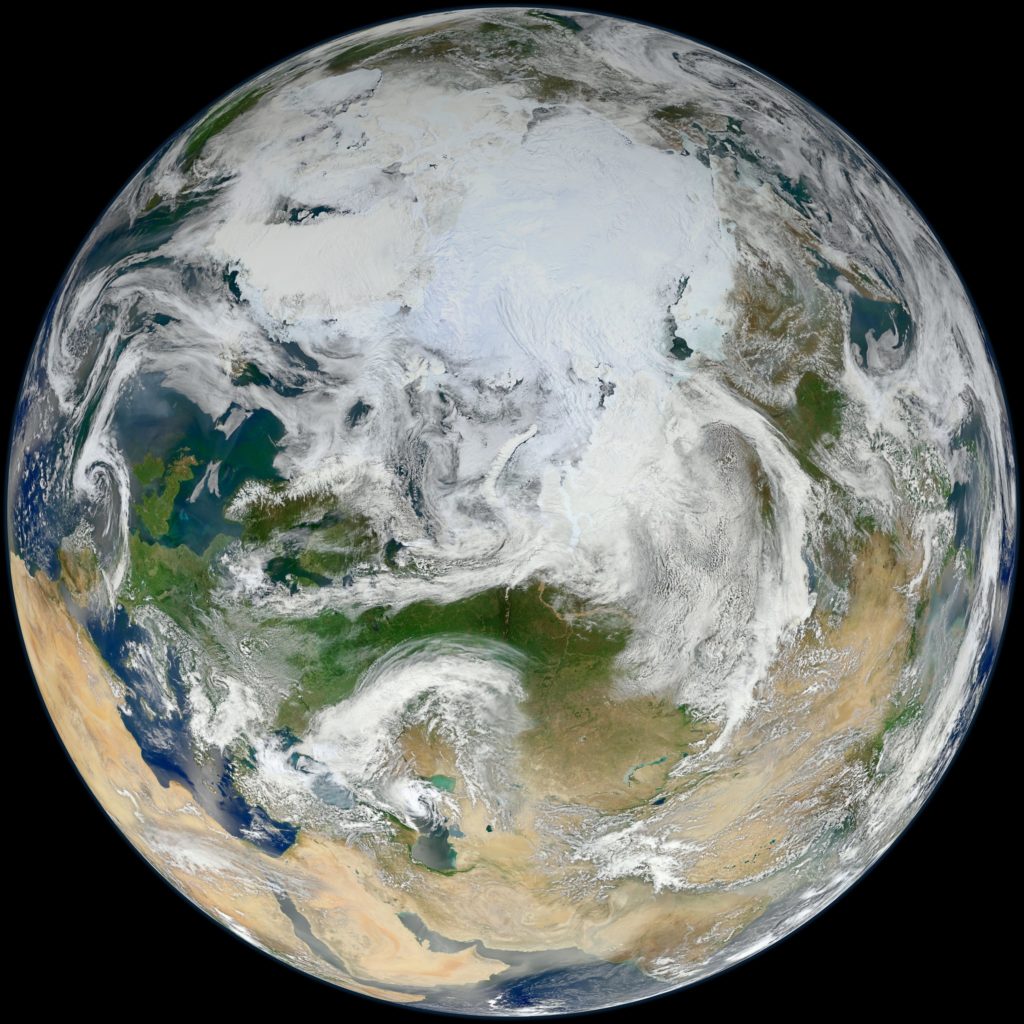
Earth Arctic view_NASA GoddardThis is a very large topic.  Academia is a large, sprawling, disorganized ecosystem. Climate change presents enormous complexity, as do the many ways humanity can respond.  Their intersection is multi-leveled, multi-sided, diverse, and likely unstable in many ways.

With this post I’d like to begin exploring the topic and open up a conversation.  I’m going to blog about different aspects of the issue this week, starting with the nature of the involved academic population.  (So if you find a point missing from one post, check the others to see if I touched on it there) Then I’ll move on to introduce the role of the physical campus; next, the academic mission; finally, intersections with the rest of the world.  Depending on how this goes, I hope to follow up with more posts, Future Trends Forum sessions, and possibly other projects.

This week’s post series has some strict scoping.  It covers global higher education, with some emphasis on American colleges and universities.*  Its timeline covers the next two generations, or roughly from now to 2080 or so.  It assumes a worldwide environmental change baseline of two degrees of global temperature increase, a significantly greater incidence of extreme weather, some stresses to food and water supplies, and economic fluctuations.

I would also like to bear in mind the potential scope and impact of human responses to climate change.  Their combined scale within this scope could reach as high as, for comparison’s sake: post-1949 Chinese leaderships’ successive drives to reform that nation; the developing world’s 20th century decolonization; 19th century European colonization of much of the world; the combined US and Soviet space races.  The American Marshall Plan seems medium-sized in this context.** These human movements may have as much impact on academia than changes in the nonhuman world.

For reasons of time, I’m not going to start with an introduction to climate change or an overview of its likely impacts over this period, although I will work elements of these in at different points as needed.  There are plenty of easily available resources that will address introductory purposes. I’m also not going to engage climate change deniers or critics.  These posts are about how higher education responds, rather than being about the science per se.

There are other big topics I have to exclude or minimize for reasons of time and focus.  The Fourth Industrial Revolution, black swans, demographic transition, some geopolitical currents – I’d like to return to those in other posts, tracing out their intersections with an academia transforming during climate crisis.

Let’s start.

1. Who is involved when academia confronts the climate crisis?

To begin with, there is the question of who will decide how academia responds to climate change and how it participates in mitigation.  This is a strategic question, and one which traditionally involves presidents and deans, along with trustees (for private institutions) or governments (for public ones).

Faculty can also contribute through their governance function, but that varies depending on a given school’s culture, faculty organization, and to what extent there exists a critical mass of professors with tenure protections.  Additionally, professors can also shape policy based on their research expertise (Earth science, sociology, finance, etc.).  This may take the form of campus study groups or formal institutes.  On the other hand, if the adjunctification of the professoriate continues, at least in the United States, the faculty role in campus climate change strategy will recede.

To what extent will students shape campus strategy?  If Generation Z’s current political profile bears out, we should expect some degree of student activism in colleges and universities that primarily serve traditional-age learners.

climate change protest_stanzim

Those teaching a larger adult population will experience a different politics, depending on how that population balances its priorities.  If today’s sociology of work (precarious positions, increasing part time labor) persists or deepens, then all students will have to juggle employment and activism.  Students may also use climate approaches to help them determine which schools to apply to.

All other campus populations  – i.e., staff – may be involved as well.  IT, for instance, works exceedingly closely with questions of electrical power, not to mention aspects of campus facilities.  Librarians maintain a significant physical presence on physical and digital grounds, and therefore are subject to risk and mitigation.  They also help render access to climate change information.  Development officers may face new directions for fund-raising.  Grants and compliance officers may face new governmental regulations.  Lobbyists and communications staff must work with a changing environment. Everyone working on a school’s physical plant confronts potential challenges.

Each of these populations have interests in common with the others, starting with the most political and basic: how to survive and grow.  More narrowly we might anticipate:

  • the rise of professional development around climate change;
  • grant funding for climate-themed work;
  • an addressing climate crisis section on one’s c.v.;
  • different forms of personnel management around climate issues (rewards for innovative mitigation work or punishments for excessive carbon consumption, say).

That’s for on-campus populations.  Many others are likely to be involved beyond an institution’s students and employees, once we consider stakeholders and academically-adjacent sectors: businesses (publishers, ed tech companies, consultants), professional associations, nonprofits, foundations, governments, and local communities.  For the latter, we should consider how climate change impacts town-gown relations.

Some of these populations are charged with long-term strategy.  This is precisely the mission of private institutions’ trustees, for example.  Some presidents view their mission in this light.  Governments both local and national accept this charge, even if they carry it out poorly in practice.  Foundations often see themselves in this light, along with some donors.  I suspect many of these groups currently seek to learn more about the unfolding crisis, either publicly or quietly, and are eager to start taking necessary strategic steps.  This is a terrific time for collaboration and education.

…and more posts are on the way.  I’m aiming for one per day this week.

*The US focus (as a measure of partial attention) is due to my having spent the past year+ working on Academia Next, which is about American higher ed.  Now that that’s in print, I can return to my prior level of global analysis.

**My selection of these examples is meant to illustrate scale, not to indicate political endorsement.

(thanks to John Kellden for a pointer; thanks to Tom Haymes for reading; many thanks to my Patreon supporters for thoughtful conversations; Earth photo by NASA Goddard; protest photo by Stanley Zimny)

Posted in climatechange | 9 Comments