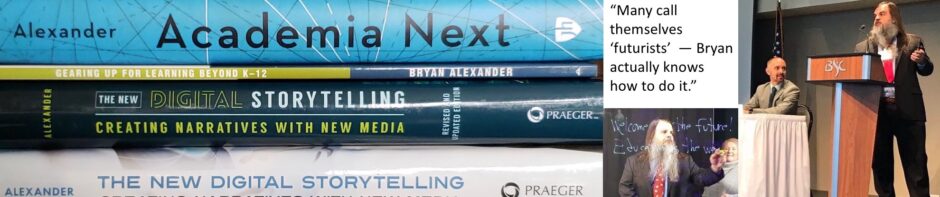
Many call themselves “futurists” — Bryan actually knows how to do it.
–Howard Rheingold
Bryan Alexander is perhaps higher education’s most prominent intellectual provocateur.
–The Chronicle of Higher Education
One of the most creative and perceptive people in higher education today!
–Mark Carnes
Is @BryanAlexander a wizard because he wrote about the possibility of a pandemic in 2018? He says he has a beard like one.
–NPR’s 1A
“Hardest working man in edtech!”
–Jim Groom
Gotta love @BryanAlexander‘s ability to catalyze a conversation without leaning on hyperbole or triggers.
-Mark David Milliron
This is so well-structured and thoughtful that it almost made me forget I was terrified while reading it.
–Kyle Erlenbeck
When @BryanAlexander is futuring about you, you’d better start futuring yer own dang self!
–Stephanie Doscher
Your prescience is wild.
–Mike Hauge
[F]uturist and higher-ed guru Bryan Alexander…
–Gabriel Paquette



You may wish to be more explicit in what you seek. The headline uses “will”; your last sentence before the poll uses “should”. What one predicts will happen is different than what wants to happen, and I wasn’t sure which you were looking for.
Oh, good catch, Greg. Correcting now.
(I wanted “will” not “should”)
My take would be that the only thing to regulate is that platforms claiming to be platforms need to provide an open API and allow adversarial interoperability. If you don’t have an API you’re not a platform, and liable for your content. This changes the current situation where tech companies have it both ways. Seems like a fair exchange, no?
It also does away with the need to break up monopolies. With open API’s you can do all the breaking up yourself.
Ton, is there precedent for a government to mandate APIs?
Facebook and its ilk are no different, historically, than any number of disruptive technologies that we have encountered in the past, save for the scale. Please take a look at the readings and media I offer in my “Trends in Digital & Social Media” e-book [ https://granite.pressbooks.pub/comm601/chapter/a-historical-perspective/ ] for my course about the history of social media. Hot takes: today’s social media is just another version of 2000+ years of prior social media; each iteration of social media has brought about disruption.
Anil Dash’s “12 Things Everyone Should Understand About Tech” [ https://medium.com/humane-tech/12-things-everyone-should-understand-about-tech-d158f5a26411 ] offers several insights that relate to Bryan’s options. Facebook seems to connect to all of them in some way. Worth reading.
My takeaway from these perspectives is that if society (families, communities, individuals) cannot find a way to make peace with the disruptions that occur because of technologies, then it is likely that government entities will “make peace” for them, on their behalf. The analogies I offer are that Henry Ford could not have known nor been expected to account for the disruptive effect on human sexuality when the Model T became accessible to millions of common Americans [ https://teachinghistory.org/history-content/beyond-the-textbook/24073 ] . Along with new concepts of privacy came the concept of the “date” which required a social adjustment.
In contrast, in my work with suicide prevention experts, the ability to reduce instances of suicide death by firearm lies firmly within the community of gun owners. If the culture of temporary confiscation of firearms by trusted friends or law enforcement were prevalent enough that suicide death by firearm was no more common than any other form of suicide method, then perhaps there would not be any need for discussions about legislative action, such as Red Flag laws.
If social media – and Facebook in particular – are so disruptive and so dangerous to individuals, families, communities and society as a whole, we can either come to a mature adjustment to them (codes, habits, rules of thumb, common behaviors that we teach in pre-school/K) or we can rely on the government to do it for us. I would prefer the former.
Steve, I admire the research and thought going into that fine comment. Very rich historical context.
Your conclusion… I wonder how we might use AI to make such an adjustment.
Bryan – There are few dimensions to the AI implementation: Do we want AI to do what a human could do (AGI), do one single task (ANI), or do something that surpasses human capability (ASI)? Would there be a natural language component to it, and if so, in every language that Facebook supports? Who designs the algorithms, how are they monitored, how open are the classification models, and on what level of understandability can all of this be explained to a common person?
see: ACM FAT* Conference Proceedings: https://fatconference.org/2018/
Fairness, Accountability, and Transparency in Machine Learning: https://www.fatml.org/
I don’t know how likely this is, but if people knew how to curate and regulate Facebook to see only their closed filter bubble, as I do, these problems would disappear. I see NO political ads or conversations. I see ads only relating to my narrow interests, and I feel free to purchase from those advertisers.
I taught myself to use Facebook; it doesn’t use me.
I am aware of the issues around Facebook, but I learn those from reading the news. None of them are my experience.
The world is generally a mess for a variety of reasons—one of them is that humans do not inherit memory, so people and generations are constantly being born and having to learn everything from the ground up. That’s why we have what passes for an education system, so I am with Steve Covello—social media education needs to start early and go long.
I’m very glad you said this, Sandy. Since Facebook and Twitter started I’ve heard complaints about them which suggested people really weren’t using them actively. Lists, follows, unfollows – that makes life a lot better.