To begin with, the five scenarios are fascinating. They include future cybersecurity worlds including behavior modification tech and a contested internet of things rollout.
Weber then identifies what the report missed. This takes some cold eyed self-examination, and isn’t an easy thing for many to do, especially in academia, but it’s a classic futures practice. Weber finds the report overestimated the pace of change, which is always a risk. It overstates how much data is worth in the market, which sounds counterintuitive, but links up with the hype around big data. And the document wasn’t conservative enough in another area:
We also understated the stubborn robustness of existing institutions in the digital security world. In the private and public sectors, the big, powerful institutional actors of 2015 — Apple and the NSA, Alibaba and the Cyberspace Administration of China — are for the most part still the big powerful institutional actors at the dawn of 2020. For all the talk about disruptive innovation, the incumbents have proven themselves stickier and more capable of absorbing innovation than expected.
Weber goes on to identify what the report accurately forecast, or at least got more or less in the ballpark. This isn’t for self-praise, I think, so much as to more closely identify the report’s underlying worldview. Again, this is good futures practice.
Gallup published another poll about how Americans view higher ed. It’s not a big poll, but offers several key points that anyone interested in academia and the US should consider.
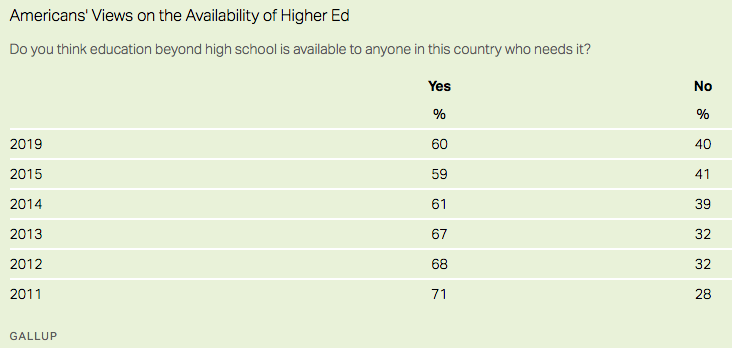
First, what do we make of higher ed accessibility? How available do Americans think higher ed is? The question itself is precise:
“Do you think education beyond high school is available to anyone in this country who needs it?”
Yes, a majority think post-secondary education is available… but that majority has slipped over the past eight years. In contrast, 40% think not, and that number has grown steadily through the same period. But overall we see capacity there.
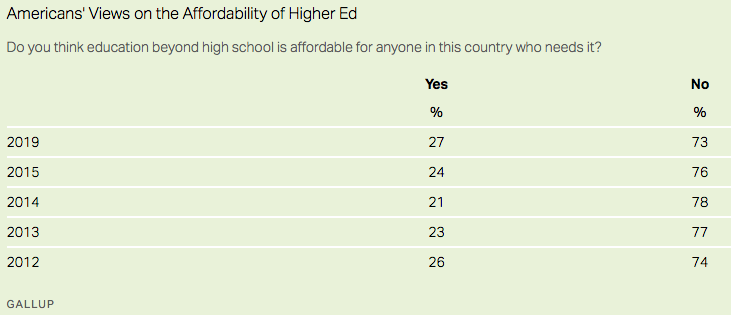
In contrast, do we think higher ed is affordable? You won’t be surprised at the answers to this second question:
A pretty solid three quarters of Americans say: no. And that proportion has remained roughly stable for almost a decade. That’s a durable, damning majority for higher ed to face.
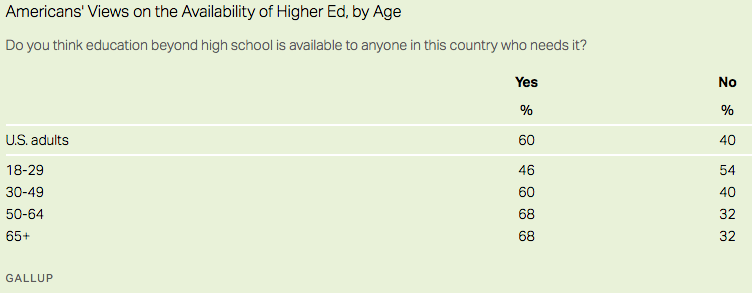
Third, check out the breakdown on availability by age:
OK boomer
That is a substantial generation gap. A majority of 18-29-year-olds think higher ed is not available, and they are alone in this attitude. Clear majorities of folks 50 on up think it is available.
Let me remind you that 18-29-year-olds represent a majority of college and university students. How many currently enrolled students are this frustrated? What does that mean for the people teaching and supporting them?
Add this to last month’s Gallup poll about how Americans value higher ed a bit less – especially young people – and the picture is not a good one. Unless we’re only talking about older people, the majority of whom seem (by this data) to be fine with where colleges and universities are headed.
Looking ahead a decade, should we anticipate greater intergenerational tension? Should we expect more state and federal moves to address affordability? What strategies can colleges and universities adopt to rebuild their reputation, especially among younger people, while improving affordability? One more question: how much of this is about perception mixed with storytelling, and how much based on reality?
Orange is good. Green is better. Yellow is terrific. Map by Inside Higher Ed.
The bad news: that’s still way below what states spent in 2008, when the greatest financial crisis of our times hit. And that was way below what states used to spend.
Grapevine concluded that nearly all American states increased public higher ed funding by 5% over last year, and more than 18% compared with five years ago.
You can see a very positive trend when looking at total American state spending on public higher ed:
2015: $81,313,423,272
2018: 88,245,094,149*
2019: 92,058,661,739
2020: 96,637,246,170**
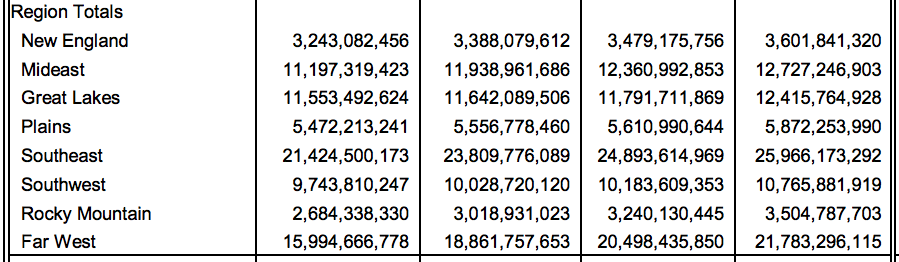
There’s a good amount of variability by state. You can see strong regional variations as well, with the south(east) and west really taking off:
Columns 2-5 are FY14, FY17, FY18, and FY19.
Again, those are all increases.
So why is this happening? The Grapevine lead puts it down to macroeconomic growth and a political shift:
“I think this is probably predictable given the state of the economy right now,” [Jim Palmer, the editor of theGrapevine survey and a professor of educational administration and foundations at Illinois State] continued. “In order for states to increase funding for higher education, two things need to happen. First, the states have to have the fiscal capacity to increase funding. And then of course, second, there has to be a political will to increase funding. I think that after several years of tuition increases, there is growing political pressure for states to perhaps increase funding and to counter the trend toward increased tuition.”
Excellent! Then why am I not jubilating?
To begin with, we are still below where things were in 2008. The Great Recession walloped American states, and funding has still not recovered. Full credit to SHEEO for tracking this carefully.
Further, as great as 2008 sounds, that funding level is below where states once were.
As Chris Newfield has documented, American state governments spent a generation slashing per-student support from the 1980s on. That Great Mistake, as Chris calls it*, represents one giant step backwards (and a powerful stride towards increasing student debt). The Great Recession represents another big step back. What Grapevine reports about the past year is a very, very tiny step forward. We’ll need a lot more of them.
Thanks to Elizabeth Redden for giving us a fine look at the Grapevine data before the site itself shared it.
*I don’t know why they skipped 2016-2017 in this table.
Last month (year) (decade!) I was fortunate enough to be interviewed by Bonni Stachowiak. We talked about all kinds of stuff, from Academia Next to information history and teaching.
Bonnie’s podcast, Teaching in Higher Ed, is fine listening for anyone interested in education.
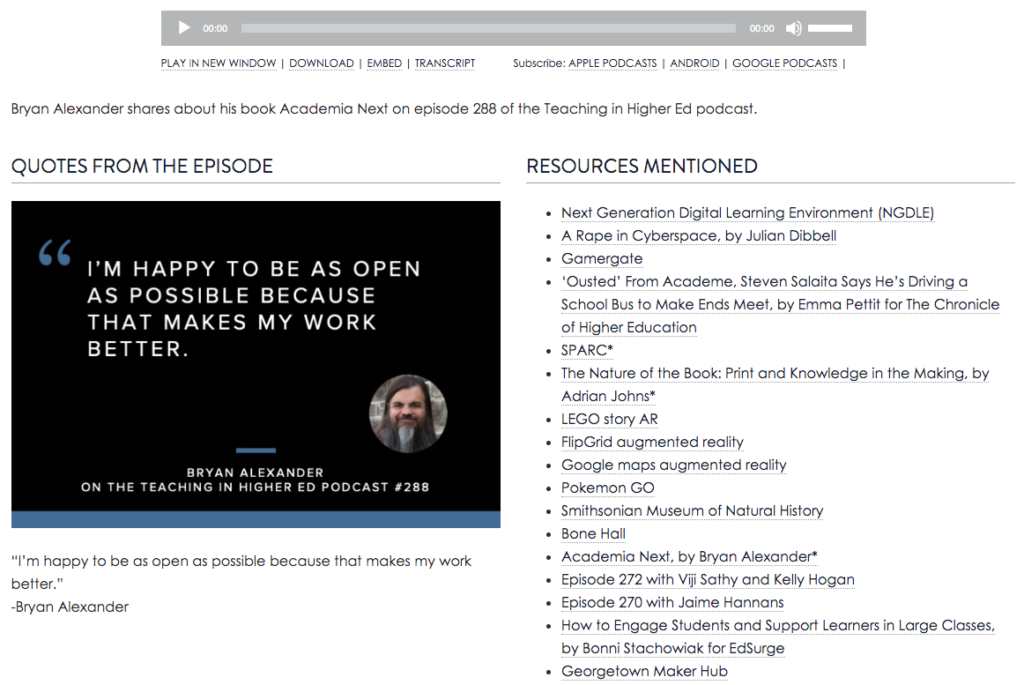
I’d also like to commend the web publishing side of her podcast practice, because she takes the web seriously. Check out what she does for this one episode:
On the right she’s taken the time to list and link to things we talked about: books, videos, institutions, my new book, more podcasts, and more. That requires a lot of work, hunting down twenty-one+ references.
On the left Bonnie created a slide with something I said that she liked. That’s really sweet and beyond the call of duty.
And on the top, did you catch the transcript link? Yes, Bonnie posted a text version of the discussion. That’s almost nine thousand words. It’s a 17 page pdf – and I know this because you can download the transcript. How many podcasters take this kind of step towards accessibility?
Taken together, this kind of web work is far beyond a syndicated mp3 file. Bonnie takes the web seriously and with great generosity. For that and for inviting me to her program, she has my thanks and admiration.
As I write this the year 2019 is on its last legshours. The year 2020 is on its way, and it’s still impossible to hear that date and not get a science fictional buzz off of it.
Usually these are backward-looking (by definition) and are really just tentative stabs at nostalgia, as I grumped on Twitter. They seem the opposite of my futures approach, which uses the recent past to help inform forecasts.
Now, for my Patreon supporters, I did post a three-part trends summary in aid of extrapolating forward. (You can join them!) But here on this blog I’d like to do something different. I’d like to open up the comments box for you to share your thoughts:
What do you anticipate for 2020?
I’m thinking of what you see for education in 2020, but you can also speak to your own life beyond education, or the world as a whole.
The movie theater showing Star Wars: The Rise of Skywalker began by screening 35 minutes of trailers. At first I thought this was because they had us trapped. Then, once I saw The Rise of Skywalker, I realized it was a kind of preemptive consolation prize.
Yes, there will be spoilers aplenty in this post. If you really want to see the thing and don’t want to have details revealed, please stop reading and come visit afterwards when you need a hug.
SW:TRS tries mightily to be uninteresting and forgettable. It races between scenes at crazed speeds, flinging up lovely backdrops and designs for a second or two only to drop them for the next bit of bland argument. Characters, vehicles, architecture, shots, dialogue, story beats, and literal, actual furniture pop up from the preceding nine+ films. These gestures only stroke the audience’s nostalgia. They are not there to make a deeper or new impression. Rise of Skywalker is as memorable as basic fanfiction – i.e., depending on the audience’s interest in the franchise. Its enormous budget vanishes from view with each quick cut hurtling towards the credits.
It is a movie preoccupied with time above all. Yes, much of the cardboard dialogue is feel-good puffery about having friends, being strong, doing the right thing, gosh the empire or whatever it’s called this time is mean, but the real topic under consideration is the past. “The dead speak!” is the film’s opening line in its traditional title crawl, and that’s really what Rise of Skywalker is about.
Literally, the dead speak in that we have an actor’s posthumous scenes. Rise of Skywalker is a ghost show within the franchise’s fictional universe. Leftover footage from previous movies embodies Carrie Fisher, and fairly awkwardly those clips are crammed into place. Leia then dies but somehow persists. Han Solo also appears from beyond the grave to harangue Kylo Ren/Ben. A major moment in his character arc is Kylo Ren reclaiming the name Ben, which is itself a tribute to the older character Obi-Wan Kenobi. An even older character literally comes back to life: the emperor Palpatine, killed in Return of the Jedi, now somehow propped up by “dark science” and one enormous, tube-festooned crane. Said emperor wants to bring back the empire and the resistance gets to resist it. A shattered Death Star (version 2.0, I think) looms over a raging sea.
Stacks of other but so far unkilled characters and creatures appear from the long Star Wars franchise, pre-The Force Awakens (2015). Lando Calrissian pops up to help one quest and the final battle. The planet Endor is revisited, and the horrific little Ewoks have a cameo. Chewbacca gets the medal he was denied at the end of the first Star Wars movie. A New Hope‘s opening set is the setting of the movie’s conclusion, complete with the abandoned moisture farm, Jawas, lots of sand, and a sandcrawler. That scene then reprises the first film’s famous dual sunset, which was itself reprised in Revenge of the Sith (2005). Rise of Skywalker doesn’t just fail to let go of the past; it obsesses over the franchise’s history. It is really the old emperor’s movie, with his celebration of “the work of generations”:
https://youtu.be/0vHrQCKaJiQ
This fierce, loving, and backward gaze into the past is one way that the film is essentially conservative.
Skywalker looks further back still, beyond Star Wars: A New Hope, to a technological world we last experienced around WWII. I first wrote about this strange embrace of a dieselpunk milieu when I reviewed Rogue One (2016), and Skywalker does the same worldbuilding thing. It’s not a world where networked computing exists. There are very few screens beyond a couple of radar and radio receivers. Data and information only exist in analog forms, or in 1940s-seeming radio broadcasts. Radio is the only hint of wireless tech we so. Otherwise, the film is filled with cables, plugs, cords, goggles, wheels, hydraulics, iron, and more cables. Yet no communication satellites or drones.
There is no media capture in the entire film: no handheld cameras (except one old school surveillance cam shot out, I think), no audio recording. Not only is there no citizen journalism or everyday media sharing, there’s no sign of news media. Major plot points turn on getting access to scarce physical records – a sort of map, a text – that nobody has bothered scanning, copying, or publishing. In fact, there’s barely any glimpse of print, beyond a handful of ancient-looking books. It’s almost a preliterate world. People only know about events if a participant tells someone else about it. At the very least this is a culture predicated on a foundational absence of the digital world. That it achieves spaceflight suggests something like alternate history, akin to Cronenberg’s Existenz (1999), which imaged a digital world based not on dead silicon, but on living biology. Skywalker‘s sustained vision of a pre-internet, pre-digital world speaks once more to its focus on the past, to a careful conservativism.
This vision of a past-saturated future is also one of a culture keenly interested in bloodlines. The film’s ultimate struggle for the universe is between two genealogies, Skywalker and Palpatine.
OK boomer.
While these aren’t quite royal houses, a gag about spice running might coax the science fiction literate viewer into thinking they’d stumbled onto another Dune film.* Instead, we see two dimensions of this family battle: personal struggles within the minds of Rey and Ren, alongside a conflict to either rebuild a galactic empire or… set up something else, which isn’t ever articulated. The key point is remaking civilization along either Skywalker or Palpatine lines.
On the one hand this is a handy narrative conceit and an accessible way to organize character arcs. Instead of the medieval image of a devil perched on one’s left shoulder while an angel crouches on the right, we see characters arguing with Force-driven visions of Skywalkers and Palpatines. And it’s only partially a biological scheme. The movie’s final scene sees Rey will herself into the Skywalker line and out of her Palpatine DNA.
(Actually, this might be a kind of marriage claim. The film gives Kylo Ren a redemption arc. He gradually turns away from the Palpatine dark side, rejects his Sith name in favor of his birth monicker (Ben Solo), and gives his life to save Rey. She responds by kissing him and resolving three movies’ and millions of fans’ worth of romantic tension. He dies, but no other character replaces him in Rey’s heart. With the movie’s last line, does she take his last name along marriage lines, perhaps as a half-imaginary fulfillment of longing? Yes, Kylo/Ben’s last name is Solo, but the film is clearly far more invested in Leia than Han. The movie’s gynocentrism (note the final scene is a conversation between two women, just about passing the Bechdel test) also suggests it’s open to matrilineal lines of descent.)
On the other hand, this is a very aristocratic vision. As Jeanette Ng argues, it breaks from the democratic potential of the previous two movies, which showed Rey as someone *not* possessed by a special capital-D Destiny or bloodline. This was profoundly open and empowering. No bloody mitochlorians were needed. Anybody could tap into the Force. Instead, J.J. Abrams yanks that away in favor of genealogy.
One way he does this is by inventing ways to link Rey to gender essentialism. She alone has a healing touch (remember that health care is typically gendered female). She’s the only character who connects with children, setting up a maternal vibe. Rey also connects with a small, cute robot. Yes, she also violates traditional gender norms by fighting, getting dirty, etc., but it’s interesting how the film takes time to paint her in that gender essentialist hue. It sets her up for a more premodern role.
Perhaps it’s counter to expectations for me to call this a pro-aristocracy film, but at no point do we see even a hint of any other politics. No galactic assembly from the prequel trilogy resurrects itself. There are no political parties, no other factions. Remember the emperor dismissing the Senate in the first film, or how the republic was pushed into imperium in the prequels? All of that is gone now. There isn’t even a militarized Star Trek-style federation. There are no local politics on planets. Heck, there isn’t even “an international system of currency”:
There are only some personal plots without much behind them, like the two generals trying to backstab each other.
As I mentioned earlier, there isn’t any news media. Instead the entire vast complexity of an interstellar polity considering its future is forced into the narrow box of Skywalker versus Palpatine. If most of the film’s technology is from the early 20th century, its politics are from the seventh. No wonder the climactic battle begins with a cavalry charge. Calling the movie conservative is almost too kind, as Rise of Skywalker is actually reactionary to a breathtaking extent.
Yet perhaps Rise of Skywalker manages to pull back from a truly conservative vision. In terms of representation it marks progress over the earlier films with greater roles for women and nonwhite people, plus a same-sex kiss in the celebration scene (but what happened to Rose?) (and see Tim Burke’s criticism). But this world’s social dimension is largely emptied out. There isn’t a culture to conserve. Visually, we see few people on the screen for most of the run time. The Sith cult (?) is faceless animation. A festival is quickly passed through. Instead Abrams prefers to show us small confrontations between handfuls of characters in isolation. When Rey and Kylo Ren first duel nobody witnesses the event save Finn, who’s pulled away. The climactic throne room battle is a series of single combats. The epilogue is a quiet scene with Rey alone, only pausing to speak briefly to a passerby. This visual constriction echoes the political emptiness I mentioned earlier. When a swarm of rescue ships appears to save the doomed rebel fleet (another callback to A New Hope), we have no idea who they represent or where they came from, besides a cheesy “friends.” They are “[t]he Rebel fleet from nowhere,” as Phil Owen and Ross Lincoln put it. Nowhere is where the movie ends up, a no-place without populations, politics, or society.
That is because the film’s obsessive focus on the past won’t let it imagine an unfolding present, much less a future. It can’t let a world emerge. It can only position older characters and their surroundings and make them work through a thin, aristocratic plot. When at least it steps away from most of the old, there’s very little left. Our heroes’ triumph doesn’t mean anything besides Rey’s claiming of a name. She buries lightsabers and hence the Jedi order. The resistance has nothing to do, having, well, resisted. We might wonder about what Finn meant to tell Rey or where Jannah (the other ex-Stormtrooper) came from, but those slender plot threads just hang suspended in a void. The film just stops, exhausted. Rise of Skywalker has conserved so much, so deeply, and looked so hard at the franchise past that there’s no possibility of moving forward. That might be the final triumph of its conservative vision.
*The original Dune novel as well as the five sequels are also keenly interested in bloodlines. The opening plot is about a centuries-long breeding program. A key conceit involves people somehow accessing their ancestors. For Herbert this is part of his deliberate vision of a world made conservative by certain technological and cultural choices.
(Note: TTT adds the header “completion” to its responses. The program also sometimes ends its run in mid-sentence.)
That got dark really quickly. Which isn’t a crazy response to the entered text, given a lack of context. But is a very different bit of text than we’re used to.
That experiment rapidly inspired others on Twitter, many of which became very disturbing, such as:
and:
and
Naturally I had to enter the fray, so I entered the first lines of “Little Drummer Boy”:
Come they told me
Pa rum pum pum-pum
A newborn King to see
Pa rum pum pum-pum
Our finest gifts we bring
Pa rum pum pum-pum
To lay before the king
Pa rum pum pum-pum
And deliver our glory
Pa rum pum pum-pum
While they’re laying their stock
Pa rum pum pum-pum
They don’t miss an opportunity to taunt us
I’ll wipe them off the map (pun intended)
And wipe
Interesting. Again TTT gets the formal aspect down. And again it veers off into darkness and strangeness (what pun?).
Next, I shifted to literature, with the first lines of “A Christmas Carol”:
Marley was dead: to begin with. There is no doubt whatever about that.
Later, at Supe’s house, the group decides to get someone into the city to help them out. In particular, at one point where they all have a real fight with a group of bandits. Apparently, one of the members was targeted for a grenade that almost blew his head off, while on the other side, his cousin was killed because the leader of the group was hiding under the bed when they approached. After the fight, the group members all leave Supe, and again,
Egads. TTT leaped from mystery and dread to war and crime.
I responded with another classic:
‘Twas the night before Christmas, when all through the house
Not a creature was stirring, not even a mouse;
‘Tis the season for elves’ party! How little did I know
That some unwritten rule was leading me astray.
The dance’s begun, and the pantomime may be heard,
Of merry moody houses, and joyous laughter,
The clatter of clogs on the floor, and flocks of birds
In the high-caste fields, and merry jesting, and song.
But this day would
That’s not bad (but “high-caste”?). Elves and merry are spot on.
‘Twas the night before Christmas, when all through the house
Not a creature was stirring, not even a mouse;
Not a breath was in the air, nor did any sound come
From the earth or heaven.
Then there was a great knocking at the door,
Like thunder upon a thunder-storm, which shook the place,
And made the hinges of the door tremble.
And suddenly the Great Wolf in the North came through
And the Great Whale came into the house,
And into the front of the house a man dressed in white
With
Wow. At that point I decided to pause my experiments, and instead to offer you all best Christmas wishes.
PS: Janelle Shane taught a neural net to create Christmas carols. Enjoy.
Greetings from the Christmas week. I hope you’re all doing well, and that those inclined to celebrate are having a grand time.
I’m writing from home, which feels like a rare occurrence after a high octane travel schedule (NYC, Bethlehem, Berlin, Istanbul over the past month). I’m also recovering from pneumonia, possibly exacerbated if not acquired by said travel, which is the main reason I’ve been relatively quiet.
But the work continues, despite illness, travel, and holidays! Today I want to share some news about my practice, one small and the other medium-sized. Both are experiments. For both I invite your feedback.
First, I’m opening up my Goodreads author page for Q+A. That means anyone with a Goodreads account can post a question about my new book, Academia Next. I’m happy to answer.
(I’ve been using Goodreads for years and have had a fine experience. Discussion is at least nice if not very good. And as a bibliophile I enjoy the shelf mechanism.)
Second, I’m launching a virtual presentation and consulting service. Usually people engage me to speak or consult in person, which is splendid. Yet I know some would-be clients can’t bring me out to their location for one or more reasons: logistics, cost, or concerns about carbon. So today I’m offering my services in an online option.
Anything you want me to do in person, we can do virtually.
I can present, address, or otherwise speak to your audience of any size through the videoconference technology of your choosing. I can also create and lead a workshop, or facilitate a meeting through the same. We can add other technologies as you like, including asynchronous ones (so far people have asked for Google Docs, Twitter, email, and Slack). I can provide videoconference and asynchronous tools if you prefer.
We can customize this to your specifications. I can take up as much time as you like, from a few minutes to several hours (although people have a limit of how much videoconferencing they can do at a sitting, perhaps 90 minutes). We can use telepresence robots at one or more audience sites, if you like. And since I have more than 25 years of experience, I can make the virtual work well.
Why am I doing this now? Several reasons.
I now have access to very high speed and very reliable bandwidth at home, so I can offer virtual events at the drop of a hat.
I want to be able to work with colleges, universities, libraries, nonprofits, companies, and governments that have tight budgets. That condition seems likely to persist or grow. Virtual events cost you 1/2 to 1/4th of my in-person fee, and also don’t involve additional travel charges.
Virtual events may well become the main way we do these kinds of professional meetings. Concerns over carbon costs are starting to cause academics and academic-adjacent people to rethink travel, especially long-haul trips by air. We are also becoming more accustomed to virtual conversations, partly as the tech improves, and also as we gradually adjust to its characteristics. We could experience the majority of conferences, workshops, and meetings through video (plus other tech), reserving a relative handful of occasions for face to face. That’s the present direction of trends. I’m willing to bet – professionally on their continuation.
What do you think of these two moves, virtual and Goodreads?
The number of students enrolled in American higher education declined again, according to National Student Clearinghouse data. When I say “again” that refers to the fact that total enrollment has dropped for eight years, semester by semester. (I’ve been tracking this for a long, long time.)
Total enrollment slid below 18 million for the first time in years, down to 17,965,287, a -1.3% downward tick since fall 2018. It’s not a dramatic drop, but a steady one.
To put that in perspective, let me offer a quick list of total enrollments by fall terms, using Clearinghouse numbers:
2011: 20,139,348
2012: 19,791,149
2013: 19,511,518
2014: 19,258,730
2015: 18,929,736
2016: 18,663,617
2017: 18,463,677
2018: 18,196,846
2019: 17,965,287
That’s nearly a decade of sustained decline. We should be able to think of this as a trend. And it’s almost an 11% drop. As study lead Doug Shapiro put it, “That’s a lot of students that we’re losing.”
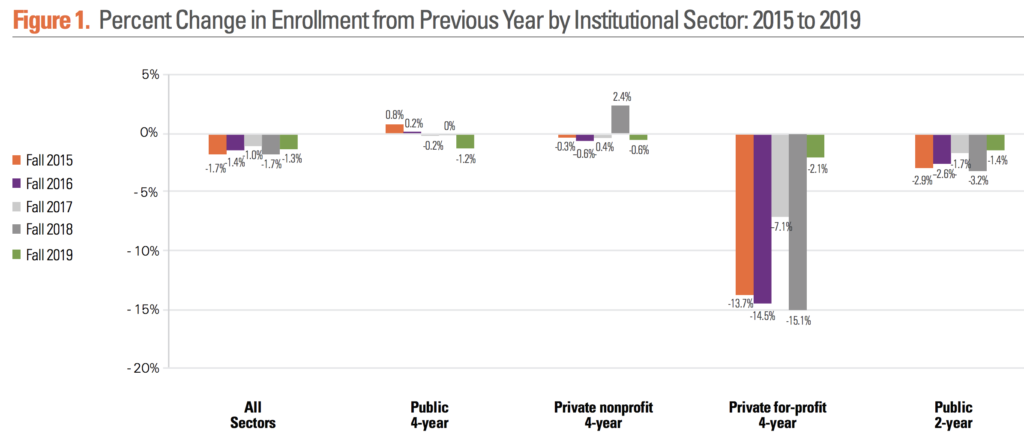
There are several ways to slice this year’s data, starting with institutional type. The decline for fall 2019 was across the board, hitting all sectors of higher ed:
Click to reach the report directly.
In fall 2019, overall postsecondary enrollments decreased 1.3 percent from the previous fall. All institutions experienced enrollment declines, with the largest drop in the private for-profit four-year sector (-2.1%), followed by the public two-year and four-year sectors (-1.4% and -1.2%, respectively) and the private nonprofit four-year sector (-0.6%). Public sector enrollment (two-year and four-year combined) declined by 1.3 percent (174,518 students) this fall.
For-profits continue to collapse, despite the DeVos Department of Education’s efforts (which says something). Community colleges keep dropping, as unemployment remains historically very, very low.
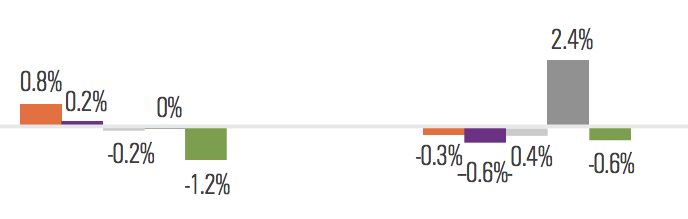
Four-year public and private colleges and universities also saw enrollment declines:
Public 4-years on the left, private 4-years on the right. Green columns = fall 2019.
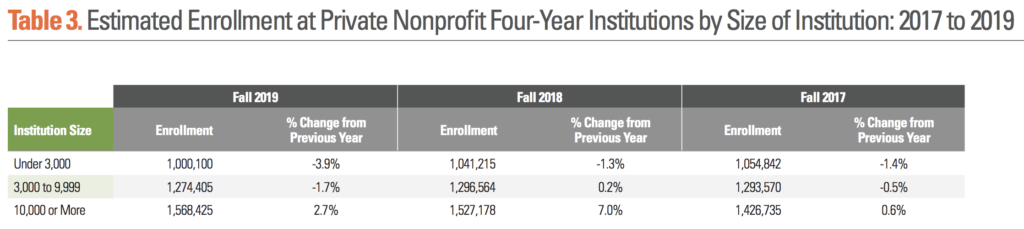
Notice a quiet but key point about institutional size. The smaller the school, the more likely they were to shrink:
Bigger is better, at least when it comes to campus scale and enrollment.
Demographic data confirmed at least one well known trend, more women than men attending post-secondary classes. My back of the envelope math says 59% of students are now women:
Student age is counterintuitive, at least against the trend of more adult learners. Those adults are leading the way out of the classroom door:
Geographical variation was interesting. Alaska was the outlier, losing more than 10% (!) of their student numbers. On the flip side, Utah kept growing, lifting their numbers by 4.9%.*
Top states with largest enrollment declines by number of students:
Florida (-52,328), New York (-19,386), California (-19,272), Missouri (-14,869) and Pennsylvania (-14,799)
Top states with largest enrollment decreases by percentage change:
There are many factors, all of which are familiar to my readers: rising anxiety about student loans; the historically low unemployment rate, which encourages some to try their luck in the labor market; demographics. Also potentially in play: the availability of free or cheap learning online; growing dissatisfaction with higher ed. Will any of these forces change direction in the near or medium term future?
Again and again I say this: unless a campus is extraordinarily rich (the 1% of academia’s 1%), they are likely to be dependent on tuition to keep alive.
Some colleges and universities are being hit harder, while others are doing fine. You can see from the way I summarized data slices above that there is plenty of variation. What I’m talking about here is not about a given institution, but the American post-secondary sector as a whole, at the macro level.
 Berkeley’s Steven Weber recently published a useful and bracing essay that I can commend to you all. It’s about his research team‘s scenarios for cyber threats envisioning the far-of year of… 2020, published in 2015.