A video-based community responds to the coronavirus

I’ve been thinking a great deal about virtual communities and online relationships lately.

There’s the obvious fact that we’re relying on them and participating in them more than ever.  Such connections are increasingly how we learn about the pandemic, how we cope with it, how we seek to understand the extraordinary event.

I participate in a great many of these digital networks across a range of platforms, from Twitter to LinkedIn, email and Gchat, Facebook to Mastodon.  I have a sprawling personal learning network (PLN) that cuts across all of them.  My students intersect with them through even more tools, including class pages.

One is the Future Trends Forum, a video community we launched in early 2016.  The center of this group is weekly, hour-long video conversations about the future of higher education.  Hundreds of guests have appeared.  Thousands of people have participated by listening, watching, asking questions, and generally being part of a large, ongoing discussion.  Just about every session is recorded and posted to YouTube.   (Here’s the full archive, approaching 200 videos now)

What can such an enterprise do in response to a global pandemic?  Let me outline what we’ve done.  Perhaps the story can be useful for others.  It’s also a key phase in the Forum’s nearly five years of existence.

Back in February I thought the Forum could serve as a venue for discussing COVID-19’s impact on higher education.  It could be a place for information sharing, for storytelling, for questions and first attempts at answers.  We could host experts in particular aspects of the unfolding crisis as well as practitioners with crucial experience.  We could also support each other as we endured enormous stress.

So in early March I started rescheduling upcoming Forum sessions.  Our last pre-COVID-scheduled event was March 12th, with the amazing Bernard Bull, one day after WHO declared the virus to be a global pandemic.  From then on the Future Trends Forum focused on the novel coronavirus and what it meant for higher education.

Each session was recorded and uploaded to YouTube, starting with March 19:

March 26:

April 2:

April 9:

April 16:

That’s a month of conversations, live and emerging as the pandemic spread through the world.

One way of grasping the nature of those conversations is to look at the questions raised by participants, aimed at guests, myself, and each other.  Here’s a sample from one week, drawn from questions submitted via a text box and unedited:

– I see 4 types of challenges & am curious how we navigate them going into the fall: 1) instructional challenges; 2) institutional/structural challenges; 3) societal structural challenges; 4) regulatory

– How do we prioritize 4 sets of challenges: 1) instructional, 2) institutional structural, 3) societal challenges, and 4) regulatory challenges?

– I hear a lot about “going back to normal”-and while that’s comforting to some degree, we don’t always ask “did normal work?”.How can we move to “this is an opportunity to do better”.What is better?

– To get through the spring, we asked faculty to focus on only the most relevant learning outcomes. But for fall, should we expect the “full” menu of a course outcomes if we are still online?

– It’s April.  Everyone on this webinar has 3-4 months to work with faculty to prepare at least hybrid classes for students in the Fall.  Any suggestions about how best to proceed?

– Given the extreme existential threat to universities this poses, as well as our responsibility as public intellectuals and scientists, how can we step up as leaders to demand rational action

– in a more public way as *leaders* in public (rather than just our institutions) along lines outlined by AEI and others?

– Robin — you talked about so many students/teachers use rural broadband. Are you seeing programs/platforms being used ubiquitously that simply don’t work for these folks?

– Curious if the panelists have come across any really interesting examples of how institutions that focus on hands-on, polytechnic have developed a blended learning approach? pre-covid or post covid.

– Curious if the panelists have come across any really interesting examples of how institutions that focus on hands-on, polytechnic have developed a blended learning approach? pre-covid or post covid.

– What are strategies you would suggest to help instructors get to the “next step” or “phase 2” part of delivering courses online, especially for instructors that haven’t taught online before?

– In the context of the pandemic, who do you involve in starting to think about the next academic year? The entire community: students, faculty, trustees? Or alternatively, smaller senior teams?

– Are you seeing any forward thinking glimmers of campus health and wellness plans  for a return to the physical campus?

– In what ways have people been successful in building community in this remote learning environment?

– Would it be prudent to develop templates for “dual mode” teaching in the Fall.  Teaching remote and campus students simultaneously.  Students may want a choice.  It might help recruitment.

– On what Goldie is saying: how can colleges create plans that are maximally adaptive and flexible, e.g. to provide from some mix of in-person and virtual learning that can pivot to fully virtual?

– Do you think the “2020-21 academic year” should itself be on the table for reconsideration? Is it a mistake to presume Sept to May? Or semesters? Or 3-credit hour courses over 15-week periods?

As the Forum’s moderator I quickly scanned each of those as they came in.  Now, as a blogger, looking back at them with more time to reflect, I’m struck by their intelligence, skepticism, imagination, and diversity of topic.  It’s a testimony to how synchronous video conversations can be of the highest quality – and also of each participant’s awesomeness.

Between sessions the Forum community had the chance to direct where the whole thing would go.  I opened up a poll about next steps.  64 people completed it, which is about one third of our average weekly audience over the past month (good) or around almost 2% of our official email announcement list’s subscriber base (not so good).  Given that limitation, let me share some questions and responses.

We asked how much of a focus the Forum should have on COVID-19, going forward.  Leading choices were “all pandemic, all the time” and “alternating weeks between crisis and normal Forum topics.”  The answer:
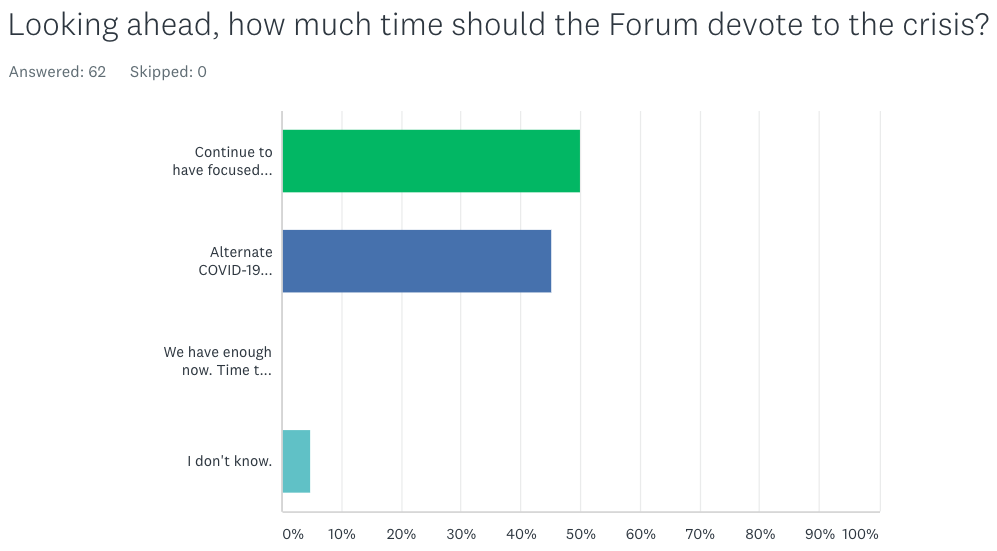
Forum coronavirus poll_all COVID or not?

I think we’ll split the different and go for 3 weeks of COVID-19, 1 week other.

We drilled down on topics into some finer detail.  A question asked which topics people were most interested in, and gave them quite a range:
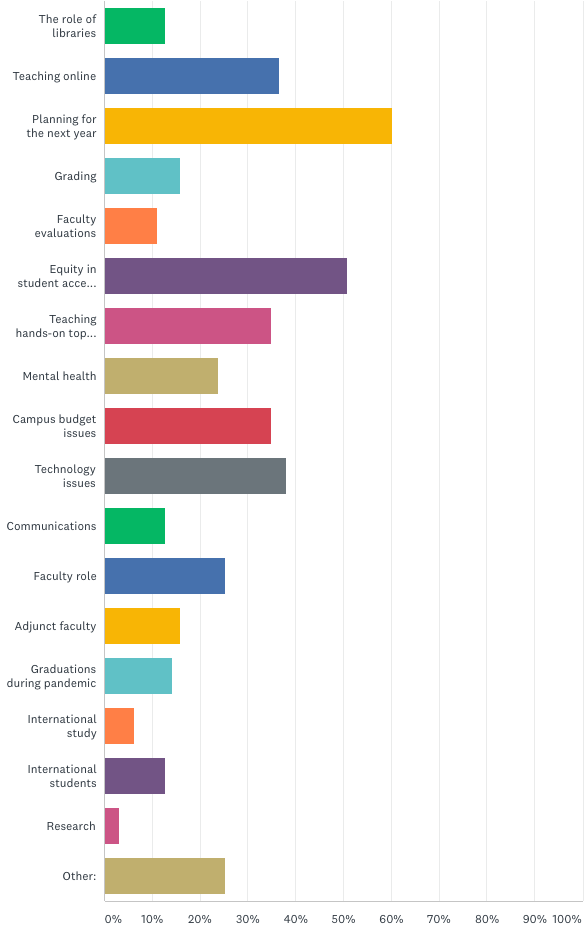
(If you can’t make out the choices, they were: Campus budget issues; Grading; Teaching online; Technology issues; Faculty evaluations; Planning for the next year; International students; Mental health; Adjunct faculty; Research; Equity in student access to online education; The role of libraries; Faculty role; Teaching hands-on topics (labs, etc) online; Communications; Graduations during pandemic; International study; Other)

Planning for the next year led responses, followed by equity.  Our guests and topics will follow accordingly.

“Other” responses were very interesting:

  • Addressing lack of participation by students online
  • How to Crowdsource the Future
  • Basic needs and other non-academic support, particularly for (already) vulnerable populations
  • The challenge of unlearning some of the less optimal strategies re: online learning
  • Course materials.
  • Centers for Teaching and Learning etc or support staff for faculty
  • Leapfrog opportunities / redefining systems
  • I think there are some forced privacy issues that are coming into play now that everyone needs to keep a distance from each other and do all learning remotely. For instance, some students are in a situation where they are required to use an online proctoring service because there is no-where else to go to take a proctored exam. There is now a lot more data that is being collected in LMSs than ever before and institutions are scrambling to report on the data. Do students know what we know about them and do faculty and staff know how to interpret the data to benefit learning online?
  • Student engagement with online student support
  • National programs to accelerate OERs, OA, and national core database collections. We need to move from competition for these resources to collaboration and cooperation, without killing off all the vendors. But clearly more could be done.
  • Learning Engineering
  • Enrollment — how are schools thinking about summer and fall enrollment with such changes in delivery methods (online, remote, etc.). Also, how are schools thinking about tackling ground-based courses, such as biology labs, when their campuses may remain shut down and courses are still remote?
  • Hybrid learning…where people can do some / most of their learning online, but still have a real-time personal interaction with faculty / TAs/GAs and/others (while exercising safe distance OR a phone call)…
  • I selected a lot of topics (8), but ALL of them are important to us at this time. Our college was NOT prepared for this, at all.
  • What will the NEW “normal” look like in AY 2020-21?
  • How are we going to handle a 25-50% cut in the student body next year? How do you recruit students when you don’t know what you will/can offer next year. Also, I’m in Texas, and $19/barrel oil will play a part in this, too. Yuck.

Another survey question concerned Forum formats.  In the past they’ve usually focused on a single brilliant guest, offered no presentations, but consisted of free-flowing conversation.  COVID-19 sessions hosted several guests each time.  So both of those were options, along with a tutorial model and whatever else people suggested.

The responses:
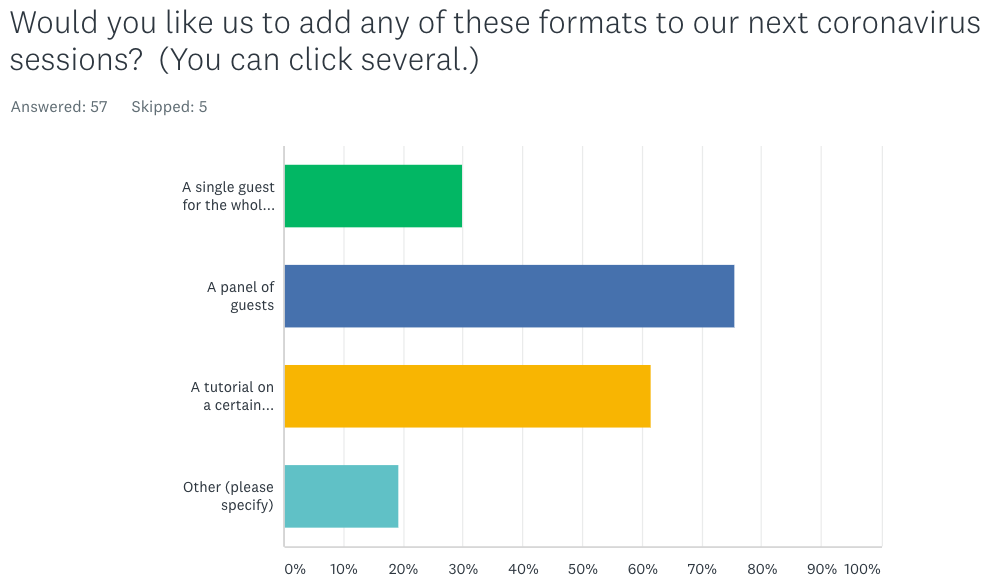
Forum coronavirus poll_format

Panel of guests led.  Tutorials came in second, so we have to create those.  Under “other” were interesting ideas for facilitation, including a pre-session poll, pre-published questions, and having a session where we all think and co-vision together.

Speaking of format, we also explored where people would like to carry on conversations after sessions.  The results were fairly spread out:
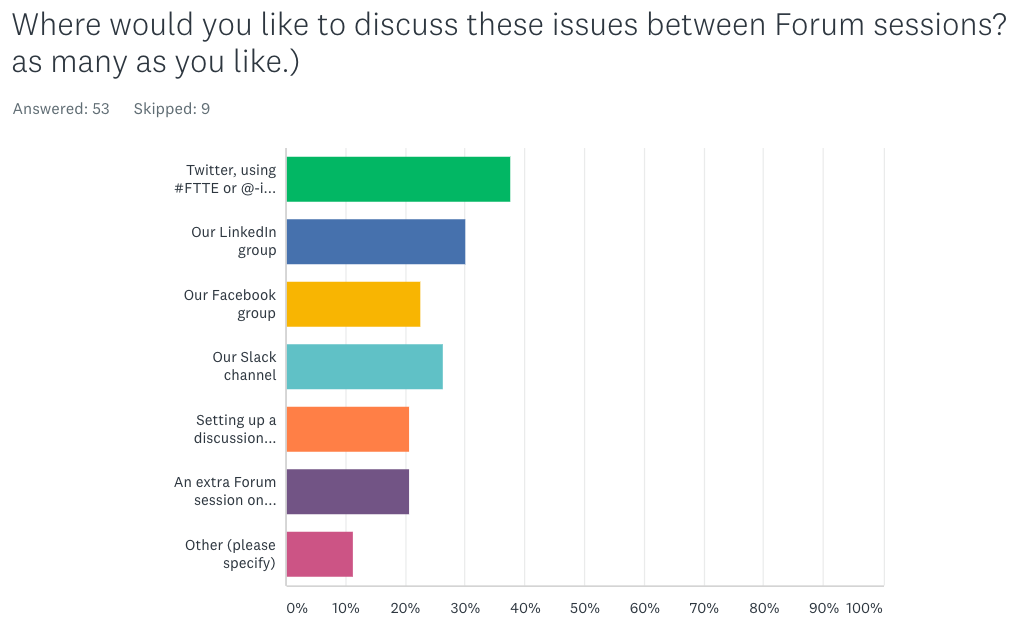
Forum coronavirus poll_discussion tools

Twitter does have a lead.  It’s also much more active in terms of user participation than the LinkedIn and Facebook groups, so that might become the Forum’s home away from home.

Summing up:

The Future Trends Forum has rapidly thrown itself into the extraordinary crisis hitting higher education.  Our conversations have been rich and thoughtful, addressing the situation from a wide range of perspectives and breaking the whole problem down in multiple ways.  In the short term I hope these conversations can help people in and adjacent to higher education better cope with the crisis.  In the long term this account might be useful to students looking back at how academia grappled with the great crisis of 2020.

It’s one example of how a virtual community can pivot and engage.  As the Forum’s creator, host, videographer, producer, and host I’m perhaps too biased to assess this objectively, but I can try identifying some key aspects.  Our focus on audience questions and comments (as opposed to solely on guests’, or my own) yielded a rich approach to the topic.  Offering a venue was a useful act for those who participated; it was also able to build on nearly five years of community building and practice.

We’ll keep doing this, changing up format a bit, and then working in some non-COVID-19-related higher education topics.

My deepest thanks to our guests and to the splendid Forum community for making it all work.

Posted in coronavirus, Future Trends Forum | 6 Comments

The coronavirus and I: an Easter update

Happy Easter to readers who celebrate that holiday.

After weeks of analysis, forecasting, and research-sharing, I wanted to take this weekend moment for a personal post, to update you on what I’m up to and how I’m doing.  Analysis, forecasting, and research-sharing will return with the next post.

As always I want to be transparent and open.

For the past month my family has been in quarantine.  We started this far in advance of our state (Virginia) governor’s announcement, thanks to my wife’s careful, EMT-professional attention and planning.  She stocked up the house with plentiful supplies and locked us down.

As a result, we’re all physically healthy.  A few of us get seasonal allergies – it’s springtime in northeast Virginia, so every plant-based lifeform is blooming ecstatically – and that’s about it.

bread slabs on plate

Yes, I’m baking more gluten-free bread.

Mentally, it’s more complicated.  Our son, Owain, prefers living with us to living in his university dorm, and he’s taking classes online, which is a mixed blessing.  For the live video sessions (Microsoft Teams) he heads into our recording booth.  Our daughter, Gwynneth, continues to work at what has become an essential job: security for datacenters.  Depending on what’s in the news and how much we partake of it, all of us are susceptible to bouts of gloom and frustration, like pretty much everyone else.

Me?

It’s very strange to not be traveling all over the place.  I realize now how much of my life has been arranged around the next two trips in line.  Over the past year I’ve had 1-6 trips/month.  Not doing any of that is a bit disorienting.  To be honest, not having to fly in the United States is actually a big relief.

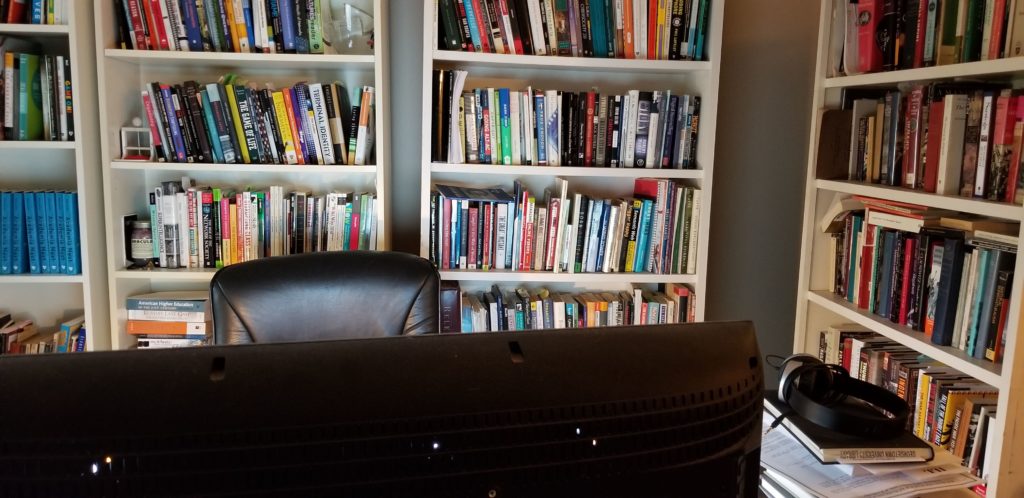
Now my work has settled down spatially to wherever my laptop is.  Where that is, most of the time, is my office desk and its big screen display, along with the book shelves.  I take  detours to the home recording booth for audio or to other parts of the house, for variety’s sake.

Bryan office 2020 April 12

I’m trying to keep my health up.  I walk when I can (when there aren’t many people outside) and use the exercise bike+ desk about once/day.  Pullups are a daily thing, to the amusement of our cats, who are delighted we’re spending more time attending to their needs.  I continue with my 2/3rds vegan diet – Mark Bittman‘s “VB6” – and have pushed it further, with several days in a row that are entirely vegan.  I’m learning about veganism and have lost about 15 lbs.  I can say more about this dietary bit for curious folks.

Meanwhile, my work hasn’t stopped.  Quite the opposite. I’m still working the future of higher education . I keep reading about the necessity of self-care, the importance of reducing expectations, the health benefits of getting rest, the politics and sanity of pausing to reflect… and I’m doing none of those things.

That’s because I’ve been working up to 16 hour days, 7 days a week, for what must be the past month, although it’s hard to tell since things are a bit blurry.

Why?

There’s the mission, first of all.  I help people think about the future of higher education.  That’s what I do.  That future has just been beaten with a stick, had gasoline poured on it, and shoved down a rocky slope into what looks like a foggy abyss.  I have to work this.  This means researching like mad, tracking how academia is reacting to the pandemic. Some of that work is very public, like the various resources I’ve aggregated, a bunch of blog posts, media interviews, and the many live video events I’ve hosted.  Some is quieter, including connecting with my hundreds of established clients as well as a swarm of new ones.  I’ve helped clients translate face to face events online and rethink their strategies.  A lot of these institutions – these people – are suffering.  I help as best I can.

Second, some of my preexisting work has survived the global plague.  Some of that work has actually become more intense.  Academia Next continues to make its way in the world, eliciting feedback and conversation, plus some video events.  My next book proposal is in an excellent publisher’s hands, having survived a first round of peer review; with luck I’ll post about getting awarded a contract.  My current Georgetown seminar (subject: education and technology) is now online, and we all know well now that shifting a face-to-face class into a wholly digital format is not a trivial matter.  I’m scheduled to teach a summer class (subject: gaming in education), which means I have to redesign the whole thing for being online.  Other work was starting up once COVID-19 hit, and not all of it went away.

But some did go away, and in a big way, which brings me to the third reason for overwork.  The majority of our business revenue came from in-person, face to face events, like keynotes, presentations, workshops, and on-site consultations.  Here’s what 2019 looked like:

BAC revenue 2018-2019

Much of that consulting was in person.

Over the past month most of those engagements just evaporated.  Some were postponed to 2021.  Only a few shifted online, and some of those with a fee reduction.

You can see what that does to our bottom line.  That’s a business collapse in the wings.  The proverbial wolf has arrived at the door.

So we pivoted.

A month ago I realized that if nobody was going to be doing face to face events for a while, and many have translated those into videoconferencing, then that’s where my work had to focus.  If that’s where academics and others interested in the future of higher education had moved to, then I had to follow.  And not just follow.

You see, I’ve been conducting, organizing, and participating in live video events since the 1990s.  The Future Trends Forum started in 2016 and has held weekly sessions nonstop.  I’ve been blogging about it.  Since the coronavirus reached pandemic levels I’ve hosted or cohosted up to five events per week for hundreds or thousands of people at a time.  I’m a good moderator and want to apply that skill to making conversations happen.  We need this now, as COVID-19 upends the world.

Each session takes time.  There’s the live event itself, of course, but also a lot of preparation: setting up logins or registration, finding fine guests, outreach over email and social media, helping people with tech glitches.  There’s some juggling of technical details, too, as I have used at least seven different video platforms recently (Zoom, Shindig, WebEx, On24, Adobe Connect, Blackboard Collaborate, BlueJeans). Afterwards there’s a lot of followup with individuals (which I recommend for any event) as well as creating a video recording.  The last bit for me can mean downloading a raw video file, editing it into shape (cutting out dead bits, adding title cards), uploading it to YouTube, then sharing it with participants and the world.  I’m basically doing video production plus working in each video itself. Doing five of these a week is a serious job by itself.

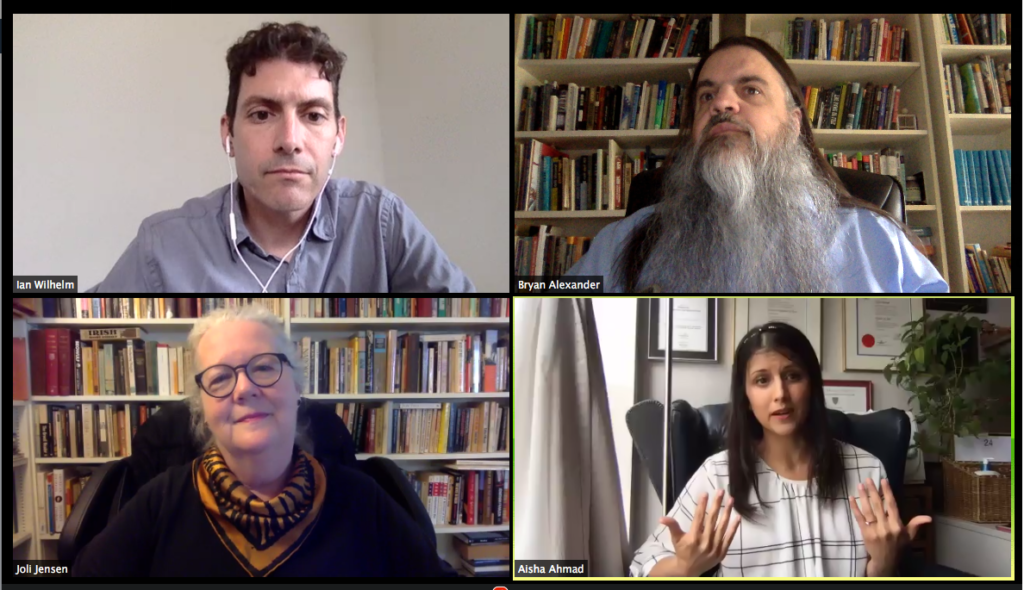
Chronicle_Ian Joli Jensen Aisha Ahmad

From a Chronicle of Higher Education conversation with cohost Ian Wilhelm and guests Joli Jensen and Aisha Ahmad.

This month it’s starting to pay off.  I think I’ve helped make some useful conversations happen.  And now several clients want me to do these for them professionally.  If that works and leads to more such paid videoconference work, it might become a central part of Bryan Alexander Consulting’s offerings in 2020 and beyond.

Meanwhile, non-video, non-face-to-face projects continue.  We just published the April 2020 FTTE report, and subscriptions to it keep growing.  I share content and discussion with supporters on Patreon, and those numbers are also rising.  Royalties trickle in from book sales.  And I’m working up an ebook on how to offer good webinars. (Dear reader, you are very welcome to support each and all of those efforts.)

So that is why I’m working insanely long hours.  History has happened, and we’re responding as best we can.  If all goes well we can help people, advance conversations, and survive or even thrive.

And how’s by you?

Posted in Bryan Alexander Consulting, personal | 8 Comments

How will the pandemic change college and university curricula?

How will the COVID-19 pandemic change what higher education teaches?

buy neurontin online buy neurontin no prescription generic

Many of us have been exploring how colleges and universities will conduct their educational mission over the next several semesters.  That’s a vital question, of course.  But in this post I’d like to ask you all to think about what campuses will teach.  Consider the next term (summer) as well as the next academic year, 2020-2021.

To begin with, certain programs and areas may increase in campus support and student enrollment.  There’s a lot of demand for more front-line medical staff, from nurses to first responders.  Less discussed but still needed are other professions within the full allied health spectrum as COVID-19 infections keep building: medical technicians, anesthesiologists, occupational therapists, mental health therapists, office managers, medical IT services, and more.  For example, Harvard (!) just launched an online medical ventilation class. I should expect many campuses to try expanding their health care offerings across the board.  This should occur both in the undergraduate and grad school realms.

EDITED TO ADD: public health majors and classes should also see an upward spike in demand.

buy aurogra online buy aurogra no prescription generic

What other fields will receive a boost?

curriculum tetris

On the undergraduate side I would guess students will flock in even greater numbers than they already do to business and economics as the economy staggers to its knees.  Campus administrations may grow those sections and classes as they see a need to rebuild the economy.

buy cenforce online buy cenforce no prescription generic

Will politics, poli sci, and government grow?  I’m thinking of election year boosts, which may be traditional, and heightened by this year’s unusual election.  But I wonder as well about the need to understand nations and localities under the pandemic’s great stresses, especially if civil unrest occurs and/or emergency measures are implemented.  I can imagine special topics classes, as well as campuses urging students into those majors or minors as part of higher ed’s civic mission.

I expect a bunch of pandemic- and plague-themed classes to appear across the curriculum.  Think of plagues seen through lenses of history, philosophy, religion, anthropology, cultural studies, etc.  I’ve already offered a syllabus for a literature class.  Will pandemic studies programs appear, at least as minors or interdisciplinary initiatives?  EDITED TO ADD: Oberlin College is offering an interdisciplinary class on the pandemic itself, “Uncovering COVID-19: Critical Liberal Arts Perspectives.”

What will happen to graduate programs beyond the health care field?  Will some number of grad students alter their research to meet the present urgency, bending (say) an anthropology dissertation on death rites to focus more on rituals around fatal disease?

On the flip side, the amount or range of subjects offered might shrink, thanks to ongoing challenges heightened by the pandemic’s fierce economic pressures.  During yesterday’s Future Trends Forum our guests considered what spring term 2021 might look like.  One of their responses included “fewer programs”:

This could take the form of academic program prioritization – i.e., when a campus deciding which programs bring in the greatest number of students or revenue (not necessarily the same) and diverting resources to them, while cutting programs on the other end of the spectrum.  Economic collapse will certainly drive this kind of thinking in general, but the pandemic should give it additional contours.  Think of arguments to cut (for example) literature classes, because it’s more important to fund expanded health care offerings.  Academic program prioritization can become ferocious exercises in micropolitics; the current atmosphere suggests they’d become even more intense.  For some number of colleges and universities – maybe a lot of them – these arguments will occur under the aegis of institutional survival.

We could also see other stakeholders or outside players pressuring campuses to make curricular changes.  State governments, already dealing with the double blow of recession and pandemic (think of growing health care costs, expanding public services) could well urge/lobby/seek to compel universities to follow the curricular patterns outlined above.

buy metformin online buy metformin no prescription generic

  How will foundations, governments, and nonprofits respond through their grants processes?  To what extent will businesses try to adjust what post-secondary education teaches?

Over to you now.  I’d like to raise this as a topic for discussion.  Are you seeing any evidence of higher education’s curriculum starting to change in the wake of COVID-19?

PS: one satire.

(photo by Plan de Alfabetizacion Tecnológica Extremadura; thanks to my wife for the Harvard link; thanks to Obie Jason Mittell for the Oberlin example)

Posted in coronavirus, future of education | 17 Comments

Flipping the higher ed new normal: from synchronous to asynchronous education

What’s the best role for synchronous teaching and learning during a pandemic?

Over the past few weeks the switch to wholly online learning has been represented by live video meetings.  Screenshots of students and faculty in their Hollywood Square boxes are the emerging icons of the new post-secondary order.

Zoom University is a nickname I’ve seen pretty widely.  Already a casual glance turns up all kinds of ZU merchandise, even stickers.  “We live in Zoom now” claims the New York Times Style section.  Too much Zoom experience has a nickname: being Zoomed out.

Zoom I Paid Too Much for this education

Remember how I told you to watch for refund demands?

(I am mildly curious about why Zoom blots out any mention of the many other video tools out there: Blackboard Collaborate, Skype, Google Hangouts (Meet) or whatever it’s called now, Shindig, Adobe Connect, various Cisco offerings, Lifesize, etc.  I know people don’t want to mention Microsoft Teams because it’s Microsoft.  I don’t have good enough stats to know what Zoom’s market share actually is in higher education.)

This discursive emphasis on video in education is based on some reality.  Campuses have taken to videoconferencing for classes at unprecedented levels during the pandemic and it’s easy to see why.  Most instructors who’ve never taught online can find live video to be a closer analog to their classroom practice than asynchronous tools.  I would bet many instructors want to feel a connection to their students, and the active video feed counts for much more than an email reply or a Blackboard discussion post.  They want “conversational spaces” for teaching and learning (Diana Laurillard; cited by Tom Haymes).

Meanwhile, many faculty and students own or otherwise have access to hardware capable of capturing and displaying video.  Plus a lot of colleges and universities purchased licenses for one or more videoconference tools.  And – less widely discussed – there are decades of scholarship on how to teach with synchronous technologies.

However, over the past week I’ve been seeing and hearing stories of pushback.  There’s a current of thought which holds that students would be better served by dialing back the Zoom and shifting instead to a greater emphasis on asynchronous tech.

What’s the reasoning here?

First, requiring live video means assuming students have access to infrastructure.  Not everyone has the right hardware.  Worst, not everyone has sufficient bandwidth.  Those that do might struggle with limitations of data caps or competing with folks thrust together in a lockdown and each hungry for broadband.  Heading out to an academic or public library is not an option, and the same goes for setting up shop at a Starbuck’s or McDonald’s.

(I’m not sure how strained national and local infrastructures are by this.  Any problems they have will worsen things for all.)

Second, time zone issues can become a real problem in scheduling a simultaneous event.  This is especially true for international students.* It can also be a problem for people within sprawling nations, such as Russia, Canada, or the US.  For the latter I recently heard of Hawaiian students having to cope with meetings scheduled for early mornings on the mainland’s east coast.

From a Reddit/profs thread I started:

I am on the west coast. There is a student down the street who goes to Cornell and is now doing online classes. She has instructors who are doing synchronous classes… which means she is up and online at 5 AM to attend lecture.

It sucks.

I am strongly advocating for the asynchronous approach with my colleagues, and most of them get it thankfully.

Third, scheduling becomes harder for many people under quarantine.  Think of parents with children now staying at home, or people balancing limited bandwidth: multiple students and professionals.  Those who still have jobs may see schedules shifted.  Those working directly to address the pandemic – nurses, surgeons, first responders, etc. – will also run into scheduling problems.

Fourth, turning on a camera for an hour or more might be a problem for people suffering physical health issues.  They might be sick from any number of ailments, not to mention the coronavirus itself.  Those enduring mental health problems, possibly exacerbated, may not want to present themselves to other people.   They may also (or additionally) be caring for other people and not want to show that on screen.

Fifth, as with any other technology, faculty and students have to learn how to use it competently.  Anyone who’s ever used videoconferencing knows the many ways users can run into tech problems: camera not picking up, mic not recording, speakers not playing.  Then there are accidental ways we can look foolish or embarrass others, from bad camera angles to not muting oneself.  These are all problems corrected by practice over time, especially with the help of skilled folks… but we haven’t had that luxury this past month,.

When I wrote “competently” I was only speaking of the technical side.  The pedagogical dimension – the whole point of the exercise! – runs into versions of these problems as well, especially for faculty just using the tech for the first time.

EDITED TO ADD: Sixth, live video is not always comfortable for people with a range of non-neurotypical profiles. (thanks to Sue Scheibler for the reminder)

There are also challenges with Zoom in particular.  Recent criticism of its security practices (cf those from The Intercept: 1, 2) have given some campus IT leaders – and their associated lawyers – pause.

I’ve raised this topic with a range of academic audiences and heard a lot of assent.  If I’m right – and, as ever, am happy to be corrected by evidence – we’re seeing a nationwide reaction to a first wave of videoconferencing practice and policy.  I don’t have enough information about other nations to go on.

Are you seeing this, or experiencing it in your own practice?  Are there other rationales in play?  And is anyone using this switch – if they have the time – to follow Haymes’ advice to reflect deeply on what actually works best?

*Yes, for years I have considering setting up a counter-clock Future Trends Forum to serve Asia, as well as being easier on Australia and parts of Africa and Europe.  Let me know if you’re interested.

(thanks to many friends, including a slew on Facebook and this Reddit thread)

Posted in coronavirus, education and technology | 22 Comments

Transmissions from the pandemic’s fringe

When observing a society for futures purposes or literary analysis, I have always appreciated seeing what goes on along the extreme margins.  This activity can shed light on issues that more popular or mainstream cultural productions miss.  They can also be baffling, infuriating, entertaining, or a mix of these.

Along those lines, today I’d like to share some of what I’ve seen around the fringes of the global coronavirus pandemic.  These are recent stories from two countries.  Each touches on different ideas and tendencies.  Each one might point to some elements of what comes next.

Two caveats: first, to be fair, such stories might not ultimately signal anything, if they fail to gain traction or just fizzle out.  That’s always a risk in both futuring and lit crit.  Second, these are developing stories, so I’m going on very fast takes and analyses.  They could easily mutate into something different as new evidence appears and/or as the stories continue.

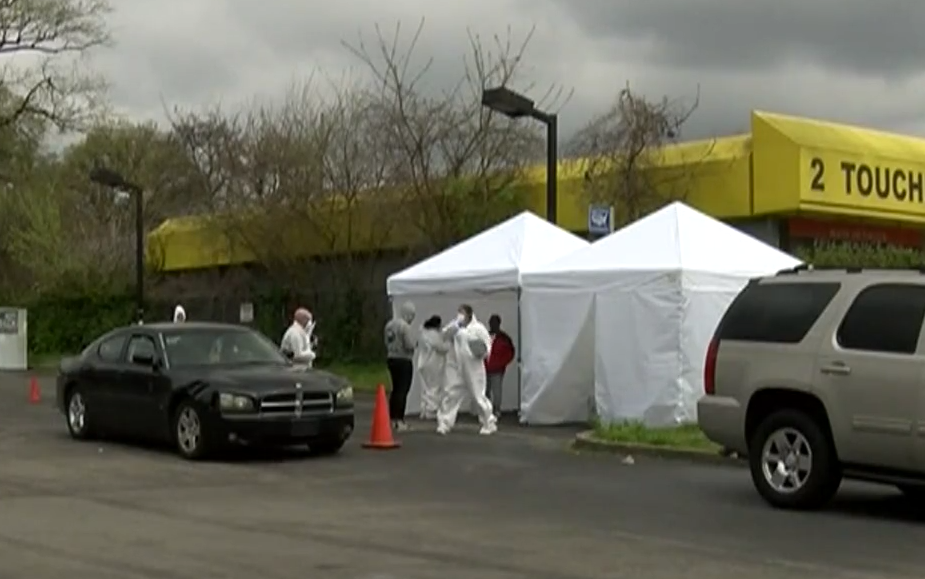
ITEM: Some folks are setting up apparently fake coronavirus testing sites in Louisville, Kentucky.  Several “testing sites” billed people’s Medicare or took payment directly without offering actual medical services, according to the authorities and activists in that story.  Confronted, the site staff fled.

coronavirus drive by test scam KY

ITEM: A few Brits are setting fire to 5G towers, and authorities are looking into the likelihood that the arsonists believed the tech to be linked to the spread of COVID-19.

Evidence that the conspiracy fans are attacking those towers is tentative so far (it’s a developing story), but this short video offers some grounding, unless it’s a hoax:

I shared this story on Twitter, which elicited an anti-5G tweet from Naomi Wolf:


This in turn yielded a pro- and anti-5G thread, including this tone-deaf, historically challenged bit:

https://twitter.com/amandakhurley/status/1246772245512499201

ITEM: a Pennsylvania priest wants to hold a Woodstock-scale Easter event in Florida.

“I’m gonna announce it. We’re gonna hold an outdoor Easter blowout service. Not online. A national gathering. You come from all over, like Woodstock. And we’re gonna gather and lift up Jesus Christ.” So far, a location and time for the service have yet to be announced.

An echo of this appeared in Moscow, apparently:

Back to the would-be evan-Woodstocker: listen to how he describes his thinking:

“Shame on every European full gospel church, bunch of sissies, that shut down during this thing. If you’re putting out pamphlets and telling everybody to use Purell before they come into the sanctuary and don’t greet anyone, you should just turn in your ministry credentials and burn your church down — turn it into a casino or something. You’re a loser. Bunch of pansies. No balls. Got neutered somewhere along the line and don’t even realize it.”

ITEM: There is some nice and easy humor about the pandemic and its responses, like that of the reliable Borowitz.  But I’m more impressed by Scots comedian Frankie Boyle’s take, which can be far more bleak.

A light sample:

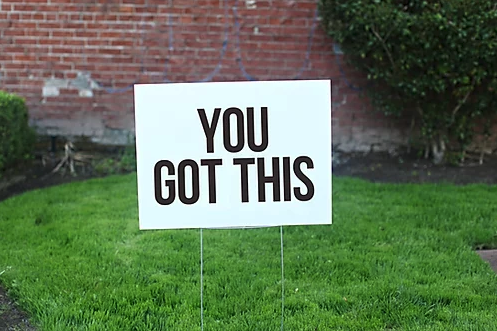
Mistakes have been made in the handling of the crisis. Like flying the Buckingham Palace flag at half mast when the Queen’s not in, which is just an advert for burglars. In my local park, someone has tried to cheer people up by chalking “You Got This!” on the ground. Literally the last thing you want to hear in a pandemic.

"You got this" sign

So what can we deduce from these stories?  What themes can we discern, beyond human daffiness?

We can recognize a string of familiar culture tropes: scamming, conspiracy theory, technological suspicion unto Luddite violence, religion opposing itself to science and state, gender and sexuality reaction, black humor.

I think we might uncover some more signals if we press on these points.  The Louisville scam story reminds us of how much credulity we can bring to health care issues.  It also recalls how swiftly communities can react to perceived threats to bodily and financial health.  The 5G fantasy links up with both of those medical aspects.  Wolf’s odd tweet about Belfast reminds me of how often new technologies let us romanticize the past; we should look for people to re-imagine the pre-pandemic past through similarly nostalgia-fogged lenses.

I don’t know anything about the Pennsylvania church’s theology and politics, but they do echo some conservative suspicions of some sciences… a suspicion which dates back a while in American culture.

On Doyle’s column, which I find hilarious and brilliant, there are a few details.  First, note how he mocks seniors for political and cultural reasons, working around the edges of ageism.  Second, the fierce critique of the Boris government builds to a left wing analysis and call for action:

Indeed, you have to wonder if the virus is so very different from extractive capitalism. It commandeers the manufacturing elements of its hosts, gets them to make stuff for it; kills a fair few, but not enough to stop it spreading. There is no normal for us to go back to. People sleeping in the streets wasn’t normal; children living in poverty wasn’t normal; neither was our taxes helping to bomb the people of Yemen. Using other people’s lives to pile up objects wasn’t normal, the whole thing was absurd. Governments are currently busy pouring money into propping up existing inequalities, and bailing out businesses that have made their shareholders rich. The world’s worst people think that everybody is going to come out of this in a few months and go willingly back into a kind of numbing servitude. Surely it’s time to start imagining something better.

Which isn’t a call to vote Labour, as the author slams them along the way, too.  My point is that these stories show some ways people on the political left – and, in Pennsylvania, the right – can view and use COVID-19.

At the same time Boyle made his reputation by pushing jokes to or over the edge, which doesn’t always win general admiration (see these samples of criticism: 1, 2).  As disease deaths mount up and economies collapse, we might enjoy and share this kind of dark humor.  It’s a staple of experienced soldiers and emergency services staff.

Are you seeing any similar stories from the fringe?

(thanks to Owain Alexander, Mike Richichi, Jesse Walker)

Posted in coronavirus | 16 Comments

FTTE report: special and open COVID-19 edition

FTTE logoToday I published the April 2020 Future Trends in Technology and Education report to all subscribers.

I’d also like to share an open, free edition with you all.

buy azithromycin online buy azithromycin no prescription generic

To recognize that not all readers can afford to subscribe to FTTE, or aren’t affiliated with a subscribing institution, I’m publishing this special report:

FTTE 2020 April – COVID-19 edition

You can download and read it right now.  It’s a pdf without any DRM, so you can also share it with those whom you think could use it.

All of its content is focused on the pandemic’s impact on the trends reshaping education.

If it is of any assistance to you and yours, terrific.

buy zovirax online buy zovirax no prescription generic

  Please do consider supporting it with a subscription here, if you have the means.  Individual subscriptions, Patreon signups, and institutional subscriptions are all grand. As an independent futurist, there’s a stark limit to how much content I can produce for free.

buy augmentin online buy augmentin no prescription generic

  And any support is deeply appreciated.

In the meantime, I’ll try to do this again for the May edition, the June edition, and so on, as long as the pandemic crisis persists.

buy premarin online buy premarin no prescription generic

Let me know what you think.

Posted in FTTE report | Leave a comment

Two pandemic scenarios for March 2021

I presented these short scenarios to an online event in March, and would like to share them here.

They are based on two different models for how the COVID-19 pandemic could play out over the next year, drawing on my virus scenarios (Hubei for the first, waves and long plague for the second).

To be clear: I do not endorse any of the outcomes sketched out in what follows.  They represent a range of options based on certain drivers. As always, these scenarios are part of my work in trying to describe possible futures, rather than to prescribe certain paths forward.

buy glucophage online buy glucophage no prescription generic

  Readers, on the other hand, are quite free to apply them as they see fit.

For Olaf Stapledon

Take 1: It’s April 2021.

People are celebrating one year since the Great Pandemic.  We share stories about the huge shock, the months of agony, the recession, the colossal reboot, getting the vaccine over winter.  There are TikTok festivals, songs, augmented reality exhibits, alternate reality games, documentaries from Disney and Netflix, and ostentatious, live action social distancing reenactments.  Some wear last year’s masks.

Allied health professionals celebrate more somberly.

buy vigora online buy vigora no prescription generic

  They paid a heavy price to contain the contagion and are still recovering.  They keep after everyone else to please, please get your COVID-19 shots already!

People have gotten used to face to face lives again, after an initial phase of delight, awkwardness, and rediscovery.  Colleges and universities are back to their face to face ways, although enrollment is lower and their finances aren’t good.  More people have more respect for science than they did a year ago.

The economy struggles back from recession.  President Biden is enjoying the White House.  He makes few public appearances, like many senior citizens now; vice president Harris is increasingly the face of the administration.  Multiple lawsuits have been filed against Donald Trump and various members of his administration.  Trump himself runs a new and generously funded cable tv channel.

Take 2: It’s April 2021.

COVID-19 has been raging for a year, coming and going in waves and more virulent mutations.  35% of the human population has now been infected.  The death toll approaches one million, at least according to WHO.

buy valtrex online buy valtrex no prescription generic

  Multiple vaccines are in trials worldwide, but none have truly succeeded.

Intergenerational culture has splintered.  Some increasingly revere senior citizens as precious elders, at times connecting with traditional societies’ practices.  In contrast others celebrate the Boomer Remover for political and cultural reasons.  These two populations loathe each other deeply.

The medical profession has been churned up badly.  A majority have been infected and deaths amount to 20% of allied health staff.  Students, volunteers, and others have been pressed into medical service to various degrees of efficacy.  Civilians regard most medical workers with deep respect or reverence.  A growing body of stories (film, tv, books, games, XR) feature heroic and often martyred medical staff.

Education is entirely online.  A broad range of technologies are in use, from the older and simpler (email, texting, mailed DVDs, TV broadcasts) to the more ambitious (virtual reality, AI bots).  There are fewer schools, colleges, and universities, as their physical requirements are no longer viable and their finances have been badly hit.  Some have been taken over or retaken by nonprofits, businesses, churches, and governments.  Institutional education has shifted its curriculum towards a deeper focus on allied health and economic reconstruction.  Older faculty and staff are less active and visible than they used to be; a significant number have died of the virus.

A number of faculty teach independently, the most prominent supporting themselves through YouTube ads, podcast sponsorships, and crowdfunding.   The rest do what they can.

Most national economies are a shambles.  Globally economic growth has ceased.  Unemployment statistics are unreliable, but about 25% seems to be close. Some number of people have exited the formal economy and either retire or work informally.  Digital businesses and allied health care are the main industries that thrive.  Books about the 1930s are widely read.

Politically, the world alternates between conservatism and instability.  In the United States Donald Trump is still president, after last November’s election was marked by low participation, dubious tallying, and acrimony.  Elsewhere, some nations experience governance failures while others are in open civil war.  Various forms of authoritarianism are in place from localities to nations.  Face-to-face protests are rare, driven by desperation or arrogance.  Online unrest is continuous, driving targeted offline protests and other actions. Individual acts of violence occur worldwide.

Culturally, science is very controversial, as some associated it either with the pandemic or the failure to stop it.  There is a steady trickle of protests, property damage, and acts of violence against scientists and scientific enterprises; the FBI debates classifying them as hate crimes.  Multiple religions are growing worldwide, from ancient ones enjoying rebirths to new movements.  Snake oil sellers are a smaller industry, dominated by Alex Jones and Gwynneth Paltrow.  On the other hand, a good number of people quietly blame religions for aiding COVID-19’s spread and dun believers for not supporting mitigation efforts.


Coming up next: higher education scenarios.

buy zydena online buy zydena no prescription generic

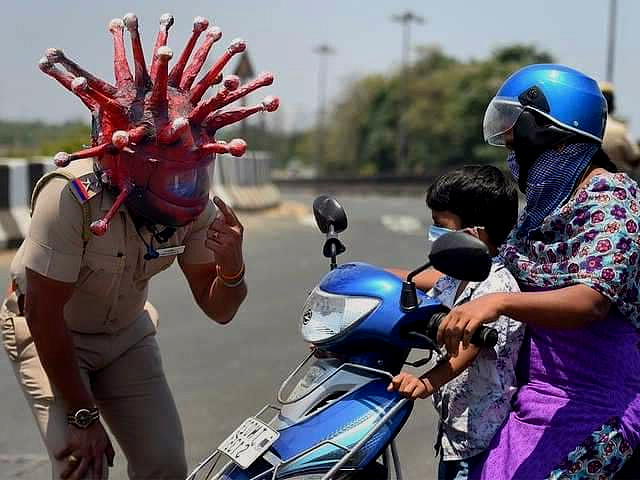
(thanks to the Online Rager, Tom Haymes, and other friends; photo by Shantanu Dutta)

Posted in coronavirus, scenarios | 14 Comments

And now for something different and less dire

For weeks I’ve been posting about dread, decline, and death.

I know that’s hard and heavy.  So I wanted to cheer you all up.

buy valif online buy valif no prescription generic

Here’s a story about goats.  Many goats, stomping into a Welsh town:

This may have inspired an English vision:

coronavirus Dalek

One friend imagines them chanting: “Inoculate! IN OC U LAAAAAATE!”

Another friend and epic Whovian waggishly observes:

You may now return to your lockdowns – but watch the streets for unusual visitors.

Posted in cheer | 4 Comments

COVID-19 versus higher ed: the downhill slide becomes an avalanche

How might the COVID-19 pandemic ultimately impact higher education?

In 2013 I introduced the peak higher education scenario.  I’ve developed it further since. Alas, American higher education has generally fulfilled that forecast.  Now that COVID-19 has hit, things are getting worse, and faster.  Imagine peak higher education on steroids and with the fast forward button jammed down.

tl;dr – it could be bad.  Very bad.

In this post we’ll identify the various pressures the pandemic exerts on colleges and universities.  Let’s focus on the financial dimension.  For sake of (relative!) simplicity I’ll focus on the United States.  Reader can carry some findings over to other countries’ post-secondary systems, depending on local conditions.

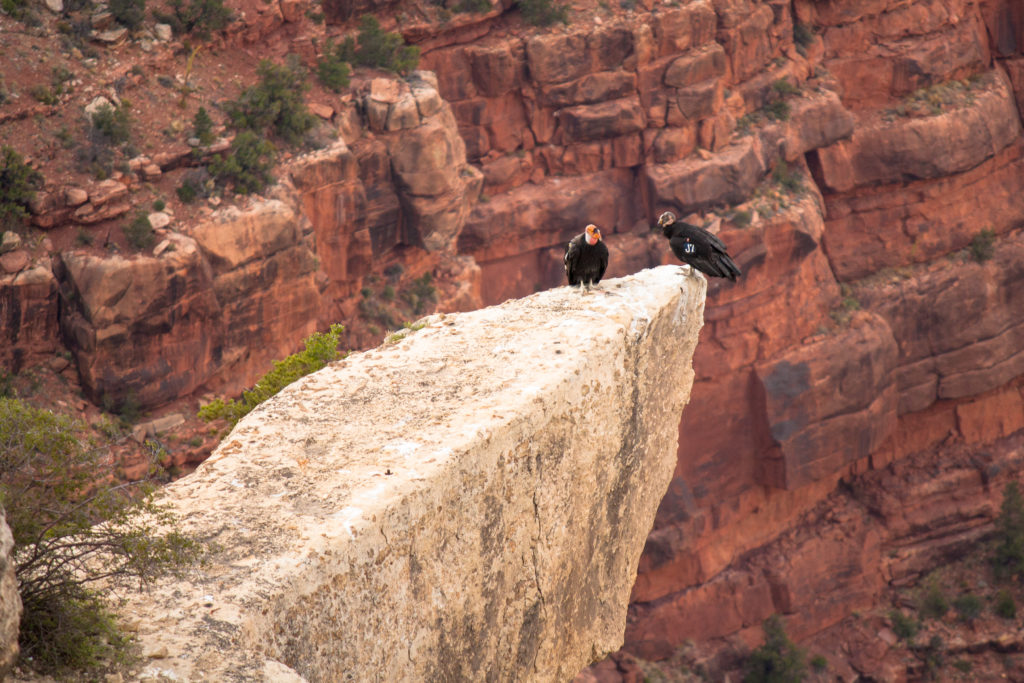
Condor Coffee Break

Preparatory notes: the economic hit may be severe and complex, with many moving pieces and interlocking elements.  As you read on keep in mind those connections.

Pandemic: I’m going to refer to my previous scenarios about how COVID-19 could play out, short, long, and wavy.  My assumptions about the broader economic picture will stem from those futures.

Apologies for being telegraphic or clipped in what follows.  I am running low on time.

Cuts to public higher education American states have reduced per-student funding since the early 1980s, generally.  Recessions have accelerated this tendency, as reduced state economic activity cuts tax revenues.  The American economy is hitting a recession for at least one quarter this year, so we should expect at least a 2008-2009-level reduction in support.

If COVID-19 follows my other scenarios (long, wavy), we’re looking at multiple quarters of recession.  We could also call this a depression.  Whichever terminology we use, state governments will have less to spend on higher ed.

To expand on that point a little: think of how unemployed people make less, so pay less in state income taxes. They also spend less, which means a smaller amount of sales tax reaches state coffers.  State governments may also see certain budget lines forced to grow.  Think of publicly supported health care as the pandemic sickens residents.  Think, too, of state infrastructure work becoming more expensive: extra cleaning of certain sites, funding to public medical systems.  Recall that states have community obligations as well.

Combine that with the very low regard most states have for their public colleges and universities (see this story) and imagine just how far public appropriations can fall by fall 2020.

Endowments For the relatively small number of campuses that have significant endowments, those are in serious trouble now.

Three-quarters of the $630 billion in endowment funds at U.S. universities and colleges is invested in equities, or stocks, according to the most recent available accounting, at a time when share prices have plummeted since the start of the coronavirus.

This may rebound or even recover at some point, depending on how long the pandemic rages and just how far it ruins the economy.  In the meantime, those colleges and universities will likely suffer a hit.

Families spending less As the overall economy sours many families will have less to spend, and still less desire to.  They will hunker down for safety and survival.  Not all – some will be profligate on cheap credit, while others maintain or expand their resources.  But a good and growing number will lack the stomach to put out for college.

One result is down-shifting which institution they attend.  Instead of a research-I, a state school.  Instead of a state school, a community college.  Rather than a liberal arts college, a wholly online enterprise.

Another result may well be holding off on going to university at all.

Now, there’s a strong counter to this, namely our habit of increasing enrollment during economic crises.  Community colleges should see a spike upward, as they did in 2008-2009.  Online-only schools may as well.

Charitable giving Gifts, donations, and alumni support may drop as well.

Paul Friga observes:

Philanthropy, especially annual campaigns, will decrease as individuals lose jobs and personal net worth. Overall giving in 2008 dropped 11.7 percent from the previous year, and donations to education also experienced similar double-digit drops. Endowment returns will decrease in correlation to stock-market performance; in the year following the Great Recession, endowment returns dropped on average by 23 percent, according to a survey of more than 400 universities.

Enrollment decline During this semester we may see some students disengage from classes for a variety of other reasons: personal stress, family health, economic crisis, bad experiences, technological issues, and more.  They could take incompletes or withdraw from classes.

What happens to them in summer?  How many will take classes then?  Will that odd season see an enrollment drop?

But summer pales in importance next to fall term.  As I’ve said, much depends on how the pandemic plays out.  If COVID-19 is done by August – or, more importantly, if we perceive it as beaten by then – we could see students return to campus in full force.  Some might not.  They could fear infections, either from insufficiently cleaned sites or from risky classmates.  Others might prefer the online experience because of its convenience or the safety of doing it from home.  A gap year might look appealing. Overall enrollment might tick down.

And if COVID-19 continues to rage, or comes roaring back during fall term?  How much further will enrollment slide?  Art & Science Group polled high school seniors and found some who are rethinking college this fall, either considering attending a more local and cheaper campus, or who are pondering skipping this fall term entirely. And recall Brian C. Mitchell and W. Joseph King’s aphorism from How to Run a College (2018): enrollment means revenue.

I’ll return to this below.

cliff Michael Coghlan

Refunds Several universities have issued partial refunds to students for room and board.  For example,

At the University of Wisconsin system, which encompasses the state flagship in Madison and 12 regional campuses, officials estimate they are paying out about $78 million for refunds of room and board charges after clearing students out of residence halls.

“We decided to refund this because we thought that was simply the ethical thing to do,” said system President Ray Cross. Students and families need the money, he said. “Of course, this is a huge revenue hit.”

Refunds could go beyond room and board.  Fees are a likely target, as we can see in this petition, which calls on the University of California San Diego to reduce fees that the author deems to be no longer appropriate:

Since UCSD decided to put all the classes online, then the school fees, like

Spr Qtr Campus Activity Fee 73.06
Spr Qtr ICA Activity Fee 259.04
NonRes Supplemental Tuition Sp 9918.00
Spr Qtr Recreation Facil Fee 117.00
Spr Qtr College Activity Fee12.08
SPRING QTR STUDENT SERVICE FEE 376.00
SPRING QTR TRANSPORTATION FEE  64.58
TUITION SPRING 3814.00
Spr Qtr University Center Fee 101.46

Should be lower or cancel. Please support please. A lot of students still suffer from the student loan.

The bigger target is tuition.  It may well be that many students find the digital experience to be of lower quality than the face-to-face instruction they had recently received.  Beyond student opinion, stories could circulate through mainstream and social media of badly designed classes, slow response times, awful video interaction, etc.  How many will request partial refunds or reduced tuition prices?  How many will do so informally versus filing lawsuits (Americans do love litigation) versus lobbying states legislatures?

Campus medical costs The majority of college and university costs are compensation to staff.  Custodians to presidents, professors to librarians, paying for people is typically the lion’s share of a campus budget.  And that may shoot up.  Medical costs have already been rising, as insurance costs rose and institutions were unable to pool resources for improved economies of scale.

The pandemic should make this worse.  As more people get sick insurance companies will have to pay out more, which puts pressure on them to realize more revenue through fees.  And as more academics get sick, ditto.  It may well get more expensive to operate a campus – just as revenue starts dropping.

International student numbers These may decline worldwide for obvious reasons: fears of infection and official travel restrictions.  How long these fears persist depends on how long the pandemic lasts and with what severity.

Some American colleges and universities have relied on international students since around 2000.  Their absence is another financial blow.

Campus sports The NCAA is paying Division I campuses much less than they expected, as games get canceled:

Two weeks after the event was canceled, the NCAA announced it will be distributing $225 million to its approximately 350 Division I members, much lower than the $600 million it was set to dole out in installments had the tournament been played.

This isn’t a great deal of campuses – precious few actually make money on spots – but points to ripple effects throughout American academia.  Some schools offer sports to boost recruitment.  What happens when those games are no longer played?  How long does fondness for and awareness of teams last when they’re mothballed?


Put all of these together and what happens to American higher ed by this time next year?

One academic thinks one fifth of these institutions are staring at a cliff:

I think in the short term, it’s not 10 percent that are in real trouble, it’s 20 percent. That’s not to say 20 percent are going to close. But it ups the possibility. We’re now going to have upward of 20 percent really terrified. If this crisis is going to take out all of next academic year, that bottom 20 percent may never come back.

Let me flesh out that death’s head a little more.  Think, first, of queen sacrifices.  As enrollments slide for some, doing a cost-benefit analysis is going to be very appealing for quite a few administrators and trustees, not to mention making sense for legislators.  Departments that bring in the lowest number of students – and also fail in institutional politics – are likely to face cuts or mergers with other departments.  The same goes for other units: programs, schools.

Campuses can also merge.  This can be voluntary, when a healthier college or university absorbs one on the edge of extinction (really “acquisition” is a better name than “merger” for this reason).  It can also be involuntary if state governments get involved.

Closures are now more on the table than they have been for the past decade.

Alongside these measures all colleges and universities have some tested tools in their toolbox:

  • Nudge faculty and staff out the door with buyouts, early retirements, and other inducements or maneuvers.
  • Cut faculty and staff compensation through furloughs, reduced medical support, reduced retirement support, cuts to salaries.
  • Increase tuition and fees, expecting students to go further into debt.  When will we reach the $2 trillion mark, fall 2021?  Spring 2020?
  • Double down on adjunctification after an initial wave of not rehiring adjuncts.  Who will be able to fill open tenure lines, much less create new positions?
  • Cut all kinds of budget lines: professional development, building maintenance, salaries.  Campus politics will heat up as units and individuals jockey to avoid the next swing of the ax. I expect academic libraries will be in some cross hairs.
  • Expand online offerings.  After all, these can’t give you coronavirus.  And there’s little expectation of tenure among online instructors.
  • Keep trying to tell the story of higher education’s value in more effective ways.
  • Deny that there’s any crisis.  Seriously, people will do this… and they’ll tend to have tenure.

I do wonder if we might not see some new construction, since interest rates are effectively zero and campuses can borrow… unless their credit ratings are too low for banks.

About those cuts: back in 2001 and, less so, in 2008 there was talk of “cutting the fat.”  I’ve heard some of this since, usually from Republicans complaining about some of higher ed.  Yet as Chris Newfield acidly and correctly notes:

We’re out of fat.  We’re cutting sinew, muscle, and bone.  Hence my forecasting of queen sacrifices, mergers, and closures.  Peak higher education on steroids.

How higher ed can best navigate this terrible crisis is… the subject for another post.

PS: The title of this post is a reference to a classic line from the great science fiction tv series Babylon-5.

For more reading consider Paul Friga’s recent article.

(thanks to Todd Bryant, Michael Horn, and more friends for links and thoughts; cliff and birds photo by Derek Bruff; cliff by Michael Coghlan)

Posted in coronavirus, future of education | 26 Comments

Higher education is already feeling the first effects of COVID-19

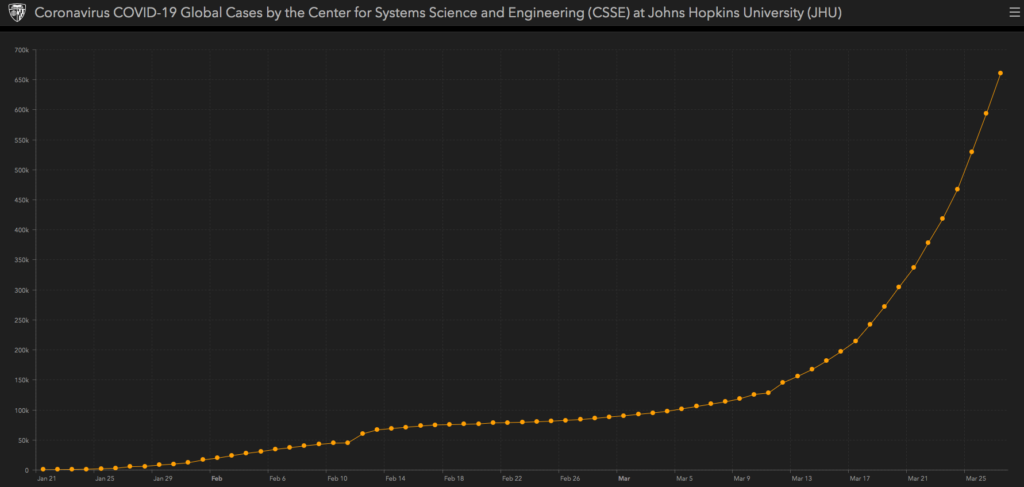
As I write this COVID-19 continues to gnaw on the human race.  Data is increasingly dubious for a range of reasons (politics, testing, etc.) but the range looks like between 630,000 and 720,000 infected and around 30,000 dead, with both registers rising (WHO, New York Times, Worldometer)*.  In the United States the CDC reports 122,653 infections and 2,112 dead, while the Times estimates more, “at least 135,738” infected and  “[a]t least 2,391” dead.

Did I mention rising?  Here’s the Johns Hopkins dashboard‘s worldwide case graph:

coronavirus comfirmed cases 2020 Jan 21-March 29_JHU

How will that takeoff curve hit higher education?  I’ve been tracking this since the start, and will have much more to say this week.  Right now I’d like to start with evidence of impact.  And I don’t mean campuses migrating face to face instruction online.  We’re already there, mostly, with a few exceptions.

Several campuses have taken drastic steps over the past week, citing COVID-19 as what pushed them over the edge.

The San Francisco Art Institute (SFAI) decided to close.  COVID-19 was the final straw:

The final straw for the faltering institution was when discussions to merge with a local university collapsed after the coronavirus sent the Bay Area into a lockdown. Pam Rorke Levy, the institute board’s chair, estimated the university’s total debt was around $19 million but likely to increase because the school is not earning revenue during the health crisis.

According to the official statement:

SFAI’s leadership has no clear path to admit a class of new students for the fall of 2020. Given our current financial situation, and what we expect to be a precipitous decline in enrollment due to the pandemic, we are now considering the suspension of our regular courses and degree programs starting immediately after graduation in May of this year.

SFAI was already in financial trouble.  The pandemic pushed it over the edge.

Further north, Central Washington University (CWU) declared financial exigency.  This is a very precise term that frees up a campus administration to take all kinds of drastic measures, including terminating tenured faculty members.  At Times Higher Ed forecasts, “it’s likely to make layoffs…”

The official statement makes the pandemic’s economic impact very clear through a detailed breakdown:

CWU anticipates that measures required to inhibit the spread of COVID-19 will reduce overall enrollment through the erosion of retention as well as the recruitment of new students… CWU anticipates the absence of students, employees and visitors will result in a significant loss of revenue that supports bond payments, “System” revenue that is realized through the use of dining services, the Wildcat Shop, residence halls, and other services… the required cancellation of university-sponsored events will result in the loss to the university of revenue associated with conferences, camps, and many other student-life and academic events…

In California Notre Dame de Namur University (founded 1851) announced it would stop admitting new students.  And they are canceling sports!  It’s not a closure per se but really sounds like one.

NDNU intends to remain in operation through the spring 2021 semester.. We are working diligently to build pathways for our students to finish their degrees while we evaluate options for the university’s future.

Why?  They were already in the kind of trouble I’ve been telling you all about for years:

In the face of sharply rising costs in the Bay Area, we have a very modest endowment and limited resources at our disposal. At the same time, we have experienced our lowest enrollment in 30 years, a decrease of 33% since 2013. This has created a dramatic decrease in net tuition revenue while the cost to educate students has increased by several thousand dollars per student.

A 33% decline!  Their official announcement doesn’t mention the pandemic, but it seems likely to have contributed to their decision.  Their classes are already online.

East of Washington, the University of Arkansas Little Rock (UALR) is considering cutting the numbers of its campuses from 5 to 3.  Enrollment and financial pressures have been squeezing that institution lately, and now the pandemic is playing a role:

[Chancellor Christina] Drale expects more money will be cut as a result of fewer expenses, such as lapsed salaries for people who have left but not been replaced and decreased travel amid the covid-19 outbreak. “Of course we don’t know how much this crisis will affect this year’s budget,” Drale said.

Meanwhile, an Illinois liberal arts college announced it would close.  MacMurray College (founded 1846) determined that it “had no viable financial path forward amid declining enrollments, rising competitive costs and a small endowment.”  The pandemic played a role in this determination:

The coronavirus pandemic and resulting economic disruption were recent factors that complicated MacMurray’s financial condition, but they are not the principal reasons for the Board’s decision to close, according to [Board of Trustees Chair Charles] O’Connell.

On the east coast, Quinnipiac University decided to cut faculty and staff salaries because of the pandemic:

“The far-reaching disruptions caused by Covid-19 have resulted in significant additional expenses for our university and lost revenues from programs that were canceled,” [President Judy] Oilan wrote in an email to staff members on Monday, March 23.

Is it unsurprising that Moody’s downgraded higher ed’s overall outlook to negative?

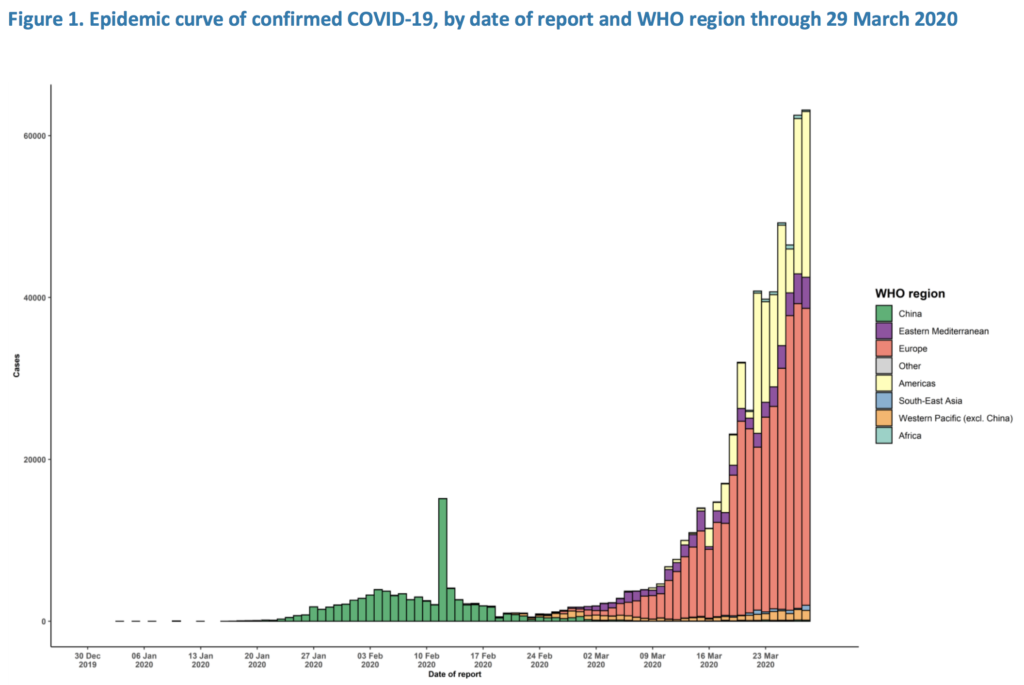
As a final thought, here’s the latest epidemic curve graph from WHO:

coronavirus epidemic curve 2020 March 29 WHO

Let me pause for now.  This is a post about evidence, not forecasting.  Forecasting is up next.

Are there other examples out there?  Should I track them?

*Here are the latest numbers from those sources.  Infections: 634,835 – 720,117 – 721,412.  Deaths: 29 957 – 33,925 – 33,956.

Posted in coronavirus, higher education | 2 Comments