Reflecting on higher ed in the pandemic

As higher education continues to grapple with COVID-19 I’ve been talking with various kind interviewers.  It’s a good way for me to think through my analyses.

Here are two.

First, Howard Teibel and a colleague talked with me on his podcast.  They asked good questions, aimed at futures work, sustainability, and organizational change.

buy fluoxetine online buy fluoxetine no prescription generic

Second, Doug Lederman at Inside Higher Ed asked me to reflect on this question: “What is your emerging vision for post-crisis higher education in general?”  My compressed answer is in his column, and also copied here:

Much depends on how the pandemic plays out.

If nations like the U.S. can burn through all or the worst of COVID-19 in a couple of months, as China did, the impact will be intense but short term. If the coronavirus and our response persist for a year or more, academia will be redefined.

I fear many of the financial costs will clobber our budgets as state appropriations to publics reduce even further, as campus costs mount, international enrollment drops, endowments wither and families are just able to spend less on education. All of that occurs in the short-term scenario.

buy clomid online buy clomid no prescription generic

If COVID-19 gnaws on nations for semesters on end, that will gut higher education’s finances. Given recent institutional history, we should expect an expanded adjunctification of the faculty and “queen sacrifice” cuts to programs (especially the humanities).

Our shift online could take several forms. First, if bad-experience stories circulate and have influence, we could see participation and even enrollment decline. Second, given equity issues worsened by recession, open education resources and open-access publishing could triumph. We may also see inequality drive different technology uses, with wealthier communities using more demanding technologies (virtual and mixed reality, telepresence) while poorer ones turn to tools with lower infrastructure demands (asynchronous video, audio, images and text).

Third, as entirely online pedagogy continues, certain pedagogies and support structures should win widespread attention. Colleges and universities might compete for students (as well as faculty and staff) based on how well and prominently they carry out these teaching methods. Fourth, if the pandemic persists unevenly, coming and going in waves over a long period, we might get used to alternating between face-to-face (i.e., really blended) teaching and wholly online instruction.

Research is experiencing a stall now as faculty remove themselves from on-campus resources. An attenuated pandemic could depress scholarly output for a year or more. At the same time, some faculty members may play an increasingly public role for their research, from work in health care to analyzing COVID-19’s impact through the lenses of sociology, political science, culture, media, urban studies, etc.

buy zoloft online buy zoloft no prescription generic

This may appear both in formal scholarship, research and development, or public advocacy.

Read the whole column, which interviews other people.

buy grifulvin online buy grifulvin no prescription generic

  Interestingly, it’s a sequel to a first column, which is rich by itself.  George Station and others critiqued it, and Doug responded seriously.  Bravo to all.

And thank you to Howard, Doug, and their teams for interviewing me and sharing the results.

Every day I’m researching and reflecting on how the academy is rapidly changing.  I try to blog about it for a bunch of reasons: to spur discussion, to get feedback on my thinking, to share information, and to document this extraordinary moment in history.

More to come!

Posted in coronavirus, interviews, podcasts | 5 Comments

COVID-19 in 2020: several scenarios

For nearly two months I’ve been tracking the coronavirus outbreak.  I’ve been sharing forecasts, examining analyses, and collecting forecasts here, on Twitter, on LinkedIn, and Facebook.  Now I’d like to share some scenarios for how the pandemic might turn out.

A scenario is a futuring artifact, a story about the future, shaped by certain key forces and events.  Each scenario below is based on different understandings of COVID-19 and the human response to it.  Each scenario also responds to the others.  #2, for instance, can be caused by a nation failing to implement the policies of #3, or thinking the situation is more like #1.

These are not predictions but ways of thinking ahead.  So what can you do with them?  Their purpose is to help spur the reader’s thinking and planning about the next few years.  Some will follow a given scenario and imagine themselves in that future, envisioning their professional and/or personal lives in such a world.  Others will trace an institution, nation, or other entity along that track.  Still others will see a world formed by the combination or intersection of several scenarios.  And some will be inspired to craft their own.  All of these are excellent; I’d love to hear how you use them.

A note about scope: my analytical unit here is the nation.  The United States is the one I know best, but these scenarios should be applicable to many others, given some particular integration.  They may also apply to sufficiently large localities, such as provinces or states.

Caveat1: I am not an epidemiologist nor a sociologist or political scientist.  As a futurist I seek information across multiple domains and disciplines and weave the results into models and forecasts.  The following are based on that kind of research; I welcome corrections and other amendments in comments below and will gladly edit this post as necessary.

Caveat2: this post is only about the pandemic itself.  I’m saving commentary on educational implications for a subsequent post.

1: THE HUBEI MODEL: A SINGLE, SHORT WAVE

In this scenario COVID-19 appears, courses through a nation, then ceases, all within several months.  The relatively short time span may be due to aggressive public health measures: social distancing, surveillance, quarantines, travel bans, etc.  The virus may also not be as virulent in practice as was once feared.  Its mutations do not prove additionally dangerous or may actually prove less sickening. By winter 2020-2021 COVID is close to the flu in impact, if not its nature.

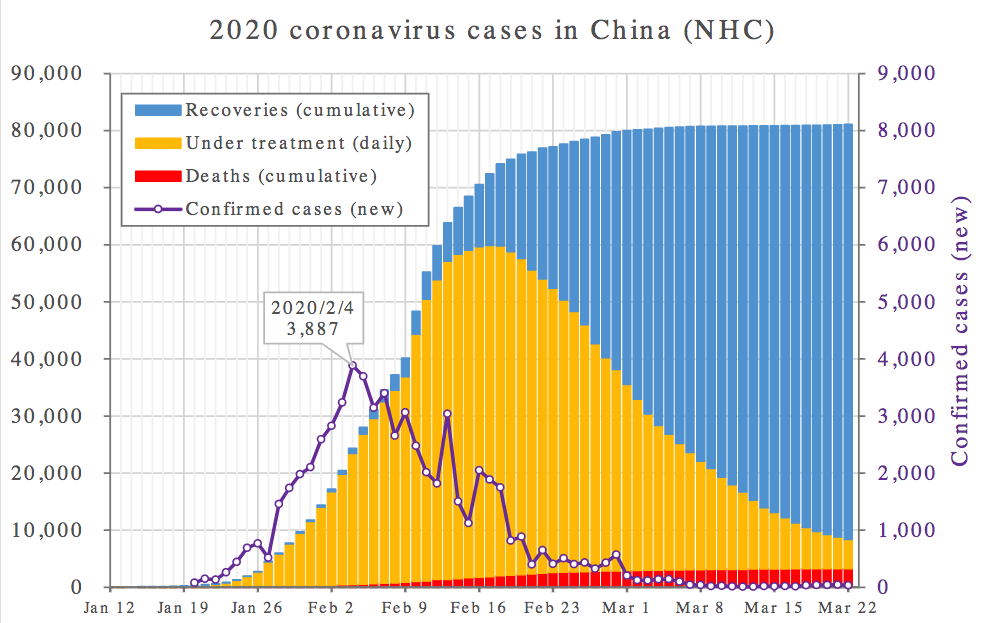
As evidence of this possibility, biophysicist and Nobel laureate Michael Levitt finds that the virus’ growth rate is lower than many estimates believe.  We can also look to the Chinese experience, specifically the outbreak, surge, and ultimate control in the province of Hubei in the course of roughly three months.

coronavirus China 2020 Jan-March Wikipedia

Bill Gates recently made the case for this scenario, provided a nation takes Hubei-style measures.  “If a country does a good job with testing and “shut down” then within 6-10 weeks they should see very few cases and be able to open back up.”

Italy might, hopefully, be about to realize this scenario:

This scenario is the most desirable of the three.

2: VIRAL WAVES: LONG DURATION, UNEVEN IMPACTS

In this scenario COVID-19 surges through a population, retreats, goes quiet, then returns again.  It may repeat the pattern in successive waves over time, striking again and again.

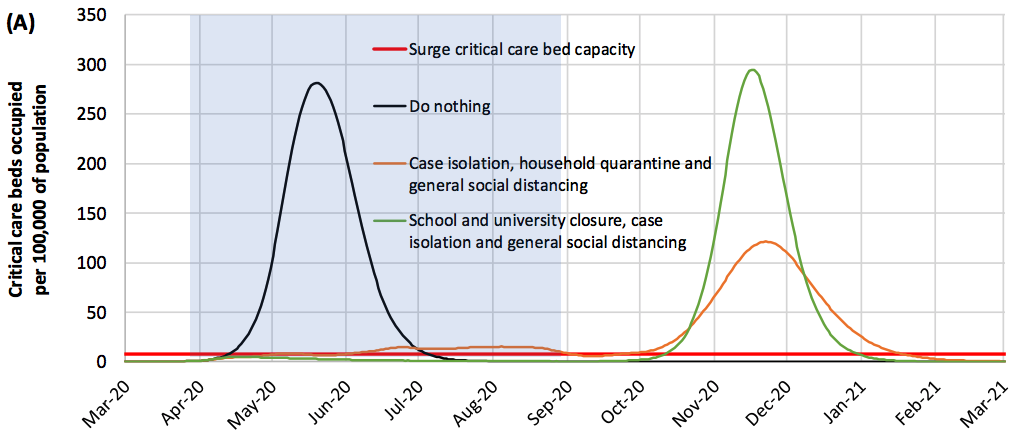
Several factors  can drive this scenario.  Significant mutations of the virus could yield new forms that prove dangerous and difficult to treat.  A nation can reduce its anti-coronavirus measures too early, leading to a rebound.  As the recent Imperial College report observes, “Once interventions are relaxed… infections begin to rise…”

coronavirus in waves Imperial College report

One United States government report posits this scenario, imagining a “pandemic [that] will last 18 months or longer and could include multiple waves of illness.”

India might give us an early sign of that, attempting a “Janta Curfew (peoples’ curfew)” for just 14 hours.  Or US president Trump might offer another, if he shuts down containment measures too quickly, as some think he might.

Changing seasonal conditions could push down infections, then yield a fresh spike.

This scenario could also occur in local or regional settings, as successive viral waves move into a given population.  One nation could successfully experience a short infection, Hubei style, then get hit ahead by a wave transmitted from a neighbor or the right travelers.

Benign version: a vaccine tamps it down to being akin to the seasonal flu.  The warning then will be “Don’t forget to get your COVID shot!”

3: THE LONG PLAGUE

In this scenario a COVID-19 pandemic lasts for a year or two.  Biologically, the virus may prove to be just that virulent, possibly through mutation into different and/or more dangerous forms.  Politically, a state may decide to maintain anti-virus measures for that long a period through a combination of analysis, caution, and political will.

In particular, a government may choose to maintain aggressive policies until vaccines are found, determined to be effective, and available for widespread distribution.  The Imperial College report notes that

[t]o avoid a rebound in transmission, these policies will need to be maintained until large stocks of vaccine are available to immunise the population – which could be 18 months or more.

The American report noted in the preceding scenario also cited 18 months.

This may not be the best outcome for human life.  Neil M. Ferguson tells a New York Times columnist that his best case scenario for a long plague costs 2 million dead Americans. Think about what this could do to seniors, who are especially vulnerable.

For social and economic life this may be devastating.

…and so over to you.  What do you make of these scenarios?  How do you see yourself, your family, your professional world in each?  Which do you see as most likely (as opposed to most desirable) where you are?

Next up: using these scenarios to drive scenarios for higher education.

(thanks to Phil Komarny, Tom Haymes, and my wife, among others)

Posted in coronavirus, scenarios | Leave a comment

Reading for the plague: a syllabus

As a futurist I spend most of my time looking ahead to understand what might happen next.  Sometimes this means drawing on my background as a literature and book person, hunting literary sources that help illuminate the future.
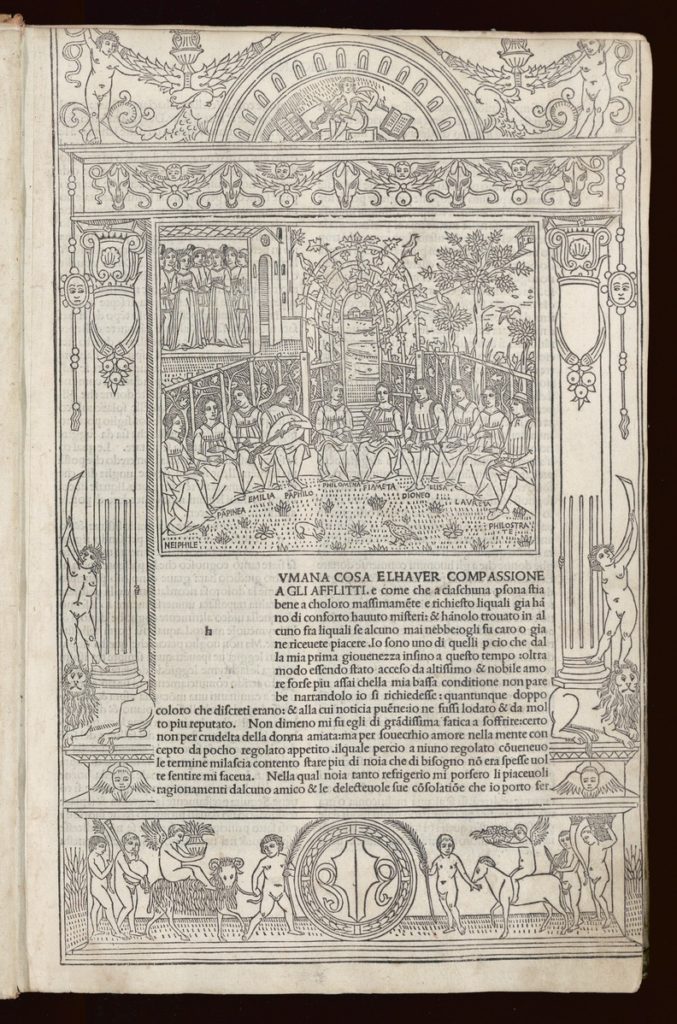
Boccaccio_-_Decameron,_MCCCCLXXXXII_ad_di_XX_de_giugno_-_3852856_Scan00015.tif

“Illustration from a ca. 1492 edition of Il Decameron published in Venice”

So once the coronavirus outbreak began, I started thinking about readings.  My list grew into a kind of sprawling syllabus, which I’d like to share.

My goal was to assemble a good range of texts from a diverse set of authors.  These come from across seven centuries, although they’re biased towards the past hundred years.  They stem from a variety of genres, including realism, science fiction, fantasy, horror, and magical realism.  Some focus on preventing a plague, while others explore the course of a disease or its aftermath.  Several are concerned with storytelling itself.

I started with novels, but things grew from there.  Now there are novel-ish book length narratives, short stories, short story collections, a play, and a diary.  I’d like to add nonfiction, if folks can help me create a good list (EDITED TO ADD: here’s one.  Thanks, Vanessa!).

For each item I offer a very brief note about why I picked it.  Each also links to a relevant Wikipedia article.  There are links to free and open content, as available.

Novels

Boccaccio, The Decameron (1353).  One hundred stories about being human, told by people fleeing a plague.  (Decameron Web; one Project Gutenberg English language translation; another one; Librivox recording)
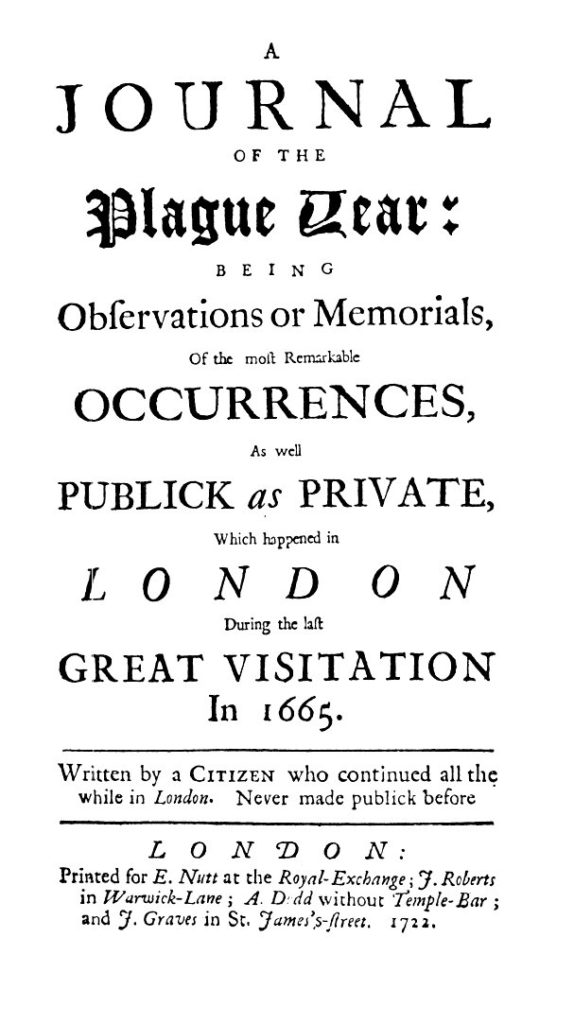
Daniel Defoe, Journal of the Plague Year (1722). The narrator reflects on his experience of a 1665 bubonic plague outbreak in London.  An unusual novel, containing a lot of evidence alongside a personal story: data tables, official documents.  I have an introduction here. (Project Gutenberg edition; Librivox recording)

Mary Shelley, The Last Man (1826).  Another science fiction work from the genre’s founder.  The story takes place in the late 2000s, and concerns a plague that wipes out the human race.  Several characters are clearly analogues for people Shelley knew, such as her husband and Byron. (Project Gutenberg text; Librivox recording)

Alessandro Manzoni, I Promessi Sposi (1827); English translation, The Betrothed.  Known for chapters describing a seventeenth-century plague centered on Milan.

Jack London, The Scarlet Plague (1912). An old man, survivors of a plague that set human civilization back millennia, tries to tell kids about the world he recalls.  (Project Gutenberg edition; Librivox recording).

Katherine Anne Porter, Pale Horse, Pale Rider (1939).  A short novel about people suffering from the Great Influenza. (thanks to Liz Ahl)

Albert Camus’s La Peste (1947); English translation, The Plague (1948). A much-interpreted vision of a plague striking a North African town, seen as an existentialist classic.  It’s become popular of late: Alain de Botton in the New York Times; Jonah Raskin in Counterpunch.

George R. Stewart, Earth Abides (1949). A work of ecological science fiction, this traces the collapse of human civilization after a horrendous plague.  Our point of view character studies changes to the natural world and the shift of society to a hunter-gatherer existence.

Richard Matheson, I am Legend (1954).  A pandemic turns survivors into vampires. (thanks to Phil Katz)

Michael Crichton, The Andromeda Strain (1969). An early techno-thriller about stopping a plague before it could go viral.  The story is immersed in science, the military, and technology.

Stephen King, The Stand (1978; revised edition 1990). A devastating plague created by the American military wipes out most of the human race.  What follows is a fantastic struggle between two societies of survivors.

Frank Herbert, The White Plague (1982).  After his family is killed in a terrorist attack, a biologist creates and unleashes a disease that devastates the human race.

DoomsdayBook(1stEd)Samuel Delany, Flight from Nevèrÿon (1985). A linked short story collection taking place in a fantasy world, where a plague breaks out and gradually draws the narrative to contemporary New York City.

Gabriel García Márquez, El amor en los tiempos del cólera (1985); English translation, Love in the Time of Cholera (1988). One conceit parallels love and disease. I haven’t read this one yet, but that’s a good reason to create a syllabus.

Connie Willis, Doomsday Book (1992). We follow two plagues as they strike Britain in parallel, the Black Death in the 14th century and a new disease in the 21st.

P. D. James, The Children of Men (1992). Humanity is stricken by infertility and civilization changes for the worse.

José Saramago, Ensaio sobre a cegueira (1995); English translation, Blindness (1997). A plague of blindness strikes a city and its society falls apart.

Geraldine Brooks, Year of Wonders: A Novel of the Plague (2001).  An exploration of the 1665 London plague.  I actually haven’t read this one, but am intrigued.  Apparently it responds to both Defoe and Camus.

Kim Stanley Robinson, The Years of Rice and Salt (2002). An alternate history, wherein the Black Plague utterly exterminates Europe, and the following centuries develop differently.  There is also a religious/fantasy plot, as several characters are repeatedly reincarnated.
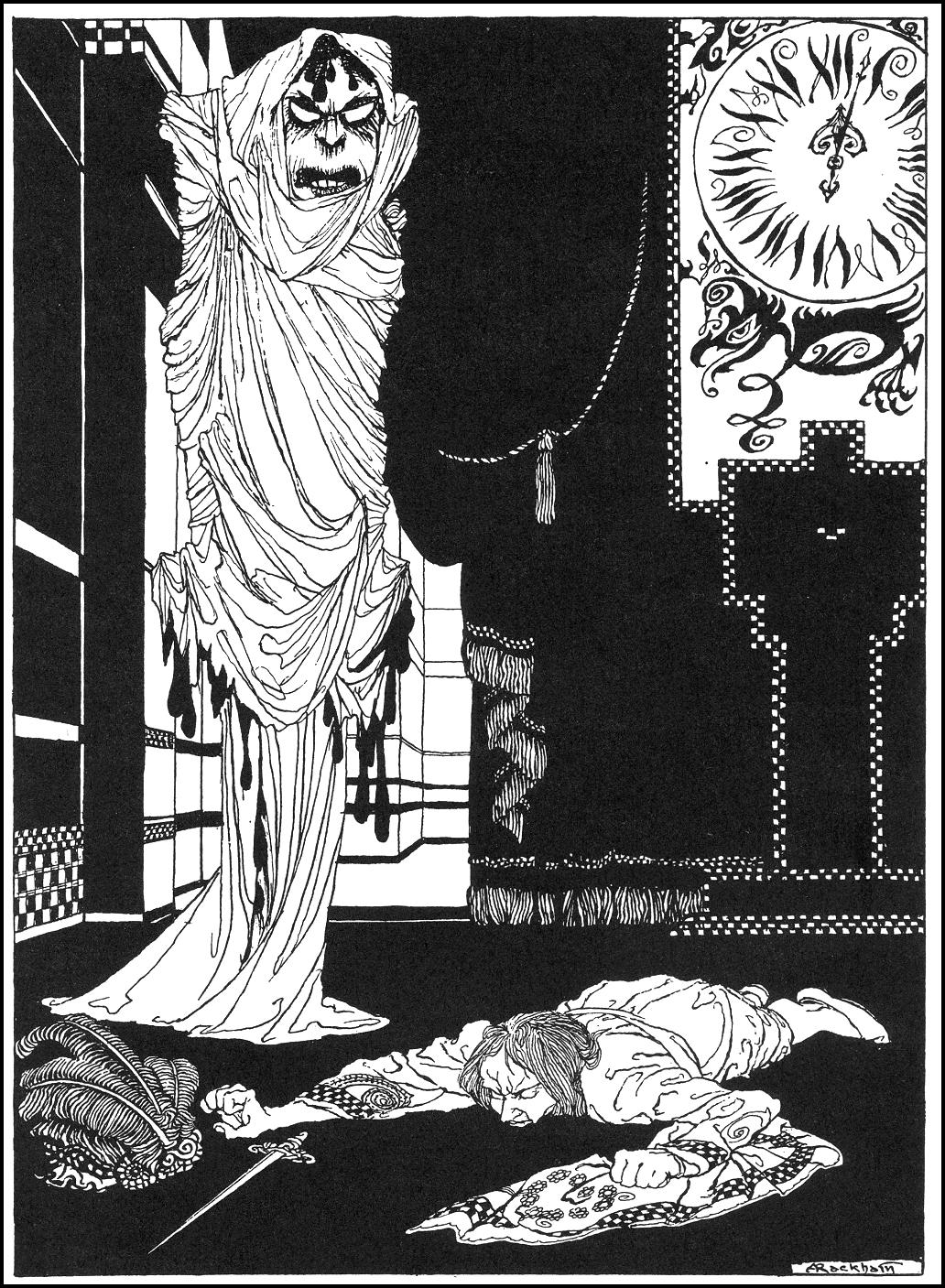
poe_masquereddeath Rackham

Rackham illustration for Poe’s “Masque”

Margaret Atwood, Oryx and Crake (2003), The Year of the Flood (2009), MaddAddam (2013). Three visions of the same, shared story, wherein a corporate scientist launches a plague to wipe out a dystopian humanity.

Thomas Mullen, The Last Town on Earth (2006).  Historical fiction describing a Washington town in the 1918 influenza pandemic. (thanks to Eric Behrens)

Colson Whitehead, Zone One (2011).  A plague of zombies.  (thanks to Chris Lott)

Peter Heller, The Dog Stars (2012).  Survival after a massive pandemic. (thanks to Chris Lott)

Emily St. John Mandel, Station Eleven (2014). Follows two timelines: the outbreak of a horrific flu and what’s left of civilization, years later.  The latter plot focuses on a traveling Shakespeare troupe.

Ling Ma, Severance (2018).  Story of a major pandemic. (thanks to Chris Lott)

Karen Thompson Walker, The Dreamers (2019). A sleeping plague strikes a California town. (thanks to Chris Lott)

Short stories

Edgar Allan Poe, “The Masque of the Red Death” (1842). Classic vision of decadence and power versus a plague.  Back in college I used to host Red Death parties. (Poe Museum text; multiple Librivox recordings)

Thomas Mann, “Der Tod in Venedig“; English language, “Death in Venice” (1912). An older man’s attraction to a youth is paralleled with a disease outbreak.

Alice Sheldon/James Tiptree Jr., “The Last Flight of Dr. Ain” (1969). A biologist crafts a plague against humanity.  (Lightspeed copy)

Cory Doctorow, “The Masque of the Red Death” (2020).  A riff on Poe.

Plays

Aleksandr Pushkin, «Пир во время чумы» (1830); English language title, “A Feast in Time of Plague.”   (Russian text; Archive.org English translation) (thanks to Phil Katz)

Tony Kushner, Angels in America: A Gay Fantasia on National Themes (1991, 1992). Multiple intertwined plotlines explore the AIDS epidemic, connecting politics, religion, urban life, gender, and more.

Anthony Clarvoe, The Living (1993).  Describes the 17th-century London plague.  (thanks to Phil Katz)

Nonfiction

Charles Rosenberg, The Cholera Years: The United States in 1832, 1849 and 1866 (University of Chicago Press, 1962).  (thanks to Phil Katz)

John M. Barry, The Great Influenza: The Epic Story of the Deadliest Plague in History (2004).

Think in the Morning has been blogging novels from 1918.

Other

Samuel Pepys‘ diary (1660-1669). During this decade Pepys recorded his daily life, including encounters with a plague.  One list of plague-related entries. (Project Gutenberg texts; Librivox readings)

César Cui, Пир во время чумы (1900); English language, A Feast in the Time of Plague.  An operatic setting of Pushkin’s play.  (thanks to Phil Katz)

Virginia Woolf, “On Being Ill” (1926). Essay.  (Project Gutenberg text) (thanks to Liz Ahl)

Jill Lepore reflects on some of the books in this post.  Here’s a list of books I mostly haven’t read.  “How Pandemics Seep Into Literature.”

What to do with this

I’d love to learn about other readings, since this isn’t an exhaustive list.  Please add in comments; I can edit this post.

Would anyone like to read into this list together, online? Some folks expressed interest via email and Twitter, like Monica Bilson, Tony D’Angelo, Paul Bond, Norm Friesen, and Chris Lott.  We could have a pandemic book club!

(thanks to Thomas Burkdall, Lucy Guerlac, Liz Ahl, and Vanessa Vaile)
Posted in book club, coronavirus, teaching | 25 Comments

The moment for a partisan pandemic

Someone soon may call this The Blue Plague.

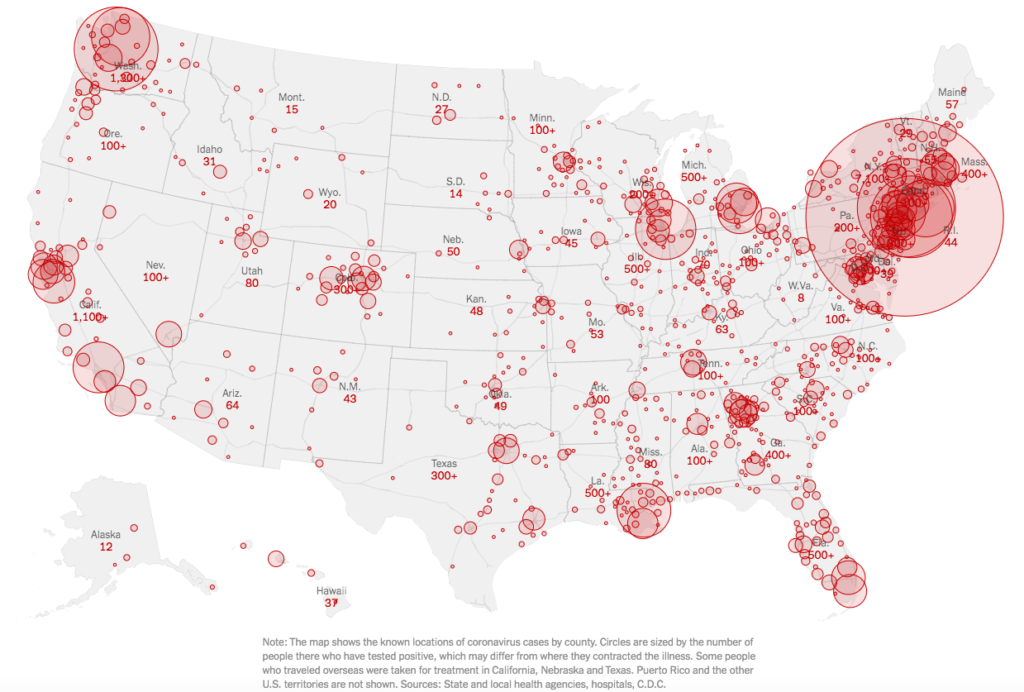
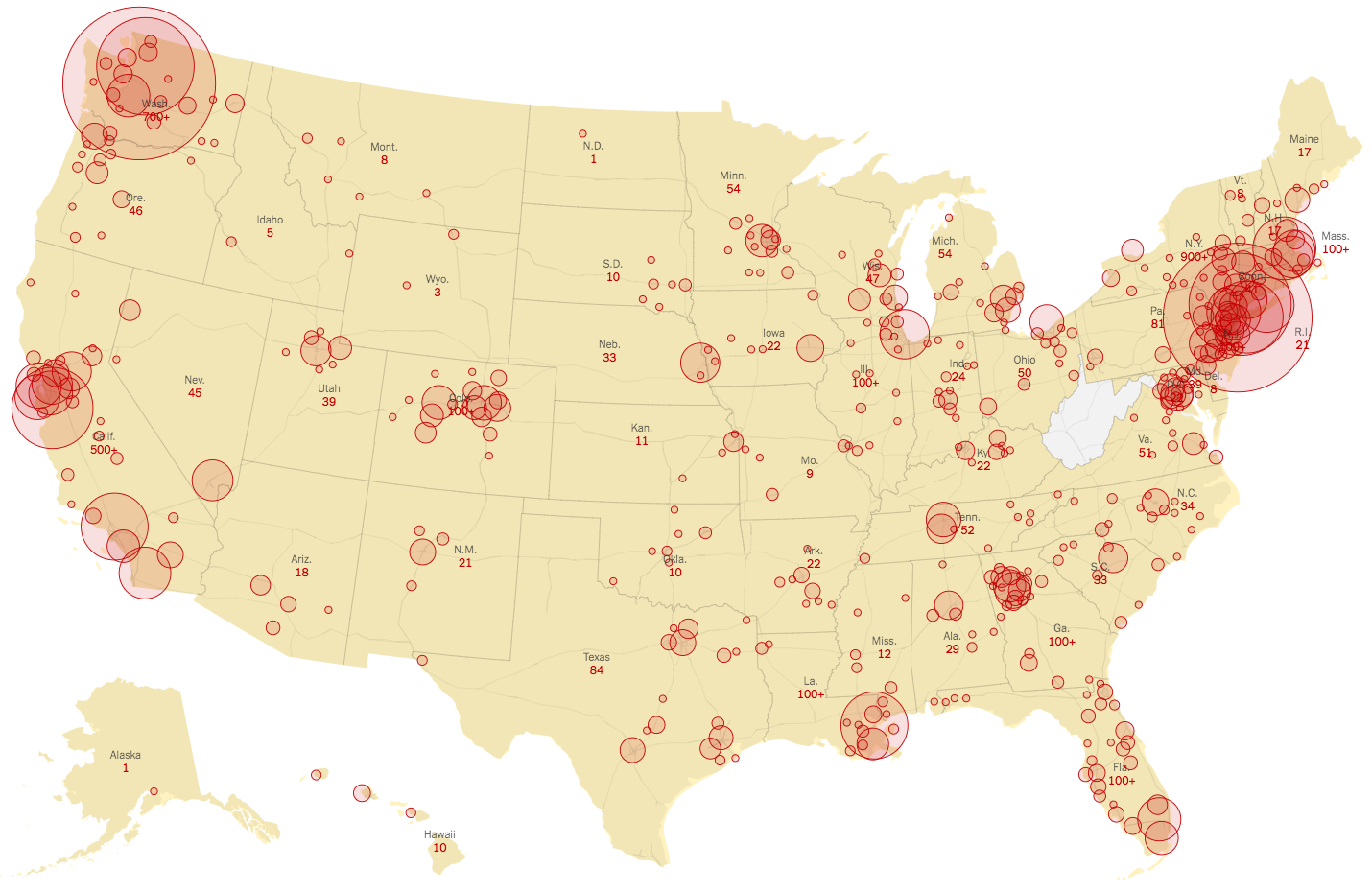
Why?  The largest urban clusters of coronavirus infections and deaths are, as of this writing, New York City, Seattle, and the Bay Area.  Coming up in a second tier are Detroit and Chicago.

We can see this clearly in current data.  Here’s the New York Times’ map:
coronavirus US spread 2020 March 20 NYTimes

Yes, there are nodes in Appalachia, the south, and the west, but the biggest ones are clearly deep in blue territory.  NYC and San Francisco are bedrock Democratic towns.

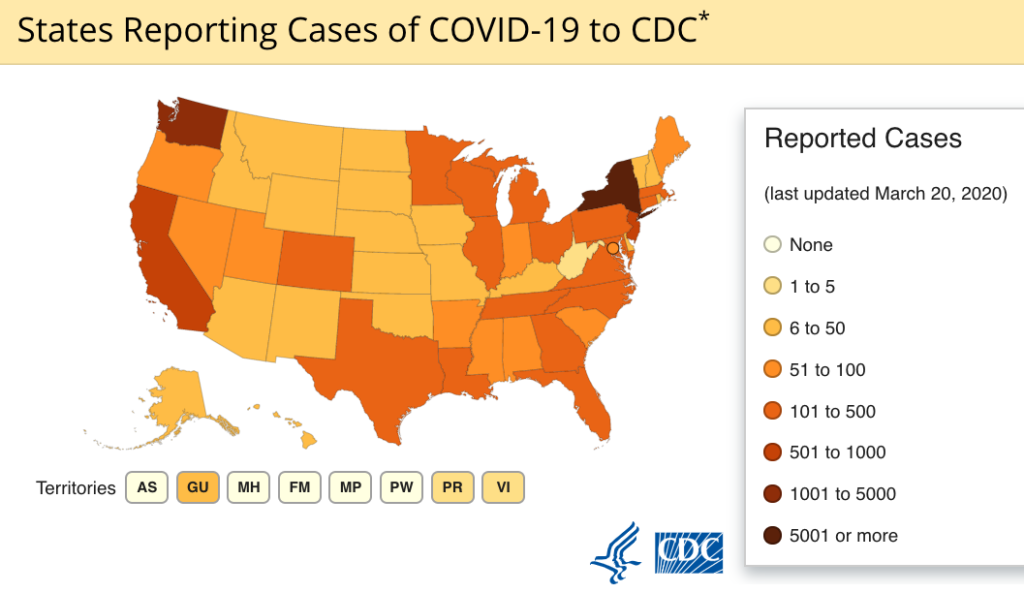
We can also see this blueness reflected in state level data.  Here’s the latest CDC release:

coronavirus US spread 2020 March 20 CDC

Again, New York and Washington in the lead, followed closely by New Jersey and California.

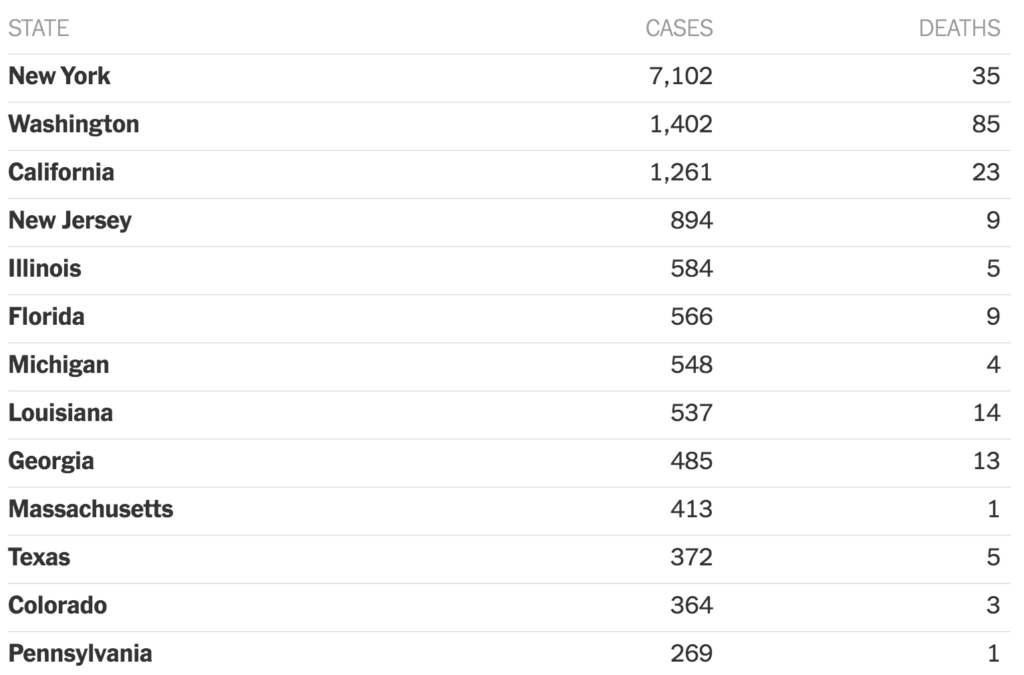
The New York Times offers a related list:

coronavirus infections deaths by state 2020 March 21 NYTimes

Blue states clearly dominate here, led by the urban areas noted above, plus New Jersey swept in due to its long-standing and deep connections with New York.  As Ronald Brownstein remarks in the Atlantic,

each of the four states with the largest number of coronavirus cases is a Democratic-leaning place along the coast: New York, Washington, California, and New Jersey. Florida, a coastal, internationally oriented state that leans slightly toward the GOP, ranks fifth. Illinois, Louisiana, Massachusetts, and Texas, each with at least one big urban center that functions as a gateway for tourism and trade, come in next.

Versus:

with only a few exceptions, the states with the fewest number of confirmed cases are smaller, Republican-leaning ones between the coasts, with fewer ties to diverse populations and the global economy. That list includes Wyoming, Idaho, Missouri, Montana, South Dakota, Oklahoma, and Kansas.

To be clear, the epidemiological reasons for this divide are important (think of these as global cities).  I am certainly not at all arguing that these cities somehow caused their infections or deaths, or that they deserved them.  Instead, I’m wondering if some Americans will make those arguments.  Here I’m interested in the political and cultural ways we might interpret and make use of the coronavirus plague’s appearance so far.  Recent political polarization should play a role, especially when heightened by a general election season.  And the deep psychological and social dynamics of pandemics historically play out socially and politically.

There are already signs of this.  Raw Story offers a survey of conservative snark on Twitter.  Folks there complain about: left wing Democrats using COVID-19 to push for Medicare-for all; media bias; blue policies driving disease.  It’s a useful and disturbing index.  Elsewhere we can find conservatives proclaiming American strength in dealing with the pandemic or slamming progressive gender concerns as inappropriate for the crisis,

One way the blue-red COVID-19 political-cultural divide may be playing out is in terms of different state policies.  For example,

blue cities and states [are] moving more aggressively – and more quickly – than more conservative communities. New York Democratic Gov. Andrew Cuomo, for example, has taken a number of steps, including banning gatherings of 50 or more people and most recently, on Wednesday ordering businesses to cut on-site workforces by half (people could work from home). San Francisco is under a “shelter in place” order, while Washington’s governor, Jay Inslee, a Democrat, ordered a statewide shutdown of bars and restaurants.

Whereas:

Oklahoma Gov. Kevin Stitt, a Republican, was castigated on social media for tweeting a photo of himself going out to dinner with his family – and for saying he would continue to do so despite the outbreak.

Herbert White PlagueI’d add Alaska’s Republican Representative’s recent recommendation to senior citizens that they not worry about the virus (!).

That policy difference is in turn based on differing ideological approaches to government’s role.  Ronald Brownstein observes that “[w]ith a few prominent exceptions, especially Ohio, states with Republican governors have been slower, or less likely, than those run by Democrats to impose restrictions on their residents.”  He goes on to note:

Of the states that have taken the fewest actions to restrict public gatherings or limit restaurant service on a statewide basis—such as Texas, Missouri, and Alabama—almost all have Republican governors, according to research by Topher Spiro, the vice president for health policy at the liberal Center for American Progress, where he directs a program that examines state health initiatives.

In addition to a difference in state policies we may also see coronavirus attitudes divide most clearly in terms of a rural-urban split.  Generally, of course, Democrats tend to succeed in cities while the GOP’s base is in the countryside.  As the pandemic is so far focused on urban areas, we can expect political arguments to follow. For instance,

[Christopher Mooney, professor of state politics at the University of Illinois at Chicago]: “We’re really seeing this in Illinois – downstate, they are thinking of this as a Chicago problem,” Mooney says. People in conservative areas of the state think, “This is an urban problem. This is a foreign problem,” he adds.

Note that association of city with foreignness.

Ed Kilgore agrees:

there’s a chance it will simply reinforce small-town and rural hostility to the culturally alien influence of big-city folk aligned with foreigners, given the more cosmopolitan (demographically and economically as well) nature of Urban America…

There’s a demographic and policy angle to the country-city split which matters a great deal:

[Eva Kassens-Noor, a professor in the global-urban-studies program at Michigan State University] believes that U.S. communities will experience the coronavirus in contrasting, but complex, ways: While the disease will probably spread more rapidly in urban areas, she says, more of the population there is young and healthy. And while outbreaks may not be as pervasive in rural America, they could still prove very damaging because the population is older and has less access to quality health care.

Another driver for casting COVID-19 as the Blue Plague may come from Trump-era class politics. Brownstein again:

[Geoffrey Kabaservice, the director of political studies at the libertarian Niskanen Center and the author of Rule and Ruin, a history of the modern Republican Party:] “The feeling increasingly is that experts and the media are all part of this elite class that is self-dealing and is looking down on less-educated and less-fortunate people, and [that] they can’t be trusted to tell the truth.” He adds, “That dynamic … has been reinforced” by the emergence of the “conservative media ecosystem,” which unstintingly presents “elites” as a threat to viewers.

Note the part about the media.  Long-standing Republican dislike of (some) media plays a role here, as shown in a recent Pew poll:

Republicans give the news media lower ratings than Democrats for COIVD-19 coverage but rate their own news sources higher

That media attitude goes further, connecting with a party divide about the seriousness of the threat:

Majority of Americans think the news media have exaggerated COVID-19 risks at least slightly; Republicans more likely to say so than Democrats

So much of this is the present and very recent history.  How might it unfold in the near future?

Brownstein offers two possibilities based on a scenario wherein “the virus never becomes pervasive beyond big cities.”  First, that outcome “could reinforce the sense among many Republican voters and office-holders that the threat has been overstated.”  Second, racism and nationalism could ramp up, as

it could also fuel the kind of xenophobia that Trump and other GOP leaders, such as Senator Tom Cotton of Arkansas, have encouraged by labeling the disease the “Chinese virus” or the “Wuhan virus.”

Kilgore adds another twist: “it’s also possible heartland insularity will feed on itself and embitter endangered people even more toward the godless, elitist mongrels of the East and West Coasts and the pathogens they breed.”

What if another scenario occurs, and the pandemic breaks into red as well as blue precincts? Kilgore sees a resulting drop in GOP fortunes: “It’s possible confidence in Trump and his administration will flag in Red America as the pandemic ceases to be mostly a blue-state, big-city phenomenon.”

Let me offer a third option, a different possibility in addition to the Masque of the Blue Death.  The red-blue divide is not, nor has it ever been, a total description of American culture or even politics.  It has always downplayed bipartisan agreement and policy areas that don’t play out in neatly nonpartisan ways, from privacy to intellectual property to a lot of foreign affairs.   It papers over the enormous complexity and diversity found in a nation of 325+ million people stuck with only two political parties.

And in this case we’ve already seen similar variations.  Ohio’s governor is a Republican, and that’s a newly minted red state, but DeWine took the lead in driving that state’s stay at home and institutional closure policies.  Moreover, there are many ways for politicians dyed the deepest blue to work with a hated president. “Democratic governors have been in the unusual position of urging cooperation with a president they’ve spent their tenures battling and even suing.”

At another level we can recognize that for all of the cries that the GOP hates science, red states are as much consumers of health care as their blue competitors.  At the same time we’d do well to remember progressive medical quackery (cf Goop) and the fact that antivaxxers are non- or bipartisan.  For conservatives, being against evolution, say, does not mean one avoids antibiotics or ventilators.  Hating pointy-headed intellectuals doesn’t keep conservatives away from pharmacies and hospitals.    Call it cognitive dissonance or mental compartmentalization, red state folks get sick and turn to allied health for help.  As a result they can view the coronavirus pandemic as, well, a dangerous virus, and call for a range of expanded services.

Such a call could well emphasize the private sector and nonprofits (think of religious groups) over state support, but that ideological divide could also fall away thanks to another aspect of Republican and conservative thought.  Note that Trump referred to the national drive against COVID-19 as a war.  That’s a carefully chosen term.  The post-Vietnam War GOP prides itself on its support of the military, and a good number of its members seem likely to support having the federal government organize society along warlike lines, especially if such an effort was led by one of their own.

This can lead to positions that cut against the normal red versus blue narrative.  A casual trawl of Trump’s recent Twitter emissions shows him celebrating a landlord telling tenants not to pay rent, a blow against sacred contracts.  He praised a Republican senator’s support for telemedicine – not exactly the actions of anti-science zealots.  And he just claimed to be using the hated federal government to… give money to small business and workers?

I’m not saying Trump has suddenly had a radical change of heart and embraced the tenets of modern progressive thought.  He’s also pushing drugs that medical authorities seem to say won’t work.  I’m also not saying both Dems and GOPs are equal; my own politics are to the left of the Dem mainstream.  I’m not calling for bothsidesism. Instead I’m arguing that red versus blue is a clumsy analytical tool, and using it will cause us to miss a good chunk of reality.  That’s a bad move in a pandemic.

To sum up: we could see America acculturate the COVID-19 pandemic in culture war terms, with political implications.  On the other hand, this Blue Plague moment might be a brief one, depending on the virus’ progress and how Republicans respond.

If the former occurs, what does a COVID-ized culture war look like?  Much depends on how far the pandemic goes. If the course is brief and we all heave a sigh of relief in late April, virus arguments could just become part of the general political discourse.

The longer the pandemic lasts, though, the deeper the pressure on and damage to American life, and the greater the odds of civil unrest.  Unemployed people living in desperation and fear for their lives are fine candidates for insurgencies and violence.  Social breakdown can make room for countervailing structures, which might not be so benign.  We could see official or DIY barriers of all kinds put up between red and blue area, within or between states.  Imagine people launching online attacks, mail threats, or in-person assaults on those they deem unclean or enabling the plague.

For education, I will have much more to say in following posts.  For now we can think of political pressure to cut support to academia in many forms: state funding for public universities, federal research programs, political laws aimed at curtailing or supporting certain campus behaviors, and so on.  If this plays out in terms of the culture war, we should expect increased Republican and rural resentment of colleges and universities.

Posted in coronavirus | 3 Comments

Anticipating a pandemic

Here’s one thing about being a futurist.  Sometimes the world confirms one of your scenarios or models, but it’s not something to celebrate.  That’s because what you foresaw isn’t good news for anyone when it actually enters the real world.

buy tadalista online buy tadalista no prescription generic

Academia Next coverCase in point: my newest book, Academia Next, came out from Johns Hopkins University Press in early January 2020.  I wrote it in 2018-2019.

If you read chapter 14, the most forward-looking section, you’ll see pages of me anticipating a wide range of global changes that could hit higher education.  Some of them appear fairly likely.  Others, less so.  On page 212 I offered some options:

…black swan possibilities also lurk. Historical examples abound, such as a leader’s sudden death by accident or assassination that unravels a political order. A new religious sect or the vigorous reformation of an existing faith can win adherents and upend societies. Beyond political and social causes, a pandemic that exceeds our medical containment capacity could not only constitute a humanitarian disaster but also sap regimes, shock economies, and electrify cultures. (emphases added)

I don’t think a reader mentioned this to me until February, once the coronavirus terrorized Hubei and began reaching out to the world.

Yet that passage is not the most telling bit.  Much earlier in the book is a longer meditation on disease and higher ed.

buy stendra online buy stendra no prescription generic

  It appears as an example of futures thinking within chapter 1.  I invited readers to use their imaginations in order to see how academia could change under certain conditions.  As an example, I offered this on page 23:

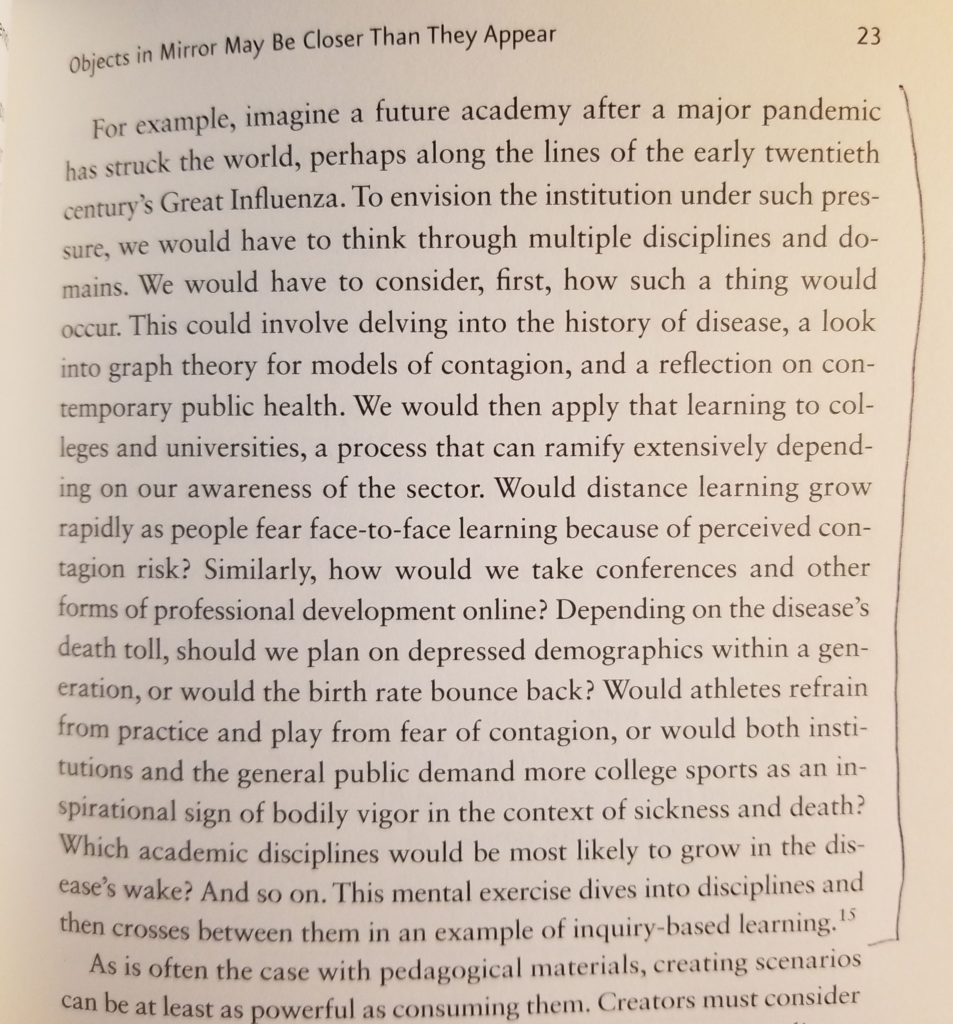
…imagine a future academy after a major pandemic has struck the world, perhaps along the lines of the early twentieth century’s Great Influenza. To envision the institution under such pressure, we would have to think through multiple disciplines and domains. We would have to consider, first, how such a thing would occur. This could involve delving into the history of disease, a look into graph theory for models of contagion, and a reflection on contemporary public health. We would then apply that learning to colleges and universities, a process that can ramify extensively depending on our awareness of the sector. Would distance learning grow rapidly as people fear face-to-face learning because of perceived contagion risk? Similarly, how would we take conferences and other forms of professional development online? Depending on the disease’s death toll, should we plan on depressed demographics within a generation, or would the birth rate bounce back? Would athletes refrain from practice and play from fear of contagion, or would both institutions and the general public demand more college sports as an inspirational sign of bodily vigor in the context of sickness and death? Which academic disciplines would be most likely to grow in the disease’s wake?

Note that I used the word “pandemic” in both instances.

evil eye Quinn DombrowskiSince COVID-19 seized our lives more than a few readers have asked me about these passages.  They have all been kind and refrained from making warding off the evil eye gestures in my direction.
buy prednisone online buy prednisone no prescription generic

My students last summer were similarly kind when I posed a pandemic to them as a design challenge for the future of the university.

But please don’t think I’m bragging.

buy ventolin online buy ventolin no prescription generic

  I don’t mean to claim some oracular title for myself.  As demonstrated last week, working through disease outbreak futures is an established, long-running scenario practice, both by professional futurists and those who don’t use the name.

Here’s the thing.  Futurists generally want things to get better in their chosen domain.  I want academia to thrive.  But we have to look ahead across a full range of possibilities, from utopia to dystopia, as I like to say.  We can’t avert our gaze from negative or even horrible futures in the hope of salvation.  We have to consider the future as a whole, as objectively as possible, with an open mind.

I just hate getting this one right.

PS: Johns Hopkins University Press, this book’s publisher, made my book and many others available for free online, as a response to the pandemic.  I’ve linked to the appropriate chapters up above.  Kudos to them for doing this!

(thanks to Remi Kalir, who requested it; evil eye by Quinn Dombrowski)

Posted in coronavirus, futures, writing | 8 Comments

Coronavirus and the world: today and four forecasts

It’s March 18th, COVID-19 keeps spreading, and the world’s reactions are deepening.  Global infected numbers passed 180,000 and deaths near 9,000, reportedly (and there are doubts about numbers).  There are more infections and deaths outside of China than in, according to WHO, who maintains a global risk assessment of “very high.”   The coronavirus is racing through Europe, throwing Italy into a nationwide quarantine and medical horrors.  Spain is next up.  France and Germany have tightened their borders.  In fact, most of Europe is raising border shields.  The British government is reconsidering its herd immunity plan after a high profile report thought it could lead to up to hundreds of thousands dying.  Some leading US politicians are referring to COVID-19 as a “China virus” while some Chinese representatives blame it on the US or Italy.  Canadians (of course) are calling for caremongering.  The disease is heightening economic inequality. Sex workers are losing business.

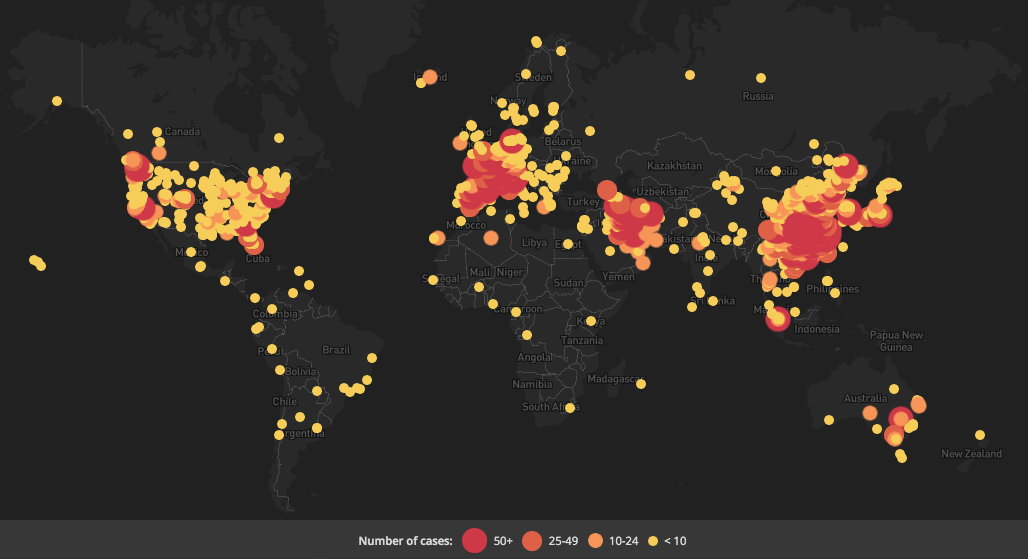
coronavirus world map 2020 March 17 HealthmapIn the US, there are 3,487 infections and 68 deaths, according to the CDC. The stock market is in chaos after the worst fall since the Cold War; some finance people have gone beyond fearing recession to muttering about the d-word. Trump now seems to take things seriously, calling on Americans to avoid gatherings of more than 10 people, and even agitating for a yuge stimulus bill, but most people don’t believe him.  More than a dozen Congresscritters have quarantined themselves as is the outgoing White House chief of staff.  New York State’s governor called for federal troops to expand that state’s medical capacity. San Francisco imposed a shelter in place edict and New York City is thinking about it.  Medical workers are starting to get infected. Sports are shutting down and celebrities are getting sick, which means This Is Now Real for a lot of folks.  Alamo Drafthouse movie theaters closed up.  One vaccine is being trialed in Washington state, appropriately.

coronavirus US map 2020 March 17 NYTimesThat’s a snapshot of the present. Now let’s look at some current futures work that anticipates COVID-19’s near future.

In this post I’ll share a series of forecasts.  This may give you insights on how to plan for what’s next, as well as give a sense of how futures work can be done during a major crisis.

(The numerical order below is arbitrary)

Adalja AmeshFORECAST 1 Amesh Adalja (Johns Hopkins University Center for Health Security) offers a less frightening vision than most in an interview with Sam Harris.  Adalja thinks the case fatality rate (CFR) is actually much lower than others have found.  His 0.06 rate is six times more lethal than seasonal flu, but far less homicidal than other rates I’ve seen.

Adalja emphasizes several factors in creating that rate.  Data collection so far has often been skewed by comorbidities and what he calls a “severity bias.”  Adalja relies on South Korean data, which he deems the most robust.  He fears state overreaction causes some medical problems, including capacity shortages and extraneous deaths (pointing to China and Italy). Additionally, COVID-19 is not that strong a virus materially, having a delicate fatty layer that, dried out, kills the thing.

As a result of this low CFR, the coronavirus should play out like a bad flu season over the next few months: a good number of infections, a small number of deaths suffered by susceptible people.

I recommend listening to the whole podcast.  Harris asks good questions and Adalja answers with admirable concision.

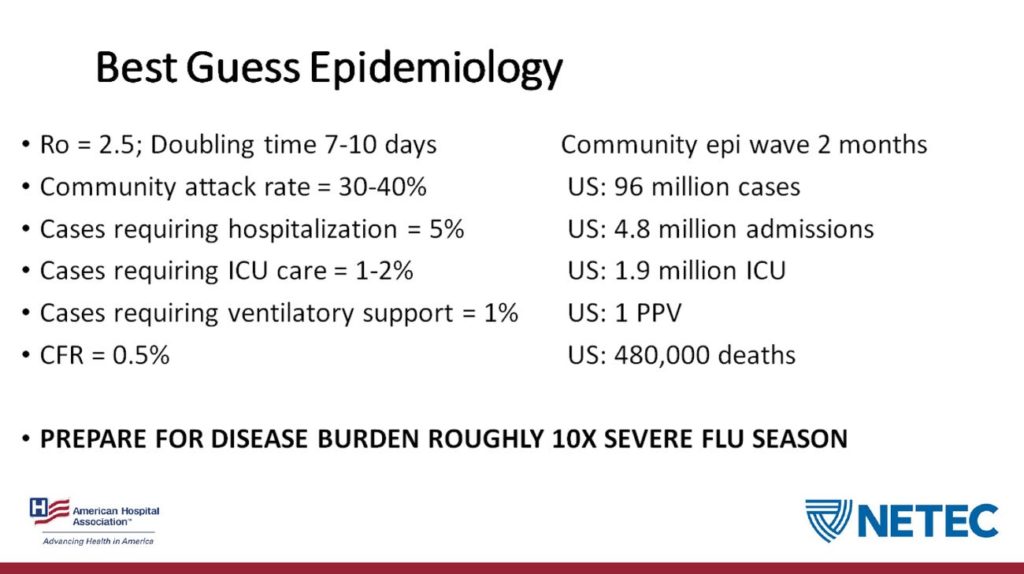
FORECAST 2 On March 6th Business Insider shared a “leaked” slide from an American Hospital Association webinar.  The presenter was Dr. James Lawler, associate professor of medicine at the University of Nebraska’s Global Center for Health Security.

The slide forecasts the course of a coronavirus outbreak in the US over two months:

coronavirus extrapolation AHA

First, some caveats from the BI article:

The slide does not give a particular time frame.

The slide represents “his interpretation of the data available. It’s possible that forecast will change as more information becomes available,” a spokesman for Nebraska Medicine told Business Insider in an email.

The American Hospital Association said the webinar reflects the views of the experts who spoke on it, not its own.

I’d add that we don’t know the rhetorical situation.  Was this a worst case scenario?  Was he trying to soothe or freak out the audience?

Second, a few clarifying attempts.  R0 is reproductive rate, how many people a given infected person will infect.  Community attack rate: I think that’s the proportion of a population who get infected.  ICU: intensive care unit.  CFR: case fatality rate, or what proportion of people the virus kills.  PPV: I don’t know.

Third, some discussion.  Dr. Eric Feigl-Ding has a good Twitter thread raising issues about key points.  The CFR is on the low side, as is the ICU number (Italy’s seeing 10%).  It presumes no public health measures.  Degradations to health services through staff getting sick, supplies running low, or competition for scarce beds (see below) don’t play a role.

All of that said: this single slide gives us one way to think ahead about COVID-19.  It introduces non-experts to key terms.  It uses statistics.  The result is a kind of thin scenario, a glimpse of how things might unfold.  Rhetorically, it can spur us to action: to learn, to take public health seriously, etc.

FORECAST 3 Dr. Liz Sprecht fired off a Twitter thread exploring how the outbreak/ pandemic might stress medical services.  Then she developed the thread into an article.  She’s associate director of science and technology at the nonprofit Good Food Institute.

What drives this instance of futures thinking is the extrapolative method:

We can expect a doubling of cases every six days, according to several epidemiological studies. Confirmed cases may appear to rise faster (or slower) in the short term as diagnostic capabilities are ramped up (or not), but this is how fast we can expect actual new cases to rise in the absence of substantial mitigation measures.

That means we are looking at about 1 million U.S. cases by the end of April; 2 million by May 7; 4 million by May 13; and so on.

Sprecht focuses her exercise on two crucial medical metrics: available beds and masks.  Read through to see just how bad she thinks it’ll get.

I want to give the author additional credit for showing ways her extrapolation could vary, based on different numbers:

If I’m wrong by a factor of two regarding the fraction of severe cases, that only changes the timeline of bed saturation by six days (one doubling time) in either direction. If 20% of cases require hospitalization, we run out of beds by about May 4. If only 5% of cases require it, we can make it until about May 16, and a 2.5% rate gets us to May 22.

Why do these two metrics matter?  It’s clearly horrible that hard-working medical staff may suffer, and some will die.  On top of that, let Eric Feigl-Ding explain:

FORECAST 4: Another forecast Twitter thread comes from infectious disease scientist Stephen Riley, who wants us to think ahead at a social scale.  First, he urges us to recognize COVID-19 will be with us for a long time:

As a result, massive and sustained quarantines means changes to our societies:

No metrics here.  Just a forward glance at the likelihood of social transformation.

To sum up: four different views of COVID-19’s future, each using a different approach.

Coming up: more forecasts from other people, then some of my own.

(thanks to Steven Kaye and many others; stay uninfected, you all)

Posted in coronavirus, futures, scenarios | 6 Comments

COVID-19 and higher education: three video gatherings

COVID-19 single moleculeAs the coronavirus pandemic continues to infect the world (169,225 cases, 6,494 deaths now) higher education keeps responding.  More campuses are shutting down face to face classes and migrating instruction online (see our latest data).

Among many other developments, video is rising as a pedagogical and communications mechanism in both its synchronous and asynchronous forms.  I’ve been working on this for years, and will have much to say over the next few days.

But first I wanted to draw your attention to something I’m doing along these lines.  Since my family now lives in the Land of Blazing Broadband and we’re also trying not to leave the house, I’m spending more time hosting videoconferences.  That means the Future Trends Forum, meetings with my students, meetings with clients, conversations with reporters, and helping other folks with their live video events.  I will share more on this.

…starting with several news items.

First, this Thursday’s Future Trends Forum will be an open conversation about COVIID-19 and higher ed.   The session won’t be based on one guest as per usual.  Instead, we want to hear from you all.  What are you seeing and doing?  What are your anxieties and hopes for this crisis? Add your thoughts to the comment box below.

I’ve also invited a bunch of practitioners to say a few words about what they’re doing.  Join us from 2-3 pm EDT on Thursday the 19th.  Please spread the word about this community event.

Future Trends Forum banner

Second, on Tuesday ISTE/EdSurge and I have joined forces to offer a video event on How Colleges Should Respond to the Coronavirus.  Jeff Young and I will moderate and respond to your questions.  With us will be Beth Kalikoff, director of the Center for Teaching and Learning at the University of Washington, and Stephen Downes, international ed tech commentator and inventor, who runs the long-running OLDaily newsletter.

You can participate starting at 4 pm EDT/1 pm PT.

Third, this past Friday I helped host the largest live video event I’ve ever worked on.  Nearly 3,000 people preregistered for a conversation hosted with the Chronicle of Higher Education.  At any given time during the session we had from 400 to 800 people engaged in the conversation by my count, while hundreds more took in the program through streaming services, even when a presidential press conference intervened.  The Chronicle’s reporter Karin Fischer did a terrific job interviewing guests and participants.  USC’s Dr. Sarah Van Orman shared what she’s learned by applying her medical expertise to a major university facing the pandemic, then took many good questions.

Forum Chronicle_Greg Britton

Karin Fischer, myself, Greg Britton. Screenshot by Liz McMillen.

So many questions and ideas came up through Shindig!  What are the strategies campuses are using to transition from face-to-face to online learning?  What are the roles of accreditors and stage agencies? What happens with international students attending US campuses and American students abroad?  Should certain staff be eligible for hazard pay?  How can we support populations lacking technological infrastructure to participate in online education?   Should academic libraries curtail or cease face-to-face services?

Forum Chronicle Doug Reilly_Roxann

Doug Reilly and colleague; Karin Fischer; myself. Screengrab by Roxann Riskin.

What I’m trying to do with all of these live video events is to provide spaces for people in and around higher education to talk and think through what’s happening to us.

I want to use this video tech productively, inclusively, accessibly.  I hope this practice can help us improve our responses to the crisis, to address problems carefully, and drive towards a better academia.

More to come.

Posted in Future Trends Forum, videoconferencing | 4 Comments

The little spreadsheet that could, and did: crowdsourcing COVID-19, higher education, data, and stories

I’ve been tracking the global coronavirus since early February, with a focus on how it impacts higher education worldwide.  That tracking has meant blogging here, tweeting, and creating a resource post.

Then I made something new, and now I have a tiger by the tail.

tl;dr – there is now a giant and still growing spreadsheet of campus closures and migration online.  I am looking for one or two helpers.

OK, the story.

Several days ago I came up with the idea of tracking college and university responses to the outbreak.  Specifically, I was interested in how academia migrated education online.  I saw how one part of this migration often included suspending face-to-face classes, if not shutting down entire campuses.  I wanted more data and stories.

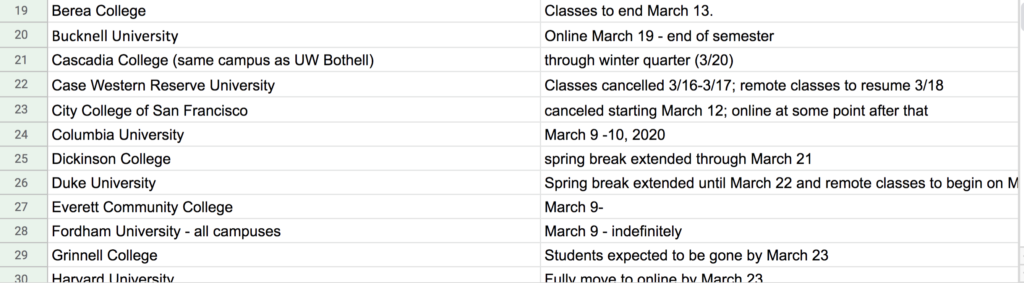
Not finding a good resource, I did the web/Generation X thing and made one.  Over on my personal Google Drive I set up a simple spreadsheet with a few columns: name of institution, their schedule for going online and/or closing, misc. notes, and also supporting documentation.

I could have kept this private.  Heck, it could have been an Excel file on one of my desktops.  But I’m an old Web 2.0 fan, a lover of what the open web can accomplish, and am also very very busy.  So I decided to open the Sheet and tell the world, hoping folks would contribute data, correction, and stories.

Did they ever.

Within hours the spreadsheet grew.  More campuses appeared.  Folks added extra columns for more data.  Still more colleges and universities appeared.

coronavirus Sheet _campus and schedule screenshot

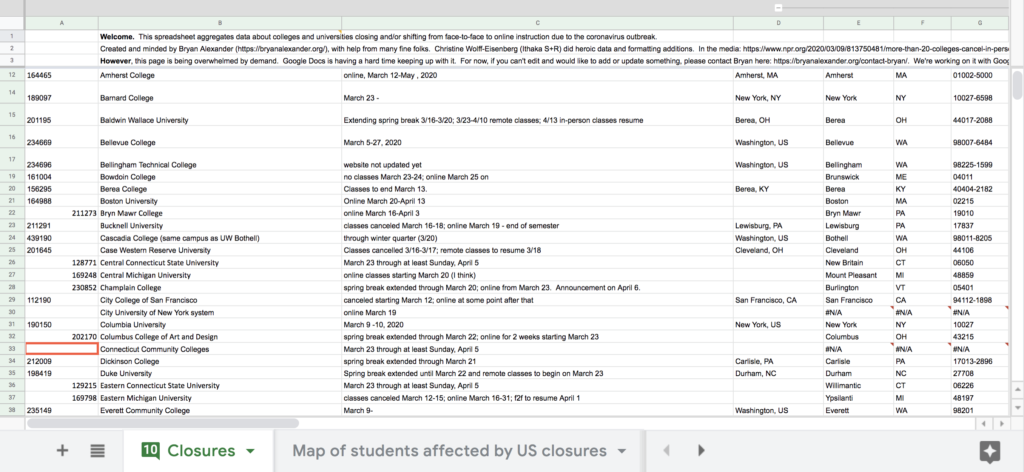
Then the geniuses at Ithaka S+R, led by the splendid Christine Wolff-Eisenberg, really went to town.  They hauled in IPEDS data and deployed a dozen extra columns.  Why?  Now we could automatically have fields populated with institutional type, geographical location (including lat and lon), student headcount, and more.  Student headcount meant we – any user, actually – could generate a live count of how many enrolled students were impacted (2,972,409 as of this writing).  4 columns became 13.  A dozen rows became a hundred, then more.  Tabs for worksheets popped up.

coronavirus campus closing crowded screenshot

This is about 40% of the sheet’s width now.

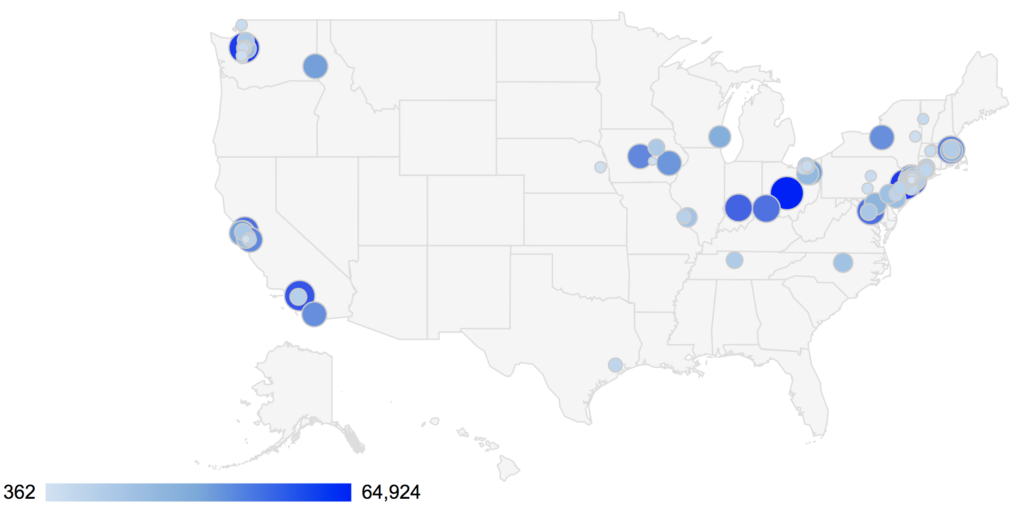
Christine and her crew then turned some of the growing data to generate a live map of US campuses responses:

coronavirus Sheet map screenshot 2020 March 11

Interest and use accelerated.  People started sending me more information by Twitter and email.  I emailed the Sheet link to certain folks who might have more to add.

Then media attention appeared.  National Public Radio interviewed me, and included a link to the Sheet. Al-Jazeera interviewed me.  Times Higher Education joined in and linked as well.  Inside Higher Ed wrote about us several times.

Which led to a torrent of contributions.  The spreadsheet grew further.  More news stories about colleges closing and going online appeared, along with rumors (which I wouldn’t add unless confirmed), official statements, elected officials making pronouncements, analyses, etc.

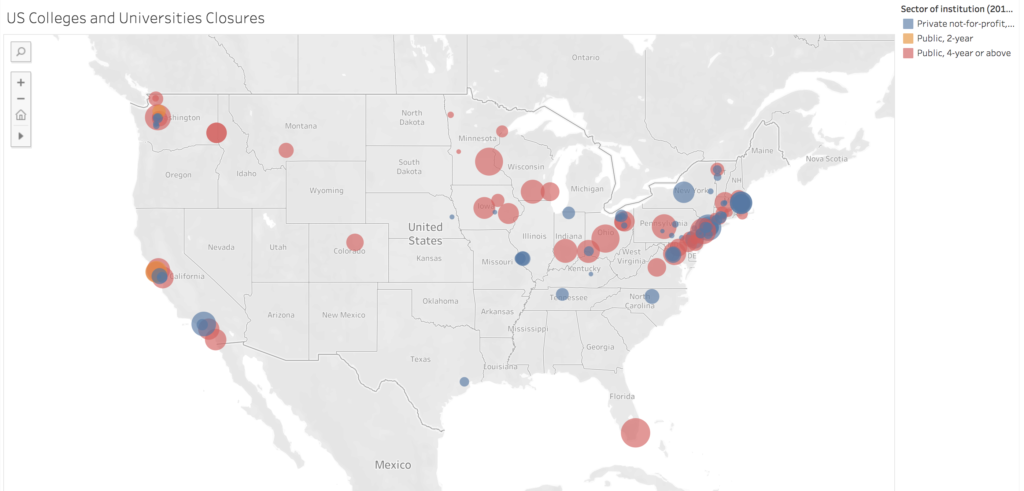
Tim Young got inspired and generated this map of US campus closings/migrations through Tableau:

coronavirus map of US campus closures 2020 March 11_Tim Young


And all of that growth and energy… ultimately broke Google Docs.

Yes, we hit the limit of what Google would provision.  I started getting weird issues with the Sheet, like the editing bar disappearing.  Others reported not being able to edit it or the page taking too long to load.  There is no formal Google Sheets support, so I hit up a Google Support page and researched.  Meanwhile, the hits – and errors – kept coming.

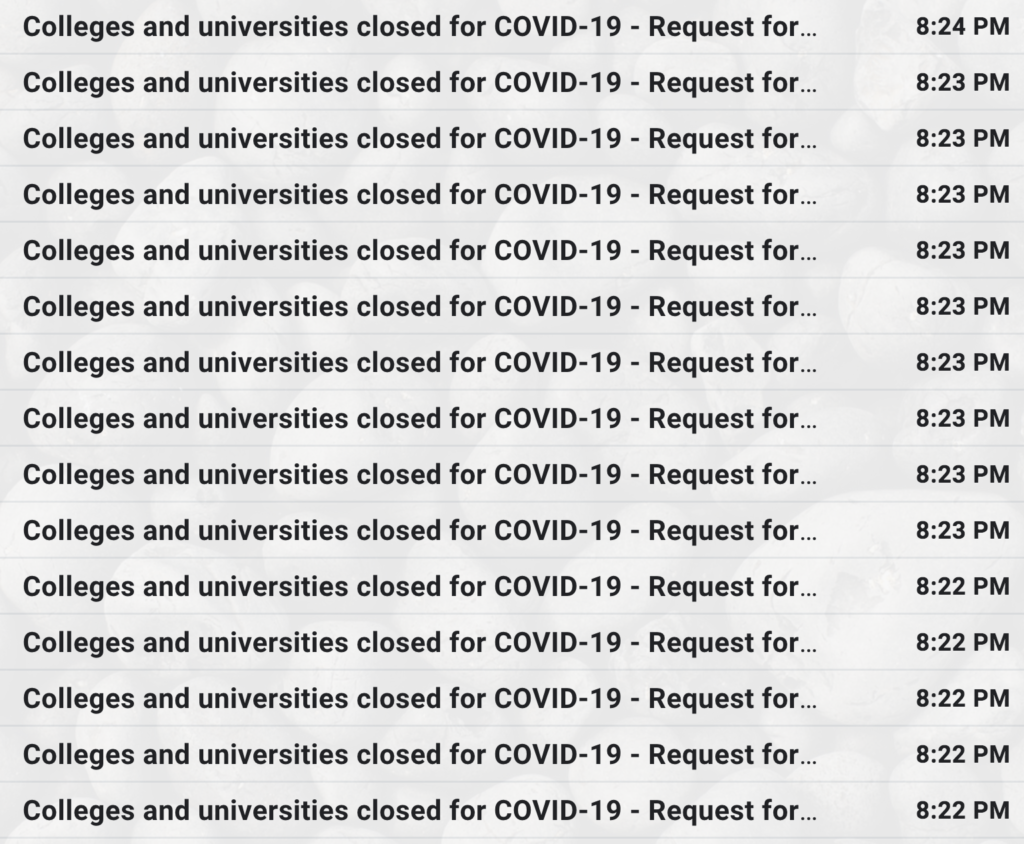
At one point I managed to switch the document’s setting to let users request editing access.  I thought that might work.  But in 10 minutes I received more than 300 requests.

Google Sheets email overrun

Now repeat this twenty times.

Whooops.  I threw the switch back – although it took me some time, as the page kept misloading.  Finally, eventually, I set it back to view-only, with a plea for folks to contact me with new data.

So today I’ve spent a lot of time manually adding data as people share it with me over email, Twitter, LinkedIn, Facebook, Gchat.

To be fair, we have gotten some criticism.  Stephen diFilipo raised a classic web 2.0 argument:

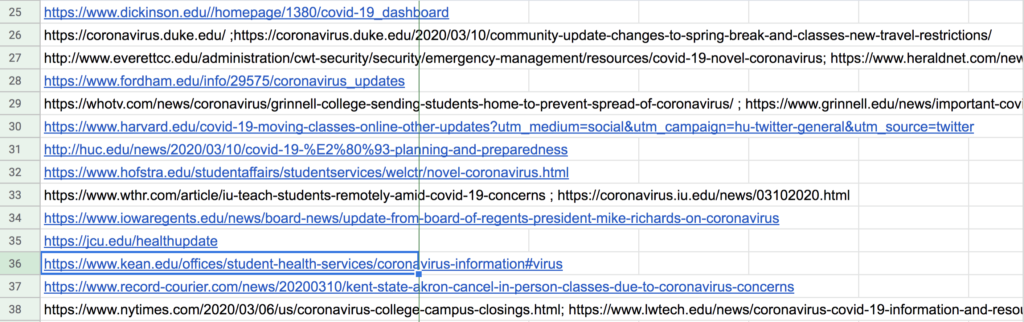
Good point.  However, for reliability the Sheet has one great strength.  Every campus line has a documentation field.  Folks have filled that with official announcements and journalism, mostly.

coronavirus Sheet sources sample

For comprehensive – we’re trying.  I’ve been bugging people around the world to add data from their nations and regions.

Where do things stand now?

As of this writing Tom Hanks has the coronavirus, Donald Trump mangled an address, the NBA canceled some games (!), and Angela Merkel is scaring the Hohenzollerns out of Germans. For my story, I’m talking with Google engineers to make the Sheet editable by the world again.  It might not be feasible, and I’ll have to figure out how to build a Form that feeds a Sheet (which sounds like a sailing term), so people can send me data with a bit of structure.

It’s possible that American higher ed will just shut down in person, and transition totally to online education.  In which case the document becomes a snapshot of a giant transformation.

The Sheet’s story is an interesting one for social media and online tech in 2020.  It’s largely a successful instance of crowdsourcing, in that the results are useful.  It hearkens back to the rise of Wikipedia etc. But it also ran smack into infrastructure limitations – here, how Google provisions its Docs.

Also, would any of you like to help me?  I’m at my wit’s end with handling the thing.  Normally I’m supposed to be doing my future of education research, teaching a class, prepping another, starting the next book.  Now thanks to COVID-19 I’m also trying to redesign my business for a largely online world, work on two projects for paying clients, help my students get their class wholly online, redo my summer class for ditto… and this spreadsheet is sucking down hours each day.  I’d be delighted if one or two of you could help me add data.  I have zero budget for this, but at least I can promise you my thanks, the gratitude of people in and around higher education, and a polite, social distancing refusal to shake your hand until this is all over.

PS: stay safe, everyone.

Posted in coronavirus, research topics, technology | 31 Comments

Coronavirus and the world: how futurists have been working on this kind of thing for years

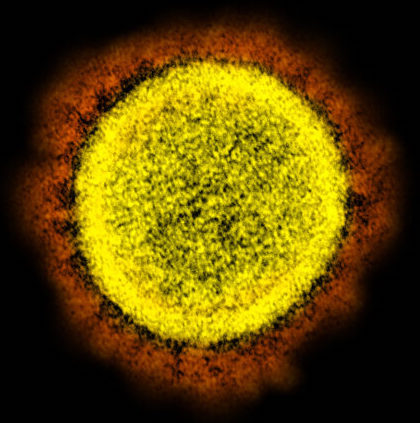
SARS-CoV-2I’m sometimes asked what futures work is good for.  Some folks complain that it doesn’t always provide solid predictions of what’s next.  Others think it’s just fantasies and a waste of time in pratical reality.

One standard response from the futures profession is that we futurists help people think about the future: more creatively, more openly, with better information, and more strategically.  You could say we improve planning or we expand vision.

Today’s case in point of the utility of futures work is the COVID-19 global outbreak.  Futurists have been forecasting and exploring such events for decades.  That work has informed disaster planning, and we can all turn to it for more information now.

In this post I’ll share some examples and reflections on what we can learn.  I wrote “some examples” because this is by no means an exhaustive list.  It’s a sampler, showing some of the range and capacity of the field.  Readers can hunt for more, or I can add some if I get time.

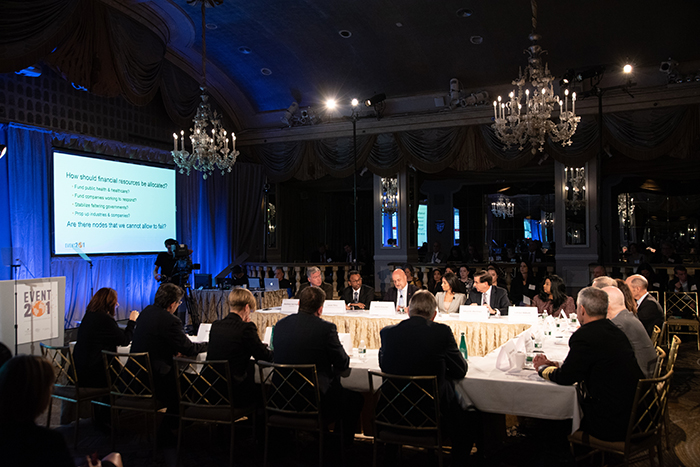
Tabletop simulation: A tabletop simulation combines role playing with physical and/or digital materials.  The 2019 Event 201 exercise involved a group of leading officials grappling with a disease outbreak starting in Brazil.  And when we say tabletop we mean it:

Event201-NickKleinPhotography-344-group with PPT

Participants played mostly by conversation and determining courses of action, which the game managers then represented and integrated into events.  The scenario had certain initial conditions and progress, such as:

When [the disease] starts to spread efficiently from person to person in the low-income, densely packed neighborhoods of some of the megacities in South America, the epidemic explodes. It is first exported by air travel to Portugal, the United States, and China and then to many other countries. Although at first some countries are able to control it, it continues to spread and be reintroduced, and eventually no country can maintain control.

There is no possibility of a vaccine being available in the first year. There is a fictional antiviral drug that can help the sick but not significantly limit spread of the disease.

Those are conditions and events players responded to.  Then things progressed further, both because of player decisions and forces beyond their control:

Since the whole human population is susceptible, during the initial months of the pandemic, the cumulative number of cases increases exponentially, doubling every week. And as the cases and deaths accumulate, the economic and societal consequences become increasingly severe.

The scenario ends at the 18-month point, with 65 million deaths. The pandemic is beginning to slow due to the decreasing number of susceptible people. The pandemic will continue at some rate until there is an effective vaccine or until 80-90 % of the global population has been exposed. From that point on, it is likely to be an endemic childhood disease.

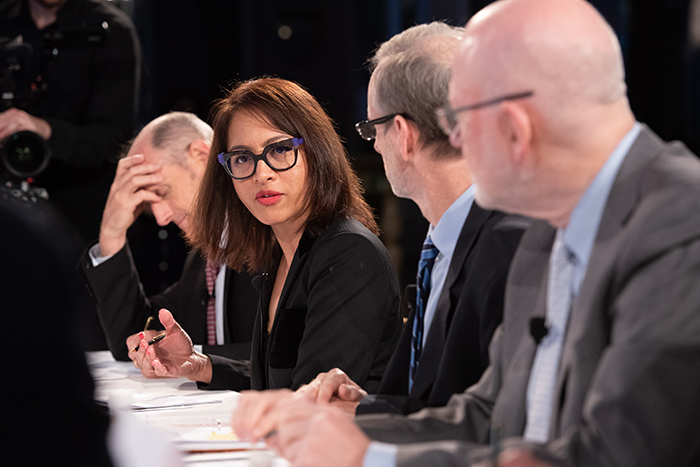
In response to the game, everyone involved generated a series of recommendations to the rest of us.

Event201-NickKleinPhotography-272-head in hand

Related: the 2018 CladeX tablestop sim.

Real world simulation: East Africa Community exercise 2019 EAC and WHO offered a simulation of a disease outbreak.  All kinds of people were involved, from farmers to government officials.

The exercise scenario depicted a cross-border Rift Valley Fever (RVF)-like virus outbreak (a fictitious virus described as East Rift Fever was created so as not to interfere with current public health efforts targeting real viruses circulating in the region). The outbreak scenario impacted humans and animals, lives and livelihoods, agriculture, trade and tourism, peace and security and the overall regional economy.

How did it work?  This wasn’t a computer simulation or tabletop exercise.  Instead, a central control room sent out updates to players in their actual geographical positions, updating them on the outbreak’s development, then gathering responses.  Players were in the real world, engaging as far as possible with other people.

What were the results? Why do this at all?

The simulation identified clear strengths, including functional multi-sectoral collaboration; the effective use of the One Health approach; rapid response to alerts and deployment by some rapid response teams; and functional use and activations of standard operating procedures and guidelines.

The exercise was not only intended to identify achievements and challenges in preparedness and response for a public health event affecting the East African Community, but also, by exposing participants to a realistic scenario, and to practise the roles they would carry out in a real emergency.

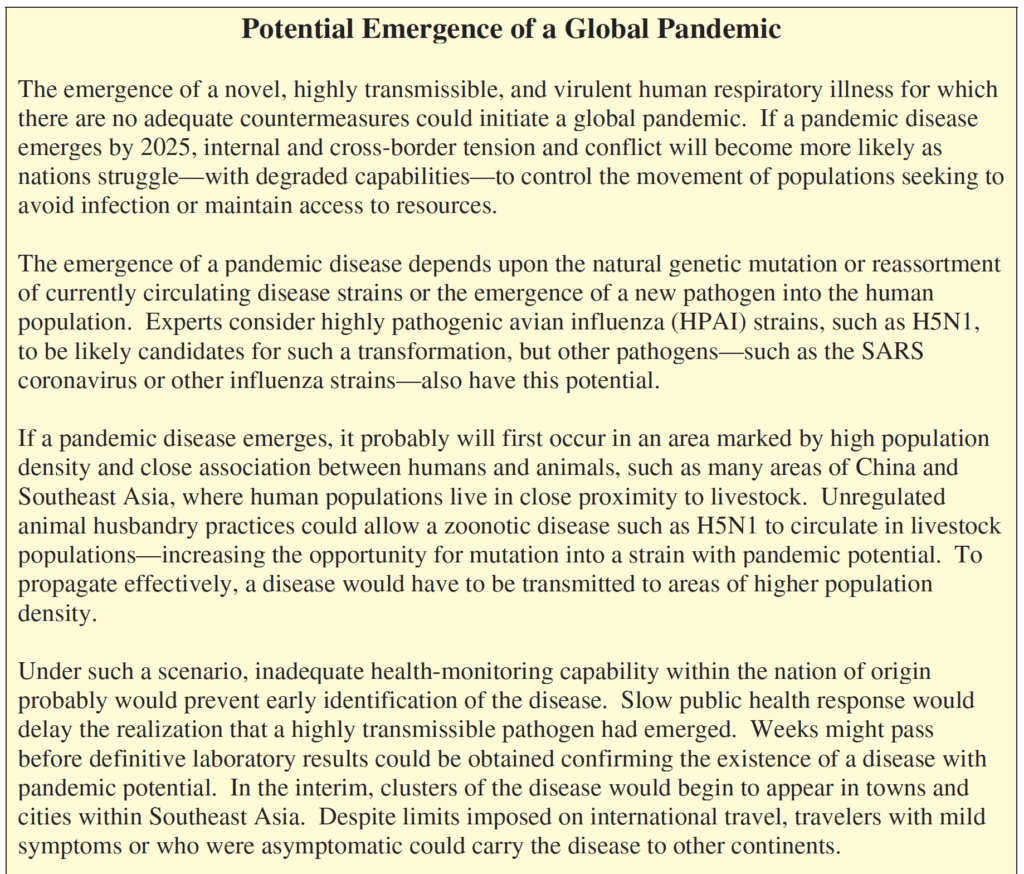
Trends analysis and projection An example of this approach comes from the US National Intelligence Council‘s 2008 global trends report.  The document covers a lot of ground, since its purpose it to outline a wide range of challenges, but let me draw your attention to page 75:

pandemic scenario_National Intelligence Council 2008

It goes on:

Waves of new cases would occur every few months. The absence of an effective vaccine and near universal lack of immunity would render populations vulnerable to infection.a In this worst- case, tens to hundreds of millions of Americans within the US Homeland would become ill and deaths would mount into the tens of millions.b Outside the US, critical infrastructure degradation and economic loss on a global scale would result as approximately a third of the worldwide became ill and hundreds of millions died.

Note the geopolitical unrest aspect, crucial to the report’s audience, and which we really haven’t experienced so far.

One more example of trends analysis comes from… my most recent book, Academia Next.  I wrote this in 2018 and handed into my kind publisher in 2019.  On page 23, a thought exercise:

Academia next pandemic passage 1.jpg

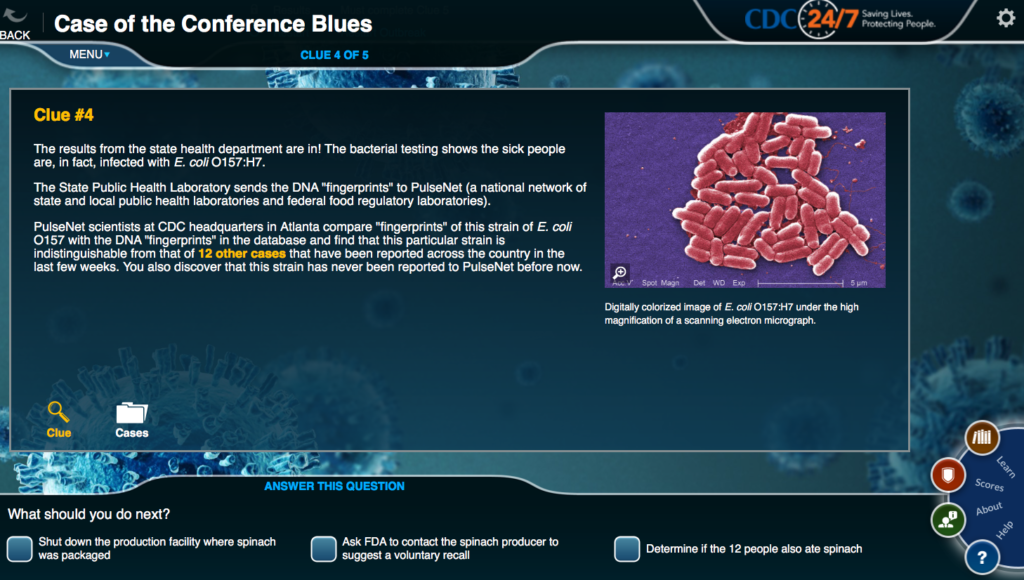
Computer game: CDC Solve The Outbreak The CDC produced a web game that simulates various disease outbreaks.  Players have to pay careful attention to the evidence provided (data, photos, definitions, descriptions) and think hard about how to investigate and address each one.

CDC Solve The Outbreak game

Computer simulation: modeling a disease outbreak with cellular automata In 2016 Sangeeta Venkatachalam and Armin R. Miklerexplored using this computing approach to forecast the course of a disease.

(Don’t forget the World of Warcraft blood plague!

“Seemingly innocuous aspects of the game world, each directly mirroring an aspect of real-world epidemiology, allowed what should have been a very minor point of interest in a small area of the game… to become the first online instance of uncontrolled plague to affect millions of Americans, Asians and Europeans at home…”)

AI analysis: Shaping Tomorrow’s forecast uses automated horizon scanning and analysis to seek out emerging trends.  It’s a fascinating service, and one that’s been peering at diseases for a while.

Science fiction and other literatures Literature has addressed diseases since the earliest documents we have.  Think of Oedipus being brought to his doom by investigating a plague, or Daniel Defoe’s A Journal of the Plague Year (1722).  Science fiction has long considered plagues.  Mary Shelley’s last novel (1826) is about a disease that exterminates the human race.  Olaf Stapledon’s Last and First Men (1930) also nearly wipes out humanity.  More recently, a Dean Koontz book actually invented a disease named for Wuhan.

Those are examples from print media.  We can find more examples in other media, from comic books (such as Y: The Last Man, 2002-2008) to the devastating “Confessions and Lamentations” episode (1995) of Babylon-5.  Contagion (2011) may be the best cinematic vision of a pandemic.

Each of these visions lets us imagine a world struck by disease.

And so on.  There are many more examples, but I hope I’ve made my point.

One more related point: professor Clare Wenham clearly points out that other researchers have been identifying the outlines of pandemic response for nearly 20 years.


…and so what?  What do these visions and games, stories and exercises tell us?  What’s their use?

First, the experience of seeing through a scenario helps us understand how things might unfold under certain circumstances.  This in turn gives us insights into how we can prepare now.  See, for example, the Event 201 recommendations (that we should have heeded better than we did).

Second, these are pedagogical experiences or objects.  They inform us about the many aspects of each problem, from disease science to inter-governmental-agency wrangling.  They are learning experiences for anyone who might be involved in a breakout.

Third, they teach us as well about ourselves.  How might we react when a disease creeps into our lives?  Psychological and social depths can be illuminated.

Fourth, they are practices, giving participants the chance to test their skills and plans to various degrees.

I hope we have learned from the futures works for the challenge hitting us in the present.

(thanks to many folks in conversation; SARS-CoV-2 image via Wikipedia)

Posted in coronavirus, futures, gaming, professional development, scenarios | 2 Comments

Coronavirus and higher education resources

coronavirus_National Institute of Allergy and Infectious Diseases I currently maintain several resources concerning higher education and the COVID-19 coronavirus outbreak.

buy amitriptyline online buy amitriptyline no prescription generic

  I’ll keep this post about them on the top of my page as long as it can be useful during the pandemic.

buy orlistat online buy orlistat no prescription generic

I launched this post on March 9, 2020.

buy antabuse online buy antabuse no prescription generic

(image via National Institute of Allergy and Infectious Diseases)

Posted in coronavirus | 26 Comments