Coronavirus, the world, and academia: 2020 March 6 update

In this post I’ll update you on what I’ve found about higher education’s response to the COVID-19 outbreak, with an eye towards the future.  It’s a continuation of the coronavirus blogging I’ve been doing since early February.

(Meta question: is this something you’d like me to keep doing?  Should I add or shift to other media: video, videoconference, podcast?  This poll is still open.)

I’ll start off with some notes about the outbreak in general, followed by a longer examination of academia’s responses to it.

This is a long post, since so much is happening.  I hereby promise that there is some comedy at the very end.  So grab a cup of coffee or tea and buckle in.

I: Developments in the outbreak

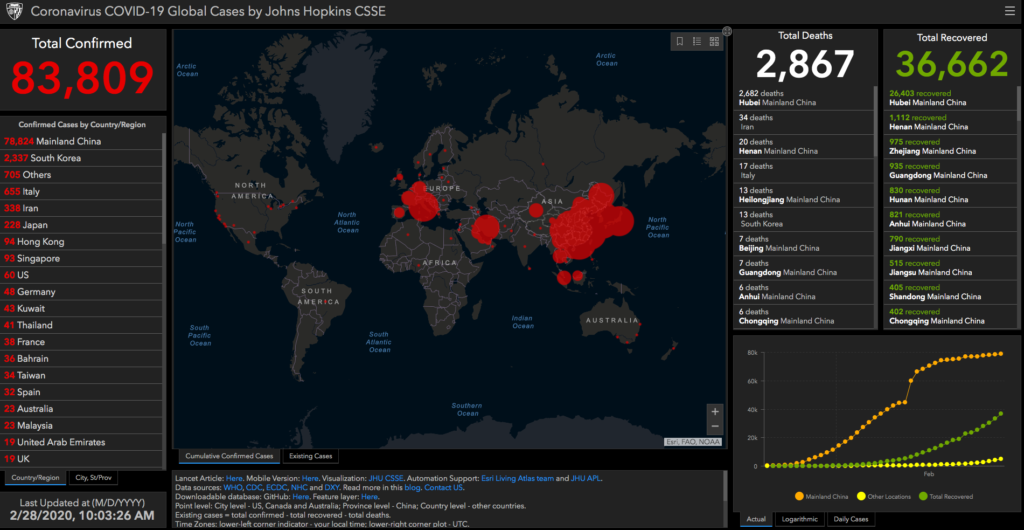
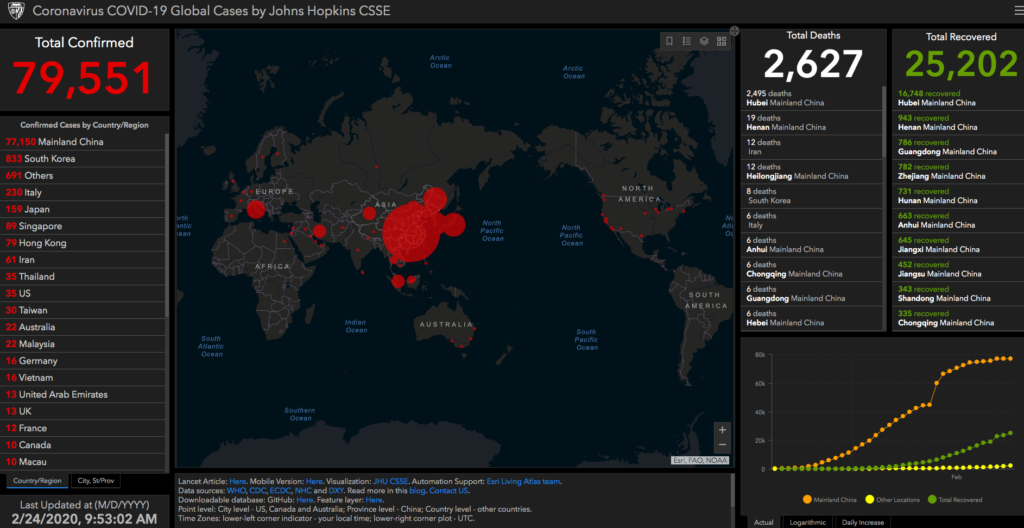
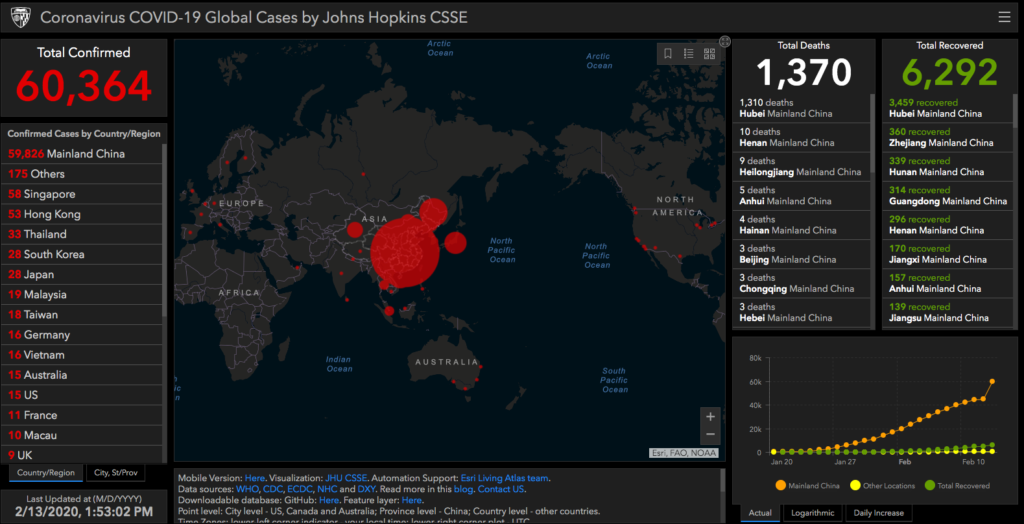
COVID-19 continues to spread.  Confirmed infection cases broke into six digits.  According to the Johns Hopkins dashboard:

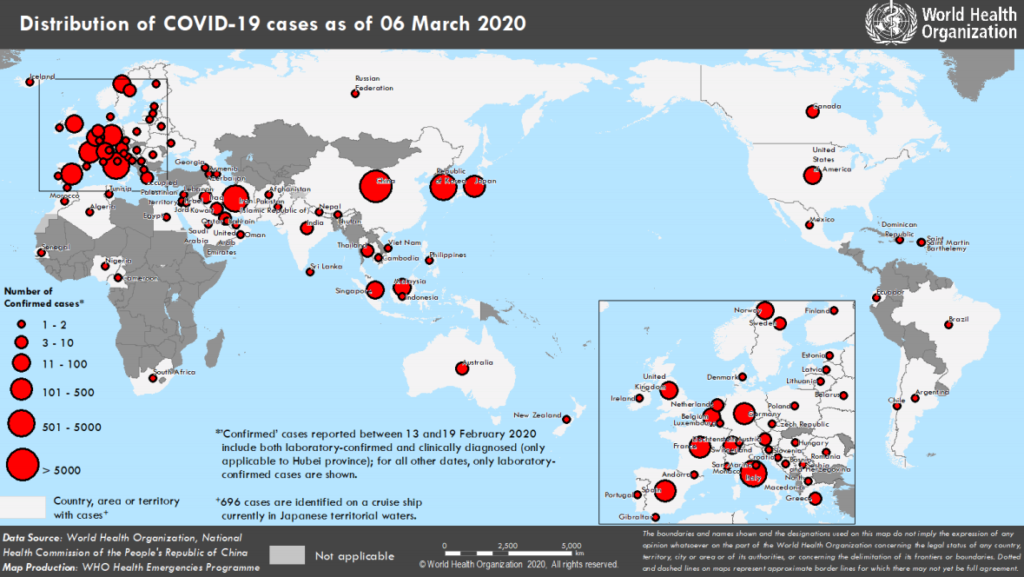
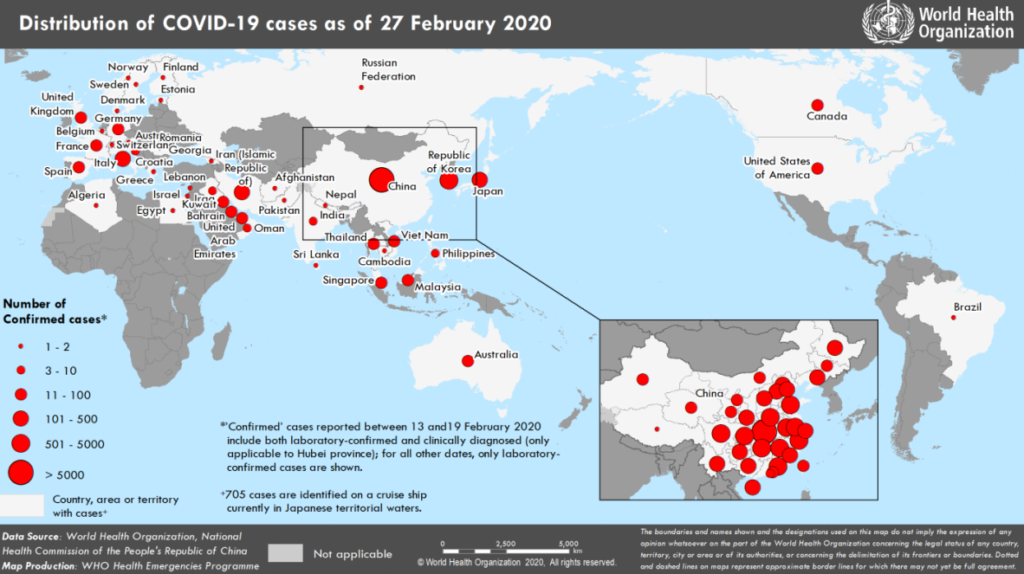
Globally, many nations now host infected people.  Here’s the latest WHO map:

“4 new countries/territories/areas (Bhutan, Cameroon, Serbia, and South Africa) have reported cases of COVID-19 in the past 24 hours.”

In the United States, the coronavirus is spreading across states, with clusters on the west coast, according to the CDC:

Three of those states have declared states of emergency as of this writing.

Politics In addition to the human suffering and death, other problems are growing or appearing.  I’ve seen many stories and complaints about equipment shortages worldwide.  In the US criticism of the CDC is rising about how it handled testing: fumbling the first test kits and doing too little, too late to test the population.  Meanwhile Trump keeps saying things that contradict WHO and general medical opinion.  At the same time he and Congress passed a bill allocating more than $8 billion towards addressing the outbreak:

The bill will provide more than $3 billion to the Centers for Disease Control and Prevention, the National Institutes of Health, and the Food and Drug Administration for research on diagnostics, therapeutics and vaccines. Each US state will reportedly receive at least $4 million for state and local government response.

Global Voices has an article describing how the Chinese government quashed reporting on the virus during early 2020.  Related: Xi’s government is now branding itself as the global leader in COVIID-19 response.  The Chinese government also seems to have launched an online disinformation campaign against Taiwan.

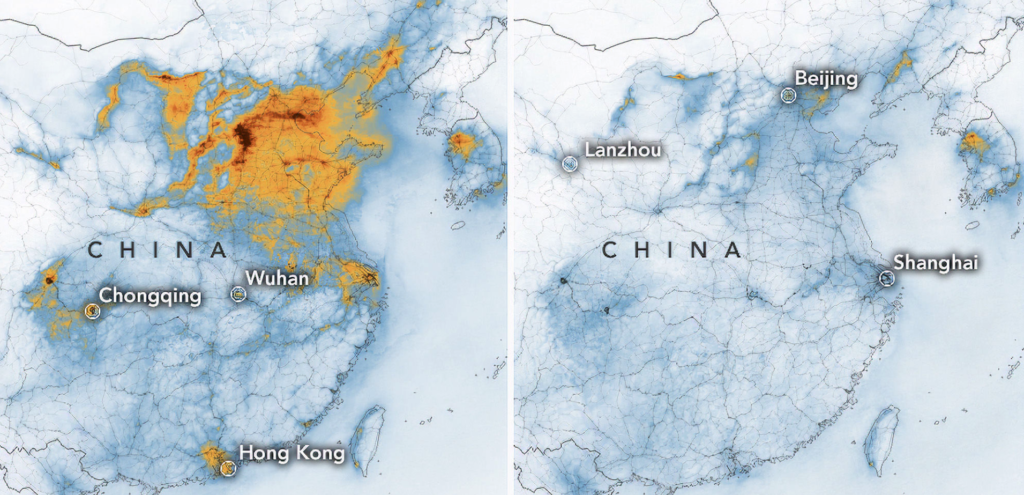
Silver lining: in some ways the near-pandemic has been good for certain things.  China’s air pollution problem lessened, thanks to a drop in travel and economic production:

January 1-20 versus February 10-25

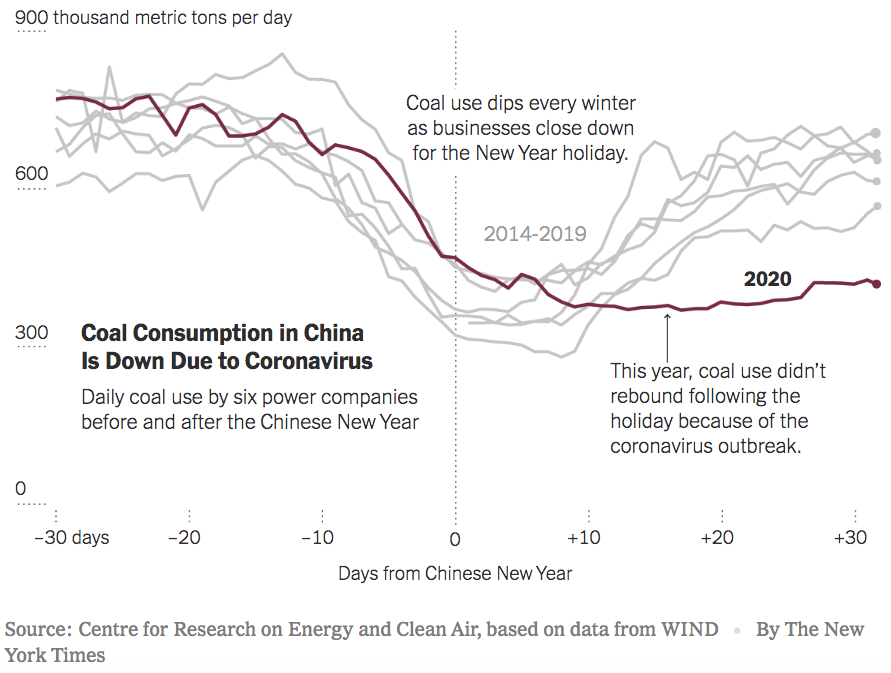
China’s carbon emissions have also dropped during this period.  We can see this in the decline in coal usage:

(I am still waiting for a conspiracy theory blaming climate change activists for COVID-19.)

Culture There are articles reflecting on what formerly busy major centers are likely, empty of people.  Canceling big events like Comicon and more people working from home means quieter public venues.  On a related note, finishing the US Census might be difficult.

That’s all for the general outbreak for now, because we need to spend a lot more time on…

II: Impact on and responses from higher education

In an early post I offered some categories for college and university connections to the coronavirus.  They still seem to hold, so I’ll use them to structure the rest of this post.  They are: academics as public players, changes to campus life, expanding digital academics, scholarly communication, impacts on institutional finance, political dimensions, and planning for the next disease.

Academics as public players Inside Higher Ed offers a good roundup of some university research.  Meanwhile, medical students are at risk, learning and working potentially on the viral front lines.

Changes to campus life Italy is closing all universities nationwide for the next two weeks.  Some American college basketball teams have canceled away games.

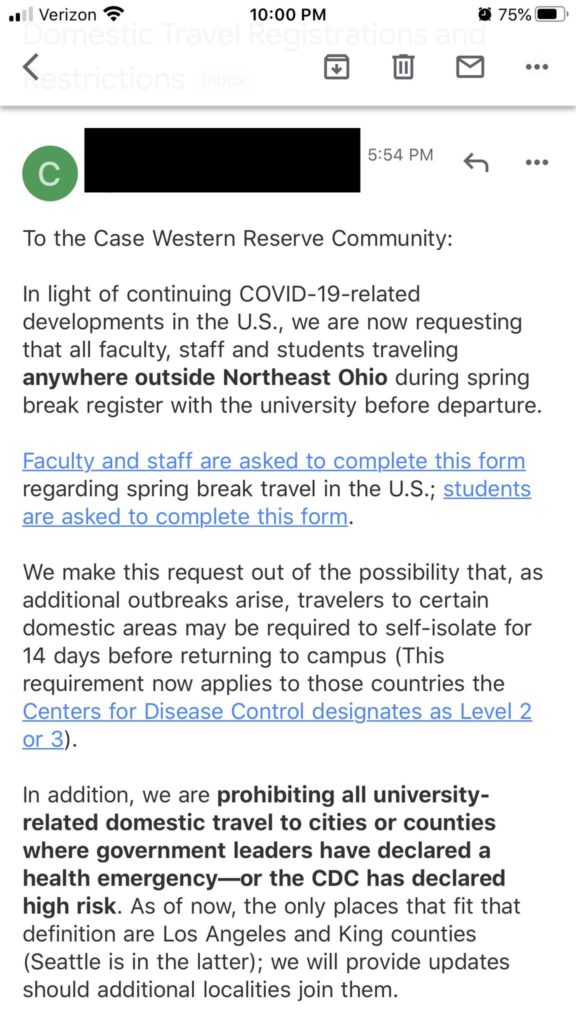
New or heightened academic travel regulations and restrictions are appearing.  For example, Case Western Reserve University asked anyone traveling anywhere – student, faculty, staff – to register ahead of time.

There are others following this Case Reserve plan:

Schools like Duke, New York University and the University of Chicago are asking students and faculty to register their travel plans, even locally, on a web-based form developed for emergencies like earthquakes and terrorist attacks.

Expanding digital academics   How will the disease drive education online? Perhaps by the creation of online classes open to the public at large, like Coursera’s COVID-19 class.  Or perhaps by popular demand.   A Change.org petition (HT Paul Fain) called for the University of Washington’s Seattle campus to close for the outbreak…

We are asking Ana Mari Cauce, the president of the University of Washington Seattle to take the initiative and close the campus in order to stop the spread of this virus. Take advantage of technology, start online classes. We all already know the risks COVID-19 poses to the public, particularly those who are immunocompromised or elderly, and we must act now to keep students, their families, and the community safe.

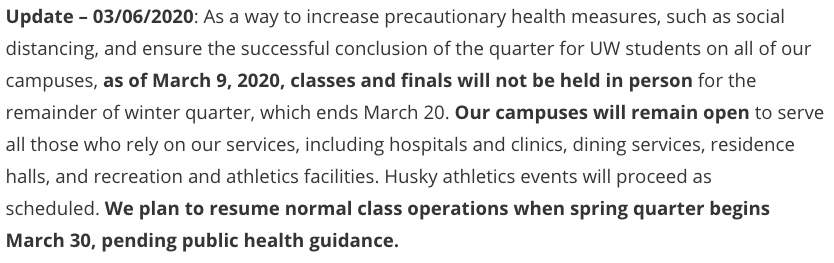
… which may have played some role in that institution’s decision to suspend instruction for the rest of March.

Several other colleges and universities have also closed, albeit for briefer times (so far). As Jay Sieling put it,

People are considering such steps because of the potential of infection, which bad stories like this heighten:

New Hampshire’s first coronavirus patient, a hospital employee, went to an event tied to Dartmouth business school on Friday despite being told to stay isolated, officials say, and all others who went to the event are now being told to stay isolated.

Speaking of problems, Joshua Kim and Eddie Malone argue that outsourcing digital learning to OPMs is a liability in the outbreak.

Conferences and meetings: I’m seeing more cancelations as well as events flipping online (for example) (another example).  In contrast, the ACU-GSV conference announced it would still meet in person (March 30-April 1) but with very interesting medical additions.  The hosting hotel will do more, like “increas[ing] the frequency of cleaning high touch point areas such as elevator buttons, doorknobs, public areas and implementing deep-clean guestroom procedures while also increasing the number and availability of hand sanitizer stations. ”

And notice this:

Temperature-screening will be in force. We will have various mechanisms to temperature-screen attendees, including passive scanning of all attendees prior to entry to the venue. Temperature screening may result in false-positives resulting in more secondary screening and some individuals being denied entry who register a temperature on both primary and secondary screening. We apologize for that and will have secondary screening performed by trained medical personnel on-site. If you are denied entry due to temperature, you will be provided a complimentary pass to the 2021 Summit. [boldface in original]

I can see many problems with this, including picking off people with non-COVID infections.  (Also, the language seems copied from another conference.) Where else should we expect to see thermal screening: airports, movie theaters, schools?

Further,

there will be no attendees from Mainland China, South Korea, Iran or Italy without any exceptions. We are so sorry for what our partners in these countries have gone through, but we must protect the health and safety of the overall community. We have provided refunded tickets to the handful of individuals planning to come from these Level 3 Countries.

Scholarly communication Open access content is still out there, including from publishers and aggregators (Elsevier, Springer, Wiley; 1science’s links and records archive).  Duke University Press added some by opening up relevant titles into what it dubbed a syllabus.

On a related note, the Coronavirus Tech Handbook is a great open resource.

Impacts on institutional finance Threatened by enrollment drops, institutions may turn to enrollment insurance.

Political dimensions The United States Department of Education offered recommendations for campuses struggling with enrollment, nationality, and financial aid.

Planning for the next disease There is a splendid Google Sheet listing and linking to many college and university pages on COVID-19 and their policies thereof.

For more on this, Paul Fain offers a great round-up of the week’s stories.

What next, at least in terms of academia’s response?

Since colleges and universities tend to learn from each other’s operations, we should expect to see some implement versions of the Case Western travel tracking system.  I wouldn’t be surprised to see thermal scanning pop up in sites, including cultural heritage ones.

When closures and shifts online end – whenever that might be, April, September, or 2021 – will campuses have a hard time getting some students back?  Consider: COVID-19 dread is now enormous.  What will it take to convince students (not to mention staff and faculty) that a campus is safe?  Alternatively, if the online experience is good enough, will we see a group of students permanently shunt from face-to-face to digital learning?  The opposite question is also worth asking: will bad online learning experiences drive digital learning numbers down once COVID-19 passes the crisis stage?

On a much broader, more macro level I wonder about the intersection of the coronavirus outbreak with climate change.  Can we only parse one crisis at a time?  Are there positive or negative intersections between the two threats?

That’s all for now.  What are you seeing of COVID-19 in academia?

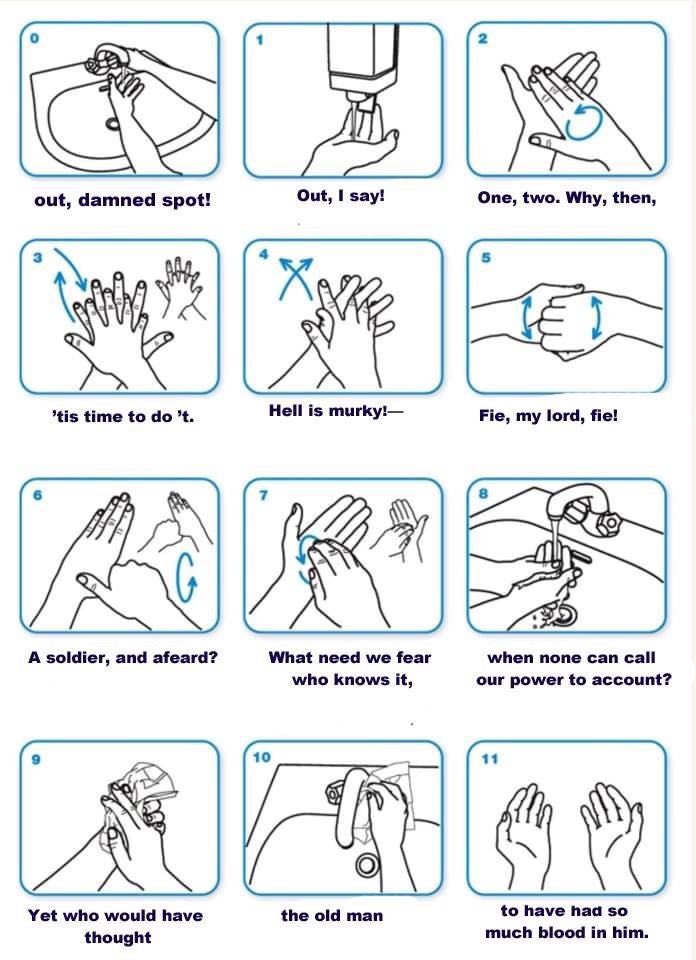
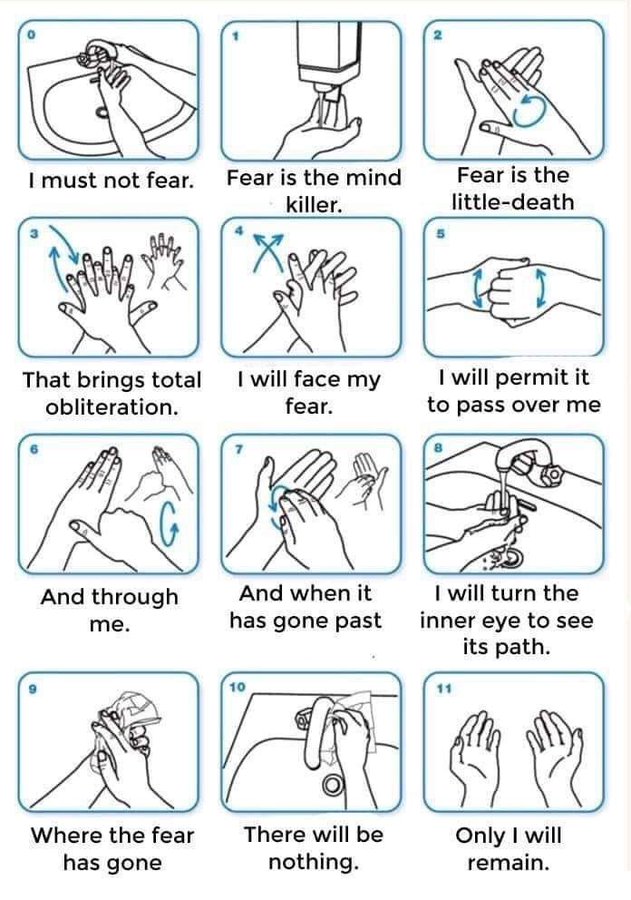
PS: in reward for your patience at making it thus far, here are two funny takes on handwashing instructions.

Macbeth hand washing

and a science fiction joke, which is actually compelling:

coronavirus Dune washing

(thanks to my wife, Jay Sieling, Roger Schonfeld, Derek Bruff, Elena Clark, Facebook friends, my students, and friends)

Posted in coronavirus | 1 Comment

Coronavirus and academia: what can we do to help now?

Coronavirus_C-Tan-nCov_Wuhan_strain_01-20200123104509I’ve been tracking the coronavirus outbreak and its impact on higher education for weeks.  That’s a mix of blog posts and tweets.

My question today is: what else can I do to help?

Is there anything I can add based on my futures, education, and technology expertise?

I’ve been having offline conversations with many people over the past months.  Here are some of the ideas folks have offered.  Each has its own benefits, affordances, and costs:

  1. Holding video conversations about COVID-19 and education, modeled on the Future Trends Forum.  Host one or several experts (CDC, WHO, campus planners, HHS, researchers) and connect them with an audience in actual conversation.  Grab sponsors.
  2. Work with a nonprofit, government agency, professional organization, or business to host a video conversation aimed at their particular slice of academia.
  3. Start a podcast series updating us on the latest about COVID-19 and education.  It might have to be fairly frequent, given the speed of events.
  4. Run an email newsletter updating readers on the latest about COVID-19 and education.  Each issue would be smaller than FTTE, which is monthly.
  5. Launch a public research project on how campuses can best use the digital world to protect their communities while conducting their educational missions.  This could include blog posts here, articles, video, audio, interviews, discussions, etc.
  6. Keep doing what I’ve been doing with blogging and Twitter.

I’m putting this to you all, dear readers, because I need your guidance.  I want to help higher education through this crisis, and also want to do so well.

What do you think?  Please use the comments box below.  Vote in this poll:


And if you prefer to reach out to me privately, click here.

Posted in coronavirus | 7 Comments

COVID-19, academia, and the big push online: an update

How is higher education responding to the COVID-19 coronavirus outbreak?

(If you’re new to this blog, I’ve been tracking the virus since it appeared in January, as part of my broader project of studying the future of higher education.  You can find all of my posts about the topic here.)

The virus continues to spread.  I won’t summarize that here today, because of time, but you can find more from these sources.  It’s starting to impact some campuses now.  The University of Sydney lost more than one fifth of its students, who are Chinese nationals. Several California and Washington state universities stated that some of their populations have been exposed to the coronavirus. A researcher (not faculty?) at Rice University (Texas) might have COVID-19, so the campus “asked a ‘small group of students and faculty’ to self-quarantine.”  The University of Queensland investigated an infected student who may have visited one of its campuses.  New Zealand campuses fear students falling behind in their studies, as well as institutional financial stress. Some universities in northern Italy remain closed.  (Japan closed K-12 schools; no impact on higher ed yet.)

coronavirus 2020 Mars 3_JHU

The latest stats from the Johns Hopkins project.

Several American campuses announced a suspension of their study abroad and international partnership programs in certain nations: China, Italy, Japan in particular.  The United States Centers for Disease Control (CDC) asked all campuses to think about suspending study abroad everywhere:

Given the global outbreak of novel coronavirus (COVID-19) institutes of higher education (IHE) should consider postponing or canceling upcoming student foreign exchange programs. IHE should consider asking current program participants to return to their home country. Those overseeing student foreign exchange programs should be aware that students may face unpredictable circumstances, travel restrictions, challenges in returning home or accessing health care while abroad.

IHEs should consider asking students participating in study abroad programs to return to the United States.  (repeated boldface in original)

The US Department of Education announced a task force to look into the impact of this disease on schooling.

Academic events are starting to be hit.  EDUCAUSE canceled its ELI conference in Washington state. The Asia-Pacific Association for International Education Conference and Exhibition (#APAIE2020) canceled its Vancouver event.  The American Physical Society canceled its Colorado meeting.

March Madness basketball games might be played without in-person audiences.  No word on canceling games and practices; any news on this score, readers?

A University of Albany student party elicited attention and controversy for having a coronavirus theme:

A since-deleted video of off-campus party, which featured Corona Extra beer, surgical masks and a white sheet decorated with a biohazard symbol, appeared on the Instagram account @BarstoolAlbany last weekend with the caption, “Corona virus isn’t gonna stop anyone from partying.”

Academic research continues worldwide, even dramatically:

https://twitter.com/Dali_Yang/status/1234861499019153421

What does this all mean?

Campuses may be reacting more quickly than they did a month ago.  Karin Fischer notes of the decisions to break off connections with afflicted nations: “The swiftness of those decisions is notable in comparison to deliberations when coronavirus first broke out in China.”

Campus emergency plans and exercises seem to be being updated and tested.

How many members of a given academic community lack sufficient access to health care?  Think of faculty, staff, and especially students in the developing world, or in the United States.  Should they consider themselves infected, some will not seek testing or medical attention.  They may suffer and spread COVID-19 further.  In addition, how many people employed by colleges and universities lack sufficient sick leave, and will force themselves to keep working while ill? How will institutions address this?

I wonder if campuses or on-campus projects are planning on asking governments for financial relief as international students drop (short term) and public revenues tighten (medium term).  Reuters reports that the Italian government is already working up aid plans to its injured economy.

I would like to draw attention to two big, overlapping, and potential developments: a big push online for colleges and universities and a boost to video.  Several American universities rapidly migrated classes online for their Chinese partner campuses, including NYU, Duke, and Fort Hays State.  That’s both asynchronous (LMS etc) and synchronous (videoconferencing).

This could simply keep going.  Students, faculty, and staff may feel increasingly nervous about being in face to face meetings and will prefer to work and study remotely.  We already have access to a lot of the tech, and maintain some of it in house: campus hosted or leased LMS, document hosting (Google Apps, Office 365), email, some video solution (Elluminate, Connect, Shindig, Zoom, etc).  Networked hardware is fairly widespread, if unevenly.

Bryan: I voted! 2020 March

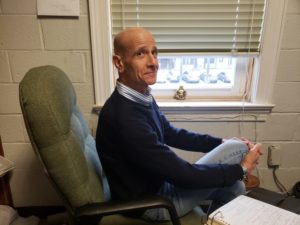
Me this morning after voting, back in my office. I may be spending a lot more time here.

Which brings us to challenges.  My readers know that the digital divide means unequal access to bandwidth, which can limit use of video and large files.  Faculty are not universally schooled, practiced in, and happy about teaching online.  Campuses may lack sufficient staff to enable a big, fast online push.  This is also happening during the middle of academic terms in many instance, which makes the transition even more difficult.

Video may pose particular challenges.  While humanity loves video, most are not skilled and practiced at creating it.  Think of awful webinars you’ve been exposed to, for a sample of how low the quality can be.  And we still don’t view video as an adequate substitute for in person connection, generally; we may deem rushed online education to be a poor experience.

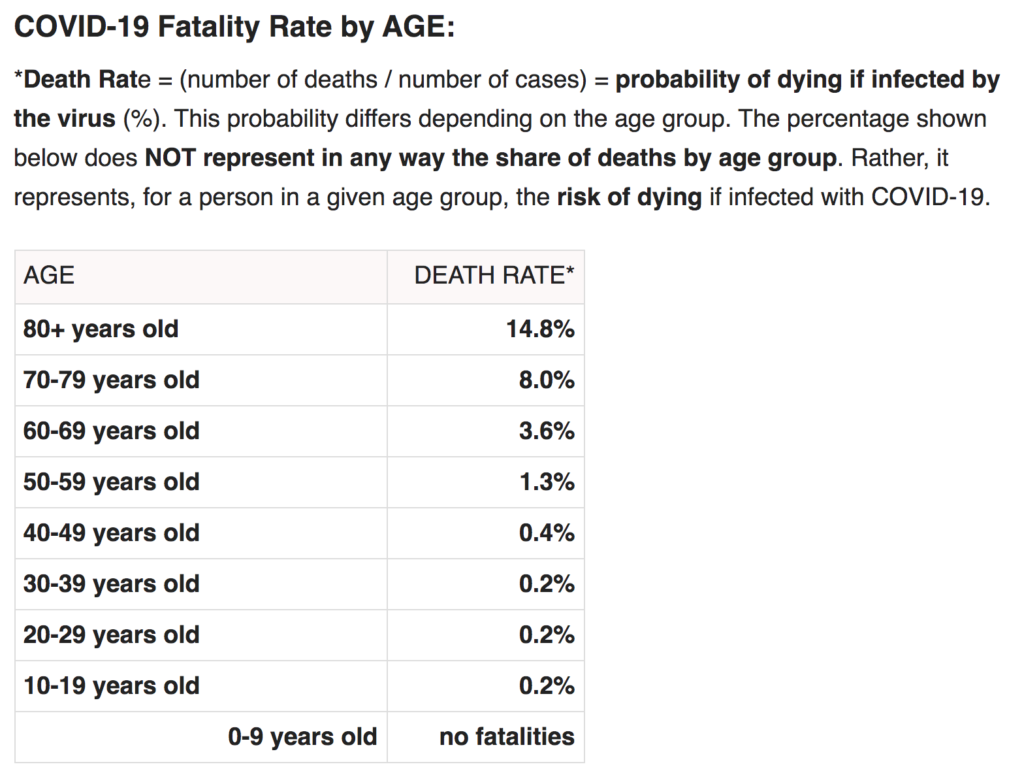
Student age may play a role here.  Let’s assume that the data we have now about age and coronavirus lethality holds true, at least in general perception.  The older one is, the more dangerous COVID-19 is, especially after age 70.  For example, according to the data aggregated by Worldometer:

coronavirus death rate by age_Worldometer

If this data bears out – or, more importantly, if most people believe and act upon it – then we could see efforts to enroll senior citizens become more digital.  Which can be challenging, given that population’s tendency to be less digitally experienced as well as being likely to have less tech access.  What are the best practices here if “[w]e will interact with students in a different way,” as an al-Jazeera video quietly observes?

There’s a broader context for this discussion.  Such an online migration is buttressed by a similar, larger move across society.  As people increasingly find face-to-face contact problematic, they will likely shift more functions and experienced into the digital realm.  Shopping in stores, where COVID-infected folks will be coughing?  Head to Amazon and Etsy.  Health care, where crucial workers are overexposed?  Anticipate a rise in various forms of telemedicine.  Want to see a movie or live concert?  The digital world offers plentiful riches.  2020 may well see the past generation’s digital migration accelerate, both in the world at large and within academia in particular.

I will blog more about this potential/unfolding migration as I can.

(thanks to Jay Sieling for one fine link; thanks to my Patreon supporters for thinking through this with me)

Posted in coronavirus, education and technology, videoconferencing | 9 Comments

What does COVID-19 mean for higher education? Looking ahead.

Today I was planning on responding to Eddie Maloney and Joshua Kim’s thoughtful column about what powers change in academia.

But circumstances urge me instead to post about COVID-19* and higher education instead.  I’ve been tracking this so far in my professional capacity as higher ed futurist (see here, here, here, here).  Today I’d like to respond to recent developments in the outbreak-nigh-unto-pandemic and discussion in the higher ed space.

I’ll start by summarizing what we know so far, then explore what this means for colleges and universities.  As ever, please add your thoughts, information, and questions below.

Caveats: to paraphrase McCoy, I’m a futurist, not a medical specialist.  This is a fast-moving story.  Data and news are provisional.  And I don’t have time to represent the long futures practice of modeling outbreaks today – I can claw my way to that soon, if you all like.

I: the status of COVID-19 so far

What do we know of the outbreak as of February 28, 2020?  I’ll work from the links I listed here (and please add more resources).

We have some understanding of how it works and spreads (CDC info page).  Vaccines are under development.  There are many open questions: incubation period, lethality rate, reinfection rates, how it can be transmitted on surfaces.

The coronavirus has spread to more nations, touching every continent save Antartica.  The latest additions include “Brazil, Denmark, Estonia, Georgia, Greece, Norway, Pakistan, Romania, and North Macedonia,” according to WHO.  Nigeria claimed the first sub-Saharan case. WHO also mapped out the spread graphically:

coronavirus 2020 Feb 28_WHO

Countries depicted in white have at least one infection.

WHO’s leaders have taken to addressing the human race on a daily basis (this morning’s).

For more data about infections and deaths across the world, we can turn to the Johns Hopkins dashboard, which is still the best:

Coronavirus 2020 Feb 28_JHU

That matches Worldometer data. I suspect people will see 100,000 infections and 3,000 deaths as milestones.  It’s spreading faster outside of China than within.

Death rates vary quite wildly by age.  I’ve been seeing charts like this all over:

coronavirus death rates by 2020 Feb_Worldometers

(I’m still waiting for people to nickname this “boomer flu.”)

In the United States the outbreak hit partisan territory very strongly.  The Trump administration appointed vice president Mike Pence to lead American efforts; following this Democrats criticized the administration (one example), which defended itself by claiming Democrats and the media were blowing things out of proportion in pursuit of electoral gain (for example) (or this).  In at least one case conflict between local authorities and the CDC seems to not have turned out well.  The United States Navy will quarantine some ships in the Pacific.  There are calls for individuals and families to prepare for pandemic.

Economically we continue to see problems.  Stock markets have been staggering. Asian-based supply chains are struggling.  Air travel isn’t doing well.

Where is all of this headed?

On the New York Times Daily podcast health reporter Donald G. McNeil Jr. offered two extreme scenarios for the next couple of years.  Best case: COVID-19 gradually becomes part of the seasonal cold cycle, a nuisance to cope with.  Worst case: something like the Spanish flu, with hundreds of millions or more infected and millions dying (remember the lethality rate of around 2%).

Goldman Sachs offered a similar scenario pairing.  Best case sees China’s economy suffer two bad quarters, then return to growth by fall 2020.  Worst case sounds like recessions rippling worldwide.  As I said on February 12,

we could imagine coronavirus becoming a minor but long-standing piece of our total disease puzzle… something between SARS (which it has just exceeded) and the unspeakably devastating Spanish flu. It’s a wide range, but we don’t have a lot of data now.

Politically, we seem to be following my forecast of increasing state power.  China seems to have succeeded in controlling COVID spread through exercising enormous powers, while clamping down on free speech.  The Trump administration through Pence might start throwing its weight around.  This trend suggests data will be problematic, as seen with this story about a potentially hidden Iranian death toll.

At least 210 patients have died in Iran, health sources have told BBC Persian, way above the official figure of 34. Iran denies withholding information about the number of people infected.

Speaking of which, Alex Tabarrock points us to a nice 2016 summary of political lessons learned from the history of disease.

Culturally, people are making jokes about the outbreak and how we respond.  McSweeney’s mocks Pence and the CDC’s facial hair announcement.  The New Yorker jabs at Trump’s response.

II: What this does to higher ed and how higher ed may respond

Already COVID-19 is being felt directly.  One University of California-Davis student seems to be infected and is under quarantine.

Let me recap the categories I set out earlier in February: academics as public players, changes to campus life, expanding digital academics, scholarly communication, impacts on institutional finance, political dimensions, and planning for the next disease.

Academics as public players The examples I gave are continuing, both in terms of researching the virus, sharing information, and intervening in public discourse.  I haven’t seen much beyond that.

Changes to campus life Chinese academia still seems to be hit hard, from exams and classes to scholarly travel.  I think something similar is happening to Italy and Japan.  I’m not sure about other nations, including South Korea.

Many campuses are ramping up health measures worldwide, from what I can tell.

How will this impact college sports? I don’t know if leagues and teams are postponing games or even practices.  I do suspect it could further boost interest in e-sports.

Study abroad and other international travel is coming under scrutiny, and sometimes being suspended.

American K-12 is apparently ramping up all kinds of measures.

Expanding digital academics I’ve been hearing about large numbers of Chinese students learning online.  Worldwide, there are signs of campuses exploring shifting face to face classes to the online world. This could be a major development in ed tech, possibly driving online learning to new enrollment heights and into campuses that have tried to avoid it so far.

Scholarly communication Open access projects are still going on.

Impacts on institutional finance Enrollment threats are ongoing, focused on China.  Other nations hit so far do not contribute quite so many students to the international higher education market, but their impact could well count, depending on a given campus.

A protracted pandemic that clamps down on economic growth could also injure academic economics.  Those institutions relying on endowments might not be able to do so for a year or two.  If states see tax revenues suppressed, they will likely cut back on supporting public universities.

Political dimensions The United States Department of Education will launch a COVID-19 task force.

I’m still looking for connections between COVID-19 and Chinese international politics.  I’m also tracking anti-Chinese campus bigotry.

Planning for the next disease And planning for this one?

I’ve heard offline and listserv discussions about universities dusting off contingency plans created from 2001 on, after 9-11, Katrina, SARS, and so on.  I don’t know how up to date those plans are.  A biologist/former university president just asked us all to get planning and operational right now.  (Don’t miss this line: “Consider pedagogic and technological plans to move instruction online.”)

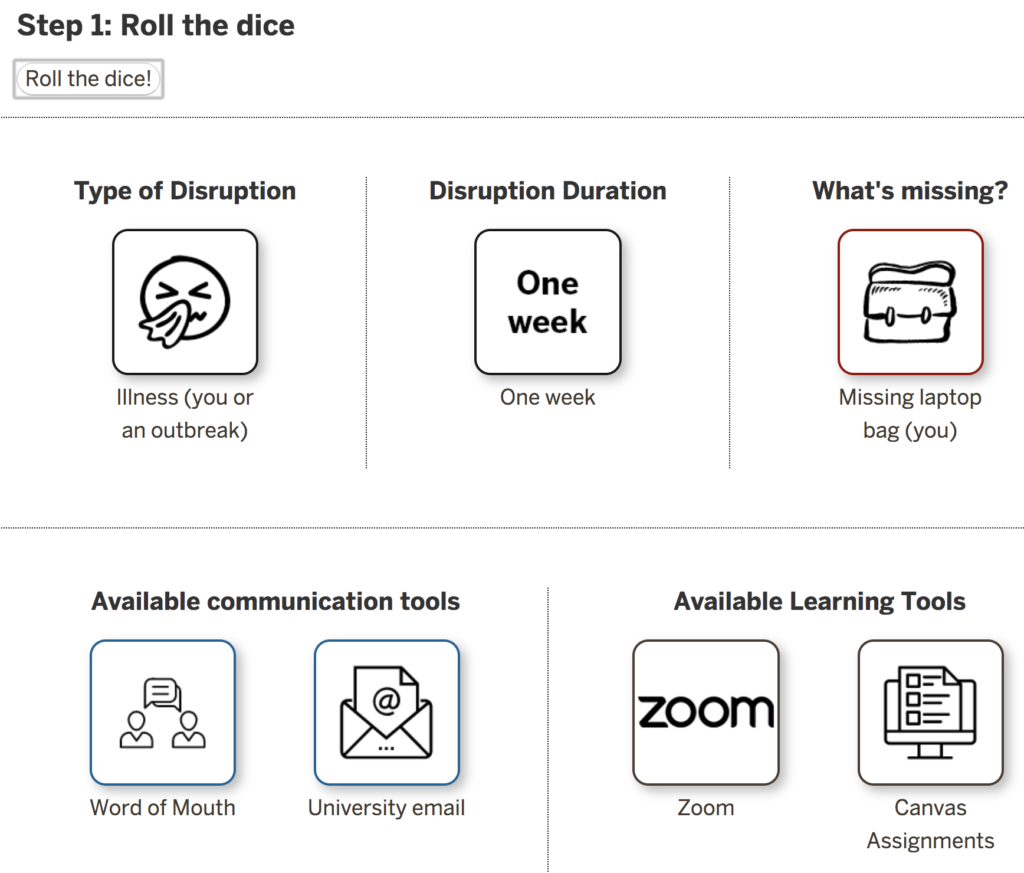
I wonder how many campuses have run simulation exercises recently.  For a prompt, here’s a handy little web game from Indiana University which you can easily rerun:

emergency game page_Indiana U

Additionally, I suspect COVID-19 is starting to appear as a classroom subject.  I don’t know how many classes are focused on it entirely.

Personally, I’ve been sharing information and thoughts on this blog, on Twitter, on LinkedIn, and Facebook. I also had my ed tech seminar explore the topic in realtime.  Here was the in-class assignment:

  1. Based on our class work so far, what can we say about how people learn of the coronavirus/COVID-19 outbreak?  How will the potential pandemic impact teaching with technology? You can use these resources.
  2. Analyze the WHO COVID online class .

To sum up: COVID-19 is starting to impact higher education worldwide, unevenly.  Hardest hit nations are reducing face-to-face operations and shifting online.  Financial stresses are appearing, if unevenly.  Campus planning may be shifting into gear.

What’s next: we still don’t know if we’re seeing limited outbreaks or a roaring global pandemic, and that obviously determines everything else.  Only a few academics are likely to participate in the bigger picture either as researchers or communicators.  Campuses may entrench to protect their populations and business models, which migrating operations online.  If things get Spanish flu horrible, then we could see academia crunched economically while distance learning becomes normative.

What do you think?  What have I missed?

*Following WHO, I’m going to refer to the disease as COVID-19 from now on.  SARS-CoV-2 is what causes it.

Posted in coronavirus, research topics | 2 Comments

How I track the coronavirus

UPDATED January 8, 2022

How can we best stay informed about the coronavirus/COVID-19 outbreak?

I’ve been tracking it carefully for weeks, and have built up an online search strategy.  I’d like to share a description of it here, partly in case it’s useful for readers, and also to request additions in case it’s missing anything.

I’ve broken these down into general categories by source, style, and openness.

Dashboards Information presented to give us a snapshot of the outbreak.

Coronavirus 2020 Fen 26 JHU

  • COVID Act Now, “America’s COVID Warning System,” displays data about the pandemic in the United States.
  • Harvard, the Boston Children’s Hospital, and others offer a similar dashboard.

coronavirus 2020 Feb 25_Harvard

Coronavirus_2020 Feb 26 Worldmeters

Academic dashboards Projects measuring college and university behavior:

Public research and preparedness Information from leading public-serving institutions.

Open source, open access research Materials produced by scholars that are freely and openly available without paywalls.

Open news and analysis Content produced that’s not necessarily by academics, and is also freely and openly available without paywalls

Paid content news and analysis Articles and other media behind paywalls.

  • LitCovid: “a curated literature hub for tracking up-to-date scientific information about the 2019 novel Coronavirus.”
  • New York Times: hub
  • Washington Post: updates
  • Financial Times: COVID-19 page

Social media Here I’m looking for the best sources, not hashtags or communities, although I’m open to the latter.

Online learning Educational materials about the outbreak in particular – i.e., not about disease or health care in general.

Libguides Curated resources produced by libraries:

Newletters The best in email.

  • Sinocism is excellent for China in general.  Rich and including many Chinese language sources.

Prediction markets

That’s all for now.  What do you think of these sources?  What should I add?  Are there good video and podcast resources?

If this is of value, I’ll keep adding to it as the outbreak continues.

(thanks to Jay Sieling, Sifu Dai, Esty, Bethany Bovard, Mike Sellers, Audrey Watters, Ruben Puentedura, and Ilene Frank for recommendations) 

Posted in coronavirus, digital literacy, research topics | 9 Comments

Today’s grim higher education indicators

Today I’ll take a break from blogging and tweeting about the growing COVID-19 outbreak and return to the state of American higher ed.

(Note to self: really try harder to get more cheerful topics)

I’d like to share several stories that point to the increasingly fragile state of this nation’s colleges and universities, then draw some conclusions from them.

LIU-logoFirst, one case study of impending cuts.  Long Island University announced it would freeze new enrollments in certain programs.  What does this mean?  “While new students will not be admitted to these programs, the university will continue to offer the necessary courses for current students to be able to graduate on time within these majors.”

What’s headed for the freezer?

art history, earth system science, French, Italian, music performance, Spanish, geography and geology. ​A list of frozen programs provided by the chair of LIU Post’s Faculty Council also includes a number of education-related undergraduate programs as well as master’s programs predominantly in the liberal arts and education fields…

buy albuterol online buy albuterol no prescription generic

Why is this happening?  My readers can guess: enrollment and finances.

Total full-time-equivalent undergraduate and graduate enrollment at the Post campus has declined from 6,029 in 2015 to 5,458 in 2019, a drop of about 9.5 percent, according to data LIU provides to its bondholders. However, the number of enrolled freshmen spiked last fall to 771 students, up from 564 the fall before, an approximately 37 percent increase.

Universitywide, across all campuses, the number of total faculty has declined by 21 percent since 2015, from 1,979 to 1,558.

Long Island U profFreezing is interesting, strategically.  It gives LIU time to transition faculty into other teaching roles, or to encourage them to retire.  Failing that, the campus is setting up a queen sacrifice down the road.

buy zithromax online buy zithromax no prescription generic

As one professor, Michael A. Soupios, political science, put it: “Soupios described the use of the word ‘freeze’ as ‘euphemistic rubbish … Frozen is tantamount to death. You’re not going to be thawed.’”

Second, the Chronicle of Higher Ed reports on a recent survey of campus leaders.  It’s a small sample, about 6.5% of the total sector, so we might be cautious with the results.

Key findings include:

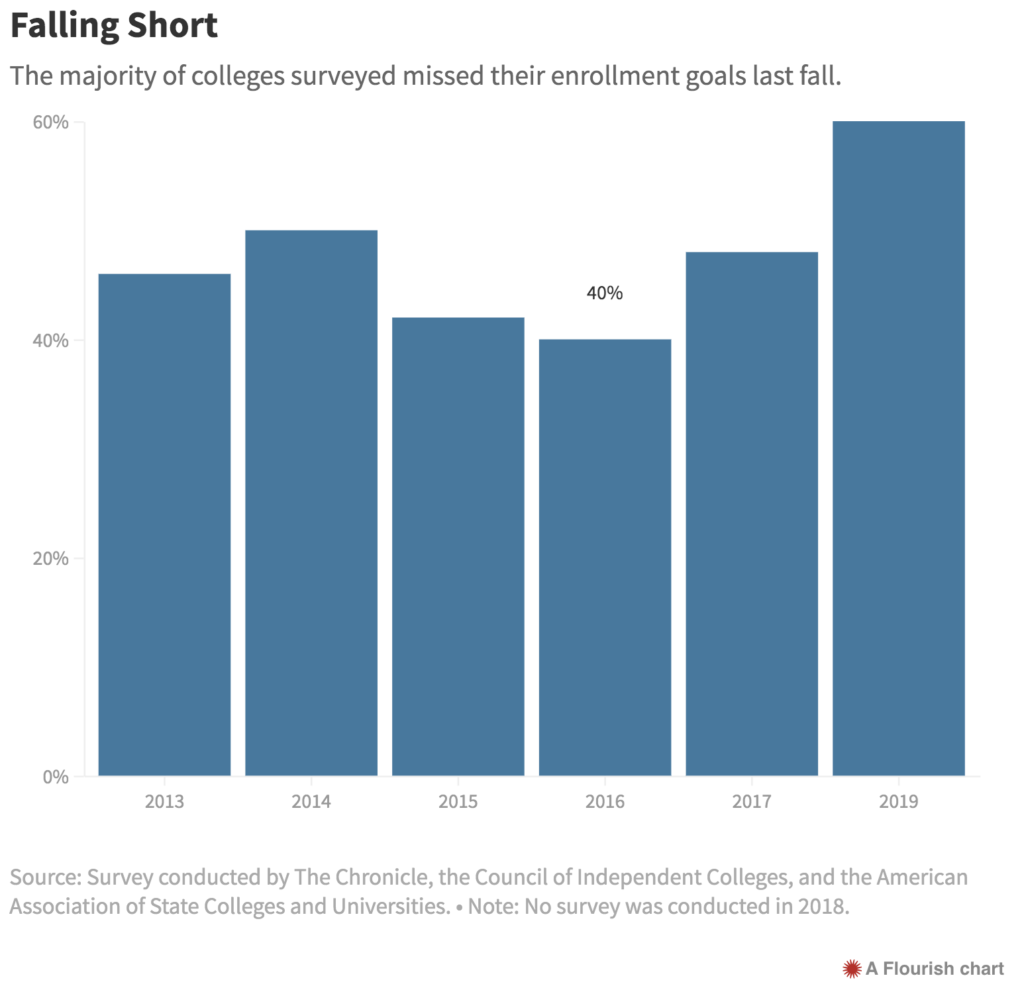
  • Enrollment woes: “about 60 percent of public and private institutions responding to the survey missed their enrollment goals, although private colleges were more likely to miss their goals by a wider margin.”

colleges missing enrollment 2013-2019_Chronicle

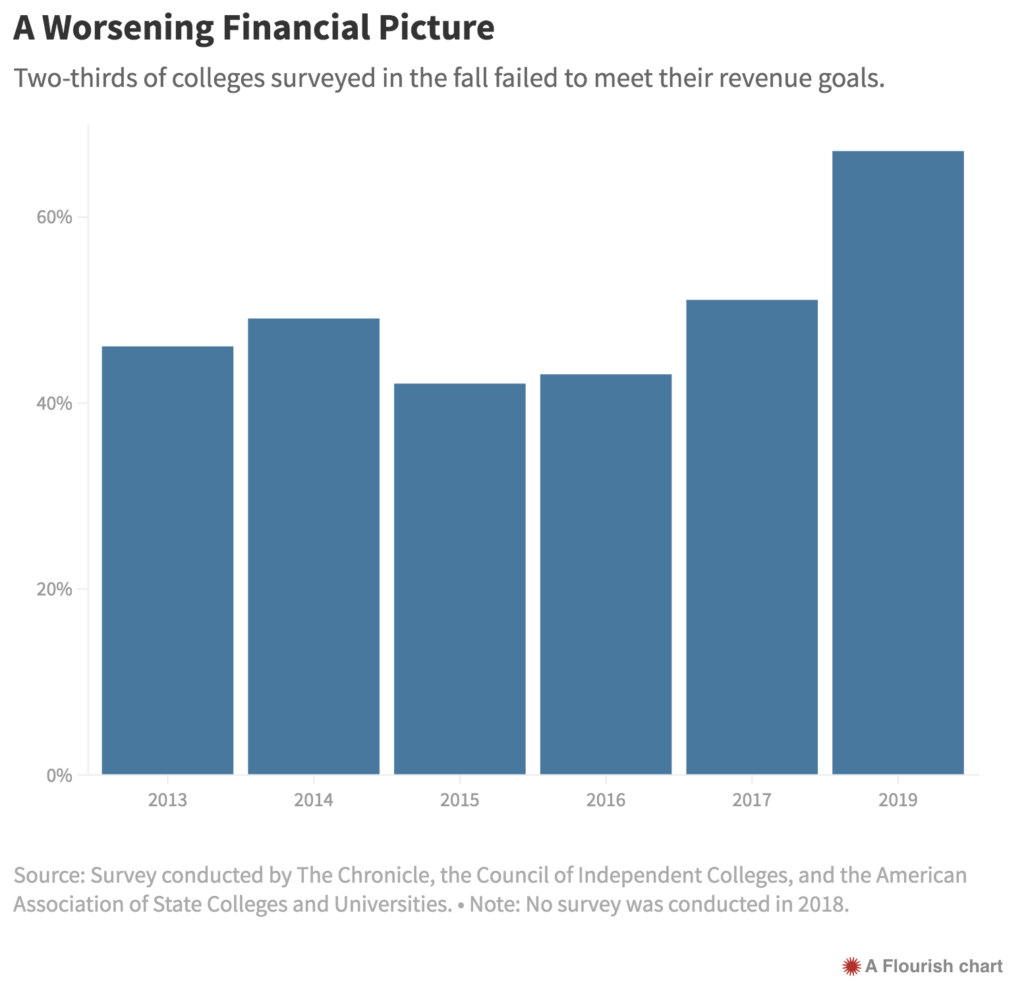
  • Financial woes: “Sixty-seven percent of institutions did not meet their net-revenue goals, with public institutions hurting slightly more.”

colleges missing revenue 2013-2019_Chronicle

Note as well that differences between private and public institutions on these scores are nearly nil: “Fifty-two percent of private institutions missed both enrollment and net-revenue goals, compared with 49 percent of publics.”

Remember that this survey covered several hundred colleges, meaning there’s a range of institutions and data.  What the Chronicle did here was look at overall trends, the macro picture.

What’s also interesting in that survey is what campus leaders reported for their responses:

starting new programs to attract students, enhancing the marketing of the institution, and putting more pressure on enrollment management. (The private colleges, in particular, favored starting new programs.)

Cutting back was less popular. Compared with the number of institutions that said they would start new programs, roughly half as many institutions said they would consider eliminating underenrolled programs.

buy prednisone online buy prednisone no prescription generic

Reductions in campus services and layoffs also were less-appealing responses.

buy acyclovir online buy acyclovir no prescription generic

Plus “recruiting nontraditional populations of students, and retaining the ones who are already there.”

Now, there was a significant difference between public and private institutions in terms of one strategy:

Forty-six percent of private institutions raised their level of aid, while roughly 30 percent of publics gave more aid last fall. Half of the public institutions gave out the same level of aid as the year before, compared with a third of private colleges.

Overall the larger trend is towards adding rather than subtracting, exploring rather than cutting.

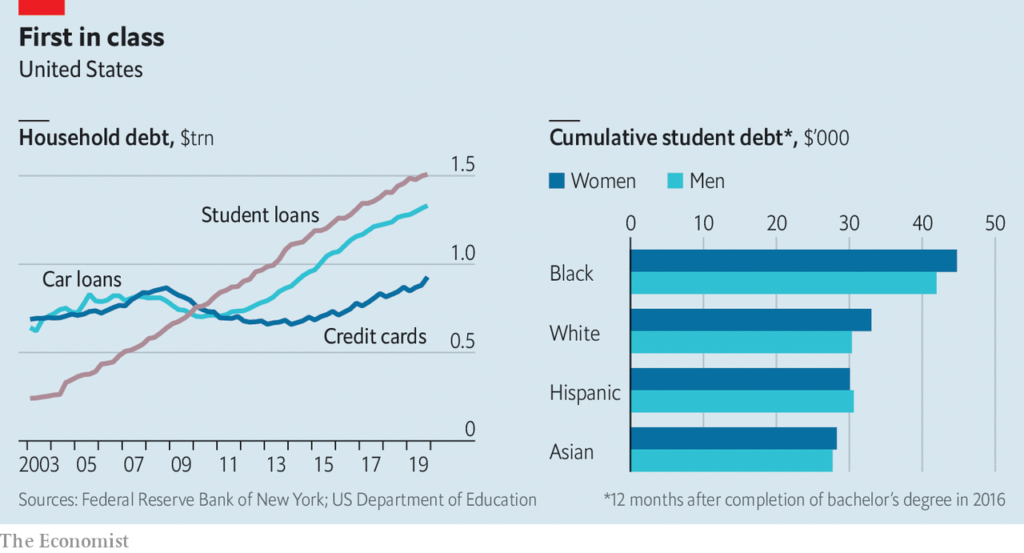
Third: the Economist offers their estimate of America’s total student debt: $1.5 trillion.

This isn’t news to my readers, but it’s a useful snapshot/refresher of a debt totaling

around 7% of GDP. Fully 45m Americans owe an average of $37,000; a fifth are struggling to make repayments. Despite making up 56% of the student population, women owe two-thirds of total debt.

student debt 2002-2019_Economist

Thank you for the sarcastic title, Economist.

So what can we take away from these three stories?

First, that American higher ed continues to be under stress, and that its leaders are working strategically.

Second, that cuts – or “freezes” – are on the table.

Third, that higher education finances are under particular pressure, and seem likely to remain that way for a while.

Note: I introduced the peak higher education theory to the world back in 2013.

(thanks to Stephen Landry)

Posted in research topics | Tagged | 7 Comments

Pandemic and academic possibilities: the coronavirus outbreak continues

I blogged about possible futures for the coronavirus on February 12th, then followed up by looking into possibilities for academia two days later.  How have things changed since?

In this post I’ll begin with a quick update on COVID-19 according to the sources I track, then I’ll focus on higher education.  Keep in mind that I’m working as a futurist, doing environmental scanning, building up forecasts, and drawing on many years of work on disease outbreaks conducted by futurists.

I: The coronavirus in the world

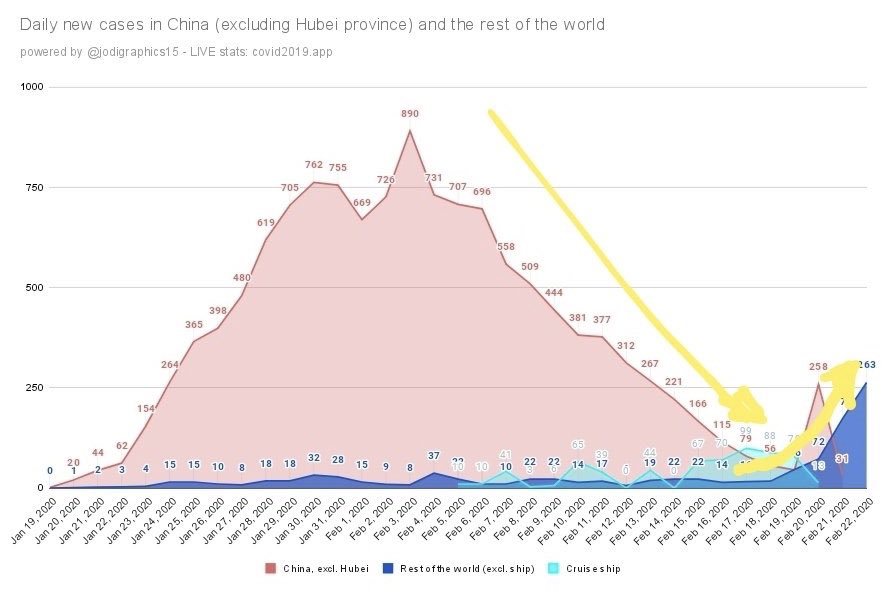
Overall, the number of new cases reported each day in China has decreased in recent days, while the opposite has occurred in the rest of the world.

coronavirus China vs world 2020 Jan19-Feb 22_Ding

As of February 22.

That graph is two days old.  Here’s the Johns Hopkins report from this morning:

coronavirus 2020 Feb 24_JHU

Case by case COVID-19 spreads beyond China.  Iran saw its first cases (with conflicting data), which in turn have driven new infections in Bahrain, Iraq, and Kuwait. South Korean instances doubled – on high alert, that nation will now test anybody there who shows any symptoms.  Instances in Italy have spread, leading to quarantines for several towns near Milan.  The CDC issued a travel warning for Japan as well as South Korea.

As a result, some experts and authorities are asking us to plan on the outbreak becoming a pandemic.  This is already spooking markets.  The World Bank’s Pandemic Emergency Financing Facility (PEF) – a fund designed to provide cash to fight this very kind of crisis – is actually dwindling, as investors reduce its value.

Supply chain worries are real, if not getting a lot of attention.  There is some quiet concern about the huge role Chinese industry plays in manufacturing “[a]bout 150 prescription drugs — including antibiotics, generics and some branded drugs without alternatives.”  Apple shifted some of its China-based production to Taiwan.

Geopolitics: the United States State Department accused Russia of spreading online disinformation about COVID-19.

More on data and information: the World Health Organization has set up a globe-spanning information gathering enterprise:.  They gather data worldwide:

The goals of global surveillance are to: 1) Monitor the global extent of the epidemic; 2) Provide early epidemiological information to support risk assessment at the national, regional and global levels; 3) Rapidly detect new cases in countries where the virus was not previously circulating; 4) Monitor trends of the disease after a first case is imported and; 5) Provide epidemiological information to guide response measures.

They draw on regional and national systems:

WHO regions implemented immediate reporting of COVID-19 cases through systems already in place – such as The European Surveillance System in the European Region, EMFLU in the Eastern Mediterranean Region, and FluNet in the Americas Region; or by setting up a new electronic data collection system (South-East Asia region).

And so there’s one civilization-wide point of information:

A Global Surveillance COVID-19 database centralizing all COVID-19 cases reported from outside China is maintained at WHO HQ, and data analysis is conducted daily to: follow the transmission of the disease between countries; describe the characteristics of human- to- human transmission within clusters of cases; describe the characteristics of affected persons and their exposure history; and support the evaluation of public health measures implemented in response to the epidemic.

I can’t find a public face for this yet.  I also have not come across assessments or critiques of this Global Surveillance System (what a title!).  If you have, please share.

In the United States the situation is unclear.  The CDC’s most recent statement is cautiously optimistic:

Imported cases of COVID-19 in travelers have been detected in the U.S. Person-to-person spread of COVID-19 also has been seen among close contacts of returned travelers from Wuhan, but at this time, this virus is NOT currently spreading in the community in the United States…

For the general American public, who are unlikely to be exposed to this virus at this time, the immediate health risk from COVID-19 is considered low.

In contrast, WHO deems total world risk as “high.”  The State Department and CDC fought each other over how to get cruise ship passengers home; the CDC lost.  An Alabama senator NIMBYed very hard claims  he got Trump to prevent sending any of those passengers to his state.

At the same time America’s unusual way of financing health care means a large number of uninsured people avoid seeking medical attention.  How will they react, what kind of care will they receive if COVID-19 hits them?  Perhaps a US outbreak will expand support for Medicare for All.

One potentially huge problem to consider: how will a coronavirus pandemic impact American elections this year?

“In the context of a public health emergency, you want everyone to be able to access the healthcare system,” [Matthew K. Wynia, a doctor and the director of the University of Colorado’s Center for Bioethics and Humanities] said. “You don’t want people with a contagious illness deciding, I’m too afraid.”

China offers one example, canceling its annual parliamentary meeting.

We are already seeing partisan responses to how America is responding to the outbreak.  This from a Democratic senator:

On a related point, will institutions suffer a further erosion of trust?  For example, should publicly shared statistics about infections and especially deaths turn out to be significantly lower than the reality, would this lead to criticisms and outrage aimed at authorities?  Consider how different institutions put themselves at risk by acting on this score: religious bodies, military organizations, medical professionals, alternative medical gurus.

On the flip side, as I wondered earlier this month, will we see those authorities expand their powers?  At least one financial site thinks that a worsening outbreak/pandemic can trigger government financial support to troubles industries, starting in China.  The IMF has made lending noises. Will American states and/or Trump use fears of coronavirus to arrogate power, even declaring states of emergency?  How will political fights play out within nations (cf this example from China)?

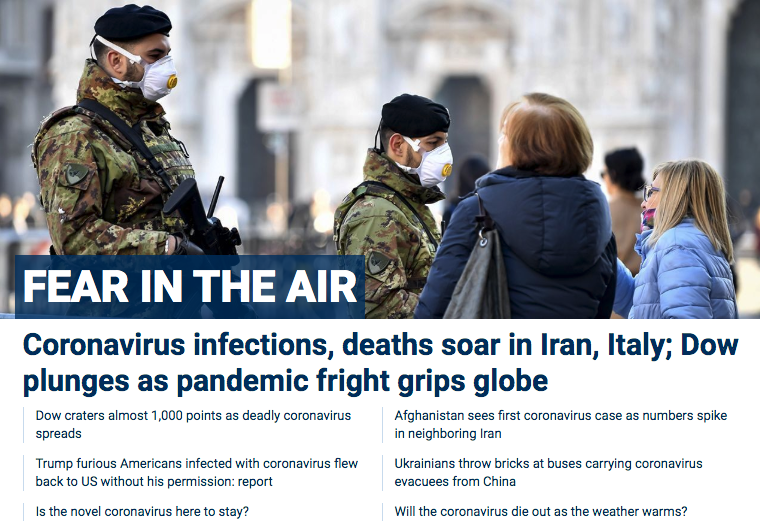
News media seem to have decided to inflate the fear bubble.  CNN.com now leads with coronavirus.  Here’s from Fox News’ main page:

coronavirus Fox News Fear in the Air

I am still keeping my eyes open for other short-term possibilities, like new business operations, alternative medical offerings, racism (against China, but watch Iran), technologies, citizen journalism (and its suppression), transnational spats, religious responses, misinformation and reactions, and changing mask practices.

Medium to longer term, I’m considering: changes in f2f meeting practices, accelerated migration online, more vegetarian/vegan diets, some political crashes, an economic recession, and new religious movements.

II: Coronavirus in academia

Italy closed several universities as the disease spread in that nation.

Chinese academia has been hit hardest of all.  As John Richard Schrock points out, exams, scholarly conferences, meetings, face-to-face classes, in-person research, in-person publication processes, degree completion, thesis and dissertation defenses have all degraded and slowed down.  The hugely important gaokao may be pushed back.  The title of Schrock’s piece: “Science has been placed on hold.”

Chinese classes moved online very quickly and at scale:

By 2 February, some 22 online curriculum platforms opened 24,000 online courses for higher education institutions to choose from, including 1,291 ‘national excellence courses’ and 401 virtual simulation experimental courses, covering 12 undergraduate programmes and 18 tertiary vocational programmes.

Shanghai Jiao Tong University launched 1,449 online courses, both live and recorded, for undergraduates and 657 for postgraduates, said Ding Kuiling, the university’s executive vice president.

Ding said the university launched 165 courses on platforms including the massive open online course (MOOC) system for Chinese universities so that students from all over the country can watch them for free.

Peking University said that beginning this week it was offering 563 undergraduate classes with 290 of them livestreamed and 101 video classes provided online via the university’s website, as well as 96 discussion classes via online group chats….

Some international students are still stranded in China. The outbreak has run long enough that some North African students who took classes in China have finished being in quarantine.  On a related note, at least one university system is lobbying its government to allow Chinese students to set foot on campus:

The director of Universities New Zealand, Chris Whelan, said the ban was not fair on the students. It also put about NZ$170 million (US$109 million) in fee income from the students at risk.

“From our point of view, it’s extremely serious,” Whelan said…

New Zealand’s universities are heavily reliant on foreign students, particularly those from China. In 2018, 18% of the students at New Zealand universities were full fee-paying foreign students and nearly half were from China.

The University of Queensland cut casual (adjunct) instructor hours (and hence pay) as enrollments sank.

I haven’t seen much in the way of reaction by American higher ed, at least on the teaching side.  One exception is how Duke’s Kushan (China) campus moved entirely online, led by Matthew Rascoff (a fine Forum guest, too) – very impressive!  How many other colleges and universities are quietly planning similar moves?

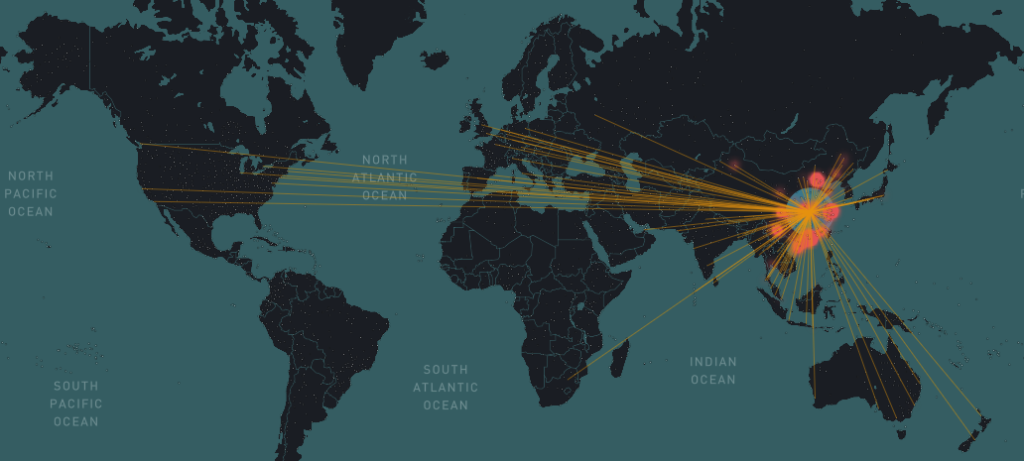
Research and resources: the University of Minnesota’s Center for Infectious Disease Research and Policy (CIDRAP) launched a COVID-19 online resource center. Northeastern University’s Alessandro Vespignani built a web tool to visualize possible links between travel bans and infection:

coronavirus_EPIrisk_2020 Feb 23

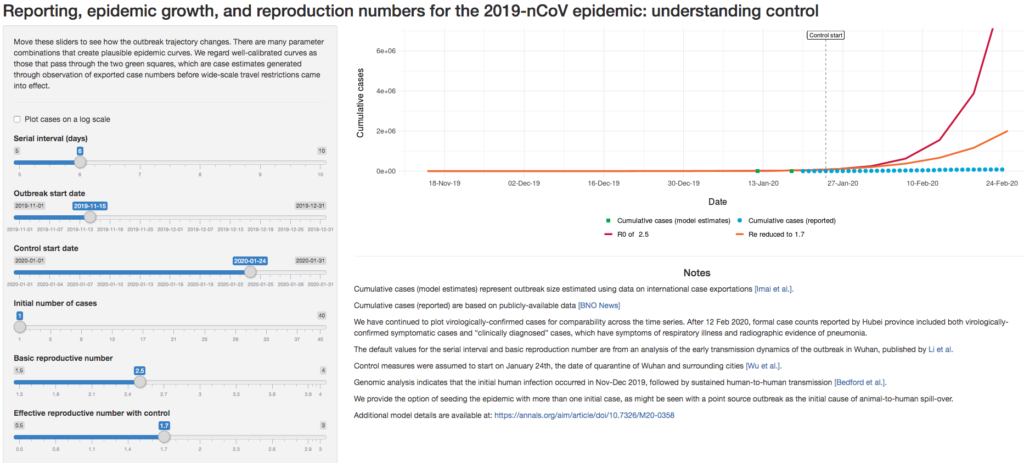
From the University of Toronto’s Dalla Lana School of Public Health comes another good web app, built by Ashleigh Tuite and David Fisman.  It lets you explore how this outbreak can grow depending on several key variables:

coronavirus web tool_Toronto

WHO has published a database of nearly 600 scholarly articles on and around the coronavirus.  (Tech note: they’re using Sharepoint, and post versions of this bibliography in a range of formats.)

If you are looking for more examples of higher ed coronavirus resources online, in my first academia-and-coronavirus post I linked to and described  bunch.

Academia and COVID-19 in the short term: I’m looking for more of all of this, from enrollment pressures to campus racism and more online work.

Medium and longer term: it’s possible that student bans will accelerate peak higher education in the US.  Online may tip into the world’s leading enrollment space, past f2f.  Geopolitical tensions may reverse academic globalization.

What are you seeing around you?

(thanks to my wife for links and discussion; thanks to Karin Fischer, Eric Feigl-Ding, Peter Rothman, and Art Fridrich for links)

Posted in coronavirus, research topics | 1 Comment

More queen sacrifices in Michigan, Texas, and Arkansas

American higher education continues to exercise the queen sacrifice strategy.  Here I’ll share three recent examples from across the country.

(If you’re new to the term, it’s one I’ve been using to describe a college or university strategy of cutting full time and especially tenure-track faculty members.  The term comes from chess, and describes giving up the most powerful piece one has in a risky play for victory.  In my analogy tenure-track faculty are the queens of the campus board, given their positions, their long-running status, and governance role.  You can find more examples and discussion here.)

University_of_Arkansas_at_Little_Rock_SealFirst up, the University of Arkansas-Little Rock (UALR) is planning on cutting faculty members.  Its chancellor asked the University of Arkansas system‘s trustees for permission to declare retrenchment status, which lets the institution remove faculty members:

a reduction in programs and/or services which results in the termination of employment only because of (1) a bona fide financial exigency or (2) formal academic planning including Board approved changes in institutional missions, substantial program changes…

Why is this happening? UALR explained thusly in a FAQ aimed at current students:

You are enrolled at UA Little Rock at a time when the higher education landscape is changing rapidly. A combination of flat state funding and a decline in enrollment has required us to make tough decisions about how to remain competitive in the future.

Yes, enrollment and financial pressures, according to the Northern Arkansas Democrat-Gazette:

A decade of declining enrollment has forced UALR officials to look for ways to trim the university’s budget. This year the university will come up more than $10 million short of what it actually budgeted, after years of falling enrollment and basing budgets on enrollment projections that were too optimistic…

Dropping enrollment, largely treated as temporary by previous leaders, over the past decade has hit UALR hard. With more than 13,000 students in 2010, UALR counted about 9,600 enrolled in the fall of 2019, about 1,100 of whom are high school students paying lower tuition.

Chancellor Dralle also added weak state funding to the rationale.

Which programs and professors are to be removed?  It’s unclear now.  If the trustees grant the request, then a process unfolds, whereby “university leaders conclude campus meetings, leadership meetings and vetting programs through established procedures…”  Faculty may play a role in that process:

Amanda Nolen, president of the faculty senate, said she expects members to play a “central role in reviewing and making recommendations on any proposed academic program deletions or modifications.”

Drale described this process in terms of prioritization: “This review will also allow us to focus on our strengths and prioritize our investments in the future.”

HSU_SealNext, Hardin-Simmons University will cut a series of degrees and programs, along with a group of faculty members.

On the block: “17 faculty positions will be cut from these programs, and additional faculty reductions are forthcoming from several of the remaining programs.”

Programs facing the ax include:

Doctor of Ministry, Master of Arts in Family Ministry, Master of Arts in Religion, Master of Divinity, Master of Education in Gifted and Talented Education, Master of Education in Reading Specialist Education, Master of Music in Church Music, Master of Music in Music Education, Master of Music in Music Theory and Composition, Master of Music in Performance, Minor in Music on the M.Ed. degree, Bachelor of Business Administration in Banking & Financial Services, Bachelor of Business Administration in Nonprofit Management, Bachelor of Business Administration in Public Administration, Bachelor of Music in Theory and Composition, Bachelor of Science in Human Sciences in Physical Education, Minor in Biblical Languages, Minor in Leadership, Minor in Sociology, Minor in Spanish, Express Teacher Certification, Master Reading Teacher Certificate

At the same time, “14 administration and staff positions have been eliminated, with additional positions to be cut in the future.”

What’s the reason for these reductions?  According to Inside Higher Ed, “[President Eric Bruntmyer] said the cuts were made due to financial difficulties, to help close a $4 million deficit.”

These cuts occur two weeks after HSU announced it would shut down its Logsdon Seminary.  Two years ago the campus cut other programs, faculty, and staff.  It seems that these financial difficulties are long-standing.

(Hardin-Simmons trustees also committed to donating $100,000 to the campus at their February meeting.)

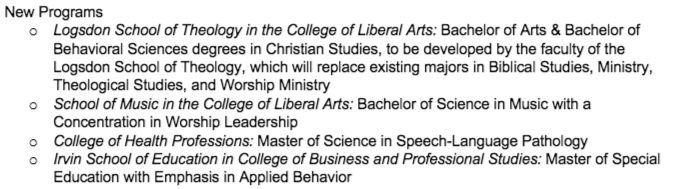
According to a document linked from the Big Country News story, the university is also adding some programs, as per the queen sacrifice model:

Hardin-Simmons new programs

KCAD logoOne more: Kendall College of Art and Design (KCAD) will combine some programs and end another.  First, “[t]he current Industrial Design, Furniture Design, and Metals and Jewelry Design programs will all be combined to create the Product Design program.”  Second,

Kendall also plans to merge the Fine Arts programs — Photography, Drawing, Sculpture and Functional Art, Printmaking and Painting into a new degree program. That change does not have a set timeline yet.

At the same time,

The school also plans to suspend enrollment of its Art Education program and eliminate the program entirely no later than Spring 2022. The two Art Education faculty positions will be eliminated as current students finish their degrees.

There’s also an administrative cut in the works:

The college also reviewed its current staffing levels. According to a press release, that review found a “heavy ratio or administrative support and director-level positions compared to faculty positions.”

The college said it plans to eliminate four staff positions as well.

The cause?  Enrollment decline, according to Inside Higher Ed.  KCAD’s Wikipedia article notes that “[t]here were 1,459 students enrolled at KCAD for the Fall 2013 semester.  By 2020, enrollment had dropped to 832.”  MLive states that the Art Education program suffered a spectacular plummet, having  “experienced a 62% decline in enrollment the past five years, the college said. Currently, only 18 students are enrolled.”

The institution’s president blamed this on local conditions, especially demand for education:

“If we look at education programs across Michigan,” said McCrackin, “they’ve seen as steep decline of roughly 7%. Our education program in the past five years has seen a decline by 62%. We have a fabulous program, but without students we don’t have a program at all.”

There’s also a sign of administrative efficiency in the official explanation for merging those programs.  “[Kendall College interim President Tara McCrackin] said the merger makes sense because those programs have already been working together.”

KCAD’s history is fascinating.  It started off as a two-year design program nearly a century ago, then grew with the general American higher ed boom in the 60s and 70s, adding four-year and graduate degreed.  In 2000 is merged with Ferris State.

Taking a look at these cases, what can we learn?  What do they tell us in connection with other queen sacrifices and cuts?

  • These are very different institutions.  One is arts and design, another’s deeply religious, and a third is a general, public university.  Each has its own (fairly long, for US academic) history and local context.  Each one is following a different path for implementing these cuts.   Yet they all suffer from the same challenges: declining enrollment and concomitant financial pressures.  They are also all weighing individual programs for student interest.
  • Education joins the arts as a popular target for cuts.  I would link this with demographics, as decreasing K-12 student populations don’t exactly trigger a boom for teachers, especially in the midwest.  In addition, the current climate sees teachers as undercompensated and generally ill-treated.
  • These cuts address present and recent challenges.  They aren’t so much aimed at anticipating upcoming problems.
  • I hesitate to link Hardin-Simmons’ woes with changes in American religious affiliation, especially for younger people.  If that university’s primary audience is Texas, they should surely have no shortage of religiously-interested students.  But perhaps there’s a ripple effect in play, with religious institutions nationwide competing for a shrinking pool of applications overall.

(thanks to Lee Skallerup-Bessette for one story; others via Inside Higher Ed)

Posted in research topics | Tagged | 2 Comments

Essential Films for Technology and the Future 101: a syllabus

What are the best movies for thinking through the future and technology?

This topic came up on Twitter after I realized a disturbing number of my students had seen neither 2001: A Space Odyssey nor Soylent Green.  After some expressions of proto-geriatric dismay people encouraged me into this wild declaration:

That’s what this post is about.

To explain my criteria: these are movies that give us much to think about when we consider technology and the future (at the time of production).  Each should explore one of more themes along those lines.   Some are cultural touchstones, at least for certain population.  On top of that, each is at least good if not marvelous to watch.

I also tried to pick films from a range of times and places.  The first example is from the 1920s, while the most recent ones are from the past few years.  While Hollywood is overrepresented, Germany, France, Japan, and the Soviet Union each have movies here as well.

I have excluded certain films and videos for reasons of clarity.  All that follow are works of fiction, as documentaries would constitute a different list.  All are feature films, as they have the time to develop arguments at length and explore worlds; short films are great, but deserve their own category.  I’ve also ruled out television, because that is a vast and distinct cosmos.  I have also resisted the temptation to extract fine scenes from otherwise underwhelming films, like the apocalypse/old tech closing scenes of Terminator 3 (2003), the far future coda to A.I. (2001), or the interface scenes from Minority Report (2002) and the Iron Man movies (2008 et seq) – although it would be a fun project to assemble such a future tech scene anthology/highlight reel.

For each title I offer reasons why I think the movie is interesting for thinking about technology and the future.  These are only a few reasons and notes, not histories of the films or reviews. In the overall list I tried not to repeat themes too often (i.e., not too many movies about AI, not too many dystopias, etc.), so each movie’s entry also has related films that are worth watching.

I’ve arranged them in chronological order because that’s how I roll.  Think of this as a timeline of how film imagined future technology over nearly a century.

I’m not teaching such a class, but I’d like to someday.  Maybe I should follow Jim Groom’s suggestion and set it up as an open class.

Essential Films for Technology and the Future 101
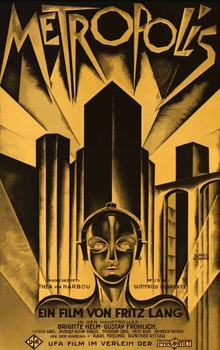
Metropolis posterIt’s astonishing how much the next century of technology movies depend on Metropolis (1927).  Fritz Lang and Thea von Harbou shotgunned the screen with trope after trope that viewers have recognized ever since.  There’s an alluring/sinister robot.  There’s videoconferencing.  There’s the vast, all-encompassing, and fascinating future city, riffed on by many directors since like Ridley Scott and George Lucas.

And there’s class struggle fought with and through technology.  It’s deep Wiemar, complete with Marxist gangs and a Hegelian finale, but the detailed depiction of social groups separated through machines echoed down the decades since.

Runners-up: Aelita (1924), Frankenstein (1931), Things To Come (1936).
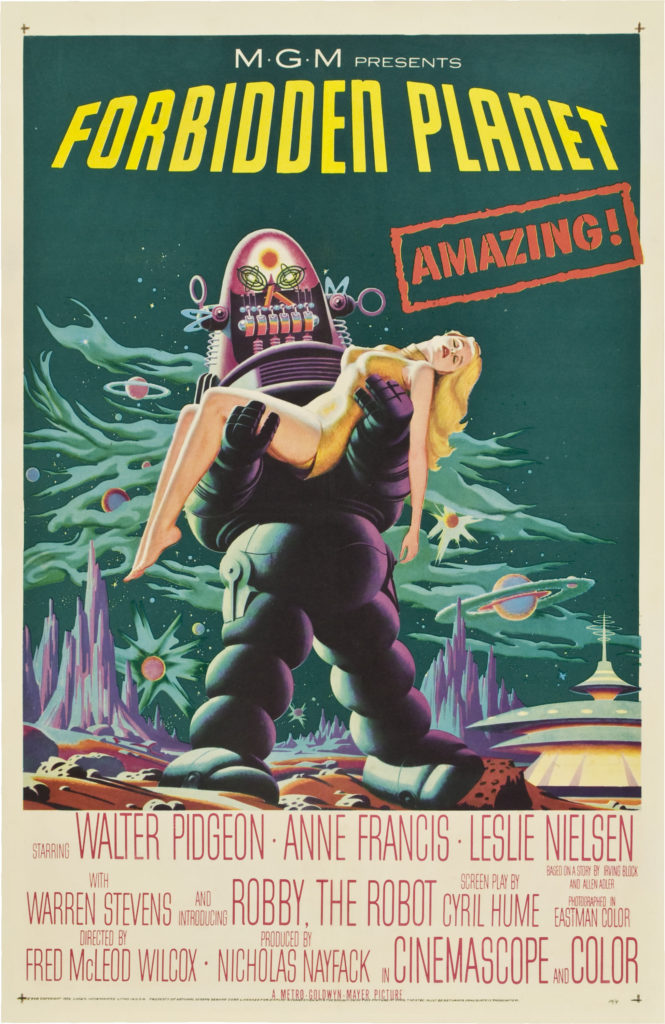
Forbidden planet posterForbidden Planet (1956) is remarkable for what it turns upside down.  Our protagonists arrive at their destination not in a rocketship, but in a flying saucer (recall that the term was only invented nine years earlier).  There’s a huge and scary robot who turns out to be friendly and beloved by fans ever since.  A mad scientist has built a giant computer, but is imprisoned by the literal realization of Freudian psychoanalysis.  Did I mention it’s also a riff on The Tempest?

It’s also a movie that never really lets us escape technologies.  Our protagonists live within a spaceship, and the mad scientist and his daughter live in a crazed modernist fantasy facility.  The alien planet is desolate and we don’t spent much time out of doors.  The planet might be forbidden, so we spent the rest of our time amidst gadgets.

Runners-up: Rocketship X-M (1950), Destination Moon (1956).

Desk_Set_cinema_posterDesk Set (1957) is a delightful Tracy-Hepburn comedy about automation and information technology.  The plot is based on a business attempting to replace a human (all women) squad of reference specialists with a pair of giant computers, and the romances around it.

There’s an awful lot going on here, way ahead of the curve.  We can see early signs of the library professional grappling with the digital world.  There are cultural clashes between different occupational norms.  Inevitable is the question of how, when, and why should computers replace humans.  There’s the gender angle, of male-driven tech taking over for women in a feminized field.  And we can see social class connected to it all, from the structuring of relationships to a pretty stark hierarchy of power.

And it’s a lot of fun from start to finish.
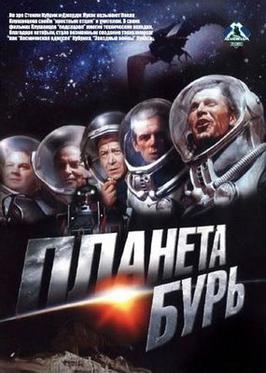
Planet of Storms posterSeen one way, Planet of Storms (Планета Бурь, 1962) looks like a standard mid-century space adventure.  Heroes take a rocketship to explore an alien planet.  Things go wrong and adventures ensue.

Viewed another way, Планета Бурь offers a different take on that theme, because it’s a Soviet film.  First off, while it draws on western film tropes to an extent, it simply looks different.  All kinds of design elements offer alternative takes on what non-Soviet viewers would expect, from robots and spacesuits to clothing and landscapes.

For another, being a Soviet film, it advances an unsurprising ideology.  Characters argue about the logic of history, human development, profit versus communism, and so on.  The mission is a collective one, more important than any single character -again, not like usual Hollywood fare.

Worth viewing on its own, Planet of Storms offers an unusual take on technology and the future.  And I’m convinced one of the Terminator films ripped off a character’s death scene.

Runner-up: the utterly insane Planet of the Vampires (Terrore nello Spazio, 1965).

Alphaville1965

Alphaville (1965) gives us technological dystopia, but of a particular kind.  Its world is glossy and stylish, utterly cool.  It’s also film noir, complete with trench coats, fedoras, and arabesque smoking, decades before Blade Runner.  A computer gone wrong runs Alphaville, but a bad place has never looked so good.

The low budget Goddard worked with gives us an unusual science fiction vision, bereft of massive special effects.  We’re not really in a different world at all. Instead we get a world we might have wandered in to by visiting the wrong office park.  Characters reference mid-20th-century history (Werner von Braun, Ford Galaxy cars, Gaudalcanal) – i.e., the contemporary world. It’s an intimate, accessible imagination of dark technology.

About the AI: Star Trek fans will be familiar with a hero talking a computer into submission.  And that computer’s voice!  Spoken by a war veteran who was shot through the throat, it’s impossible to forget and has never been surpassed.  Only HAL has come close.  And speaking of which…
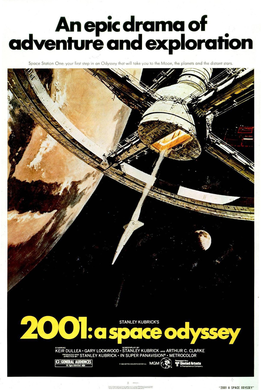
2001_A_Space_Odyssey_(1968)2001: A Space Odyssey (1968) is for many people the ultimate vision of scary AI.  HAL 9000 (his name Clarke’s cute code for “IBM”) begins as supremely competent and supportive, always available to help, like a prototypical Siri or Alexa.  His turn – never explained in the film, but clearly outlined in the novel – gives us scenes of Kafkaesque frustration and nightmare.

2001 also gives us glorious visions of space travel, with plenty of vehicles soaring through the void.  Kubrick famously shows lyrical flight, quotidian travel details, and realistic physics.

The film is crammed with technological innovation.  Videoconferencing, tablet computing, image recognition, AI ethics, rotational gravity – there’s so much here.

Runner-up: Silent Running (1972).

Colossus_the_forbin_project_movie_poster (1)Colossus: The Forbin Project (1970) plunges us right into the Cold War and never lets us escape for a moment.  Nearly every scene immerses us into nuclear war’s vast and terrible machinery.  Soldiers, functionaries, politicians, and scientists of war are our cast, while MAD facilities are our setting.

It’s an AI movie, famously, with a weapons-controlling program bootstrapping itself into global hegemony.  This is a theme well established in print. My own favorite is Harlan Ellison’s searing “I Have No Mouth and I Must Scream” (1967).

It’s also a posthuman movie.  Colossus is clearly beyond humanity in most ways, and leaves us in the dust.  We invent our successor, and live to service its triumph.
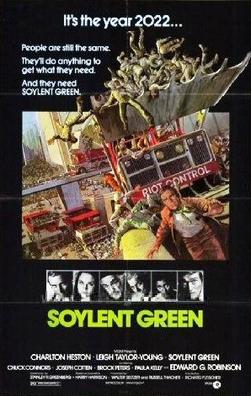
Soylent GreenFor all of our talk about overhyping tech’s positive possibilities, it’s clear movies have always loved technological dystopia. Soylent Green (1973) gives us one of the most famous such, this time based on contemporary fears of Malthusian overpopulation.  The human race has overshot Earth’s carrying capacity, so we’ve jury-rigged all kinds of technological stopgaps: bicycling to power electrical lights, synthetic foods (no, wait), assisted suicide facilities, and (yeah) synthetic foods, Swift style.

Soylent Green is also profoundly about inequality.  You can’t get much starker than the rich having poor slaves (called “furniture”), and the latter being eaten as food.  It’s an updated vision of Wells’ Morlocks and Eloi.

Note as well the role of oceans in the film.  This is an environmental film.

It’s based on Harry Harrison’s better-titled novel Make Room! Make Room! (1966).

Runners-up: THX 1138 (1971), Z.P.G. (1972), Rollerball (1975), Logan’s Run (1976).

Blade RunnerLike Alphaville Blade Runner (1982) is film noir, but a generation late.  The main technology in view is robotics so good as to fool most humans.  Every scene from start to (famously fraught) finish presses hard on the question: how should people treat the autonomous creations we invent?  In that sense the movie’s real ancestor is Frankenstein.

Other technologies fill the screen, starting with an iconic update of Metropolis.  Los Angeles is dark, crammed, transnational, impossible to encompass, striated by inequality.  It is filled with an Ixian array of machines beyond robots: videoconferencing, humanity detectors, flying cars, nifty guns, street electron microscopes, synthetic life with trademarks stamped at the molecular level, voice interfaces, photo analysis software…

While a box office and critical failure when it appeared, Blade Runner has become one of the most influential sf films of all time.  So imitated, in fact, that it’s hard for current audiences to grasp how fresh its vision was at the time.

Nausicaä of the Valley of the Wind posterNausicaä of the Valley of the Wind (風の谷のナウシカ, 1984) takes place in a far future, when life on Earth has changed in deep ways.  Human civilization has shrunk and new lifeforms populate the world.  In this setting a clash over technologies and power erupts.

This is fascinating for our purposes on several levels.  First, it’s deeply ecological, intertwining every human and technological question within natural, nonhuman systems.  Second, the technology is very strange.  Not only do we see a mix of high and low, new and old, but it all blends with biology.  Third, it’s unusually gynocentric for most movies about tech, as it turns on a struggle between two women.  Fourth, like Dune or Star Wars it builds up fantasy elements – mostly social and cultural – on top of science fictional devices.

It’s also beautiful and eerie.
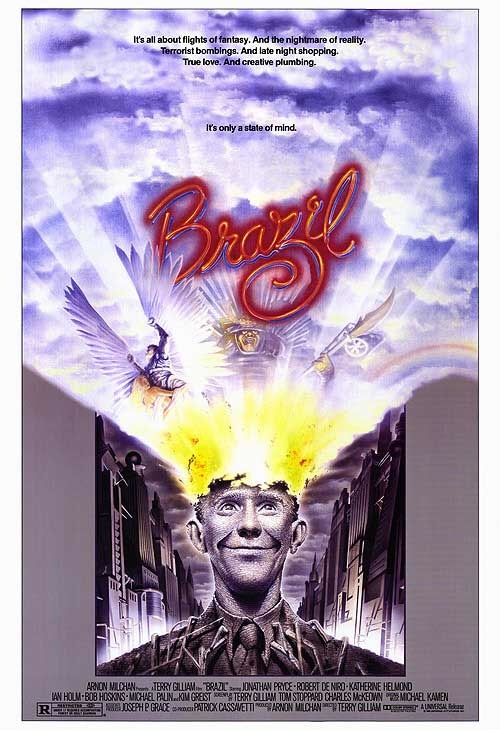
Brazil movie posterBrazil (1985) gives us one of the best realized technology-enabled dystopias.  Terry Gilliam exquisitely crafts a bureaucratic nightmare, elaborating on it with sadistic detail.  At the same time Brazil is profoundly, obsessively, finally about the power and failure of imagination.

All of this is carried across by a rich technological vision.  On the one hand we see advanced tech: cityscapes to rival Metropolis; maintenance suits close to Apollo’s; computer games; digital files; synthetic and advertised food.  On the other we fall back on older tech, which litters Brazil‘s world: black and white tvs, literal paperwork, pneumatic tubes, typewriters (the movie kicks off with a typo, which is really a bug).  It’s a realistic combination for a movie usually deemed fantastic, recognizing the dogged persistence of old tech amidst the new.
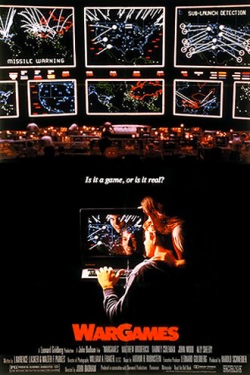
Wargames posterWarGames (1983) returns us to the Cold War, but from the point of viewer of innocent bystanders, rather than its directors.  That conflict’s final brush with apocalypse forms the background and foreground alike for this film.  Like its contemporaries The Day After (1983) and Threads (1984) WarGames takes us from home to HQ, rural cottages to military command.  Its technologies are that of total annihilation – and playing games.

Yes, this strange movie is also a meditation on gaming and play.  A military computer to simulate or game WWIII has gotten a bit out of control, which leads to eerie scenes of terrible innocence and logic, armageddon amidst a quiet game of chess.  Game theory hangs over the entire plot.

This movie also emphasizes and helps introduce the character of the very young hacker.  It’s a generation gap film, really a young adult story, and those demographic clashes create some of the plot’s energy.

Runners-up: The Terminator (1984), Hackers (1995), Sneakers (1992), Starship Troopers (1997).

They Live (1988) is a cult favorite for a few reasons, including a ludicrously long fight scene and an unabashedly anti-Yuppie, pro-homeless and working class politics. I’m citing it here because of its most famous scene.

Our nameless hero finds a mysterious pair of sunglasses.  When he puts them on the world turns black and white, but also reveals hidden messages behind most media.  Billboards and magazines turn out to subliminally command viewers to OBEY, MARRY AND REPRODUCE, or have NO INDEPENDENT THOUGHT.  Dollar bills read THIS IS YOUR GOD.

It’s a fantastic, dizzying scene. I’ve used it to introduce Marxist analysis to students.  As a technology, it offers a fun take on augmented reality. It also argues for technology as a liberatory force.

Ghost in the ShellGhost in the Shell (1995) grounds technology in the world of future crime and law enforcement.  It’s a kind of police procedural, as a special police unit hunts a powerful criminal hacker amidst a swirl of geopolitics.

The film is saturated with technology of all kinds, from its own version of cyberspace (with its own lingo) to Metropolis-like cityscapes, camo fields, sentient tanks, robots, new media, and more.  Central to the plot are officers who are cyborged to various degrees of tissue replacement; their nature is meditated upon.  Hacking is part of their  basic cop m.o., and also part of their bodies.

The original film was visually fascinating and had a fine soundtrack.

Runners-up: Akira (1988), Enemy of the State (1998), Tetsuo: The Iron Man (鉄男, 1989), Robocop (1987).
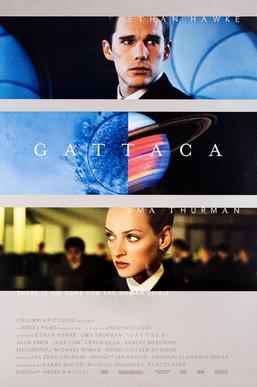
Gattaca posterGattaca (1997) is possibly the most interesting movie about biology, technology, and innovation.  The plot concerns a bio-social hack, as a genetically compromised man fights to trick his way into a biologically elite space program.  Along the way we learn about a society deeply structured by inequalities driven by genetic science.

It is in many ways the most thoughtful and interesting film about the ways we could use and misuse genetics, and is widely taught, from what I can gather.

Note how the movie’s ultimate purpose is to send a person into space, and how only a few seconds are concerned with that actually happening.  Gattaca is a sign of the decline of human spaceflight.

Runners-up: Andromeda Strain (1971), Demon Seed (1977), The Fly (1986), Okja (2017).

The_Matrix_PosterIt’s a bit daunting to realize just how brilliant and ambitious The Matrix (1999) was.  It may be the perfect cyberpunk film, deeply embracing that genre and taking it to fine extremes.  It’s also a lyrical ode to virtual reality’s first wave, not only realizing it in detail but taking VR’s ontological heights to political levels.  And it’s the best visualization of Plato’s Cave I’ve ever seen.

It may be the high point of cultural imaginings of the hacker.  Neo becomes the savior of humanity and reality itself, having won the ability to reprogram the world’s basic stuff.  Over the next two decades hackers have fallen, I think, down to techbros.

There are no sequels.

Runner-up: Total Recall (1990), Open Your Eyes (Abre los ojos, 1997), The Truman Show (1998), π (1998), Inception (2010).

EXISTENZ postereXistenZ (1999) asks us to imagine a different world, one where we have virtual reality and gaming – just built not with silicon-based tech, but entirely through organic devices.  Mad genius director David Cronenberg pursues this unusual vision with gusto, giving us a wide range of biological machines, from game controllers to implants to “factories.”

I think this defamiliarizes classic technology problems (what is reality? when is a device too intrusive? what do we lose when engaging with media?) and makes them sharper, more interesting.  It also lets us rethink the disturbing and uncanny aspects of the digital world that we have grown accustomed to.  And there’s the sheer disgusting joy in exploring this organic tech’s ecosystem in full squicky detail.

Eternal_Sunshine_of_the_Spotless_Mind

Eternal Sunshine of the Spotless Mind (2004) asks us to consider how we might use the ability to edit our memories.  Cleverly, this is not so pompous or grand as that question suggests, as the film focuses on a handful of people using memory deletion to attempt to feel better about their relationships.  Ultimately, it’s a kind of tragic/romantic comedy.

Things don’t turn out well.  The technology keeps having errors, especially thanks to operator misuse.  Users overdo it and their sense of reality starts to fray.

Ultimately the tech and its uses lead the film to question the role of memory in human identity, with a big helping of wondering at predestination.
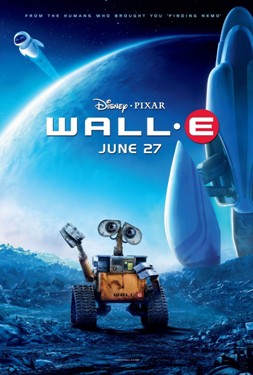
WALL-E posterWALL-E (2008) is another ambitious film.  It begins with a vision of a devastated Earth, literally trashed by tech-enabled human consumerism.  It then adds a post-planetary humanity drenched in said consumerism as a tech-enabled mock-utopia.  From these dark worlds it offers a slim hope of non- or even anti-technological promise.

WALL-E explores the theme of old tech’s persistence, especially when contrasted with the triumph of the new.  It manages to invest us emotionally in crusty old tech, while teaching us to fear, then desire the new.  Pixar has an incredible way with audience emotions.
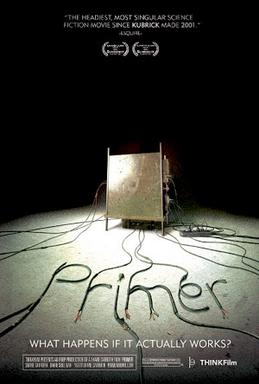
 

Primer_(2004_film_poster)Primer (2004) is in some ways a pure science fiction movie.  It’s about two friends who invent a new thing and what happens next… and that’s about it.  We don’t see the society around them.  No political issues, no romances, no action scenes occur.  It’s purely about technological invention.

It’s also not an easy movie to get into, because it proceeds quickly and without a lot of pedagogy.  Our protagonists talk about their invention and how they engineer it quickly, to each other, without pausing for the audience to catch up.  Much is done visually, without oral or textual explanation.  It’s a good example of the “hard sf” subgenre.

Like Alphaville Primer had a laughably low budget, so it snuggles right up to our world without any transition.  Key scenes take place in storage units and suburban house hallways.  You can easily imagine these two young men bootstrapping time travel in the next county.

Runner-up: Tucker: The Man and his Dream (1988).
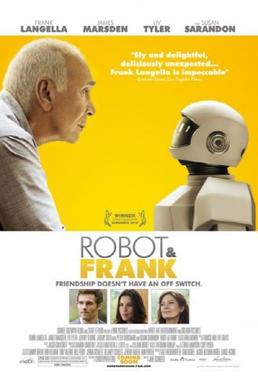
Robot_and_frank_posterRobot and Frank (2012) flips Wargames on its head, as the main tech user is very old, rather than very young.  That’s the plot’s main point.  Frank is retired and his adult children worry that he can’t take care of himself, so they buy him a companion robot.  In a way it’s the ideal movie for our geriatric century, as populations age up: the anti-Soylent Green.

Rather than pondering the nature of intelligence, the film explores the relationship between user and machine.  Frank is initially hostile, especially when the bot tries to teach him to change his diet, but comes around when encourage to teach the bot some of his skills.  You see, Frank’s profession was that of burglar… so once again we return to technology and crime, but in a very genial manner.

Runner-up: Moon (2009).
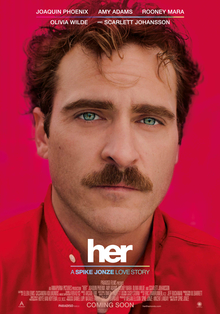
Her poster Her (2013) revisits the conclusion of Alphaville by asking us about love and automation – specifically, to imagine a person falling in love with an AI.  Our protagonist is a lonely and withdrawn man, but opens up to his phone’s “operating system.”  The movie follows many classic romantic tropes: increasing intimacy, growing physicality, awkwardness when the beloved and friends connect, jealousy, all done by what is essentially a lone actor interacting with a voiceover.

At the same time it pushes hard on our imagining of AI, seeing it not as a cold enemy but a warm friend and lover.  Indeed, at several points in the film humans come off as inferior to Samantha.  That feeling builds until the concluding posthuman moment.  (That’s set up by several quiet glimpses of lone people besotted with their mobile devices.)

*The hero is named Theodore Twombly.  Besides being fun to say, I can’t help but be reminded of The Twonky (1953).

Runner-up: Ex Machina (2014).

Snowpiercer_posterBefore Parasite there was Snowpiercer (2013), Bong Joon-ho’s first lacerating take on inequality.  While Parasite touches on technology, Snowpiercer is drenched in tech from a wide range of time and domains.  It all takes place on and around that signal nineteenth-century machine, a train, as it hurtles endlessly through a ruined landscape, powered by very new and very old resources.  Some characters enjoy the benefits of a new type of food (a gelatinous nod to Soylent), while others relish living within an aquarium.

Again we explore that mix of old and new technologies, asking questions about what and how we choose to use.  Again we see inequality starkly enforcing the smallest details of human lives.
The Martian movie posterThe Martian (2015) is an optimistic movie, a can-do ode to DIY in space.  Our titular stranded character has to follow Robinson Crusoe by building up enough of a mini-civilization to survive, before being rescued.  That theme is important enough to add it to our list, given contemporary obsessions with dystopia.

The range of technologies are interesting.  On the one hand this is a story about space travel, so we see advanced tech: a fine spacecraft, custom-created housing units for the Martian surface, cutting-edge computers.  On the other, Watney begins with very little, and starts with agriculture (so this is a movie in part about biology).  Step by step he adds other bits of kit: plastic sheeting, tarps, remnants of busted devices, repurposed machines.  It’s like a maker space on Mars.

It’s also passionately optimistic about space travel, which isn’t something we’ve seen much of since 1990.  For comparison, see Gravity (2013).
The_official_poster_for_the_film_Hidden_Figures,_2016Some of the best visions of the future come from history.  Hidden Figures (2016) rights a historical wrong by reintroducing key players at the start of American spaceflight: black women mathematicians.  Their struggles to be taken seriously, as professionals and human beings, are the core of the movie’s drama.

At the same time it’s also a film about grappling with technology.  Our “computers” crunch a vast amount of numbers with pen, pencil, and whiteboard, turning at times to then cutting-edge calculators.  Then one becomes the programmer of what we now recognize as a computer, going on to manage a swarm of coders.  Hidden Figures is about the birth of modern computing.

And it’s about spaceflight.  We don’t follow Mercury capsules into orbit so much as see how they were set in motion.  It’s fascinating and heartening to see space travel viewed so aspirationally today.


Films I haven’t seen that could be contenders:

  • Ikarie XB-1 (1963).  I’ve heard great things and I adore Lem, the source of the movie.  I just haven’t had access to a good copy.
  • The Imitation Game (2014).  Over the past year I exceeded my Cumberpatch tolerance.  Is this worth seeing?
  • I haven’t seen any of the Neon Genesis Evangelion movies, although I’ve watched some of the series.  Do they work for our purposes?

Likely movies I excluded for various reasons:

  • Avatar (2009): far more interesting for its production tech than for, well, just about anything else.
  • Elysium (2013): what a great idea, so badly executed.
  • The Social Network (2010): not only is it bad history, but it’s really a horror film.  Good example of hating hackers.
  • Sunshine (2007): so many good scenes in a movie nearly entirely set within technological artifacts.  But it was undone by that stupid final act.

What do you think of this list?  Am I unfair to the runners-up?  Would you like to add to the list, or use it for a class?

(thanks to multiple friends on Twitter and Facebook; They Live Poster credit to By http://www.impawards.com/1988/they_live.html, Fair use, https://en.wikipedia.org/w/index.php?curid=6690694)
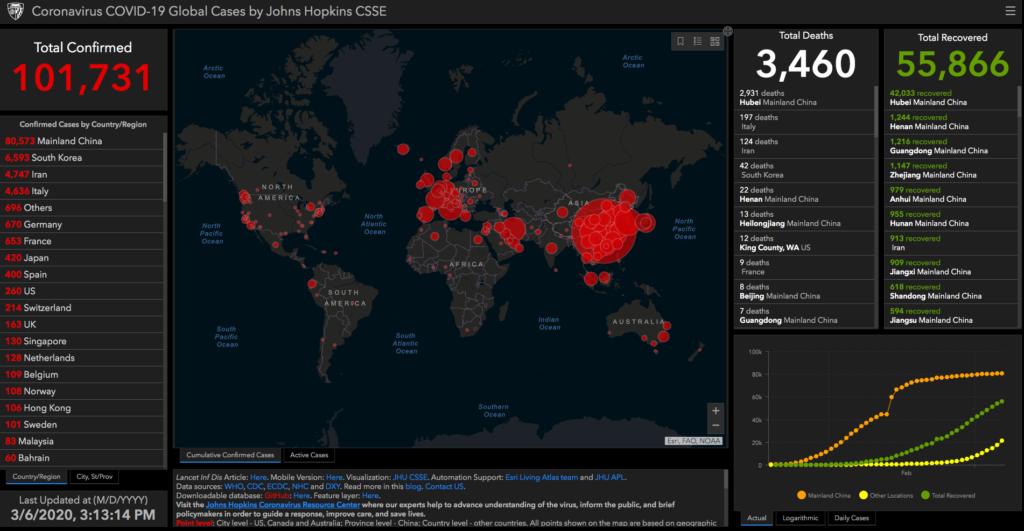
Posted in movies, teaching | 28 Comments

What might the coronavirus mean for higher education?

Yesterday I blogged about the possible future paths of the coronavirus outbreak.  Today I’d like to ask: what does all of this mean for academia?

I’ve been thinking about this problem for years, actually. Disease outbreak futuring is a longstanding thing. I also find it useful for getting people to think more creatively about education, since it’s a deep and unusual idea to bring to the academic table.  A year ago I led a short workshop session on this for Georgetown’s new Learning, Design, and Technology students.

Today I’ll break the topic into a series of subtopics for the present and very short term, then speculate about how they might shape the future of education looking further ahead.  And check the previous post if you have questions about COVID-19 in general.  Lots of links there.

Some of this will be sketchy, as things are developing quickly, and facts on the ground may be hard to discern in the moment.

Academics as public players The coronavirus is an opportunity for us to bring intellectual firepower to bear in helping ease the crisis.  There are plenty of examples already, like Imperial College London’s report series, this University of San Francisco explainer or this Johns Hopkins University visualization:

Coronavirus JHU 2020 Feb 13

Academics in public intellectual roles can do a lot of good. Or at least get a lot of attention through social media, as Eric Fiegl-Ding (Harvard Chan School of Public Health) has done (and to be fair, he’s tweeting very well now). At least two Chinese academics – law profs, both – have spoken and written publicly to criticize their government’s handling of the crisis.

Naturally some academics are energetically researching the disease.  For example,

Researchers from multiple organizations, including the State Key Laboratory of Respiratory Disease under Guangzhou Medical University, have successfully isolated a strain of virus from swab sample of an infected patient’s feces, said Zhao Jincun, a member of Chinese respiratory expert Zhong Nanshan’s research group, at a press conference Thursday.

The swab sample was provided by the Fifth Affiliated Hospital of Sun Yat-Sen University, said Zhao, also a professor with the laboratory.

I easily found more instances of this, like one from Hong Kong’s Polytechnic University and another from the University of Pittsburgh.

Georgetown library_wipes sign

From Georgetown University’s Lauringer Library.

Changes to campus life On the ground, campuses will take steps to protect their populations, with different strategies and implementations.   Closing a school for any length of time is one big step.

Some may reduce student, faculty, and staff travel, either in general or, more likely, to regions deemed especially infection-prone.

Related to this, campus operations may suffer a loss of capacity as employees stay away, either from illness or fear thereof.  Think of what happens to instructional staff, public safety officers, medical staff, financial staff, residence life staff, and so on.  Add to this the mental health stress on students bodies already prone to anxiety and depression; how will they fare when counselors run short?

Schools may also implement quarantine measures within parts of, or the entirety of, a campus. As Jay Sieling points out, “Given the high R factor, on campus housing becomes a hotspot for potential spread.”   Campuses aren’t great places for social distancing.  Princeton asked students who visited China recently to self-quarantine.

Others may expand on-site health care offerings at all levels, from advice and basic supplies to adding facilities. This could stress an institution’s capacities, especially if an outbreak takes place. (credit to Jay Sieling)

Clear and rapid communication will be key.  Alas, academics are not always good at this skill.

Face-to-face classes may decline in popularity, or administrations could just suspend them.  We’re already seeing this in China, which just canceled some major exams.  This can lead to an uptick in distance learning in various forms (asynchronous, synchronous).

Which brings us to the third point…

Expanding digital academics  On the teaching and support side, how can a university or college connect with students who can’t leave home, are warned away by the highest levels of travel restrictions, or are stuck in quarantine?  Online teaching and general communication is likely to expand.  Growing that will run into all of the problems we already know: faculty attitudes, campus support, infrastructure, learning design, student expectations, etc.

Scholarly communication Publishing is responding in interesting but historically consistent ways. The large publishing groups have launched sites with some opened-up content: Elsevier, Wiley, and Springer.  Nature is running a kind of live blog about the outbreak.

A Change.org petition calls on them to do more.  A pirate content site, The-Eye, has set up a coronavirus research paper archive.  There’s an interesting story about open access preprints and confusion over naming the virus.

I wonder about informal links between professors in China and elsewhere.  As the Chinese government seems to be making international cooperation difficult, will faculty cross borders to share and build knowledge of the coronavirus?

Impacts on institutional finance All of this can impact universities’ and colleges’ bottom lines.  Australian universities have lobbied that government to soften its travel bans in order to allow students back on campus.  Some American campuses are worried about a drop in Chinese students.

Meanwhile, any damage to local or national economies caused by the outbreak could hit universities.  For example, they could enter recession and depress public funding.

Political dimensions In yesterday’s post I pointed to the possibility of racism directed at populations that people see as especially disease-carrying.  Right now this means the Chinese, as that nation contains the overwhelming majority of infected people, and there are a few early signs of racist reaction.

coronavirus_fear of Asian students

If COVID-19 spreads deeply to other nations or ethnicities, they could also become targets of bigotry.  Academic leaders will have to help tamp down any disease-fueled racism.

The coronavirus may also connect with geopolitics.  For example, the ongoing US-Chinese trade war/transnational rivalry already plays out on campuses, as my readers now, from American faculty disliking Confucius Institutes to the US Justice Department investigating researchers to IT departments rethinking Huawei purchases.  Fears of infection could nudge American staff and faculty towards a more anti-China stance.  For another example, universities in nations that are already trade partners with Beijing, or considering joining One Belt One Road, might turn to oppose those relationships if they are sufficiently scared by either COVID-19 or Xi’s treatment of it.

Planning for the next disease With every outbreak we can learn more about how to best respond to the next one.  Some colleges and universities already have plans in place (example) (example) (example) (example), which they can now test out or modify.  The CDC offers guidelines as does the American College Health Association (ACHA). An Australian university studied its response to H1N1 back in 2009-2010, as did researchers looking at two American campuses and another team for a Turkish university.


Putting these together, what do we get?

I can imagine tension between schools wanting to expand online teaching and those opposed to it for a variety of established reasons.

If the coronavirus hits hard in a university’s region, social unrest and political instability may break out.  I haven’t seen this yet at scale, beyond some individual voices criticizing governmental responses, but such events could place enormous pressure on academic communities.

Academics intervening in public issues expose themselves to all kinds of criticism and backlash.  Think of a professor, for example, who links coronavirus to climate change.  If an alternative medical treatment takes off, and a faculty member criticizes it, they could easily face an online (or in person; see preceding paragraph) outrage mob.  Imagine what happens if religious responses become significant, and staff or faculty tangle with them.

I do wonder if the outbreak will give open access a significant push forward.

As the outbreak persists, research universities may play a larger role in terms of developing treatments.  Other departments may also conduct and publish relevant research, from sociology and poli sci to media studies and law. Classes will address the topic, like this one from Oberlin.

If COVID-19 continues or reaches pandemic levels, all of these can be attenuated.  Given enough time, impacts may be felt at the curricular level.  And again academia may be roiled by larger economic forces.  In my Georgetown simulation student forecast rising interest in certain classes and departments: allied health, of course; agriculture (all kinds of disruptions are possible here, and people must eat); politics and economics (how to respond to the crisis and how to rebuild).

Universities in nations less well equipped to respond to the outbreak – i.e., poorer countries – are likely to run into these issues before others.

That’s it for now.  What are you seeing in higher education, wherever you are, readers?  PS: be safe.

(thanks to Nancy Margaret Saleeby, Joe Murphy,  la.donna.pietra, Roger Schonfeld, Tim Pendry, and more for conversation and links)

Posted in coronavirus, research topics | 1 Comment