In October I gave a talk (online, of course) about climate change and the future of higher education. EDUCAUSE hosted the event; accordingly, my focus was on campus information technology. I appreciated the chance to try out my most recent thinking on the topic. There was some very good discussion.
Now a French journal, Numérique responsable (Responsible Computing) published an article about the presentation. Which let me crack my knuckles and dust off my old French skills. Vas-y!
Bertrand Mocquet did a fine job of hitting the key points I sought to emphasize: retooling the physical campus; campus IT supporting changes in online instruction; possible demands for campuses to use less digital technology; campus protests against certain research; changes in research agendas; student activism linking climate change with decolonization; COVID economic closures gave us a glimpse of a world with reduced carbon output.
One bit surprised me. The article suggests my focus is North America, which means I need to do a better job of getting across the global nature of this research. It might be that simply being an American, presenting in English, having degrees from an American university, and working with so many United States clients gives my work a stronger local flavor.
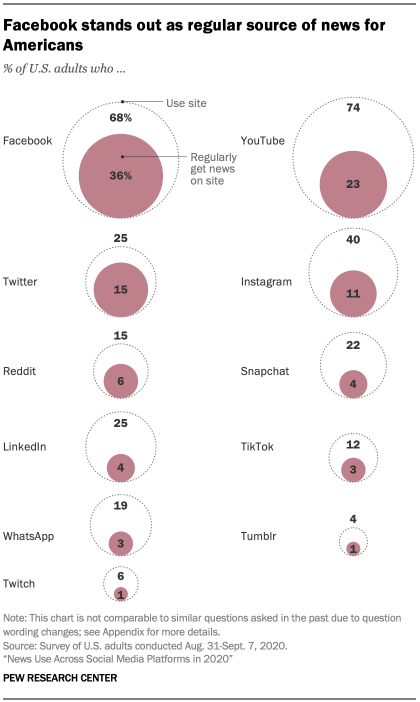
To begin with, Pew found a lot of people find news content across social media. “About half (53%) [of U.S. adults] say they get news from social media…” And yet at the same time more than half of that population don’t trust the stuff: “six-in-ten (59%) of those who at least rarely get news on social media say they expect that news to be largely inaccurate…”
Which platforms do we prefer? Here’s the breakdown:
More than one third of Americans turn to Facebook for news, which is a big chunk of the population. Around one fourth fire up YouTube for this purpose. Following those is Twitter, then smaller and smaller numbers for the rest.
(There’s an interesting twist to this point: “These lower percentages for news use are in some cases related to the fact that fewer Americans report using them at all, compared with the shares who use Facebook and YouTube.
Next, authors Amy Mitchell and Elisa Shearer slice the results by demographics, and I found these results utterly fascinating. Take a minute to work through this:
The gender breakdowns are very clear at times, with women massively preferring Facebook and Instagram compared with men, and the reverse for Reddit.
Age reveals the persistent truth in the much derided age and tech correlation – i.
e.., across the board, folks over 50 and especially beyond 65 are still less likely to use these technologies, at least for the purpose of finding news. Note, too, the preference of Reddit, Twitter, and Instagram among the under 30s.
Increased education seems to drive Twitter, Reddit, and above all LinkedIn news hounding.
Lower amounts of education point users towards Facebook and YouTube. I am very curious how this distinction maps onto which social media platforms higher education teaches.
Among people of color, Black and Hispanic populations prefer Instagram, while LinkedIn leads for Asians. White people tend towards Facebook and Reddit, with a sharp dropoff for Instagram.
Political parties are intriguing, with Democrats simply more likely than Republicans to use social media for use across all platforms. The gap is most clear with Reddit, yet also very visible with Instagram and Twitter.
What can we take away from this?
To begin with, there are practical lessons for academic communication. To the extent a college or university is concerned with its population’s news diet, the Pew findings come in very handy. If a campus wants to reach out to specific populations under the aegis of news, it now has helpful targeting information. And campuses seeking to trace how they are talked about can similarly prioritize.
I wonder how this impacts information and digital literacy programs. Should it nudge instructors to foreground certain social media platforms for extra attention?
Will the increasing social divide by educational attainment continue to play out through our social media news gathering habits? That is, will we see low information voters (for example) sticking to YouTube, while those with graduate degrees hew to LinkedIn and Twitter, creating another pair of information bubbles?
I do wonder as well about the differences by race. Is Instagram the closest thing we have to a common space in this topic? Conversely, will Reddit and Facebook become the digital news equivalent of white flight suburbs?
Naturally I would like to see more data and analysis. I’d love to see more about use behavior – how they use social media (following hashtags? making lists?), how often they make or share content versus sucking it down. Jon Lebkowsky told me he wanted to learn if people obtained news from social media content, or from professional news media publishing through social media. And I wonder about platforms missing from this report, namely blogs.
On a personal level, I find some of this strange. I do not look for news on YouTube, LinkedIn, or Instagram. I do get some slices of information from a couple of Reddit boards. On the other hand, I follow gender and education (yet not age) in using Twitter for some news. And I apparently fly in the face of my gender, age, and education in using several good Facebook groups for some bits of news. As you might suspect from the previous paragraph, I get much more news from my RSS reader.
What do you think of the Mitchell and Shearer report? I’d love to hear your thoughts. The comments box stands open.
Last week the Future Trends Forum hosted Joshua Kim and Edward Maloney, authors of the just-published The Low-Density University: 15 Scenarios for Higher Education (Johns Hopkins University Press). I was hoping to dive into their fine book, which offers visions of multiple strategies for higher ed to explore, and we did. But the guests and most of the community were also interested in the implications of the DC Capitol riot, which had occurred the day before. So we also discussed that.
It’s a good example, I think, of how the Forum can host rich conversations. It’s also a useful snapshot of higher ed at this moment in time.
To begin with, here’s the full video recording:
We also had a ton of text questions during that hour. Josh and Eddie tackled many, but some couldn’t fit in, so I wanted to share them here. They give a sense of how people responded to the Capitol events, as well as to The Low-Density University. I’ve removed the authors’ names and have edited slightly for clarity:
In his August piece in Inside Higher Ed Josh wrote about the threat to enrollments posed by alternative credentialing. I wondered if he could talk more about that.
One thing I noticed is that if there wasn’t already a sync/async online degree completion program, institutions are scrambling to make one. Is this sustainable? Does this change the tenor of education?
But Eddie, those answers (about the purposes of higher ed) are really specific to 4-year residential institutions for “traditional” college students. What other purposes do we need to meet?
Which of the authors’ 15 scenarios do they think are most promising, if we assume that the future will be less stable than the present (e.g. climate change causes political and economic instability)?
What do you think about the cost of education? How do we fix this problem (student debt and student resort living experience)? Vs online? Future? AI/VR?
Faculty are not rewarded for being good teachers. The teaching and learning space is always touted as a solution but that is not what faculty culture is built on.
[I]f education is so important to democracy, etc., then isn’t there something fundamentally wrong with an education system accessible to only a small percentage of the population?
Joshua Kim and Eddie Maloney; question by Tony Sindlar
We also had a robust chat going on throughout the hour. I wanted to share some extracts, again to give you a sense of the discussion. Again, it’s anonymized and edited lightly:
Glad to be back after the 2 week break
I had difficulty getting a copy of Ministry for the Future. Just received it. I’ll try to catch up
Hello all from Olympia WA and thank you for this forum
For most people, higher ed is about getting the degree and getting a job
How is [higher ed] doing? Could it be done better and cheaper another way?
The “buying time” is a big opportunity cost for most people
Absolutely NOT!!!! We would say to half the population they must bow to our supreme ivory tower position.
Teaching cannot be neutral. As public intellectuals, we have an obligation to work for equity.
Not my country… but I think the time to make strong unequivocal statements was a year or two ago
We should listen better – rather than pontificate.
Teaching is inherently political work. We have a responsibility as scholars to engage in work as a public intellectual. What frustrates me is that there seems to be a disconnect between the business of higher education and the mission of higher education.
Yes, everyone concerned with health of democracy should press for consequences with 25th amendment at the top of choices. (my personal opinion)
If not now – when? If not us – who?
Certainly we should perform and engage students in close readings of our governing documents and relevant historical precedents.
If we adopt Georgetown’s president’s guidance to support the common good, college presidents could weigh in on the role of race in yesterday’s event.
I’m here to think about the future of higher education and these experts’ insights about exciting/promising models 🙂
25th Amend at this time adds more division.
We need to focus on January 22. (and, probably, on the role of race in how protestors were treated.)
Higher ed should lead and be a safe space for discourse.
Healing can begin when the abuser faces consequences. This can be related to sexual assault on campus accusations
Leaders come and go, but social media remains. Both twitter bans and section 230 have been in the news over the past two weeks. What about addressing the enabler?
Preserving the ability to hold space for diverse conversations and opinions is a very important component of civil society
One of the initial purposes of higher education here was to create a well-informed citizenry to help our democracy succeed. Yesterday was evidence of our democracy sliding away. We aren’t meeting one of our goals if we don’t speak out.
a school law perspective: conversations, topics, etc should always relate to the curriculum – how would this be connected to learning goals is critical
On 9-11 and the rest of that month, I threw curriculum into Social Emotional Learning – students need to process. It is appropriate to do so now
I agree with both speakers. Now is the time to act. Just as we need bystander training to intervene in the classroom or workspace in the moment of racist or violent behavior, now we need to do so on a national level.
What makes up the schools is people …. plus money. Without money they wouldn’t exist.
I also think that higher education is undervalued for what it contributes to society from an objective research – “Knowledge Creation” perspective.
The elite colleges wield enormous power in hiring with their brand and alumni network. It is a big factor in the exorbitant costs and admissions craziness.
I keep bringing up The Knowledge Factory by Aronowitz. Also good: anything by Henry Giroux.
happy to do my reading homework, I was curious specifically about our speakers views given the types of institutions they work at.
I would add that higher ed should also be advocating for all kinds of education. Namely, vocational education and paths for people who don’t want to or cannot attend college
The cost of education makes it an engine of inequality.
OK…Pelosi & Schumer JUST called for Trump’s immediate removal
What do they think about Raj Chetty’s work? Can higher education overcome the bifurcation of the workforce and spatially concentrated inequality. This may be bigger than us.
Every time I come to the FTTE, I add more books to my Goodreads “to read” list.
~ 50% of international students are also first generation students too
calling for and actually doing it are two different things. Talk is cheap.
I hope higher ed will through out the entrenched tenure system and go for a business model
Josh and Eddie’s book can be read for free on Project MUSE. It can be purchased as a Kindle ebook on Amazon. https://jhupbooks.press.jhu.edu/title/low-density-university
kids don’t learn from ppl they don’t like – true of students of all ages
Why not teach these curricular topics in high school so everyone is exposed?
I think there’s a difference between engaging with the principles and philosophy of social engagement and actually engaging with the societies which the student (or the professor) is in or near.
Pelosi called for 25th fyi
If the goal is bringing people together, how does telling half of America they are wrong – the way they think is wrong?
But the liberal arts/general ed requirements impose a big cost and opportunity cost on people who just want to get into the job world
Violence is not unwrong
Is there a reference for this? The Netherlands produces excellent engineers and scientists – without liberal arts.
How do the humanities and social sciences stand in the Netherlands?
But how do we pay for it? Debt is now insane.
My son just finished a Physics degree there with no liberal arts content. No doubt if you are studying liberal arts or humanities it is not an issue.
I’m finding anecdotally that the people who “just want jobs” are more likely to engage in academic dishonesty because they see it as a transaction. Does that viewpoint cheapen both “versions” of higher ed?
I would like to see the evidence that the inclusion of liber arts in vocationally oriented education actually has an impact.
I’ve been for years reviewing if my undergrad liberal arts was worth it or worthless
I think as a country we need to totally rethink education
The academic dishonesty is caused by the perverse emphasis on testing and grades
an education system that excludes people is anti-democratic
Arun’s contention that college has very little impact on critical thinking skills is interesting.
Speaking of funding, how do we even make the distinction between public and private at this point? When most public schools get their funding from federal student loans and international tuition dollars, at what point are these still public state institutions?
Good point. “public” is quite private. Did you see Jim Duderstadt’s joke about U Michigan being “state supported”?
Duderstadt’s observation is brilliant & extremely accurate.
Doing liberal arts as a foundation in high school followed by college for vocational training and more liberal arts at the master’s level
That’s reductive. I’m on two separate committees on this. You can’t divorce the commodification of education from this.
Note we won’t get different results by doing what we have always done.
You can’t divorce grades and tests?
You can change grading and assessment easier than the systemic issues of education.
Check out Ungrading by Jesse Stommel
The biggest systemic issue is the degree system
Alfie Kohn has also written on grades
Thank you for keeping it real
Thanks! Glad my 2pm meeting was cancelled at the last minute so I could join for the session. 🙂
What US president has NOT committed impeachable in the last 30 years? None, I’d say, if you don’t have a political “party line” bias…
I’ll check out Alfie Kohn too, but the issue is multifaceted – and its not the only systemic issue.
My thanks to the guests and community for such an energetic and convivial discussion.
If you’d like to learn more about the next Forum sessions, or to register for any of them (for free, as ever!), check this post.
I wrote this post before and after rioters stormed the United States Capitol building. I have notes for a post about that… event, but that’s come after this one because of scheduling.
Today I’d like to announce the Future Trends Forum schedule for the next two+ months, and invite you all to register for sessions. I’m very excited about the guests and topics:
How are academic staff doing during this attenuated academic crisis?
We’ll explore the question with Lee Skallerup Bessette, Learning Design Specialist at the Center for New Designs for Learning and Scholarship at the Georgetown University, and author of a widely discussed Chronicle of Higher Education article, “The Staff Are Not OK.”
How will liberal education be transformed by the COVID-19 pandemic?
We will meet with professors Beth Benedix and Steven Volk to explore their new book, The Post-Pandemic Liberal Arts College: A Manifesto for Reinvention (publisher; our bookstore).
This Thursday we’ll meet with Shannon Dunn, assistant director at the University of Florida’s Information Technology department, and winner of the 2020 EDUCAUSE Rising Star Award.
The Future Trends Forum will meet with Dr. Paul J. LeBlanc, President of Southern New Hampshire University (SNHU) and leader of that institution’s major transformation.
How can campus IT best support diversity and inclusion?
In this session we’ll meet with Deborah Keyek-Franssen, Associate Vice President and Dean of Online and Continuing Education at the University of Utah, and winner of a major EDUCAUSE award. She was cited for: “her dynamic and visionary leadership to promote positive relationships between the academy and the IT community and for her research and advocacy in support of diversity, equity, and inclusion (DEI) across the IT practice.”
There is more to come, with a stack of potential guests in various points within the Forum pipeline. Is this kind of look ahead to upcoming events useful?
With this post we start discussing the fifth and final part of the novel, chapters 89-106 (pp. 445-563). I’ll begin with a summary of the story so far, add comments from readers, add some of my own notes, then ask questions for discussion. At the end I’ll add any resources I’ve come across.
You can share your thoughts by writing comments at the end of this post. You can also contribute via social media – I’ll copy this post or a link for it to Twitter, Facebook, LinkedIn, Mastodon, and Medium. I can copy and link to your comments there in next week’s post. You can also respond through a podcast, video, web page… just be sure to let me know somehow.
One more note: if you have any questions for me to ask the author, let me know! I’m sending him the email shortly.
Now, to dig in!
Summary
SPOILERS AHEAD. Obviously:
The climate crisis turns around. CO2 levels drop for the first time, due in part to “greening of the ocean shallows with kelp” (446) but especially to the carbon coin and “drawdown efforts” (455) (chapter 89). More of the economy than ever is tied to blockchains (454-5). The United Nations agree to spread climate pain around globally and more justly (463). The Antarctic has been stabilized (ch 93) and the Arctic Ocean’s albedo reduced (523-4). A new holiday, Gaia Day, is celebrated (546).
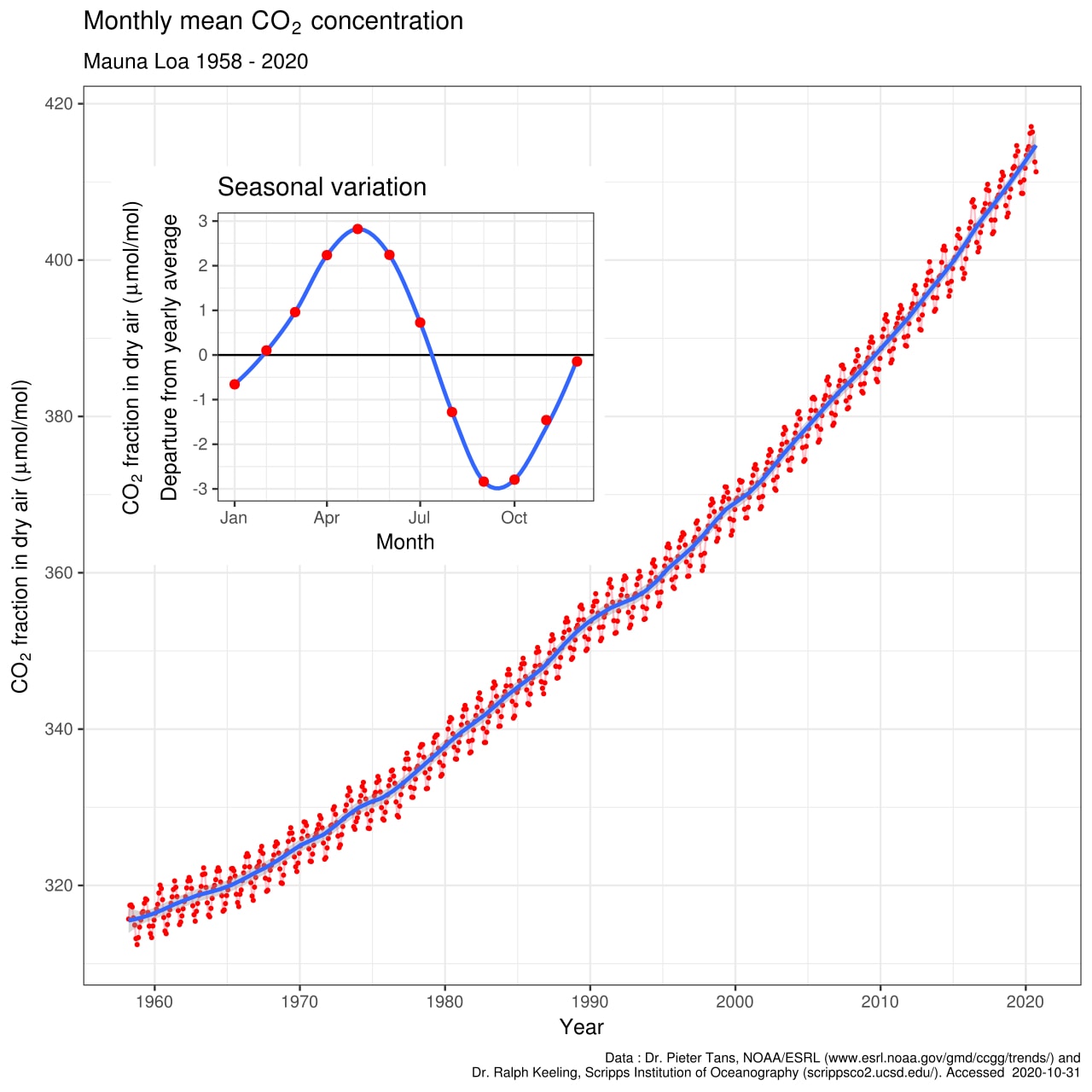
The United Nations Conference of the Parties (COP) meets and shared both good news and problems, including the total human population starting to decline (477, 502), nuclear power and materials, failed states, the status of women, and more (94). They have a poster using the Keeling Curve:
The Keeling Curve (475).
In the Ministry, Tatiana is assassinated (ch 89). Mary retires and Badim succeeds her (ch 98).
Frank has a brain tumor, which kills him. Mary goes on a world voyage and starts a relationship with an airship captain Arthur Nolan.
Notes
From readers:
Joe Murphy was skeptical about terror and geopolitical plots. Joshua Kim and Chris Mayer pondered making climate change central to college and university missions. Lisa Sieverts and Mark discussed the chapter (87) from last week where people relocated voluntarily for climate reasons:
As someone who lives in a small town, I thought it was unrealistic that the Montanans agreed to abandon their town. (Personally, I hope I would do the right thing and agree to leave when it would be so clearly good for the planet.)
and:
I liked what he said about the suburban communities cheerfully leaving their communities. Some developers bought out a small cul de sac near our local college to build apartments and at the time I was outraged that this tiny community had been bulldozed, but now I’m not so sure.
Tom Haymes argues that the novel makes a great case for interdisciplinary thinking and practice.
From me:
The novel continues with more non-main-plot chapters. There is another riddle chapter, the answer for which is not provided (ch 95). There are also meditations on technological determinism (ch 90) and revolutionary politics (ch 99). We get micro-stories about characters we never see again, but who give us glimpses of ideas and the world in transition, like a Hong Kong political activist (ch 101).
Technology: the world uses many technologies and practices we now know to measure the improving climate, “the Great Internet of Things, the Quantified World, the World as Data.” (p 454) An international group tints the Arctic Ocean to reduce its albedo (523-4).
Mary’s new partner is named Arthur, yet he plays no heroic role in the world beyond making her happy. I’m not sure what this means, except perhaps a quiet argument for a world without individual superheroes.
Discussion questions
What made the successful decarbonization work? How would be describe the strategy?
Related to 1: which pressure points were squeezed to make the victory happen?
Some geoengineering plays a key role in the world’s triumph. It’s less ambitious than anything spaceborne, but definitely more than we’re doing (deliberately) now. Is this a kind of geoengineering compromise or middle path?
Arguably the world’s success was partially driven by terrorism. Nobody is identified as the authors of all of those acts of violence, much less prosecuted for conducting them. In fact Badim, head of the Ministry’s “black wing,” is promoted to the next head of the organization. What argument is the novel ultimately making about the climate crisis and violence?
What role did higher education play in the novel, overall?
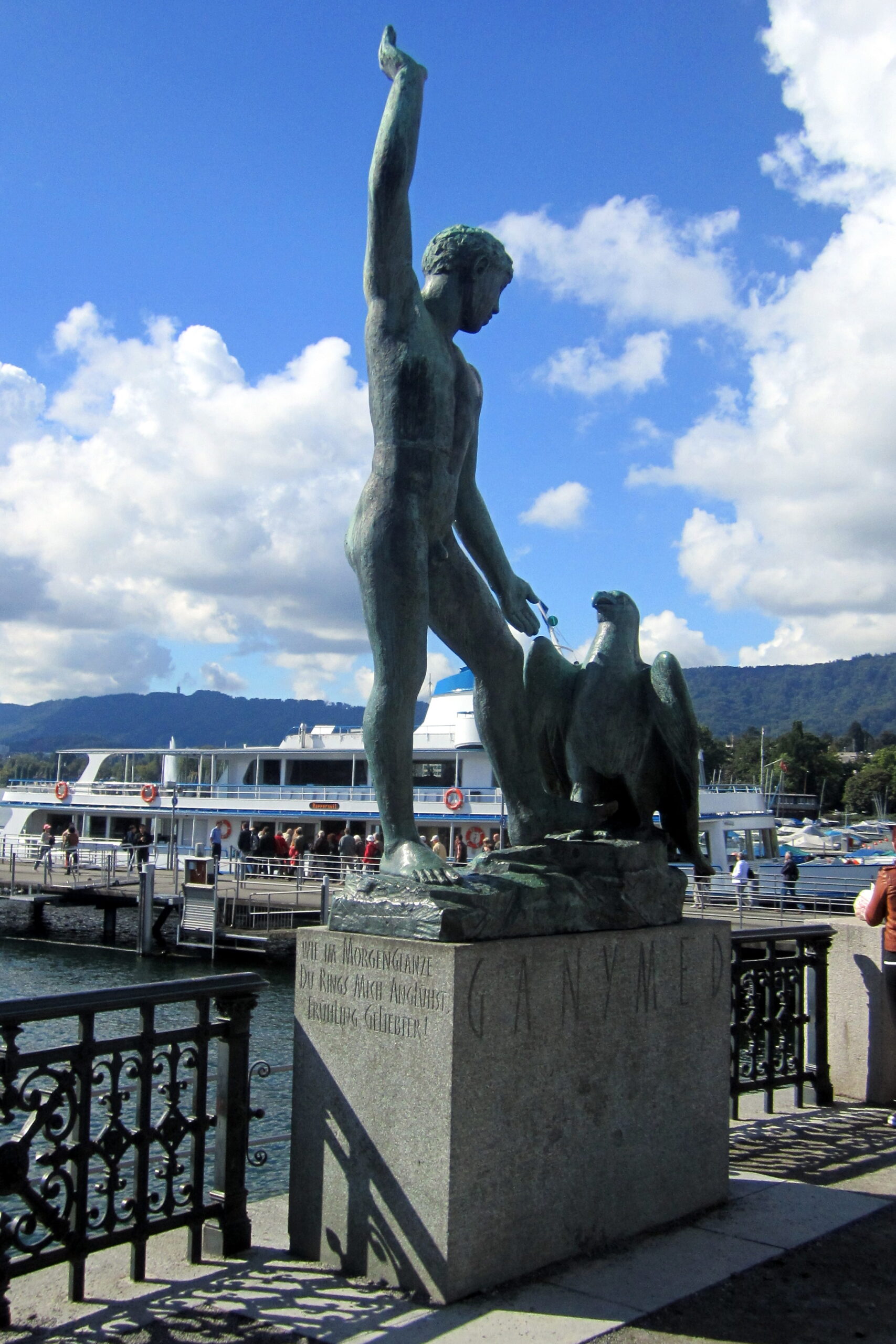
On the last two pages Mary and Art return to the Ganymede statue (seen earlier) and wonder about its meaning:
“…where the statue of Ganymede stood…. This was a place she often came to; something in the statue, the lake, the Alps far to the south, combined in a way she found stirring, she couldn’t say why.” (34)
Art suggests it’s about a man offering himself as a sacrifice for animals. Is that man Frank? Or is there some much larger sacrifice occurring in the novel?
UPCO2 claims to be “the world’s first tradable, carbon token available on a public blockchain.” More: “When you invest in UPCO2, you invest in sustainably preserving the rainforest, which is good for the planet and your portfolio. UPCO2 is the best way for you to buy, hold, sell or burn carbon credits. It’s convenient, trustworthy and rewarding. It’s a financial incentive to do what’s right for the planet and to do well for yourself in turn. A crypto that’s actually clean.” (thanks to Steve Foerster)
Thanks to so many readers who shared their thoughts so far. Now, over to you for the final round of discussion!
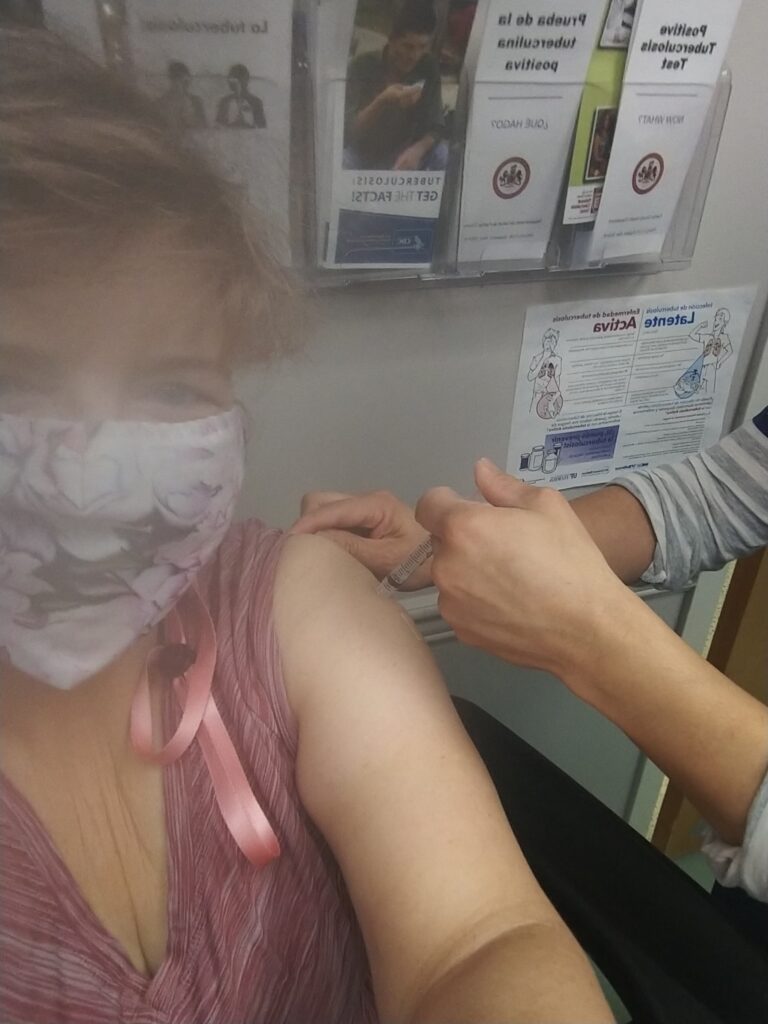
Here’s a 2020 story: this Tuesday my wife became the first person in our house to get a COVID-19 vaccine. She received it so soon because of her new job as a contact tracer for the county east of ours. The vaccine was the Moderna flavor, and the kind professional who did the deed was named Laura.
Ceredwyn’s arm was sore for a day. She’s scheduled for the second shot in January.
This story a good way to close out 2020 on a personal note. After so much chaos and stress, a small victory is something our household very much needed.
Terri Givens and others asked me for a personal post about this year. I’m not very good at that kind of thing. I try to keep myself out of my writing as much as possible, which might be a generation X trait. But as 2020 shambles to a close, a personal reflection sounds fitting.
So much happened to me and my family this year!
Twelve months ago we had recently moved to northeastern Virginia when 2020 began, and were basking in lavish infrastructure. I shudder to think how my work would have proceeded had we still been living in rural Vermont. We could not have done any videoconferencing there, so… would we have desperately moved somewhere we could? Perhaps crashed with friends of family somewhere that had 21st century fittings? Or would we have had to suspend the work and…
As it was, COVID hit our business very hard. More than one half of my work vanished in a few days. That was the stuff requiring travel to in-person events, like workshops, speaking engagements, and on-site consulting. I used to travel up to six times a month. That all vanished in March. So: we had to pivot. Everything went online and fast.
Remember that my work is done without a net. I’m not bankrolled by a company. I don’t have tenure. And I definitely don’t have family riches to draw on. Being a higher education futurist is a perpetual scramble for sustainability, and the pandemic threw that hustle into overdrive.
The first move was to hold, support, and join lots of live video events. I had hosting and facilitation skills, both online and off-, so I put those to use. In spring there were weeks when I hosted, helped, or was hosted in two or three video sessions per day. I taught myself the admin ropes behind platforms I didn’t know well enough, like WebEx. I reached out for potential clients. I wrote about videoconferencing… and it all came together by summer.
The second was to get in front of the pandemic and stay there, figuring out what was actually happening, how it hit higher education, and futuring based on that research. This was a way I could apply my skills and knowledge to the growing crisis, doing some good and maybe in a sustainable way. One page in Academia Next became notorious – that’s the one asking readers to anticipate a pandemic. But I threw myself into getting live data and information, then getting it out to people in as many ways as possible. I created this COVID resource post, stuck it on top of this blog, and have edited it there ever since. I hosted a torrent of videoconference discussions and presentations, both on the Future Trends Forum and elsewhere. I followed and interviewed experts. I blew up Google Apps with a spreadsheet tracking the great spring academic migration online. Above all I listened hard and asked questions.
This, too, yielded results. People within and adjacent to academia needed this stuff. They were looking ahead, trying to improvise responses to a very fluid situation. They also needed to get their experiences and stories out.
Hosts asked me less about the macro trends reshaping higher ed and more about opening in-person campuses versus going online.
Does this sound deliberate and strategic? It was, to some extent, being based on brooding, analysis, research, reflection, and consultation… and it was also the result of dread, anxiety, and stark terror. As I said, I watched the virus spread worldwide very carefully. As a futurist I knew how to anticipate negative outcomes, as well as positive ones. So I could see how this –
I heard from the pandemic’s ravages from my student who had family in Wuhan. I also heard about them from my own family: my daughter, the disaster planner, and my wife, the emergency services guru. I heard from my father, nearly 90, riddled with comorbidities, surrounded by other such folk, and not sure what to do. Again and again I imagined deaths, injuries, social dislocation, cultural upheavals, political unrest. I saw this worldwide, and imagined it at home. Sure, it might not turn out that badly. Some friends and other people assured me it was overblown. But we could not take the risk.
So we locked down and stayed down. We ordered groceries and all kinds of supplies by delivery. Our pantry became a survivalist bunker which we checked and rechecked. We masked up when we took brief, nervous forays into the outside world for exercise, walking at the least crowded times, and shunning people energetically.
This was and is so, so strange for me. I’m an extrovert, a person who thrives on interaction with other people. I love being in groups and crowds. 2020 rewrote this bit of my software, turning me into an anxious homebody who flinches even at fictional representations of people being physically close to other people.
And yet I had to be close to some. Our household is large and full, with a string of humans and animals. We each have private spaces, but we also must spend time together. It’s an enforced family closeness. I love it, because I love being with my family. Yet at the same time I want them to get away from me and the rest of us, to live their own lives with other people.
They needed to be supported, too. Hence my far too many 70 hour work weeks. (I wrote more about this earlier.) Hence the kind of work experience when, exhausted, you force yourself to keep going, even with accidental naps at the desk. When people talk about the pandemic giving them too much downtime I just grind my teeth. I think that January and February will see things on a less frantic pace. I hope so.
COVID COVID COVID, as soon to be ex-president Trump once said. That really is what loomed largest over my life in 2020.
Stepping away from the pandemic itself, I was fascinated by how higher education responded. All of the analyses and explorations I was doing showed me a complex struggle, a myriad of institutional and personal stories. The story that colleges and universities were brittle, unchanging temples got a little more complicated in 2020, and that’s something I find inspiring.
One part of that transformation involved responses to the year’s “great awokening” over antiblack racism. I saw this throughout higher education, first in the US and then in other nations. I saw it in my classes and with the students. It was clear in the Georgetown Big Rethink project. My summer gaming seminar was wracked by George Floyd’s killing and electrified by the popular mobilization.
I did not say much about this. I felt that I had little to contribute. Instead I tried to give platforms to others, especially black folks, and to do what I could to help my students think about race and racism. I read and thought. Our son got us out of the house to march:
BLM march in our town.
Students: I taught more in 2020 than I have since 2000. Four classes this year, and dozens of splendid students. I love teaching. I love these seminars and invented a whole new one from scratch this year. It was my spring ed tech class that transitioned from being in person, deep in Georgetown’s Carbarn, to being wholly online. An appropriate class for that process, no? I keep saying this: the students are a perpetual delight and inspiration. So are my LDT colleagues.
2020… at times it felt like my life was consumed in the grand fiery ideas of the year, the pandemic, racism, what was happening to academia, and the reverberations and implications of these. At other times I felt like I was doing the year the wrong way.
For example, I switched my eating habits over to veganism, starting gradually last December, then fully by spring. Yes, when the good advice was to welcome eating comfort food and making dishes one loved, I chucked all of that to figure out what to do with garbanzo beans and why there were so many kinds of lentils. I loved eating and making food, and it took months to stop thinking of a plant-based diet as something other than medicinal or experimental. I’m still not there yet.
But I lost nearly 50 pounds. My body feels better. I’ve learned an awful lot in terms of what to eat and how to prepare it. I just prepared a kind of mega-menu of what I now know how to cook and was shocked to see thirty items listed. I haven’t become a vegan apologist or evangelical yet, but am happy to talk about the experience. It seems like it was the right thing to do. (Let me know if you’d like to hear more. I might do something additional with this story.)
Another example: some told us to step back during a crisis, to ratchet down our expectations for what could be accomplished during an asterisk of a year. Nah, said I, apparently, and overdid it instead. I followed the old Soviet shockworker (уда́рник) model, it seems, of urging oneself on to every greater workloads for the greater good. Was this the right thing to do? Perhaps?
Recognitions actually came in. I was interviewed by a range of media outlets, perhaps most visibly the Wall Street Journal, who did a fantastic job with video. Academia Next won an award from the futures community. I won another award from an organization I greatly admire. This wasn’t just from my 2020 work, of course, but the year seemed to bring attention to my career – which is outrageously humbling.
And now it’s very late. My eyelids keep malfunctioning, shutting down over my eyes to blot out the laptop. My wife is asleep, because she has to hit the contact tracing headquarters (all socially distanced, tested, and vaccinated, of course) first thing in the morning. I am so proud of her doing this crucial work, right in the teeth of the crisis.
Meanwhile, the cats are taking turns sitting on me, staring at me in order to remind me of my obvious duties to their species.
I don’t know if this post made sense or adds anything to what you know and see, dear readers. I try to cudgel my brains into finding an overarching idea or several inspirations from the personal experience of 2020, and the results don’t fully satisfy.
One is that we saw a series of screwups, snafus, heinous acts, and outright crimes as humanity grappled with the pandemic and with racism. “The history of 2020 should be written in crayon,” muttered a character in Death to 2020, and I see that. I’ve said before that I’m sure we’ll actually remember this year very much. We suppressed the 1918 pandemic quite thoroughly, and the national if not global shudder of horror and release greeting 2020’s end makes me think of a species-wide drive to move on. But I hope we think hard about the screwups, snafus, heinous acts, and outright crimes. I hope we learn from them. I hope we improve thereby.
Another is that we saw resilience. Lots of resilience, vast libraries of examples of resilience. I don’t mean that in that corporate buzzword sense. What I’m thinking of instead is human beings being confronted with something they didn’t want to see, exercising their imaginations, trying out actions, and then learning from what transpired. I saw that at scale: in institutions, in cities, in cultures. But I also saw that with individual people. My students working at the syllabus, while trying to move house during a pandemic, or deciding if they should risk infection by going to a protest. Student athletes grappling with changes made to the crucial few years of their higher ed career. People inventing new ways of teaching, new technologies, new practices.
And I think of my family, hunkered down and living in history. How they put up with my long hours and strange dishes. How they learned and worked hard all year, each of them. How they made stuff, from videos to comics to costumes. How they grew and thought and told stories and looked to the future.
That’s enough for now. I told you I was awkward at this, and the cats are most insistent that I get to bed where I belong before the year becomes 2021. Thank you for reading this far. Be safe, each of you. Best wishes for the new year upon us all.
What can 2020 tell us about higher education in 2021?
It’s still too early to really make this call, in some ways. 2020 is too fresh, too close, and too riven by a mixture of fierce political fighting and enormous amounts of information for us to generate a thorough analysis of the year. But we can draw on what we’ve learned, now, in all its freshness and contingency, to scope out 2021 as it draws nigh. And such an analysis might shed additional light on how we think/thought about this extraordinary year.
Speaking of which, here’s a single gif to summon up our shared sense of 2020:
All right. I’m basing this post on a few sources, starting with this very blog, as I’ve been writing here all year. I’ve also been tracking the year in a dozen FTTE reports. Georgetown University’s Big Rethink offered a great deal of insight and reflection. My Patreon supporters have been very thoughtful. And the Future Trends Forum community has been talking up a storm all year.
What follows is not in any particular order. It is not a history of 2020, but a sketch of possibilities for 2021 drawing on events from this year. It is also not as extensively sourced as I prefer; please see preceding paragraph for more sources.
A mixed approach to the pandemic In spring 2020 effectively all of American higher education, and the systems of several other nations, moved online. This changed by fall. Roughly one quarter to one third, of campuses reopened for in-person education, about that many remained entirely online, and the rest attempted various hybrid forms. During that semester some switched modes, including versions of a “toggle term.”
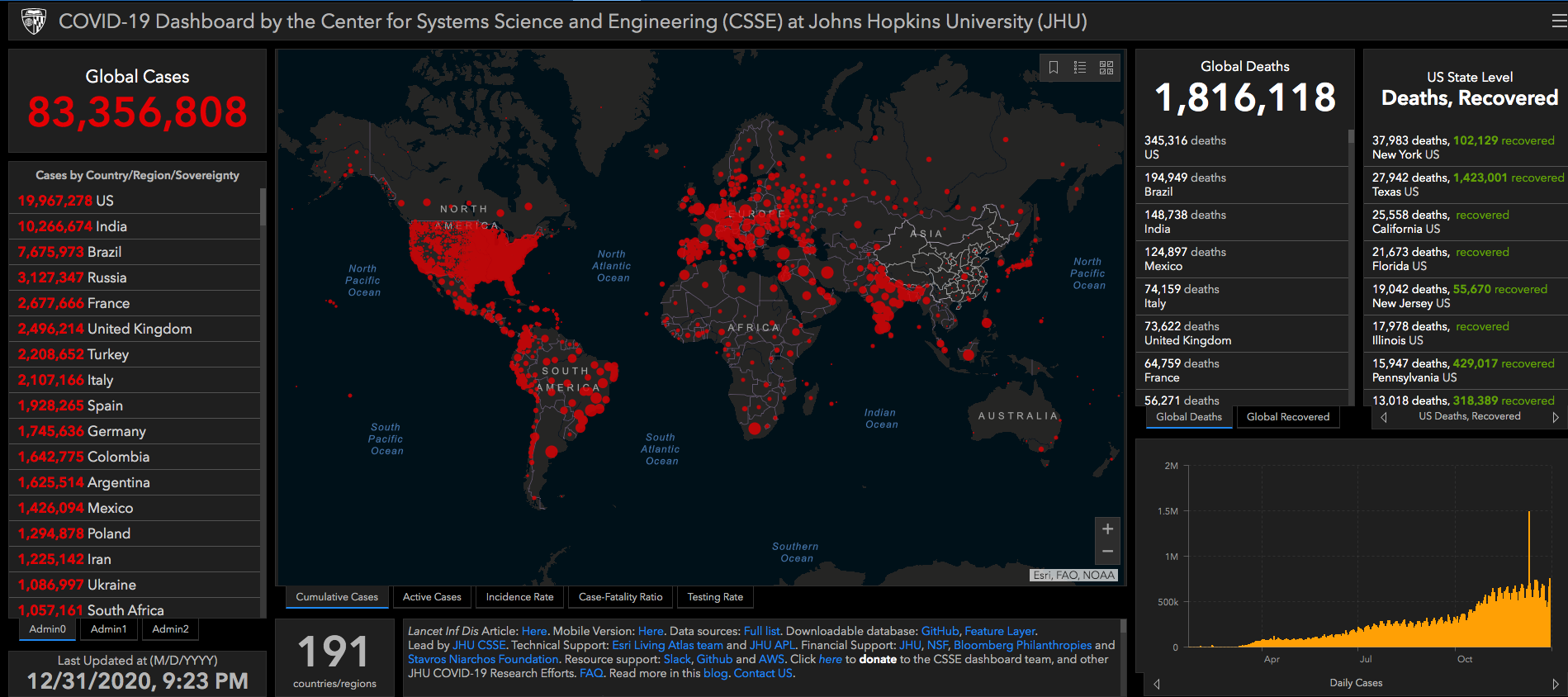
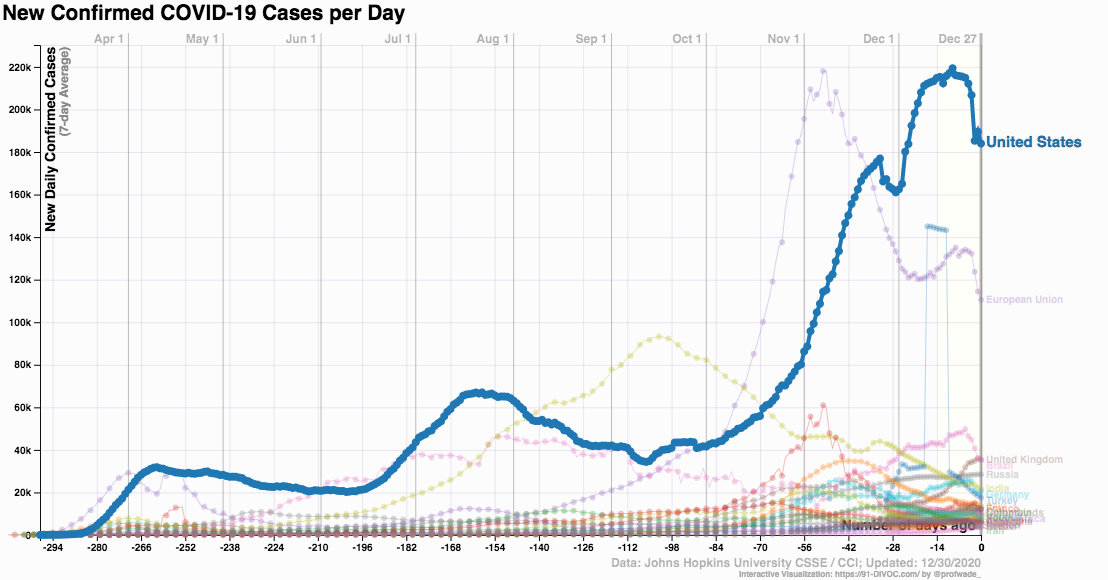
Looking ahead to 2021 we see the opportunity for another mixed approach, depending on how the pandemic plays out. On the one hand, several vaccines have passed national tests, are being distributed, and taken up. More than 2 million people have had the first dose, according to the CDC, and that number will rise. On the other hand, the B.1.1.7 COVID strain, which is more infection that previous strains, has spread from Britain to other nations, including several states within the United States. Global cases and deaths keep rising. American cases rose horribly over the past two months:
The past week’s dip could be an artifact of holiday reporting.
And while more than 2 million people getting the shots sounds impressive, it represents less than one percent of the American population of roughly 330 million.
So we might begin spring 2021 in a version of fall’s mixed mode. Hopefully we will turn a corner with the pandemic, once enough people receive vaccines, after which more campuses will host more in-person students.
Institutional flexibility It’s important to recall that many colleges and universities did something extraordinary in spring 2020. Yes, the shift online was done sloppily in some cases, we can argue about remote/emergency instruction versus online learning, and there were all kinds of logistical and resource problems. But hauling academia entirely online in a matter of weeks, often days – in a year that’s overused the term “unprecedented” we can identify this achievement as literally without precedent. It showed a terrific institutional flexibility and energy that we rarely associate with the academy. That is a crucial takeaway.
A renaissance of online pedagogy As soon as WHO declared a global pandemic faculty and staff began thinking about how to teach well online. There were a great number of first-time instructors who had to learn this and fast. As I’ve told every human being I’ve been in contact with this year, they were able to learn from a generation’s worth of study and practice, as well as the skilled professionals in instructional technology, instructional design, and educational technology positions. A tremendous amount of practice and development happened in a few months.
As shocked spring gave way to (alas) hopeful summer this rapid learning continued, both for those of us who taught during mid-year and for everyone planning fall term classes. It was an immense moment of professional development, planning, learning, inspiration, and design.
It’s easy to see the problems here. The financial hammering institutions took (see below) means professional development and professional developers were often cut down. Not all faculty were interested in learning from mere staff members about how to teach online. Not everyone had the time to do so, either, given the pandemic’s brutal hits to the economy and families. There were many, far too many instances of mistakes, of bad online pedagogy inflicted on students who deserved better. But the opportunities were there to various degrees, and some took advantage of them. 2020 saw a big chunk of academia think and work hard on how to improve teaching.
Instructional designers et al received zero publicity for this work. Ditto centers for teaching and learning. They certainly haven’t enjoyed lavish bonuses for work in poor conditions. But they did great work and deserve our applause – and our awareness of them as key players to be in 2021.
A reawakening on race and racism One of 2020’s signal events was the massive social movement against anti-black racism. This engaged higher ed from students to presidents, driving a rethinking of how campuses supported or opposed racism.
A big question for 2021 is: how much of this energy will persist? Many Big Rethink interviewees were not sure 2020’s activism would continue into the next year, or yield structural changes. Personally, I can see both persistence and a falling off, depending on an individual institution’s climate and how national politics plays out.
The financial hammer came down Readers and other audiences know that I’ve been warning about increasing economic pressure on American higher education for years. The pressure comes from a bad mix of forces, including demographics, public defunding, financialization, overbuilding, an out of date business model, and more. This argument powers much of my recent book, Academia Next (Johns Hopkins, 2020), so read therein for more details.
If we think of that pressure as a fire increasing in temperature, COVID-19 poured accelerant all over the blaze. States cut back appropriations more than usual. Campus costs rose as their revenue dropped. Total enrollment ticked down even further than it has been for nearly a decade. Reserves were tapped. And cuts started in spring, then kept coming.
What does this tell us about 2021? The larger economy has been badly damaged, and will need recovery and rebuilding time. It’s an open question if Congress can assist.
Higher education faculty and staff (those who aren’t cut) will probably, generally, have to do more with fewer resources. There will be campus political battles fought over dwindling budgets. Queen sacrifices will occur. Campus leaders will decide if they want to lose adjuncts and squeeze more teaching out of full time and tenure-track faculty, or ax the latter to maximize the former. I expect old fights to break out with redoubled urgency, struggles over campus sports, residence hall amenities, “administrative bloat,” the role of the humanities, just how many professional programs can be offered, and so on.
Macroeconomics 2020 saw many economies injured badly. America experienced a vertiginous collapse of GDP and employment, then a rapid race in the direction of recovery. How this will play out in 2021… it might look like 2009-2015, as a slow, incremental recovery.
At the same time, income and wealth inequality sharpened during this awful year. Implications for higher ed include a greater focus on the very wealthy for fund raising and recruitment.
Speaking of inequality, the American recession hit women harder than men, based on gender representation within afflicted industries as well as persistent child-rearing practices. Women scholars saw work fall behind. How will 2021 address these losses?
Politics This year we learned the old lesson about higher education being politically active. Doubtless to the shock of some folks who grouched that young folks were too passive, 2020 saw some campuses mobilize along different political lines. Some day anti-racism activism in different forms, from renaming buildings to efforts to decolonize curricula. National elections were waged across campuses. Other social justice causes – over sexual harassment and assault, by gender, by sexual orientation, by immigrant status – energized some. Rising US-China geopolitical tension hit campuses from Confucius Institutes to jailed faculty members, and saw increasing federal pressure on higher education.
Looking to 2021, we might expect each of these causes to live again within higher education. There is some variability, of course. Some energy might be lost with Trump out of the White House. The Biden administration’s China policy will shape that vast conflict’s presence in colleges and universities. Trump and right wing activists may play some role on campuses, either in recruiting or just stirring the pot for publicity and donations.
I am not sure if a Biden Department of Education will increase campus administrative demands. I expect that they will attempt to reverse DeVos sexual assault guidelines. They may offer more policy requests on gender and race. Campuses might see hiring more staff to address such changes as prudent.
Climate change This is not something most academics wanted to discuss in 2020. Most I spoke with and listened to were aware of the crisis to some extent, but they were much more focused on COVID and Black Lives Matter. They also rarely saw a connection to climate change from their work.
To the extent that academic individuals and organizations see their way past 2020’s two signal crises, they may have openings to think ahead into the climate crisis.
College sports It is clear that American higher education will do whatever it takes to support some athletic activity. Some colleges and universities suspended or shed various teams, notably the ones that were not high profile, or weren’t basketball or football. Meanwhile, others set up science fiction levels of expensive containment systems to keep games happening, even in the teeth of COVID.
Frankly, I don’t know how this impacts higher education. I don’t know if it cost sports campus support or made academia look cold blooded to the sports-obsessed American public. But looking to 2021, I would expect this pattern to continue: tennis and rifle teams set aside, while football players struggle across playing fields layered in more security than most banks.
Speaking of which…
Higher education’s reputation American academia has been dinged over the past decade for many reasons, including perceived costs and results. Under the Trump administration the old right-wing complaint about culture warrior profs has seized a larger population of Republicans.
Did academia’s response to the pandemic change our standing? To what extent does the public view universities as the wellsprings of vital health research? Does that public think academia played a role in the amazing vaccine triumph? Or do people see academia as mishandling the crisis, offering substandard online teaching and being willing to welcome back students at the costs of injuries and death?
In 2021 we might seek to repair that reputation, especially if we want to get enrollments up, to win governmental policies we prefer, and avoid the ones we don’t.
Enrollments Total enrollment ticked down again in fall 2020. If we banish COVID effectively next year we *could* see a reversal… if enough Americans can muster up the desire and ability to take classes. If that happens, and Biden manages to reverse America’s Trumped reputation abroad, and China doesn’t decide to pull students from its great adversary, then perhaps international numbers will rebound.
How might which academic programs change as a result of 2020’s events? I have previous spoken of a COVID curriculum, which would be higher on allied health, with possible additions of poli sci, government, econ, and business. It is still early for data, but early signs are that the allied health care forecast is correct. NPR refers to this as the Fauci Effect. It could easily continue next year, especially as students continue their majors. I do wonder which programs are losing a corresponding number of interested learners.
Libraries We know that most academic libraries suffered financial cuts in 2020. If 2021 is as bad economically, I can’t see a way for libraries to escape further hits.
I am appalled that so few people concerned about misinformation, disinfotainment, the infodemic, etc. bother to recognize that librarians are superb guides to the online information world, have been working on this for decades, and are eager to help. It infuriates me every time someone hollers about bad information and refuses to recognize some of my heroes, the librarians.
Technologies and education
2020 saw the greatest number of people taking classes online. To the extent COVID recedes in 2021 that number will drop… but I think not in perfect correspondence. Some number of students approved of the experience. Once COVID is done (say, at seasonal flu levels of infections and deaths) I suspect online class rolls will be higher than before the pandemic.
More hacking and crime: the past year showed plenty of evidence of this, culminating in spectacular hacks of the federal government. I can’t see why there wouldn’t be more of this.
Fragmenting and controlling the internet: several nations showed they could shut off internet access, or just modify access to certain content. By year’s end Silicon Valley giants started expanding content moderation strategies. Will a Democratic White House change this in the United States?
Automation: every month saw further advances and controversies for both hardware and software.
In education automation proceeds on many vectors, from chatbots to academic research to robots for certain tasks. I do wonder if we will see some students and faculty protesting some of these projects and services.
Open education possibilities: 2020 saw textbook spending decline, based on some measures. Surely the economic crisis will encourage more OER usage. Hopefully cuts to library and research budgets will similarly spur more researchers to consider open access, which also grew incrementally.
XR (virtual, mixed, augmented reality) is making gradual progress, primarily with militaries and tech firms, but still awaits a breakthrough device. Many expect Apple to offer one.
I do wonder what happens to social media in 2021. Most platforms had a terrible 2020, with a rising techlash and hostile government responses. User bases have been solid, though, and no alternatives have gotten traction, including just exiting social media.
The learning management system/virtual learning environment world seems to have settle into tweaking and incremental adjustments. Canvas keeps growing.
Big data and data analytics: 2020 saw the debate over this grow in intensity. On the one side, people and organizations who view the tech as empowering students, done well. On the other, people and groups who dread privacy violations and “cop shit.” The pandemic heightened things, as a public health emergency typically involves additional scrutiny of human behavior. At home proctoring had good year in deployment, from what I can see, and a bad one reputationally. 2021 will see this debate continue.
3d printing had some bright spots in 2020 as folks printed medical equipment parts. (I still adore this one: the Vermontilator.) I haven’t seen much holding this tech back, and expect continued development.
The second wave of podcasting grew and grew this year. I have been anticipating retrenchment, and would not be surprised to see some kind of podcast recession. Except for audiobooks, which have a rich market growing in place: aging folks.
Video obviously grew in importance in 2020, from videoconferencing to producing and consuming content, from Tiktok to Netflix. Many complain about Zoom, the one brand folks have chosen to stand in for an ecosystem, and so we are seeing a series of experiments and innovations seeking to improve it.
Copyright and technology: big intellectual property holders continue their efforts to stop what they see as infringement. We saw that with an anti-streaming measure stuck into an American COVID relief bill and how the US-Mexico-Canada Agreement (USMCA) pushed the Mexican government to pass a new copyright law with stricter measures. I would expect this decades-long behavior to continue.
That’s enough for now. I have another, more personal post about 2020 and 2021 for tomorrow. What do you think of this sketch?
The COVID-19 pandemic has hit higher education hard in many nations. In the United States many colleges and universities suffer from virus-caused financial pressures, from decreased enrollment to reductions in state funding. This has led to all kinds of cuts: to programs, majors, departments, staff, and faculty.
Today’s example comes from Indiana University of Pennsylvania, which just announced a queen sacrifice. (If the term is unfamiliar, it describes when a campus reduces tenure-track faculty members. It’s based on the chess stratagem. I’ve been tracking examples here.) In November the Philadelphia Inquirer broke the story of 80 faculty being cut. This week the New York Times reports that “I.U.P. would lose 128 faculty positions, or 15 percent of its full-time instructors — 81 through layoffs and the rest through attrition.”
I cannot find a good list of which departments are being hit this way. From a university white paper I can share the fields that aren’t being cut, which IUP dubs “Areas of focus”: “science, math, computer science, pre-engineering and engineering; allied health disciplines; behavioral health; business”.
No surprises there for my readers.
Alongside this move is a cross-curricular revision of academic programs, with a range of them being cut, moved, or merged. The total effect is a reduction in the number of programs offered.
The immediate reason is, of course, the pandemic:
When Covid-19 arrived, the state system initially projected that it would take at least a $52 million hit, chiefly from lost tuition and refunds to students, though $39 million from the federal CARES Act would soften the blow. (Later projections would show an even greater financial hit.)
Yet COVID-19 just adds to preexisting problems at IUP and elsewhere. The Times describes a background that’s familiar to my readers: declining domestic enrollment (“15,600 in 2012 to 10,600 at the start of the 2019-20 school year”), declining international enrollment, demographic transition (the American northeast), and a state government cutting per-student support. As the official IUP statement reads,
Most of IUP’s revenues come from tuition, and in the last ten years, IUP’s enrollment has fallen by about one-third: from over 15,000 students to just over 10,000. We have not had a similar reduction in the size of our workforce.
Tuition rose, as did student debt. The crisis was brewing; COVID just sped it up.
Matt Richtel does a fine job of showing the human cost of IUP’s cuts, offering several personal stories. He also points out the crucial social impact, as the region depends on higher ed to advance itself.
Other PASSHE campuses are also being hit. One report cites “expected system layoffs totaled 186.”
As COVID and its effects continue to roar through the world, we should expect more queen sacrifices like this one. Not all campuses are subject to these exact same pressures, of course, and not all have the same mix of resources and options. But the queen sacrifice is a card leaders can play, and the game is getting rougher across the country.
My thoughts and hopes go out to the impacted faculty members, their families, and their students.
With this post we’ll discuss the fourth part of the novel, chapters 69-88 (pp. 341-443). I’ll begin by sharing readers’ comments from last week, then offer a quick summary of the story so far, followed by some notes, then several discussion questions. At the end I’ll repeat the reading schedule and add any resources I’ve come across.
You can share your thoughts by writing comments at the end of this post. You can also contribute via social media – I’ll copy this post or a link for it to Twitter, Facebook, LinkedIn, Mastodon, and Medium. I can copy and link to your comments there in next week’s post. You can also respond through a podcast, video, web page… just be sure to let me know somehow.
Now, to dig in!
Readers’ thoughts from last week
Tom Haymes sees the book arguing that “addressing climate change will require a process of emergent design that crosses disciplinary boundaries.” Vanessa Vaile notes that some unnamed characters may repeat. Doug Reilly has many ideas about how this could play out in academia. Chris Mayer meditates on the complexity of civilization-wide mobilization.
Kevin Werbach finds the novel to be frustrating, being too close to 2020 and its advances not credible enough. Steve Foerster has many thoughts, including wondering what happened to nuclear power.
Last week the climate crisis was worsening and many efforts to address it were under way. Now: carbon levels rise to 470 ppm, a heat wave kills hundreds of thousands in America, and 140 million climate refugees are on the move (348-9, 396).
A new Saudi Arabian government flips from being a petrostate to supporting the carbon coin, while a Brazilian left wing/green regime protects that nation’s rain forests and African states are starting to turn against oil (chapters 69, 71). A movement shifts much of American land towards new forms of agriculture and supporting wildlife (ch 72). American students launch a debt strike, which tips over the financial sector (ch 75). The Ministry works to cap maximum individual wealth (ch 81). Social unrest spreads, driving politics left (ch 82). The carbon coin seems to be working and Mary encourages more financial reform, to be led by China (ch 84).
Violent attacks continue, including knocking out Russian oil production “in the coldest part of that winter.” (346) Attacks on the Ministry may have encouraged African support (355). The mysterious attackers are not widely feared (368-9) but they might step back (ch 78).
Frank serves out his prison sentence, which seems very mild to this American reader. He gets out and starts connecting with animals and suggests a new form of Nansen Passports to Mary, then falls ill.
Notes
The novel has more non-central-plot chapters, including more very short riddle chapters: history, herd mammals. There are also meditations on modern monetary theory (MMT) and a celebration of the US Navy as a social model (ch 76). We get micro-stories about characters we never see again, but who give us glimpses of ideas and the world in transition, like a farming woman getting her husband to accept carbon coins (ch 80), a huge catalog of ecological nonprofits (ch 85), and the population of a small Montana town shutting down (ch 87).
One Ministry leader pushes a movement for a kind of global patriotism or nationalism, based in part on online identity, like the YourLock platform they launched (358).
There are many damning lines about one academic field, such as:
That this debate was a clear sign that macroeconomics as a field was ideological to the point of astrology was often asserted by people in all the other social sciences, but economists were still very skilled at ignoring outside criticism of their field… Macroeconomics had thus long ago entered a zone of confusion, either early in the century or perhaps from the moment of its birth, and now was revealed for the pseudoscience it had always been. (343-4)
Technology: the novel introduces “pebble-mob missiles,” swarms of tiny killer drones (346-8). Tracking protected animals yields The Internet of Animals (ch 72, 359). Ships transition to solar-powered sailing vessels (ch 84).
The Wallenius Marine OceanBird
Discussion questions
At last higher education appears in the novel! Do you think a student debt strike could succeed?
Things might be turning a corner at this point. Earlier in the novel was a discussion of leverage points to use to save the world (54-6). Which of them turned out to be the most effective?
What do you make of the relationship between Mary and Frank?
How feasible is a planetary identity movement?
At this point in the novel there are many, many different groups and projects working to address climate change, from nonprofits to bankers, governments to terrorists. How do we think of this agglomeration, as the biggest social movement in world history, or as something else?
Last week Kevin Werbach observed that “there are no villains” in the novel. Joe Murphy agreed, seeing this as a way of focusing our attention on systems… and on us, the readers. What do you make of a story told almost entirely about protagonists?
READING SCHEDULE
January 4, 2021 – chapters 89-106 (pp. 445-563)… the end!
What might it mean to unbundle higher education during a pandemic?
Earlier this month I read about The U Experience in Inside Higher Ed. The U Experience is an experimental startup with the goal of providing an undergraduate residential semester… for students attending different colleges and universities, taking classes online. UE staff are establishing an epidemiological bubble around their students, so that the latter can socialize freely and without masks. The whole thing will take place at a resort in Pottsboro, Texas.
I was fascinated by the idea, not least because I’ve been calling for such a thing for years before the pandemic. It seemed like an idea worth exploring for students who want the residential experience but preferred to take classes online, especially traditional-age undergraduates (18-24). Yet I still wasn’t sure how this would work.
To learn more, I reached out to the UE team. Their founding president, Adam Bragg, agreed to answer my questions by email. Here they are, with my questions scarcely edited.
1. Are you recruiting students enrolled in American colleges and universities, or also those learners taking classes elsewhere?
Any student currently enrolled in a college, university, or higher educational program anywhere in the world may apply for a spot in The U Experience.
We currently have thousands of students from hundreds of colleges who have applied.
2. Limiting the student population to a Dunbar number is a fascinating idea from a socialization perspective. It does seem low, however, given that most campuses host several hundred (at the low end) to tens of thousands. Are you planning that students will enjoy a combination social life, in person (at Tanglewood) and online (with classmates and other peers)?
We decided on limiting this first U Experience to 150 students because we feel that it’s the right number as far as keeping everyone safe and engaged in the community. We want to offer this to as many students as we can, but we still want it to be a personal experience for those who participate. We may decide to increase that number for future semesters, but right now we’re limiting our class to 150 students.
While some college campuses typically have thousands of students in their community, most interactions happen within small social circles.
I’m sure students will be maintaining relationships with their friends and college classmates while they are at The U Experience and our feeling is that those interactions can only enhance their experience.
3. Is the reality tv show going to happen? If so, how many students will be able to participate?
Right now, it would be premature to talk about any details regarding a potential TV show.
4. What academic criteria will you use in selecting your first 150 students?
Our goal is to create a community that will provide students with social, academic and personal growth opportunities. Just like traditional colleges and universities, in order to have an environment that brings value to the community, we are hand selecting participants. There are several factors that we are considering during the student selection process.
Students applying to join The U Experience begin by making students profiles in our virtual community where they get the chance to indicate who they feel would most like to see on campus. To ensure a diverse and inclusive community, our staff will be evaluating applicants on their individual strengths and how they fit into the class. Applicants have the opportunity to introduce themselves with a bio to give insight into their goals and aspirations. Our staff will take all these factors into consideration to select those students who we believe will best contribute to a stimulating, creative, productive and diverse community.
5. What criteria will you use to determine if this first semester is a success?
Operationally, we will do a complete review of each aspect of the semester from guest speakers and program elements to safety protocols and food service. We will review every element of the semester with our staff to identify what worked and what presented challenges. We will also do a post-semester survey with each of the 150 students to get their insight and opinions on the experience.
Our top priority is to keep our students safe, healthy, and happy, and beyond that the ultimate test of our first semester success will be the amount of student interest in our Fall 2021 program. If we’re successful in broadcasting our message and students are raving about this spring being the best semester of their lives, we’ll consider our mission a success.
6. If it is a success, what would your next steps be – offering additional U Experiences at other locations, for example? Do you think the U Experience could work after the pandemic is controlled? That is, would you consider hosting such a UE for students talking classes online in general, beyond COVID’s constraints?
Our mission is to unbundle the college experience so students can choose to pursue less expensive educational options like online learning without having to compromise on the social aspect or miss out on the college experience. Online learning has been growing in popularity over the past decade, with the rise of MOOCs (massive open online courses), and colleges have invested billions of dollars in building their online teaching infrastructure. We expect online learning to continue growing in popularity over the coming years, long after COVID. As we grow with time and offer a greater number of campuses each semester, we’ll also be able to provide different types of community experiences that students can pick and choose from.
Some thoughts and responses:
I’m fascinated by their global ambition. The U Experience sounds like a very American experience, with its emphasis on a rich, residential, undergrad time. We know this appeals to some folks from other nations, based on the success (pre-Trump, pre-COVID) American colleges and universities have enjoyed in recruiting global students. Perhaps UE can recruit the largest number from European and African nations, where the time zone differences for live sessions are most workable.
The part about students socializing online during the selection process is interesting. It’s different from the undergraduate application process. Instead, it sounds like an audition of sorts or a Greek house rush in its competitive and performance nature. Or, since UE founders are from Princeton, that campus’ eating clubs. Unlike those processes, this one will be entirely virtual.
The 150-student scale is interesting beyond the Dunbar number aspect, which I think is smart. From a sustainability level, UE needs to make this work for a very very small group of students. It’s smaller than starting up a college, for example. Given the roughly 17 million undergrads in the US, this is a micro-experiment. If we look globally, there are up to 200 million students to approach. Put another way, UE has an enormous pool to select from.
First, it offers a sense of normalcy beyond the pandemic. As Colleen Flaherty writes, “there are people willing to pay for a sense of normalcy.” The chance to have a residential experience without masks in a resort setting is obviously appealing. Second, the competitive social aspect appeals to some people (again, cf the Greek system). UE has a good shot at making this work.
Obviously, the biggest risk is a COVID-19 breakout. Safety from it is the UE’s foundational premise. Other safety risks are also present, as they are in every residential undergraduate setting: injury, assault, stress, etc. The UE will have to manage this semester with assiduous care.
That need will be heightened to the extend that the spring 2021 garners media attention. I would expect some of the students to be active in social media, documenting their experience. Buzzfeed reports that at least one Instagram influencer has been admitted. More traditional media may also follow, which is why I asked Bragg about reality tv show rumors. Such attention will magnify any issues that arise, but can also build publicity for following semesters.
Returning to my earlier point, a successful spring term for the U Experience could inspire more such projects. Bragg was clear in our conversation about wanting to expand. I can imagine other enterprises launching to try capturing this emerging market. Startups could vie with established academic institutions. Perhaps a large state system like SUNY would consider setting one up in-house.
What do you think of The U Experience?
My thanks to Adam Bragg for taking the time to generously answer my questions.



 January 14, 2021 –
 January 21 –
 January 28 –
 February 4 –

 February 25 –
 March 11 –