Our Ministry for the Future reading: part 3

Today we continue with our reading of Kim Stanley Robinson’s Ministry for the Future.

If you’re new to the book club, here’s the introductory post.  Today’s we’re right at the novel’s middle.  If you’d like to check out our discussions of earlier chapters, here are part 1 and part 2.

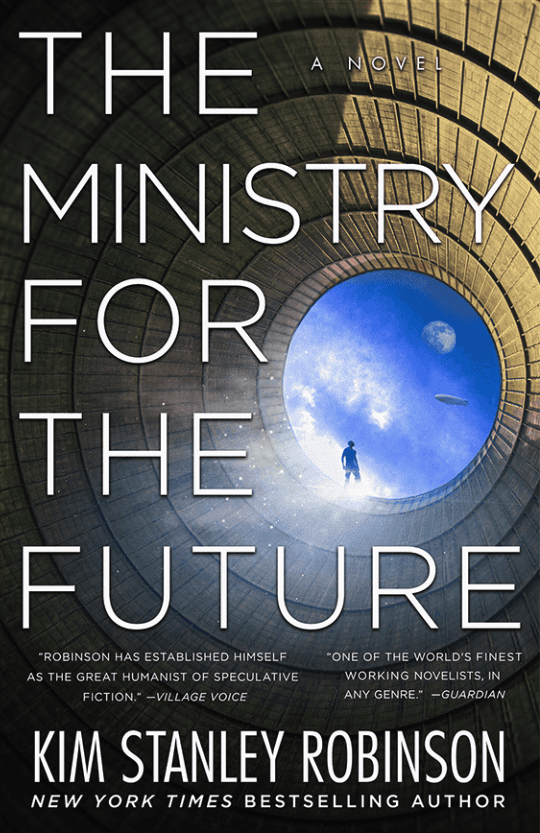
MinistryFuture coverAnd welcome to all readers!  Happy holidays to those who celebrate during the winter solstice.

With this post we start discussing the third part of the novel, chapters 51-68 (pp. 227-340).  I’ll begin with a summary of the story so far, add some notes, then ask questions for discussion. At the end I’ll repeat the reading schedule and add any resources I’ve come across.

You can share your thoughts by writing comments at the end of this post.  You can also contribute via social media – I’ll copy this post or a link for it to Twitter, Facebook, LinkedIn, Mastodon, and Medium.  I can copy and link to your comments there in next week’s post.  You can also respond through a podcast, video, web page… just be sure to let me know somehow.

Speaking of which, shout-outs to last week’s discussants Leslie A. Donovan, Steve Foerster, Chris Mayer, Sally Mudiamu, Doug Reilly, and Kevin Werbach. They touched on a great range of topics, from carbon coins and short time horizons to atomic power, central banks, international organization, as well as potential roles for higher education.  These fine folks pointed out the US Federal Reserve making climate change moves (!!), one carbon coin, another carbon coin, and the Future Generations Commissioner for Wales.

Beyond our blog, on his blog Tom Haymes offers a thoughtful post on climate change, scarcity, post-scarcity, and learning. (PS: Tom has a new book out  with a great title – Learn at Your Own Risk – and even better content. Go grab some copies.)

Now, to dig in to this week’s reading!

Summary

“The thirties were the zombie years. Civilization had been killed but it kept walking the Earth, staggering towards some fate even worse than death.” (p.227)

In this section we advance further in time, through the 2030s, and the climate has gotten worse. CO2 levels hit 463 ppm (56). Climate terrorism ramps up, with coordinated drone strike on air travel downing aircraft and killing thousands, leading to a massive decline in flying, as well as a similar torpedo hit against container shipping and others upon power plants. The Children of Kali scare people out of eating beef by claiming to have introduced mad cow disease at scale (51) while oil executives are attacked (56). Another revolt hits Paris (55). Los Angeles floods (59).  There are ten million climate refugees and both strikes and protests in many cities (60).

Meanwhile, most people are scrambling to respond.  Indian states experiment with expanded direct democracy and large-scale solar power (52). Mary and the Ministry pressure energy companies to support pumping water from under the Antarctic ice shelf, while inventing a user-owned, blockchain-backed alternative to social media called YourLock (53-4, 60). Badim suggests the creation of a new religion (56). The south polar pumping project makes progress, albeit at a cost (57).  Credit unions start to replace banks. Mary convinces the world’s central banks to back her carbon coin plan; China’s central bank head plays a key role in this.

The Ministry is bombed. Mary relocates to a mountaintop retreat with guards, but they are attacked there as well and shift to a Swiss military bunker, where they learn other international agencies and Swiss banks have been attacked by unknown assailants (60, 62-3).

Swiss Alps by crash71100

“And you need the Alps.” (p. 340)

Mary visits Frank in prison twice.  We learn Frank is also the “Jake” we saw marrying into a refugee family last week.

Notes

More non-plot chapters occur, including one on how to end capitalism (64).  There are two more very short riddle chapters on the photon (53) and the Earth (66).  Further micro-stories crop up about characters we never see again, but who give us glimpses of ideas and the world in transition.

Social change: we see something of Janus Athena, who seeks to “efface gender, to exist in that very narrow in-between, the zone of actual gender unknowability.” (54; p.241)

Technological change: we remain where we were last week, in a slightly advanced version of our world, with airships, blockchain, and many drones.

I think the author just coined the term “Götterdämmerung syndrome.”  It’s the subject of chapter 61:

The Götterdämmerung Syndrome, as with most violent pathologies, is more often seen in men than women. It is often interpreted as an example of narcissistic rage. Those who feel it are usually privileged and entitled, and they become extremely angry when their privileges and sense of entitlement are being taken away. If then their choice gets reduced to admitting they are in error or destroying the world, a reduction they often feel to be the case, the obvious choice for them is to destroy the world; for they cannot admit they have ever erred.

Discussion questions

  1. On the theme of violence: did the terror attacks we’ve seen so far succeed in changing human behavior, reducing our carbon usage?
  2. What do you think of the novel’s weaving together of fiction and ideas so far?
  3. How plausible would widespread use of YourLock be?
  4. Badim’s new religion of climate change: what do you think that might look like?
  5. The book has been silent on academia so far.  What role do you think colleges and universities could play in this world of the 2030s?
  6. Ministry staff offer this list of targets to attack for cutting back emissions in a serious way: “Carbon pricing, industry efficiency standards, land use policies, industrial process emissions regulations, complementary power sector policies, renewable portfolio standards, building codes and appliance standards, fuel economy standards, better urban transport, vehicle electrification, and feebates, which is to say carbon taxes passed back through to consumers.” (251) Which of these do you see as most likely for humanity to tackle now?

READING SCHEDULE

December 28, 2020 – chapters 69-88 (pp. 341-443).

January 4, 2021 –  chapters 89-106 (pp. 445-563).

Previous posts:

More resources:

  • New York state divested its pension funds from oil companies
  • The leading Kim Stanley Robinson website has a huge post on the novel, with links to tons of resources, including a fine shout-out to this very online book club.

Over to you!

(thanks to saramin for linkage; Swiss Alps photo by crash71100)

Posted in book club | Tagged | 14 Comments

Good news for 2020: the COVID-19 vaccine triumph

We are living through a research triumph and might not be fully realizing it.

Yesterday I started writing this optimistic post, but got caught up with more COVID-19 data, which led me to issue two grim Twitter threads (1,2). That dark mood still hangs over me today, so I can’t help but see the optimistic topic of this post as something Futurama’s Dr. Farnsworth would shout.

goodnewseveryone

But it’s true.  This is good news.

Let me explain, then point to the future, as we do on this blog.

That we now have COVID-19 vaccines – not just one, mind, but several – is astonishing.  We have never crafted a coronavirus vaccine for humans before, not for SARS or MERS, and those have been with us for years.  And humanity has never built a successful vaccine for anything, much less a global pandemic, in under a year. This represents a heroic combination of people, resources, innovation, hard work, risk, and institutions.  It’s one for history, on the same plane as Salk’s polio vaccine.

So why aren’t we cheering more?

Some people are, and that’s one reason the rest are not.  In the United States the pandemic is ruthlessly politicized, so naturally Trump and some of his supporters are delighted.  The president tweets about the vaccines fairly often.  Given partisan political logic, not to mention Trump’s bone-level mendacity, his opponents have an incentive to not follow suit.  Once Biden becomes president, the equation will flip, and Republicans may abhor the vaccines, while Democrats praise it. (Tucker Carlson gives us a hint of this switch.) Those who aren’t engaged at the party identity label might just sit the thing out.

Another reason for our refusal to be gleeful is that so many of us are immersed in dread and anxiety because of the pandemic and its associated economic fallout (cf my tweets from last night). December is a holiday time for many, especially in the Anglosphere, and various public health measures cramp or vitiate the season’s spirit. The horrors of escalating infections, hospitalizations, and deaths are uppermost in our minds. There’s also the popular sense that 2020 is just, in Time magazine’s dumb cover story, the worst year ever.  While I mock that expression I respect the sentiment it fumbles to describe.  That 2020 was a succession of awfulness is a hard feeling to shake.  The pandemic has been, and is, terrible. And the vaccines are only just now starting to be delivered.

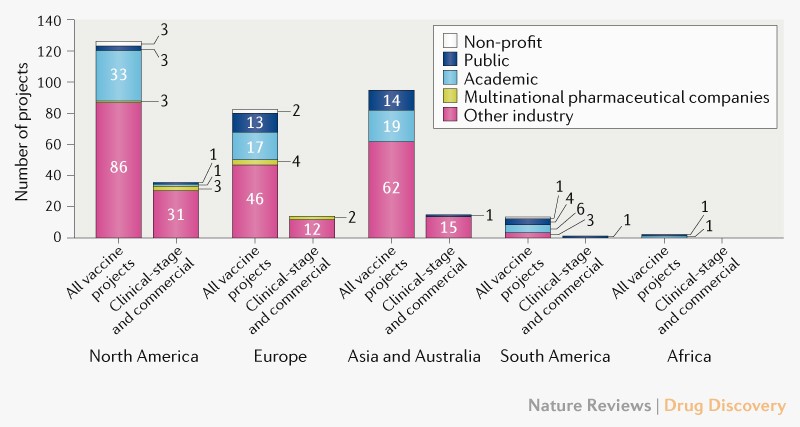
A third reason may be that the vaccines are not clearly identified with a single entity that we are already prepared to celebrate. Nobody likes to throw parades for drug companies, assuming we can someday hold parades again. No charismatic, media-savvy scientist has strode forth, although I expect Turkey and Germany to praise Ugur Sahin and Ozlem Tureci.  Moncef Slaoui doesn’t seem to have a following. No university has revved up a publicity campaign to arrogate glory to its scientists. No nation has claimed victory, so patriots can’t cheer.  In fact, this success is clearly a multinational or transnational story, with contributions from Europe, Asia, North and South America, and Africa.

coronavirus vaccine developers by nation and industry

Worse, multi-agency arrangements are in play, which usually fail to win media attention. How many people have even heard of COVAX or the Access to COVID-19 Tools (ACT) Accelerator, much less the Global Research Collaboration for Infectious Disease Preparedness (with its awesome acronym “GLoPID-R”)?

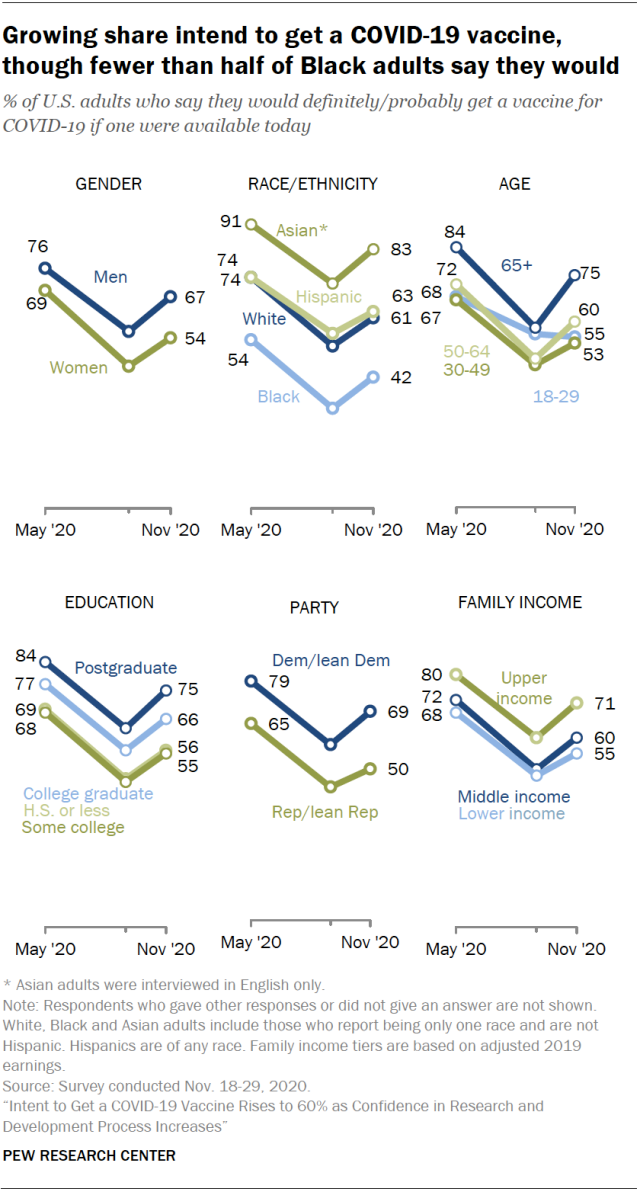
An additional reason may be that so many people refuse to take the vaccines or express skepticism about them, at least in polling.  There’s certainly an established antivax movement.  Beyond that core, bipartisan cadre is a wide range of Americans.  Recent polling has shown that women are more likely to resist the vaccines than are men.  Latinx and black people are much more likely to decline a vaccine than are whites and Asians.  Education and age are strong correlates with anti-COVID-vax attitudes.  For example, from Pew Research:

coronavirus-vaccine-intent_Pew 2020 Dec

The nay-sayers aren’t a majority of America.  They constitute roughly one third. But it’s a substantial enough group that media outlets and many people are probably leery of rubbing pharma success in their faces.  This might be even more true for people burned out on culture wars after a bitter 2020 election.  Progressives don’t want to attack people they wish to elevate.

Interestingly, Gallup finds that the biggest reason for people to be leery of vaccines is the very speed of their success. “In a follow-up question, 37% of Americans who would not get a vaccine say the rushed timeline for the development of the vaccine is the main reason they would not be vaccinated.”

There might also be some anti-nerd feeling at play here, connected to the residual disdain for science fiction.  Trump named the American effort Operation Warp Speed, and I remember well the negative reactions to that title.

I don’t want to be pollyannish about this.  There are all sorts of problems involved in making the vaccine work.  As I’ve told many of you, there are serious distribution issues. Already we’re seeing furious debates within the United States about uneven shipments to states and how to organize recipients.  Globally there are problems of inequity, with the poorest nations apparently far down on distribution lists. There may be religious opposition (and already one question). The Pfizer-BioNTech vaccine has a ferocious freezing requirement. So far the vaccines are not open source.  A new COVID variation has appeared in Britain and that nation’s health leader deemed it to be out of control.  We don’t have a sense of long-term effects.  And so on.

I am curious about how the COVID vaccine story will play out in the future, both its impact and how we acculturate it.

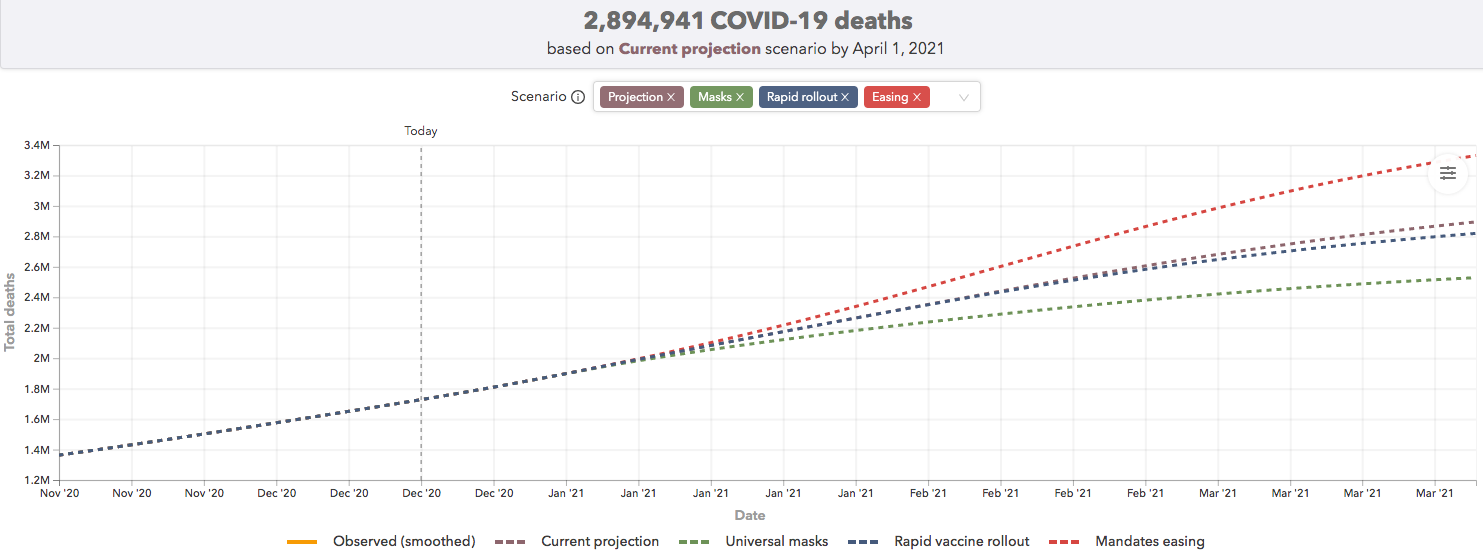
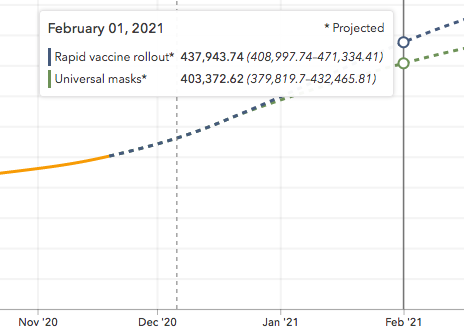
IHME projects that a rapid vaccine rollout could save 60,000 lives worldwide over the next three months.  If production keeps roaring along and enough people actually take the doses, we should expect that savings to keep rising, and the rate of new deaths to steadily drop.

coronavirus projected deaths Nov 2020-Mar 2021_IHME_2020 Dec 20

We should expect some historians to assign some credit for the success to president Trump, and for that to be hotly contested for years to come.

I am curious about what this means for the reputation of science.  Will the COVID vaccine triumphs inspire more popular interest in science, at least in epidemiology or public health in general? I expect it might nudge more people to explore careers in those fields. Yet anti science feeling has deep and diverse roots, as a casual glance at the sheer variety of anti-vaccine people shows.  I don’t mean science studies academics, but people in the broader population. The science culture wars could rage for another generation…

…which is important for how we grapple with climate change. If substantial populations remain skeptical of science, that augurs extra political and cultural stresses as that great global crisis proceeds.  Doing interdisciplinary climate science research, offering mitigation projects, teaching the topic, arguing for civilizational changes all already face obstacles and opposition.  One lesson of 2020 and the pandemic vaccines might be that we should expect climate progress to receive weak support and broad-based dislike.  We remain, broadly, as a species, uncomfortable with how science works and what it brings about.

Posted in coronavirus, futures | 2 Comments

Higher education fall 2020 enrollments: the latest data

As the fall 2020 semester comes to an end, we now have updated data on enrollment.

buy vilitra online buy vilitra no prescription generic

National Student Clearinghouse Research Center logoThe National Student Clearinghouse Research Center has been tracking these numbers closely all season.  I shared their previous reports as they appeared (September, October, November), and now want to blog about their latest update.

tl;dr version – higher education enrollment dropped significantly in fall 2020, more steeply than any semester over the past decade.

Now let’s look at the details.

The broad picture is unchanged from the previous three releases. Undergraduate enrollment dropped, grad enrollment rose, first-year and community college enrollment fell off of their respective cliffs.  What this week’s report does is upgrade the data.  I asked Doug Shapiro, the Center’s director (and great Future Trends Forum guest) about what they did differently.  His response: gathering even more data from more campuses and weighting results across sectors.

What does the data reveal?

Total enrollment declined 2.5%.

Undergrad enrollment went down 3.

buy zovirax online buy zovirax no prescription generic

6%, or a loss of more than half a million students.

Graduate enrollment went up 3.6%. (There are many more undergrads than grad students – so far – which is why this number has less of an impact.)

First-year enrollment dropped 13.1%.

The Clearinghouse sliced and diced the results in a few different ways.

buy intagra online buy intagra no prescription generic

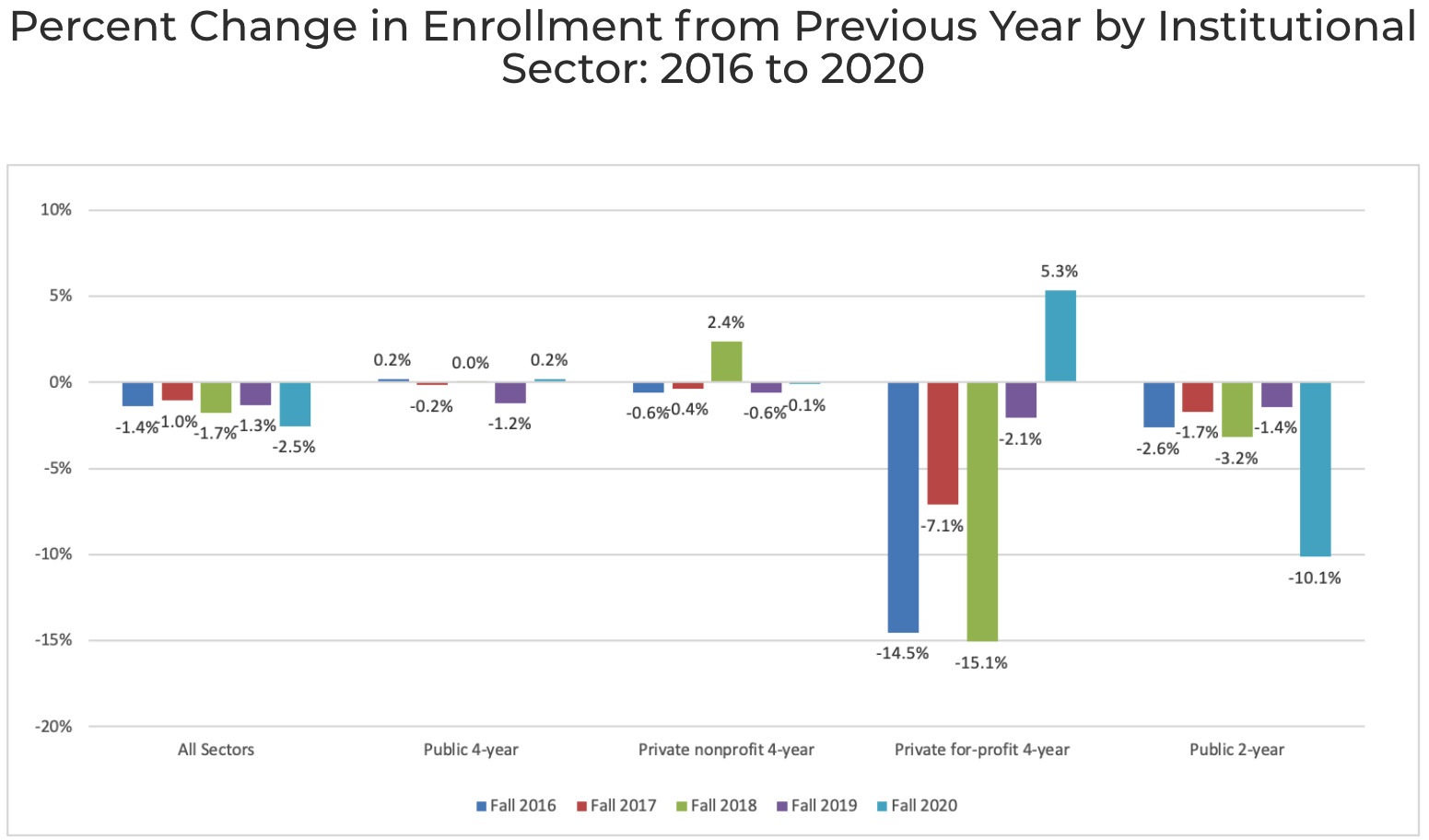
  For example, by sector or institutional type:

enrollment 2016-2020 by sector_Clearinghouse

Note that community colleges not only continued a multiyear decline, but really lost numbers badly this term. Note, too, how for-profits utterly flipped their script from a long-running collapse into the only bright spot this term.  And don’t miss how private four-year institutions endured a slight decline, while public equivalents enjoyed a slight rise.

If we look at this in terms of public versus private, the former suffered badly:

Public college enrollment (two-year and four-year combined), which enrolls 7 out of 10 postsecondary students, declined by 4 percent or nearly 530,000 students this fall, mainly due to decreases at public two-year institutions.

Demographic analysis brings out other elements.  The age of students, for example, shows some variation.  Traditional-age undergraduates (aged 18-24) dropped the most, -3.7%, reflecting that first-year plummet.  Adult learners also declined, but only by 1%.  Looked at in terms of gender, the “feminization” of enrollment accelerated, as men’s numbers dropped more than did women’s.  7,217,092 men took classes this term, down -5.1% from fall 2019.  In contrast, 10,561,392 women enrolled, a dip of just 0.7%.

Slicing the data geographically reveals a more complex picture, with rises and declines scattered across the United States.  The states with the worst losses are in the west, southwest, south, and midwest:

New Mexico 99,900 -9.5%

Michigan 437,480 -9.2%

Alaska 20,234 -9.1%

Oregon 182,820 -7.9%

Washington* 292,382 -7.0%

Mississippi* 153,428 -6.4%

Ohio* 556,354 -6.3%

California 2,298,754 -6.1%

Similarly, leading increases are in the northeast, mid-Atlantic, and west:

New Hampshire 182,020 15.8% (!)

Utah 378,855 4.8%

District of Columbia 72,763 2.9%

From another angle, if we look at the data in terms of full time versus part time study, both declined, overall: -2.2% and 3.1%, respectively.

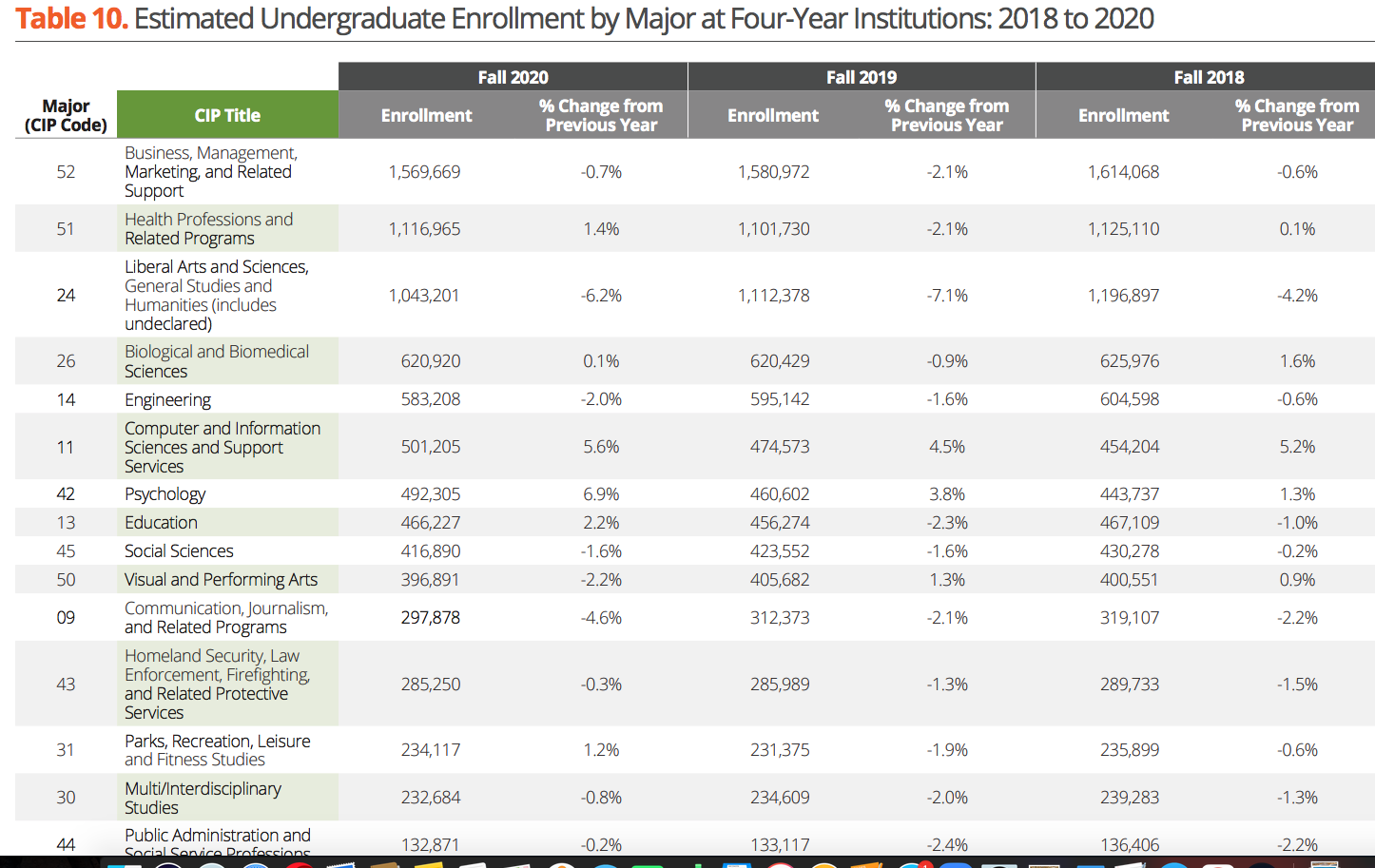
Changes in majors are very interesting.  The Clearinghouse groups degrees into larger categories, which yield some insights.  Here are the most subscribed fields:

enrollment majors 2018-2020_Clearinghouse

Business rules, but continues a slight decline.  The full spectrum of health care (51, 42, 26) is healthy, especially psych.  The humanities, in contrast, keep falling.  For example, the field where I got my degrees, English Language and Literature/Letters, enrolled 120,097 students, down a whopping -7.3% from last year. 2019’s 129,606 was a -5.0% drop from 2018, itself falling -4.4% from 2017.

What can we say about these findings?

I already commented on earlier editions of this research, and can quickly summarize those notes.  The supermajority of campuses depend heavily on tuition and fees for their business model, so this is trouble. Competition will heat up. The relative health of grad programs might encourage campuses to shift energies in that direction, away from undergrad offerings. The first-year plummet is a hole that’ll work through afflicted institutions for years to come.

Why is this happening?  Clearly COVID-19 plays a role.  When I asked Doug Shapiro about this, he replied that the digital divide had a major impact as the pandemic drove many classes online.  That is, would-be students would saw themselves having issues with hardware, software, or networks were less likely to enroll.  That population is disproportionately represented in community colleges.  Or they viewed hands-on subjects as less likely to be taught well online.  This is a huge point, and yet another sign of the damage the digital divide inflicts on America.

This is also a major blow to the theory that college enrollment rises with unemployment.  Although Shapiro did observe in conversation that some people must have thought the spring economic shock would not last, and didn’t see post-secondary degree work as worth the trouble.

One community college president offered another reason: “The biggest is finances — he says students and their families are squeezed right now, despite the low cost of tuition at most community colleges.”

I would also frame this in terms of the nearly decade-long enrollment decline. I first referred to this trend as peak higher education back in 2013, and so far that model has held. Indeed, fall 2020 is the most intense instance of this enrollment pattern.

Looking ahead to 2021, much depends on how would-be learners perceive the threat of COVID-19 to themselves and how they see campuses responding.

buy filitra online buy filitra no prescription generic

  If enough people see colleges and universities as safe places where they can get valuable degrees, enrollment might tick back up in spring.  Otherwise, we can see the decline continue.

Posted in enrollment | 8 Comments

A high school graduation forecast from WICHE

How does the high school to college pipeline look?

Many American colleges and universities recruit undergraduate students from the pool of recent high school graduates.  This is usually the stereotypical first-year college student image, a bright 18-year-old who transitions from their senior high school experience to being university frosh over a short (if dramatic) summer.  It’s only one segment of the higher ed student body, as more and more adults enroll, but let’s focus on it for now.

The Western Interstate Commission for Higher Education (WICHE) just released an updated report on high school graduate population projections, and it’s sobering for those who haven’t been tracking this issue in particular or demographics in general.

tl;dr version: high school grads will peak in 2025, then decline.

Let’s dig into the report and bring out some highlights.

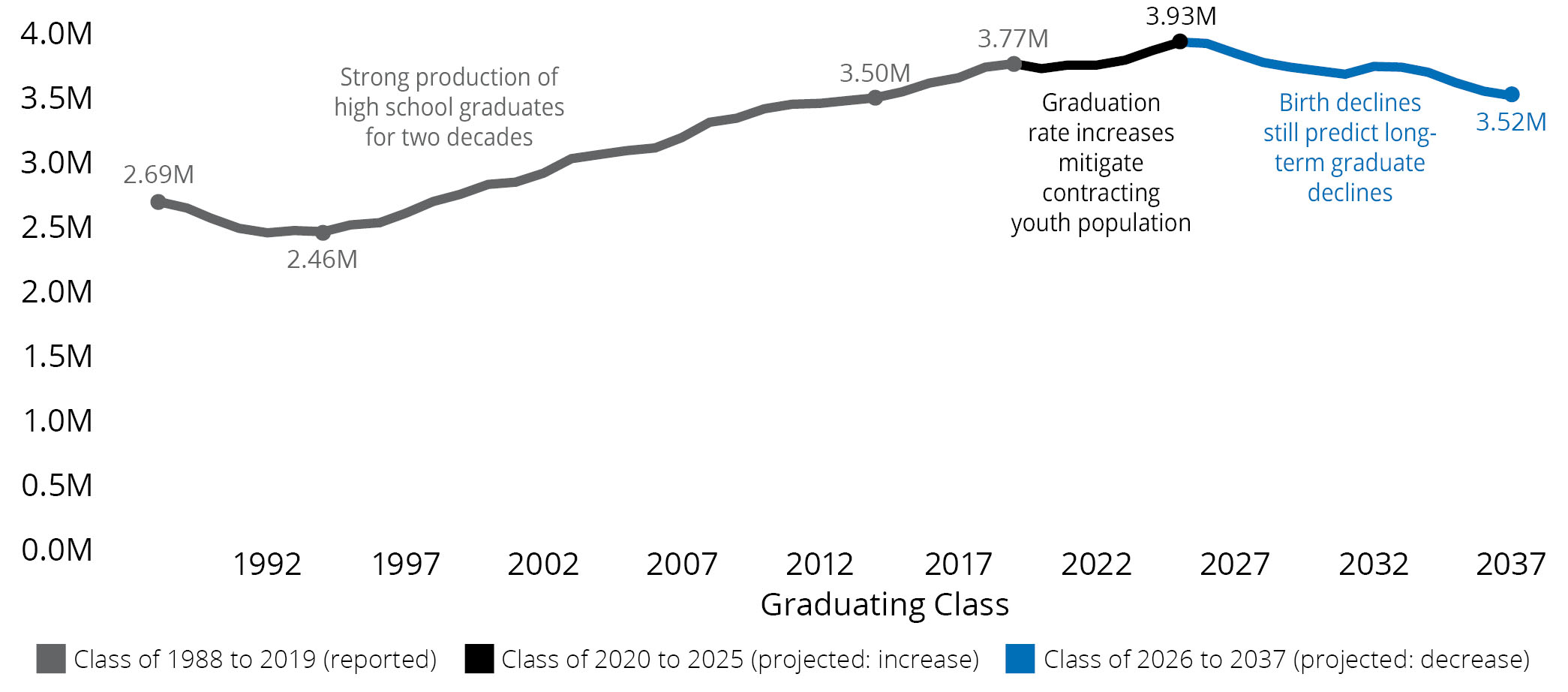
WICHE situates their projections in recent history.  Consider their graph:

WICHE high school grad chart 1990-2037_2020 Dec 16

From the early 1990s on high school graduation numbers really soared.  This helped feed into the major higher ed expansion at the same time.  But starting in 2025 those numbers will start ticking down.  That downward slope continues for more than a decade. “The U.S. high school graduating Class of 2037 is projected to be about the same in number as Class of 2014 (3.5 million).”

This is a national overview.  Regional differences can be strong.  WICHE forecasts midwestern and northeastern graduate numbers to keep falling, while the south (mostly Texas and Florida) continues to produce bigger graduating classes.  In the west, it’s mostly about one state:

The number of California graduates continued to increase heading into the projections, but at about half previous rates of increase: total California high school graduates increased 2 percent annually, on average between 2003 and 2011, and 1 percent annually, on average between 2011 and 2019. Predicted stagnation in high school graduate numbers for California, and then predicted contraction…

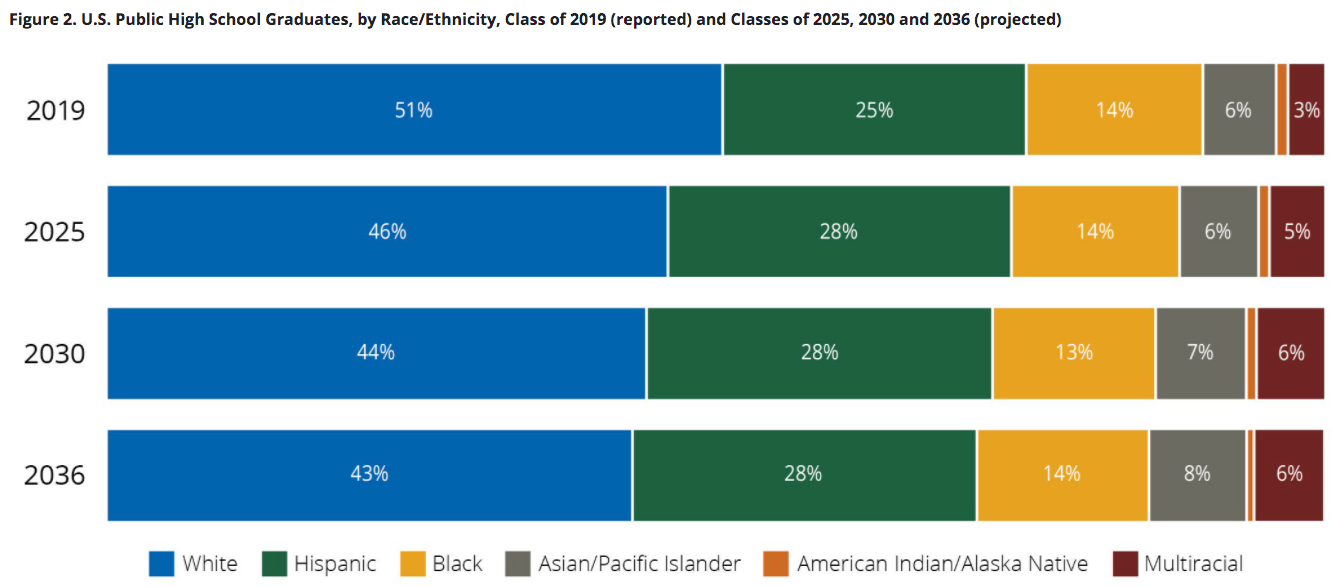
In terms of race and ethnicity, WICHE supports the consensus view: declining white numbers, unchanged black graduates, and rising Asian and multiracial populations.   One surprising detail for some is that Latinx birthrates have started dropping. “[A]fter 2007, the greatest decreases in births accrued with Hispanic mothers – with 17 percent fewer Hispanic births in 2018 than 2007.”

WICHE high school grads ethnicity 2019-2036_2020 Dec report

One key point, and WICHE is careful to make this right away: the report does *not* account for COVID-19. It’s based on data extending through the year 2019.  National Student Clearinghouse data indicates that 2020 saw a major drop in high school grads enrolling in higher ed.  WICHE thinks that 2020 grad numbers might actually be higher, as schools tried hard to be flexible, but that 2021’s class may shrink.

What does this mean for higher education?

On the one hand, the rising numbers for the next five years may cheer admissions offices and those who pay attention to their work.  Amid the many difficult short- and long-term trends, this looks like a medium-term opportunity, at least for campuses seeking to fight against enrollment decline. It helps that the actual numbers for 2019 were higher than WICHE anticipated.

On the other, the 2025 peak is right in line with Nathan Grawe’s model.  Some of you will recall that Grawe forecast a drop caused by the 2008 financial crash and its negative impact on childbirth. 2008 + 18 takes us right to 2026.  Inside Higher Ed quoted a WICHE leader on this:

“That good news really can’t escape demography,” said Patrick Lane, vice president of policy, analysis and research at the Western Interstate Commission for Higher Education. “There are simply fewer students available that were born in and after the Great Recession to fill college seats going forward.”

The WICHE report may also encourage people in and around academia to pay more attention to demographics, because changes to birthrates are a fundamental driver behind those high school graduation numbers.  And the powerful trend here is for fewer births.

Some campuses may decide to expand ties with high schools in order to improve the flow of students from the latter to the former. There are all kinds of ways to do this, of course, including letting high school students take college classes, colleges loaning advanced scientific equipment to K-12 districts that can’t afford them, and so on.

Another strategy may be to recruit more from private high schools, as they are now doing better that publics:

Nationally, private high school graduates are now projected to increase in number by as much as 13 percent from Class of 2017 to 2025… Then, even as the number of U.S. public school graduates is projected to begin contracting after 2025, 9 percent more private high school graduates are projected by Class of 2030 compared to Class of 2017. Private high school graduates are projected as 10-11 percent of U.S. total high school graduates over the course of the projections. So, while public school populations still drive the overall number and patterns for total U.S. high school graduates, these positive private school trends contribute some “cushion” to the overall downward trend that is predicted by annual decreases in the number of young children beginning with 2007.

We could also see the reverse, as some campuses cut back on recruiting 18-year-olds in favor of adults.

Another strategy: improving outreach to students of color, as they constitute a growing aggregate.   Obviously this is a major concern in 2020.  Perhaps the WICHE report will spur institutions to keep focusing on that in the future.


Posted in demographics, enrollment | Leave a comment

Our Ministry for the Future reading: part 2

Today we continue with our reading of Kim Stanley Robinson’s Ministry for the Future.

If you’re new to the book club, welcome! Here’s the introductory post.  And here’s last week’s discussion of part one.

MinistryFuture coverAlready discussion has been flowing.  In comments on last week’s blog post, Joshua Kim offered advice about the novel’s style.  Kevin Werbach found the first chapters realistic and was fascinated by the idea of a Gini coefficient for the planet.  Steve Foerster has an answer to one of my questions.

More: political scientist Mark Rush shared a lot of responses in two comments (1, 2). One key point:

the solution to the climate crisis requires the creation of a global government with legitimate, extensive, potentially violent power behind it to force people to abide by changes and policies necessary to control the climate changes. Otherwise, we are faced with that world described in chapter 16 where the well to do hunker down and wait out the disaster while the poor…just…suffer and die. OTOH, there is no question that people are going to die because of climate change. So, who gets to decide?

Elsewhere on the web, but still in the book club, Tom Haymes notes on his own blog the theme of too much water, and builds on that to explore the theme of an information deluge.  (PS: Tom has a new book out this very day, with a great title – Learn at Your Own Risk – and even better content. Go grab some copies; it’s available this week.) In his Inside Higher Ed column Joshua Kim argues that colleges and universities already play the future-oriented role that the novel’s imagined Ministry performs.  And in a second blog post Haymes argues that the advent of digital technology should enable us to rethink economic paradigms.

Now, with today’s post we start discussing the second part of the novel, chapters 27- 50 (pp. 107-225).  I’ll begin with a summary of the story this part reveals, add some notes, then ask questions for discussion. At the end I’ll repeat the reading schedule and add any resources I’ve come across.

You can share your thoughts by writing comments at the end of this post.  You can also contribute via social media – I’ll copy this post or a link for it to Twitter, Facebook, LinkedIn, Mastodon, and Medium.  I can copy and link to your comments there in next week’s post, as I did up above with Tom’s and Joshua’s.  You can also respond through a podcast, video, web page… just be sure to let me know somehow.

Now, to dig in!

Summary

(NOTE: Spoilers for chapters 27- 50 (pp. 107-225).)

With many pieces on the board, the plot, like the planet, heats up.  Mary, under police guard after Frank’s attack, learns that Badim is part of a “black wing,” a shadowy direct action group willing to countenance violence (110; chapter 27).  That group may be connected to the Children of Kali, who conduct drone strikes and assassinations (ch 33). The Antarctic crew experiments with using their pumping idea on Thwaites Glacier and elsewhere (chapters 29, 44).  India plans on doing another independent geoengineering project, and is also running a massive, solar-powered, organic farming initiative (140-2, ch 34).  The Arctic’s ice cover melted completely, for the first time, in 2032 (147; ch 36).

We meet a Libyan refugee family that a man named Jake marries into; he sounds a lot like Frank (ch 37).  A direct action group takes the Davos meeting hostage and makes participants become more self-sustaining, while showing them slides and videos about the climate crisis (ch 39).  The Ministry comes up with the idea of offering a carbon coin, a tradable, blockchain-backed currency created by sequestering carbon (ch 42).  Mary pitches the world’s central bankers on the carbon coin, but they refuse to buy into it (ch 45, 50).We learn of a Californian project to recast water as a common good, then to build a vast new catchment for rebuilding groundwater (185-7, ch 45).  Frank continues to live on the run, joining then leaving a family and helping refugees, until he gets arrested (ch 47). Mary visits Frank in jail (221-225, ch 50).

The climate crisis worsens.

Notes

Ministry for the Future _my stickies

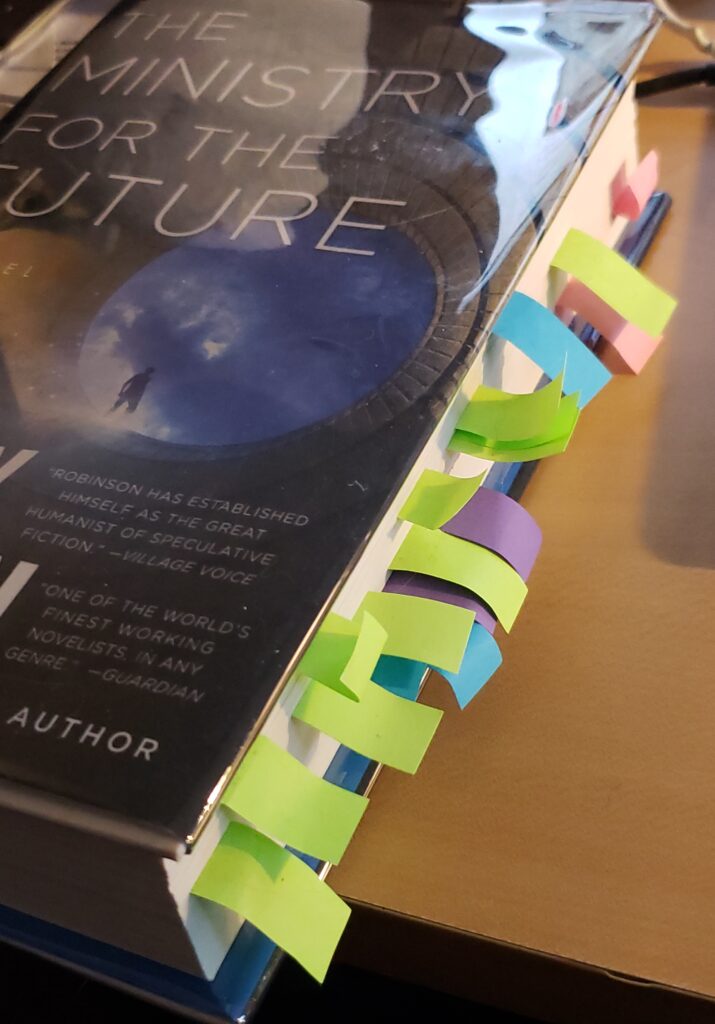
My library copy with some post-its.

The novel continues to offer non-plot chapters. There are some very short riddle chapters, such as one where the speaker is encryption or the market.  There are also meditations on Hebrew tradition, historical periodicity, economically discounting the future, the Jevons paradox, and the Bretton Woods conference and world order. We get micro-stories about characters we never see again, but who give us glimpses of ideas and the world in transition: Indian reformers (ch 31), climate migrants, an unnamed city experiencing a water shortage.

Technology notes: we learn that airships are being widely produced (148). Drone strikes can succeed by using large numbers to overpower defenses (135).

In chapter 42 characters discuss “the Red Plenty argument” (171). This refers to Francis Spufford’s 2012 book, Red Plenty, a combination of fiction and history, describing the Soviet Union’s experiment with central planning backed by cybernetics and lots of data.

Mary remains our main character, with Frank in counterpoint.

One more note: “Ministry” is a loaded term. It refers to the governmental agency, of course, but also has salvific overtones from religion.  It is, after all, about saving both humanity and the world.

Discussion questions

  1. What do you make of how Ministry for the Future weaves together narrative and ideas?
  2. At this point in the novel humanity is not acting in a cohesive way. However, we do see various projects offered by separate governments and organizations at scale: California, India, the Antarctic team. Do you find this a likely way we will proceed? Is it an effective one?
  3. What do you think of the climate change mitigation strategies this part of the book has offered?
  4. Returning to the question of violence: we now know the Ministry is connected to people who commit property damage and violence against people.  Looking ahead, how do you think this two-winged strategy will fare?
  5. Joshua Kim notes that academics do not play a major role in the novel thus far. He then invites us to fill in that gap. How do you envision colleges, universities, and our populations acting in the Ministry‘s future?

READING SCHEDULE

Coming up next:

December 21, 2020 – chapters 51-68 (pp. 227-340).

December 28, 2020 – chapters 69-88 (pp. 341-443).

January 4, 2021 –  chapters 89-106 (pp. 445-563).

Previous posts:

More resources:

Now, over to you!  What do you think?  Please use the comments box or share your thoughts elsewhere.

(thanks to Mary Churchill)

Posted in book club | Tagged | 32 Comments

Campuses and COVID: several updates

As I write this post the COVID-19 pandemic continues to rise in the United States and Europe.  At the same time colleges and universities are winding down 2020’s educational activities.

I’d like to share several updates.

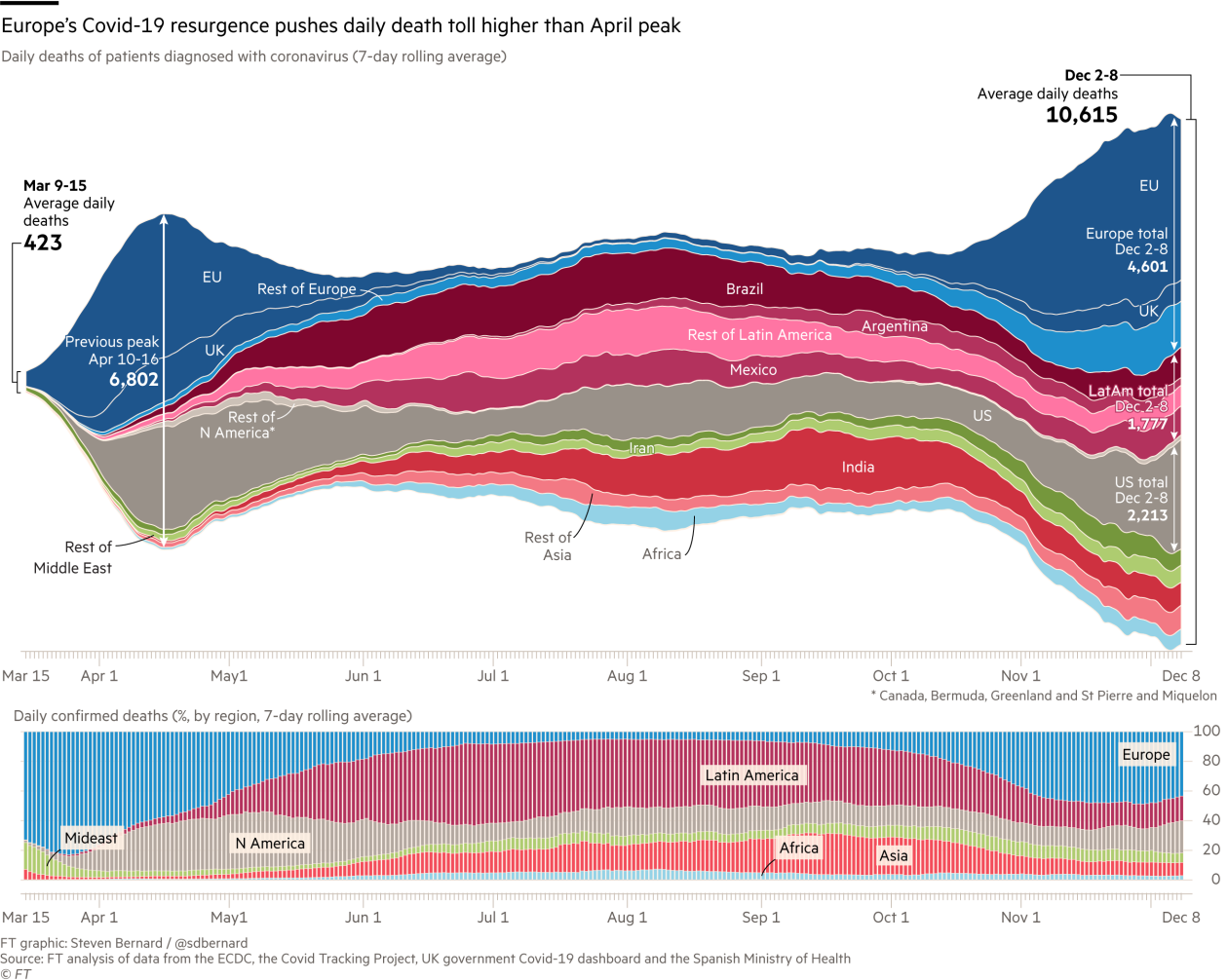
First, on the pandemic: worldwide, there are 70,461,926 confirmed cases of COVID-19.  Among them there now stand 1,599,704 deaths, according to WHO.  The Financial Times sees Europe as a whole leading the world in deaths:

coronavirus world spread Financial Times 2020 Dec 13

IHME projects over 1.8 million dead worldwide by January 1.

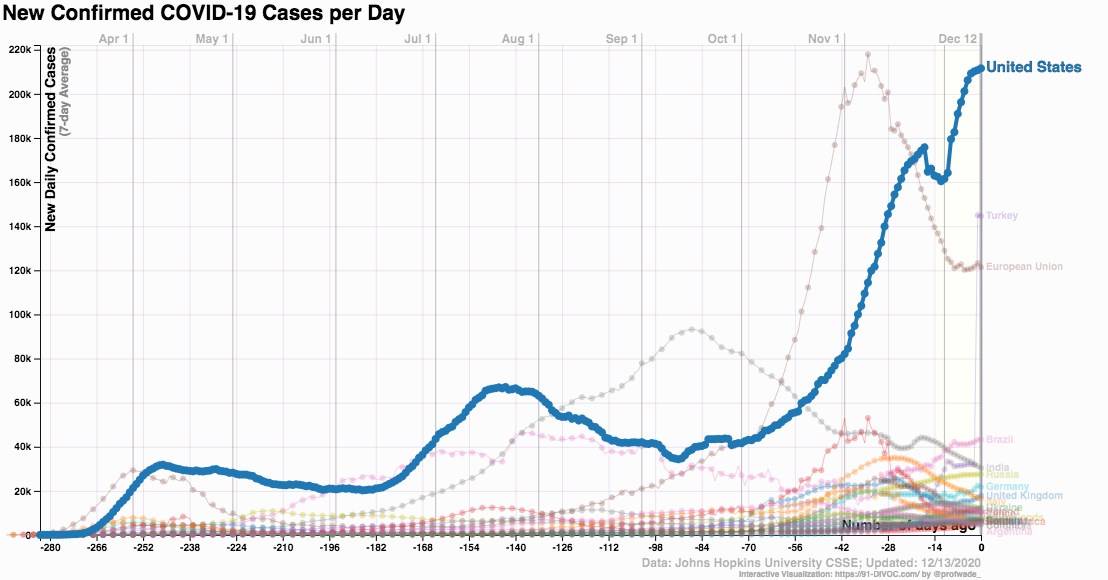
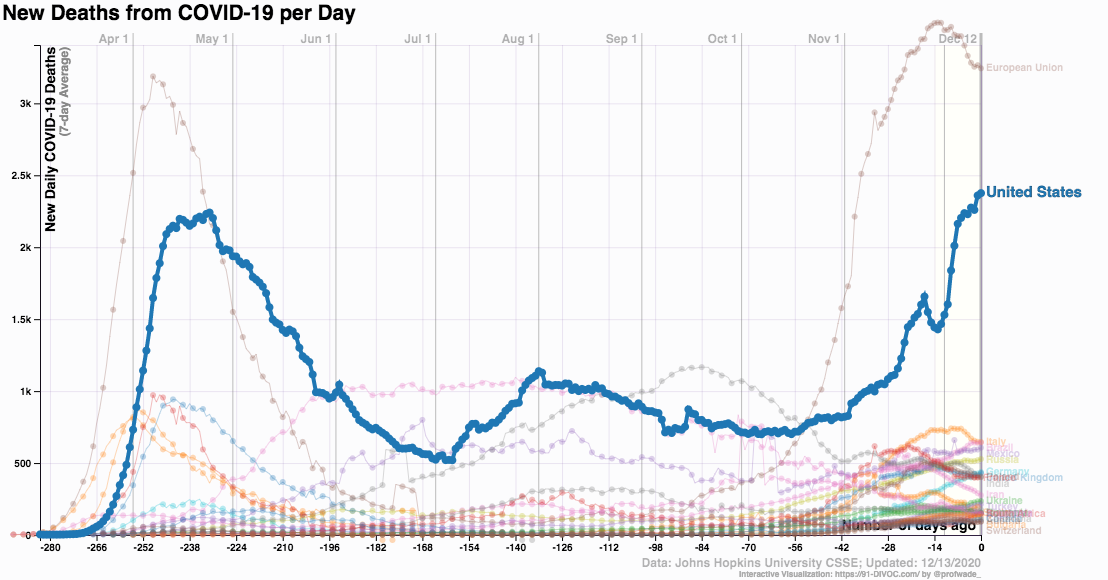
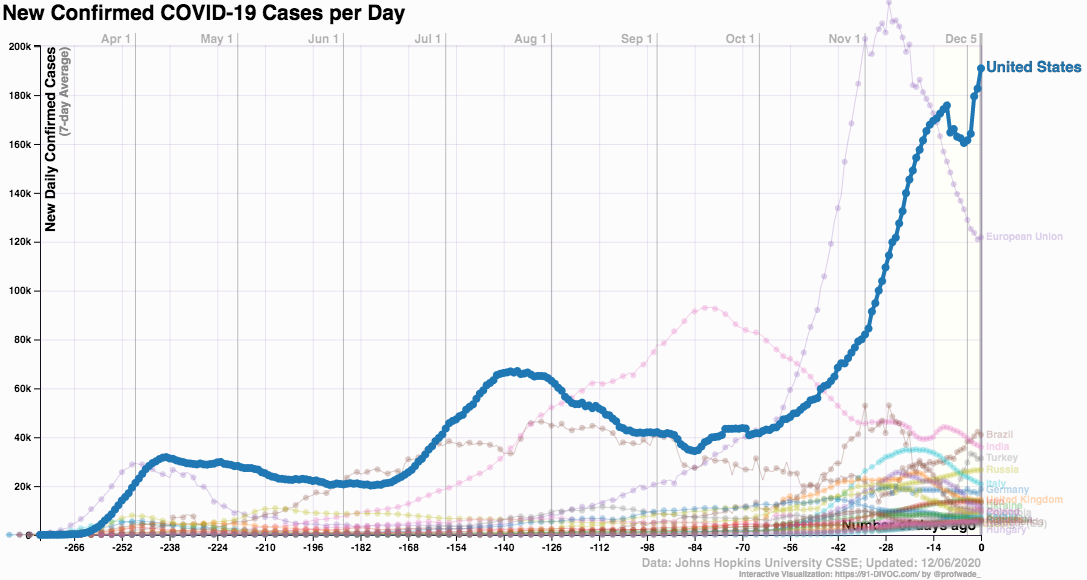
In the United States 15,932,116 people have been infected, or roughly 4.5% of the entire population.  The virus has killed 296,818 people in America, according to the CDC.  That number will probably break 300,000 by the time you read this.  America has more infections and deaths than any other nation on earth, according to Johns Hopkins and visualized by 91-DIVOC:

coronavirus cases by nation 2020 Dec 1391-DIVOC

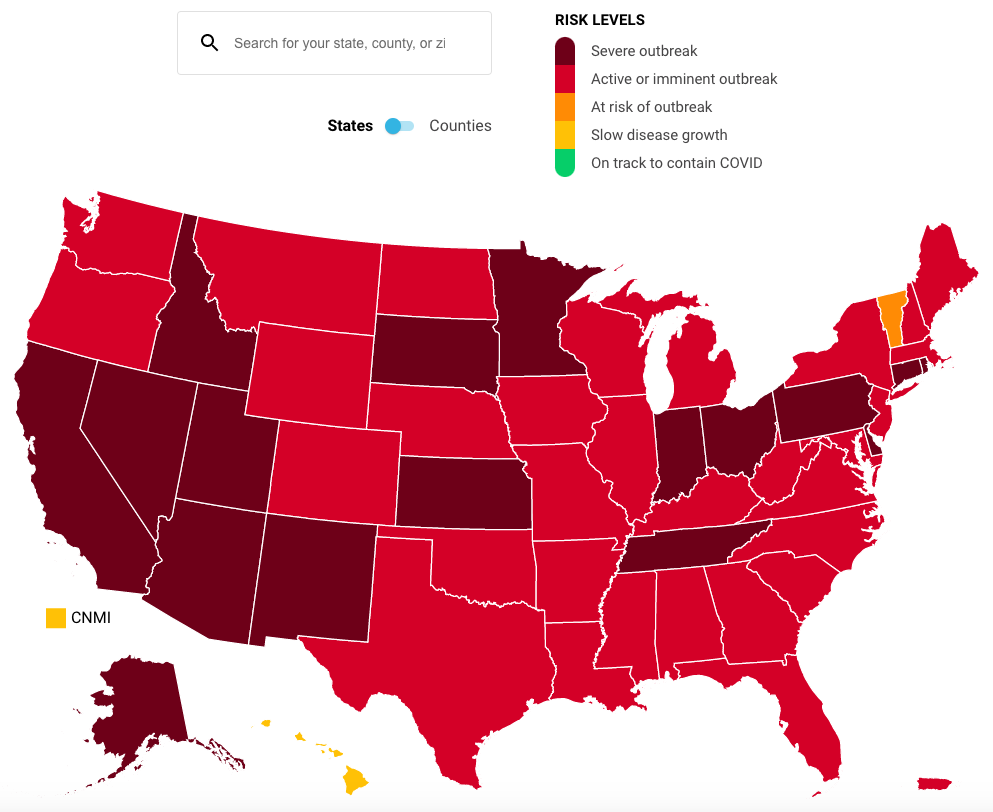
coronavirus deaths 2020 Dec 13_91-DIVOC Cases are rising everywhere in the United States, in every state, according to COVID Act Now:

coronavirus US risk levels by state _COVIOD ACtnow_2020 Dec 13

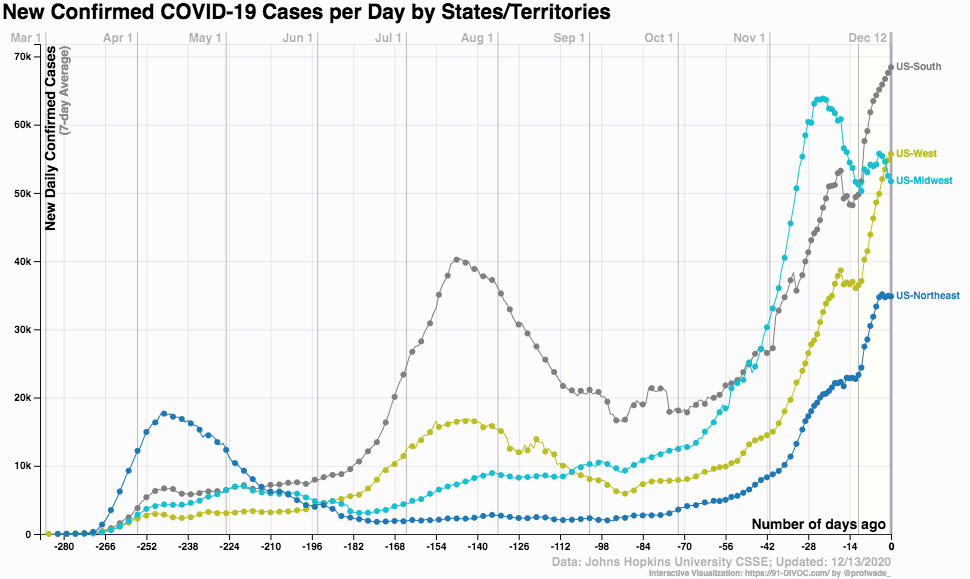
The same trend occurs broken down by regions, although the midwest seems to have turned a corner:

coronavirus cases US regions 2020 Dec 13_91-DIVOC

Looking forward, IHME projects 334,000 dead in the United States by January 1.

Against this, the first vaccine distribution commenced, starting in Kalamazoo, Michigan.

That is the pandemic context for our considerations of higher education.

(The preceding may look cold. I wrote in a mixture of fury, dread, and exhaustion. I listened to my family today, both in my house and elsewhere, and feared for every one of them.  My son is living with us, taking university classes online, because he fears the on-campus infection risk. My wife is working as a contact tracer.  The pandemic reaches throughout my life.)

(I don’t write about these feelings very often.  I feel I can do a better service by sharing research and analysis.)

Second, a New York Times team found that colleges and universities are present in some counties where COVID-19 cases rose to unusually high levels.

As coronavirus deaths soar across the country, deaths in communities that are home to colleges have risen faster than the rest of the nation, a New York Times analysis of 203 counties where students compose at least 10 percent of the population has found…

[S]ince the end of August, deaths from the coronavirus have doubled in counties with a large college population, compared with a 58 percent increase in the rest of the nation.

Who died among the infected? “Few of the victims were college students, but rather older people and others living and working in the community.”

Is this causation or mere correlation?  Did in-person education this fall infect and kill community members?  In favor of causation we can identity various transmission routes.  A typical one involved socialization outside of classes:

“The students came back anyway, and swooped down on bars and restaurants and other places and caused outbreaks in the community,” said Debra Furr-Holden, a Michigan State epidemiologist and associate dean for public health integration.

The Times notes an underappreciated infection pathway:

More than 1.1 million undergraduates work in health-related occupations, census data shows, including more than 700,000 that serve as nurses, medical assistants and health care aides in their communities.

And still another:

At Valley Senior Living [North Dakota], the main nursing home and assisted-living provider in town, college students make up about a quarter of employees. They help residents brush their teeth, serve meals of meatballs and potatoes and become like substitute grandchildren to people whose isolation has intensified during the pandemic.

Note that these involves students as workers.  This role rarely wins media attention, but is certainly very important, especially for poor students.

Note, too, that this is partial data, only reaching a few hundred counties.

How will this impact college and university plans?  Does this data play a role in delaying spring term opening?  Will it encourage some to move instruction entirely online, or to at least de-densify their campus?

Speaking of partial data, the New York Times also published a frustrating report on infections within college sports teams.

It’s multiply frustrating, starting with its main finding:

At least 6,629 people who play and work in athletic departments that compete in college football’s premier leagues have contracted the virus, according to a New York Times analysis. The vast majority of those infections have been reported since Aug. 15, as players, coaches and the staff around them prepared for and navigated the fall semester, including football season.

That’s a lot of infections.  I wonder how many infections they led to.  How many deaths?

The Times adds that these results “collectively demonstrate how the virus can intrude on programs even when they have stringent safety protocols, including widespread testing.”

But what’s also frustrating is that this data was very hard to get, and only represents a fraction of the story.  Listen to Blinder, Higgins, and Guggenheim:

The actual tally of cases is assuredly far larger than what is shown by The Times’s count, the most comprehensive public measure of the virus in college sports. The Times was able to gather complete data for just 78 of the 130 universities in the National Collegiate Athletic Association’s Football Bowl Subdivision, the top level of college football.

And “[s]ome of those schools released the pandemic statistics only in response to requests filed under public records laws.”  Straight up, around half of American college football teams – and their host institutions – simply refuse to share this information with the world.

The remaining schools, many of them public institutions, released no statistics or limited information about their athletic departments, or they stopped providing data just ahead of football season. [emphases added]

The N.C.A.A. does not track coronavirus cases…

What does this mean?  “This had the effect of drawing a curtain of secrecy around college sports during the gravest public health crisis in the United States in a century.”  And “university leaders have routinely hidden their deliberations and debates from public view.”

Some of this academic secrecy was the result of mid-stream changes:

The University of North Carolina had reported 37 infections [in July 2020], for instance, and Western Kentucky University said it had just six.

But those schools were among the 13 that stopped releasing statistics about cases within their athletic programs. Some schools changed their approaches as the start of football season neared, abruptly citing privacy laws to justify withholding the very data they had provided for weeks or months. A handful offered no explanation at all.

As I’ve previously written, American higher education is now operating during the pandemic in a data void of its own creation.  Internally, while some campuses publish some data, many do not.  This drives external entities, like the New York Times, to not just conducting lots of data gathering and analysis but also investigation into what actually is occurring, and at an enormous scale, with hundreds or thousands of institutions.  And the Times, despite its excellence and resources, still can’t get data on even one half of American higher education.

We don’t know how many infections there are among college and university populations.  We don’t know how many deaths have resulted.  In far too many cases, and certainly in the sector as a whole, we can’t meaningfully judge pandemic responses.

This data void impacts everyone in or adjacent to the academic enterprise.  Students, librarians, faculty members, presidents, other staff of all kinds, family members; funders, state governments, publishers, communities abutting campuses: we are all forced to make decisions with a damnable paucity of information.

We can, and should, do much better.

Posted in coronavirus | 1 Comment

College enrollment decline: new data on high school graduates

How is higher education enrollment changing this year?

I’ve been tracking enrollment trends for years.  In 2020 things have become more strange and intense, given the combination of pandemic and bad recession.  So far the best data we have shows that the total number of students taking classes at American colleges and universities has declined during the fall semester by about 3.3%.  This drop is sharper than the steady decline we’ve seen for nearly a decade.

A new report today sheds some light on this topic.

buy propecia online buy propecia no prescription generic

  The number of student who graduated from high school in 2020 and proceeded directly to higher ed fell by 21.7%.

I’d like to share highlights that struck me as important. Let’s dive in.

One quick caveat: not all college and university students are recent high school grads, despite the popularity of this image.  A good chunk are adults. In today’s post we’re just focusing on the 18-year-old segment.

National Student Clearinghouse Research Center logoThe report comes from the National Student Clearinghouse Research Center, which has been doing great work on enrollment data.

buy forzest online buy forzest no prescription generic

  A key finding from this latest publication is that while COVID doesn’t seem to have slowed down high school graduation rates, it seems to have cut back that population’s college enrollment by more than one-fifth: “21.7 percent, nearly eight times the pre-pandemic loss rate (-2.

buy zenegra online buy zenegra no prescription generic

8%).”

Put another way,

The immediate college enrollment rate decreased to 27.7 percent from 35.3 percent last fall, a decline ten times steeper than last fall’s drop (from 35.9% in 2018 to 35.3% in 2019).

That figure doesn’t cover variations by race, geography, or class, which the report does address.  High schools with a majority of students who are poor, or underrepresented minorities, or from cities sent far few graduates straight to college than the rest:

enrollment high school to college Clearinghouse 2020 Dec 10enrollment high school to college Clearinghouse 2020 Dec 10

What kinds of higher education institution are these students attending, or not?  It looks like recent high school grads are avoiding community colleges most of all:

enrollment in higher ed from high school 2019-2020_Clearinghouse

Summing up, Inside Higher Ed quotes the Clearinghouse’s director, Doug Shapiro:

[T]he pandemic impacted high school graduates in their immediate college enrollment, and those from high poverty, low income, and urban high schools have been hit the hardest. The enrollment gaps appear to be widening because of COVID-19.

University Business describes this development as “an alarming free-fall in the postsecondary enrollment rate.”

Why does this matter?

First, if higher ed is currently experiencing an increased focus on equity gaps, it looks like that problem just got worse, at least when it comes to recent high school graduates.

buy grifulvin online buy grifulvin no prescription generic

Second, unless these numbers completely reverse themselves in fall 2021, higher ed will have to deal with this hole for the next few years.

Third, this could give some institutions the incentive to work more closely with high schools in order to improve that pipeline.  The opposite is also possible, in that campuses could decide to double down on adult learners.

Posted in enrollment | 7 Comments

Our Ministry for the Future reading: part 1

And now we begin with reading of Kim Stanley Robinson’s Ministry for the Future.

If you’re new to the book club, here’s the introductory post.  And welcome to all readers!

MinistryFuture coverGreetings to Twitter friends like Justin Cerenzia, Steven Foerster, Rebecca Pope-Ruark, Julie Uranis, Becky Klein-Collins, Tanya Spilovoy, and Catherine Wehlburg.  Thanks to Joshua Kim for his kind column about our reading.

With this post we start discussing the first part of the novel, chapters 1-26 (pp. 1-106).  I’ll begin with a summary of the story so far, add some notes, then ask questions for discussion. At the end I’ll repeat the reading schedule and add any resources I’ve come across.

You can share your thoughts by writing comments at the end of this post.  You can also contribute via social media – I’ll copy this post or a link for it to Twitter, Facebook, LinkedIn, Mastodon, and Medium.  I can copy and link to your comments there in next week’s post.  You can also respond through a podcast, video, web page… just be sure to let me know somehow.

Now, to dig in!

Summary

Ministry for the Future begins with horror, a mass death in India due to a climate change-caused heat wave.  This opening chapter introduces us to Frank May, one of our main characters, an American working for an international aid organization, and the lone, badly traumatized survivor of that initial disaster.

We then change gears to meet the titular Ministry, based in Zürich.  Technically, it’s a Subsidiary Body of the United Nations Framework Convention on Climate Change, established in 2024, but people preferred the nickname “Ministry for the Future.” (16)  Its leader, and the novel’s central protagonist, is Mary Murphy, an Irish politician. (18)  We also meet other leaders in the Ministry and learn about their charge: to help the world decarbonize.

Through the Ministry we learn that India responded to the heat wave by mounting their own geoengineering effort (37-39) – without international support.  India has also had a peaceful political revolution. (18)

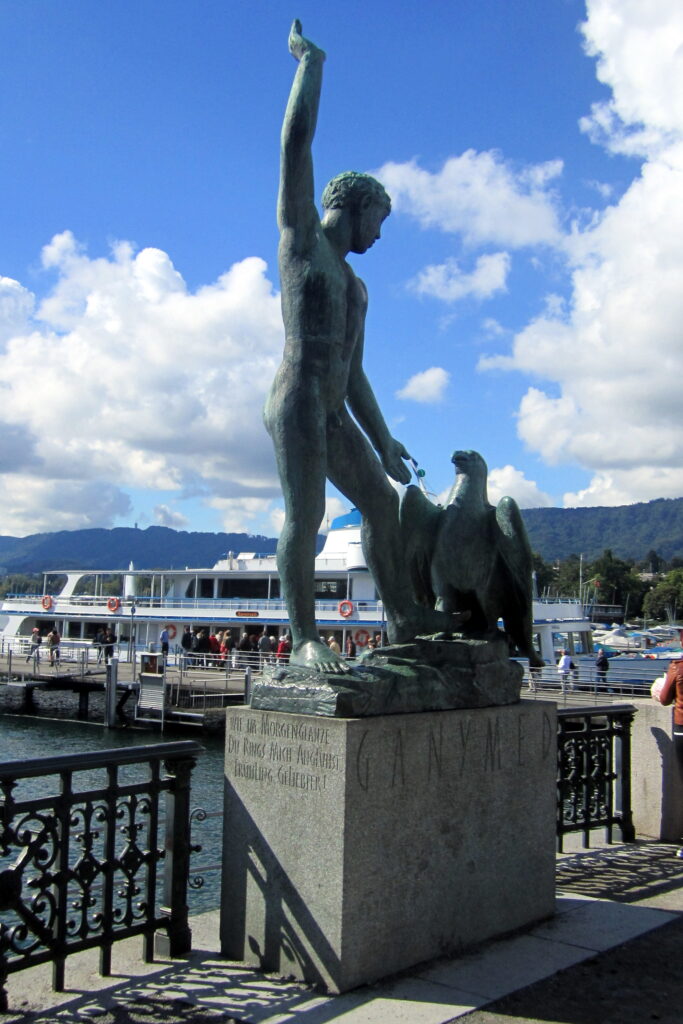
Ganymede Zurich_Wally Gobetz

For Mary: “…where the statue of Ganymede stood…. This was a place she often came to; something in the statue, the lake, the Alps far to the south, combined in a way she found stirring, she couldn’t say why. Zurich – life – she couldn’t say.  The world seemed a big place when she was here.” (34)

We also meet a crew of Antarctic experts who invent a daring plan to slow that continent’s ice sheet loss. (79-83)

Meanwhile, Frank grapples with his bad case of PTSD.  He undergoes therapy and tries to join a kind of green terror group, the Children of Kali, but is rejected. (49-50) He commits a crime in Switzerland (77-8) and goes into hiding.  Then he kidnaps Mary Murphy and furiously demands that she take greater action to address the climate crisis. He rattles her, then escapes. (91-106)

Notes

Robinson covers a lot of ground in this part of the book.  We meet a lot of people, learn about global geopolitical systems and ideas, learn about a range of topics from the Gini coefficient to what lubricates the motion of massive ice sheets.  The tone is dark, as befits an unfolding planetary catastrophe.

I’ve described the book in terms of plot, but chunks of it stand apart from typical storytelling.  For example, the novel includes very short riddle chapters.  On page 13 it’s the sun.  There are also meditations on political theory (41), extinctions (43-4),  economic measurement (73-6), and problems of human perception (87-88). We get micro-stories about characters we never see again, but who give us glimpses of ideas and the world in transition (51-2, 59-61).

Several character names are open, even on-the-nose signals of their roles.  Frank May: he’s definitely direct and open (i.e., frank) while also undecided (may).  Mary is, as befits the Christian tradition, positioned to be the mother of human salvation.  The novel’s first line is similarly on the nose: “It was getting hotter.”

There are plenty of echoes back to earlier Robinson novels: characters named Frank, lots of walking, rapid-fire political arguments, glimpses of social perspectives, and critical theory.

Discussion questions

  1. Do you think the Indian government justified in conducting its geoengineering project? What does this suggest about the near term future of international governance and climate change?
  2. Frank urges Mary to support violence. What forms of such climate change-related violence do you anticipate, either in the novel or in our world?
  3. Ministry leaders discuss possible leverage points they can work with to save the world. (54-6) Which do you think are the most effective?

READING SCHEDULE

December 14, 2020 – chapters 27- 50 (pp. 107-225).

December 21, 2020 – chapters 51-68 (pp. 227-340).

December 28, 2020 – chapters 69-88 (pp. 341-443).

January 4, 2021 –  chapters 89-106 (pp. 445-563).

Previous posts:

More resources:

Over to you!

(thanks to Bill Benzon, Joshua Kim, Gwynneth Alexander, and more; Ganymede photo by Wally Gobetz)

Posted in book club | Tagged | 51 Comments

The post-COVID summer of higher education

What happens to higher education if COVID-19 vaccines are widely taken by next summer?

Way back in September I offered a scenario with a much darker vision, based on COVID continuing to gnaw on society for several more years.  Today I’d like to offer a more optimistic scenario.

Some supporters on Patreon contributed to this one, and I’m grateful to them (and you can join them!).

This scenario is predicated on several events occurring:

  1. One or more vaccines successfully pass both quality (effectiveness) and safety tests.
  2. Production occurs at enormous levels, with hundreds of millions of doses shipped in a few months.
  3. Adoption is widespread – i.e., the number of people resisting the coronavirus vaccine is small enough to allow some form of herd immunity to take place.

None of those events are certain to happen over the next few months, but they could.  Let’s assume they do for the purposes of today’s scenario.  Readers can work out what it would take for the stars to align – and share thoughts in comments below.

How might things fall out?

DECEMBER 2020

Infections soar in the United States and Europe.  The American outbreak spikes upwards as Thanksgiving, then Christmas holiday gatherings accelerate the viral spread.

Snapshot of infections from today, via 91-DIVOC:

coronavirus infections by nation-US 2020 Dec 6__91-DIVOCHospitalizations, injuries, and deaths follow suit.

At the same time vaccines race through tests and into early production.  Awareness of this is widespread, fanned by professional and social media.  This spurs both hope and carelessness, the latter driving cases up even further.  Some front-line health care workers get the first doses, as do at-risk seniors in care facilities.

SPRING 2021

Increased public health problems rise in January, as populations get lax w/vaccines’ promise.  Infections, injuries, and deaths keep building up, unevenly across nations and regions.  Mask wearing mandates are issued at city and county levels, informally backed by the incoming Biden administration.

coronavirus US death projections to Feb 21_dated 2020 Dec 6_IHMEcoronavirus US death projections to Feb 21_dated 2020 Dec 6_IHME

IHME projection.

Yet in the United States vaccines are distributed and taken by larger numbers of leading populations, including front line health workers and people living and working in elder care facilities.  As weeks go by vaccine production keeps churning.  More populations get access to doses.

Antivax sentiment is widespread.  Old school antivaxxers keep doing their thing.  Additionally, some right wingers urge people to avoid the shots, blaming the Biden administration and the media for pushing a bad treatment.  Antivax opinions also occur on the left, as a variety of opponents and arguments appear, from criticisms of the medical establishment to New Age nostrums.  Overall, women, black folks, younger people, and those without post-secondary education continue to be more skeptical than others.  Stories of side effects ricochet across social media.  But the majority of people flock to get whichever vaccine appears first.

In spring 2021 campuses tend to follow fall 2020 plans, more or less: a mix of in-person, online, and blended educational experiences.  More programs and classes are online than there were in the fall, given the pandemic’s general rise.  Appetite for the vaccine is among academics is high.  Different campus populations get access to doses at different calendar times, depending on each group’s role and also on differences by county, state, and region.

Meanwhile, more and more people get the vaccine as weeks and months go by, and winter yields to spring, then to

SUMMER 2021

tree in Vermont summer lightBy May 2021 COVID cases are falling in Europe and the United States.  Hospitalizations and deaths lag, but follow the overall trend. Long haul injuries continue to occur, and also continue to avoid the media spotlight.

In academia there aren’t many classes offered, as per tradition, but a greater proportion occur in person, as compared to summer ’20.

To teach or take an in person class, each person must provide proof of vaccination. Such proofs are attested digitally, supported by a range of authorities (governmental offices, insurance companies), while some people prefer physical artifacts, such as bracelets.

Through May, June, and July each college and university carefully assesses these summer classes to see how they proceed. Some of these experiments backfire, as faculty, staff, or especially students* are diagnosed with COVID-19.

At some point in this season a majority of Americans are vaccinated.  After that, there are arguments about what number constitutes herd immunity (60%? 70?), and various organizations issue claims of different numbers being attained.  The overall trajectory continues to be of increasing vaccination.

Colleges and universities plan for the majority of fall ’21 to be face-to-face.

FALL 2021

By August and September the consensus is that COVID-19 is in retreat.  Numbers and assessments vary, with fierce arguments over case fatality and reinfection rates, but it is clear that fall 2020’s bleak escalation has been reversed.  Antivaxxers are nearly universally shunned, mocked, and derided; their numbers are falling.

Campuses eagerly welcome back students for higher-density experiences.  Administrations enforce various degrees of public health measures, including requiring proof of vaccination to set foot on campus, personal and waste water tests, and restrictions on crowds.

Cocurricular activities aim to return to pre-pandemic levels.  Sports fans flock to tailgating. Greek houses conduct their yearlong socialization. Clubs meet in person. Residence halls offer programs.  Guest speakers and performers hit platforms.

Not everyone returns to campus.  Some older faculty and staff, especially those with comorbidities, are cautious and argue for continuing to work remotely.  The same goes for younger people living with this population. Some students prefer to continue online, either from dread or convenience.  As a result each campus has to decide on how or if to offer some hybrid educational experience.  Once again, HyFlex is an option, as is offering dual catalogs (one for online, one for in-person).  A clear majority of students, faculty, and staff hit campus in person at close to 2019 levels.

Overall enrollment might jolt up for the first time since 2012 as more people feel better about higher education’s possibilities.  International student numbers could play a role in such an uptick.

At times COVID-19 outbreaks hit campuses.  Administrations respond with what is by now a familiar playbook: containment, quarantine, short-term Toggle Terms.

2022 AND BEYOND

Tuition and fees may rise as campuses try to recover from the pandemic’s financial hole.

Students who took classes in 2020-2021 will refer to themselves as “the Class of COVID.”  Some number might see themselves as having endured a subpar educational experience.  Some might begrudge pre- and post-COVID students.

Some faculty will happily withdraw from digital practice, setting aside an experience they found unpleasant or faulty in favor of one they knew better.  Others will continue to teach online different degrees, from offering programs online to flipping classes.

Overall, the post-COVID campus is more digital than what schools looked like in 2019.  Some institutional operations have migrated thoroughly online, including many administrative functions, most of faculty and staff hiring.  Online programs and distance learning as a whole enroll higher numbers than ever:

Faculty seek to claw back some governance capacity after perceiving administrations having grown in size and scope for emergency purposes.

Research in non-pandemic fields will have to catch up with those that worked on COVID.  This might be a source for grant-making and campus support – or else the gap will persist.

Much depends on the cultural memory of the pandemic.  Will we suppress it and move on, like the Great Influenza and the 2008 financial crash?  Or will it play an active role in our thinking?

If we remember, then:

–Universal Design for Learning could add a public health dimension.

-Campus building design could change to allow more social distancing and connections between interior spaces and the outside.

-Pandemic-related academic programs will keep growing in enrollment and support.

-Campus operations are more extensively digital than they were before the pandemic hit.

-“Now that HigherEd institutions know what is required to confront the next public health crisis, remote teaching and learning has become a concrete option instead of an extreme, far-fetched scenario.” (Cristian Opazo)


Thus concludes the scenario.  It’s one I think many in academia will appreciate.

Remember that scenarios are not predictions so much as models of what might occur, given certain conditions.

It’s also a scenario covering a lot of moving parts, and just a first pass at the topic.  What do you think of it?  What else should we bear in mind?  Overall, how do you think it could play out?

EDITED TO ADD: comments from Twitter:

Shane Meyer sees professional association and travel altered:

Paul Martin hoped that teaching would improve, based on a certain campus capacity being realized:

[W]hat changes to teaching will be made by those who never took advantage of their institution’s CTL until they were forced to by the pandemic. Will the experience have been transformative or a temporary step away from what they’ve always done[?]

Jill Yoshikawa sees an opportunity to rethink higher ed:

Peter Elliott thinks financial damage will be harsher:

https://twitter.com/psefsu/status/1335707006280355841

https://twitter.com/psefsu/status/1335712612055658497

RalphGigliotti thinks one aspect of the curriculum will receive a boost:

Thecman thinks students will pressure post-pandemic institutions for more flexibility:

On LinkedIn, Suzanne Wilson Summers adds a great point:

Where the politics of this will get hairy and shape the scenario is whether or not public institutions will be able to require vaccinations (as we currently do for meningitis) for both students and employees in red states like mine. It’s hard to see states like TX, FL, GA, etc,. that have treated masks as an individual freedom issue not doing the same with vaccines. If that’s the case, I think it will have a long-term impact on the ability to recruit faculty.

(Thanks to my Patreon supporters, especially Catherine Wehlburg)

*I wrote “especially students” not to shame them, but for the simple statistical reason that there are a lot more students than instructors or support staff.

Posted in coronavirus, scenarios | 3 Comments

The book club is back with Ministry for the Future

I think it’s time to restart our online book club.  And I know just the book for us.

For those new to the club, it’s an online reading group focused on titles that might help us better envision the future of higher education.  Some readings are nonfiction, each exploring a different aspect of where academia might be headed (for example) or how the world which academia inhabits might change (for example).  Other readings are science fiction, giving us more imaginative views of higher ed and the world (for example).

The way this works: I pick out a book, sometimes after a poll, then organize a reading schedule for it.  Every week I post about that week’s selection, offering a summary and discussion questions.  Readers participate by, well, reading, then sharing thoughts in comments to these blog posts.  They also respond on other platforms, from Twitter to Facebook to their own websites. I harvest those comments and add them to the next blog post here.  Readers can comment and contribute a great deal, actually – here‘s the most active reading we’ve done so far. Sometimes we’re able to get authors involved for conversation.When the book is finished the series of posts and comments remain live for any future readers.

We started way back in 2014 and have read nineteen books to date.  We’ve been reading between one and five books per year…

…yet not one in 2020 so far.  An obvious explanation is that we’ve been too busy with this year’s chaos.  Another reason is that I’ve been teaching more than ever, four classes over the course of calendar 2020, which has soaked up most of my collaborative reading energies.

But now we’re back!  With the post the book club officially resumes, with a new book to read and a reading schedule.

MinistryFuture coverThe book is Kim Stanley Robinson’s The Ministry for the Future (2020), a near future science fiction epic about the next generation or two to tackle the climate crisis.  The plot focuses on a new United Nations agency tasked with addressing the problem, and how they proceed.  A counterpoint character is an aid workers who survives a horrible disaster and tries to figure out how to live afterwards. It’s a rich, ambitious, and frankly optimistic book, and might be just what we need now.  (We read an earlier, similarly future-oriented novel by the same author in 2018.)

You can buy a copy from our little online bookstore or look for a local library copy.

THE SCHEDULE

Let’s give everyone a week+ to get a copy, and then:

December 7, 2020 – chapters 1-26 (pp. 1-106).

December 14, 2020 – chapters 27- 50 (pp. 107-225).

December 21, 2020 – chapters 51-68 (pp. 227-340).

December 28, 2020 – chapters 69-88 (pp. 341-443).

January 4, 2021 –  chapters 89-106 (pp. 445-563).

Monday of every week I’ll post here with a summary, some thoughts, and questions for you all.  You can also look at all posts tagged for this reading.

In the meantime, here are some links about the novel to get you started:

Any questions?

In the meantime, happy reading!  And see you soon in the Ministry’s offices.  It’s cold in Switzerland this time of year, so fortify yourself with appropriate drinks and bundle up.


Posted in book club | Tagged | 22 Comments