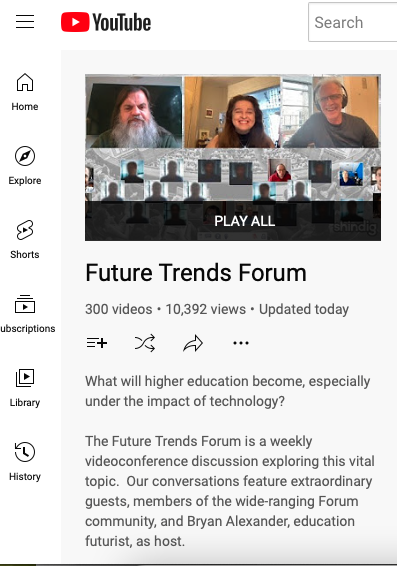
300 videos: the Future Trends Forum passes another milestone

Today the Future Trends Forum passed a major milestone.

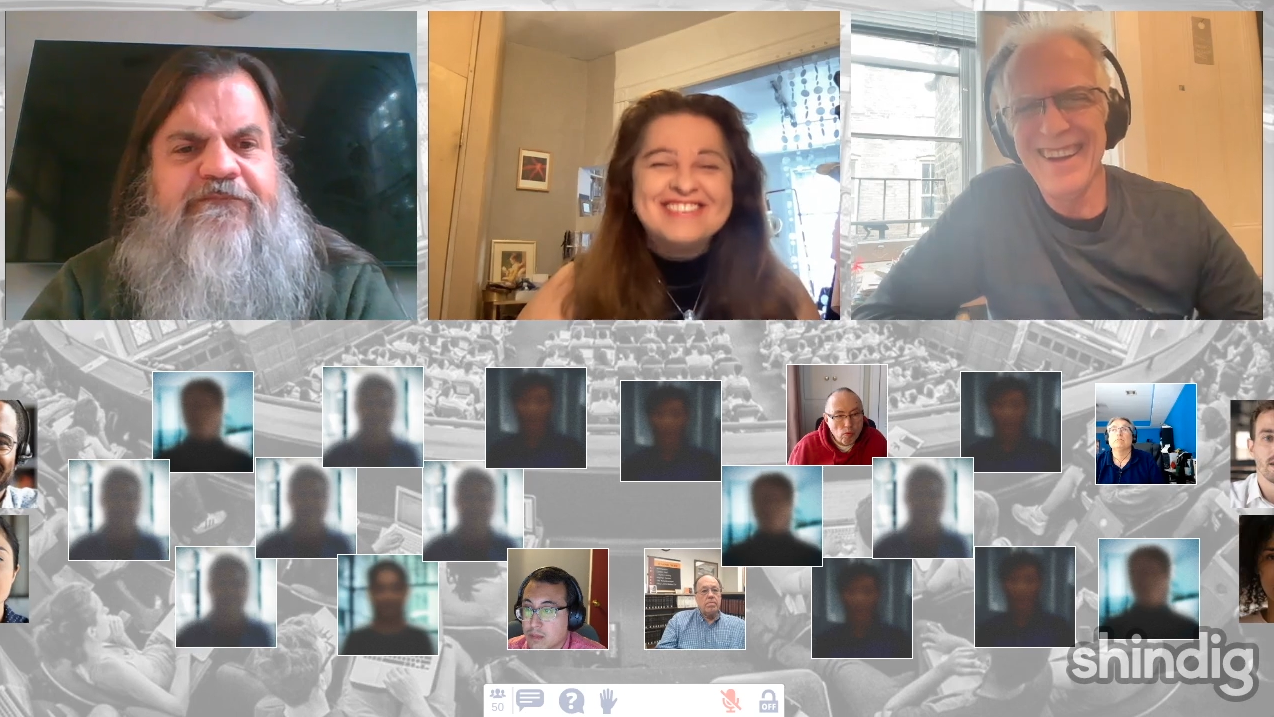
Yesterday we hosted two favorite guests, Maya Georgieva and Emory Craig, to explore extended reality (XR) and its connections to higher education and the web3 idea. The Forum community came up with a range of questions and thoughts for Maya and Emory. Together they shared a lot of information, analysis, and experience, from institutional structures to faculty development, details of specific technologies, and the future of higher education. We also had a lot of fun.

Forum Maya and Emory laughing 2022 March

Today I uploaded that session’s recording and the Forum hit a milestone as a result. Our YouTube playlist now contains three hundred (300) recordings.

Forum YouTube 300th video on playlist

Since we launched in early February, 2016, the Forum has successfully published three hundred videos to YouTube.  Week after week, month by month, over more than six years we’ve held great conversations, then shared them with the world, free of charge.

That’s a huge amount of content, by the way. We cover a wide range of topics, both at the top level (each session’s nominal subject) and where conversations take us, from admissions and blended learning to teaching and web3. In fact, the topics became so vast I had to set up a webpage just to organize them:

Future Trends Forum Index screenshot

My thanks go to the guests who donated their hours to meet with us. Many thanks to the fabulous Forum community who make it all work through their conversation and support.  Many thanks, too, to Shindig for sharing their cool technology with us.

300 videos.  And more are coming up.  Here’s to 500!


Posted in Future Trends Forum | 2 Comments

Why has higher education decided on Zoom?

Question for you all: why are so many colleges and universities using Zoom, after two+ years of the pandemic?

Let me explain my question, then share what I’ve learned from research and conversations. I’d love to hear your thoughts.

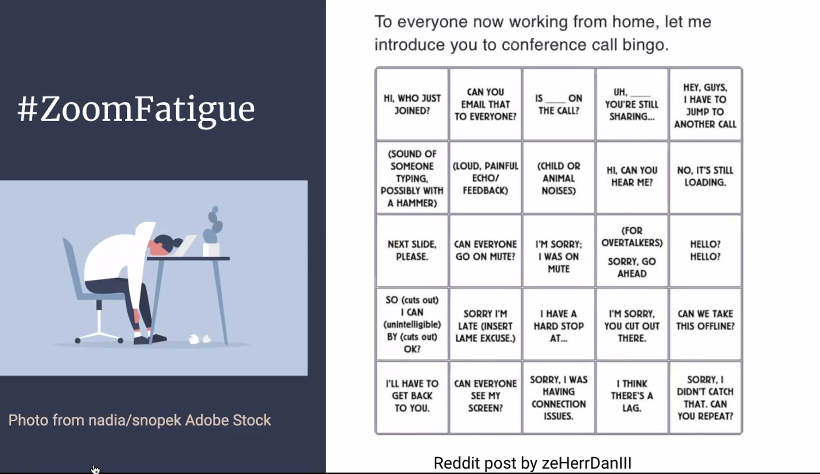
Zoom Bingo

I’ve been working in ed tech for around thirty years, a fact which sometimes terrifies me. I’ve seen a lot of platforms and applications come and go.

In higher ed, I usually see many different platforms being offered by (or outsourced from) a given college or university.  Within each type of computing service, I’ve seen all kinds of products and brands offered.  For example, once the learning management system/virtual learning environment took off around 2000, I and others have tracked which ones different campuses adopt: Blackboard, Moodle, Canvas, etc. None have taken over the market, although BB came close for a time, and Canvas’ growth remains robust.  For another example, once cloud computing became acceptable, colleges and universities have turned to Amazon, Microsoft, Google, Apple, and combinations thereof.  Each decision interests me, and moreso over time.

So we come to videoconferencing. In early 2000 many campuses already hosted, or outsourced, a wide range of synchronous video tools.  (I used Microsoft’s Netmeeting to teach parts of a class in 1999.) When I visited or worked with a given college or university or academically adjacent business or nonprofit I might have seen Microsoft Teams, Google Meet, Blackboard Collaborate, FaceTime for the Macisti, WebEx, Skype, BigBlueButton, Shindig, BlueJeans, Zoom, etc. in use.  Some places had dedicated rooms with hardware; others did not. Before the pandemic I hadn’t seen one of these tools dominate.

In my own professional work I used a wide range of these, depending on the setting and purpose. Shindig for the Future Trends Forum, Zoom for Georgetown classes and events, WebEx for some government clients, Teams with my son (because that’s what his university uses), Skype for one podcast, Discord for several groups.  Everything else I could find for research.

Then once COVID hit, Zoom suddenly, well, zoomed to the top.

To be fair, Zoom’s triumph has not been complete. I see Microsoft-centric campuses using Teams, like my son’s University of Vermont. Google Meet is out there.  Some general-purpose applications include their own videoconferencing, like Slack and Discord. Gamelike GatherTown exists. For some reason news media reports kept insisting that Facetime was popular in hospitals, despite lots of people not owning Macs and not everybody fondling an iPhone. And startups have appeared, sometimes from educational spaces, such as InSpace or Engageli.

But Zoom seems to have run the table. It’s what I see across the spectrum of geography and institutional type.  Zoom is starting to become a generic term for videoconferencing, like Xerox for photocopy.  It managed to get past, and thrive despite, zoombombing and Zoom fatigue.

Why is this?  How did Zoom triumph, and how long will it stay on top?

I’ve been quietly asking this question since 2020, and the answers have been interesting. Over the past few weeks I’ve asked the question across social media, with the best results on Twitter, and wanted to share the results.

ZOOOM

  1. Quality of service or stability. People report that Zoom “just works.”  (thanks to Mathieu Plourde) It’s up more often, presents fewer glitches, than others.
  2. People were already familiar with it.  This means campuses need to spend less time getting users up to speed.
  3. Enterprise choice. Central IT chose it for its own reasons, which might include others on this last. IT shops already tightly wedded to Microsoft or Google might have a harder time here. Speaking of which…
  4. Cost.  Several people have remarked that Zoom was cheaper than competitors (for example).  Also, that the 40 minute free trial was a good way to hook people.
  5. Marketing.  Some have said that Zoom reached out to educators more effectively than others (for example).
  6. Ease of recording.
  7. Audio quality.  Several podcasters have recommended this point (like so).
  8. Capacity. Folks have told me some other platforms hit size limits pretty quickly.
  9. Simplicity. Zoom has few features and works alone, without having to plug into other user functions (compare to Google).
  10. Better for people on lower bandwidth networks. (Mathieu Plourde, encore fois)
  11. Accessibility. Few are good at this, but Zoom beats others, according to P.F. Anderson and Jason Frank.
  12. Breakout rooms.  Which leads to…
  13. Pedagogy. “Zoom helps me mimic what I do in the classroom most closely (group discussions, polls etc.),” reports Sharon Alker on Facebook.  Linda Troost agrees on polling.
  14. Some special features.  Matthew Bruckner likes that “it allowed me to share only part of my screen so I could still see my notes when using PowerPoint on a single screen.”  Kimberly Sagarin approves of gallery view.  Dedicated rooms for physical locations met with Miloš Topić’s approval.

Additionally, after COVID had begun, Zoom may have grown based on its success – i.e., some popularity being due to its popularity. Zoom may have become a friendly, or at least familiar, face during the worst times of the pandemic.  It wasn’t an easy thing to switch away from. We could think of this as inertia or something most people were – are – too busy and/or tired to think about.  We could deem it, as Janet Scannell does, status quo bias.

So why wouldn’t a college or university use Zoom?

Blackboard Collaborate offers one advantage, according to Dr. Z:

https://twitter.com/VeryCuriousDocZ/status/1508458585273032707


Microsoft Teams still has supporters.  Jason Green offered one pro-Teams argument:

https://twitter.com/jasongreen/status/1508170767267155973


Cerstin Mahlow offered an interesting critique of Zoom from Europe:

One critique of Zoom on accessibility comes from Kit Englard:

Arindam Basu argued for using different tools for a very different pedagogical design:

https://twitter.com/arinbasu/status/1508171402209538050

Some extra thoughts: I’m interested, if unsurprised, that the reasons for campuses to select Zoom are overwhelmingly not pedagogical.  Price, bandwidth, integration with other tools, audio quality, enterprise concerns, etc. predominate.

I am also interested in how stable Zoom’s position has been. Several startups have appeared, with others on the way, and some giants have fought for the crown, but not have made even a serious showing.  Two+ years is a long time in the tech world.  It may be that Zoom’s initial success paved the way for further successes, making it look omnipresent (think: kleenex) and even inevitable.

Last point: it’s interesting that VR has not emerged as a major competitor to videoconferencing. While web3 has been rising, relatively few folks have been using it as a Zoom alternative.  That struggle, between virtual and videoconference realities, lies ahead.

Thanks to the swarm of people who shared their thoughts with me, asynchronously: academic_happy, Gary Ackerman, Rocky Allinger, P.F. Anderson, Brian Baute, Jared Bendis, Michael Berman, Susan Blum, Ian Bogost, Michael David Cobb Bowman, Terry Bradley, Matthew Bruckner, Cassiciacum, Jon Chapman, Donald Clark, Cara Clarke, CSU_IDT, Dhamphyri, Zack Dowell, Chris Edwards, Jeanne Eicks, William de la Em, Kit Englrd, Ella Epshteyn, Kim Flintoff, Frameable Inc., Sarah Frick, Noah Glaser, Sara Goldrick-Rab, Jim Groom, Luke Hobson, Harold Jarche, Jeannette, Dennis Jerz, Robert Kelchen, Lydia Kitts, John Kline, Lisa Leutheuser, lmockford, Chris Lott, Dave Mazella, Robert McGuire, Gretchen McKay, Christine Mullins, Peter Naegele, Michael Palmer, Pat Parslow, Peeragogy, Jennifer Polk, professor Powell, Ravi Ravishankar, Howard Rheingold, Mike Richichi, Miguel Rodriguez, Jennifer Sader, Kimberly Sagarin, Mark Sample, Joe Saul, Janet Scannell, John Schinker, Anne-Marie Scott, Vicki Sells, Peggy Semingson, Peter Shea, Tony Sindelar, Holly Skillin, Peter Von Stackleberg, Heather Staines, Graham Stanley, Robert Brent Stansfield, George Station, Robin Sullivan, Kari Swanson, Steve Taylor, thecman, Miloš Topić, Matt Townsley, Linda Troost, Mark Vickers, Edward Vielmetti, Steve Weidner, Fridolin Wild, Ann Witbrock, xiousgeonz, Virginia Yonkers, the Very Curious Dr. Z.; the Instructional Designers in Education and Remaking the University Facebook groups, and more.

Thanks, too, to the AU newsletter for the kind link.

Posted in education and technology, technology, videoconferencing | 32 Comments

Writing a book: the reviewers’ revisions step

This week is the spring equinox. Here in Virginia the temperatures have risen appropriately. At times it’s warm enough that breezes are welcome, rather than chilling. Some first flowers are daring to blossom.

purple flower in March

Meanwhile, I received reviews on my next book’s manuscript and thought this might be another good time to explain a bit about the scholarly publishing process from an author’s point of view. It’s one author’s perspective, of course, an n of one, so be sure to bear in mind other stories as well as your own situation.

A few months ago I turned the manuscript for Universities on Fire over to my publisher, Johns Hopkins University Press.  That was a single Google Doc with about 69,000 words and a small stack of embedded images.  (I say “about 69,000 words” because I hadn’t formatted the end notes properly. When that’s done it’ll add to the total.)

It’s a weird, almost dizzying feeling to do this.  I’ve done it four times before, not counting my dissertation, and each time there’s a big swoop of tangled-up emotions.  Pride, at having written such a chunk of text. Dread at what people might think of it.  Nervous energy, once I think of errors to correct and stuff to add. And some relief at having reached this stage of the publication process.

Next, my hard-working and excellent editor read the manuscript (“ms”) and gave me feedback. Then he sent the ms out to some reviewers. These are people with academic experience in the book’s field, who promise to read and review the book carefully.  I cannot learn their names, in order to preserve their ability to comment without blowback.  What I do see is their feedback.

That translates into a small stack of pdfs, largely consisting of answers to a shared questionnaire from the publisher. Questions are good and basic, probing into the quality and market viability of the ms. They leave plenty of room for reviewers to analyze the text, dive deeply into specific issues or passages, to point to better arguments, to call for reorganization, to recommend not publishing, and a lot more.

So now I have to address these reviews, revising that big Word Doc into version 2.0.  There are passages to cut, others to expand. There are additional sources to include. Two chapters in particular need some overhauling. In most chapters I need to revise paragraphs and add subheaders in order to make the big points more clear. Adding a chart and/or infographic might be useful along those lines. There are technical details to correct. One theme to really draw out. And also parts of the ms to leave alone as unremarked by the reviewers.

I also get to work in the stuff I’ve been thinking of and researching since I turned in version 1.0.  The topic of climate change is obviously one that’s developing rapidly and deeply.  Higher ed’s response is far less so, but is occurring, and there is always more to find out on that score.

Next up? After some week of intense writing I forward the new ms to the publisher. Then they determine if v 2.0 is improved enough to move on to the next stage.  That’s copy editing, page layout, creating cover art, checking image permissions, building a proper index, and more.  But first, I have to revise like mad to get there.

Throughout this process my publisher is a fine presence and resource.  My editor is a terrific person with a deft touch, a keen eye, and a very needed sense of humor. Other staff are wrangling a bunch of other functions, from copyright to marketing.  Writing can be a very isolating experience, but not with comrades like these.  My thanks to the Johns Hopkins crew.

Now – back to writing!


Posted in writing | 1 Comment

How many COVID casualties will Americans accept in order to reopen society? Poll results

The Russian invasion of Ukraine is raging and may be a world-historical event. It has certainly become the center of media and policy attention in many nations.  I’ve posted about it and have been researching it constantly.

For this post I’d like to shift focus to another major crisis, one now in its third year.  It seems almost cruel to do so, given how deeply many of us are invested in the Ukrainian crisis. And it might seem callous to say “what about that other terrible thing?” Yet I have an obligation to analysis and forecasting. Plus I want to honor hundreds of people responding to a charge I set out a few weeks ago.

To explain: the pandemic continues. As of this morning the world just passed 6 million people dead by COVID-19.  Remember that’s a total of official numbers, based on published governmental counts, and therefore likely an undercount by a significant amount.  Think 7 or 8 million dead, maybe more – and remember what Daniel Defoe and others have observed about how inured people become to death during a pandemic.
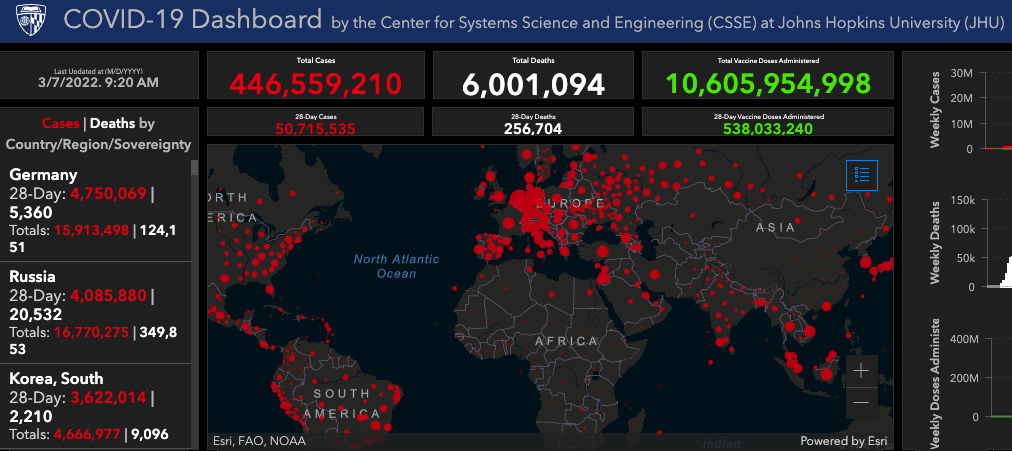
coronavirus world dash 6 million dead JHU 2022 Mar 7American deaths now stand at 955,135, according to the CDC. That’s certainly an undercount, in part because American stats lag over weekends (which is inexcusable). I’m working on the assumption of 1 million+ US dead as of last month.

That’s only COVID deaths. Long COVID numbers are more vague.  I’ve seen figures estimating between 10 and 40% of those who endured the virus have ailments and injuries afterwards, from brain fog and joint pain to exhaustion and heart problems.   A new study finds what looks like brain damage attending infection.  Depending on what percentage of infectees suffer from chronic aftereffects, we should expect tens of millions of Americans to experience Long COVID for months and years to come, straining an already exhausted and badly supported system. Hundreds of millions around the world will join them.

Which brings me to a COVID futures question I posed a few weeks ago. Despite all of these horrific casualties, many around the world are hoping to relax public health measures, due to case numbers plummeting after a horrific winter peak. To be clear, COVID is not disappearing. Rather, the number of people it infects is dropping towards a sub-pandemic state. The presumed goal now is for COVID-19 to be endemic, part of human life, just not a world-shaker.

So let’s try to calibrate what we do next. What is the deaths threshold for opening up society?  How many dead will we accept in order to resume a non-pandemic communal life? What can we forecast about public health strategies for the next several years?

tl;dr answer – we’ll probably accept an awful lot of dead people to do without masking.

(When I say “accept” I don’t mean “all Americans happily decide as one on a single public number.” I mean a rough-edged consensus occurs without any major reform movement.  It doesn’t mean we don’t do anything, as maintain many countervailing efforts of various kinds: contact tracing, vaccination research and deployment, urgent care of the sick, etc. There may be public complaints and private criticism about our public health stance, but overall we decide to go along with our collective behaviors.  Put another way, blog commentator Rob C. asks us to think of this in terms of acceptable risk.)

I asked this question in mid-February.  Specifically, I focused on America, since it’s the country I’m closest to and because it plays such a significant role in the pandemic: source of historic vaccines, home of leading researchers, outsized victim, and location of many shambolic responses.

I also tried to crowdsource the question, inviting quantitative and qualitative responses across several platforms, starting with this blog.  To give some structure to responses, I offered a range by hundreds of thousands dead: 200,000, then 300,000, etc.  I also invited comments.

To be fair, this was not a formal survey by any social science standards.  First, as one commentator pointed out, the various audiences I connect with on each platform will likely be politically biased.  Second, while I tried to stir up interest and responses, the total number of responses ended up being low, so the n is unimpressive. Worse, each platform had different constraints on how many options I could pose, how many words could be in each option, what graphics I could add, which audience would see it, etc., so there’s some inconsistency in the questions.  And there’s probably come overlap among those audiences across platforms.

The results, while thoroughly unscientific, are nevertheless interesting, at least to me, and I hope to you. They point to a rough direction of one COVID future. They answer the question by saying, approximately, that Americans will accept hundreds of thousands killed by the virus each year so that we can return to normalcy.

For context, here are the leading causes of death in the United States, according to the CDC:
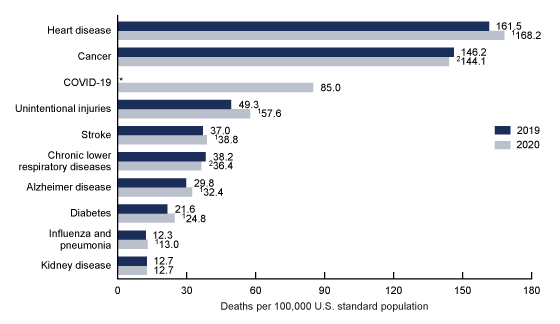
Figure 4 is a horizontal bar graph showing the age-adjusted death rates for the 10 leading causes of death in the United States 2020. It compares 2019 rates for the same causes.

Note COVID’s rapid ascent.

That isn’t too different from death causes worldwide, at least in 2019, according to WHO:
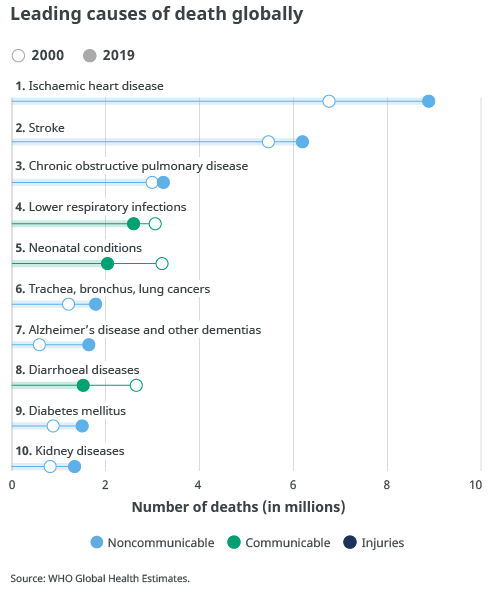
Keep in mind that many of those deaths occur below the radar of public consciousness, for various reasons. A good number take place behind privacy regulations. They can require some medical knowledge to understand, which makes them harder stories to tell in some mass media.  And many hit seniors. COVID has taught us that, at least in the US, popular culture seems relatively unmoved by the deaths of elders.  Ageism is fierce and deep.

So with that context we can return to my question. Let me break down answers by individual platforms where people responded.

On Twitter, I posed the question as a simple poll, sharply constrained by the format, and answers appeared thusly:

A pretty strong majority for 400,000 there, although 22 votes is a very small n.

Several comments also followed.  Two friends responded that I was too optimistic, with Amy Pearlman thinking that “I’m not sure there’s an upper limit and that scares me deeply.” Similarly, Joe Murphy quietly and coldly thought “the options are missing a zero”.  Cristian Opazo compared results to flu deaths as a baseline.  And one person disagreed with the premise.

Shifting to another platform, I hosted an embedded poll on this very blog. The results:
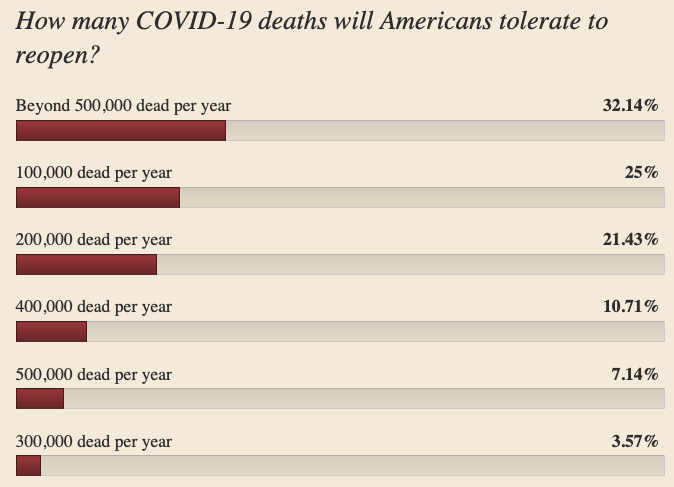
coronavirus Bryan death poll blog results 2022 March

Blog respondents are somewhat less sanguine than those on Twitter.  Only almost exactly one half (49.99%) see 500,000 and above as an acceptable butcher’s bill.  Half fall below that, with almost one half (46.43%) on the 100,000 and 200,000 levels.  For some reason the polling plugin won’t show many how many people responded.

Comments hit a range of points.  Trent Batson asked us to distinguish between published data and perceptions, which is important.  One COVID infectee asked us to remember the painful experience the virus can bring about.  Glen McGee thinks the numbers are too much to comprehend, and also may be politically skewed.  Dahn Shaulis observes that mass deaths from other causes will make the question more difficult.

I also posted the question to LinkedIn, which also strongly constrained my choices.
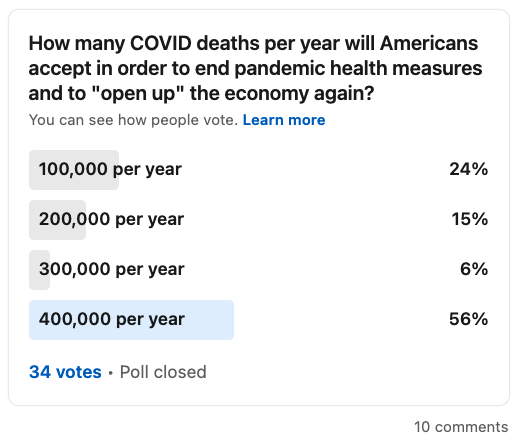
coronavirus Bryan death poll LinkedIn results 2022 March

These results lie somewhere between the Twitter and blog reactions.  A bit more than half went for the maximum of 400 K, while 39% saw a very lower threshold, 100-200K.  34 people responded.

Comments were interesting.  Rob Chapman echoed my Twitter interlocutors, saying “Your scale doesn’t go high enough I’m afraid.”  Andrew Benedict-Nelson was similarly dark: “Answered 400k because I don’t think they are even counting.” Mathieu Plourde responded along related lines, then broadened his commentary:

As long as they are not “their people”. I see COVID being treated like school shootings from now on. It’s just the cost of freedom in America, like systemic racism and a corporate culture of burning out. Sad but true. The left will be outraged

Joe Desiderio came up with a stark way to structure my survey:

Alternate way to ask this Q: Which city would you be most comfortable wiping off the planet in one year’s time?
Roanoke, VA (100,000)
Salt Lake City, UT (200,000)
St. Louis, MO (300,000)
Bakersfield, CA (400,000)

Trey Martindale questioned the premise, wondering about a different query: how would individuals act according to their assessment of personal risk?

I asked this question on two other platforms, but the results there went a bit sideways from what I’ve shown so far.  I offered the question on Medium, which turned out to be harder, since that platform doesn’t have its own polling function. I quickly built a Google Form and embedded it in the Medium story.  On the plus side, this gave me a lot more room to craft the question and answers. Alas, this approach may have put off readers, since a mere three people responded.  (Come to think of it, I haven’t seen many polls on Medium.) At least Google Forms easily creates a nice-looking pie chart:

coronavirus Bryan death poll Medium results 2022 March

Only one textual response came in, which was only polite, rather than tackling the issue.

I asked the question on Facebook as well.  Again, that platform makes polling impossible unless asked in a post to a group, or on a Facebook page. So I kludged up a text poll and invited folks to answer with the letter representing their choices:

Here are some choices, using the United States as an example:
A) 100,000 dead per year
B) 200,000 dead per year
C) 300,000 dead per year
D) 400,000 dead per year
E) 500,000 dead per year
F) Beyond 500,000 dead per year
Think of it this way. After which number will we decided, collectively, that we should return to emergency measures?

Out of 26 comments only two picked out one of those options. (I’m not going to use links for comments here, because Facebook messes with them past a certain point) Andrew Peterson actually picked several options to make a point: “100K until we hit it, then 200K, at which point 300K will be ok…. pretty sure we’d go up to about 300 million until we’d agree on anything.”  Tom Elliot broke things down by political party:

for a significant percentage of Americans, and one entire political Party, 500,000 dead a year is worth ignoring. We accept deaths from the flu but in the tens of thousands at most. That really ought to be our benchmark.

NPR did an entire piece this morning (my morning) about how Democratic governors are dropping mask mandates, even limited ones, because of polling, not science. It’s likely a component of the decision process for sure but then NPR likes to ignore the finer points of such things if they can fit the story into their “floundering Dems” narratives.

Let me synthesize the other two dozen comments:

  • A sense that Americans will accept a lot of deaths because, as Mathieu Plourde noted above, we already do so (from a nurse: “like we tolerate gunshot deaths and deaths due to lack of access to affordable healthcare. We are not really a culture that cares about one another.” From a Briton: “the barbaric US health care system.”)
  • Ditto because of the politics and perceptions around public health (“We are still dealing with people who believe it’s a hoax, or refuse remdesevir and demand ivermectin. As long as science is confused with opinion, we are stuck.”
  • Ditto around vaccination status and how Americans perceive the vaccination status of the dead (“If we experience hundreds of thousands of deaths per year but 95+% of those fatalities are among those who stubbornly remain unvaccinated, my inclination is to shrug and move on.”)
  • People feeling threatened by how other people will decide on this question, based on their own comorbidities, age, or immunocompromised status.  One shared a webcomic on the topic.
  • A fluctuating sense, depending on how the virus behaves (“I’d expect a dynamic environment where the situation changes all the time, or at least a few times per year” and “Once fall and winter forces people back inside, people gear up for winter events and parties, but taking precautions lags behind until the infection rate rises, with deaths following, again.”)
  • A sense that COVID can’t be controlled any longer (“there is a growing medical consensus that we are fast approaching the point where it is effectively unstoppable, and that most of the control measures that applied (with varying degrees of success) to the earlier waves are now ineffective and somewhat pointless for the majority.”)
  • A query about the question, wanting specifics on public health measures
  • Disagreement with the question, because we won’t decide based on such numbers (“I am not sure COVID tolerance has anything to do with the numbers for most people. A million strangers don’t affect us personally.”)

So, summing up this mass of heterogeneous data and commentary: a strong response favors 400,000 and more COVID-19 deaths per year as what America will stand in order to move to a post-pandemic footing. This is based on a variety of reasons, including perceptions of how the United States has handled the pandemic so far, how this culture processes other mass casualty sources, and because of politics.

A minority report thinks Americans will see a lower threshold in the 100-300,000 range.  We didn’t get as many comments from this side as for the others, but I infer they consider the ways we can vary our public health strategies fairly quickly, depending on perceived threat levels.

My thanks to the hundreds of you who took the time to answer this cold poll, especially to those who wrote commentary.

Now let’s see how this experiment in forecasting works out. Watch the published death tolls (minding the undercount issue) and see how public health measures play out.  If the majority is correct, America will try its best to live as normally as possible until deaths head towards a half million per year. If the minority report is closer to reality, expect some flexibility in public health deployment, with changes every few months.

In the meantime, please take care and be safe.

(thanks to Ceredwyn for sharing her doom-inflected public health thoughts, Phil Long for data and reflections, to Benjamin Ryan for sharing his reporting, and to my fine Patreon supporters for conversation)
Posted in coronavirus | 3 Comments

Russia’s invasion of Ukraine as climate crisis war

When does the climate crisis lead to war?

Let me share some notes and speculations.

For years analysts have forecast that global warming would likely accelerate or directly cause armed conflict. One way for such wars to occur is when environmental disasters drive social or political instability. Another is for nations or other forces to war for limited resources, such as water or energy sources.  (I recommend Christian Parenti’s Tropic of Chaos as a good start on the topic.)

Some have looked into modern history and seen that first model already at work.  In this view the Darfur War (2003-ongoing) or the Syrian Civil War (2011-ongoing) are struggles either worsened or simply kicked off by aspects of climate change, namely droughts.

Perhaps we can think of the present Russian war in Ukraine as a climate change war, yet in a different way from those in Darfur and Syria.  Or different in several different ways which suggest new forms of 21st century conflict.

First, the Ukrainian war now includes a new geopolitical weapon: financially striking an opponent’s ability to produce and sell oil.  States can wield this weapon against other nations, as can other entities, including corporations. As I write this the United States and allied nations have taken many steps to attack the Russian economy, from sanctioning banks and oligarchs to blocking individual payments via Google and Apple.  The ruble is sinking quickly in value and Russia’s stock market has plummeted, while it was allowed to open.  The goal is, of course, to punish Russia and compel its leadership to end the war.

Note that the anti-Putin coalition has not yet banned purchasing Russian oil and gas.  The reasons for this are clear, namely that losing those supplies would cause massive humanitarian hardships in certain nations which lack alternatives.  Now, it’s possible that such a ban might emerge in some form as the war continues. Winter is receding and summer’s heat has not yet arrived, so heating and cooling demand is lower for a time.  Allies could pool and cobble together alternative power stocks as well as their own petroleum sources to make up for a Russian shortfall. It’s unclear to what extent this is feasible at scale; it might be an action only some nations can take.

In whichever particular forms this financial strategy might appear, it’s clear that we’re seeing a new form of economic warfare. To the extent it relies on significant non-carbon energy sources it is suited to the climate emergency.

Second, Russia’s Ukrainian invasion takes place during the start of a massive, even epochal, and global decarbonization effort. Accelerating that effort can be a weapon or war, as shifting energy consumption to renewable (solar and wind especially, along with hydro and geothermal) sources shrinks the market for petroleum, which injures economies based on the stuff.  Put another way, a progressive move away from carbon can also be a strategy against regressive, oil-based enemies.  Jonathan Overpeck, dean of the School for Environment and Sustainability at the University of Michigan (my alma mater), makes this case clearly:

[I]magine a world where all countries have access to affordable energy generated within their own borders, where petro-states no longer have the power to blackmail other countries or impact the international price of energy. This is not a fantasy — it’s the future we are heading toward, as clean renewable energy and storage displace fossil fuels in powering everything we do. This clean energy revolution is already engaging most nations, and with green energy, every country can choose if they want to deploy their own clean energy or depend on other countries for imported clean energy. Countries big and small, rich and poor, can all access a future of cheaper cleaner energy from wind and the sun.

Along these lines Bill McKibben has published several ideas for green weapons, if you will.  Today he asked for Americans to carpool their electrically-powered cars, so that we would be less reliant on oil, which would make it easier for Biden to block imports from Russia.  Last month he floated the idea of a massive installation wave of heat pumps, both in Europe and the United States, which would decrease demand for oil, gas, and coal power.  Bill emphases the many benefits of these ideas beyond harming an enemy’s economy: slowing global warming and reducing carbon pollution (as distinct from CO2’s role in global warming).

Looking ahead, we can see in these strategies the emergence of climate action as a potential geopolitical weapon.  While this has links to the financial warfare noted above, it has a different grounding and works in separate ways.

Third, perhaps Putin launched this invasion because of where he saw climate change taking his nation. Already we’ve seen global warming playing hob with Russia, as its infrastructure built on once solid permafrost is now warping and breaking with rising temperatures.  Another fundamental structure will soon be in danger: the dependence of Russia on the carbon economy.  Selling oil and gas is a crucial part of the country’s income. If the world successfully changes its energy base away from petroleum, then the new market would gut Russia’s economy.

Perhaps Putin looked ahead at this possibility, this likelihood, and foresaw a collapse of national power.  Decarbonizing nations were as much a threat to Russian security as NATO expansion, in his mind. Did he decide to act against Ukraine now, while Russia could still afford to mount a major war in the face of likely international opposition, before the climate crisis sapped Russian power?  To be clear, I’m not imagining this explanation in terms of a nation seizing oil supplies or other vital goods, but rather fulfilling non-energy-related geopolitical goals while still having the energy to do so.

If this is right – and I could well be wrong, trying to read Putin’s well cloaked mind from afar – then perhaps we could see the Russian invasion as a war of… transition. It’s a phenomenon enabled or thrown up by the global transition away from fossil fuels.  Put another way, the Ukrainian War is an event during our transition phase, before we reach a post-carbon settlement.

Note that while I’m writing about the very very large picture, of a civilization in transformation, there are all kinds of movements and exceptions within this transition. The nations I’ve depicted as shifting towards renewables are also trying to provide natural gas to each other. There’s a rising argument in favor of atomic power as a power source for the transition, which many Greens and environmentalists oppose.

Besides these three possibilities, we could also see struggles appear based on the first climate crisis war model I mentioned, as scarcities drive political friction. This morning one analyst asked us to imagine certain nations rationing electrical power if the Ukrainian crisis continues or deepens. (The host charmingly called this “the R-word”). Vijay V. Vaitheeswaran offered this potential scenario:

if they lose a significant part of their gas in a country like Germany — over half their gas comes from Russia, and it’s not just Germany, there’s a bunch of European countries that have a lot of Russian gas — and [if] it all goes offline just like that, then the various options — running your coal plants a little more aggressively, getting LNG [liquified natural gas], of course, and other sorts of efficiency measures, all sorts of things, higher prices, leading to more efficiency — won’t be enough, is the thinking from some experts. And you’re going to have to maybe shut down probably industrial users first — the heavy consumers, maybe steel plants, maybe some other kinds of industries that use a lot of natural gas for high industrial heat. And that will be unpopular, but not nearly as unpopular as cutting off grandma in the middle of winter.

“And that will be unpopular.” I’m thinking of how rising gas prices kicked off the gilets jaunes movement in France. How might people respond when industries go dark, transportation becomes infrequent, and indoor climates harder to condition?  Will a sense of political or climate service suffice to keep civil order, or will things splinter?  How will Russians respond to the degradation of their economy, not to mention rising numbers of war casualties? Climate change driving political friction indeed.

One last note. In the Russian invasion we see many echoes of older politics, like Putin’s hallucination of a Jewish president leading a neonazi regime. Perhaps we’re also seeing the emergence of new politics, generated by the intersection of geopolitical developments, the climate crisis, and our responses to both. We could see climate patriotisms crop up, whereby it’s patriotic to stop driving a gas guzzler or one installs rooftop solar to get at an international enemy.

Along these lines Naomi Klein outlines several ideologies, starting with what she calls a politics of nostalgia.  She links together Putin, Donald Trump, Tucker Carlson, the Canadian convoy protests, and others as united by a love for an older, somewhat fantastic politics. That’s an ideology based on a mix of petroleum, opposition to climate action, hostility to immigrants, and racism.  “[T]hey are bound together by an attitude toward time, one that clings to an idealized version of the past and steadfastly refuses to face difficult truths about the future.”  For them,

oil is a stand-in for a broader worldview, a cosmology deeply entwined with Manifest Destiny and the Doctrine of Discovery, which ranked human as well as nonhuman life inside a rigid hierarchy, with white Christian men at the top. Oil, in this context, is the symbol of the extractivist mindset: not only a perceived God-given right to keep extracting fossil fuels, but also the right to keep taking whatever they want, leave poison behind, and never look back.

For a visualization, I’d suggest the shawl conservative American representative Boebert wore to this week’s State of the Union address:

Boebert drill baby drill_PostMillennialTo oppose them Klein advocates a politics

very much like a Green New Deal, a framework to get off fossil fuels by investing in family-supporting unionized jobs doing meaningful work, like building green affordable homes and good schools, starting with the most systematically abandoned and polluted communities first. And that requires moving away from the fantasy of limitless growth and investing in the labor of care and repair.

Which then goes right into the Ukrainian war:

It also happens to be the best way to cut off the petrodollars flowing to people like Putin, since green economies that have beat the addiction to endless growth don’t need imported oil and gas. And it’s also how we cut off the oxygen to the pseudo-populism of Trump/Carlson/Bannon, whose bases are expanding because they are far better at harnessing the rage directed at Davos elites than the Democrats, whose leaders, for the most part, are those elites.

Klein has a lot more to say, including a description of a new oil politics based on rising prices; you should read the whole thing. For now I’d like to pause with her two opposed political models, each synthesizing climate change and the Russian invasion. Although rooted in the present and, to some degree, in a semi-imagined past, they may well be early forms of politics to come.

Taken together, these pictures of politics around the climate crisis give us ways of imagining future alliances and strategies.  We may look back to our time and view Russia’s invasion of Ukraine as the first major climate crisis war.  It may not be the last.

(thanks to Jody Greene for helpful discussion)

Posted in climatechange, politics | 9 Comments

I couldn’t turn 55, but I did, and I am

In February of each year I have my birthday. This year I turned 55. Yes, 55, a number which does have its own song:


So let me take a step back from the blog’s usual topics, withdraw from the world situation for a moment, and answer the question: what’s it like?

This is awkward for me.  I’m not comfortable writing about myself.  I run into all the usual autobiographical obstacles: it feels arrogant, I don’t think the stuff will be interesting, there’s a big dollop of vulnerability, etc. Yet I’ve done this before (2021, 2019, 2018, 2018, 2017), so I have some momentum, at least, and some interest from readers, so I’ll flail on.

At first turning 55 wasn’t a big deal. I worked hard the whole day. My wife and I enjoyed a nice, if pandemic-constrained, dinner. I checked into Facebook and found hundreds of kind comments, which made me tear up. Nothing much else happened.

Then, a day later, after one huge work project finished and a few open minutes let my mind roam, I found myself sideswiped by reflections.  Mentally I turned inward, away from the world. 55 seemed a lot closer to 60 than I’d expected. I recoiled from that thought (someone helpfully told me a restaurant chain gives senior discounts to people 55 and up) and rummaged through memories instead.

55 in the middle, by Michael Coghlan

“55 in the Middle”

I didn’t have far to go in the memory files – just in this month – before recent deaths struck me. My friend Dick Thodal died in Vermont. He created and managed of Middlebury’s public access tv station, MCTV. We first bonded over a shared favorite movie, and I worked with him on the station’s board for several years. I loved learning from him about video production, local history, the lore of community tv, and his own military experience with cryptography and the Vietnam war.

Around the same week Dick Collitt, who, with his wife, Sue, ran Ripton’s general store for decades, died.  I saw Dick many times a week for years, as the store was the center of town. It was our post office, snacks source, and gossip central. Dick was always ready with a wry grin, happy to tell jokes, talk about the town, or to compare notes on weather and how best to survive it.  Several times we cut wood together, building up stocks for needy people in town.  He saw our children grow up.

Just weeks before those two gentlemen died, Willem Jewett died.  He was a major figure in Vermont as a legislator and, for a time, his party’s whip. For years he made a great presentation to our annual town meeting (remember that Vermont town meetings are actual governance), updating us on statehouse considerations, seeking our feedback. He was an avid outdoors person, skiing especially.  I loved picking his brains about politics.  We argued a lot, too.  He was our family lawyer and helped us out. Later in life he struggled with a vicious cancer. When it became too much he took his own life – and used that last act to call on the state to better support assisted suicide.

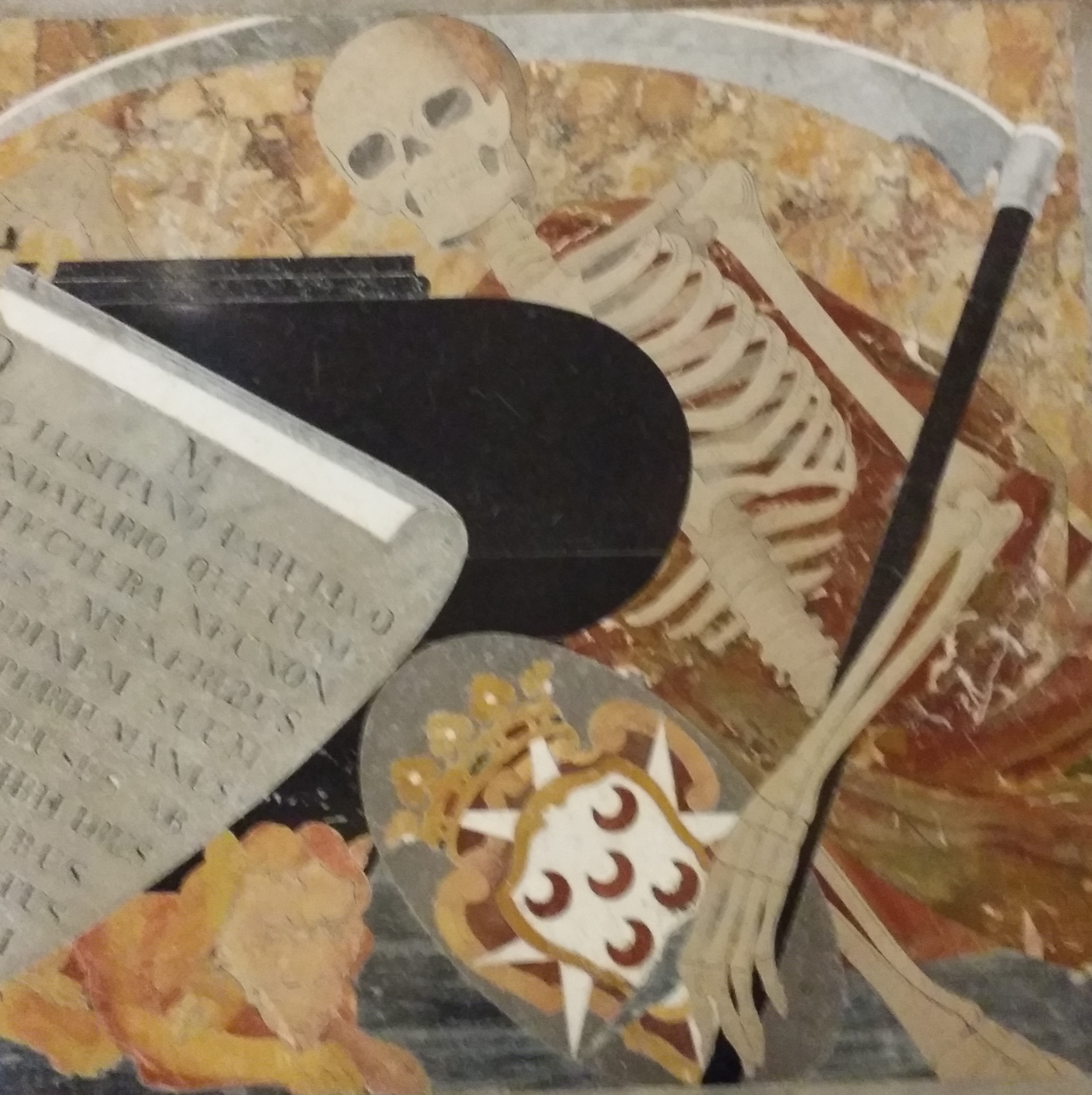
Reacting to someone else’s death usually elicits thoughts on one’s own mortality.  Obituaries bring the reaper up close and sharp. Willem was 58, just three years ahead of me. Again I think of what I’m doing now, and if it’s the best use of whatever time I have left.  That thought is the opposite of wanting to relax or retire.  It’s an adrenaline shot to the mind.

skeleton St. John's Co-Cathedral Valetta

From the St. John’s Co-Cathedral in Valetta.

Death also makes me care less about stuff – physical stuff, I mean. Looking at my tools, clothes, games, dishes, books, electronics is different now. I think less of them as things to enjoy and more about how my family would have to deal with them when I fall over.  Yes, it’s that Swedish idea of döstädning or, literally, death cleaning and it’s quite clarifying. I buy fewer objects and have been thinking more about which items should be around me when I die.  I suspect that nimbus of belongings will contract over the next few years.

Yet I worry about that contraction psychologically. I’ve seen too many instances of people aging away from the world, gradually shrinking their horizon until it holds just a tiny space for one’s body and memories. My father’s been doing this, dismissing world issues he used to care about, blithely ignoring what’s happening in his state and county, focused entirely on his health, his rooms, and his entertainment.  This appalls me. I dread experiencing such a dwindling of concern, a concession of progress and development.

Professionally, I fight back. As a futurist I keep looking ahead and scanning the world. For the past couple of years climate change has anchored my research and it will keep doing so for reasons which seem utterly obvious to me. That’s a problem which exceeds any possible lifespan I may enjoy, and keeps me pointed ahead and into the totality of human civilization. The new book is about that. More videos are on the topic, as well as the podcast series in production now. Articles are appearing. Hopefully the conversation within higher ed can improve, and the sector take more, better steps.

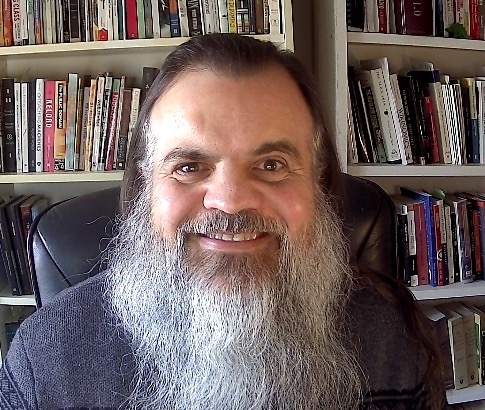
Bryan smiling in front of office books 2022 Feb -a

In the office.

And there I am, shifting away from the self and towards a big, juicy, external problem. That really is my tendency in life. But to the topic, the specter of death naturally brings up my own body. So far, so good. The vegan diet cut my weight down without any return to its previous height. Avoiding alcohol and caffeine as I’ve done for years is apparently a healthy thing. I’m still lifting weights and walking. A return to yoga and/or tai chi is under way.  I want to keep this fleshy carcass functioning to its maximum ability as long as possible.

I don’t know how long that will be.  Statistically someone born when and where I was has a median death in their 70s, so 20 years is one measure. Yet my parents have lived into their 80s and 90s, and with more punishing lifestyles, so perhaps I can expect another 40 years.  But I fear physical and mental decline very much. I also fear American health care and the possibility of not being able to access it.  Again, that staring death’s head drives me to work more, harder, and right now.

And yet. Readers know I’ve expressed fears of a punishing work schedule (up to 60, 70 hours/week) killing me, and for the first time in a long, long time I might be in a position to do something about it. BAC has been successful enough that I can start hiring people to do some things. I can say no to more gigs, choosing more carefully the ones I’ll address.  This is a gamble, assuming certain things about the economy and my marketplace, and it could easily go wrong through disability, recession, or professional reversal. Yet perversely I may have to work less in order to get more done.

I wonder which signs of aging I’m showing and which I avoid. I try hard to avoid the stereotype of the crusty old man who mocks everything new and from younger people, although the catalog of “recent music” on TikTok does depress me. In so much of my work ego is something I try to shove aside, making room for other people (students, clients, audience members, interlocutors) to share their thoughts and to grow.  As a futurist I’m always looking for signs of what’s next. I push myself to look to domains where I’m not comfortable.  Hopefully this works.

The combination of looking ahead and opening myself to others may have gone too far, in a way. I find myself too often obsessed with criticism of me. Negative comments too easily find a way to recirculate in my head.  My wife refers to this as giving hostile people rent-free space in my brain, which is a good line, yet apparently I am a welcoming and easy landlord. Sometimes it feels like I have a mental glass jaw, where any critique stops me in my tracks.  I have no idea how visible this is to other people, but I want to stop doing it.  Any suggestions?

On a different level, being in the mid-50s is certainly the highest level of my own professional success.  Our business is more successful than ever, with an impressive clients list. I’m interviewed by high profile sources. My next book being published means I have written a small stack of books, which fulfills both professional and childhood desiderata. Digital work keeps growing, from this blog to the Forum and more. And I want to do still more!

55 Quinn DombrowskiOne sign of aging is one I firmly embrace: the rising importance of friends and family.  These relationships are supposed to be key to happiness later in life, so… good!  Every day I’m staggered by how kindly and with what love my children view me. Without going into detail, this has been the opposite of my own experience as a son. In contrast, my son and daughter actually choose to talk with me of their own volition, sharing their thoughts, concerns, and lives. It overwhelms me at times, a tidal force of paternal love.  That my wife still loves me is a mystery at times, and I feel both astonished and adoring each day with Ceredwyn.  I feel closer to my brother than at any time in our shared lives.

I feel more deeply connected to friends than ever. Some I “speak” with every day via email, chat, text, Telegram, Facebook, etc. Their messages are of the highest priority.  Perhaps the pandemic warps this view, but seeing friends in person is awfully sweet.  I care about each friend’s health more than I used to.

I’ve written before about the allure of nostalgia, and must admit the bugger likes to pop up without much warning, and with a great deal of seductive power.  I see a random person and their stance, hair, nose reminds me of a friend from the 1980s and I can see them right now, all the years dissolved away, and the context swimming into view.  Answering questions often drives me to cite sources, which can bring to mind where I first found them, and then I’m in the University of Michigan’s Graduate Library and Reagan is president. Nostalgia is an ambush. Memories are, of course, a precise form of haunting.

How to handle this without being devoured by ghosts?  Why, by looking to the future, of course. I shove those memories around until they help me anticipate what comes next.  That’s what I do with most things in the present, poking around until I find potential signals of potential futures.

So that’s 55, chased by ghosts and death, looking ahead, making stuff, and wanting to get better at it all.

(photo credits: 55 in the middle, by Michael Coghlan; 55 and child by 55 photo by Quinn Dombrowski)


Posted in personal | 17 Comments

Simulations and scenarios for the Ukrainian crisis

As the Russian invasion of Ukraine continues, many wonder how it might conclude.  Will Putin conquer the whole nation, or move on to new targets? How will the western sanction strategy impact Russia?

This may be where simulations and scenarios become useful. A scenario is small story about a potential future.  Typically we build them based on one or two driving forces, and often produce several together for comparative purposes.  A simulation, in contrast, is either a human or computer representation of a situation, where people (or software) make decisions to drive that situation to an end state.   A simulation may resemble a game, or be one, as with wargames or business simulations.  A scenario is ant object to think through, while a simulation gives users ways to intervene in the problem.

I find scenarios help us think about futures usefully. As stories they are very accessible, allowing us to imagine ourselves in them. Multiple scenarios give us ways to see divergent possibilities.  Simulations perform a similar function, as a given run-through constitutes a narrative. Simulations can also shed light on difficult and emergent decisions, as well as surprising us as the future often can.

People have been creating scenarios and simulations of the Russo-Ukrainian conflict since it began in 2014, as well as some predating that time.  Indeed, it looks like the Biden administration took both simulations and scenarios seriously in their planning. I’ll share some here in the hope they give us some ways of thinking about where the crisis may be headed.  Since current events gradually render these alternate histories, they may also serve as interesting historical notes.

1: Scenarios

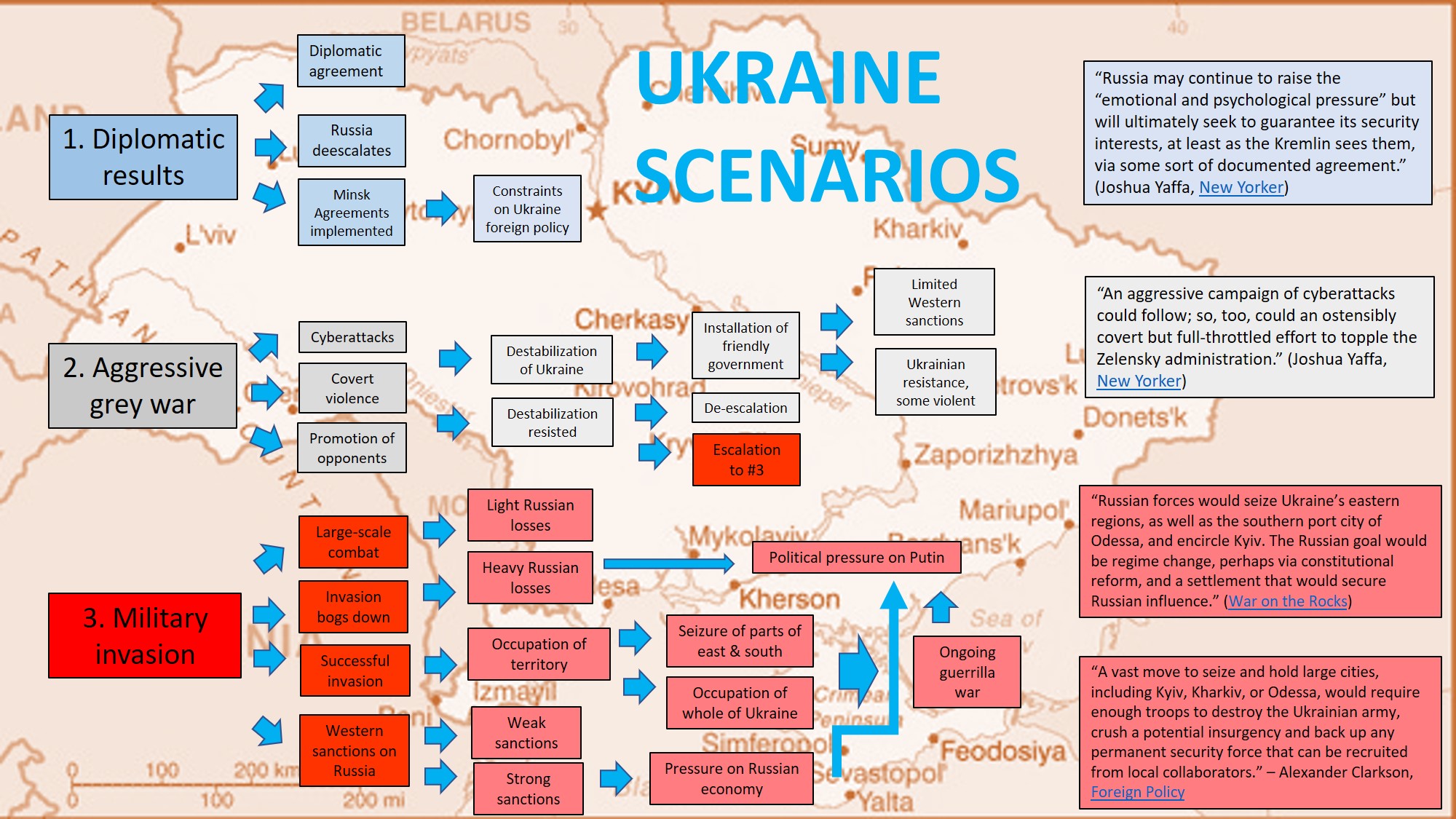
Josh Calder shared this infographic with me, developing a sequence of events for three different ways forward: diplomacy, irregular war, and a conventional attack.

Ukraine scenarios 2-2022_Josh Calder

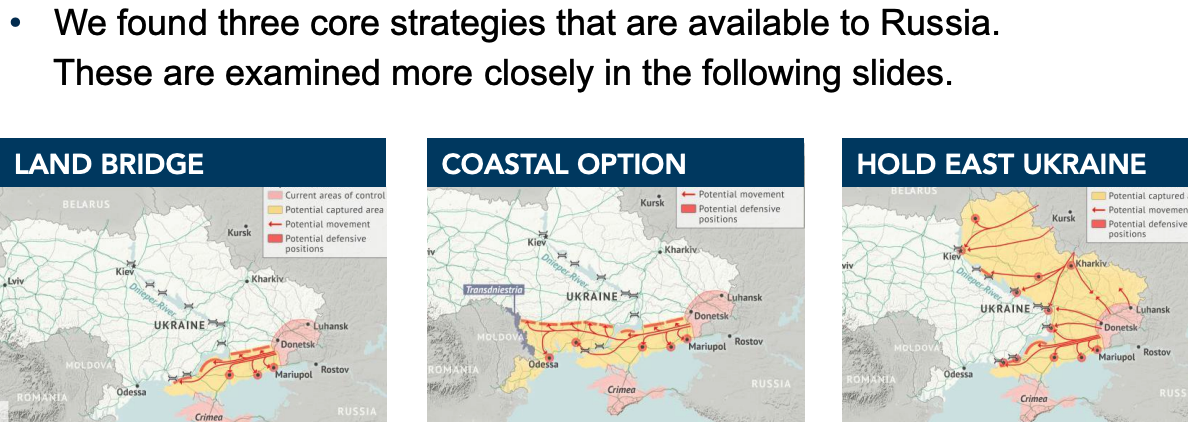
STRATFOR created several scenarios describing different Russian invasion strategies:

Ukraine invasion STRATFOR scenarios

The reality looks most like Hold East Ukraine.

The Russian-led Valdai Club published an invasion story which looks pretty close to reality so far.   Interestingly, the article breaks down pros and cons, concluding that such an invasion should be unlikely to occur.

Assuming war, other scenarios appear.  A Foreign Affairs article offers a range of outcomes following Russian success in Ukraine.  Josh Calder created another infographic, this time of what might result from the war. Note the chained sequences of effects, along with rating them for relative likelihood of occurring:

Ukraine outcomes 2-2022 V3_Josh Calder

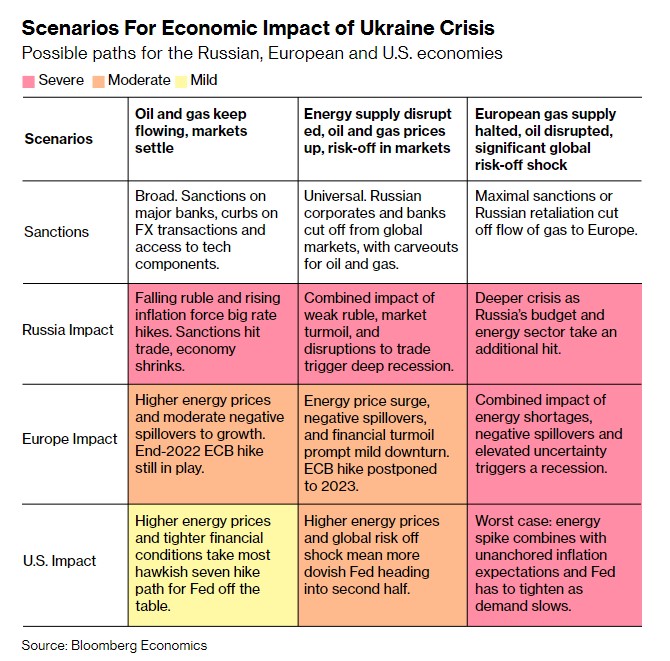
A Bloomberg column considers three scenarios for how western economic sanctions could impact Russia and the world.  Zoe Schneeweiss helpfully turned them into a single infographic:

Ukraine war sanction scenarios_Zoe Schneeweiss

EDITED TO ADD: The Atlantic Council offers four scenarios for the war’s ending.

2: Simulations

The preceding scenarios depict futures as narratives.  Simulations place people or bots in decision-making roles, in the middle of scenarios, if you will, and show us branching possibilities.  As artifacts, they can appear in the form of playable materials (i.e., games) or as descriptions of a simulation being run.

Beyond Ukraine, how might the war expand to other nations, such as those to Russia’s east?  Famous and foundational think tank RAND gamed a Russian attack on the Baltic nations.  This elicited at least one critique.

Bandera is a matrix game, which is a kind of blend of tabletop and role-playing games.  Players take up the roles of Russia, the Ukrainian government, Ukrainian Separatists, the USA, and the European Union.   It’s freely available to download and play.

Futurist Stephen Aguilar-Milan ran two matrix game simulations with very different outcomes.  In one a Russian invasion of Ukraine develops into war with NATO, and Moscow’s forces are ultimately defeated.  In another Russia successfully occupies Ukraine and the Baltic states, dealing NATO a major defeat.

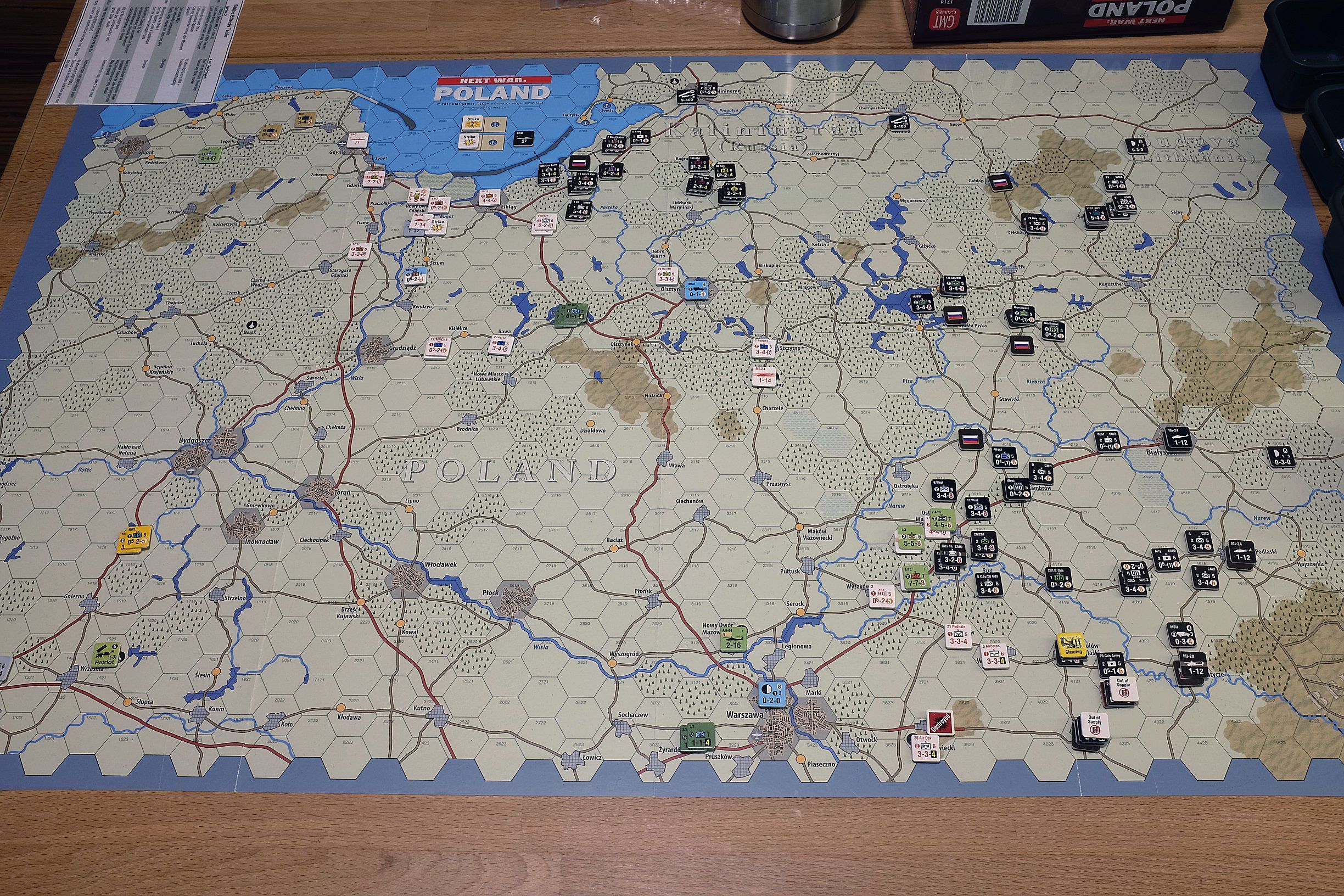
Next War: Poland simulates a Russian invasion of that nation.
Next War Poland game_Jakub Kircun
In terms of computer wargames, Operational Art of War IV apparently has some levels displaying Russian and Ukrainian armies at war. I think this is at the small unit scale, but haven’t played it.

What do you make of these?  Are there other scenarios or simulations for this topic which you recommend?

(thanks to Brian Tain for this post and for answering my question, as well as to Lennaert van Mierlo and the Association of Professional Futurists, especially Josh Calder and Stephen Aguilar-Milan, plus Viktor Motti. Several scenarios via the excellent Naked Capitalism blog.  Next War: Poland photo by Jakub Kircun)

Posted in futures, gaming | 2 Comments

What might the Ukraine crisis mean for academia?

As I write this the Ukraine crisis is deepening.

Russian president Putin recognized two separatist, self-declared statelets in eastern Ukraine, then sent armed forces into them.  In response the European Union and Great Britain announced sanctions, followed by the United States. The German government halted its approval of Russia’s Nordstream-2 pipeline.  According to US president Biden, Putin will use this step as a launching point for invading other Ukrainian territories.

Ukraine Donetsk and Luhask regions_NYT 2022 Feb 22

I have many thoughts about the situation, but wanted today to start a discussion about one particular aspect. What might these events mean for colleges and universities?

I’m inspired by Alex Usher’s post this morning (and everyone should subscribe to his newsletter/blog) which raised several points.

A hit to international research – “in this more dangerous world, top-level science is going to be a lot less open and less free.”  We’ve seen early signs of this in the United States with regards to China, which Alex also mentions. I’m not sure how far this will go, however, as Russia only produces about 3% of global scholarship, according to the NSF.

Ukrainian refugees rising – how might higher education respond?  Usher raises three ways: teaching, research, and housing.

buy tadalafil online buy tadalafil no prescription generic

It would be helpful to think through what it is Canada might be able to do for them, and more specifically, what Canadian universities and colleges might do to assist not just individual refugees who wish to continue their studies or continue teaching, but also what help we can provide Ukrainian academia as a whole as it resists physical assault.

That sentence concerns Canadian academia, but also applies to higher education in many other nations.

There is also the possibility of inter-institutional collaboration on this score: “If there is one agenda around which Canadian universities could usefully co-ordinate action in the days ahead, it is this.”

Curricular offerings – Which fields might expand in enrollments and offerings as a result of this crisis, especially if it persists and/or expands?  Usher mentions “[p]eace and security studies” are likely to do well, which makes sense.  I’d add classes and programs in war, geopolitical strategy, and so on.  I would hope we’d see more interest in Russian studies and language, but I suspect not, given the past general of active disinterest.

Cyberwar on campus – Russia and NATO have a lot of cyberwar capacity, and may well start using it on each other.  We should not be surprised if academic computing gets caught up or openly targeted.  Usher:

there is a reasonable chance of Russian counter-retaliation. This could take a couple of forms, the nastiest of which could involve widespread cyber-attacks on key cyber-infrastructure.  Now may be a good time to back up all your files on some kind of hard drive.  And if you’re a CIO – well, I imagine most of them are working very hard this week to prepare for a lot more denial-of-service for ransomware attacks.

Note that these attacks could hit at multiple levels, from individual to enterprise.

Economic problems – the crisis could stir all kinds of economic woe. NATO sanctions are designed to damage the Russian economy, which can strike Russian universities.

buy temovate online buy temovate no prescription generic

If energy prices take off, as they seem likely to do, that imposes immediate if small costs to campus operations for heating and transportation. If the crisis ratchets up still further and economic problems escalate (think, for example, of cyberwar’s potential economic impacts) then inflation and supply chain issues visit colleges and universities.  Stock market fluctuations, which we’re already seeing, could chew up some endowment investments.

Students, staff, and faculty at war – there are hundreds of academic institutions in Ukraine, with more than a million students, according to Wikipedia.  How many academics – students, faculty, staff – will head into combat, either voluntarily or through impressment?

buy lasix online buy lasix no prescription generic

  How many campuses are near or in the combat zones?  Think, for example, of the University of Luhansk, Luhansk National Agrarian University, Donetsk National Medical University, or Donetsk National Technical University.

This is all short term.  What happens if the crisis persists and deepens?  For example, if Russian forces enter other Ukrainian lands, or if fighting breaks out with NATO member states?  On a less dramatic level, what if the heightened situation we’re experiencing today persists for months?

It could play hob with the global economy, or at least parts of it.

buy augmentin online buy augmentin no prescription generic

  We could see problems grow into unemployment in some areas.  This, among other things, could (not necessarily) drive more people to post-secondary study.  Nations and regions economically close to Russia, such as parts of Europe, may suffer as sanctions and their followup effects degrade the Russian economy, as Naked Capitalism points out. This can, in turn, drive more extreme politics.

If the fighting spreads to other nations, more academics may be involved, either as fighters or as collateral damage.  The burden of wounds, psychological trauma, and deaths will accumulate.

If the crisis appears intractable, we can anticipate political actions which might target campuses, depending on the nation and its politics.  We could see increased funding for Russian studies, stronger controls on international collaboration, or incentives for study abroad in certain nations.

Yet this is all happening now, very quickly. The situation will surely offer more demands and complexities.  Think of this post as notes jotted in haste, designed to stir conversation. How do you see the Ukrainian crisis impacting academia?

Posted in politics | 4 Comments

How many COVID casualties will Americans accept in order to reopen society? A poll

How much will America accept to live with the pandemic?

I have a poll, but let me explain it first.

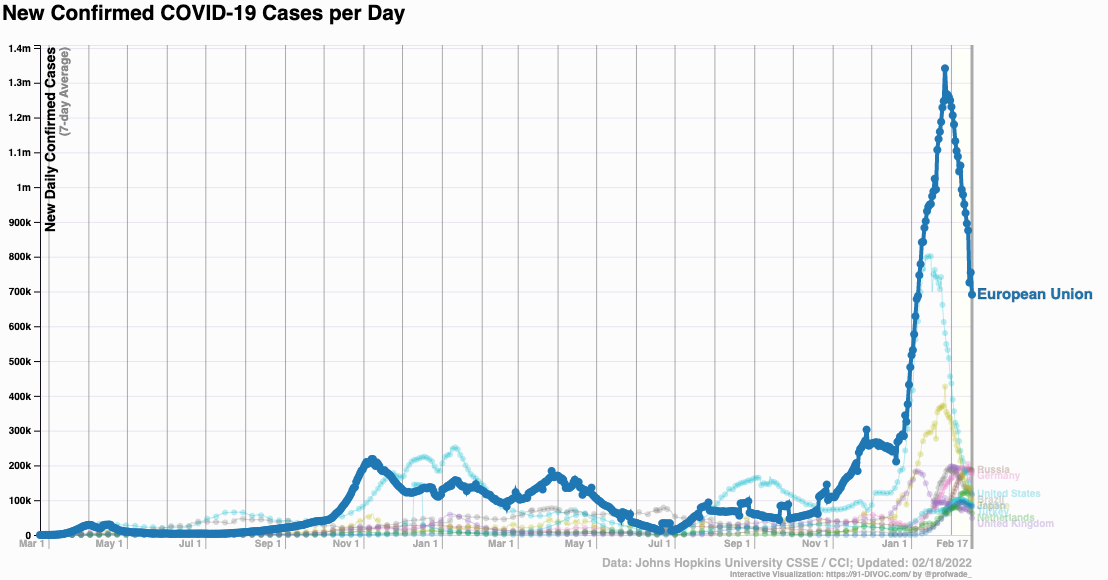
Right now the COVID-19 virus seems to be ebbing in many nations.  Total infections and deaths since 2020 keep growing (420,908,184 cases and 5,869,200 dead worldwide, according to Johns Hopkins) but the gigantic Delta and Omicron waves are subsiding.  Here, for example, are how the most infected nations are faring, according to 91-DIVOC:

coronavirus cases by countries-EuropeanUnion highlit_91-DIVOC_2022 Feb 18

That downward slope is great to see and experience.

Hospitalizations and deaths lag, of course, but seem to have stopped rising, and instead hit something like an oscillating plateau:

coronavirus deaths by countries-EuropeanUnion highlit_91-DIVOC_2022 Feb 18

If no new infectious waves washes through us, we can expect the deaths to gradually drop.

These new developments are inspiring all kinds of calls for societies to “open up” – to end masking, stop pretending to care about social distancing, and get back to the interpersonal activities we did before COVID hit.

buy zenegra online buy zenegra no prescription generic

  To resume the economy of fall 2019.  To get those haircuts and hit the bars without dread or guilt.

At the same time nobody seriously thinks we’re going to utterly erase COVID-19 from civilization in the near term. Instead, we’re hazily expecting some measure of losses: of hospitalizations, sickness, deaths, and long COVID. We’re starting to rethink cost/benefit as a cold, macro level.

Which brings me to the poll.  Let’s focus on the United States for now, where we have had 78,060,327 infections and endured 926,497 deaths, according to the CDC, whose numbers tend to be conservative.  Let’s assume COVID doesn’t disappear, but continues circulating through the population, doing some amount of damage.

How much human damage will we come to terms with, in order to re-open?

I’ll narrow it down to a single number for clarity’s sake.  How many COVID dead will be accept as the price to pay for a post-pandemic society?

buy tadasiva online buy tadasiva no prescription generic

Here’s the poll.  More notes below.

This question might seem cold or ruthless, yet it reflects the calculus we perform at some level. As individuals we make risk assessments frequently, as when we cross the street and estimate likelihood of being run down or when we decide to be among people when we’re ill.

As a society we make all kinds of decisions based on estimates of human damage. We set road speed limits by balancing likely casualties and our desire to race along. We construct and adjust projects, policies, and large institutions to reduce deaths based on certain causes: public health campaigns and shots to drop flu infections, calls for exercise and a vast sports domain to keep so many people from dying of certain heart problems, an anti-smoking effort to cut down tobacco-caused cancer cases.

For example, cars kill around 39,000 people per year in the United States.  (36,096 in 2019, 38,680 in 2020, or “as many as 42,060 people are estimated to have died in motor vehicle crashes in 2020“) To keep this butcher’s bill from being even worse we teach driver’s education classes, police streets with speed traps, conduct public awareness campaigns, etc.  It’s an number to consider – worse when you think of non-fatal injuries – but it’s one we live with, in order to do things we value with cars, trucks, and motorcycles.

We seem to be doing the same thing now for COVID-19.  We have a decent sense of who tends to be most vulnerable to injury and death: people over 75, the immunocompromised, those with certain comorbidities.  As we end mask mandates and give up on some people who refuse to get vaccinated, we are bargaining that we can collectively bear the number of illnesses, injuries, deaths, and long COVID cases.  My question is: what number?  How far will we go?

I realize that “we” is a hasty construct to account for the combined decisions of around 330 million people in a wide range of circumstances.  “We accept” papers over all kinds of disagreement and dissent. Yet for now I want to focus on crowdsourcing a rough, single number to give a sense of what will result from those combined decisions, that democratic compromise which we collaboratively construct.

I am very interested in the wide range of ideas, assumptions, and behaviors that go into such a large scale decision.  Ableism, ageism, capitalism and its opposition, technophilia and technophobia, party politics – all are welcome in the discussion boxes below.

One more thought: please don’t read the tone of this post as being inhumane in a Strangelovian way.

buy tadora online buy tadora no prescription generic

I’m writing directly here to get the poll going.

buy elavil online buy elavil no prescription generic

As some of you know, I have been terrified and outraged by the horrific suffering COVID has inflicted, thanks in part to certain human decisions which let it rip or made it worse.  I have friends and family members who are at serious risk of coronavirus illness, injury, and death.  I’m not posting to make light of their experience.  Instead, I’m writing to determine how we all choose to value them.

I have also polled people on Twitter, Facebook, and LinkedIn. I’ll follow up with a post comparing results.

Posted in coronavirus | 15 Comments

How campuses engage with the climate crisis: a taxonomy

How might colleges and universities grapple with the climate crisis?

This question is the subject of much of my work now, as you can see from these posts. Researching answers can lead in a wide range of directions, not to mention down some twisty rabbit holes.  Today I’d like to avoid those depths and instead look at a very macro, very ten-thousand-foot level.  Let’s explore a schematic analysis looking at campuses as institutions and communities, facing perhaps the greatest crisis of the century.

(I draw the following from my forthcoming book on the topic, Universities on Fire.)

To start, let’s break down the different ways by which the climate emergency can hit academic institutions.

  1. There’s the direct, environmental way, as storms strike, desertification and aridification expand, fire rage, heat rises, and waters surge through a campus.   We can call this the primary impact vector.
  2. Other campus impacts result from the ones crashing through the primary vector.  Think of how temperature rises, the intrusion of salt into fresh water, and the arrival of new diseases can sabotage agriculture, which then leads to human misery and economic dislocation. This can reshape the area around some campuses, not to mention challenging a university’s ag programs.  It can also injure campuses which enjoy appealing physical grounds in terms of mental health and outreach. Additionally, these ecological shocks can also strike academics directly, through newly arrived diseases.  Increased storms can injure a local economy by damaging infrastructure, products, and workers, which can in turn blow back on a local college or university.  Let’s place all of these knock-on effects under the header of a secondary impact vector.
  3. Humanity responds to pressures exerted through the primary and secondary vectors, and these responses engage the academy.  For example, natural disasters can prompt migration; the tendency of some regions to become uninhabitable will drive even more people to seek new abodes.  Economic dislocation (a secondary impact vector) can breed social problems as well as feed extremist politics.  Further, as humanity revises its energy production basis to get away from carbon dioxide, all kinds of ripples can work through society, from changes to economics, human spaces, and gender roles.  If we extend our response to the crisis to include rethinking society and politics (viz anticapitalism, donut economics, decolonization, etc.), campuses feel the results as they are embedded within society and politics. I think of all of these organized together as the third climate crisis impact vector.

Given this triple threat, how can campuses react? As institutions, as individual people affiliated with schools, as groups within a college or university, academics have a broad range of strategies and responses available.  Following the tripartite model above, we can similarly break down the scope or domain of academic action. Seen through our macro lens, academia can act on three levels, starting with the smallest events and actions taking place on campus:

  1. The physical campus.  From renovating buildings to hosting renewable power generation, turning lawns to forests or gardens, banning carbon-burning vehicles, changing food service, and embracing green computing, academics have institutional grounds and materials as a major ground of action.
  2. The campus in its community. Colleges and universities partner with local businesses, nonprofits, government agencies, and civil society for a range of purposes.  The local community can also pressure a campus in many ways, from subjecting it to policies to protests. “Local” can scale up to municipal or other subnational governance, too. In short, there’s potential for productive work as well as friction. In America we call this “town-gown relations.”
  3. Academia on the world stage.  Already higher education contributes powerfully to humanity’s climate crisis actions by producing vital research. Individual academics can act as public intellectuals, translating their research for general consumption and influence.  The reverse is also true as nation-states and transnational entities implement policies or generate other influences on the academic world. Further, some within the academy – faculty, staff, students – will seek to organize for climate mitigation and adaptation efforts.  Indeed, some call on us now to imagine a new, post-carbon civilization; colleges and universities are fertile grounds for such creative work.

(I’ve also been thinking about the various arguments I’ve heard about why campus populations should not seek to change their institution during the climate crisis. Let me set those aside for now, perhaps for a future post just on the topic.  That’s a different response category.)

To be fair, we can easily think of responses which cross between these boundaries, such as working with a religious group with a powerful local presence as well as a significant global one.  Further, there’s not a hard and fast line between town-gown and academic in the world.   I tend these artificial categories to be heuristics, a very rough sketch of possibilities.

How do these two sets of three interact? Let’s play them against each other to produce that beloved tool of futurists, a grid:


Academia engages the climate crisis
Impact vector On campus Institution in community Academia in the world
Primary or direct impact


Secondary impact


Tertiary or socio-political impact


To explicate this scheme further, I can offer some real world and hypothetical examples for each cell on this grid.

Primary or direct impact: on campus, elevating buildings to allow flood water to pass underneath. In community: students and faculty partnering to construct and maintain a large seawall.  In the world: professors publishing research modeling the impact of an Atlantic Meridional Overturning Circulation (AMOC) slowdown.

Secondary impact: on campus, revising sociology curricula to focus on climate-driven social changes. In community: increasing partnerships with local medical care providers and public health authorities to address climate-caused health problems.  In the world: students, faculty, and staff lobby national governments to adopt a no-growth economy.

Tertiary or socio-political impact: on campus, setting up an institute for Post-Carbon Society. In community: offering housing and teaching for climate refugees.  In the world: scholars advocating in public to block geoengineering.

Let’s stick these into the grid:

Academia engages the climate crisis
Impact vector On campus Institution in community Academia in the world
Primary or direct impact Elevate buildings Seawall construction Researching AMOC changes
Secondary impact New curricula Local health partnerships Agitate for new economy
Tertiary or socio-political impact New academic institute Support refugees Against geoengineering

I think that shows the breadth of ways colleges and universities could engage with the climate emergency, both proactively and reactively.  It might be useful to give academics a sense of the options they have, and a pointer towards the multi-pronged nature of the threat.

I hope it’s useful to some of you.  What do you think of this template as a heuristic?

Posted in climatechange | 2 Comments