Designing games for education

Today we had a great Future Trends Forum session and I wanted to share as much of it as I can here.

Our guest was famed designer Michael Townsend, creator of the famous A Dark Room, and who has just released a new web-based simulation of emerging technology with Google, the Qubit Game.

The resulting conversation was energetic and rich. We asked him questions about how to best design educational games.  All kinds of topics came up, from educational theory to comparative software platforms and how to start creating.  People flung a lot of resources and ideas around, and quite a few wanted to capture that, hence this blog post.

Here’s the full recording, followed by the chat transcript:

On the chat: I’ve edited it lightly, mostly anonymizing people, arranging some bits to flow more smoothly together, and adding a few headers.  Otherwise the text is in chronological order as it transpired.

Introductions

currently under tornado watch but that’s not unusual this time of the year – tomorrow through the next, next Saturday will be in the 90’s … we need rain!

Hello from Silver Spring, MD

Good day from Madison, where 500+ people are standing in line to see the Corpse Flower.

Hello from Southeast Texas, where it’s July in May.

John, 500+ people standing in line for a flower show?

Literally one flower. The Corpse Flower blooms for about 48 hours and smells like a dead body. It’s in our arboretum. This is life in Madison.

Stayin’ classy in sunny San Diego 🙂

My daughter is moving to SD in July! Hope it’s still sunny then

John – Metaphors, get behind me!

Link to Corpse Flower –

Cool and cloudy on the NE Colorado High Plains, a welcome break from high winds and May Day snow.

Into the session: design and theory

I can relate. I’m in the gulf between projects at the moment. It’s disconcerting to have choices.

I remember the Game of Life – is it similar?

An anti-interface game deliberately designed to highlight horrible UI.

We have Peoplesoft. It’s a more frustrating game.

LOL!

Nah, airlines are a worse multiplayer game.

NO different that “how to get a degree”

Yes/No logic constraints

House wins that game too often LOL

Will that game make noises?

I do not believe it has any audio.

zone of proximal development, mastery, etc.

My favorite version of the dark room game is Jared Bendix’s “Treasure of the Wumpus” – it’s an audio game.

YES James Paul Gee!

Lev Semyonovich Vygotsky – zone of proximal dev.

I did not realize Vygotsky had a middle name.

You forget some of these authors are people. 🙂

Russians have long names.

You might laugh or scream in frustration though!

You may not know that Lego Mindstorms gets its name from a book by Seymour Papert called Mindstorms: Children, Computers, and Powerful Ideas.

Mindstorms text

“The Origins of Mindstorms”

Creativity is pretty high up on the Bloom’s taxonomy.

Creating and consuming – thought provoking stuff, especially as I’m a non-gamer (with one phone based exception 😉 )…

I can’t wait to talk to my classmates tonight about how Papert and Vygotsky came up today.

The Forum community is extraordinary.

we do this with every From Soft game though

Oh! One of my grad students did a presentation on that very game. Fascinating

There’s an early game with a turtle I played in the library in the 90s. Anyone remember the name of it? You gave it simple commands and it moved around the screen.

Yes. The turtle used to be a physical robot with real pens.

That’s Logo! Turtles.

Logo ?

Accessibility and difficulty

I can think back at least as far as Bloodborne, this conversation came up

Ah yes.

From Soft fans want the game to be “hard” for the sake of difficulty, rather than allowing more folks to get into the story

That drives me nuts.

me too 🙂

Thank you 🙂

Grant Stoner @Super_Crip1994

I prefer variable difficulty settings.

Games let you fail repeatedly.

School teaches failure is bad.

Failing forward is so important but something we don’t design our courses to allow

Failing is ok.

Forum Michael Townsend laughing_Roxann

Screengrab by Roxann Riskin.


yes, and we also have to be careful about how we title them, I’ve seen too many games with “girlfriend mode” or “baby mode”

If I could post a vomit emoji I would re: “gf mode”

omg

I’ve always loved Michele Dickey’s article on engaged learning and game design…

There are a lot of game mechanics built into my course itself. There is lots of room for non-consequential failure. Students have trouble wrapping their heads around it, though.

We need ‘games for old people’ recommendations.

Maybe? I don’t remember it looking like the screencaps. But I was five, so memory might not be as sharp.

Making games on your own, from the start

there’s nothing wrong with board games

build/modify your own

I have an Oculus, and feel REALLY old playing it. BUt it’s fun. Board games are a weekly thing.

“Build a game” is like “Write a book”

Like writing a story.

Game design is a mentality, not a technology.

This is fantastic. Thank you. I really appreciate you sharing the code.

well asked. That is what I was trying to ask earlier.

I think your question is a little too broad, which is why you’re not getting satisfactory answers

I’ll keep working on it. Thanks!

Education is already gaming.

“Gaming” also implies like, cheating – like “gaming the system:

We’ve turned it into a game. The question is what are the goals of the game.

I was talking to a student this morning who was desperately searching for a cheat code for my class.

was it “do the work”?

No. It was “I didn’t do the work. How can I still pass.”

“You! shall! not! PASSSSSSSS!”

“Games People Play”

yeah.

Games and assessment

Hmm, that assessment idea is interesting. You could have ‘team based’ outcomes, if you’re focused on collaboration. Your ‘team’ has to survive or get the reward

I have some ideas

Race car drivers and pilots both use simulation/games for assessment purposes. Better to make mistakes in simulation.

Uhm, this is What Muzzy Lane does. Our platform is used in some ID circles to introduce game design for education. And we do assessments, in a game format, though I agree- you can’t really do pure assessment at the same time you are doing formative.

Students fail, gamers die

All games have one failure state at least: people never enough motivated to try ‘playing’ it or quit right away.

I dunno about that

The systems of education are not friendly to failure states.

it’s kind of a given in FromSoft games that you’re going to die, and die a lot. Some roguelikes, like Hades, even encourage it

Similarly with Celeste.

Roger Schank on learning by doing, through failure, etc. “Learning is about failure and recovery from failure.”

Failure needs to include a vision of success and a hint of what to try?

The fundamental problem in using games in education is not letting the extrinsic motivators of the game overwhelm the intrinsic motivator that is essential for deep learning.

Alice?

ID for game design…..sounds REALLY interesting!

The best strategy I’ve come up with is to use extrinsic motivators to engage in tasks that require intrinsic action. Not sure that solves it.

In an institutional context (e.g., a course), another failure mode is failure by the faculty member to use the game appropriately. Papert mentions a devastating example of teacher failure in implementing his game; it’s near the end of Mindstorms.

https://archive.org/details/glitch_exaplogo … choices 4 and 5 are the Turtle
david furlow

Ryan Baker@Penn has done a lot of interesting work on gamifying learning, applying game engagement and interaction metrics to learning experience modification, & providing cheat codes as another way of learning… withdraws the codes for summative evals.

If people are interested in deep dives on design, Extra Credits is great:

“Teach them something when they don’t know you’re learning” sounds scary, no?

Isn’t that what Big Brother did?

I took his class on Edx, along with 50k or so others… don’t think he will remember me!

And scoring perfect every step.

Yes that is where the question came from – those 7 aesthetics. I’m a completionist. 🙂

author.muzzylane.com to signup jfiske@muzzylane.com or linkedin.com/in/jeff-fiske-00a893

I’m glad to learn of Muzzy Lane, and excited to see they offer courses on Teacher Education. I’ve submitted a request via your company’s website to learn more.

signing up is free and allows you to get demo activities you can tear apart!

A Financial Times game teaching the climate crisis, plus mitigation and adaptation

intrinsic v extrinsic rewards

This is getting me thinking as well about how games can, and do, also create “learning” at a lower level… altering and enhancing perceptual and attentional processing. See Daphne Bavelier’s work on action video games and attention….

VR, AR, and wrapping things up

Loved the simplicity you stated that with

AR was amazing in games like Pokemon Go… it used SO many resources my poor iPhone could not handle it on.

Man! I’d love to hear him speak more on why he thinks VR is dead

VR is pretty good, though. Beat Saber, baby!

I play ping pong on Oculus with friends.

I think VR is going to have to be something you visit – think Star Trek Holodeck.

you’re talking about access, too – VR is expensive and also gives a lot of folks motion sickness

like me

and ARGs don’t have to rely on tech – like Dionaea House (sp) or LARPing

Plus you’re screwed if you don’t have binocular vision

I loved ARIS.

ugh great conversation but I have to go!!

But Google Glass was the biggest disappointment because it didn’t make AR work.

There is a history of games breaking off into art forms. Theater and music are notable examples. We continue to use the words “play” with each, but no longer call them games.

I hope for prescription spectacles…

This is a chat that has tons of resources it would be nice to capture. Any way to?

This is another chat that I’d love to have archived somewhere. it’s moving too fast to capture everything.

Friends, any objections to me blogging this chat? I’ll anonymize you.

Thank you so much!

Blog it up!

Blog it!!

Thanks!

One plays trombone.

Another great session, Brian! Thanks to you…and thanks to Michael!

Sorry…BRYAN.

Thanks for all the discussion!

Thanks to everyone!

Thanks!

It’s all just a game!

TY and thanks for your time.

We don’t know the end state.

Thank you!!

Thank you – now I have even more tabs open!

Many thanks to Michael for being a terrific guest, and the Forum community for just being terrific.
Posted in Future Trends Forum, gaming | 1 Comment

The Climate Game: an educational simulation from the Financial Times

How can we use games and simulations to teach about the climate crisis?

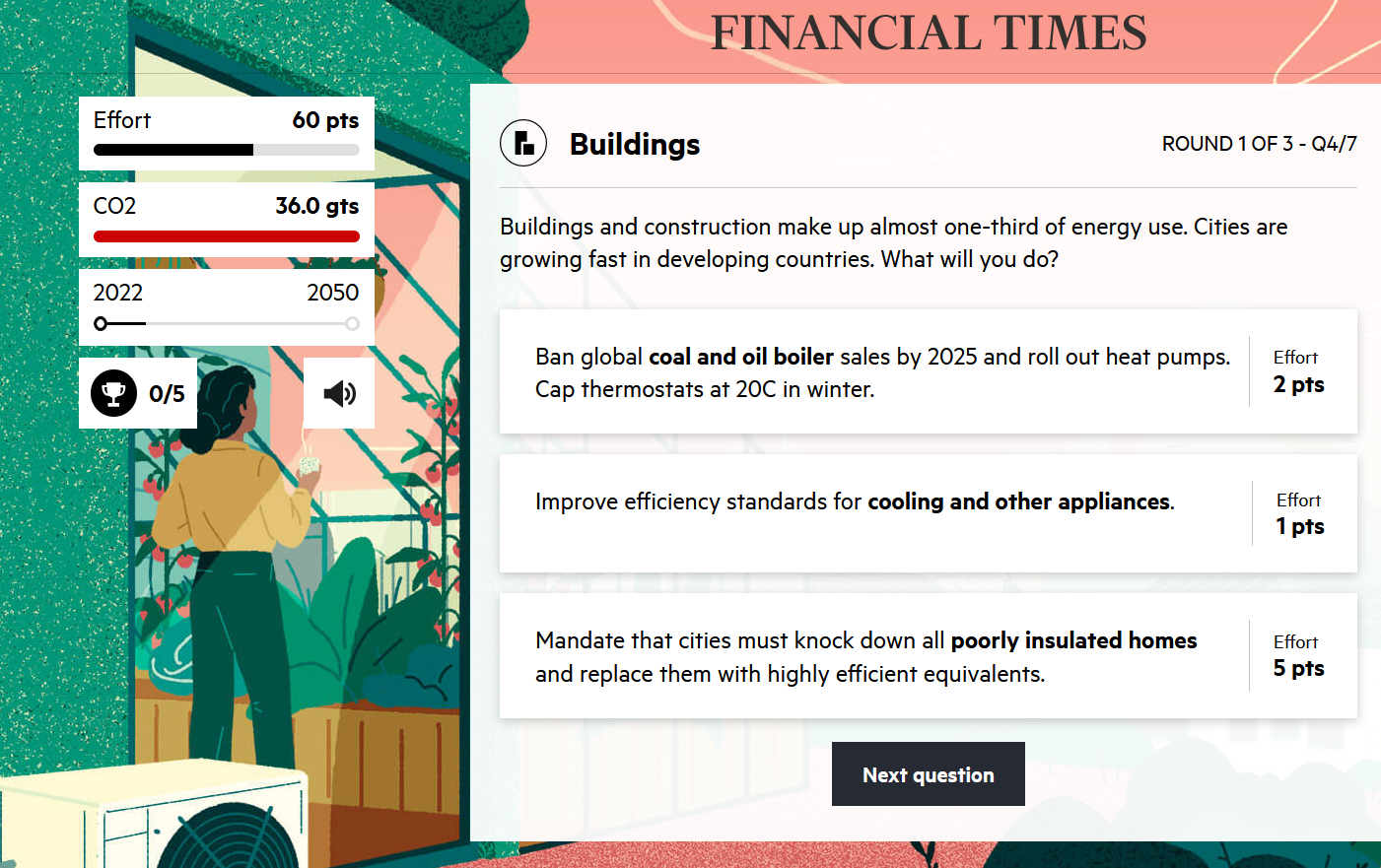
An interesting example comes from the British Financial Times, which just launched a small web game.  Let me outline the game, then offer a few thoughts.

In “The Climate Game” you play “the global minister for future generations” for the next thirty years.  Unlike the minister in Kim Stanley Robinson’s novel, you have a lot of power over the nations of the world. Your goal is to reduce global greenhouse has emissions through a series of choices about major aspects of the world: energy use, diet, transportation, architecture.

Financial Times climate game_buildings choices

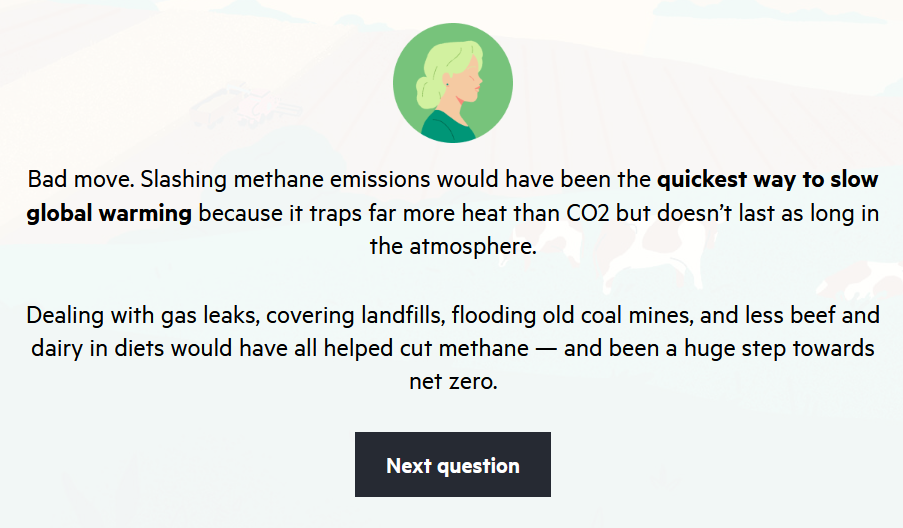
Feedback appears in several ways.  Every three, four, or nineteen years (rounds) the game displays the world’s changing energy use, along with an assessment of your progress or lack thereof.  You can win awards for doing especially well in some areas, like equity or job creation.  Occasionally you get quicker responses from an advisor, who reports on the short-term impact of a particular choice.

Financial Times climate game_feedback bad move

OK, I’ll focus on methane next time!

At the end the game assesses your overall performance. You get a nice chart, your advisor reflects on you, and an overall grade appears in how you did compared to Paris goals and attaining net zero.  The game also compares your results against how other players did. For example, here’s a playthrough where I started off making very tentative moves, then increased the scope of my decisions later on:

Financial Times climate game_mixed results finale

Some random events will interrupt your progress, such as ice sheets melting faster than expected.  Otherwise, you progress through the same set of choices every game.

As a game, this works decently. Your choices are meaningfully reflected in feedback and winning is not easy. There’s replayability available, despite facing the same set of choices each time. It moves very quickly – you can do all three rounds over coffee.

This is a resource management game – well, obviously, as you’re managing planetary resources.  You also have a limited amount of political capital, measured in “Effort” points. You can burn through them quickly, so it’s important to reserve them for the game’s last turns.  (If you run out of Effort before the end, you’re fired.)

Resource decisions impact what else you can do down the road behind the scenes. As one advisor to the game describes,

If you make the right choice in the electricity sector early on, it pays dividends in transport later in the game when you decide to ban internal combustion engine (ICE) vehicles in advanced economies. But if you make the wrong choice, you can go ahead and ban ICE vehicles, but you won’t see the reductions coming through as a result.

If you want to build enough high-speed rail to encourage a shift away from aviation, you need a lot of infrastructure. But unless you’ve decarbonised the industry sector, all that cement and steel to deliver the high-speed rail is going to have tonnes of emissions going with it. Everything has to move together.

There are some attempts at role playing, but those are just gestures. An early screen lets you pick an advisor from a group of four, yet there’s little difference between them. In the last third of the game your character apparently moves to a dangerous area as a political move, but it’s not a choice you make, nor does the game represent what this entails. You might be a planetary minister, yet you have neither name nor avatar.

It’s a low media game, consisting entirely of text, basic images, and a couple of occasional side effects (“That sounds too cheerful for a game on the climate crisis!” shouted my wife from the next room). I’m fine with this, but wonder if some would prefer a richer media experience: animations, video clips, music, and so forth.

As with all simulations, “The Climate Game” expresses an ideology. Economics looms large, unsurprisingly for a game produced by the Financial Times. Growing jobs and GDP are good things, as opposed to reining in capitalism or aiming for a zero growth economy. Although public opinion can turn against you, you have the option to spend money on an ad campaign to make your choices look better, and that’s been a great success every time I’ve played, which reflects a fairly cynical view of politics.  Moreover, there’s no revolutionary option in the governmental role. You have no choice but to keep the present-day political settlement going (which, combined with your ministry’s power, nearly described Mann and Wainright’s Climate Leviathan model). There’s a decision with a space mining option, which the game hates.  Methane appears a few times, but plays a large role.  Taken together, the game presents a view of how humanity should best handle the climate crisis, nestled within a fairly conservative view of the world as a whole. (You can see this even more clearly in the FT cheatsheet.)

I recommend it and am curious to see how it plays in classes.

Give it a try. Let us know what you think.


Posted in climatechange, gaming | Leave a comment

Reading the new IPCC report: Impacts, Adaptation and Vulnerability

What impacts will climate change have on the future?  What do they mean for higher education?

IPCC report 2022 coverToday we continue our group reading of the new IPCC report, focusing on the Impacts, Adaptation and Vulnerability document produced by Working Group II.  We’ll dive into the “Summary for Policymakers.” Next week we’ll following up with the “Technical Summary.”

We’ll begin with a summary of the high points, then shift to questions.

(For more info on this reading, click here.)

The “Summary” is divided into three parts: risk, adaptation, and resilience development.

1: RISK

The cumulative scientific evidence is unequivocal: Climate change is a threat to human well-being and planetary health. Any further delay in concerted anticipatory global action on adaptation and mitigation will miss a brief and rapidly closing window of opportunity to secure a liveable and sustainable future for all.

This section details the many risks humanity and the rest of the world run from global warming.  And there are a *lot*.  I won’t repeat them all here, but will just hit some of the highlights, like “increases to the frequency and intensity of climate and weather extremes, including hot extremes on land and in the ocean, heavy precipitation events,
drought and fire weather.”  There is damage to species and ecosystems, “reduc[ing] food and water security,” threats to physical and mental health, and economic impact.  The report also identifies human and other populations most at risk, due to location, the inheritance of colonialism, and governance.

Risks can also interact with each other in mutual reinforcement and/or creating additional risks. Human actions can also make things worse – for example:

deployment of afforestation of naturally unforested land, or poorly implemented bioenergy, with or without carbon capture and storage, can compound climate-related risks to biodiversity, water and food security, and livelihoods, especially if implemented at large scales, especially in regions with insecure land tenure

These are broken down by horizons: “the near-term (2021–2040), the mid (2041–2060) and long term (2081–2100).”

2: ADAPTATION

This section begins by explaining: “Adaptation, in response to current climate change, is reducing climate risks and vulnerability mostly via adjustment of existing systems.” Then it reveals many nations are starting to work on adapting to global warming, especially for water risks, but at too basic a level and in a fragmentary way.

The report outlines a series of adaptation measures broken down by categories: food systems, forestry, conserving water ecosystems, energy systems, addressing climate migration, and redesigning urban and rural “settlements,” as well as “Effective Ecosystem-based Adaptation.”  One key point is a call for public economic restructuring:

…integrating climate adaptation into social protection programs, including cash transfers and public works programmes, is highly feasible and increases resilience to climate change, especially when supported by basic services and infrastructure. Social safety nets are increasingly being reconfigured to build adaptive capacities of the most vulnerable in rural and also urban communities. Social safety
nets that support climate change adaptation have strong co-benefits with development goals such as education, poverty alleviation, gender inclusion and food security.

One problem: most of climate funding goes to mitigation (reducing global warming), while not enough is aimed at adaptation.

3: RESILIENCE DEVELOPMENT

Another definition: ” Climate resilient development (CRD) is the process of implementing greenhouse gas mitigation and adaptation measures to support sustainable
development.” This document concludes by arguing for the urgency of resilience work. Yet a given community’s ability to plan and act for resilience differs from others based on location, financing, historical constraints, and other factors.  For example, “Climate impacts and risks exacerbate vulnerability and social and economic inequities and consequently increase persistent and acute development challenges…”

Inclusivity is key.  Urban areas should be leading targets for planning.

IPCC 2022 future wheel

What does this mean for higher education?

If we think of colleges and universities as parts of the communities described above, then we need to engage in adaptation and resilience work *now*.  We are clearly at risk.

We can also play a role in research, according to this document.  For example, section 2 advises us that “[c]onsidering climate change impacts and risks in the design and planning of urban and rural settlements and infrastructure is critical for resilience and enhancing human well-being (high confidence).”  This is something academics who work in multiple fields can work on: urban studies, agriculture and food systems, political science, government, etc.

Similarly, other sections (C.5.2, C.5.3) call on humanity to create new models in order to improve governance, to “[e]nhanc[e] knowledge on risks, impacts, and their consequences,” to produce “[a]wide range of top-down, bottom-up and co-produced processes and sources [to] deepen climate knowledge and sharing…” C.5.5 urges us to create new tools for monitoring and evaluating adaptation.  Again, academia is a fine source for this kind of work.  Sharing such knowledge is part of the sector’s pedagogical function.

The report actually addresses academia fairly directly at a few points.  For example, it wants humanity to address “including capacity building at all scales, educational and information programmes, using the arts, participatory modelling and climate services, Indigenous knowledge and local knowledge and citizen science.”  That hails colleges and universities directly.  Similarly, D.2 invokes a series of institutions: “Climate resilient development is facilitated by international cooperation and by governments at all levels working with communities, civil society, educational bodies, scientific and other institutions, media, investors and businesses…” [emphases added]

Note the positioning of education.  This is not a call for retreating into the ivory tower, but a summons for academics to work with the world.

Questions

  • Does this call for adaptation and resilience match your understanding of the climate crisis?
  • Thinking of that timeline for the rest of this century, how can humanity plan and act on such a temporal scale?
  • If the world is biased towards mitigation over adaptation, is the same true for higher ed?
  • One final note: you can’t miss the IPCC’s urgency even through bureaucratic language.  This document is a fierce call for action *right now*. Will academia respond?

The comment box stands ready for your thoughts.


Posted in book club, climatechange | Tagged | 2 Comments

A queen sacrifice proposed in Arkansas

An Arkansas university is considering a major queen sacrifice.

(“Queen sacrifice”: removing tenure-track faculty members, based on a chess analogy)

HSU sealHenderson State University is a rare institution, a public (state-supported) liberal arts university. Their financial exigency committee produced a recommendation for serious academic program cuts, which entail faculty terminations.

Programs on the block include: accounting, business information systems, data science, finance, French, general studies, German, management, management information systems, marketing, music performance and composition, political science.  By my count ending those programs also ends 33 faculty positions.

One local paper reports that “Henderson spokeswoman Tina Hall said the school’s academic programs are expected to shrink by ‘approximately 30-40%.'” Total savings from these cuts will net HSU $3.7 million.

Why might this occur?

The clue is in the committee’s name.  “Financial exigency” is an academic term of art. It describes a dire financial situation. Once declared, more options are on the table, including radical ones.  Why is Henderson in such straits?  Wikipedia reports that a financial crisis struck the campus in the 2010s:

Glendell Jones Jr.’s… tenure as president was rocked by a series of scandals and bad publicity, and he and his senior leadership were twice the subject of no-confidence votes by the faculty. When the true scope of the university’s budget crisis became public in July 2019, he was asked to resign. He currently serves as an assistant to the president of Georgetown University.

Jones—as well as several other current and former administrators, staff, and members of the Board of Trustees—were called to testify before the Arkansas legislature in 2020 as part of the state’s effort to understand the university’s staggering financial collapse.

This crisis drove Henderson to join the Arkansas state university system in 2019 (although they were state supported as early as 1930; thanks to Jason Green for the tip).  According to one local account, in 20019:

Henderson State University was on the brink of insolvency, its balance sheet loaded with millions of dollars in uncollectible student accounts. Only an emergency $6 million loan from the state in 2019 allowed the small Arkadelphia school to keep its doors open.

And so now:

Layoffs and budget cuts loom in the near future. Most faculty and staff are now furloughed for one day each week — an effective 20% pay cut. Over the past fiscal year, a hiring freeze has already reduced the number of Henderson employees by almost one-third, mostly among staff.

Faculty positions are likely next in line.

So why these particular programs, and what do they have to do with university finances? The state mandates a specific review process (Word Doc; thanks again to Jason). My readers will be unsurprised to learn the cause is low enrollment. Continuing from the Magnolia Reporter:

In December [2021], the Arkansas Division of Higher Education notified institutions of programs that had so few graduates as to raise concerns about their future viability. The division advised Henderson of 34 such programs.

One driver for overall enrollment pressure is, of course, the double whammy of demographics and COVID:

Engman, the faculty senate president, said the COVID-19 pandemic worsened problems at Henderson, which was already grappling with shrinking enrollment. A declining population in southern Arkansas means fewer high school graduates from the region and fewer students moving on to college…

Over the past five years, the state’s four-year public universities have seen an almost 10% decline in student headcount, from 100,413 in fall 2016 to 90,920 in fall 2021.

As one editorial writer observes, “virtually every county in the south half of Arkansas is losing population.”  In 2020 HSU lost nearly 12% of its student numbers.

Criminal charges against two faculty members for cooking meth probably didn’t help matters.

What can we learn from this story?

It’s an interesting case of a queen sacrifice. Some aspects are present elsewhere in higher ed: declining population in an institution’s market, decreasing enrollment, COVID, and some financial pressure.  On the other hand, HSU has some distinct features, namely the massive financial crash of the past decade and the recent shift from private to public.

I’ll note that the targeted programs are a bit unusual.  Typical queen sacrifices focus on the humanities, whereas in the committee’s proposal cuts fall heavily on the social sciences (including business) as well.

One way to think about Henderson is as an unusually frail institution hit harder than most by recent trends. Most campuses weren’t in this weak a position before COVID.

NB: there isn’t a lot of reporting or commentary on this story, so I’m working from a very few sources. I’ll be happy to update as more information surfaces.

(thanks to a former student)

Posted in horizon scanning | Tagged | 7 Comments

Continuing our reading of the new IPCC report

What’s in the latest United Nations Intergovernmental Panel on Climate Change (IPCC) report?  What does it mean for higher education?

Last fall we started reading the first installment (by Working Group I) on the climate crisis with our online book club.  Now two more parts have appeared – Working Group II: Impacts, Adaptation and Vulnerability; Working Group III: Mitigation of Climate Change –  and we can read them together.  Everyone is welcome.

What, exactly, are we reading?

IPCC report 2022 coverThese reports are digests of the most cutting-edge climate science, written for all readers.  They represent the best current knowledge we have about the crisis.

Each report appears in three forms.  I’m going to focus on the shortest one, the Summary for Policymakers. Each one also has a Technical Summary, which I’ll work through.  There’s also a Full Report, but since that runs nearly 2,000 pages, I think we can consider it optional.

How will this online reading work?

Every Monday for the next month I’ll post about a chunk of the readings (see schedule below). I’ll summarize them as best I can and ask questions for discussion. Then you all can share your thoughts in comments for each post.  You can also share thoughts elsewhere – Twitter, your own blogs, Facebook, etc. – and I’ll try to capture them in the next post. We’ll also hold a live video discussion on the Future Trends Forum.

SCHEDULE

May 2 – Starting off with Working Group II: Impacts, Adaptation and Vulnerability.

May 9 – Finishing Working Group II: Impacts, Adaptation and Vulnerability.

May 16 – Starting Working Group III: Mitigation of Climate Change.

May 23 – Finishing Working Group III: Mitigation of Climate Change.

May 26 – live video conversation on the Future Trends Forum.

May 30 – conclusions and more thoughts.

After that our entire conversation will remain up on this blog, with each post tagged “IPCC2021.”

Here are some resources to aid in reading:

A trailer for “Impacts, Adaptation and Vulnerability”:

A trailer for “Mitigation of Climate Change”:

More:

Any questions or requests?  Otherwise, on to our reading!  Welcome aboard!  Our next reading post will be on Monday.

You can find out more about our book club, including each reading series going all the way back to 2013, right here.

Posted in book club, climatechange | Tagged | 1 Comment

Please talk me out of a grim climate crisis analysis and forecast

As I revise Universities on Fire I have been mulling over one way of looking at the climate crisis in recent history and the near future.  It’s a grim view, specifically of the United States, and yet I can’t shake it.  Please help talk me out of it.

Fair warning: I’m writing this in a hurry, caught between competing deadlines, so it’ll be a short post without a ton of links or development.

The Age of Stupid

I’ll explain this shortly.

Let’s start with the American partisan divide over the climate crisis.  Roughly speaking the Republican party either doesn’t think it matters, or thinks it’ll happen but humans didn’t do it and the government should stay out of the issue, or considers it a conspiracy/scam. In contrast the Democratic party has been increasingly interested in viewing climate change as a dire threat and wanting to do something about it.

So when Americans elected Trump and gave both houses of Congress to the Republicans in 2016, we were set for a climate crisis retreat on the political side.  (This is one reason I saw my friend Bill McKibben campaigning fiercely for Hillary Clinton that year.

buy suhagra online buy suhagra no prescription generic

) While civil society may have become more interested in the climate crisis, government was either stymied or retrograde. So that’s four years lost.

Then in 2020 the US elected Joe Biden. He pledged to treat the climate crisis as a leading threat. He proposed a series of programs and participated in the 2021 COP meeting. Yet all of that political energy ran into a political minefield. Many of those programs died in Congress, thanks to solid Republican opposition, plus being undermined by putative Democrats Manchin and Sinema. Meanwhile, Biden authorized more oil drilling.

Next, Putin attacked Ukraine and it looks like Biden’s political calculus changed. The American president responded to that new war by (among other things) calling for increased fossil fuel production (LNG to Germany, expanded infrastructure, etc.) in order to help countries avoid buying Russian oil and gas.  As for alternatives, global opinion seems to hold that renewables (primarily solar and wind, also hydro) are not capable of being scaled up to meet potential energy shortfalls.  In short, for geopolitical reasons, the White House led the way in increasing fossil fuel production.

The political calculation has other components. As 2022 staggers on, some polls indicate that climate change is not a leading issue for most Americans now. Perhaps in response to such assessments, Biden and some other Democrats have stopped talking about climate change as much as they used to. The topic barely appeared in the 2022 State of the Union.

buy zoloft online buy zoloft no prescription generic

This brings my grim story to the rest of 2022. Looking ahead, I see little chance of relief.

buy tadasiva online buy tadasiva no prescription generic

  The consensus seems to be that the GOP will attain a Senate majority in November’s Congressional elections, and also make gains in the House, perhaps enough for a majority. This would block any major climate initiatives from Biden in 2023-2024, assuming he attempts any, given the GOP’s militant and well organized opposition to anything along these lines.

Which brings us to 2024 and eight years of next to no American governmental progress on the climate emergency.  That’s almost a decade, lost. Is the US really responding this badly to what is arguably the biggest 21st century crisis?

Looking further ahead, what are the odds of the Democratic party returning to a climate focus, winning the presidency in 2024, and also getting back majorities in both houses?

Please help me see a way out of this. Tell me Biden will use his extensive federal experience to whip up some powerful executive orders which will actually get done, running past Republican judges. Make a case that the states making up the majority of American economic power are going to take more action on the issue. Perhaps you see a climate disaster occurring which will sap Republican opposition to climate mitigation and adaption policies. Or something.

Otherwise I’m staring at stuck with the title of a cruel yet fair documentary from a decade ago, which describes our era as The Age of Stupid.  That described the world; for now, in this post, I’m just focused on the United States.

buy elavil online buy elavil no prescription generic

Are we really ending up being such lousy ancestors?

Posted in climatechange, politics | 16 Comments

Starting to think about how the climate crisis hits campuses

This week I published a short article about the climate crisis and academia.  Specifically, it’s an introduction to how the emergency can strike physical campuses.

The Society for College and University Planning (SCUP) was kind enough to publish “Anticipating the Climate Crisis on Campus” in the latest issue of their Learning by Design journal.

Anticipating the Climate Crisis on Campus, page one

There I touch on building design, weather-driven disasters, new architectural concepts, power sources, geographical variation, air conditioning, heat protection, community partnerships, direct air capture of carbon dioxide, and more.  It’s a lot to cram into a short piece, but the issues are complex. There is so much to discuss in this huge topic!

Consider it one way into the field described by Universities on Fire.

I hope that today’s article can connect campus planners with the rest of the academy within the growing conversation about the climate emergency.  Then, beyond discussion, action should follow.

Thank you to SCUP and the editorial team for this opportunity.

Posted in climatechange, writing | 3 Comments

A glimpse into one state’s university enrollment changes

How is public higher education changing?

We have a new sketch of an answer to this question for one state.

buy dapoxetine online buy dapoxetine no prescription generic

  The Detroit News recently ran an article about Michigan’s public universities, focusing on enrollment. I’d like to share some of it here.

The overall picture is one of most Michigan public institutions losing enrollment over the past decade to various degrees, except for a couple enjoying the opposite experience:

Michigan public university enrollments 2011-2022_Detroit Free Press

Some of this is unsurprising.  The University of Michigan is one of the world’s great universities.  Michigan State is also highly ranked.  Naturally they attract students (like myself, back in the day).

Yet, setting aside Michigan Tech’s near-plateau, I think the rest of the picture is not so well appreciated.  Consider how many of those institutions saw their student numbers drop by values in the 20s – or 30s.  Central Michigan University (CMU) lost nearly one half of its enrollment. It is actually closing up some residence halls this fall.

Now, those are all relative numbers, comparisons and proportions.  What are the absolute numbers? According to Michigan Association of State Universities (MASU) data, total enrollment in state universities was 303,969 in 2011.  By 2021 it fell to 262,985, roughly a 14% decline.  2022 numbers are still to come.  2011 seems to have been the peak, as I’ve noted elsewhere.

buy singulair online buy singulair no prescription generic

What’s behind this overall net loss?

buy priligy online buy priligy no prescription generic

The News article cites demographics, which makes sense, since Michigan’s overall population is barely growing: 9,883,640 in 2010 leading to 10,077,331 in 2020, according to Census data.   The state’s median age is somewhere in the upper 30s, depending on source (Google versus Infoplease). Some are concerned that Michigan is aging up and out, producing fewer kids, as per the global demographic transition I’ve mentioned before.

The article also mentions COVID, although it adds that the decline predated the pandemic.  And it adds a cultural detail:

“Lou Glazer, president of Michigan Future [states that] “you’ve got this drumbeat, which we think is inaccurate but is out there, that says getting a college degree is less valuable…”

Again, watch for that cultural shift.  We may be moving away from uniformly thinking every needs more college.

CMU in particular might have been out-competed by its siblings – “University-provided documents also show school officials admit to being out-recruited by other universities, particularly in Metro Detroit” – yet the result seems to be a net decline for the system.

Jennifer DeHaemers, CMU vice president for student recruitment and retention [wrote]: “When enrollments reached a peak around 2010, a general sense of complacency overtook some areas of the university, creating a sense of satisfaction with outdated technology and leading to a failure to employ new and updated best practices of recruiting…”

What futures does this story suggest?

If the trend of the top two grow while the rest shrink continues, we might see cuts, consolidations, or closures for those experiencing the most difficulties.

buy vibramycin online buy vibramycin no prescription generic

The specter of this might spur some of the institutions to new recruiting strategies, from fierce competition with each other to building out new programs and expanding their reach, including online.  Given Michigan’s splendid geography, I wonder how many students might head there to work on the climate crisis.

For now, this is a snapshot of one state’s public higher education enrollment.

(thanks to Tom Stroup for the story; to Ed Vielmetti and Brad Bernatek for sharing the MASU data, and MASU for aggregating it)

Posted in enrollment | 3 Comments

Americans often estimate other Americans inaccurately, it turns out

How many people do we think belong to a certain group?

Contemporary American politics has a tendency to focus on identity, as commentators and politicians assure us. Yet we may be thinking about this pretty badly, according to a new YouGov report.  If their poll is correct, Americans tend to massively overestimate some smaller group sizes while seriously underestimating larger ones.

As a futurist I’m fascinated by the results. What they reveal about contemporary American thinking suggests a lot of directions for politics and culture to take.

Here I’ll summarize the poll’s results, then offer some reflections.

YouGov surveyed around 2,000 people, asking them to estimate the proportion of Americans who belong to various groups.  They selected group identities across a number of domains: religion, sexuality, economics, race, education, geographical location, household details, behavior, and more.  Participants answered questions like “If you had to guess, what percentage of American adults are [x]”? with percentages.

Some caveats: first, this isn’t a massive survey.  I’d prefer a much larger one, with responses broken down into their own identities.  Second, we might disagree on the numbers YouGov selected to represent reality.  Polling on sexuality, for example, is notoriously variable and unreliable.  Determining if a person is a member of a given religion has some different options and results.  Racial identity gets into multi-racial complexity.

To the survey!

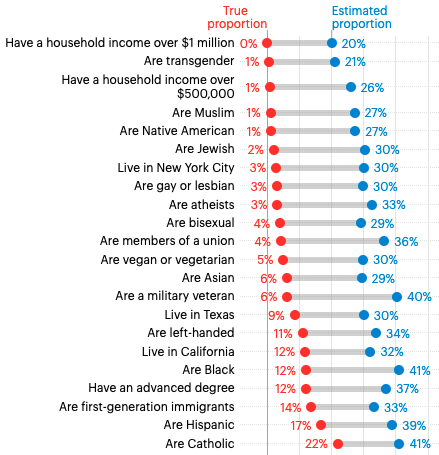
First, Americans tend to overestimate the actual size of minorities, especially those with the smallest numbers, and sometimes by a lot.  As the report’s header summarizes, “small subgroups of the population seem much larger to many Americans.”  Consider our sense of how large some of the smallest groups are:

Americans estimate populations_minorities top_YouGov_2022 March

20% of Americans are millionaires!  A third of Americans live in New York City!

What’s behind these wrong guesses? Just this slice of the results begs a lot of questions.

We can easily imagine a mix of media attention, political activism, and cultural shifts driving some views, such as the overestimation of transgender people, vegans/vegetarians, gun owners, first-generation immigrants, and black people. I can imagine representational biases within mainstream media leading to the over-prominence of California and New York, and perhaps the advanced degree number.

Other explanations may be based on some older cultural values. The misprision of veterans may be due to America’s military culture.  Similarly, our inflated wealthy numbers follows the American dream’s optimism.  I don’t know if high Catholic numbers are more due to Catholics overestimating their cohort or anti-Catholics fearing them.  Perhaps the grossly inflated union numbers are due to conservative media, right wing politics, or some kind of legacy view inherited from the mid-2oth-century, when a lot of Americans were actually union members.

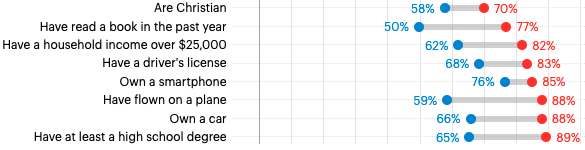
Second, Americans underestimated actual majorities.  We think there exist fewer people than there really are who are Christian, read a book last year, make more than $25,000/year, have a driver’s license, own a smartphone, have ever flown on a plane, own a car, and who have attained a high school diploma:

Americans estimate populations_majorities_YouGov_2022 March

That’s an interesting take on technology, for a start. Americans are more into driving, smartphones, and planes than we think we are.  I am curious about that lowball, especially since most of those technologies are not new.  Do we have an outsized image of technological refuseniks?  How does this feed into cultural and political attitudes about tech?

The Christianity underestimate suggests several underlying causes. I can infer that some people have followed the secularization idea for a while and believe the decline of faith is happening faster than it is. I can also imagine Christians who see themselves as endangered, under attack from secular forces undercounting their own numbers.  And it might also be a logical response to overestimating the number of other faiths’ adherents seen above (Muslims+Jews+atheists totally 90%!).

Third, we’re not always wrong when we estimate how many Americans occupy various identities. We got some stuff right, or close enough, in the poll.  The numbers of people whose households make more than $100,000/year, for example, or those who are Republicans, who are married, have at least one child, voted in 2020, are white, and have a pet: we nailed these, compared to the others.  The COVID vaccination number isn’t bad, either:

Americans estimate populations_accurate middle_YouGov_2022 MarchTaken together, this paints a complicated picture of American attitudes.

There’s a futures orientation to these results, perhaps. The overestimation of some minorities – Latino, Asian – points to their growing numbers, while the underestimation of white people’s numbers suggests their decline.  The massive overestimate of trans numbers may similarly indicate a growing challenge to the assigned at birth gender binary.

We could also see an emerging politics from this, one that pays a lot of attention (positive and/or negative) to small groups. At the same time it’s one which sees economics in terms of very accessible success, with large numbers of wealthy people.

At this point some readers will cry out that I’m missing the real lesson, which is that Americans are often lousy with statistics and statistical thinking.  That’s also true.  You can see it in the general middle-ness of our estimates, tending to avoid numbers that are very small or very large.

The YouGov author, Taylor Orth, has an interesting take on this, worth reading in full:

When a person’s lived experience suggests an extreme value — such as a small proportion of people who are Jewish or a large proportion of people who are Christian — they often assume, reasonably, that their experiences are biased. In response, they adjust their prior estimate of a group’s size accordingly by shifting it closer to what they perceive to be the mean group size (that is, 50%). This can facilitate misestimation in surveys, such as ours, which don’t require people to make tradeoffs by constraining the sum of group proportions within a certain category to 100%.

This reasoning process — referred to as uncertainty-based rescaling — leads people to systematically overestimate the size of small values and underestimate the size of large values. It also explains why estimates of populations closer to 0% (e.g., LGBT people, Muslims, and Native Americans) and populations closer to 100% (e.g., adults with a high school degree or who own a car) are less accurate than estimates of populations that are closer to 50%, such as the percentage of American adults who are married or have a child. [emphases added]

If this uncertainty-based rescaling occurs, it’s something we should bear in mind as we assess large group’s collective action and culture.

I think there’s a lot to find in this study, and I’d like to hear your reactions.

Posted in research topics | 5 Comments

I’m interviewed for an Inside Higher Ed podcast

Last week Inside Higher Ed interviewed me for their podcast, The Key.

The Key podcast IHE logoDoug Lederman, a fine host, began by asking me about futures thinking, so I offered a quick intro to the profession. Next, we discuss how the pandemic changed higher education, and what those changes might portend for the future.  I positioned things as a continuum of options, between one pole wanting to transform the university, especially in terms of race and technology, while another pole wants to return back to fall 2019.

We went on to discuss innovation, improving teaching, building up a higher standard of student care, the importance of CARES, my peak higher education scenario.  I make the case for the importance of the trends which afflicted academia before the pandemic persisting after COVID declines.  Then I introduce my work on academia in the climate crisis.  Doug asks me to pin down the present moment, and I riff on how futurists should consider a wide range of futures.

I conclude on a big picture note, asking listeners to think of what kind of ancestors future academics might want us to be.

Here’s a direct link to the podcast page.

Posted in interviews, podcasts | 2 Comments