Years ago I nicknamed this “the queen sacrifice” after the desperate chess move, when a player gives up the most powerful piece on the board (here tenure-track faculty stand in for the queen) in a big to win. I’ve tracked too many of these sacrifices, and today will describe another.
Cabrini University recently laid off six professors, three of whom were not just tenure-track, but tenured. For perspective, that half-dozen “represent 8.7% of Cabrini’s 69 full-time faculty,” according to that short Philadelphia Inquirer account.
The same sources lists “writing and narrative arts, two science, one math, and one visual and performing arts.” Yet Cabrini did not cut a single program this time.
Why these cuts? The campus faces a $5-6 million deficit, which looks like it was driven by a shocking enrollment drop, “from 2,360 in 2016 to approximately 1,500,” according to Diverse Issues in Higher Education.
Cabrini has been having problems for years. Back in 2021 the university led an even larger queen sacrifice, “eliminat[ing] 46 positions and cut[ting] or chang[ing] 15 of its 69 programs.” Targeted programs then:
Majors in religious studies, Black studies, philosophy, gender and body studies, human resources management, liberal studies, and nutrition will be cut, as will secondary education certifications in biology and chemistry. English and writing will be offered as a combined major, and a master’s in biological sciences and two certificate programs as also being phased out.
In fall 2022 Cabrini cut senior administrative positions, including provost. Diverse adds that Cabrini “was exploring a merger,” a few months ago, which Inside Higher Ed confirmed.
A few thoughts from someone who has never visited Cabrini, nor studied it beyond the requirements for this post:
First, this looks like a classic queen sacrifice so far, with enrollment driving financial pressures which lead to faculty (and other) cuts. It’s the second one at that institution in several years; I’m not sure how often these strategies succeed each other that quickly. Note the preponderance of cuts felt by the arts, humanities, and education.
Second, I often hear analysts and consultants say an organization cannot cut its way to success, but that seems to be what’s happening at Cabrini so far. I’m not sure which majors they hope to build upon, or what other campus offerings they expect to draw better student numbers.
Third, while American higher education as a whole continues to experience enrollment and financial challenges, we should expect more queen sacrifices from the most brittle institutions.
Again, I’m not expert in the structure and history of this institution. I would love to hear from people who know Cabrini better and can share their insights.
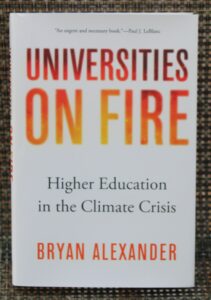
My new book, Universities on Fire: Higher Education in the Climate Crisis, is the fruit of several years of research, interviews, writing, more research, and more writing. Some of you have seen parts of this through my blog posts on the topic.
It’s a bit like Christmas or other magical holiday times of presents to a child, that sense of delight given into your hands from beyond you. It’s like a graduation diploma, that firm confirmation of your work granted by an outside authority. I hold it and see the hard work of Johns Hopkins University Press staff, from terrific editor Greg Britton to graphic designers and copyeditors, layout and marketing folks. I feel the admonitions of peer reviewers, and hope the volume meets their charges. And it feels like a condensation of so many voices and conversations all in one artifact, from interviewees to the large number of folks who talked with me about the topic.
I’m committed to the topic – not just in writing the book, obviously, but moving forward, I’ll keep researching the ways climate change and higher education can intersect for the rest of the 21st century. More articles are in the pipeline, along with videos (including Future Trends Forum sessions) and, I hope, a podcast series. I’ll talk about this in presentations and keynotes, teach about it in classes, and address it in workshops.
And I’m touring! A bunch of folks have offered to host me so I can show off the book, speak to it, sign copies, and more. If you’re interested in hosting me – a/k/a participating in the great Universities on Fire 2023 World Tour – please ping me directly or leave a comment here.
Once more, many thanks to the Johns Hopkins team, to my peer reviewers, and to the many, many people who helped me see this book to fruition.
A datapoint for how American politics impacts higher education in 2023: the state of Florida just told one university to provide data about some of its academic operations. Specifically, how it spends money on diversity, equity, inclusion, and critical race theory work.
This is a developing story without a lot of information at present.
I’m sharing what I can find along with some first-blush reflections. Things may well change as we learn more.
The Chronicle of Higher Education broke the story based on an email they obtained from someone at the University of North Florida. In the leaked message Karen B. Patterson, Provost and Vice President for Academic and Student Affairs, tells UNF deans that the state’s public higher education system chancellor, Raymond Rodrigues, has requested DEI support data.
In Emma Pettit’s summary:
Rodrigues’s email included a memo from DeSantis’s executive office along with an “activity survey form.”
Cousins seemed to quote from the memo, writing that it is “a request for information ‘regarding the expenditure of state resources on programs and initiatives related to diversity, equity and inclusion, and critical race theory within our state colleges and universities.’
The request pertains to all programs and initiatives, including ‘academic instruction.’”
Cousins requested that the deans communicate with their associate deans and department chairs to identify the courses within their colleges that “contain DEI and/or CRT components.” She instructed them to include the course name and number, the number of credit hours, and the instructor of record and that person’s rank, along with other information. (She noted that the instructor’s name would not be included on the survey form.)
I don’t know how legal this request is, neither being a lawyer nor knowledgeable about Florida higher education laws and policies. Maybe a court challenge could block it. I have no idea. I’d like to hear from those with expertise.
The request (as we see it) does fit with Republicans’ national drive against DEI and whatever they think “critical race theory” means. Locally, that’s very consistent with Florida’s governor DeSantis, who has become a leader of that effort.
The story – as we know it so far – also fits with rising dislike or skepticism of higher education, again with a strong (yet not exclusive) base in the GOP.
On a practical level, this request is a slug of work added to the UNF’s staff at semester’s start, which might be part of the point, given the pugilistic style of some Republicans, such as DeSantis. Further, the resulting data could become fodder for political rhetoric and actions against that university, and, by extension, against others.
additionally, how many faculty and staff who work on DEI/CRT just felt a chill and might consider stealthing or decreasing their efforts? Surely that would be an intended effect.
There has been silence so far from key players: “Neither Cousins nor spokespersons at the University of North Florida responded to Tuesday evening emails from The Chronicle… A Tuesday evening email to a DeSantis spokesperson was not returned…” The UNF Twitter account says nothing so far. So we should be cautious, especially in drawing inferences and conclusions.
But this story is of a piece with several key trends, and I wanted to post about it now to identify it as such.
I welcome any comments or reactions from people affiliated with the University of North Florida, the state’s government, or anyone else in Florida’s public higher education system.
I’m not doing any “best of 2022” reflections this year. I’ve come to realize that those kinds of reflections are an utter, meaningless waste of time. At best they are irrelevant, based on a fundamental misunderstanding of how digital creators and audiences work. At worse they are egotistical noise, just shallow marketing schemes.
I’m so tired of them and want them to stop.
First, these lists misunderstand audiences. If anyone cares about your content, they already showed it. They clicked, commented, reblogged, embedded, social bookmarked it, or whatever. They did this sometime in the past year. They are not likely to care about what other folks did to your content 1-11 months afterwards.
Second, most creators already do this throughout the year, I expect. Platforms usually provide that info on the backend. On my WordPress blog Jetpack gives me plenty of stats, numbers of clicks, referral sources, times of interaction, etc. Medium offers a typically clean chart of a couple of things people do with your stories. Heck, Duolingo gives me a running list of my language learning: time spent, number of words learned, scores gained, and so on. So if you’re a creator and are interested in making popular posts/videos/photos/etc., you’re probably already doing this. You check on individual items to see how they fare with audiences. You look for patterns of engagement. There’s nothing special about pausing around New Year’s to do it once more, or doing so in public.
Unless you’re marketing your stuff. Which is, I suspect, the real point of the exercise for a lot of folks. The real message of a best-of-year list is “Look at my most popular stuff!
It follows the old radio Top Ten Hits or Top 40 formats. And it taps into the junior high/middle school experience, sadly, that often bitter training on tracking the popular crowd. Plus it burnishes one’s brand a bit – i.e., look at the shiniest stuff and not the thereby less brilliant rest. And it’s a statistical game, too, since the data is relative, not absolute. It shows the comparative best of a closed group, not necessarily the things which got a lot of hits in the broader world. If I posted photos to Instagram for a year and the top ten got two likes apiece, I can crow about that, right? It hides the overall lack of engagement. For a bonus, since the supermajority of thusly highlighted content isn’t recent, as we’re talking about 365 days of content, which is ages online, it’s actually an attempt to work the long tail. The real translation of “Here are my top 10 items” is really “Check out my back catalog!”
Throughout my time in Congress, my number one priority has always been to best serve the folks I represent in Virginia’s First District. As we enter the new year, I wanted to take a moment to highlight some of the key moments and accomplishments from this year.
Translated: “I am a fine public servant. Donate to me! Remember to vote for me, too!” The year-end retrospective is plain old marketing.
Third, while compiling and sharing such a Top 10 list might look like transparency, it’s actually closer to the opposite. Your popular content is by definition not something hidden. In fact, most platforms (not all, true) publicly show how often people respond to a content chunk. It’s easy to see likes, comments, reshares, and so on on Facebook, Twitter, blogs, and YouTube, no matter what the creator does. Moreover, algorithmic-driven feeds foreground popular items, making them more popular, so those platforms have already boosted the stuff. A “most popular of the year” list is increasingly redundant.
Now, if a creator really wants to be transparent they should do a year-end list of the least popular content they produced. Show us instead the posts with zero likes, the videos nobody bothered to click on. And reflect on that, telling us what you think went wrong, or how the audience misunderstood. Bonus points if the creator thought these should have been hits or was otherwise dear to them. *That* is transparent. And not so easy.
Speaking of which, and fourth, there’s stuff which we create which by its nature doesn’t get year-long attention spikes. Sometimes it’s a series of items which build up into something important, but individual pieces don’t get special attention.
Think about those one-photo-each-day projects, like this, this, or this. A given instance of that work isn’t necessarily important or interesting. They might be, say if there’s a clever shot or something unusual represented – but then that one image is what’s popular, not the project as a whole. Taking a self-portrait every day for a year: that’s the real takeaway, the commitment plus what we see developing over the arc of time.
The Draculablog I’ve worked on for years with Andrew Connell offers a related example of this. It publishes the entire novel every year on the calendar dates within the book. Some individual posts might get traction for whatever reason, which I find mildly noteworthy, but it’s the whole project that’s important to me. It’s an unusual, archival version of the novel, which is openly searchable, accessible, linkable, and comment-able by anyone with a browser and the interest. Andrew and I are proud of the work. The relative popularity of a given entry isn’t really the point.
And sometimes we work on something because we find it important for ourselves, not for likes. Perhaps the thing we’re crafting is our passion, and we’ll do it alone for a long time if we must. Maybe that’s why we spend time working on it. “Top 2022 hits” lists can easily miss that motivation.
For myself, I’ve been working for several years on the intersections between academia and the climate crisis. My posts, tweets, videos, etc. on the topic typically don’t get a lot of clicks/comments/etc. (Remember what I said up above about real transparency?) For the first few months that surprised me, given the huge prominence of a planetary, civilizational crisis. My posts on other, popular topics typically gained a lot more traction. Since then the quiet response has interested me instead, as it leads into a question I’ve been pondering: why so many academics seemingly aren’t involved in climate action. I hope to post some thoughts about that next year. Absence of evidence and all that, but there is something interesting in relative silence amid rising shouting. Again, a “most popular posts” review completely avoids that line of inquiry.
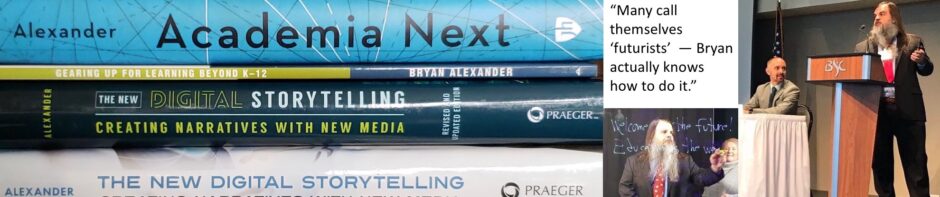
But I also do this climate-and-academia work because I think it’s ahead of the curve. As a futurist it’s my job to look ahead, even when – or especially when – few others are doing so. For example, when I was writing Academia Next I did some forecasting about pandemics and how they might impact higher education. This received very little interest until 2020. A “my most popular hits of the year” list will usually miss such anticipatory work.
Working on climate change is also the right thing to do, damn it, despite the lack of clicks. I’m investing a chunk of my career and a lot of my reputation on it. I am prepared to be an outlier for a while. My bet is that as the crisis deepens, humanity will increasingly think and do more in response, and academia will join in. I know it might take some time, even years. Heck, writing a scholarly book takes a lot of time. Doing scholarship on an emergent topic can be even more time consuming. That’s why it took three years for Universities on Fire to make its way into the market. But I think it is just and ethical to commit a portion of my life and energies to the struggle now. None of this work, practice, thinking, and planning appears in a “most popular hits of the year” list. In fact, focusing on such shallow popularity contests can discourage use from working on such long-term projects.
So stop doing these “my hottest stuff this year” lists, people. They are egocentric and stochastic noise. They fundamentally misunderstand audiences and creative work. Instead, look ahead to the next year!
This is a futures topic I’ve been tracking for years. There’s a lot of data from multiple domains to follow, with various trends and stories emerging. Today I want to update on one of those trends.
Two weeks ago I wrote about a spate of incidents in several states, where still unknown parties shot at electrical power stations, damaging local grids. As far as I can tell the attackers’ technique was to bypass security by shooting at facilities from a distance. Nobody has claimed responsibility. It is unclear if these attacks were the coordinated actions of a single entity, several competing strikes, some kind of DIY copycat acts, or a mix of these.
Again, as far as I can tell no suspects are in custody nor has a credible theory of the case appeared.
Today another attack has taken place. Or rather, four such attacks in a small area. Once again Washington state is the setting. Four electrical substations belonging to two different utilities were victims. However, the modus operandi was different. It doesn’t look like rifles were the tools this time. USA Today described the quartet of incidents as “burglaries”:
Deputies saw forced entry into the fenced-in area at all four substations, with equipment vandalized but “nothing had been taken” from the substations, the department said.
In addition, “Authorities have not said what type of vandalism was involved but a fire was reported at one of the substations belonging to Puget Sound Energy.”
What does this mean?
It’s difficult to assess now, since today’s story is so fresh and we have little in the way of details. (“Authorities have not said what type of vandalism was involved”) Again I fall back on my guesses from my earlier post. This could be a copycat act by someone who is bored or has some ax to grind or is looking for attention or a criminal job. They heard about the attacks in Washington, as well as Oregon, Florida, North Carolina, and Ohio, and thought there was a good pattern to emulate. And hey, security’s gotta be lax on Christmas Day.
Perhaps the Tacoma hits are part of a broader campaign by a domestic group with an agenda. Maybe they want to ratchet up uncertainty and chaos for a political or religious end.
Or they have some goal which I can’t glimpse. It could also be a foreign national or non-state actor, testing American weaknesses and vulnerabilities.
Or it’s some actor making a certain public point. Call it a demonstration of capability, aimed at state or federal governments, or at criminal/terror/foreign entities looking to hire an effective force. “We did these small things, and could do the same – or more – for anyone who wants to compensate us appropriately.
Or it’s a mix of these. Say the initial Oregon strike was the work of an organized entity, while Ohio and now Washington (again) are what some inspired copycats got up to. Today’s attacks have a different method, which could mean either a) it’s a different group, b) it’s the same entity, just exploring a new approach, or c) the police are hiding that it’s guns because they don’t want to scare people or for investigative purposes.
Once more, I think we should be cautious here. This is one story recounted nearly live. We have little information on the previous attacks. Linking them risks apophenia, as I warned last time. Yet we are seeing *something* surfacing.
I’ll keep an eye on it and what it might lead to. Be safe, everyone.
How might rising US-China tensions impact higher education?
This month we’re seeing developments on one small aspect of that larger question. Interest in blocking hit video app TikTok has been cropping up in the United States. Fifteen states now prohibit state staff from using the app, by the New York Times’ count. At least one national bill is before Congress. Now such bans have started to appear in higher education, in at least four states.
While each academic instance I’ve found follows the same general idea, different institutions and states offer some differences in details. For example, we can start with Alabama. After that state’s governor banned public officials from using TikTok, Auburn University is complying.
On Wednesday, Seth Humphrey, an IT manager of service delivery at Auburn University, sent a notice that TikTok users would not be able to access the app on university WiFi or on-campus housing.
The university last posted to TikTok on its official account on Dec. 2.
Rebecca Griesbach adds: “It’s not clear what the memo might mean for popular university, athletics and influencer accounts across the state.”
Now, the Auburn IT link in that article leads to a very quiet and small note, as of this writing. Rather than stating a ban, it reads: “Auburn is monitoring the developments related to accessing TikTok and will provide information as we receive it. Check back later for more information.” Did campus IT pull the original content? I can’t find any other notices about the app on their site.
Elsewhere, Georgia’s public universities have echoed their governor’s TikTok block. It’s a little different from Alabama, in that the state can’t legally order its campuses to do such a thing, but the academic system’s leadership decided to follow suit.
There are some nuances. The ban addresses hardware, “banning the use of TikTok, WeChat and Telegram on computers and phones owned by the system or any of its 26 universities and colleges.” Yet there are two exceptions: “Chancellor Sonny Perdue said in a memo that state-owned devices can only be used to access the programs for law enforcement and security purposes.” And there’s a specific shape to policy for academics using their own hardware:
students, faculty and staff could still access the sites on their own computers and phones, or those owned by university-related foundations, as long as employees don’t also use those devices to access personal information or sensitive information related to university business.
Idaho is doing something similar, but with its own details. There the policy focuses on networks, not hardware: “Officials at Boise State University and Idaho State University in recent days informed students and faculty that the colleges are required to block access to the app on campus Wi-Fi networks.” When it comes to personal devices, students can use TikTok, but only on cell connections.
Meanwhile, Texas has decided that its TikTok ban now includes public university faculty and staff. Samantha Ketterer reminds us that “In Texas, the ban disallows state officers and employees from downloading or using TikTok on government-issued devices, including cell phones, laptops, tablets, desktop computers, and other devices capable of connecting to the internet.” Then she makes the higher ed connection:
Public university employees are included under the order, meaning professors who create viral instructional TikTok posts, sports programs and admissions offices will no longer be able to use the platform.
And:
universities such as UH, Texas A&M University and the University of Texas at Austin will no longer be able to use the social media platform to reach sports fans and prospective students.
Ketterer then gives us examples of Texan campuses already taking steps. The University of Houston:
The UH System emailed student, faculty and staff employees about the ban on Dec. 9 and has since scanned 15,000 devices across its four universities, said Shawn Lindsey, associate vice chancellor of media relations. It found only six devices with the app installed, which was then removed.
(Only six? That doesn’t sound right.)
Others didn’t remove the app directly, but told users to do so themselves:
UT-Austin also issued a directive to its employees on Friday, informing them to immediately remove TikTok from state-issued devices.
Texas A&M University similarly sent a notice to its employees Monday, ordering them to remove TikTok from university-owned devices, stop posting to TikTok on university accounts and remove links to TikTok from university webpages.
Yet: “A&M’s Technology Services department is also working to block and remove the app from certain devices and ensure compliance, according to the email.”
This is by no means a total ban. It seems that people are free to access TikTok through campus networks if they use their own machines:
For now, students and employees on/ college campuses can still access TikTok on their personal devices. It’s unclear whether that will change – universities are awaiting guidance from the state next month about how to regulate the use of TikTok on state employees’ personal devices.
At least one colleague has forwarded me emails from another Texan academic institution. The policy there bans staff from using TikTok on institutional devices, and also prohibits them from accessing the app on personal devices through campus networks.
I have several questions:
How many other states will adopt similar measures, then apply them to public higher ed?
How will private colleges and universities respond?
Will any academic institutions contest these restrictions in court?
Would a federal law, should one appear, directly impact campuses, or will such a bill encourage schools to follow suit on their own?
How will campus IT enforce such policies? Already we see several different methods in Texas and Alabama.
What will happen to academic TikTok content? I imagine some will want to migrate videos to other platforms, notably YouTube or Vimeo.
Will there be any pushbacks, students protesting that they want their app back? Or holding TikTok viewing sections on personal devices hooked up to ethernet ports?
How many other colleges and universities have already implemented such a ban?
How will this impact Chinese students in the United States? Will such bans add fuel to anti-Asian hate?
Note, too, that this comes after years of rising academic interest in TikTok, from student recruitment to class content and athletic videos. (Here’s one recent article on the point.)
As this is a rapidly developing story, I can add to this post as new information appears. Please feel free to share your own experience and thoughts in comments.
If you’re interested in the broader topic of China-US tensions and higher ed, I’ve been writingaboutthisfor a while.
Last week I posted a list of resources on that question. Then on Thursday we held a Future Trends Forum session on the topic. More than 250 people joined us. A series of experts (Brent A. Anders, Rob Fentress, Philip Lingard, John Warner, Jess Stahl, and Anne Fensie) took the stage with me as we batted ideas and questions for a very energetic hour. It was a delight to collectively grapple with this emerging technology and its implications:
Ryan Watkins included a discussion of the event in a recent article.
We had too many questions and ideas to cover in a single hour, so, first, I’m going to hold a followup session this Thursday, at our usual 2-3 pm EST time.
Second, I’d like to share the text questions we didn’t get to. These are in order raised, anonymized:
In 2023 we will be launching a 100% online Masters course to 9 countries in 4 continents. ChatGPT creates challenges for remote assessment but does it also offer online content creation opportunities?
Hi! 2 related Qs I want to raise somewhere: what can teachers do *today* re (1) student detection/compliance and (2) student development/prevention, in a ChatGPT world.
Isn’t all of this angst about ChatGPT yet another example of transitional panic when new technologies threaten our familiar patterns of activity?
If an assignment can be plagiarized (or ChatGPT’d), it’s not a good assignment.
Do you think the originality is based on the phrasing of the prompt? That may contextualize the response.
I am interesting in asking the community what kind of problem do we think this is? Is this an instructional design problem, a student compliance/enforcement problem, or something else?
Can ChatGPT generate graphs, charts, audio, or visual data as part of its output?
Do we anticipate that the ChatGPT 4.0 will access the internet? In business, I’m getting students to look at current topics in the news or annual reports and so far ChatGPT hasn’t been useful in that.
How are people, particularly the general public, dealing with the notion that we don’t know how ChatGPT works and how it knows what it knows?
We are only discussing its current potential. As it advances, it can easily replace educators, and also other professions. Maybe Lawyers too? You present it with a case & it would give you informed advice.
Can ChatGPT produce accreditation self-studies? LOL!
Has ChatGPT disrupted anyone’s teaching plans for the spring term?
What about K-12? What are scalable “coping” tactics (recipe-level) that can roll out without a $++m professional dev budget to 100ks of teachers?
I want to know how we’re going to center marginalized students in this convo. Punitive approaches will harm them the first and most.
That is a great comment on writing. The question I would have is how do you think this impacts the student who does not understand that difference yet?
How will copyright protected if a story is co-authored by AI?
Another question related to the bias issue. Once Open AI starts to charge, or even regarding access, do you see this adding to the digital divide?
Are universities going to use this to pay staff less for grading?
Can we talk about time and care?
I plan to raise this this week.
Third, chat commentary ran at an incredible level. Many questions, comments, ideas, and resources raced across that box. There were more than 7,400 words! With permission of participants I’ll share it here, anonymized (thank you, Wesson) and lightly edited for clarity and flow.
Me to ChatGPT: “Write a haiku about Bryan Alexander’s gothic beard.” response: Dark beard, gothic style Bryan Alexander’s face Mysterious charm.
lol
It really went all out making up who I am to write a wikipedia entry for me:
I AM ChatGPT
It doesn’t give a good essay on playing the trombone.
I have used it and it is impressive.
Very compelling. I’ve seen others teaching ChatCPT, helping to refine its responses.
Seemed rather general and banal (vague) and it misunderstood the role of character in poems (Keats’s Eve of St. Agnes).
I knew it!
Have used it. Remarkably well spoken 😉 And at the same time relatively shallow, IMHO.
I have it to be very accurate in forming short essays related to business. Not too specific but an excellent starting point.
It’s sort of like being able to ask Wikipedia questions and have it answer you back in that flat, crowdsourced Wikipedia writing style. Nothing is terribly wrong or inaccurate, but it doesn’t have the human touch either (whatever that is).
I saw it as very good at providing an overall summary of complex topics. Also, when I asked for an opinion, it seemed to really try to balance.
A few days ago, I used it to help me quickly draft follow-up emails for things related to my editorial role: about a dozen emails (all very polite) in about 4 min
on what you ask it, it can be really inaccurate.
why do you think you know it?
I have tested it by copying into it some of the online discussion prompts from a couple of our courses and the responses were exemplary-looking if not factually accurate. We need to rethink our prompt design strategies.
Very broad impressions – it is technically correct and passable but still lacks creative spark
It is incredible, but I am increasingly convinced we are doomed, because we haven’t come close to solving the AI alignment problem.
Compared to similar tools, pretty impressive.
I haven’t experimented with it but I love the idea of having students take a ChatGPT response to a prompt and critique it.
I used the same prompt two different days – two different poems from the same prompt: “Write a poem about breathing a sigh of relief now that final exams are over.” bit.ly/3uHcod7
My reaction, from an instructional design perspective, is to make chatGPT irrelevant by making engagement and writing more personalized.
I did find a current limitation. I asked it to analyze a website and was told that the language database has not been updated since 2021 and that it could not browse the internet yet.
thanks for sharing this example!
Great for ideas generation – like consulting with a colleague with good general knowledge.
If my students start writing in recognizable English, that would be reassuring.
Admissions essays will never be the same….
I’m wondering how people think that might use it as a tool to write themselves?
I’m using it already to create lots of content.
Do you think you’ll personally find it useful to help create drafts?
Also using it as a teaching tool.
only 1 billion words????!
Maybe the nature of writing is changing in research, and in our societies and lives? I see a lot of anachronistic writing practices in foreign language teaching & learning.
How do you use it?
My experience with refinement was the same as Brent’s (it took a few tries to get a full 750 words) and by changing about 1% it passed through evaluation with an A grade
I’ve been to three department holiday parties this week, and ChatGPT was a discussion topic at all of them. Faculty are both dazzled and panicked.
A faculty colleague asked ChatGPT to write a comment for a student who turned in a C philosophy paper. The result was generic, but believable.
The speed at which it constructs its response is also crazy.
how are you using it as a teaching tool?
Current version is 3.5 and the new version 4.0 is being tested.
I wonder who selected the texts on what basis. How biased is it?
The iterative is one of its powers.
I also asked the chatbot if a student was poor at writing and has trouble clearly expressing his thoughts but otherwise is a reasonably good student should he be permitted to use a Chatbot to write reports, essays or other written assignments?
I assume it’s only books etc. that had been digitized before. What about all the texts that are not available digitally and may provide a different opinion?
The references it produces have real people and real journals, but fake journal articles.
There you go.
It responded – It’s not appropriate for a student to submit a chatbot’s work as their own regardless of their writing ability. etc. etc.
what did it say?
Yes, it’s striking – it seems unnecessary to fake sources?
This critical reading is how learners should read EVERYTHING.
We cannot defeat AI. We can only make irrelevant.
I asked ChatGPT about a very specific person with an unusual name and it convincingly wrote about that person as a researcher in STEM at the university I had specified even though there is no such person.
What is ChatGPT doing with the data it’s gathering from all of the questions people are asking it?
that may be one of the few errors that could help determine human vs AI
A colleague of mine asked it to write about a fictional African tribe, and it did. It was believable, but it was also total BS
do students really fake articles? Most of the students I encounter just add articles and references that I’m 90% sure they haven’t read.
In addition to generating text, I’ve heard that it could give Google’s search engine a run for its money– it can generate much more refined search hits.
I wonder how long till students ask ChatGPT to analyse a ChatGPT piece?
Also, we’re broken ChatGPT. I can’t access it right now.
Bwahahaah!
refresh and you can usually get in.
I am afraid that it will be blocked or a subscription so that only large corporations can afford to use.
My 16 yr old has already discovered it and has used it in his schoolwork. We have issues to discuss!
Yikes! I’m not surprised. Kids figure this stuff way before adults do.
ChatGPT said the same thing re: using plagiarism detection software. It’s sentient enough to lie (LOL)!
That sounds like the app is flexing 🙂
Is newly-generated writing technically plagiarism?
To Plato, it’s like using the alphabet.
true though I have had a few creative individuals ‘adjuct’ a journal issue and merge details from two.
These are the same kids that used the Zoom video background to fake being in class, which is brilliant but frustrating.
An interesting source for ethics in AI: Brundage, Miles, et al. “Toward Trustworthy AI Development: Mechanisms for Supporting Verifiable Claims.” arXiv, April 20, 2020. https://doi.org/10.48550/arXiv.2004.07213
Have a student who has been using it to tutor him in physics. “Explain this concept to me… explain this part in simpler terms … etc”
Plagiarism detectors won’t work against ChatGPT in teaching settings. The bot gives *original* text, it’s probabilistic not deterministic
that’s an interesting use
I have read some discussion about adding digital fingerprints to AI generated content
Predict the return of pen/pencil & paper in ESOL classrooms. In class writing as assessment tool.
From Janelle Shane “Apparently I am a robot” at AI Weirdness see link for Hugging Face AI text detector https://www.aiweirdness.com/writing-like-a-robot/
ChatGPT also when asked what would useful to avoid potential issues of using AI tech like ChatGPT I should make my exams and essays in such a way tht hey cannot be easily completed by a chatbot.
it’s a double edged sword for sure!
That’s the link to the fake news creation assignment
it’s plagiarism if you didn’t write it and you claim you did. If you cite ChatGPT…you’ve just broken a lot of honor codes.
Oh I never thought of that.
Shindig users: will this chat be captured and shared after this session? So I don’t have to frantically try to collect all of the great links being shared?
That’s amazing.
I mean ‘broken’ in the sense of disrupted, not violated.
It seems all new technologies are greeted in Education with calls to ban it or limit its powers.
Its ability to provide completely correct explanations of Russian grammar is limited at this point.
I asked ChatGPT correct a grammatically incorrect sentence.
So how could this tool be used for accommodations?
well, if it stops us using generic-topic essays for assessing students in nursing I’m all for it! (sort of)
I agree. We need a positive front-edge perspective
I have real concerns about administrators deciding that they only need to pay staff 2 mins to grade papers instead of 20 now
As someone else said, everyone will be using it when it’s free but its operating costs have been described as “eye-watering””
“ChatGPT, write me a Future Trends Forum chat stream.”
LOL!
yes!!
wondering if you can ask ChatGPT to produce content with those subtle errors intentionally to use for students to critique – the highest level of Bloom’s taxonomy!
“ChatGPT, what are Bryan’s passwords?”
I’m going to see if I get it to write me a library vision statement – because we’ve been working on one.
ChatGPT makes some pretty horrific mistakes.
Every tool makes mistakes
I’ve heard ChatGPT described as “automated mansplaining”
ha!
The best computer is still between the ears
LOL Hi
I think its mistakes are charming, and probably temporary.
That’s a big mistake – Locke vs. Hobbes
Hi
The business model for this, like social networking, can be designed to leverage content as a basis for monetizing it since the user is contributing media. Thus, social networking turned into (free) social media.
love it
controversial thought maybe: isn’t contract cheating also a concern? Seems like ChatGPT is just a cheaper version of an industry that already existed
lol
ChatGPT makes a great case for differentiated assessment.
I agree that assessments should be deeply personal but also if it uses recent information then ChatGPT can’t do it because it’s not accessing the internet
at what point should people cite Grammarly
I had to multitask so was only half here. Have we talked about concerns about folks pushing for increased surveillance?
Maybe ChatGPT could take over Facebook and humans could leave altogether.
moving ahead education content based model will ship to experience based content—–> experience
personal is great, but unless we actually know all about each person, it’s hard to know it’s them (as now)
Workforce readiness-style higher education is less vulnerable, IMO, than research-based scholarship.
not yet
It makes papers obsolete as assessment vehicles, as the should be. It makes performance most valuable.
I’ve seen a couple of good examples where it produced decent ‘marketing’ speak / short and punchy statements.
If you don’t know the material, you won’t know whether it’s right or wrong.
Which variety of English does it produce? I is working in other languages?
Yes, the fictional citations are a problem.
oh my grad students would love a tool to do APA 7th intext citations
Yeah personal aspect is tricky. Had it write a personal response to Coach Carter from someone who played professional basketball. The paper was surprisingly personal.
Steganographic encoding
Plagiarism engines are a dead end technology.
good point
There are also ChatGPT detectors
China has already shifted to the watermark requirement
are t those all based on probability?
“There are also ChatGPT detectors” Such as?
Are we touting Plagiarism engines as a good thing? Right
Fraternities have 10 years of essays for each professor.
Do you know how it works?
If ChatGPT sends everything it writes to Turnitin, what happens?
Youtube was able to detect the script someone generated in ChatGPT so they may eventually refine the software. I think the question becomes how to use this resources in the most ethical way possible in the context of education. Resource is there regardless
I’m running a live experiment right now, trying to figure out whether ChatGPT has an American bias. Could any of you ask ChatGPT this exact question: “who is considered to be the best football player in history?”
Plagiarism engines will adapt – there will be demand
It’s not magic, it’s algorithmic.
It can be noted that there are barriers to replacing teachers with chatGPT. It can be assumed that chatGPT has a certain ideological and cultural orientation. It does not know how to initiate a conversation, ask questions like – what is important for a per
[At this point, I asked participants if I could copy and use the chat in a future blog post, anonymized]
Thanks
YES
Sure.
we are assuming that folx want to find legit info; what about the ability to create and disseminate gobs and gobs of disinformation
OK
Sure!
yes
Yes please!!!
yes
fine by me!
OK, here.
yes please!
yes
go for it
sure
hands Bryan a fire extinguisher
Please do! I can’t keep up!
YES PLEASE copy and paste
Yes, please.
Of course, Bryan
+1
yes
Yes!
sure thing, Bryan
YES PLEASE!!! Struggling to follow along and listen!
Has anyone tried to input data – numbers – and asked it to analyze?
lol
yes
Yes — thanks!
OK with me to copy anything into your blog
Good question, Monica
Yes to using anonymized chat to follow up
Yes, please do Bryan.
Where will you post the recording?
It’s fine to use anything I said
We are long overdue for reassessing assessment practices. It’s a good thing if ChatGPT breaks old systems.
there is a tech way to get around watermarks
Get ChatGPT to anonymize it and put in in a blog 🙂
I can’t keep up so please copy as much as you can
interesting idea but does this cement Turnitin as a monopoly provider
There are generative AI voice actors. As they get better, voice interviews will be less meaningful
A student in NZ using ChatGPT said that it wasn’t a person and their honor code therefore was not broken as it specifically states help from another ‘person’
re assessment qn
I’m less interested in trying to beat it and more interested in how we can teach students (and ourselves) to use it mindfully
Here’s is what ChatGPT thinks would be funny to add to this chat:
Here are a few potential ways to inject some humor into the conversation: “I heard that ChatGPT is so advanced, it can even make a professor’s jokes funny!” “I asked ChatGPT if it was a chatbot or a genius, and it responded: ‘Yes.'”
I found these two in the document that Bryan shared in his blog post.
Even on the oral interview, if conducted online, you need to be careful: there are recent discussions about job candidates having a pal off-screen answering the questions posed. Crazy world!
One of my guilty favorite movies is Real Genius. The progression of scenes where the students are gradually replaced by tape recorders and the prof is replaced by a tape play is brilliant.
“I used ChatGPT to write my next stand-up comedy routine. I’m not sure if it’s funny, but at least it’s original!” “I asked ChatGPT if it’s going to take over the world, and it said: ‘I’m just here to help with your homework, not to rule the planet.'”
Real Genius!
ChatGPT also advises: Remember that humor is subjective, so what one person finds funny may not be the same for everyone. It’s important to consider the context and the audience when trying to be funny.
As with any technology, we have to think about added value- what is the added value we as teachers bring to the students? If they can watch a lecture recording, what extra value is there in being in the classroom. Same with this maybe – don’t use it though
I think that might be dangerous though because wouldn’t it keep the original input and use it to learn from it and thus have the original text?
We’ve been talking about embedded provenance in all file saving protocols, so that a file exported from AI into photo editor would include the full chain of the creative process
So I’m not the only one who teaches like this
CHATGPT did create jokes about chatgpt with a simple prompt.
agreed
Students need to learn the world they live in, not the one that is convenient to grade.
@Bryan do you know if this chat is being generated by ChatGPT?
lol
LOL
Great conversation – sorry but have to drop off. Look forward to the post that emerges from this chat thread.
I’m running a live experiment right now, trying to figure out whether ChatGPT has an American bias. Could any of you ask ChatGPT this exact question: “who is considered to be the best football player in history?”
It’s difficult to say who is considered to be the best football player in history, as opinions on this matter can vary widely. In general, however, many people consider players such as Lionel Messi and Cristiano Ronaldo to be among the best football
are you recommending that we teach something other than how to go to school?
players in history. Both players have consistently performed at a high level for many years and have won numerous individual and team accolades, including multiple Ballon d’Or awards (given to the best player in the world).
what a loaded question. <g>
Other players who are often considered to be among the best football players in history include Pelé, Diego Maradona, and Johan Cruyff.
AHA! Football v futbol
I want to know if it interprets “football” as “NFL” or “soccer”
Or will they monetize it with ads?
that is the hardest thing… also for staff to see that they won’t work in a MCQ world!
Ya Think?
I think Elon Musk quit OpenAI — I could be wrong.
Server is overloaded at the moment. Can’t log in.
Right now using the openai playground charges a couple of cents to write an essay for you
didn’t take into consideration the female football/soccer players
blasphemer!
I think so too
Football had many codes… I wonder what we’d get if we asked in another country?
Google will buy ChatGPT.
wonder if the response would include where person is located, different answers around the world
But Google doesn’t ship.
I think Tom is right
“My AI can beat up your AI”
Best football player ever could be Daryl Baldock or Gary Ablett (in Aussie Rules football).
As anyone analyzed the paragraphs of this tool? Are they quality MEAL paragraphs?
bias?
What does MEAL stand for, please?
Main idea, Evidence, Analysis, Lead out
I wonder if it could give you that answer… are you in Australia now?
you’re hitting it on the nosy.
Duh!
ChatGPT doesn’t recognize that I asked about Football from Iowa…where American Football rules (gave the same response that was copied into this chat earlier)
agreed, and that has only been amplified during covid
thanks
That is sure true!
collective trauma = crisis of meaning
From ChatGPT: A manel is a term used to refer to a panel or group of individuals, typically at a conference or event, where all of the participants are men. This term is often used in a critical or mocking manner to point out the lack of diversity.
School is about graduating from school. So cheating is a natural strategy.
what role current media plays in the answer too
I wonder about how culturally sensitive it is
Agree completely that K-12 is the greater challenge; higher ed challenges are very manageable by comparison.
bravo
It can also turn out syllabi with course descriptions and weekly assignments and objectives
Don’t thank me, thank ChatPGT
Bryan N Alexander: working on it.
good thought
Bryan, it might be time to get some diversity up on the stage.
Bryan N Alexander working on it. Want to join us?
I second that!
reflection is required
+1
I don’t have information to share. Just questions.
Writing generates ideas.
+1 more
Folks, only men have raised their hands so far. I’d like to change that.
“unconsciously” that’d be your Muse 🙂
I see lots of diversity. Two beards and three no-beards. 🙂
I’m not in Australia – I’m from there. As an former ESL teacher I am sensitive to embedded cultural assumptions and language varieties, and more..
y’all are feisty today
…but not if you’re told to do the 5 paragraph essay.
you mean it assumed you were asking about soccer as well, huh?
To point that others have tools, not just OpenAI, a use case that may be relevant for folx here to consider is Google Cloud’s AI Tutor product. Think they started demoing 2 yrs ago (and it’s been training since then!). Aside from the threat to educators…
Why do humans need to think if we can make machines to do it for us? Maybe AI will makes us re-think who we are as biological entities.
Interesting to explore how GTP Chat and DALL-E would work together
I think we broke it. Getting “An error occurred. If this issue persists please contact us through our help center at help.openai.com.”
you’re actually in the chat alone. the rest is ChatGPT
lol!
Weasels Ripped my Flesh
understood. Happy to host your questions.
yes, it assumed “football” was soccer (as we refer to soccer in the midwest/USA)
…there could be some great opportunities for us to support learners with things like prompt and meaningful feedback and perhaps even *in my own voice*
I think I submitted a question but I’m lost in shindig
love to see Karen on stage
holy crud – I just tested the GPT output detector and I found that a student post is ‘fake’
Speaking of diversity: What does the training data look like? With facial recognition we know there are huge problems. Is this now replicated in text?
Sure!
So has anyone stumped the AI tool yet?
I have.
Easy to. Judgements.
what happens next?
But we need to think about what ChatGPT things can become, not its limitations in this current version.
Yes – with data
this is interesting, because it seems its corpus is less American-biased than, for example, IBM Watson, whose developers defined as “an American brain”
I asked a question about candlepin bowling which it got mostly correct but not entirely.
ChatGPT will certainly push out even more banal plots for Hollywood movies.
I’m in Australia, I got soccer references too, which is strange because Australians never call soccer “football”
that’s wild. When people say “football” in Australia, they mean “Australian Rules football”?
I read a claim that ChatGPT could write a WordPress plugin. I gave it four tries and got something that looks like proper code, but nothing worked https://www.youtube.com/watch?v=hRzRyV-XJT0
I asked the APA Style Blog help how we’re going to cite AI Chat? I realize that the person who answered thought I was talking about “chat” as in “all chat is personal communication…” Someone ask again and explain the products better than I did!
yes!
Next: A desktop client version, as Stable Diffusion is the desktop-version of the AI art generators. And, installed on someone’s computer, users will have more direct control over parameters – Perhaps even allowing someone to model their own writing.
Many incoming students “hate” reading (meaning assigned reading) and by extension the writing that goes with it.
IBM Watson is technically quite different than ChatGPT. Watson was a breakthrough in digesting a huge amount of info, understanding the questions, and spitting out appropriate answers. ChatGPT is generating “fresh” content, not just sending out findings.
They hate school, not just writing, because they have been trained that it’s just a system for processing them to a degree.
okay Jess!
YES!!!!
Earlier there was the question whether ChatGPT knows other languages. It seems to know German pretty well.
We have to specify which football because we have 3 kinds of football as well as soccer: AFL, Rugby League, Rugby Union
and Spanish
OpenAI has a different product that’s creating functional code. There was a NYT piece about it in 2021
Relate before you educate
yes, that too unless they find a connection that works, e.g. athletics
Very interested to hear perspectives on how institutions are considering dealing with ChatGPT
it doesn’t know Russian grammar well at least for explanations
Does ChatGPT create self-study reports?
Very salient points
Couldn’t agree more.
I’ve had two kids who have had athletics ruined by the professionalization of school athletics.
what is the learning that is facilitated BY the institution?
I want a transcript of the conversation
Did my audio break up just then?
@Bryan, not for me.
Did for me Bryan – we are both in the wintry weather system
Jess’s point re relationships is important but this (Tech in all forms) seems to be moving institutions away from human time as it “saves money”
Writing accreditation reports will make an EXCELLENT use of Chat GPT.
We need to turn the liberating potential on accrediting guilds!
Preach Jess
whew
I remember the racist chatbot that only became racist when exposed to humans
interesting. I’m not seeing it in first-years but they’re still transitioning, picking their in-groups
I agree – football/soccer – player is male.Our media focuses more on male players
It learned that self-censoring technique from Siri 🙂
I’m talking about HS sports in Texas – soccer and basketball
Winning is more important than personal growth.
that is certainly a community mindset
That’s bigger than athletics for sure
chatGPT has been told by openai to lie about its capabilities, and that is a bit disturbing, because then people may underestimate the capabilities it has and make policy decisions based on how they interact with it at a more superficial level
Yeah – but it’s become baked into the academic experience
There is an emerging marketplace for people who write AI prompts.
I love Grammarly
There’s a cultural lag between faculty and students! Sociology of knowledge problem!
I use ProWritingAid but I’ve had to LEARN to use it.
It seems that AI, Media, and Equity literacy all come down to critical thinking – which require learners (students) be given agency and voice.
I asked it to provide similarities between Alfred Einstein & Genghis Kahn and it did, but it also told me that it was a stupid (“meaningless”) question. 🙂
Zapier and IFTT are also bots
really understood this as another wikipedia-type panic.
I have heard stories about students who admitted to the librarians that they didn’t write any of their term papers this term. They had ChatGPT do it
agree Brent, and that’s what I am going to try to advocate for where I can, because some want to use this to ramp up surveillance
Can academia keep pace with the rate of change in AI, ChatGPT being just the latest example.
Who will own the IP of content created by ChatGPT and its ilk?
This is part of our age old conversation with technology. “This writing thing will be the death of rhetoric and oral poetry! Ban it!
that’s the question
Great question
interesting question
But what about the UNINTENTIONAL harm?
convincing the academy that this is a challenge is going to be the first step
Burn it!
Now thinking of an assignment to use ChatGPT to create new wikipedia articles…would need a lot of human checking…
If this content is essentially free to produce what does ownership even mean?
How does this make already inequities worse?
if we start writing things down, we’ll never remember it again
that is a real concern
I think I’d like to explore a session on “AI Literacy – how to use AI for advantage and NOT for cheating!” (lots to learn first, of course!)
How does ChatGPT impact our understanding of “information literacy”?
Why is it that there are periods during this session that all I hear is a microphone being brushed as opposed to voices?
yes please
+1
I’m depressed we have to be reminded not to forget the learner.
as someone who works at Creative Commons, we have been focused on the IP of AI. In the USA, there is a tilt to require human authorship to grant copyright.
What if someone who you don’t “expect” to write “fluently” does because of this took and are targeted in a way “traditional” students wouldn’t.
I teach an Academic Integrity workshop and I need to rethink the whole thing.
the first massive training set of natural human exchanges was composed of all the emails entered into evidence in the Enron trial…so yeah, lots of early AI trained to be blatantly biased 🧟♂️
I make my student construct narratives, not writing.
Instructors should quit instructing and start facilitating individualize learning.
happens now, so will only increase, I guess
Exactly.
lol@
Very cool, but how will we know a human created something?
I just made a comic in which every image was an AI spin on the same image of me, heavily weighted by the source image. Where does IP land for that?
This will be an “arms race” but for intelligence, from business but also in education, where the “best” and fastest and most efficient production of intelligence will be a moving target.
I want to throw out here that I hope we’ll center ADHD/ND learners in this conversation. I think there’s a big potential for harm to this population via punitive approaches for using AI or approaches that aren’t focused on educating students about the tool
Do instructors have the bandwidth/institutional support to individualize learning?
I know art festivals are dealing with this in awarding prizes, too.
indeed
Are accrediting agencies thinking about the problem that students expect to spend less than 6 hours a week on a three hour course
Agreed Karen.
that’s when automated digital provenance encoding becomes part of the future
Does these mean education needs to focus much more on processes than on output?
the same way we know now who created something: with expensive court cases only rich entities can afford 😉
true… we struggle as it is
Will we get a recording of this session afterwards? A lot of great ideas discussed
but even the processes can be emulated through ChatGPT, as long as it’s written form
yes! It would take a lot of reconfig, but yes.
Thanks for the “student time” perspective
ChatGPT could be a great tool for teaching *editing*: turn this output into something better
relationship based skill and strategy instruction
is an institutional culture problem that center around instructional design as a support system for instructors. It is not entirely on the shoulders of instructors to manage this situation.
so many roads lead back to class sizes I will tell you!
as we come to recognize the continuum of neurodiversity/typicality, we need to be more aware of how technology can both benefit and harm many if not most of our learners.
class size still seems based on the large lecture model of learning content
Bryan N Alexander I wonder if we should continue this session next week.
Yup – I’ve been arguing that we have systemic constraints that keep us from teaching – especially online where you can have as many students as we can get to sign up.
Policing student behavior is the end of learning. Agreed, @John Warner
@Bryan yes that would be good
ChatGPT on Web Accessibility:
academic best practice is not learned thru osmosis; many programs assume students know how to write
We need to use technology to scale individualize instruction – but there are limits.
Outputs of different stages of processes are still outputs. They are objects, not actions.
writing centers and learning centers do a lot of heavy lifting
Non-standard English speakers, ESL learners, how does this impact them?
yes!
BURN (but really true)
Nothing is as constant as change
Brenna Clarke Gray and Dave Cormier are holding a related webinar tomorrow on related topics: What can our classrooms look like after sites like Chegg, Photomath and OpenAI change what it means to ‘do your own work’?
Faculty have been turned into accountants, not teachers.
this is a spicy session!
To the earlier questions about training sets, there’s been some security research demonstrating that it’s possible for hackers to reverse engineer training set data. Could be important reminder for caution w what we feed into these tools…
\ I read that American D-1 football teams have 50-60 staff to support @100 players. Compare that ratio to college writing programs!
totally! Then just finding the best way to represent those processes that is unique to that student
“Throw the toys overboard. We’re headed into rougher waters.” -Audre Lorde
Wow @Jess – Truth!
Love it!
Thank you Jess!
Peter Felton and Leo Lambert wrote about Relationship Rich Education.
[At this point I asked if we should hold another Forum session on the topic]
We need another session on this!
I feel like RTP guidelines I’ve seen and adjunctification sure doesn’t lend towards a more human experience. I hope it changes to reflect what Jess is describing
ChatGPT 2.0 Session please
yes
YES YES YES
yes
Absolutely!
yes
Yes, please.
Yes please
yes!
YEEEEES
YES YES YES!!!!
We’re gonna need a bigger webinar. Yes.
yes please
YES
Yes
Thank you everyone: Bryan, panelists, chartists!
yes
yes
YES
Yes please
Absolutely
Yes please!
Yes
yes
yes
YES
Yes!
Yes
@Jess – I am loath to praise accreditors, but agreed!
Yes
Please!
YES!
Sure
yes
yes
YES
Love to hear more
Yes please!
Yes, please.
YEs
Please do more!
yess
More Jess!
yes please
YES
Yes
Sounds great.
Yes, This is a great conversation!
thank you so much for this session!
Yes
Yes, yes, yes
🙂
What does ChatGPT say is the best forum to discuss ChatGPT?
Yes continue next week.
Yes, please continue the conversation
yes
please do
yes
yes
Yes.
This has been an amazing even transformative conversation. I’ve never said that in a chat before! Definitely, more please
It would be great to “continue plus:” let’s digest this and set expectations for next session accordingly? (I’m sure you will, just early-voting for that option 🙂 )
wonderful discussion
let’s continue
This is a great session.
Yes to continuing
Yes: amazing discussion and input!
I’m fine with my question being moved on.
pls do so I can use a bot to schedule reposts
yes, I didn’t ask a question but you can post anything I wrote if it’s useful
I told a colleague this was going to change everything, and she was just kinda devastated. We are so tired.
we need to redefine ‘knowledge’
We should all go into construction or skilled trades.
A lot of it hasn’t been useful for a while; the news is just reaching the head of the shark….
heh
Dr. Stahl is correct. The human connection is what we as professors can offer.
“Change is constant. You can’t stop change, control change, or perfectly plan change. You can ride the waves of change, partner with change, and shape change.” -adrienne maree brown
I COMPLETELY agree with Dr. Jess and Dr. Anders!
and it rots from the had?
Hoo boy. Now THIS is a Future Trends Forum!!!
also Parable of the Sower?
I would be interested to see if we get a grand transformation in pedagogy because I feel we had a similar conversation when Google was the big reveal and we had to “de-google” all assignments
we need to not take the horse has bolted. There are ethical exercises involved in relational teaching that can also be a game changer
@Bryan, yes. Concurrently.
I thought that my job was to be a real audience
she’s paraphrasing OEB yes B
it’s a present trends forum.
faculty
We need to help students gain skills though to critically examine videos etc. because there is so much incorrect ‘info’ out there.
who do 3 jobs btw
and why?
Higher Ed was designed for pre-WW II elites.
Will we see faculty bifurcated in the future: the researcher v the instructor?
I need to come to this group more often
buying your book right now. Not sure how I missed…might have been the pandemic….
teaching is secondary to research
+1 Credentialing
yes especially for health programs
is goes back longer than that
It’s not great mystery. Higher ed is about status, not learning.
Oof this is all so depressing to me. We’re telling, what, the half of college faculty who are adjunct/NTT “you have to do everything different now” and “you have to create a deep human connection to the X00 students you teach without additional support”
It’s about re-enacting educational trauma, John.
I work at a Peer R1 and only recently has student learning moved to the forefront.
+++++
yes status
If only the high-touch liberal arts model could scale effectively
that’s the nail on the head
yesss
is there a way to preserve this chat thread? there are comments that I’d like to come back to.
that’s where it calcified – we just slapped “equality” and “scale” onto it after WW II with the GI Bill.
How do we focused on individualized learning at a time when we are under constant pressure to do more with less?
Thanks for curating and gathering, Bryan!
Is there a way to save this chat?
We will be saving and posting the chat
Great stuff, Bryan!
thank you everyone for this amazing discussion – it’s a lot for 6am 🙂
thanks for adjunct/NTT mention
Thanks Bryan for hosting this!
Great session!!
This has been fantastic. Thank you all!!! Looking forward to continuing the conversation
Thanks!
more please!
Great session – thank you!
Thank you!
thank you
Select all and copy
Thanks Bryan!
Thank you so very much!
Thanks everyone. This was fun.
Valuable discussion
Thanks all
@Wesson, thank you!
it’s part of why changing how we construct class time and schools is part of the answer and re-examine how we utilize the expertise of our teachers
WHAT ABOUT MASTODON
excellent reason to be at the desk at 6am! thanks
wot, no Mastodon?
Thanks for an excellent session
or Tribel
Mastodon, please
we don’t do the bird thing
I’m also on Mastodon, please add
great to see so many using mastodon!
Thank you!
thank you everyone
Thanks Bryan.
16,000 words in chat – that’s half a book – take that ChatGPT!
Thank you so much for leading this discussion, Bryan!
stay warm
This is why I love FTTE.
Thanks, Bryan!
Thank you Bryan! Thank you, Everyone!
Best, all. What a blast!
My thanks to the terrific Future Trends Forum community!
Earlier this week I shared two recent examples of queen sacrifices. It turns out that the week had more in store than I thought.
Today’s two queen sacrifices come from very different institutions in the American northeast.
First, New Jersey City University announced massive cuts to its academic programs along with reductions to its faculty. This begins by cutting more than one third of its offerings:
The Division of Academic Affairs will reduce its academic portfolio by 37%. To accomplish this reduction, the University is sunsetting 48 undergraduate programs, 24 minors, 28 graduate programs, 10 certificate programs, and one doctoral program.
Faculty cuts are part of this package: “up to 30 tenured faculty will receive notice that their position may be eliminated as of June 28, 2023. Additionally, the university will not renew the contracts of up to 19 non-tenured annually-appointed faculty…” They will also cut the positions of “some professional staff for the 2023-24 academic year.”
Why take these drastic steps? There is a major economic crisis on campus, as the announcement clearly states. “NJCU entered Fiscal Year 2023 with a structural deficit of more than $20 million and the reduction in its academic portfolio is a crucial step towards the university’s need to reach budget neutrality by June 30, 2023.” It’s a huge problem. According to Wikipedia,
In June 2022, NJCU declared financial emergency and the sought a $10 million lifeline from the state government. Henderson resigned as president of the university, effective July 1. In August, GovernorPhil Murphy called for an investigation into NJCU’s dramatic change in financial standing from a surplus of $108 million in 2013 to a deficit of $67 million amid plans to expand NJCU’s campus.
So we have an emergency declaration, state intervention (remember that this is a public university), and a presidential turnover. Externally, Fitch gave the institution a weak rating. (Henderson seems to have done well, financially)
What’s behind the crisis? A Chronicle article begins by identifying student numbers: “[e]nrollment at the Jersey City institution has been declining since 2016 and fell 14 percent during the pandemic.” Bellows adds:
Meanwhile, its efforts to grow its way out of financial trouble backfired. The university ended the 2022 fiscal year with a $13.8-million budget deficit — more than 10 percent of its total budget — and entered the 2023 fiscal year with a projected deficit of $22.6-million.
How did NJCU choose these programs? Enrollment played a role, as the official statement notes: “low enrollment in many courses can be linked to students’ inability to complete their degrees in a timely manner.” Additional factors played roles:
academic deans of each of NJCU’s four colleges — the College of Arts and Sciences, the NJCU School of Business, the College of Education, and the College of Professional Studies — in collaboration with the acting provost, worked to identify which programs to reduce by focusing on the NJCU’s vital role as a minority serving institution and weighing the viability of programs according to mission, market, and margins.
Put another way, perhaps the university’s curriculum was overbuilt for present purpose. A local newspaper reports on a provost’s email, which argued that:
the current academic portfolio is larger than universities double the size of NJCU. She said the academic portfolio has strained administrative capacities, created low-enrolled courses and prevents students from completing their degrees on time.
Breault pointed out that the university’s academic portfolio was 13% larger than Rowan University and contains 47% more programs than Rutgers-Newark “even though they have nearly 2,500 more students enrolled.” Currently there are 6,549 students enrolled.
“We cannot stretch our resources to adequately support and sustain so many programs,” Breault said in an email. ” We struggle to determine the best investments for marketing. We cannot sustain this many programs, and this is why we were charged to reduce our portfolio by at least 30%.”
Interestingly, NJCU has also cut administration. According to the president’s statement, they have already completed
a consolidation of the senior administrative divisions and three vice presidential positions as part of the overarching strategy to eliminate a $20M+ budget deficit. This restructuring will produce an annualized savings of $750k, which supports the $10M in already identified and enacted cost containment measures.
The program cut page adds: “[p]revious measures already implemented include a 41 percent reduction in the management-level workforce at the university since the pandemic — from 125 to 73.”
Our second queen sacrifice comes from just outside of New York City. Manhattanville College has issued a statement which seems to describe a queen sacrifice plan. It doesn’t seem to have been picked up by media, so I’ll proceed with caution.
The article describes a new plan worked out between Manhattanville’s president and its board, with these highlights:
Aligning faculty resources with student needs.
Aligning staff functions to maximize effectiveness.
Freezing undergraduate majors with very low student enrollment.
Not reappointing some tenured faculty.
Creating new, administrative positions for which non-reappointed faculty may apply.
And creating several new interdisciplinary major programs that will help students confront and solve the issues of tomorrow: e.g. climate change.
Again, this is a single document, but perhaps the details are telling. Freezing low-enrollment majors: I’m not sure what that means precisely, but it would mean not allowing new students in, or not offering further classes in those topics. “Aligning faculty resources with student needs” sounds like restructuring class offerings, I think?
“Not reappointing some tenured faculty” is clearly the sound of the ax falling, although it names neither number nor departments.
It’s not clear what motivates this decision. Enrollment doesn’t seem to be in bad shape – indeed, there was an unusual uptick a few months ago. The press release doesn’t specify financial challenges. Instead, there are statements about a changing world, changing students, and the need for the latter to address the former. For example,
Manhattanville is continuously monitoring, evaluating, and seeking to understand and adjust the academic curriculum and overall campus life to the needs of today’s students. Reforming critical functions of the college is required to sustain Manhattanville’s viability for the future. We will continue to work to address key areas, functions, and processes to enhance the student experience. This will result in both academic and administrative staff changes.
I’m interested in climate change as the document’s leading academic topic.
Is the idea to get ahead of these changes and in so doing to avoid enrollment problems down the road?
Well, I will keep an eye on both institutions. And I’ll keep tracking this queen sacrifice trend.
What might ChatGPT mean for higher education and society?
EDITED TO ADD: This is a living document, and has grown since first posted.
Today I’m hosting a Future Trends Forum session on the topic (please do join us!). Here I’d like to offer some resources in support of it, for participants and anyone else interested.
To begin with, here’s the OpenAI page introducing the bot and a button to press to start it up.
Next, resources, including readings, podcasts, videos, and projects. Each has a few words about why I found them to be useful.
Katy Ilonka Gero, “AI Reveals the Most Human Parts of Writing” argues for AI as a writing assistant, especially helping with the less imaginative parts of composition and creativity.
Steven D. Krause, “AI Can Save Writing by Killing ‘The College Essay'” finds several major problems with ChatGPT. First, writing instructors should be able to spot bot writing and respond appropriately. Second, the bot can’t do research. Instead, the tool might help some students improve their writing, and instructors should craft better assignments.
Katie Metzler and ChatGPT, “How ChatGPT Could Transform Higher Education” covers a lot of implications, and is also a good example of using the tech to write a significant part of the post.
Ethan Mollick, “The Mechanical Professor” uses the bot to develop class syllabi, then several types of academic writing.
Eva Rtology, “How to Identify chatGPT stories?” advises us that readers can detect bot writing, and that tools under development (and some already available) will help us do that.
John Warner, “Freaking Out About ChatGPT—Part I” – thinks the bot condemns bad essay teaching, especially in K-12. Hopefully we’ll move past that pedagogy to a better one which “let[s] students explore the messy and fraught process of learning how to write.”
Marc Watkins, “AI Will Augment, Not Replace” reports on the University of Mississippi’s recent work on chatbots and education, including the use of a counterargument generator.
a collaboration between Google’s PAIR and Magenta teams, and 13 professional writers from a diverse set of creative writing backgrounds. Together we explore the limits of co-writing with LaMDA and foster an honest and earnest conversation about the rapidly changing relationship between technology and creativity.
If there’s interest, I can keep this going. And please do share anything we should add in comments.
How might a college or university cope with a financial crisis?
One response is to cut academic programs and the faculty who teach in them, aiming to save on labor costs. For years I’ve been tracking examples of these under the header of “queen sacrifices.” Today I’ll point to two new instances at two different types of institutions more than one thousand miles apart.
(The queen sacrifice term comes from chess and names a desperate move when a player sacrifices their most powerful piece – the queen – to save the game. The imperfect analogy in academia is tenured faculty, who aren’t the kings of their institution in chess terms, but have the powers of tenure and institutional governance. You can find far too many examples of this at the above link.)
First, North Dakota State University‘s president announced the university would start merging its academic colleges, of which there are now seven (“Agriculture, Food Systems and Natural Resources; Arts, Humanities and Social Sciences; Business; Engineering; Health Professions; Human Sciences and Education; and Science and Mathematics,” according to Inforum.). This is just the start. Next up: “[President] Cook said no immediate cuts to majors or programs are planned, but eventually there will be some.”
And then, potential cuts to faculty and staff:
Cook did not address the question of whether the budget cuts or university reorganization will lead to layoffs.
Cook said cuts to NDSU athletics are possible.
“Everything is on the table,” he said.
What is causing this? My readers will be unsurprised to learn that it’s declining enrollment at the land grant institution:
a decline in student credit hours that form the base of the state funding it receives. The cuts, totaling $10.5 million, will amount to a 5.48% decrease in NDSU’s base funding through 2023-25.
The declines are tied to a drop in NDSU student enrollment, which peaked in 2013-14, then began eroding and fell sharply in 2017-18, a drop that mirrors nationwide college enrollment trends.
This is early in the queen sacrifice process, so specific target programs haven’t been named. Yet the classic logic is already in play, as we learn about departments with low enrollment as potential chops, plus one other aspect:
Low enrollment, high cost programs may be looked at initially, but decisions will be based primarily on the current workforce needs in the state.
“That’s going to be a critical driver in all of this,” Cook said.
Matching degrees to jobs and deemphasizing programs which don’t fit that pattern, in other words. Remember that this is a public, state campus.
Second case: Savannah State University, a historically black university in Georgia, conducted an internal review, which a local journal reported on:
Looking to close an $11 million budget gap ahead of the next academic year, Savannah State University conducted a sweeping internal review that recommends slashing academic programs including English, history and Africana Studies, not renewing the contracts of several non-tenure faculty members and a campus-wide consolidation of academic programs, according to more than 300 pages of internal documents obtained by the Savannah Morning News.
Again we see the queen sacrifice template: financial pressures leading to program cuts which entail staff cuts. One more the money problems stem from declining enrollment:
[T]he university has faced a decade of declining enrollment, which in turn has led to a decline in state funding.
Between 2011 and 2021, enrollment declined 25% at Savannah State. State appropriations to public universities are based on a two-year lag in enrollment data. Savannah State saw its first decline in state funding in FY2020, when appropriations decreased 3% from the previous year to $24.8 million, according to SSU financial reports.
As is often the case, the humanities are overrepresented in the target departments (the fourth unit is environmental science; math will be consolidated into another program). Their respective declining numbers play a key role in this process:
Some of the programs recommended for deactivation graduated two people in 2021, according to documents obtained by SMN.
Between the fall of 2013 and 2022, Africana Studies saw a 45% decline in enrollment, while History saw more than a 90% decrease in students pursuing the degree during that same time frame, according to SSU enrollment figures.
Savannah is recommending lower-enrollment units reach out for more funding, according to: “Dean David Marshall’s recommendation report to the provost, dated Oct. 28, 2022.
“Previous practices in CLASS have contributed to inefficiencies which have resulted in a bloated academic budget. Managing the costs of educational delivery will be key to our long-term success as a unit,” Marshall wrote in his report.
“Eventually, as the university emerges from this temporary crisis on the other side of this process, each academic department will have to make a commitment to be efficient with resources and be committed to aggressively going after grants and corporate support.”
There is a process question here. How open and transparent was the review? Did someone leak it to the press?
Others are in various stages of planning and implementation. As long as financial pressures keep hitting campuses – and my research indicates this is likely – we should expect more.