Two figures for generative AI: the calculator and the mad scientist’s assistant

As people grapple with ChatGPT 3 and other instances of generative artificial intelligence, we sometimes turn to imagination in order to describe and understand the technology.

I’ve seen folks raise the Terminator movies, HAL-9000, and generic scary robots to express their fears, for example.

buy zovirax online buy zovirax no prescription generic

  Others use history, bring up comparisons from prior technological revolutions, to think through possibilities: AI like the European printing press.  One of my young students told me AI feels to him like the appearance of the world wide web must have felt to me in the 1990s. (And sometimes it does.)

In this post I’d like to offer two historical analogies or imaginative figures for how we might experience generative AI.

I: The Calculator

When I started playing with generative AI and thinking about its educational implications I thought back to the rise of the commodity digital calculator, back in the 1970s.  I remembered debates over its potential impact which occurred around me.  Students might not learn basic math, went one claim, and would instead outsource those crucial skills to handhelds.   Numerical literacy would dwindle, just when it was needed as society became every more closely tied to rapidly advancing science and technology.

calculator_Awilda Ortiz or 125329869

Over time we integrated calculators into teaching in various ways.  To oversimplify, some classes went on require graphing calculators. Others, instructing younger students, teach the operations first, then let students outsource the work later on.  In other words, a pedagogical consensus emerged which included the technology.  The consensus persisted even as the physical calculator migrated into software forms.

There are already practices emerging now which follow the calculator’s story in apprehending generative AI. For example, some instructors want to have students use ChatGPT to create essays, then critique them as bland, badly cited writing, which helps them advance their own composition abilities.  Alternatively, students can use large language model tools to create first drafts of content, then edit, amend, and improve them on their own.  And so on.

Remember, too, that while we are accustomed to calculators in our lives, as they are embedded deeply in them to the point of being background noise, we don’t actually use them simply.  The world rarely gives us simple math problems we can enter, then results we can use straight away.  Instead, life mostly presents us with those dreaded story problems, which we need to translate into an operation calculators will perform. Then we need to do stuff with the results.  So it is with generative AI. On the front end we need to formulate useful parameters, which takes some doing (and how many classes teach this?). On the back end we often have to work with the results: picking the best image of a set, redoing the prompt, perhaps editing the best image in another app. Or we take a chatbot’s text as a draft to revise.

Now, this calculator comparison assumes generative AI is competent as a calculator. It isn’t the case in reality now, as a range of AI make mistakes or produce terrible results. Yet we might see the technology’s quality improve to a point where many people find it sufficient for their purposes.  As one observer put it, “ChatGPT and its fellow essay bots are simply the scientific calculators of writing in a world that is still obsessed with four-function calculators.”  Heck, you can use ChatGPT to code a calculator.

II: Igor, the mad scientist’s unstable assistant

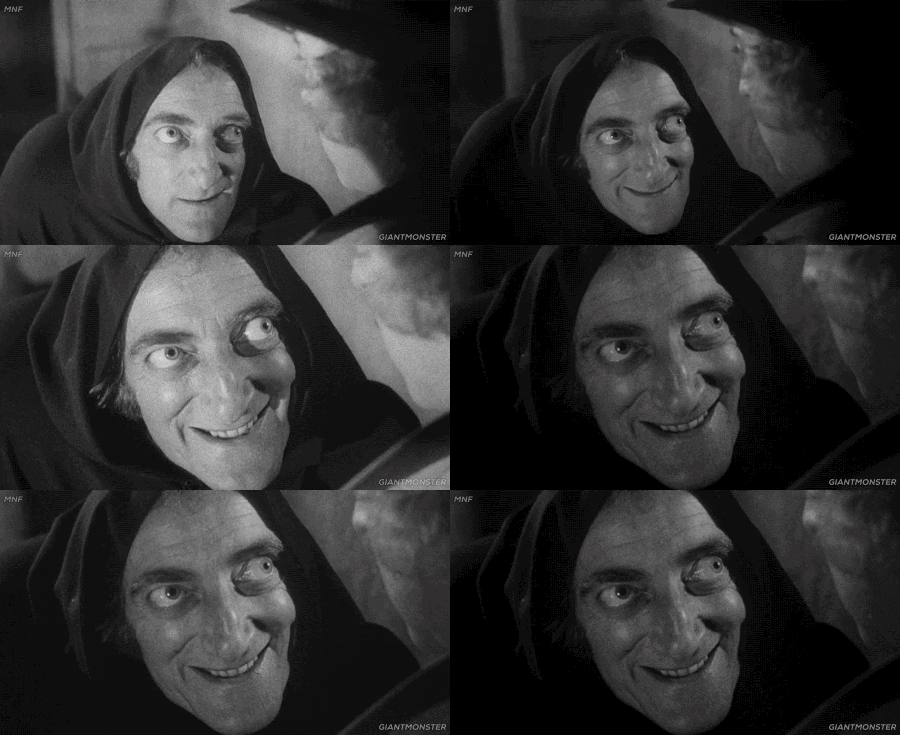
Alternatively, Bing’s chatbot et al might not become that reliable.  Instead, these tools might act erratically.  Like a mad scientist’s hunchbacked assistant.  As Igor.

Igor Marty Feldman

“EYE-gor,” that is.

Igor wants to help, but sometimes gets… creative, and provides results far from what we asked for.  Igor usually obeys us (the mad scientist), but sometimes wants to follow his own plan or the voices of others (think of the famous “guardrails”).  Remember the strangest art which you’ve coaxed from Stable Diffusion or Craiyon, those transmissions from the uncanny valley, or read about a New York Times writer’s weird Bing chat. ChatGPT and Bing’s chatbot do quickly leap to churn out the text you require, yet at times will just balk, as per its internal (and sometimes mysterious) guidelines.  And ChatGPT is capable of cheerfully producing horrors on demand.

There’s a great, relevant scene in the fantastic Bride of Frankenstein (1935). The two mad scientists (it’s such a fine film that it won’t settle for just one), Frankenstein and Praetorius, complain about the quality of hearts in the cadavers they have.

buy augmentin online buy augmentin no prescription generic

  One assistant hears this and helpfully stalks off to grab and murder a casual passerby, then provide the resulting fresh corpse, which pleases the mad scientists.  The assistant did help out, albeit in an, er, unorthodox fashion.

buy ventolin online buy ventolin no prescription generic

Playing the Igor off of the calculator, we see two very different understandings of generative AI.

buy clomiphene online buy clomiphene no prescription generic

Either we see it as stable or unstable.  We view these tools as easily understood (most calculator functions are clear to many users) or susceptible to following commands other than our own.  Its quality is durable or sometimes risible.

Both technologies and their analogies can be frightening at times.  The calculator is less so, yet like many labor-saving devices, threatens to weaken our individual capacity to perform, or even understand, that labor.  The hunchbacked assistant can easily wreck havoc, even when trying to follow our instructions. While a calculator is cool, unremarkable, and office-friendly, an Igor is ungainly, warped, unpredictable, and strange.

There are other figures and metaphors for us to use, of course.  Today I’d just like to offer and contrast these two, at least for entertainment, and perhaps for a touch of imagination.

I’d like to close with an image from Bride of Frankenstein, which combines a freaking assistant with cool, reliable tech:

Karl_the_Assistant_The_Bride_of_Frankenstein_1935.JPG

One of the poor henchmen in Bride of Frankenstein (1935).

(calculator photo by Awilda Ortiz; Marty Feldman from the vast archive of Giphy; The Bride of Frankenstein’s Karl the Henchman from this wiki)

Posted in automation | Tagged | 17 Comments

Some ways for generative AI to transform the world

For the past two months I’ve been scrambling to work on generative AI.  That’s the phrase I prefer to corral together ChatGPT, art generators like DALL-E, and any AI-driven software which helps us make content.

Besides hosting Forum sessions (some of our best attended and viewed: 1, 2, 3) I’ve been trying to write up thoughts on two levels: what this means for higher ed now and in the short term; some bigger picture implications. Here I want to share some of the forecasts I’ve been building up on the second category.

For this post to work I am assuming a few things.

  1. Generative AI advances briskly over the next few years, improving in quality and growing in instances. It gets better at making content: text, images, audio, video, games, 3d printing, XR.  There is no wild breakthrough which totally redoes the tech, nor does the technology collapse.  For the latter, I’ve heard arguments that the predictive model is ultimately too flawed to be reliable. After all, some innovations do stall out or his dead ends.  (I like to cite 8-track tapes here.) But for now, let’s imagine that ChatGPT et al make significant progress.
  2. Enough people perceive generative AI (“GAI” from here on) to be of at least sufficient quality to use it. That doesn’t mean everybody thinks the stuff is good enough, just that a large enough number think it is to make a difference.  This also differs from my assessment of GAI’s quality, or anything like objective takes. The point concerns human adoption of tools, rather than the tools themselves.
  3. GAI has very broad impact, along the lines of the World Wide Web’s appearance.
    buy tadasiva online buy tadasiva no prescription generic

      It’s not just a technology for a niche population. It isn’t quietly fed into preexisting tech without a murmur, like autocomplete in Google search and Gmail. It actively changes things. Or, if you like, enough people see GAI as a change agent to use it to change things at scale.

  4. The history of technology and innovation is a useful guide.  For example, Everett Roger’s diffusion schema holds up, and that we can apply lessons from various stages of the digital revolution.
  5. I’m not aiming for utopia or dystopia, but for a world with many different experiences and views.

Enough caveats. So, for the short and medium term:

More GAI applications start to appear, increasingly specialized or marked by economic, political, and cultural identities. Microsoft and Google’s engines duel with, or complement, each other. A Chinese firm publishes a ChatGPT competitor tilted towards Xi Jinping thought.

buy nolvadex online buy nolvadex no prescription generic

  A Western politically progressive art generator appears. A conservative Christian group publishes a movie generator which emphasizes their themes and blocks forbidden content, along the lines of CleanFlix. The Indian government celebrates a suite of Hindutva content creators.  European white nationalists release a pro-racial ethnostate-favoring game creator.  Over time as GAI technologies become more accessible and more people acquire relevant coding skills more engines appear with ever more precise, or narrow, foci and biases.

As a result, humans increasingly fill the world with AI-generated stuff: stories, images, movies, clothing designs, architecture, games, 3d printed artifacts. New categories of generative AI appear and we get used to asking GAI to create stuff for us.

buy clomiphene online buy clomiphene no prescription generic

 One milestone will be when software succeeds in building out feature films on command. For example, here’s “a movie poster for an 18th century Gothic novel starring Helen Mirren, directed by Stanley Kubrick” imagined by Midjourney:

a movie poster for an 18th century Gothic novel starring Helen Mirren, directed by Stanley Kubrick: created by Midjourney

Imagine being able to order up such films on demand. Another milestone will be the first GAI-created AAA computer game.  “Make me a 4x game based on my home town with better weather, Roman empire levels of technology, and all advisors drawn from heavy metal musicians in the 1990s.”

We then go through another great round of new media cultural reformations.  Our shared sense of what constitutes real creativity, how to restructure copyright, what freedom of speech means, authorship, journalism, information overload,  storytelling and art expectations and forms, and more mutate and mutate again, before giving way to new settlements.  We come up with new ways of handling the sheer mass of new content, as we have historically done, trying out practices, artistic schools, formats, and technologies.  (For precedents see the rise of moveable type, expanded literacy, and the web.)

The nature of truth in media might come to the fore. I’m thinking of passable fakes, like GAI-crafted evidence for courts, politics, intimate betrayals (“Look, there you are with him!”), business fraud (“Here’s my receipt!”), etc.  The history of photography – which went through this problem repeatedly, from the 19th century to Soviet airbrushing to Photoshop – gives us some ways we could respond.

The pornography world is already participating in GAI, and it seems reasonable to assume they will continue to do so.  Play this across all AI-capable media: videos, text stories, audio, video, then computer games and on to XR.  Recent history suggests there will be criticism of porn.ai from a wide range of quarters (religious conservatives, psychotherapists, feminists). This in turn will likely lead to legislation and possibly new GAI from different perspectives: women-friendly porn.ai, video GAI which doesn’t permit nudity, game generators which mandate inclusion of religious scriptures.

Various individuals, businesses, cultures will take hits or fail completely, while others blossom, depending on how they respond to the generative AI age in different domains and markets.

buy valtrex online buy valtrex no prescription generic

New businesses and cultures emerge, as do new cultural leaders and influencers.

Capital flows in, funding new projects and old providers. Capital tries to surf the GAI wave, controlling its ragged edges, leading to creative and legal disputes.  Economic actors use GAI to produce economic strategies to demolish competitors or establish monopoly.  (I’m waiting for “Leadership Secrets of ChatGPT.”)  Expect venture capital to fuel “grown-up GAI for the real world.” (Carlotta Perez’ Technological Revolutions and Financial Capital (2004) influences by view here, emphasizing the crucial roles capital investment plays.)

We should expect years of governments fumbling with policy and regulation, as bureaucrats and officials struggle to keep up with rapidly advancing tech and its complex effects.  We should also expect some leading GAI powers to exercise historically standard influence peddling and corruption.

Militaries and spy agencies will certainly exploit generative AI. Imagine a rising colonel asking ClausewitzBot for new weapons, strategies, tactics.  Next, human soldiers will try to figure out how to grapple with GAI-shaped enemies.  Or think of spymasters having good deepfakes produced to blackmail key officials, or counterintelligence services running endless simulations of how certain agents might behave under various threats and enticements.  Let me offer a future-oriented example from today via a ChatGPT prompt: “Tell me how a conventional army can use AI to defeat a popular guerrilla insurgency in central Asia.”

Tell me how a conventional army can use AI to defeat a popular guerrilla insurgency in central Asia.

Imagine doing this with an AI trained on not only general web content, but also internal military intel.  And the AI has been trained by analysts on these kinds of questions, with far more parameter prompts.

Political actors can increasingly use GAI to make propaganda in various media and forms.  They can also ask generative AI to create tools for torture, both physical and mental. “BlackOpsBot, give me strategies to injure community or population [X] with full deniability.”  More benignly, we should see political campaign operatives using bots to project how opposing candidates might behave in public debates.

There are plenty of connections with other tech:

  • Office suite – GAI creating slide, text, and spreadsheet content for users, as Microsoft is apparently arranging now. These tools increasingly create rough drafts for us.  It’s an open question how much we’ll edit and revise them.
  • Web content – should replace human-staffed content farms.  A cheaper way to pop up quick web pages for new projects.
  • Social media – GAI becomes a way to improve or expand one’s presence.  Imagine in a few months or years, telling a bot to: “generate a video of my morning from 9 to 10 am, cutting out silent parts, and in the style of Alfred Hitchcock. Post to Instagram in 45 second chunks, one chunk ever two hours.”
  • 3d printing – software offers new 3d designs, then AI starts doing its own prototyping and printing.
  • Speech interfaces –  “Siri, sing me a punk song, US East coast style.”
  • AR/VR/XR can become a home for all AI generated content, since it already uses most media: text, images, audio, video.  GAI serves as a creator’s Gesamtkunstwerk assistant, then as its creator.

There will be attempts to ban all or some of GAI at multiple scales and in various social groups, from nations and cities to churches and companies.  There may also be calls for people to renounce using GAI, perhaps as a performative public statement, or as part of belonging to some group.

All of the above is simple first-order extrapolation, assuming GAI grows and exerts pressure on key points in human civilization.  There are many more possibilities, which I invite readers to share in comments. Now let’s imagine some more complex and interesting ways generative AI could play out, based on second-order impacts and other historical precedents:

  • Intersections with climate change and climate actions. Imagine the IPCC, governments, businesses, and individuals using certain GAI to plot their climate forecasts and the strategies they want to respond to them. Alternatively, we could see climate activists turn against the tech as burning up too much CO2, pressing for its regulation or banning.
  • Post-growth political economies. If some nations decide to throttle back industrial-technical civilization because of demographics, politics, or environmental concerns, embracing degrowth, circular economies, or donut economics,  how does generative AI fit in?  Does a state use an advanced application to create strategies for redistributing wealth – or use another to directly manage such? Do we accept GAI art as a legitimate cultural form, one which adds to quality of life even as we pause or retreat from economic growth?
  • Techlash. Today’s anti-Silicon Valley skepticism and anxiety could tamp down GAI adoption.  That might lead to divisions and schisms in usage, from divided households to national differences.
  • Strict regulation.  Governments might regulate GAI out of general use, as we see with nuclear weapons and biohacking.
  • Butlerian Jihad. One possibility is that resistance to GAI grows enough to tip culture over into a massive anti-AI wave.  For a science fiction example, Frank Herbert imagined an anti-AI cultural-religious movement in Dune.
  • Cultural and social division – do we see people identifying with specific GAI bots or types of them?  We already have folks happily proclaiming their loyalty to Steve Jobs and Fox News; we could see something similar, or perhaps more intense.

…and I have more thoughts on this subject.  I haven’t touched long term effects.  The impact of GAI on education, and how academics might respond, is the topic of another post.  But I wanted to get this out here for now to contribute to the conversation in a futures way.

What do you think of these possibilities?  What else do you envision for the future of generative AI?

(thanks to my Patreon supporters and various friends for thinking through these forecasts. You know who you are.)

Posted in automation, futures | Tagged | 4 Comments

A queen sacrifice at Saint Leo University

One way colleges and universities can respond to rising financial pressure is to cut personnel.  Sometimes they fire tenure-track faculty, either by removing their academic programs or by declaring financial emergency.

buy priligy online buy priligy no prescription generic

This is a policy I’ve dubbed “the queen sacrifice,” based on the chess gambit of giving up one’s most powerful piece.

buy trazodone online buy trazodone no prescription generic

  In this analogy tenure-track and especially tenured faculty have the queen’s role, being often enough the most powerful pieces on the campus chessboard, given their governance powers and protections of tenure.  I’ve blogged many examples of this.  Far too many.

Today’s example comes from Saint Leo University, which just announced a series of cuts.  Their vice president for Strategic Enrollment Management described it as “[r]educing our university’s footprint and programs.”

The cuts include ending teaching at eight sites beyond the main campus: “Charleston, SC; Joint Base Charleston-Naval Weapons Station, SC; Columbus, MS; Corpus Christi, TX; and Jacksonville, Lake City, Ocala, and Mayport, FL.”   (Students can finish their programs online.). SLU is also shutting down some degrees: “Bachelor of Arts in international hospitality, Bachelor of Arts in human services, and the Master of Science in human services.”  Further, “all degree programs in the College of Education and Social Services will become a part of other colleges”; I don’t know if that sets the stage for further reductions.

In terms of personnel, “A total of 111 faculty and staff positions were eliminated.”  Note that “27% [of those] were recently vacant,” or 30, meaning 81 people will lose their jobs.

In addition to those academic cuts, six sports teams will end.

Resources thereby freed up will shift to other programs with higher demand:

Part of the university’s future focus will include growing the university’s bachelor’s degree program in nursing and many of the programs in its newly established School of Computing, Artificial Intelligence, Robotics, and Data Science.

All STEM and allied health.

What can we learn from this story?

Saint Leo University Campus Scene

Saint Leo has 1706 academic staff, according to Wikipedia, so the 81 lost represent just under 5% of the total.

The president has only been in office for less than a year, which is a common element in queen sacrifice stories.

The disciplines impacted are interesting. Unusually for a queen sacrifice, no arts or humanities programs are on the block.

buy grifulvin online buy grifulvin no prescription generic

  Typically, STEM fields are scheduled for growth.  I am curious about why human services is ending there, as that field doesn’t seem to be having issues.

buy udenafil online buy udenafil no prescription generic

  Is it in decline locally, or was the program in a bad way?

Note the emphasis on online learning:

“Throughout its history, Saint Leo University has continually evolved to meet the needs of students—from opening education centers on military bases to being one of the first to offer online degree programs,” [Saint Leo University President Ed] Dadez said. “The future vision for our university will continue on this course, including more educational partnerships with businesses and organizations, customized pathways for earning degrees, and new investments in our online learning program.”

Notes on language and presentation: the university described this set of cuts as “streamlining,” an interesting choice of words.  The announcement also noted the faculty and staff position cuts *after* mentioning sports teams, which says something about institutional priorities, communication tactics, or both.  And the text emphasizes adjusting to the labor market.

This hasn’t gotten a lot of press that I can see.  Does anyone have more to add, especially if they work for or near the university?

(thanks to Mo Pelzel for the pointer; photo by Allen Forrest)

Posted in higher education | Tagged | 4 Comments

How higher education might respond to the climate crisis: an introductory interview

How might colleges and universities engage the climate crisis?

Bringing Theory to Practice LogoI was recently honored to be interviewed on that topic by the Bringing Theory To Practice team.  In the most recent issue of their Bringing It newsletter BT2P asked very good questions, then kindly edited my responses with admirable clarity and concision.

buy vidalista online buy vidalista no prescription generic

I spoke to the themes of my  Universities on Fire, so this interview is a good introduction to that book.

One context was my involvement in BT2P’s Paradigm Project about reimagining undergraduate education, and I spoke to that movement.  (Here’s our Future Trends Forum introduction to Paradigm)

Thank you to Paul, David, and the whole BT2P team for their kind hosting!

Posted in climatechange, interviews | 1 Comment

Three years of pandemic: risks, losses, and lessons

Three years ago today I posted this:
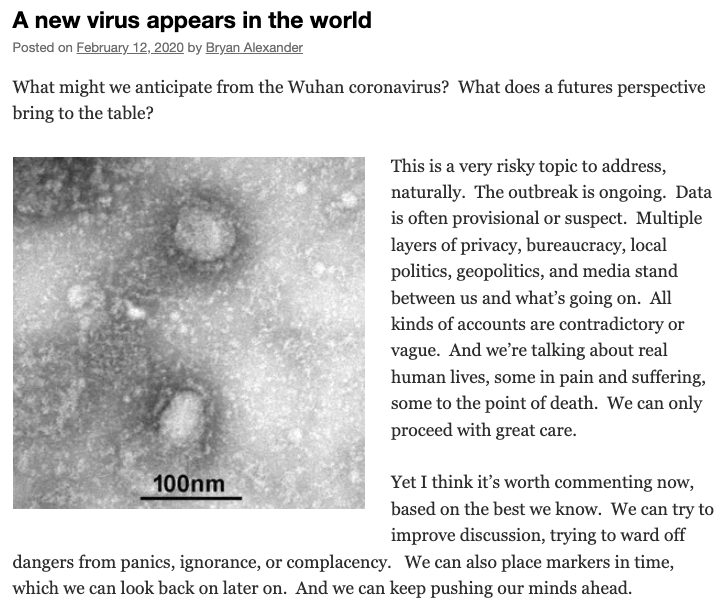
coronavirus_Bryan's first blog post 2020 Feb 12

Three years, 124 posts, and a planetary storm later – where do we stand?

I had in mind a long essay for this anniversary. But for reasons which will become clear below, I determined that nobody would read that far, so I opt instead to be concise.  I also wanted to reminisce about my own work on COVID-19, but didn’t think that would be of interest to most.  So let’s cut to the chase.  Hang on – I’m going to go quickly.

I: What was actually unprecedented

In late 2019 what became known as COVID-19 appeared in Wuhan, then started spreading. In early 2020 that coronavirus began to race around the world and people who should have known better called it “unprecedented.”

Coronavirus JHU 2020 Feb 13

From February 14, 2020. Look at that map. Look at the death toll.

Even the most casual glance at history shows ample precedent for contagious diseases attacking societies, but enough people either never thought of this, or just extrapolated from their own shock and good fortune to assume the whole of civilization had never been afflicted, so the stupid meme took off.  (Nations which recently endured contagions like SARS and MERS tended to be, in contrast, wiser.)

What was actually unprecedented was how higher education responded.  In a matter of weeks – sometimes only a few days – and rarely with extra help – we flipped nearly all of in-person post-secondary classes online.  As I’ve told academic audience after audience, this was a remarkable thing.  Yes, we made all kinds of mistakes, especially as unpracticed and undersupported faculty and students struggled to make emergency remote instruction work – all while the pandemic built and gnawed at us.  There were some awful pedagogical practices at work, and I can tell some stories about this.

But we did it. And then we did more. In April 2020 I told the Wall Street Journal about some models I had for how colleges and universities might continue to respond to the pandemic, especially as planning went on for fall term of that year.  Those models proved true, more or less, but were also far too macro to catch the sheer innovation which was starting to occur.  Campuses came up with new plans for classes.  They rebooted calendars. Some split on-site attendance in two by academic year while others picked which buildings could be opened and when. Institutions rethought gap years, first-year orientation, classroom density, outdoor classes, graduation protocol, Greek life, social life in general, libraries, sports, WiFi coverage, infection dashboards, and more.

Higher education, long described as institutionally conservative if not reactionary, suddenly leapt online and rethought itself.  We collectively did a tremendous amount of learning, experiment, practice, revision, imagination, and implementation. And we did it at scale.  Full scale, in fact.

I believe that we can recognize the mistakes we made, listen to the sheer amount of human work and anxiety involved, as well as the rising suffering causes by the pandemic and its effects – while also celebrating that academics also demonstrated tremendous care, creativity, imagination, and hard work.  We broke the mold, and that is unprecedented.

Or it was, for a time.

II: Putting the present behind us

As 2020 staggered in it became clear that the trend of energetic innovation was matched by a rising desire to return to fall 2019, before the virus. Some of that countervailing trend’s force came from faculty who disliked teaching online and wanted to get back in the classroom, and who had some measure of governance power (most do not). Some number of students felt the same.  Perhaps a stronger force still came from administrations dreading the financial hits they were taking, especially from lost room and board fees, for those with significant residential student bodies.

Two largely external innovations empowered this countervailing trend even further.  First, there was the astonishingly fast development and deployment of a COVID vaccine at national levels.  Setting aside the boneheaded “vaccine hesitancy” for the moment, this invention helped many people believe they could meet with people in person once more.

(At the same time the CDC did something no futurist I know of anticipated.  The CDC screwed up. They botched test rollouts and struggled with messaging.  They also struggled with Trump.  Seriously, check out the cool heroes of Contagion (2011) if you want to see how many people through the CDC would act. It is to weep.)

Second, there was the CARES Act, which proved a financial lifeline for hard-hit colleges and universities.  Day by day it looked more likely that in-person education might not be a humanitarian disaster.

This was not a consensus view.  Consider, for example, Tressie McMillan Cottom’s fierce comments from April 2020:

https://twitter.com/tressiemcphd/status/1254505454178234368

“It is better for institutions to die than for people to die.”  Who in higher education agreed?

In public health terms, it was a no-brainer to realize that students, faculty, and staff not meeting each other in person was clearly safer than bringing them back together in a game of epidemiological Russian roulette.

Yet gradually, then generally through 2021, we played that game. At scale.

Students, faculty, and staff gradually repopulated campuses.  And there was a great deal of positive emotion because many of us are invested in that sometimes magical experience.  There was also a gradual financial return as fee payments rose.

What was the result?

Fewer campuses shut down than I expected, thanks to the federal and student cash inflows. Enrollment declined, but not as badly as it might have.  Primarily- or entirely-online universities saw their student numbers blossom.

Yet in a crucial, essential way, we do not know what the results were.

You see, I and others tried to track the human costs of the pandemic within higher education.  I noted infection totals as best I could, along with some deaths, but the data problem was far beyond my resources.  4,000 institutions each with some degree of autonomy and idiosyncratic data reporting systems represented a horrendous data collection challenge. As fall 2020 began it became clear that not even the New York Times could track the pandemic’s casualties within academia, despite throwing dozens of reports at the problem.

We haven’t solved that problem since.

As I write this I cannot find any source reliably describing how many students, faculty, and staff were medically damaged by their COVID experiences. I can’t tell you about many now have long COVID, a condition which adds further health problems.  I can’t report how many academics the virus killed.  On top of that, I don’t know how many people who aren’t academics were sickened, injured, or killed because of contact with academics who spread the virus, thanks to being in contact with fellow students, faculty, and staff.  To some extent higher education’s “reopening” was a terrific opening for the pandemic. Our decision to try a return to 2019 sickened, injured, and killed some people, or just made their situations worse. Some readers will know people in those categories, or may be in them themselves. Yet we may never know the real numbers.

Put another way, how many institutions took the opposite view of Tressie Cottom’s? Some, perhaps many did, implicitly. But we just don’t know.

And then we moved on. Eventually president Biden, if not the CDC nor the World Health Organization, declared the pandemic over.  Masks and social distancing melted away.

III: 1921 2.0?

And that’s where we stand today, finally realizing my post-pandemic campus scenario throughout the sector.  Some rare folks wear masks.  Campuses have different policies about vaccinations.  But we seem to have moved on, like American society as a whole.

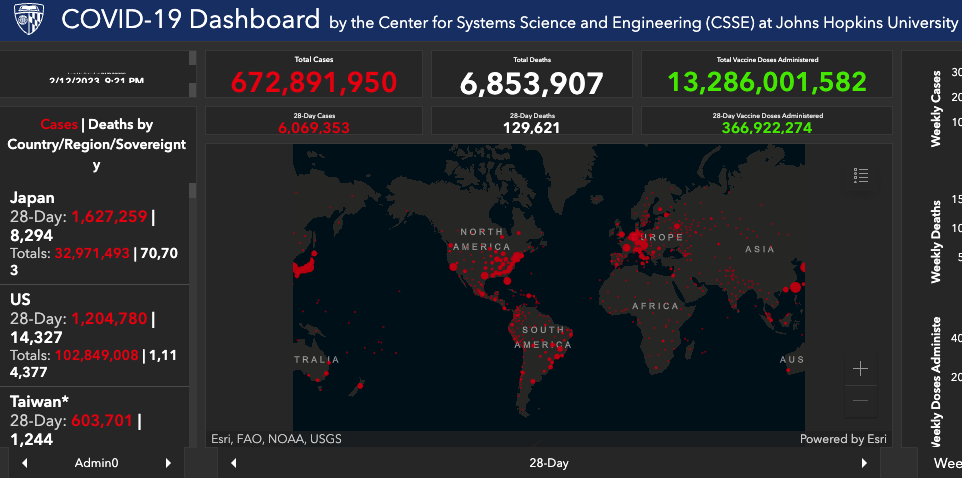
Oh, COVID is still here:
coronavirus world dashboard JHU 2023 Feb 12

Here’s that Johns Hopkins dashboard tonight.

That’s why I think of 1921.  Briefly, in 1918 the so-called Spanish flu tore into a humanity already ripping itself to shreds with the new, science fictional levels of destruction the First World War’s industrial-scale terror was delivering. That influenza raced along military and economic supply lines, devouring the very young and the very old.  By 1920 the death toll stood at tens of millions, perhaps more.

And then, by 1921, we moved on.  We didn’t erect triumphant monuments because we had little to celebrate.  Medical science and public health had done their best and learned a lot, but ultimately experienced a staggering butcher’s bill.  Besides, the aftershocks of WWI (including a series of wars; the thing didn’t stop cleanly) grabbed the limelight. The Great Influenza faded in memory as the 20s began to roar (or, in the nascent USSR, do a very different thing indeed).

You see where I’m going with this. As I write we have no national commemoration of the great struggle against COVID-19.  The world has lost nearly 7 million people, and probably more, given mortality statistics, yet our mourning is quiet and individualized, rather than public and social.  There’s a giant sense of futility, either of “we’ve done all we could” or “I’m doing fine, thanks.” People tell me “they want their lives back” and that they don’t see how they can persuade people to mask up, much less get vaccinated.

There’s a strong individualism at work here, when people tell me they make decisions based on their own assessment of personal risk.  How will a certain behavior – masking or not, going for a haircut, visiting grandparents – increase the odds of me getting infected, hurt, or worse?  That’s the question, and it’s a terrible one for COVID. That’s because this is an infectious disease, and my decision impacts potentially many other people.  But that individualist mindset closes off the world beyond one’s skin.  What level of risk will I accept, and forget the rest of us.

Acceptance is the word of the day now, just accepting COVID’s extra burdens of illness and death on top of the others: cancer, AIDS, car wrecks, the occasional murder. We’re so over it all now.  It’s 1921 again, as it were, and we do have a lot on our plate.  There’s Russia’s war in Ukraine, the US-China cold war, economic turmoil, the climate crisis (for some of us), technological challenges – and what’s going on with balloons and unidentified objects being shot down?  Not to mention our personal lives and entertainment.

I’ve seen this personally.  I’ve tracked the pandemic since the start (my wife just shared some emails and chat we exchanged in January 2020), trying to apply my professional skills to do what I could to help.  I’ve blogged, tweeted, made podcasts, made videos, written articles, given presentations. In 2020 these were sometimes in great demand.  Heck, I broke Google Sheets by triggering so many demand Google engineers couldn’t keep the thing running.  Yet interest started to fade, then drop. Folks – including academics – are just not very into the pandemic.  When I mention it in front of live audience people get quiet. I haven’t gotten an audience question on the topic for a year or longer.

What happened to 2020’s torrent of innovation?  That’s a good question. We did change a lot of institutional operations.  Academics are more digitally experienced and skilled than they were in 2019, overall, from what I can tell.  I think many campuses are better prepared to do emergency remote instruction than they once were.

Do we have that sense of urgency?  I don’t see it.  Do we have that level of creativity and openness to possibilities?  I’ll leave that for readers to decide.

IV. Peering ahead

What does this tell us, o futurist, about what’s to come? you might ask.

I now look at the pandemic as a kind of test run for how humanity might respond to the climate crisis for the next few generations.  From this I deduce a few things.

First, we are capable of immense innovation.  Technological creativity and social creativity alike are right in our wheelhouse – especially for academia. This gives me a great deal of hope.

Second, we are prone to thinking in national, rather than global frameworks, which will cause some problems when it comes to another planetary crisis.  In the United States, our badly broken public health system means we’ll likely think subnationally, in terms of states, counties, and cities, since that’s where the real decisions and actions were.

Third, we’ll think about the climate emergency in even small terms than towns.  We’ll focus on our individual selves, not unreasonably, but will then remove from thinking the social and planetary contexts within which we’re embedded. People will decide that their own behaviors are too insignificant to have any impact, and will therefore keep on flying, burning coal, etc.  Or we’ll make decisions based on individual risk.  “Sure, I live on the Atlantic coast and might get pummeled by the rising sea or see my groundwater turn salty. But I’m clever and will protect myself.  Now, where did I park the SUV?”  I’ve heard versions of this from academics already.

Fourth, we’ll politicize the heck out of just about any science.  Put another way, we all believe in the science – it’s just political science that we often have in mind.

And fifth… what depresses me now is just how accepting we are.  As I write this Americans accept COVID killing a few hundred of us every day, three years on. It doesn’t merit talking about, not in person nor across any media. If I told you in 2019 that we’d just get used to that daily toll, would you have believed me?

It’s unclear how many are living with Long COVID – tens of millions?  It’s not clear just how we’ll rebuild a shattered medical care system. But we’re moving on. So when it comes to global warming, I fear we’ll swiftly get used to coastlines nibbled away, people fleeing overheated towns and cities, climate migrants in the millions, collapsed rivers, new diseases, old diseases in new places, ecosystems mutating, and food stocks declining, once the initial media buzz wears off and we just … acclimate.

I sincerely hope I’m wrong.  Yet I can’t shake that conclusion, three years on.  Three long years after the virus reached out to seize the world.

In the meantime I hope each of you, dear reader, is safe and sound.  I wish you well.

(thanks to friends, family, and Patreons for thinking through this post with me)
Posted in coronavirus | 2 Comments

56: another great year closer to the grave

Yesterday I turned 56 years old. Once more I rode the Earth for a single solar orbit, busily working on the planet’s surface while generating my share of electromagnetic emissions hurtling into space at the speed of light.

Here I’ll continue what is now a blog tradition of birthdayblogging (previously: 2022, 2021, 2019, 2018, 2018, 2017), doing a bit of autobiographical reflection.  Plus photos and poems.

What does it mean to pass this milestone number 56?

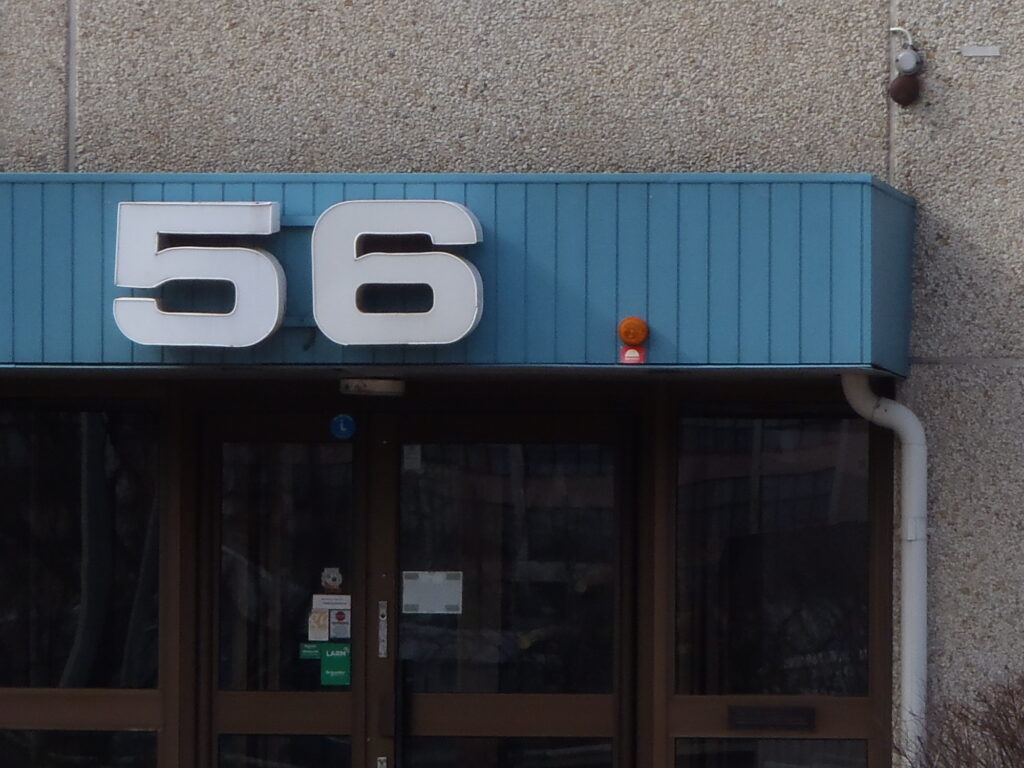
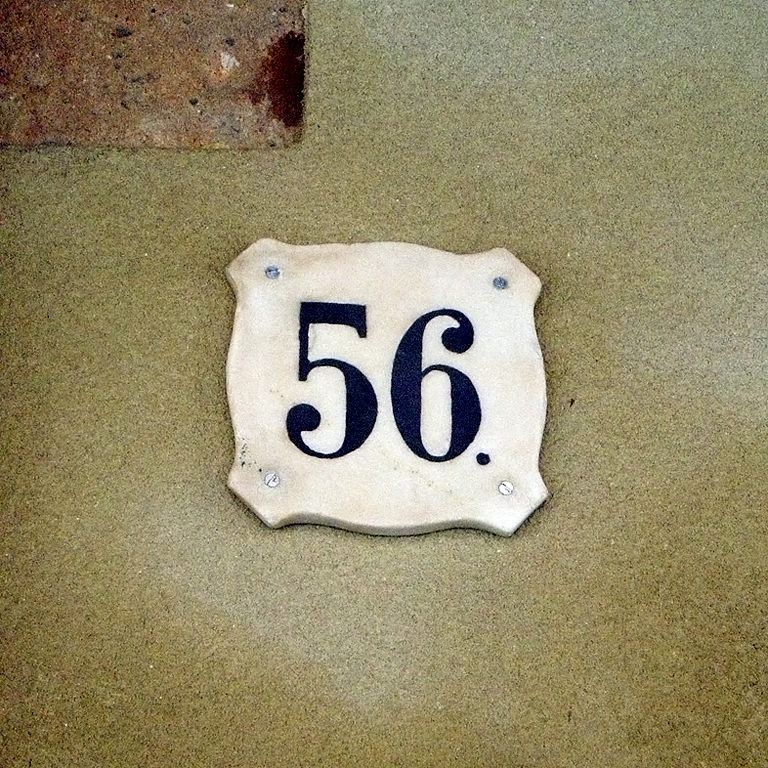
The number 56, photo by evaekeblad

In some ways the annual view gives me hope. Biologically, I’m still alive!  And my ambulatory carcass let me do all kinds of professional work since last February.  My latest book, Universities on Fire, went from giant Word file to galley proofs, indexing, a nice cover, and finally print/ebook.  The Future Trends Forum continued and grew its audience.  Over the past year I taught five seminars for Georgetown University and co-taught a sixth, which clearly shows I still love the teaching experience.  I led or participated in a ton of videos and podcasts.

buy levaquin online buy levaquin no prescription generic

I traveled more for work, as various people decided that the pandemic was done, or at least bearable. That included visiting South America for the first time, which means now I’ve traveled to every Earthly continent save Antarctica.

Of all of those activities, two loom larger in my life than before.  Writing: I’ve published four books now, one in two editions, enough to justify me quietly adding a books page to my blog. I write fewer articles, because books soak up the time and are more rewarding.  This hasn’t slowed down my online writing (hello). I love writing and publishing so much and want to do more.  Three (3) book projects are in various Google Doc forms now and I really hope to see each to completion.  Video: we just passed 340 Future Trends Forum recordings posted to YouTube. That’s seven years of work which shows no sign of slowing down.  And YouTube just decided to monetize my channel, so all of this video work might be paying off and becoming sustainable. I’ve been working on a podcast project; it might be better as a video series now, or perhaps both.  Me, becoming more of a writer and digital-media-maker.

At the same time, as a futurist, I know well to look askance at optimistic pictures.  To help me balance my view the Nightmare Network, a horror website focused on the work of Thomas Ligotti, sent me a cheerful email early yesterday morning:

Even after a person
is gone from this world,
people often tend
to remember birthdays.

They say: today is
the birthday of someone
who would have been
so many years old.

So just in case you’re
not around next year:
happy birthday.

“Happy Birthday” by Thomas Ligotti
(From DEATH POEMS)

Thank you, you melancholy and nihilistic lot.  Balance struck.

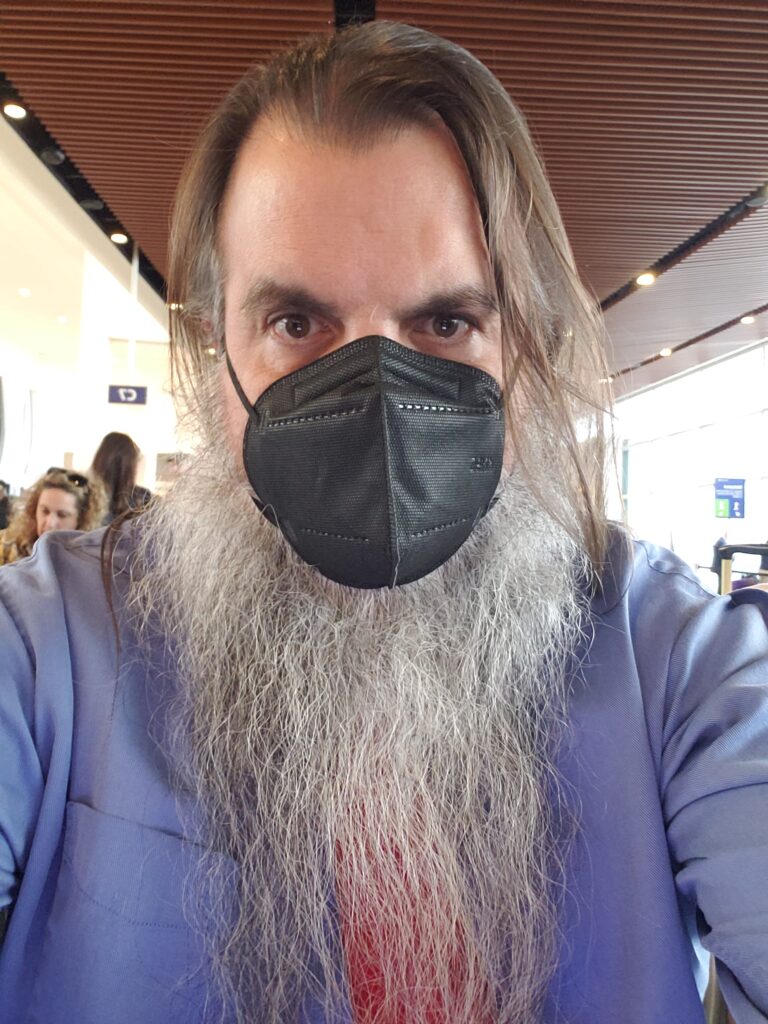
Bryan Alexander masked at New Orleans airport 2023 February 10

In an airport, where I spent around 4 hours yesterday.

So yes, the past twelve months contained many not so brilliant moments.  Biologically, I’m healthy, thanks in part to my vegan diet and regular exercise – I added bicycling to the last. Yet COVID-19 finally got me in October, and while I recovered without signs of Long COVID I dread vulnerabilities which might result in the future.  I try to keep up with the research, which can be sobering or not terrifying.

I also lost too many friends. This is apparently part of getting older, a thought which offers no comfort whatsoever.  Each was a terrible surprise:

Jenny Colvin was a librarian whom I know through her podcast series and our shared love of books, plus my work with Furman University over the years, where she worked, but never met her in person. She suddenly died this spring, far, far too young.  I attended her blended funeral, Zooming in among the in-person guests.

Mike Sellers was a game designer and scientist. I first met him through Howard Rheingold’s virtual community, where we argued and connected over politics, games, and culture. He was generous, giving me copies of one game he helped develop so I could teach students with it, then sharing another game for me kids, who adored it and remember much of it to this day, twenty years later.  He became a professor and died cruelly young.

Tomak Baksik was an artist and an extraordinary spirit.  Fiercely creative, endlessly working at his art, he loved wild stories and the natural world.  I knew him for most of my life and have so many tales of Tomak. Skeptical of the digital world, he filled a YouTube channel with evidence of his endless work. He visited my home for banter, ax-throwing, food, yoga, and left in fine fettle… then died two days later.  Again, horribly young.

I miss each of these friends so damned much. Each appears to me regularly on my mind’s periphery, sneaking quietly in as I think and move about in the world. I want to tell Mike about a game I’m working on, then grimace with pain. Jenny would love this one novel and I should save it for the podcast which will never come. Tomak cheers me on when I lift weights and mutters at me when I see his sculptures and panels around the house. Each advises me at different times, unpredictably.

Last year I said I was haunted by friends; this year the ghosts’ gallery became even more crowded.  How much more crowded can it get?  When do the ghosts outnumber the living friends?  When do the memories fade and their stories decay?

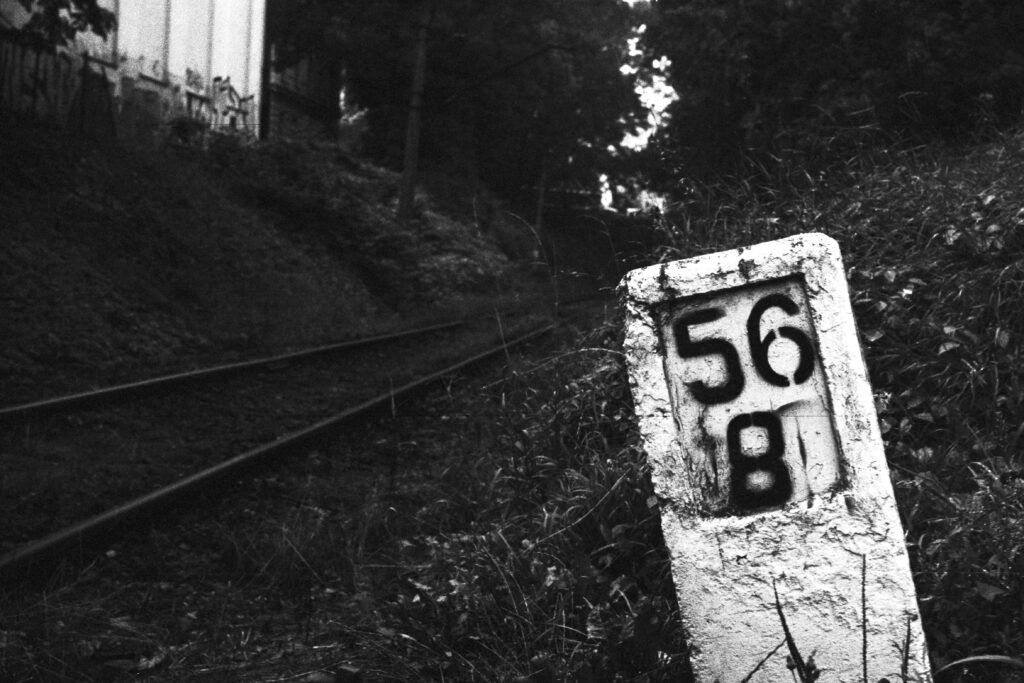
56, by doctor spider

The deaths of others spur on fears of our own deaths, usually. They spook me into greater health: eating better, exercising more, being serious about medical matters.  I think about the years I have left.  My cohort statistically dies in our 70s, so perhaps I can plan on fifteen-twenty years to go.  My parents live in their late 80s and early 90s, so maybe a longer span awaits.  Or not.  Jenny, Mike, Tomak stand before me as sentinel warnings.  So again I throw myself into life.  Memento mori is the ancient lesson of the dead.

Central to that life is my very vivid family.  My wife continues to be my sun and moon. She worked heroically during the pandemic, fighting the public health fight. She does the books for our business, keeping it running. She writes, including a beautiful novel.  And does a lot more.  She and I have been married to each other longer than we’ve been alive.

Our children live with us for now, hunting jobs and working at projects.  Each is amazing in their own way.  Owain is outrageously tall and has a powerful historian’s mind, not to mention a writer’s gift. Gwynneth creates comic books and, professionally, manages emergencies; a government needs to hire her now! I love all three of them with a power I stutter to describe out loud, and can only write of conscious that my words fail.

Friends are dear to me. Mostly I experience them online, from afar.  Some are frequently in touch via Gchat, Telegram, Facebook, email, Twitter. I don’t see enough of them in person. I’ve known some so long that nostalgia hits me at times when we talk, deep flashes of 20th-century memories and old longings.  I know these relationships should be beneficial to us as we age, but I don’t need that argument to know how much I love and delight in friends. (As a man, this needs saying, and isn’t easy to say.)

Nostalgia isn’t claiming me yet, although I see the appeal.  I barely know any new music, and mostly explore it by going through past work, often in my lifetime. Yet I listen to Bandcamp regularly, so I’ve got a glance at the coalface of the new. I try to keep up with new movies, but somehow struggle to actually see them. Instead, I mine Criterion for the classics and rarities I’ve missed or not appreciated enough. My reading is similar, running at the emergent titles while digging into the archives.

Ah, I want to live forever, or at least a long time, so I can revel in all of this art.  Better yet, so I can be with friends and family. Yet I also, still have a deep, overwhelming desire to get things done. My future of education work keeps getting better and more widely known: excellent. I’m focusing now on the climate change aspect; this might be something more appreciated down the road than at present, but I’m going to bet a lot on that eventuality. This year I’ll do a bunch of interviews, articles, book talks, virtual presentation for Universities on Fire to stir the academic pot. Hopefully I can help get the millions of humans in the higher education enterprise to see further and do more about it.  (It’s an imperative.)

I’ve been working on myself, as the therapists and kids say. Started seeing a therapist. I’m trying to fix the attitudinal problem of hyperfocusing on every potential criticism and downplaying positive input. Old folks are supposed to have thick skins; I need to grow mine out.  I have to figure out how to stop doing the classical American male thing of not expressing my emotions.  And how not to overwork myself to an early grave.

56, by xavi blanch

That all sounds too relaxing, though.  I want to work, to love my family, to be with friends, to devour art.

Onwards!

How dull it is to pause, to make an end,
To rust unburnish’d, not to shine in use!
As tho’ to breathe were life! Life piled on life
Were all too little, and of one to me
Little remains: but every hour is saved
From that eternal silence, something more,
A bringer of new things; and vile it were
For some three suns to store and hoard myself,
And this gray spirit yearning in desire
To follow knowledge like a sinking star,
Beyond the utmost bound of human thought.

(56 photos by Eva the Weaver, doctor spider, and Xavi Blanch)

Posted in personal | 7 Comments

American higher education enrollment: the decline declines?

How is higher education enrollment changing?

The National Student Clearinghouse Research Center just updated their fall 2022 enrollment numbers.   Here I’ll summarize their findings and add some commentary, based on the report as well as a press briefing.

(Here’s their first data report from October. I’m hosting their director for a Forum conversation in a few weeks.)

tl;dr – American higher ed enrollment continued its decade-long decline, albeit less steeply than during the COVID years.

Now for details.

Overall undergraduate enrollment shrank 0.6% compared to fall 2021, or by “about 94,000 students.”  Total undergrad numbers stand at just under 15 million.  That’s a smaller decline than American campuses experienced during the pandemic.

The number of students taking classes not for credit actually increased.  There were steeper declines for degree-seeking undergrads: 1.2% for those working on associates degrees, 1.6% for BA/BS.

Graduate student numbers also decreased, by 1.2%.  That’s a shift after several years of pandemic-era grad student growth.

One bright spot: the number of first-year students increased across the board, after several years of decline.

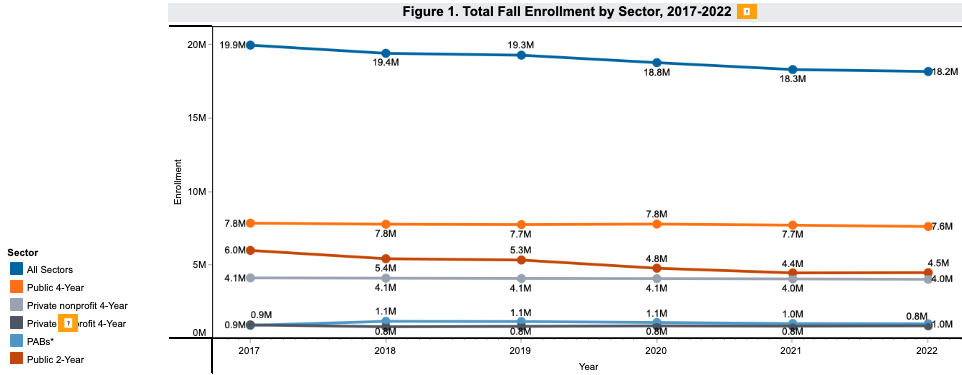
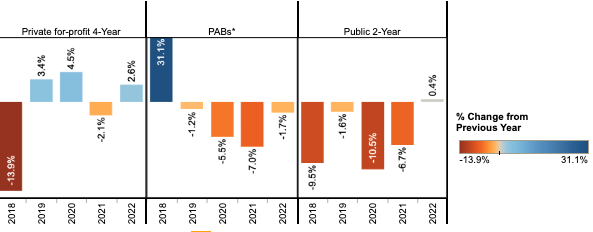
Broken down by sectors, private nonprofit four-year schools “were essentially flat” due to a small downturn of -0.1%.  There were larger declines in public universities. Community colleges actually enjoyed an enrollment uptick. This wasn’t from traditional student, but entirely due to dual enrollment (i.e., high school students).  Without dual enrollment community colleges would have dipped down 1%.


enrollment US higher ed 2017-2022_Clearinghouse 2023 Feb

The Clearinghouse also offers this view:

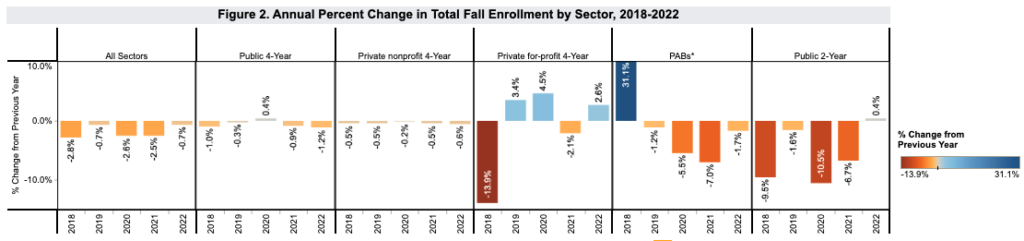
enrollment US higher ed by sector 2018-2022_Clearinghouse 2023 Feb

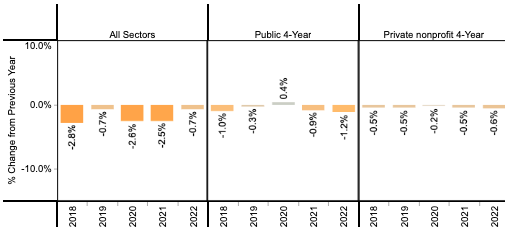
(That’s a little small, so let me display it in two bigger halves:

enrollment US higher ed by sector 2018-2022_Clearinghouse 2023 Feb -left edge

and

enrollment US higher ed by sector 2018-2022_Clearinghouse 2023 Feb -right edge

)

Broken down by demographics, white students were the only population declining in first-year classes, by 2 ½% and by 3.6% overall. Latino and Native American populations increased, while black first-year student numbers were unchanged. In overall undergraduate numbers Latino and Asian students grew, while blacks and whites declined.

In terms of gender, male student numbers were essentially flat, rising by 0.2%, while female enrollment declined by -1.5%.

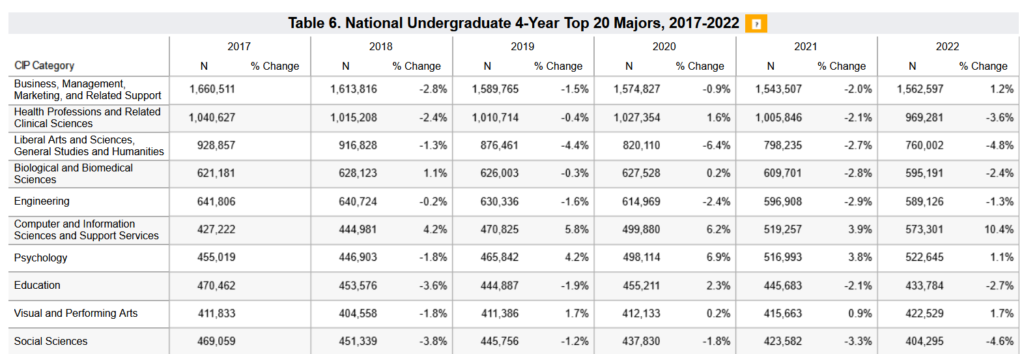
How are different courses of study faring?  The Clearinghouse previously identified five leading majors at four-year institutions; out of those, only business majors increased, by 1.2% The total number of business majors stands over 1.5 million students, and is the most popular field. The other four decreased, such as health fields (down 3%) and liberal arts (down 5%).  In contrast, computer science shot up 10%.  Other majors enjoying growth include psychology,  engineering, and biomedical sciences.  In communication colleges construction trades are growing.

popular majors 2017-2022 by Clearninghouse_published 2023 Feb

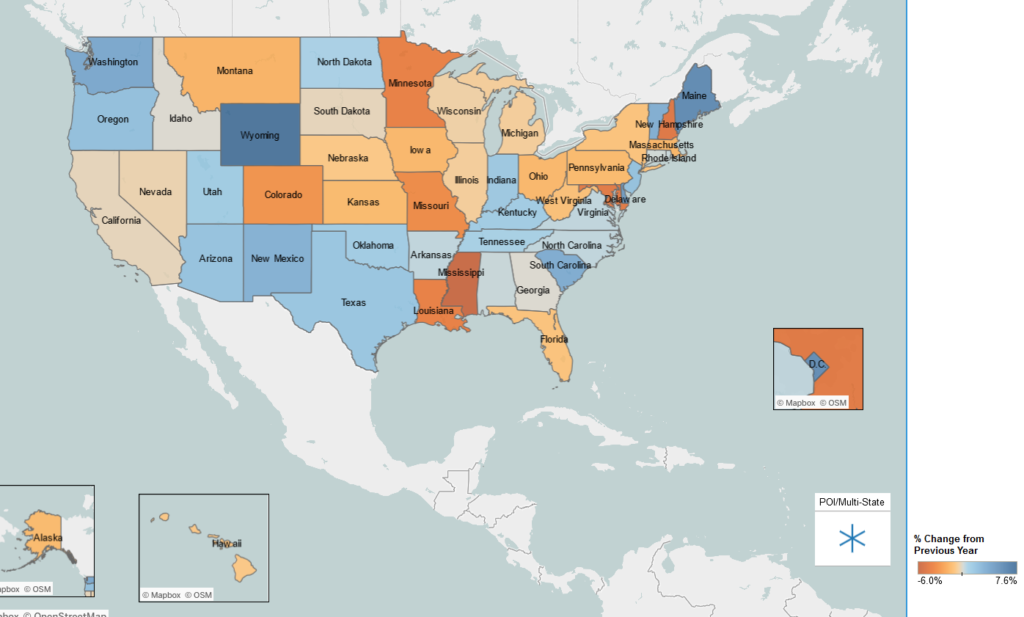
Geographically, midwestern and northeastern states saw steeper declines than western and southern ones overall:

enrollment by state 2022 fall_Clearinghouse 2023 Feb report

What can we take away from this data?

Online learning continued to grow.  The Clearinghouse reclassified most entirely- or mostly-digital campuses under the header of “multi-state institutions.”

For the Clearinghouse, the pandemic’s effects seem to be over.  That’s how they viewed the downturn in grad students, numbers of which had increased once COVID-19 struck.  Yet echoes are still there:

postsecondary enrollment remains well below pre-pandemic levels, down about 1.23 million undergraduates and 1.11 million total enrollment, both undergraduate and graduate, compared to fall 2019.

Some commentators have interpreted this data as good news.  Forbes: “The College Enrollment Slide Is Leveling Off.”  Washington Post: “College enrollment stabilizing.”  I do not share this optimism.  First, because it’s one semester of data, and doesn’t necessarily indicate a turn.  As one observer notes,

“There could be a number of things making this [increase] appear,” said Joni E. Finney, director of the University of Pennsylvania’s Institute for Research on Higher Education. “I think it’s positive, I just don’t think it’s a trend yet. I think we need to see more to know if this is going to stick.”

Second, because the COVID decline accentuated a prior decline.  As I’ve observed for a decade, higher ed enrollment peaked in 2012, and declined for the next seven years *before the pandemic*. It looks to me like we might be continuing that trend, and enrollment continue to slide downwards.

Third, *if* enrollment stabilizes at this point, then we remain below 2012 and are not building back to it. If we still believe in expanding access to higher ed, we continue to fail in that goal.

Back to institutional types: the data about community colleges tells me most of those schools will double down on dual enrollment.

Finally, I want to close by thank the Clearinghouse for doing this work.

Posted in coronavirus, enrollment | 17 Comments

My spring seminar on educational technology is now live

This month my educational technology seminar started.  I wanted to share the class design with you all, to be consistent with my open practice.

I’m teaching LDES 702, Studies in Educational Technology, in Georgetown University’s excellent Learning, Design, and Technology program.  This graduate program brings in a great range of students pursuing careers about, or just interested in, instructional design and related academic fields.  My colleagues are amazing and the students terrific. I love teaching in LDT.

My idea behind the class was to immerse students in the ed tech world. We began with discussion and a survey about their ed tech background, so I could adjust the curriculum accordingly, starting where the students are, then taking them further.

Formally, my goals for the class are that, by the end of term, the students should be:

  • conversant with the major issues in educational technology
  • familiar with a range of educational technologies, both conceptually and practically
  • equipped with a strategy for keeping up with, and participating in, the profession
  • able to create an educational technology assignment for a class
  • be able to advise an academic institution in technology strategy

Every week hits a different topic, and we engage it through a combination of scholarly and/or professional reading along with hands-on work.  I try to have each inform the other.  This also helps make the class very meta, as we use technologies we’ve been studying.  For example, we poke around the class LMS instance and explore using various tech for asynchronous communication.  Moreover, I try to structure the class in a sequence of increasing tech complexity, with each week building on the next, generally.

Speaking of which: the default mode for the class is HyFlex. We physically meet in a physical classroom, but some of us will participate remotely for live classes. Students might be ill or located elsewhere.  I have at least one remote session myself due to travel for other work.

This year I’m bringing in more outside experts. Their areas of professional expertise include accessibility, information literacy, AR/VR/XR, and running a campus IT enterprise.  The reason is to bring in more voices, while connecting students with people who work in these domains full time.  Plus I wanted the class to see aspects of their university they might not have engaged with.

I think the seminar has the students doing a lot of work.  They read a good amount, then have to discuss and apply what they’ve read in in-class discussion and asynchronous writing in Canvas, the university’s LMS. They get to teach each other technologies informally throughout the semester, and formally for one exercise. They have three assignments:

  1. Analyzing one educational technology
  2. Creating a scholarly bibliography for their final project, which is
  3. Either an in-depth analysis of one educational technology, or a project using one as a sample learning experience.

About those readings: we have only one book (print or digital), Neil Selwyn’s excellent Education and Technology: Key Issues and Debates, now in its 3rd edition.  Otherwise everything is online, either on the open web, in uploaded pdfs, or accessed through the university’s licensing structure. I wanted to keep student costs low, while reflecting the range of discussion on ed tech.

As usual, I make the class as democratic as possible. Students co-design our class rules, both for in-person work and online. They generate some topics and share resources (some of which now appear on the syllabus below). Their backgrounds and interests help drive the seminar.

Also as usual, I make the class discussion-based. I will shift to minilecture mode when certain topics come up and the students don’t know much about them.  So either I’ll present, or point to a presentation, on topics like copyright law or the history of the web.

Now for the syllabus:

ed tech in higher education_Stable Diffusion-2

(image generated by Stable Diffusion)

Syllabus

LOCATION: Carn Barn 315

DATE AND TIME: Thursdays, 4-6:30 pm EST

January 12, 2023 – Introductions

Technology exercises

  • concept mapping ed tech (Miro exercise)
  • install Duolingo; get access to ChatGPT; make sure you have admin rights on a laptop or desktop

January 19, 2023 – The LMS and the Web

Technology exercises

  • explore Canvas
  • edit Wikipedia

January 26, 2023 – Digital and information literacy, plus open, part 1

Special guest: librarian Jess O’Toole

Technology exercises

February 2, 2023 – Learning spaces and open, part 2

Optional readings:

Technology exercises

  • redesign the virtual classroom
  • Design considerations for physical classrooms
  • rogue scholarly solutions: the OA Button
  • Learning Space Rating System v3 – version 3 adds to the prior LSRS v2 inclusive design with three parts: 7.1 Physical Inclusion and Universal Design, 7.2 Cognitive Inclusion, 7.3 Cultural Inclusion

February 9, 2023 – audio

Technology exercises

  • Audacity and beyond
  • create an audio file with at least two tracks.  Upload to Soundcloud.  Share with class digitally and in synchronous session

February 10, 2023 – MIDTERM ANALYSIS DUE

February 16, 2023 – video

Technology exercises

February 23, 2023 – mobile

Guest speaker: Judd Nicholson, Vice President and Chief Information Officer at Georgetown University

Technology exercises

  1. Capture media, upload to Canvas
  2. Reflect on Duolingo language learning
  3. Compare responsive design (find examples in class)
  4. Analyze Canvas app

March 2, 2023 – accessibility and design

Guest speaker: Kevin Andrews, Accessibility Coordinator at Georgetown University.

Technology exercises

  • Explore using WAVE
  • TBA

March 9, 2023 – no class; Spring Break

March 16, 2023 – Gaming and education

Technology exercises

March 16, 2023 – MIDTERM BIBLIOGRAPHY DUE

March 23, 2023 – VR, AR, XR

Work with the library’s awesome Barrinton Baynes

Readings:

Technology exercises

March 30, 2023 – AI

Technology exercises

April 6, 2023 – no class; Easter

April 13, 2023 – STUDENT CHOICE OF TOPIC

April 20, 2023 – students teach technologies

  • Selwyn, Education and Technology: Key Issues and Debates, chapter 8

April 27, 2023 – last day of class

  • Student presentations
  • Class evaluation

May 8, 2023 – FINAL PROJECT DUE

Posted in classes and teaching, teaching | 2 Comments

Employers, hire more people without college degrees, says the New York Times

Do employers require too many college degrees from applicants?

The New York Times now thinks so.  An editorial today – not from a single author, but from the paper’s entire editorial board – calls on employers to be more open to would-be workers without higher education credentials.

Let me walk you through the argument, in part because it’s behind a paywall, and also because the points it makes are significant.

New York Times logo

The editorial begins by noting – accurately – that the American economy often punishes people for not having any college credentials.  “[T]he earnings gap between those with a college education and those without one has never been wider.”  The column connects this with rising higher ed prices.  “[T]he cost of college spirals upward, putting it out of reach for many.”

In response, employers should reduce reliance on degrees and instead be more open to those without them.  The Times casts this as a humane, humanitarian gesture, one which:

demonstrates both good policy and good leadership, representing a concrete change in hiring philosophy that stops reducing people to a credential and conveys that everyone — college-educated or not — has experience and worth that employers should consider.

The editorial then adds the recent low unemployment level and tight labor market as a reason. “Public and private employers have been struggling to find qualified applicants, prompting a re-evaluation of hiring criteria.”  So reducing reliance on academic degrees will make it easier to staff positions.

Such a transformation in hiring practices would benefit society, continues the piece, first by helping us address big problems: “If the United States can’t find ways to tap into all of this [undercredentialed] talent, we will not be able to solve our most urgent problems, like climate change and pandemic preparedness.”  More, opening up hiring could improve American politics and society:

Too many Americans see our society and economy as profoundly unfair, set up to serve the needs of well-connected elites and providing more benefits to people who went to college or know how to work the system. And too many feel that political leaders don’t care about them and that government and institutions don’t work for them. Opening up jobs may seem small-bore, but it shows that government is listening and helps build trust among those who may feel unseen or looked down upon by parts of the labor market.

It could also help address discrimination based on race – “Black and Hispanic job-seekers are less likely to have bachelor’s degrees than non-Hispanic whites and Asian Americans” – and problems due to rural location: “only 25 percent of [rural Americans] hold a bachelor’s degree or higher.”

The Times’ call might fit into a rising trend.  The editorial reacts to a recent policy change by the state of Pennsylvania. That state’s move follows a similar one by Utah. Pennsylvania’s neighbor Maryland opened up hundreds of government jobs to applicants who are “qualified, nondegree candidates” nearly a year ago.  Maryland might be the first state to have done this.

And it’s not just governments taking such steps.  The editorial notes what a bunch of us have been tracking in the business world:

The private sector has been moving gradually in this direction already. Major players to embrace skill-based hiring include General Motors, Bank of America, Google, Apple and Accenture. IBM is recognized as a particular leader; about half of its U.S. job openings no longer require a four-year degree.

So why does this one editorial matter?  Several reasons.

First, the New York Times remains the leading American newspaper, the fabled “newspaper of record.”  Its editorials can both reflect and influence elite opinion.

Second, much of what the describe actually exists.  Those state and business policies are not hypotheticals.  Put another way, the Times isn’t calling for something new, but just more of policies already in the world.

Third, note the politics here.  While Maryland’s decision was made by a Republican, as was Utah’s, Pennsylvania’s leader is a Democrat, and the New York Times is reliably aligned with the latter party.  This isn’t simply or entirely a right-wing anti-intellectual push.  The Times piece notes this is, instead, a bipartisan “movement.”  You can see this in the progressive arguments it makes (anti-racism), the centrist ones (it’ll make society better), and the one which usually comes from the right (helping rural America).

Fourth, if enough employers enact such policies and hire enough would-be employees, popular demand for higher education credentials could decline.  That could further depress college and university enrollment, which has already been declining for a decade.  That in turn exerts financial pressure on institutions, the supermajority of which are tuition-dependent, and can therefore lead to program closures, staff and faculty reductions, campus closures, and mergers.

Fifth, it’s not clear to me what such a movement would mean for community colleges and associates degrees.  Would employers relax requirements for those as well?

Sixth, if the job market changes like the Times asks, I wonder if there’s room for higher education to attract students by offering more microcredentials.  People can take several classes and win a badge in (say) project management or team leading or Java proficiency, then take those microcredentials to a job without going on to win a degree.

At a broader level, I find the Times piece fitting into my peak higher education model in a quiet way.  The editorial doesn’t explicitly call for fewer people to enroll in college, but does recommend that a chunk of the population pursue careers without post-secondary experience (or credentials).  In other words, should public and private institutions heed the editorial, we shouldn’t expect an uptick in enrollment, but more of the opposite.

Which brings me to a final point.  I’ve previously written about a huge change in how Americans think about higher ed. For a generation we thought that the more people get more college experience, the better. Since 2012 or so there have been signs of that national consensus breaking down.  Now if the New York Times no longer shares that inherited model, is that shared view truly broken?


Posted in future of education, politics, trends | 5 Comments

Talking with college presidents about the climate crisis

What might colleges and universities do about the unfolding climate crisis?

somewhere over the midwest from a plane 2023 January

Over the American midwest.

Several months ago* I had the opportunity to join a meeting of campus presidents.  Nearly all were from the United States, fairly dispersed geographically.

buy diflucan online buy diflucan no prescription generic

Institutions ranged in size, but tended to the small and medium.  I also met with other people in this setting: some deans and provosts, plus a range of vendors pitching themselves to presidents.

I was invited to lead a discussion about climate change and higher ed.

buy metformin online buy metformin no prescription generic

  Our session was moderately attended, neither ignored nor crowded, and did compete with a clutch of competitors.  I kicked things off by speaking quickly to the main themes of Universities on Fire: multiple levels of academic engagement and impact; the grand strategy big picture; potential political drivers for institutional action; the problem’s urgency.   I compared change to great historical crises which academia participated in, such as WWII and the Great Depression. I also pitched the idea of campuses expanding climate operations to attract students.

Next, Colorado College’s president described a whole series of things they had done: targeting, then achieving net zero emissions, including through renovating many buildings; creating a campus Office of Sustainability; some carefully chosen carbon offsets for travel; more climate-focused classes (“28 out of 30 academic departments at CC offer courses that focus on sustainability”); student-professor research collaborations; a teaching and research in environmental education (TREE) semester where students “live sustainably” and teach K-12 kids; environmental- and sustainability-themed study abroad; convincing the local city to use more renewable energy; decommissioning a local power plant. One key point appeared from this impressive report: students taking climate action helped their mental health.

Pacific Union College wasn’t to be outdone. They did a lot of work on fire threats, which climate change is escalating, as I wrote about in Universities on Fire (p. 41): cross-training faculty and staff on emergency response, clearcutting a firebreak around buildings, massively thinning underbrush in the remaining woods, hosting a helipad for airborne assistance, and more. They also did water reclamation, put some acres in a land trust, made their cafeteria all plant-based (some religious backing here), added more climate classes, and set up a conservation technology major.  The latter is pretty rare.

The audience (a mix of presidents and other folks) had some questions. How to incentivize faculty to work on climate? Several answers from the panel: a growing number of faculty will be interested anyway; set up an interdisciplinary climate research or teaching center; built the topic into gen ed.  A TIAA representative asked about changing campus investment strategies. I mentioned student activism on endowment divestment (ex: Harvard). One president described following an ESG policy. Someone else warned about greenwashing. One president wanted to know about data showing students were attracted to climate classes; I didn’t have this to hand.  One nonprofit head argued that students are very passionate about the climate crisis.  The president of one non-US university wanted to say the energy crisis (caused by Russian war) was relevant to climate change.

I also took in a panel on technology and higher ed and asked panelists to talk about green computing, or how campus tech should change to respond to the climate crisis. One president candidly said they hadn’t thought about it and would look into the topic.  Another said he thought of the question in terms of space, as in technology enabling their institution to potentially need fewer offices and perhaps no new buildings.  He also noted that we are finally making progress towards the paperless office idea, which has good environmental effects.

Beyond those two panels, I visited every session I could and spoke with many people in hallways and wherever I could find them, from presidents to vendors and staff.  One president told me she wanted to install a solar panel array on campus to generate some power sustainably, but ran into two problems.  First, it wasn’t cheap and their state government wasn’t supporting such efforts. I think she meant expenses both financially and politically – i.

buy silvitra online buy silvitra no prescription generic

e., convincing stakeholders to undertake the capital layout. Second, there was another political challenge. That campus bought electricity from a local  source (I wasn’t clear if it was a utility or non-utility business), and the president didn’t want to offend them by started to compete with them.

Another president from a conservative campus in the southeast told me her students weren’t interested in climate change.  “Mostly, they want bigger trucks,” as she put it. I asked if her institution might develop a brand of *not* doing climate action, and if that might attract some students.  The president wasn’t sure.

There was a very interesting session on dealing with institutional boards in hyper political situations. Its chair asked the crowd to volunteer stories along those lines, and there were several. One only addressed the climate crisis. A president described her  campus as facing two different populations, geographically: one group passionately devoted to fracking as an economic growth engine, and another, more urban, keenly interested in environmental activism. Both had representation on the institution’s board, so how to handle these opposites?  The solution: first, the president said she never made ideological statements on climate issues, aligning with neither bloc.  Second, she helped faculty (and staff, I think) win grants, which pleases nearly everyone.

Several food vendors were interesting.  One appeared twice, in their normal guise and also with a green food unit. When I asked each business about climate change, every one had a response ready to go, concerning serving less meat and fewer animal products, or trimming their greenhouse gas emissions, or taking other steps.  Yet beyond the one green food unit none led with these – except their photos tended to be of plants, not meat.  Plenty of fruits and nuts, in other worse, and no steaks.

Some climate change themes emerged across these discussions.  First, presidents seemed more interested in climate when it was a local matter than as a national or global issue.  Second, nearly nobody brought up the topic.

buy tadasiva online buy tadasiva no prescription generic

  Climate just wasn’t a leading issue.  There were plenty of others to worry about!  DEI, enrollment, finance, state politics, changing students, COVID, and more.   Now, presidents often spoke of  “sustainability,” but that was usually in the financial sense.

My overall takeaways: schools like PUC and Colorado College are outliers, early adopters, the first wave of potential change to come.  Institutional leaders are interested in pragmatic, not ideological or political, efforts.  Many are nervous about climate’s political charge; I think they saw plenty of downside risks in publicly committing to climate adaptation or mitigation and few upsides.

*Details relatively anonymized. At least one reporter openly roamed the event, but I’m not sure every participant felt they were speaking publicly.  Colorado College and PUC were happy to share their work.

Posted in climatechange | 1 Comment