What is the Zeroth World, and how can we use it?

What is the Zeroth World?

I bumped up against this odd term for the first time in August and it just stuck in my mind.  The first encounter with a new word or phrase in a language one knows well triggers well-honed responses.  The thing must be jargon from some field, or a regional expression, or a neologism, or, more likely, something from imaginative fiction.

Typically I Google and check Wikipedia to get some context for new words.  But that didn’t help in this case.  Search engine results were few and contradictory, while Wikipedia sent me in a different direction (see below).  My interest perked up.  Maybe this was just random noise, a bit of short-lived slang.  Yet “zeroth” resonated with me, uncannily.  I trusted and admired the source where I found “zeroth” and wondered.  Perhaps it’s a signal of something to come; that’s where I’ll conclude this post, after teasing out the phrase.

To begin, then: I found “zeroth world” in Maciej Ceglowski’s account of the Hong Kong protests.  (If you don’t know Maciej, he’s a brilliant programmer, activist, and writer.  Pinboard is one of his projects.) The author wrote clearly and movingly about the event.  Early on, though, was this passage:

…coming in to the Hong Kong protests from a less developed country like the United States is disorienting. If you have never visited one of the Zeroth World cities of Asia, like Taipei or Singapore, it can be hard to convey their mix of high density, mazelike design, utterly reliable public services, and high social cohesion, any more than it was possible for me or my parents to imagine a real American city, no matter how many movies we saw. And then to have to write about protests on top of it!

It’s hard to write articulately about the Five Demands when one keeps getting brought up short by basic things, like the existence of clean public bathrooms.

Zeroth World is a part of contemporary civilization, then.  It includes those three East Asian cities and is marked by those characteristics of design, services, and society.  That’s a start.

zero by Quinn DombrowskiBut why “zeroth”?  It’s an odd word, one rarely used in written English and probably less often spoken.  It means “preceding one in a series” in the way “first” means “before second, third, etc.”  The Wiktionary explains it as: “In the initial position in a sequence whose elements are numbered starting at zero; the ordinal number corresponding to zero.”   There’s a Zeroth Law of Thermodynamics with precedes the other Three and Isaac Asimov apparently added a Zeroth Law of Robotics.  Wikipedia offers several other senses as well as the delightfully obscure alternate spelling “0th“:

And so on.  All right, so we know what “zeroth” means.  What does “zeroth world” represent?

It plugs into the Cold War sense of three blocs or worlds: the First World (the US and its allies, most advanced), Second World (the USSR and its allies, not so advanced), and the Third (non-aligned and developing world).  After the Cold War’s end Second World fell out of use, but First and Third remained (think of “first world problems”).

Google Ngram: First Second Third worlds visualized

Google Ngram sees Third World as the most popular term of late.

So if we read those three as a sequence of development of quality of life – it was a First World model, after all – then the Zeroth World stands above the First.

Hacker News has one discussion thread about Maciej’s article that accepts and expands on this sense of the term, adding China and maybe Switzerland, plus a site-appropriate cheer for better mobile phone connections.  Sebastian Pokutta uses the term in this sense in his blog post about potential positive impacts of AI on the global economy: improving economic productivity, yielding a much better world.

However, there are other senses out there.  The Urban Dictionary thinks zeroth means the narrow world of high tech:

Problems caused by adopting bleeding edge technology for common, daily use before it’s reliable, such that the technology’s imperfections complicate your life. Loosely, problems that most people living in a wealthy, industrialized nation would probably roll their eyes at.

Along these lines one Fogus wrote about “0th world problems” back in 2012.  Here’s a similar post.

zero graffiti by duncan c

Google led me to a third sense of the term via a Wikipedia entry for “G-Zero”_world. It’s drawn from a 2012 book about an emerging international order without cohesion, without today’s big G-groups (G-7, G20, etc.). The authors even run a website called GZERO.

(Wikipedia also thinks someone once called the Church of Satan the Zeroth Satanic Church, but prefers the former for an article’s title.)

I found some evidence of a fourth sense of the phrase, to mean “very wealthy.”  This blog post describes “zeroth world problems” as the kind rich folks in the first world can endure:

“Poor me!  I just found a free flight to Europe with a lie-flat seat, in business class like I wanted, to the destination I wanted, on the date I wanted.  BUT it has a long layover at an airport where I don’t have free lounge access.” (This was actually a thought I had a few days ago.)

“I have 4 free nights expiring soon so I had to plan a free trip with my wife to Aruba.  What an inconvenience!!“  (I’ve actually heard this one too.)

One MetaFilter commentator thought this way as well.

And in a completely different vein someone has come up with a scary monster called “Shub Zeroth.”

Shub Zeroth

What can we do with the zeroth world meme in its first sense, besides track its origins and contours?  I think it might be a useful way of thinking about the future.

Science fiction has long proceeded by transforming language*.  Stories offer altered words that cause the attentive reader to imagine how the world changed.  The famous example is a character walking down a hallway to a door; the door dilates; he steps through.  We might catch the word “dilate” and start imagining how a door would do that.

Similarly “zeroth world” helps us imagine a world more developed than the first, as far along a developmental track as the first is from the second.  It’s a futures prompt that nudges us to imagine a world or time to come that’s significantly different from the past.  Language is a futuring tool.

On the other hand, the idea of a zeroth world is also a critique.  The first world idea is inherently self-congratulatory.  In response, zeroth sets the first in some shade, causing us to see its flaws and limitations.  Like postmodern to modern, or Internet2 to the rest of the internet, it’s a way of helping us move past the status quo.  In 2019 America there’s even a political charge to it.  “Make America Like Singapore” isn’t quite MAGA.  Moreover, since the tentative exemplars we’ve seen occupied the second or third world only recently, thinking of them as beyond the first world forces us to ponder how they ascended so far, so quickly – and how they passed us.

The definitional glimpses I shared above are starting points.  Gap analysis: how could the first world (or third) get to a position where it had excellent public services, wifi, productivity, and a combination of high population density with social cohesion?  Visualization: what would a first world location (say, Detroit or Rome) look like in a zeroth settlement?  Personal level: how does your life change in the zeroth?  Politics: what keeps the first world from becoming zeroth?

Singapore's night sky

Singapore’s night sky

Let me close where I began with the strangeness of the term.  Again, the very oddness of the thing might indicate it’s ephemeral and/or minor, but it seems indicative of broader ideas.  It opens up the imagination.  And it might be a tentative first signal from an emerging future, one which looks more like Hong Kong than Chicago.  Better yet, like something new and better still.

(zero images by Quinn Dombrowski and duncan c; Shub Zeroth by Nebulon5)

*I first heard the term “transformed language” from professor Eric Rabkin, then at the University of Michigan.

Posted in futures | 7 Comments

Grad school enrollment: mostly good news, but some bad news

How are graduate programs changing?

The Council of Graduate Schools just released a new report based on enrollment data for American universities from 2008-2018.  The findings, while not shockingly surprising, are important for anyone looking at the future and present of academia.  They bear out many trends from last year’s report.

The report (Hironao Okahana and Enyu Zhou, “Graduate Enrollment and Degrees: 2008 to 2018”) offers some good news.

buy levaquin online buy levaquin no prescription generic

  Applications to  American graduate programs increased 2.2% over 2017, with private universities enjoying a 7% boost.  Enrollment also rose, with first-time numbers up 2.

buy suhagra online buy suhagra no prescription generic

1% and total enrollment growing 1.5%.

Master’s programs remain the most popular, by far: “the large majority (83.3%) of all first-time graduate students in Fall 2018 continue to enroll in programs leading to a master’s degree or a graduate certificate…”

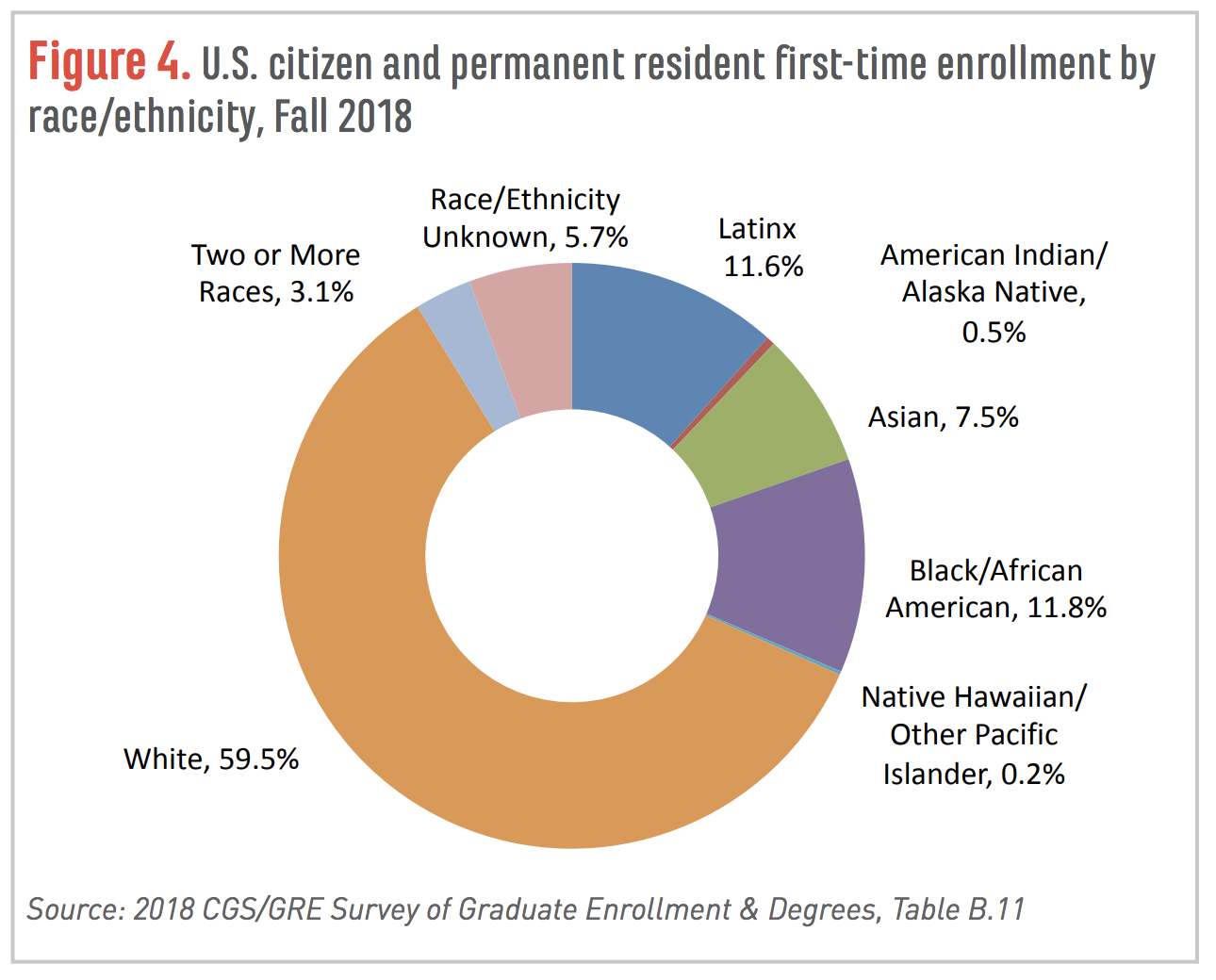
Racial minority applications rose significantly:

grad enrollment by race 2018

Among first-time U.S. citizens and permanent resident graduate students in the Fall of 2018, about 24.1% were underrepresented minorities, including American Indian/Alaska Native (0.5%), Black/African American (11.8%), Native Hawaiian/Other Pacific Islander (0.2%), and Latinx (11.6%)…

The positive trend for Latinx students has been consistent for the last three years.

Women continue to make progress in grad programs:

In Fall 2018, more than half of first-time graduate students both at the master’s degree and certificate level (59.7%) and at the doctoral level (54.4%) were women (Tables B.7). Women also earned the majority of graduate certificates (64.8%), master’s degrees (58.3%), and doctoral degrees (53.0%) awarded by U.S. institutions in 2017-18…

The report breaks out disciplinary differences.  The humanities remained flat, unsurprisingly.  “The fields of education (-1.6%) and arts and humanities (-1.7%) reported the largest declines in total enrollment over the ten-year period between 2008 and 2018…”

Math and computer science boomed.

the largest one-year gains in first-time enrollment by broad field of study were in mathematics and computer sciences (4.3%), health sciences (3.3%), and education (3.2%).

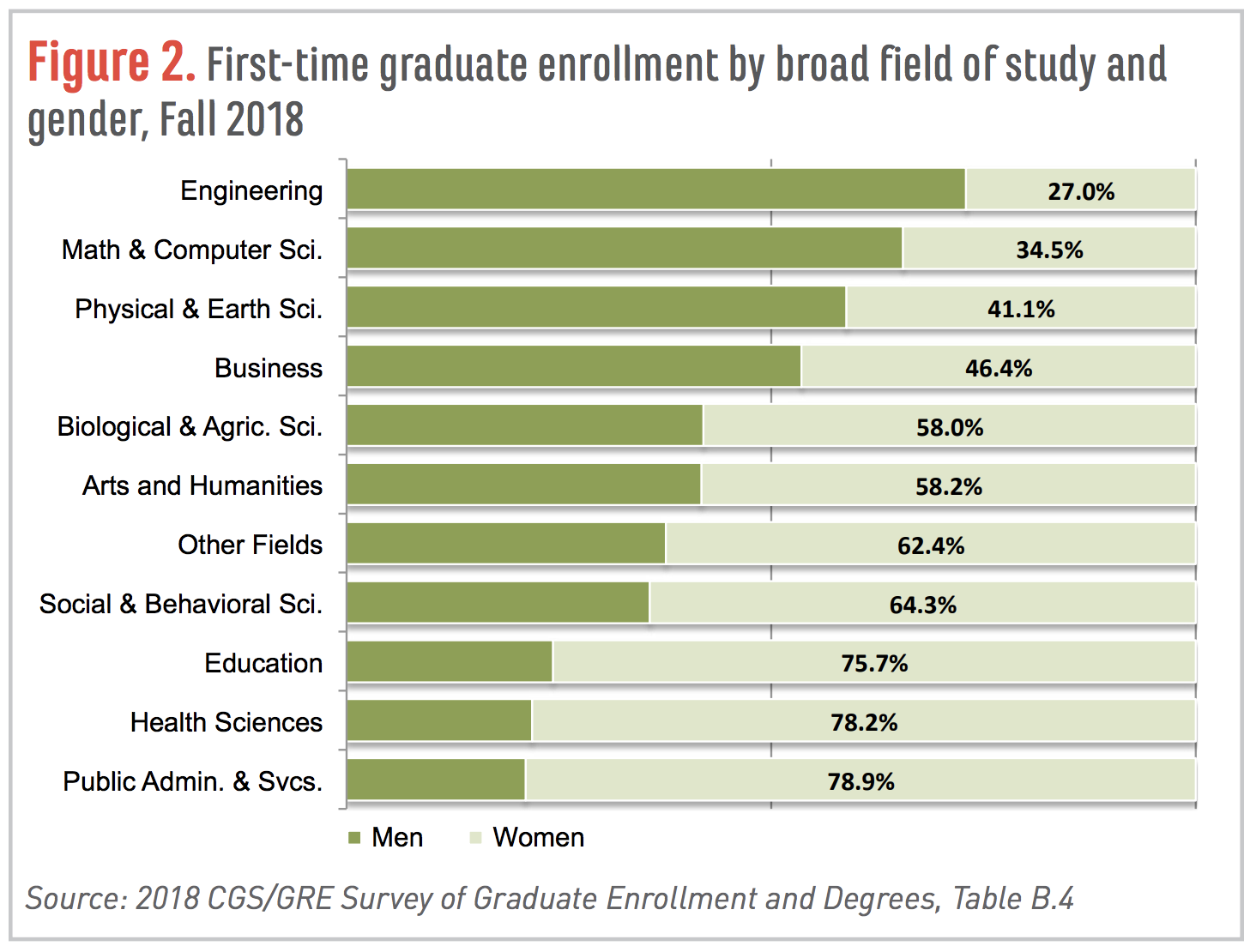
Engineering actually dropped, but the reason for that seems to be political (see below).  Engineering remains America’s most popular graduate field, and STEM as a whole continues to dominate:

Some of the news is not that good.

Public universities did not see an application increase. Applications actually dropped 0.7%.

While women’s number rose overall, “men still constituted majorities of first-time graduate enrollment in business, engineering, mathematics and computer sciences, and physical and earth sciences…”

And international numbers continued to go down: “First-time graduate enrollment of international students decreased (-1.3%) between Fall 2017 and Fall 2018.”  Hence one disciplinary surprise: “the decline in engineering enrollment is largely driven by a decrease in international students.”

It’s interesting to compare this report about graduate programs with undergrad enrollment.  Disciplinary patterns are fairly similar, with STEM booming and the humanities not doing well.  Women, now the majority of students, keep rising. There are more efforts to attract and support underrepresented minorities.

I do wonder about universities facing down undergrad enrollment declines.  How many are thinking about bulking up their master’s programs?  And how much further will international numbers fall?

Posted in enrollment | 1 Comment

Six years later: Bryan Alexander Consulting in 2019

Six years ago Ceredwyn and I launched Bryan Alexander Consulting.  From that day on we’ve shared our story, being open and transparent about the enterprise.*  An update is now overdue.

tl;dr version – we’re doing well, growing and developing, boosted by a big move.

BAC logoIf you’re new to the story, BAC is a consulting firm specializing in the future of higher education.  We’re a small shop, featuring two full-timers plus whomever else we can wrangle for individual functions and services.  Most of our infrastructure is digital and distributed.  We offer a range of services and also make a lot of stuff: books, articles, interviews, video conversations, and more.  We’ve served more than 100 clients, including universities, governments, companies, and nonprofits (here’s a partial list).

Over 2018-2019 BAC was hard at work.  Some operations carried over from previous years, such as consulting in various forms, giving keynote addresses, blogging, non-blog writing, and running the Future Trends Forum weekly videoconference.  My new book, Academia Next, went from outline to chapters to indexing, and is due out in a couple of months.

Other services started for the first time, or changed significantly.  I began teaching in Georgetown University’s Learning, Design, and Technology program, partly online, partly in person. This delights me deeply.  I started offering more presentations wholly online – i.e., via video or telepresence robot.  The FTTE report transitioned from free to a subscription model.

Some of those changes are due to the biggest change by far.  We upped stakes and moved from Vermont to northern Virginia, near Washington, DC.  This was an epic struggle, including a 500-mile trip starting from a blizzard, but we made it (with some blogging).  I owe you all some reflections on the many differences; for now I’ll just say that there have been many improvements for BAC.  We’re within commuting distance of Georgetown, so I teach in person.  Digital infrastructure is far better than Vermont’s, so I can actually conduct video work from home, while uploading and downloading massive files.  Travel infrastructure is also much better, with two major airports within an hour’s drive and a train station five minutes away.  And so, so much is going on in DC, from many educational organizations being based there to national events and new technologies in play.  BAC-DC is certainly a big step forward for the firm.

How’s the business doing financially?  Overall, pretty well.  Demand has risen since the move, and we do speculate on the reasons.  (Do people see the DC area as a kind of promotion?  How much depends on the Georgetown affiliation?

buy valtrex online buy valtrex no prescription generic

Is it just easier to connect with me?) The move was much more costly than we anticipated in terms of money and time, so we spend a good chunk of the past six months addressing that.

Let me offer a breakdown of BAC’s revenue streams:

BAC revenue 2018-2019

To explain:

Speaking: these are keynote addresses to large audiences, such as associations, governments, business meetings, or large university settings.

Consulting: this is actually a very diverse set of offerings.  It includes facilitating meetings, designing and leading workshops, conducting research on spec, teaching university classes, advising officials on technologies and education, and more.

Virtual events: video-based presentations or consultations.  Lower price tag.

FTTE: this represents subscription fees, either from institutions or individuals.

Patreon: support from 127 supporters.

Royalties: this includes sales of books (The New Digital Storytelling, 2nd edition; Gearing Up for Learning Beyond K-12), sponsorships, and clicks to the Amazon Affiliates bookstore.

Unsurprisingly consulting is the largest revenue stream, almost exactly 1/2 of BAC’s income.  Speaking gigs are a close second.

Bryan sharply addressing Nebraska with FTTE

The rest are much smaller, relatively, but will hopefully grow, especially as my new book comes out and people become more accustomed to virtual presentations.

This tells me that people value most highly my in-person work, which is, of course, enormously flattering, and objective confirmation that BAC provides a certain value.  However, it does pose questions of scale, since I’m just one person, with limits on my time – limits which will rise as I keep aging (turning 53 in February).  Accordingly BAC fees will rise a bit in 2020 (an overdue increase, in fact), and I will allocate more resources to more scaleable efforts – i.e., media.

Speaking of media, there are a bunch of items on our punch list for the next few months:

  • Refreshing the BAC website
  • ” ” FTTE “
  • Moving the Future Trends Forum page and setting up a more serious site
  • Finishing podcast planning and production, so the damn thing can actually launch

In non-media terms, I’d like to explore holding face-to-face meetings about the future of education.  I’ve done this before with the NERCOMP group, organizing workshops and groups on the future of multiple topics (2015, 2016), on 3d printing in academia (2015), on VR/AR/MR in education (2018), and more.  We could offer a program like this as a standalone event in an accessible location, or attach it to another one.

Stepping back, what are the values BAC embodies and tries to express?

  • The value of human connection. We believe in people learning together, be it through video conversation, in-person meeting, or via social media.  We think we can be smarter together, even in an age of trolls.  I bring information to clients, and they bring me a lot of their own.  It’s a virtuous cycle.
  • The value of openness.  Ever since the start we’ve shared BAC’s adventure in ways that very few others have done.  There are some things we can’t share for reasons of privacy (ours or clients’), non-disclosure agreements, and so on.  Otherwise we are quite transparent about what we do, what we learn, and where we’d like to go.  That’s a better way for us to learn and to contribute.  Hence this very post.
  • The value of giving back.  The supermajority of BAC work is paid, but we also try to participate in the world without remuneration as much as we can.  So I’ll go to one or two events each year, unpaid, because the cause is worthwhile.  I make a lot of digital content, nearly all for free, and the benefits are manifold.  This is part of our sense of human connection and openness.

I think these all intertwine.  By sharing my thoughts socially I get to learn from how other people respond, which improves my thinking.  Sharing what folks say in my workshops and presentations in my writing enriches the latter.  BAC is all about networks, in other words.

What else would you all like to know?  What do you think of our work?  Anything you would like us to do?

If you’d like to engage or support BAC, you can consider our services, subscribe yourself or your institution to FTTE, support us on Patreon, leave comments below, or contact us directly.

* Previous BAC reflections can be found here: 2018, 2017, 2016, 2016, 2015, 2014, 2013.

Posted in Bryan Alexander Consulting, personal | 14 Comments

How likely are campus mergers?

Are campus mergers a sustainable strategy?

A recent Chronicle of Higher Education article does a good job of explaining just how rarely academic institutions merge, at least so far.

Let me summarize the high points, then add some comments of my own.

Robert Witt (chancellor emeritus of the University of Alabama system, president emeritus of the University of Alabama) and Kevin P. Coyne (senior teaching professor in the Goizueta Business School at Emory University) start from evidence: “every college closure, merger, and acquisition from 2016 through the end of the most recent academic year — 163 of them across all types of institutions.”

Their analysis is that in two sectors – private and for-profit higher ed – campuses are much more likely to close than merge.  “Among private nonprofits, 55 institutions ceased to exist. Of these, 41 were closed, and 14 were consolidated through mergers.”  When mergers happened, they usually involved one partner with a very specific, very narrow focus:

fully eight of the 14 consist of small, highly specialized niche schools in such fields as music, the fine arts, and medicine being absorbed into larger nearby institutions.

These include such examples as the Salt Institute for Documentary Studies being absorbed into the Maine College of Art, the Bridgeport Hospital School of Nursing being absorbed into the University of Bridgeport, and the School of the Museum of Fine Arts, Boston, being absorbed into Tufts University. Similarly, another one, Union Graduate College’s merger with Clarkson University, involved an institution that granted only graduate-level degrees.

Michael Coghlan, photo of merging railroad lines

What about public universities? “Public colleges took over many nonprofit institutions during this period (33) —but only other public colleges.

buy neurontin online buy neurontin no prescription generic

”  The rationale?

Presumably, they were ordered to do so by their governments, because as a matter of public policy, governments do not close failing institutions. (As evidence, not a single public institution was listed as “closed” during this period.

buy amoxicillin online buy amoxicillin no prescription generic

)

Overall Witt and Coyne are very sanguine about mergers as a campus strategy. “For most struggling colleges, the only route to survival will be through making optimal academic and operating decisions and implementing them with an emphasis on productivity and cost management.”

Some thoughts of mine to add:

Yes on public universities.  Closing one has got to seem terribly embarrassing to a state governments, a sign of failure or impending shrinkage.  Recall that Massachusetts set up policies to help mitigate the impact of closures.

Yes on the difficulties facing private colleges trying to merge.

buy zovirax online buy zovirax no prescription generic

  I’ve written about this recently concerning a failed one in New England.

Let me put it this way.  It takes the reality or prospect of imminent financial disaster to bring a campus leadership to consider a merger.

buy symbicort online buy symbicort no prescription generic

  That doesn’t necessarily make for an attractive prospect to another institution, unless the ailing campus has some unrealized strengths that the partner can embrace.

And yet.  If the current tide of pressures on higher education doesn’t recede, will publics drive state universities to pick up stricken peers, public or private?  Will well resourced institutions decide to acquire weakened campuses in gestures of goodwill?  If not, we should expect continued queen sacrifices and closures.

(for Paige Francis)

Posted in strategies | 2 Comments

Some podcasts I’m listening to in 2019

Every year or so I recommend some podcasts that I’ve been listening to.  Since today is International Podcast Day, it seems a good time to issue a blog post update.  (previous posts: 2018, 2017, early 2016, mid-2016, 2015, and 2013)

And there are a bunch, nearly 50.  I’ll break these out by category.  Some programs really fit in two or more, so I made do.  I’ll also add episodes I’ve been on.  (And yes, planning continues for my own podcast series or two.)

What follows are either currently running programs or ones that concluded very recently.

podcast bunny(And can I saw how awesome it is to see this current, second wave of podcasting grow and develop?  What a splendid development in digital storytelling!)

Storytelling (nonfiction)

Risk! Personal stories about, well, risky stuff: sex, drugs, violence, madness, fun, and horror.  It’s as if the Moth showed up at your door at 3 am, drunk, half dressed, waving a stick of dynamite, and insisting that you have to listen.

The Story Collider: fine personal stories about science, performed Moth-style.

Storytelling (fiction)

Clarkesworld Magazine podcast: beautifully read fantasy and science fiction short stories, with many women and non-US writers represented.

The Magnus Archives: excellent British horror stories. Each episode is a single recording from the titular archives, a first-person relation of some creepy event.  All stories knit together into larger arcs involving the archives, their hapless staff, and their own mysteries.  Excellent audio performances.  Meanwhile, the same group is responsible for the very, very silly Stella Firma, an improv science fiction show.

NoSleep: scary short stories, initially told as campfire tales, and now as something like anthology horror.  Excellent MC-ing.  Very funny riffs on sponsors.

I meet another SFF Audio guest

I meet up with another SFF Audio guest, Paul Weimer.

SFF Audio: the indefatigable Jesse Willis hosts readings of and discussions about classic and little-known science fiction and fantasy stories.  I’ve been a guest a bunch of times.

Starship Sofa: science fiction stories short and long, plus poetry, science, discussion, and the awesome MC-ing of Tony C. Smith.  The first science fiction podcast to win a Hugo award, and the first denizen of the District of Wonders.

Tales to Terrify: horror stories long and short, plus some commentary and bouts of ghost hunting. Also in the District of Wonders.

Politics and current events

Arms Control Wonk: a group of experts probe current developments and recent history.

Behind the News with Doug Henwood: host and guests discuss current events (American and international) from a left perspective.

The Daily: each episode looks into a current story, then adds a summary of leading events.  New York Times.

The Dream: a deep dive into the grift-heavy world of multi-level marketing.  This is important stuff, alas.

Economic Update: a look into major economic issues from current affairs from a left perspective.  Richard Wolff is very engaging.

On the Media – analyses of contemporary journalism and related issues, from a progressive perspective.

podcast group

Radio Open Source : not about technology, but a wide range of current events and culture, with a strong Boston flavor.

Slate’s Political Gabfest: an elite, East coast, urban, liberal look at current politics.

Culture

Beyond the Book – a look into the book publishing industry.  It’s clearly biased in favor of strong copyright policies and practices, a bias I don’t share, but the program is also very informative.

In Our Time – superb, high-speed conversations about history, science, and culture.  One of my favorites.

Reading Envy – a librarian and her friends discuss what they’ve been reading.  I’ve been a guest several times (2014, 2014 again, 2015, 2016, and 2017) and still Jenny allows me back.

History

13 Minutes To The Moon: a detailed look at Apollo 11, with the nifty narrative device of focusing on the titular moments, which serve as a springboard to understand the US space effort as a whole.

BackStory: each episode explores a major theme across American history, often starting from current events.  There are now new and more diverse historians on board, and each program is more fluidly structured than it was at the start.

Behind the Bastards: stories of terrible people, mostly mass murderers and/or grifters.  Robert Evans hosts with a mix of historical curiosity, moral passion, and a cruel sense of humor; comedians guest.

HardCore History: excellent, thoughtful, detailed explorations of intense historical events, from ancient Persia to the Cold War. Host Dan Carlin is mesmerizing in a growling, thoughtful, passionate late night radio way.

History Extra podcast: interviews with writers covering a range of historical topics with something of a British perspective.

Revolutions: excellent, accessible, rich history of revolutions in Britain, America, France, Haiti, and south America, among others.  Mike Duncan is very good, offering well organized and compelling presentations laced with a mordant sense of humor.  Currently he’s on the Russian Revolution and doing a fine job.

podcast setup in black and whiteStuff You Missed in History Class: each episode covers a historical incident from a wide range of time, with an emphasis on relatively modern and western subjects.  Hosts Holly Frey and Tracy V. Wilson are splendid: deeply knowledgeable, humane, funny.

Futures

The Disruptors: a look into visions of the future, through interviews with a wide range of people .  Matt Ward’s a fine host. (my appearance)

Flash Forward: a nice mix, with each episode focusing a particular “what if,” offering a story taking place in that world, followed by a discussion from the present.

Spark: a CBC exploration of the future.  Norah Young is a great host. (thanks to Ken Bauer)

Seminars about Long-term Thinking: presentations to the Long Now Foundation on a variety of topics (history, science, culture) through the lens of very long-term thinking.

Education

EdSurge on Air: this education reporting and analysis team also has a podcast.  They cover K-12 and post-secondary education. (my appearance)

EduFuturists: a British team looks into ed tech.  I think the emphasis is on K-12.

FutureU: interviews with people researching and/or leading changes in higher education.  Jeff Selingo and Michael Horn are genial, thoughtful, and energetic hosts.

Higher Ed Social: conversations about different aspects of education.

Research in Action: Katie Lindner’s show is hosted by Oregon State University Ecampus, and does what it says.  Every week dives into cutting-edge research about higher ed. (my appearance)

Teaching in Higher Ed: Bonni Stachowiak interviews a wide range of guests involved in postsecondary instruction. (my first appearance)

Technology and science

99% Invisible: plunges into architecture, infrastructure, and the built environment, always finding good stories. (thanks to Chris Lott)

a16z: a look into emerging technology from the perspective of Silicon Valley venture capital fund Andreessen Horowitz.

The Contrafabulists: Audrey Watters and Kin Lane critique technology with attention to education, APIs, and business.

Engines of our Ingenuity: short, well done monologues on technology, inventions, and people.  Every single episode has a transcript and references.  Did I mention they’ve done more than 3,200 shows so far?

Radiolab: fine storytelling about unusual ideas in science.

Reply All: looks into the digital world, pulling out cultural or whatever stories it finds interesting.  It’s energetic, friendly, trend-obsessed, and hard to stop listening to.

The Story Collider: fine personal stories about science, performed Moth-style.

Techdirt: conversations about various digital topics. This can include rich details about technologies and policy.

Economics

EconTalk: interviews with major economists conducted by a puckish, provocative MC.  Every single episode has an annotated, hyperlinked transcript completed with time markers, references, and suggested readings: bravo!

Slate Money Podcast: very useful, both informative and engaging, with a healthy amount of self-deprecation, although I miss Cathy O’Neill.  The only Slate podcast I genuinely like, on balance.

*******

Have you heard any of these?  What else are you listening to?

(images by Alan Levine, Montclair Film, David Shortle; one correction thanks to Warren Blyth)

Posted in digitalstorytelling, podcasts | 5 Comments

What Americans think of the present and future of science and technology

Where will science go in the future, and how will that impact our lives?

I’ve been tracking this question for a while, so it’s good to have fresh research to hand.  A new Pew Research survey asked Americans what they thought about the future of science.

The results are a bit counterintuitive and very important for anyone interested in technology or education.  I’ll pull out the findings I find most interesting and useful.

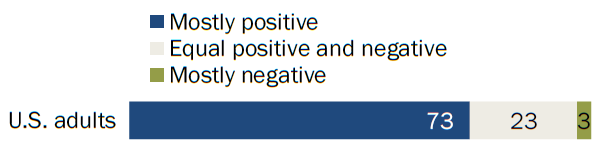
To begin with, Americans are very, very positive about science.  Despite the present techlash, despite Democrats’ fears of anti-science Republicans and Republicans’ worries about liberal woo, about 3/4ths of us hold a mostly positive views.  Only 3% deem science to be mostly negative.

views of science

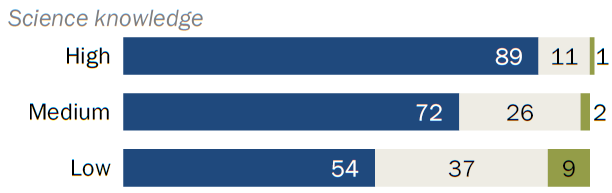
Unsurprisingly, those attitudes towards science correlate with knowledge of science. Pew sketched out that information level not by educational attainment, but through an 11 question battery added to the poll.  I’m not sure how rigorous that is.  The results make intuitive sense:

views of science based on knowledge of science

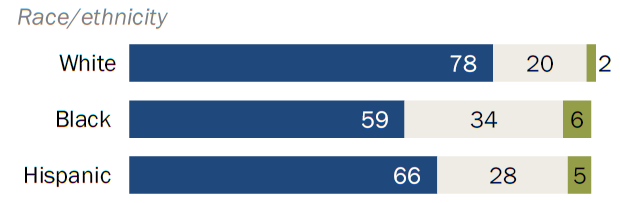
There are significant divides by race, with the largest gap opened up between blacks and whites:

views of science by race

(Again, I wish Pew tracked Asian-Americans)

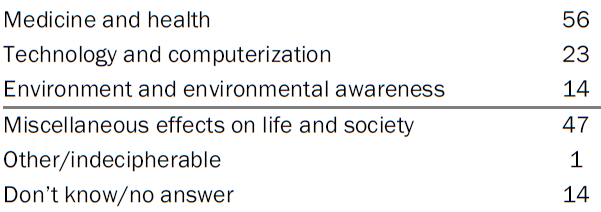
Pew then asked what Americans like most about science.  The results are fascinating:

what Americans like about science

Science for health care is the leader by far.  The digital world is far behind it, barely mustering a quarter – and this might be a sign of the techlash settling into American culture.

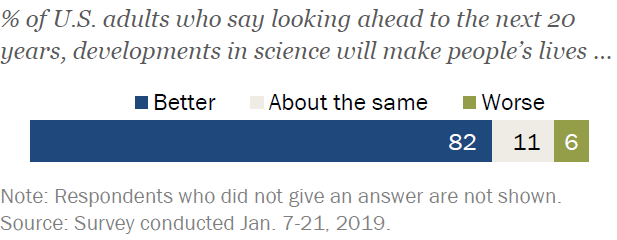
Looking ahead, Americans are as happy or even happier about science in the future as we are of it in the past.

Americans look ahead to science

That echoes the first result in this post and goes beyond it a bit.  Again, the techlash and various culture war science arguments seem to have little impact on our overall sense of science’s possibilities.

Racial differences persist here as well:

Large majorities of white and Hispanic adults (84% and 83%, respectively) and somewhat fewer black adults (74%) are optimistic that new scientific developments will improve lives.

Our love for science in health care extends to the future as well as the present:

Here, too, medical advances prevail in the public mind as a likely source for improvements ahead, with six-in-ten U.S. adults (60%) referencing this topic when asked to think about developments in science that will make people’s lives better.

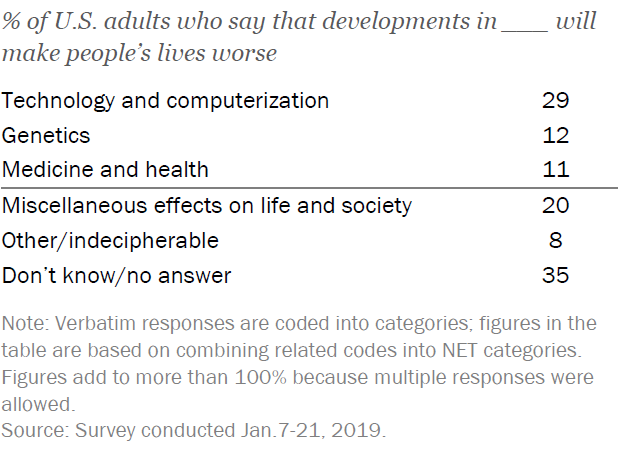
Now, on the negative side, what do we fear about the future of science?  Here the techclash appears clearly, with the digital world leading the way:

what Americans fear about the future of science

What can we take from this?  A few thoughts.

The correlation between attitude and knowledge may influence efforts to increase science education.

I’m not sure what to make of the racial dimension going forward (the historical reasons are quite evident).  Perhaps a Democratic party striving to focus on black and Latinx voters and donors will be slightly less inclined to be publicly pro-science.

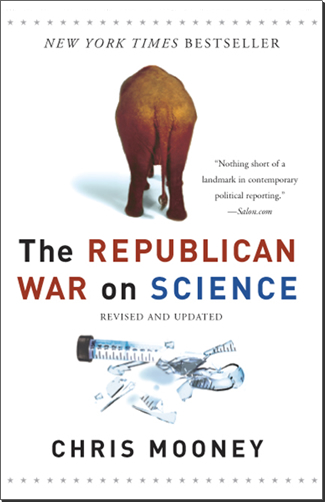
Mooney_GOP war on scienceWhat does it mean that a large majority of Americans are bullish about science and tech, while we also hold many anti-science views, from climate change denial to quack “medicines”?  I think four possible explanations are in play.

  1. Many forms of science skepticism just hasn’t won over many adherents.  Science studies, for example, never really climbed back up from its humiliation in the Sokal hoax.  Creationism/intelligent design has suffered nothing but failure in public policy.  Democratic candidate Williamson, while making splashy appearances, only polls around 1% (538).  Meanwhile, even though the techlash is going great guns, the technology companies move from financial and user base strength to strength.
  2. People compartmentalize.  They can believe that climate scientists are scamming the world, or that evolutionary biologists are destroying religion, or that NASA endorses magic skin patches, while at the same time enjoying the benefits of ibuprofen, cryptography, air travel, and GPS navigation.  While this may look like a contradiction, it’s quite liveable.
  3. People focus their dislike on a sliver of science, not the whole.  Climate science and evolution are tiny, tiny strands of the overall fabric of scientific inquiry, statistically.  While historians, economists, and academics in general tend to see all sciences as a big slab, or folded into STEM, it’s easy to separate out the different fields.  For a parallel, see conservatives who despise the academic humanities, but happily read into history, literature, religion, and philosophy.  Or for an example further afield: I despise American cheese, but love most cheeses, and don’t see the former as an obstacle to the latter.
  4. Health care is especially important.  My intuition here is that advanced health care is such a valuable good as to overpower or sidestep opposition to other parts of science.  It seems that people who worry about specialists being uncaring elites and folks who celebrate other forms of medicine will ultimately accept antibiotics.  We know that health care is enormously important in American politics and life.  We put up with all kinds of awkwardness, horror, and immiseration in its pursuit; it’s far easier to set aside qualms about Darwin or science’s colonial history when seeking cancer treatment.

One more thought: I wonder if the rise of geek culture into the mainstream has helped build science’s reputation.

What does all of this mean for higher education’s future?

It’s good news for allied health, of course.  Pre-med, biology, physiology, radiology, etc. are well thought of and unlikely to be attacked.

That 29% of people who see technology problems ahead can augur several changes.  Computer science might become unpopular – not in terms of enrollment, necessarily, but politically and culturally, from the national level down to campus.  Fields perceived as critical of tech – media studies, science studies – might become more popular.  The use of technology in research might receive some criticism, although that isn’t too visible now – and when it is, through lovely photos and video, we love it.  In contrast, that 29% might start to resist technology in instruction.

The tracking of low knowledge to high skepticism might translate to more support for general science education: public intellectual work, a la Neil DeGrasse-Tyson; more core curricular requirements for non-science majors; outreach to K-12.

For this survey and its topic, I’d love to see more details.  What results if we look at education, gender, geography, age?  This AAAS study gives some interesting insights that way.  Has anyone surveyed by comparative scientific field – i.e., asking folks what they think of biology versus astronomy, etc.?

And for you, dear reader: what does your immediate world think of science?

Posted in education and technology, futures, technology | Leave a comment

A global futures event is happening online this November

I’m very excited to share news of an upcoming futures event taking place online later this autumn.  It’s one I’ve worked on, and want to invite you all to check it out.

On November 9th the Association of Professional Futurists (of which I’m a board member) is holding an online Futures Festival.  Its theme is Radical Transformations:

We see ‘radical’ not as something negative, but to stand for nontraditional, visionary, creative, ingenious. We seek people and projects harnessing disruptive ideas to upend the status quo, challenging the dysfunctional, restructuring political and civic engagement, addressing social and environmental problems, and reframing extremist agendas (to name a few examples).

Those presentations and discussions will start at 7 am UTC (3 am EDT) and end at 7 pm (3 pm EDT).  That’s twelve hours of futuring. Did I mention that the event is free and open to all?

Why those hours?  Because the event is global, aiming to involve as many people from around the world as possible.  We are especially focused on representation from populations typically underrepresented in forecasting.  (You can see that strategy in the festival team‘s makeup.)

Speaking of which, there is room for more presenters.  If you are able to speak to your own radically transformed future vision, click here.  The process is very welcoming!  In fact, a previous presenter wrote up their experience as a guide. And there’s more info:

Sessions are in a variety of formats, and range in length from 30 to 60 minutes, including time for group discussions. In addition to your live session, your FF’19 video recording will be publicly accessible and promoted through social media after the event.

Of course, you can register as a participant – again, for no cost – right here.  All are welcome.

The event has a social media presence.  These hashtags should let you track things across Instagram and Twitter:  #futuresfest19 and #radicalfutures.

Please join us on November 9th as a participant, presenter, or both.

Posted in futures | Tagged , | Leave a comment

When a campus merger falls apart

For years I’ve been forecasting more mergers in higher education.

buy nolvadex online buy nolvadex no prescription generic

I never said they’d be easy to do.

Case in point: this summer I noted that Marlboro College in Vermont agreed to merge with the University of Bridgeport in Connecticut.   This week that attempt at a union fell apart.

What happened?

The Inside Higher Ed article doesn’t provide anything from Bridgeport, besides a quiet, abstract comment from president Laura Skandera Trombley: “moving through the months of negotiations, we became increasingly concerned and decided that it was probably in our best interest to withdraw.”  Concerned about what?  “Trombley declined to elaborate.”

Marlboro’s president, Kevin Quigley, had more to say.  Listen closely to this passage:

“We were really attracted by the compelling vision that Bridgeport had for us, but despite our repeated efforts to understand how that vision would be implemented programmatically and financially, we really never got any details over three months of negotiations. We wanted to understand how Marlboro endures.”

How the college endures: recall that Marlboro is much, much smaller than Bridgeport.  Marlboro taught 150 students, while 5434 take classes in Bridgeport.  We can infer that there were questions about how the smaller institution would exist within the larger.  Think of traditions, reputation, governance, habits, identity – and how all of that could be dissolved in the new entity.

The official Marlboro statement focused on those issues:

As the smaller institution, Marlboro College was especially determined to protect the integrity of its rigorous, self-directed academic model and self-governed community. In addition, Marlboro needed assurances on UB’s enduring commitment to the Vermont campus and guarantees that the wishes of Marlboro’s generous donors, who established the College’s current sizeable endowment, would be maintained.

We can infer that Marlboro did not receive those assurances.  Especially not over the long haul (“UB’s enduring commitment”).

buy fluoxetine online buy fluoxetine no prescription generic

  Integrity: just how autonomous would the new Marlboro be within the relatively vast Bridgeport world?  Self-governed community: it sounds like Marlboro resisted being integrated into UB.

We could get even more direct.  What if a leading value Bridgeport saw in Marlboro wasn’t pedagogy or tradition, but real estate?  In that Inside Higher Ed article, Trombley initially applauded these things about the Vermont campus: “faculty exchanges, partnered courses and Bridgeport’s greater access to outdoor facilities — including Marlboro’s organic farm and 18 miles of cross-country trails.”  That’s a lot of nice physical plant, in addition to the (relatively) small curriculum.

Colleen Flaherty adds this: “Quigley said the ‘right partner’ may want Marlboro’s campus to be an immersive retreat or something similar.

buy vardenafil online buy vardenafil no prescription generic

Some 130 acres are designated as an ecological reserve.”  Again, valuable real estate.

In contrast, here’s what a Marlboro professor focused on:

Rosario de Swanson, professor of Spanish, Latin American literature and gender studies at Marlboro, said it’s admirable on one hand that the college “walked away from the merger because it means that perhaps it was not the best for the integrity of our program and faculty.”

Program and faculty, not grounds.

We don’t have a lot to go on here, since so much of the merger discussion happened behind closed doors, including some NDAs, but these communications from all sides  sound like a shared sense of value in the lands Marlboro owns.  Perhaps that’s what Bridgeport valued most highly, acting accordingly, and Marlboro grew to resent it.  Reread this line in that context: “despite our repeated efforts to understand how that vision would be implemented programmatically and financially, we really never got any details over three months of negotiations…”  Perhaps those details weren’t as important as the prospect of UB owning a nice bit of upper New England.

buy doxycycline online buy doxycycline no prescription generic

The merger failure may also involve problems associated with Vermont’s struggling higher education sector.  Flaherty notes what my readers know well: “Southern Vermont College, Green Mountain College and the College of St. Joseph closed this year. Burlington College closed in 2016. Goddard College is on probation with the New England Commission of Higher Education.”  Two other campuses merged to become Northern Vermont University, and now students, staff, and faculty there sound scared about what might happen to them.  Perhaps Bridgeport assessed Vermont in a grimmer light this fall than they did in the summer.

CTPost reports this statement, which seems to agree:

UB’s reasoning for walking away from the merger discussions was further explained by Trombley in a message to the UB community Friday night.

“As you are all aware, liberal arts colleges are struggling nationwide and the hardest hit state is Vermont, where they have seen four institutions disappear over the past year,” Trombley wrote. “While we hold Marlboro in great esteem, we have concluded that their challenges are too great for us to proceed.”

“the hardest hit state [in the nation] is Vermont…”  Did UB come to think of Marlboro as more costly than it first did, or even as a poison pill?

So what’s next?  Again, Bridgeport is silent, but Marlboro is openly ready about looking for new merger partners.  According to VTDigger,

The college had set out to find a potential college to merge with about a year ago. It ultimately received four written proposals, including from UB. Quigley said Marlboro, which is once again looking for a partner, would be returning to those potential merger partners.

“They’ve all expressed a willingness to pick up the conversation,” he said, adding that the school was also willing to talk to other interested institutions.

In a VPR post Marlboro’s president was open about possibilities, including closure:

“We’ve laid it out — our strategy of trying to do the best we can to make it on our own, to explore partnerships,” he said. “And if that doesn’t work out, and this is our far least preferred option, is to close but to do it in [an] ethical fashion as humanly possible.”

What does this tell us about the future of higher ed?

Primarily, that mergers are both appealing to contemplate, especially for needy campuses, but difficult to execute.  American higher education believes in a high degree of institutional autonomy, which makes it hard to fold two schools into one.  It must be harder still when the two would-be partners are so different in size: acquisitions, not mergers.

To the extent that we value a college or university’s distinct nature, offerings, traditions, and identity, it will be more challenging to merge them into something new.

Posted in strategies | 1 Comment

Thoughts on chatbots

This week Inside Higher Ed interviewed me and some other folks about chatbots.  I was brought in as ed tech futurist.  Also on deck were leaders of companies actually making chatbots for education: Ivy.ai and Admit.hub.  Lindsay McKenzie did a good job of outlining key aspects of the issue: which functions ‘bots perform, customization, when to defer to human respondents, personalization, and more.

Here I want to go a bit further.

Chatbots now are at a certain developmental level.  They can resemble phone trees or the decision-making flowcharts of certain computer games, letting users navigate through them Choose Your Own Adventure style (one example).  They can also work with natural language do a basic degree, one that improves gradually. They are typically text only, although some add graphics and even animation.

Most are narrowly functional, like this one, aimed just at keeping you from falling asleep.  Others work as communication adjuncts, spreading a message with something more interactive than mass messaging or spam (for example).  Some handle discussion moderation, as on Reddit.

At present virtual assistants Alexa/Siri/et al in many ways function as chatbots.  They are much more fluent and have greater capacity, but are structured in similar ways: precoded responses to a fairly narrow set of inputs.

Beyond that?  How could the field change as the tech improves, especially with incremental development and the impact of AI?  And there’s a lot of work to do on that improvement.*

We could simply see more use of chatbots.  Earlier this year Gartner forecast 20% of customer interactions taking place with bots by 2020.  Extend that a few years out.  Add to it our rising shift towards messaging apps, which are in many ways better situated for chatbots than the rest of the media landscape.

Organization and institutions can learn a lot from chatbot interactions over time.  This can be simple and very practical – i.e., a preponderance of questions about printing policies means they are unclear or badly communicated, and that can be remedied.  Or the results can build up into larger policies at the program level.  These reactions can then be fed back down to the bots to help their performance.  Obviously analytics plays a role here.

If bot personalization deepens and takes hold, we might spend increasing amounts of time with bots (or just one, our favorite).  As individuals we could search not just local data but broader swathes of the digital world this way, or shop.  Chatbots in this vision are competitors to Siri et al., moving from the margin towards the center of our digital lives.

As chatbots improve, more organizations (schools, businesses, nonprofits) could outsource more services to software.  Conversation as a Service (CaaS): as far as I can tell James Melvin coined the term.

One endpoint in this development arc: chatbots, virtual assistants, intelligent speakers, and AI could fuse into one field of human-computer interaction.

Another and related end point for chatbots is to pass the Turing Test.  Some have tried, of course.  Every year bots struggle to convince humans that they’re in the same phylum.  Once this occurs then classic automation possibilities arise, either swapping humans for chatbots or using bots to redefine human work.

On the other hand, chatbot growth could stall or reverse.  First, the technology just might not develop much farther, and we enter a chatbot winter.  Second, the rising dislike of companies using data analytics may block bots from rising at scale.  Third, we just might hate the things.  Most remember Clippy.  And forth, chatbots misfiring or reproducing bias could reduce their appeal.  For example,

So what do these chatbot possibilities mean for education?

The current field of use – campus information – could expand or contract, as per the above.  There are many ways for students (and others) to interact with chatbots short of formal instruction and research: schedules, basic class admin, library materials, fines, applications, student organization information, athletic info, alumni relations, etc.

I wonder about how far chatbots will go in more complex, non-instructional interactions.  The IHE piece notes that Ivy.ai is exploring introducing them to mental health counseling, which echoes my mention of ELIZA, while also eliciting serious pushback in comments.  If such an intervention works, perhaps businesses and campuses will try chatbots on other, sensitive topics, like student life, contentious campus conversations, or HR processes.

We should, of course, see schools trying out chatbots for more instructional functions in a variety of ways.  The fields most likely to be involved are those with easily checked objective content, such as the sciences, following the pattern in AI and automated tutorials (for example).  We could also see a drive to build bots for topics with the largest enrollment, like college algebra.  The largest classes may be well suited for chatbot support, a la Jill Watson. If chatbots stand out in certain professional fields, their college preparatory classes might be more likely to use them.  For example, I’m seeing signs of chatbots in business and health care.

I’m not seeing chatbots replacing faculty for a while, if ever.  They instead seem like supplements to a flesh and blood instructor.

On the other hand, chatbots just might never work well for learning.  One study found a seriously inferior experience:

how student[s] interact with chatbots is fundamentally different to interactions with human teaching staff. Studies showed that students apply simpler sentences, lack much rich vocabulary and get distracted more easily.

At the same time some faculty – and students – will create or edit chatbots, starting with computer scientists.  Open source tools will make this easier, as will commercial learning software.  This should, of course, lead to its own challenges.  Allied to this is research into chatbot use, which can occur across disciplines: computer science, human-computer interaction, psychology, for starters.

Back to personalization: how far will campus-affiliated chatbots connect with the needs of individual learners?  We can imagine software imitating speech patterns, remembering questions over time, or cross-referencing different domains (multiple classes, cocurricular learning, etc).  Will people experience multiple personalized chatbots hosted by the same school?  Will chatbots be able to ingest data from other ones?

Personal conclusion: I don’t always do well with chatbots, as I’m often in a hurry and have a hard time slowing my thinking down to their frameworks.  I do often feel the desire to speak to a human… except in games.

*See, for example, Denys Bernard and Alexandre Arnold, “Cognitive interaction with virtual assistants: From philosophical foundations to illustrative examples in aeronautics.” Computers in Industry volume 107, May 2019, Pages 33-49, https://doi.org/10.1016/j.compind.2019.01.010.

(Chatbot photo from Twitter-Trends)

Posted in technology | 5 Comments

The Future Trends Forum community reflects

Two weeks ago I asked all participants in the Future Trends Forum to reflect on their experience.  Here I’ll share some of the results.

(If you’ve ever participated in the Forum, didn’t get to the survey, but still want to share feedback, please leave comments on this post.  If you don’t want your responses to be public, you can contact me directly.)

71 people responded.  Out of 2,889 in the distribution list, that’s about a response rate of about 2 1/2 %.  So it’s not too representative, but also not too bad, as such things go.

First, I asked about how people use the Forum and what they do with it.

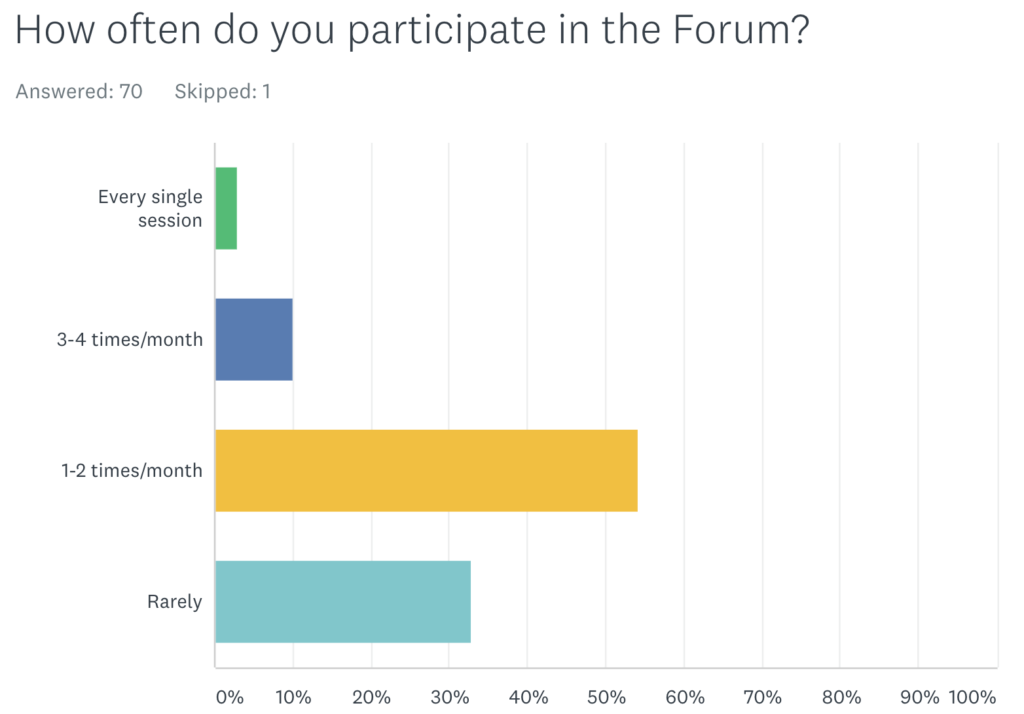
Their participation rates in the live Forum varied, with the leading group attending 1-2 times per month:

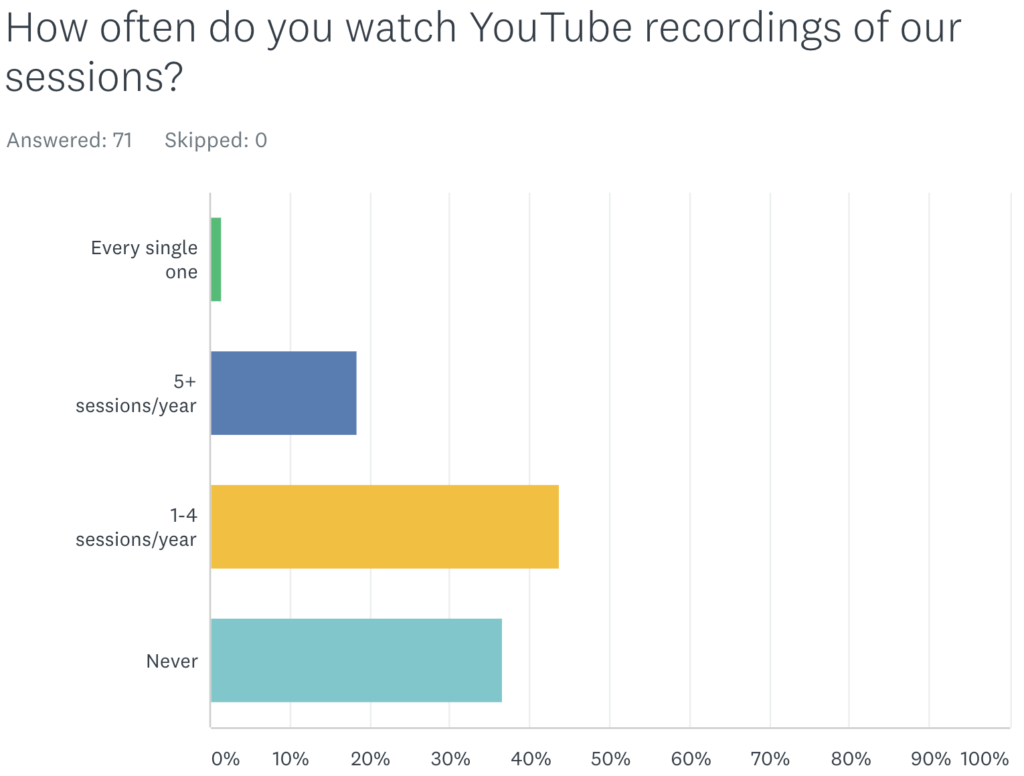
We have a huge archive of previous sessions on YouTube, nearly 170 videos.  Almost half of the population watches 1-4 of them per year; the rest, less than that.

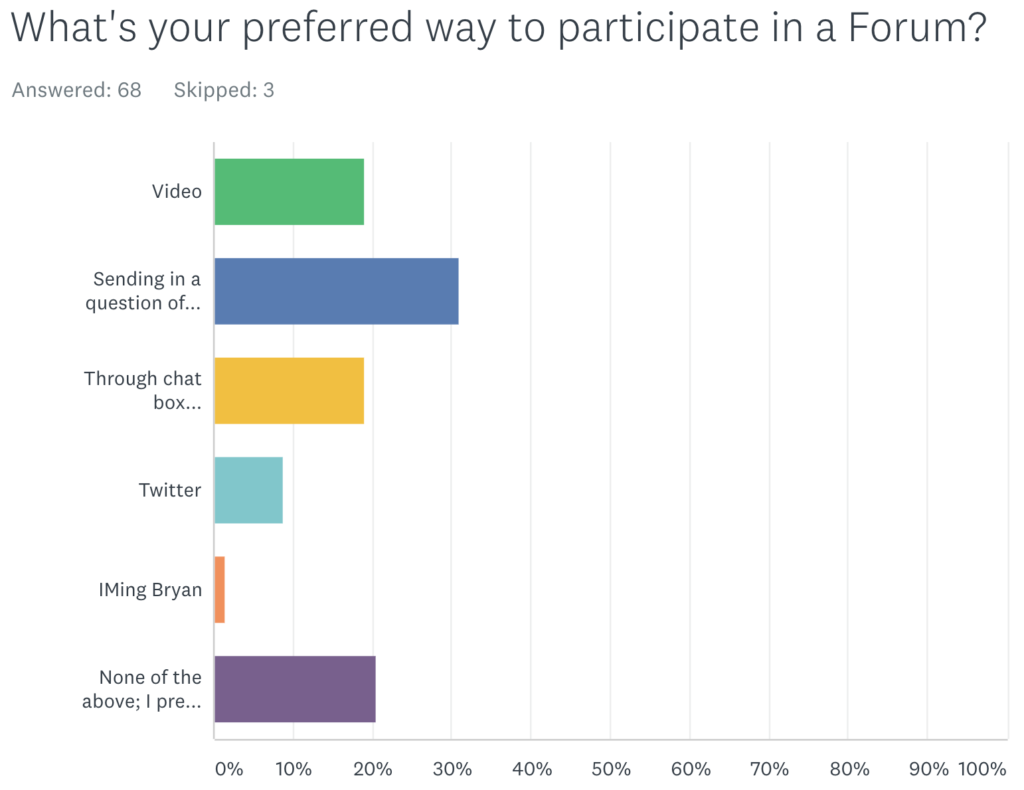
In sessions, how do people prefer to ask questions and make comments?  Responses were quite varied, including using Shindig’s text feature, video, chatting, and Twitter:

About 1/5th prefer to stay silent and just soak it all up.

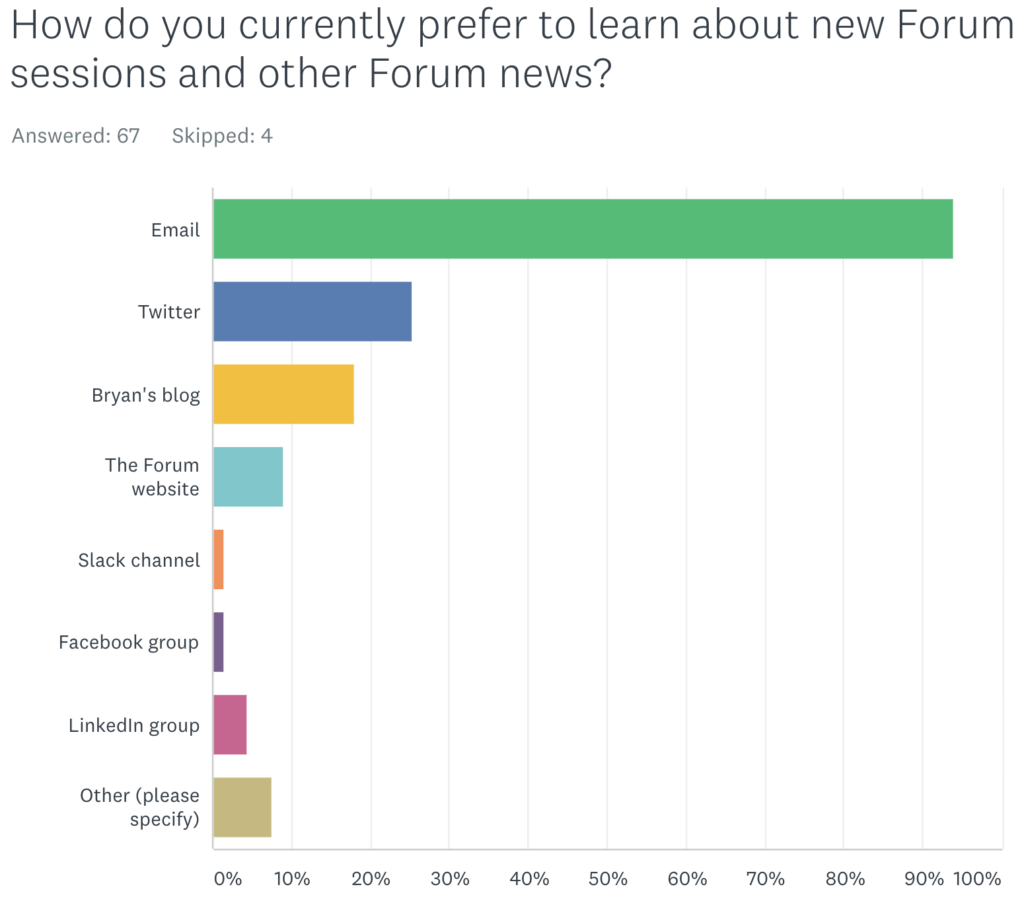
Between sessions, how do people like to learn about upcoming ones?  Email remains, by far, the most popular medium, with Twitter a very distant second:

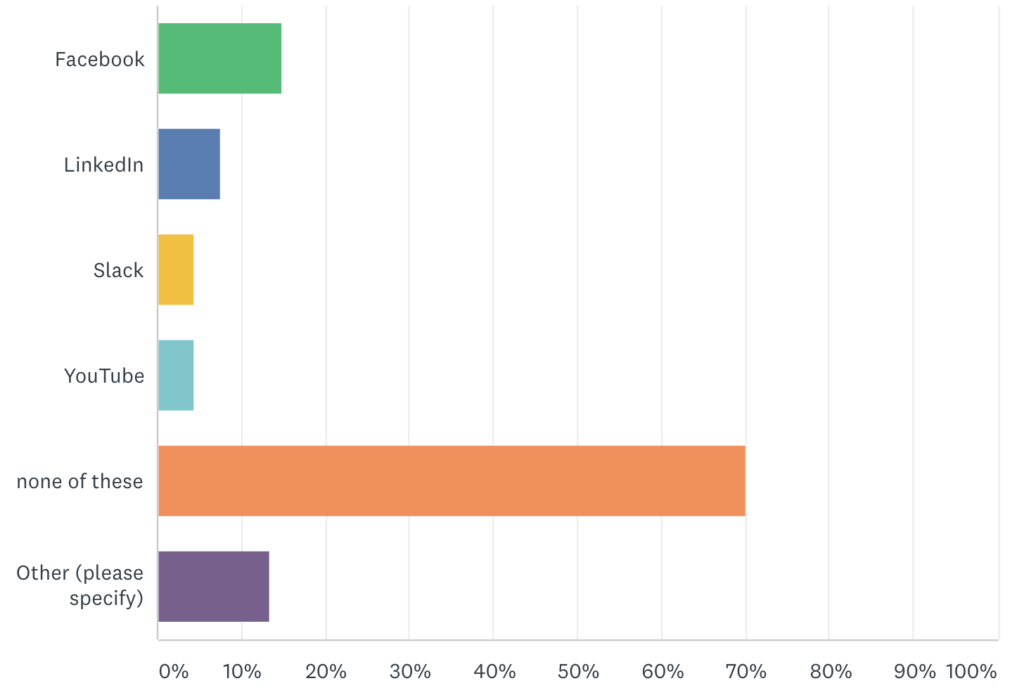
Where do people discuss Forum issues between live sessions?  Our social media platforms are starting to get some traction, led by Facebook, but there’s a lot of room to grow:

I asked who people’s favorite guests were over the past year.  The leaders?   Cathy Davidson, followed by John Seely-Brown and Ann M Pendleton-Jullian.


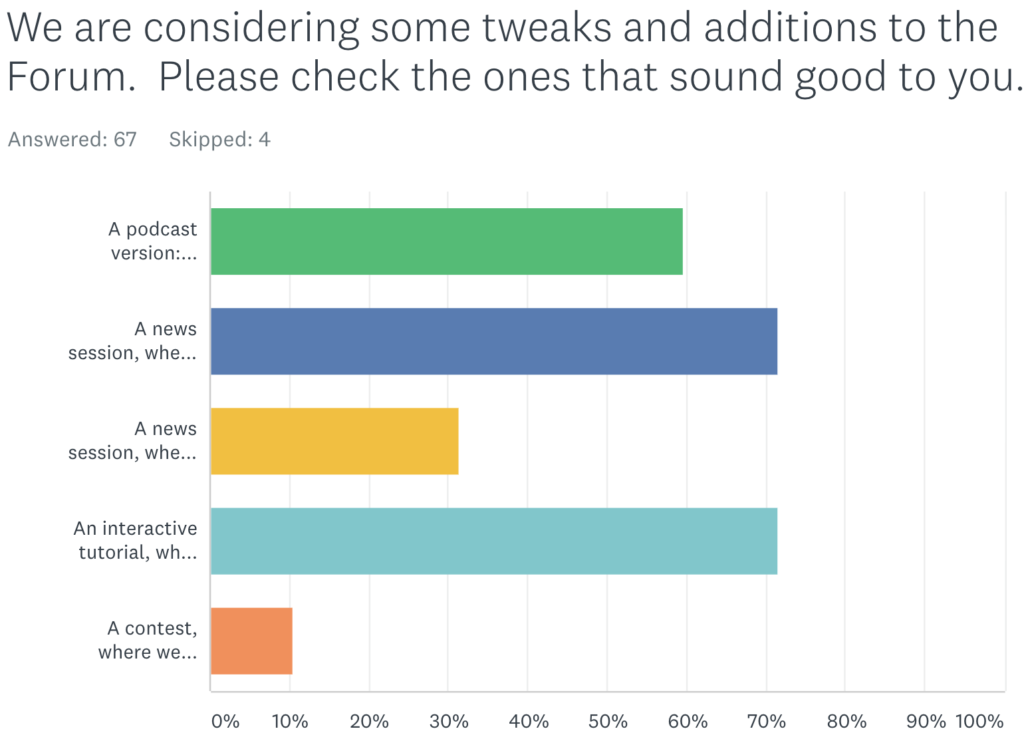
Second, I asked about what they’d like to see in the Forum going forward.  I floated some possibilities.  The graphic below cuts off the text, so let me share the full questions:

  • A podcast version: recordings edited for sound format, published as podcasts.
  • A news session, where panelists respond to recent education news
  • A news session, where *you* respond to recent education news
  • An interactive tutorial, where we dive into a topic to learn about it (copyright 101, why does college cost so much, higher ed in one nation other than the US, intro to Next Gen Learning Management System, etc)
  • A contest, where we collectively determine the winner for a certain thing

Their preferences tended towards news panel and tutorial:

I asked for suggested themes, and plenty came in.  Highlights included big data and data analytics, different institutional types, innovation, AI, economics, pragmatic change, VR/AR/MR, demographics, certification, and, of course, the future.

Last on the survey were recommendation for how to sustain and grow the Forum.  These were all over the place and very rich, including:

  • expand the audience and guests, adding new sectors, more international people, and more diversity
  • offer more face-to-face sessions
  • approach foundations for collaboration
  • sometimes bring in a guest host
  • expand participants’ networking opportunities
  • polling tools
  • return sessions to dive more deeply with certain guests, topics
  • social media: add Instagram, Twitter accounts; ramp up currently used platforms.
  • people like the YouTube recordings, and didn’t realize their extent
  • spinoff artifacts appeal, such as articles or multimedia documents created out of the Forum

To sum up: people generally appreciate the Forum, and have good ideas about extending it.  We want to use social media more, and are just starting to, as email remains central.  There’s a hunger to explore Forum topics through new types of sessions, repeat sessions on key topics, and continuous conversation.

And: many thanks to the Forum community for taking the time to reflect together on this community’s development.  I’m honored to work with you all.

Posted in Future Trends Forum | 2 Comments