A new virus appears in the world

What might we anticipate from the Wuhan coronavirus?  What does a futures perspective bring to the table?
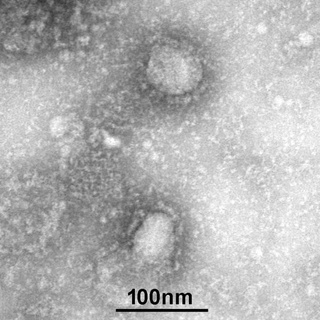
Coronavirus_C-Tan-nCov_Wuhan_strain_01-20200123104509This is a very risky topic to address, naturally.  The outbreak is ongoing.  Data is often provisional or suspect.  Multiple layers of privacy, bureaucracy, local politics, geopolitics, and media stand between us and what’s going on.  All kinds of accounts are contradictory or vague.  And we’re talking about real human lives, some in pain and suffering, some to the point of death.  We can only proceed with great care.

Yet I think it’s worth commenting now, based on the best we know.  We can try to improve discussion, trying to ward off dangers from panics, ignorance, or complacency.   We can also place markers in time, which we can look back on later on.  And we can keep pushing our minds ahead.

In this post I’ll summarize some evidence and analyses, then outline general thoughts about how the coronavirus story might unfold.  In a followup post I’ll dive into early signs of educational implications.

First off, there seems to be some rough idea about the nature of the coronavirus so far.  It’s caused by severe acute respiratory syndrome coronavirus 2 (#SARSCoV2), according to the Lancet.  Its R0 number (the average number of people an afflicted person can infect) is somewhere between 2 and 4.  It has killed at least 1,000 people and infected tens of thousands more.  Its epicenter is the Chinese city of Wuhan, Hubei province.  That province is where nearly every case has occurred, although some global infections and a few deaths have been reported, and WHO is concerned about two European cases that might have arisen without any Chinese connection.
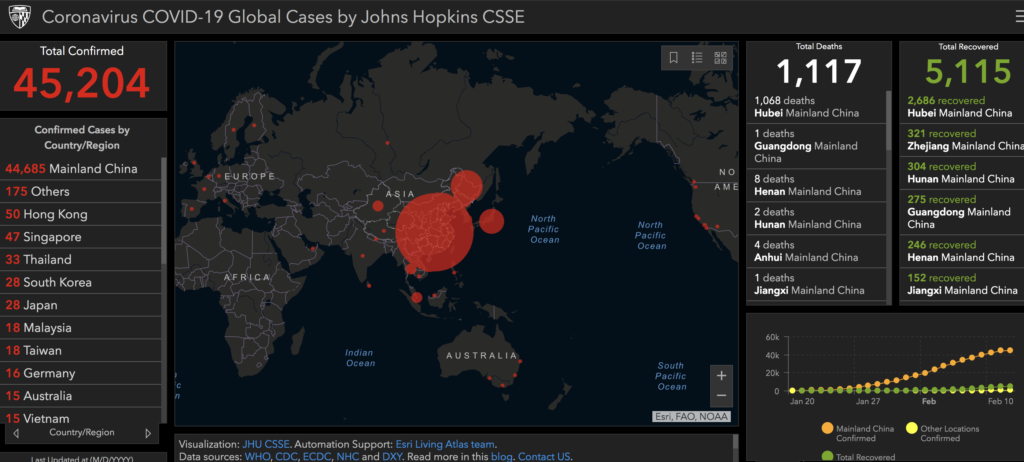
Coronavirus stats 2020 Feb 12_JHU

And yet so much is uncertain!  The thing’s lethality rate might be very low, as in 2%, but it’s hard to say for sure as data are cloudy.  Incubation times are all over the map, perhaps as long as two weeks or as short as a day, with wildly different results for how far and quickly the infection spreads. China might be failing to diagnose infected people by a factor of as much as 19. Moreover, one prominent scientist offers a truly scary vision:

The coronavirus epidemic could spread to about two-thirds of the world’s population if* it cannot be controlled, according to Hong Kong’s leading public health epidemiologist.

His warning came after the head of the World Health Organization (WHO) said recent cases of coronavirus patients who had never visited China could be the “tip of the iceberg”.

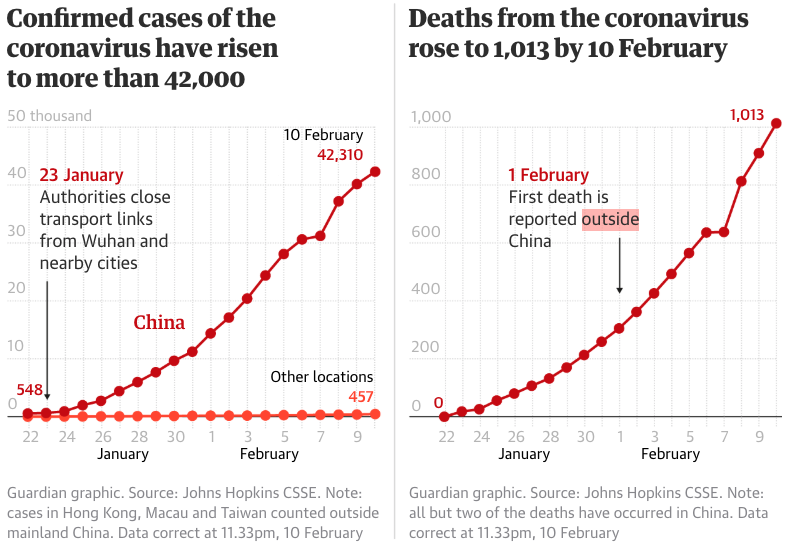
The Guardian accompanies those shocking assertions with these graphs:
Coronavirus rising_Guardian 2020 Feb 11

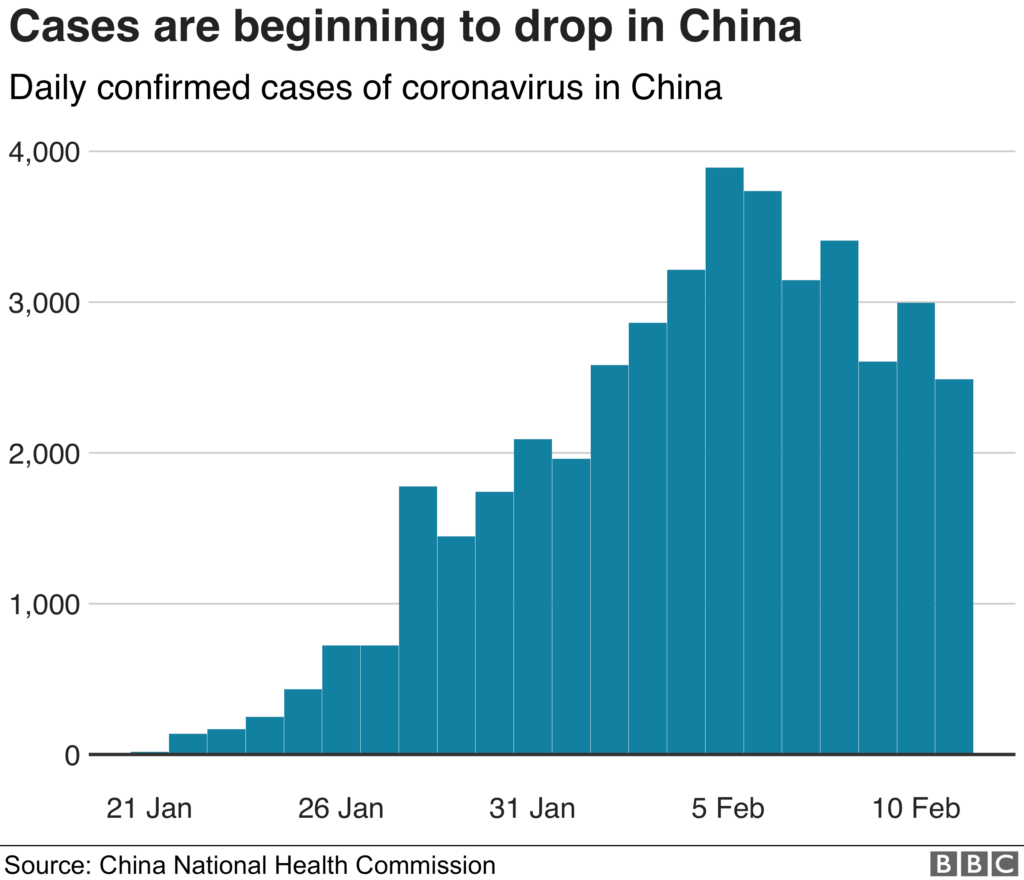
Those portray a virus with infections and deaths rising steadily.  We can extrapolate from them into serious global danger or disaster.  But at the same time China’s senior medical advisor, the leading SARS expert, stated that the number of new cases was actually falling, and that things are coming under control.

The peak should come in middle or late February, followed by a plateau and decrease, Zhong said, basing the forecast on mathematical modelling, recent events and government action.

“I hope this outbreak or this event may be over in something like April,” he said in a hospital run by Guangzhou Medical University, where 11 coronavirus patients were being treated.

The BBC offers a graphic that expresses this peak:
coronavirus_cases_Jan-Feb 2020 BBC

So which picture is correct, a brief outbreak or a global nightmare?

As a futurist, I’m always looking for how present day trends can unfold in the future.  Based on this very brief sketch so far, I’d just like to pose a question.  Where does the outbreak go from here, following the trend of a global pandemic or towards just a brief outbreak?  For the latter, we could imagine coronavirus becoming a minor but long-standing piece of our total disease puzzle.  For the former, something between SARS (which it has just exceeded) and the unspeakably devastating Spanish flu. It’s a wide range, but we don’t have a lot of data now.

Along another futurist line, people have asked me if the virus is a black swan.  That’s an event with an extremely low likelihood of occurring, yet with huge impact when it goes. (The term is Nicholas Taleb’s.) I don’t think that’s so here.  For one, major health organizations have been watching and planning for such events for decades.  For another, everyone else has as well: governments, disaster planners, urban planners, you name it.  We’ve gamed, simulated, and told stories about outbreaks.  In fact, I led a short workshop session on this very idea a year ago for Georgetown’s new Learning, Design, and Technology students.  (More on that next post)

Now, for a third futures approach, let me try to assemble what I’ve seen so far as a kind of matrix of possibility.  Let me range across a series of top-level categories, fitting evidence into each one, teasing out implications for where this all could head.  Then we’ll conclude with speculation informed by all of that.  Yes, each of these categories has many points of overlap with the others.

Medical systems These may come under unbearable stress.  We’re already seeing signs of this in China. The way that symptoms appear – sniffles, joint pain, etc. – could lead many people not actually carrying the disease to present themselves to urgent care facilities, overwhelming normal capacity.  Medical staff are getting infected, reducing medical capacity while expanding the people needing treatment. And despite trying to lock at least 50 million people in place, quarantines might not actually work, yielding poor results and a lot of costs.

There’s also a question about how much American health care depends on medicines produced in China.  Which brings us to…

Economic effects These are starting to building up.  American stock market prices have already ticked down.  If Chinese workers begin staying home to avoid sharing/obtaining the virus, this could hit the complex network of trans-Pacific supply chains, in turn driving up prices and reducing stock.**  This could lead to layoffs, which then depress demand for goods and services.  Blockades of Chinese cities, declining worker time on the job, shortages of supplies, and anxiety about shopping in public could clamp down on that country’s economy, which now plays a major role in the global economy.  Slowing down travel crimps every effected business and area.  Xi knows this and has apparently warned officials to not clamp down too harshly on the coronavirus, because of economic damage. A slowdown or recession in China then impacts the global economy.

We are seeing some other signs of economic impact.  Working from home is apparently rising in China.  At least one company has developed a new “contactless” delivery approach:

Meituan was among the first to introduce “contactless” food delivery, which basically means leaving the meals at a designated area for the customer to pick up. The company also installed meal retrieval cupboards around hospitals for Wuhan medical staff.

Last week, KFC and Pizza Hut started offering the same service, and the measures are going beyond food delivery. Several ecommerce companies will also offer contactless delivery to avoid infections, according to announcements from the Chinese Ministry of Commerce.

One Twitter user even claims this development:

Meanwhile, “contactless” digital businesses are surely doing well.  Think of it: stuck at home, unable to go out, how attractive even more digital entertainment must be.  I imagine gaming and streaming services are enjoying more demand.  The 11 million (!) Chinese expats who visited China and are now stuck there might well find solace online.

On a related economic point: a business slowdown or recession would likely cut carbon emissions, so some could coldly view COVID-19 as good for addressing climate change.  This might add to last year’s emissions decline in the developing world.

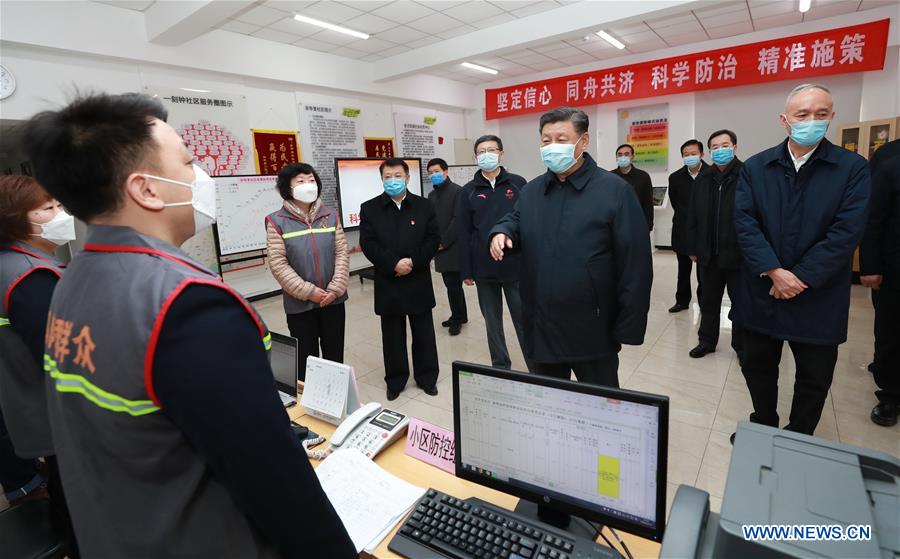
Politics Disease in the modern era can expand state power.  The Chinese government is using its powers to quickly build hospitals while throwing up the biggest quarantines in history.  The city of Shenyang is requiring travelers to check into transit with their real names, in order to better track the virus’ spread.  People’s Daily has a stirring editorial calling on the nation to battle against the sickness, including this photo of Xi:
Coronavirus Xi with mask

“Chinese President Xi Jinping, also general secretary of the Communist Party of China (CPC) Central Committee and chairman of the Central Military Commission, inspects the novel coronavirus pneumonia prevention and control work in Beijing, capital of China, on Feb. 10, 2020.”

In America, the Pentagon is preparing to offer military bases to the Department of Health and Human Services as extra medical facilities. Officials have great incentives to use governmental power, and popular opinion can support them in this drive.  The early signs of a 21st century surveillance state that we’ve experienced (or aided) so far may grow quickly.

This is the opposite of what small government politics seeks, as we saw with Trump’s actions:

In 2018, the Trump administration fired the government’s entire pandemic response chain of command, including the White House management infrastructure. In numerous phone calls and emails with key agencies across the U.S. government, the only consistent response I encountered was distressed confusion. If the United States still has a clear chain of command for pandemic response, the White House urgently needs to clarify what it is.

Meanwhile, face masks – of dubious value outside of clinics, but popular nonetheless – apparently mess with the facial recognition tech China has been deploying.
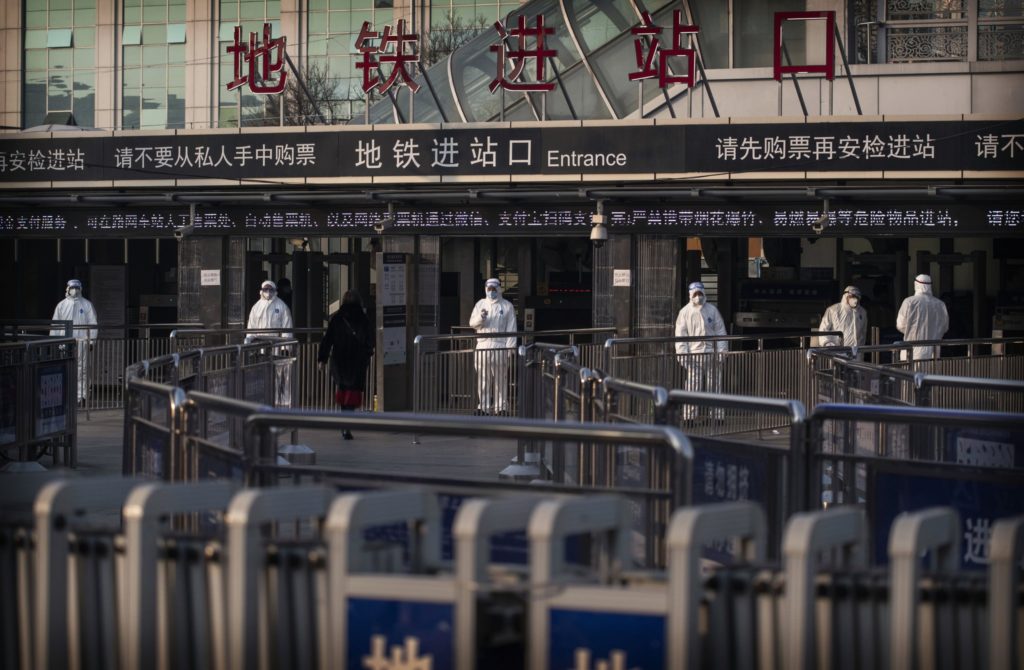
China checking for virus_NYT

In fact, we know from history that a disease outbreak can erode public trust in authorities.  The death of tragic doctor Li Wenliang provoked some public outrage.  If this occurs in China, it could play out in terms of local (city, province) governments being paralyzed by unrest.  Beijing can then intervene, perhaps making a case for its involvement in localities because of the latter’s incompetence or corruption.  We may already be seeing signs of this (example) (example) (example).

International cooperation seems to be uneven.  WHO is working away (from the director’s speech on Feb 11: “The bottom line is solidarity, solidarity, solidarity”), but China is resisting many offers of assistance.  Meanwhile Japan has decided to bar visitors from a Chinese province – not Hubei, but Zhejiang.  As Bill Bishop asks,

https://twitter.com/niubi/status/1227387599335120901?s=19&fbclid=IwAR1yu0ljaOTKfsMgQuKWQHrNi2AGFki7AEz2FP5hVRdOrq_HSLWJNsnpDOo

Good question.  According to WHO Zhejiang has 1117 cases, compared to Hubei’s 31728. Guangdong also has 1177, but isn’t targeted by Japan.

Culture We should expect pseudo- or openly anti-scientific practices, products, or services to appear.  The very useful film Contagion (2011) offers a good example of this as an unscrupulous character talks millions into a useless floral “cure.”  I wonder what will emerge from the different woo worlds: the elite and liberal (Goop), the right wing (Alex Jones), and the poor and desperate.

I have anticipated anti-Chinese racism from the start, of course.  This is a classic human response to a feared disease, to blame the carriers’ group for some flaw or failing.  In the United States this may be understated, given the Obama and Trump administrations’ successive failure to mobilize anti-Chinese feelings for their respective policies (TPP and trade war), and given Chinese-Americans’ status as a model minority.  But it could well take off, especially as problems people perceive as coronavirus-driven start biting hard.

Interestingly, there’s no settled word for the virus.  The CDC calls it “2019 Novel Coronavirus (2019-nCoV),” a name guaranteed to trip off of nobody’s tongue.  Wikipedia allows “Wuhan coronavirus.”  WHO just dubbed it COVID-19. The lack of a clear name for something can be a sign of its novelty.

On a different cultural front, the virus seems to have launched from animal food markets or preparation sites.  If we’re seeing rising interest in vegan/vegetarian diets, perhaps some will connect the two.

It is fascinating to see some cultural responses going transnational.  There’s a spat between Denmark, Hong Kong, and China over a Jyllands-Posten corona-virus-themed flag parody.  And some Chinese citizens have taken to writing cryptic reviews of the American-produced Chernobyl series (about the Soviet disaster) as a way of criticizing Beijing.

Media It’s easy to imagine American media outlets whipping themselves and viewers into a frenzy of panic, as they did with Ebola.  And not just American media.  On the other hand, they might fear overhyping the disease and losing audience as a result.  So far my limited sampling of American tv news shows little interest in the coronavirus, as their attention focuses on the presidential race (today, fear and dread of Bernie Sanders, it seems).  Newspapers are following suit, although usually maintaining some ongoing drip feed of continued disease coverage.

Digital technology The coronavirus represents a new test case for the digital world.  Social media will play a vital role in how we respond to the disease as a civilization, while falling under rising scrutiny.  All kinds of disinformation and fake news can spread easily, as can too-quick reactions. (Snopes has a good archive)  This puts pressure on the tech giants to do more, even costing them at the bottom line, which can also lead to more fumbles and misfires around content management.  Governments can get involved, as when Malaysia prosecutes a women for sharing dubious content on Facebook.  The Chinese state is using its digital tools to manage the outbreak to some extent, even launching a virus detector app based on a lot of surveillance.

At the same time technology can allow people to share information around state censorship (already happening), or state control can fail to either detect or intimidate people on certain themes.  Some citizen journalists are reporting out (for example).  There is also (to some degree) popular digital activity to support the Chinese state.

A range of people and organizations are already using digital platforms to help address the virus.  The CDC uses its web presence to share calm, updated information (for example).  Wikipedia has been busy.  Global Voices has started sharing Chinese responses.  Baidu open sourced some gene sequencing detecting software Others have pointed to disease simulations and games, like this World of Warcraft event.  One blogger is translating a Wuhan diarist’s report into English, nearly in realtime.  Businesses are scrambling to play a rewarding part, like this firm’s quick release of a coronavirus tracking tool.

The crisis may be a testing ground for AI’s utility in the real world.  A Canadian firm used “an AI-driven algorithm” to detect the coronavirus before anyone else did.  Beijing is running some kind of AI to analyze human temperature data.  Companies are applying AI to speed anti-viral drug development.


And so?  What does all of this suggest for the short and medium term future?

Depending on how long coronavirus keeps killing and terrifying people, a great deal of friction, for a start.  Cultural, political, economic: the virus has roughed up our edges and painful intersections are happening.  We could see China’s political order shaken up, leading to either some change at the top level (Xi sidelined) or a more controlling state.  In the United States Trump could arrogate emergency powers at some level to address the crisis, although his combination of small government ideology and trademark incompetence make that less than a sure thing.  Economic mini-recessions can ripple globally, growing or flattening businesses and industries.

I’m very interested in the cultural and technological changes now in the offing.  The experience of another human-animal disease that launched from a meat market might nudge us a bit further towards a veg/vegan diet.  Physical isolation could drive us further online, jostling against the rising techlash.  We may have to rethink how much power we want states and companies to have over digital information as a result of this outbreak.

Economically, we might speak of a coronavirus recession striking certain areas.  Depending on how damaged supply chains are, global business could rethink them, either in the direction of growing more local capacity or of hardening those complex systems.  I do wonder if we’ll see less personal contact in certain businesses.

If COVID-19 truly escapes Hubei and sweeps the world, these frictions can catch fire. Then we can see national or regional effects: economic recessions, medical systems melting down, political orders shaken or knocked over.  Cultural responses could come quickly and in great diversity, from changes in interpersonal relations (will people still shake hands? how does dating fare?) to possible religious activity.  Perhaps alternative medicine will enjoy a boost, if people view the outbreak as a failure for established health care systems.

Or: coronavirus is this decade’s SARS and fades into the background.  All of these potential changes dwindle into quite ripples, then drop below the surface.  Xi’s government proceeds, if with fewer signs of popular support and more suspicion from the rest of the world.  Some additional signs of anti-Chinese racism will crop up.

Which of these trends and problems seem most likely from your perspective?  What are you seeing in the coronavirus?

Next post: COVID-19 and the future of higher education.

*That’s a pretty huge “if.”  Which is, I think, exactly the speaker’s point.

**On a personal note, my wife ordered eyeglasses from China.  She just got a note saying they’d be delayed a few weeks.

(thanks to Rodney Murray’s Militant Optimist newsletter for the AI links; thanks to Exponential View for more links; ditto the excellent Sinocism newsletter; thanks to Steven Kaye, Tom Lairson, Phil Long, Roger Schonfeld, Tim Pendry, and more for conversation and links)

Posted in coronavirus, research topics | 7 Comments

I discuss Academia Next on Trending in Education

Trending in Education logoThe media tour for my new book continues!

Last week the Trending in Education podcast was kind enough to host me.  Mike Palmer and I had a wide-ranging conversation, touching on adjuncts, pedagogy, technology, disruption, and some of my scenarios.

Thanks to Mike and the TiE team for having me on.

buy clomid online buy clomid no prescription generic

Posted in interviews, podcasts | 3 Comments

Snapshot of a conversational morning

I’d like to share a small sample of how I use social media.  Not for a spectacular event, nor a comprehensive overview, and definitely not in a professionally ethnographic way, but just to demo some ways social media can work well, even in 2020.

Let’s start with Twitter, then head to blogging.

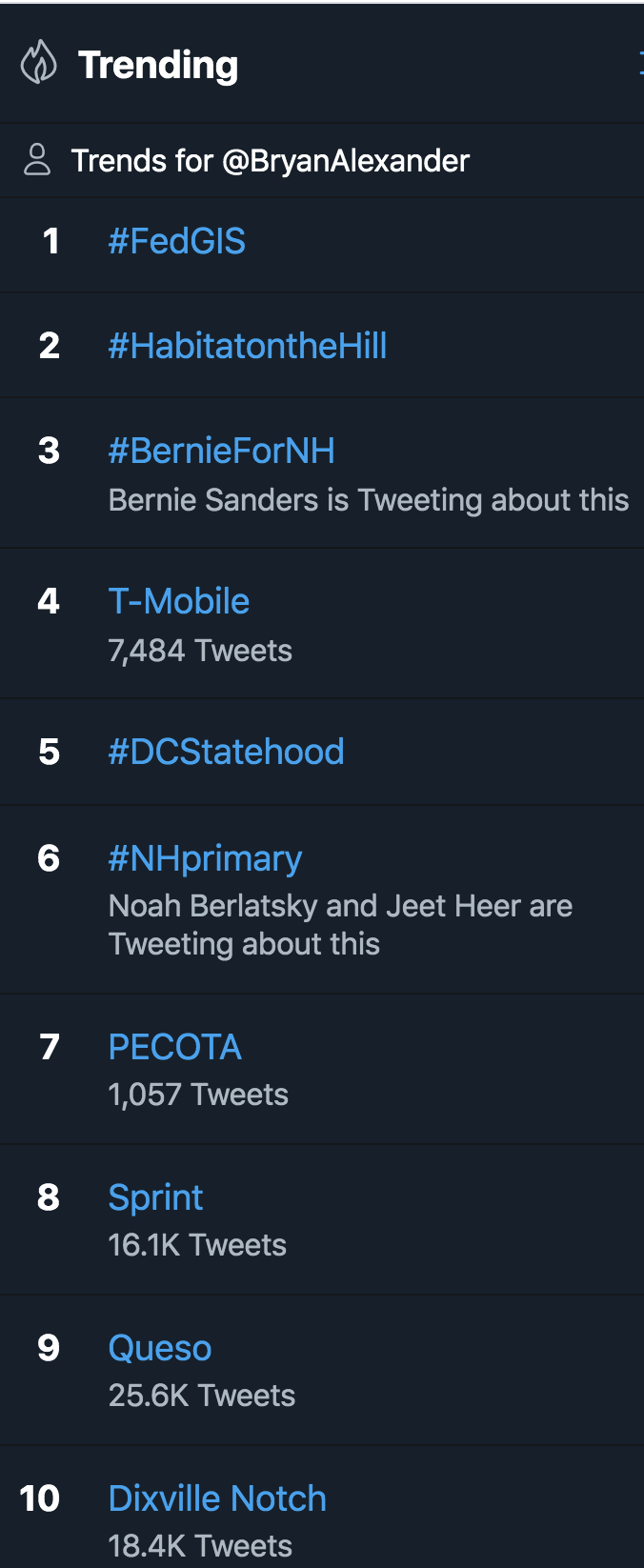
This morning – after minding the dog and cats and feeding my wife her coffee – I checked Twitter’s leading hashtags.  It’s an easy way to get a rough snapshot of what the Twitter-using world is thinking.  That’s useful for me as a person (the world says hello) and also for me as a futurist (always minding trends).

Twitter trends 2020 Feb 11

Interesting.  We see the New Hampshire presidential primaries, a government tech meeting I hadn’t heard about, a housing meeting I also didn’t know, a huge technology business development, and DC news.  I had no idea why queso is trending, nor what PECOTA was or is.  Things to learn, if I chose to.  (These results are skewed somewhat to my geographical location in the DC area)

Next, I simply asked Twitter: what was on folks’ radar?

Bernard Bull – podcaster, college president, and upcoming Future Trends Forum guest – swiftly replied with this:

https://twitter.com/bernardbull/status/1227245201330245632


Which is fascinating!  I poked him back to see what else he could say.

Dan Blickensderfer responded with another educational topic:

https://twitter.com/Dan_Blick/status/1227232285524668416

Which is a potentially very big story.  Caroline Coward responded to that with her own news along that line:

Other folks jumped in, some making professional connections.

Another friend replied with a mix of politics and personal health.  Still another one mentioned his work on an important education data gathering project.

Naturally, I contributed my share to the discussion, which is the right thing to do.  I fed Twitter with some stories that I found, like this huge telcoms merger decision (remember the hashtags?):

In another tab I checked this blog’s comments and links (ably hosted by Reclaim).  I do this each morning, sometimes in the afternoon as well, to make sure I approve any non-spam comments that the software held for me.  This led me down a nice blog path.

A few days ago I posted about the possibility of rebooting academic conferences in the light of the planetary climate crisis.  Five very good comments followed.  Then Stephen Downes blogged a very interesting and somewhat contrarian response.  He argues that society is deeply structured to encourage us to burn more carbon, and that to step back from flying would diminish his ability to do his work, which he sees as having social value.  Instead, we need to push on those who make global decisions to change the rules of civilization, and that is a better use of our time. (I wrote a comment; as of this writing it still hasn’t appeared.)

Downes blog post

Then Alan Levine* responded to both of our posts, also in an interesting and somewhat contrarian way.  He reached back in history to reflect on the sad stability of conference tech, as well as to note some Second Life explorations (and reminding me of this 2005 article I co-authored).  He also praises Virtually Connecting as a way of breaking up that stability. Comments flowed in, including one from Sandy Brown Jensen, which reminded me to reread her blog with its ongoing digital storytelling practice.

Sandy Brown Jensen blog header

I responded with two comments (not live as of this writing).

I have all kinds of thoughts about these comments and posts, of course, and the entire discussion is feeding nicely into my academia and climate change research effort.  But here I just wanted to step back and note the conversational flow.  It begins with a blog post, continues to comments on that post, moves to another blog post, adds a comment there (I hope), leaps to another post, then expands to more comments still, then returns to this very meta blog post.  Comments here, blog posts elsewhere, and comments on those sites could follow.

Note how I’m trying to represent as much of this as possible in the post you’re reading now, from summaries to screen grabs and lots of links.

Back in 2002 David Weinberger captured a sense of this multi-site conversational style with the memorable phrase small pieces, loosely joined.  The web has moved on since, obviously, but this principle still lives.  It even lives in the Twitter conversation I described up above, even though those very small pieces are part of an increasingly feared behemoth.  Maybe the term doesn’t hold up in 2020, but the practice it named is very much alive.

This is one good way to use what we now call social media, even alongside those things we find troubling or terrible.

My hat’s off to everyone who participated in these conversations.

Next blog post up: disease!

*Alan’s blog style has infected this post, as you can see from the high incidence of images.

Posted in technology | 6 Comments

Five community colleges to merge

I’ve been forecasting and tracking college mergers for a while.  Today I’d like to add another merger to the list.

Five Minnesota community colleges will merge within two years, according to Inside Higher Ed.  That’s (in alpha order) Hibbing Community College, Itasca Community College, Mesabi Range College (which has two campuses), Rainy River Community College, and Vermilion Community College, all part of Minnesota’s Northeast Higher Education District.

Minnesota Northeast community college district logo

The system’s trustees approved this plan last month.

How will the merger work?

Accreditation will become unified.  One side effect will be “staff… hav[ing] single databases to look at student records, bills and personnel lists, as opposed to having to toggle between five databases…”  “Budgets, academic programming and enrollment management systems will also be shared…” And staff may shrink: “staffing levels will depend on enrollment, and the district would utilize attrition and retirements rather than layoffs if cuts were necessary.

buy sildalis online buy sildalis no prescription generic

”

Two desired results: “It will also be easier for students to transfer within the district, and the colleges will no longer be competing with each other for students.”  As NHED’s interim president, Michael Raich, put it: “We will create seamless learning experiences for students across the region…”

On Twitter SynthBio was very hopeful:

Why is this happening?

The major reason is an enrollment drop, amounting to “a decline in full-time-equivalent students of about 35 percent since 2011.”  A local newspaper notes that “Rainy River Community College, in International Falls, for example, currently has fewer than 100 students enrolled.”  This is driven in part by low unemployment rates (community college enrollment is tied closely to them).  As Minam put it on Twitter, “They got jobs and started going to work..” Demographics also play a role, since the state’s aging, like many midwestern states.  More Minnesotans live in cities now, which drains population away from rural areas, like those served by these colleges.

(Low enrollment isn’t a problem just afflicting these five Minnesota colleges:

Over all, the Minnesota state system has lost about 20 percent of its enrollment over the past decade, according to Bill Maki, interim vice chancellor for finance and facilities at the system.

The Timberjay says that state enrollment has declined for nine years.)

To answer SynthBio’s questions, I think this is a very sound step, strategically.  Enrollment declines can lead to layoffs, queen sacrifices, and closures.  Here these five colleges can band together, pool resources, and increase their chances of survival.

I have some questions – and must admit that I lack local knowledge, as an outsider.  First, will they manage this without faculty or staff layoffs?  Second, how comfortable are staff and faculty about the change?  Inside Higher Ed’s coverage represented them as being cautious, while also calling for compassion.

buy stromectol online buy stromectol no prescription generic

Will this narrow academic choices?  I’m not sure.  The interim president says the merger can expand academic options, which makes sense, as students win easier access to offerings at other campuses.  But I wonder about the trend of guided pathways, and also about Iron Range access to broadband for online learning.

What about larger campuses gobbling up small ones?

buy amitriptyline online buy amitriptyline no prescription generic

  Yes, we have seen academic versions of asymmetrical mergers and acquisitions (for example).  Perhaps the smallest NHED campuses will find themselves dominated by the larger, unless leadership strives to balance them out.

As a sign of a general trend, keep watching for such radical moves.  Overall enrollments are still declining nationwide.  Unemployment remains low.  Rural areas are suffering.  Perhaps all of these stimuli will be enough to seriously grow inter-campus collaboration at all levels.

buy dapoxetine online buy dapoxetine no prescription generic

Posted in enrollment, trends | 4 Comments

Higher ed and climate change: the end of academic conferences as we know them

AAEBL conference pplSince I started researching climate change and higher education‘s future I’ve participated in and witnessed many discussions about the topic.  In person and online, academia seems to be increasingly interested in exploring what climate change means for colleges and universities.

One small piece of that broader puzzle stirs passions more than just about any other.  How will academic conferences change in the age of climate crisis?

We usually start with a basic idea.  Air travel emits a lot of carbon.  To the extent that faculty, staff, and some students fly across the world for national and international conferences, we are contributing in a small way to heating the planet.  Therefore we need to rethink this practice.  As FemEdTech put it, “We have to be more responsible.”

What does such a rethink look like?

Several ideas have been floated.

A) Individual academics should fly less, especially at longer distances.

B) Conferences should shift away from national and international scale to local or regional events, which can be reached by less carbon-intensive means, like trains.

C) Conference activities can head online through various technologies.

D) We can all keep flying to conferences, but also buy carbon offsets.

A recent University of Exeter report called for a mix of A-C through:

cut[ting] the carbon footprint from long-haul air travel by 50 percent by 2025 and by 75 percent by 2030, while academics are organizing online conferences with regional hubs in a bid to reduce flying while maintaining face-to-face networking.

In that linked article we can find a version of D, too:

KU Leuven …  has introduced a voluntary carbon tax of 40 euros ($43) per ton of carbon emitted for academics who travel by air. The money is used to invest in green activities at the institution.

I’ve floated plans A-D to a variety of audiences and networks.  The results have been fascinating.  I’ll share some of the ideas that came up, and add some more of my futures thinking to boot.

The hybrid conference has already been successfully implemented. The Society for Cultural Anthropology changed their international conference in 2018 to a new form, which we could see as heading towards A-C above.  Here’s how they describe doing it again this year:

Distribute 2020 will be virtual and distributed: virtual in that it will be anchored by a dedicated conference website streaming prerecorded multimedia panels; and distributed in that presenters and viewers from across the globe will participate in the conference via in-person local “nodes.”

Distribute 2020 will offer three full days of streamed audio-visual panels and in-person local nodes where participants can gather with others to view the conference and join in related activities like workshops, art exhibitions, and dinner salons. Our goal is a low-cost, highly accessible, carbon-neutral conference that might pave the way for rethinking the mega-conference model.

Everything I’ve heard signals that this went well for that academic population.  You can read and watch a series of video reflections from 2019 here.  The Comparative and International Education Society is doing something similar.

Question: is this the next form of the academic conference, or a transition stage to wholly online meetings?

Hiring/tenure/promotion/review has to change. Presenting to conferences is often a useful thing to do for career advancement.  If we cut back on face to face events, we’ll have to adjust academic review.  As Lisa Hinchliffe observed,

Will some departments value virtual presentations less highly than in-person ones?  If on-site conferences dwindle and attendance at them becomes scarce, will be rate participation in those events more highly?  We will have to reset incentives to make this work.

How does this impact equity in an increasingly unequal academy? We could see long distance travel becoming increasingly the province of the academy’s most privileged: tenured faculty members, those working at the wealthiest institutions, parents with the best child care, and so on.  In this way a climate change strategy could exacerbate inequalities.

On the other hand, watching YouTube and interacting on social media is much less expensive on multiple fronts: money, time, accommodations.  If conferences migrate more fully online more academic populations could enjoy increased access to those professional opportunities.

Which technology to use?  I often hear video for primary content, presumably based on live streaming presentations (keynotes, panels, plenaries, talks). This makes a lot of sense, given the enormous and nearly total appeal of video to the human race.  It also might represent an improvement over some keynote speeches, where most of the audience can barely see the speaker and might not be able to interact with them at all.  Other improvements might be available, as Henrietta Carbonel observed:

Social media then fits the role of interaction, starting with Twitter, which already has a long track record of being events’ backchannel.  I haven’t heard LMSes floated for discussion, file sharing, and general anchoring, which might be a sign of that technology’s limitations, or that most academics don’t view the LMS as useful beyond individual classes.

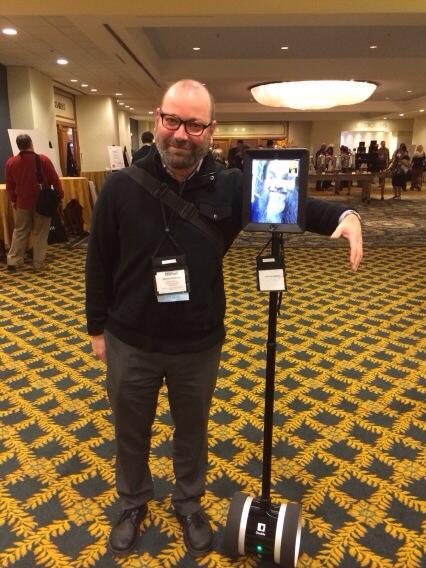
doppelbot_GershovichOther, newer technologies could play a role.  Virtual reality can be great for immersion in spaces.  Social uses are lagging, but down the road they might serve, allowing us to imagine academics in their offices interacting with far-off colleagues through goggles and glasses.  On a different angle I would suggest using telepresence robots (“doppelbots”) for face-to-face events where in-person attendance is dropping. (Here’s me doing this at a conference in 2014) Doppelbots could be a transition technology, a bridge to a totally virtual conference world.

Criticisms and resistance. Asking academics to change their conference structure has elicited some blowback, some quite fierce.  I often hear that academic travel is just too small and cutting it back would have too small an impact upon climate change overall.  Requesting or compelling faculty, staff, and students do make that sacrifice is both a waste of time and also an unnecessary burden on an already stressed population.  Indeed, this could distract educators from taking and/or organizing for more salient steps to mitigate or adapt to climate change.  Couldn’t those energies be devoted to passing carbon taxes, for example?  Ideologically, urging individual academics to change course might just be another form of virtue-signaling consumerism. (This MetaFilter discussion gives a good sense of this line of thought, albeit for a different case)

Revamping conferences might not be a globally applicable idea.  Some nations lack low-carbon capacity for travel – i.e., most of the US, ill served by passenger rail.  Some universities inhabit remote locations or dwell within large, relatively underpopulated areas.  Think of Alaska, Australia, Russia, the northern 2/3rds of Canada.  Would a general reduction of academic travel unfairly penalize those populations?

Academics might find technology-mediated remote conferences to be insufficient for purpose.  Technophobia or unfamiliarity with tech can power some of this, of course, but so can a loss of travel’s pleasures: seeing new places, getting away from the daily grind, serendipitous meetings, reconnecting with colleagues.  Poor tech support could wreck virtual conference participation. And technology can add new problems, such as online abuse.

In fact, digital technology might not be a good solution.  Depending on which measurement one uses, videoconferencing might have higher carbon costs than travel.  This should be true of more computationally intensive tech, such as 3d video, VR, or blockchain, assuming someone finds a way of using that last tech in this cause.

Some have told me that cutting back academic travel is a kind of attack on higher education, participating in a devaluation of academic work.  It might even align with reactionary anti-intellectualism.  They haven’t cited conservative mocking of climate change activists for flying around the world to protest carbon excesses, but they could.

Even more fiercely, some folks got very personal with me, accusing me of holding a puritanical attitude, or questioning my academic credentials.  This was… useful for me to hear, as I proceed along this research inquiry.  As an independent, I have to take care.  And I haven’t even run into climate change deniers yet on this score.*

It may be that these opposition arguments win the day, at least for a while, leaving universities and colleges to pursue option D (above).

Who is involved in strategizing about this? One aspect of the overall problem of higher ed and climate change is who’s involved in making the decisions.  So far I’ve mostly seen people frame it as a question for faculty (well, the tenure-track faculty minority).  Staff travel doesn’t appear much.

Students haven’t played much of a role in this conversation, but that could change.  After all, some do travel for undergraduate and graduate research. Moreover, rising student activism around climate change could turn its attention to this one piece of higher ed’s carbon footprint.  Targeting endowment investments is already occurring.  When will students protest a professor’s global trip, then scale that up?

Off-campus players can also play a role in this topic (cf my earlier post). Local or national governments could pass laws that drive universities and colleges to curtail faculty – say, by insisting all enterprises above a certain size must be carbon-neutral or -negative.  Hand in glove with this are entities that could help academia make such changes.  Which businesses would step forward to help transform academic meetings?  Will nonprofits organize to encourage or assist this process?  Can academic associations, think tanks, or foundations play a role?

There’s still more to conferences than air travel. We can rethink other aspects of academic meetings as part of a global climate change strategy.  Some events have already cut back on swag (printed materials, bags, t-shirts, etc).  Jeroen Bosman sees more to be done:

Let me pause at that point.  Clearly this is not a simple issue.  It can be fraught in many ways.  What’s the best mix of my A-D options?  Which other strategies can we pursue?

Where are we discussing this?  How can we best proceed?

*I see climate change deniers all over the place, including my Facebook page.  I mean I haven’t seen anyone deny climate change is happening during debates about how higher ed should respond.

(doppelbot photo by Mikhail Gershovich; all others are mine)

Posted in climatechange | 13 Comments

In the media for Academia Next

Since Academia Next came out (Johns Hopkins University Press) (Amazon) I’ve lucked into a bunch of media appearances.

It’s excellent to get the word out about the book, of course, but I also love the conversational aspect.  It helps me expand my thinking, with the extra bonus of getting to know more people.

To start off with, on January 17th I was interviewed on the College Empowerment podcast. Tony D’Angelo was a fine and fun host.

College Empowerment logo

A week later Georgetown University’s School of Continuing Studies (SCS) gave me a very kind video interview:

They had an awesome production studio and team.  It was also good to get to learn more about GCS.

Then Rodney Murray interviewed me for his fine Pulse podcast.  We covered a lot of ground.  Man, Rodney is a fascinating person to learn from and talk with.

Rod's Pulse Podcast

There are other interviews in the works, too.

It’s a strange experience, being asked about one of your books.  Sometimes you’re asked to summarize tens of thousands of words and years of work in a few minutes or less, which can be daunting.  But it’s a great intellectual exercise, like crafting an article’s abstract, or explaining some of your professional issues to someone outside of that realm.  It forces you to think back to the book’s purpose and voyage, seeing all of that from a new angle.

There’s more autobiography in interviews than I’m used to.  As a GenXer I don’t easily talk about myself, so I suppose it’s good to touch on that point.  And I know it makes the book more accessible to some folks.  Especially for nonfiction without a lot of characters, it’s useful to become one of a sort, a cross between narrator and stage manager.

Looking ahead, the ideas interviews raise can nudge me forward to the next book.  These did that.  I’ll say more about it as book #4 comes into focus.

Posted in interviews, podcasts, writing | 2 Comments

One forecast for higher ed in the 2020s

It’s the year 2020 and the appearance of a new decade has many people looking ahead to see what might come up.

One example comes from Inside Higher Ed.  John Kroger* offers ten predictions, and it’s a useful set to work through.  It’s also a good example of the futures method of trend extrapolation.

In this post I’ll note and respond to each one, based on my future of education work.  I’ll comment on both content and method.

One note: the author starts with present-day trends, then pushes them ahead a decade.  This is a good exercise for anyone, and I appreciate it.

buy elavil online buy elavil no prescription generic

  I’d add some others – heck, I track about 90 – but each of these are solid.  That said, there are limits to this approach.

buy bactroban online buy bactroban no prescription generic

  Each of the trends could stop, retreat, or just get weird.  And each can elicit opposition in a kind of dialectic.  I’ll list some below.

Now on to Kroger’s ten:

1. One Hundred Small Colleges Close

Economic pressure will increase on small rural colleges and over one hundred will close their doors. To survive today, a small college needs a great location, a large endowment, and a powerful brand. Schools with all three of those attributes will thrive. Schools with one or two will have challenges but get by. Schools without any of the three will fail.

tenThis is a reasonable forecast, given the trends I’ve been tracking.
I’d go a little further and divide this into public and private institutions, which have very different dynamics.  Then add responses to this, like state government policies and rising merger attempts.

2. Transformation of the NCAA

In  the coming decade, large universities with big sports programs will pay their players, and application of anti-trust laws will lead to robust wage competition. Forty-five major sports universities will decide to compete.

buy finasteride online buy finasteride no prescription generic

Everyone else will opt out, choose true amateur athletics, and Division I as we know it will implode.

This sounds like an improvement!

College sports is one part of academic I’m weak on, still, so I hesitate before adding much here.

3. Higher Education Finance Debate

Education costs will continue to rise above inflation, forcing a nationwide debate over higher education finance. Is higher education a private good, to be paid for with personal loans, or a public good, to be paid for with government grants?  Congress will wind up greatly expanding Pell grants, and many states will adopt free community college, but a college education will remain increasingly unaffordable, leaving many more students opting for technical training instead.

A very interesting forecast, in that it suggests two divergent ways forward: some state support for some parts of higher ed, while the rest of academics keep shooting upward in price and inaccessibility.

This is a trend extrapolation, but one that leaves open different responses.  Nicely done.

4. Continued Humanities Enrollments Decline

Humanities enrollments will continue to decline. Students at elite colleges and universities will continue to major in history and literature, confident in their long term job prospects, but everyone else will continue to move toward pre-professional degrees. Pundits will still insist that the liberal arts are the best career preparation, and they will be right, but that argument will continue to fail to get any traction – except with the wealthy, who already believe it.

This is a straightforward extrapolation of the present and recent past. It doesn’t allow for the trend to shift, being pessimistic about the humanities’ ability to turn things around and American culture’s current attitudes remaining stable.

Note the assignment of the humanities to the wealthy.  Note, too, the conflation of humanities and liberal education.

5. Reinvention of Accreditation

Accreditation currently does little to advance quality assurance, and the process is slow, expensive, unwieldy, and bureaucratic. This cannot continue. Moving forward, accreditation leaders will begin to set objective outcome and finance standards and reinvent their processes, to focus more on quality and results and less on bureaucratic box-checking.

This is one of the most important items in the list.  It addresses one of the least-discussed parts of higher ed, and thinks it’ll become more significant than it is now.  And that’s not implausible.  I’ve heard murmurs of this kind of thing from some accreditors.

Methodologically, it’s good to see a relatively obscure trend highlighted.  For many, accreditation is academia’s dark matter

6. Disruption

People have been predicting for decades that technology would disrupt higher education, but little has changed. The reality is that technology does not disrupt industries – more agile and sophisticated companies do. Given the deep frustration of the tech industry with the current state of education, expect companies like IBM, Microsoft, Facebook and Google to enter the K-12 and higher education space not just as software providers, but as education providers with their own suites of learning management software, courses, and credentials. The tech companies will enter the space as part of their competition for mindshare, but the end result will be to push aside many traditional higher education providers.

A very interesting forecast.  Note that it doesn’t see any academic entities or other nonprofits entering that disruption space, which is quite an assessment.  Instead, it focuses on the business sector, and in particular the very large tech companies as leading actors.

I do wonder about the last two sentences.  One focuses on class technology, rather than content, which is what we’re seeing now.

7. Tenure Crisis

Currently, we have a two tiered faculty system. Only 25 percent of faculty are tenured or on tenure-track and have acceptable wages and benefits, while 75 percent are adjuncts, with very low pay, no security, and no benefits. As universities fight to stay afloat financially, use of cheap adjunct labor will increase to a crisis point, with frequent strikes and demands by adjuncts that compensation pools currently paying for tenure track faculty be shared with them. In response, some universities will abandon both tenure and the exploitative adjunct model entirely and adopt a new paradigm. Faculty will not have tenure, but fixed period contracts with contractual guarantees of academic freedom and bonusses for high teaching performance evaluations and outstanding research outcomes.  Compensation will fall in the middle of the current spectrum, lower than current tenure track salaries, but much higher than what adjuncts are currently paid, with benefits the norm.

Another extrapolation from present day trends, but this time to a breaking point, complete with labor unrest and serious institutional shifts.

8. Increase in Inequality

As education prices increase, and public financing decreases, many elite private colleges and universities will deemphasize equity in admission in favor of revenue generation. Private elite colleges and universities will revert to their role prior to enactment of the G.I. Bill, propping up wealth and privilege, and that will be increasingly acceptable to wealthy families familiar with the model from private K-12 education.

Another theme my readers will recognize.  Again, this is an extrapolation of a current trend.

buy glucophage online buy glucophage no prescription generic

However, it leaves off the non-wealthy.  I’d like to hear more about the date of non-elites, including community colleges, many state universities, religious private colleges, and so on.

9. Expanded University-Corporation Research Partnerships

As lab and research costs explode, the complexity of research problems escalates, and federal research funding continues to dwindle, expect more high-profile partnerships between universities and corporations who depend on research to drive their bottom line. This, in turn, will drive down basic research in favor of work with clear profit potential.

A very important forecast, and one based on present day reality.  Note the shift from state to federal policies here.  Note, too, the emphasis on the big picture: a sea change in basic research.

10.  U.S. Exports More Students

As domestic education costs continue to rise, expect more U.S. undergraduate students to seek out less expensive options in Europe, Asia and Latin America. Though this will hurt U.S. institutions, it will produce a more geopolitically aware American population.

Agreed, at least the first part.  I find few in American academia are thinking of this, but it’s a potentially powerful force.

Overall, a solid forecasting article, especially given its brevity.  Keep an eye on these.

(Ten-ball photo by Fabio Hofnik)

*I’m not sure who John Kroger is.  The article lacks the customary bio blurb.  The author’s name has a link, but that just defaults to the Inside Higher Ed main page.  Could it be this John Kroger, former president of Reed College?

Posted in future of education, trends | 3 Comments

4 futures for how civilization could respond politically to climate change

Thinking about how higher education and climate change may intersect is a deeper topic that it might appear.  Because climate change is so vast and because higher ed is so complex and sprawling, all kinds of domains and issues enter the stage.

Today’s case in point is… planetary governance.

Yes, there’s a body of literature and a global debate about how to organize humanity’s responses to the climate crisis at the governmental level.  This is a major political science research topic, naturally.  And one of the most important works on this is Climate Leviathan (Verso, 2018) by Geoff Mann and Joel Wainwright.  In this post I want to draw out what I see as most exciting from that book, then offer some thoughts as to how it all connects with higher education’s future.
Climate Leviathan explores the future of governmental structures from a Marxist perspective, interwoven with centuries of political philosophy.  For example, the title signals the book’s engagement with Hobbes’ Leviathan (1651).  Theodor Adorno, Naomi Klein, Carl Schmitt, Tony Negri, and Albert Einstein (!) all play roles.

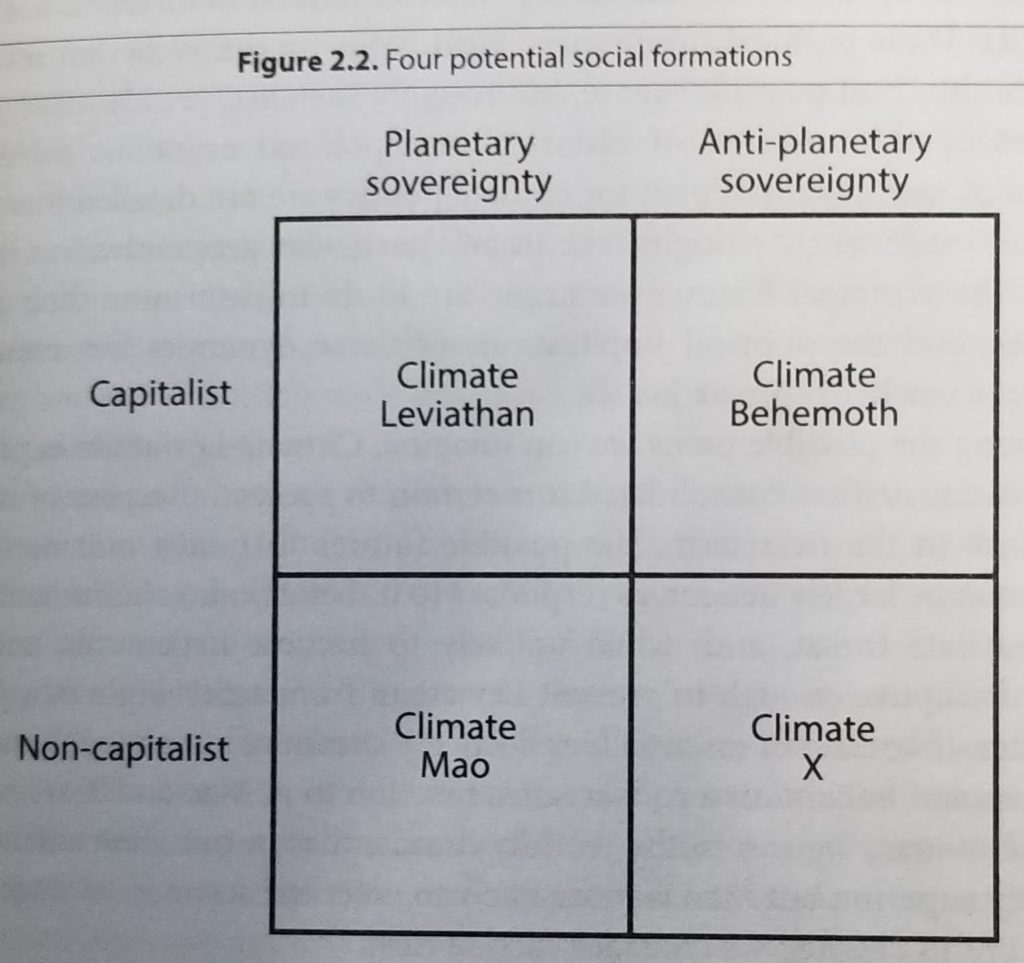
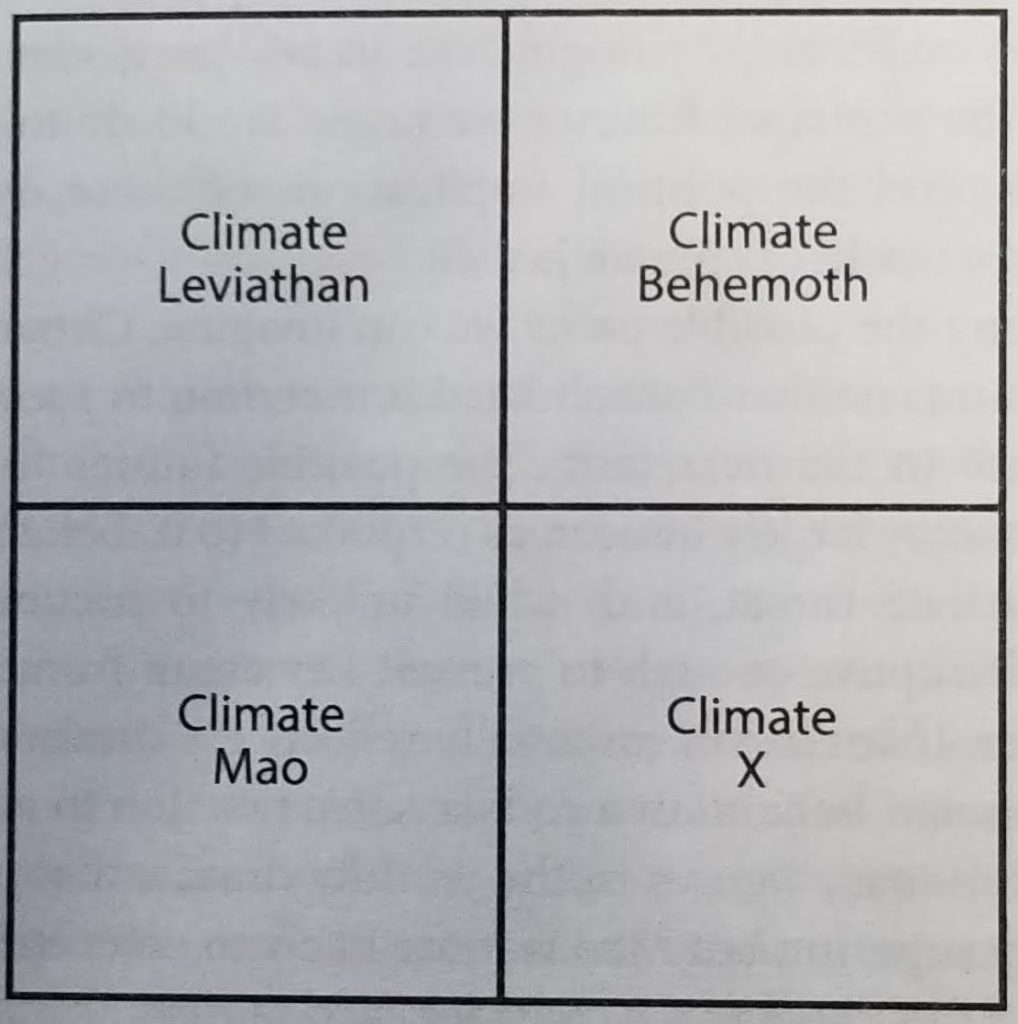
What anchors such a rich and wide-ranging exploration is a classic quadrant visualization.  Looking ahead, Mann and Wainwright offer four ways forward for human politics and government (29):

Quadrant 1

To understand what generated this set, let me pull back the visual so you can see the two major trends generating the “four potential social formations”:

climate leviathan quadrant -detail

The two generative trends are political settlements around economics (either pro- or anti-capitalist) and divergent models of planetary governance (unitary, like a world state, or dis-integrated into multiple, autonomous states, as we now have).  The interplay between these two trends via their extremes generates the four futures models pictured above.

What would the models look like if they described future realities?

buy avanafil online buy avanafil no prescription generic

  Climate Leviathan sketches these out unevenly.

Climate Leviathan is a world state or strongly bound alliance of states, committed to preserving capitalism while adapting to (not so much resisting) climate change.  Mann and Wainwright see seeds of this in the Paris Accord (pre-Trump).  A combination of ecological and financial crises may speed the Leviathan’s way as authorities can declare emergencies which require extraordinary powers (151).

buy tadasiva online buy tadasiva no prescription generic

Climate Behemoth: this is a world of nationalistic nation-states, each refusing to do anything to mitigate or adapt to climate change.  The authors see Trump and Bolsonaro as examples of this attitude.

(NB: the name of this one turns on a neat bit of linguistics, arguing that the word is actually plural, rather than singular, so it fits well with a plurality of states.

buy lasix online buy lasix no prescription generic

  “behemoth is the plural of the Aramaic behema, ordinary cattle or beast”, 44 )

Climate Mao imagines, as you might expect, a Chinese government a bit more Maoist than it is at present, and able to influence much of the world.  Here we see a combination of anti-capitalist politics with a strong, unitary or alliance-dominating government.  It “reflects the demand for rapid, revolutionary, state-led transformation today.” (39) Signs of Climate Mao can be seen in China’s rapid, state-led development of solar power.  However, contemporary China seems equally committed to participating in Leviathan.

Climate X: ah, this is where the book gets controversial (for example).  The authors refuse to outline what such a future would look like.  Instead, they see a non-centralized, anti-climate change world order as a space of possibility that we need to create.  They do draw on some sources for suggestions, notably the tradition of left-wing insurgencies and of indigenous people’s movements (189).

…Climate X is a world that has defeated the emergent Climate Leviathan and its compulsion toward planetary sovereignty, while also transcending capitalism.

buy nolvadex online buy nolvadex no prescription generic

  This is obviously a tall order… (173)

(X here is the unknown in math, as well as a kind of lexical refusal of order.)

Readers can imagine for themselves how each of these worlds could play out in detail.  Science fiction has offered visions of each.  Further, you might see a world formed by two or more of these formations occurring at the same time – i.e., China and One Belt, One Road embodying Climate Mao, NATO nations forming up into a Climate Leviathan, while several nations play Behemoth and pockets of X break out around the world.

What does this mean for higher education, if we assume for the moment that this quartet describes some likely futures?

To begin with, each offers colleges and universities a powerful renegotiation of many features of higher ed.  Mao and Behemoth can impose strictures on student recruitment and faculty/staff collaboration, while Leviathan would offer its own.  Each of those three could intervene in questions of curriculum or research.  Mao and Leviathan could seek to adjust campus carbon budgets, from disincentivizing travel to mandating the placement of carbon sequestration technology on campus.

At the same time this unfolding political order becomes the subject of research and teaching.  Mann and Wainwright stress that academic research is actually behind on climate change, “particularly the social sciences.”  (56) Increased academic study of climate change could then, in turn, get shaped by the emerging states, as Leviathan sees funding for certain kinds of scholarship and Mao prefers certain curricula.  Public intellectuals can intervene to help shape those political orders with all kinds of risks, on campus and off.

Academia may become a vital source for developing Climate X.  Colleges and universities have (for now) the freedom to research and teach into this topic with some creativity.  We also have a long tradition as a site of student unrest. This is by no means uniform or even widespread, but the capacity is there.  If climate activism trends as young as it seems to, institutions serving traditional-age students could become the seedbed of X.

What do you make of the Leviathan approach?  Have you thought of or read other visions for the future of politics in the climate crisis?  How does higher ed respond?

Posted in climatechange, future of education, futures, scenarios | 2 Comments

Navigating my way into veganism

For the past month I’ve been I’ve following a vegan diet.  So in a brief pause from my focus on the future of education, I’ll share some thoughts about this experiment.

It’s actually not that great a topic shift for this blog.  For one, I’ve written about health and diet issues before.  My posts on giving up caffeine and alcohol are some of the most popular things I’ve ever written (part 1, part 2).

For another, veganism ties into a theme I’ve been exploring lately: climate change and its relationship with higher education.  Many commentators and activists argue that one strategy for either global climate mitigation or adaptation (or both) is humans cutting back on eating animals and animal products, since those food subsystems emit methane and carbon in significant amounts.  So I’m looking into this food strategy as part of my broader research.  And actually living it is a way of practical learning.

The other reason is that I’m concerned about my health and weight.  I’m big fellow, partly because I’ve lifted weights since I was a teenager.  Yet my BMI tests above 30, and I know that some part of my lifestyle cause that: extensive travel, long shifts at the keyboard without using the standing or biking desks.  Yes, I also know the criticisms of BMI, but as I cruise past 50 years of age I’d like to see about extending my lifespan, and weight loss is key.  And my new primary care physician insists.

buy cytotec online buy cytotec no prescription generic

So: into veganism.

15798321I started with Mark Bittman’s “VB6” diet.  That means I eat vegan-ly all day until 6 pm, after which I can devour anything I choose.  I chose this path in order to make the transition less shocking to my body and habits.  After all, my usual diet involved meat (full gamut: beef, chicken, pork, fish, etc.) in 2-3 meals per day, plus dairy products (cheese and eggs, primarily) in about the same rhythm .

So I checked out dozens, then hundreds of recipes for every meal of the day, from soups to pizza, plus snacks, scouring books and the web.  I bought different stuff, or some of the same but in changed quantities, from local grocery stores. I researched some of the science and commentary, which can be both often endless, sometimes contradictory, and occasionally dubious.

At home, for snacks I swapped out chips and pretzels for apples and nuts (incidentally, this is what Frankenstein’s monster eats).  I replaced breakfast or lunch cheese or sausage omelettes with various scrambles including tofu, onion, garlic, and ginger.  I got back into making corn tortillas and loading them with red or black beans.  I experimented with ways of making leafy greens more palatable without adding calorie-drenched dressings – so far, lots of vinegar.  I continued eating and baking bread, although avoiding recipes that include eggs or milk.  I also cut down the amount of bread, wanting to reduce carbs (as per primary care physician’s advice).

Eating out hasn’t been much of a problem so far.  For breakfast and lunch I can easily find fruit, granola, and breads.

There were no changes to what I drink, which is almost entirely water.

One external force impinged on this experiment, as I came down with pneumonia in December, thanks to overwork.  Despite that, I didn’t pause VB6 activity.  That illness ended shortly after the new year.

So how did the experiment turn out?  Where do things stand now?

  1. I’ve lost 5-10 lbs.  There’s some fluctuation.  I can’t see any difference, but my wife says the loss is apparent.
  2. I continue to experiment with recipes, more frequently than I did before.
  3. Avoiding my habitual meals and snacks proved less onerous than I thought it would be.  It might be that I just enjoy exploration and trying out new or altered recipes.
  4. My appetite has fallen steeply. I am rarely hungry when I used to be.
    buy aciphex online buy aciphex no prescription generic

      Formerly I’d wake up hungry and thinking about breakfast.  Now I don’t feel hunger pangs until afternoon, sometimes later.  I’ll skip breakfast or lunch, or even both. It feels like I hacked my metabolism, ratcheting it down, at least in terms of appetite.  The total amount of food and calories has dropped.

  5. The post-6-pm, non-vegan dinner is not what I expected. Surprisingly I don’t gorge on meat or cheese, although I still enjoy those to a degree.  Instead I actually eat less for dinner – again, my appetite is lower. I eat almost 1/2 of what I did before and leave the meal with more leftovers.  Last week I went to dinner with friends and ordered prime rib.  Normally I would savage the entire thing, but this time I barely made it through half of the portion.
  6. The biggest problem is that my delight in food has fallen overall.  I no longer turn to meals with a sense of delight or comfort.
    buy fluoxetine online buy fluoxetine no prescription generic

      Instead I have come to view most eating as something… medicinal, akin to a chore.  I observe carefully, but without pleasure. That’s especially true for vegan eating, but also increasingly so for non-vegan foods.  My joy in meat and animal products has gradually diminished.  For vegan dishes I am not experiencing any of the joy in eating that vegan writers and my vegan friends proclaim.

    buy antabuse online buy antabuse no prescription generic

  7. My physical strength and energy feels about the same.  They were lower when I started, but the bout of pneumonia seems like the main cause, and they resumed when it ended.
  8. My biggest dietary weaknesses are chips and pretzels.  It takes fierce willpower to keep them away from me.
  9. I don’t feel evangelical about this experiment.  It feels… satisfactory in that I’ve managed to carry it out for a month, even through a serious illness and the holidays, but I don’t want to gush about it.  The whole thing feels strange and experimental.  I haven’t experienced a connection to other people’s diets or other food cultures.  At times I just feel melancholy about the loss of joy in eating.

What’s next?

  • I’ll keep on with this experiment.  VB6 looks like the right fit for now, as I don’t feel up to going 24/7 vegan.  I don’t know what it would take to switch me over.
  • There’s a truly daunting amount of research to do, which I’ll keep pursuing.
  • If you know me, you know that some of that research is social.  I’ve already starting talking this up on Facebook, and gotten a range of responses: support, annoyance, recipes.
  • In a few weeks I will check in with my primary care physician to see what she thinks.
  • I will monitor changes in my mood to see how the diet impacts it.
  • In a month I’ll be able to start gardening, and look forward to setting up plants I can eat.

What do you make of my experiment?  Is it TMI?  Does it sound reasonable?

Posted in personal | 21 Comments

Starting this semester’s seminar on education and technology

This week my new education and technology seminar began.  It’s in Georgetown University’s Learning, Design, and Technology program, and called LDES-702: Studies in Educational Technology.  I first taught it in 2019.

Here I wanted to introduce the class, starting with my plans for it, then the tentative reading and assignment schedule.

The general idea is for students to work through a different tech or tech-related practice each week.  They’ll read and engage with scholarship about the stuff, both asynchronously (online) and synchronously (in person or via video).  They will also get some hands-on work with the tech, like recording audio, creating a class in an LMS, creating an information literacy guide, etc.

Woven across those weeks are a whole series of themes and critical approaches.  From the syllabus:

social justice, technology, and education; access and equity; the relationship between pedagogy and technology; asynchronous and synchronous technologies; globalization versus the local; assessment; campus support structures and sustainability; student agency.

I want to frame these with as much historical context as the class can hold.  Meanwhile, I’m eager to see which themes the students generate and develop.

That’s because I am continuing my democratic pedagogical practice.  I want the class to be a place where each student’s experience and thinking are crucial, and where students are empowered to shape the class.  We already started discussing which technologies to use for asynchronous conversation – right now, it looks like we’ll begin with Canvas, then explore others in response to the tech we investigate.  We also created a set of rules for working together.  And the syllabus has several open spaces for the students to collectively choose themes, readings, and exercises.  I also left open some readings so that I can better pick ones as I get to know the students and their interests.

More on pedagogy: since this is a graduate seminar most of the class time will consist of discussion and some hands-on experimentation.  As usual I’ll try to shun lectures, but will be ready to do mini-presentations for key topics on the fly (only) as needed.  My official statement:

Pedagogically this class combines project-based learning, discussion, constructivism, and educational technology.  You will each play a key role in creating and sharing meaning – collaboratively – as we explore this subject together.  The class is yours, and so you have a say in how it goes and is shaped.

And now, the schedule.  Note that some of the readings aren’t specifically about that week’s technology, but advance themes we explore throughout the semester.

January 15     Introductions

  • What is ed tech?
  • What technology do you use?
  • How should we organize this class together?

January 22     LMS and the Web

Technology exercises:

  1. develop a strategy for tracking ed tech digitally
  2. explore Hypothesis

January 29     Digital and information literacy

Technology exercise: create your own digital literacy guide

February 5     Learning spaces

Technology exercise: redesign the classroom

February 12   Open

Technology exercise: post two CC-licensed content items to the Web

February 19   Audio

Technology exercise: create an audio file with at least two tracks.  Upload to Soundcloud.  Share with class digitally and in synchronous session.

February 26   Video

Technology exercise: assemble a video with images, video, and soundtrack; share with class.

February 28 – MID TERM PROJECT DUE

March 4         Mobile

Technology exercise: TBD

[March 11 – no classes; spring break]

March 18       Universal design, accessibility

  • Reading TBD

Technology exercise: pick an educational web page or other digital content; plan a redesign for accessibility

March 25       Gaming

  • Reading TBD
  • Student-selected reading TBD

Technology exercise: produce an interactive lesson in Twine or alternative tool

April 1            VR

  • Reading TBD
  • Student-selected reading TBD

Technology exercise: TBD

April 8            student choice: future trends

  • Student-selected reading TBD

Technology exercise: TBD

April 15          student choice

  • Student-selected reading TBD

Technology exercise: TBD

April 22          student presentations

LAST DAY OF CLASSES

May 1    FINAL PROJECT DUE

…..

The mid-term project is an annotated bibliography aimed at each student’s final project.  Final project: “This will take the form of either an instance of a learning technology, a detailed course plan, a research paper (as a first step towards publication), or another digital object, following the instructor’s approval.”

Onward!  And good luck to my students, as this will be a wild ride.

Posted in teaching | 9 Comments