Read the IPCC climate change report with us!

Yesterday the Intergovernmental Panel on Climate Change (IPCC) published a major set of reports about the climate crisis. These are very important documents for the topic, and so I’d like to host an online reading and discussion of them with a focus on what this means for higher education.

IPCC behemoth cover 2021To explain: first, I’ve been hosting an online book club since 2014. Our long-standing theme is the future of higher education. To that end we’ve read books about academia, of course, along with titles from economics, technology, sociology, and political science, along with a series of germane science fiction novels.  We hold our discussions online, based in blog posts, comments on those posts, and conversation elsewhere, from Twitter to LinkedIn and people’s own websites.  It works.

Second, what does the climate crisis mean for higher education?  I’ve been exploring this intersection for several years. It’s the subject of the book I’m finishing now.  I believe that global warning represents perhaps the leading threat facing colleges and universities worldwide, and that we’ll struggle with this for at least the next two generations.

So let’s put these two themes together and take a look at the new IPCC report.  I’ll share my impressions and you can comments here and elsewhere.  Again, the focus will be on what this means for higher ed, along with your general reflections and questions.

Fair warning: I am not a climate scientist.  I’ve researched the topic intensely for several years, and will do my best.  Others should weigh in with their expertise.

If you’ve looked into the documents you know that they are several, different in scope, and also widely varying in size, from a 42 page pdf to a nearly 4,000 page (that’s four thousand pages) behemoth.  How can we approach this corpus?

Here’s my plan.

First, I’ll post about the shortest one, the executive summary, the 42 page “Summary for Policymakers.” That will be probably one or two posts including my attempts at a synopsis, high points, and academic implications.  You all can respond in the comments, on Twitter, etc.

Next, I’ll blog about the “Technical Summary,” which is about the length of a short book.  This might be a post or three, depending on content, time, and your interest.

After that… I don’t know if anyone will have the stomach for all 3,949 pages of “The Physical Science Basis.” Let me know if I should give it a try and put up a post for any determined readers.

How does this sound?  Who wants to join me?


Posted in book club, climatechange | Tagged | 12 Comments

Scenarios for the next COVID-19 variants: the SAGE document

What will COVID-19 develop into?  What variants should we expect?

I’d like to continue my futures exploration of the pandemic today by focusing on a set of scenarios recently published by Britain’s Scientific Advisory Group for Emergencies (SAGE).  It’s an interesting document, sharing a range of possibilities well grounded in current epidemiology, from what I can understand. These potential futures are ones colleges and universities need to consider as they plan for 2021-2022.

Let me summarize and excerpt them here, then develop some implications for higher education.

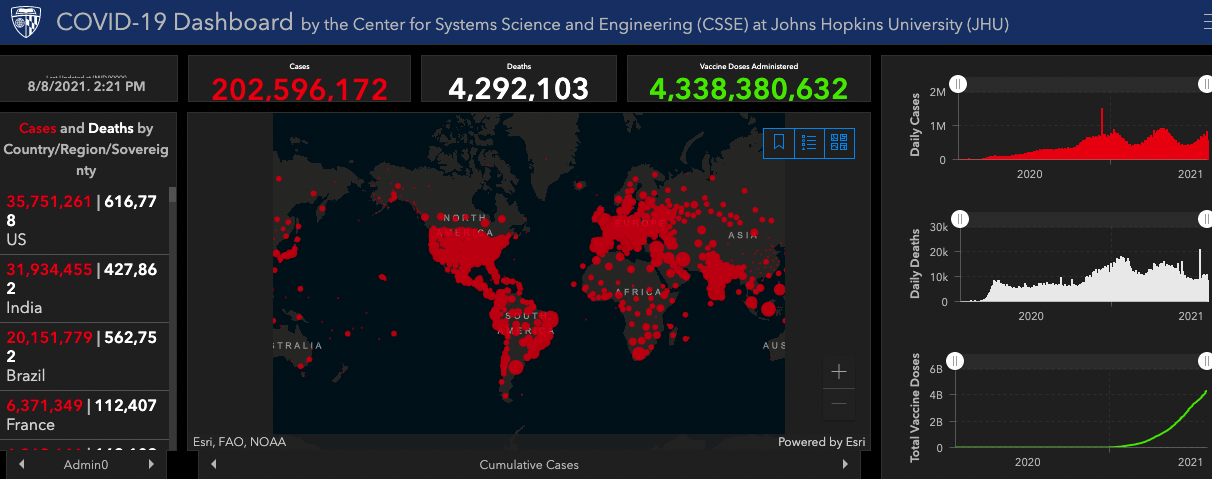
coronavirus world dash JHU 2021 August 8

COVID-19 status as of this post, via Johns Hopkins.

SAGE’s method – implied, but not fully stated – seems to focus on several scenario variables: virus transmissibility, lethality, and ability to escape vaccines, all driven by mutations to the virus’ shape and contents.

“Scenario One: A variant that causes severe disease in a greater proportion of the population than has occurred to date.”  In other words, this new COVID variant injured and kills more people and a greater range of us.  SAGE offers two modern analogies to help us visualize how terrible this could be: “For example, with similar morbidity/mortality to other zoonotic coronaviruses such as SARS-CoV (~10% case fatality) or MERS-CoV (~35% case fatality).”

35%. Think about that – out of every infected group, about one third dies.  And SAGE considers this to be a “[r]ealistic possibility.”

“Scenario Two: A variant that evades current vaccines.” In other words, the vaccines we’re taking now don’t work as well in blocking transmission and illness.  William Haseltine dubs this one a ““vaccine-busting variant.”  The Delta and Lambda variants are early examples of it.

Note that this could occur by a virus jumping from humans to animals, mutating in those new hosts, then returning to humans again.

“Scenario Three: Emergence of a drug resistant variant after anti-viral strategies.”  Similar to number two, but also more dangerous for therapy and treatment.

“Scenario Four: SARS-CoV-2 follows an evolutionary trajectory with decreased virulence.”  This is a positive development, with COVID-19 weakening over time.  It wouldn’t disappear, just become less and less transmissible and damaging.

The first three are dangerous and frightening. SAGE deems them to be have a decent likelihood of occurring (1+2 are “Realistic possibilit[ies]“, 3 “Likely – unless the drugs are used correctly“). Scenario four is benevolent – but, alas, not so likely to happen soon. (“Unlikely in the short term, realistic possibility in the long term.“)

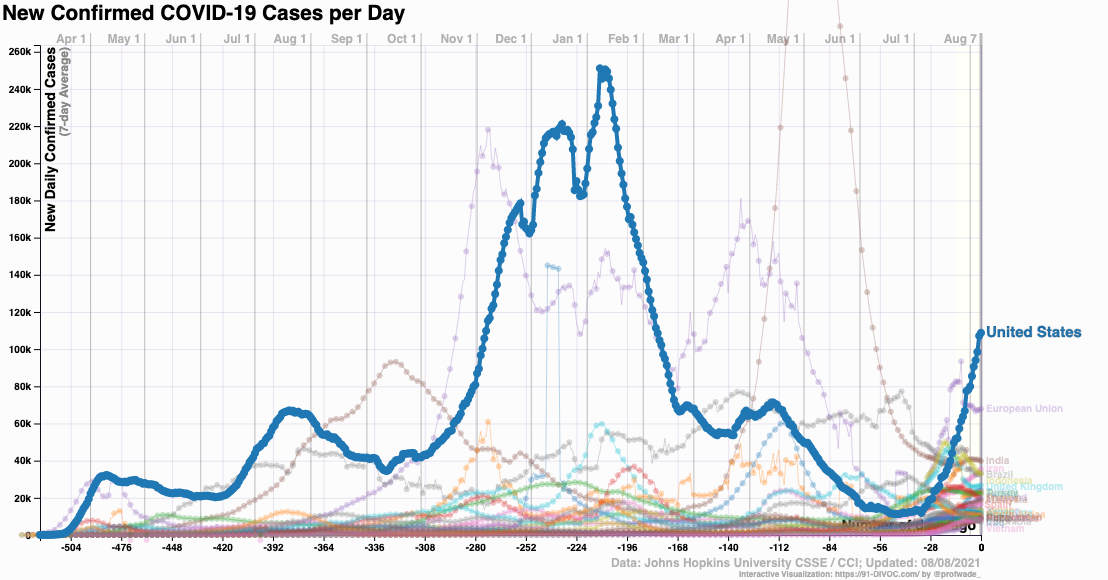
coronavirus cases by countries_UnitedStates_91-DIVOC_2021 August 8

COVID infections by nation to date, with US emphasized, via DIVOC-19.

Overall, what is to be done?  For many of the scenarios SAGE recommends similar responses: reducing transmission through nonpharmaceutical interventions (NPIs) (i.e., masking, social distancing, lockdowns, etc.); continuing to offer current vaccines, worldwide; developing and administering vaccine boosters; extensive monitoring of humans (and animals) for variants; rapid development of new vaccines; stockpiling therapeutic drugs; investing in AI for long-term use.  In case of scenario three, SAGE recommends not giving people as many antiviral drugs as we now do.

As scenarios, it’s important to remember that they are not only visions of possible futures, but attempts to influence the present. One BBC account reflects that these scenarios seem less likely to occur in that country, given dropping case rates, but might represent an attempt to scare people into better public health behavior.

What does this mean for higher education?

It depends on the scenario.  If scenario one occurs, we face the choices presented in summer 2020: close campuses and shift to remote instruction, or attempt in-person education with major on site protocols to reduce infections?  Increased lethality, and range of most injured victims, means a greater proportion of the academic community can be directly hit. If death tolls reach MERS levels I would hope all campuses would shut down in-person operations, but the pandemic experience shows clearly that many colleges and universities can follow other logics.

Scenarios two and three present similar, familiar choices for postsecondary institutions. Do we invite populations back on campus and trust in our individual mixtures of vaccination, testing, and NPI to keep most of us safe?  Or do we return back online and take major financial hits?

Scenario four is a path back towards normalcy. COVID-19 becomes like the seasonal flu. We want people to take their vaccines. Some will get sick, and a few die. But socially we deem this to be acceptable.  Face to face instruction returns and many try their best to recapture fall 2019.

Academic research appears to be essential for the world in every scenario, especially the first three. This suggests that colleges and universities divert more resources to relevant programs, even if they are suffering financially overall.

Which of these seems most likely to occur?  How do you think they might impact academia?

Posted in coronavirus, scenarios | 10 Comments

Should higher education advance or oppose geoengineering?

As the climate crisis deepens, geoengineering options are in the air.  My question for today is: should academia support and advance geoengineering research, development, and deployment, or should higher education do its best to resist any such efforts?

To explain: geoengineering in this context refers to artificial interventions into the total Earth system in order to reduce global warming.  There are many ways we can mount such projects.  Altering the brightness of clouds or oceans could bounce back some solar radiation into space. Many and/or large mirrors orbiting the Earth could intercept some solar radiation. Seeding the oceans with iron could encourage algal blooms or more phytoplankton, which like to eat carbon dioxide, then plummet to seabeds bearing their carbon cargo.  Launching aerosols, such as sulfates, into the stratosphere could reduce the amount of energy reaching the Earth’s surface.

(To be clear: yes, the term “geoengineering” can cover other projects, including some humanity has already done, like damming a river. In this post we’re just focused on the climate change aspect. If it helps, think of these projects as solar radiation management (SRM) or solar geoengineering, since they focus on adjusting how much the Earth receives from the sun. Direct air capture of CO2 could fall under this header, but I’m saving that for another post. Also, we’re not going to talk about conspiracy theories this time, please. (Ye gods but does Flick have a ton of “chemtrail” photos))

It’s easy to summarize the arguments in favor of such megaprojects. They could reduce global warming, if done properly.  Proponents also argue that seeding clouds or feeding plankton is much cheaper than revolutionizing the energy foundations of human civilization.

There are more arguments against the idea.  First, I wrote “done properly”; the potential for getting things wrong is vast. Imagine throwing a region into drought, or pelting another with enormous rainfall, or sending temperatures in the wrong direction. Second is the problem of governance. Since there’s no Planetary Modification Authority, there’s little to stop one nation, a rogue billionaire, or anyone else who scrapes together the means from mounting a big project… and then we’re back to things going wrong, accidentally or deliberately.  Third, if a geoengineering project succeeds, we would have to maintain it indefinitely.  If we don’t, the solution ceases (mirrors de-orbit, clouds aren’t seeded) and temperatures rise right up. Fourth, a moral hazard problem appears if a successful SRM project reduces interest in decarbonizing our power systems.

There is a lot more to say about the topic, but here I want to focus on just one piece of it: higher education’s role.  What will academia do to contribute to geoengineering?

Let me offer several possibilities.

A) Colleges and universities play a leading role in making geoengineering happen. Our research can envision how it might work, and how to do it well, from engineering fields to political science. Our development capacity can yield field tests and prototypes, which others (business, government) can take up.  And we can play a public role in urging such entities to get it done as a way of reducing climate harm.

B) Academia actively opposes geoengineering.  Our research and teaching can explore the many ways such projects could go wrong; I summarized a few up above. Then we can use that knowledge to enter the public arena to block such efforts.  Individual researchers can urge humanity against hacking the world. Perhaps universities or associations thereof could lobby politicians to promulgate a SRM ban.

That’s a pretty stark either-or, A/B. Let me add other options:

C) We remain neutral, overall. Yes, geoengineering appears in certain classes. Yes, some faculty publish papers on the topic. But we don’t exit the ivory tower in battle mode.  Either the academic world doesn’t see this as something we should go public about, or we can’t muster a consensus for a stand.

D) Academia is all over the place.  Some professors run podcasts to urge cloud brightening while others make YouTube videos claiming that would wreck parts of the world. Some campuses host R&D projects, on-site or elsewhere, while students from others stage marches in national capitals. Classes in campuses around the world offer a range of views.

I’m partial to D) myself, but I’d like to hear from you all.  Which route do you think higher education will take?  And which path should we pursue?

(graphic by Hughhunt – Own work, CC BY-SA 3.0)

Posted in climatechange | 3 Comments

Delta COVID changes the pandemic struggle: a leaked CDC document and what it means for higher ed

Last night and this morning I worked hard on climate change and higher education, writing up two book chapters and a blog post.  But I’m not going to blog about that today, because the latest COVID developments are so urgent and fast-moving.

Here I’m going to outline a leaked CDC document, then point to some possibilities for higher education.

This week the Washington Post published an internal CDC Powerpoint stack and the CDC’s director admitted its authenticity. The document is a presentation by a task force to the rest of the organization, apparently, and it develops two points: the latest research on the Delta COVID-19 variant and how CDC should best communicate it.

Let me summarize the key points, and share some of the graphics.

CDC leaked presentation_intro slide

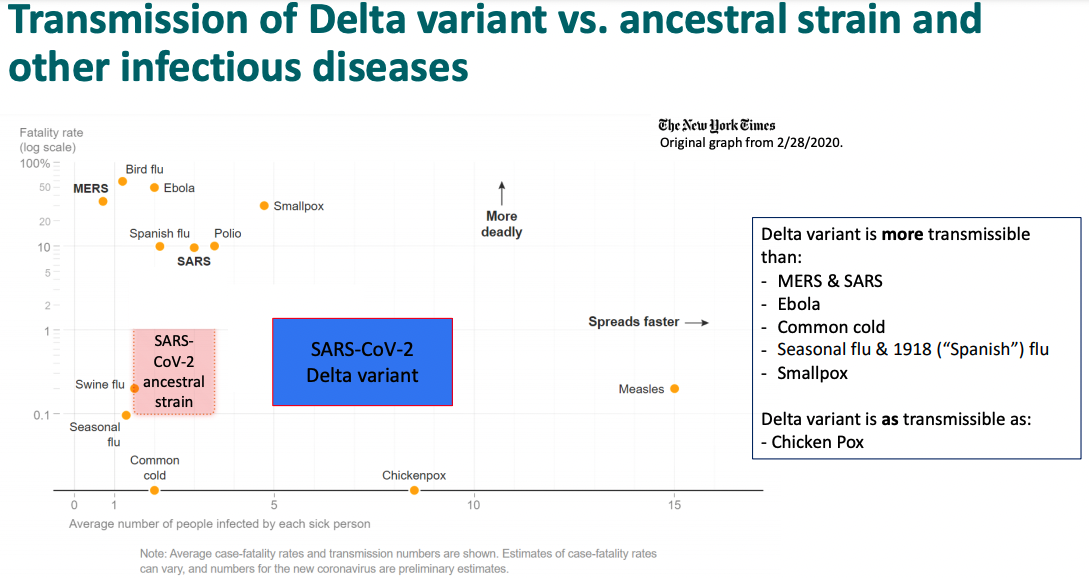
Delta is much more infectious than previous COVID variants.  It’s more transmissible than smallpox, akin to chicken pox, not so virulent as measles.  Its R0 value is up to 8 or 9. It’s also somewhat more dangerous to humans, leading to some increases in people being hospitalized, admitted to ICUs, being put on oxygen, getting pneumonia, and dying.

Here’s the presentation’s chart comparing Delta to other COVID-19 variants and to other diseases:

CDC leaked presentation_graph

Additionally, vaccines are not so effective with Delta as they are with prior variants. They are still good at massively boosting our odds of not being hospitalized or killed, especially if we’re not immunocompromised or living in long-term care. But vaccinated people can catch and spread Delta.to a surprising degree.  A growing number of vaccinated people are showing up with COVID-19 in hospitals: 15% of the total in one sample.  “Vaccine breakthrough cases will occur more frequently in congregate settings, and in groups at risk of primary vaccine failure (i.e., immune compromised, elderly, etc.)”  At worst, “Delta variant vaccine breakthrough cases may be as transmissible as unvaccinated cases.”  Don’t miss that sentence!

Delta infections may also last around 50% longer than do previous variants.  At least one slide (16) notes data showing infections lasting a “median 18 days vs. 13 days for ancestral strains.” (“ancestral” means “prior,” I believe)

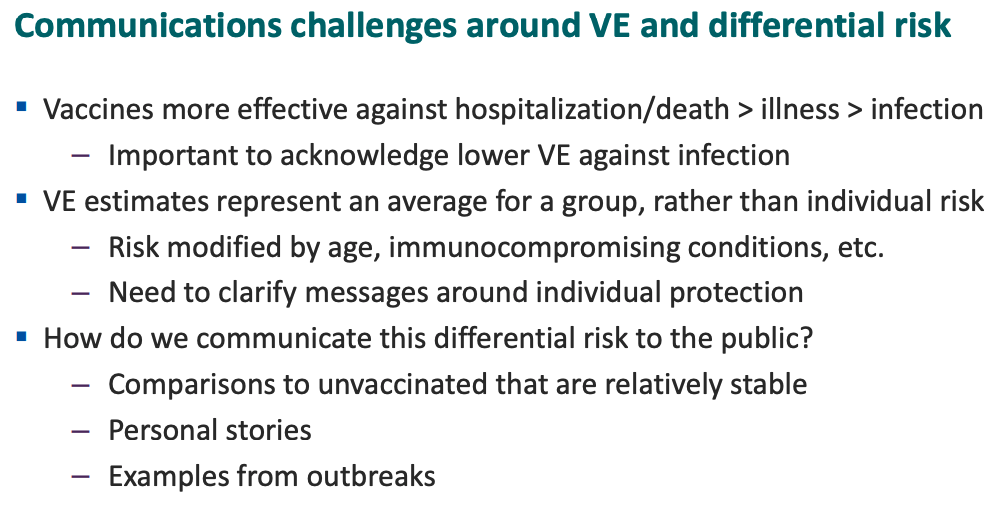
For the CDC (and, I infer, public health professionals in general) this presents communication challenges.  Vaccines look less effective than they did just a few weeks ago, but are still crucial.  So the document urges people to talk about how rare transmission and harm is for the vaccinated, compared to the unvaccinated.

There’s actually a series of recommendations, including personal stories played off against broader statistics:

CDC leaked presentation_communication challenges

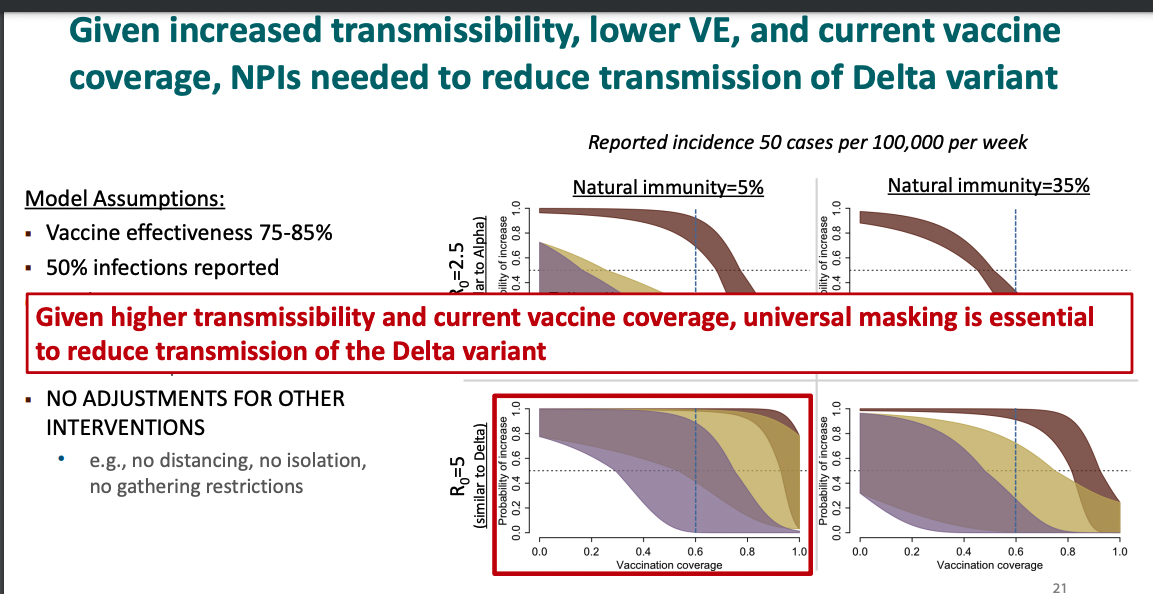
What is to be done?  The presentation is very clear.  First, all kinds of nonpharmaceutical interventions (NPIs), like social distancing, limits on meeting sizes, stay at home orders, etc. should be implemented.  The slideshow above all asks CDC to call for masking at a universal level:

CDC leaked presentation_universal masking

Note the fiery red font and box.

Second, we need more vaccinations, even given their reduced efficacy.  This is especially important for “vulnerable populations”: people with comorbidities, those living in senior housing and long-term care units.

What does this mean for higher education?

We’re already seeing signs of the Delta variant infecting the academic world, acting as the leaked CDC document describes.  One vaccinated university president admitted to testing positive for the variant:

As did another.  Elsewhere, the University of Maryland canceled study abroad trips to Britain, due to Delta takeoff there and federal guidance.  Louisiana State University canceled an athletic trip.

Yet right now many academic institutions seem oriented on something close to business as usual.  Reopening for in-person education is widespread.  The Chronicle of Higher Education’s vaccine mandate tracker counts 619 campuses requiring vaccinations, or just  around 14% of the total American sector. One approach to not mandating vaccinations is to mandate testing on the unvaccinated (for example) or to just test everyone (for example).

Some campuses are pushing to increase vaccinations in their populations, and we could see more over the next few days.  The University of Michigan, my alma mater, announced a vaccine mandate as I finished this post. As incentive, Auburn is giving prizes to vaccinated students.  A Florida university tried to mandate vaccines, but changed its mind under pressure from students and possibly politicians.  An online petition spoke thusly:

“Many students have scholarships, or even volatile living situations and giving them an ultimatum regarding the vaccine is immoral,” the online petition’s description said. “Putting anything in your body should be a calculated choice, not a means to avoid social punishment. This move will deter students from the institution and impede on the social, mental health of the students more than it already has.”

The petition claimed EWU’s vaccination requirement for on-campus activities is in violation of Gov. Ron DeSantis’ executive order banning businesses from requiring “vaccine passports” for access or services.

Which gives one glimpse into “hesitation.”

Duke University announced a mask mandate for all campus buildings except dorms, explicitly because of Delta, as did the University of New Mexico.  The University of Kansas didn’t mandate masks, but strongly recommended people wear them indoors.

We may also have to deal with a socio-cultural problem over people who have not been vaccinated, the anti-vaxxers or vaccine hesitant. Some medical authorities argue that America’s failure to get half the population injected made Delta worse.  For example,

If more people had been vaccinated earlier this year, cases would not be rising now and a return to masking wouldn’t be necessary, said Dr. Eric Topol, director and founder of the Scripps Research Translational Institute in La Jolla, California.

“We wouldn’t be in this pickle if we’d had 70% of the population vaccinated,” he said. “When you have more than half your population not (fully) vaccinated, you’re vulnerable.”

How much on-campus friction should we expect about this?  For example, if a student proudly proclaims themselves unvaccinated, how long until someone talks sternly to them, or just clouts them?  How much static, or violence, should campus staff expect in trying to impose public health measures?

I’m thinking of this in part because of an email I received from the right-wing Turning Point group, which proclaimed that “More than 2,500 colleges and universities across the country are essentially forcing students to get the COVID vaccine — regardless of their health or discussions with their own medical doctors.”  Besides being factually wrong (see the Chronicle tracker up above), this could indicate a drive to increase the political nature of the pandemic and our response.

We will also have to grapple with mental health challenges.  Ray Schroeder writes movingly about this in a new column, urging us to recall the long-term psychological cost of the pandemic to date.  If Delta keeps surging through our population, that cost will surely rise even further.

To sum up, American higher ed is responding in our historical fashion of autonomous and diverse decision-making.  It looks like a mix of innovation, imitation, and all too often taking steps which increase the chances of Delta spreading.

Looking ahead, campus leaders may be revisiting the decisions they made in summer and spring of 2020, weighing costs, risks, public opinion, and strategic intelligence.  I don’t know how many are seriously considering alternatives to in-person education, either remote instruction or some form of HyFlex.  I expect to see various forms of mask and vaccine mandates or encouragements.

On a personal note, my wife has been called back to work as a contact tracer for the county next to ours.  Meanwhile, I have a professional trip scheduled for next week and am, well, anxious about it.  I’m also scheduled to teach classes in person starting later in August and am quite keen to see what measures are in place to keep students and myself safe.  Will some or all of this switch online in a few days?

My best wishes to all readers for their sanity and physical health.

(thanks to Ed Vielmetti, the Chronicle of Higher Ed and Inside Higher Ed for some stories, as well as Tom Haymes, Ruben R. Puentedura, and my family for discussions; edited to correct a missing word)

Posted in coronavirus | 4 Comments

Four futures for higher education after neoliberalism

How might higher education change if society moves beyond the neoliberal order?

Scholar Chris Newfield recently published a fine set of scenarios for future colleges and universities.  It is very much worth your time to explore.  Here I’ll set the stage and sketch it out as an introduction.

Newfield is the great scholar of how American states have defunded public higher ed.  In a series of books he has investigated the politics and economics in great detail: Ivy and Industry: Business and the Making of the American University, 1880-1980, Unmaking the Public University: The Forty-Year Assault on the Middle Class, and The Great Mistake: How We Wrecked Public Universities and How We Can Fix Them.  He spoke on the topic brilliantly with the Future Trends Forum in 2017:

He uses this research to build out a futures vision in a recent Radical Philosophy article.

“Universities after neoliberalism: A tale of four futures” starts with a classic four-scenario creation process.  To explain: one way to generate a scenario is to assume one or several change drivers are at work, then extrapolate a future vision based on their taking effect.

buy intagra online buy intagra no prescription generic

  For example, what might America look like if health care became its leading economic sector? We can go further and pick out a trend whose outcome we find hard to determine, then identify two opposite ways it could go, creating two scenarios from that.  For example, the internationalization of higher education: more global or more local?

What Newfield has done is more ambitious and, in full disclosure, something I find to be a lot more fun to do.  He starts with one basic assumption, that the neoliberal world order (dating back to the fall of the Soviet Union or earlier, to Thatcher and Reagan) is in popular crisis:

under the pressure of international social forces, neoliberalism is increasingly breaking down. These forces include the Covid-19-induced public health crisis, the climate emergency, multiple modes of racism and neo-colonialism, and the grinding effects of economic inequality.

Chris gives examples to show how this is starting to play out:

Neoliberalism has fractured in places like Hungary and Turkey, where it is being replaced by an authoritarian form of national capitalism. Something like that was happening in the US under Donald Trump, who sponsored a new round of tax cuts while denouncing trade liberalisation. At the same time, the liberal centre, incarnated by ‘third way’ New Democrat Joe Biden, has been backing away from the tradition that runs from Reagan and Thatcher through Clinton, Obama and Blair.

buy silagra online buy silagra no prescription generic

Starting from that, the article picks out two trendlines, privatization and platform, pushing each to extremes: much more privatization versus much less, more traditional democracy against decentralization and local autonomy.  Then the author places these two pairs against each other to form a quadrant, yielding four futures formed by where each polar extreme connects with the others’, or four possible universities:

Newfield-4 after neoliberalism

(Tracing this out is a great, intense, and creative exercise.  Strongly recommended.)

What they look like: “Fragmented Decline” (#1 in the drawing above) is what happens when privatization accelerates and today’s democratic politics persists.   That means increased administrative management in colleges and universities, along with more debt and stratification by race and economics.  “Debt-Free College” (#2) is also based on continuing today’s democracy, but then goes in the opposite direction with higher education funding, as the name signals.

On the top half of the chart we flip to the other political pole.  Now things are decentralized and local autonomy is key.  “Funding Equalised” (#3) ends privatization. In that world social movements drive a massive change in higher education finance, shifting resources from wealthy institutions and families to schools and students who need it most.  “Autonomous” or “Abolitionist” maintains privatization but demolished our current academic order, replacing it with many small, self-run educational entities “with fully non-capitalist and decolonised processes of higher learning.”

How does this play out?  What are our options now for shaping higher education towards or away from each of those scenarios?

buy azithromycin online buy azithromycin no prescription generic

  Might the future consist of blends or connections between them? Read the whole piece and find out.

I do want to offer a few observations on the side:

The “Autonomous” or “Abolitionist” university focuses on indigenous practices and history more than the other three.  It also reminds me of various left anti-authoritarian educational currents from the past century, from Ivan Illich to anarchism and Summerhill.

Newfield does good work in reversing some usual causal chains.  He thinks, for example, that universities are not just passive expressions of social forces, but have the ability to carve out new directions on their own.  Similarly, he doesn’t see college as giving graduates an economic boost, so much as identifying and supporting those already riding high:

The advertised result of a B.A. degree is entrance to a good, fulfilling job and a stable financial future – in the US, it was the ‘American dream’ of a middle class life, supposedly still offered to a multi-racial student population.  The actual result of a B.A. degree is the limiting of this kind of affluence to a smaller elite – without expressly denying B.A. access to everyone else…

The actual result is cross-racial and cross-class inequality of opportunity.

There are some clever formulations, like this: “We talk quite a bit now about the gig economy. One of its enabling conditions is the gig academy.”

Now, over to you.  What do you think of the four Newfield scenarios?

Posted in future of education, futures, scenarios | 3 Comments

American life expectancy declined, mostly due to COVID-19

For years I’ve used a certain phrase in presentations.  It came up when I was describing modern demographics.  I would explain how lifespans have increased in developed nations, and that more people will live longer, and then want on to explain what this meant for higher education.   Then I’d pause and mention that this was likely to keep happening, unless something truly extraordinary happened.  Like, say, a plague.

Now we’re in the second year of COVID-19.  As I write this the pandemic has killed at least 4,109,303 people worldwide, according to the World Health Organization (WHO).  That’s at least 607,289 dead in my country, according to its Centers for Disease Control (CDC). In India the official statistics may be grossly wrong, with the actual death rate for that nation being nearly as high as the published global number, according to a new study.

This horror now appears in demographic data. The CDC just reported that “[i]n 2020, life expectancy at birth for the total U.S. population was 77.3 years, declining by 1.5 years from 78.8 in 2019.”

More: “U.S. life expectancy at birth for 2020, based on nearly final data, was 77.3 years, the lowest it has been since 2003.”

What caused the downturn? COVID-19, primarily:

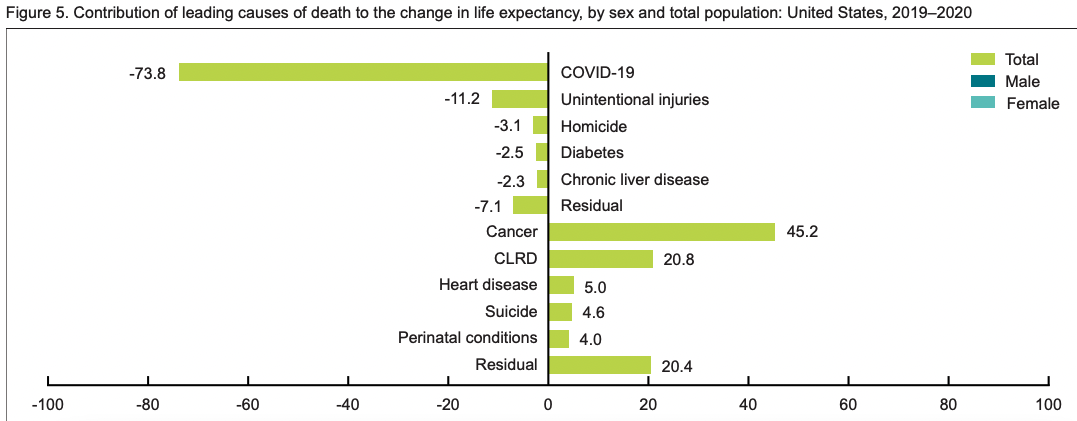
Mortality due to COVID-19 had, by far, the single greatest effect on the decline in life expectancy at birth between 2019 and 2020, overall, among men and women, and for the three race and Hispanic-origin groups shown in this report.

The report breaks down all causes thusly:

CDC life expectancy decline 2021 July

[The deaths were] primarily due to increases in mortality due to COVID-19 (73.8% of the negative contribution), unintentional injuries (11.2%), homicide (3.1%), diabetes (2.5%), and Chronic liver disease and cirrhosis (2.3%)

(For those non-COVID reasons, I wrote about this in 2019, pointing to research about deaths of despair among the poor and/or undereducated.)

CDC broke down the new data by gender:

Life expectancy at birth for males was 74.5 years in 2020, representing a decline of 1.8 years from 76.3 years in 2019. For females, life expectancy declined to 80.

buy cytotec online buy cytotec no prescription generic

2 years, decreasing 1.2 years from 81.4 years in 2019.

The decline hit all races, albeit unevenly:

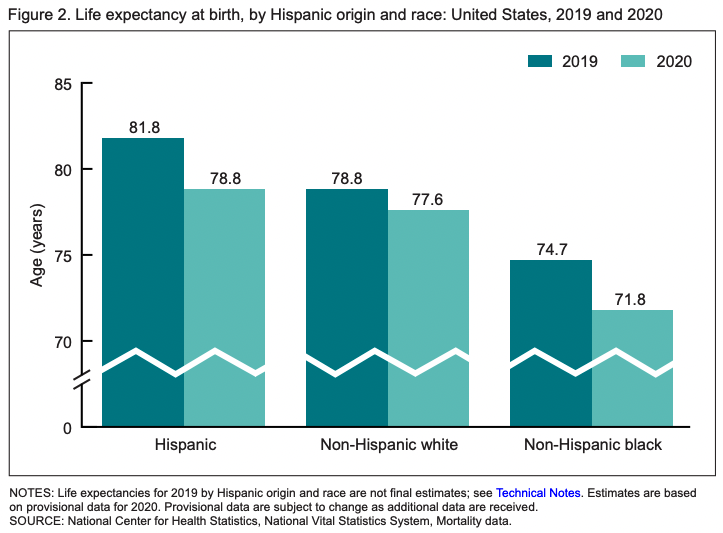
CDC life expectancy US by race 2021 July

Between 2019 and 2020, life expectancy decreased by 3.0 years for the Hispanic population (81.

buy prelone online buy prelone no prescription generic

8 to 78.8)… It decreased by 2.9 years for the non-Hispanic black population (74.7 to 71.8) and by 1.2 years for the nonHispanic white population (78.8 to 77.6)…

The Hispanic population experienced the largest decline in life expectancy between 2019 and 2020 (3.0 years).

What does this mean for the future?

buy vardenafil online buy vardenafil no prescription generic

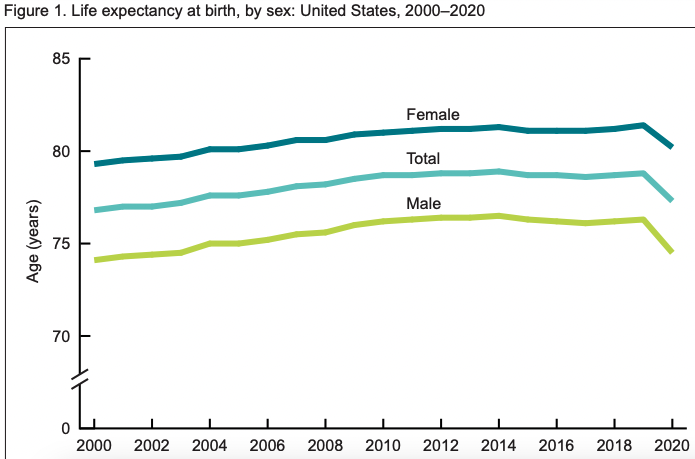
It depends on if we see this as the start of a long term trend or not.  If we do, then the 2010s were a peak lifespan for the US.  Consider this CDC graph as evidence for such a turning point:

CDC US life expectancy 2000-2020

Imagine that sharp downturn on the right edge continuing for years.

To make the case for such a future one would have to show that the deaths would continue.  That could be driven by continued COVID-19 mortality, which isn’t happening now (in the US) as the most vulnerable (seniors with comorbidities) are largely protected. We are seeing more hospitalizations, which means more “long COVID” (longterm injuries) which could lead to more deaths.  Further, the death toll may turn out to be worse if we can prove the year’s excess deaths were actually COVID-caused.  Or more variants could become more lethal.  Having us lose what I’ve called the race between variants and vaccines would make this scenario even more likely.

Adding to its likelihood would be more deaths of despair. That’s only a fraction of the pandemic’s butcher’s bill, but they do occur and aren’t slowing down.  I would also add deaths due to the climate crisis, starting with casualties from extreme weather (floods, heat waves, storms) and moving on to chronic conditions worsening thanks to the climate.

On the other hand, the 2020 life expectancy drop could be a historical blip. 2021 has seen COVID deaths fall pretty steadily after January, according to 91-DIVOC:

coronavirus deaths US states regions -emphasis South 91-DIVOC_2021 July 22

While the delta variant is booming, it seems to mostly be spreading infections and injuries without immediate fatalities. That’s due to improving treatment but also to the great vaccination rates of the most vulnerable.

buy neurontin online buy neurontin no prescription generic

As for deaths of despair, they have given rise to some (if not widespread) political outrage, which may translate into better care, or even social support.

The biggest mortality question in my mind is climate change – and that’s the topic for another post.

Posted in coronavirus, demographics, trends | 5 Comments

Have master’s degrees gone too far? A critique and a discussion

Have master’s degrees become a problem?

Last week New America’s education policy leader Kevin Carey gave an interview to Slate.  In it Carey and his interlocutor, Jordan Weissmann, argued that American master’s degree* programs have been corrupt and dangerous in many cases. It’s a powerful claim against one thriving part of higher education, and Carey is both smart and influential, so I’d like to explore it here.

A little background: I kicked off a Twitter discussion about the topic with a thread yesterday as well as a LinkedIn post, so I’m going to build on what I said then.  I’m also going to include thoughtful and useful replies, which makes this a kind of networked or multi-voiced post (which I love).  Additionally, I’ll share as much linked content as a can for readers who can’t get past various paywalls.

More background: if the term “master’s degree” is unfamiliar, it refers to an advanced academic degree midway between undergraduate or bachelor’s (like a bachelor or arts) and a PhD.  Most are master of arts (MA) or master of science (MS), along with specialties such as master of fine arts (MFA).  The history of master’s degrees is actually interesting; Wikipedia gives a start.

In recent years people have been taking more master’s degrees and for a set of reasons.  There is a lot of social backing behind the drive to get an MS/MA, starting with increasing credentialism – i.e., more requirements or recommendations for master’s degrees to be considered more jobs.  There is also a growing number of people with bachelor’s degrees; a master’s outcompetes them on the labor market.  Hence the expression “the master’s is the new bachelor’s degree.”  Then there’s the overall education gospel, the idea that more post-secondary education is a good thing for people (hat tip to Tressie McMillan Cottom in her essential book Lower Ed).

Combining these forces means rising demand for master’s programs, even while undergrad enrollment declines, even during COVID-19. (In fact, Josh Kim once cited rising MA/MS programs as an argument against my peak higher ed model.) In some cases master’s programs are profit centers, helping prop up the rest of an institution.  As Rob Gibson observed on Twitter,

This can mean a great deal of financial temptation for colleges and universities, as Stephen Landry notes.

Now, on to the Carey/Weissmann interview.   The gentlemen begin by recognizing the growth of master’s programs, then casting this as a problem. As Weissman puts it in a statement/question: “master’s degrees are basically the biggest scam in higher education, and it seems like prestigious nonprofit universities are in on the grift along with for-profits…”  Carey agrees with this, with one caveat:

Probably the biggest scam in higher education remains one-year certificates offered by shady for-profit colleges that cost, like, $25,000 and don’t lead to a job. Master’s degrees are probably No. 2. Certainly, within the confines of colleges that are not legally for-profit, they are the biggest scam by far.

Why are they a scam?  One major problem is that while MA/MS programs are more job-focused than BA/BSes, they do not have the same expectations of transparency about success rates.  It’s harder to find information about post-graduation career prospects in these programs, as opposed to undergrad degrees, say the discussants:

If you’re offering bachelor’s degrees… [y]ou have to publicly publish your acceptance rates, your average SAT scores, so to the extent that you’re selling selectivity, you actually have to back it up with data, whereas in the master’s degree market, you can call almost anything a master’s degree. Master’s degree programs do not have to publish their admission statistics, which creates, I think, an enormous temptation for institutions that have very attractive brand names, that are attractive in no insignificant part because their undergraduate programs are very selective, to open up the floodgates on the master’s side and pay no penalty in the market because people don’t know they’re doing it.

Perhaps the most dangerous part of this problem are master’s in the creative arts, since they cost a lot and do not often reward that investment, as careers in the arts usually don’t pay well.  Carey acidly notes that “[t]he phrase starving artist exists in the vernacular for a reason.”  In support of this he and Weissmann refer to a recent Wall Street Journal article where Melissa Korn and Andrea Fuller found several first-tier universities offering programs whose graduates sometimes were unable to pay off their student debt:

WSJ elite MA arts programs debt to income 2021 July

You can see that not all degrees are failures.  The points clustered on the graph’s left side are success stories, at least in financial terms.  Yet enough points occur to the right to make the reader concerned, as they show people for whom the MA/MS promise failed, yielding instead a lifetime debt burden.

That debt produces another problem for Carey.  He argues that students can take out more federal loans for graduate study than they could for undergraduate classes, which worsens to broader student debt crisis.

If you are an undergraduate, you can only borrow a certain amount of money from the federal government to go to get a bachelor’s degree, and that’s very specifically because they don’t want people to overborrow. In graduate school, you can borrow not only the full cost of tuition, but also room, board, living expenses, which, in a city, could be tens of thousands or more dollars per year, regardless of how much money you already owe to the federal government, by the way, and regardless of whether you have any real prospect of paying it back…

In other words,

[Y]ou’re essentially creating an unlimited spigot of money that can be used to fund graduate programs, which just creates an enormous moral hazard for colleges and universities when it comes to creating these programs.

So debts rise, which can blight the lives of those graduates who don’t follow careers fortunate enough to generate enough money to pay them off.

Carey then adds a fascinating extra charge, which is to rethink the identity of these MA/MS programs.  Despite being housed within non-profit universities, they aren’t non-profit enterprises.  That’s because many colleges and universities rely on corporations to help offer those masters programs, and give them hefty chunks of the revenue. In other words, some master’s programs are basically for-profit degrees concealed by a non-profit’s logo.  Last year Carey published a very detailed breakdown of the role OPMs play in non-profit higher ed program operations, which I recommend.

On Twitter Weissmann chimed in on this point:

https://twitter.com/JHWeissmann/status/1416456203803271169

On a moral level, interviewer and interviewee see these for-profit enterprises are clearly exploitative. They exact money from students to provide revenue for the broader campus:

[T]he numbers have to add up somehow, and right now they’re just not adding up for the students. They’re adding up for the colleges. The only defense the colleges really have to offer is “We need the money.”

As a result, Carey argues for a change in federal policy.  If the reality is one of grift and scamming, as Weissmann put it, then redress is required. “I think any master’s program should be treated as for-profit and regulated that way. ”

What should we make of this argument?

There’s a lot of truth to it as presented, especially the damning Wall Street Journal story.  When I shared this interview many responses agreed with it.  For example, Trace Urdan sees outsourcing MA/MS operations to companies as speeding up the growth of programs, although he wants to protect the for-profit nature of those partnerships:

https://twitter.com/Trace_Urdan/status/1416455744140894210

Carrie Saarinen observed “the sudden swell in online EdD programs and ads targetting ABD students to finish their degree… the EdD is the new MBA. Keep an eye on that trend.”

If Carey and Weissmann are correct, then there should be a greater need for consumer information about these increasingly problematic programs.  As Jeanne Eicks notes,


At the same time there has been some pushback to the Carey/Weissmann critique. David Rosowsky argues that the case is overstated, since the need for MA/MS credentials is real, based on changing technical and social conditions.  Moreover, many programs are good:


Some people defended master’s programs they participated in. Brad Garrison offered a personal anecdote of how his education MA boosted his career:

https://twitter.com/Be_RadG/status/1416445930119729152

Mike Sellers described a gaming undergraduate degree he leads as so intense an MA version might be appropriate:

I can add my own anecdote of teaching in a Georgetown master’s program.  My colleagues there offer superb classes and student support.  The students are awesome and go on to supercharged careers.

Meanwhile, Matt Holt offered several counterarguments on LinkedIn.  He sees the critique as too broad: “I am tired of news articles that paint with an overly broad brush.” He asks what a new pricing level might look like. “Should we give away online M.S. degrees because they apparently have no value? … What is a FAIR price (ahh, the age old question)?”  Then he raises the fact of lower cost, high quality programs available online:

Want an M.S. in computer science from Georgia Tech (a program easily in the top ten CS programs in the U.S.)? You can do it online for approximately $7,700. Same with an online M.S. in analytics at Georgia Tech. Want an MBA with stackable credentials from a notable Big Ten school. Complete the University of Illinois’s iMBA (and yes, partnered with Coursera) for $22,000. These costs hardly strike me as being usurious.

I would add another note.  To the extent that these graduate programs support or even subvent the money-losing undergrad ones, there might be an interesting connection to the rising discount rate.  That is, successful MA/MS programs allow a campus to keep elevating that undergraduate tuition discount.  If the former gets checked, what kind of pressure hits the latter?

Overall, what does this critique of master’s degrees mean for the future of higher education?

It’s early to tell how much of an impact it might have.  On the one hand, I might be making too much out of a Slate molehill.  That site does like to offer contrary and provocative articles as part of its business model.  And regulators at both state and federal levels might be too preoccupied with other issues to delve into this sub-sub-subset of education policy.

On the other hand, Kevin Carey is a major thinker in higher ed.  Jordan Weissmann is a high profile economics journalist. The Wall Street Journal is, of course, a major outlet for people thinking about business.  Seeing this critique surface suggests that some might be taking it seriously.

Keil Dumsch adds to this:

I would add the possibility of political partisanship.  American Republicans are already far more skeptical of higher ed than are Democrats. They could seize Carey/Weissmann as another stick with which to beat the academy.

Perhaps we’re observing the start of an anti-master’s backlash.  It could occur on the federal level.  States might also play a role, as Bobbe Baggio noted on LinkedIn, asking about California legislation against OPMs.  Also on that thread Matt Holt pointed to Virginian regulations.

If the analysis convinces enough people and the remedy (regulation) kicks in, then some of those programs will shrink or disappear, and others become more expensive to offer.  That would cut back on the internal profits they provide their institutions, which adds some financial stress to those universities.  Not to them all:

https://twitter.com/Trace_Urdan/status/1416470896630394884

We could also see total enrollment in master’s programs drop, in an echo of how for-profit enrollment collapsed when the Obama administration started pressuring that sector.  In which case we might experience a version of peak higher ed: peak master’s degrees.

What do you make of this critique?

(thanks to Twitter discussants Alice Daer, Keil Dumsch, Jeanne Eicks, Charles Findlay, Brad Garrison, Rob Gibson, Stephen Landry, William Pannapacker, David Rosowsky, Mike Sellers, and Trace Urdan. Thanks as well to LinkedIn respondents Bobbe Baggio, Matt Holt, and Carrie Saarinen.)

*Has anyone challenged the term “master’s degree” as racist yet?  The term predates American slavery, but the resonance could be galling.  Two Ivy League universities already ended their use of the term “master” in a related context.


Posted in economics, enrollment, future of education, higher education | 13 Comments

Will humanity take these decarbonizing steps this year? The Lynas choice

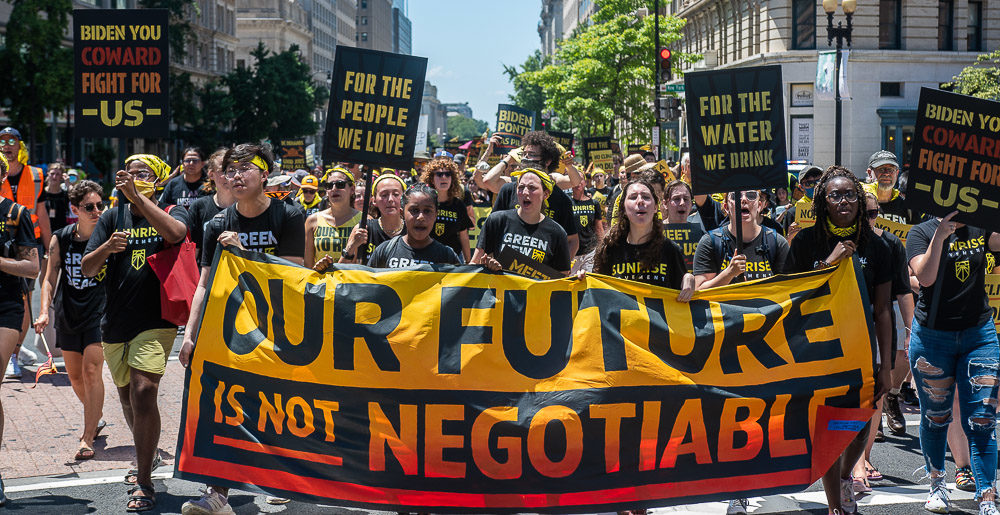
Today, July 15th, the Sunrise Movement is organizing a national action in the United States.  Its aim: to pressure the Biden administration to take more serious steps about the climate crisis.

Sunrise Movement 2021 July 15 day of action_website image

In line with that call, I’d like to pose a question about the climate crisis.

buy premarin online buy premarin no prescription generic

I’m reading Mark Lynas, Our Final Warning: Six Degrees of Climate Emergency. (2021) The bo0k offers a series of visions of the world after global warming, with one chapter per degree rise by 2100. Naturally each additional degree makes things worse.

But early on the book pauses to point out a strategic choice that the human race has access to right now.  Lynas offers one list of things humanity can do to try reducing the chances of seriously terrible global warming, and I’d like readers to consider what’s involved and how likely they could occur.  The precise goal of achieving the actions in this list is to “keep… to the Paris target of staying below 1.5°C above pre-industrial levels.” (271)

In the list are two main items:

  1. canceling the development of all planned carbon-burning (coal, oil, gas) power plants
  2. “stop[ping] selling cars and trucks straight away – anything with an internal combustion engine in fact – as well as home boilers, aircraft and shipping, cement kilns, blast furnaces…”

I invite the reader to consider what it would take to accomplish this.  You can estimate how likely it is that we make it happen.

Yet these huge measures might not be enough to have a good chance of stopping global warming.  Lynas explains:

even if we succeed in cancelling all these sources of future emissions, we are still 200 Gt over budget for the 1.5°C target, if we want a 66% chance of staying under it. If we are prepared to accept only a 50% probability of staying at 1.5°C – gambling the planet for somewhat worse odds, in other words – we can go for a total budget of 580 Gt of CO2. But even then we are still more than 100 Gt over the target (and more, if we include land-use change).

buy silagra online buy silagra no prescription generic

The only way to retain even a 50:50 chance of a 1.5°C outcome, therefore, is to do something about future emissions from existing infrastructure – by closing it down early. (272)

So he adds other items to the list:

  • shutting down all currently operational coal power plants
  • “closing heavy industry, and taking petrol and diesel trucks off the roads before they reach the end of their lifetimes.”
  • “scrapping jet aircraft and switching from flying to other less energy-intensive modes of transport until someone comes up with carbon-neutral air travel.”

What would be required for civilization to take these steps in 2021?

There are many issues involved in even considering such vast possibilities, obviously.  Lynas touches on several: equity of sacrifice within and between nations; economic devastation, starting by killing the fossil fuel industry; political unrest. Readers can add more.

If such changes seem difficult, unlikely, or laughably implausible, Lynas then follows up with the logical result. We would have to be “prepared to accept the additional climate damages that predictably arise between 1.5 and 2°C.”  These include: the north polar icecap passing a tipping point into steep decline; increased melting of the Antarctic ice sheet; millions of acres in northern Asia, now covered in permafrost, thawed out and releasing methane (a far more potential global warming gas than CO2); over 100 major cities experiencing serious flooding; dengue fever spiking in Latin America; declines in agricultural production; more people exposed to dangerous (as in causing illness or death) levels of heat; the collapse of many coral reefs.  Several of these changes will accelerate the others, as when an open Arctic Ocean’s dark waters retain heat, rather than bouncing it away as high-albedo ice historically did.

buy ivermectin online buy ivermectin no prescription generic

(273-5)

That’s a choice we have before us: radical decarbonization at once or accepting one form of global disaster.  Note that a 2 degree rise isn’t the worst case.  Degree by degree Our Final Warning ratchets things up until 6 degrees.  At that point it seems like most observers and modelers give up, or just don’t want to gaze into such an abyss.

buy avanafil online buy avanafil no prescription generic

  The choice I identified falls far short of that.

While you consider those possibilities, please add one dimension: the role of academia. How many students, staff, and faculty are thinking of Lynas’ choice now, or advocating for one of his two paths?  What role does academic research play in informing or motivating the public about that choice? If parts of higher education are committed to mitigating climate change, do they find themselves in open opposition to the energy industries Lynas’ first option would gut?  Conversely, how much of academia is planning on a 2 degree temperature rise for the next two generations?

Posted in climatechange, futures | 3 Comments

Heat domes, low-density campuses, and what we can do: two excellent readings

As I write this post two major crises are hitting the world in ways which bear closely on higher education’s future. Across the world very high, even extraordinarily steep temperatures are striking certain regions from Siberia to Canada, causing humanitarian and environmental damage while reminding people that the climate crisis is proceeding. At the same time colleges and universities are adjusting, amending, tweaking, or just tossing out plans for fall term operations as they track COVID-19’s potential impact during the race between vaccines and variants. Once again we cope with the overlap of coronavirus and climate change.

So I’d like to recommend two excellent articles, one on each topic.

To begin with, many academics were anticipating a return to wholly in-person activities as COVID infections declined and vaccinations spread.  Yet that picture of the short term future is now cloudy. A sizable chunk of people in some developed nations are steadfastly refusing – excuse me, “hesitating” – getting vaccinated, pushing the date of populations hitting herd immunity further and further away. At the same time new virus strains are racing across the globe, notably the delta variant, at least keeping the disease at pandemic levels, if not kicking off new regional or local outbreaks.

What does this mean for fall 2021?  What should campuses do to prepare? Only a few campuses are mandating vaccines for their student population, and fewer still for faculty and staff.  As of this writing 327 American colleges and universities have issued such a mandate, according to the Chronicle of Higher Education’s tracker.  That’s around 12% of academic institutions in the United States.  Clearly most campuses here are holding off on such requirements for now.

Yesterday’s Future Trends Forum session raised another strategy.  Karen L. Pedersen, the dean of Kansas State University’s Global Campus, Kim Siegenthaler, associate provost for Online Strategies at Georgia State University, and the Forum community explored what remote work for faculty and staff could look like.  We touched on various policies, mechanisms, and general possibilities for campuses to require in-person, on-site work versus off-campus operations.  I floated the idea of a HyFlex work configuration. Here’s the full recording:

What about remote students? We didn’t deeply address various forms of remote teaching.

That’s where my friends and colleagues Eddie Maloney and Joshua Kim come in.  This morning they published* an update on their low-density university model, and that’s the first article I wanted you all to read.

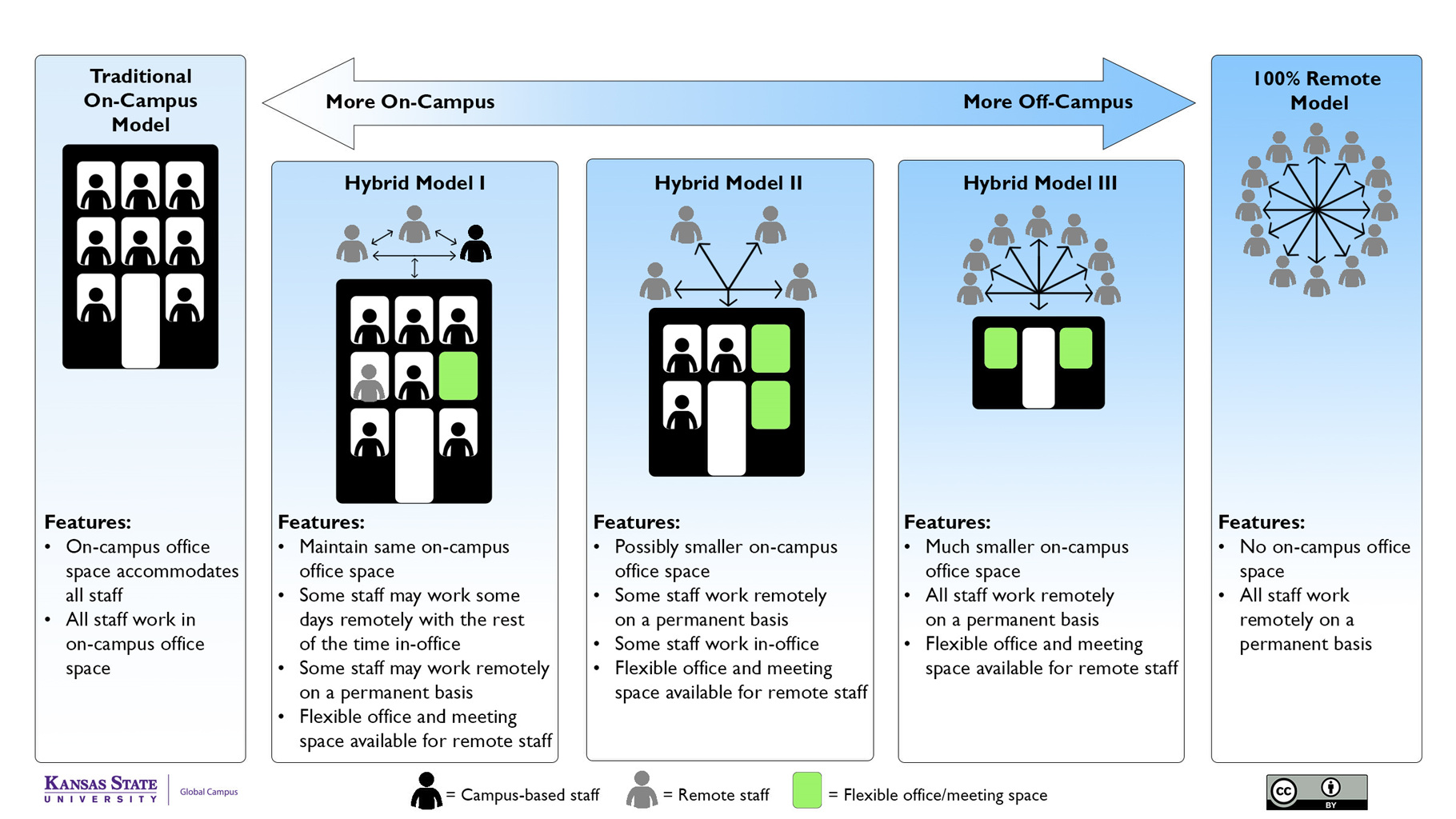
Maloney and Kim start by referencing Karen Pederson’s Kansas State University, which has published a framework for faculty and staff locations, a “Remote Work Continuum.”

Remote Work Continuum

Note that it positions two extremes as polar opposites (I think of them as “fall 2019” and “spring 2020”), but it also provides three different modes for blending them.  KSU breaks those down by scheduling, space, and population.  Note, too, how faculty and staff can choose options – again, you can see why I think of this as HyFlex work.  (Here are our two discussions with the creator of the HyFlex model, Brian Beatty: 1, 2. The Frank Nerd offers a remarkably brisk summary.)

Eddie and Josh then compare this workforce question to the educational one:

Decisions among campus academic units to move to some version of remote and hybrid work serve as much to create the low-density university as the decision to shift residential courses to blended and online delivery methods.

They compare the Kansas model to their own continuum of teaching across different levels  of presence:

Low Density U 15 versions_Maloney and Kim

Which leads them to this conceptual reframing of fall:

Instead of thinking about the future of academic staff work as either “on-campus” or either “100% remote”, we should instead be thinking about the range of “more on-campus” and “more off-campus.”

Then, taking this further than 2021:

Going forward, the “traditional on-campus model” may end up being the exception. Reserved for those ever-rarer cases where some form of hybrid work does not make sense.  And the extent to which 100% remote work will grow remains an open question.

Read on to see where they take this idea.  Call it low-density, hyflex, blended, but we seem to have glimpsed a new median for academia.

The second article I’d like to recommend focuses on the other crisis, climate change.  Journalist David Wallace-Wells starts off by summarizing the past month’s string of dangerous heat events, including both excessive dryness and drought as well as too-high humidity. He goes further, raising different ways we can think through such events. One is to see them as confirmations of climate science. Another is realize that these occurrences are the latest in a series, that we’re already waist-deep in the climate crisis.

A third is to consider extremes.  Wallace-Wells cites Sarah Miller’s personal reflection on the crisis, and quotes her conclusion: “[A]ll the right words about climate have already been deployed. It’s time for different weapons.”  Those links are to a Swedish activist’s argument in favor of violence as a tool in pushing humanity to decarbonize.  Some of you know this is a theme I’ve been tracking for a while.  Campuses may be early sites for its appearance.

A fourth is to consider that we are living in an ongoing emergency, and to act practically to adapt out of it with minimal damage.  He offers an impressive list of things to accomplish now:

early warning systems, dramatically expanded cooling centers, and forecasts featuring wet-bulb temperatures, when it comes to heat waves; rebuilding infrastructure, energy infrastructure particularly, to make it resilient in the face of new climate extremes; retrofitting homes and “future-proofing” agriculture by developing new strains of crops that can thrive, or at least survive, in our brutal new world…

[D]efensive infrastructure, such as sea walls and levees, or large-scale controlled burns of forests in places like the American west, or driving mosquitoes extinct through genetic engineering so they don’t begin spreading tropical diseases like dengue or malaria as far north as Scandanavia in the decades ahead. According to models developed by Portland State’s Vivek Shandas, simply “greening” cities through more grass and green roofs, lighter building colors and more tree canopy…

This is different from sounding the alarm. This is a call for practical action.

The author cites University of Waterloo professor Moreno-Cruz, who urges “climate realism”:

https://twitter.com/jmorenocruz/status/1410337975913828357

How much of the world is in that mental space?  How much of higher education?

Two powerful articles.  Now I’m off to work on more chapters.  Stay safe, everyone.

*How do they write so much?!  Josh is a column-generating machine, writing nonstop for years at IHE while working full time at a major research university.  And Eddie manages to teach, run the amazing CNDLS office, help run a graduate program, and still co-author articles and books.  They are astonishing people.

Posted in climatechange, coronavirus | 6 Comments

Three big ed tech projects: cashing out or historic investments?

Over the past few days three big ed tech entities made major financial moves. I was struck by that coincidence and wanted to explore what the combination might means.

ITEM: To start with, major online program manager (OPM) 2U purchased much of online class provider edX for $800 million. As part of the deal Harvard and MIT will launch a new and so far unnamed education nonprofit.

For more information, here are the official announcements from 2U, MIT, Harvard, and what seems to be the nonprofit’s placeholder, “Transforming Digital Education.”  There is also some good, early commentary and analysis from EdSurge and Trace Urdan.

ITEM: Language learning app Duolingo, founded by Luis von Ahn, filed an IPO.  As  TechCrunch and others have noted, the market values Duolingo above $2 billion.  Its user base and earnings are rising.

ITEM: major learning management system/virtual learning environment provider Instructure, maker of Canvas, also  filed for an IPO. They tried this before, so now it’s a  second attempt.  Instructure is, unlike Duolingo, losing money.

So what does this big money trifecta tell us?

It may be a huge boost for 2U. They now have access to tens of millions of potentially new students.  According to a slidestack for investors, 2U stands to gain:

Increases TAM through combined 50M+ global learner base, 1,200+ Enterprise clients, 230+ university and corporate partners, and comprehensive suite of 3,500+ offerings ranging from free-to-degree

Combined entity will have massive global audience and strong consumer brand, top five education website with traffic of 120M+

They can also trade on the elite reputation of campuses associated with edX, namely MIT and Harvard.

Eddie Maloney and Joshua Kim go further, seeing the 2U+edX combination as a challenger to the much larger Coursera. What we see now are OPMs on steroids.  As Paul Fain put it, “MOOCs have become OPMs.”


I’m not sure what to make of the new MIT-Harvard nonprofit since there’s so little information available. I do like Goldie Blumenstyk’s comments:

It’s hard to even fathom the potential impact of an $800-million nonprofit devoted to the future of online learning and eliminating educational disparities around the world. Add to that the academic muscle undergirding the nonprofit, overseen by edX’s founders, Harvard University and the Massachusetts Institute of Technology, and the societal, technological, and pedagogical potential here feels enormous. But what actually will be realized? Harvard and MIT promise that the new nonprofit’s mission, name, research, and other activities will be developed more fully in the coming months. [emphases in original]

Even more from Phil Hill here.

Duolingo: much depends on how the sale goes and what happens to its value over the next few months, but a successful infusion of cash could drive the owl into expanding or adding offerings.  New languages are a clear development, but what about adding conversations with native speakers, or even branching out into new curricula beyond language?

Note that criticisms of Duolingo – for not being good on spoken languages, for not doing much on culture and language – don’t seem to have dimmed its prospects so far.

Instructure: Phil Hill does good work in showing the complexity of the offering, based on the structure of Instructure and its holding.  I don’t have a good sense of its odds for a successful IPO.

Overall, these three stories remind us that serious money is interested in ed tech.  COVID-19 may have increased investments as so much of higher ed moved online.  Perhaps that’s a long-lasting change… unless people flee the pandemic’s online experience and rush to embrace in-person life, in which case June 2021 might represent a peak before a financial fall.

What do you think about these three ed tech financial stories?

Posted in economics, education and technology | 14 Comments