Life on Earth can recover from a drastic climate shift by evolving into new species and creating new ecosystems. Humans cannot.
Every few years the Intergovernmental Panel on Climate Change (IPCC) issues reports on the climate crisis. These documents are hugely important for the global conversation about the topic, not least because they summarize cutting-edge science and offer policy recommendations. The most recent one, the Fifth Assessment Report (a/k/a AR5), appeared in 2014.
AFP scored a world scoop by publishing a new and very concerning draft report from UN climate experts. The report serves as the international reference document to measure how the planet is warming.
Hundreds of scientists contributed to this 4,000-page report, the previous edition of which came out in 2014. Their assessment of the speed and consequences of climate change is more alarming than ever.
As far as I can tell APF has not shared that big, 4K document at all. They have so far only shared an introductory article, made this piece for syndication, and created this video:
You have to click on the link, since AFP disabled embedding this one.
Writeups from other sources, like this, rapidly appeared, but they don’t add much beyond recapping the APF summary.
What can we say about this ghostly report now, as it impacts higher education?
Put another way, should we even spend time on this leak-in-process? We don’t have much to go on, after all. And the document is a draft, meaning the actual report will differ once it appears next year. Yet probing it can have some uses. The APF notice gives us a glimpse of the climate crisis in time, showing warnings being sounded as the United States apparently backs away from major steps. Discussing it might set us up for the report next year. And for higher education, which all too often isn’t strategizing on climate change, the APF leak might be a useful prompt. Or even a needed goad.
The summary repeats the threats those following climate change already know: “Species extinction, more widespread disease, unliveable heat, ecosystem collapse, cities menaced by rising seas.” Those threats hit unevenly and unjustly: “those least responsible for global warming will suffer disproportionately, the report makes clear.”
One key change in the report is the finding that these dangers are growing, and their advent “accelerating… bound to become painfully obvious before a child born today turns 30.” The APF video starts with the claim that parts of coastal cities, and entire urban areas located on the edge of major bodies of water, will be wiped out.
More, major tipping points or “dangerous thresholds are closer than once thought… A dozen temperature trip wires have now been identified in the climate system for irreversible and potentially catastrophic change.” And some impacts are already being felt: “A warming world has also increased the length of fire seasons, doubled potential burnable areas, and contributed to food systems losses.”
There is also a powerful metaphor for describing some changes in the nonhuman, natural world:
…even as we spew record amounts of greenhouse gases into the atmosphere, we are undermining the capacity of forests and oceans to absorb them, turning our greatest natural allies in the fight against warming into enemies. [emphases added]
What does this mean for higher education? Well, that’s the subject of the book I’m frantically writing, so I’ll try to be quick here and focus just on what the APF is reporting, then link it directly to academia.
Cities being partially or entirely wiped out, abandoned – how many campuses are located in such urban areas? How many are planning for migration or some sort of defensive measures for long-term persistence on site? Which academic researchers are studying this? And for the cultural heritage sites in the path of rising water, how many universities and colleges are planning on their protection, relocation, or other forms of preservation?
Social justice – for campuses focusing now on issues of racial inequality and inequity, are they also extending that awareness to climate justice? Recall how the AFP account emphasizes that climate dangers will fall (and are starting to fall) on marginalized populations.
Storytelling – in the AFP video Climate Central’s Ben Strauss asks us to think about the stories future generations will tell of our time. Which researchers are studying this now?
Let me leave with this concluding thought from the AFP writeup:
We need transformational change operating on processes and behaviours at all levels: individual, communities, business, institutions and governments… We must redefine our way of life and consumption.
Just how far is academia thinking in terms of reinvention during the climate crisis?
Eight years ago Ceredwyn and I launched a business, Bryan Alexander Consulting. Which is astonishing. That’s nearly a decade. As a friend said, soon we’ll have to send BAC to college.
We’ve been very transparent about our work, sharing as much information as we can, barring legal limits and client wishes. Every year since 2013* I’ve blogged about BAC’s progress.
Hopefully that gives people some insight into what we do here.
If you’re new to BAC, it’s a small consultancy focused on the future of higher education. We help clients (colleges, universities, associations, nonprofits, governments, businesses) understand and plan for where academia might be headed. To this end we conduct and share research through a variety of channels, while also offering consulting on spec.
Overall, right now we’re actually doing well. Revenues are at a record high for us, although so are working hours. Because of the pandemic we haven’t done any in-person work, which is a financial loss, since fees for each in-person presentation tend to two-three times virtual events, yet we’ve done a higher volume of them, leading to a new increase. The pandemic transition to entirely online work accomplished in spring 2020, everything since has proceeded smoothly on the logistics backend. On the front end, video events occur daily, while asynchronous work (research, writing, etc.) takes place continuously.
We continued to add new clients and to serve preexisting ones. The overwhelming interest has been how higher ed responds to COVID-19 and what comes next.
With the new fiscal year starting in July we’ll increase fees for all services. This reflects inflation, rising demand, and also the enormous demands on my time. Virtual events will be $3000 per day; consulting, $3000 per business day of time; in-person presentations and keynotes at scale, $9000; expenses billed as needed.
At the same time, I’m considering a senior discount for the FTTE report; I’m curious what you all think of that.
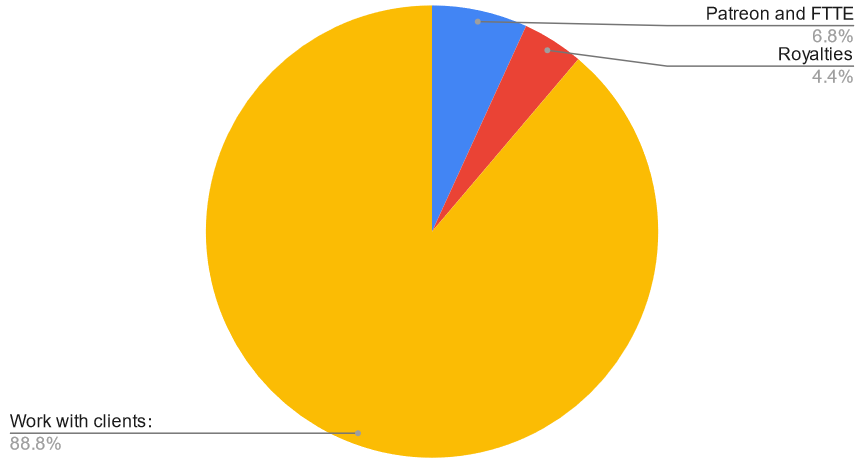
Speaking of revenue, this is what 2020-2021 looked like:
Obviously working with clients represents the supermajority of income. For the past year that has included speaking engagements, facilitation, workshops, small presentations, consulting, and teaching university classes.
Patreon and FTTE are growing, albeit slowly. Royalties are higher than ever (hello, Academia Next!), but clearly have room to grow.
Besides transactional services, I continue to conduct other work for free. Social media is some of that, notably Twitter and LinkedIn, podcast interviews, and this very blog. The Future Trends Forum continues to grow audience and win fine reviews, all for free. I keep doing this for a few reasons. First, this is a way for me to share my thoughts and, better yet, improve them through interaction with you all. Second, writing, speaking, etc. sharpen my thinking. Third, all of the open content is a kind of marketing, although we haven’t really established how well it works – i.e., does the Forum drive would-be clients?
Speaking of the Forum, I finally gave it its own site. Surprisingly this took more time than I expected, because I had to learn the new WordPress “blocks” editor. I really don’t like it, but it’s useful to know, and now I’m accustomed to it, mostly.
Some operational and strategic choices are now on the table. I’d love to hear your thoughts.
Smoother paperwork In person events are coming back as the pandemic withdraws, and we’re thinking of a little paperwork revision. Normally we billed for our fee, plus expenses – i.e., travel, lodging, food, printing, etc. This can become tedious and fiddly, so we’re thinking of just building expenses into a larger fee, based on cost estimates. This is simpler for everyone.
Gaming This has become a feature of my teaching, part of research, and has also crept into some facilitation. I’ve used other people’s games, introduced games into online events (for example), and have started creating my own (for example) (another tiny one). Where should I take this? For example, should I publish a game in some way, keep doing research, or…?
COVID-19 From the first outbreak in Hubei province I was on the story, tracking it very closely. Higher ed had a crying need for intelligence on the pandemic and I was in a good position to provide. Now that infections and deaths are dropping, especially in some nations, the focus shifts to what comes next, and I should follow suit. Indeed, I’ve been there for months.
Climate change My next book’s manuscript continues to grow by thousands of words each day. More research, interviews, examples appear each day. If all goes well Universities on Fire will appear in 2022. If I’m right about the climate crisis being a major force shaping academia’s future, and if people receive the new book positively, then BAC work may follow. Indeed, climate change research and consulting could become a major focus for the firm. We might have to take on associates for that purpose. Speaking of which…
An Associations option We could start publicly bringing in folks to do work along the lines of their specialties, especially for skillsets we don’t have in-house. Beyond climate change, we could consider professionals who could advise clients on IT management, library strategy, media services, curricular redesign, financial operations, student services, and so on. We could add capacity for things I already do, such as futures work, pedagogy, or digital storytelling. BAC could become BAC Associates. And speaking of association
Partners I’d like to partner more frequently with other entities. We’ve done a little of this, such as through sponsorships and Future Trends Forum events. We could do more, where another group and BAC have complimentary interests.
Now, if you’re interested in all of this and would like to engage BAC’s services, do visit the site and let us know what we can do for you. If you would just like to support this independent futures enterprise, which offers a lot of free content to the world, consider subscribing (for free!) to us on YouTube, subscribing to FTTE, or supporting us on Patreon.
I’d like to thank the many people and institutions who have powered BAC through continued success. That means our awesome clients, many readers, participants in all kinds of live events, and our terrific supporters.
In 2011 a group of academics published a short, provocative, and thoughtful Manifesto for Teaching Online. They updated it in 2016, and now this year MIT Press brought out their work in book form.
On June 10th the Future Trends Forum hosted two of the authors from the University of Edinburgh. Siân Bayne and Jen Ross, both part of UE’s Centre for Research in Digital Education, starred in a brilliant and transnational conversation. I was so impressed by the depth of thinking, by the resources shared, and by the questions we did and didn’t get to, that I wanted to expand on the session here.
Across the session several topics loomed large. For example, we explored how digital media changes the structure of academic authorship. Our guests recommended James Lamb’s post on Remixing the nature of authorship for more on this.
A provocative question asked us to consider how universal Universal Design for Learning actually is in terms of culture, situation, and more. On Twitter Ed Webb observed:
So many questions kept the discussion racing along. So many, in fact, that we couldn’t get to them all in a jam-packed hour. I’ve copied them here, organized loosely by theme, and stripped of authorship, since I wasn’t able to get approval from each commentator.
Some questions looked ahead to ways of improving online education, appropriately:
We have heard that student engagement was a huge issue with online instruction. I think that it can also be a challenge in traditional modes. Is this an area you’ve been exploring?
Do we need to push for a better integration between (online) learning / teaching design and design + ethics approaches such as value-sensitive design, values in design or responsible design?
Can we/should we let go of things like courses, classes, semesters, universities, etc, given that we don’t suffer the constraints that made them necessary in the first place? If not, why not?
Some focused on the Manifestos’ texts with specific suggestions:
Would framing things often titled “Best Practices” as “Evidence-Based Practices” help??
Several wanted to explore implications of the COVID-19 pandemic on digital teaching:
The experience of teaching on line during the pandemic should not be allowed to lie fallow. What do you think are the most important lessons learned that all instructors should reflect on in F2F?
How to mitigate a potential backlash against online teaching & learning as we’re moving into a gradual “reopening of HE institutions?
Good thoughts to chew on – and the comments box awaits you, should you like to reply.
In the meantime, check out the manifesto in its various forms. My thanks to our guests and participants.
For nearly a decade I’ve been tracking one higher education enrollment trend. Since 2012 the total number of students taking classes in American colleges and universities has declined. It’s a steady trend, with the curve dipping down every single academic year.
COVID-19 exacerbated this trend. Fall 2020 saw enrollments drop more steeply than in previous years, down 2.5% overall. Which gave rise to the natural question: how would enrollment fare in the spring 2021 semester?
Well, new data on this just appeared from the National Student Clearinghouse Research Center. Short version: total enrollment declined by 3.5%, “seven times worse than the decline a year earlier.”
In this post I’d like to break down their findings, exploring what they mean for higher education.
The Clearinghouse report leads with this:
Overall spring enrollment fell to 16.9 million from 17.5 million, marking a one-year decline of 3.5 percent or 603,000 students, seven times worse than the decline a year earlier.
Again, the COVID crisis accelerated the pre-existing decline. 16.9 million students: that’s about 15% down from the 2012 height of around 20 million.
Now, that 3.5% actually represents a split in populations based on academic level. Undergrad numbers were worse than that, but grad programs actually did better:
Undergraduate students accounted for all of the decline, with a 4.9 percent drop or 727,000 students. In contrast, graduate enrollment jumped by 4.6 percent, adding more than 124,000 students.
This is consistent with the COVID experience so far. It also reminds me of Josh Kim’s 2018 argument that higher ed is fairly healthy, based on grad program growth. However, remember that the undergrad population is much larger than the graduate one, even with these changes.
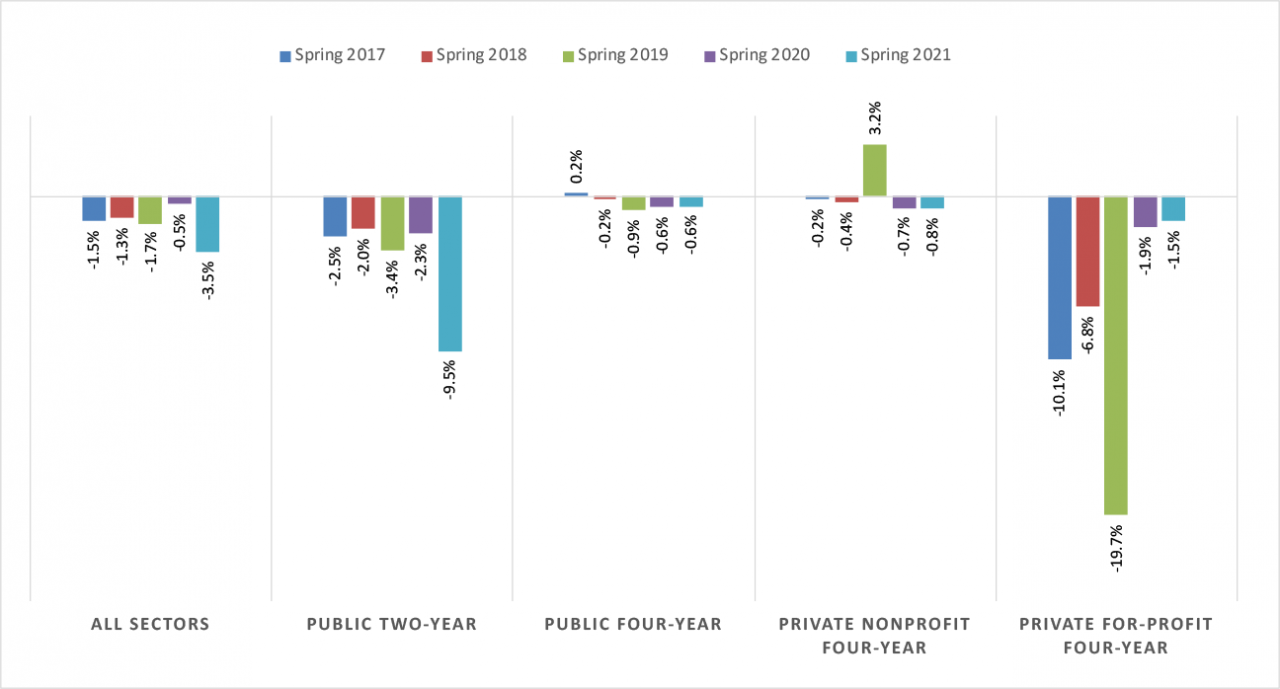
Institutional categories: enrollment fell across all institutional types in spring 2021, if unevenly:
One sector was hit the hardest. Community colleges saw students numbers fall -9.5%. “Over 65 percent of the total undergraduate enrollment losses occurred in the community college sector.” In contrast, public four-years went down by 0.6%, private nonprofit four-years 0.8%, and private for-profit four-years 1.5%.
Types of students: the decline was general across all full time students. Part time was uneven:
part-time enrollment declined only at for-profit four-year and public two-year institutions. Part-time students increased at public and private nonprofit four-year institutions (+3.7% and +2.8%, respectively…
Demographics: enrollment fell across all ages, led by traditional-age undergrads.
Traditional college-age students, age 18 to 24, saw the largest decline across all age groups (-5% or 524,000 fewer students), largely attributable to their steep losses at community colleges (-13.2% or 365,000 fewer students). Adult students aged 25 or older fell at less than half the rate of the younger group at community colleges (-6.1%), and experienced gains at public four-year and private nonprofit four-year institutions (+2.7% and +2.3%, respectively…
In terms of gender, the long-running trend of women constituting a growing majority of higher ed students continued. The gender gap is now striking, with only 6,829,297 students identifying as men, while women number 10,026,004. By my calculation 40.5% of American post-secondary students are male and 59.5% are female. There are nearly half again as many women taking classes as men. (It’s crucial to remember this is a historical flip from centuries of male-dominated classes.)
Enrollment decline by gender breaks down unevenly by institutional type:
This trend is especially visible in the community college sector, with male enrollment dropping by 14.4 percent compared to a 6 percent decline in female enrollment. Also, the increase of 44,000 female students (+1%) is contrasted with a drop of 90,000 male students (-2.7%) in the public four-year institution sector…
The report didn’t include breakdowns by race or other demographics. In an Inside Higher Ed interview Doug Shapiro did touch on economic class:
Low-income students were more likely to withdraw from higher education during the pandemic than high-income students or students with undergraduate degrees, according to Shapiro. As a result, community colleges have experienced greater hits to their student ranks over the past year.
“If you didn’t already have a degree, you are much more likely to be working in low-wage jobs. Front-line workers are much more likely to be out of work and to be much more stressed financially during the recession and the pandemic,” Shapiro said. “Those are the students particularly that we see disappearing from community colleges, especially this year.”
Academic major: according to the report three courses of study showed the most robust growth:
In terms of the year-over-year percent change, Computer Sciences and Psychology showed the largest enrollment growth at four-year colleges (+3% and +4.8%, respectively)…
Psychology and Legal Professions were the only growing fields for two-year college students this spring (+0.8% and +4.8%, respectively).
Which majors declined?
Among two-year college major fields with over 100,000 students, enrollment fell most precipitously in Visual & Performing Arts (-18.1%), Security & Protective Services (-16.7%), Multi/Interdisciplinary Studies (-14.1%), and Liberal Arts & General Studies (-13.8%).
At four-year institutions, declining majors were led by: Construction Trades, -18.3%; Science Technologies/Technicians, -14.0%; English Language and Literature/ Letters, -10.2%; Family and Consumer Sciences/ Human Sciences, -8.7%; Communication, Journalism, and Related Programs, -8.7%; Liberal Arts and Sciences, General Studies and Humanities 863,899, -7.4%.
Geography: a supermajority of states experienced this enrollment decline. Only these states did not: “Idaho, Maryland, Nebraska, New Hampshire, Utah, Virginia, West Virginia.”
Some quick observations:
One vital point is that 21st century American colleges and universities tend to rely on tuition as their leading revenue stream. Declining enrollment strikes at the heart of this.
While this semester’s data ties into a nearly decade-long trend, it’s also important to realize the data as describing the impact of COVID-19. As with fall 2020, the evidence is clear that students didn’t flock to colleges and higher ed during the pandemic, as some anticipated. For whichever reasons, the opposite is true.
Remember that this report describes a macro trend. It covers 50 states and more than 4,000 institutions. There is a lot of local variance. For example, just this morning I heard from a friend at a well known New York campus which is enjoying higher enrollment. Yet if America remains committed to getting more and more people more post-secondary education, we are now clearly failing in that ambition.
Community colleges continue to suffer. They get very little publicity, either in general or within academia, but this largest sector is getting hurt badly. The damage to these institutions and the communities they serve will be felt for years to come. And it could get worse if the enrollment trend persists.
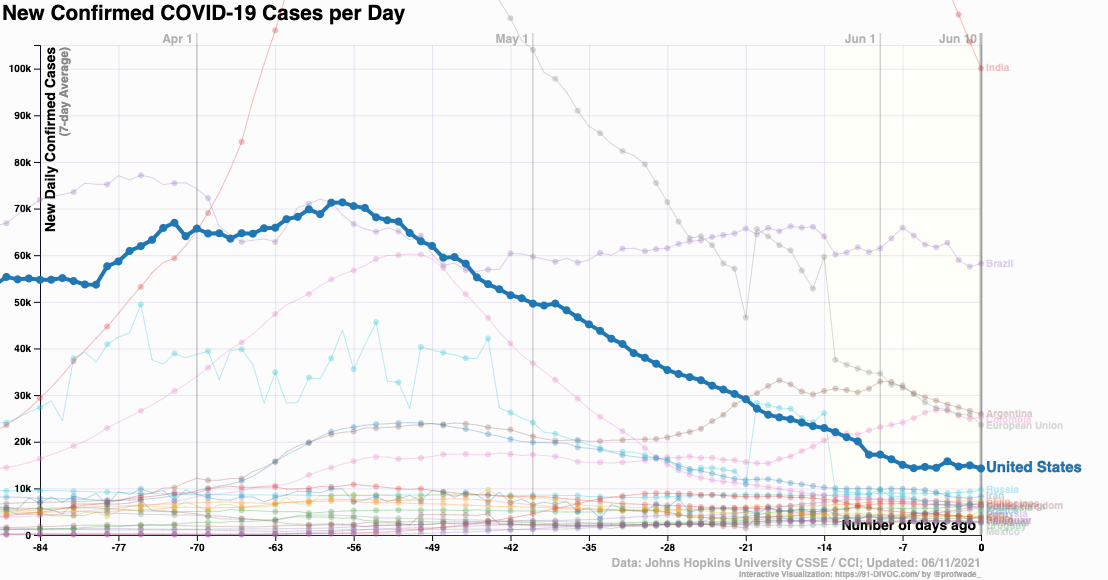
Can this trend reverse? American COVID casualties and cases continue to plummet, as vaccines steadily make their way into human bodies:
Perhaps if fall 2021 greets the nation with the pandemic’s end and economic recovery, then more families will be more amenable to taking classes.
Final note: back in 2013 I came up with the idea of peak higher education. This was and remains a scenario, one possible future. So far higher ed has been living it all too faithfully.
Last Friday night a high profile American comedian and tv host presented a criticism of higher education. In a little more than six minutes Bill Maher took academia to task for a range of problems.
I find this critique useful in two ways. First, Maher gets certain things wrong, and many people share those errors, so addressing them might be beneficial. Second, several of his criticisms point to more broadly held American attitudes. Better understanding them can help higher ed as it tries to navigate an increasingly challenging battle for public support. Plus he also packs in a lot of ideas into a few minutes.
I’m not writing this as a fan or opponent of Maher. I don’t watch his show – in fact, I don’t watch live tv at all. The only tv content I consume is video clips or episodes I’m interested in or that people recommend after they initially screen. Weirdly, I remember Maher for his odd bit in a 1987 comedy-horror movie. Here I’m picking on Maher as an exemplar of certain attitudes.
I’m also not writing as a fan of celebrities. Celebrity culture generally leaves me baffled or depressed. Yet I do want to single out Bill Maher’s rant because as a popular (if contentious) figure he seems to channel some popular opinions. Hopefully this post gets at the latter through the former.
Admittedly, this is something of a gamble. From what I can tell Maher doesn’t fall cleanly into political or cultural camps. He’s a libertarian who wants national health care. He mocks both progressives and conservatives. So a rant from him might offer a skewed or scattershot slice of the American mind. Yet I think I can draw the connections.
To begin with, I did enjoy some of the jokes. The trickle down-Florida line was nicely delivered. The Loughlin scams bit, and the comparison of higher ed to Scientology and medieval indulgences, were well barbed jabs.
So what does Maher get wrong?
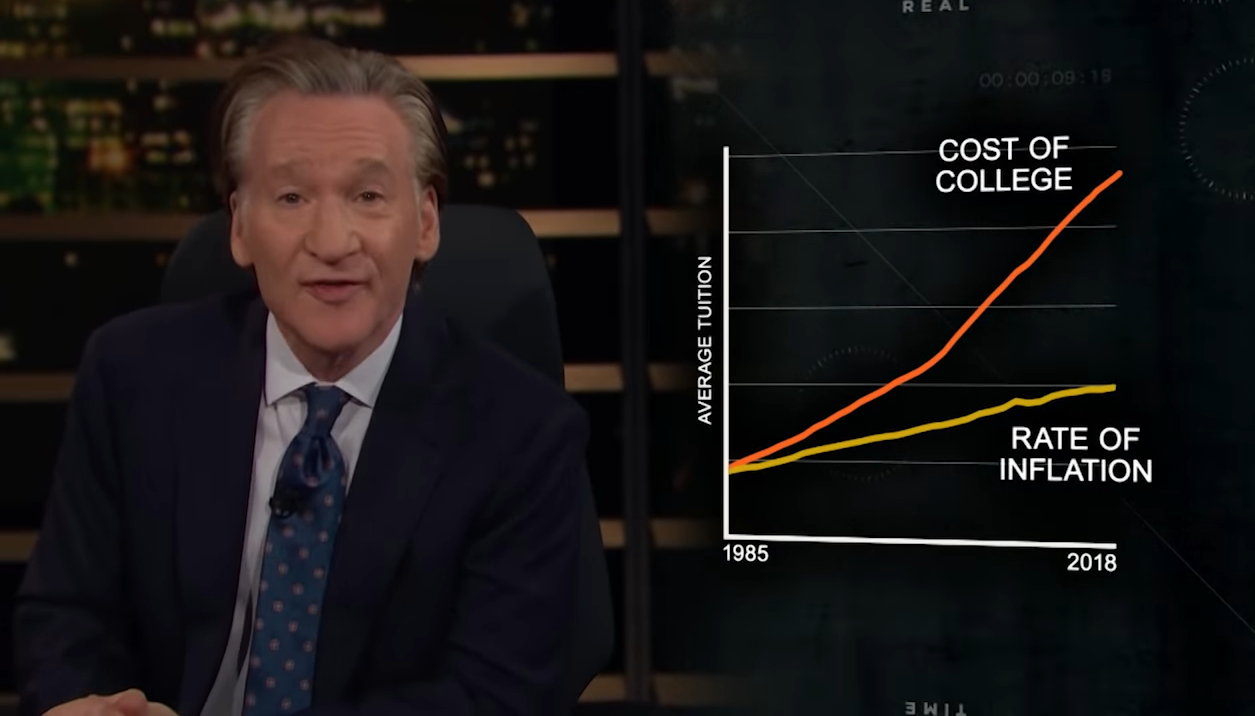
Like many, he criticizes college and university tuition for being too high. Accurately, he points out that published prices have risen faster than inflation for a generation. However, setting aside the reasons for that inflation, this misses two key points. First, the tuition amounts cited are published prices, not what institutions actually charge most students. Widespread tuition discounting means only the richest tend to pay full price, which subsidizes everyone else, who pay less. (Here’s my explainer of this obscure yet crucial practice.)
Second, focusing on the actually high published price of (say) Harvey Mudd College (one year’s tuition is $58,359; $79,539 with room and board) means ignoring the wide range of low cost colleges and universities. If we stick to Maher’s California, that could mean taking classes at one of that state’s many community colleges presents a sticker price of $1100. Further, some public universities make a point of having lower tuition that the elites. And some private colleges use that steep price+steep discounting strategy to make postsecondary education actually affordable for non-rich families. Ignoring these swarms of campuses with low (sticker!) prices in favor of complaining about the most expensive slice of American academia is, alas, a popular mistake.
Maher makes a similar error of missing much of higher ed by mocking colleges and universities as “subsidized child care” or “day care.” It’s a stinging point when paired with notorious images of luxury living or lazy rivers, and it’s true that a good number of students are teenagers. But not all, not by a lot.
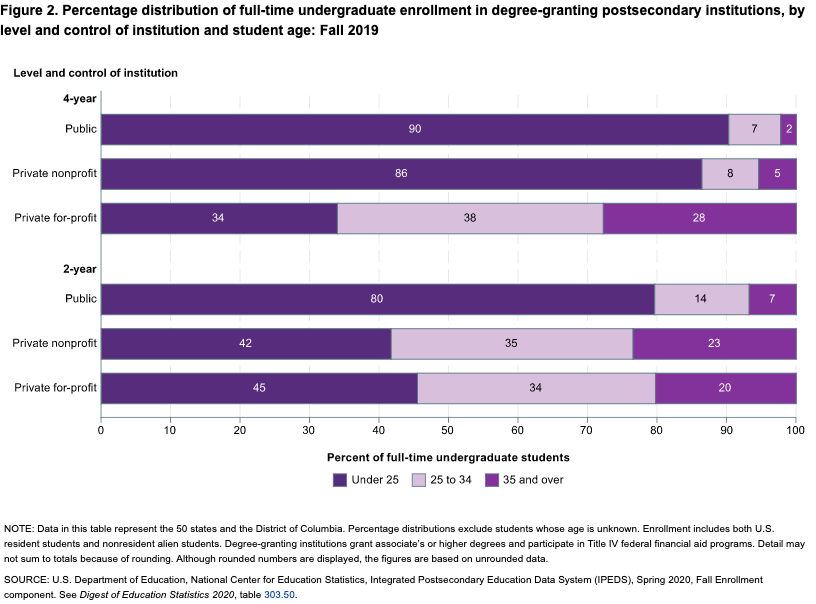
Here’s data on full time students enrolled full time in American colleges and universities in 2019:
You can easily see very different age breakdowns by different types of campus. 90% of students taking classes at public four-year schools are younger, while only one third of those at for-profit colleges and universities are. Two-year institutions (mostly community colleges) show a similar range.
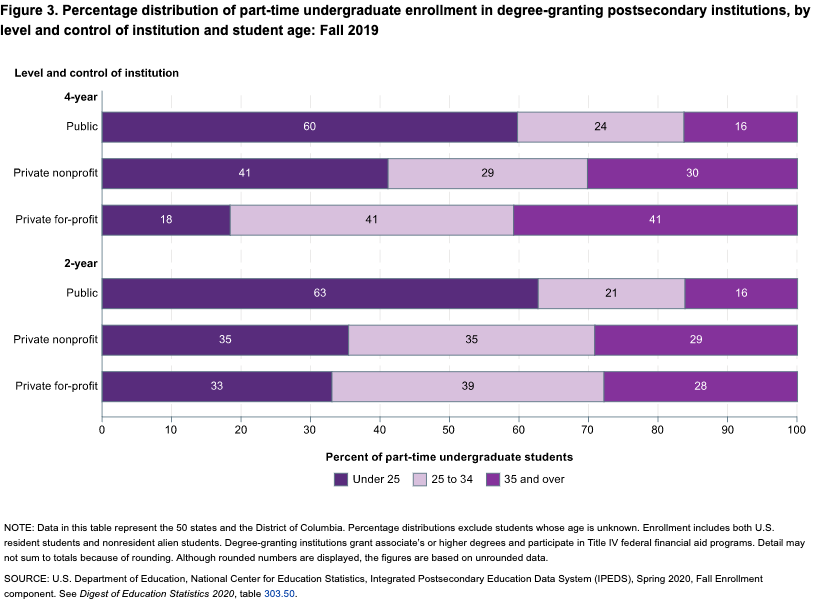
The millions of students taking classes part time is even more age diverse:
Note, too, that that data lumps all people under 25 years old into a single category. If we accept that an 18 year old living away from home for the first time is getting some kind of developmental experience, is that also true of someone who’s 24? My point is that not all of higher ed is about those teenagers, and it’s a mistake to assume it is.
Back to those luxurious settings and the famous lazy rivers: those, too, are only available in some colleges and universities. For every campus with a “leisure river” spelling out the school’s initials there are dozens of colleges with unfixed roof leaks, decaying buildings, and failing infrastructure (for example). I know Maher is attuned to economic inequality; his critique of higher ed needs to recognize inequalities between these institutions.
Maher also sneaks in a slam at the library profession: “A wanna-be librarian needs a master’s degree just to get an entry-level job filing books.” Straight up wrong. All kinds of staff shelve books. My daughter did this when she was a first-year college student. And an MLS degree teaches much more than shelving print materials.
So if the HBO host got some things wrong, what are the useful bits I mentioned earlier?
Maher gets some points dead right, like the general – and especially Democratic – idea that everyone should get some post-secondary schooling. This is still the default American idea, with persistent popularity. Or, in the comedian’s cranky phrasing, “The more time humans spend in classrooms staring at blackboards, the better.” Hang onto this idea, because Maher will circle back against it.
He also accurately notes the progressive argument that colleges can fight income inequality. The reality is more complicated, of course, with some of higher ed actually exacerbating economic gaps. And Maher gets this, reminding us harshly of a very different pro-college selling point: “Higher education is a racket that sells you a very expensive ticket to the upper middle class.” Set aside the “racket” part for now and you can see the idea of higher education as a class divider standing forth.
Maher goes on to show the economic divides between those with college degrees and those without. He then connects them to free college plans with a powerful line: “Is it really liberal for someone who doesn’t go to college and makes less money to pay for people who do go and make more?” Whatever your answer might be to that question, you can definitely make out a current of class resistance to any new federal support for higher ed. Now one implication of “racket” becomes clear, casting colleges and universities in the light of a new Gilded Age. Liberal calls for free tuition are just a way of tightening inequality’s screw.
Maher goes on to slam selected and warped curricula, emphasizing contemporary progressive politics (“You Owe Me An Apology 101”). At the same time he charges the academy with not producing enough STEM graduates, casting that problem in light of an American competition with China (a rising theme, as I’ve noted previously). These are different charges coming from very different agendas, albeit with some overlap (conservatives supporting engineering). Again, these are criticisms we’ve seen in the broader culture.
Then the host hits at the everyone needs college idea from a different angle. Maher casts rising numbers of degrees as certification inflation. Worse, that some of these credentials aren’t needed, that they are scams designed to funnel more tuition to campuses in a form of rent-seeking. Maher lists some examples, then charges his biggest cannon, assembled from the ideas he’s hit so far:
“The answer isn’t to make college free. The answer is to make it more unnecessary – which it is for most jobs.” [emphases added]
Now he’s not just calling higher education a scam. He’s not merely mocking rich schools for spending on luxury items. Instead, he’s calling for fewer people to take classes. He’s urging a good number of Americans to reject academia. He wants the college and university sector to shrink back in size and influence. He advises an end to college for all, wanting instead college for even fewer.
Having dealt this blow, Maher then repeats his economic argument. Academia needs to be cut down “[s]o that the two thirds of Americans who either can’t afford to or just don’t want to go don’t feel shut out. Because the system we have… breeds resentment.” It’s a populist argument, drawing on generations of precedent, targeting higher education as a cynical, exploitative operation that increases and benefits from class divides. In fact, Maher’s riff ends at this point, summoning up Trump and his famous praise of the poorly educated.
So what does all of this mean for higher education? Why should we spend time thinking about one comedian’s performance?
First, Maher reminds us of the power of economic populism, and not just in the ways Trump mobilized it. Academia’s sometimes intention of mitigating inequality runs smack into our role in making inequality happen. Colleges and universities will run smack into this contradiction in potentially any public setting: trying to get a state legislature to increase funding, negotiating with a local community over zoning, lobbying the federal government over tuition or research support.
Second, to whatever extent Bill Maher is representative, the public has woeful gaps in its understanding of how higher ed works. Our elite institutions stand in for the entire sector too often. Our high tuition, high discount strategy just looks like very high tuition. Adult learners are nowhere near visible enough.
Third, don’t miss the curricular hits. Obviously Maher is treading well known territory in urging the graduation of more people in STEM fields, dunning the arts and some humanities. Note that he links this desire to US-China competition. Note, too, that his call for shrinking higher ed means seriously cutting the arts and humanities, if we factor in increasing STEM enrollment.
Ultimately, Maher’s fulmination against higher ed as a whole leads to a call for Americans to cut higher ed down to size. I don’t think this comedian is the only one thinking along these lines. Back in 2013 I introduced the idea of peak higher education, a forecast that American academia had reached a maximum of enrollment and economic strength. Every year since then has proven this forecast true, as enrollment keeps ticking down and financial struggles afflict too many campuses. If higher ed is sliding down the wrong slope of a peak, Bill Maher wants to give us a shove and speed our decline. How many people share this view? And how can academia best counter it?
Lastly, I’m not analyzing Maher’s critique to embrace or denounce it. Instead I want to share its key points to those in and adjacent to academia, because they aren’t his alone. As higher education struggles to regain public support, we may hear Bill Maher’s arguments voiced more often than on a single HBO comedy show.
Last week I posted about a dozen times to Facebook. One of those posts caught the attention of that site’s content management operations. I’d like to share that experience here as an example of Facebook’s fumbling, as well as the chronic difficulties of content moderation. It’s just a small event, but perhaps it is illustrative.
Around last Tuesday a Daily Beast article caught my eye. It described how some Q-Anon activists were urging likeminded folks and true believers to avoid the 2021 Pentagon UFO report story (flying tic-tacs, etc.). Not because they thought that UFOs were bogus, but because they deemed it a distraction from what they considered much more important.
I read this in a sleepy and puckish mood, then shared it with sarcasm on Twitter and, alas, Facebook:
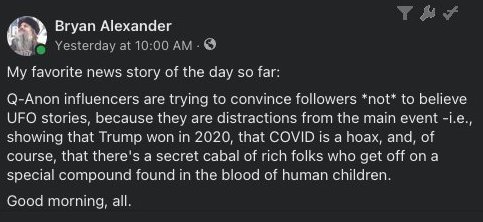
My favorite news story of the day so far:
Q-Anon influencers are trying to convince followers *not* to believe UFO stories, because they are distractions from the main event – i.e., showing that Trump won in 2020, that COVID is a hoax, and, of course, that there’s a secret cabal of rich folks who get off on a special compound found in the blood of human children.
Good morning, all.
It only elicited a few responses and I moved on with my working day. There were plenty of other things to consider.
Later that week I logged into Facebook and was greeted by this dialog box, floating above the rest of the page:
Your post goes against our Community Standards on misinformation that could cause physical harm.
No one else can see your post.
We encourage free expression, but don’t allow false information about COVID-19 that could contribute to physical harm.
I’ve heard about such things, but never experienced them as a poster. I screen-capped then hit “Continue.”
(After this point I forgot to screencap. What follows is based on my recollection alone, since I can’t find any logging of this on Facebook.)
The next dialog box asked me to understand that I had done A Very Bad Thing, that either Facebook human staff or software had found my trespass, and that I should not do it again. The following box gave me a choice: admit my grievous fault, or contest the ruling. To help guide my choice, the box added that Facebook takes feedback very seriously and would love to hear from me. I hit “Contest.”
The site paused for a few seconds, then popped up a new box. This one thanked me for my response and apologized that they were too busy to actually engage with the feedback they had just solicited. I clicked “OK,” the box disappeared, and the normal Facebook site remained… minus my sarcastic and apparently dangerous post.
So what happened here?
My friend (and organizer of the 37th Distance Teaching and Learning conference, coming up this year!) Thomas Tobin reckoned that my use of the phrase “COVID hoax” had fit neatly into an algorithm sweeping Facebook for mis- and disinformation. That the context was clearly not pro-hoax, and was, in fact, mocking, didn’t fit so nearly into the sweep.
I’m not sure if anything else in that post twigged Facebook. Trump’s “stolen” election racket and my pointer towards one of Q’s most deranged ideas might have escaped moderation.
I don’t know what happened to comments and likes etc. attached by other Facebook users, or if Facebook notified them of the deletion.
A few quick reflections: this is a good example of an algorithm (or a person, perhaps) reading badly, which is one classic problem with any kind of content moderation. It shows Facebook acting through fiat, unilaterally imposing a decision without allowing for interaction, pushback, discussion, or feedback. Note, too, the specific language of the warning – this isn’t about offending sensibilities or committing psychological damage, but “caus[ing] physical harm.”
Nothing else has followed along these lines. Facebook hasn’t given me any new warnings or asked for my feedback. Otherwise nothing has changed.
Have any of you experienced the long and shaky arm of Facebook’s content control efforts?
PS: I am overdue for a post about why I still use Facebook. That’s coming.
Today I’m going to describe a key datapoint in higher education. To do so I need to explain a deep weirdness in how students pay for American college and university classes. Many people have a hard time grasping this strange bit of finance, and many others have no idea it even exists. But it’s crucial to understanding academia in the United States, both in terms of institutional innovations and weaknesses.
So here goes.
When most people talk about how expensive college is, they often cite published tuition figures. For example, Williams College charges $59,350 per year for classes, not including room, board, and fees. Central Michigan University’s tuition ranges between $12,510 and $24,450, depending on a student’s nationality and credits accumulated. The University of Texas-Austin posts a wider range of tuition figures, but it looks like Texans pay $5,429-6,788 for a year of full time enrollment, while out of staters face the steeper amount of $19,325-23,249, all depending on course of study.
Except when students don’t pay those amounts. Which is a lot of the time.
You see, published tuition is a sticker price. Some students, generally the richest and those not winning merit scholarships, do actually pay it. Meanwhile colleges and universities offer other students, including less wealthy ones, financial assistance in the forms of grants, scholarships, and more. In practice, “tuition” turns out not to be a single thing, but something as ill-defined, flexible, and individualized as a used car’s sticker price or whatever the heck patients end up paying for health care in the United States.
Fortunately we can come up with an average of just how much lower real tuition is in practice, compared to its sticker price. We call this difference the discount rate. Say a university’s published tuition is $30,000/year. If they have a 10% discount rate, the average student pays ,000.
So some students (and their families) pay the full thirty, while others – most – pay much less, $27K on down. So the next time you hear about a campus charging x dollars for tuition, you can ask “Ah, but how much is their discount rate?” and learn more.
Clear so far?
Critically minded readers might wonder why on Earth campuses do this, rather than just charging everyone the same flat fee, as when one purchases a sandwich or bicycle. One reason is that institutions sometimes want to attract students with certain characteristics: achievement in one academic area, athletic skill, demographics, etc. Schools can induce them with tuition discounting. Sometimes this is for humanitarian or social justice reasons, as in trying to attract underrepresented and marginalized populations. Other times the reason is competitive, trying to create a student body that looks better in rankings.
Another, more macro reason is that the United States has been experiencing increasing economic inequality since the 1980s. Tuition discounting maps well onto those class divides. (A good question is does a given school set a discount rate to try to ameliorate those divides, to benefit from them, or to build graduating classes that will exacerbate them. But that’s for another blog post.)
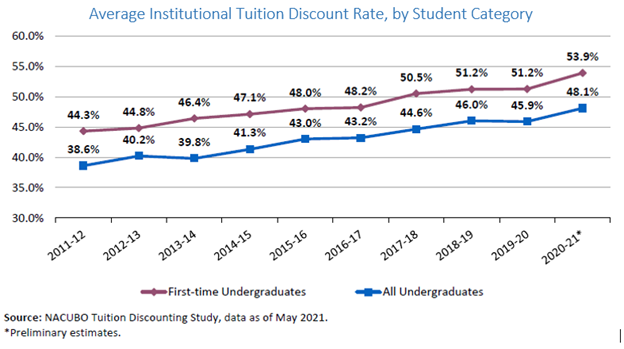
Now we’re ready for this week’s news item. The National Association of College and University Business Officers (NACUBO) released a new report on private American college and university tuition discounting.* Remember my hypothetical about a 10% rate? We’re way past that. The report estimates undergraduate discount rates stood at 48.
1% last year. The rate is even higher for first-year students: 53.9%.
Put another way, most students don’t pay the sticker price so many folks worry about:
[M]ost students received grant aid in 2020-21 and were awarded larger grants than in previous years—covering an average of 60.3 percent of listed tuition and fees for first-time undergraduates and 54.3 percent for all undergraduates. Nearly 90 percent of first-year students and approximately 83 percent of all undergraduates received some form of institutional grant aid.
As Inside Higher Ed put it, “In other words, for every $100 in tuition colleges appear to charge on paper, they do not collect $53.90 from first-time undergraduate students.” That’s for undergraduate-focused institutions.
Other universities weren’t quite as high, but close: “Master’s-granting institutions on average reported a 55.3 percent discount rate for first-time undergraduates, and doctoral institutions reported 50.2 percent.”
This discount rate is not a one-off thing, although it’s possible offers were higher due to the pandemic. Instead, it’s part of a long-running trend. Discount rates have been rising for years. From NACUBO:
The new finding marks, as you can see from that graph, and in the report’s words, “record highs.” This is a powerful trend.
So why does it matter? Is Bryan obsessing too much over financial accounting structures?
For one, increasing discount rates show higher education responding to the macroeconomic picture of increasing income and wealth inequality. That’s an important connection to make.
Second, this trend is probably not sustainable. Listen to the NACUBO press release:
Average net tuition and fee revenue reported in this study has declined from 2016 levels and, year-over-year, fell the most it has in a decade. Between 2019-20 and 2020-21, net tuition and fee revenue decreased by 6.2 percent per first-time undergraduate and by 2.5 percent per undergraduate, in inflation-adjusted dollars.
Did you catch that? Colleges and universities are making less money, even when their sticker price tuition notoriously rise. So on the one hand the popular narrative of expensive tuition is really flawed at best, at least for private institutions.
On the other, the strategy is leading to a net loss of revenue.
While sticker prices go up, discounts are growing far more rapidly and deeply. As Emma Whiteford observes, “Rising tuition discount rates can depress net tuition revenue per student if a college does not raise its sticker price in lockstep or line up other sources of funding to pay for financial aid grants. ” Which brings to mind two questions: how many campuses can keep cutting their real revenue and hope to survive? And how long can they keep playing this game before they have to start cutting programs and jobs to keep the whole operation afloat?
If we keep going down this path discount rates will hit 60, 70, then 75%.
*Said report is behind a hefty paywall, or available to NACUBO members, of which I am not. So I’m going by what the organization shares publicly, plus this Inside Higher Ed writeup by Emily Whitford.
What questions should we ask an expert in government education and technology policy?
To explain: this Thursday from 2-3 pm EDT Jarret Cummings, senior advisor for policy and government relations for EDUCAUSE, will be our guest on the Future Trends Forum. Cummings specializes in how federal policies and actions impact higher education.
How can we use games and gamification in teaching and learning?
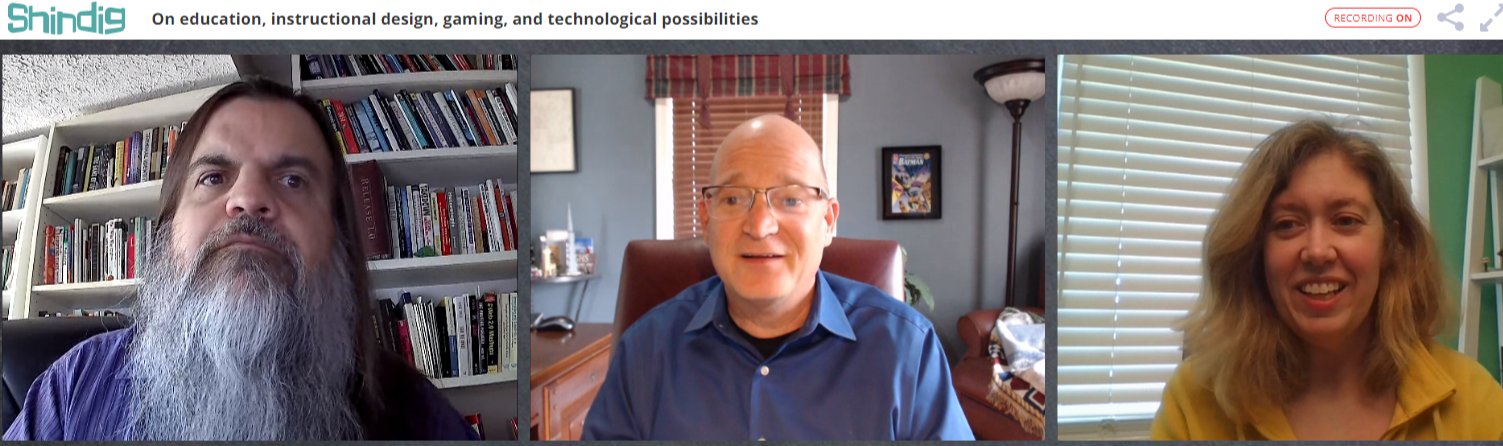
Last week professor Karl Kapp joined the Future Trends Forum to explore this subject. The conversation took off quickly as Karl raised ideas and the Forum community hurled questions.
Screen grab by Roxann Riskin. I was looking unusually serious at that moment.
I was especially struck by how many resources everyone shared, and wanted to echo them here.
To begin with, before the session started Dan LaSota shared a short Twitter exchange about a vulcanology game:
Lisa Sieverts recommended the Thiagi Group as “a tremendous resource”
Roxann Riskin sang the praises of Apples to Apples as her go to game.
Neil Fung: “There’s a free Cards against Humanity game online which incoporates custom made decks. I wonder if the project has been developed in a more educational sense.”
Moe Ash strongly drew our attention to Fluxx. “It has to be checked out…do not miss it.”
Tom Haymes offered this advice: “You can buy blank cards on Amazon. I affix Avery labels to them which I just print via a laser printer.”
While these discussions occurred within the Shindig environment, more took place on Twitter. Dan LaSota kept on tweeting, issuing several useful tweets during the session:
One tip for would be EDU game designers: play lots of games and note which game mechanics, rules or ways of doing things sparks your interest, and see how you can use these methods in an EDU game for your students.#FTTE
About #gamification in learning #FTTE: if we posit that the best learning outcomes come from sustained instructional sequences & sustained time on task, then #gamification gives incentives to persist from year to year and incentives to motivate engagement with the learning task. pic.twitter.com/ERa0KHlu9f
— Ben Rifkin בנימין (he/him) (@benrifkin) May 6, 2021
It was a busy hour!
So busy that there were also outstanding questions we didn’t get to, which I wanted to relay:
Jesse H Kemp: In general do you prefer cooperative or competitive games and why?
Neil Fung: How do current trends in video games or popular video games influence instructional game design?
Andrew Peterson: I hear a lot about board games and electronic games, but it seems like there’s a strong history in role-playing in the classroom. Does that just fit into the same mix?
Elliot Jordan: For Instructional Design students, do you recommend learning game engines first or finding learning problems and gaps that can use gamification?
Daniel Jordan: One of the ways we’re trying to encourage our faculty to implement gaming strategies at Saint Leo is through the creation of a faculty leaderboard that is linked to professional development. Thoughts on this and how to make it most effective?
Jesse H Kemp: Do you think we would get a quicker buy-in if we used simulation opposed to game? Is the terminology a hinderance?
Tom Haymes also asked about the value of extrinsic rewards for learning in game structures, pointing out that in a very recent Forum Alfie Kohn had argued such rewards were useless for education.
If you’re interested in more upcoming discussions about gaming and education, check out our June gaming session with the Penn State designers of the What The Deck game. If you’d like to check out previous Forum conversations about the topic, head to our archive.
Got more resources to share? Would you like answering those outstanding questions, or posing some of your own? The comment box awaits your next move!
Three years ago I pondered when the first college or university would charge $100,000 or more per year to attend.
What does that 2018 probe into the future look like in 2021?
To give a little background: in that 2018 post I was looking at six figures as a psychological or cultural milestone. The post assumed $100,000 wasn’t just tuition, but total cost: tuition + fees + room/board, for residential students. It also focused on sticker price (the published prices), not what a good number of students actually pay after various discounts.
To make the projection I did some back of the napkin math with inflation calculators to do some really basic extrapolation. I estimated that, roughly, the first time a campus broke that $100,000 barrier would be academic year 2029-2030.
So far things seem to be proceeding towards that date. The most recent article on the most expensive American campuses I found offers these at the top price points:
University of Chicago $81,531
Columbia University $79,752
Harvey Mudd College $79,539
Northwestern University $78,654
Barnard College $78,044
Scripps College pay up to $77,588
Brown University $77,490
University of Southern California $77,459
University of Pennsylvania $77,264
Dartmouth College $77,152
PrepScholar offers a similar list. So the most pricey institutions are in the upper 70-thousands, with one breaking the $80K threshold. For comparison’s sake, when I first posted on this idea in 2018,
some of the most expensive institutions in the United States, like Harvey Mudd, Columbia, University of Chicago, or Sarah Lawrence [are] best positioned to crack that number. Depending on whichwebpage one reads, their total cost is, as of this writing, somewhere in the $60,000s.
From the 60,000s into the upper 70,000s we’ve gone in three years. It looks like the top are proceeding on schedule. We might expect them to all explore the 80,000s for the next few years, then rise up into the $90K band, and then into six figures.
What would power such a continued rise? To begin with, each of these institutions is expensive to run, between credentialed faculty, extensive services, and significant physical plants. Further, each maintains an elite reputation, which in the American setting means high prices. Since economic inequality continues to rise, these colleges and universities can continue charging top dollar to the richest families and using that income to support discounts for the rest.
Yet recall that extrapolations are very crude tools, useful as a first approximation and starting point. We can imagine various ways for the 2029-2030 event not to occur. The mental barrier of crossing into six digits could prove too daunting, especially for younger populations less enamored of high capitalism, in which case we could see total prices piling up in the 90s.
Alternatively, state and/or federal governments could change course, as Chris Newfield calls for, and start expanding their support to higher education. The Biden proposal for two years of free community college tuition, while not a direct challenge to the Columbias on our top list, might be a first step in this direction. That could pause the rise in public university prices and also nudge private institutions to try competing more on price, including published fees.
It’s also possible that the long-heralded popping of a higher ed bubble comes to pass, and the entire pricing structure sags downwards.
And we shouldn’t skip the possibility that my 2029-2030 target is too conservative. One or more colleges or universities could cross the $100,000 threshold before that academic year, as Mike Richichi wrote. The accelerating wealth of the richest families could inspire more ambitious price setting. Campus leaders might deem $100K to be a signal of supreme academic prestige and/or argue that it is – literally – the price (some have) to pay in order to support enrolling everyone else at discounts. Campus costs are likely to keep rising, as John Sener pointed out. They could also soar for all kinds of reasons, including damaging legal settlements, already ballooning health care costs, and accounting mistakes. It’s also possible that climate change could drive costs up, if a campus commits to major mitigation efforts (building a seawall, extensive renovation or construction) or suffers badly from weather damage caused or worsened by the changing climate.
I’ll try to check in on this topic same time next year, and so on.
What do you think? Are you seeing signs of the $100,000 threshold coming closer?




 Fortunately we can come up with an average of just how much lower real tuition is in practice, compared to its sticker price. We call this difference the discount rate. Say a university’s published tuition is $30,000/year. If they have a 10% discount rate, the average student pays ,000.