
For years I’ve used a certain phrase in presentations. It came up when I was describing modern demographics. I would explain how lifespans have increased in developed nations, and that more people will live longer, and then want on to explain what this meant for higher education. Then I’d pause and mention that this was likely to keep happening, unless something truly extraordinary happened. Like, say, a plague.
Now we’re in the second year of COVID-19. As I write this the pandemic has killed at least 4,109,303 people worldwide, according to the World Health Organization (WHO). That’s at least 607,289 dead in my country, according to its Centers for Disease Control (CDC). In India the official statistics may be grossly wrong, with the actual death rate for that nation being nearly as high as the published global number, according to a new study.
This horror now appears in demographic data. The CDC just reported that “[i]n 2020, life expectancy at birth for the total U.S. population was 77.3 years, declining by 1.5 years from 78.8 in 2019.”
More: “U.S. life expectancy at birth for 2020, based on nearly final data, was 77.3 years, the lowest it has been since 2003.”
What caused the downturn? COVID-19, primarily:
Mortality due to COVID-19 had, by far, the single greatest effect on the decline in life expectancy at birth between 2019 and 2020, overall, among men and women, and for the three race and Hispanic-origin groups shown in this report.
The report breaks down all causes thusly:
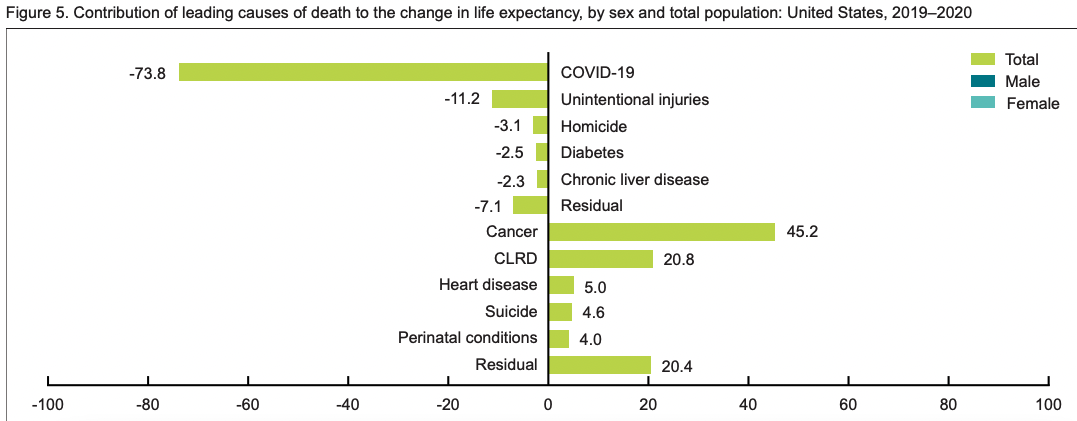
[The deaths were] primarily due to increases in mortality due to COVID-19 (73.8% of the negative contribution), unintentional injuries (11.2%), homicide (3.1%), diabetes (2.5%), and Chronic liver disease and cirrhosis (2.3%)
(For those non-COVID reasons, I wrote about this in 2019, pointing to research about deaths of despair among the poor and/or undereducated.)
CDC broke down the new data by gender:
Life expectancy at birth for males was 74.5 years in 2020, representing a decline of 1.8 years from 76.3 years in 2019. For females, life expectancy declined to 80.
buy cytotec online buy cytotec no prescription generic2 years, decreasing 1.2 years from 81.4 years in 2019.
The decline hit all races, albeit unevenly:
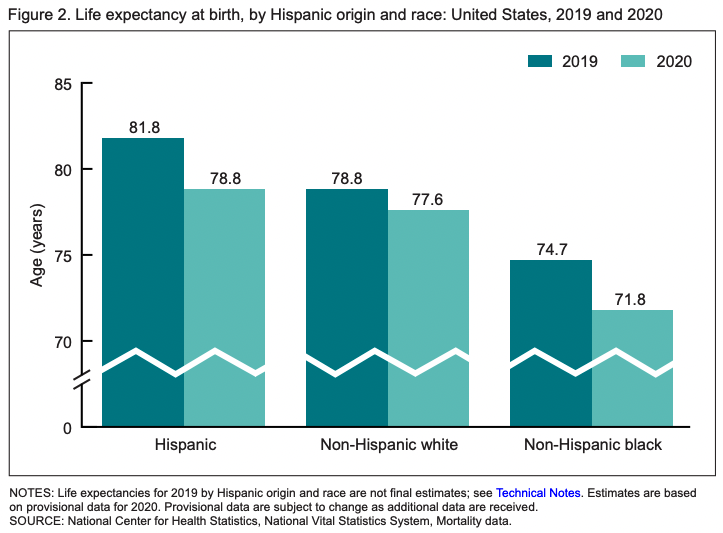
Between 2019 and 2020, life expectancy decreased by 3.0 years for the Hispanic population (81.
buy prelone online buy prelone no prescription generic8 to 78.8)… It decreased by 2.9 years for the non-Hispanic black population (74.7 to 71.8) and by 1.2 years for the nonHispanic white population (78.8 to 77.6)…
The Hispanic population experienced the largest decline in life expectancy between 2019 and 2020 (3.0 years).
What does this mean for the future?
It depends on if we see this as the start of a long term trend or not. If we do, then the 2010s were a peak lifespan for the US. Consider this CDC graph as evidence for such a turning point:
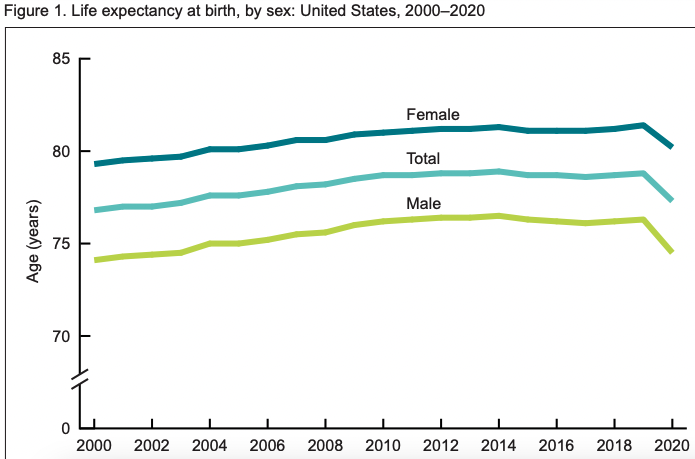
Imagine that sharp downturn on the right edge continuing for years.
To make the case for such a future one would have to show that the deaths would continue. That could be driven by continued COVID-19 mortality, which isn’t happening now (in the US) as the most vulnerable (seniors with comorbidities) are largely protected. We are seeing more hospitalizations, which means more “long COVID” (longterm injuries) which could lead to more deaths. Further, the death toll may turn out to be worse if we can prove the year’s excess deaths were actually COVID-caused. Or more variants could become more lethal. Having us lose what I’ve called the race between variants and vaccines would make this scenario even more likely.
Adding to its likelihood would be more deaths of despair. That’s only a fraction of the pandemic’s butcher’s bill, but they do occur and aren’t slowing down. I would also add deaths due to the climate crisis, starting with casualties from extreme weather (floods, heat waves, storms) and moving on to chronic conditions worsening thanks to the climate.
On the other hand, the 2020 life expectancy drop could be a historical blip. 2021 has seen COVID deaths fall pretty steadily after January, according to 91-DIVOC:

While the delta variant is booming, it seems to mostly be spreading infections and injuries without immediate fatalities. That’s due to improving treatment but also to the great vaccination rates of the most vulnerable.
As for deaths of despair, they have given rise to some (if not widespread) political outrage, which may translate into better care, or even social support.
The biggest mortality question in my mind is climate change – and that’s the topic for another post.



Doomer than I am about US decline, I see it as part of a larger story: the US folowing Great Britain’s 1950 trajectory into bankruptcy and squalor.
I could be wrong, to quote Carl Sagan. We have strength the UK lacked then but also violent divisions that could erupt into Civil War or at best, steep declines in what I openly call “The Hick States” of anti-science Trumplandia. I would be happy to let them form their own hick nation, as long as the Feds take away the nukes and scientists. This time the Old Dominion would go with the smart people, and money.
Joe, It sounds like you have read David Blanchflower, Dartmouth prof and Bank of England ex-member. NOT WORKING: WHERE HAVE ALL THE GOOD JOBS GONE? 2019. He is sympathetic with what you say, being himself a Brit. Glen
Glen, I have not but thank you for the reference. My inspiration has been careful study of World War 2. The US demanded repayment of loans to the UK, arguably with an eye to reducing Anglo power long term and guaranteeing US hegemony postwar.
It must have been enormously depressing for the English to lose the bulk of the Royal Navy to the breakers’ yards on the 50s and 60s. I could see this happening to us mid-century, as China eclipses us. No more super carriers or strategic bomber fleet.
The Chinese have their own issues, but I could see them simply wanting our nation diminished and docile, as we wanted the UK, and a consumer market for their goods.
Interesting perspective … sadly, I am not a student of the ups and downs of global hegemony. Yes, China will be interesting to watch. But I assume a global financial panic or re-set is inevitable, and wonder how China would manage that. The West tries to manage ups and downs, including opening up more government jobs. What happens during the next downturn is unclear at this point.
I find myself reacting against lumping mortalities altogether to come up with an average lifespan. What really matters to me is MY lifespan — not everybody else’s. The fact that we seem to instinctively *move* cognitively by locating ourselves (or our interests) (somehow) in that number should tip us off that something hegemonic is going on here.
When I glance through the obituaries in the morning newspaper, I look for names that I know — but I also register the ages of the deceased. Those older, I marvel at their long years. Those younger make me appreciate the years I have, and those that I have left to me.
All this helps to disaggregate the data for me. But the rhetoric of data — ever since William Petty’s 1690 “Political Arithmetick” — has been overwhelmingly in the other direction. Petty was among the first to present “statistics” (statist-ics) as a persuasive maneuver. Sadly, visual rhetoric of this kind does not reveal ‘who’ is saying ‘what’ to ‘whom’ for ‘what reason’. It must be, in fact, deconstructed to be truly meaningful.
https://www.marxists.org/reference/subject/economics/petty/index.htm
Donald A. Mackenzie is brilliant when it comes to deconstructing statistics: see especially, his “Statistics in Britain, 1865-1930: The Social Construction of Scientific Knowledge” (1981).
Another early classic in this STS genre is Steven Shapin and Simon Schaff on the founding of the Royal Society and its peculiar mixture of rhetoric and consensus formation, in “Leviathan and the Air-Pump: Hobbes, Boyle, and the Experimental Life.” Both these books fit nicely within Science and Technology Studies (STS), in addition to historical sociology and sociology of knowledge.