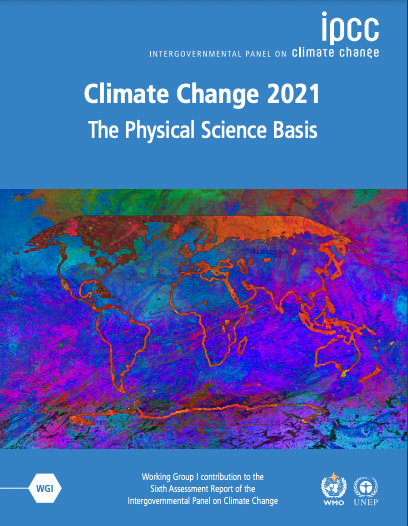
Yesterday the Intergovernmental Panel on Climate Change (IPCC) published a major set of reports about the climate crisis. These are very important documents for the topic, and so I’d like to host an online reading and discussion of them with a focus on what this means for higher education.
 To explain: first, I’ve been hosting an online book club since 2014. Our long-standing theme is the future of higher education. To that end we’ve read books about academia, of course, along with titles from economics, technology, sociology, and political science, along with a series of germane science fiction novels. We hold our discussions online, based in blog posts, comments on those posts, and conversation elsewhere, from Twitter to LinkedIn and people’s own websites. It works.
Second, what does the climate crisis mean for higher education? I’ve been exploring this intersection for several years. It’s the subject of the book I’m finishing now. I believe that global warning represents perhaps the leading threat facing colleges and universities worldwide, and that we’ll struggle with this for at least the next two generations.
So let’s put these two themes together and take a look at the new IPCC report. I’ll share my impressions and you can comments here and elsewhere. Again, the focus will be on what this means for higher ed, along with your general reflections and questions.
Fair warning: I am not a climate scientist. I’ve researched the topic intensely for several years, and will do my best. Others should weigh in with their expertise.
If you’ve looked into the documents you know that they are several, different in scope, and also widely varying in size, from a 42 page pdf to a nearly 4,000 page (that’s four thousand pages) behemoth. How can we approach this corpus?
Here’s my plan.
First, I’ll post about the shortest one, the executive summary, the 42 page “Summary for Policymakers.” That will be probably one or two posts including my attempts at a synopsis, high points, and academic implications. You all can respond in the comments, on Twitter, etc.
Next, I’ll blog about the “Technical Summary,” which is about the length of a short book. This might be a post or three, depending on content, time, and your interest.
After that… I don’t know if anyone will have the stomach for all 3,949 pages of “The Physical Science Basis.” Let me know if I should give it a try and put up a post for any determined readers.
How does this sound? Who wants to join me?



Yeah, I’d love to read it with other folks.
Happy to join you on this adventure in IPCC land Bryan.
I’ll certainly read along with the summary for policymakers, since that’s in my wheelhouse. I’ll enjoy reading your analysis of the technical summary, but can’t promise to read along for that part, since I don’t follow the topic as closely as you.
Hey Bryan! I’ve not book clubbed with you since “The Water Knife” (resulting in a few more Bacigalupi titles on the book shelf and interest in the “cli-fi” genre).
I’d love to try again, a first glance at the summary finds it some dense reading, but a key is how these results can generate some action. Given a number of educators I have been working with designing learning activities around the UN SDGs (13 is the unlucky lumber for climate https://www.un.org/sustainabledevelopment/climate-change/) there’s a good reason to try. Seems too a good target for some annotation action too.
I might not make it to the 3900 pager 😉
Bryan: first, no doubt climate change is upon us, not doubt we humans have largely or totally caused it, and no doubt the effects of climate change will engulf human society. How does it affect higher education? I think that’s the wrong question. To me, the right question is what will higher education do to save humanity?
Nice re-framing Trent. I was thinking about this the other day when a Georgia Tech researcher who is one of the principle authors of the latest IPCC report was asked whether she thought the responses since its publication from political leaders across the globe indicated to her they were reacting constructively to the reports exhortation that a 5 alarm fire is raging and we have to put everything we can into fighting it. The scientist responded she’s not a politician or government representative. She’s a researcher and her job is just to communicate the facts as she understands them. It’s the role of others what to do about it.
Really? Are we still in that mindset as scientists that are job is research and discovery but the consequences of what our discovery reveals is not our business. We just need to look for the next grant to keep our lab going and find the next interesting question to investigate?
Let me add then to your list of ‘right questions’, What is the role of science and scientists when their research findings unequivocally reveal an imminent catastrophe that realistically includes the extinction of life on earth as we know it?
Phillip, “scientists” or $cientist$?
https://higheredinquirer.blogspot.com/2021/07/academic-capitalism-and-next-phase-of.html
https://en.wikipedia.org/wiki/For-profit_higher_education_in_the_United_States
Trent, what will higher ed do to save humanity? US higher education? The system that was formed through land theft, genocide, and forced labor? The system that not only reflects inequality and injustice but actually reinforces it? I suppose almost anything is possible, humans can change, but the institutions and their ideologies are not promising.
https://higheredinquirer.blogspot.com/2021/07/academic-capitalism-and-next-phase-of.html
I grant your comments’ pertinence, Dahn — and, right, higher education is now dedicated to jobs with not even a bow to civil responsibility (civil, not civic). However, while politics can achieve the move to renewable energy sources, it cannot re-shape the consciousness of our species and that is necessary if we want a sustainable future. Higher education is supposed to shape the leadership of our global society; it must just do a different kind of shaping.
Commented yesterday or so I thought…must have omitted the crucial step of clicking the post button or posted it somewhere else altogether.
I’m looking forward to our discussion, already off to a lively start, and thinking how to extend/connect it beyond academia (necessary imo if it’s to shape conciousness). This August 9th Morning Consult Report, “Summer of Disaster Has Barely Moved the Needle on U.S. Climate Concern,” indicates what consciousness shaping is up against.
https://morningconsult.com/2021/08/09/climate-change-natural-disasters-ipcc-report-data/
Good catch, Vanessa. Just added it to today’s post.
Thank you for the link to The Last Humans Project — added link to reading resource bundle and subbed to mailing list.