How will colleges and universities plan for January? A crowdsourced tracking project

How will higher education respond to the Omicron wave next month?

As I’ve said before, it’s difficult to forecast what COVID will do, given the variability of the virus itself as well as how humans respond to its action.  What we know now, December 20th, 2021, is that Omicron is much more transmissible than previous COVID strains. Cases have been appearing, then rising in many nations.  In the United States many states have officially detected this new strain.  Given that transmissibility we should probably expect a far larger reach.

Yet while this is disturbing, there seems to be a kind of cultural ambivalence about Omicron.  On the one hand there are epidemiologists and public health officials warning of a new tide which could hit medical systems very badly. On the other, there isn’t a lot of urgency elsewhere.  We know that booster shots massively improve one’s chances of not getting ill and not spreading the virus, but fewer than 18% of Americans (59.2 million) have gotten boosted so far, according to the CDC. I must add that boosters are free and widely available.

A personal anecdote: on Saturday my son and I went to the nearest grocery store.  We were worried about COVID-19 rising. My wife reported that in the next county infections doubled over the past two weeks, then doubled again last week. But Owain has celiac disease, meaning he needs gluten free food to survive, and grocery stores aren’t always good about getting us the right items through pickup or delivery.

buy silagra online buy silagra no prescription generic

  We’re both fully vaccinated and boosted, so, masked up, we went in.

Over the past two years this store has been great about masking. The store clearly mandated masks and customers generally followed suit, as have all staff. Yet yesterday we saw more and more unmasked faces as we went through the aisles. Overall I estimate around 40% of customers were either chinstrapping or just maskless.  Owain joked that there must have been an announcement over the PA, claiming the pandemic was over.

Grocery store checkout without masks

Back to higher education. How will colleges and universities plan on operating this January?

This morning David Wippman (president of Hamilton College) and Glenn C. Altschuler (professor of American studies at Cornell University) published an article outlining what campuses should do to host in-person activities on site.  It’s a good, thoughtful column, addressing a series of practical steps institutions should take, from mandating vaccines and indoor masking to increasing testing.  Note, however, that too many did not take these steps in 2021.

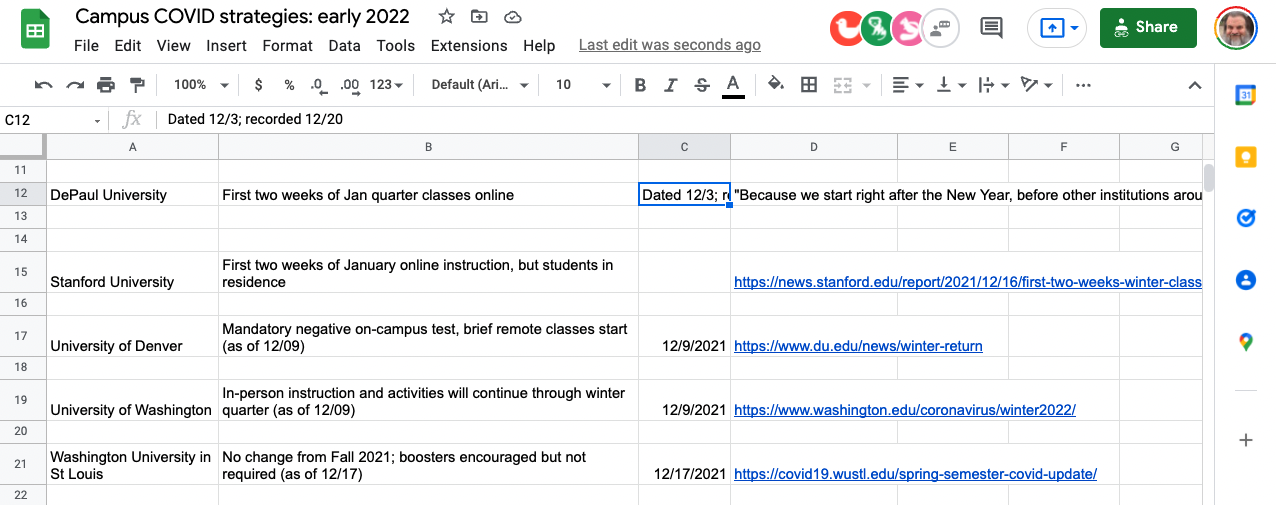
To help track how campuses are responding, several of us just set up an open Google Sheet.  It displays two lists of academic institutions (one for those using a quarter system and another for those on semester timelines), along with fields for their announced or reported actions and documentation thereof.

As of this writing six institutions are starting January classes online: Harvard University, the New School, Stanford University, the University of Denver, the University of Illinois-Chicago, and the University of Illinois at Urbana-Champaign. Each has its own timing and other campus restrictions, but all greet the new year with online teaching and learning.

coronavirus: spreadsheet of college and university plans for 2021 January

In addition Willamette University is holding a two-week “quiet period,”

during which students will be encouraged to limit their in-person activities and interactions. Many classes that can be made remote will move online during this two-week period with the intention of returning to full in-person instruction after the quiet period is completed. For the Salem campus, the quiet period will begin January 10. For the PNCA campus, the quiet period will begin January 18…

buy tadalafil online buy tadalafil no prescription generic

We expect everyone to return to campus as originally planned.

Furthermore, Penn State, UCLA, and USC all publicly stated that they are weighing January options.

If this sounds familiar to some of you, it should!  Obviously it echoes what happened two years ago, when COVID first struck and campuses rapidly chose to close in-person activities.

I’d like to invite all readers to contribute to this living document. The more eyes on the problem the better.

buy priligy online buy priligy no prescription generic

We can update the Sheet as events transpire and we learning about them, amending previous entries as things change.  People can add new categories of information and ways of displaying them as you all have time.  Hopefully we can all learn from each other.

The preceding account also may remind readers of an earlier project.

buy aciphex online buy aciphex no prescription generic

  We launched a similar open spreadsheet in February 2020 for a similar purpose, listing campuses and their plans, along with documentation.  It rapidly grew in form and content, indexing college and university actions in real time.  In fact, it won so much attention from users and media that it eventually shattered Google’s ability to provision the thing.   Still, it was a very useful tool for weeks, creating a single point to track how academic institutions were responding. (Here’s the full story.) I hope that the time of year and Google’s ever-improving technology will keep things open for as long as we need them to be.

In the meantime, please share what you learn.  Spread the spreadsheet’s news so we can keep the tracker up to date.  And, above all, take care.  Get vaccinated and boosted.  Wear those masks!

Posted in coronavirus, higher education | 9 Comments

Rethinking education for the new normal: our conversation with Lee Skallerup Bessette

Yesterday the Future Trends Forum hosted a discussion about redesigning classes in the wake of COVID-19.  Our guest, Lee Skallerup Bessette, spoke to the powerful ways student absence due to disease and mental issues can help us rethink how to structure the teaching and learning experience.

The conversation was intense, energetic, exploratory, and hard to contain to a single hour.  Accordingly I’d like to share the session.  In this post I’ll embed the video recording, along with highlights from the chat and questions we didn’t get to.

Here’s the full hour, fresh from YouTube:

On the Forum people post questions through a text box. They started coming fast by the end, so we couldn’t get to them all.  Here are the ones left over, or that we only addressed partially:

How would you theorize/build an organization/platform for self-directed learners, outside of but perhaps affiliated with a university, to extend their learning network and connect with others around subjects or projects? Leaving assessment and credentials aside. Some sort of bottom-up anarcho-syndicalist way to learn, using the affordances of digital technology.
​
While the type of assessment may differ based on content, would you argue that there is a preferable method of assessment for digital learn? I studied Problem Based Learning by Jonassen last semester

Considering social media tools like Facebook mostly keep content hidden from search engines (gray web), how will publishing to the web remain relevant? Will it get a revival?

A comment- your thoughts on importance of understanding emotional & affective labor in the context of teaching and learning… in H.E.

Is it time to blow up what we mean by a “course”?

The Forum chat is always rich, and here I reproduce excerpts. I’ve removed names, since we didn’t ask permission ahead of time.  I’ve also cut some socialization and chit-chat in order to focus on the session’s topic.  I moved a few lines around for easier reading and tried to break out category headers:

Introduction

I was honored to be an early reader for lee’s book: it’s splendid!
Lee, who’s publishing your book?
Affective Labor and Alt-Ac Careers University Press of Kansas
Preorderable at https://kansaspress.ku.edu/978-0-7006-3298-5.html

Technology, comfort, and literacy

Do you also find “today’s” students less technically adept when facing code?
The Google Jockeys abound in the Forum
Vic 20 for the win!
I say they are computer literate like we’re automobile literate.
GenX and Vic20 FTW!
BBS: Bulletin Board Service
Honestly miss the BBSes!
I started on a Timex Sinclair.
Atari 800 with a cassette tape drive! (PS: check out the recent Radiolab miniseries on cassette tape)
“Anything invented after you’re thirty-five is against the natural order of things.” – Douglas Adams
TRS-80 w/tape drive here.
lol forgot about the 1×1 clear gif
Lee, your session on WP-in-context – is or will there be a way for us to learn from you, either a recording of that session or a forthcoming paper?
I’m in an Akimbo class on Discord.
What’s important is where your crowd is. People probably still use Second Life because their tribe is still there.
https://geometrydash-free.com/
I’m part of many video game modding communities on Discord
Punch cards on an IBM 360.
Another issue I find students struggle with is understanding file structure in computers (folders, cloud storage, zip files, etc.)
At this time I’m on Discord only for educators and creators in VR…
We drove Model T’s – Today they have Hondas.
+1 on that Radiolab mixtape series. Amazing reporting!
I would contend you all have the ability to learn these digital tools – Discord, Snapchat, TikTok – these are tools
I find faulty and admins have the same struggles.
Sinclair – 2 KB RAM! 16KB Expansion Module that cost $100’s
Agreed on file structure. Phones have killed it.
I mostly know file structure from needing to understand it to install mods for video games. I do not recall it explicitly being taught in school.
Late saying hello from windy NE Colorado, fell off the internet and had to reset router.
Phones and Google’s “don’t store it just search it” ethos.
That’s because they’re using them as delivery tools, not learning tools.
Neil, gaming is a whole set of skills.
We hear so much about the Metaverse. Wondering how folks feel about whether it will be part of the “new education”? NFTs?
Is the “metaverse” just another venue for student-authored/open/community-engaged work? Or is there an actual difference of type?
Depending on who you speak with and how they are using it, it can be whatever you want to use it for. Bryan will ask the question at the end of the event.

Online learning, remote instruction, and Carnegie Units

No – It was “Online Classroom”
Distinct difference between emergency remote instruction and true online learning.
It’s a good thing if ill students stay home
Accepted premise: “butts in seats”
It wouldn’t be a terrible thing if faculty and staff stayed home more too.
And we assess them if they Show Up 100% of the time.
“contact hours” vs. quality of contact…
Thank you, Carnegie
How can they pour knowledge into your head if you’re not present??
yup. for an elite though – this ‘in person’ experience is part of the brand. its not even about in person class as much as in-person activities, community events, etc etc
Refining the limited definitions of the metaverse
The woman gets around
The learning center I work at still offers remote services which was very useful for students who could not physically make it to the Learning Center (one person had no transportation, public or personal, to the community college)
Good point about expectations of 100 percent attendance in person for all. And the inflexibility of current academic systems
Imagine a higher ed without seat time, credit hours, grades or professors with lectures. Imagine students doing it on their own time however long that takes.
You’re a germ in the seat.
Is is really design when an emergency situation requires alternate modes? Are anyone checking the efficacy of learning in this new mode??
It’ll be really interesting to see if that’s a generational change or a cross-generational one.
Learning is learning – how do we boost learning no matter what?
And what does it do to our standard lecture-based courses when we are trying to have “regular and substantive interaction”
I suspect that some of this change is generational.
That’s emergency remote instruction – a far cry from well designed distance learning learning experiences.
A genZ development?
Yes, Gen Z and also younger faculty. They are used to a more hyflex lifestyle in general. I am living a more hyflex lifestyle myself.
Need to adjust how we interact beyond the lecture delivery
Implication of importance of 100% attendance: currently 100% attendance is more of an issue with block scheduling; fewer courses in shorter academic terms. use of blended and online courses could make such block scheduling more feasible.
I wrote about the disconnect between butts in seats and actual learning recently in a series of blogs for ShapingEDU: https://shapingedu.asu.edu/blog/electrifying-education-part-iii-designing-our-way-out-class-size-contradiction
Would love to see that well designed work –
Take a look at our organization: https://goldenonline.org composed of 500+ online learning experts from 46 countries
Will take a look

Hybrid/HyFlex

But hiflex has the benefit of expectations being set and training, etc.
Easier to do ahead of time!
And HiFlex assumes a high degree of technical connectivity – not very equitable.
HyFlex is about letting any student choose any attendance option at any time while still achieving the same learning objectives
I’ve never heard of “HiFlex” and “HiTouch” what are they?
Throw out that term – what about HiRelation?
How about HiConnect?
I like that
but they are using that phrase
Can you access our archive? We had two sessions on it. You can start here: http://forum.futureofeducation.us/the-full-forum-archive/
I’ll take a look at it later then
Almost all courses are not designed to actually follow that model
I wonder to what extent we’re about to see real big generational rifts inside the faculty
Tanya Joosten is doing great work on Blended, which gets to this “alternative” mixed school from another angle.

Quality and scaling

The broader question is how does one define high quality education. How does one know truly excellent from merely satisfactory
I want to resist the association of ‘high-touch’ with ‘elite.’ In my experience, nontraditional (adult, working, parenting, first-gen) students want and need ‘high touch,’ deep connections to peers and teachers.
All learning should be high touch, even when it is at a large scale
Do community colleges do high touch?
The ones I know do their best. The CUNY ASAP program, which has gotten so much praise and attention, is an effort to design high-touch support and learning for low-income parenting students. It doubles grad rates.
But ultimately “we all underestimate the robustness of the institution of school” (Herbert Kliebard). The institution will always fight to return to what it was.
Loads of elite institutions only have hi touch from graduate students who are only 3 weeks ahead of them going through material
During Covid semester away and with the graduate online students I work with now, high relations means some cell phone, text, or Zoom conferences one on one with students. As an English, always did in person conferences for many years.
This is now the 2021 form of individual conferences.
There may be a difference between pivoting traditional Stu Success and really thinking hard about what a remote learning space looks like socially and emotionally from the perspective of the learner. The former is still a “push” model…..
What ever happened to the notion of community of scholars where students do some of their most important learning outside of classrooms???
Anecdotally, I’ve noticed that the military vets in my classes the last few semesters share they struggle with remote classes that don’t foster relationships, community, and interactions
That is my sense too, as a teacher in nontraditional, adult classrooms and someone doing program support for such students.
I did a research paper and proposal about embedding mindfulness into courses to improve stress management and anxiety. I’m hoping that perhaps I can do an actual study about it in the future.
Related: some of my top performing students the last few semesters are learners who didn’t turn on their cameras a single time. No idea what they look like but deeply connected to what they think like…
High touch online: The first time I heard about dying faculty and students communicating intensely with friends online, I realized high touch is sometimes done better online. Same with frequent FT with distant children.
Does “FT” = Facetime?
On students’ missing class from illness or anxiety: in my (small seminar) class this term, I asked students always to let me know before class if there were going to miss. Even if it was only an hour earlier, I could re-choreograph. Huge difference.
Seems to me the reason an at risk person stays in school is because of the urgings of friends who understand rather than a professor who might happen to notice the student missing
JIT’s moving from teaching to facilitating learning.
I agree it’s a human problem. Education is a social science, after all.
That’s one way to get people to read your archives, Lee. 🙂
An evil of the “contact hours = driver of learning” is that it discourages thinking about assignments that motivate and then foster learning. Assignments are more directly related to lasting learning than seat time, right?
Yes!!! This is all a learning problem. We’re not optimizing the classroom, we’re enabling learning.

Technology and classes

Some info on minimal computing: https://go-dh.github.io/mincomp/about/
I am not a tech nerd but have a spouse and son who are/were early adopters/workers in digital world. For me, the attraction of digital education for me has been the way it provides accessibility to students once we solve the technology access issues.
I’ve got to go, I’ll catch the recording later! See ya everyone.
And it’s the mobile-device minimal-computing argument that is the one that addresses the largest audiences!
Why is seat time so important if someone can get it more efficiently (while others might take longer)
He wants to use an Allen wrench
Is the “hammer” theme a good opportunity to circle back to the NFTs that you mentioned earlier in the chat?
“The computer is a medium, not a tool” Alan Kay (paraphrased)
My Diss was run on FirstClass – a bulletin board.
The reason students attend elite institutions is to meet other elite students who will refer work for the remainder of their careers
Affective experience ! So underreported in HE
Everyone is looking to build mailing lists to escape social media. New wave email.
It’s amazing how little education has to do with learning.
Hence the notion of higher education as a socializing factor
We build colleges so we have a place to put our disagreeable teenagers until they are capable of living with again
I got a lot of use out of Tannis Morgan’s piece about “Online Learning with the most basic of tools – email” which actually starts with the telephone, IIRC
P2PU: https://www.p2pu.org/en/
Progressivism was an experiment with this.
(network bandwidth ) and /or low computing technologies
College Unbound is using libraries as spaces for cohort-based adult college learning.
Ivan Illich’s web at the library! Love this!
Excellent using libraries for what their mission really us
Tutor.com started in the library (to have something for latchkey kids to do in libraries which turned into asylums)

Metaverse:

hurray for your son
David Scobey+1 your son
Metaverse, where we can look pretty while we learn.
Yea!
My college students do think NFTs are ridiculous…
Difference between Meta and Metaverse. They are not the same
Hearing impaired and deaf
Lisa exactly…
High tech requirements
Flat screens might be good enough after all.
welll – I not sure I agree, but then I am generally disruptive
@Lee – thanks for your take. Greatly appreciated.
Not an endorsement, but for anyone looking for a concrete example of implementations that are taking shape, saw this last week https://www.invisiblecollege.xyz/
For that small subset of students who are worried about protecting creator rights over their material, I can see how NFT-type solutions help. But I think that’s a minority of the issues around open work.
The IndieWeb developers might be useful too.

The end

We can find Lee at @readywriting on Twitter
As always, thank you
good idea to post
thanks as always
Thanks for this please post on your blog.
@Bryan – please post!
post away
Bryan, I agree that it’s a good idea to post this
It’s so nourishing to spend an hour with such good minds. Thanks everyone!!
Posting the chat sounds great (w/ due deference if some folks don’t want it out there)
Plan to share this session with other faculty at my college.
New Years’ Party?

Thank you all for a splendid discussion.

Next week the Forum takes the Solstice/Christmas holiday off, because we probably couldn’t get enough folks together to have a serious academic conversation on the day before Christmas Eve.  We’ll come roaring back the next week, and then it’s 2022.  Have fine and safe holidays, all!

PS: Is this kind of post about a Future Trends Forum session useful?  Please let me know.

Posted in Future Trends Forum | 11 Comments

A pandemic milestone and what might come next

Der Tod eines Menschen: das ist eine Katastrophe. Hunderttausend Tote: das ist eine Statistik!
(The death of one man: that is a catastrophe. A hundred thousand deaths: that is a statistic!)

-Kurt Tucholsky, 1925

It looks like COVID-19 has now killed about 800,000 Americans.

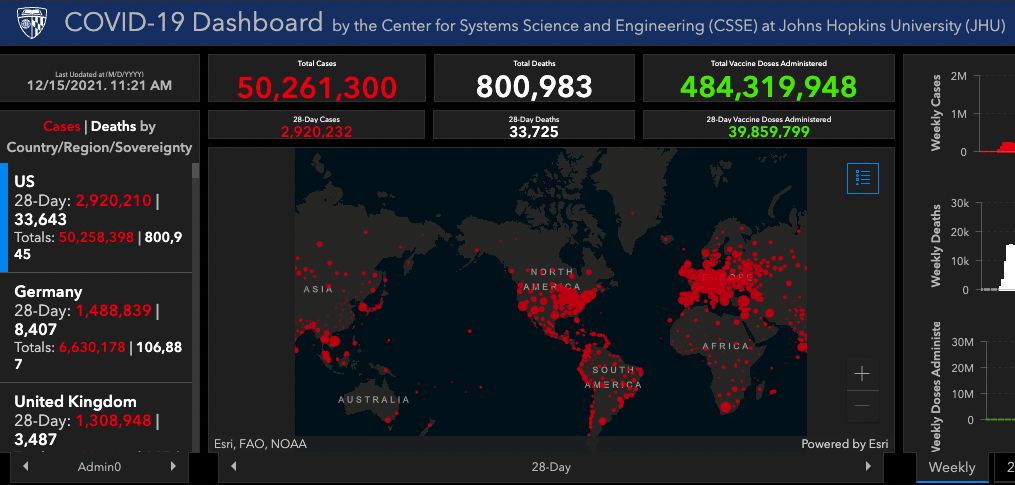
Here’s the latest dashboard result from Johns Hopkins University:

coronavirus US dashboard JHU 2021 Dec 15

800,945 dead.  I wrote “about” because American COVID data is so varied and unreliable.  On the lower side the CDC currently posts 796,010.  COVID Act Now estimates 797,000.  On the other side Worldometers thinks 821,444 while the World Bank has 800,043.

I also hedged my language because enough sources argue that published stats undercount COVID deaths worldwide, including in America.  The usual way for determining this is to track total deaths over recent, pre-pandemic years, then project them into our COVID time, checking to see how many more deaths occurred than expected. Some researchers see the real number at 20% higher, and higher still in black and Hispanic populations.  IHME calculated that actual world deaths are around double the official number, and that American deaths are more than 50% higher than the CDC’s figures.

And so many of those deaths were preventable.  Stupidly, infuriatingly preventable, because vaccines are safe, provide protection, are free, are widely available, and have been so for a while. According to the Kaiser Family Foundation:

We also estimate that 163,000 COVID-19 deaths could have been prevented by vaccination since June 2021, when safe and effective COVID-19 vaccines were widely available to all adults in the U.S.

Only around 60% of the population is fully vaccinated, according to Mayo, and that includes people whose last shot was long enough ago that its protections have weakened to some degree.  Maybe 20% have received a booster, according to CDC.

So now: at least 800,000 dead in the United States.  COVID-19 has probably killed a million.

It’s a terrifying number to grasp.  I suspect many people shy away from it.  Statistics are unintuitive for some.  Others may avoid the fact for political reasons: Republicans, embarrassed that Trump didn’t scotch the thing during his last year; Democrats, who hoped Biden would bring it under control by now.

The emotional impact isn’t something most people are used to dealing with.  Not at this scale.  The last medical emergency to strike America was AIDS, which we didn’t handle well, and whose deaths COVID already exceeds, and in a far shorter period of time.  The Great Influenza around 1918 is barely a historical presence, absent from the popular imagination.  The closest the United States has suffered in raw numbers and time is the 750,000 dead of the Civil War, although in a smaller population.  The point is, we don’t have much practice in collectively processing massive deaths.

It’s also a hard number to visualize because the deaths are hard to see – literally. There are very few visual depictions of COVID deaths. We see little evidence of people breathing their ragged, terrible last in emergency rooms, or struggling through ECMO – and for good reasons, including privacy and HIPAA.  It’s a kind of medical echo of the military’s push to not share images of dying and dead soldiers.  The result is similar.  For a culture well trained to experience the world visually, these stories of deaths are off the screen.  We’re living through (among other things) a major visual storytelling failure.

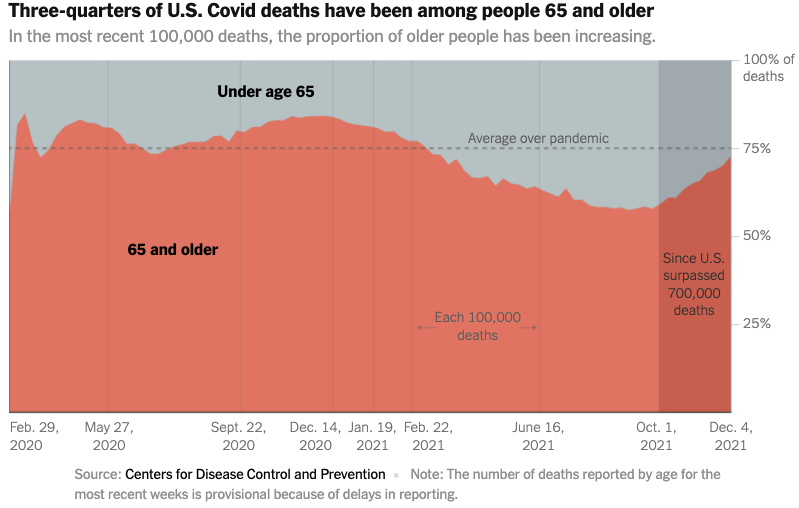
COVID deaths are also hard to grasp because they mostly hit senior citizens.  Here’s a New York Times visualization, finding 75% of fatalities among those over 65 years old:

coronavirus deaths by age NYTimes 2021 December 15

Simple ageism means we can set these deaths aside. Dying elders are less dramatic, even more expected than younger people expiring.  (COVID killed 1 out of every 100 senior in America so far.  1%!)

On top of this is COVID fatigue. It’s something the study of historical precedents caused us to expect. Every plague is exhausting to the survivors for obvious reasons: extra work for precautions, maybe additional labor for some, and the terrible emotional toll.  When I mention this point every audience has nodded, wearily, in recognition. Heading into the pandemic’s third year, we are bone weary of it. Ian Bogost has recently written movingly on the topic, if you’d like a good sample.

I see this in small personal actions when I “travel” – i.e., visit local groceries stores or train into DC and back. There was the young woman on a Metro car who, sitting with friends, fiddled with her mask (getting at jewelry?), then simply let it drop, her mouth and nose bare.  (The Metro requires masking for all passengers.) There are the nearly gas stations where it’s about a 50-50 chance that fellow shoppers – inside the store – will be masked.  There was a cheerful shop owner in his 60s, maybe older, who simply went unmasked.

One more point: while eight hundred thousand is a very round number, it might not be appealing enough.  The first hundred thousand was a major milestone.  Perhaps it’ll take one million to shock us into discussion, or maybe even action.

So what does the death roll and our reaction to it mean? What does this signify for the future?

Extrapolation, always a sketchy tool, suggests we should watch the butcher’s bill continue to build.  There’s no sign of COVID quickly falling below pandemic levels. Nobody’s trying to utterly eliminate the virus.  It’s possible that Omicron and successor variants could be far less fatal *and* rapidly outcompete Delta in the human race, but I think that would take at least a few months.

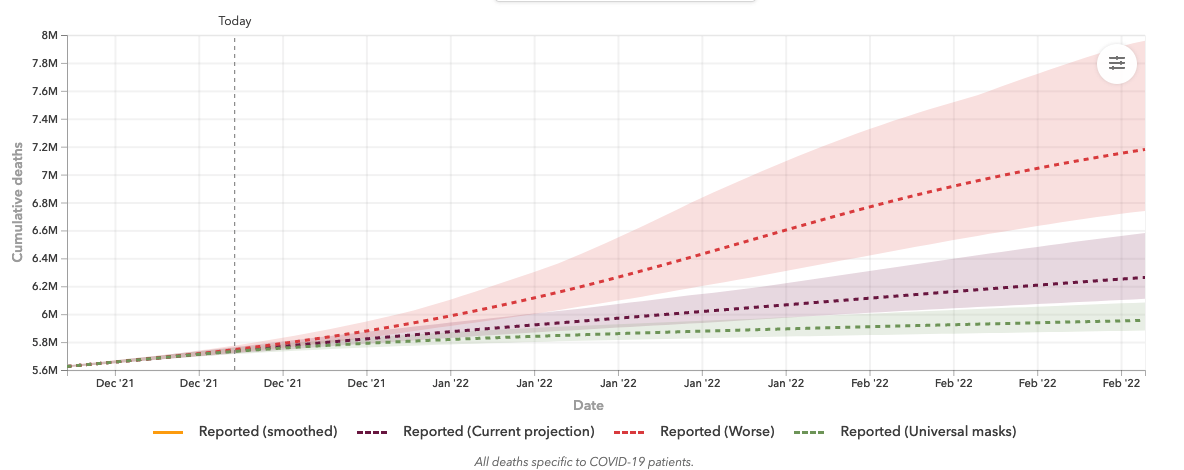
The next few months: IHME currently forecasts a range of possibilities. For the global total they project six to seven million, depending on public health behavior.

coronavirus projected deaths world Dec 21-Feb22 IHME 2021 Dec 15

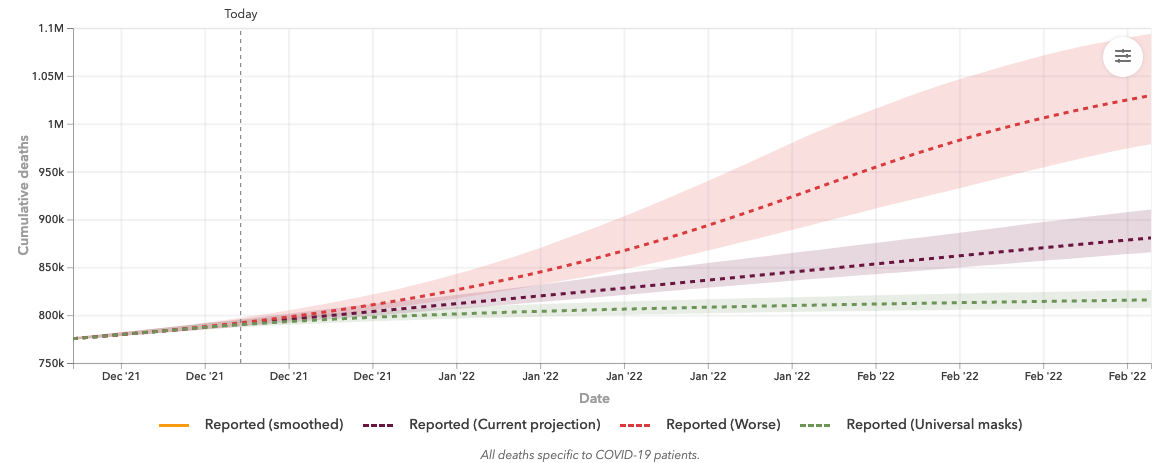
For the United States, a mere 815,000 if we wake up and get serious about vaccination and masking. The worst case blows past one million by March.

coronavirus projected deaths US Dec 21-Feb22 IHME 2021 Dec 15

As I’ve said elsewhere, Omicron’s arrival can change things up. Early studies find it to be more infectious, spreading more rapidly than prior strains. (one example) (another) It is too early to tell its lethality. It may prove more fatal, in which case the numbers end up approaching the upper bounds of those IHME charts.  The opposite is also possible.

Our collective desire to not look very hard at the death toll should probably continue.  All of the reasons mentioned above – privacy, exhaustion, invisibility, ageism, statistics – seem likely to remain in play.

Now, extrapolation is sketchy, as I’ve said. It misses changes in volume and new developments. It’s possible a rogue storyteller is even now assembling horrifying footage of deaths and editing them into a gripping, viral narrative.  America could suddenly have a reckoning with ageism, perhaps if something happens with our elderly president Biden or, more importantly, a celebrity.  I don’t think these are likely, but I could well be wrong.

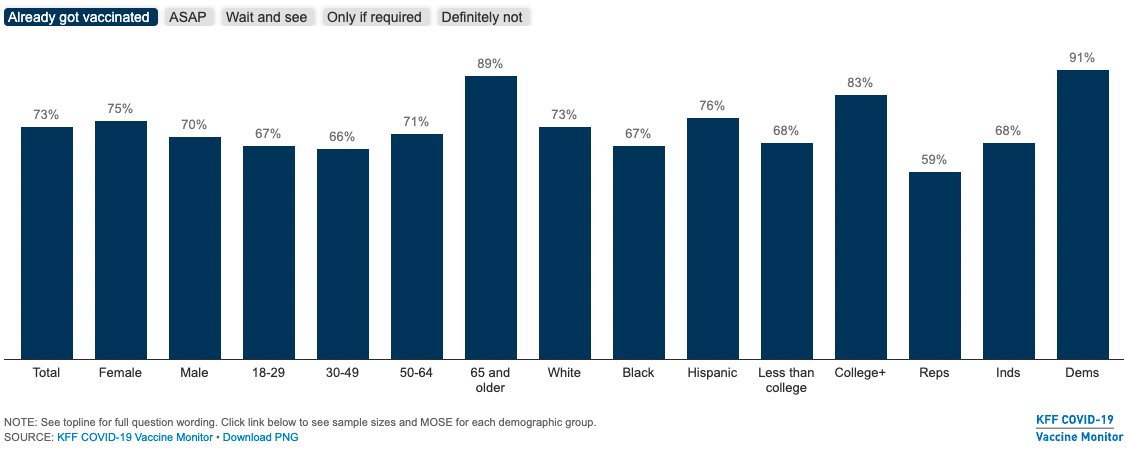
Political changes could occur. We can see strong political dimensions in who gets vaccinated, as this Kaiser tracker shows:

coronavirus vaccinated Kaiser 2021 Dec 15

Republicans and independents could experience a change of heart, depending on events.  Men, black people, those without college education, and those aged 18-49 could see political shifts that make getting shot more appealing.  I’m not sure this is likely, but American politics famously has the power to confound expectations.

We may also more hatred of the unvaccinated (the vaccine-hesitant, the vaccine-skeptical, the -resistant, etc.) from everyone else. There’s an easy political way to think of this, with Democrats hating Republicans. That leaves out the political complexity of anti-vax behavior, but does contain a chunk of it.  This hatred can take many forms, from seething social relations online and off to driving punitive policies or vigilante action to simple shunning.

Meanwhile, our lousy vaccination and booster rates suggest a nation with plenty of vulnerable people to house the virus.  Unless we change those rates massively Americans will be riddled with COVID.

Further ahead, I wonder if we’ll push hard to consign the past few years to formal memory, especially if the virus drops below pandemic levels. Public statuary in physical or virtual forms (augmented or extended reality) could appear as a way for us to process the events. I’m not sure of this. A century ago American society turned its back on that great influenza very decisively, deliberately trying to not memorialize it, so we have a memory hole precedent.  But perhaps an aging society will try to commemorate the suffering of its elders.

Let’s keep an eye on this.  And what are you seeing for the pandemic’s next phase?

PS: get your vaccines and boosters!

Posted in coronavirus | 15 Comments

Imagining the climate crisis in the near future: Neal Stephenson’s Termination Shock

Science fiction set in the near future can be very useful for futurists. Such stories give us glimpses of the present day unfolding over just a few years.  Creators either work with current trends, imagine new developments, or both.

That’s why our online bookclub has been reading near future sf over the years.  Books by the likes of Kim Stanley Robinson, Madeleine Ashby, Cory Doctorow, Malka Older, and Vernor Vinge have proven fine combinations of entertainment and food for thought.

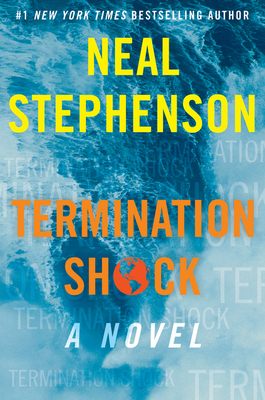
Termination Shock coverIn that spirit I just read Neal Stephenson‘s new novel, Termination Shock. (Amazon through our little bookstore). This one also fit my research into climate change, because it imagines a near future where the climate crisis has gotten worse, and people turn to massive geoengineering projects to address it.

Here I’ll share some initial thoughts.  I’ll stash spoilers in a couple of paragraphs after a suitable warning sign.

Termination Shock is a near-future science fiction novel/technothriller about climate change. Specifically, it imagines a geoengineering project designed to reduce the Earth’s heating, and how it might play out globally.

To tell this story, Neal Stephenson assembles a global cast and sends them on a lot of travel.  In fact, we could classify much of the book generically as travelogue. The main locales are West Texas, the Netherlands, and New Guinea.

Stylistically, Termination Shock is very Stephenson, full of his classic wry humor, deep dives into topics, feats of martial arts, lots of engineering, and a geek’s view of human interactions.  It’s accessible and absorbing.

The book’s first half is mostly stage-setting for the second. In it we meet a Texan zillionaire who sets up an enormous gun (seriously) (very Jules Verne, I think) to blast sulfur into the stratosphere.  He names the thing Pina2bo, after the 1991 eruption. T. R. McHooligan (yes) creates an elaborate demonstration of it for an audience drawn from the leaders of certain locales most threatened by sea level rise, then starts the vast machine going. It’s a fait accompli, essentially accomplished without obtaining approval from national governments or anyone else. In fact, stopping the sulfur launcher would suddenly warm the Earth, the threat of which is what the title names.

That global audience includes leaders from London and Venice, but the main part comes from the Netherlands, including its queen, and their actions and reflections take up most of the rest of the story. An important local ally for them is Rufus, a military veteran specializing in shooting wild hogs, which plague the area. A B-plot involves a Sikh martial artist who trains around the world, then fights dramatically against Chinese competitors on the mountainous Line of Control.

Now for spoilers.

Spoilers inside

The Texan project succeeds in altering the world’s climate fairly quickly, which benefits some nations and irks others, notably India, which fears loss of water due to a shortened monsoon. A lot of geopolitical scheming goes on, as India fears disaster and China seeks to shape events.  Spies, media campaigns, and direction actions crop up.  Two other sulfur-launching projects are set up, in Albania and New Guinea, providing a kind of global balance. Then India launches a surgical strike to take out the Texan gun, crewed mostly by drones, and spearheaded by the Sikh martial star. The latter dies heroically, making a bookend to Rufus’ personal tragedy which appears right after the novel’s start.  The sulfur launches continue.

Overall, this is a very engaging novel. Stephenson creates appealing characters and keeps them in sufficiently dire straits to keep us reading.  There are several spectacular set pieces, like a surprising plane crash and a running gun fight with drones, humans, and hawks. The book explores a real-world problem with a nice combination or political imagination and technical expertise. This is the kind of thing near-future science fiction can do well.

A few pieces didn’t sit as well with me. The Sikh hero plot ended well, but getting there felt padded out by the author’s martial arts enthusiasm. Some of the characters were surprisingly thin, like Willem, a major narrative host, whose personal life barely flickers around the plot.

Miscellaneous notes:

  • Stephenson describes a vast Dutch engineering project in loving detail. This recalls his recent calls for humanity to attempt more such, as well as similar projects in Seveneves (2015).
  • The novel argues that climate change will alter geopolitics, with “some places that most people have never heard of… becom[ing] the Suez Canals of the future.” (500)  China is spooky, but doesn’t accomplish much by the end.  India is the active nation, while Russia mostly fades into the background.Here’s a term to conjure with: climate peacekeeping. (579)
  • America appears in an interesting way. As a nation it’s mostly marginal, with characters mocking it without reprove.  Or rather, the American government is mostly offstage. Instead, America appears as a space, and one where unusual possibilities are available.
  • Some of technologies in play: deepfakes, hydrogen-fueled aircraft, earthsuits (air conditioned gear for dangerously hot climates), sensory body modifications, personal cooling devices (“Me-Fridgerators”!), drone troop carriers, non-nuclear EMP generators, and lots of drones in general (here’s a story which just broke about using drones to hunt people in one of the areas the novel describes).
  • COVID barely appears.  There are a couple of mentions of characters killed by it off-stage, and notes of successor diseases (COVID-21, I think), but the pandemic is not effectively present.

Termination Shock is very different from Ministry for the Future.  Comparing the two would be productive, and perhaps for a later blog post.

There are many nice long passages, and I’ll close with one such quote:

…where Willem came from, a Rhine was sort of a big deal;. A third of the Netherlands’ economy passed up and down one single Rhine. They had, in effect, built a whole country around it. Here [in Louisiana], though, people were gunning their pickup trucks over a causeway bestriding two and a half Rhines just as a temporary diversion of a seven-Rhine river over yonder.  It was one of those insane statistics about the scale of America that had once made the United States seem like an omnipotent hyperpower and now made it seem like a beached whale. (96)

(Spoiler photo by Quinn Dombrowski)

Posted in book club, climatechange | 1 Comment

Looking ahead to COVID-19’s third year: what it may mean for higher education

As I was finishing this post two pandemic stories unrelated to higher education hit my various feeds about the same time.  One was from a finance reporter, who proclaimed his delight in going to many social gatherings, from indoor restaurants to sports events, and determined that Americans were “over COVID.” “[P]eople are weighing the risks, but seem to be erring on the side of enjoying life’s creature comforts.”  Another was a CNN report on how three states (New York, Maine, New Hampshire) are calling out the national guard to keep COVID-overwhelmed hospitals and clinics from breaking down.  Taken together the two articles offered a little snapshot of how divided are American responses to the pandemic.

Today’s post is about how that pandemic’s third year may play out in the world of higher education.  It builds on a previous post about trying to imagine that year three in general. It also relies on when I first wrote about how higher education might exist in the pandemic’s third year, way back in September 2020.

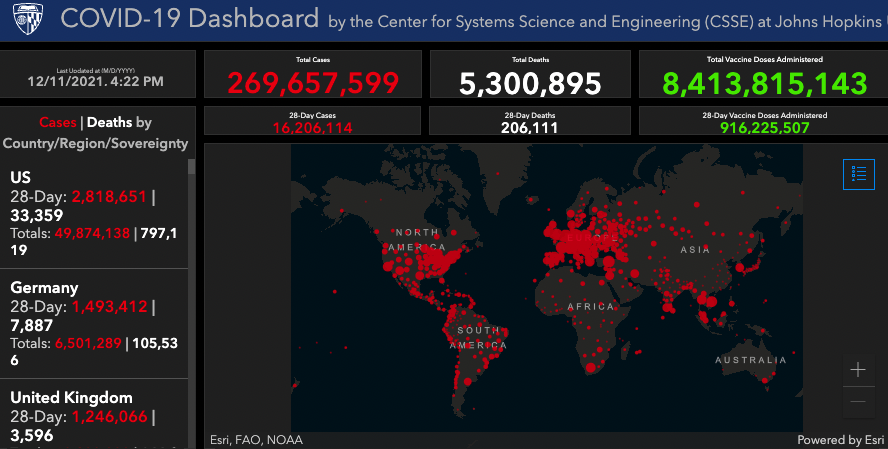
coronavirus in the world JHU dashboard, 2021 December 11

Today’s pandemic data from Johns Hopkins.

Several problems occur when building such a future vision. As I said in that previous post, it’s hard to forecast when the viral situation is so fluid.  Omicron could outcompete Delta, or fail to do so.  Omicron could be more transmissible than its predecessors, spreading rapidly around the world, infecting the non- and undervaccinated… or its R-value might be lower.  It might be more or less dangerous than previous strains in terms of immediate symptoms and/or death rates and/or Long COVID.  That’s at the macro level. At the meso and micro levels, national and local waves and troughs are even more difficult to forecast.

We could close 2022 with the pandemic’s end, tiredly celebrating COVID’s demotion to merely endemic status, and growing accustomed to getting regular boosters, much like we are supposed to get flu shots now. Or it could be raging even higher, or something in between.

A second problem is that we just don’t have good data about how the pandemic intersects with higher education.  Pick the United States. This is a disaggregated, semi-disorganized sweep of circa 4,000 institutions who tend to really hate collaborating with each other.  Getting uniform data isn’t easy in general, and we saw this over the past two years. I had to jury-rig a way of tracking spring 2020’s campus closures, crowdsourcing it because nobody else was doing it. We still don’t know many many academics were infected, injured, and killed by COVID because nobody has aggregated this data. On top of this, each academic institution can to some degree craft its own approach to the pandemic, meaning it’s difficult to categorize proliferating responses.  And this is just one nation, rather than the whole world of academia!

We have to work with what we have now, revising and honing our forecasts as data and analysis come in.  Given that large caveat, what are the ways higher education can respond to the pandemic in its third year?

From the past two years we have a body of evidence to draw upon and extend. This runs the risks all extrapolations do, namely that trends don’t always advance in straight lines. But this will give us a first sketch we can develop further.

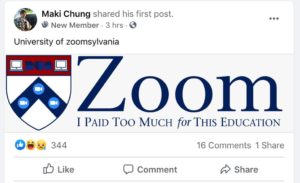
Zoom I Paid Too Much for this education

In person or online? To begin with, two opposed responses stand out based on the problems of interpersonal contact. On the one hand is the major shift to digital teaching, which was inaugurated by the spectacular (if flawed) migration online in spring 2020. We’ve seen this many times since, as online classes grew in various forms, from emergency remote instruction to carefully designed digital experiences and everything in between.  On the other hand is a determined, even fierce drive to hold classes in person. This is based on a mix of risk assessment, some kind of public health strategy (testing, masking, PPE, vaccines encouraged or mandated), a perhaps nostalgic love of face-to-face education, and the financial problem of losing residential student fees.

Both of these responses have faced strong criticism from within and beyond the academy. Each can be, in a way, a rebuke of the other. Both are costly in terms of institutional resources: money, staff, time, material, etc.

Between the two is a complex middle ground of mixed modes and hybridity. This is where HyFlex classes are, speaking of strong criticism, blending in-person and virtual experience across individual class sessions. At a bigger level, some institutions divide individual programs across the two approaches, some online and others in person.  Others have swapped modes over time, moving classes online for a certain period, then back to in-person for another.  There are many ways to make the combination work.  That cluster of mixed modes may become the median for colleges and universities in 2022, depending on how the virus’ third year takes shape and what campus leadership decides to do in response – which isn’t always predicated solely on what’s best for public health.

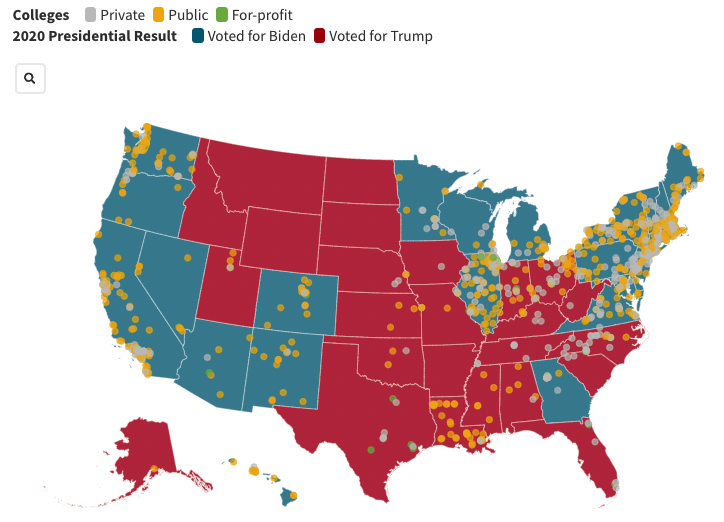
This brings us to the question of institutional supports for vaccines, masking, and boosters. How will campuses address booster shots?  It’s still early days, yet first research suggests blocking Omicron best with boosters in addition to the main vaccine doses.  American president Biden urges everyone to add boosters to their vaccinations (as do I).   Historically campus leaders do not usually follow suit.  Only 1141 colleges and universities have some form of vaccine mandate, or about 1/4th of the total, according to the Chronicle of Higher Education:

coronavirus_campuses requiring some vaxes_Chronicle_2021 Dec 11

And note that each dot doesn’t mean requiring vaccines from everyone on campus, from students and staff to faculty and senior administrators. Instead, those nodes indicate “colleges that are requiring vaccines of at least some students or employees.” (emphasis added) So a school mandating faculty – but not staff or students – get shots would appear.  (Full disclosure: I teach some seminars at Georgetown University, which requires both. I’m very thankful.)

Just a handful or colleges and universities are now requiring boosters, according to Inside Higher Ed.  The historical evidence suggests adopting such beneficial policies will be at best uneven in 2022.  If we are lucky our failure to uniformly vaccinate and boost will not spread the virus.  If we’re lucky.  If not, some of American higher education will play a role in worsening the pandemic.

For the unknown number of academics who’ve been infected, some number will experience chronic tissue damage and suffering: i.e., long COVID. How will campuses handle students, staff, and faculty with what the CDC calls post-COVID conditions?  What measure of support – medical, mental, professional – is best suited to an institution’s values and abilities?  How does an academic department, for example, support a faculty member afflicted with brainfog and persistent memory issues? What accommodations should a school provide a student suffering nerve pain, both when they attend the physical campus and take classes online?  What happens when members of a campus community deny a colleague’s assertion that they are legitimately suffering from long COVID? The American federal government seems to be arguing for chronic COVID issues to be considered as disabilities under the law; perhaps 2022 will see academia’s disability coverage expand significantly.

Beyond long COVID and injections, how might the student experience change in a pandemic’s third year?  Reader Glen McGee has pointed out the problems with some students learning less than they otherwise would have. As we’ve seen in primary and secondary schools, some number of students lost educational benefits to various degrees, including a falling off of learning how to interact in person with other humans.  Some number will disengage with higher education, either not returning to classes or deciding not to apply to a college.  For residential campuses students may feel less attached to the institution if they take classes entirely online or experience the physical setting through masks, social distancing, and a de-densified social milieu.

An OECD report refers to this trend as education hysteresis, and urges educators in general to take serious measures, starting with data collection:

there is an urgency to collect comprehensive data to gain an accurate picture of dropouts or disengaged students during school closures, develop specific support to bring those students back to school, and engage in diagnostic assessment to identify their learning needs…

What campus departments are doing this now?  Furthermore,

governments can establish different forms of targeted communication to reinitiate contact with disengaged students, and adopt a flexible curriculum centred on key competences to restore students’ confidence. Second, countries need to prepare strategies to mitigate effectively this risk in case of future lockdowns. This can include among others:

  • To monitor closely student engagement by following up on their attendance, behaviour, and learning progress.
  • To address the potential barriers to student engagement by offering adequate resources (such as laptops or tablets, and safe places to learn).
  • To provide individualised support to students so they can get the best out of the new modes of education delivery 

Again, how many colleges and universities are taking these steps?  And how are they resourcing them?

I keep mentioning resources, which is a way of building up to higher education’s financial picture. As I’ve noted for years, the economics of American colleges and universities are not doing well, on average.  Elite institutions continue to grow wealth, and to attract outsized attention, but large swathes of the sector are struggling.  Public universities suffer from the decline in student funding over the past generation. Student loans continue to swell into a horrific monstrosity, and so on.  My readers know this well.  The pandemic worsened things for some, due to a bad mix of pressures: decreased enrollment; decreased in-person fees (room and board); increased expenses.  Higher ed shed 650,000 jobs in 2020, and would have bled far more were in not for the CARES Act. Some recovery has occurred over the past year, but not nearly enough.

If enrollment declines continue in spring and fall 2022, a lot of schools will face another ratchet of financial pressure.  Again, much depends on the virus. If COVID drops down to endemic status, we may see an enrollment uptick. Yet very low unemployment means many folks are still seeking their fortunes on the job market, rather than reschooling themselves.  Additional forces may keep depressing the number of students, beyond the pandemic: demographics; international students (see below); reputational issues.

Speaking of reputation, higher ed’s status has declined in recent memory.  A big chunk of this is due to Republican politics, as that party increasingly attracts Americans without college experience.  GOP hostility to academia is longstanding, especially in a culture wars sense, but it has picked up recently (as noted here way back in 2019). Collegiate responses to the pandemic don’t seem to have additionally injured our status; that grace might persist through 2022.   Yet Congressional, state, and local elections this November will surely enflame the culture wars, which certainly involve education.  The partisan divide should continue to play across our campuses and how the broader society views them.

Those trends arose during the full pandemic experience. Now let’s check in with that older forecast and see how it fares in today’s reality.  Once more, this is good futurist practice, reviewing previous work to improve current practice.

  1. I imagined physical campuses changed: pandemic architecture (bigger and more doors and windows) appearing, fewer people on the grounds, except for Greek houses.  This seems overstated to a degree, especially as so many campuses welcomed students back in fall 2021. I haven’t found good evidence for or against the architectural change.
  2. Teaching and learning: students, faculty, and support staff are more accustomed to partly or entirely online classes. This seems to have been borne out, not without resistance and criticism.
  3. Some faculty, staff, and students do not acclimate to a more digital environment and leave the academy. The enrollment drops agree with the student aspect. It’s harder to assess how many professionals exited campuses for this reason.
  4. I thought academic research would tilt towards the pandemic and related fields, then support would drain away from the rest.  The explosion of COVID-related preprints and open scholarship supports this. I don’t have data otherwise.
  5. I suspected enrollment would decline; it did.
  6. Higher ed finances would get stiffer, with tuition and debt rising.  This is often true, depending on institutional conditions.
  7. I suggested that undergrads would lose social connections and (for traditional-aged ones) skills.  Plenty of reports confirm this.
  8. I expected some illnesses and deaths plus more mental health issues.  Confirmed.
  9. For college sports I saw two opposed paths. On the one hand, fewer games and teams as institutions found it difficult to field or pay for teams in dangerous situations. On the other hand, we could have seen schools doing anything to keep athletics going.  The latter was definitely borne out by history.
  10. For international study, I expected student numbers to decline.  They have done so.
  11. I expected US-China relations to worsen, too.  That has certainly occurred, and in a bipartisan way.
  12. For campus tech, I projected increased service demand, not necessarily with additional funding. Both of these seem to be true.
  13. I expected more automation.  Beyond individual cases of chatbots and more powerful software, I’m not aware of evidence for this.
  14. I thought the demand for libraries’ digital content and services would rise, while their budgets would plateau or fall.  That seems to be correct.
  15. And I forecast that higher ed’s reputation would take a hit, based on how it handled the pandemic. (The former turned out to be true, but not really because of the latter)

Taken together, these forecasts, modified by a year+ of experience, suggest an academy a year from now that probably teaches fewer students. Its buildings may start to show signs of COVID style. Sports will keep on. Library and IT services will keep rising, albeit without additional financial support.  Student learning will continue, but hampered.  More people within the academic community will suffer from illness, long COVID, or death.

Once again, this is a sketch. Various trends and factors can adjust it.  What do you think?  What do you foresee for higher education in 2022, if the pandemic continues for a third year?

Posted in coronavirus, higher education | 4 Comments

Looking ahead to COVID-19’s third year

What might we expect from the COVID-19 pandemic’s third year?

Yes, that’s where we are now in this December 2021, running out of the virus’ second year while all indicators are blinking GO! for a third.  Technically, the third COVID year should start in March 2022, since WHO declared the pandemic in March 2020. In fact, Chinese doctors first diagnosed a case of the virus two years ago last week, so we’re in year three of the creature’s overall career nestling within and successfully leaping between human bodies.

In fall 2020 – which feels like a decade ago – I blogged about what a Pandemic Year Three might look like, inspired by Josh Kim. * In this post I’ll update that vision, based on what we’ve learned and experienced since.  In the next I’ll turn to implication for higher education.

To begin with, imagining how the virus spreads and acts through 2022 is difficult.  Many nations, including the United States, gather and share data badly, so our understanding of where COVID stands now is flawed. Worse, we have just detected the Omicron variant. It will take at least a week for us to get an early sense of how it interacts with bodies and vaccines, due to how long it takes to culture samples etc., so there isn’t much we can reasonably speculate upon.  Omicron could outcompete Delta and dominate the (epidemiological) world, or it won’t.  It might spread more rapidly than its priors, or not. It could be more lethal than the rest of COVID strains, or less.

We could see the pandemic rage through 2022 at 2021 levels.  The virus will keep mutating, so we might see some mutations bestride the world: variants Pi, Rho, and so on, each with distinct characteristics and dangers.  Or it could decline in infection rates, dropping out of pandemic status into being merely endemic.  One popular endgame that I and others have imagined is COVID becoming like the seasonal flu.

buy cymbalta online buy cymbalta no prescription generic

It kills and sickens people at levels we deem low enough to be acceptable. We take updated shots to reduce our risks.

In short, a huge asterisk hangs over any attempt to forecast about the virus per se.

What we can do with somewhat more confidence is examine what the virus has done to us so far, then study human reactions.  From these we can identify trends, which sketch out one cloudy, contingent vision of 2022.

To begin with, where do things stand now, to the best of our shaky knowledge?

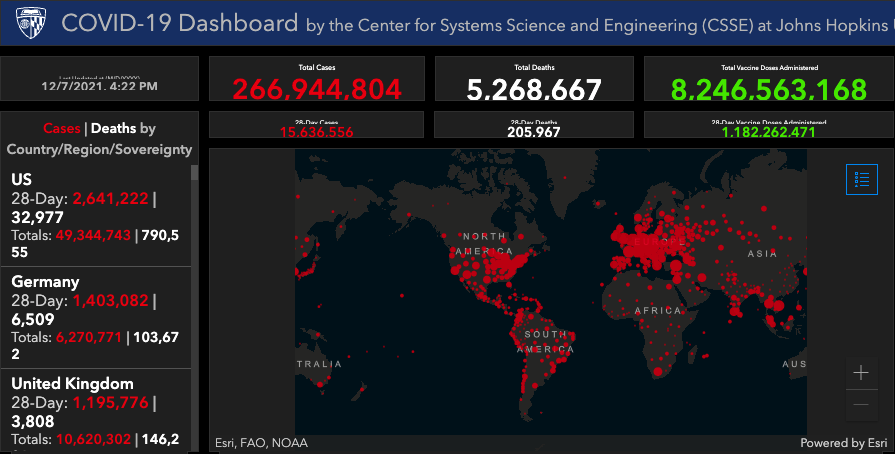
coronavirus world dashboard JHU 2021 Dec 7

There have been 266,944,804 COVID cases worldwide, according to the Johns Hopkins dashboard (above). JHU also counts 5,268,667 killed by the virus.

buy doxycycline online buy doxycycline no prescription generic

  The World Health Organization’s numbers are similar: 265,194,191 cases and 5,254,116 deaths.  In the United States alone the Centers for Disease Control numbers 49,198,746 infections (about 15% of the whole national population) and 787,064 deaths.  In Britain, COVID became the leading cause of death this year.

I can find no reliable numbers of those suffering from Long COVID, partly because of disagreements on definition and diagnosis. If 1% of infected people suffer from that chronic condition, that yields nearly 3 million people suffering for months or years, worldwide.

Again, these numbers are not great right now.  It’s obvious that there are reporting undercounts, thanks to national, local, and cultural reasons. When some researchers compare these stats against pre-COVID death rates, it looks like the real numbers may be 10-20% higher.

To sum up: the pandemic has been a horrendous human catastrophe, killing upwards of 5 million people and sickening – injuring – a much larger number.

How has humanity reacted?

Extrapolation from trends

Our response has been mixed. On the one hand we’ve developed an amazing vaccine – a vaccine platform, really – in an incredibly short period of time. We’ve also produced vast numbers of the stuff and distributed it to some populations.  Billions of people have also learned and practiced public health measures which have changed over time, from social distancing to masking, hand-washing, etc.  Health care professionals and public health workers have done heroic, largely invisible work with awful costs at times. Shut-downs and quarantines have taken place at huge scale and warped individual lives.

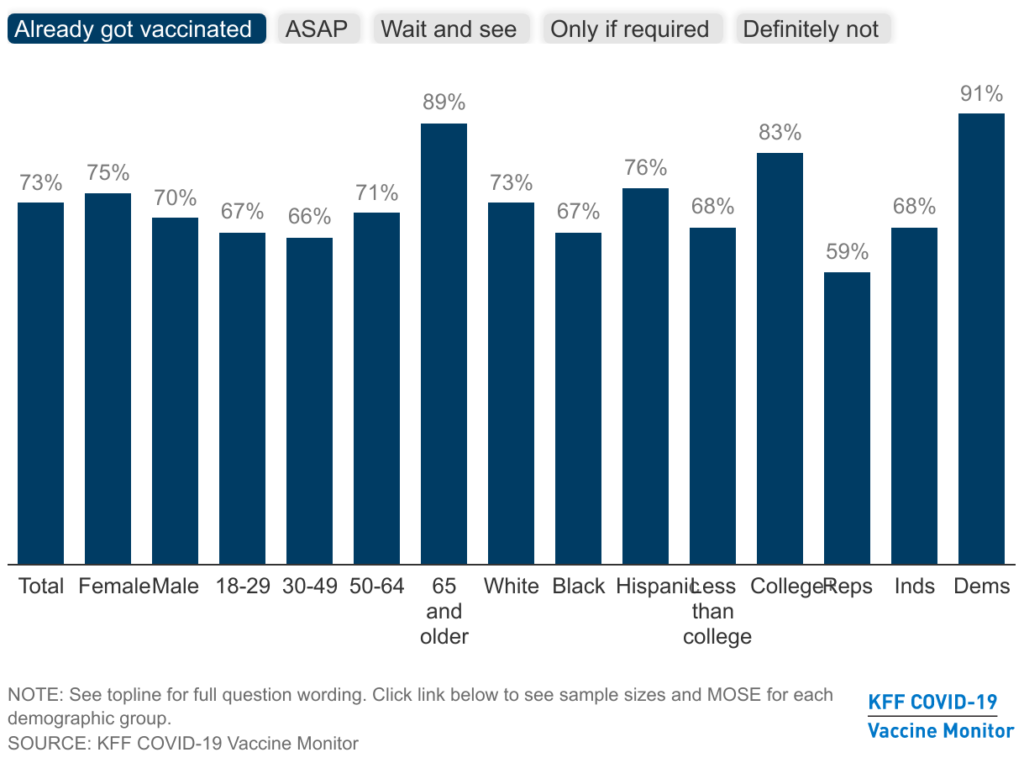
On the other… there is broad and international resistance to the vaccines, for a fascinating range of reasons.  The pre-COVID antivax movement plays a role, as do various religious beliefs, suspicion of medical and author authorities, economic fears, not to mention political concerns and conspiracy thinking. In the United States the Kaiser Family Foundation tracks vaccine uptake and resistance, and you can see quite a variation by race, political party affiliation, age, and education:

coronavirus vaccine yes Kaiser_2020 Dec 7

Beyond the vaccine, a good number of people are evading the other public health measures.  I’m sure readers can share stories of meeting people who semi-mask or just go maskless, or the many cases where social distancing is nonexistent. I experience this myself when I trek across blue counties to Georgetown University (where I teach) and back.

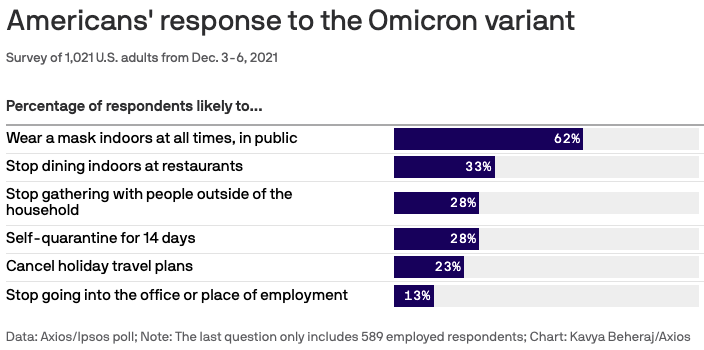
A new Axios poll adds some data to those stories, showing majorities of Americans not bothering with most measures:

coronavirus attitude towards Omicron Axios 2021 Dec 7Our social and commercial desires win out, it seems.

So there are two opposing trends. One of extensive and intensive research, medical, and public health engagement against another which disengages from these efforts and institutions to varying degrees.  Both sides are dug in with many people passionate about their views and actions. Looking ahead we should expect these two forces to persist and collide, grinding against each other as people try to navigate the pandemic’s third year.  The shifting nature of culture and politics (think about the Q-Anon ferment) means that friction could drive more cultural and political mutation. Taken together, it means humanity will continue to provide some fertile grounds for the virus to till.

A hybrid form of life has emerged, and not only in the sense of those two major attitudinal forces often located together within individual communities.  The pandemic hauled a chunk of the human experience online, deepening digital immersion and drawing some energies away from the in-person realm.

buy avana online buy avana no prescription generic

It’s not enough to say “we’re more online than ever,” although that is true, even while tech criticism is mainstream and growing.  It’s not only that online and offline worlds are increasingly intertwined. It’s that we’ve normalized that hybridity.

Think of in-person restaurants. Some have QR codes for menus or augmented reality layers attached for local color, while others have shifted their business out of dining rooms and into delivery (typically organized by digital delivery services). Or think of homes, where digital entertainment occurs in social rooms, and digitally-ordered Amazon boxes thunk on doorsteps. An Uber driver, hailed by mobile app, navigates traffic with eyes, hands, feet, and Google Maps while her passenger Facetimes a friend.  A group of people on a bus or train, masked and (maybe) distanced, avoids conversation in favor of smartphone interactions.

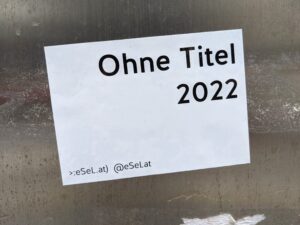
Ohne Titel 2022, by Michi SchwaigerThis hybridity isn’t new. It began in a quiet way with the networked digital world in the 1970s and took off with mobile devices in the 1990s.  It describes a digital layer laminated onto the analog world. COVID accelerated its adoption, deepened its uses, and made it mainstream.  From now on we should expect any in-person meeting to be just one visible component of a two-level engagement. On our devices we’ll expect to be able to peer out into other locations and engage with them. Increasingly when we describe a physical space we have to account for its digital layer, with the two ever more intertwined.

Those physical spaces may change as well through 2022.  Since 2020 I’ve been expecting changes to the built environment: more windows and doors, bigger windows and doors, fewer interior rooms without outside exposure, and so on. Architecture can strive to help us combat the virus. I’m not sure to what extent this has been realized so far.

Our interior spaces have also been theaters of combat, and the mental toll exacted has been intense.  Think back to the numbers cited earlier.  The millions dead mean millions more hit by those deaths.  Some of those hundreds of millions infected suffer mentally as well as physically from the encounter; hundreds of millions more had to grapple with that. The economic whirlwinds of 2020 gave many more people fierce stresses of unemployment and financial survival.  The many perceived errors of public health sapped some public faith in the process, yielding uncertainty and fear on top of the overarching dread such a widespread disease inspires.

Years of pandemic psychological stress will yield several effects over the next year.  We should expect more people to be burned out, either on the disease’s front lines or otherwise. Some will turn inwards, away from people, perhaps increasing the proportion of people scoring as introverts.

buy clomid online buy clomid no prescription generic

  Demand for mental health services should boom.

This doesn’t describe everyone, of course.  Some folks batten on crisis. Some viewed themselves as too healthy and virtuous to be negatively impact (my wife can tell stories from her public health work, oh yes). On a related note, others took comfort in culture, religion, or politics and weathered the storm. Some just didn’t get hurt.  And the conservative dislike of psychotherapy, as old as Freud, persists.

To repeat: these are trends from recent history and the present. In the preceding I described them as persisting through the next year on a basic, largely unmodified level.  This is just a starting sketch, since it is likely each development will behave in at least a slightly different way, given the fierce creativity of billions of human beings interacting on a civilizational scale.

What 2020 thought of 2022

As a futurist I routinely examine my older forecasts. This isn’t navel-gazing, but the opposite. It’s a way of checking my work, looking for strengths to maintain and errors to correct.  It should be a professional mandate.

So what did my September 2020 post think of 2022?  Let’s pull out some points.

  1. People moving out of crowded cities into the country, or just aiming for less populated spaces. It seems like this was overstated and that urban areas remain powerful social magnets overall.
  2. Intergenerational relations becoming more intense. This, too, might be overstated, appearing only in the form of younger folks refusing vaccines etc. because they are very unlikely to be sickened. (Never mind the greater danger of spreading an infectious disease!)
  3. Older folks becoming more segregated for safety’s sake.  I am not away of good studies on this.  Anecdotally I can confirm that I had to pass through more hoops this year than in 2019 to see my 90-year-old father in assisted living or rehab.
  4. Will the American character change?  I brooded: “I’m not sure if decreased face-to-face contact will confirm Americans in our individualism through isolation or, conversely, stoke our longing for norms, belonging, and conformity.” This seems very hard to quantify or otherwise measure.  I do know it’s popular in the progressive world to criticize individualism. Did COVID boost this line of thought?
  5. Americans becoming more religious.  I haven’t seen good evidence for this in terms of established faiths yet. But I was right to assess marginal faiths as taking off and getting creative.  I wish I’d anticipated “pastel Q.”
  6. Some businesses suffering, others booming.  Check.
  7. Labor market in recession: I clearly missed this one.
  8. Supply chains in flux: got it.
  9. Left-wing populism rising: I’m not sure about this one.  On the one hand, the Democratic party looks likely to keep up the Biden balancing act between the party’s left, right, and center. On the other, the “great resignation” and talk of strikes suggests some kind of leftward current.
  10. Punishment being meted out to those perceived as guilty of pandemic mistakes and crimes: so far this hasn’t really happened.  It was sexual harassment which cost New York’s governor his job, not his COVID mistakes and the coverup thereof. Trump remains a free, if Twitter-less, man. I haven’t seen any vigilante justice.
  11. More surveillance and policing: generally yes. Yet I didn’t anticipate that “defund the police” would be as popular as it was in 2020.
  12. US-China Cold War deepening: yep.
  13. A cultural boom: that seems to be under way. TV continues to be enjoying a renaissance.  Movies are trying to recover. People are reading.  Analog and digital games flourish.
  14. Automation expanding: yes.
  15. The techlash (popular criticism of Silicon Valley etc.) persisting: check.
  16. The climate crisis building: oh yes.

That’s an uneven forecast.  It looks like I was stronger on technology, culture, some economics, and geopolitics than on justice, labor, and generations.  Duly noted for my future work.

Putting all of these strands together yields a richer sketch, from economics to psychology and pop culture.

Yet it leaves out novelty. What new developments should we anticipate?  This, I invite readers to consider and share.

(“Ohne Titel 2022,” by Michi Schwaiger)

*Link fixed.  Thanks, Cogdog!

Posted in coronavirus | 10 Comments

Support your independent higher education futurist

Today I’d like to invite your support for my work.

To explain: I’m an independent higher education futurist and can’t do this work alone.

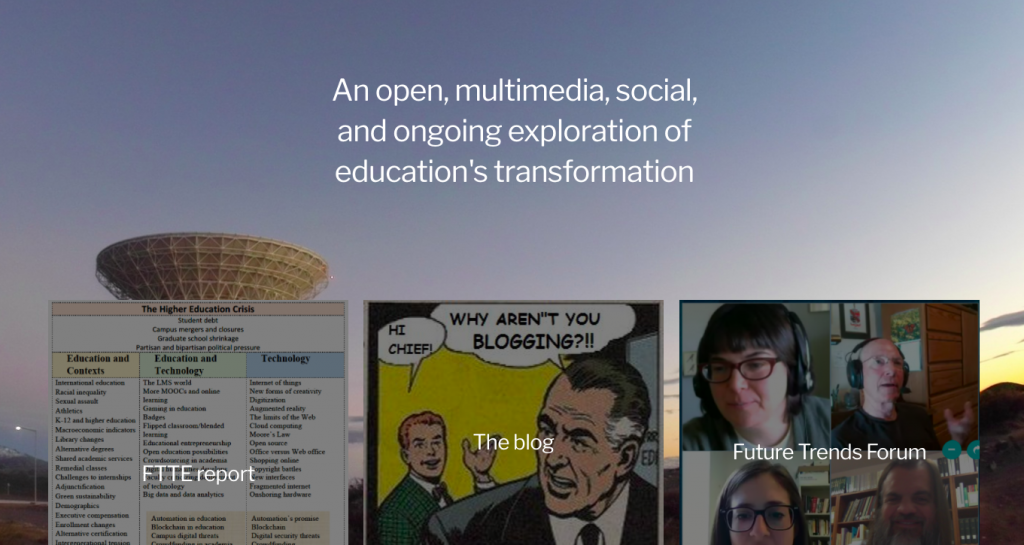
What that means: as a higher education futurist, I conduct research into how academia evolves.  A whole slew of projects and initiatives fall under this header, such as writing books and articles.  The Future Trends Forum is part of this effort, an unusual, weekly video conversation about higher education’s next steps.  (We’re coming up on our sixth year anniversary.)  There’s the long-running FTTE Report, a monthly trends analysis.  We have an online book club. And there’s this very blog. I wrap all of these together under the Future of Education Observatory banner.

Observatory screenshot

And there’s more, as the commercial used to say.  Exploring the intertwined future of academia and the climate crisis led to my next book, Universities on Fire (forthcoming, Johns Hopkins University Press). Along with the book will be a series of projects in 2022, hoping to expand and develop conversations and strategy around the topic.  On deck is a podcast series, Future Trends Forum sessions, articles, a virtual event, and maybe more.

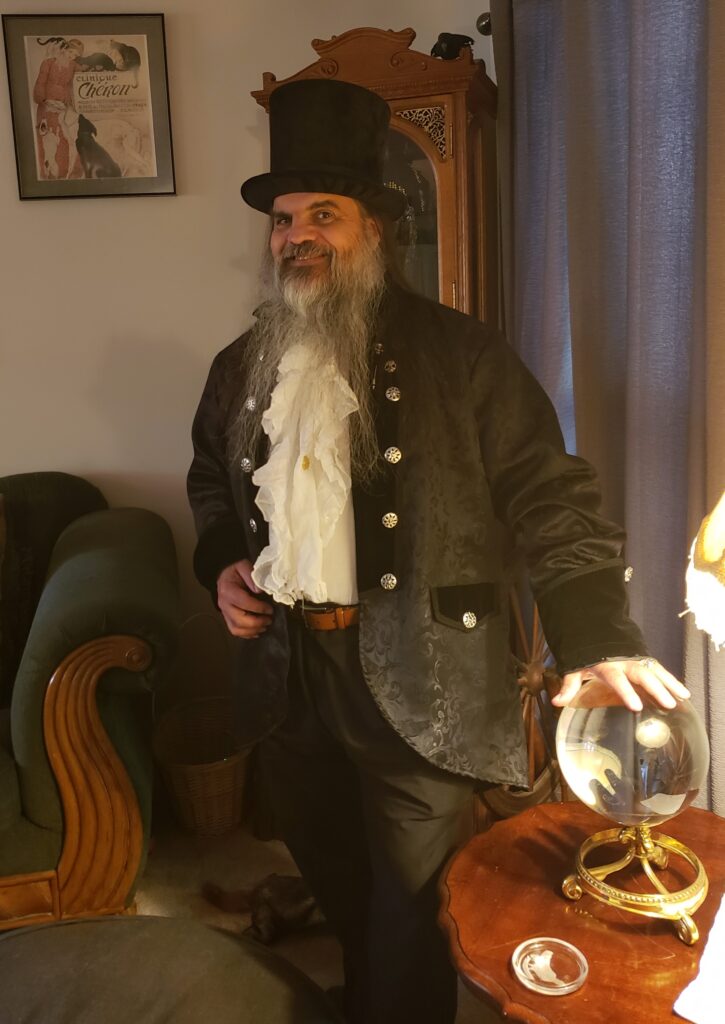
Bryan Halloween 2021 with crystal ballThe “independent” part of being an independent higher education futurist is where you come in.  “Independent” means that I do this work without a net. No institution is behind the Observatory. No family wealth makes it possible.  No government, business, or nonprofit powers the work.  I don’t have tenure or a full-time employer. Instead, I remain independent of any editorial influence. Therefore a mix of streams keep the lights on and the machines humming: consulting work, speaking engagements, virtual events, some sponsors, FTTE subscriptions, and the great supporters on Patreon.

Today I’d like to invite you to join them and keep it all going.

Here are some ways to help:

I deeply appreciate any of these actions.  I work hard to make sure each brings value, both to supporters and, hopefully, to the broader conversation about academia’s future.

I know not everyone can contribute.  These are wild times and we have both restrictions and priorities.  I appreciate whatever you can do.

More, I believe deeply in the power of networks.  This post has too many “I”s for my taste, but the work is thoroughly social and connectivist. Much of it is about connections between people, from conversations, collaborations, professional development, and networking to friendships.  Folks contribute not only their financial support but also their thoughts, creativity, and analysis, which makes the overall work smarter and better.

The future of colleges and universities is too complex – and too important – to go it alone.

Please support the work.  And thank you.

Posted in About, Bryan Alexander Consulting | 9 Comments

The climate crisis has hit the Smithsonian Museum and it will get worse

This week I have a lot of topics in the hopper: COP-26, the new COVID variant (Omicron), an update on an educational game I’ve been developing.  But for now I want to share a single story about a far larger topic.  And I’ll share it in some detail, because not every reader can climb past the paywall surrounding it.

tl;dr version – The climate crisis is already hitting America’s Smithsonian Institution in a very practical and dangerous way, according to the New York Times.

The reason is that the land where those museums stand is low-lying and increasingly vulnerable to flooding.  The climate crisis ratchets up the likelihood of rising waters and increasing amounts of rainfall.

Rising seas will eventually push in water from the tidal Potomac River and submerge parts of the Mall, scientists say. More immediately, increasingly heavy rainstorms threaten the museums and their priceless holdings, particularly since many are stored in basements.

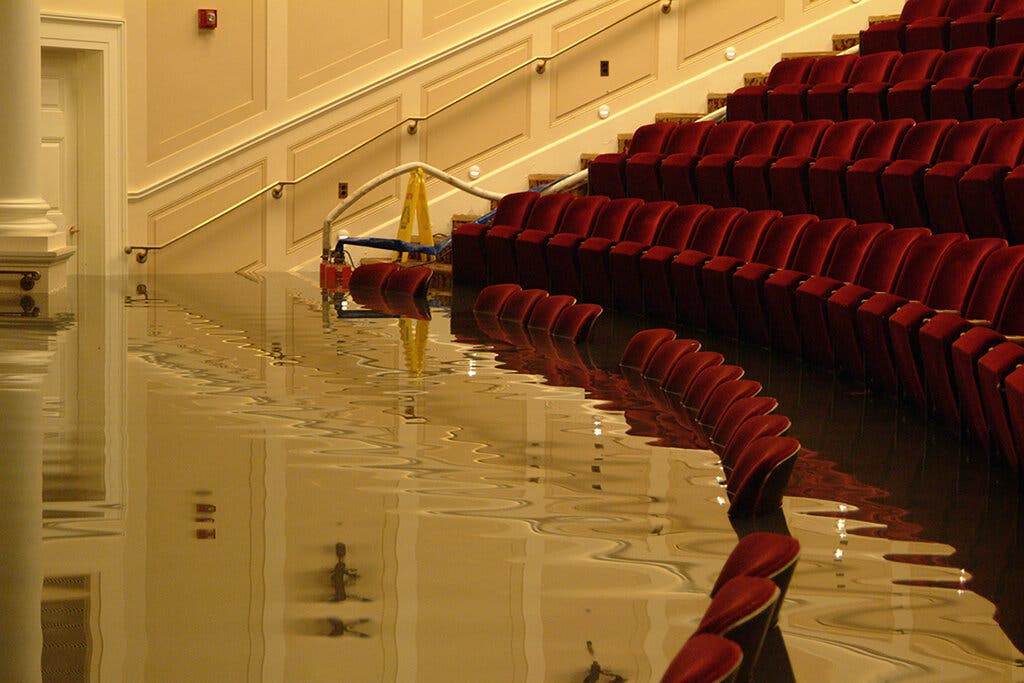
Water has already attacked the Smithsonian.  Christopher Flavelle offers many examples, from a historic train engine immersed in pooled rain to a flooded auditorium.

Smithsonian auditorium under water_NYT

“Flooding in the William G. McGowan Theater in the National Archives Building in 2006.”

At the American History Museum, water is already intruding.

It gurgles up through the floor in the basement. It finds the gaps between ground-level windows, puddling around exhibits.

buy clomiphene online buy clomiphene no prescription generic

It sneaks into the ductwork, then meanders the building and drips onto display cases. It creeps through the ceiling in locked collection rooms, thief-like, and pools on the floor.

That should give any reader concerned with the preservation of cultural heritage spine-wrenching dread.

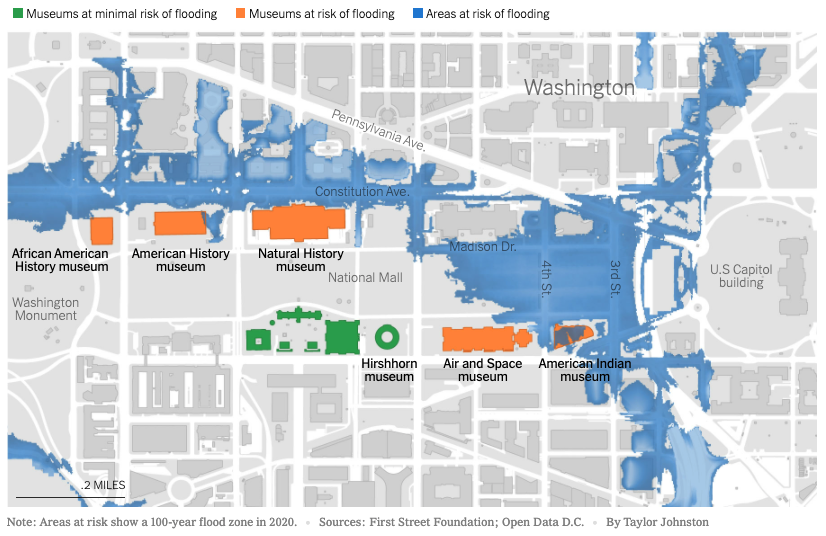
Looking ahead, multiple buildings and their precious collections are in danger:

Smithsonian museums at risk of 100 year flood_NYT

This depicts “100 year flood” dangers. That timeline shrinks with the climate crisis.

Protective measures are in play already:

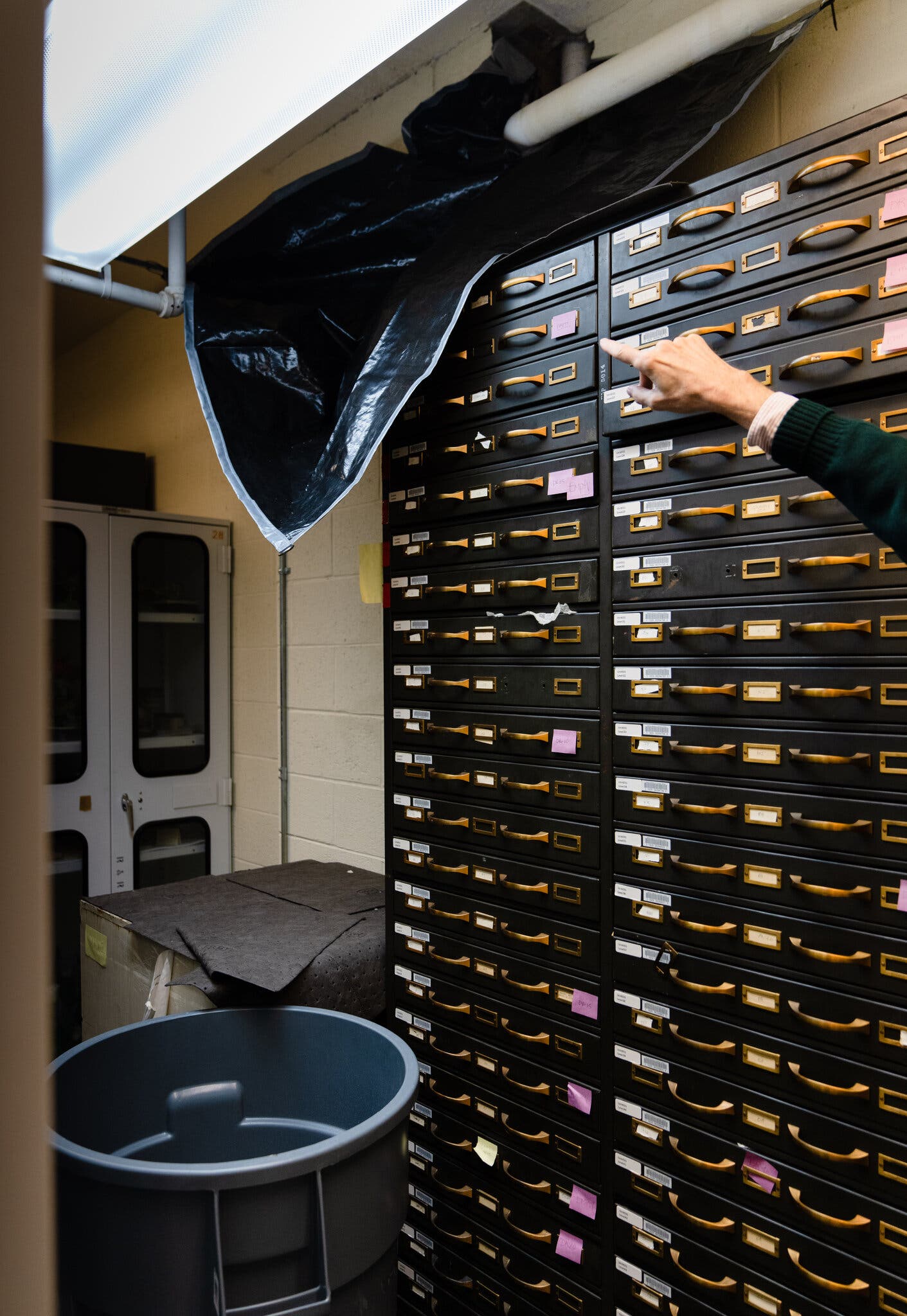
Staff have been experimenting with defenses: Candy-red flood barriers lined up outside windows. Sensors that resemble electronic mouse traps, deployed throughout the building, that trigger alarms when wet.

buy valif online buy valif no prescription generic

Plastic bins on wheels, filled with a version of cat litter, to be rushed back and forth to soak up the water.

Such steps are familiar to some people who live with intrusive water.  They may become better known as the century advances.

Yet these are basic, often DIY approaches.  Flavelle outlines more ambitious measures which may also be familiar to readers coping with dangerous flooding and rain, such as walls around the most endangered sites, flood gates, more pumps, a pumping station, and setting up “a $160 million storage site in Suitland, Md., for items from the American History Museum and the National Gallery of Art.”  It’s a familiar pattern, redirecting water or migrating away from the immediate danger.

Around the world a growing number of colleges, universities, archives, libraries, and other museums will face this awful pressure as the climate crisis worsens.  Some are dealing with it now.

buy lasix online buy lasix no prescription generic

  We have to look ahead and plan – now.


On a personal note, this story resonates with me deeply.  Not because I’m working on climate change – I am – but because in the 1980s and early 1990s I worked in a used book store located in an Ann Arbor basement. Construction cracked the building’s structure, so that every rain shower gradually trickled water down to the shop. We had buckets, plastic shielding, plastic sheets in strategic locations.

buy stendra online buy stendra no prescription generic

Smithsonian water bucket_NYT

We were very familiar with DIY defenses like this.

Every rainstorm made us deeply anxious.

Eventually the owner successfully moved the shop to an aboveground location.  Yet from then on, the first drop of rain turns my shoulders to iron as I scan the area for endangered books.

Posted in climatechange, personal | 1 Comment

Podcasts I’m listening to in November 2021

What podcasts are good to listen to these days?

I’ve been listening to podcasts since their first wave, even before Ben Hammersley coined the term way back in 2004. Now, during their second wave, this golden age of podcasts, when there are too many podcasts for any one person to listen to in a lifetime, I like to learn about interesting programs from other people.  To be fair, and in classic open/social Web practice, I share my own recommendations. To that end, every year or so I blog about which podcasts I’m listening to.  (previous posts: January 2021, 2019, 2018, 2017, early 2016, mid-2016, 2015, and 2013)

How I listen to podcasts has been changing this year.  I pushed the Stitcher app very hard, adding a lot more shows, and this didn’t go well.  The app hangs, bogs down, or just fails to load new content too often. My patience with its awful search tool ran out, as did my frustration with programs which aren’t on it for whatever reason. And I’d forgotten how much I disliked Stitcher’s lack of organizing programs. So I’m using that ancient technology called “the Web” to play some shows. Meanwhile, I’m experimenting with several other apps to see how they do: Google’s podcast app, Pocketcasts, and Podcast Addict.

Podcast bunnySome caveats about what follows: I don’t endorse the views of each of the following shows or their hosts/creators/guests. Instead, I recommend them solely to the extent that I enjoy and/or learn by listening to them.

Also, I haven’t listened to every single episode of each of these. There are some series I’m still working through. Others which appear regularly – I’m just too busy to necessarily devour each of them. Besides, while I enjoy a given podcast, I might not be into each topic they cover or guest they host.

Each of these programs is live, currently offering episodes, to the best of my knowledge. I have not included some limited series which finished more than a month ago. It might be worth recommending some of those in a separate post.

The categories below are pretty general. Some podcasts really do stretch across two or more of each.

I linked to each podcast’s web presence, if it’s available, rather than their presence on various platforms, because I still love the web.  I resist linking to a podcatcher platform’s link. I haven’t linked to video versions, when they exist, because I usually prefer the audio editions.

I’m also excluding audiobooks.  That’s a different topic, although you can see some overlaps.

This is also not an exhaustive list.  I’m listening to some now which I don’t feel like sharing here, often because I’m trying to figure out if I like them.

Higher Education

Design Thinking 101 – my Georgetown colleague Dawan Stanford hosts discussions on the many ways design thinking can play out.

EdUp – interviews with educational practitioners.

FutureU – interviews with people researching and/or leading changes in higher education.  Jeff Selingo and Michael Horn are genial, thoughtful, and energetic hosts.

Higher Ed Social – conversations about different aspects of education.

Teaching in Higher Ed – Bonni Stachowiak interviews a wide range of guests involved in postsecondary instruction. (my first appearance)

TOPcast – concerns teaching online.

What We Are Learning About Learning – a fine podcast by my colleagues in Georgetown’s Center for New Designs in Learning and Scholarship (CNDLS).
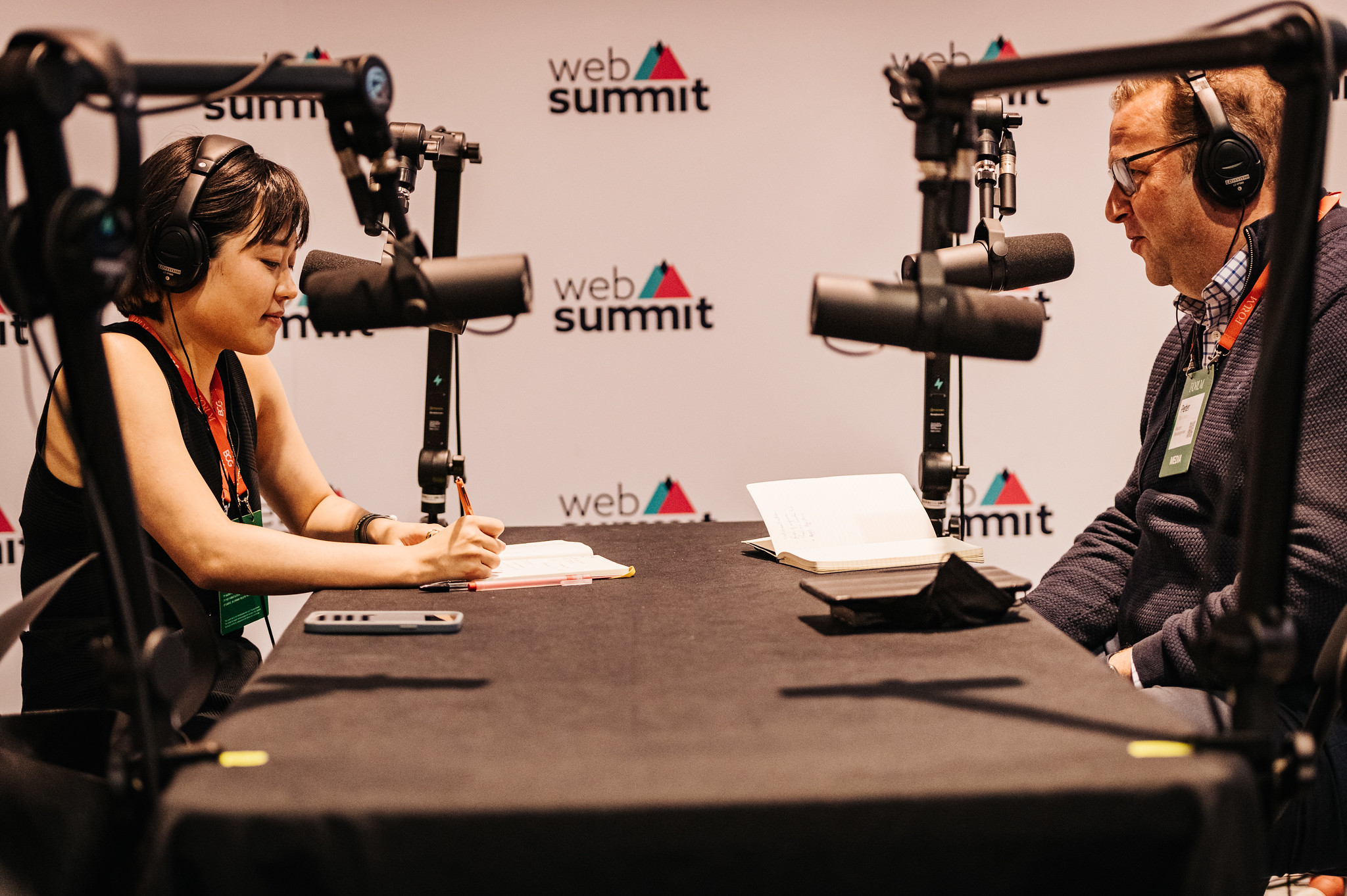
podcast booth 2 people_Web Summit 2021

Futures Stuff

City of the Future (episode one) – each episode dives into one way to possibly redesign urban areas.

The Disruptors – a look into visions of the future, through interviews with a wide range of people.  Matt Ward’s a fine host. (my appearance)

Flash Forward – a nice mix, with each episode focusing a particular “what if,” offering a story taking place in that world, followed by a discussion from the present.

Future of Everything – a look at emerging science and technology. From the Wall Street Journal.

Jim Rutt Show – the titular host interviews a wide range of people with thoughts pointing to possible futures.

The Portal – Eric Weinstein and other people bash around big ideas at top speed.

Secret History of the Future – two hosts explore interesting ideas.  From Slate/The Economist.

Seminars about Long-term Thinking – presentations to the Long Now Foundation on a variety of topics (history, science, culture) through the lens of very long-term thinking.

Spark – a CBC exploration of the future.  Norah Young is a great host.

Current Events and Politics

Analysis – a BBC program about political issues and current events, mostly from a British perspective.

Angry Planet (Substack) – each episode examines one global conflict or dynamic thereof.

Arms Control Wonk –  a group of experts probe current developments and recent history.

Behind the News with Doug Henwood – host and guests discuss current events (American and international) from a left perspective.  Henwood is always a sharp host and has fine musical taste.

Best of the Left – a grab bag of left/liberal/progressive political commentary.  Uneven but very useful and generous in its inclusion of other podcasts’ content.

The Brian Lehrer Show – an old-school call-in program. As a native New Yorker I enjoy the attitude shown by callers and guest.  As a facilitator I admire Lehrer’s balanced hosting.

Conspirituality – explorations of the many ways New Age and related spirituality/new religious movements can be terrible.  The hosts are part of that world, so their presentation is starkly self-aware, often tinged with disappointment.

The Daily – each episode (one per day, as promised) looks into a single current news story, then adds a summary of leading events.  It’s from the New York Times, so their reporters are usually guests.

Deconstructed – a left-wing examining of current events.  Part of The Intercept.

The Dig – left-wing news analysis.  Part of the Jacobin world.

The Dream – a deep dive into the grift-heavy world of multi-level marketing.  This is important stuff, alas.

Economic Update – a look into major economic issues from current affairs from a left perspective.  Richard Wolff is very engaging.

The Foreign Desk – a deep dive into a different international dynamic or crisis with each episode.  I enjoy the host’s wry sense of humor.

Global News Podcast – world news from the BBC. At least one story is in depth.

Intelligence Squared – Oxford-style debates about current events.

Intercepted – furious discussions about current events from a left/civil liberties point of view.  Part of The Intercept media world.

Little Red Podcast – good podcast about contemporary China.

NPR News Now – a very very short (<5 minutes) headline-level sketch of news, updated every few hours.  Handy in a pinch, although very limited and wastes time on things I’m not interested in (sports).  National Public Radio.

On the Media – analyses of contemporary journalism and related issues. The hosts usually take a liberal perspective and have an anti-technology ax to grind.

Popular Front – an examination of war and conflict, especially irregular struggles.

QAnon Anonymous – a very useful update on, and investigation into, the Q conspiracy movement in its various permutations and mutations.

Radio Open Source – not about technology, but a wide range of current events and culture, with a strong Boston-area flavor.  One of the first podcasts and still going strong.

Useful Idiots – a contrarian and left view of current events.

The World Next Week – a thoughtful reflection on international relations from the Council for Foreign Relations, looking ahead to developments over the next week or so.
Science and Technology

a16z – a look into emerging technology from the perspective of Silicon Valley venture capital fund Andreessen Horowitz.

Engines of our Ingenuity –  short, well done monologues on technology, inventions, and people.  There are several hosts.  Every single episode has a transcript and references.  Did I mention they’ve done more than 3,200 shows so far?

Morbidity and Mortality Weekly Report (MMWR) – very useful updates on public health.  US Centers for Disease Control.

Nature Podcast – discussions on science.

Reply All –  looks into the digital world, pulling out cultural or whatever stories it finds interesting.  It’s energetic, friendly, and trend-focused.

Science Sessions – conversations with researchers, from the Proceedings of the National Academy of Sciences (PNAS).

Techdirt – conversations about various digital topics. This can include rich details about technologies and policy.

Climate Change

Drilled – an exploration of how the fossil fuel industry fights against climate change activism.

How To Save A Planet – an energetic discussion of many climate issues.

Matter of Degrees – a good discussion of many elements of climate change.

Economics and Business

EconTalk – interviews with major economists conducted by a puckish, provocative MC.  Every single episode has an annotated, hyperlinked transcript completed with time markers, references, and suggested readings. 

Masters of Scale – discussions about modern business.  Full disclosure: I just started listening to this one.

Slate Money Podcast – very useful, both informative and engaging, with a healthy amount of disagreement.

ThinkCast – an energetic look into emerging business ideas.  From Gartner.
podcast setup, CogDog 2021

History

Behind the Bastards – stories of terrible people, such as mass murderers and/or grifters.  Robert Evans hosts with a mix of historical curiosity, moral passion, political axes to grind, and a cruel sense of humor. Comedians and sometimes journalists guest.

Hardcore History – excellent, thoughtful, detailed explorations of intense historical events, from ancient Persia to the Cold War. Host Dan Carlin is mesmerizing in a growling, thoughtful, passionate late night radio way.

History Extra podcast – interviews with writers who have recently published books on a range of historical topics with a strongly British perspective.

In Our Time – superb, high-speed conversations about history, science, and culture.  One of my all time favorites.  Melvyn Bragg is a brilliant host: direct, probing, funny.

The Memory Palace – short, moving, lyrical glimpses into the past through very curious stories.  Always a pleasure.

My Momma Told Me – two comedians explore black conspiracy theories.

Revolutions – excellent, accessible, rich history of revolutions in Russia, Britain, America, France, Haiti, and south America, among others.  Mike Duncan is very good, offering well organized and compelling presentations laced with a mordant sense of humor.  Currently he’s on the Russian Revolution and doing a fine job.

Stuff You Missed in History Class – each episode covers a historical incident from a wide range of time, with an emphasis on relatively modern and western subjects.  Hosts Holly Frey and Tracy V. Wilson are splendid: deeply knowledgeable, humane, funny.

Storytelling, Nonfiction

Risk! Personal stories about, well, risky stuff: sex, drugs, violence, madness, fun, and horror.  It’s as if the Moth showed up at your door at 3 am, drunk, half dressed, waving a stick of dynamite, and insisting that you have to listen.

The Story Collider – good personal stories about science, performed Moth-style.

Genre Fiction: Science Fiction and Horror

Creepy – one or two horror stories each episode.  Uneven but intense.

Hypnogoria – Jim Moon reads classic horror stories and also presents historical contexts about the genre.

Janus Descending – a finely produced audio drama about a doomed mission to an alien planet.  I’m 1/2wya through and enjoying it.

King Falls AM – two hosts of a small town’s community radio station are the protagonists. Like Welcome to Night Vale, but less lyrical, more hyper and goofy. (thanks to Ed Webb)

The Magnus Archives – excellent British horror. Each episode is a single recording from the titular archives, a first-person relation of some creepy event.  All stories knit together into larger arcs involving the archives, their hapless staff, and their own mysteries.  Excellent audio performances.

NoSleep – scary short stories, initially told as campfire tales, and now as something like anthology horror with detailed frame narratives.  Excellent voices and MC-ing.  Very funny riffs on sponsors.

Pseudopod – horror short stories read aloud.

SFF Audio – the indefatigable Jesse Willis hosts readings of and discussions about classic and little-known science fiction and fantasy stories.  I’ve been a guest a bunch of times.

The Silt Verses – a dark fantasy series.  I’m only a couple of episodes in, and struggled with what seemed like a very quiet audio design.

Spooked – scary stories, nicely hosted.

Starship Sofa – science fiction stories short and long, plus poetry, science, discussion, and the awesome MC-ing of Tony C. Smith.  The first science fiction podcast to win a Hugo award, and the first denizen of the District of Wonders.

Tales to Terrify – horror stories long and short, plus some commentary and bouts of ghost hunting. Also in the District of Wonders.  I should approach them to read stories.

Weird Tales Radio Show – discussions about horror, fantasy, and science fiction.

Books

Beyond the Book – a look into the book publishing industry.  It’s clearly biased in favor of strong copyright policies and practices, a bias I don’t share, but the program is also very informative with interesting guests.

Reading Envy – a librarian and her friends discuss what they’ve been reading.  I’ve been a guest several times (2014, 2014 again, 2015, 2016, and 2017) and still Jenny allows me back.

Other

Conversations with Tyler – economist Tyler Cowen talks with people about anything that interests him.  Plenty of topics and bright folks.  Cowen is a very direct, challenging host.

The Economist Asks (most recent episode; they don’t seem to have a dedicated page) – interviews with very interesting people.

Reply All – stories about and around internet culture.

Vox Conversations – interviews with a range of people.


That’s all for now.  Are you listening to these, or any others?  Happy to read of your recommendations, friends.

(podcast bunny by Cogdog; podcast booth by Web Summit; La torre de vidre by Saül Gordillo; nice podcast setup also from Cogdog)
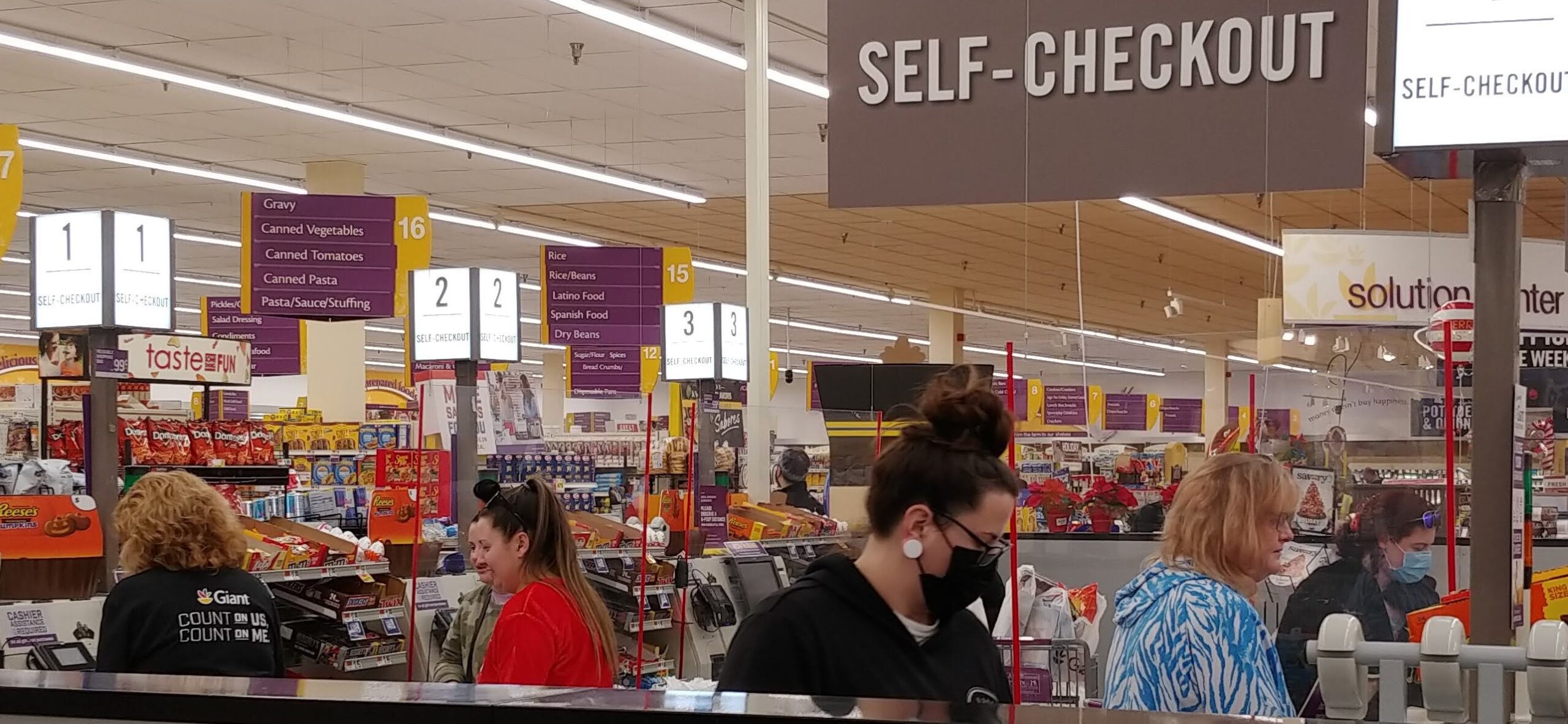
Posted in podcasts | 9 Comments

Nearly two years of eating a vegan diet: a futurist’s update and a giant menu

The past week has been a blur. Meetings, international presentations, two seminars with great students, a fine Future Trends Forum session, more family health problems, more planning the next book release, a stack of projects in various stages of realization, and meanwhile COP-26 staggers around with the human race’s future in its badly compromised hands.

I’d like to take a break from all of that in this post.  Instead, I’ll write about food and health as I prepare a batch of socca bread.  This isn’t a food blog, but perhaps the blog could use more cuisine and cooking posts.

Nearly two years ago I started eating vegan. It began as a part time thing, then grew into my entire diet.  Now it’s no longer an experiment but just how I eat.  Plant-based food is no longer a pilot project, but an enterprise system, if you will.

The results remain mostly positive. My weight loss has stabilized, down to around 217. Increased weight lifting* probably keeps total body weight from dropping any further.   The body feels better than it did two years ago. All evidence suggests the aging, sleep-deprived carcass is healthier.

buy neurontin online buy neurontin no prescription generic

mushrooms cut upFolks sometimes ask me how I feel, if I feel differently now. I’m never sure how to answer that, because I didn’t usually find myself affected by various types of food in the past. Well, other than feeling too full, or not full enough, or ill.  Some people report feeling energized by certain foods; I’ve never felt that by any kind of diet.  So I feel the same.

Nutritional supplements don’t play a role in the diet yet, besides nutritional yeast, which I sprinkle on different meals about one every two days. I haven’t felt weak or tired, except when there’s a solid and unrelated reason, like not getting enough sleep. The family doctor thinks I’m fine and hasn’t recommended any vitamins, etc.

buy cymbalta online buy cymbalta no prescription generic

I’m still learning how to vegan, which is exciting.  I know much more about some parts of the food system than I once did.  The differences between lentils are crucial, now: red for softness, French for their persistent shape and texture, yellow to produce a thick texture.  Onions, too: yellow versus white versus red, not to mention green and shallots, each with their tastes, preparations, uses.  I make more use of garbanzo beans that I thought possible, from hummus and falafel to cooking them in bowls or roasting ’em from scratch, with a big bowl soaking overnight once or twice a week.  I cook mushrooms every day, and while I can’t identify them in the wild, I now am cognizant of portobello vs shiitake vs hen-of-the-woords etc.

Usually I don’t miss my previous diet.

buy zoloft online buy zoloft no prescription generic

  Usually.  I don’t reject those former foods with horror. Some items appear in mind as fond yet distant dishes, safely blocked off from temptation, like omelettes. The big one I actually miss is fried chicken (and I’m working on a fried oyster mushroom recipe to address that need) in all of its crunchy and juicy glory.  Well, I also miss cheeses.  Vegan cheese equivalents don’t do much for me.

buy avana online buy avana no prescription generic

Vegan “meats” actually work well for me.  Mock-chicken varieties do a good job of being chewy and carrying spices.  Plant “burgers” serve decently.

Two gaps remain in my vegan repertoire.  I’m low on leafy greens, still not finding the right way of spicing them.  I’ve been trying to add some kale to other dishes. Otherwise, greens feel like non-foods, or something medicinal.  And my meals are still too brown and yellow!  And smoothies still horrify me. I’m more worried about the leafy greens.

GARLIC

Garlic in nearly everything. Of course.

My biggest weakness is chips. Any kinds, made from potatoes or any other produce. The texture is irresistible.

I undertook this change focusing on learning and health, not from a moral or political drive to preserve animals. I haven’t acquired the latter yet.  No evangelical zeal has appeared, either. I don’t criticize people for eating meat or dairy, and I don’t have any interest in buttonholing folks to praise lentils.

I don’t eat out much, partly due to the pandemic. There aren’t too many options, surprisingly, especially given some of my non-vegan dietary restrictions: no tomatoes, no hot spices, nothing acidic.  Our region has a lot of animal-raising farms. Indian and Chinese restaurants offer the best options near where we live.  A lovely Ethiopian restaurant in town cooks a mean beyaynetu. A local popup cookery offers a nice range of meals using plant-based meats. When I’m elsewhere, options really vary.  Georgetown has some good choices, but Houston, Texas did not.  Then again, I don’t travel much, thanks to COVID-19.

Instead, I cook.  Currently I make 2-3 meals each day, depending on if I’m at home the entire day, and if anyone else home is making or ordering food I can eat.  As a learning process I research recipes every day, scanning books, YouTube, blogs, then documenting the results with photos and Google Docs.

That might sound solitary, and it usually is.  This is a personal project. My family is supportive, and various members will try some dishes with politeness and tact.  Beyond the house, I don’t know what a vegan network or community is.  If I post about vegan stuff on Facebook, sometimes some people will comment with cheer or recommendations.  That’s about all.  Maybe I need to look harder.

As a futurist, I find this fascinating, albeit on a micro-scale. I’ve successfully switched my role between two different, if overlapping food systems.  I can see the many changes in sourcing, prepping, and cooking.  I haven’t experienced psychological or cultural dislocations, which sounds like a limitation of a small sample size.

Now, from all of that research and cooking, here’s what’s on Bryan’s vegan menu now. I’m happy to share recipes; perhaps on another blog?


BREAKFAST
Breakfast burrito
Breakfast patties
Crispy fried tofu
Dal: red or yellow lentil
Hash browns
Mushrooms on corn tortillas

corn tortilla makings

I make the tortillas fresh every time.

Quinoa with garlic
Sweet potato hash
Sweet potato and kale fritters
Tofu scramble

SNACKS AND SIDES
Baked chickpeas
Baked potato chips
Ethiopian lentils
Fried chickpeas
Fried mushrooms
Fried shallots
Green beans, skillet
Hummus
Peanut brittle
Potato and sweet potato fries
Refried beans
Roasted chickpeas
Tofu fingers
Tortilla chips
Veggie chips

BREADS
Basic flatbread
Gluten free drop biscuits
Herbed biscuits

lemon scones
Lemon scones
Socca flatbread

LUNCH AND DINNER
Biryani
Black beans and rice (moros y Cristianos)
Channa masala
Chickpea bowl
Chickpea curry
Curried cauliflower soup
Curried potatoes
Ethiopian stew
Falafel
Fried rice
Garlic quinoa
General Tso’s tofu
Ginger sweet potato stew
Lentil meatloaf
Mujadara

mujadara in pot

A staple, especially since one big match can yield a bunch of meals and sides.

Mushroom stir fry
Mushu veg
Mushu tofu
Orange cranberry crisp
Red beans and rice
Red lentil “kebabs”
Rice with chickpeas
Rice with lentils
Roasted veggies: brussel sprouts, potatoes, carrots, peppers, onion, squash, shallots (master menu)
Spicy lentil soup
Tofu in lettuce wraps
Tofu with cashews and snap peas
Vegan general Tso
Veggie noodles
Yellow rice


That’s all for now.  Happy to say more.

*All of my weight lifting takes place at home, since I hesitate to hit gyms during the pandemic. I’ve got a range of weights plus a pull-up bar.

Posted in personal | Tagged | 17 Comments