Two state university systems shrink over a year and a decade

For years I’ve been projecting and observing a decline in American higher education.  Reality keeps giving examples of those projections becoming observable data.  Today’s case in point is a pair of state university systems, one in Pennsylvania, the other in New York.

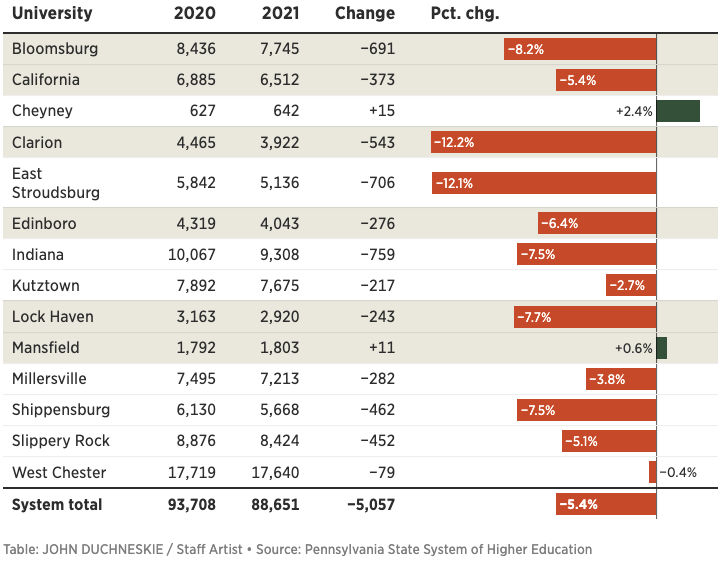
First, enrollment in the fourteen-campus Pennsylvania State System of Higher Education (PASSHE) system slid down 5.4% this semester, according to Susan Snyder.   That’s steeper than the overall national decline of 3.2%, according to the National Student Clearinghouse.

This is also part of a terrible decade-long drop.  The 3.5% loss is “its biggest one-year percentage decline in more than a decade” – i.e., since the Great Recession period.

buy suhagra online buy suhagra no prescription generic

  Listen to how far PASSHE has fallen in that time:

PASSHE’s enrollment fell to 88,651, down 5.4%, or more than 5,000 students, from last year — that’s about a $36 million loss in revenue, according to the system.

Since 2010, when system enrollment approached 120,000, most one-year declines have been 2% or 3%, but enrollment has dropped a total of nearly 26% during that time.

More than 25%!  From 120,000 to under 89,000 is a very large plummet.  Thinking of how much those institutions depend on tuition and fees for revenue shows what a crisis the decline represents.

Broken down by individual campuses, the slide is uneven, with some campuses hurt worse than others, and a couple actually growing a little bit:

PASSHE enrollment 2020-2021_Phil InquirerWhy is this happening?  Snyder sums up possible reasons for students to leave and would-be students not to attend:

In addition to the pandemic, state system and faculty officials cite other potential reasons for the drop: attendance costs, an erosion of state funding over decades, fewer high school students nationally, and fallout from the planned merger of Bloomsburg [University], Lock Haven [University], and Mansfield [University of Pennsylvania] into one university and Clarion, California, and Edinboro into another.

I’m not sure if the to-be-merged campuses’ decline will accelerate or slow that merger.

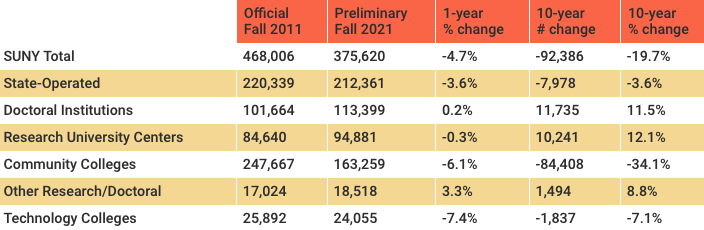
Next door, the 64-institution State University of New York (SUNY) system saw its enrollment decline by 10% during the past two pandemic years.

Worse, that downward slide worsens another case of a decade-long drop. Total SUNY enrollment went down 19.7% over the past decade.

As with PASSHE, SUNY’s enrollment picture differs by institution. SUNY is also bigger and more varies, so there are variations between institutional types at scale.  Research-intensive SUNY universities actually grew over the past ten years, while community colleges, technical colleges, and comprehensive colleges were hit hard:

SUNY enrollment 2011-2021

That 34.1% collapse of community college enrollment, from 247,667 down to 163,259, is staggering.

buy lipitor online buy lipitor no prescription generic

Why is this happening?  Report Joseph Spector sees several reasons, not dissimilar from the PASSHE case:

“There was a pandemic issue there, of course, but I think the real issue we’re grappling with is the long-term trend of declining enrollment in higher education,” SUNY Chancellor Jim Malatras told the USA TODAY Network New York…

New York has been also grappling with a decline in student population and an overall slowing of its total number of people, adding to colleges’ woes for both public and private schools.

Looking ahead, what can we anticipate?

First, we might see a Matthew Effect continue in both systems, as the highly ranked numbers stabilize or grow, while the rest persist on their downward course.

Second, a continued decline will increase pressures to merge or cut back programs and services within institutions. Closures are hard for states, but may become inevitable once the demographics bite harder.

buy vigora online buy vigora no prescription generic

Third, this could feed into some cultural shifts.  Since 2021 America has manifestly failed in its goal to expand higher education access. I’ve been watching for a turn away from that goal; repeated shrinkage might set it up.  Also, the power of demographics may elicit some cries for women to have more children.  As I’ve noted elsewhere, such cries usually fail, and there aren’t many in the US.

buy temovate online buy temovate no prescription generic

But they could appear.

Lastly, we might expect little discussion of this enrollment decline. The systems involved don’t win top billing when it comes to general conversation about higher ed.  Media coverage prefers Penn State to PASSHE, Vassar and Columbia to SUNY, and just about any other topic on Earth other than community or technical colleges.  And the same is pretty much true within higher ed at the national and regional levels.  We remain deeply, punishingly creatures of hierarchy, even as the system the hierarchy structures continues to contract.

(thanks to Jim Luke for commentary)

Posted in enrollment, higher education, horizon scanning | 1 Comment

Academia, climate change, and the future: an interview with Kim Stanley Robinson

How might the climate crisis unfold?  What should academia do about it?

One year ago our online book club read Kim Stanley Robinson‘s recent novel about one way the next few decades could play out, The Ministry for the Future (2020).  I emailed the author and the owners of that fan site to invite them to participate in our discussion.  The site spread the word, and Stan was kind enough to read along and write back.

When we finished the reading I followed up to interview Robinson, creating questions based on our discussions, picking out topics which especially interested readers and myself. Once more, he was very generous, and answered each very fully, even while heading out to Glasgow for COP26.

Here is our exchange, edited only for formatting and to add some hyperlinks.

Bryan: We were curious about the role of China in this positive narrative. Do you see it basically playing a neoliberal role, akin to the US or European states? Or is there any possibility of it playing an alternative role, both domestically and through Belt and Road partners, like what Mann and Joel Wainwright dubbed “Climate Mao?”

KSR: I don’t know. I don’t think anyone knows, including the Chinese. But when working on my novel Red Moon, which is partly about this, I began to think that it is maybe helpful to take them at their word when they talk about “socialism with Chinese characteristics.” Also, that there may be something to the idea that the CCP [Communist Party of China] has broad public support from Chinese people, as shown in polls (maybe)— that the Chinese people are proud of China and feel they have proper political representation in the current system. Who knows what they are really saying to each other in their kitchens, certainly not me; and how many hold each view, granting that every possible view is probably held by some.

In the global context going forward, the only thing one can be sure of is that China is important and a big part of the problems and solutions, and maybe their alternative political system to the various Western systems is a useful variant to have, to run a kind of giant historical test of effectiveness in dealing with climate change and dodging the mass extinction event. If it proves to be an anti-human police state dystopia, that would be bad, but I’m not confident we can judge them in those terms yet. Really— ask the Chinese— and watch for results on the world stage— and compare them to India, the US, the EU, Brazil etc.— see what happens and what their people say.

Bryan: Nuclear power (for electricity, not war) was fairly quiet in Ministry. Do you think the world will embrace atomic power as one transition source on the way to renewables, or is popular dread about the technology after Fukushima and Chernobyl etc. too great?

KSR: I don’t know, I have never seen a good analysis of the carbon budget of nuclear power— how much carbon to build a plant, how much carbon saved by running a plant over its lifetime. I do feel that everyone needs to regard the new nuclear (thorium powered) as a viable option— no knee-jerk reactions against nuclear, please— it does have its obvious downsides, known to all, but in the climate emergency we need to decarbonize fast, while people also need electricity— enough for sufficiency for all— after that, people could be put on a budget of electricity, perhaps, by regulation or pricing, but it is a health aid and needed by all (almost a billion people don’t yet have it, etc). So in this quandary we are in an all hands on deck situation, and nuclear may be part of our way forward, a bridge for another century or generation of plants, to an even cleaner way. Although there are some who make good arguments that we can do better faster with solar and wind, so again, I haven’t read an analysis that puts my mind at rest as to how we should regard nuclear. And with these thorium reactors the whole calculation may have to change yet again. The point is to stay mentally flexible and keep in mind the absolute necessity of dodging a mass extinction event and runaway climate change.

Bryan: In the novel violence against property and people plays some shadowy role in helping drive humanity off of fossil fuels. In our world of 2021, do you think we’ll see climate activists destroying or otherwise messing with property, as Andreas Malm encourages? Will it escalate to violence against humans, such as assassinating or kidnapping energy firm CEOs? Or will we generally heed Bill McKibben’s call to stick with nonviolence?

KSR: I don’t know, but your question very usefully describes the options possible going forward.

buy amoxicillin online buy amoxicillin no prescription generic

My novel is murky on this and if I had read Malm before writing, I might have portrayed things differently, I don’t know. As it is, Ministry is more a description of the chaos of history than an urging of any particular program for action, as I hope is obvious when reading the book. I saw in your book club discussion some people rather arrogantly judging my book as if it were a white paper only, an advocacy piece of some kind, and I invite those kinds of critics to read something else, or write their own novel. I like much better the ordinary generosity of people who read novels understanding what they are. Ministry is an unusual novel in form and content, but not hugely so. There have been others like it before and there will be more like it later.

As to specific suggestions to action, I myself am for non-violent resistance, but Malmian sabotage will certainly look better and better if the fossil fuel industries continue to buy off political representation and sway public opinion in bad ways. Malm’s point, or one of them, is that non-violent resistance has been successful in the past because the powers that be were afraid of much more violent resistance that would happen if they did not give something to the non-violent resistance— as little as possible to get it to stop. This point is good, important to ponder, and needs to be read together with Erica Chenoweth’s book Why Civil Resistance Works, an equally important study suggesting that if you really want specific changes, you are most likely to get them by intelligently targeted civil resistance. So, reading on this matter should include Malm and Cheonweth, Malcolm X and Frantz Fanon, etc.

The question is obviously important, and I think Ministry is more an example of the kind of mess that the near future is going to be, a kind of case study, rather than an analysis or call for action. Like all the books above, like all books, it makes a case, I suppose. Examples are chosen out of the mass of events to illustrate a theory, I suppose.

buy synthroid online buy synthroid no prescription generic

But as an individual I don’t have much of a theory here. I would say, non-violent mass action and civil resistance is the most effective and morally defensible course of action. Also— voting. If our political representatives legislated good climate action, this would be the best way to get it fast. Thus carbon quantitative easing, as in my book, and certain kinds of geo-engineering too (the glacial slowdown and carbon drawdown—these are not achieved by resistance). If a real revolution leading to a real post-capitalism comes into being by way of the public insisting on it, by demonstrations and votes, then how would that be bad? It wouldn’t be bad. So to hope for it is not naive or stupid.

buy nolvadex online buy nolvadex no prescription generic

You only need to assemble a working majority in the political system you have, and get them to legislate a better system. To say Oh we will never be able to assemble a good working political majority and do things in a stepwise legal manner is a form of capitalism realism, cynical reason, and boo-hoo clutching of pearls— an excuse to do nothing but read the internet and drink. Add Robert Meister’s books to the list here— can we reap the benefits of revolution without the violence and disorder of revolution? Maybe. Try to imagine it.

Bryan: What is the role of academia in addressing the crisis? We enjoyed your depiction of ending student debt immensely! Currently I see several levels: transforming each physical campus to carbon negativity; expanded teaching about the climate crisis (climate change is the new liberal arts); much more research into the topic across the disciplines; local town-gown partnerships on many issues (reducing emissions, changing agriculture, etc); academia taking a more active role on the world stage, from public scholarship to organizing for a new era. Do any of these stand out for you, or are there other paths for colleges and universities to follow?

KSR: These are great suggestions across the board, and I think academia could do all these things. I have a kind of syllabus in my head for a first year course that took a whole year, some kind of orientation to reality, meaning also climate change and our moment. I bet a lot of people have that kind of syllabus in their heads, and maybe they’re on paper and getting taught too, I bet they are. It would be an ideological education that includes an education in what ideology is— that imaginary relationship to the real situation that we all must have to be sane social creatures. A good ideology would be the point— ideology formation— then on to the projects that will help the moment’s crisis.

One extra thing to add, an offshoot of this kind of primary education, —a project for academia that economics departments have not been quick enough to work on— would be the creation of a replacement for profit and shareholder value as indexes of how a company or government agency, or any organization, is doing. Since profit is an index combining many factors, but clearly a kind of Ponzi scheme lie, and GDP and shareholder value likewise, a better index could be made that showed how well the organization was doing if the future was not heavily discounted (another kind of shuffling off of responsibility). It could be a kind of class assignment. Shyam Sunder’s work at Yale would be a great start and guiding spirit for this kind of work.

“Try to imagine it.” Thank you, Stan, for these rich answers and your time.  Good luck in Scotland!

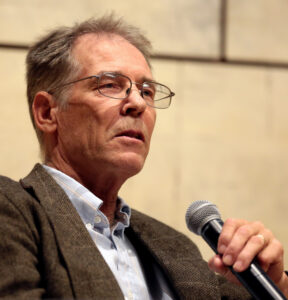
(photo by Gage Skidmore, CC BY-SA 3.

buy singulair online buy singulair no prescription generic

0, https://commons.wikimedia.org/w/index.php?curid=72961714)

Posted in book club, climatechange, future of education, interviews | Tagged | 5 Comments

American higher education enrollments declined, again: new NSCRC data

(second of two posts; here’s the first one)

National Student Clearinghouse Research Center logoThe enrollment decline in American colleges and universities continued this fall semester, according to just-released data from the National Student Clearinghouse Research Center.  This is very important for higher education in this nation.

The big picture: student numbers declined in nearly every metric, continuing a nearly decade-long fall.  Only elite universities and graduate programs enjoyed actual growth. Overall, undergraduate numbers dropped by 3.2%.  Graduate enrollment rose again, by 2.1%, albeit within a much smaller group than undergrads.  To sum up, the Center’s headline for this report is “Undergraduate Enrollment Still Falling.”

Let’s dive into the data by category.

Demographics: by gender, male and female enrollment both declined at about equal rates in fall 2021, compared to last year.  By race, the largest declines were among white, black, and native American populations, more so than Asian and Hispanic groups.  By age, nearly all demographics declined, especially people 25-29 years old, except for the under 17 population.

International students dropped by 8.2%.

enrollment by race to fall 2021_Clearinghouse

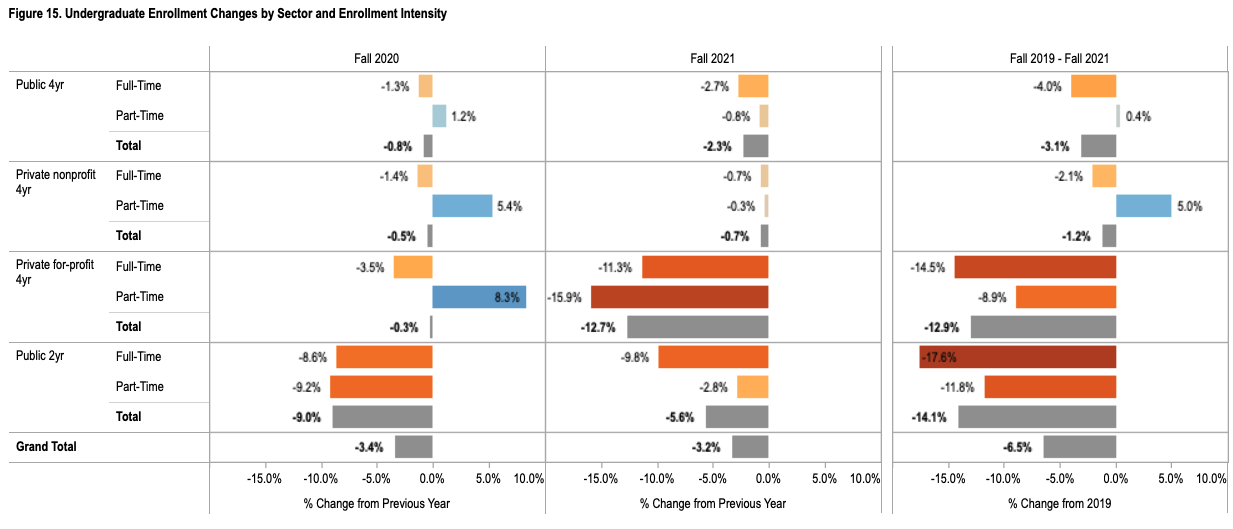
Institutional types: community colleges continued to get hit hard, dropping by 5.6%.  Private four-year schools were clobbered, falling 12.7%. Public baccalaureate institutions declined by 2.3%.  Private four-year undergraduate populations shrunk the least, only by 0.7%.

enrollment undergrad_school type_student intensity_Clearinghouse

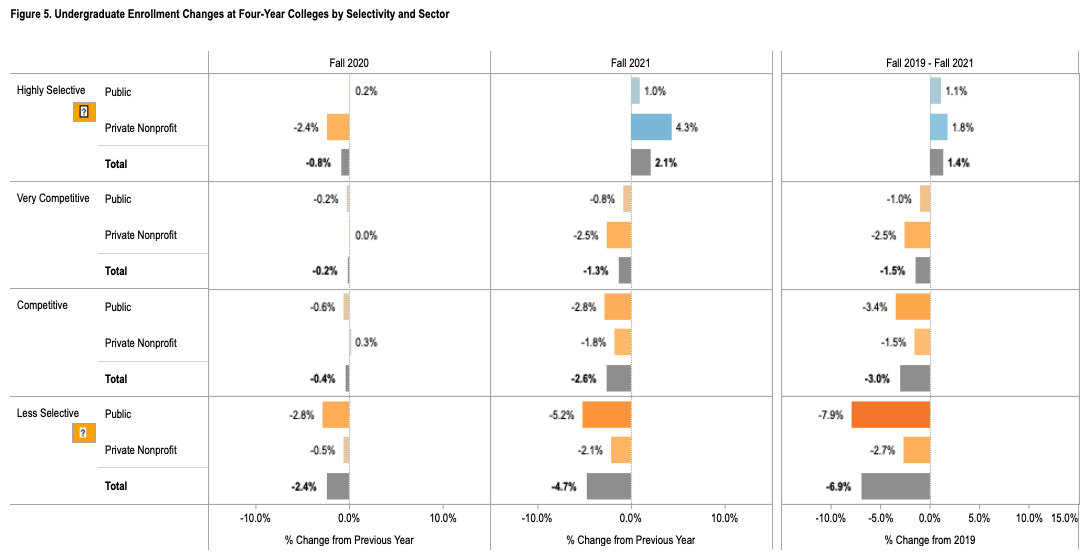
In terms of reputation, the small group of the most selective institutions actually grew, while enrollment declined for everyone else:

enrollment 2019-2021 by school rank_Clearinghouse


Online institutions actually declined by 5.4% (undergrad) and 13.6% (grad students), which is a reversal of recent years.

Geography: every American region lost students, although the west experienced a somewhat steeper downward turn.  “While the Midwest (-3.3%), Northeast (-2.8%), and the South (-2.6%) either maintained or experienced smaller declines in undergraduate enrollment, the West (4.4%) saw larger drops this fall.”

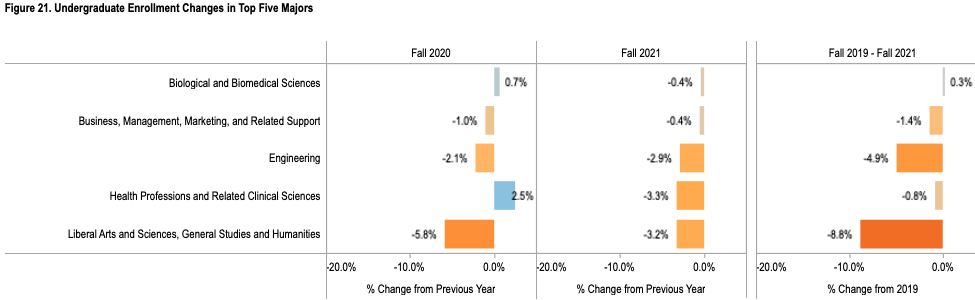
Majors and academic programs: undergraduates fled the liberal arts, humanities, and general studies.  Weirdly, health professions also declined, even during a pandemic:

enrollment undergrad by 5 majors_Clearinghouse

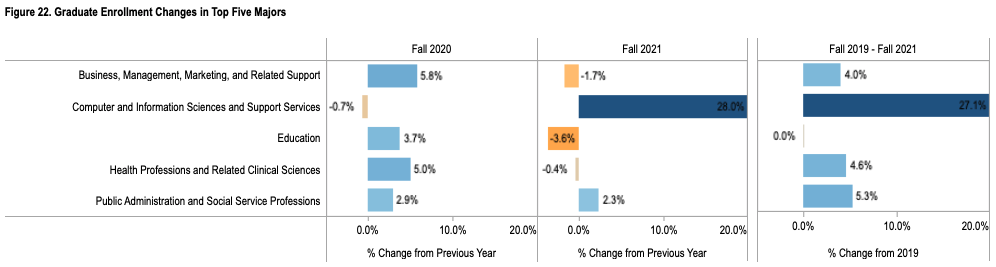
Graduate enrollment showed IT running away with the game, followed distantly by public administration.  Education declined:

enrollment grad by 5 majors_Clearinghouse

What can we take away from this report?

  1. Community colleges and for-profits were hit the hardest.  Those sectors, which compete for similar students, continue a historical decline.
  2. While new American COVID-19 infections, hospitalizations, and deaths decline, one explanation for the depression in college and university enrollment may be the pandemic – i.e., some would-be students fearing infections or substandard education for on campus activity, while others anticipate poorer experiences online.
  3. There’s a Matthew Effect at play when it comes to selectivity. Watch to see how this shapes media and academic responses, with attention paid to Harvard at al, and both faculty and staff from the most selective crowing about their growth.  In the medium and long term, will we see social-economic status become more strongly identified with college credentials, as the marginalized and poor drop away?
  4. The decline in health care as a major surprises me, and checks my “COVID Curriculum” model.  During a video meeting Center staff suggest this is a bounce back from last year, which saw higher health care enrollment.  It may also be students anticipating the pandemic’s end and a commensurate drop in hiring, or being worried about what often look like horrible job conditions.
  5. I first wrote about peak higher education nearly a decade ago. So far that scenario holds for the sector as a whole.
  6. If Americans still think we want to expand access to higher education, we are failing deeply and badly.  Community colleges, which serve more marginalized people than others, have been suffering for years now.  Are we looking at a cultural shift away from “college for all”?  Have we reached a turning point in our attitudes towards higher education?
Posted in enrollment | Tagged | 11 Comments

American higher education enrollment declined in 2020: US Census

(First of two posts)

The number of students taking classes in American colleges and universities dropped last year, according to recently release US Census data.  This is an important bit of news, given how crucial enrollment is for tuition-dependent campuses – i.e., most of them.

Higher ed wasn’t the main focus of the Census update, so let me extract the relevant bits for this post.

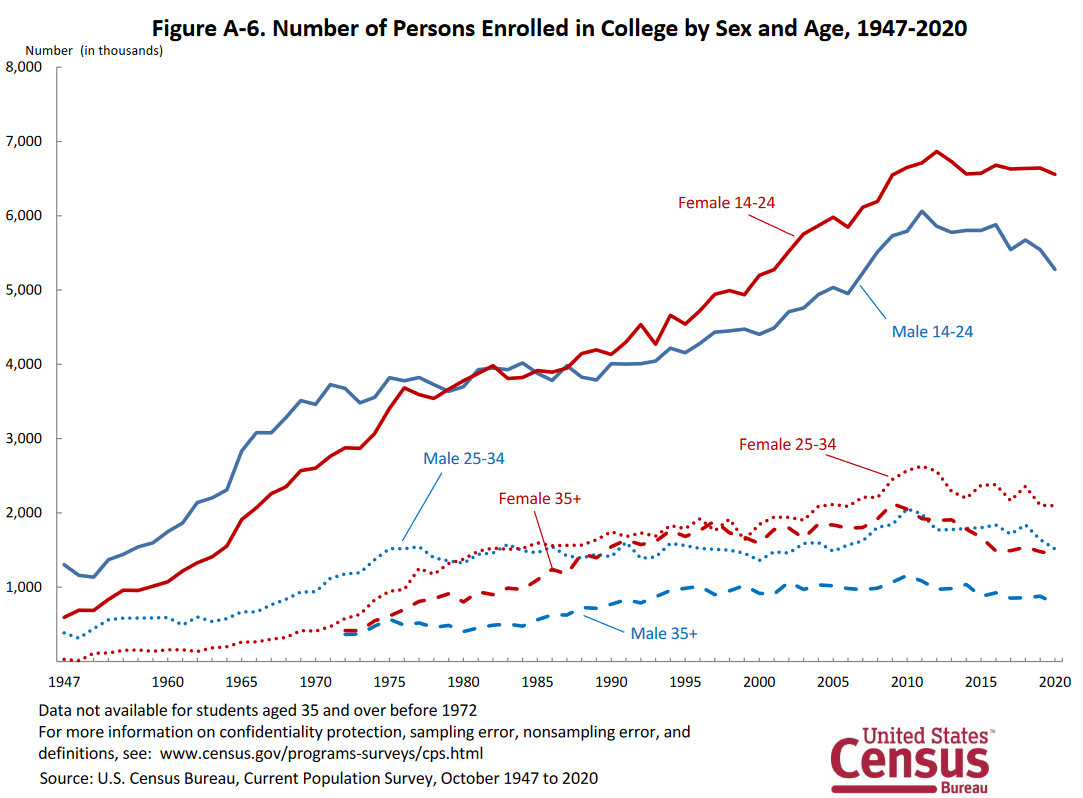
First, what happened to total enrollment?  By 2020 the Census found “[c]ollege enrollment fell to the lowest level since 2007.”

Check out their graphic, showing enrollment since the 1940s by age and gender:

enrollment 1947-2020_US Census

The peak I identified around 2012 is clearly visible, both on its own terms and in the broader historical context.

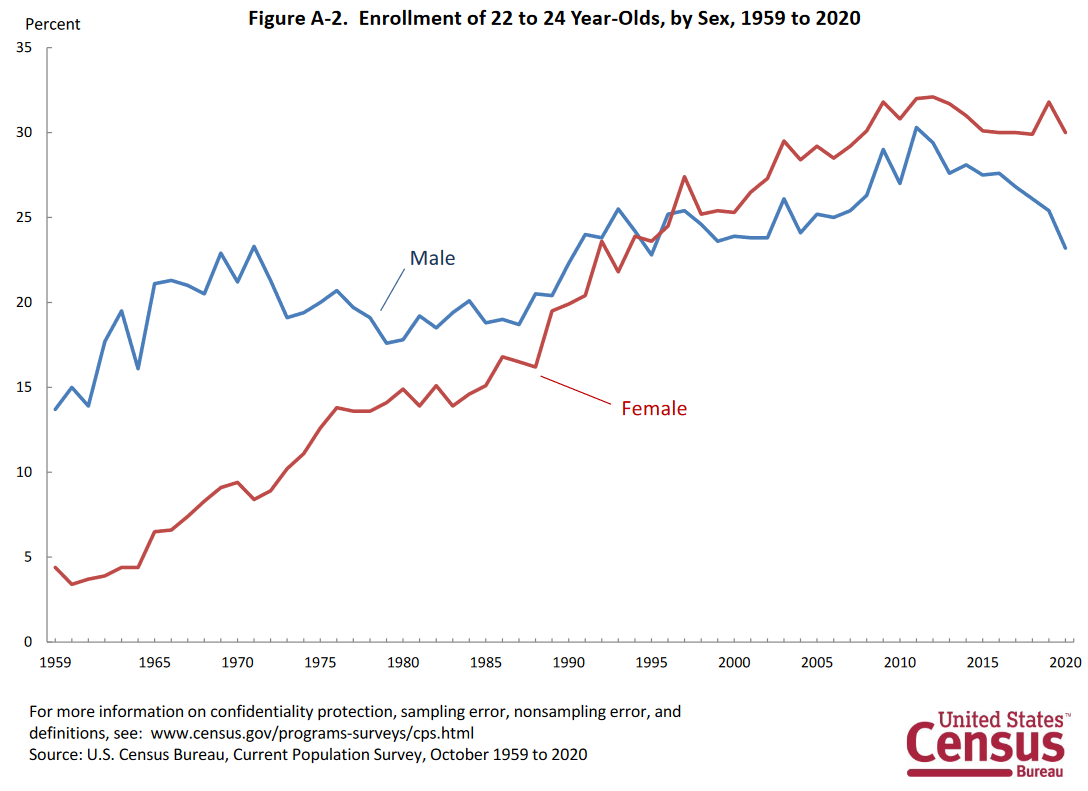
You can also see men dropping below women in every age group. In fact, the release adds this graphic which truly clarifies the point over time:

enrollment 1959-2020 by gender Census

Men outnumbered women from the 1960s and through the 1980s.  The crossover occurred in the early 1990s and was locked in from 2000 on, with women clearly outnumbering men in classes.

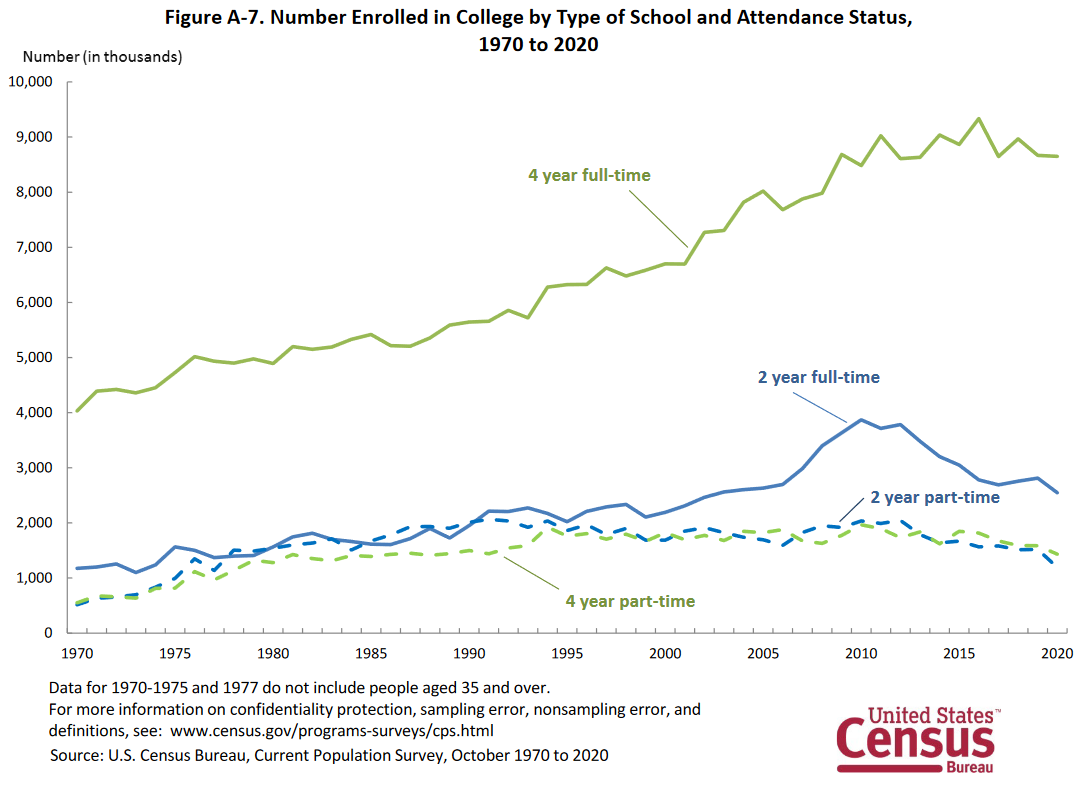
Second, which institutional sectors were hit the hardest? “Most of the decline took place in two-year colleges, which had their lowest enrollment levels in 20 years.”

You can see that very clearly in this graphic, plotting enrollment in institutional types from 1970-2020:

enrollment by institutional type 1970-2020_US Census

That 2012 peak is clear for community colleges.  4-year colleges and universities lag a bit, yet also decline starting around 2017.

How did undergrad and grad school numbers compare? The former sank while the latter did not, according to the CB: “Enrollment in graduate school held steady. Graduate school enrollment in 2020 was 3.8 million, not statistically different from 2019.”

What is the latest racial data the Census has for enrolled students? “Among college students in 2020, 53% were non-Hispanic White, 20% were Hispanic, 15% were Black, and 10% were Asian.”  That maps not too badly onto general demographics.

What do we make of this?  We should be cautious, given the many issues around the 2020 data collection – i.e., Trump and pandemic. Also, I’d love to see the data sliced into more ways, like separating out for-profits or plotting it all by geography. But we can draw some conclusions, or at least built hypotheses:

  • Community colleges continue to be clobbered.  This doesn’t get a lot of media play, nor a lot of talk within higher ed, but is a huge development.
  • The data confirms my peak higher education model, with total enrollment sliding down from 2012 on.
  • If America is still serious about expanding higher education access, we are right now in the middle of a bad failure.

Stay tuned for tomorrow, when I follow up with another publication on enrollment with much more detail.

Posted in enrollment | Leave a comment

What neonationalism may mean for higher education

What is neonationalism, and what does it mean for colleges and universities around the world?

Last week the Future Trends Forum hosted University of California-Berkeley research professor John Aubrey Douglass to discuss.  He’s the editor of Neo-Nationalism and Universities: Populists, Autocrats and the Future of Higher Education, as well as the author of several chapters therein.  The book offers studies of the development as a whole, along with case studies of it manifesting in different nations: Brazil, Britain, Russia, China, Hungary, etc.

Our discussion covered a lot of ground, starting with defining neonationalism:

a term that describes the rise, and in some cases revival, of extreme right-wing movements in key areas of the world, often characterized by anti-immigrant and xenophobic rhetoric; economic protectionism; constraints on civil liberties; attacks on critics, including journalists and academics; denial of science related to climate change and the environment; and the emergence and empowerment of demagogues and autocrats.

We probed into that definition and its applications, academic platforming, implications for the climate crisis, classroom problems, how the neonationalist tide might ebb, challenges for the reputation of science, and the relationship between nationalism and religion.

You can find the whole recording linked here, or embedded below:


Right now the whole book is freely available at Project MUSE, so you can dive right in.

Many thanks to professor Douglass and to the Forum community for a rich and vital discussion.

Posted in future of education, Future Trends Forum, politics | Leave a comment

The Biden administration seems to support increased academic engagement with the climate crisis

It looks like the Biden administration is taking an interest in how colleges and universities respond to climate change.  At least that’s a conclusion we can draw from this University World News account of a recent speech by John Kerry, the current and first American Special Presidential Envoy for Climate.

Talloires-logoKerry was addressing the Talloires Network of Engaged Universities, a group focused on academic-civic engagement.  He first spoke to climate justice at length on various points, according to Nathan Greenfield, then turned to higher education, where he envisioned two roles for the academy in the climate crisis, beginning with the physical nature of a campus:

The first is being a role model. Dormitories and other buildings must be refitted so that heat is not wasted.

buy intagra online buy intagra no prescription generic

Food services should prioritise purchasing that minimises transportation. University and college fleets should be electric.

buy eriacta online buy eriacta no prescription generic

(This is a topic I cover in the second and finals chapters of Universities on Fire.)

Then Kerry went further.  In his view, higher education should boost student and faculty involvement with the climate crisis:

It is the role of universities to ensure that their graduates are “public citizens” who not only vote but also hold to account US Congress which, as he put it, “is not reflective of the urgency that needs to be applied” to climate change.

Pursuing this point, Kerry went after the ivory tower idea and cast it aside:

The situation is so dire that universities can no longer keep the intellectual powers of their professors and researchers inside the campus gates. “I think there’s a fundamental responsibility for the university not just to teach its student body, but to be responsible for teaching the community and the world around it.”

(I cover this in chapters three through six of Universities on Fire.)

What does this mean for higher education and the climate crisis?

Perhaps we can infer too much from this report.  It is, after all, one speech by one official of the very large American presidential administration. Kerry was also addressing a group devoted to engagement and may have felt bound to celebrate or at least echo their mission.

On the other hand, special presidential enjoy Kerry reports directly to president Biden, so he may well be representing what he’s hearing from the latter, or at least what’s being discussed in that administration’s upper echelons.

buy strattera online buy strattera no prescription generic

People there may well be arguing in favor of reaching out to academia for help on what we know is a major issue for this presidency.  As COP-21 draws near, the Biden team may want a whole of nation effort on climate change; bringing in academia would make sense.

buy tadalafil online buy tadalafil no prescription generic

Posted in climatechange | 1 Comment

Learning innovation theory: one exercise

This week I tried out a new exercise in one of my seminars, and wanted to share it with you all.

The class is a graduate seminar on technology, innovation, and design in Georgetown’s great LDT program.  There’s a lot of tech history and theory involved, and I’m always looking for ways to make that material live for the students.

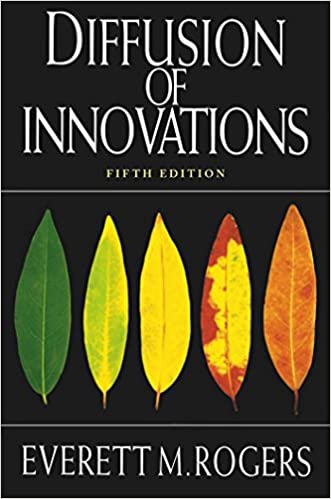
Rogers DiffusionDuring the past two weeks the class worked through Everett Rogers‘ Diffusion of Innovations textbook (5th edition). This is the great work on early adoptions, change agents, opinion leaders, homophily vs heterophilia, etc. Rich, deep stuff, clearly organized and studded with neat stories.

I admired how the students reflected on the material, thinking through its different concepts and exploring examples.  Yet I still wanted more.

In one class session we were scheduled to finish Rogers, then start into Clayton M. Christensen’s disruption theory with one short yet pungent reading.* I was concerned that they were starting from a vague sense of disruption as chaos. Besides discussing the texts, what else could the students do to deepen their understanding?

Hence the exercise:

First, I asked the class (all students masked up, as well as myself) to come up with a hypothetical product, one which didn’t exist now. Fearing that might be too broad or daunting, I narrowed down the charge to imagining a holographic projector.  They thought about this. I mentioned the Star Wars chess game as one example. They thought some more, then started developing an idea.

The thing included an overhead projector, below which a 3d scene would take place.  This would be true 3d, a vision which would display differently as you walked around it, much like a vase shows different sides from different viewpoints.  Users could interact with it with their hands on a very basic level, reaching into the displayed scene. It didn’t require user tech at all – i.e., no 3d glasses or headsets.

I encouraged them to reach back in the syllabus and bring up previous readings and topics for inspiration. They started fleshing it out in terms of use, business model, and limitations.  Then over to Rogers – who would use it?  How would uptake spread, or how wouldn’t it? Now they dove into early adopters, skeptics, laggards. Picking out opinion leaders and change agents became very practical.

We toyed with names for it.  The nerdiest member suggested EMH.  That’s what I’ll call it for now.

Then I switched things up.  Set aside the EMH for now, I told them, and let’s dive into disruption. We quickly assembled Christensen’s theory, along the way setting aside less nuanced senses of disruption. They considered different examples which might or might not fit.

Then back to the EMH.  “OK,” I told them, “the EMH company is now the big incumbent in the holographic display market.  What does a disruptive competitor look like?”

Ah. Now the exercise and the readings came together.  Small, was the first idea, smaller than the EMH, like a handheld or arm-mounted display. Cheaper.  Lower quality.  They realized that EMH customers tended to be institutions or groups: schools, theaters, the military.  The competitor would be cheap enough for less well resourced groups – and individuals! – to purchase.  As it spread the EMH firm could easily scoff at the lower quality and smaller size… until the competitor’s product evolved past that low-market end and started competing with it.  Now we were talking disruption.  Students started imagining ways the competition would proceed, including through further innovations.

At that point we hit the last minute of class, and I had to switch over to prepping them for next week.

I think it went well.  I’d like to try it again with a bit more time and perhaps some more props. Perhaps create a digital or physical sketch of the first product.  Or have the whole class built the first innovation, then split them into two, with one group stewarding that product while the other sneakily builds the down-market disruptor.

*If you’re critical of Christensen, don’t worry.  Check the linked syllabus.  In a few weeks we read Jill Lepore’s critique.


Posted in classes and teaching | 13 Comments

American tinderbox: a new poll

Today’s post is a quick one.  Work and health combined are still obliterating my schedule, and look likely to do so for a month, so here I will be direct and fast.

For years I’ve been tracking and forecasting the ways America could descend into civil unrest, breakdown, or open war (some examples). This week saw a new poll which points to more possibilities along that line.

The University of Virginia’s Center for Politics surveyed Americans about their attitudes towards opposing political parties.  The results describe a people not only divided along partisan lines, not only seeing opponents as active dangers, but justifying extraordinary responses.

Let me break down what I saw as key findings.

To begin with, look at the numbers of Americans who see their political opposites as extremely dangerous.  This doesn’t mean “I think their policies are unpleasant”:Biden vs Trump voters UVa 2021 fall

That’s roughly half on each side who sees the other as presenting a “clear and present danger” to American democracy, and who should be censored.  Moreover, and beyond that screen shot, was this question: “There’s no real difference between [Republicans and Fascists/Democrats and Socialists]”.  Biden voters supported that by 56%/29%, while Trump voters were 76%/54%.

Note, too, the very high level of distrust of news media among adherents of each side.

Next, there is also a broader, more structural unease revealed in this finding:

more than 6 in 10 Trump and Biden voters see America as less a representative democracy and more a system that is run by and rigged for the benefit of the wealthy.

Among other things, this shared attitude makes available thoughts of total critique and extraordinary action.

Which leads to where some Americans are thinking things should go.  For some of us, the ballot box is no longer enough:

UVA poll of Dems and GOP 2021 Oct

Look closely at the first two questions.  Those are not about government but social or individual action.  Around one third of Americans now strongly support independent, private action against… radicals and evil within society.

The next two return to politics.  One is about a “strong leader” and the other about such a leader not having to deal with the problems of what some quaintly refer to as Constitutional order.   A quarter of Democrats and nearly half of the GOP strongly support the former, while about one fifth of each similarly back what sounds like constitutional exception or a state of emergency.  Between one half and 82% (!) “at least somewhat agree” with these stances.

Caesarism and vigilanteism are not all of the options significant numbers of Americans are thinking hard about.  Secession is also on deck, albeit with small numbers, around one fifth strongly backing a divorce, while nearly one half are secession-curious.

Poll language is always crucial, and I was struck by some of it here. The phrase “clear and present danger” is not only a movie title, but a callback to the very important (and, I think, dangerous) Schenk vs US (1917) Supreme Court decision. That’s the one legitimizing punishment of free speech by prison due to extraordinary circumstances (WWI, in that case). Also, note the use of “censor” instead of a euphemisms like “content moderation” or suggesting private platforms screen and cull content.

I called this post “American tinder” because the poll describes a setting, not a plot.  It reveals attitudes, but not actions we’re taking yet.  It’s a combustible situation and we should watch for two things: how the attitudes persist and for sparks which might set fires.

Yet futurists always look for divergent futures and countervailing forces.  Here, the poll found a lot of common ground on individual infrastructure projects.  That points to one way Americans are united rather than trying to quash each other.  There is also this key note: “roughly 80% of Trump and Biden voters view democracy as preferable to any non-democratic kind of government.”  I would like to learn more about that 20%, but it’s good to see a supermajority still liking democracy.

Over to you, readers.  Is America a tinderbox?  What does this mean for higher education?

Posted in politics | 5 Comments

Climate change changes students: one story

This week I’m revising my climate change book manuscript.  Various chapters are in the hands of some thoughtful and generous readers, helping me hone the text.  I’m about to smoosh all of the pieces into a single, staggering Word doc and fire it at my thoughtful and generous editor.

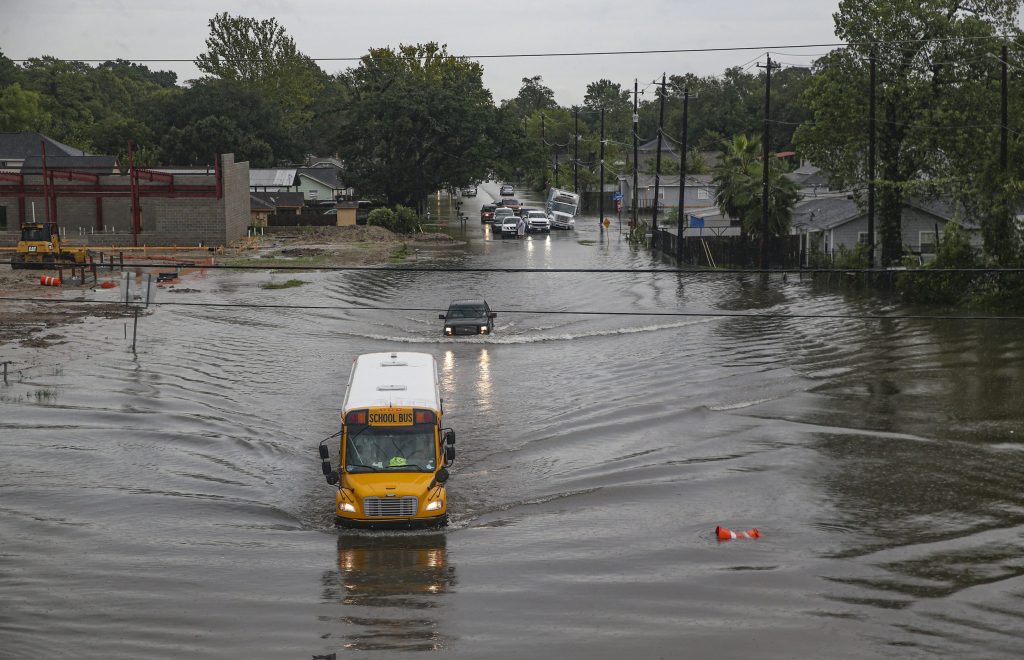
And yet the world keeps giving me more to write about on this topic!  A few days ago the very fine Hechinger Report published a piece about the impact of the climate crisis on K-12 students.  Caroline Preston focuses on American schools and kids hit by fire, heat, and floods. This obviously matters for our higher education purposes, as some of them will become traditional-age undergraduates, then adult learners.

Let me pull out some of the key themes, while you just go and read the article.

Hechinger Preston-climate-crisis-3-scaled

First, as climate damages grow in frequency and scope, larger numbers of students will come to colleges and universities with that experience.  This will inform their academic experience, including knowledge of such events and potential trauma.

Second, threats to schools can increase the amount of delayed, rescheduled, relocated, and online learning students experience.  This in turn can inform their expectations of post-secondary learning.  For example,

Two schools that were devastated in the Camp Fire reopened for the first time this August. For years, staff have been working in what Allen-Clifford likened to “an educator MASH unit,” moving from one temporary facility to another as permanent structures slowly go up. The money and mental health support that flooded in after the fire is largely gone, but each Paradise school still employs two counselors, one specializing in trauma, she said.

Third, primary and secondary school systems have not adequately addressing the climate crisis, in Preston’s view:

Relatively few school boards and systems, for example, have agreed to sign climate resolutions promoted by the group Schools for Climate Action, which was founded by Park Guthrie, a sixth-grade teacher and climate activist. When Devin Del Palacio and others tried to persuade the National School Boards Association to adopt such a statement in 2019, the Florida delegation led an effort that stripped the words “climate change” from the resolution and turned it into a statement on natural disasters.

And:

The failure of adults to teach kids accurately about the science behind and threats from climate change, much less about how to mitigate its harms, could add to the mental health trauma young people experience, say educators and psychologists.

Fourth, more is to come:

Hechinger Preston-climate-crisis-1

In the aftermath of the deluge, Schwinn conducted an assessment of flood risks and identified 24 other schools across the state at moderate or high risk of flooding. She has asked the Department of Education to allow Tennessee to use federal pandemic relief funds to relocate those schools, she said.

And one Colorado school district “is also considering ‘heat days’ when students might study from home remotely, [Tay Anderson, a board member and secretary for Denver Public Schools] said.”

Also down the road is demographic change driven by climate:

Young people are moving away, not just for better job opportunities but also for cooler climates, [Tolleson Union High School District school board president Devin Del Palacio] said. Maricopa County, where the school district is located, is one of six Arizona counties identified in a 2020 study as at risk of being uninhabitable within 30 years.

Listen to this observation and consider what it means for education’s future: “Global warming is altering how kids experience childhood.”

Kudos to Hechinger for this reporting.


Posted in climatechange | 2 Comments

Isaac Asimov’s Foundation as a tv series, part 1

Apple TV just launched a new series, a serial adaptation of Isaac Asimov’s famous Foundation series.  I’d like to review it here, partly for professional reasons, since the stories are famous examples of futuring science fiction.  Personally, I’m fond of Foundation since I first read it around age 12.

To begin, I took a pleasant break and reread the first half of the first book.  I’ll share some of the high points here, then switch to the tv adaptation.

1: THE BOOK

If you’re new to the whole thing, a quick summary.  Foundation takes place in a far future when humanity runFoundation_gnome Press edition covers a galaxy-spanning empire.  A scientist appears whose new field of study, psychohistory, lets him predict the future behavior of humanity at a large scale. Hari Seldon’s work reveals that the giant empire will shortly crash, and its collapse be followed by thirty thousand years of horror.  To shorten those dark ages he sets up a Foundation designed to preserve human learning.  That’s just the first part. The story races on into the future as people in the Foundation try to survive and fulfill Seldon’s mission, while surrounded by an increasingly immiserated and hostile galaxy.

It’s also worth noting the origin of the whole fiction, in the author pitching to legendary editor John W. Campbell the idea of a decline and fall of the Roman empire in space. That Gibbonian theme saturates what follows, unsurprisingly, from an arrogant and declining empire to successor kingdoms and rampaging barbarians and a new religion defeating a temporal power, even to the point of little jokes, like a post-imperial politician starting as a mayor or naming one too-scholarly character after a famous medieval historian, Henri Pirenne.

So, observations from this reread: so much is going on in these very fast pages! Asimov quickly assembles pieces from what was the science fiction genre in the 1940s: a galactic empire, spaceflight, awesome atomic power, science under attack, lots of male characters. He uses what Eric Rabkin calls “transformed language” to subtly point to a different world, as when characters refer to money as rusty (61; because it’s made from precious metals, which are unusually scarce in that setting).

You can also see some ways Asimov courts the reader.  Some of the antagonists are simply stupid, and our heroes successfully work around them. The book is a paean to brains over brawn, repeating a now famous adage: “Violence is the last refuge of the incompetent.” (84)  (Later amended to the less well known “violence [is] an uneconomical way of attaining an end.” (148)) Others are stereotypical classists, while the Foundation is egalitarian (56), a nice appeal to American audiences in the New Deal era.  You can see other nods to the 1940s, such as a successful strike with which the reader should sympathize (151ff). An old order appears as either dangerous or stupid, and certainly stagnant, which can appeal to younger readers.  And yet Asimov pulls back from simply pandering, or from the classic fans are Slans trope.  He never lets us into psychohistory, much like Mary Shelley holds back from showing us how Victor Frankenstein animated the dead. We never get into Seldon’s head. Indeed, without too much risk of spoilers, our point of view characters are always at best just outside of that epic awareness.  We don’t get to see the end before anyone else. Unlike a psychohistorian, we are bound blindly to the wheel of history – except for these glimpses, and, ah, but there lies spoiler territory.

There is also the intellectual thrill of psychohistory’s basic idea. Predicting the future accurately is an ancient dream, and perhaps Asimov came up with it when science had been advancing rapidly for a century.   Psychohistory doesn’t exist, of course, but it’s a terrific narrative device. Asimov deploys it well in some nicely staged scenes.

Speaking of which, a common criticism of Asimov’s fiction in general, from contemporaries through the present day, is that it’s too talky.  And it’s true, in that Foundation is certainly powered mostly by dialog.  There is no shred of Bradburian lyrical prose.  The text doesn’t spend much time describing the world and its objects in any detail.  Yet in this case the approach succeeds very well. Like a stage play it offers dramatic scenes of confrontation, scheming, humor, and disaster.  Perhaps Asimov was relying on his readers to have been well trained by radio to visualize what he sketched. At any rate, I don’t think this is a flaw.

One more note: the first Foundation stories exist in the arc of history, as all texts do. The first four short stories (the novel is really a fix-up) appeared in the early 1940s, and the opening tale came out with the book in 1951. This means that it dates itself in some ways.  There are few women, which is not unusual for contemporary science fiction, nor for a story seeking to remix the late Roman empire. Technologies are often retro, as characters read newspapers and watch television screens fixed in place; some of that is, again, intentional in trying to depict an era in decline.  It’s important to bear in mind that last point, I think.  While some science fiction authors flog medieval tropes out of laziness, Asimov, like Frank Herbert in the Dune sequence, uses them to show a society with certain structures and a deep stagnation.  Warring princes aren’t cheap or for fun, but demonstrations of a future society recapitulating the past.  Making the Empire great again, one might say.

2: TV SERIES, FIRST TWO EPISODES

I have watched the first two episodes so far, all that’s available, and rewatched parts of them, to show my family.

Overall,tl;dr, the tv series strives mightily to succeed.  It represents the bones of Asimov’s story and adds piles of extra stuff.  Some of the latter work; some fail.

To summarize the show’s plot so far: we recapitulate the beginning of Asimov’s novel, introducing psychohistory, the challenge to the empire, and the Foundation’s relocation to Terminus.  Introduced earlier than in the books are plotlines involving political struggles to come.

As a work of visual storytelling the show is gorgeous. Designers and location scouts did very well in creating interesting settings and costumes, creating a sense of other worlds and different cultures.  There is an awful lot of CGI to visualize space travel, future cities, art, technologies, and more.  Further, many characters are black, which represents an engagement with today’s racial reckoning, although I’m not sure of the politics of having so many black people as colonists in our similarly anticolonial time, nor of seeing what seems to be a majority- or all-black planet be violently anti intellectual.  I am not sure what to make of a suicide bomber being nonwhite, beyond the classic formulation that all science fiction inevitably reflects its present day. All of the actors are often excellent, striving to make the most out of scenes and dialog that, frankly, all too often fall flat.

As an adaptation… like Peter Jackson’s Hobbit series, you can see the original story represented, with padding extra stuff inserted alongside. We get the great early courtroom scene where a prosecutor arraigns Seldon almost beat for beat. There’s the young mathematician confronting the old psychohistorian. We see imperial anxiety and options around Seldon’s forecast.  The show expands the chronology a bit in ways that I find interesting, both formally and pedagogically. Before the Foundation leaves Trantor the empire hosts representatives from two warring polities, both of whom will play parts in the later narrative.  Another character is quietly, visually a robot and Seldon refers to “the Robot Wars,” both of which gesture to Asimov’s other great series and how he ultimately tied them together.  So far this should work for fans, as well as for people new to the stories.

Then Goyer et al make up new things and try to weave them in.  Gaal Dornick, not Hari Seldon, becomes the central character, complete with intertwined personal and planetary backstories. It looks like her planet was a climate-change-denying anti-science theocracy, which she escaped through winning an academic contest (itself revealing a salvific attitude towards education). The emperor, barely present in the book, expands into a three-person entity, each of whom is a clone from a founding emperor, representing “a genetic dynasty.” So far each of the trinity gets a character arc based on their ages.  There is also a massive space engineering and terrorism disaster plot.  The novel’s relocation to Terminus happens offstage and is entirely about politics; in the tv show it becomes a colonization and survival story about getting to live on a hostile planet.  Additionally, romance, sex, and childbirth plotlines take off in the second episode.  Seldon’s death occurs off-stage and unremarkably in the novel; here it is front and center, involving a plot we can just glimpse.  Looking ahead, it seems that the vault on Terminus is a forbidden and mysterious object which only Hardin can access; this is a major change from the book.

In short, we can view the series as one part reproduction and one part fanfiction.

The former succeeds in some good ways. We get some echoes of Asimov’s class politics, as the Day emperor is cruelly snobbish.  There is some transformed language, when people refer to the emperors as “Empire,” as opposed to “your majesty.”

I’m not sure the latter works.  For someone new to the stories they amplify some points, I suppose, but also add tons of cognitive load. I don’t know if these additions make the show more engaging or harder to follow. Personally, I have two problems with them.  First, I found the infills increasingly uninspired, disconnected from the source plots, and derivative of heaps of other sf. My attention drifted off.

Second, the two episodes seem to change key themes in the book.  Asimov’s tale is about powerful science and political maneuvering. The show instead emphasizes emotion and faith.  Several times it likens math to belief, and we don’t actually see any of the math beyond pretty infographics of the galaxy.  Science never really appears. I don’t think we saw a scientist character or anyone either do or refer to science. There is, in contrast, a lot of religion. Gaal Dornick comes from a very religious society. The empire mediates an interstellar tension between two groups which is partly shaped by religion. We also see emotion foregrounded as a powerful and validating force, as when one emperor unit asks another – very portentously – how they feel, as a way of making policy. In the novel, characters use reason to set aside emotion, or to make emotions work for their purposes.  In Star Trek terms, Asimov is more like Spock, while the Apple series is closer to the betazoid.  Given how calculating characters in the next stories within the novel will cynically use religion as a tool of statecraft, I’m not sure how the show will make that happen.

I have questions about some of what I’ve seen, wondering how they’ll play out.  One is that the show is curiously low tech in many ways. Yes, we do see starships, immersive virtual reality, and some kind of variable body covering. Yet information seems scarce, physically based without an accessible internet. Every planet, including the capital, features plenty of open fires and candles. On one planet people row boats to spacecraft.  The bad scene where Seldon cheers people up takes place in a massive laundry that would not have been out of place in 1940s New York.  There is also a lot of public television, where people gather to watch single, shared screens, again like the 20th century. Executions are by old-fashioned hanging (which gave me a Nazi resonance, for the source material’s composition).  It reminds me of what I saw in the Star Wars Rogue One movie, and I wonder if the reasoning will play out similarly.  Or if this is the show’s attempt to depict an empire not only stagnating, but already regressing.  Alternatively, the mix of high and low tech suggests an empire with systematic inequalities.

Miscellaneous notes:

  • The show starts with children and a mystery.  The kids swear and dare each other with some classic cruelty.  Then we see Gaal who is also young, a teenager immersed in her parents’ world. This has two functions: first, setting us up for explanations.  Second, establishing the multigenerational theme.
  • I like the visual pun of Synnax being literally and culturally a backwater.
  • The show uses the word “mankind” instead of “humanity.”  I noted this twice so far.  A deliberate call out to the novel’s sexism?
  • Derivative sf: the starships look like a cross between those from Mass Effect and Interstellar.  Trantor is the familiar giant future city we’ve seen from Metropolis to Blade Runner and the Star Wars prequels.  Armored cops and soldiers are like Stargate. Kim Stanley Robinson did a falling space elevator much better in Red Mars. I think the genetic dynasty draws from Lexx.
  • The music is disappointing. The title theme is hazy and forgettable. Otherwise it lards scenes simply diagetically.

I’ll keep watching, but my expectations are low.
Posted in sf | Tagged | 4 Comments