The Inflation Reduction Act and higher education: open thread

The Inflation Reduction Act (IRA) is now a reality, after Congress passed it and president Biden signed it into law.

It’s a mix of different items, from giving Congress new drug price negotiating powers to tweaking tax codes, but I wanted to highlight its focus on the climate crisis.  This IRA is the first major Congressional action taken on global warming.

What does it mean for higher education?

How can colleges and universities engage the IRA in terms of our physical campuses, teaching, curriculum, research, and community relations?

buy amitriptyline online buy amitriptyline no prescription generic

  How might the law help us perform roles in mitigating and adapting to climate change?

buy prelone online buy prelone no prescription generic

I’d like to pose this as a discussion prompt today, since I’m spending every waking hour this week leading an intensive Georgetown seminar for new students in the Learning, Design, and Technology program. I’ll share some thoughts later on as I pry loose the hours, but wanted to give you all a chance to explore in comments.

buy zithromax online buy zithromax no prescription generic

  Please use the links up above or add your own.

buy stendra online buy stendra no prescription generic

What do you think of IRA 2022 for colleges and universities?  The comments box stands open!

Posted in climatechange, politics | 13 Comments

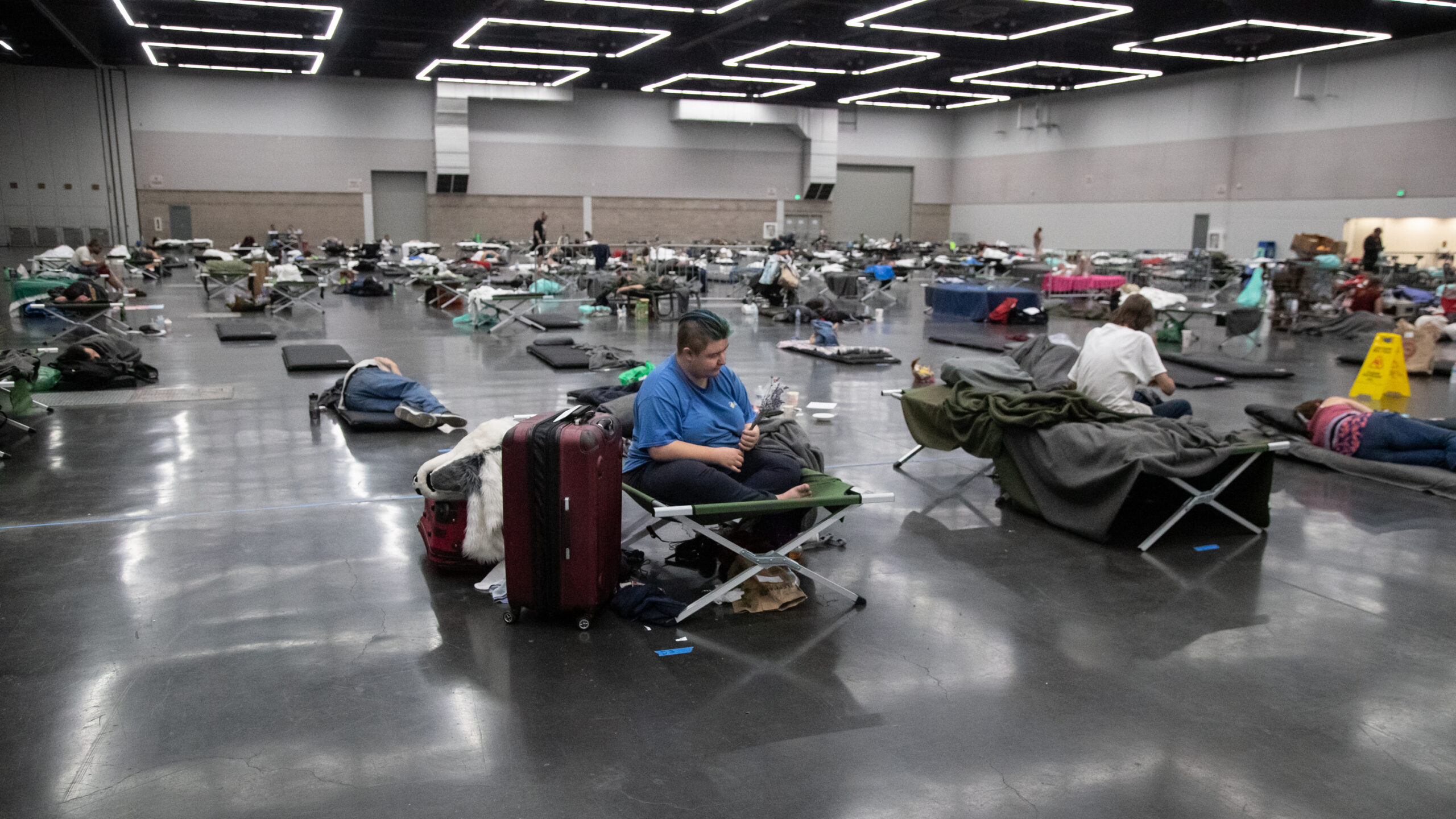
Upgrading cooling centers

What is a cooling center?  How are they changing? What does such a thing have to do with higher ed?

Cooling centers are shaded, enclosed, and obviously cooler spaces for people to shelter in during bad heat waves. Colleges and universities afflicted by problematic heat should consider building some, or renovating current spaces to serve that purpose, as I’ve written previously.  Some campuses already do so.  The key point is that as climate change increases temperatures, there will be greater need for such spaces.

cooling center by MultCo Communications

I wonder about the local community dimension here. What responsibility does a university have to provide cooling for its neighbors?  And can academics depend on the locality to provide off-campus shelter when their institution doesn’t offer enough?

Yet this question, aimed as it is into the future, might be already out of date.  Axios reports that some cities have upgraded their cooling centers into something more than a place to survive a heatwave.

Miami-Dade County is at the forefront with its mobile “resilience pod” made from a 40-foot shipping container. It debuted two years ago and offers people a chilled, solar-powered place to gather, with Wi-Fi, phone charging and a suite of solutions for “food insecurity” — including fruit trees for people to plant.

Tempe, Arizona, has budgeted $2.3 million for EnVision Tempe, a one-stop resource center that’ll have a big walk-in freezer and free ice — plus staffers who can help visitors find a job, GED classes, housing assistance, parenting programs, etc.

There’s even a new name for them: climate resilience hubs.

It’s a fascinating development. On the one hand we can see these hubs as, partly, cooling centers with 21st century infrastructure and/or amenities: internet access, electrical power, ice.  They sound a bit like a hotel in that way. On the other, they recognize the climate crisis with their use of solar power and basic agriculture. This shows the possibility of local support structures failing while offering non-carbon-dioxide-based services.  Which is why there are social services in the EnVision Tempe model.  Climate resilience hubs are hedges against a harder future.

As a futurist, I sometimes look to countervailing forces which a trend might elicit and/or work against.  Who wouldn’t want to build such a hub?  Well, to start with, a city or other entity who didn’t think they could afford it, from the initial cash outlay to maintenance to liabilities.  Or, as one friend put it, isn’t this the opposite of hostile architecture?  Some areas would happily use heat to drive away undesirables. In which case we might see climate resilience hubs appear as political markers indicating a certain attitude towards populations who can’t afford sufficient cooling, or at least as signs of wealth.

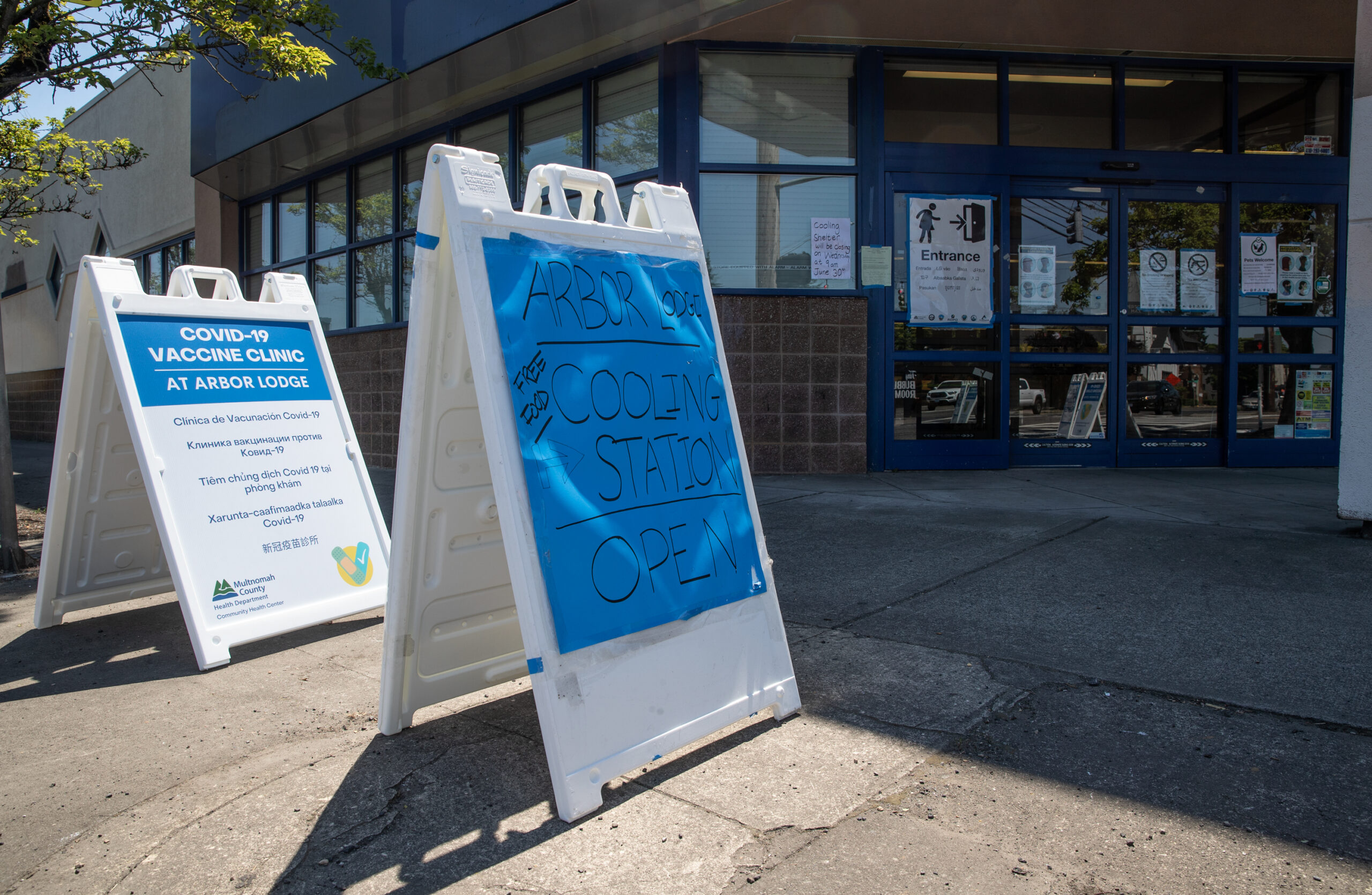
Let’s return to higher education.  Should campuses consider not merely old-fashioned cooling centers, but offering full on climate resilience hubs?

cooling center welcome sign_MultCo Communications

If my guesses about countervailing forces are right, some universities may offer hubs to indicate their politics and/or wealth.  Others may decline for precisely those reasons. Indeed, it would be bitterly ironic to see a school cut funding to its hub because it can no longer afford to maintain it for reasons based in climate change.

Much will depend on the individual nature of a given institution.  State-supported schools may be legally compelled (or strongly encouraged) to offer hubs, probably according to certain specifications, while others may be forbidden from doing so, depending on politics. A campus with a strong social service orientation might see a climate hub as a logical extension of its mission, while one with a hostile town-gown relationship might see a hub as too risky to set up and maintain. Community colleges might deem a hub as part of their local service nature, and this matches closely with what many community college libraries already do… yet we also know many community colleges have been suffering financially due to declining enrollment.

Institutions committed to social justice might see hub work as essential.  Back to the Axios report:

While “resilience hubs” are meant for everyone and all kinds of climate disasters, they’re particularly aimed at low-inc0me residents and people of color, who tend to suffer disproportionately as temperatures rise.

The idea is to meld the heat-relief imperative with social justice.

There’s already an example of this work being implemented some some academic involvement. Communities Responding to Extreme Weather (CREW) has been identifying hubs in public and academic libraries around the nation:

CREW hubs in US 2022

From the official description, they are education first, and other services second:

Climate Resilience Hubs are community institutions — libraries, churches, schools, nonprofits, local businesses and others — that help educate residents about extreme weather preparedness and other impacts of climate change. If they choose, hubs can also help residents respond to extreme weather events through material assistance. For instance, hubs can provide phone charging during a power outage, provide air conditioning during a heatwave, organize welfare checks on vulnerable neighbors, or deliver other services.

More:

If they choose, hubs are also encouraged to work with local emergency managers and community partners to determine what additional services they might provide to the community. During a heat wave, for example, a Hub might open its doors to non-customers to stay cool, stay open later than usual, and have weather forecast information readily available.

We could also see climate resilience hubs as opportunities for academic work.  It’s not hard to imagine faculty researching them in various fields, from engineering to urban studies and social work. We could also see students working in them as part of service learning or a work college’s curriculum, either on-campus or off-. Perhaps a faculty-student collaboration could pitch a hub to senior leadership, then offer it.

One last thought.  These hubs are cooling centers’ second edition.  What does version 3.0 look like?  Would higher education take the lead in creating that new design?

(photos by MultCo Communications)

Posted in climatechange | Leave a comment

How do we think of our present time, looking to the future? The 2022 Polycrisis and what comes next

Today is a Sunday in northeastern Virginia.  It’s a very warm afternoon now, the temperature around 88°F (31°C) and humidity driving the heat index to 100°F (38°C). The cats are resting inside, sensibly basking in air conditioning after lazing on the hot catio this morning. I’m with them, prepping for three classes starting this month, but also wanting to share a futures thought which I’ve been noodling on for a while.

This post is about big picture thinking.  I don’t mean just higher education’s future, my usual area of concern, but the future of humanity.

Question: how do we understand our present time, as we think of possible futures to follow?

This is always a tricky exercise. It’s hard to get some intellectual distance from urgent matters, and perhaps harder still to apprehend key developments which, while quiet now, will grow to shape the future. History shows many thoughtful people understanding their present day in ways we find skewed or just wrong.   Yet I’ve been thinking about a term one historian’s been tossing around. It feels like a productive idea to reflect with, and it’s been helping me consider a bunch of trends.  It helps me think about the present as it points to futures.

It comes from the awesome Adam Tooze (check out his fine newsletter), who has lately been writing about our times as afflicted by a “polycrisis.”  It’s a simple enough idea: multiple crises are in play, interacting with each other in ways which sometimes make things even more difficult.

Which crises are involved?  Tooze names “climate [change], [the COVID] pandemic, immigration, financial instability, global inequality, and economic risk.”  He added others to an interesting visualization:

Tooze_polycrisis_one schematic

You can easily see how these different crises, pressures, and developments cross-hatch. Then you can make other connections.  Russia’s invasion of Ukraine, for example, increases global warming by causing an increase in petroleum production in NATO and allied nations.  Inflation fuels populisms.

There’s also a meta-dimension to the polycrisis, as the accumulation of and intersections between crises become overwhelming, soaking up attention and paralyzing decision-making.

Scott Janzwood and Thomas Homer-Dixon wrote about the polycrisis model a few months ago.  Their definition reminds me of what Tooze has been thinking, but with a slightly different focus:

We define a global polycrisis as any combination of three or more interacting systemic risks with the potential to cause a cascading, runaway failure of Earth’s natural and social systems that irreversibly and catastrophically degrades humanity’s prospects…

A global polycrisis, should it occur, will inherit the four core properties of systemic risks—extreme complexity, high nonlinearity, transboundary causality, and deep uncertainty—while also exhibiting causal synchronization among risks.

Three or more – if Tooze is right, we’re certainly there in metrics.

Janzwood and Homer-Dixon also offer a good example of how the different components of a polycrisis can interact:

[one] systemic risk… (drought → food scarcity and price increases → social unrest and violence) could interact with another systemic risk (global geopolitical competition among great powers → foreign election interference) to magnify negative outcomes in the social systems in question (in the form of, for example, election of authoritarian regimes and further domestic instability). These latter outcomes could then feed back to worsen the underlying food crisis. Interactions among systemic risks can also produce ramifying consequences that extend to additional systems; in this case, for example, heightened domestic instability in multiple nations could reduce international cooperation to address future pandemics.

In addition, the authors see the possibility of “synchronized inter-systemic behavior”:

In physics, synchronization refers to the alignment of periodic orbits (i.e., oscillators) of coupled systems… For instance, randomly ticking metronomes will quickly synchronize their oscillations if placed close together on a lightweight platform (which we refer to as a “substrate”) that allows some lateral movement. In a polycrisis, this type of phase synchronization, we argue, produces a temporal alignment of systemic risks. As a result, they can “go critical” simultaneously or in quick succession; this simultaneity can then produce the “synchronous failure” of the interconnected systems…

The Omega Group (great name) also uses polycrisis language. Their definition is similar, but also a little different:

The Global Polycrisis is the sum total of all stressors affecting planetary health. It’s an unprecedented global systems problem. We need to understand it in order to respond as wisely as possible. [emphases in original]

Omega breaks down their polycrisis models into stressors, or rather groups of stressors: biosphere, societal, technological. And under each one they list a series. For example, under technology:

Electromagnetic frequency (EMF) pollution

Uncontrolled technologies: artificial intelligence (AI), biotech, nanotech & robotics

Displacement of people by robots & AI

Cyber threats

Big Data threats to democracy, privacy & human rights

Modification of the human germline and bifurcation of the population

Omega also sees their polycrisis model as hard to think through:

The Global Polycrisis is far greater than any individual stressor. Most institutions—governments, corporations, international institutions, and civil society organizations—avoid thinking about the Global Polycrisis. They:

Don’t see how they can respond

Focus on critical sectoral questions

Largely ignore future shocks

Mostly don’t prepare…

Still others have been using the term lately.  Former European Commission Jean-Claude Juncker described the EU as

challenges… mainly around the euro-area stability, the global economic crisis, and the migration crisis, to name a few. He also used the term to describe the external crises the EU had—and still has—to handle.

A 2020 book similarly pondered a Eurozone polycrisis. The term seems to be in use within the World Trade Organization as well.

A London School of Economics panel used polycrisis as a springboard for discussing changes to global governance:

Mentions have been rising in print, according to Google’s N-gram:

polycrisis Google NGram

The actual number of hits is still small. Click through the link to see more.

You get the idea.

Let’s start from the assumption, then, that we’re in a polycrisis moment, at least for this post.  Call it the 2022 Polycrisis for now.  That gives us one way to think through our present on the way to the future.

But I am not sure we can actually think through the polycrisis framing, or at least without a lot of work.  Listening to politicians, analysts, and academics, I often hear them focusing not on the poly- but on the -crisis, even at the grand strategic level.  They break up the cluster into separate crises or at most clumps of two: a rising right wing political-cultural movement acting against the climate movement while also driving pandemic denial, for example.  Here I agree with the Omega Group.

Further, I suspect that we all too often return to inherited 20th century (and earlier) mental frameworks to make sense of the 2022 Polycrisis.

Worse, it’s too easy to ignore most or all of the crises, sometimes for the very good reasons of being overwhelmed, exhausted, or having to focus on active, present dangers.

What I’m looking for now is for newer frameworks that include the present polycrisis and also help us think through futures to follow.  Put another way, how can we think of the whole polycrisis altogether, in a better and more effective fashion?

I’ve been researching this a little bit over the past month, which has been hard, given my own exhaustion and having to deal with active, present issues.  The polycrisis model has connected with some of my older research as well.  I’ve also prodded my fellow futurists for their thoughts.  Some frameworks have appeared, and I’d like to offer them for your consideration:

A bunch of people see the whole thing as a decline story.  In this narrative the post-2000 world was shot through with problems which we haven’t been able to solve, so they whole world order is now tottering and falling apart.  Our era is about managing that decline into the future, at best. Or…

Some see this as a decline on the way to truly bad stuff.  Some forecast a civilizational collapse (Jane Jacobs, Roy Scranton). William Gibson, drawing on Robert Heinlein, imagines a “Jackpot” polycrisis, involving climate, atomics, pandemics, and more, after which there are… far fewer people.  Some see this as inevitable, while others attribute the making of spectacular collapse to our being, well, very stupid.

Age_of_stupid_poster (2)

One version of this model is to resurrect the old Marxist idea of late capitalism.  All of the polycrisis elements here fall under a mega-crisis of neoliberal political economy.  This megamachine has driven everything else: colonialism, racism, sexism, global warming. Its contradictions are finally tearing the system apart.

Andreas Malm (an astonishingly productive writer), Naomi Klein, and others have been trying to tie as much of the polycrisis as they can under the climate change rubric: racism, colonialism, economic inequality, Silicon Valley, Russia the petrostate, American policy, international finance, etc.  For them modern society is the creation of petroleum power, and that civilizational design bears its impressions.  In this light not only is decarbonization and climate adaptation called for, but a civilization-wide deep rethink and redesign at least, or a reformation, even revolution.  That’s where a variety of forces come together: antiracism, anticapitalism, climate action, the war in Ukraine, and more.

Perhaps we’re in one of those grand phase change moments, like the second industrial revolution or the Axial Age religious movements – just broader and faster, thanks to globalization and modern technology.  The various crises are friction along the way, and enable the birth of a new civilization.  This phase might be the immediate and medium-term future, an era unto itself. Antonio Gramsci offered a famous formulation, a century ago:

The crisis consists precisely in the fact that the old is dying and the new cannot be born; in this interregnum a great variety of morbid symptoms appear.

I’m also fond of Paulo Freire’s similar prose:

It is a time of confrontation, this transition, the time of transition of the old society to a new one that does not exist yet, but it’s being created with the confrontation of the ghosts.

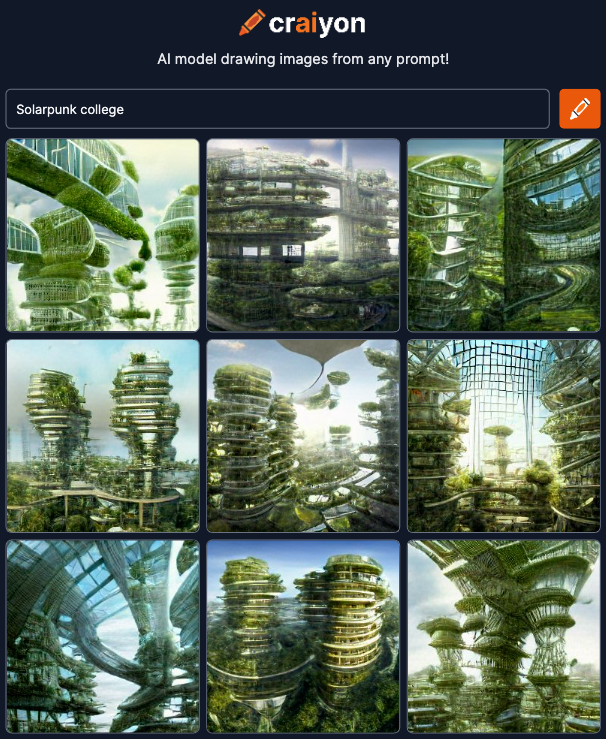
Polycrisis describes this agonizing phase change in the present. 2022 is about a planetary sweep of birth pangs.  If so, then what are we conceiving next?  The aforementioned truly bad stuff model is one possibility. In contrast, the Solarpunk design movement points in the direction of a positive social redesign.

Solarpunk college, imagined by craiyon

Perhaps the 2022 Polycrisis is a sign that we’re restarting progress.  Imagine taking the immense developmental arc of the past 200 years  – and doing that level of progress again, for the next two centuries!  Think of that literally extraordinary period of rises in education, science, standards of living, and so forth, and making such a leap ahead occur for another two hundred years.  In this framework everything happening now is friction, false starts, and the revving up up true starts for a world aiming in the direction of Star Trek, if not Iain Banks’ Culture universe.  We can lump a variety of developments or stressors under this banner: the new space race, the rise of a new gender order, the movement to rewild parts of the earth, new technologies for decarbonization.

Or perhaps we’re headed in the opposite direction.  Instead of firing up the engines of progress, the 2022 Polycrisis shows humanity starting to come to terms with the downsides of the past two centuries. The tremendous advances humanity has enjoyed are now acknowledged, yes, but set to one side as we address the mistakes and horrors committed along the way: colonialism, inequalities, genocides, racisms, environmental destruction, etc.  Perhaps we are now coming to view our industrial and technological expansions with dismay, and seek instead to reduce ourselves, shrinking our dangerous footprint. Our polycrisis in this understanding is the start of an epoch dedicated to reckoning and repair.  Under this banner we can see the global antiracism movement, rising indigenous movements, a new decolonizing mentality, changes to gender identity, skepticism about science and technology, and more.

I have thoughts about each of those, and more to add, but this post is already too long. What do you think, when you try to wrap your head around the many crises afflicting the world?  Do any of the above speak to you? Do you have another framework which works for you?

(attached image is generated by craiyon; thanks to friends on Patreon, Facbook, and elsewhere for contributing thoughts to this post)

Posted in climatechange, economics, futures, politics, visualization | 11 Comments

Sea level rise and academia in one nation: New Zealand

One nation recently published a climate action plan.  Its climate minister stated that some of the country’s homes will have to be relocated as sea and river levels rise.

I’d like to share this as one example of how we respond to climate change, and to share some observations about how one way it can impact higher education.  Here I’ll comment on the minister’s statement alone; hopefully I can get to the plan itself later on.

The nation is New Zealand.   Climate minister (and how many governments have such a position?) James Shaw said that global warming will drive a major housing move:

about 70,000 coastal homes in New Zealand were at risk from rising seas, and many more inland homes were at risk from flooding rivers.

Moving is one option of several:

“In some highly exposed areas, the risk from natural hazard and climate impacts may become intolerable,” the report says. “Inundation of buildings and infrastructure will start to occur, leading to direct damage and loss of some facilities like roads or other lifeline services, and public open space.”

The report says that a “managed retreat” from such areas will often be considered a last resort, to be used in conjunction with other adaptations such as installing seawalls and raising houses on stilts.

I want to make sure you hear that phrase “managed retreat.”  It’s one the climate community has been talking about but which hasn’t entered the mainstream.  It describes what it says, a human retreat from rising waters, conducted in a careful (hence “managed”) rather than panicky or chaotic way.  Look for this term, or a successor, to appear more often.

We can discuss the range of options here, which are distinct: seawalls versus elevating buildings versus relocation. Moving a building versus giving it up and rebuilding elsewhere is another choice.

But for now I want you to think about what this might mean, first, for New Zealand and its higher education sector.

The nation has about 1.7 million homes (source), so 70,000 is around 4% of the total stock. On that scale it’s not a lot, but obviously represents a significant humanitarian disaster about to occur.

What about higher education in New Zealand?  To what extent might it be challenged by this level of water?

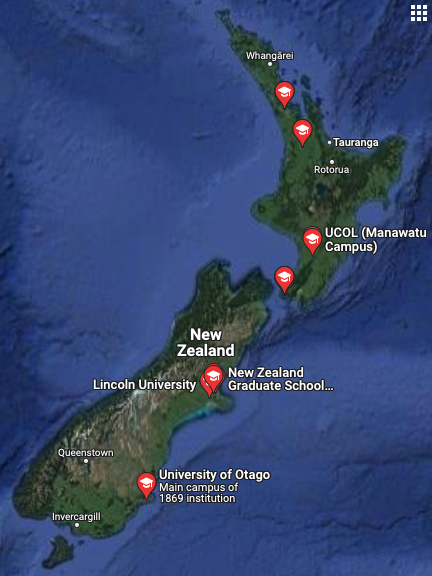
Here’s a quick map of New Zealand universities from Google:

New Zealand universities top level - Google Maps

You can see right away that several red pins are close to the sea.

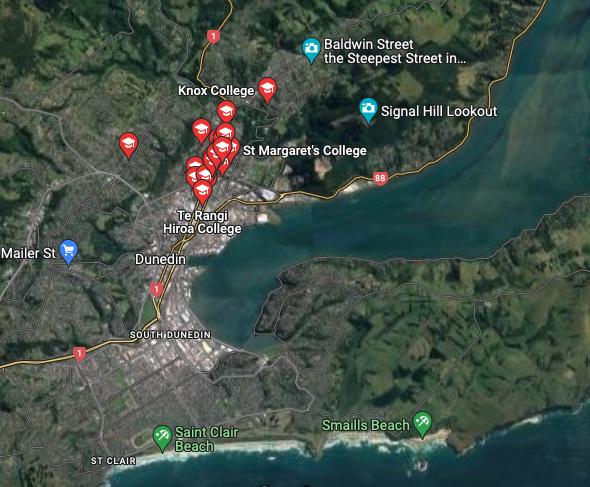
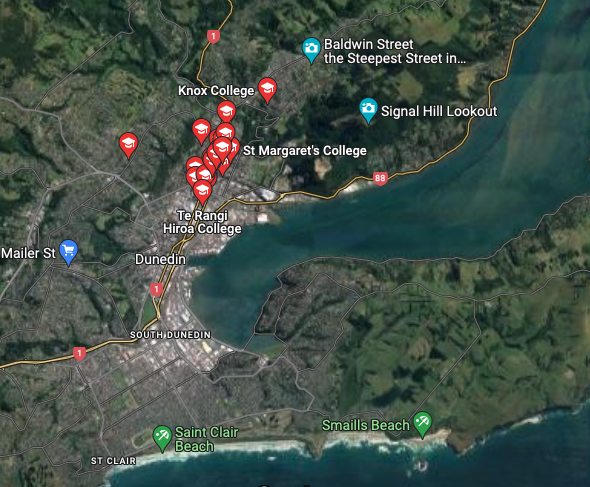
Let’s drill down on one example, the South Island city of Dunedin, right on the Pacific.  How many campuses does it host?

New Zealand Dunedin colleges and universities - Google Maps

More than a dozen downtown, too many to be individually visible in that screengrab, and all just blocks from the water.  The University of Otago‘s Central Library is less than a mile from the shore.

According to the Dunedin city council,

Our great small city of Dunedin is not immune from these global forces. Our climate is changing, sea levels are rising, ecosystems are under pressure, and communities are being disrupted by new hazards and risks…

South Dunedin is the city’s biggest challenge from the effects of climate change, because it is home to 12,000 people and 700 businesses, who live and work on a flat and low-lying former wetland which will be increasingly flood prone.

Elsewhere in New Zealand, we could consider North Island.  On its southern tip is Wellington, home to Victoria University of Wellington, Massey University’s “creative campus,” University of Otago’s Wellington branch, and more.  Wikipedia adds:

Wellington accommodates several of the nation’s largest and oldest cultural institutions, such as the National Archives, the National Library, New Zealand’s national museum, Te Papa and numerous theatres. It plays host to many artistic and cultural organisations, including the New Zealand Symphony Orchestra and Royal New Zealand Ballet. Its architectural attractions include the Old Government Buildings – one of the largest wooden buildings in the world – as well as the iconic Beehive, the executive wing of Parliament Buildings as well as internationally renowned Futuna Chapel.

New Zealand Dunedin colleges and universities - Google Maps

On the North Island’s other extremity, port city Auckland hosts a clutch of academic and cultural institutions. Let Wikipedia offer highlights:

Auckland has some of the largest universities in the country. Five of New Zealand’s eight universities have campuses in Auckland as well as eight of New Zealand’s fifteen polytechnics. The University of Auckland, Auckland University of Technology, Manukau Institute of Technology, and Unitec Institute of Technology are all based in Auckland. Despite being based in other regions, the University of Otago, Victoria University of Wellington, Massey University, and several polytechnics have satellite campuses in Auckland.

One farthest from the coast, Taylor’s College, is just about 1.3 miles from the water.

Other NZ campuses are more inland and farther away from the sea, which is a fine thing in this context. I’m not sure about their exposure to rivers. These colleges and universities might be called upon, or decide themselves, to assist their colleagues should the waters hammer them.

Note that the preceding is just about sea level rise and how it could threaten campuses. I haven’t addressed off campus issues, like academics living nearby or community relations. I haven’t mentioned other climate change related impacts on a physical campus and its neighborhood, like the increasing incidence and strength of storms, the ways new diseases might appear as biomes change, or alterations to local flora and fauna. I haven’t begun to mention the many other ways a university intersects with the crisis, from research to curricula and pedagogy.

This post is all about New Zealand and just in the light of recent statements.  I would love to hear more from kiwis who know a lot more about their lands and their academic sector than I do.  I haven’t had the chance to dive into existing and planned seawalls and elevation projects in each city, for example.

I would also like you, wherever you are, dear reader, to think about what this discussion might say about higher education elsewhere in the world.

(thanks to professor Mark Rush on Twitter)

Posted in climatechange | 6 Comments

Discussing higher education, jobs, and inequality with Tony Carnevale

Georgetown Center on Education and the Workforce CEWThis past Thursday the Future Trends Forum hosted professor Anthony Carnevale, director of Georgetown University’s Center on Education and the Workforce.  Our discussion explored higher education and its many connections to economics, from how to support first-generation college students to the role academia plays in exacerbating economic inequality.  That last point became the hour’s major theme.

The hour was so rich that I wanted to share it all here.  Plus I wanted to make available parts that not everybody got to experience.

First, here’s the full session recording:

Second, a huge number of questions came in – ultimately around 30, including one a Forum friend who couldn’t make it asked me to pose plus a couple hoisted from the chat. They were so productive that we couldn’t get to all of them in the single hour we had, so here are the unposed queries and comments, since you can hear the asked questions in the video above. I have anonymized each questioner and commentator.

Comments:

Dr. Carnevale’s idea in the Chronicle for ROI-based pricing might help bring higher ed costs down a bit, but the real culprit for the high costs is the four-year degree and its excessive seat time.

“Brutal efficiency” is why today’s higher education exacerbates inequality, whereas previous generations (from post-WW2 to 1980?) promoted social mobility.

Questions:

Why “good job” rather than developing agency to find one’s vocation?

Can you talk about the financial model of research institutes that publish on higher ed and the economy? How do these institutes make money while avoiding political pressures from granters?

How can we model inequality? Are we winning or losing?

To what extent do you believe that the problems are caused by “signalling” as described by Bryan Caplan – and thus very difficult to fix? Otherwise, what do you see as possible solutions?

Given recent consolidation in higher ed (mergers, closures, “queen sacrifices”), do you anticipate more “carve out of the middle” within the higher ed ecosystem?

Upward mobility? What about downward mobility?

Unfortunately, “tribalism” is well and alive in many hiring companies/institutions, and many times does not even give a chance to compatible candidates. How can we prevent such segregation?

You say we know how the system works economically, but we don’t tell the students. Can you please share what students should be told? And how does the message differ based on class?

What is the real value of a college education if the “ROI” when generationally Gen Z’ers are not forecasted to earn more than their parents, yet more students are “college-ready”?

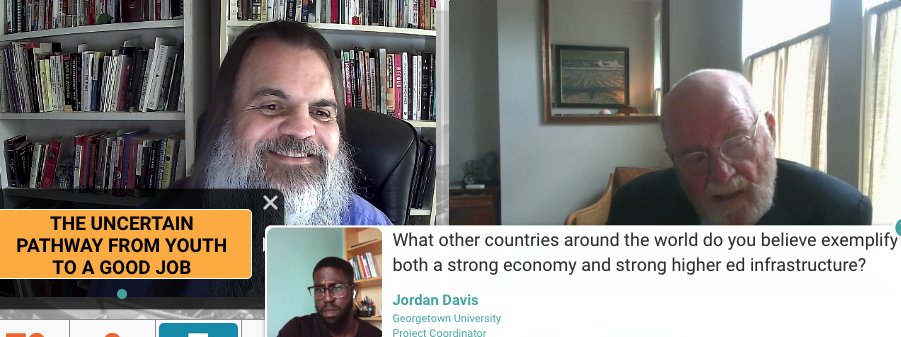
Forum_Carnevale_Jordan question

One question we did get to.

Third, here is the chat transcript.  I have anonymized everyone except myself, one participant as named author of a relevant book, our guest (who was named, but didn’t post) and a few Forum community members others singled out for praise (which I’m happy to second and share).  I have also rearranged some exchanges to make them flow better, as well as to fit more closely together under topical headers.  Lastly, I took care of a few typos, contractions, making hyperlinks active, etc.

On higher ed preparing students for good jobs:

So are we preparing students for only the marketplace or prepare students to lead productive lives (nods to Dewey)?

“Education is not preparation for life; education is life itself” – Dewey

in my well worn paper copy of Dewey’s 1938 page 18 tells me the purpose of education “is to prepare the young for future responsibilities and for success in life”. When did he say it is life itself? I would agree with that, btw.

You have to ask what “good” and “successful” (per Dewey’s definition) really mean.

Dewey was making the point “education” is not separate from the business of life. That we are always learning. But please don’t make me try to explain Dewey in a chat window.

Bryan N Alexander: We should do a Dewey reading.

So those without education are without life? Hmmm!

Higher ed is not a “pathway to the middle class”

Possibly a moot point. Who can afford either?

Right. Too expensive!

Wow, we’re loaded for bear today..

Define “good job.”

Good is a misused adjective in HE

Definition of good job from the report seems to be about income… no other aspects considered?

NO social institution is forever. What comes next?

Pierre Bourdieu on reproduction of social class

When did education stop being a public good (and financed as such) rather than a personal good financed by families

The problem is the path to “good jobs” requires four-year degrees, which are a huge obstacle in time and money, especially for the poor.

I’ve been an advocate for more career and education counseling for high school students and have read you comments on it. Can you elaborate more on your thoughts about that.

Adjunct faculty have, by that definition, lousy jobs.

Let’s say more like 5 or 6 years not 4

45k regardless of where you’re located?

$22 an hour??

Plus there will never be as many “good jobs” as we want there to be. We are churning out so many graduates that there is the “educated underclass” that Gary Roth writes about

We need career counseling through career lifespans, not just at the beginning.

lol, yes, adjunct is not a good job!

Any job can be good

and half of our classes are taught by adjuncts

It’s the perspective

Shows what we value.

US Census 2004 puts $45k in Quintile 3.

I had been one in the those positions

most of us have at some point.

Yes, It was as good as I thought it was

What do we pay “good” parents?

“Integrate” what? Why?

$$$ always means good?

#endstagecapitalism

And of course our most important jobs are rarely considered “good”

yes  – off the hook

I don’t believe that.

I have had historically “GOOD” jobs

Hence my question.

a “good” job includes healthcare benefits

I’ve had good jobs without healthcare

What does it mean to lead a happy life? You can be rich and unhappy but you’re more likely to be unhappy if you’re really poor and constantly scrambling.

Preparing students for college and college preparing students for work:

the connection between bachelor’s in humanities and high income is not inherently causal.

But you have to ask if it makes sense to drive adjuncts to overwork just to survive.

Winners in Game. Hmm.

That’s a fascinating finding, general versus specific degrees, and how general is a long earnings game while specific degrees are a short earnings game

Goldthorpe 2000 found that edu decisions seek to attain the SAME CLASS as parents. Motivation is misaligned here.

yes, interesting. I wonder if these were integrated with humanities contextualized within professional programs might affect ability to find “good jobs”.

I have grad students who are not “college ready”.

“There’s nothing in Algebra 2 that’s going to get you a job.” – depends on how it’s taught. A lot of skills in Algebra 2 can be applied to programming. THAT will get you a job.

Human capital theory not dead yet?

since when did University become the farm team for US corporations??

Better prepared! Obviously Carnevale has never adjuncted in a community college

The four-year degree is not the “best thing going” when it ruins lives with debt!!!

Educated underclass!

Not to mention the soft skills that can be gained through algebra – working through problems, maybe struggling to understand something new, general education things – of course depends on the teacher

For those interested how Algebra II is used on the job, check out this research from CEW.

thanks for sharing the Algebra II post from CEW

of course. Happy to share other references if it’s helpful!

my barista at Starbucks will take offense

Higher education, economic class, and social inequalities:

Brutal efficiency? You mean wealth distribution?

The best way to get rich is to be rich.

…and White.

Are we still brutally efficient?

Everyone should try it.

who would finance anything important with real estate tax’

Zip code determinism?

The biggest tax loophole is the mortgage tax credit.

“Underclass?” Have you ever had a Ph.D. fix your plumbing?

Wow, that’s depressing!

sort by poverty how cynical.

Self-fulfilling prophecy feedback structures?

yes

higher education really does reinforce social class

Higher Ed exacerbates inequality

Carnevale sounds like a social darwinist. Only the deserving get ahead.

guided by corporate philanthropirates

how much genius do we waste by not finding with a less racist strategy

Is higher ed a mechanism for change or a perpetuator of the status quo?

I don’t want a plumber as my Dr. Surgeon well maybe only if he has experience LOL

I want my surgeon not to have lost their last 100 patients. Education is secondary.

Ouch

why doesn’t a Jesuit college like Georgetown have more poor people

I hope not

We need to give people the education that they need, not the education that we think they need.

That was an excellent question

Gary Roth rocks.

Why does education have to be bounded by admission and graduation?

Too bad our ratings system does not reward graduates’ upward mobility rather than some of the class-reinforcing metrics, e.g., $ spent/student, #valedictorians, reputation, etc.

States used to finance systems that education the top 1- percent of seniors at high schools in every zip code

Title IV scorecard?

Colleges and universities having problems in the new environment:

Aren’t all the drop out rates/ completion rates etc. for the most part in HE less than 50%?

Lazy rivers at your campus are a great marker for future success in the workplace.

Maybe the AA will be more important?

These questions are so good, glad to be here with so many brilliant minds

Agreed!

Yet a large number of the most powerful in this economy are/where college dropouts.

Florida to let veterans teach without bachelor’s degree

I am impressed by the description of the environment as it is. What ever happened to college mission to consider the right, the just, the true, and the beautiful??

Ivan Illich started that assault on the BA in the 1960’s

Collins 1979 pt’d out Illich did not address the stratification engine that ed is

Maryland no longer requires BAs

and spouses of veterans – all they need is 12 hours of observations last I heard

NO a retraining prob — a hiring dilemma

when I taught GED, coming up with an honest why for both algebra and writing — and developing assignments accordingly — was a must

A lot of topics frantically wound together:

New America? (The stat/report)

I am not sure –

several polls came out this month.

Here’s the New America survey.

Yep, that’s the one

Why not focus on making all jobs “good jobs”

In the 1970s, arguably, education was still a leveler. That’s the world Illich was looking at.

Polling is picking up that HE is elite ideology that is NOT in the interest of workers

Yes 🙂

There are two separate issues here: 1) The cost of education and 2) The efficacy of education. They need to be considered separately.

I’d say Illich was looking at the latter.

Awesome question!

At least he is union savvy

Thanks, this private vs public response is getting at my follow-up!

read Collins on Illich 1979/2019

Adjunct Faculty in Washington DC qualify for labor representation, and most Adjunct Faculty at Georgetown University are members of a SIEU local, per terms of their employment.

The Finnish model is a good one to look at as far as a country prioritizing its public higher education system. Virtually no private colleges in Finland compared to the number and power of public colleges

Yes to mental health

On higher education as a supporter of democracy

Zuck wrote the Truman Comm

No, ZOOK

I knew Zuck was an android. He’s R. Daneel Olivaw

Truman Report was nothing than Ivy League self-promotion

My colleague Bill Tierney just published a brilliant book, Higher Education for Democracy…

the original mission of education which is the minimum requirement to run a republic

Haven’t talked yet about lifelong learning – college s lifetime acquiring of learning and skills. And breaking into the degree-centric system to build an incremental system – recognize learning along the way…

talked about George Zook, the author of the Truman Report. Look him up

Most college professors have never HAD a ‘real’ job or know how to get one. They’ve succeeded in the alternative world of academia. This is why vocational education (taught by practitioners) is more likely to help “get jobs.”

Lifetime learning can be seen as job security for HE

Bryan N Alexander: Yes, the California policy is “cradle to career.”

God forbid we care about people

👍🏻

Cal State explicitly says “cradle to career” in a few places and it is not always received well

Cradle to Career Data System

We get to see a side of Carnevale that DOES NOT show up in his studies

?

Unionist, adjunct advocate

gasp!

Speak more to the university’s purpose beyond degrees/credentialing? Is there a “public good” purpose that is social, not just economic?

Yeah. I love this crap about the 60-year-curriculum.

I worked for 25 or so years before getting back to finish my BA

ask Edmund Brown about reforming the entire system California Master Plan was the finest reform ever

John Warner discussed “public good” in July 27 IHE.

Carnevale’s activist side

Ah yes.

Natl Student Clearinghouse’s report finding moved #from 36 to 39 m who left college w/o any credential. Did millions learn nothing of value that could be credentialed? The system is not working for more than half of Americans

What kind of education system would we create now given our current needs and technologies?

we’ve been off Clark Kerr’s California higher ed mission for a while with no clear new mission

K-12 has legal “standard of care” but HE does not

could it be think adequately, communicate in several mediums adequately, and improve one’s community adequately?

Good Q @TH

Tom does ask doozies

#devil

how many of those 39M some college no degree students do you think could earn some form of microcredential if they were to return to complete?

build credential as you go system, incremental credentialing system

+++

Carnevale seemed relieved to be able to talk OUTSIDE his box!

Covid broke a weakened trade regime.

Apprenticeship …

this is a stellar convo! Excellent work by the room here

“Training” = education without agency.

Anyone got a link on TAA?

TAA

Corporate capitalism? or socialist capitalism via Collins 2013

Cliff Adelman years ago looked at & concluded pretty large number of students were really close to degree and left w nothing. We need ways to fill the holes and recognize valuable learning

Cliff is dead

Cliff was brilliant. I suspect that this is an issue that you are spending a fair amount of time on at GW. What should be looking for?

Government and business power should cancel each other out. That’s where you get liberty.

That’s what we’ve missed in our balancing act – government needs to balance business needs to balance the populace. We’ve lost this balance. When business and government align, the people are in trouble.

My advice – Figure out what you’re good at and do all you can to be the best at it.

SCOTUS disagrees with me.

#dcunited

Cliff’s data is not dead

TH another point in your favor

Some research on ROI suggests “in state” standard college – and of course STEM.

Lots of good questions

GU CEW report on A First Try at ROI is a fantastic report. Sits on my bookshelf.

Gonna share this (esp. 2nd half) with my students this fall! And with my career office.

stop making it about degree completion for starters.

The good news is learning doesn’t have to happen in a formal classroom

it never did.

precisely

Most learning happens outside the classroom if we’re honest about it.

as you know, convos about grad rates tend NOT to talk about learning. How to fix that…?

a provocative economist who knew. Thanks

That’s the $64,000 question

64k is not a lot these days.

We have significant dropping out all along system, undergrad and grad but meaningful learning not recognized

The business model in higher ed is about selling degrees. Any learning that occurs is often incidental to the process.

HE is dependent on the perceived worth of its credential.

loads of colleges understand intimately about the business model inefficiencies

Agreed!

+1

We’ve trained students that the degree is what matters, not learning.

be careful using the word power too

I ask that as an “original intent” affirmative action recipient

Looking ahead:

What outlook does Dr C see for online higher ed?

What can we do in higher education to break this cycle?

@Bryan based on this bring Dr. Carnevale back after the SCOTUS decision on affirmative action

The end:

hurray

And kudos @Bryan for herding these cats

who is asking these questions?????

Visit cew.georgetown.edu! @GeorgetownCEW on Twitter

Thank you 🙂

thanks!

Thank you.

Thanks

Thanks. I’m going to cry in the corner now. 🙂

Thanks again, Bryan for keeping the conversation going!

One nice note on Twitter:

Thanks to all who participated in this very intense and powerful conversation.

Please add your questions in comments. We’re also eager to hear suggestions for future guests on this topic.


Posted in economics, Future Trends Forum | 13 Comments

Decarbonizing my professional travel

As I’ve been researching the climate crisis and how it might engage higher education, I’ve also tried to change my personal life in response to global warming. I’ve taken up bicycling, have started eating a vegan diet, and more, but I’m stymied by a bigger challenge: how to decarbonize my professional travel.

In this post I’ll share what I’m thinking, in my usual spirit of transparency. I would love to hear your thoughts and suggestions.

I used to travel a *lot*, before COVID struck in early 2020. I would hit the road up to six times a month, heading to points domestic and international. My usual conveyance to these destinations for giving speeches, running workshops, and consulting was aircraft.  When we lived in Vermont I drove a lot, from New England to Pennsylvania and upstate New York, thanks to a paucity of transit options.  Once COVID hit I turned almost completely to virtual work. Now that in-person requests are starting to pick up, I’d like to figure out how to do less flying, as planes are the most energetic emitters of greenhouse gases.

Why would I do this?  As someone working in climate futures it’s simply ethical and non-hypocritical to practice what I preach.  More, I can learn from practice.

So how should we travel?

The American ideal is to drive like mad, especially with big and/or expensive cars/trucks. Next up is taking a jet plane, which people who don’t actually fly somehow consider to be glamorous. Both are CO2 emitting monsters.

For alternatives, science fiction admires airships, but commercial travel via blimp hasn’t returned for those yet. Riverine travel is appealing, yet very scarce, time consuming, and hard to find commercially. The best alternative to jet aircraft seems to be trains, so let me explore that a bit.

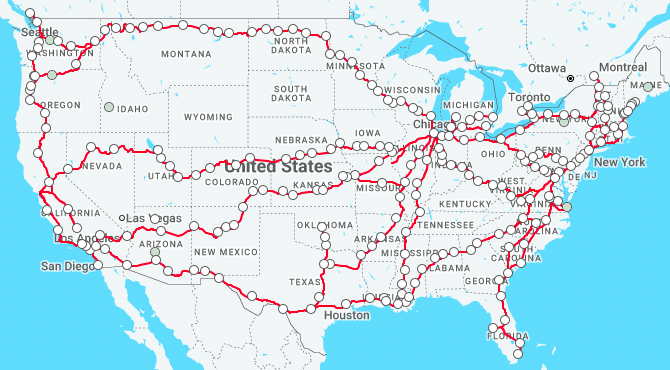
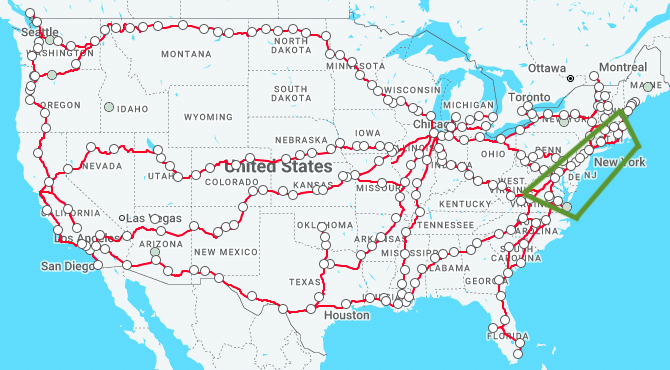
We live in northeastern Virginia and can therefore access the American Amtrak network pretty easily. One line runs through our town of Manassas, which plugs into the whole nation, ultimately:

Amtrak US map

However, a quick glance shows big chunks of the United States not directly served by this rail line.  I’ll get to that in a moment.

Right now I can hit a number of stations within a business day’s train ride. They are a handful of US locations, basically a band along the central eastern coast, Boston to Richmond. I’m happy to do that when that’s where clients want me to be:

Amtrak US map -stations with a day's travel
Beyond that group, there’s a second region of train-able destinations which are more difficult to reach. From New Orleans to Chicago, train trips from my home do exist. But they take a very long time, especially when switching lines is involved.  For example, Washington DC to New Orleans takes about 26 hours (and probably longer).

Amtrak US map two days

This presents me (and other would-be travelers) with a problem. We can buy a simple train seat and save money, but also have to endure increasing discomfort and even pain, especially if we have any health issues, including those associated with aging. Another option is to buy either a “sleepette” or sleeping compartment, which is charming and less painful, but which can cost a lot more, even more than air travel along the same route.

Beyond those green boxes above you can see destinations which take three or more days. Fares are correspondingly higher.  You can also see many areas which Amtrak doesn’t visit.  I could still take the train to the nearest station and then drive from there (rental car or Uber etc.), which adds to the trip’s emissions.

One potential good thing about train travel is the ability to get work done on the trip. Electrical outlets are widespread.  The trains provide WiFi… but signal strength varies from moderate to zero in my experience.  At best, the experience is like an uncomfortable hotel room/office.  At worst it’s enforced downtime.  Which I might require, although it’s hard to afford.

All of the above covers travel within the United States. I also travel internationally, and that looks likely to remain the province of jet aircraft. (I *can* train to Montreal, and that seems to be the only non-US train possibility.) Going by ship has some appeal, but the timescale for the shortest trip is huge.

So where does that leave my professional travel decarbonization effort?

I put together a working list of options.  It’s a sort of simple, linear flowchart:

  1. Take a train when the site is within a day’s travel from my home.
  2. Offer virtual work for clients elsewhere.
  3. If 1+2 don’t appeal to a client, and the location is close to some Amtrak station, try to arrange for multiple gigs in the same geographical area. This isn’t easy, but might work out in some situations and will reduce costs per engagement.
  4. If 1-3 don’t succeed, then present a climate crisis travel budget item to clients.  The fee will be higher than it has been historically.  It will either reflect a sleeping car/sleepette for the long train ride or a combination plane ticket plus donation to a climate crisis group.  (I am resisting carbon offsets now, as they all too often don’t seem to work.)
  5. If the location isn’t train-able, offer the plane fare + donation fee for #3.
  6. If 1-5 isn’t acceptable, I reject the professional engagement as inappropriate in the age of climate crisis.

An additional step: measuring and publishing the CO2 emitted by my professional travel.

I hope that one side effect of negotiating with a client along these lines will inspire them to think more about the climate crisis.

Looking ahead, as I do, the difficulty in making such decarbonization happen suggests plenty of entrepreneurial opportunities.  There’s got to be growing demand for climate conscious air and water travel alternatives. I, for one, would love to take a WiFi-equipped blimp to another city, or ride a comfortable boat or ship.

Will electric options start to work?  For example, would riding an electric bus be better in terms of emissions than taking a plane? When can we see a hybrid jet?

I had hopes that the Biden administration would expand train coverage across the United States. I even dreamed Americans would realize high speed trains existed.  Alas, those ideas seem to be deferred. Perhaps Hyperloop rides will be the next option to actually appear.

What do you all think? Anyone else have travel decarbonization ideas?

Posted in Bryan Alexander Consulting, climatechange, travel | 30 Comments

A brutal heat wave, a Biden possibility, and what they might mean for higher education

Two developments crossed my radar this week and I’d like to flag them here. Both concern the climate crisis.  Each has implications for higher education.

I: Heat wave

Last week I visited Phoenix, Arizona for a conference. At one point I stepped outside, wearing my suit and tie, socks and shoes, like an idiot, to get a sense of what 110°F felt like.  It began as pleasantly warm and rapidly became debilitating. “This must be what my food feels like in the oven,” murmured another person next to me.

Bryan Alexander Phoenix 116 degrees APO 2022 July

Wearing full professional battle dress – suit, tie, buttoned up shirt – and starting to question my sanity.

That was famously hot Phoenix and I experienced it voluntarily. This week swathes of Europe are feeling similarly over-like and Europeans had no such choice.   France is enduring temperatures past 100 F:

44% of Europe is now on a drought warning and 9% on alert, according to the EC. A British airbase at Brize Norton shut down after part of a runway melted. while that government issued its first-ever red warning. Wildfires hit dried out parts of Spain and France.

A couple of years ago British meteorologists offered a forecast for a heated nation decades from now, after global warming had done more of its work. This week matched that forecast:

This has been going on for weeks, back into June.  And the climate crisis, which made this heat worse, will just keep spawning such brutal heat for generations to come.

Note that this is occurring when the Pacific Ocean has a La Nina system at work- which is cooler.

But what does it mean for higher education?

Think of a university’s physical campus. Do its buildings provide enough cooling through shade, air conditioning, and more to keep its population safe?   How reliable is such safety? How costly, especially as oil prices have soared? How is the campus water supply? Looking beyond this week, how many universities are rethinking and planning for more such events ahead?

Beyond the institution’s borders, will the campus open its doors to shelter people from the nearby community?  Or will academics take shelter off-campus?  Already thousands of people have fled their localities. Do campuses offer to host some of them? How many students, faculty, and staff are among these heat refugees?

Think of people experiencing this one heat wave and how they might intersect with higher ed.  Students, for example, for whom this event may be personally, financially, medically harmful or mentally traumatic.  People in their community may be disabled or killed by the event. Ditto friends and family. How does a university support such students through the academic experience?  Consider faculty and staff living through this as well.

I am curious about some other academic reactions:

Will we power down for the hottest weather, shutting down campuses to avoid costs and risks?

Might the specter of this heat wave help spur academics to take more steps to mitigate and adapt to climate change?

Will new building designs appear on campus, intended to cool off inhabitants while also not adding CO2 to the world?

2: A Biden possibility

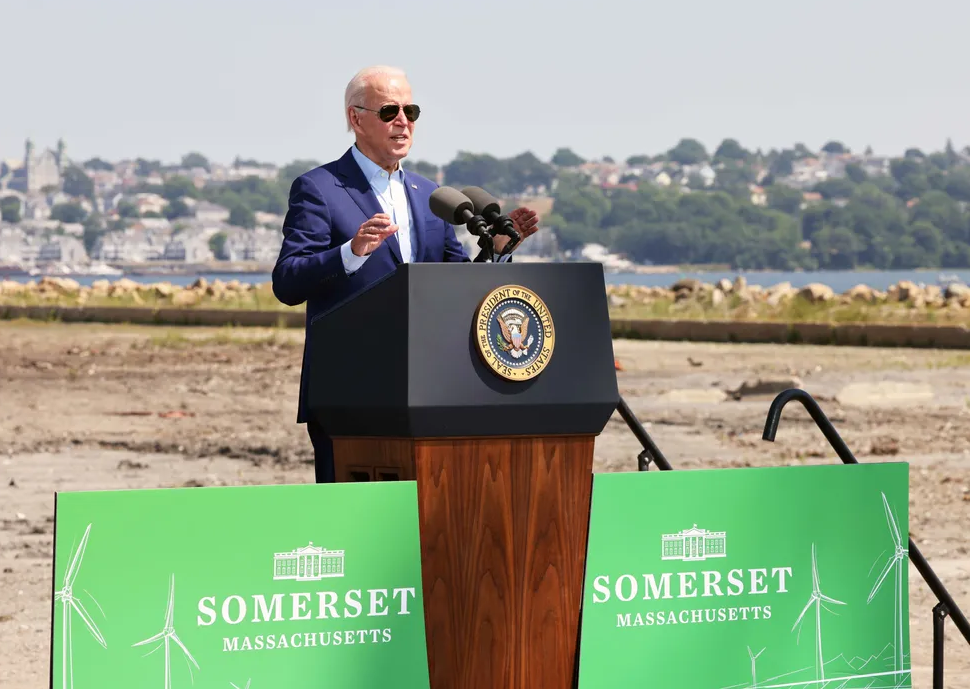
The Washington Post ran a story claiming that president Biden was considering declaring a federal emergency over the climate crisis. Climate writer and 350.org founder Bill McKibben thinks this a fine idea, especially as Biden’s Congressional plans have foundered on Republicans and Joe Manchin. Biden has not done so as of yet, but the possibility is in the air.

Biden speech on climate in Mass 2022 July_HeraldNews

What might this look like? We received a glimpse yesterday when the president gave a speech outlining some programs, although falling short of an emergency declaration.

He announced the allocation of $2.3 billion from an existing Federal Emergency Management Agency program to help communities, particularly those in disadvantaged neighborhoods, build structures and programs to withstand the severe heat, storms, fires and floods that climate change has already started to bring.

Separately, he announced the expansion of the federal Low Income Home Energy Assistance Program, which has historically been used to help people pay to heat their homes in winter. The program will now also be used to help pay for people to cool their homes in summer, and to build community cooling centers.

Mr. Biden also directed the Interior Department to open the door to building offshore wind farms in the Gulf of Mexico…

None of these engage higher education directly, but each could improve communities adjacent to campuses.  They might also serve as inspiration for academic actions, such as assisting locals in heating and cooling, or building wind power on campus.

Additionally, there’s apparently a lot of room for action in an emergency declaration, legally, but with political and practical constraints.  We could imagine Biden directing industry to produce climate goods, from wind turbine blades to electric car batteries. We saw a version of this when he drove increased heat pump production. He could announce a crash research course, commandeer vehicles, and more beyond my scope, as I’m not a Constitutional lawyer. (I’d love to hear your thoughts in comments, those with more experience)

How might this impact higher education?

On a direct level, perhaps a new R&D push would engage academic research.  A drive, for example, for a new generation of geothermal energy devices could involve professors, staff, and students in engineering. A call to study a new national climate plan could mobilize academics from a wide range of disciplines.

Or the administration could announce a Climate Service Corps, inviting students to join and work on climate mitigation and adaptation.  The government could aim that at particular problems or areas, such as grid upgrading or the Florida coastline.  Alternatively, the feds could support community engagement efforts. (thanks to Kristen Dellasala for this thought.)

On an indirect level, federal emergency actions could impact the communities inhabited by colleges and universities.  Closing down nearby businesses which produce CO2, for example, could hit local economies.  Similarly, repurposing local firms’ production could alter those local economies.

Further, let me return to the idea of inspiration.  Seeing the feds spend real money on climate action might nudge some academics to support taking steps along similar lines.

On the other hand, we might also see a lack of action.  I’ve been researching the opposition to climate action and will try to write it up – there are a lot of reasons here – but Matt Holt raised one point specifically about federal action.  If Biden declares a state of emergency, Americans will politicize any resulting actions.  Acting in line with it will appear either as progressive, pro-Democratic, and supportive of the administration.  Not participating may seem to be the opposite, and so forth. Academic leaders may not want to participate in such federally-sponsored climate action, for fear of antagonizing donors, the local community, state politicians, and more.

3: final thoughts

The end of Biden’s climate work has already inspired depression and outrage, at least among those for whom the climate crisis is a priority. Looking ahead, the Congressional barrier to federal climate action will last for the next two years, assuming the GOP takes control of either the House or Senate, which means more depression and outrage among those thinking ahead.

Some academics will share these views.  We could experience dread and resignation. Some faculty, students, and staff will be furious at what’s just happened, and angry at America’s climate paralysis at a national, governmental level.  How do these feelings manifest on campus and within academic communities?

Some will buckle in and continue their academic work on the crisis: more research, more teaching. Some will push for expanded climate academics, from additional research support to new curricula. We may see drives to change campus operations, from building design to vehicle permitting to food service.  Political actions may appear as well, from protests and lobbying to direct action.

Perhaps the non-academic world will change more than I just described.  McKibben urges activists to turn away from the feds and focus on changing corporate behavior, so we could see a wave of protests aimed at CEOs, product and service boycotts, and more. American climate politics might develop despite the federal dead end, with state governments taking all kinds of actions (for good and for ill), plus a social movement or movements growing. Again I mention direct action taking place, from pie-throwing to property damage and human violence. If such developments occur, they may find echoes in colleges and universities.  Think of, for example, students, faculty, and/or staff mobilizing to support (or oppose) a local governmental measure.  Political and social movements can find chapters on campuses.  And how might academics respond to direct climate action in the world?

Alternatively, American academia may stay quiet for the near future. Students, faculty, and staff have so much else to worry about, after all. The end of federal legislative efforts on climate removes one political housing for individual climate interests. The great crisis might become more abstract and intractable for many academics.  Those working on the issue in our research and teaching can just keep going.

In the meantime, please be cool and safe, everyone.  These are dangerous times for some.

(thanks to Adam Tooze for stirring and sharing thoughts; thanks to the essential Bill McKibben for his mandatory newsletter)

Posted in climatechange | 1 Comment

Campus technology for the climate crisis: a summer 2022 workshop

Last month I offered a workshop on what climate change might mean for higher education. I’m just starting to do this kind of thing, so I’d like to share and document it here.

The setting was the ShapingEDU Virtual Summer Camp.  That meant a bunch of folks interested in education and technology, mostly (all?) in higher ed.  Sessions covered a wide range of topics: AI, libraries, storytelling, race, gender, cloud computing, science fiction as metaphor, etc.

spacecamp_agenda_DAY2m

A sample day.

What I sought to do was get people working in an around ed tech to think about how the climate crisis could change their work over the next generation.  From the description: “[F]rom campus buildings to teaching and research… [p]articipants will each start developing an educational technology plan for the fraught years ahead.”

In practice, that meant a session framed around what I see as three the topic’s major domains:

  1. The physical campus
  2. Research
  3. Teaching
  4. Campus-community relations
  5. Campuses engaging the nonacademic world as a whole.

Time was very limited, so I quickly presented key ideas and questions for each domain, then asked participants to write about how their work might change, and how best to support that transformation.  That writing could take place in the Zoom chat and in other locations – I recommended Google Docs or similar.

buy prelone online buy prelone no prescription generic

I shared a Google Slides presentation to anchor my prompts:

As is usual for me, that’s a lot of slides in a hurry.  I think people absorbed them.

Overall, the workshop went well, from what I can tell. People were interested throughout, based on most of them sticking around and participating.  Folks gradually responded to the general discussion. The topic is daunting, so breaking it down into subdomains and giving folks practical ways to think about it seemed to help.

ASU brought in a visual facilitator to graphically reflect the session. I was very impressed by what they created, and am delighted to have their permission to share it here:

asu-camp-climate-crisis_Created by GraphicRecordingStudio.com for ASU ShapingEDU

Created by GraphicRecordingStudio.com for ASU ShapingEDU

I like the visual byplay between red/orange for heat and crisis, versus green for optimism and engagement.  The artist seems to have been attracted to the solarpunk vision, as you can see on the image’s bottom half.

ASU also recorded the session and posted the results to YouTube:

Some quick thoughts:

First, I want to be transparent about my work, which has been a personal principle for decades now. As I do more and more on the climate crisis, I hope to share that effort with as big an audience as possible.

Second, I hope these materials are useful. Please grab stuff for your own workshops, classes, presentations, etc.

Third, I’m not sure if this workshop’s ambition was too great for a single hour. It’s like the old class coverage question, shallow versus deep? Would it have been better to downplay all topics except the third, teaching?

Fourth, I counted on the ShapingEDU crowd to participate, given that group’s history, and they did. Yet this approach might not work for everyone else. Were my questions well chosen?  Should I have added other interactive exercises: quick polls, shared whiteboarding (on Jamboard, Miro, or whatever)?  Perhaps my attempt to cover a lot of ground in a hurry didn’t surface divisions of opinion within the group. A four quarters exercise might bring those out.

buy lasix online buy lasix no prescription generic

What else would be appropriate and productive?

Fifth, the topic is emotionally daunting, even devastating. I tried to strike a balance between sharing threatening information and encouraging productive optimism. I’m not sure this succeeded. Is this something to scaffold and make present in greater detail and intensity?

Sixth, I made a point right away of not giving a climate science 101 presentation.

buy xenical online buy xenical no prescription generic

There wasn’t time and there are plenty of ways for people to pick that up. Yet I didn’t identify sources. I do this in the notes for Universities on Fire; should I have offered a link or quick guide?

Seventh, I was delighted to see participation. Should that extend beyond a single hour of Zoom? That is, I post about the climate crisis and academia on my blog, which is open to comments and links from other blogs. The Future Trends Forum already has a subtheme on the topic. Should we go further?  People could connect with more interested people and share their thoughts asynchronously.  Asynch also helps us get past the global time zone problem for synchronous events. Perhaps I could set up a hashtag for Twitter etc., or launch a discussion board, or a dedicated blog?   Maybe create a YouTube series for a fuller multimedia effect.

Eighth: there is a growing number of climate change workshops in the world, each aimed at a different audience and hitting distinct themes.

buy symbicort online buy symbicort no prescription generic

  Climate change and leadership, climate change for executives, climate and health, etc. Right now I’m offering generic materials aimed at everyone in or adjacent to academia.  This ShapingEDU event targeted an ed-tech-ish group. Would it be worth carving out different offerings for distinct subgroups and interests?

My thanks to ShapingEDU and ASU for hosting this workshop.  Thanks to GraphicRecordingStudio.com for the rich imagery. Thanks, too, to the participants for thinking together with me.

Posted in Bryan Alexander Consulting, climatechange, presentations and talks | 1 Comment

A shattered consensus: the end of college for everyone

For a generation or more America has held a rough cultural consensus: that the more people go to college, the better.  In fact, some have argued for everyone to get some higher ed experience, or least to prepare all K-12 students for that choice.

What if that consensus is breaking up?  What might happen if most of America is no longer convinced of “college for all”?

In this post I’d like to explore such a scenario. I’ll back it up with a bit of research, focusing on current trends, then conclude with some forecasting, and leave the idea open for your commentary, critique, and development.

This is a long one, so grab a cup of your preferred beverage and buckle in.

1: The Inherited Consensus

We can start by recollecting the recent consensus.  Over recent decades, American society called for increasing numbers of people to get college and university degrees. We saw the proof of this desire in the long enrollment boom stretching from the 1980s through 2012.

university_Rapid Spin

The reasons behind the consensus are easy to identify: the need to prepare workers and residents for an information economy; the belief that a more educated population is wealthier and healthier; the personal benefits of degrees.  These reasons became more evident as America deindustrialized, propelled a digital revolution, and competed on an increasingly challenging and globalized marketplace.

We can identify a series of developments in the 20th century which led to that conviction. The GI Bill gave veterans access to higher education after WWII and Korea.  The Sputnik shock, then the full on space race drove an increase in STEM study. The Civil Rights movement expanded access for black people. Vietnam-era draft deferments for study grew enrollment.  The large Baby Boom population needed expanded higher ed capacity to serve it at historical rates, which the Higher Education Act (1965) supported.   In the 1970s and 80s there was a push for more education to save the fortunes of people in the deindustrializing Rust Belt. At the same time the conservative anti-union drive, followed by a bipartisan neoliberalism, made higher ed a desirable way to boost one’s changes in a tougher labor market. (cf Cottom’s excellent Lower Ed) Adult higher ed expanded.

John Sener found this great table about the 1980s:

de Alva and Mark Schneider_advising high school sophomores to go to colle 1980-1990

Look at that rise, and just over one decade!

There’s a lot more going on here, worth a bunch of blog posts, but for our purposes today it’s enough to set the stage. By the 21st century’s second decade the United States was committed to increasing access to higher ed for everyone.  From guidance counselors to state governors, federal agencies to families, we held a rough, uneven consensus that the more people took college classes and, better yet, degrees, the better for everyone.

And it was uneven. Children of the wealthy obviously had an easier time deciding to attend college, while the poor and minoritized did not.  Robert Putnam showed that differences in public K-12 funding at a hyperlocal level skewed college preparation.  Yet the overall picture, as rough and uneven as it was, was for more people to go.

What could shatter that consensus?

2: How to Break Up a Consensus

To begin with, politics. Political partisanship already shapes some seriously negative attitudes – i.e., a lot more Republicans than Democrats are skeptical of higher ed.  Unless the GOP experiences some kind of transformation to loving academia (and 2022’s local races show no signs of this), then a good number of Americans have already broken from the consensus.
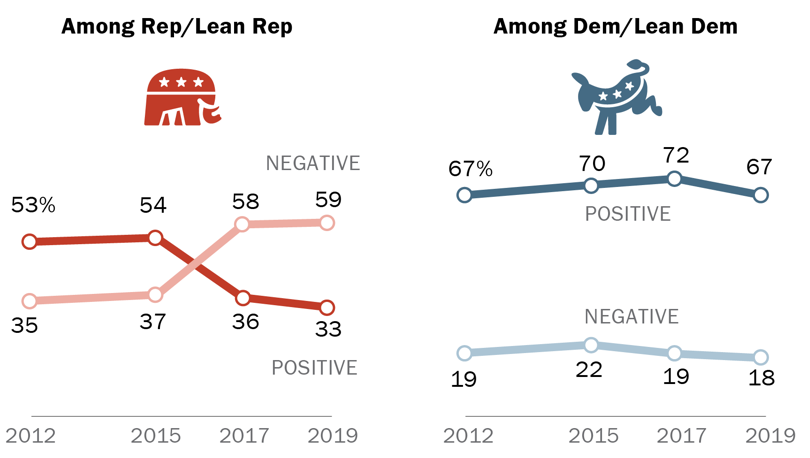
attidues towards college by party_Pew 2019 -party only

While Republicans attack familiar campus targets (critical race theory, “useless” majors, gender studies), criticisms and open fear about higher education aren’t restricted to partisanship. Few of these are new, especially the widespread dread about student debt. Anxieties around published tuition figures receive plenty of media play, as do account of extremely high amounts of loans, way beyond the media, which is circa $30,000.  Published tuition is roughly twice what people actually pay on average, as I’ve been saying for years, but academia’s practice of tuition discounting is largely invisible.

Beyond debt and politics, there is also the sense that some jobs can take workers to the middle class without much or any college experience. We can point to popular advocates  for such work, like Mike Rowe and Matthew Crawford.  They indicate jobs where workers are especially in demand, and were so before the so-called Great Resignation, such as woodworking or plumbing.  The current American labor market is very good, with unemployment now standing at 3.6%. This may encourage employers to withdraw college degree requirements from job applicants.  As a Washington Post article observes:

While the pandemic labor shortage has prompted more employers to welcome applications from workers without degrees, workforce advocates have been pushing back for years with some success against so-called degree inflation triggered by the Great Recession.

This represents a shift from the past decade and a half:

When the economy tanked in 2008 and millions of laid-off workers began competing for scarce jobs, employers got pickier about who they hired and increasingly added four-year degree requirements to some “middle-skills” jobs that had frequently been filled by workers without degrees. (Middle-skills jobs, which include positions in fields such as health care, IT and sales, require some training or education beyond high school, although not necessarily a B.A.)

This needs some more detail.  A recent Gallup poll showed large numbers of parents expecting their children to enter the workforce right out of high school.  They split over attitudes towards those children entering college:

About half (54%) of parents of children between the ages of 11 and 25 said that if there were no limitations on their child’s opportunities after high school, they prefer or would have preferred their child pursue a four-year college degree. An additional 8% would prefer their child earn a two-year degree. The remaining 38% said they would prefer their child pursue an option other than higher education.

Let’s look at that 54% and break it down a bit. Gallup slices the group by politics, educational attainment, race, and geography:

Gallup American parents attitudes towards college for their kids 2022

Again we see a deep political split, with under half of Republicans and independents – i.e., a majority of Americans – wanting college for their kids, while a solid major of Democrats do. Republicans and independents are also much more excited about non-college alternatives:

Gallup American parents attitudes towards college -by party 2022

We also see higher ed as a self-reinforcing, self-reproducing loop, with adults who have degrees significantly more likely to want more of that for their kids than those without.

Perhaps something similar is happening with geography, as suburbs become more stocked with graduates, while the countryside fails to do so. Note, too, the strong racial breakdown, with black families far ahead of other races (notably absent from the report are Asians, though).

Yet return to the passage we quoted. Just over half of parents would prefer college for their high schools – if there were no limitations!  If we assume those limitations include money, that’s a huge finding. Think about the 46% who, even given that huge “if,” would like their children to do something else.

Some of the latter feels like pent-up demand for options:

The study also reveals that while 84% of parents of current students would be “satisfied” to send their child to college or a technical training program, 45% said they wish there were more options available to their child.

That’s nearly one half who want other avenues. What other options might those be?  And if they don’t appear, does this mean support for higher ed is not very deeply rooted?

That’s a large number of people who might be interested in new social movements or institutions.  Think about new religions, intense political groups, climate change activist groups, and more.

And community college continues to poll badly: “Eight percent of all parents said they would prefer their child attend a two-year or community college over any other pathway, including four-year college…”  There’s an interesting racial dynamic there, even a contradiction:

Parents of White children were more than twice as likely to prefer two-year college for their children as parents of Black or Hispanic children. However, national enrollment statistics show that Black and Hispanic undergraduates are more likely to begin their postsecondary education at community colleges than White students.

Remember Gallup’s big “if”, removing all obstacles?  They asked parents what those obstacles where.  Finance led the way, unsurprisingly.  Beyond that – well, things became more complex, when decomposed by race:

Gallup American parents attitudes towards college -obstacles 2022

There was no statistical difference between the likelihood of Black, Hispanic and White children facing financial barriers to their parent’s ideal postsecondary pathway; however, parents of Black children were twice as likely as parents of White children to say that a lack of information or availability is a barrier to their child.

The preceding describes parental attitudes, the object of the survey.  Gallup didn’t poll their children this time, but did find an important detail when asking what kids actually did:  “about one-third of children whose parents want them to attend college do not do so.”

I would add to these work-based concerns the possibility of some people avoiding both work and higher education, because they are doing care work at home.  Some are full time parents, of course, although that number declines with the number of children. Others are doing elder care, as the senior population grows.  How many are devoting time to caring for family members stricken by Long COVID?

Furthermore, how many people have exited both school and the labor market because they’re suffering from Long COVID? Physical and mental debilitation blocks participation in both.

All of the above is only partly prospective. Would-be students are already voting with their feet.  After a long enrollment boom from the 1980s through 2012, the number of students taking classes has declined every year.  We’re down more than 22% as of spring 2022, according to National Student Clearinghouse data.  I offered the peak higher education scenario in 2013 and we’ve been living it every year since. As I’ve said before, if America is still committed to increasing post-secondary experience, we’re failing.  It may be that the old consensus of more college for more people is shattering all around us.

University of Student Loans on car

There is also the possibility of generational experience having an impact.  I’m not a fan of the Strauss-Howe model of strong generational differences and determinism, but it is clear that certain experiences at certain stages of life can have a profound impact. Here I’m thinking of Gen Z, whose life experience includes the 2008 financial disaster, not to mention the 2020 economic spasm.  It also includes the highest sticker prices for universities and the highest amounts of student debt. For them the inherited consensus, that higher ed is a ticket to a better life, might not be so convincing as it was for their elders.

If we take all of these ideas and developments together, we can see the “college for all” consensus fraying. If they persist and that consensus falls apart, what might replace it?

3: Signs of an emerging higher ed consensus

What might a new consensus about American college enrollment look like?

I think it would echo some historical attitudes, with some 21st century twists.  Higher ed is great and appropriate for certain populations, but not for others.  The wealthy and/or highly educated should send their kids to universities. Those who want to pursue degrees requiring advanced degrees (law, medicine, some STEM), ditto. People looking for some STEM jobs (life sciences, engineering; not necessarily computer science) should obtain a BS. Those seeking some technical jobs: an associates’ degree makes sense.

Who shouldn’t go? Those looking ahead to a career which won’t pay well enough to address hefty student loans.  Those without a clear future path and the means to explore it through post-secondary schooling. People with an evident aptitude for hands-on trades. People demonstrably gifted in the IT world.

Most of the above assumes Americans think of higher ed in terms of the marketplace.  Will we go beyond that mindset and agree that college has important non-career-related benefits? That is, will we support the ways post-secondary schooling expands minds, improves multiple literacies (textual, cultural, digital, etc.), enhances civic engagement, and above all instills critical thinking?

I’m not sure.  On the one hand there seems to be broad interests in these desiderata. Perhaps we’ll see the larger neoliberalism consensus shatter and Americans turn to a more community-oriented mentality, a la the New Deal, in which case we’ll support the public (as opposed to private) good of more people going to college.  On the other hand, we might not agree that the college experience is the best way to obtain them. I could imagine a chunk of the population arguing that such is the job of K-12 and public libraries, and we should focus on improving those schools instead of sending more people to college. I can also see people wanting us to become more broad-minded, more literate, more civically inclined, more critical through some online… something. (cf people who argue against libraries, because ebooks exist)

We could see a strong political divide. One goes to college as an assertion of progressive or liberal politics, or affiliation with Democrats.  Another avoids higher ed to express their conservative/right wing/Republican bona fides.  This applies for students.  Family members and officials may follow suit in how they advise would-be students to act.  “If you really care about social justice, you should go to college.” “If you want to show your support for entrepreneurship, you don’t need that university.”  If the political divide worsens into active unrest, violence, or something more dire, identifying college with politics may well become more intense.

We could also see the popular attitude segment still further.  If we follow post-2000 gender trends, we might see college as a fitter place for women than for men.  Americans’ obsession with crime might lead to arguing against incarcerated people or people who have been convicted of an offense taking classes. Racism could, of course, drive a sense that black people don’t need so much post-secondary experience, perhaps under a “diet racism” cover or perhaps more openly.  We could also, on a related note, hear calls for people not to attend college in order to have more children, as the demographic transition continues.

Or, in a popular phrasing:

Tired: college for everyone

Wired: college for some

NB: in case it’s not obvious, I am not endorsing this potential consensus. I am describing it.

4: What does this mean for American higher education?

If that consensus is falling apart, one possibility is that our society continue to divide – socially – by academic experience and attitudes, along other measures.  The party divide outlined above is stark and to some extent self-reinforcing. So we could well see the academic population being more Democratic-ish than it is now.  Going to college will become an increasingly political act.

If we collectively, unevenly, overall decide that we don’t need more college for more people, that depresses enrollment.  Which, of course, depresses revenue for the supermajority of colleges and universities.

Academia would have to try harder to get our story told.  That might mean hiring more outreach and communication staff (which can irk those concerned about “administrative bloat”). It might involve supporting faculty and staff acting as public intellectuals, showing the world the strengths of higher education. It would entail better lobbying with state governments and the feds.

Part of that story will be political.  Will campuses want to reach out to independents and Republicans, marketing themselves accordingly?  Or will others double down on a form of progressive/social justice/Democratic signaling?

Along that line, will campuses focus on the climate crisis in part as a way to win students from a shrinking pool?  As the crisis deepens and – hopefully – more people are engaged with it, a college or university’s commitment to climate mitigation and adaptation might be a strong selling point.  Taking the opposite view may also win some students.

Summing up: this is one possible future, a scenario or forecast. It might not happen, and I’m thinking of ways for the old consensus to resurrect itself.  It may also transpire in forms I didn’t outline here.

If this successor consensus comes to pass, and America throttles back its desire to send ever greater numbers of people to college, it will have deep and extensive implications for higher education.

As always, I write to hear your thoughts.  Please comment and reflect.

EDITED TO ADD: Denise Levens wrote many thoughts on this Twitter thread:


(University of Greenwich photo by Rapid Spin. Thanks to George Lorenzo for conversation – his newsletters are great, like this one. Many thanks to my thoughtful Patreon supporters! Thanks to friends for conversation on Facebook. Thanks, too, to folks on Twitter who answered my question: Susan Blum, Kat Bailey, Karen Costa, Alex Usher, Chelsea O’Brien, CyberGriffin, Vincent Briley, Paul Henley, Zak, Barry Dahl, Cesar, Robert Kelchen,  S Barcinas.)
Posted in future of education, scenarios | 13 Comments

Chat waterfall: one videoconferencing practice

How can we conduct webinars well?

Over the past two years I’ve seen and used many strategies and practices. One unusual technique has appeared, one for getting webinar participants to write in a certain way in a chat box. I found it charming and entertaining, and wanted to note it here as one tool in the videoconference toolbox.  I’d also like to see what folks think, especially those who have used it.

The thing is simple. A facilitator asks everyone to start writing in response to a prompt – but not to hit “enter” until a given signal, whereupon everyone hits return simultaneously.  The chat box suddenly fills up. A canny facilitator quickly identifies and celebrates fine responses.

What is this technique called?  I’ve heard various names, but found no consensus, so I asked around on Twitter and Facebook.  I was impressed by the wide range of replies and the imagination they showed. Here are some the responses, with credit to individual respondents, linked when linkable:

1-2-3-Go (Kimberly Sagarin, Thomas Tobin)

321 (“referring to the countdown when everyone types return,” writes Monica Van Dieren, Thomas Tobin)

avalanche (Scott Meyer, Joshua Eyler)

chat blast (Sara Brownell)

chatmospheric river (Megan Barker)

chatslam (Brett McCollum)

chatstorm (Stephanie Doscher, Naomi Uman)

chatterfall (Bethanie Morrison, Torrey Trust, Melissa Beers, Terry Greene)

chatterfloat (Autumm Caines)

everybody writes (Neil Mosley)

hot lava (“there’s a volcano of ideas brewing and they all erupt in the chat flowing like hot lava,” according to Christina Ragan)

infinite monkeying (Ken Usman-Smith)

Mad Tea.  Learning Moments has a graphic about it, and they sourced the term and concept to Liberating Structures: (The Center for Project-Based Learning at WPI)

Mad Tea infographic

popcorn (Karen Bellnier)

ready set go question (Derek Bruff)

think-share (Melissa Wong)

waterfall (Joshua Eyler, Robert Talbert, Jessica McKee, Ernie Perez, Clint Lalonde, Thomas Tobin). I also wondered about the Spanish language equivalent.

word cascade (Trevor Griffey)

Zoomchatchaos (Lisa Beach)

There may well be other names.

Besides the name, how do you use this chat-chaos-storm practice?  To be clear, I haven’t used it myself as a facilitator or presenter.

Debra Berke describes her method of hosting one such blast, then “ask[ing students] to note similarities and differences in responses.”

Sara Brownell advises “asking folks for a limited number of responses (yes or no, a/b/c/d) so you can quickly skim.” [I think this means a limited number of words in each response.]

Melissa Wong describes her method:

Candace Sleeman uses it for polling, a bit like Sara Brownell’s practice:


So if every participant behaves, and nobody jumps the gun, the result is something like a secret ballot, at least until all entries appear.

Now, I said I appreciated the waterfall etc., but not everyone does, which is one reason I wanted to blog about it.  Here’s Jim Luke’s critique:

https://twitter.com/econproph/status/1539723131740372998

He sees it as messy and more:

https://twitter.com/econproph/status/1539983238432755713

Joe Murphy observes that a chatblast can be more of a stimulus than a real discussion.  Joe also compares chatterfall to word clouds.

lmockford points out that poor bandwidth can wreck any such exercise.

Reflecting on these pro- and anti-chatchaostormfall views, I think we can see some emerging practices for certain practitioners and situations.  It can work as a quick poll, as a discussion prompt, and as a way to shake up or invigorate a quiet group.  Doing so well means avoiding the problems pointed out above.

Have you experienced this, either as facilitator or participant?


Posted in teaching, videoconferencing | 11 Comments