-
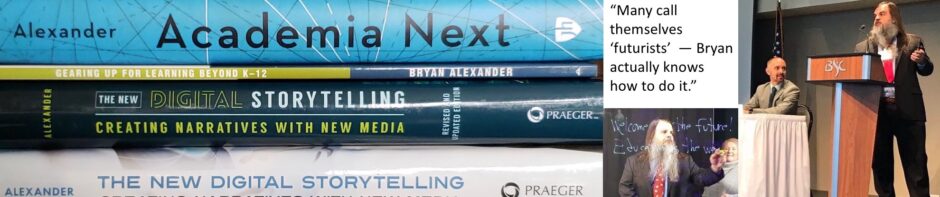
Many call themselves “futurists” — Bryan actually knows how to do it.
Bryan Alexander is perhaps higher education’s most prominent intellectual provocateur.
–The Chronicle of Higher Education
One of the most creative and perceptive people in higher education today!
Is @BryanAlexander a wizard because he wrote about the possibility of a pandemic in 2018? He says he has a beard like one.
“Hardest working man in edtech!”
Gotta love @BryanAlexander‘s ability to catalyze a conversation without leaning on hyperbole or triggers.
This is so well-structured and thoughtful that it almost made me forget I was terrified while reading it.
When @BryanAlexander is futuring about you, you’d better start futuring yer own dang self!
Your prescience is wild.
[F]uturist and higher-ed guru Bryan Alexander…
Flickr Photos
Recent Comments
- MD Viewer on The Inflation Reduction Act and higher education: open thread
- sibyledu on American views of higher ed decline, once again
- sibyledu on Health Care Nation, a 2026 update
- Brent Anders on Health Care Nation, a 2026 update
- Hearts Game on Undergraduate completion rates stabilize; one third of students don’t finish college in under six years
Subscribe via RSS
Categories
- About
- automation
- blogging
- book club
- bookstore
- Bryan Alexander Consulting
- cheer
- classes and teaching
- climatechange
- copyright
- coronavirus
- DEI
- demographics
- digital literacy
- digitalstorytelling
- discussions
- economics
- education and technology
- enrollment
- FTTE report
- future of education
- Future Trends Forum
- futures
- gaming
- higher education
- horizon scanning
- humor
- interviews
- K-12
- liberal education
- libraries
- literature
- movies
- personal
- podcasts
- politics
- presentations and talks
- professional development
- readings
- research topics
- reviews
- scenarios
- services
- sf
- speaking
- storytelling
- strategies
- teaching
- technology
- travel
- trends
- Uncategorized
- videoconferencing
- visualization
- web3
- writing
Meta
Tag Archives: Putnam2015
Concluding Robert Putnam’s _Our Kids_, asking “What is To Be Done?”
Today we finish up our online reading of Robert Putnam’s new book, Our Kids: The American Dream in Crisis. The book’s final chapter reflects on the problems diagnosed so far, and asks simply, classically, “What is to be Done?” As with … Continue reading
Reading Robert Putnam’s _Our Kids, chapter 5, “Community”
Let’s continue our online reading of Robert Putnam’s new book, Our Kids: The American Dream in Crisis. In this chapter we change focus from individual families and schools to broader social networks, addressing “Community”. As with previous chapters I’ll summarize its content, … Continue reading
Reading Robert Putnam, _Our Kids_, chapter 4, “Schooling”
Let’s continue our online reading of Robert Putnam’s new book, Our Kids: The American Dream in Crisis. In this post we move on to chapter four, simply titled “Schooling,” a topic central to this blog and my work. As with … Continue reading
Reading Robert Putnam, _Our Kids_, chapter 3: “Parenting”
Let’s continue our online reading of Robert Putnam’s new book, Our Kids: The American Dream in Crisis. In this post we move on from families to child-rearing, with chapter three, “Parenting”. As with previous chapters I’ll summarize its content, then offer some reflections, … Continue reading
Robert Putnam, _Our Kids_, chapter 2: “Families”
Let’s continue our online reading of Robert Putnam’s new book, Our Kids: The American Dream in Crisis. In this post we move on to chapter two, simply titled “Families.” As with chapter one I’ll summarize its content, then offer some reflections, … Continue reading
Robert Putnam, _Our Kids_, chapter 1
With this post I kick off an online reading of Robert Putnam’s new book, Our Kids: The American Dream in Crisis. Today we start with the first chapter, “The American Dream: Myths and Realities”. buy silagra online buy silagra no prescription … Continue reading
Reading Robert Putnam, _Our Kids_, together online
Last week I mentioned wanting to read Robert Putnam’s new book, Our Kids (Simon & Schuster, 2015). That’s because it’s an important, attention-winning new work, and because it bears closely on inequality and education issues I’ve been examining. So let’s read … Continue reading


