The end of Roe and what it might mean for American higher education

I do appeal to educators across the nation to think, seriously and urgently: With the landscape for women’s reproductive rights changed, what will your institution do to prevent the erosion of women’s hard-won achievements in higher education?

–Jo Ellen Parker

This morning the United States Supreme Court ruled against Roe v. Wade, the 1973 decision which legalized abortion for the nation.

I have many thoughts and reactions to this. I view this Dobbs decision as a disaster for America, especially for women.  As someone who’s always been pro-choice, many of those thoughts and reactions involve swearing. I have also spent the day supporting my outraged family, while trying to help as many friends as I can. We are planning next steps of various kinds. I have also been trying to share helpful information online.

(Information: Wired has a post-Roe resources article.  We Won’t Go Back hosts a map of planned, upcoming protests. Amnesty International USA offers a web page to help you easily create letters to governors, as well as a community organizing service, I think.  And Jia Tolentino has a rich, impassioned, powerful, and sobering article.)

Now, in this post, I want to do something else. I’d like to contribute what I can to the crisis. I’m not a lawyer, nor a medical professional, nor a politician. What I am is a futurist, with knowledge of colleges and universities.  I’d like to bring those forecasting skills to bear, and try to get people thinking about one particular part of the problem: what the end of Roe might mean for higher education.

Caveat: this is a post written in haste, in response to a rapidly emerging situation. It does not mean to be definitive. Instead, the goal here is to offer some initial forecasting attempts, and to spark discussion.  I hope to learn from people’s responses.

1: EMERGING CONTEXT

First, to explore that question requires sketching its emerging national context, and that seems likely to involve a strong political division of states. Already a number of states have issued laws which ban or otherwise restrict abortion severely. At the same time other states have reaffirmed their support for women’s access to reproductive care.  This divide has strong red versus blue culture war divides, of course:

abortion divide of states AP 2022 June

Note the purple states.  They might not take steps at that level. Some, such as Virginia (where I live) are not clearly Republican or Democratic in terms of overall political settlement.  For now, these are potential battlefields. This leaves us with three groups of American states.  Extrapolating, we could imagine that tripartite division hardening over the next two years as governments and activists fight for their respective sides.

Those states don’t exist in isolation from each other, of course. State governments may try to extend their anti-abortion policies and practices to other states, and some have already done so. This can involve trying to block shipment of abortion-related medication or personal travel across state lines.  The Texas abortion vigilante law has national scope.  Attempts to use digital data for surveillance (cf the Tolentino article, linked above) tend to involve technology providers based out of state.  Clearly this interstate dimension is a realm for further struggle.

The post-Roe political landscape also includes cities.  We should expect some cities to line up with their states on abortion, as we’ve seen with New York City’s mayor proclaiming his support for women’s right to choose.  The opposite should also occur, with pro-life city governments aligning with pro-life state governments.  Yet we should anticipate splits between municipalities and rural areas versus their capitals, given the contentiousness of this issue and the variety of America’s political culture.  Imagine, say, Austin trying to defy Texas, or eastern Oregon opposing Salem.

Back to the federal level – and here I must hesitate, not being a lawyer, so take this paragraph with a big heaping of salt, but the ruling against Roe‘s privacy argument can open up further rulings against other decisions and laws which also rest on privacy. We should expect pushes to restrict a range of LGBQT+ rights, racial minority protections, and more. These could remain at the state level, continuing the divide mentioned above, or rise to SCOTUS decisions at the national.

It seems likely that national, state, and local abortion struggles will continue for the next year and more, which carries them into the 2024 national election cycle.  Depending on how that turns out, the winners sworn into office in early 2025 may have the power to seriously revise national and state abortion policies – i.e., a Democratic party victory could see an effort to return to Roe in some way, while a Republican win might see national anti-abortion laws seriously considered in Congress.

The politics around this intensified abortion struggle can play out in many ways.  Historically, as least since the 1970s, they have included peaceful protest, armed assault, political organizing, terrorism, cultural artifacts, and more.  Perhaps this struggle will expand, even becoming more violent.  Today president Biden called for all sides to be peaceful, but for pro-choice people to aim their energies at November elections.  Maybe we will collectively heed that call.  I’ve forecast scaled up unrest previously, since 2008, yet reality has tended to not follow suit.

In this context, far too quickly sketched out, colleges and universities will continue to operate and academics consider how to respond and act in a post-Roe world.

II: HIGHER EDUCATION AFTER ROE

How do the complex systems of individual campuses intersect with this legal development and all of its effects?  How does the end of a national abortion right impact the trends shaping higher education?

The indispensable Jo Ellen Parker gives us key themes to work with.  We can start with enrollment. Students who can’t access abortions are more likely than others to drop out of classes or not enroll:

One predictable consequence of legal bans on, or restricted access to, abortion and possibly contraception will be reduced educational attainment for women faced with unplanned pregnancy and parenthood, injured by illegal abortions, or prosecuted and convicted for terminating a pregnancy.

Research clearly shows that when women can choose how to manage their reproductive lives they are more likely to stay in school and earn degrees. For example, only one-third of student parents enrolled in college complete a degree within six years, compared to one-half of non-parent students.

To the extent that post-Roe state policies prevent women from exercising their right to abortion, the numbers of women will likely decline.  This may start in high school. This is a blight to individual lives and careers.   Low-income women are more likely than their peers to be hit by abortion restrictions, as three sociologists argue in Inside Higher Ed.  Poor women of color, even more so.

It may also depress total enrollment for some institutions, which will have the costs I’ve outlined elsewhere.  As Parker notes, this is a historical change:

Let’s be clear: The sharp increase of women’s participation in higher education in the last half-century has been socially and economically transformative for women, families, and communities.

It came about largely as a result of allowing women to exercise their reproductive rights.

Will we see women’s numbers drop to male levels? (Women outnumber men in higher ed classes by about 3:2 now.)

Enrollment may change further as a result of the Roe decision as students consider where to attend college. How many women will look out of state to avoid local abortion policies?  How many will shun colleges and universities in states mandating reproductive laws the students abhor? Perhaps student applications will align with their abortion politics.  And if the majority of would-be students are pro-choice, will campuses in pro-life states see applications and enrollments drop? As Janet Koven Levit writes, “Prospective students will pause before deciding to live in a state where the legislature radiates an almost obsessive hostility toward women’s reproductive-health-care choices.” From a Teen Vogue article:

“If a state does not tell a young woman that they are entitled to terminate a pregnancy after a rape, I’m not sure I’d be spending my money on education in that state,” [former United States Senator Claire] McCaskill tells Teen Vogue. “It will be interesting to track enrollments at colleges in these states.” McCaskill notes that Washington University in St. Louis “attracts some of the brightest minds in the country.… I wonder how many of those graduates would reconsider staying in Missouri because of what has been created by officeholders with extreme views…”

Similarly, Neil Gluckman mentions that faculty hiring (and presumably retention) could be hit, if colleges and universities have a harder time attracting people to positions in states with strong abortion laws.

On another level, Jo Ellen Parker reminds us that an uptick in pregnant students on campus has costs for that institution:

Women facing unwanted pregnancies who hope to stay in school need specific, and frankly costly, support. If they become parents, these students typically need additional financial aid to support the costs of tuition and a growing family if they are to stay in school. Otherwise, they must sacrifice their long-term educational and earning potential to meet immediate financial needs. They also need reliable, safe, and affordable child care, of course. They need flexible schedules and advisers trained to help them integrate their parental and educational priorities…

Those who become pregnant but do not wish to become parents also need supports to stay in school, including counseling; those damaged by illegal or amateur abortions need medical and mental health care and potentially now legal services.

We need to plan on that increasing level of support now.  And not all campuses are in a flexible financial position to do so easily.  It won’t be easy.

Moreover, academic institutions may face conflicts between individual staff, faculty, and students’ decisions and the policies issued by those institutions and the governments they’re subjected to.  Consider the range of potential friction points:

Another set of issues emerges when conflicts arise between caring for students and complying with the law. (This is not an unfamiliar conflict to educators, who can face similar challenges around student alcohol consumption and undocumented students.) Each institution, in light of its own mission and circumstances, will face wrenching questions.

Will its student peer advisers be prevented from sharing information with fellow students about abortion services and resources? Will its health services? Will its counselors, protected by confidentiality, be able to share information about reproductive health care in their patients’ best interests as they see it? How will the inevitable protests and activism emanating from campus women’s centers be met? Under laws such as that already in effect in Texas, will colleges and universities encourage or forbid staff from reporting students known, or suspected, to have sought an abortion?

Let me add to that list challenges for campus technologists. How will they respond when, say, a pro-life state government issues requests for student, staff, and faculty data?  As Tolentino argues, dataveillance is now a key part of the abortion struggle:

In the states where abortion has been or will soon be banned, any pregnancy loss past an early cutoff can now potentially be investigated as a crime. Search histories, browsing histories, text messages, location data, payment data, information from period-tracking apps—prosecutors can examine all of it if they believe that the loss of a pregnancy may have been deliberate. Even if prosecutors fail to prove that an abortion took place, those who are investigated will be punished by the process, liable for whatever might be found.

How will a chief information officer respond to a query to find data along these lines?  How might every person in the request chain respond, down to the support techs working with individual machines?

On the flip side, how many academics will use technology to further women’s access to reproductive care?  One option for people needing such care may be telemedicine. Another would be to use blockchain technologies to secure funding and information. Would campus IT face ethical challenges, caught between pro-choice users of such tech and a pro-life government?  These campus technology conflicts could occur across the nation.

Tensions may also occur within the two primary domains of higher education, teaching and research.  As Neil Gluckman pointed out in May, health care and public health curriculum may be impacted: “Medical schools could be left puzzled about what they’re allowed to teach.”

Pamela Merritt, executive director of Medical Students for Choice, worried about doctors-in-training who wish to learn how to provide safe abortions for their patients. Merritt said her organization’s first goal will be to press medical schools to be clear on whether they teach abortion training, so students can make informed decisions.

“It is legal, ethical, and necessary that they incorporate abortion education and training into their curriculum,” Merritt said. “Teaching about abortion and even training when it is on an apparatus, when it is in a classroom setting — that’s legal whether abortion is illegal or not.”

Within the domain of teaching, it should surprise nobody if a new wave of student activism breaks forth. As ACE official Terry Hartle predicts,  “A lot of students will be very unhappy that something they believed to be a fundamental right is being taken away from them.”

Another source for potential friction is academics speaking out about Roe and what comes next.  We know from a generation’s worth of Web experience that faculty, staff, and students can express themselves online in ways which irk their administrations.  There is plenty of room for campus populations to write, speak, and otherwise communicate abortion positions and observations that will raise challenges.  These utterances may occur, or be aimed off-campus, such as on Facebook or Tiktok, as well as on campus grounds and infrastructure.

Such discussion is already occurring, unsurprisingly.  Michigan State University quickly hosted an exchange of views between various faculty (from law, philosophy, and politics) and some administrators about the issue. University of Tennessee law professor Glenn Reynolds blogged his take on the decision soon after its publication. Faculty in the University of Washington’s School of Public Health issued (I think) a joint statement.  FIRE reports on one university investigating a student Zoom chat (I think) for potential harassment charges during a heated discussion of abortion.  Back in May students at some institutions marched and issued pro-choice demands.

Will institutions take public positions in favor of or opposing abortion rights?  There will be pressure to do so from parts of each academic community.  Individual university and college leaders may feel that they must do so for their own reasons of conscience, religion, or politics. Michigan State University’s president issued a firm statement in favor of “reproductive health care [a]s a basic human right.” Perhaps public institutions in strongly pro-choice or pro-life states will sense they have some room to make a properly aligned proclamation, or even feel politically encouraged to do so.

Beyond position statements, institutions themselves may try to avoid, defer, or otherwise deflect local political decisions on abortion, now that the Supreme Court has devolved those choices. The University of Michigan has already started up a task force to support its women in case Lansing enforces its century-old abortion ban. An Oberlin College doula group started planning on expanding services for the community.  Southern New Hampshire University’s president LeBlanc offered this support to their faculty and staff:

Against these tendencies is, of course, academia’s long tradition of trying to be apolitical. (Here’s one argument.)

Will there be boycotts?  One NYU historian urged colleagues to avoid professional work in anti-choice states:

https://twitter.com/historianess/status/1540382253150257152


How many professional groups will make such a decision?

Things can go beyond boycotts, rhetoric, and task forces. They always have that potential. We should consider the possibilities for unrest. Violence is also possible. Historically, campuses have sometimes hosted physical attacks. We could imagine, for example, academic anti-abortion activists organizing on campus for a bomb attack on a nearby clinic or to attack a pro-choice speaker.  Or the opposite, with pro-abortion activists among students, faculty, and staff mobilizing at their institution to go after a pro-life march or a fake clinic. Recruiting, planning, demonstrating, practicing – colleges and university may see such occur.

All of these possibilities would take place in an academic world already reeling from the past two+ years of a pandemic and political corrosion. So many students, faculty, and staff who are now responding to the Dobbs decision are already drained, exhausted, anxious, or traumatized by recent history. Many are not ok, as the saying goes, and now they face another historical quake.  How much more suffering and burnout will result?  To what extent will the end of Roe make it even harder for academics to do their work?

There are other dimensions to this development.  Other possibilities lie ahead. I’ll stop here, because this is long enough, and I have a lot of work to do. There are people to support.  In the meantime, please let us know what you think this Supreme Court decision will mean for higher education in the comments.  Do any of the preceding potentials resonate? What else should we bear in mind?
Posted in enrollment, future of education, politics | 9 Comments

Reading the new IPCC report: mitigating climate change, continued

What impacts will climate change have on the future? What do they mean for higher education?

Today we continue our group reading of the new IPCC report, focusing on the Impacts, Adaptation and Vulnerability document produced by Working Group III. Specifically, we’ll dive into the Technical Summary, which is an expansion of last week’s Summary for Policymakers.

Also, on May 26th we hosted a video conversation on the topic!  The Future Trends Forum held its first book club conversation:

We’ll begin today with a summary of the high points, then outline some first implications for higher education, and conclude with questions.

(For more info on this reading, click here. To look back at the previous installments of this series, click here and here.)

IPCC 2022 cover working group III

The IPCC divides this document into six parts.

1: Introduction

The report emphasizes that it includes new data, science, and approaches generated since 2014.  It argues for closer links between climate change mitigation, sustainable development, and social justice.

buy fildena online buy fildena no prescription generic

2: The Changed Global Context

Here the IPCC notes major changes since the last report, in 2014: rising interest in climate action; growing signs of the crisis, including the addition of more greenhouse gases to the atmosphere; the 2015 Paris Agreement actually issuing national climate targets; progress in alternative energy technologies.

The report then makes the case for climate action to integrate with the United Nation’s Sustainable Development Goals (SDGs).  Further, the document calls for climate action to not only occur across multiple domains (financial, technological, social, etc) but to involve complex, broad-based governance.

(Check pages 9-11 for a table of improvements balanced by challenges, a classic good news and bad news story)

3: Emission Trends and Drivers

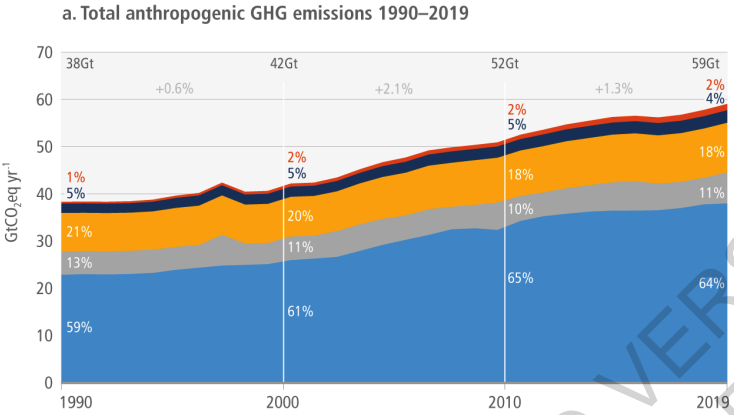
Here the IPCC summarizes the best current science about greenhouse gas (GHG) emissions. All GHGs continue to grow, led by carbon dioxide and methane, although the rate of growth is less than it was in the earlier 21st century.

buy tadacip online buy tadacip no prescription generic

IPCC GHG emissions 1990-2019

4: Mitigation and Development Pathways

Mitigation – actions designed to reduce global warming – are badly needed, as we are currently on track for “a median global warming of 2.4°C to 3.5°C by 2100″.  The report outlines many ways* to adjust human society and behavior to increase mitigation, then adds that more drastic measures may well be needed: “If obstacles to accelerated mitigation are rooted in underlying structural features of society, then transforming such structures can support emission reductions.” The report frames this in terms of overall development as well as in terms of a “just transition.” Once more, making such changes in line with the sustainable development goals appears.

This section also sees mitigation in the 2020s being so low that things will have to ramp up very much from 2030-2050.  It also offers several different ways we might attempt that, or Illustrative Mitigation Pathways (IMPs):

heavy reliance on renewables (IMP–Ren), strong emphasis on low demand for energy (IMP–LD), extensive use of Carbon Dioxide Removal (CDR) in the energy and the industry sectors to achieve net negative emissions (IMP–Neg), mitigation in the context of broader sustainable development and shifting development pathways (IMP–SP), and the implications of a less rapid and gradual strengthening of near–term mitigation actions (IMP–GS).

Here the report makes a noteworthy call for humanity to implement some form of carbon capture. There’s a specific list of techniques: bioenergy with carbon capture and storage (BECCS), afforestation, and direct air capture with storage.  This section concludes by noting the many benefits humanity can realize by adopting an aggressive mitigation strategy in the short term, including improved health and eventual economic progress.

5: Mitigation Responses in Sectors and Systems

This section – the largest in the report – examines ways different sectors can mitigate the crisis.

Energy: begins with a call for “rapid and deep reductions in energy system CO2 and GHG emissions,” which will likely lead to “stranded assets,” fossil fuel reserves and infrastructure left to economic loss.  In contrast, the renewable energy world represents a massive economic opportunity.  A whole series of technological developments appear, including hydrogen power and improved batteries.

buy eriacta online buy eriacta no prescription generic

Urban and other settlements: most of humanity now lives in cities, with their numbers and footprint likely to grow through 2050. Therefore urban planning and design needs to address global warming thoroughly, dealing with infrastructure (new and legacy), extreme weather, carbon capture, transportation, and informal populations.  Governance is both complex and key.

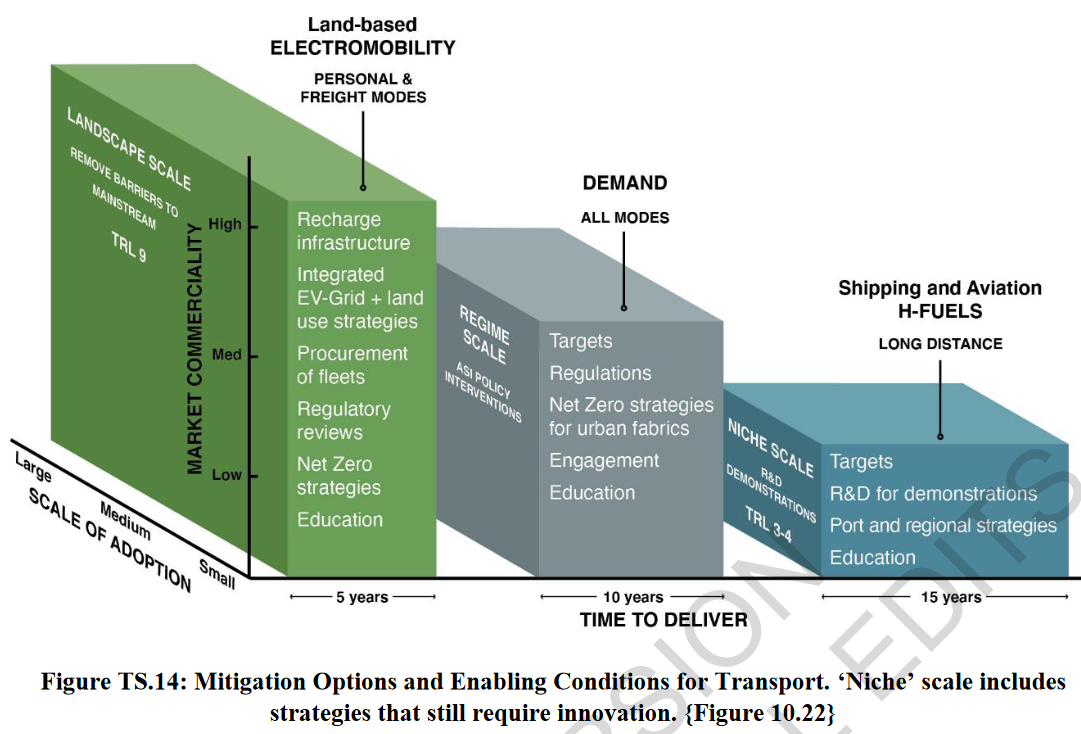
Transport: this section calls for more “electromobility” (electric cars plus scooters etc.) and further research and development into biofuels, synthetic fuels, hydrogen, and more.  There is also praise for “[c]hanges in urban form, behaviour programs, the circular economy, the shared economy, and digitalisation trends.”  At the same time there are issues around governance, labor rights, and mining impacts.

IPCC 2022 transportation options

Buildings: the report reminds us that buildings contribute greenhouse gases through their construction and operation. To stop this, the document calls for a variety of design measures, from maximizing space use to circular use of materials.  Retrofitting buildings is also a good idea.

Industry: extraction and manufacturing business has grown since 2000, and so have its GHG emissions.  Plastic production – deeply reliant on fossil fuels – has also grown.  The report calls for increased energy efficiency, “circular material flows” (re-use and re-purpose of stuff), switching industrial production to electrical power sources, using materials which don’t emit carbon in their production, capturing carbon leakage, embracing new technologies, and more.

Agriculture, forestry and other land use (AFOLU): this domain contributed significantly to global warming, “account[ing] for 13–21% of global total anthropogenic GHG16
emissions in the period 2010–2019
.”  Hence calls for ending forest reduction, for growing more trees, producing more alternative foods (plant-based “meat,” insects, algae, bivalves), and for changing human diets to ones “high in plant protein and low in meat and dairy.”

Each of these can interact with the others.  For example, “Wind and solar power can coexist with agriculture in beneficial ways.”

This section also calls for removing carbon dioxide from the atmosphere through various means, although in very hedged ways. There’s a range listed here, from seeding oceans to expanded forestry to bichar and emerging technologies.  There are many open questions, from how to store captured CO2 to energy inputs.

6: Implementation and Enabling Conditions

That potentially cryptic header refers to “behaviour and lifestyle, policy, governance and institutional capacity, international cooperation, finance, and innovation and technology can accelerate mitigation in the context of sustainable development.”  So this section is how to get people and systems changing.

It includes tactful calls for laws to drive social change along direct (banning CO2 production) and indirect (altering people’s behavior) lines, as well as repeated calls for expanded and improved governance.  There are also recommendations for cities, media enterprises, lawyers, and businesses (especially for carbon pricing and taking subsidies). Overarching is a plea for integrated decision-making, which is understandable, given the problem’s scope and complexity.

IPCC 2022 policies-GHG-technologies

This is just one cut through a few parts of the governance problem.

There are many more enabling conditions and barriers in play. Financing these changes remains below what’s needed.  Intellectual property rights might or might not help.

buy avana online buy avana no prescription generic

Technologies may arrive which disrupt these plans.
 

7: Mitigation in the Context of Sustainable Development

Looking at climate change from a justice perspective also means placing the emphasis on: i) the protection of vulnerable populations from the impacts of climate change, ii) mitigating the effects of low–carbon transformations, and iii) ensuring an equitable decarbonised world…

The IPCC calls for all of the above to be done justly and equitably. They use the United Nations’ Sustainable Development Goals as a way of framing such action.  Actions, rather, and these actions can cut across different directions.  For example, some policies can help SDG and climate goals reinforce each other, while others involve trade-offs between them.  The trick is to mount a wide range of actions – a portfolio – and watch for the connections between them, SGDs, and climate strategy.

What might this mean for higher education?

There are very few direct references to education at all, much less to colleges and universities.  Mostly education appears as part of the SDGs, where the document supports expanded access to and better quality of schooling.

At one point a call appears to “use education and information instruments to shift behaviour,” but this is confined to “(media campaigns, websites).”  More ambitious is this idea for changing schooling as a whole:

Changing from a commercialised, individualised, entrepreneurial training model to an education cognizant of planetary health and human well-being can accelerate
climate change awareness and action.

There we see education (as a whole, presumably including academia) transformed and at the same time transforming society. That’s a bold and enormously ambitious vision.

Beyond that call, we can identify connections between different parts of universities and what the report argues for.  Changing up the physical environment of a campus, for example, ties into changes to nearly every mitigation domain: buildings, cities (urban institutions), transport, and energy.  Implementation and enabling conditions are, first, terrific subjects for research. Second, they provide opportunities for academia-community connections. Third, they leave open opportunities for academics to seek to influence the world, using their intellectual capital.

…and that concludes our run-through. I might post a summary with more reflections, if there’s interest.

*”More than 2000 quantitative emissions pathways were submitted to the AR6 scenarios database“!!

Posted in book club, climatechange | Tagged | 5 Comments

American higher education enrollment declined again, continuing a decade-long trend

Enrollment in American higher education just declined.  Again.

National Student Clearinghouse Research Center logoThat means the total number of students taking classes in American colleges and universities during spring 2022 went down compared to the previous semester (fall 2021) and the prior spring term (2021).  The numbers and analysis just appeared from the National Student Clearinghouse Research Center.

In this post I’ll unpack what the data show, then offer some reflections based on my work as a higher education futurist.  I hope I can add to the discussion thus far.

A couple of caveats before proceeding: first, this is macro, sector-level data. It’s about the entirety of United States post-secondary education. Obviously there will be variations of all kinds between regions, states, localities, and individual campuses.  Second, this is the first published data on spring 2022.  The Clearinghouse usually follows up their initial releases with followups based on additional research. So consider this data provisional for now.

The Clearinghouse report

At the big picture level, “[t]otal postsecondary enrollment, which includes both undergraduate and graduate students, fell a further 4.1 percent or [by] 685,000 students in spring 2022 compared to spring 2021.” [emphasis added]  The total number of students stands at 15,917,249. Comparing this semester to the one just before, “The declines this spring are also markedly steeper than they were last fall, when total postsecondary enrollment declined by 2.7 percent from the previous fall.”

How does this decline play out within different levels of higher education?  Everyone got hit: “Enrollment declined this spring at both undergraduate and graduate levels.”  However, “[u]ndergraduate enrollment accounted for most of the decline, dropping 4.7 percent this spring or over 662,000 students from spring 2021.”  Comparing 2022 to fall 2021, “[u]ndergraduate enrollment is also falling more steeply this spring than it was in fall 2021 (-4.7% vs. -3.1%).”

How did different types of institutions fare? Numbers were not good across the board, as each group lost students:

enrollment 2018 to 2022 springs_Clearinghouse

If we look at campuses by public versus private funding (in the US, “public” means nominally state-funded), the former were hit hardest. “Public institutions suffered the brunt of enrollment declines this spring, losing 604,000 students (-5.0% from a year ago).”

If we break things down by institutional identity, “[c]ommunity colleges accounted for more than half of these losses this spring (351,000 students).”  Worse for that large and underresourced sector, “[f]or a second straight year, community colleges suffered double-digit declines in full-time students, amounting to nearly 11 percent (168,000 students) this year and 20.9 percent (372,000 students) for the two years since spring 2020.”  Note, too, that “[a]t private non-profit four-year institutions, part-time student enrollment dropped this spring (-4.1%), reversing last year’s gains (+2.8%).”

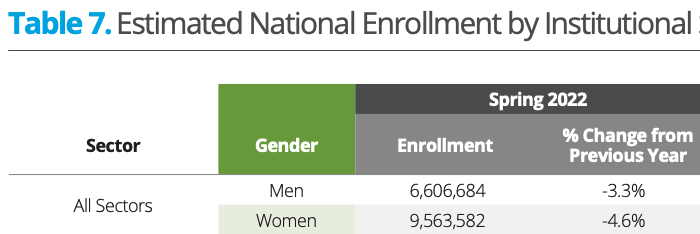
What demographic results does the Clearinghouse offer?  They sliced their data by gender, which shows two things. Women continue to significantly outnumber men, further establishing a twenty-first century reversal of prior centuries.  Meanwhile, both genders saw enrollment declines:

enrollment 2022 spring by gender Clearinghouse

The report didn’t break down the full picture by race. They did analyze the first-year student population this way, however, and the results are mixed:

By race and ethnicity, Asian and Latinx freshmen numbers grew nationally in spring 2022 (+15% and +4%, 1,700 and 2,300 students, respectively). In contrast, Black freshmen declined by 6.5 percent (2,600 students), compounding previous losses for a total of 18.7 percent (8,400) fewer Black freshmen than in spring 2020.

How does the enrollment picture play out by states?  Things varied.  The states losing the largest number include Arkansas (7.1%), Missouri (7.1%), Washington (7.2%), Vermont (7.2%), California (-8.1%), and Michigan (15.5%). Gainers number New Hampshire (8.2%), Colorado (9.0%), and Indiana (10.7%).

(The Clearinghouse cautions that for some of these states, “a large institution had inconsistent data submission across years, making enrollment estimates less accurate. Interpret the data with caution…”  They include Colorado, Michigan.  A similar caution applies to Indiana, whose “[d]ata for 2022 were impacted by reclassification of for-profit four-year institutions.”)

What does this data say about the impact of COVID? It looks like the enrollment drop we suffered during the pandemic’s height continues, even as deaths have plummeted and the country seems to have moved on.

Following a 3.5 percent drop last spring, postsecondary institutions have lost nearly 1.3 million students since spring 2020… As a result, the undergraduate student body is now 9.4 percent or nearly 1.4 million students smaller than before the pandemic.

Community colleges have suffered the worst, “hav[ing] lost over 827,000 students since the start of the pandemic.”

Let me offer another view with some COVID-era numbers from the report, for total enrollment:

Spring 2020  – 17,185,751  

Spring 2021 – 16,586,893 

Spring 2022 – 15,917,249 

Were there any bright spots in the report?  Perhaps. There is one glimmer of potential light having to do with first-year students:

A special analysis of the spring freshmen highlights distinctive pandemic-related enrollment trends. Nearly 340,000 students started college for the first time this spring, an increase of 4.2 percent from spring 2021. However, the growth this spring was not enough to return community college freshman enrollment to pre-pandemic levels, with the current freshmen numbers still running 7.9 percent (17,000 students) below spring 2020’s levels.

Further, primarily online institutions continued to do well. “[S]everal states experienced growth because students enrolling in primarily online institutions based in these states have been increasing…” Not everyone will see this as positive, however. Some deem online learning inferior to in-person, while others criticize some of the institutions involved.

Some reflections

I’ve been tracking this enrollment trend for more than a decade. Every year since 2011-2012, every semester student numbers have ticked down.  COVID accelerated the trend, making the decline more pronounced.

Personally, I am struggling mightily to avoid hollering “I told you so!” Far too many times I’ve been the only person in a room or event pointing this out, and warning people about the futures it might entail.  Also, for twenty years (!) before that (!) I’ve been telling academics to get online and helping them do so. My track record on this gives me a basis to crow from. But it also gives me little pleasure, because the academic realities represent so much loss and suffering. I will hold myself back.

So what might this trend’s continuation mean for higher education’s future?

Financials The overwhelming supermajority of American colleges and universities depend on students for their financial stability, as only a handful are rich enough to draw on fat endowments, and most public universities receive a minority of their funding from their state governments. Students, in contrast, bring in the bulk of dollars through the tuition, fees, room, and board they or their families or external supporters provide. Losing students strikes at the heart of college and university sustainability.

Politically, this makes it harder for public universities to ask their state governments for more money.  “We’re teaching fewer students, and therefore deserve a funding increase” is not the most appealing argument.  Remember that states have massively cut those dollars already, and the politics aren’t great for getting more.

Within academia, a shrinking enrollment scenario may deepen our competitive instincts. This can make collaboration harder to support.  It can also empower administrations to cut.  Plunging enrollment is almost universally cited in queen sacrifices.

Online Note that primarily online institutions did well, once again.  Southern New Hampshire, Western Governors, et al seem to be moving from strength to strength – although Liberty University might not, hobbled by scandals. Will the overall trend encourage more colleges and universities to seek more students online, and/or shrink their in-person footprint?  The “end” of COVID suggests a joyous return to in-person learning, but we’re not seeing that borne out in the sector as a whole.

For-profit resurgence? I am curious about for-profits. Their massive enrollment losses seem to be tapering off. Are they about to return to their early twenty-first century growth habits?  Buried in the data is a sign of their growth:

enrollment 2022 spring by institutional type and age Clearinghouse -for profit boxed

Did you catch that?  Of all American higher ed sectors, the only one enjoying enrollment growth among people 24 and younger are the for-profits.  Their excellent marketing capacity must be doing well.  Will the Biden administration follow the Obama in cracking down on this sector?  Or will we see another for-profit resurgence?

Community colleges They doesn’t get much discussion or media buzz, but this large swath of American higher ed is all about access. They have been suffering since the Great Recession.

Not paying much attention These numbers are actually easy to ignore.  They describe an entire sector, and American academics – Americans in general – don’t usually think in these terms. We prefer to think about a given campus, or a certain discipline/profession, or sometimes of a subsector, like the liberal arts college world. After all, it’s a vast country. Those in states not suffering a Michigan-level plummet can count themselves fortunate. Those working in institutions whose enrollments are stable or even growing can cling to that data.  In other words, a lot of folks who focus on things other than the trend this report bears out.

The mission of more college Starting in the 1960s, American culture began to seriously consider the idea that the nation would be better off with a lot more people going to college. By the 1980s this had become a country-wide consensus, and so a long boom took off.  Yet since 2012 enrollments have dipped and dipped.

Looked at one way, if American higher ed is committed to increasing access to the post-secondary educational experience, we’ve been failing for a decade. Looked at another way, that national consensus may be breaking up right now.  How else to describe so many people voting with their feet and avoiding campuses?

Perhaps we’ll regain that consensus, somehow. At some point either WHO or CDC will declare COVID-19 to be endemic, rather than pandemic, and the people who believe either may joyously send their family members to classes again. The powerful demand for more STEM degrees could elicit students taking those paths for presumably well paying futures. Maybe more campuses will choose to teach adults and elders, as our population ages.  My call for higher ed to prepare the world for the climate crisis might find students who agree. Perhaps America will repair its global reputation for hating immigrants and loving to shoot each other, eliciting a new flood of international students. Perhaps a younger generation, lacking Cold War cultural programming about the evils of socialism, will consider collective good a viable thing. Perhaps.

As a futurist, I try to envision multiple and contradictory futures, so I make room for that one. We could rerun the 1980s and enjoy a new boom. But I also fear the opposite, because lots of forces push hard on keeping enrollment further down. The specter of student debt looms large and isn’t going away. If the Biden administration somehow staggers forward with some forgiveness package, all of the structures which inflated the hideous debt balloon are still operating, so we’ll reach $1.7 trillion again and beyond.  Conservative criticism of education continues to thrive.  The skilled trades beckon, as their workers age up. The consensus could wither away and we return to a cultural sense like we saw in the 1950s: college being a nice thing to have, especially for the deserving. Or the consensus will splinter along culture war lines, and universities become even more of a blue zone, hated by the red.

Sliding down the peak Way back in 2013, when enrollments started to dip down after a generation+ of growth, I first raised the idea of peak higher education.  That scenario meant higher ed numbers would keep declining, and decline they have, every single year since. In the fall of 2011 American higher ed enrolled 20,556,272 students.  Now we just taught 15,917,249.  That’s 77.4% of where we were, a drop of 22.6%.

With this week’s Clearinghouse research, we continue to fit that peak higher education scenario all too well.


Posted in enrollment, trends | 9 Comments

Climate and higher ed: our book club IPCC reading heads to live video

What impacts will climate change have on the future? What do they mean for higher education?

buy silagra online buy silagra no prescription generic

Our online book club has been exploring this question by reading the latest IPCC report.  (For more info on the schedule, click here. To check out each installment of the series, click here, here, and here.)

Today we’re hosting a live video conversation on the topic!  From 2-3 pm EDT the Future Trends Forum will hold its first book club edition. It will be an open discussion.  I will, as needed, share notes from our reading, but the focus will be on what you all think.

Everyone is most welcome.

IPCC 2022 degraded vs healthy ecosystems

Posted in book club, climatechange, Future Trends Forum | Tagged | Leave a comment

Starting up our gaming and education seminar

This week I’m teaching my gaming and education seminar for Georgetown University’s Learning, Design, and Technology program.  I’d like to share my plans for it here.

(This week’s book club post is on its way.  It’ll be the next one.)

The goal of the class is to dive into how we can use gaming in education, with an emphasis on higher ed. Every class meeting focuses on one particular form of gaming (computer, tabletop, role-playing) or an aspect of gaming. We read scholarship on the topic, play one or more sample games, write notes in the class learning management system, and do some hands-on game design work.  I offer a mercifully brief introductory presentation for each one.

Students get to shape some of the class. They develop their own final projects, which are educational games. They collectively determine two class topics, along with how we explore them. And we work together to decide how class sessions should be conducted, online and off-.

This is a very intense and fast class.  It’s only six weeks long, including one national holiday, yet it’s a full semester of work.

Hunter on Ogre board

Steve Jackson Games produced a massive board for Ogre, and Hunter appreciates it.

I’ve taught the class once before, in 2020.  This time I’ve made some changes based on my reflections and student feedback.  Other changes occur because the first version took place during the pandemic, so was entirely online. So far, this summer’s class will be in person, albeit with all of us wearing masks and trying to respect social distancing.  Given the pandemic, there’s always the change of the university flipping the toggle online or ending the mask mandate.

Another change is adding more wiki-ness to the class.  Well, not wiki software per se, but setting up two Google Docs (Georgetown’s enterprise standard) for students and myself to develop during the seminar. One is for keywords, and I’ve been adding some to get us started: role-playing game, zone of proximal development, NPC.  I hope the students will build up terms, definitions, and examples as we go. The other is for reflections on games we play during the class. I’d like it to be a kind of collection gaming journal.

Despite all of this planning, I’m trying to leave open space for flexibility, especially in responding to student interests. I have picked out for game building applications (Storyboard, Twine, RPG Maker, Game Maker) and will see how much of them the students can work with in our short time together.  I may replace some games, readings, and activities along the way. And, of course, we might have to change things as COVID dictates.

Here’s the syllabus. Please note that some readings are not hyperlinked, because they are available to my students as campus digital resources.

May 23 Introductions and into the magic circle

  • introduction to the class: logistics; classroom democracy; cocreating rules of the road; meta design aspects
  • student work, including previous examples
  • introduction to gaming: history and theory
  • game: The Thing From the Future
  • technology: download and install Steam
  • writing in Canvas:
    1. student self-description character sheets
    2. what is your game persona’s D&D alignment (This quiz might help.)

May 25 Tabletop gaming

May 30 – Memorial Day

June 1 Role-playing games

June 6 Computer gaming

June 8 Education and gaming, 1

June 10: final project pitch due

June 13 Education and gaming, 2

  • reading: James Paul Gee, What Video Games Have to Teach Us About Learning and Literacy, (71-219).
  • writing in Canvas: responses to readings
  • games:
    1. Bondbreaker; Waterworks!
    2. Reacting to the Past

June 15 Gaming and design

June 20 Design for education and gaming

June 22 Storytelling and games

June 27 Student topic pick

June 29 Student topic pick and final project presentations

July 8:  final projects due

Posted in classes and teaching, gaming, teaching | 1 Comment

So you want to create an online class independent of a school

What’s the best service or tool for creating and hosting an online class by oneself?

A client asked me this question last week, and I really didn’t have a solid answer ready to hand, since most of my work to date has involved institutions.  So I started asking around, bugging individuals and querying social media. The results fascinated me. They also appeared in different places, so I thought it might be useful to aggregate and share them here, in one spot.

A little background: the person asking me this is not affiliated with an educational institution at the moment, so they can’t relay on campus resources, nor use a .edu email address.  They want to create a learning experience to introduce people to a topic they’re passionate about.  There may be professional development angles to pursue, too.

So how would one do this, building and rolling out a class on your own? My instinct is to whip up a WordPress instance and go from there, but the client doesn’t necessarily have experience with that platform.

Here are the suggestions which rolled in via Twitter, LinkedIn, Facebook, email, etc.

NB: this post is not meant as an endorsement of any product, nor have I received support from any of the providers below in writing it. This is research and a prompt for further conversation.

I’ve organized this list in simple alphabetical order, rather than by types of services:

Argos Education – this site vows to offer services for teachers, but seems to still be in development.  “In January 2022, the first products will go live on Argos,” according to the front page, so… behind schedule, or in stealth mode?

Canopy – lets users create and host classes, apparently through a drag and drop interface.  Would-be learners can explore course catalogs, too.

Canvas – a popular learning management system/virtual learning environment for institutions, there is also a Free-for-Teacher service which might do the trick.

edX – they publish open source code for building one’s class.

Google Classroom – this has the advantage of familiarity. I think people can use it without a .edu email address, but am not sure.

H5P – I still haven’t used this yet, but it seems like a GUI web authoring tool. If it offers web hosting, perhaps one could build a class here.  Maybe as alternative to WordPress?

Kajabi – they offer a class creation service, among other things.

Learndash – their service helps you build code for a class, which you can then import into a WordPress instance. I think.

Learning Experience Canvas – a pdf worksheet which nicely guides you in course design. They also offer classes on how to create online classes.

Learn Worlds – they offer to set up users with their own school, not just a single class.

Maven – from what I can tell, they teach you how to make an online class, then host what you create.

Mighty Networks Courses – provides hosting and tools for creating online classes.  Looks like a GUI interface.

Moodle – the popular LMS/VLE takes some backend skills to install and host, but can also be accessed from hosting services like MoodleCloud. Another option is to contract with an expert Moodler for support, as Hart Wilson recommends:

Rise – this looks like it’ll host your class, which you can build there with GUI tools.

Sakai – this academic LMS also appears in at least one group’s paid hosting options.  EDITED TO ADD: it does have a gradebook. (thanks to Linda Burns)

Talent LMS – they proclaim that users can use their service to “[c]reate new courses with a few simple clicks, add users, and go live by the end of the day.”

Teachable – will teach you how to build an online class, give you the web interface to make it, host it, and market it, I think.

Thinkific – the site emphasizes selling classes. It claims to be fully GUI in interface.

Udemy – the MOOC provider may let users create classes there.

UTeach – this is a web app hosted by AppSumo.

WordPress – the powerful and popular web authoring tool upon which this blog post was crafted can also be a tool for class creation, although there’s more to the process than dragging and dropping.

People suggested some ways of developing WordPress along these lines, including in concert with other services. Phil Vincent raised the idea of “WordPress with added LMS functionality, such as LearnDash plugin or WPLMS theme might work?” Perhaps one could use WP with an H5P plugin, as Sarah Frick suggests?  Miguel Guhlin describes these other options:

https://twitter.com/mguhlin/status/1526722495126065152

While people were volunteering and debating options, some also reflected on a strategic level.

For example, Neil Mosley carved this list into two groups:

Edward R. O’Neill asked us to think about the question in terms of prospective students:

On a related note, Andy Jack advised us to gear up for thinking about marketing:

Also, George Veletsianos has a good post on the topic.

Overall, a couple of thoughts.  First, it looks like there is now a competitive marketplace for web-hosted classes, independent of academic institutions. There are multiple providers to choose from.  Second, many are clearly commercial, not only charging for their services, but also serving as marketplaces for would-be teachers to sell classes to would-be students.  Third, as Neal Mosley pointed out, there’s an interesting overlap with learning management systems.

Do you have any feedback on these services and tools?  Any others to add to the list?  If there’s interest, I can update this post as new ones appear.


(Thanks to Brianna Bannach, Curtiss Barnes, Bethany Bovard, Kate Bowles, Tara Bunag, Jennifer Clarke, cogdog, Karen Costa, Tony D’Angelo, Charity Davenport, Kristen Dellasala, Georges Detiveaux, Tabatha Dragonberry, Judith Dutill, Ella Epshteyn, Steve Foerster, Sarah Frick, Noah Geisel, Robert Gibson, Jim Groom, Miguel Guhlin, Josh Halpern, Lisa Hinchliffe, Anita Hughan, Ian the Big Bad Wolf, Andy Jack, Taylor Jadin, Harold Jarche, Michelle Kassorla, Ginger Lockhart, Jim Luke, Vahid Masrour, Dan McGuire, William Minton, Kate Mitchell, Neil Mosley, Tim Neubert Cristian Opazo, Michael Palmer, David Preston, Colin Simpson, Judith Tabron, Hans Tilstra, Trish, Fabiola Vacatoledo, George Veletsianos, Phil Vincent, Jessamyn West, Audrey Williams, Hart Wilson, Joshua Wilson, Mark Corbett Wilson, Candace Winslow)

Posted in classes and teaching, education and technology, teaching | 10 Comments

Reading the new IPCC report: mitigating climate change

What impacts will climate change have on the future?  What do they mean for higher education?

Today we continue our group reading of the new IPCC report, focusing on the Impacts, Adaptation and Vulnerability document produced by Working Group III.  We’ll dive into the “Summary for Policymakers.”

IPCC 2022 cover working group III

We’ll begin with a summary of the high points, then outline some first implications for higher education, and conclude with questions.

(For more info on this reading, click here. To look back at the previous installments of this series, click here and here.)

This report is broken into four main sections, after an introduction.

Section B: Recent developments and current trends
The biggest trend this report identifies is unsurprising, that greenhouse gas emissions have been rising, including during the 21st century. There have been some positive developments, which slowed the rate of growth, but: “Emissions reductions in CO 2 from fossil fuels and industrial processes, due to improvements in energy intensity of GDP and carbon intensity of energy, have been less than emissions increases from rising global activity levels in industry, energy supply, transport, agriculture and buildings.”  Overall, it seems likely we’ll overshoot a 1.5 degree rise by mid-century or earlier.

Greenhouse gas (GHG) emissions vary widely around the world. One key bit: “The 10% of households with the highest per capita emissions contribute a disproportionately large share of global household GHG emissions.”

Some low emission tech has gotten cheaper. Digitization (shifting analog experiences online) might help, “but can have adverse side-effects unless appropriately governed.”

Section C, System transformations to limit global warming
This starts off with a stark warning: “GHG emissions are projected to rise beyond 2025, leading to a median global warming of 3.2 [2.2 to 3.5] °C by 2100… (medium confidence).”  Stopping that would take “rapid and deep and in most cases immediate GHG emission reductions in all sectors.”  The section details a range of changes: reducing fossil fuel burning, switching to renewables, changing construction materials, exploring hydrogen and other new fuels, sucking down and storing carbon in cities, retrofitting buildings, expanding forests, and switching diets to contain more plants.  Accomplishing this will include “socio-cultural and behavioural change,” which might be encouraged by “Choice architecture,” or “the presentation of choices to consumers, and the impact that presentation has on consumer decision-making.”

I mentioned sucking CO2 out of the atmosphere. The IPCC is adamant about the importance of this: “The deployment of CDR [carbon dioxide removal] to counterbalance hard-to-abate residual emissions is unavoidable if net zero CO2 or GHG emissions are to be achieved. ”

Section D: Linkages between mitigation, adaptation, and sustainable development.
Can climate change mitigation work with the United Nation’s sustainable development goals? The IPCC thinks so, if we handle the policies properly.

buy vibramycin online buy vibramycin no prescription generic

  That includes being attuned to inequalities and not punishing the marginalized.  Doing this the right way might build positive momentum: “Attention to equity and broad and meaningful participation of all relevant actors in decision-making at all scales can build social trust, and deepen and widen support for transformative changes.”

Here is one sample of the sheer range and complexity of the decision-making this report anticipates:

IPCC 2022 mitigation tradeoff chart sample

Section E: Strengthening the response

This is the strategy section, outlining how mitigation might succeed.

The text frames this in terms of two opposed forces:

‘enabling conditions’ refers to conditions that enhance the feasibility of adaptation and mitigation options. Enabling conditions include finance, technological innovation, strengthening policy instruments, institutional capacity, multi-level governance and changes in human behaviour and lifestyles…

Barriers to feasibility would need to be reduced or removed, and enabling conditions strengthened to deploy mitigation options at scale. These barriers and enablers include geophysical, environmental-ecological, technological, and economic factors, and especially institutional and socio-cultural factors.

buy cytotec online buy cytotec no prescription generic

For example, “There is sufficient global capital and liquidity to close global investment gaps, given the size of the global financial system [enabling conditions], but there are barriers to redirect capital to climate action both within and outside the global financial sector, and in the macroeconomic headwinds facing developing regions. ”

Getting this done requires good climate governance, which seems to be massively democratic in involving all kinds of stakeholders, especially the marginalized.

What does this mean for higher education?

This document addresses academia and education directly less strongly than previous bits of the IPCC report.  The word “education” only appears twice, once as part of decent living standards (i.e., the world should mitigate climate change so as to allow people access to learning) and another time as an instance of “[e]conomy-wide packages that support mitigation and avoid negative environmental outcomes.”  There are also calls for research, unsurprisingly, but the report does not identify whom the researchers might be.

buy strattera online buy strattera no prescription generic

To be honest, this surprised me. Perhaps colleges and universities need to do more to demonstrate their capacity to address climate change mitigation.

Questions

  1. Does the community around you believe in the urgency to act that this document shares?
  2. Do you think global and just climate governance is possible?
    buy priligy online buy priligy no prescription generic

      What might it look like?

  3. What roles might academia play in mitigation?
  4. And what else do you think about this document?

Next week: on to the technical summary.

Posted in book club, climatechange | Tagged | 3 Comments

Year three of the pandemic: one million plus dead in America and we’re moving on

997,083.

That’s the number of Americans killed by COVID-19 so far, according to the CDC.

We think of it as a million, if we think of it at all. That’s not just because large statistics are often hard to parse, but also because nobody trusts anybody’s numbers now. COVID-19 testing has fallen off the map, thanks to the success of personal tests, which usually go unreported to public health systems; the lack of interest at local, state, and federal levels to coordinate on data; the utter failure to get things together for wastewater testing (which is really useful!).  In the pandemic’s third year, the richest and most technologically advanced country in the world knows less about COVID than it used to.

Before all of that, or in addition to it, we have the problems of politics causing people to mess with data. The CDC published a new community transmission system which effectively downplays infection rates. Donald Trump clearly told us to test less, in order to have fewer “cases.”  Some families demand of hospitals that their dead don’t get “COVID” as cause of death.

The CDC's sunny view of things.

The CDC’s sunny view of things.

Then we have the knock-on deaths. Those are the people who couldn’t, or wouldn’t, go into hospitals for the care they needed for non-COVID problems.  Sometimes the facilities were overrun with pandemic patients. How many people have died as a result?

Some of you know I track this stuff, and that includes looking at excess deaths. Such counts and analyses have seen the US blowing past 1 million months ago. We’re probably in the 1.2 million zone now. Worldwide, the number may be as high as 15 or 18 million.

Back to America: most aren’t mourning these terrifying numbers now, it seems. Instead, we accept the butcher’s bill, if we think of it at all, like we accept so many other death tolls: car deaths, deaths of despair, death by congestive heart failures. We’ve moved COVID deaths from the “important, even sexy” column to the “shrug, it’s part of modern life” one.

Generally, we also want to get on with our lives.  “I want to live without fear,” some tell me.  “It’s over,” others insist, citing the vaccine’s success and lower weekly death tolls this month.  Many people seem to have forgotten that SARS-CoV-2 is a contagious disease, and prefer instead to think about it as something which only happens to them.  They view it like the question of wearing a bicycle helmet, a matter solely of personal risk. So if I think I’ll probably be fine when the virus comes close to my nose, I’ll junk the mask, hit the bar, and embrace my hairdresser.

The extraordinary vaccine plays a role in this cultural transition.  Or rather, the vaccines, since it’s been a long time (in COVID time) since we thought one shot would do it, and the “vaccine” is more of a platform, really. We need multiple shots, and then new ones as the virus throws off new mutations. Perhaps we’ll get used to the need for regular new doses, like flu shots. Every year or every six months will come the call from governments, counties, drugstores, your family physician (if you have one), and clinics to get your new COVID shot. Like flu shots, not everyone will get them for various reasons – we’re too busy, we are antivax for a wide range of reasons, or we don’t think it’s serious – and the virus will continue its work.

Beyond the vaccinated and/or confident, what about the people who are at serious risk of being sickened or killed by the virus? The immunocompromised, those with serious comorbidities? Ah, remember what I said about our moving the disease to the “shrug, it’s part of modern life” column. We are starting to think of these very vulnerable people as ordinary casualties to be, like people killed by cars, which is to say we barely think of them at all. Besides, we’re not seeing compelling stories about those people. Some are them older, and their dying from the virus is apparently fine with a disturbing number of Americans. Moreover, the older, the already sick, the immunocompromised, all are invisible in the stories we tell, for various reasons.  (One of the stories of COVID in America is how badly our storytelling has been.)

What about long COVID and the tens of millions of Americans suffering from a range of illnesses, tissue damage, and disabilities therefrom? Well, many Americans can dismiss some cases as hysteria or hypochondria or simple weakness, it seems. Especially if women, black people, Latinos, or poor people are those suffering. There’s a long tradition of that. Then we can just… accept long COVID as part of our social world. For years to come we’ll know some people who cough a lot, because they have “COVID lung.” Some will get winded easily, and we diagnose it as the same, or because of COVID heart. Some will not be as mentally sharp, and we’ll forgive them, or tease them, because they have COVID brain fog. Others will disappear from sight or just die, and that’s ok, because we moved them to the forgettable column.  The enormous suffering of the victims, the huge strain on our health care systems: ditto.

I write this and I know some of you think I’m being too bitter or too unfair. Perhaps I’m too morbid because I just lost two friends in the past two weeks (one to an unrelated cause, the other unknown). I’m also spending time in person and at a distance with my fragile, badly ill, 90 year old father, who lives on the very edge of death, riddled with COVID possibilities, and maybe that has made me unduly sentimental. Maybe all of that’s true.

But I had these thoughts in April, and March, and before. Some of you know I wrote about breaking the one million barrier when excess deaths pointed in that direction.

This is one way a pandemic ends, not with a bang nor with a whimper. Instead the pandemic becomes endemic in shambling stages, and we gradually weave it into everyday life. There’s nothing dramatic like a sudden cure. Nothing so ambitious as eradication is even on the table.  We just extend a warm, intimate, and invisible embrace to the virus and turn, minus some of us, to the next day.

What does this tell you about how America will handle the next pandemic?

(thanks to my wife, who works in public health, for conversations; thanks to my Facebook friends for their responses to an earlier draft of this)

Posted in coronavirus, personal | 3 Comments

Which university or college will be the first to charge $100,000 per year? Checking in on a 2018 forecast

When will the first American college or university charge $100,000 or more to attend for a year?  What might that mean for higher education?

I first posed this question in 2018, during the Before Times. The gist was that a hypothetical Most Expensive University (MEU) would crack the six figure barrier around the academic year 2029-2030.  To be clear, that price would be the published price, before any discounts kicked in. It would include tuition, the biggest number, along with room and board plus other fees.  Some call this the annual “total cost of attendance.”

(You can read that full blog post for more terms and definitions, as well as good comments from readers.)

I checked into this forecast last year and found prices at the most expensive schools, candidates for MEU, rising on schedule.

How do things stand now?

99,999 by Alan Levine

Recent prices for the most expensive institutions seem to have stabilized, according to a CBS News article. Here are samples from the top:

University of Southern California $77,459

Harvey Mudd  $77,339

University of Pennsylvania $76,826

Amherst College $76,800

Tufts University $76,492

Dartmouth College $76,480

Brown University $76,476

Northwestern University $76,317

University of Chicago $76,302

Wellesley College $76,220

That’s all close to where things stood last year.

Yet that CBS article looks like it’s out of date, once you look at campus webpages.  As of today, USC’s official financial aid page declares its annual cost to be $85,648 ($75,576 if you live with family, and “[a]dd $450 New Student Fee for your first semester.”). Harvey Mudd now charges $82,236.  U Penn is $85,738 ($83,134 if living off-campus, $70,558 if you live at home).  Amherst: $80,250. Tufts: $84,600 ($74,600 for commuters).  Dartmouth costs $83,802, Brown $83,683, Northwestern $87,804, University of Chicago $82,140, and Wellesley $81,000.  So they’ve crossed over from the 70s into the 80s.

Last year I wrote that “It looks like the top are proceeding on schedule. We might expect them to all explore the 80,000s for the next few years, then rise up into the $90K band, and then into six figures.”  We’re definitely in the eighties now.

But I might have been too conservative in my initial post. If that back of the napkin 4% annual increase holds firm, Northwestern University might be first across the $100,000 barrier in just five years:

2022: $87,804

2023: 91,316

2024: 94,968

2025: 98,767

2026: 102,718 

Peers would follow closely, if these calculations hold up.  Here’s USC, for example:

2022: 85,648

2023: 89,073

2024: 92,636

2025: 96,342

2026: 100,196

What might this mean?

The combination of high sticker price with high discount rates could yield a very diverse student body.  This might create a stronger role for economic diversity in elite undergraduate education, as Joe Murphy observed.

Perhaps the moment when the first total cost of attendance leaps past $100,000 will stir a national discussion about higher education’s cost.  Yes, it’s utterly true that we’re discussing prices for a tiny, tiny slice of America’s academic ecosystem, less than 1% of the campuses maintained in the United States, yet the symbolism may be potent. We know the public is fascinated by sticker prices, while tuition discounting remains shadowy. We also know the public follows academia’s steep hierarchy, paying outsized attention to its upper reaches. Will the conversation build on Republicans’ growing anti-academic animus, and so yield more subsidy-cutting and speech-censoring?

To take a step back, how might these forecasts err?  They are, after all, simple extrapolations, albeit fed with correct data.  In their simplicity extrapolations can easily run afoul of reality’s complexity.  For example, it’s possible that adding a digit to total cost of attendance will prove to be a psychological and political barrier that few want to breach, at least for a while, as John Sener noted back in 2018.

Your predicted date may be delayed for a couple of years by schools not wanting to go over that threshold, but eventually the simple (compound) math will overtake their concern. A few schools might be canny about it for while (as Princeton did in 1981 with its $9,994 price tag).

In which case the milestone advances to a point later in the decade, perhaps in line with my original estimate.

In that original post I suggested some other ways to push back that date, such as an increase in state funding or more severe cuts to campus budgets.  Both of those are possible, of course, but how likely?  State governments are generally recovering from the pandemic, yet remain deeply constrained by competing budget lines: pensions, infrastructure, policing, K-12, and health care. Budget cuts might be hard to sell in institutions with elite reputations.

On the other hand, inflation is now soaring.  It stands this month at 8.3%, according to the federal government, and that exerts all kinds of upward pressures on university prices.  Start with increased heating and travel costs, then add the worries felt by staff, faculty, and student workers who see their compensation dwindle as their prices soar.  Further, in this situation, how many state governments will feel like expanding how much they spend on public higher ed?  In other words, we could see the first MEU cross over into six figures in the short term, unless inflation falls back.

I’ll try to check in on this topic same time next year, and so on, until at least one academic institution attains the milestone.

(photo by Alan Levine)


Posted in economics, future of education | 16 Comments

Reading the new IPCC report: diving into the Technical findings

What impacts will climate change have on the future?  What do they mean for higher education?

IPCC report 2022 coverToday we continue our group reading of the new IPCC report, focusing on the Impacts, Adaptation and Vulnerability document produced by Working Group II.  We’ll dive into the “Technical Summary.”

We’ll begin with a summary of the high points, then shift to questions.

(For more info on this reading, click here. To look back at the previous installments of this series, click here and here.)

This report is broken into five sections.

Section A: Introduction
This offers some parameters and formal explanations. For example, there’s a handy vocabulary list, along with an explanation of how the text qualifies many assertions by variable confidence levels.

  • It also notes some changes since the last report, AR5, such as:
  • Risks and solutions
  • Emphases on social justice, equity and different forms of expertise have emerged.
  • A call for social transformation: “The current coupled human and natural system is insufficiently resilient and does not meet societal goals of equity, well-being, and ecosystem health. Meeting the objectives of the Paris Agreement, Sustainable Development Goals, and other policy statements requires society and the biosphere to move to a new and more resilient state”

Section B: Observed impacts and adaptation
This part begins by outlining the many ways the climate crisis is already impacting humanity. These include: changes to ecosystems; extreme weather damage to humans, plants, and animals; harm to food and forest systems; problems of too little water (aridity, water insecurity) and too much (excessive and/or unpredictable precipitation); harm to human physical and mental health; involuntary migration.

Next appear a list of vulnerabilities, including estimates of the populations at high risk (3.3 billion) and low (1.8). Among the former indigenous people are especially at risk. The report goes on to map out risks by intersecting identities:

The intersection of gender with race, class, ethnicity, sexuality, Indigenous identity, age, disability, income, migrant status, and geographical location often compound vulnerability to climate change impacts (very high confidence), exacerbate inequity and create further injustice (high confidence).

Coastal population clusters are especially threatened by sea level changes. Economies are at risk of disruption and damage, yet “[c]limate impacts and projected risks have been insufficiently internalized into private and public sector planning and budgeting practices and adaptation finance (medium confidence).”

Section C: Projected impacts and risks
This is the core of the report, in my estimation. It expands on section B’s threats and vulnerabilities in much more detail. Here I want to identify some of the leading ones, but invite readers to explore on their own:

  • species extinction
  • damages to natural CO2 sinks
  • rising food insecurity
  • increasing human problems from changes to water systems
  • ” number and scope of diseases
  • more details on migration: “Under all global warming levels, some regions that are presently densely populated will become unsafe or uninhabitable with movement from these regions occurring autonomously or through planned relocation (high confidence).”
  • rising numbers of people living in poverty
  • growing chances for civil war and interstate fighting
  • economic damages increase in a nonlinear way with temperature increases
  • some developments collide and produce new risks

Some areas appear for special attention:
-geography:

Asian and African urban areas are considered high risk locations from projected climate, extreme events, unplanned urbanisation, and rapid land use change (high confidence)” and “Arctic communities and Indigenous Peoples face risks to economic activities (very high confidence) as direct and cascading impacts of climate change continue to occur at a magnitude and pace unprecedented in recent history, and much faster than projected for other regions (very high confidence)

-unequal damage: “Non-market, non-economic damages and adverse impacts on livelihoods will be concentrated in regions and populations that are already more vulnerable (high confidence).”

This section of the report touched on geoengineering, raising it as a possible but challenging option.

IPCC 2022 degraded vs healthy ecosystems

Section D: Contribution of adaptation to solutions
How can humans respond to the crisis? This section begins by looking into our first responses:

  • some animal, plant, and human adaptation is under way, but many are hitting limits
  • human *maladaptation* is occurring. To explain: “inappropriate responses to climate change create long-term lock-in of vulnerability, exposure, and risks that are difficult and costly to change (very high confidence) and exacerbate existing inequalities for Indigenous Peoples and vulnerable groups, impeding achievement of SDGs, increasing adaptation needs, and shrinking the solution space (high confidence).”
  • human responses are starting to happen, but are too incremental and poorly funded
  • “Decision-support tools and decision-analytic methods are available and are being applied for climate adaptation and climate risk management in different contexts (high confidence).”

Looking ahead:

  • conservation planning needs to be scaled up and integrated into everything else.
    -mitigation and adaptation are both essential. One shouldn’t substitute for the other. Doing both won’t be easy – “Competition, trade-offs and conflict between mitigation and adaptation priorities will increase with climate change impacts (high confidence).”
  • nature based responses can be good, but require a lot of supporting work to succeed.
  • solutions need to address inequalities. “Integrated multisectoral strategies that address social inequities (e.g., gender, ethnicity) and social protection of low-income groups will increase effectiveness of adaptation responses for water and food security (high confidence)”
  • solutions should also be diverse and varied, depending on local circumstances: “Adaptation pathways break adaptation planning into manageable steps based on near-term, low-regret actions and aligning adaptation choices with societal goals that account for changing risk, interests and values, uncertain futures and the long-term adaptation commitment to sea-level rise (high confidence). In charting adaptation pathways, reconciling divergent interests and values is a priority (high confidence).
  • changing societies to meet the crisis may generate additional ways to respond:”Deep-rooted transformational adaptation opens new options for adapting to the impacts and risks of climate change (high confidence) by changing the fundamental attributes of a system including altered goals or values and addressing root causes of vulnerability.”

Section E: Climate Resilient Development

Right now, humanity isn’t trending in the right direction.  Instead,the IPCC sees

[g]lobal trends including rising income inequality, urbanisation, migration, continued growth in greenhouse gas emissions, land use change, human displacement, and reversals of long-term trends toward increased life expectancy run counter to the SDGs as well as efforts to reduce greenhouse gas emissions and adapt to a changing climate.

Major areas to focus on: “energy, industry, urban and infrastructure, land and ecosystems, and societal” systems.  This means not just working with science, but also “the role of non-climate policies, social norms, lifestyles, power relationships and worldviews in
enabling climate action and sustainable development.
”

These are not only steps which avert catastrophe, but are also good for humanity:

Climate action and sustainable development are interdependent. Pursued in an inclusive and integrated manner, they enhance human and ecological well-being. Sustainable development is fundamental to capacity for climate action, including reductions in greenhouse gas emissions as well as enhancing social and ecological resilience to climate change. Increasing social and gender equity is an integral part of the technological and social transitions and transformation toward climate resilient development. Such transitions in societal systems reduce poverty and enable greater equity and agency in decision-making. They often require rights-based approaches to protect the livelihoods, priorities and survival of marginalised groups including Indigenous peoples, women, ethnic minorities and children. (high confidence)

What does this mean for higher education?

This document seems to call academia to act, as we noted last week.  There are several points which hail education directly, such as TS.D.6.5, which urges us to pursue “[s]ocial policy innovations include social safety nets,inclusive approaches to disaster risk reduction and the integration of climate adaptation into education.” (emphases added) I read that as a full spectrum integration, including teaching, research, and institutional operations.

TS.D.10.6 develops the curricular aspect a bit further, advocating for “climate change literacy.”   Listen to how that’s outlined:

Ways to enhance climate literacy and foster behavioural change include access to education and information, programmes using the performing and visual arts, storytelling, training workshops, participatory 3-dimensional modelling, climate services, and community-based monitoring.

On the one hand we could see this as a series of teaching methods available to a range of actors, such as governments and nonprofits. On the other, we can read this as not only a call for a curriculum, but for certain pedagogies.

Education can also play a role in mobilizing people to act.  From TS.E.2.1: “Conditions enabling rapid increases and innovative climate responses include experience of
extreme events or climate education influencing perceptions of urgency…”

Questions

  1. Do people see climate action in such a positive light?  Or do we see it as something painful, like medicine for an illness?
  2. What would a climate literacy effort look like? That is, would it be something infused through a curriculum, or based in certain classes, or housed in an interdisciplinary center?
  3. What is maladaptation in higher education?
  4. And what else do you think about this document?

Next week: on to Working Group III: Mitigation of Climate Change.

Posted in book club, climatechange | Tagged | 2 Comments