Modeling the decline of American Christianity

What does America look like if the decline in Christian belief continues? What might this mean for higher education?

buy eriacta online buy eriacta no prescription generic

I’ve been tracking this religious trend for a while (2021, 2019, 2017). Today I’d like to follow up with a new Pew study, which models several possible scenarios for American religious transformation.  As a futurist who tracks religion, but is not a religion scholar, I found the work fascinating and useful.  It’s a good example of evidence-based trend analysis, extrapolation, and scenario development.

The main focus of the study (Stephanie Kramer et al) is people switching religions. In the American context, or in the view of Pew, this means a person being born in a Christian faith, then leaving for something else, including to a status of no formal religious affiliation.  “Since the 1990s, large numbers of Americans have left Christianity to join the growing ranks of U.S. adults who describe their religious identity as atheist, agnostic or ‘nothing in particular.’”

The report starts from a 2020 baseline, then extrapolates several scenarios based on different forms the decline trend might take.  That baseline looks like this:

The Center estimates that in 2020, about 64% of Americans, including children, were Christian. People who are religiously unaffiliated, sometimes called religious “nones,” accounted for 30% of the U.S. population. Adherents of all other religions – including Jews, Muslims, Hindus and Buddhists – totaled about 6%.

From that baseline, how might America change if the observed dis-Christianization continues?  To explore this, Pew offers several models of Christian affiliation in decline, depending on how the trend plays out:
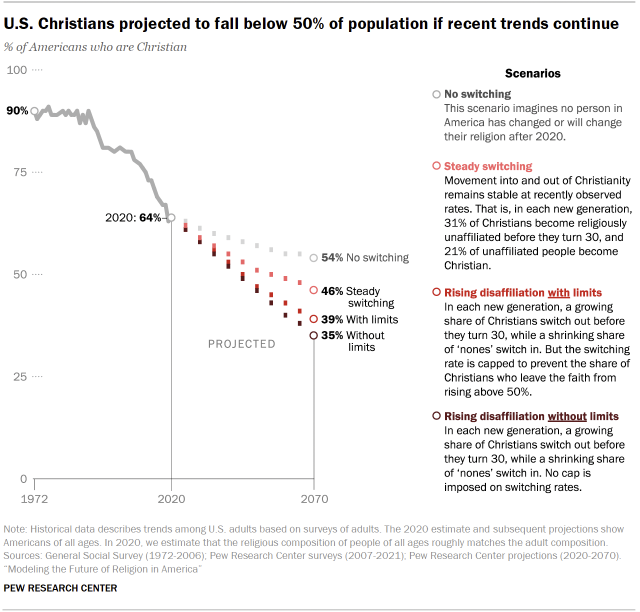
American religious affiliation 1970-2070_Pew

You can see different dates when Christian affiliation falls below one half of the population, unless the “no switching” change occurs.

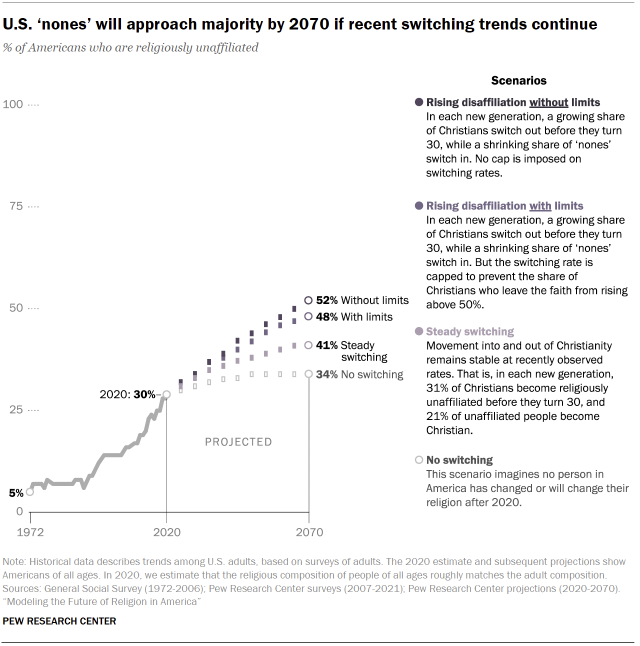
At the same time, the proportion of “nones” (“People who are religiously unaffiliated”) rises to different levels, again depending on how that trend takes shape:
American religious affiliation by nones -1972-2070_Pew

At the same time that 6%, those who are neither Christian nor “none,” will likely grow.  “Under each of the four scenarios, people of non-Christian religions would grow to represent 12%-13% of the population – double their present share.

buy strattera online buy strattera no prescription generic

”  Interestingly, Pew sees this driven not by switching, but largely by migration:

Immigration has an outsized effect on the composition of non-Christian groups in the U.S. because adherents of religions like Islam and Hinduism make up a larger share of new arrivals than they do of the existing U.S. population.

The report wraps these three projection sets together to create four different scenarios, which are too short for me to summarize usefully, so I’ll just share them directly:

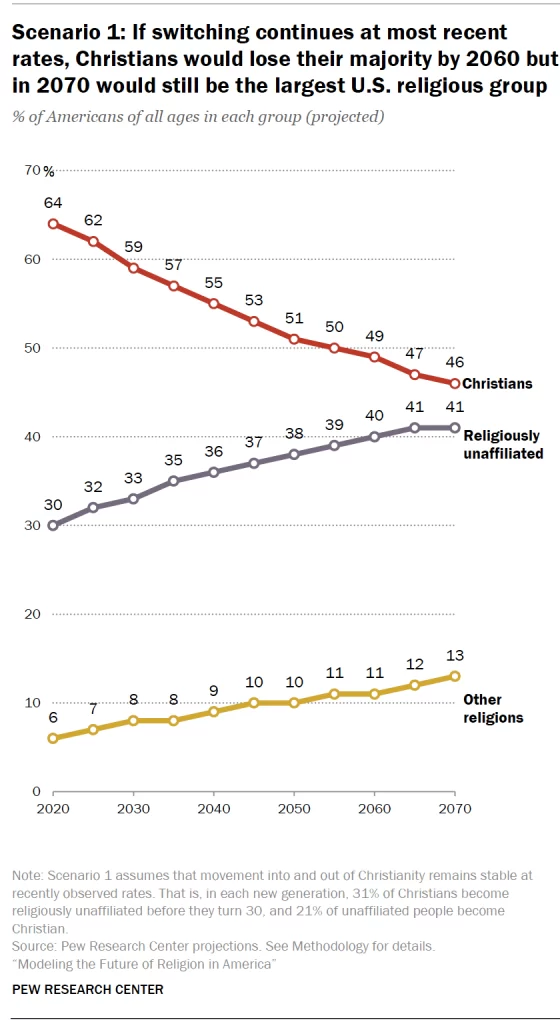
Scenario 1: Steady switching – Christians would lose their majority but would still be the largest U.S. religious group in 2070

Switching assumption: Switching into and out of Christianity, other religions and the religiously unaffiliated category (“nones”) continues among young Americans (ages 15 to 29) at the same rates as in recent years. Most significantly, each new generation sees 31% of people who were raised Christian become religiously unaffiliated by the time they reach 30, while 21% of those who grew up with no religion become Christian.

Outcome: If switching among young Americans continued at recent rates, Christians would decline as a share of the population by a few percentage points per decade, dipping below 50% by 2060. In 2070, 46% of Americans would identify as Christian, making Christianity a plurality – the most common religious identity – but no longer a majority. In this scenario, the share of “nones” would not climb above 41% by 2070.
American religious affiliation 1970-2070_Pew scenario 1

In contrast, a world with more “nones” and fewer Christians:

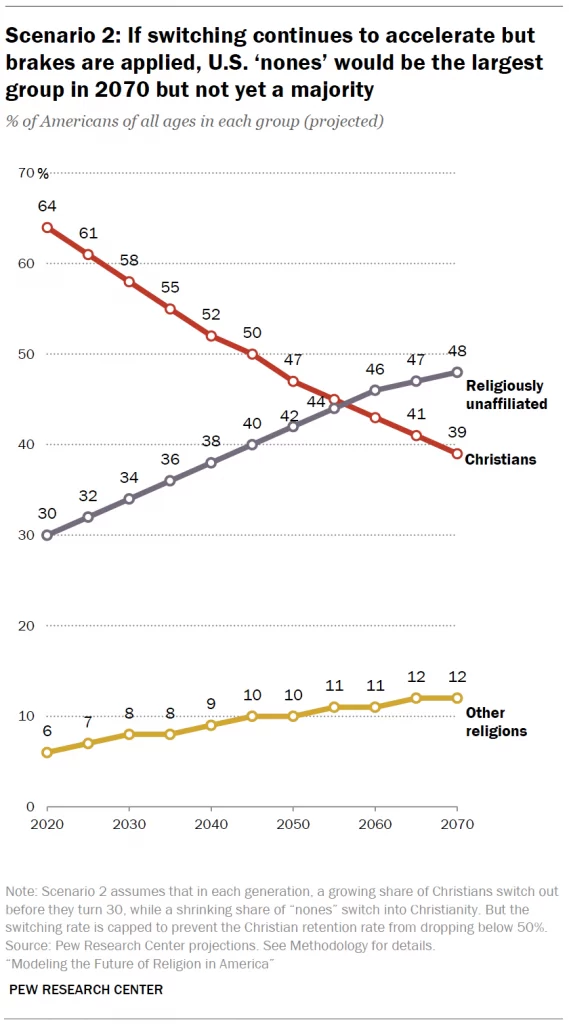
Scenario 2: Rising disaffiliation with limits – ‘nones’ would be the largest group in 2070 but not a majority

Switching assumption: Continuing a recent pattern, switching out of Christianity becomes more common among young Americans as each generation sees a progressively larger share of Christians leave religion by the age of 30. However, brakes are applied to keep Christian retention (the share of people raised as Christians who remain Christian) from falling below about 50%.

buy wellbutrin online buy wellbutrin no prescription generic

3 At the same time, switching into Christianity becomes less and less common, also continuing recent trends.

Outcome: If the pace of switching before the age of 30 were to speed up initially but then hold steady, Christians would lose their majority status by 2050, when they would be 47% of the U.S. population (versus 42% for the unaffiliated). In 2070, “nones” would constitute a plurality of 48%, and Christians would account for 39% of Americans.
American religious affiliation 1970-2070_Pew scenario 2

Pushing things a bit further, a new majority appears:

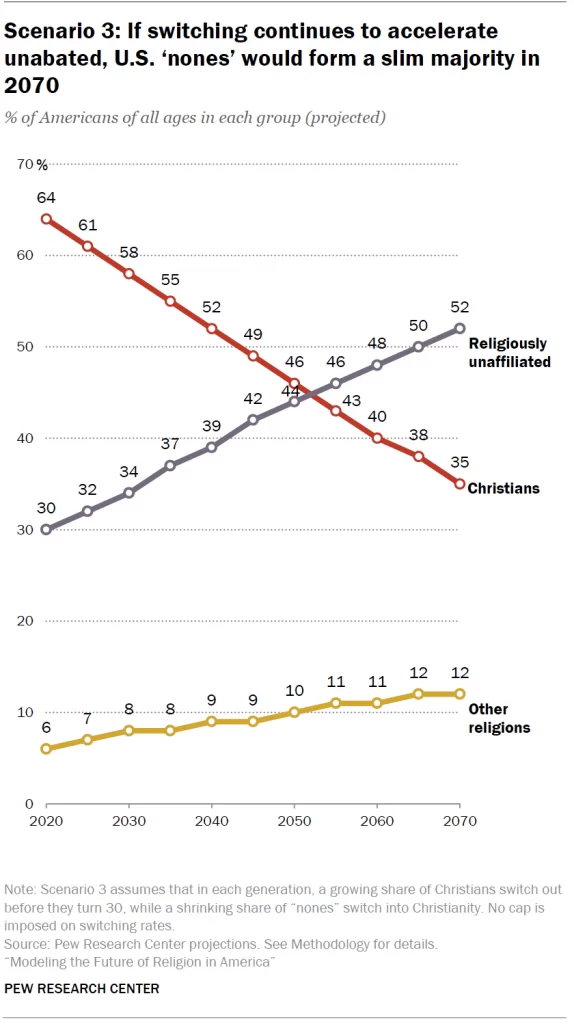
Scenario 3: Rising disaffiliation without limits – ‘nones’ would form a slim majority in 2070

Switching assumption: The share of Christians who disaffiliate by the time they reach 30 continues to rise with each successive generation, and rates of disaffiliation are allowed to continue rising even after Christian retention drops below 50% (i.e., no limit is imposed). As in Scenario 2, switching into Christianity among young Americans becomes less and less common.

Outcome: If the pace of switching before the age of 30 were to speed up throughout the projection period without any brakes, Christians would no longer be a majority by 2045. By 2055, the unaffiliated would make up the largest group (46%), ahead of Christians (43%). In 2070, 52% of Americans would be unaffiliated, while a little more than a third (35%) would be Christian.
American religious affiliation 1970-2070_Pew scenario 3

Or if switching away from Christianity slows down in a big way:

Scenario 4: No switching – Christians would retain their majority through 2070

Switching assumption: This scenario imagines no person in America has changed or will change their religion after 2020. But even in that hypothetical situation, the religious makeup of the U.S. population would continue to shift gradually, primarily as a result of Christians being older than other groups, on average, and the unaffiliated being younger, with a larger share of their population of childbearing age.

Outcome: If switching had stopped altogether in 2020, the share of Christians would still decline by 10 percentage points over 50 years, reaching 54% in 2070. The unaffiliated would remain a substantial minority, at 34%.
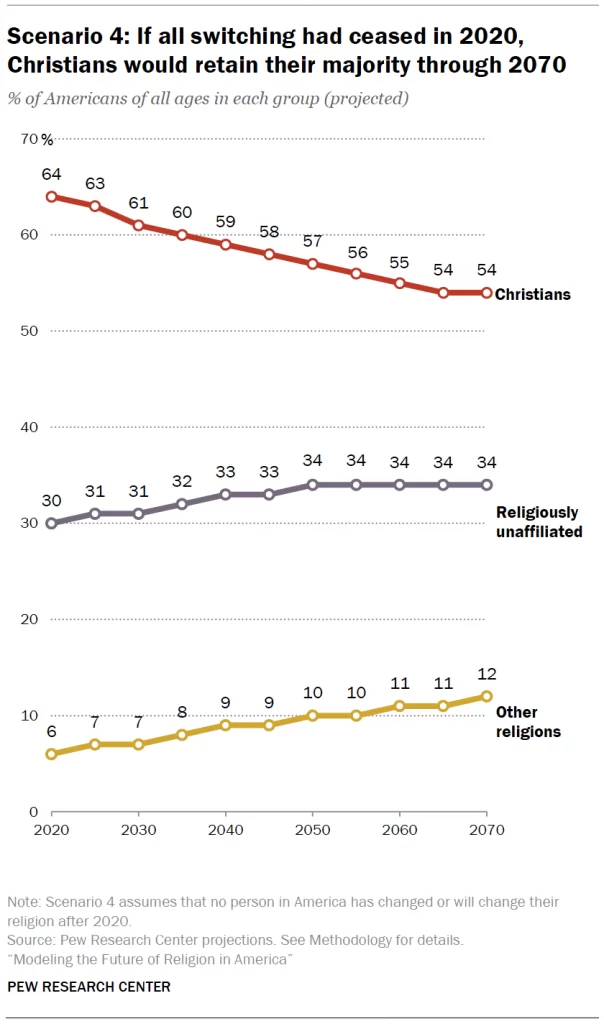
American religious affiliation 1970-2070_Pew scenario 4

To the authors’ credit, they offer four more scenarios, based on changing various inputs to their model:
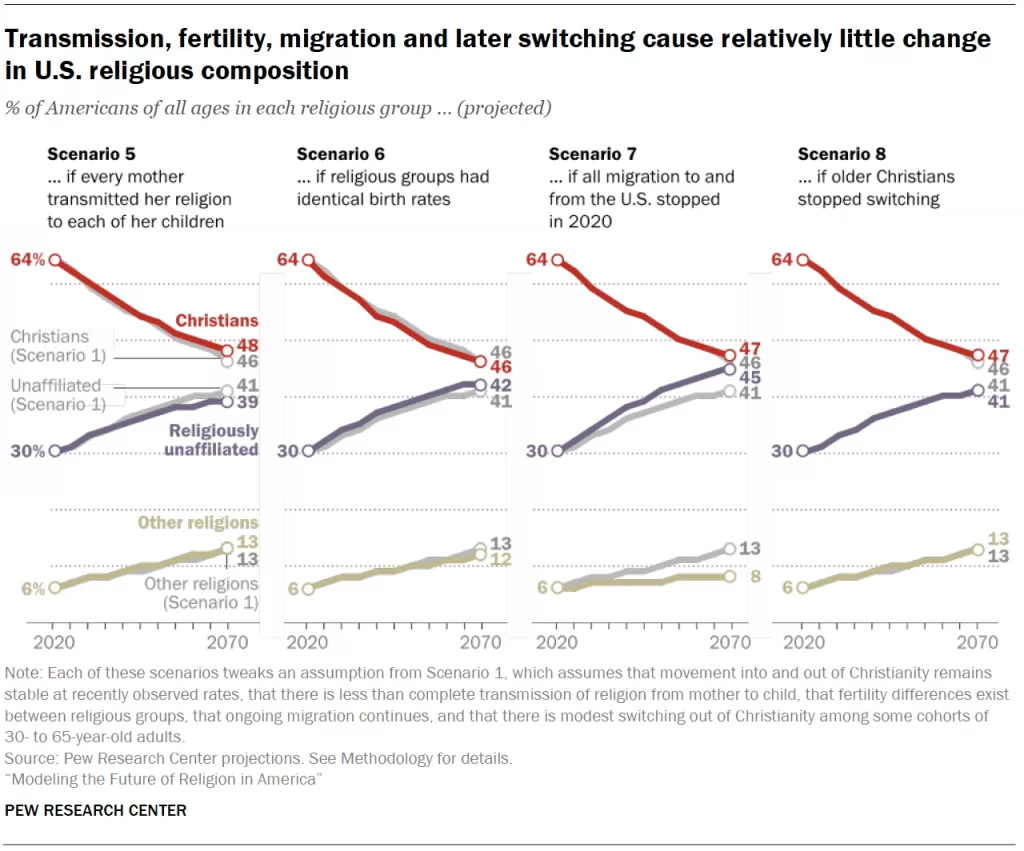
American religious affiliation 1970-2070_Pew scenarios 5-8

All told, those scenarios take us to 2070, roughly.  The report then ventures a generation ahead, too, and suggests a change in this disaffiliation/rising none trend:

If trends are projected for an even longer period, change slows under most scenarios. Even in the most extreme switching scenario, in which each cohort of young adults disaffiliates more than the one before it, with no floor imposed for Christian retention, Christians would still represent about a quarter of the population in 2100. Under other scenarios, the rate of growth of the religiously unaffiliated (and decline of Christians) is curbed by 2080. This is due to switching dynamics. If the Christian and unaffiliated populations become similar in size – an eventuality under most scenarios – and if the gap between their retention rates remains small, then the growth of the unaffiliated eventually would slow, and the religious groups could reach equilibrium rather than one group ascending completely and the other disappearing.

Note that the report hedges its forecasts carefully.  For example,

Of course, it is possible that events outside the study’s model – such as war, economic depression, climate crisis, changing immigration patterns or religious innovations – could reverse current religious switching trends, leading to a revival of Christianity in the United States. But there are no current switching patterns in the U.S. that can be factored into the mathematical models to project such a result.

I would add the enormous possibilities opened up by swelling numbers of “nones.”  Consider how the report describes that population:

[R]eligiously unaffiliated Americans today are not uniformly nonbelieving or nonpracticing. Many religious “nones” partake in traditional religious practices despite their lack of religious identity, including a solid majority who believe in some kind of higher power or spiritual force. It is also unclear how this may change in the future, and whether connections to these beliefs will weaken if disaffiliation becomes even more common in the broader society. At the same time, many observers have wondered what kinds of spiritual practices, if any, may fill the void left by institutional religion. We plan to continue exploring this question in future research.

We could easily see a swath of that group heading to a new religion (again, I’ve been monitoring new religious movements for this and other reasons) or to an established one that has become appealing due to changes in message, leadership, practices, etc.

What might this mean for colleges and universities?

There are several potential impacts, as I’ve pointed out previously.

  1. Declining Christian affiliation threatens religious colleges and universities in their enrollment, staffing, alumni connections, and overall relevance.  This can lead to institutional cuts, program and department closures, campuses shut down, or mergers.
  2. A number of American colleges and universities have formal religious identities.
    buy amitriptyline online buy amitriptyline no prescription generic

    Would their leaders feel impelled to change this status?

  3. Religious studies as a field of research and teaching may similarly be constrained, if interest follows religious affiliation.  We’ve seen evidence of that in plummeting numbers of majors. Imagine how religious classes within a general curriculum might suffer, or change in order to win students.
  4. Intergenerational tension might heighten. That would be due to a belief or religious membership gap opening up between the youngest and older people belonging to a college or university.
  5. A variation of #3: supporting students may become more challenging, depending on the context.  I imagine older faculty and staff with religious beliefs helping increasingly irreligious students succeed, and the possibility of clashes there. The opposite could also occur, as the number of older students grows while younger people increasingly become staff and faculty.
  6. Animosity towards education, particularly from the right, may take on a more deeply religious cast, to the extent that partisans link unbelief with higher ed remain.  It’s not much of a stretch to imagine Republicans deeply critical of universities and fearful of Godlessness combining the two more closely.

One more implication, newly emerged, is that this changing religious landscape intersects with the end of Roe v Wade.  I wrote in June about how local abortion rules might impact colleges and universities. Perhaps we’ll see religious affiliation become more geographically sorted, with “nones” leaving states with strong abortion restrictions and some of the Christian population moving to them.

Let me add some caveats of my own, in addition to those offered by the Pew report.  I’m still open to the possibility of a major new religion appearing in this century, perhaps anchored on the climate crisis, and that could engage a great deal of “nones.”  We have also seen various New Age and generally “spiritual” figures and groups appear since the 1960s; those could coalesce into something more institutional.

Further, these are national trends and scenarios.  For a large, diverse, and complex society like America, there are all kinds of local variations to play out.  As we saw in 2017, religious affiliation varies strongly by race, gender, education, sexuality, and geography, among other factors.


The full report covers a lot of ground, including different ages and their religious behavior, intergenerational transmission, migration, and issues with different dataset.  I recommend the whole thing to you, and would like to hear people’s thoughts and reactions.
Posted in demographics, politics, scenarios, trends | 3 Comments

Campus climate change schema: one example

Yesterday I shared a simple framework for understanding how campuses may approach climate change. That post offered a few hypothetical examples. Today I’d like to add a real world example.

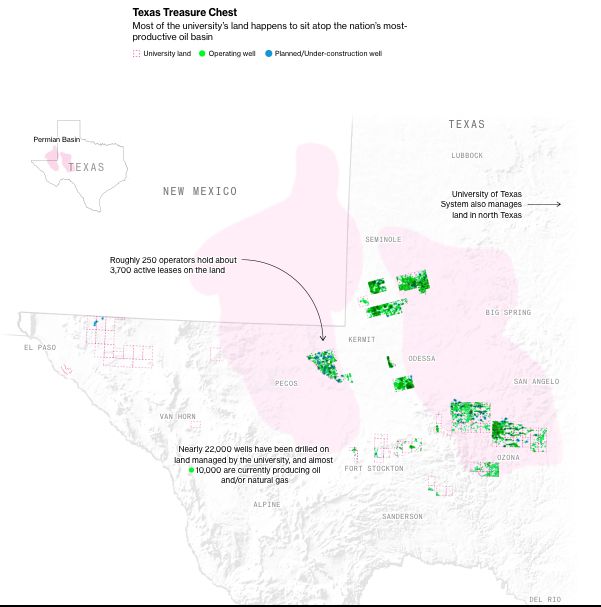
Let’s start with the University of Texas-Austin.  A Bloomberg report describes the institution as making a lot of money by (among other things) owning a big chunk of oil-rich land.

Land operated by the University of Texas System is on track to post its best-ever annual revenue in fiscal 2022 because of soaring oil prices and production on its property in the Permian Basin. Oil reached a high of $120 a barrel earlier this year as a result of a war-induced energy crunch. The revenue is expected to help narrow the gap between the Texas system’s $42.9 billion endowment and Harvard’s $53.2 billion as of June 2021.

There is some helpful mapping:

University of Texas-Austin oil holdings_Bloomberg

This isn’t a passive source of income, either.  UT did its best to ramp up production:

Over the last six years, University Lands brought on teams of engineers, geologists, geophysicists and other experts to make extraction as efficient as possible, leaving very little oil in the ground.

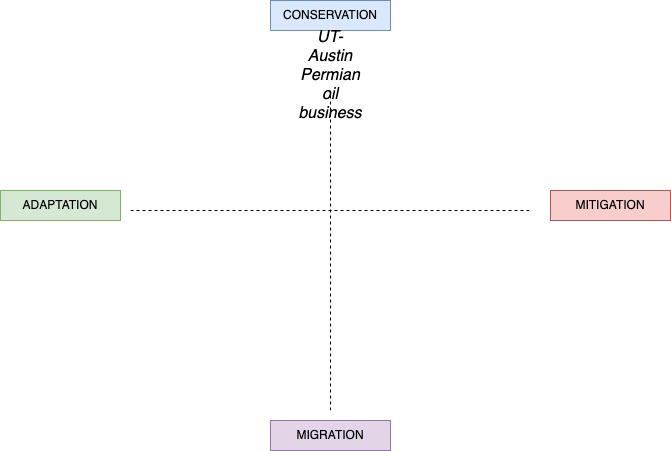
What stance towards global warming does this operation indicate? According to the schema I posted yesterday, there are four positions a campus can take as it grapples with the climate emergency: Conservation, Mitigation, Adaptation, and Migration. I’d slot this fossil fuel exploitation squarely in the Conservation spot, as the monies go into Austin’s endowment, an ultimate financial backstop to preserve the institution.  Draining and selling fossil fuels at scale is certainly neither climate mitigation nor adaptation, and there’s no sign of migration.

We can visualize that position like so:

Yet this is a futurist blog, so we can look ahead to anticipate how things might change.  The Bloomberg piece is right there with us, noting that UT’s land is not only rich in carbon, but also in renewables:

“These lands host extensive wind and solar power generation,” said William R. Murphy, Jr., the chief executive officer of University Lands, a division of UT that manages its land. The university “expects considerable growth in these areas and other emerging energies,” he said.

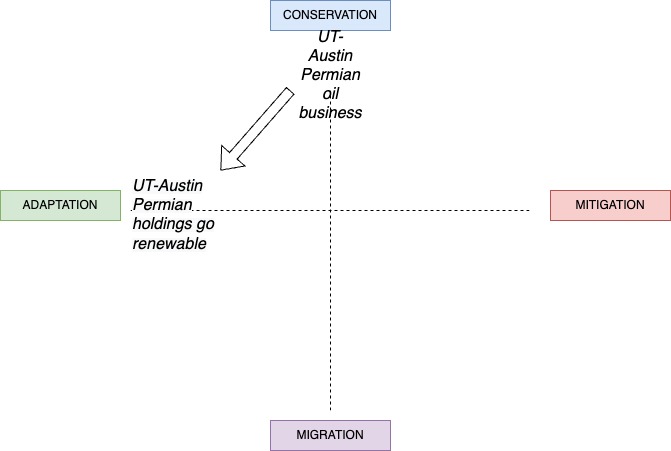
How might the university’s position change if it flips the switch and shifts from fossil extraction to generating solar and wind?  We could consider this a form of Adaptation, the institution changing some of its functions to adapt to a changing world:

Campus climate crisis compass_UT Austin Adapt

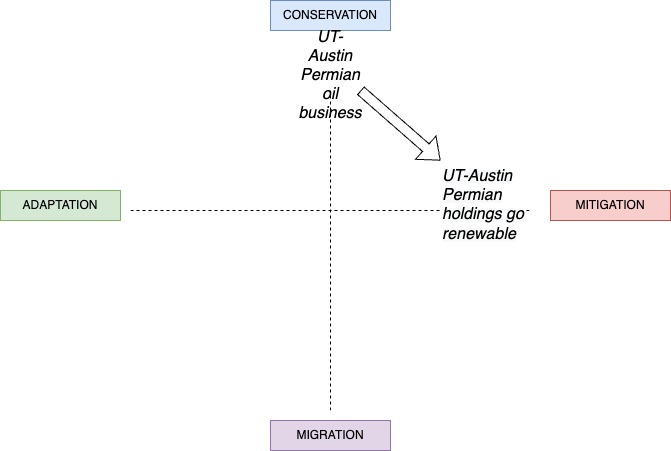
Or perhaps the institution will go further, viewing their new Permian usage not just as adaptation to a crisis, but as an effort to mitigate the emergency. They are no longer helping burn carbon, but helping others use renewable electricity.  The visualization becomes this instead:

Campus climate crisis compass_UT Austin Mitigation

Or possibly the institution isn’t clear on its direction, and offers a strategy mixing adaptation with mitigation, landing somewhere in between:

Campus climate crisis compass_UT Austin in the middle

You get the idea.

This is a very simple use of the schema, based on one single (if massive) part of a large and complex institution. But maybe it can get people started on thinking about the rest.


Posted in climatechange, higher education | Leave a comment

How campuses might act on climate change: a new framework

How might academia grapple with the climate emergency over the next years and decades?

Today I’d like to offer a simple schema to start conversations.  Some of you know I’ve been research this topic for years (Universities on Fire is available for pre-order!). Now I want to share a quick and productive (I hope) way into the topic.

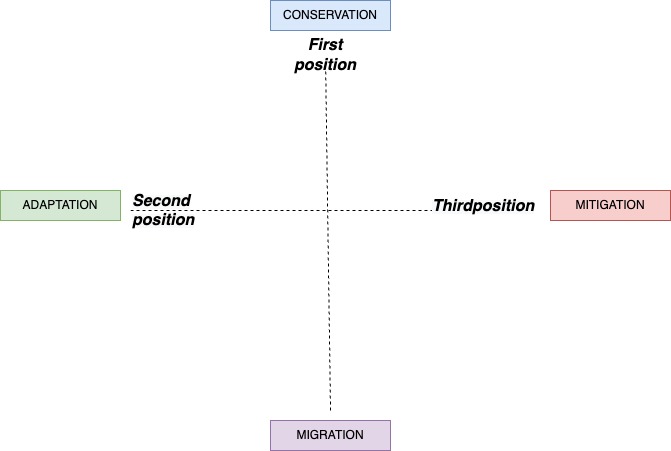
The schema has four pieces. Each one embodies and imagines one strategic direction a college or university could take.  That’s a general way of understanding its allocation of scarce resources, including money, labor, and attention. It can represent a whole institution or parts of it.

The parts are Conservation, Adaptation, Mitigation, and Migration.

  • Conservation A campus focuses its resources on maintaining itself into the future. Its population, from senior administration to students, may or may not see that future as meaningfully shaped by the climate crisis. The vision of what these academics seek to conserve may be drawn from the present or recent history.
    buy strattera online buy strattera no prescription generic

      It could also be partial, neglecting some details – i.e., a focus on one swath of the curriculum, for example. We could imagine an alumnus wanting to conserve the business program, their fraternity and sister sorority, plus the school’s sports teams, while a current student hopes to see the physical campus and the undergraduate program persist, etc.

  • Adaptation The institution recognizes the deep and present threat of the climate crisis and seeks to modify itself accordingly. Depending on the school’s situation, this could involve work on the physical front: building barriers against growing waters or desert; elevating buildings against flooding. It may include curricular and research efforts to meet anticipated student and intellectual world needs, such as: increasing climate research efforts and support; expanding climate-related classes, departments, and programs. On the town-gown side, the adaption mode may mean partnering with the local community on resilience efforts. Campus digital activity may change as well, perhaps by offering more online work to reduce in-person travel as that becomes costly financially and reputationally, or reducing computing efforts deemed too productive of greenhouse gases.
  • Mitigation A college or university sees itself not just reacting to climate dangers, but playing some active role in fighting the unfolding crisis. This could take many forms.  On the physical campus side, the institution could take many steps to reduce its greenhouse gas emissions: shifting its transportation fleet to electrically powered vehicles and encourage academics to do the same; changing food services and agricultural programs to reduce both CO2 and methane emissions; re-sourcing campus power away from fossil fuels, either by offshoring or on-site production; etc. Faculty, staff, and students may reduce travel by CO2-intensive means, especially jets and individual cars. Academics engage the local community in greenhouse gas reduction.
    buy lexapro online buy lexapro no prescription generic

    Some academics take a public intellectual role, encouraging the world to change.

    buy tadacip online buy tadacip no prescription generic

  • Migration A school decides to move its physical location away from a danger zone, such as a coastline, desert edge, or site where wet bulb temperatures will likely reach dangerous heights too often. This migration might be total, as in moving the entire suite of institutional offerings and much of the physical plant to a better spot. It could also be partial, such as opening and expanding a branch campus, gradually transferring more operations there over time. It could take the form of a multi-institutional merger, gradually shifting population, classes, research, and other services to a school in a safer location.

To begin with, we can use this four-fold schema to describe a given college or university’s stance towards the climate crisis at a given moment.  Further, an institution could select one of these frameworks and stick to it for years. Alternatively, one could switch between these four options, depending on leadership changes, how the crisis plays out locally, the impact of large-scale politics, and the community’s understanding of the crisis, among other factors. For example, one campus might start in the Conservation mode, then change to Migration with the arrival of a new president and new board members, then, with the next administration, abandon that position and do Mitigation instead.

It’s also possible that a given institution adopts two or more of these positions at the same time. That could be done as a deliberately mixed policy – i.e., “we’ll plan for Migration while doing Adaptation in the meantime.” Multiple modes could also occur in a decentralized institution, as when, say, a very autonomous graduate program Adapts while the undergraduate school Conserves.

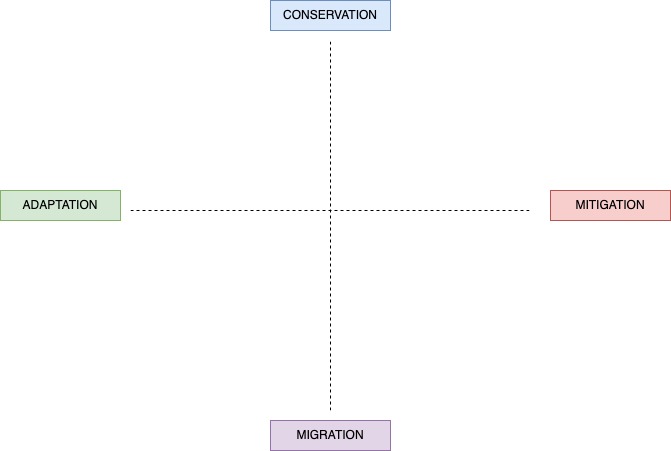
We might also use this schema to depict a range of attitudes and practices within a single college or university.  To clarify, we can visualize the overall scheme easily, like so:

Campus climate change compass

A campus could occupy, simply, one of those four cardinal points.  Or, as said earlier, it could change positions over time, zigzagging across the schema.

Campus climate crisis cardinal points_example of moving positions

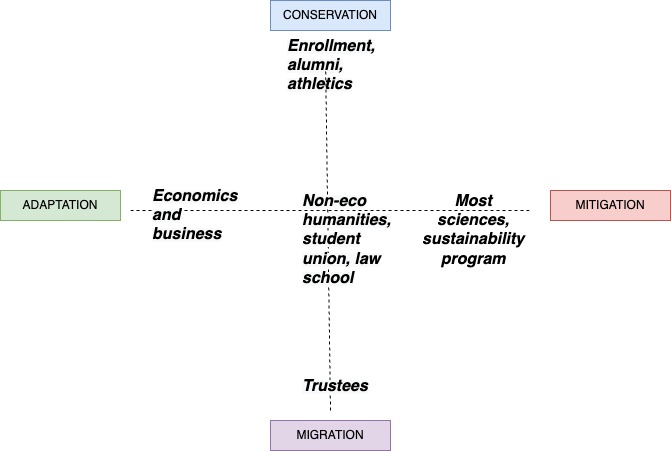
And another institution might occupy several points at the same time, with divided ideas, views, and practices:

Campus climate crisis cardinal points, multiple points

Note the group in the middle, not taking a cardinal position.  Some proportion of any campus will likely occupy that space, at least for a time.

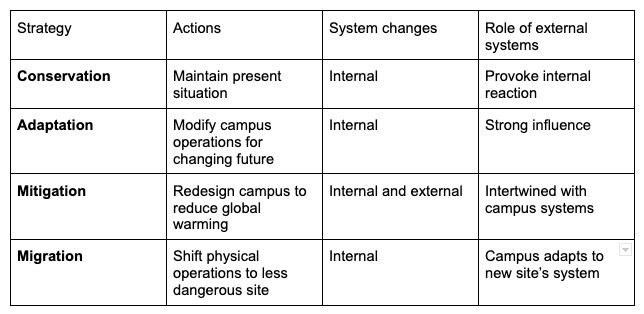
In conversation about this scheme, my friend and colleague Ruben Puentedura suggested adding a systems level of analysis. That lets us think of which systems a given campus choice engages, as well as what kind of feedback loops result. I noodled with this and produced a table:

Scheme with systems

A different idea arose from my Patreon supporters (you can join them!), who wanted to make space for a fifth campus category, one which went further than the four. This one describes a campus which adopts a crisis stance, mobilizing its population and different institutional parts to struggle with global warming at its most important mission.

buy zithromax online buy zithromax no prescription generic

Several Patreons offered the term Revolution, which fits neatly in with the previous four at a grammatical level.

Four positions or five, I invite readers to build on and experiment with this schema, and welcome your feedback to this post.

(thanks to my brilliant Patreon supporters and several friends, plus my daughter for essential graphic design advice)

Posted in climatechange, future of education | 2 Comments

Emporia State University fires tenure-track faculty, commits a queen sacrifice

Emporia State University sealEmporia State University has just fired a group of faculty members, including those on the tenure track.  It’s the latest example of what I’ve called a queen sacrifice.

(This occurs when a college or university cuts tenure-track faculty members. The source of the phrase is chess, where queens are the most powerful piece, as tenure-track faculty are, in theory, the most powerful members of an academic community.  In the game giving up the queen is a desperate move, often an attempt to wrest victory from a very bad situation, and so it seems to be for colleges and universities axing people in those positions.)

This is an emerging story. Emporia’s news site doesn’t have an official statement so far. The official Twitter account is silent.  So I’ll summarize what I’ve been able to learn from other sources.

Emporia State University president Ken Hush submitted a plan to cut certain faculty to the state board of regents.  KBOR, which had granted that power to its campuses last year, approved the plan on Wednesday, and Hush then issued a series of firings.

The regents’ policy is fairly broad.  The Chronicle summarizes it like so:

According to the approved framework, the university can “suspend, dismiss, or terminate” employees based on factors “such as, but not limited to” low enrollment, cost of operations, reduction in revenues for specific departments or schools, current or future market considerations, restructuring, realignment of resources, performance evaluations, teaching and research productivity, and “low service productivity.” Affected employees can appeal to the state’s Office of Administrative Hearings. The burden of proof is on the employee, and “no discovery will be permitted,” the document says.

Who was cut under this policy?  23 [UPDATED: 33] professors, according to student reporters, from the following departments:

Accounting, information systems, and finance – 1

Art – 1

Biological sciences – 2*

Business – 1

Communication & theater – 2*

Counselor education – 1*

English, modern languages and journalism – 5*

Music – 3

Physical sciences – 2

Social sciences, sociology and criminology – 5*

*numbers have been confirmed by department chairs

All told, the cut people amount to “about 7 percent of Emporia State’s work force.”  Here’s one of those instructors on Twitter:

Students and faculty protested the cuts.

These cuts to certain departments seem to go along with shifting university resources to other departments:

“Going forward, ESU will realign resources in programs that sit squarely in our strike zone,” said Hush. “For example, ESU excels in programs like nursing, biology, technology, business, psychology and teacher education. In fact, we are further refocusing and reenergizing some of our teacher preparation programs. No one does teacher education better than Emporia State University!”

Why is this occurring?  As per most queen sacrifices, the institution is feeling “extreme financial pressures,” according to local media. My readers will be unsurprised to learn that the cause of those pressures is the combination of COVID and a drop in student numbers.  The latter is steep, according to this official statement: “on-campus enrollment declined 24 percent between 2017 and 2021,” according to the Chronicle of Higher Education.

Some observations:

  • There was no declaration of financial exigency, although the administration highlighted economic pressures as paramount.
  • Emporia did not conduct an academic program prioritization effort to determine which units and people to cut.  According to the Chronicle, they deliberately avoided this action:

Brent Thomas, the interim provost, painted the process Emporia State used as considerate of the faculty. At the Wednesday board meeting, he said that it would be “unwise, harmful, and frankly unethical to ask faculty to make decisions about people and programs across the entire university. We did not believe that we should put our faculty into situations where they were forced to point at one another as targets for restructuring.”

  • Cuts fell across the curriculum. The humanities seemed to catch about half of the ax blows, but social and natural sciences were hit as well.
  • ESU’s latest news release uses a lot of euphemisms to set the state for the queen sacrifice, like “the framework would allow ESU the flexibility to realign resources to address the university’s structural deficits that have been ongoing for several years, accelerated by COVID.”  There is also a futures theme in describing this action as part of a strategy called: “Forward Focused, Future Ready.” (italics in original)
  • The regents’ policy is really open-ended. How many other states will follow suit?  And are appealing faculty actually denied discovery?
  • President Hush (a Dickensian name) is an interesting person.  He’s an Emporia alumnus, as well as a former board member. He lacks any advanced degrees and apparently donated significantly to a Koch brothers fund.  Professor Max McCoy sees that funding as one sign Hush is aligned with an anti-academic Republican state government.
  • McCoy also views the cuts as the suspension of tenure at Emporia State, and writes that he fears losing his job for saying so.  It certainly looks like it.

As I have said before, keep an eye out for more such queen sacrifices. That move seems to have become an established one in American higher education.

(thanks to Caroline Coward and Peter Shea for the pointer, and to Windwailer for a good link)

Posted in higher education | Tagged | 3 Comments

Extreme heat and California higher education

Several times academics have told me that climate change is “too futuristic” to discuss, in terms of how it impacts higher education.

buy priligy online buy priligy no prescription generic

  It no longer surprises me, but it is still interesting. I wish I could understand where that idea was coming from.

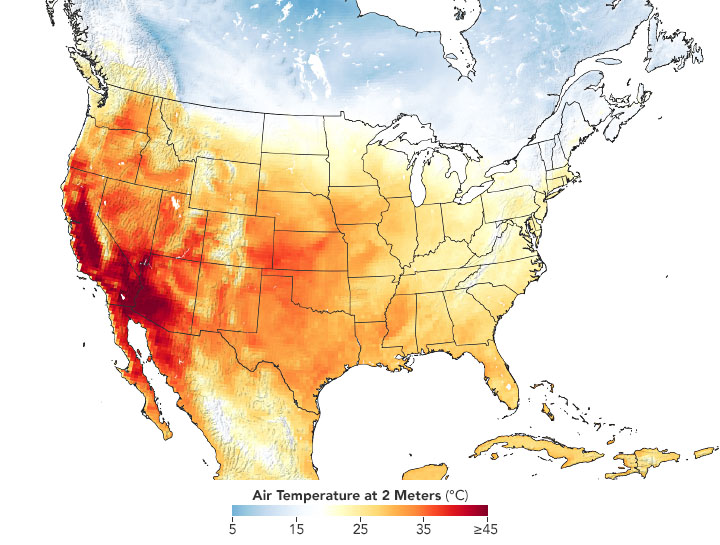
Because reality is pretty darned futuristic now.  Last week I described climate change driven heat and water disasters around the world. Today’s case in point is California’s colleges and universities, baking in a brutal heat wave.  Inside Higher Ed’s Sara Weissman has a very good article on this, which I’d like to draw on in this post.

The heat wave is threatening vulnerable people with injury. It is also testing the state’s electrical infrastructure, as people crank up air conditioning and fans.

California heatwave_geos5_2020250_NASA Earth Observatory

How does it impact academia?

Weissman describes a series of different effects and responses on two levels: the physical and human campus, and also town-gown relations.

Shifting classes online is one option (which I’ve referred to as a Toggle Term in the COVID context) already in play: “Laney College in Oakland closed its campus Tuesday because of the heat, according to an email sent to students. Online courses were held, but in-person classes were canceled.”  And this may have some downsides:

Mel Ehlers, a sophomore at Laney, didn’t have classes at the college Tuesday and was not affected by the closure, but she was worried it might inconvenience students who rely on campus services, such as the food pantry or on-campus showers.

“One concern I have for my classmates right now is that … many are using the campus for other basic resources,” she wrote in a[n unlinked] Twitter message.

For those institutions still offering in-person classes, relocating people across campus is an important move:

Jonathan Eldridge, assistant superintendent and vice president of student learning and success at the College of Marin, said the sustained heat has put a lot of pressure on the cooling systems in some buildings and made them less effective. As a result, some classes were moved to buildings where they wouldn’t normally meet.

Setting aside buildings as cooling spaces is essential, it seems, when other buildings lack air conditioning:

[California State University, East Bay] has some dorms that have fans but no air-conditioning. The university kept certain buildings open each day of the Labor Day weekend to ensure students, faculty and staff members would have somewhere air-conditioned to go.

Pomona College is having a similar experience:

The older dorms at Pomona College, which make up two-thirds of student housing, lack air-conditioning, said Avis Hinkson, dean of students and vice president of student affairs. Fifty cots have been set up in various air-conditioned places on campus for students to sleep on if their rooms are too warm. There aren’t enough beds for all the students who may need them, but she expects some students will stay with friends off campus or in the campus center, which is being kept open 24 hours a day as a cooling area for students. Water stations and mist machines have also been put up throughout campus as places for students to cool down.

buy dapoxetine online buy dapoxetine no prescription generic

Others have improvised cooling spaces:

Some faculty members have also gone out of their way to create air-conditioned areas where students can hang out, he said. For example, the chair of the performing arts department put extension cords, power strips and cold drinking water in the lobby of the performing arts building so students could use it as a lounge.

Urging social practices on the campus population is another strategy. The College of Marin recommended certain behaviors for safety:

The aforementioned California State University campus has its own behavioral recommendations:

How you can stay cool:

Drink water! Stay hydrated–if you feel thirsty, you are already dehydrated

Avoid alcohol–that frosty beverage actually dehydrates you

Wear loose fitting, light clothing

Refrain from working and exercising outside during the hottest parts of the day (11 a.m.- 4 p.m.)

Check in on the elderly, young children, sick and those without air conditioning. Don’t forget about pets, too!

They also offer tips on “What do watch for with heat exposure” and what to do “If someone is showing signs of heat exhaustion.”

At a different level, the heat wave impacts academic institutions’ relationships with their local communities.  Up above I mentioned the pressure on California’s electrical infrastructure, which has led to calls for people to use less electricity.  So the same colleges and universities which are trying to increase their cooling services are also asked to cut them back.  For example:

[Kimberly Hawkins, news and media manager at Cal State East Bay] said campus leaders are also trying to conserve power to comply with a Flex Alert, a call for state residents to voluntarily reduce their energy use, by the California Independent System Operator.

“The university is aware and doing what we can to play our part,” she said. “Housing residents have been provided educational messages on how they can take a role in conserving energy and staying cool during this period.”

Meanwhile, some academic institutions are making services available for their local communities.  One is to offer cooling spaces to the town:

Pacific Union College, a private liberal arts institution, on Thursday designated an air-conditioned room in its on-campus church as a community cooling center where Napa County residents can cool off, use power outlets and drink ice water, the Napa Valley Register reported. The center could stay open past Sept. 8 depending on the level of need.

Another is to help firefighters, as California is notoriously prone to blazes:

Salish Kootenai College, a tribal college in Montana, is operating as a base for firefighters battling nearby wildfires, as it has done repeatedly over the last two years. President Sandra Boham said between 25 and 75 firefighters are staying in tents in the campus parking lot each night and using gym showers, in addition to portable showers brought to campus.

Let me take a step back from these details and stories for a minute.  They represent several key ways the climate crisis can impact academia.  They don’t cover each possible way. As I’ve said before, global warming intersects colleges and universities along multiple axes:

How higher education engages with the climate crisis_overall

Today we’re looking primarily on the campus grounds and local community aspects. There’s potentially more to say about the California heat wave in terms of research, teaching, and these institutions’ connections with the broader world in the Anthropocene.

buy ivermectin online buy ivermectin no prescription generic

Now, California is just one American state and the United States is just one nation in the world, albeit a major actor in the climate crisis.  This single story is a small case study on the global stage. The climate crisis will play out in different ways in different areas, depending on local conditions as well as their position in global system. My point is that we can learn a lot about the future of higher ed in global warming by paying attention to this early crisis incident.  There will be many more to come.

buy diflucan online buy diflucan no prescription generic

(North American temperature map by NASA’s Earth Observatory)

Posted in climatechange | 2 Comments

What does the new work from home situation mean for higher education?

New patterns of remote work are appearing, as different nations rethink their COVID plans.  What might they mean for higher education?

To set the stage, let me share some data from Stanford economist Nicholas Bloom:

This is early data for a rapidly developing situation, but let’s start from it to get our thoughts and imaginations going. What happens to a society where about one third of its working hours are done remotely?

Since my focus is higher education’s future, let’s zero in on that point.  What are the impacts on colleges and universities?

Some sub-questions:

  1. How much academic work will we conduct remotely during the 2022-2023 academic year?  Which units, which departments will be more work-from-home-oriented than others?
    buy stromectol online buy stromectol no prescription generic

  2. If the workforce outside of the academia experiences this large uptick in remote work, will that influence students to desire more online education?
  3. If this relatively high level of work from home persists, at least in the medium term, how should colleges and universities change how we prepare students for the workforce?
    buy zydena online buy zydena no prescription generic

I posed early versions of these questions on Twitter and received some fascinating responses.

buy xifaxan online buy xifaxan no prescription generic

Karen Belinier identified some academic work hesitation:

Amanda Albright pointed out one reason for academics to welcome work from home options:

Drew Tatusko saw strategic reasons for a university to offer remote work:

What are you seeing in your part(s) of the academic world?  What do you anticipate we’ll see on this point for the next year?

buy ventolin online buy ventolin no prescription generic

Posted in coronavirus, future of education | 8 Comments

Modeling civil unrest in the United States: some historical cases

Greetings from the United States holiday of Labor Day.  I took a day off yesterday with my wife to explore Fredericksburg, a nearby Virginia city with interesting historical and general stuff.  Being an America, I couldn’t take the day really off, and managed to work whenever I could: in the car, in the hotel.

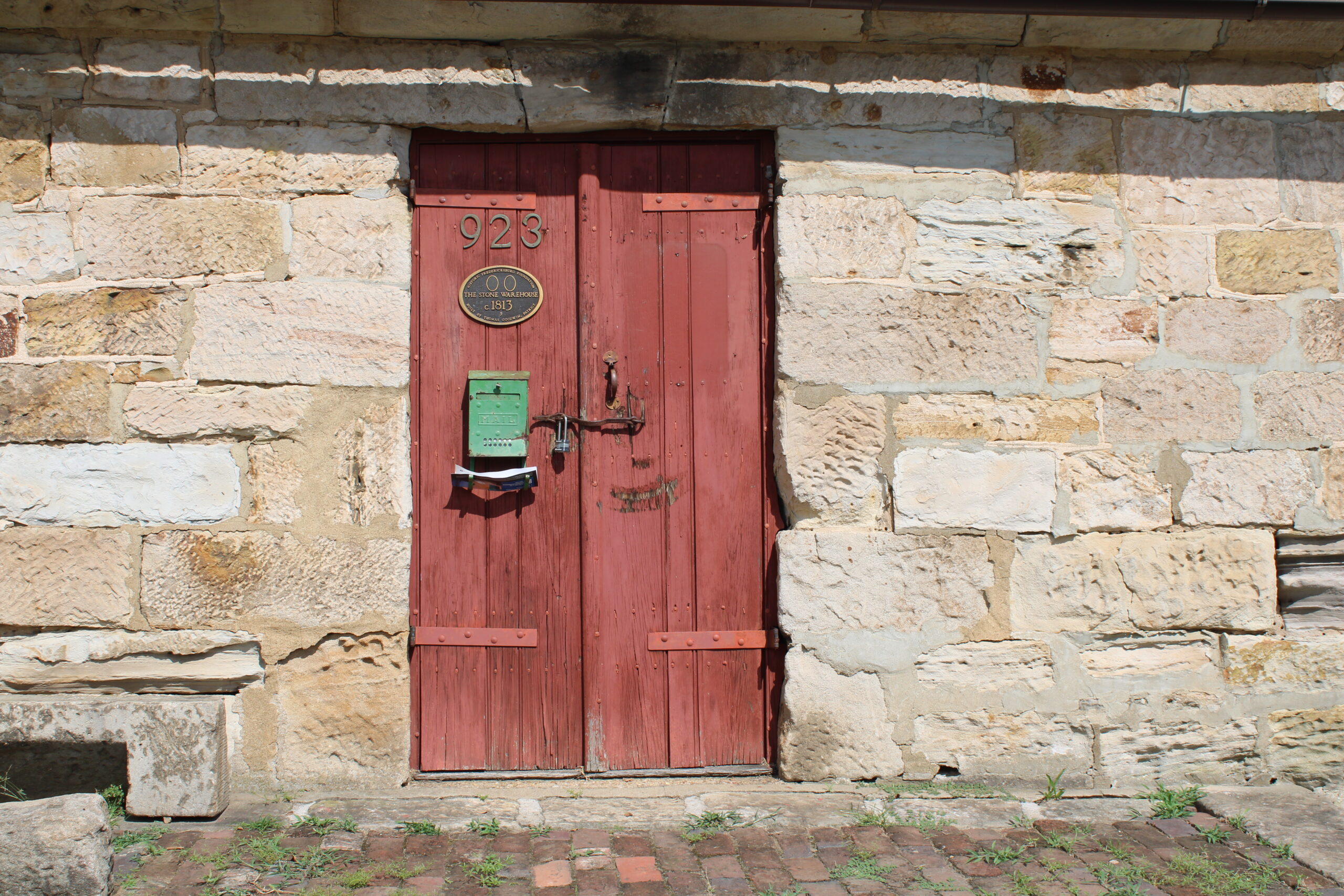
door Fredricksburg old house next to river

Continuing to teach myself photography.

Labor Day is a contested day in American history, although modern celebrations show few signs of it. We tend to celebrate with outdoor relaxation, a genial nod to summer on its gradual way out the seasonal door.  We often forget that historical labor movements preferred the date of May 1st for its international and radical charge, and that conservatives succeeded in hauling it to the calendar’s either end precisely to neutralize that meaning.  Or, as Eugene Debs put it, “We never hear of Capital Day, not because Capital has no day, but because every day is Capital Day. The struggle in which we are now engaged will end only when every day is Labor Day.”

So struggle and opposition in American culture is today’s theme, instead of grilling and loafing. I’d like to look ahead to where such turmoil might take us, and in ways not always focused on labor.

I’ve been modeling potential civil unrest in the US for a while, as some of you know (in terms of polycrisis, neonationalism, recent polls, after Trump, the 2020 election, 2018-2019, the 2016 election, egging on fears, and Sinclair Lewis). One way of doing this futuring work is by drawing on historical examples. History does not repeat, but some relevant  historical events can give us some rough ideas of how insurrections/civil war/rebellions/secession/etc. might play out.  At the least they give us examples to think with.

Today I wanted to offer a group of these examples, drawn from the past few generations, which might be useful.  For each one I’ll offer a very brief introduction, then explore how something similar might play out in the modern American setting.

One caveat: what follows are sketches of history, not serious historiography. Each one is way too short, and you should really dive into each on your own, including in comments. They are samples and summaries to stir your imaginations and investigations.

Another caveat. For these examples/models I assume a few details:

  1. Trump (and DeSantis, the most likely Trump successor now) live and keep doing their thing for at least a few years.
  2. Civil unrest happens, to some degree.
  3. Time horizon: medium term, the next 5 years, or so.

The future can easily invalidate #s1 and 2.  While Trump often appears in rude health and, in American style, is rich enough to pay for top notch medical care, he also has poor health habits and is nearing 80.  He or DeSantis could, of course, be killed, either in accidents or by the time-honored American tradition of assassination.  As for my second assumption, we haven’t seen much unrest over the past five years, despite my forecasts.  We might not experience anything of the kind – and should hope to be so fortunate.

One last bit of throat-clearing: there are other historical examples we can draw from, especially on the global stage.  I have been working on others, but wanted to get some out there now. I’d love to hear your own historical ideas.

Onward:

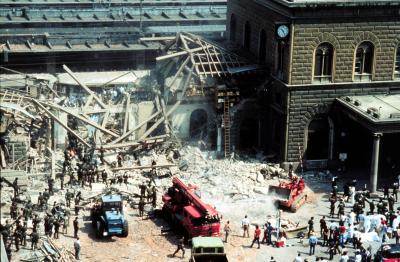
THE YEARS OF LEAD Italy endured a low grade civil conflict starting in the 1960s. Various extreme right and left groups targeted each other, the government, civil society, and civilians with bombings, kidnapping, robberies, and assassinations. The extreme right’s goal was the notorious “strategy of tension“: to scare people with terror enough that they would accept a reactionary government. The left’s strategy: to mobilize the population enough to kick off a left-wing revolution. Both used violence and terror as risky but sometimes successful recruiting tools, as well as for resource-gathering (cf bank robberies). Violence and terror also kept the cycle going by instilling the desire for revenge in survivors, friends, family, and witnesses.

Strage di bologna - By Beppe Briguglio, Patrizia Pulga, Medardo Pedrini, Marco Vaccari - www.stragi.it/, CC BY-SA 3.0, https://commons.wikimedia.org/w/index.php?curid=301978

The 1980 Bologna railway massacre.

How might this apply to the United States? It is not difficult to foresee some extreme right-wing groups (3%ers, Oath Keepers, Proud Boys, etc) increasing their violent acts and becoming more ambitious. One established American precedent is The Order, a hard-right racist fringe outfit which conducted bank robberies and at least one assassination in the mid-1980s.  Following the Italian example, not to mention the action of some Republicans around the January 6th event, we would envision some politicians allying themselves with these fringe activists to varying degrees of secrecy or openness, for a shared cause and/or mutual benefit.

I’m not sure if there will be any such corresponding action on the extreme left, since so many are wedded to nonviolent action. But we could see such organizing happen if a group feels right-wing dangers are dire enough and if they are willing to obtain the necessary tools.  Perhaps right wing attacks will spur retaliation. Or maybe some will see their struggle as so fundamental to humanity that they must risk extreme action (cf the classic “if you had a time machine, would you travel to the 1920s and murder Hitler?” prompt).

Recall that in the Italian case the activists were very small in number. The Red Brigades numbered a few hundred out of a nation with circa 50 million people. The United States, in contrast, numbers nearly 330 million and is very well supplied with weaponry.

Recall, too, that in Italy’s Years of Lead neither side succeeded in taking over the government, even after kidnapping and killing a former prime minister.

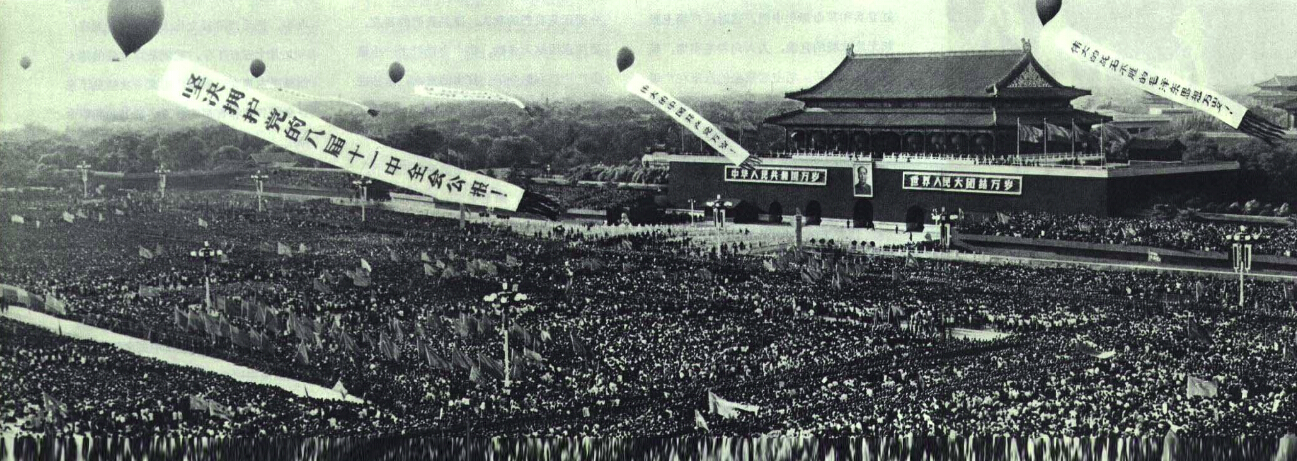
CHINA’S CULTURAL REVOLUTION From 1966 to 1976 political chaos engulfed the People’s Republic of China. Chairman Mao, having lost a great deal of power due to the horrific failure of his Great Leap Forward, launched a political gamble to rebuild his leadership. The story is complex and not easy to summarize, but it took the broad form of a revolution from above, which developed into widespread unrest to the level of civil war.  Mao used national, regional, local, and cultural supporters to provoke political instability while building up a Stalin-level cult of personality.  To do this Mao and his allies ran huge propaganda campaigns, created new political-military units out of teenagers, spurred endless rounds of local political fighting (hence struggle sessions and escalating local violence), and purged leaders across the system, along with preparing the nation for war with the Soviet Union, and more.

China Cultural Revolution Tiananmen 1966_Wikipedia

(I recommend Frank Dikötter’s The Cultural Revolution: A People’s History, 1962—1976. The complexity of this story is immense, and its recency means it’s difficult to get perspective and documents.)

How might this play out in the United States?  Obviously the American situation is very different.  Contemporary America is a world leader and is neoliberal in ideology, as opposed to China’s developing nation status during these events, not to mention being a communist state. However, we could imagine a right wing American leader, such as Trump, applying some of Mao’s practices if he wins the 2024 presidential election. Imagine him authorizing various local groups (militias, friendly state governments, local or state police) and federal agencies to go after people he doesn’t like (liberal school boards, tech companies, whatever Trump thinks Antifa is). Trump (or DeSantis) could use federal powers to crack down on anyone he doesn’t like, such as sending troops to deep blue cities, increasing digital surveillance, or denying resources. Trump (or DeSantis) could also follow Mao in urging repeatedly updated political opinions, talking up foreign war to scare people at home, calling out domestic enemies, and generally building up a cult of personality.

Obviously there are limits to this analogy. Trump is no ideologue like Mao was; I’m not sure what a Little Red Book analog might be.  Further, today’s GOP counts economic growth as a major, even leading achievement, while a Cultural Revolution level of chaos would undermine that.

One thing to keep in mind: Mao succeeded, at least in terms of his drive to rebuild his own power. He lived the last years of his life in supreme authority, albeit in declining health, after dismantling some of his support structures.

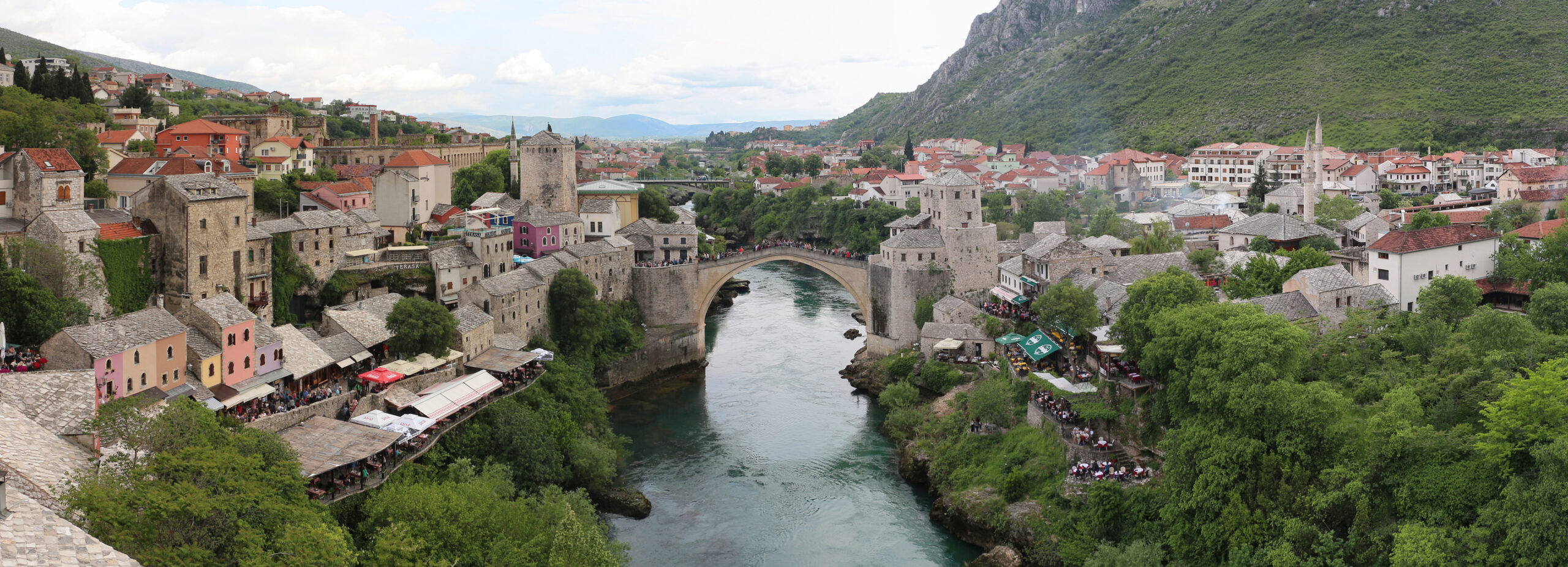
THE DESTRUCTION OF YUGOSLAVIA In the 1990s this nation tore itself apart, as a nationalist party tried to seize and expand control over the whole republic, and as different sub-nations sought to secede. A powerful national army proved a major power source for the Serb hardliners, as did militias. Republics generated their own forces, including irregular militias. Violence escalated in cycles of vengeance and deliberately inflicted terror. Republics exited the federation while the war grew in complexity and horror.  Other nations intervened, eventually establishing a shaky peace – followed by more conflicts and more unstable settlements.

Stari_Most_viewed_from_North

Bosnia’s Stary Most (Old Bridge) over the Neretva River, rebuilt after being shattered in the war.

What vision for American conflict does the destruction of Yugoslavia present?  This is a more extreme model than the first two, but it could play out in several ways. imagine if Trump or DeSantis wins the White House and cracks down much harder than in the Mao model. Such suppression, surveillance, and violence provokes resistance at the state and city level. Democrats/liberals/the left attempt to secede in some way, such as declaring local autonomy from the Republican administration. They could organize self-defense forces at scale. This could spark an escalated federal crackdown. Any violence would drive all sides to further organization and action, and the nation spirals into civil war.

Alternatively, we could imagine the reverse, with a Democratic election victory and the Trump/reactionary right treating the winner as a tyrant. The latter could attempt to secede at the city, state, and/or regional level. They could organizing violence at various levels, from lone activists to militias or suborned local police, aimed against federal forces or locals perceived as aligned with them. The White House follows Lincoln in 1861 and responds with greater force. The civil war spiral kicks off.

Once more, there are obvious differences between the United States in the 2020s and post-Tito Yugoslavia. As with the Chinese comparison, America is not a communist state.  The USA is also more powerful geopolitically, not at the point of having foreign forces intervene and force settlements.  There are not clear-cut mixtures of ethnic, religious, and linguistic divides; the American situation is more complex.  Yet ethnic cleansing, should it occur, might take different forms, such as racial mass murder.


Why these historical examples out of all others?

First off, I was looking for situations that were as close to the present as possible.  That makes the comparisons less removed than, say, examples from Europe in the 1600s.  These histories are still distant from our present in key ways.  The contemporary internet, for example, could prove a powerful tool in any actor’s arsenal. The experience and impact of COVID-19 might inflect any such future history in ways quite different from our examples.

Second, for each one I began by isolating present-day factors which could drive civil unrest in the United States. Looking at dueling small groups in Portland, Oregon and the group which rioted in the US Capitol brought to mind the fierce, committed extremists of modern Italy. Considering Trump’s cult of personality, I looked for contemporary examples.  North Korea offers one, as does Italy’s Berlusconi, but not with the deliberate cultivation of chaos represented by Mao’s top-down revolution. Considering secession presents several alternatives, like Czechoslovakia’s split or the Eritrean war, but former Yugoslavia has advantages: a larger number of factions, a late industrial economic base, and a mix of ideologies with other identities.

Again, these are sketches. There is a lot more to say about each of those stories. There are plenty of ways today’s American context differs from each. Plus I have a lot more research behind this, but don’t want to overwhelm in a single FB post. My goal is to get you all thinking and commenting, so have at it.

(Bologna bombing photo by Beppe Briguglio, Patrizia Pulga, Medardo Pedrini, Marco Vaccari – www.stragi.it/, CC BY-SA 3.0; Cultural Revolution photo from Wikipedia; Mostar’s Stary Most image from Wikipedia)

Posted in politics, scenarios | 10 Comments

Extreme heat, reduced rivers, and higher education

For years I’ve been researching and writing about the impact of climate change on higher education. This summer has brought global warming to the forefront; will academia take the crisis more seriously as a result?

To recap from the past month: higher temperatures, too much water, and too little water, all exacerbated by the climate crisis have wracked the world.  Let’s start with China, where an unusually high heat wave is hitting province after province:

On 18 August, the temperature in Chongqing in Sichuan province reached 45°C (113°F), the highest ever recorded in China outside the desert-dominated region of Xinjiang. On 20 August, the temperature in the city didn’t fall below 34.9°C (94.8°F), the highest minimum temperature ever recorded in China in August. The maximum temperature was 43.7°C (110.7°F).

It is the longest and hottest heatwave in China since national records began in 1961.

Which is bad for reasons we’ll discuss, but I wanted to add this detail:

According to weather historian Maximiliano Herrera, who monitors extreme temperatures around the world, it is the most severe heatwave recorded anywhere.

“This combines the most extreme intensity with the most extreme length with an incredibly huge area all at the same time,” he says. “There is nothing in world climatic history which is even minimally comparable to what is happening in China.”

In Pakistan the monsoon has arrived earlier, apparently thanks to global warming, which has spawned horrendous flooding across that nation.   Property destruction, deaths, homelessness are all rising.  One third of the county’s surface area is under water and one in seven Pakistanis hit by it, according to the BBC. Bill McKibben has a fine, furious post on the story, and he shares these terrifying clips of the flooding:


Too much water or too little: in the Horn of Africa, three nations suffer from a 40-year drought. It’s worse now, as an “unprecedented four failed rainy seasons has killed millions of livestock, destroyed crops and forced 1.1 million people from their homes in search of food and water.”  Again, climate change is not the cause, but an accelerant.

In Europe higher temperatures have shrunk major rivers, including the Loire, Rhine (finally recovering), and Danube.

(What about the American megadrought?  That’s for another post.)

The damages and suffering are staggering. Floods and dehydration kill and injure people. Property destruction leads to financial losses and homelessness. Reduced rivers reduce shipping, hydroelectric power, nuclear power, and tourism, with all kinds of economic costs, even threatening to cut shipments of Chinese rare earths essential to electronics.  Droughts starve crops of water, making food more expensive and increasing hunger.

Those are direct impacts. Think of the secondary ones. Economic dislocation can breed further economic problems, especially in our hyperconnected world. This can lead to industries declining, recessions, a tide of human pain, as well as governmental responses and nonprofit activity.  Populations suffering from this can be more vulnerable to extremists political, religious, and cultural. We could see increases in substance abuse and domestic violence.  And so on.

And that’s not even mentioning other developments and trends which engage with this particular problem cluster.  Crop destruction, for example, is even more of a problem when the Ukrainian harvest is forced down. Parts of China’s economy and society are both already stressed by a current COVID wave and that nation’s strict response.

This is the present, happening now. Everything we have seen in climate science tells us things will just get worse. Even if we take major steps now, which we’re not, the amount of greenhouse gases we’ve added to the atmosphere have built in continued temperature rises.  We should therefore prepare for further heatwaves and their knock-on effects.

So what does this have to do with colleges and universities?

I’ve been modeling that intersection for the past two years, and have concluded that the answer is it’s a multi-leveled interaction. Here’s one infographic I made for Universities on Fire (now available for preorder):

How higher education engages with the climate crisis_overall

To break it down, moving from left to right: these heatwaves and floods impact campus grounds.  Media coverage hasn’t said much on this score, but physical campuses are as vulnerable as the rest of civilization’s built environment to too much rain, storm surges, and drought.  Extreme heat and water can hit the academic population, from students to staff and faculty members.

Such terrible weather also impacts some of our research agenda.  Storms, floods, etc. can damage research sites, from libraries and archives to archaeological digs to flora and fauna to specialized laboratories. On the other side of the coin, some (and I suspect an increasing number of) researchers will study these events in various academic disciplines: meteorology, hydrology, urban studies, economics, Earth science, etc.  The latter do not have to be colocated with the severe weather conditions, of course.

Similarly, floods and heat waves can intersect with postsecondary teaching in several ways. There is the nightmarish practical problem of classes scheduled to take place in these dangerous areas, and how to relocate them, shift them online, or defer teaching them – above all, how to keep students, faculty, and support staff safe.  There is also the intellectual aspect, whereby events may provide useful examples for certain classes, and eventually appear in different curricula. French nuclear reactors lowering their output because of declining river levels, for example, might prove a useful case study for certain engineering classes. Further, instructors face the challenge of teaching some students who experienced these disasters and bring some echoes of that experience, perhaps in the form of trauma, to class.

There are two more dimensions of the academia-climate relationship to consider. Moving along the infographic, we proceed to how a given academic institution interacts with the world.  First, a given campus exists in close connection to its immediate community.  (In American higher ed, we call this “town-gown” relations.)  When the area is inundated by floods, parched by aridity, or brutalized by dangerous heat, what happens to that connection?  For example, what is the responsibility of a college or university to assist its neighbors in providing shelter, emergency aid, cooling spaces, mental health support? Can a campus count on its neighbors to provide them with the same?

Second, academic institutions exist in the broader world, despite the semi-mythical ivory tower idea. Is such a disaster a subject for campus public intellectuals to address? Would local governments ask for faculty members to advise them?  What risks do individual academics and their home institutions run when the former act upon the world stage? Recall that networked and mobile digital devices give any member of an academic community the potential, however slim, to appear on that stage through media capture and production.

This is just a framework. You can probably generate other examples of the interaction between academics and the climate crisis.  The key things here are, first, to realize what’s happening in the world right now and, second, to start planning for what their worse successors might do.

In the meantime, I will follow up with another post looking at the North American heat crisis and its role in higher education.  And send my hopes to everyone afflicted by this intercontinental disaster.

Posted in climatechange | 3 Comments

Starting up my future of higher education seminar this week

Last night I held the first meeting of my Future of Higher Education seminar at Georgetown University.  The students were awesome.

Here I’d like to share some of the thinking behind the class design, as well as the syllabus.

The topical goal is to explore the future of higher ed, obviously, which means diving into two domains: the futures field and how the academic ecosystem functions.  Each class meeting engages both of those worlds, twining them together to help students forecast.   For futures work I have them try out different methods, including horizon scanning, trends analysis, scenario creation, and gaming. For higher ed they read scholarly books and articles about academia’s present functioning, recent history, and unfolding future.

I’ve taught this before, and have changed things somewhat. I wasn’t happy with how we handled technology and education and knew this was a major interest for LDT students, so I cut a number of those readings and instead give students space to design several sessions, from topics to materials to exercises. I’ll prepare and assist them, in keeping with the program’s emphasis on design thinking and student empowerment.

On the technology side I’ve found that students didn’t take natively to RSS or Twitter lists, so I’m going to mandate that this time. They have to choose one tech and practice it over the semester.  For RSS readers I’m pointing to Inoreader.  For Twitter lists, Twitter. We’ll also consider other tools, like Google Alerts, email newsletters, and podcasts.  (It’s good that students have access to the Chronicle of Higher Education through Georgetown’s library.)

crossing the Potomac

Crossing the Potomac river in front of our classroom’s building.

Students get to do a lot of work in this seminar, actually, besides learning one technology and doing a stack of readings. They have to share horizon scanning findings every class.  There are two mid-term assignments, a short trends analysis and a strategy memo. The former is designed to get them practicing a key futures technique. The latter prepares them for communicating with academic leaders.  At the course’s end they create a future academic institution, a project combining creative work with a reflection.

They also get to play my matrix game about a future university. I’m making some changes based on last year’s playtesting. I’m also preparing physical components, including a board and cards.

Last note on the readings: students will read two of my books, and four weeks of my writing feels awkward to me.  That’s the most I’ve ever asked of any group of people. I know Academia Next will give them a ton of content plus examples of two futures methods (trends and scenarios). I know Universities on Fire addresses a hugely important topic for the class.  No replacement texts will do the trick. Still, it feels egotistical.  I’ll see what the students make of so much Bryanness.

Now, on to the syllabus:

August 25, 2022 – Introductions

Designing the class: technologies, community, practices, pathways

Forecasting methods: introduction to futuring

Exercise: introduction Canvas thread

Stewart Brand, “Pace Layering: How Complex Systems Learn and Keep Learning”


September 1, 2022 – Futures and Systems

Gidley, The Future: A Very Short Introduction, chapters 1-4

How To Run a College, chapters 1-6

Exercise: assemble academic systems


September 8, 2022 – Scanning the Horizons

How To Run a College, chapters 7-9

Stanford 2025

Forecasting methods: horizon scanning, higher education

Exercise: set up digital scanning practice


September 15, 2022 – Trends

Exercise: horizon scanning

Academia Next, chapters 1-6

Forecasting methods: horizon scanning, STEEP

Forecasting methods: trend analysis

Exercise: turn this week’s horizon scanning into trends


September 22, 2022 – Scenarios

Exercise: horizon scanning

Academia Next, chapters 7-15

Forecasting methods: scenarios


September 23, 2022 – TRENDS ANALYSIS DUE


September 29, 2022 – Speculative Fiction as Futures Tool

Exercise: horizon scanning

Forecasting methods: fiction


October 6, 2022 – Delphi Method: Educational Technology

Exercise: horizon scanning

EDUCAUSE Horizon Report 2022

Forecasting methods: the Delphi Method


October 13, 2022 -Educational Technology 

Exercise: horizon scanning

Readings: selected by students


October 20, 2022 – Gaming the Future

Exercise: horizon scanning

Readings:

  1. Alexander, “A Web Game for Predicting Some Futures: Exploring the Wisdom of Crowds”
  2. Game materials: The Future University Matrix game, general rules

Matrix game, 1

Role assignments:

Forecasting methods: simulation gaming


October 27, 2022 – Student Determined Topic

Exercise: horizon scanning

Matrix game, 2


October 28, 2022 – STRATEGY MEMO DUE


November 3, 2022 – Decolonizing the University

Exercise: horizon scanning

la paperson, A Third University Is Possible


November 10, 2022 – Higher Education and the Climate Crisis

Exercise: horizon scanning

Universities on Fire (digital file TK)


November 17, 2022 – Higher Education and the Climate Crisis

Exercise: horizon scanning

Universities on Fire (digital file TK)

(no class November 24, 2022 – Fall Recess)


December 1, 2022 – Student Futures

Presentations


December 14, 2022 – FINAL PROJECT DUE

Posted in classes and teaching | 5 Comments

Biden announces a student loan forgiveness policy

Today president Biden announced a new policy for student debt forgiveness.

I’d like to summarize what it offers, share some thoughts, then invite you all to comment.

The plan specifies amounts to be forgiven: “The Department of Education will provide up to $20,000 in debt cancellation to Pell Grant recipients with loans held by the Department of Education, and up to $10,000 in debt cancellation to non-Pell Grant recipients.”  This only applies to people making under $125,000 per year.

The statement makes several points about timing.  First, loan payments, which have been paused since Trump in 2020, are paused one more time, then will restart: “the pause on federal student loan repayment will be extended one final time through December 31, 2022. Borrowers should expect to resume payment in January 2023.”

Second, forgiveness is following that schedule – i.e., isn’t starting now:

The Department of Education will work quickly and efficiently to set up a simple application process for borrowers to claim relief. The application will be available no later than when the pause on federal student loan repayments terminates at the end of the year.

The Chronicle of Higher Education note on the announcement reminds us that this timeline may be too optimistic, as lawsuits may slow things down.

There’s an interesting and appealing part about reducing payments for some via

a new income-driven repayment plan that protects more low-income borrowers from making any payments and caps monthly payments for undergraduate loans at 5% of a borrower’s discretionary income—half of the rate that borrowers must pay now under most existing plans.

One important detail on taxes: “Thanks to the American Rescue Plan, this debt relief will not be treated as taxable income for the federal income tax purposes.”

There’s an effort to address

the broken Public Service Loan Forgiveness (PSLF) program by proposing a rule that borrowers who have worked at a nonprofit, in the military, or in federal, state, tribal, or local government, receive appropriate credit toward loan forgiveness.

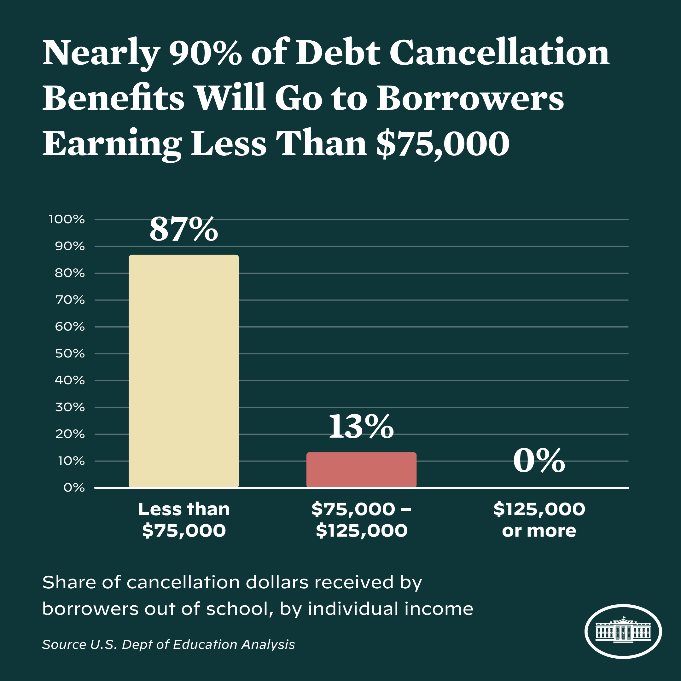
An important point from the official statement is the argument that it will not benefit wealthy people.  That’s been a criticism from those opposed to debt relief without means testing:

Biden loan forgiveness aimed at middle and lower class_2022 August 24

(This Department of Education statement prefers the phrase “targeted relief.”)

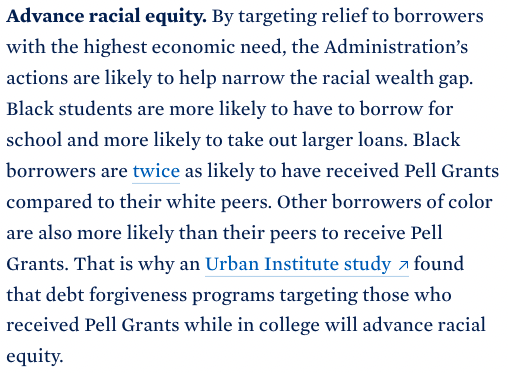
Another argument is that such forgiveness furthers racial justice:

Biden loan forgiveness -racial equity_2022 August 24

The scale of the plan is avowedly very ambitious:  

If all borrowers claim the relief they are entitled to, these actions will:

Provide relief to up to 43 million borrowers, including cancelling the full remaining balance for roughly 20 million borrowers.

(43 million is about 13% of the American population)

The plan also includes measures to try keeping college and university prices from rising, with language like “Protect future students and taxpayers by reducing the cost of college and holding schools accountable when they hike up prices” and “”colleges have an obligation to keep prices reasonable and ensure borrowers get value for their investments, not debt they cannot afford.”  However, it’s not clear what this might actually mean as specifics are few. There’s a bit about “continu[ing] to fight to double the maximum Pell Grant and make community college free.”  And this is just… open ended? “The Department of Education is announcing new efforts to ensure student borrowers get value for their college costs.”

More to the point is going after colleges by addressing their accreditors: “The [Department of Education] has re-established the enforcement unit in the Office of Federal Student Aid and it is holding accreditors’ feet to the fire.”  For-profit higher ed receives particular attention: “In fact, the Department just withdrew authorization for the accreditor that oversaw schools responsible for some of the worst for-profit scandals.” 

There are other hints about controlling prices, like this line about addressing career programs – does this mean vocational schools? “The agency will also propose a rule to hold career programs accountable for leaving their graduates with mountains of debt they cannot repay, a rule the previous Administration repealed.”  The administration will also create a new, public document: “an annual watch list of the programs with the worst debt levels in the country, so that students registering for the next academic year can steer clear of programs with poor outcomes.”  Lastly, this push for certain schools, with the administration “requesting institutional improvement plans from the worst actors that outline how the colleges with the most concerning debt outcomes intend to bring down debt levels.”

Thoughts:

I’m not sure if this plan would prevent the debt bubble from inflating right away.  The language about controlling college and university prices strikes me as vague, but I’ll check with some accreditors for their thoughts.

The national politics are tricky here. There’s a broad range of dislike for debt forgiveness, which Biden has to mollify: people who already paid their loans, those who are ideologically opposed to debt forgiveness, and folks who don’t see higher ed as an entitlement like public K-12, plus Republicans automatically opposing anything from this White House. For example,


Fox News, unsurprisingly, complained that this would add to the deficit. You can see some efforts to address these criticisms with the insistence on forgiveness not helping wealthier people. There’s also delaying repayment until after the November elections, which might make those of us paying off debt happier.

There is clear support from the Democratic left, like senators Sanders and Warren:


Perhaps we’ll see a cultural shift towards de-privatizing higher ed. This tweet brings the idea to my mind, suggesting a historical turn:

Or we might see this executive order become a party political football to be fought over through November’s elections, and possibly beyond.

On a personal note: I’m 55 and still paying off loans from three degrees.  My children are in their 20s, university graduates as well, and are filled with dread at the amount of debt they confront. Biden’s policy will help us, straight up.

Now over to you.  What do you make of this new development?

Posted in economics, higher education, politics | 6 Comments