New York announces a climate change campus

How might higher education respond to the climate crisis?

One answer to this very large question is for a given campus to expand its academic teaching on the topic, across the curriculum.  A second answer involves expanding a college or university’s research work, also across the disciplines.  Over time, an institution’s commitment to building and sharing global warming knowledge increases.

As an alternative, we can imagine the creation of climate programs within larger universities.  Or in a more ambitious way, by creating an entire climate institution.  I speculated about this in my recent book, Universities on Fire, forecasting that “entire graduate schools and undergraduate colleges specializing in the climate crisis appear…” (4) Later on in the book I added:

Looking decades ahead, we can imagine an academy increasingly devoted to studying the Anthropocene through familiar academic departments and new ones. Depending on an institution’s nature and strategy, we may forecast new forms for such work: centers, institutes, academic programs, colleges within universities, entire standalone colleges and universities devoted to researching the topic.   (86; emphases added)

That is precisely what New York state recently announced.  Stony Brook University will lead the construction of the New York Climate Exchange on Governor’s Island.

According to the Stony Brook official page as well as the New York Times’ article, the Exchange has several distinct yet interconnected functions.
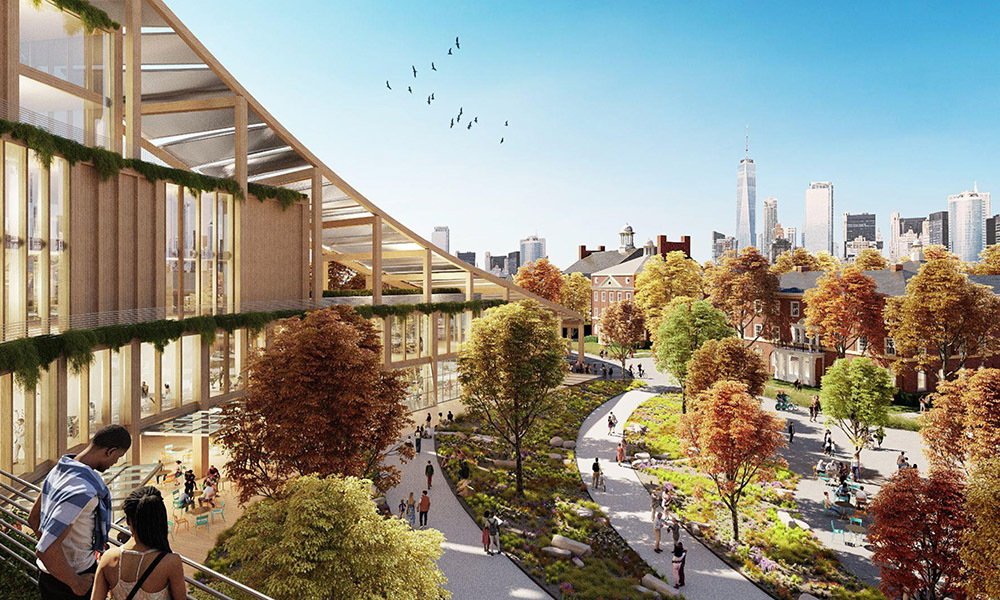
Stony Brooke Exchange rendering

From the project renderings page.

Research and development This is how the Stony Brook page leads off, describing the Exchange first of all as “a first-of-its-kind international center for developing and deploying dynamic solutions to our global climate crisis.”  R&D appears to be key.

It’s still early days, but the Stony Brook FAQ offers a list of potential research topics:

The Exchange will tackle the most important elements of the climate challenge: air, water, food, and energy studies. Some initial areas of focus include:

  • Green infrastructure for coastline resilience
  • Electric vehicle-to-grid integration
  • Circular organic waste management
  • Climate resilient hydroponics
  • Data visualization of extreme event impacts
  • Policy strategies for implementation of solutions
  • Advanced aquaculture for urban food security and carbon capture

Teaching One part of the new school’s pedagogical function involves teaching undergraduates and grad students.  Stony Brook makes it sound like its own branch campus:

The Exchange is an opportunity to amplify and expand the research already being done at Stony Brook in the areas of climate and sustainability. It will also offer a Climate Solutions Fellows program for graduate students, a Climate Solutions Semester for undergraduates

I’ve written that climate teaching should be interdisciplinary, and Stony Brook agrees:

Climate solutions are not limited to the so-called hard sciences and require an “all-of-the-above” approach including across the humanities, social sciences and healthcare. The Exchange envisions many interdisciplinary projects on Governors Island and welcomes ideas and inspiration from all fields of study. Additionally, we expect that the arts will be well-represented through performances, art installations, and other possibilities.

More teaching: workforce development The curricular strategy sounds based on jobs for the immediate community, with the Exchange “host[ing] job-training and skills-building programs for local residents to help them launch successful careers that improve our regional environment.”

Indeed, Stony Brook belabors the point, emphasizing that the Exchange isn’t a liberal arts space so much as a job training center:

The unique purpose of The Exchange will be to bring together the voices of all stakeholders so that solutions to our climate crisis are not just academic or theoretical, but social and practical — including research that becomes commercially viable and ideas that lead to immediate action on the local and global levels.

(Readers of American higher education history will recognize this centuries-old argument about theoretical versus practical teaching)

The Times article describes a statistical emphasis on workforce: “The campus will create more than 2,200 jobs, city officials said, and eventually serve 600 college students, 6,000 job trainees…”
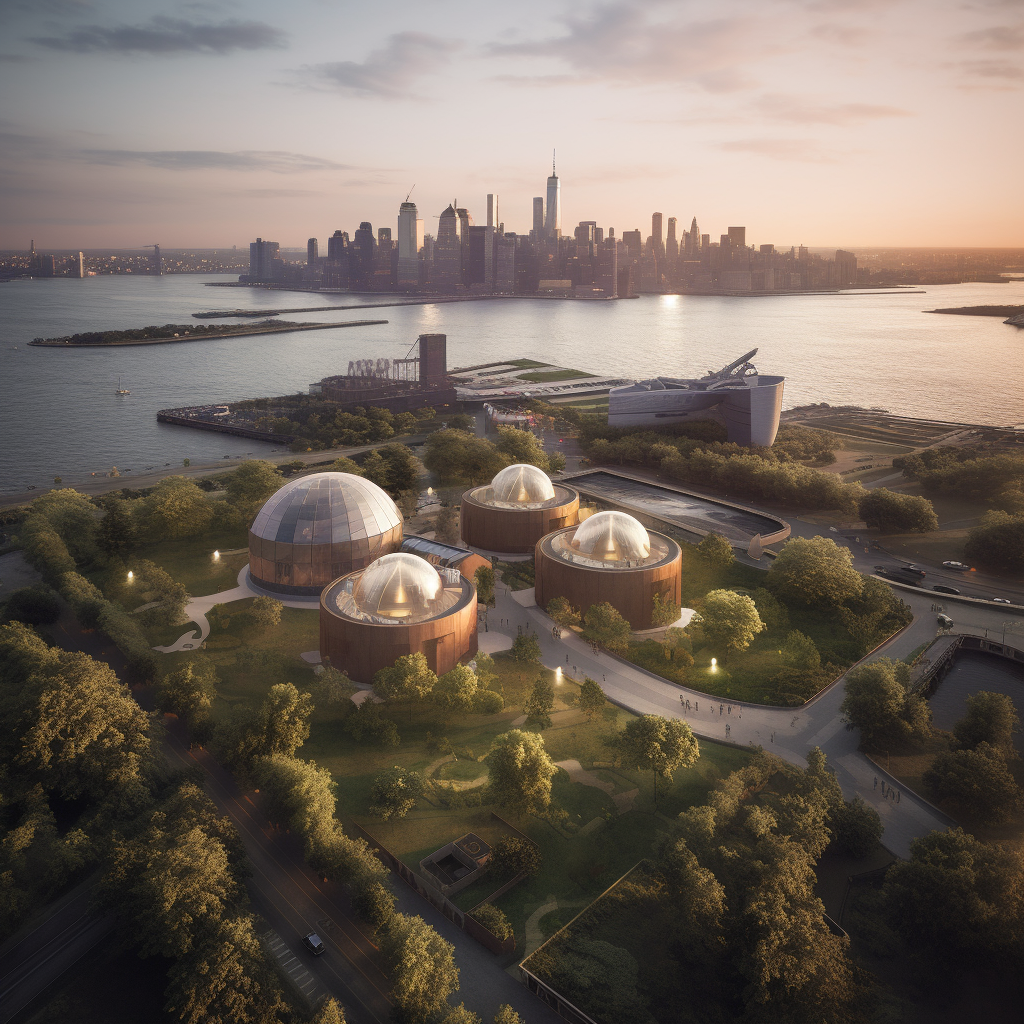
Midjourney imagines_An_academic_climate_change_center_on_New_Yorks_Governors Island 2

One of Midjourney’s efforts on the topic.

Rethinking campus operations In addition to conducting higher education’s classic functions of teaching and research, the enterprise will experiment with its operations as part of its climate focus. “The design and operations of The Exchange itself will serve as a model for sustainability with a carbon-neutral facility that blends into the natural landscape of Governors Island.”

One goal is to be electrically sustainable.  According to CBS:

“It’s going to be covered with solar panels and have geothermal energy. So it will not need electricity from the grid at all. In fact, it’s going to give electricity back into the grid,” said Claire Newman, president and CEO of the Trust for Governors Island.

Blending these functions It sounds likely that climate study will cross institutional domains.  For example, the New York Times mentions that “[t]he climate hub will serve as a ‘living laboratory’ that features resilient design.”  I imagine faculty research, student inquiry, and the campus physical plant all involved.

Stony Brook offers this sketch of topics which can be integrated across those domains:

Environmental Justice and Inclusion

Reconciling global inequities, reducing burdens, distributing benefits more fairly, and redressing past discriminatory practices and their impacts.

Climate Interdependence

Adopting the “nexus” approach to sustainable climate change solutions with emphasis on the connection between the critical ecosystem domains of water, food, and energy.
Sustainable Urban Environments

Developing and demonstrating sustainable, affordable solutions for coastal urban environments, starting on Governors Island and extending outward into New York and beyond

How is this funded and supported?  The Times describes several sources:

About $150 million in funding will come from previously allocated city capital funding, city officials said. Another $100 million is from the Simons Foundation, founded by the billionaire James H. Simons, and $50 million will be contributed by Bloomberg Philanthropies, founded by Mr. Bloomberg, a longtime supporter of rebuilding the island. The consortium will raise another $400 million and cover operational costs…

Additionally, the Exchange has a lot of partners from academia, the corporate world, and local non-profits.

Things are in the planning stage now.  Construction itself won’t begin until 2025.  The Times thinks it’ll open for business in 2028.

One criticism of this project comes from Scotland’s Donald Clark, who sees the construction as flying in the face of climate change’s needs:

Let’s solve our carbon footprint problem by ‘building’ another campus in an island…. head, table, thump….

It has long been the knee-jerk reaction in Higher Education to shove up buildings, as if that were the solution to a problem. In this case, it’s exacerbating the problem.

I share Clark’s concern, as the Twitter exchange shows.  It also reveals a split in academic thinking about global warming.  One side follows the historical pattern of recognizing new or expanding academic endeavors by creating new material expressions (buildings, campuses, sites), infrastructure (jobs, programs), and by hiring people.  Against this is the broader economic thinking we see from no-growth and de-growth advocates, who would see us shrink our footprint, especially the richest “us.” Within American academia we could align this with the decade-running enrollment decline, or the so far scarce idea of deliberately shrinking a campus footprint (cf Gordon Gee’s recent move).

I’m also worried about how the thing will actually get built, given the enormous problems of building anything in the New York City area (cost overruns, delays, scope creep, etc).

At the same time I’m impressed by this group of partners committing themselves to creating an academic entity dedicated to the climate crisis.  There’s a lot of potential there, both locally and in terms of R+D for the world.

Are there any similar academic entities in the world?  How many more should we anticipate?

Posted in climatechange | 1 Comment

When will the first university or college charge $100,000 per year?

When will the first American college or university charge $100,000 or more to attend? What might that mean for higher education?

I first asked this question back in 2018.  I wanted to use that psychologically important six figure price as a milestone to come, a signal event in the history of rising published institutional charges.  In that post I offered a forecast. Today I’d like to check in on that post, as I’ve been doing ever since (for examples: 2021, 2022).

99,999 by Alan Levine

To recap and summarize: I was trying to estimate when the first American campus would crack $100,000 for total cost of attendance for a year of full time undergraduate schooling.  That means the combination of tuition and fees, plus room and board.  It includes only published prices, not accounting for discounts through scholarships etc.

For example, here’s the official, published total cost of attendance for the University of Southern California, with a helpful breakdown:

University of Southern California total cost of attendance 2023 May 11Amherst College helpfully adds some further expenses:

Amherst College total cost of attendance_2023

Looking for such data, I selected some or all of the most expensive institutions, checked out the rate by which their prices rose, and estimated that one would breach six figures by the 2029-2030 academic year.  Last year I revisited these Most Expensive Universities (MEUs) and found several getting pricier more quickly.   Two, Northwestern University and the University of Pennsylvania looked like they would reach six figures by 2026.

Let’s check in on those MEUs in this year of 2023.

Here’s the list of leading contenders I assembled previously, updated with their official costs for the upcoming (2023-2024) academic year, re-ranked in descending price order:

USC $90,921

Harvey Mudd College 89,115

University of Chicago 89,040

Wellesley College 89,091

University of Pennsylvania 89,028 ($88,892 for living off campus)

Amherst College 88,599 (assuming the insurances aren’t waived)

Tufts University 88,300 (without health insurance, as noted)

Northwestern University 87,804

Dartmouth College 87,793

Brown University 84,828

There are others in this bracket.  Cal Tech is definitely towards the top with an annual charge of $86,886.  Columbia University’s total cost comes in at $85,967.   Claremont McKenna College prices in at $86,500.  Duke University: $84,517.   Stanford University: $84,683. Sarah Lawrence College publishes a direct charge of $81,224. Harvard University slides just under the 80K bracket with $79,450.

(For simplicity’s sake, I’ve left off estimates of non-billable personal costs, as well as extra fees levied on first-year students.  I’m also using on-campus housing figures, as the host campus is responsible for those, unlike for off-campus living.  I include books, as those are both necessary class costs, and also amenable to open education resource amelioration.)

In my previous posts on this topic I worked from a 4% annual price increase.  If we apply that to USC, they cross over the $100K barrier in four academic years:

2023-2024 $90,921

2024-2025 94,558

2025-2026 98,340

2026-2027 102,274

Harvey Mudd also crosses in that academic year, just a hair behind:

2023-2024 $89,115

2024-2025 92,680

2025-2026 96,387

2026-2027 100,242

Let’s see how all eighteen of those campuses fare over the 2020s:

Institution 2023-2024 2024-2025 2025-2026 2026-2027 2027-2028
USC 90,921 94557 98340 102273 106364
Harvey Mudd College 89,115 92679 96386 100242 104251
University of Chicago 89,040 92601 96305 100157 104164
Wellesley College 89,091 92654 96360 100215 104223
University of Pennsylvania 89,028 92589 96292 100144 104150
Amherst College 88,599 92142 95828 99661 103648
Tufts University 88,300 91832 95505 99325 103298
Northwestern University 87,804 91316 94968 98767 102718
Dartmouth College 87,793 91304 94956 98755 102705
Cal Tech 86,886 90361 93975 97734 101644
Claremont McKenna College 86,500 89960 93558 97300 101192
Columbia University 85,967 89405 92981 96701 100569
Brown University 84,828 88221 91749 95419 99236
Stanford University 84,683 88070 91593 95256 99067
Duke University 84,517 87897 91413 95070 98872
Sarah Lawrence College 81,224 84472 87851 91365 95020
Harvard University 79,450 82628 85933 89370 92945

(I fudged cents manually, mostly cutting them off, because I couldn’t figure out how to handle that in Google Sheets.)

2026-2027 seems to be the breakthrough year with five institutions crossing over.  Next, academic year 2027-2028 sees six figures as par for the course for this MEU group.

Now, that 4% back-of-the-envelope number is out of date.  Inflation famously or notoriously has taken off over the past two years, and that definitely impacts college and university economics. The inflation rate has cooled off this week to 4.9% (Bureau of Labor Statistics), but was obviously higher for a time.  Some of those higher costs are baked into present pricing (think energy, food service, health care, and also staff cost of living) and so will goose up charges for the near future.

Let’s see what happens if published prices go up by a rough and simple 5%:

Institution 2023-2024 2024-2025 2025-2026 2026-2027 2027-2028
USC 90,921 95467 100240 105252 110515
Harvey Mudd College 89,115 93570 98249 103161 108319
University of Chicago 89,040 93492 98166 103074 108228
Wellesley College 89,091 93545 98222 103133 108290
University of Pennsylvania 89,028 93479 98153 103061 108214
Amherst College 88,599 93028 97680 102564 107692
Tufts University 88,300 92715 97350 102218 107329
Northwestern University 87,804 92194 96803 101644 106726
Dartmouth College 87,793 92182 96791 101631 106712
Cal Tech 86,886 91230 95791 100581 105610
Claremont McKenna College 86,500 90825 95366 100134 105141
Columbia University 85,967 90265 94778 99517 104493
Brown University 84,828 89069 93522 98199 103108
Stanford University 84,683 88917 93363 98031 102932
Duke University 84,517 88742 93179 97838 102730
Sarah Lawrence College 81,224 85285 89549 94026 98728
Harvard University 79,450 83422 87593 91973 96571

2025-2026 is the new breakthrough year in this model.  A majority of MEUs join the six figure club the following year.

What does this mean for higher education?

In a sense all of this data-gathering and modeling doesn’t matter very much.  $100,000 is an arbitrary number, no more important than $99,999 or $100,001. I’m also picking on a very, very small slice of American colleges and universities.  The community college sector, for example, is far larger in number of institutions and educates a massively bigger number of students.  Further, it’s not exactly shocking news to reveal that higher education’s sticker prices rise.

Yet I do think this probe could be of use.  To begin with, the switchover from five to six figures may prove to be psychologically or culturally significant. We do tend to pay extra attention to such numbers, like the year 2000 millennium or numbering COVID dead by increments of hundreds of thousands, then millions. To the extent the first campus to cross this arbitrary milestone becomes a cultural moment, I hope these posts can prepare some of us.  Further, I expect at least some administrators to be aware of the potentially bad press for that milestone, and will take steps to make it look less frightening; we can anticipate such steps now.

There’s another reason to pay attention to these MEUs. They tend to draw outsized attention both within and outside of the academic ecosystem.  Their reputations loom large within a very calibrated institutional hierarchy. How they handle price increases, and how society responds to them, will be the subject of study from other colleges and universities.

More deeply, I think such staggeringly high sticker prices illuminate the real pricing model of higher ed, one based on combining those fees with deep discounts.  I expect discount rates to grow in tandem with the published prices, perhaps reaching 75% by the decade’s end. This clearly reveals the massive disparities of American income and wealth; indeed, one could see our deepening discount+rising prices model is a carefully structured expression of living in a post-Piketty world.

Once again I must hedge this discussion. These are crude, first-order extrapolations.  A whole galaxy of events can throw them off target: escalating war in Ukraine, which helped trigger inflation; a financial crisis; economic and/or political crises between the United States and China; political chaos involving the 2024 election; climate disasters; etc.  Within higher education administrators have options and strategies which could take them in different directions.

For now, I hope I’ve inspired some discussion.  I’ll check back on this six figure forecast a year from now.

(daring odometer photo by Alan Levine)


Posted in economics, future of education, higher education | Tagged | 18 Comments

Rebooting my use of Mastodon

After another few frustrating months on one Mastodon server, I’m trying the whole experience again with a reboot.  I shifted my account to a new instance, which means you can find me at this address? handle? some elephant-ish nickname?

@bryanalexandee@mastodon.education

Mastodon band, photo by frenkieb

Not this Mastodon – but I do love the band.

I confess to being of two minds about Mastodon.

On the one hand, I’ve had a poor experience with the thing so far.  Each server I’ve used has ranged in badness from administrators hating me to  staging a vast, roaring silence in response to my every toot. The onboarding process isn’t great, reminding me of what greets non-geek users of Linux or, back in the day, Second Life.  There are many mores and practices to pick up, some of which aren’t readily understood and/or contradict.

On the other, too many people I respect have made a point of committing to Mastodon. And I like the distributed, user-oriented idea of the Fediverse.  So I’ll give it a shot.

This does take time.  I’ve got to learn this new server’s ways.  I have to manually build up my social network there – right now it’s about 1-2% the size of what I enjoy on LinkedIn and Twitter. Thankfully, some folks have been very helpful in the process.

I remain on all of my other platforms.  I haven’t exited Twitter. I do owe a blog post about why I persist on Twitter and Facebook (nobody ever complains about LinkedIn), and my explanation is a version of Willie Sutton’s famous answer.

In the meantime, if you’d like to connect with me on the tusk plane, @bryanalexandee@mastodon.education is how to find me, I think. Do share your own contact in comments, if you like.

(awesome photo by Francis Bill)

Posted in technology | Tagged | 15 Comments

Extrapolations: notes on Apple’s climate fiction series, episodes 4-8

How can we imagine the future under the impact of climate change?

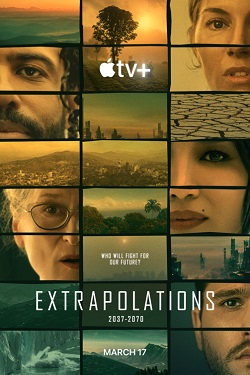
Extrapolations PosteI’ve been watching the Apple TV+ series Extrapolations, which offers an interesting example of climate fiction.  It’s a kind of anthology show, with each episode depicting one story at a point in the next few decades as the global situation worsens.  Some characters, events, and themes knit the episodes together.

I summarized the first few episodes previously.  Let’s continue and finish the season.

For each episode I’ll offer a plot summary, a sketch of its extensive worldbuilding, a bit on themes, and some reflections.  At the end I’ll add some thoughts as I have time.

Spoilers ahead.

4: “2059: The Face of God”

The American president Burdick (as in burdock, I think: prickly) signs the Climate Intervention Treaty, banning geoengineering  It classifies certain substances as controlled ones: calcium carbonate, hydrogen sulfide, sulfur dioxide.  Carbon sequestration isn’t working.  Billionaire Gita Mishra threatens to unleash a geoengineering project unless Burdick withdraws from the treaty, citing climate justice and blaming other billionaires for working (instead) on rockets. The president convenes a team to grapple with the situation, while also working with Nick Bilton, CEO of megacorporation Alpha.  Someone shoots down Gita’s plane and as a result the other planes unload their geoengineering payloads, followed by hundreds of thousands of drones around the world doing the same.

Worldbuilding: global warming is heading to 2.5 degrees C.  There are accords signed during the Tel Avid COP which took place in episode one.  Djibouti has large seawalls or barriers. So does Mumbai.  The Alpha company is larger than ever.

We see many new or developing technologies. Holographic displays are still working.  A new invention is an uncrewed, zero carbon emissions perpetually aloft plane, solar powered a drone.  Very light phones now consist of little earpieces, which can project large virtual screens. Other phones are entirely transparent. There are also fully transparent computers. Drone deliveries are commonplace.  Some kind of food tech involves making food at home from proteins.

Themes: the world’s elite making top-down decisions.  Family is central – i.e., we begin with father-son tension over geoengineering. That father closely advises the American president.  The son runs away to his stepmother.  That stepmother builds aircraft, while the father sails on sailboats.

5: “2059 Part II: Nightbirds”

Quick prologue: someone steals from the Svalbard Seed Vault. The main plot concerns an epic road trip across part of India in order to set up a beneficial project.  An assassin and aspects of ordinary life threaten the mission.

Worldbuilding: India is at war against … Pakistan? A southeast Asian volcano spewed ash into the atmosphere and cooled things off a bit.  The previous episode’s conclusion is referred to as an act of eco-terrorism, but its impacts are hard to discern.  Daytime temperatures get hot enough to disable and kill; curfews restrict human access to extreme welt bulb temperatures.

Technology: there’s a nanobot treatment for breathing problems.  People use insulated sleeping bags to protect themselves from excessive heat.  You can launch drones by a  simple hand toss.

6: “2066: Lola”

The plot concerns a character who works as a kind of personal stand-in for the people clients have lost.  He changes his appearance, switches up languages, and studies memories to best represent the missing or dead.  Cognitive issues begin to beset him, as he’s the grown-up kid who had summer heart in an earlier episode, and then things get worse.

Worldbuilding: the summer heart idea from a previous episode returns, with impacts to brain function.  Increasing heat drives up digital cloud service costs, or at least is the justification cloud companies use to jack up rates. People can suffer from “heat rage”; perhaps CRISPR can help.  Rotterdam was evacuated and London’s Metro floods Blockchain is key to digital infrastructure and has a huge carbon footprint.  There are Heal the Land colonies, with some cultish overtones, and also with implications that participants/members can change their identities to live there.  CO2 might be up to 560 ppm. The previously mentioned animal resurrection service claims to be about to reintroduce humpback whales.

Extrapolations_Going Away Party

7: “2068: The Going Away Party”

The story involves a New Year’s party in San Francisco hosted by an aging and failed inventor and his frustrated wife.  There are many nods to Who’s Afraid of Virginia Woolf? (1962), including tensions and betrayals between two couples and an argument over children existing. The holiday structure for this family-based representation of the future calls out to Years and Years (2019).

Worldbuilding: the Alpha virtual assistant is still a thing, with people using their voices to summon presentations. Phones are still thin slivers of glass. Hologram interfaces can be based in a locket while a chip allows people to see augmented reality superimposed on their vision at any time, even during sex. Robots – androids – are advanced enough to simulate human beings.  Economic class divides are sharp.

The atmosphere is poor with people carrying their own oxygen to breathe. At least one person embraces a no-hugging, no-touch ethos; it’s not clear if this is just a personal affectation or a new cultural form.  Solar and wind power have declined, at least because of poor atmospheric quality. Heat waves kill large numbers of people. “Climate fatigue” is apparently a thing animals and presumably people can suffer from.  Carbon constitutes a currency in some way, including in a black market. Uploading or “digitizing” the human personality is starting to be possible, in part to putatively reduce one’s carbon footprint.  Burbank, California no longer exists.  The Hague is hosting trials of corporations and individuals for crimes against the climate, or ecocide.

8: “2070: Ecocide”

Zillionaire Nick Bilton is tried for ecocide. We learn that he was born a Russian, Nikolai Biltinov. He views life as transactions and thinks it’s best to assign fantasy worlds to the poor. Bilton’s company launches a carbon drawdown product, albeit one which will reduce atmospheric carbon down to 470 parts per million, a number determined by a shadowy cabal of businessmen.  Bilton built that technology (the “Newcomen,” named after the British inventor of the first steam engine) based on stolen tech from an inventor, whose daughter he raises in hiding.  That daughter calls for CO2 to drop to 350 (as in this organization).  Bilton ends up in orbital prison.

Worldbuilding: carbon dioxide is over 560 ppm.  Ecocide became a crime in 2050, according to Alpha. There are prisons in orbit and a penal colony on the Martian moon of Phobos. Some British and Dutch cities are domed.  Bees and wildflowers disappeared in mid-century.  Somehow genetic engineering addressed illiteracy.  The Marshall Islands are no longer habitable.

At least one court is automated by AI. Holographic representations are larger than in prior episodes, although scales and alignment can be off; their controls can be embedded in furniture. People can use a series of holographic avatars to disguise themselves. There are also Star Trek-Holodeck-style virtual spaces, complete with AI-driven agents. Data can be stored in little slivers; phones are now similarly sized tiny devices, stuck on people’s heads. Drones deliver printed-out communications.

Themes: the morality of businesses, the culpability of consumers.  The climax of the episode blames humanity as a whole for climate change.


Overall, I think this is an impressive and noteworthy show.  It aims to accomplish a lot, tracing out one climate crisis future in significant detail.  I want to focus on that issue for the rest of this post.

How do you tell a story about the climate crisis?  It’s a famously vast topic, a hyperobject, and one a whole subgenre – climate fiction – wrestles with.  To treat it Extrapolations models several strategies, starting by foregrounding family stories.  This humanizes complex problems and offers ready emotional connections.  Similarly, the show keeps putting small human interactions before us to embody the hyperobject: a courtroom drama sans jury or in-person spectators, two smugglers in a truck, a few members of a board.  Overall there’s a lot of microcosming at work.

The program also tells the global warming tale through the top-down viewpoint of many thrillers, with leading characters being political and economic leaders, offering us exposition and persuasion.  It is not very democratic, in that we see most of the world order shaped by elite decisions, imposed top-down style.  It’s a straightforward way of showing us the world through the people in charge of it.  “Nightbirds” and “Lola” are exceptions to this rule, their characters on society’s bottom rungs, mystified about most of what’s going on.  Our protagonist in “Nightbirds” sees an explosion in the sky and doesn’t know what to make of it; we do, because we learned about it from the world leaders who made it happen in the previous episode.

Extrapolations proceeds by sounding a deeply melancholic note most of the time.  Episode are tonally and often visually dark, showing as catastrophes and gradual decay.  This builds to nearly Wagnerian levels by episode 7 as we realize the world is so terrible and hopeless that escaping and hoping for a civilizational reboot is the best available option.  (And if you’re skeptical of uploading’s viability, it’s fancy suicide.) Episode 8 tries to undo that tone by setting up a clear villain for a clear fall, leaving an image of optimism behind.  Unconvincingly, I’d add.

The series also approaches the problem of climate narrative by trying out different genres.  “Nightbirds” is a grungy crime thriller, while “Face of God” is a glossy grand political thriller, “Going Away Party” a brutal family drama laced with posthumanism, and “Ecocide” a courtroom drama.  It’s an anthology approach of sorts, tackling the problem from multiple perspectives.  I’m not sure how this plays out with audiences, especially those who prefer a tv series to plow a single generic furrow.

I have many more thoughts about the show, but want to pause for now and save ’em for another post.  Has anyone else seen it?  I recommend it with reservations.

(“Going Away Party” via RogertEbert.com)

Posted in climatechange | Tagged | Leave a comment

American faith in higher education is declining: one poll

Last month the Wall Street Journal and NORC ran a poll asking Americans what they thought about their views of the nation, particularly about economics.  One question concerned higher education.  The answers to it are sobering and I’d like to revisit them today.

The results are also behind a paywall, in the WSJ’s case, and not available on the NORC site, as far as I can tell (I emailed them; no response yet), so I’ll try to summarize what I can here, thanks to the help of a fine librarian and some time poking around databases.

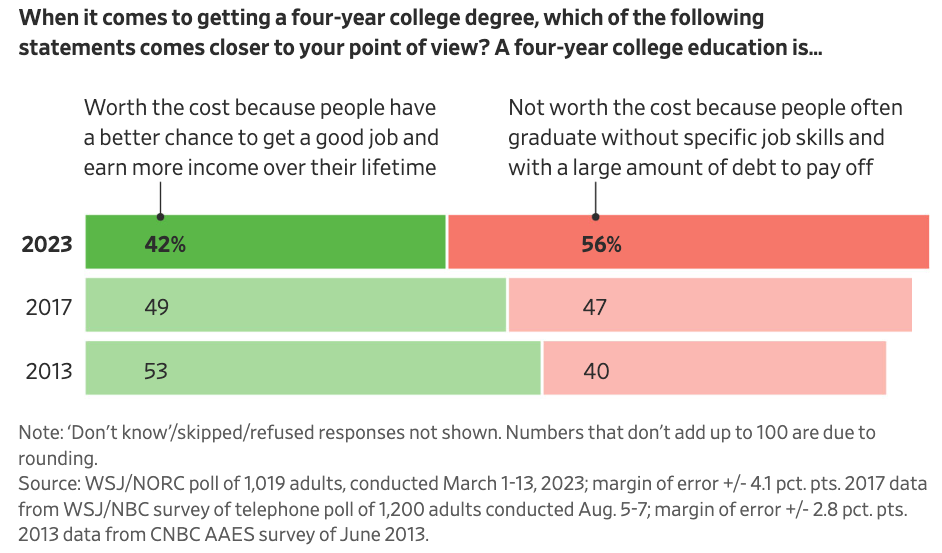
The main takeaway is that our view of higher education’s value is souring.  Fewer of us see post-secondary learning as worth the cost, and now a majority think college and university degrees are no longer worth it: “56% of Americans think earning a four-year degree is a bad bet compared with 42% who retain faith in the credential.”

The question was put this way:

When it comes to getting a four-year college degree, which of the following statements comes closer to your point of view? A four-year college education is worth the cost because people have a better chance to get a good job and earn more income over their lifetime or not worth the cost because people often graduate without specific job skills and with a large amount of debt to pay off?

Note that this isn’t a one-off finding.  WSJ/NORC have been doing this for a decade, every several years, and the trendline is against higher ed.

In 2013, 53% of Americans were bullish on college, and 40% weren’t. In 2017, 49% of Americans thought a four-year degree would lead to good jobs and higher earnings, compared with 47% who didn’t.

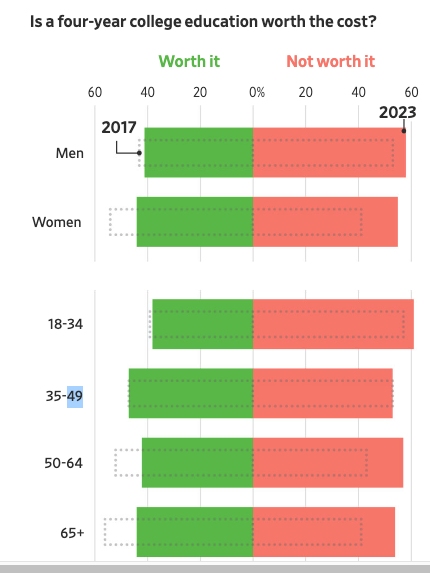
Broken down by gender, women tend to have a higher opinion of higher ed than men do.  Decomposed by age, skepticism is highest among younger people.

The overall negative trend occurs in each population slice, yet to different degrees:

Women and older Americans are driving the decline in confidence. People over the age of 65 with faith in college declined to 44% from 56% in 2017. Confidence among women fell to 44% from 54%, according to the poll.

What can we take away from this single question and its responses?

We can resist the temptation to load it with too much significance.  After all, it was a small poll, reaching barely more than 1,000 people.  It was just one question, not allowing for much nuance.  The other questions in the survey emphasized economics, and in measures allowing for some anxiety, so encouraged a simply ROI view of college.

Some will criticize the poll as coming from the Wall Street Journal, but I don’t think this is a good critique.  The opinion side of the WSJ is definitely on the reactionary side, yet the journalistic enterprise is solid.  The latter is who took down Theranos, for example.  And the article’s author, Doug Belkin, does fine work.  (He was a great guest on the Future Trends Forum.)

Yet I think we can count the results as significant.  I don’t think they’ll surprise anyone who’s been following American opinions about higher ed.  It’s clear that academia’s status hasn’t been trending in a favorable direction for a while.

What’s behind that downward impression?  My readers already know the answers: increasing student debt and its cultural presence; declining enrollment; politically charged critiques, now largely from the partisan right; a low unemployment rate suggesting one doesn’t need a BA/BS to starting working into the middle class.  I’d like to add “bad media coverage” but am not confident in this, because I avoid some media (tv news) and have not found a good study on the point.

It’s hard to find nuance in such discourse.  Most people work from the assumption that published tuition is what people pay, for instance. The huge range of degrees, the variety of degree levels (certificate, bachelor’s, masters, PhD, microcredential), the spectrum of perceived institutional quality, the complexities of labor markets all shape so many different paths through higher education, to say nothing of the varieties of personal human academic experience, notably including preparation.

The non-economic benefits of higher education also fall away.  Personal growth, especially for traditional-age undergraduates; finding purpose in life; exposure to different ways of thinking; immersion in new social contexts: a purely economic assessment ignores these desiderata. The public desire that post-secondary students learn certain things (civics, numeracy, communication, etc.) is also nonpecuniary in outcomes.

A deeper survey would do a better job of accounting for these real details.  But the overall sourness seems to be there and deepening.  And I urge my colleagues to not dismiss this as an economically driven argument, a point I hear all too often, given the real costs and burdens higher education imposes on a substantial number of students.

I’ve previously written about how Americans from the 1960s on were fairly united in their belief that the more post-secondary experience people got, the better. That consensus seems to be fraying now, and a significant loss of faith in higher ed can have major consequences for the academy.

First, since the majority of colleges and universities depend on enrollment for their financial sustainability, declining interest in post-secondary experience means fewer students on campus.  This yields increasing economic pressure on these institutions.

Second, a series of major challenges facing humanity need academic input. The climate crisis might be the most salient of these.  Dealing with technology and disinformation is a leading topic for many people. If enrollment declines, we reduce the number of scholars producing research as well as the number of students educated to handle these crises.  Decreasing support for higher education could also sap our ability to collaborate with communities and influence public debates.

Third, higher education depends financially on public goodwill to a significant extent.  The roughly two-thirds of American institutions which are public receive some (albeit too little) funding from their respective state governments.  Public and private institutions alike can draw funds from state and federal government grants.  A public which is skeptical of how these campuses operate is not likely to support spending more on them.

Further, we depend on public goodwill in non-financial ways. A public who thinks academics do valuable work might be less likely to want to control our research and teaching. A hostile population may be more willing to, say, cut tenure for the dwindling proportion of faculty who have it.

Again, this is all about one question in one poll with a small n. But it points to directions higher ed and its national setting are headed in, and we should think hard about how to respond.

(Many thanks to the Georgetown University library staff for helping me track down this story.)

Posted in future of education | 7 Comments

Queen sacrifice at St. Cloud State University

How can colleges and universities respond to today’s many challenges?

One strategy is to cut: to delete various academic programs, support staff, and faculty. When such axing includes tenure-track faculty I call it a queen sacrifice, borrowing the chess metaphor to recognize the radical nature of the decision.  I’ve been documenting these moves, sadly, for years.

St._Cloud_State_University_sealToday’s example comes from St. Cloud State University, which announced it would cut a series of academic programs and lay off a group of academic workers.

I’ll outline what I can determine about the story, then reflect on its broader meaning.

According to the local Star Tribune, six programs facing the axe include undergraduate and graduate ones:

The majors to be phased out are philosophy, theater, nuclear medicine technology, real estate and insurance at the undergraduate level, as well as marriage and family therapy at the graduate level.

The human cost involves professors and administrators: “The university will also lay off 23 faculty and 14 staff, which will save more than $4.1 million in the coming year, as well as offer early separation incentives for employees…” I cannot determine the tenure or other status of these people.

Proportionally, the layoffs seem relatively small.  The campus Wikipedia page estimates 783 faculty, so the cuts count for around 3% of the whole.  The same source offers 773 staff, yielding about 2% cut.  That’s not counting however many take “early separation.”

The rationale behind this queen sacrifice will not surprise my readers.  St. Cloud enrollment has declined recently.  Not just declined, but plummeted:

The student headcount at St. Cloud State has dropped from more than 18,000 in 2010 to about 10,000 last fall. But not only are the numbers dropping, the students are changing: Nearly 50% of students are part-time, about 25% are under 18 and enrolled in postsecondary classes, and about 10% are 35 and older. [emphases added]

Looking at the St. Cloud website, their official enrollment statistics for the past five years present a stark picture:

St Cloud University enrollment 2017-2022

One important dimension of this story is not just the cuts, but shifting resources away from the truncated programs and people.  Note this explicit description:

the suspension of those majors will allow the university to reallocate resources into programs with higher demand and dig out of the deficit, according to St. Cloud State President Robbyn Wacker, who announced the budget cuts Wednesday.

“programs with higher demand” means the leadership found theater etc. to not enroll enough majors, while they anticipate finding more students majoring in other programs.   Which programs promise enrollment gold? “[H]olistic health and wellness, education, leadership, and engineering and applied science.”

So what does the St. Cloud story mean for higher education as a whole?

There’s always a risk in generalizing from one story out of 4,000 or so, especially given the rich diversity of American higher ed. But we can find some forces at play in this case, which also occur elsewhere.

Take the enrollment decline.  My readers know I’ve been tracking this since America passed peak higher ed in 2012.  Minnesota, where St. Cloud lives, has been really losing students.  Another local source estimates the state’s declining enrollment as 100,000 since 2010.  One source of that decline is, as my readers also know, dropping birthrates as well as internal migration: “‘There is a decline in enrollment that is being driven by the underlying demographics,’ said Susan Brower, Minnesota State Demographer.”

Beyond demographics, there seems to be a demand decline because of changes in the labor market:

While the enrollment declines have impacted The University of Minnesota System and private non-profit colleges as well, the drop-off has been greatest across Minnesota state four-year universities like Saint Cloud State.

“That suggests to me that there is something else going on too,” Brower said. “Either with the way that they’re recruiting or the way that they’re aligned with the other needs of potential students.”

This last points to what I’ve previously referred to as the shattered consensus, the end of most people thinking everyone needed more higher education.  Perhaps Minnesota in general is experiencing early signs of that transition, and St. Cloud is at their leading edge.

Parody Saint Cloud State University seal, reading "Dont Think Too Much," from the Daily Nous website

Parody seal from philosophy website Daily Nous.

On a different point I was surprised by the unusual mix of majors being cut.  Typically the arts and humanities lead queen sacrifices, so seeing theater and philosophy was unsurprising.

Yet marriage and family therapy, nuclear medicine technology, real estate and insurance? I would have thought all parts of therapy would be going well, given increasing demand for that profession.  The university’s decision to do more with “holistic health and wellness” should incorporate all of therapy.  President Wacker’s recent column in favor of university degrees cites similar fields as good examples of the higher ed experience.

Ditto nuclear medicine, especially with the state’s aging population.  Real estate, though – perhaps Minnesota properties are declining in value as the population shrink.  Perhaps all of those departments were just performing badly, or students and administrators saw them as such, in which case the situation might be particular rather than offering an instance of a broader trend.

Overall, the St. Cloud story offers us yet another queen sacrifice example.  As I’ve said earlier, we should look for more examples as other universities and colleges experience declining enrollment and other financial pressures.

(thanks to Stephen Landry)

Posted in higher education | Tagged | 4 Comments

Thoughts on Earth Day 2023

On this Earth Day 2023 I’m thinking of many things.  My ongoing research into higher education and the climate crisis fills my mind with the sprawling dimensions of the problem: rising sea levels versus campuses, academic research and activist students, desertification and infrastructure.

This day can be compromised, of course.  There’s a commercialization of it under way. It’s also a good opportunity for greenwashing.  Yet I’m thinking of its basic idea, the appeal for Earth consciousness as well as its call to action.

(This will be quick, as I’m caught between work and a family trip.)

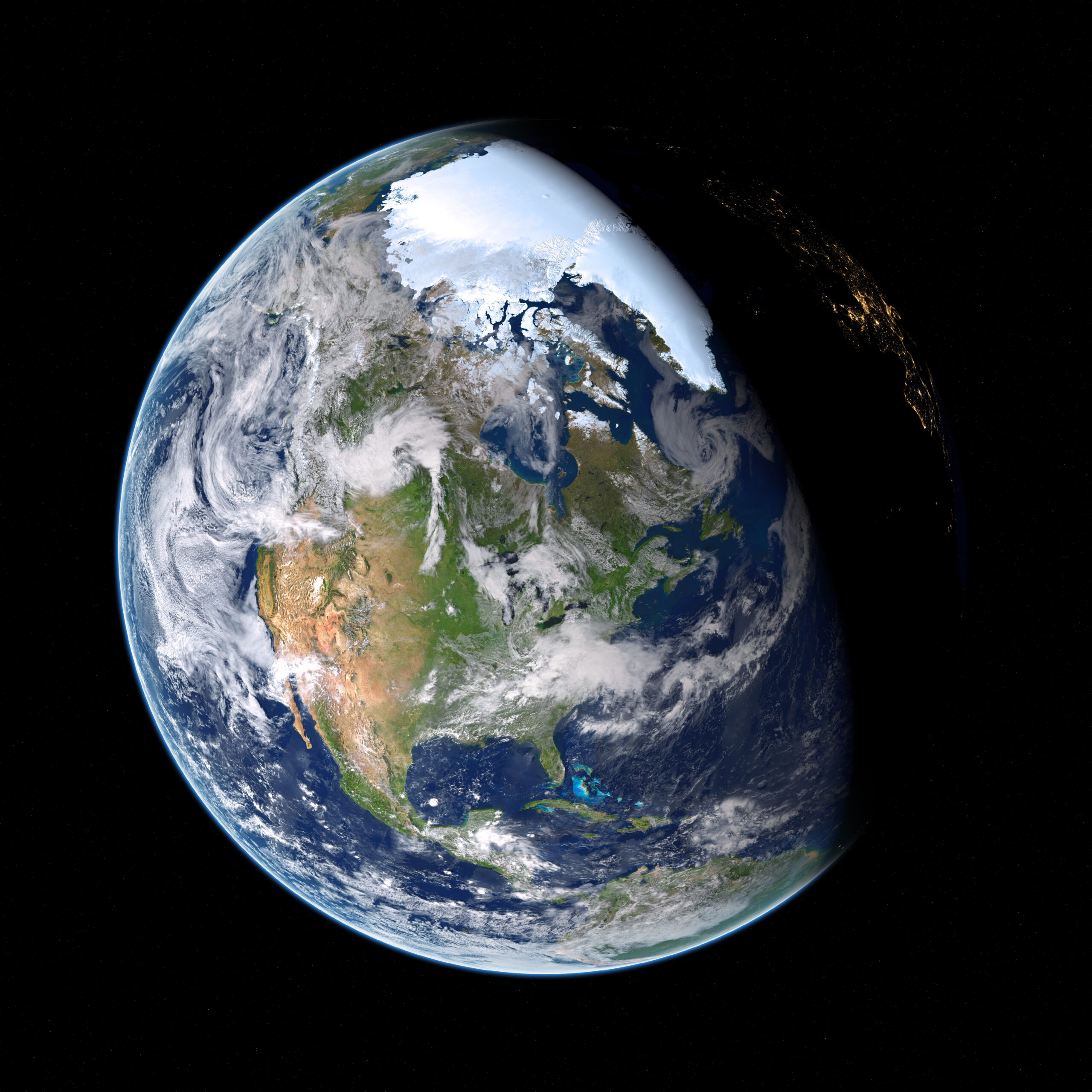
Earth from nearby space_Burnt Pineapple PRoduction

What should we do, in academia?

I think of the academics – faculty, staff, students, etc. – for whom climate change is not a call to action.  It’s part of the background hum of 21st century life, one piece of the very large strategic mosaic.  Thinking and planning about it can be outsourced in many ways: to a sustainability officer, some environmental studies faculty, to insurance companies.  It doesn’t merit proactive steps.  We have a *lot* of other things on our collective plates, and all too often have to address them with fewer resources and less support.  Many people are exhausted from the past few years of pandemic, politics, precarity.

I hear this, especially the last point about exhaustion.  Such has been the lot of too many academics before the pandemic and Trump, but I’m glad to see the issue in the mainstream now. Yet thinking ahead – remember, I’m a futurist – I have to anticipate the ways the climate crisis can impact colleges and universities when we don’t take proactive steps.

In Universities on Fire I describe three levels of potential impact.  They vary from location to location, by institutional structure, by the complexity of Earth systems, and over time, but in general they start with the direct damage caused by natural events.  Storm surges, floods, storms of all sorts, drought, fire, desertification, aridification, dangerously high temperatures, dangerously high wet bulb temperatures, and more can all hit campuses.  At a second level we see followup natural effects as global warming proceeds: diseases moving to new areas, current flora and fauna fading away and being replaced by new life, agriculture under stress, etc. At a third level we have the many ways humans respond to the crisis. Government policies (pro- or anti-climate), business actions, the positions of nonprofits, the behavior of all of us as residents, consumers, voters, activists, growing numbers of climate refugees… all of these can press upon a given college or university in many ways over the years to come.  Starting now.

Put another way: if academics don’t want to think and act about climate change now, we’ll have do in the future.

I’ve previously identified several domains for academic action.  We can rethink and redesign the physical campus, from buildings to grounds, electrical power to transport, food service, and more.  We can expand our climate-oriented research enterprise, across the disciplines, perhaps surfacing new fields.  Our teaching can grow, from infusing classes with climate examples and consciousness to creating new courses, degrees, and programs. We can do more with our immediate communities in many ways, from energy partnerships to service learning and applied research. And academics can pick up a more public role, sharing research and teaching broadly, as well as doing activism.

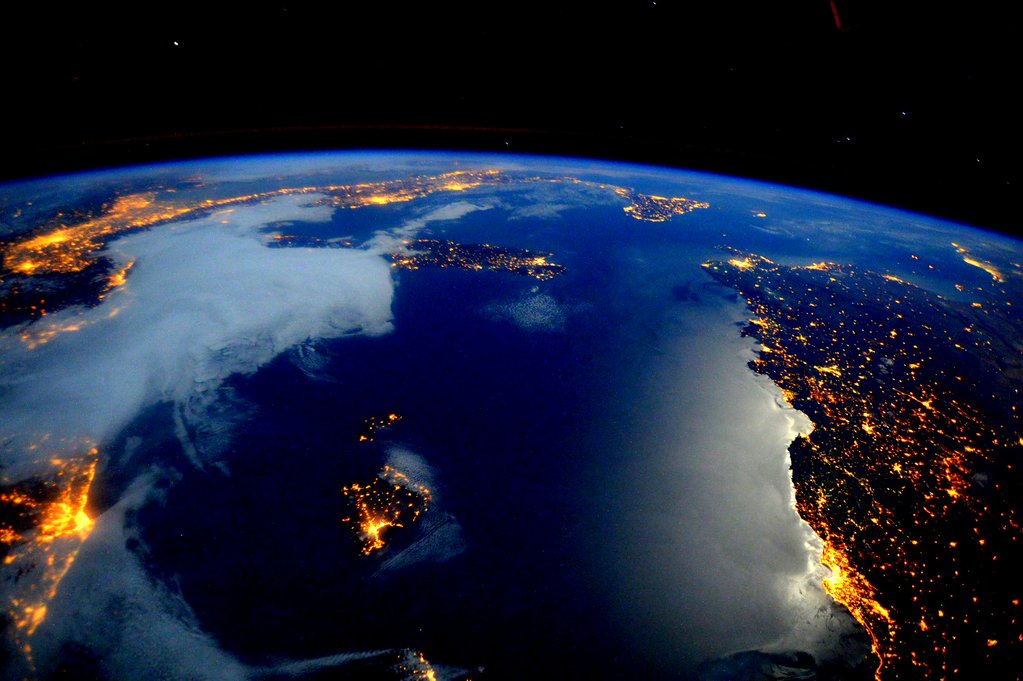
Today images of the Earth will be widespread.  For some of us they’ll give a taste of the overview effect, that reframing of thought to consider the entire planet as a whole.  (For others this is a bad thing; such may be the subject of a next book.) These images make me think of higher education as an entire sector, all 20,000 institutions or so, all the millions of us, together, and wonder what our collective role is.

Because the climate crisis is a radical and vast thing, potentially, a gigantic rethink of human civilization and identity.  We are starting to reconsider our economic model, our politics, our food systems, what progress means, what it means to be humans. We are starting to build a new civilization from the guts of the current one. Surely this is a clarion call for academic involvement.  If the climate crisis is as vast an issue as most scholars and activists think, an event and process on the scale of the industrial revolutions or World War II, what is the ethical response of a professor, librarian, students, grants officer, scholarly publisher?  Are we not called to take a hand?

And think of what academics have to offer!  The immense intellectual horsepower that has already powered so much climate understanding.  The amazing opportunity to teach a generation or two of the human race. The potential to aid our communities and the entire world.  Higher education has a unique and powerful position in the unfolding crisis.  How, then, should we act?  What should we do?

Earth at night from NASA Marshall Space Flight Center

Happy Earth Day, all.

(first photo by Burnt Pineapple; second photo by NASA’s Marshall Space Flight Center) Continue reading →

Posted in climatechange | 6 Comments

Instructors after AI

How will the current wave of artificial intelligence change college teaching?

I’ve been thinking AI and education for years, and it’s all come into sharp focus lately, due to the advent of large language learning (LLM) bots like ChatGPT (previously). I’ve posed the question to academics and other people interested in higher education, and many answer by wondering what a post-AI instructor’s job looks like.  One extreme view holds that AI is failing now and will collapse soon, so our task is to protect higher education from damage.  Opposed to this is the fear that we might not need human instructors* at all, if these new technologies keep developing.

Today I’d like to chart a middle path and wonder what happens to the job of teaching in higher education if AI continues and improves.  What happens if generative AI gets better – not artificial general intelligence level, but good enough to make content which large numbers of people value, somewhere between a calculator and a mad scientist’s assistant?  What does an instructor do in a post-LLM world?

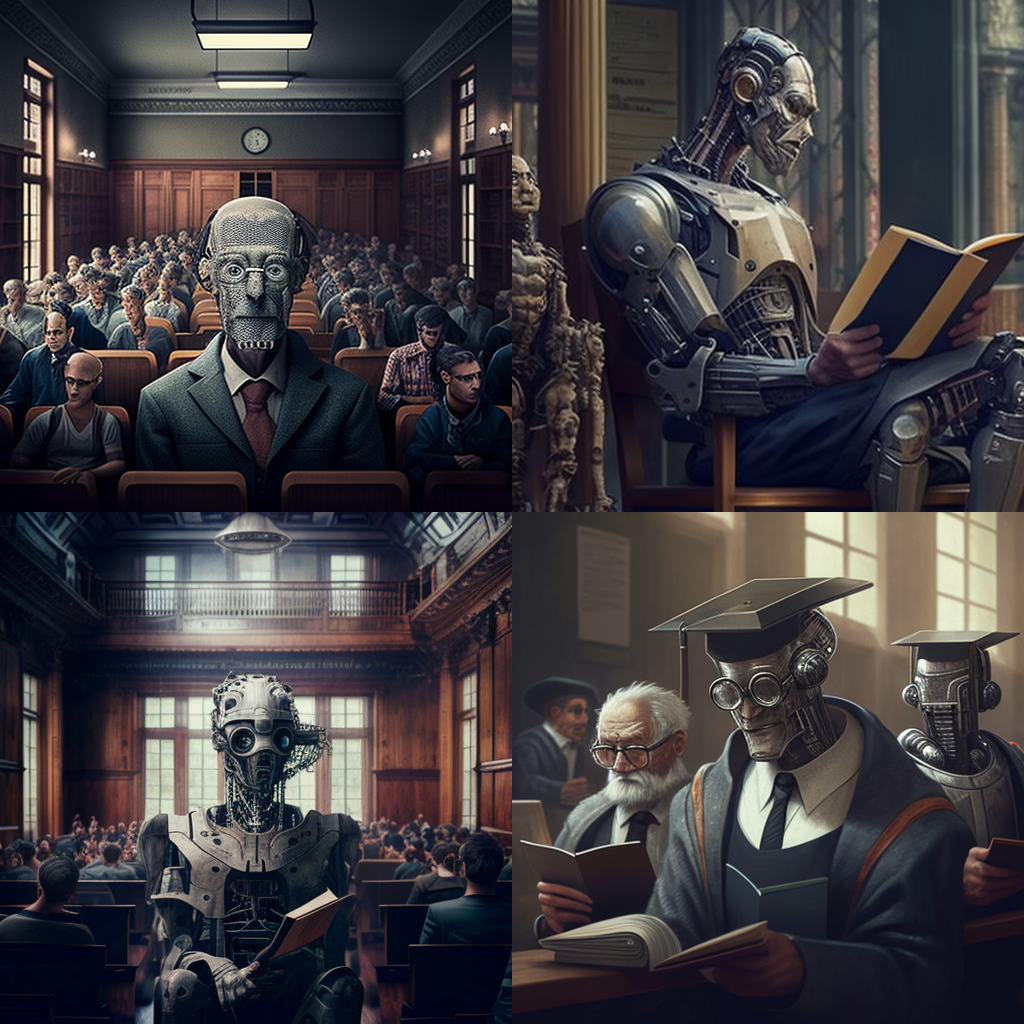
University faculty after artificial intelligence, visualized by Midjourney

“University faculty after artificial intelligence,” visualized by Midjourney

Here’s the list I came up with in conversation with many people over the past month, from students to Patreon supporters, Facebook pals, friends in person and strangers online.  It’s not in any particular order and there’s a lot of overlap between points.

  1. Teaching prompt engineering (showing how use the tech: the best ways to write a prompt, how to iterate results, how to go beyond simple content generation). This includes teaching learners how to interact with AI to teach them best, apart from the human instructor.
  2. Instilling a critical stance about technology.  This should certainly include criticizing AI, which can take place in various ways and through different disciplines – i.e., science and technology studies, rhetoric and composition, computer science, etc.
  3. Offering students emotional support, both in the class context and in their lives.
  4. Facilitating group work.  Right now Bard, Bing, etc. are good at interacting with a single user, but don’t seem to have much capacity for wrangling clusters of students.
  5. Guiding students through a curriculum, or answering the “what to learn now?” question. Teachers do this within classes, as well as through advising.
  6. Related to 6: teaching students what they need to know and aren’t interested in.  This might be according to an instructor’s views, or what a larger authority (state government, community) prefers.  For one example, it could take the form of encouraging an arts-loving student to learn math.
  7. Structuring learning over the long haul. It’s easy now to learn something small on demand (what’s the French word for “cat”? what happens inside a biological cell?), but people have a harder time persisting in learning over weeks and years.
  8. Protecting students in their learning process. This can be defense against political attacks (example: studying evolution in a creationist context) as well as in terms of social, interpersonal issues.  (Related to #3 above)
  9. Nurturing curiosity.  Generative AI can satisfy one’s curiosity, but how to spark and support it?
  10. Teaching critical thinking. It’s not easy to find consensus among educators about what that means or how we do it, and I think we overstate how much we actually do this, but it’s something we tend to value highly. (#2 above is part of this.)
  11. Teaching, inspiring, and supporting creativity. There are other sources for this, but teachers can be good at helping students exercise and explore their creative sides.
  12. Modeling.  Former student and current teacher Justin Kirkes thoughtfully explained on Facebook: “Modeling vulnerability in the learning process, excitement in exploration, curiosity in the unknown. These aren’t behaviors that are always innate in learners, but can be called forth.”

It’s a messy list, with redundancies and parts I’m not sure about. And assembling it gives me questions.  How much of this can be automated, either now or in the likely near future? How are we likely to value (culturally, financially, professionally) such counter-AI skills?

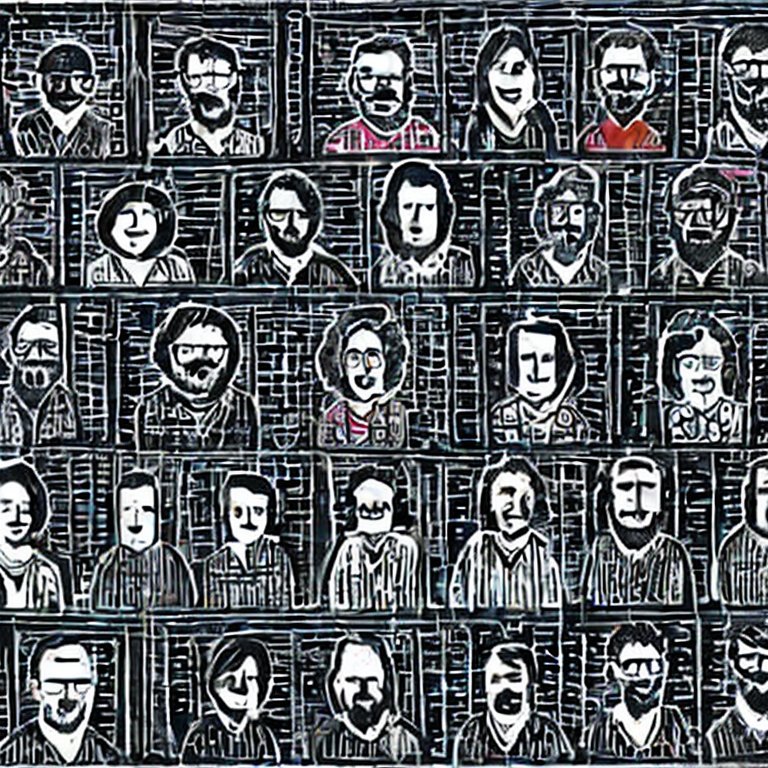
University faculty after artificial intelligence visualized by Stable Diffusion

“University faculty after artificial intelligence,” visualized by Stable Diffusion

What do you think of this outline of the college teaching profession post-generative AI?

*I’m using the term “instructor” here to emphasize the college or university faculty member’s teaching mission.

Posted in automation | Tagged | 6 Comments

Come study with me at Georgetown University

Interested in learning more about education and technology?

Today I’m taking in a gallery walk of student work.  This is for the academic program I teach in, Georgetown University’s Learning, Design, and Technology (LDT) master’s degree.  I’m busting with pride about what the students have accomplished, and that makes me want to invite more people to join them.  Who wants to study with me and my brilliant colleagues?

Georgetown library steps

LDT’s goal is to “give… students a broad conceptual foundation in the theories of learning and teaching coupled with real world experience in faculty development, educational technology, and instructional and learning design.”

Along those lines students take great classes in learning research methods, design thinking, creativity, learning analytics, technology and innovation, and the university as a design problem.  Electives cover topics from blockchain to gaming in education, creativity to speculative critical design for anti-racism.  Students start the program in August with an intensive one-week introductory class.

I teach, co-teach, cat-herd, or help some of these classes.  Tech and innovation is the biggest one, a multidisciplinary dive into technologies and how innovations occur (fall 2021 edition). The future of higher education is a seminar I created from scratch and which relies most on my own current research (fall 2022 instance).  Education and technology combines hand-on tech learning with institutional, theoretical, and critical perspectives (2023 version).  Gaming and education is a summer class, a blazingly fast and fun immersion in the topic (2022).

But set me aside.  My colleagues are brilliant.  I learn a great deal from Eddie Maloney, Dawan Stanford, Maggie Debelius, Yianna Vovides, Randy Bass, David Ebenbach, Lee Skallerup Bessette, and more.  And the students are amazing.  Most come from around the world and a wild range of backgrounds and interests.  Class discussions are a treat.

So much comes out of the LDT world.  Students create great research and projects.  Faculty write books and make other media.  A bunch of, well, everyone collaborated on the powerful Big Rethink project.

Check out the LDT website.  Look into the classes I teach, if those interest you.  Fling questions at me or the program staff.  Then, if this engages you, apply!

Posted in classes and teaching, teaching | Leave a comment

One small glimpse of upcoming campus climate change politics

I started writing this from the Denver airport, on the way to Colorado College, where I presented on colleges in the climate crisis.  I noodled further at different points on the next trip, to the University of Wisconsin-Stout, where I addressed their Effordability Summit.  These are my first stops on the Universities on Fire book tour – and reach out if you’d like to host me!

Speaking of climate change, I’d like to share a fascinating story about a growing problem at one university.  I am not so much interested in the affair itself but more in how it potentially signals things to come.  I’m still traveling, so this won’t be long.

The story concerns Harvard* law professor Jody Freeman, one of whose specialties is environmental law. From what I’ve seen she looks committed to addressing climate change.  Yet at the same time she sits on (and is paid for sitting on) the board of ConocoPhillips, a major fossil fuel company, recently in the news for winning the Biden administration’s approval to expand operations in Alaska.

Conoco Phillips_LogoThis board position has elicited conflict of interest charges on campus.  To begin with, the Guardian article describes faculty criticizing what they see as a contradiction: “Colleagues say Freeman’s fossil fuel ties raises serious questions about a conflict of interest, while threatening to damage the university’s climate credentials.”  A leaked email develops the point further:

[Harvard’s] Salata Institute asserts it ‘will not accept funds from, or partner with, any company that does not share the goal of moving our global economy away from fossil fuels,’ [so] we ask: why does this policy not exclude awarding funds to a board member of one of the world’s most intransigent fossil fuel merchants?

And:

We ask not only about a potential conflict of interest, but also about the appearance of a conflict of interest, particularly one that might damage Harvard’s reputation and impair its efforts to be a leader in climate and sustainability work … might not intellectual partnership with a faculty member who has a fiduciary responsibility to a secondary interest, ConocoPhillips, with its mission to ‘explore for, develop and produce crude oil and natural gas globally,’ suggest a conflict of interest with these goals?

Approached by the Guardian, professor Freeman stood her ground:

I share the goal of moving the world to a low-carbon future as fast as possible and forcefully addressing the enormous challenges posed by climate change. There are many ways to make a difference, and activism is very important. I have chosen to engage in several ways, including by being an independent director on the board of ConocoPhillips to help advance the transition to a low-carbon economy, and think my involvement there remains positive.

At the same time, some students have fired off their own critique.  From Divest Harvard’s open letter the main charge is uselessness and hypocrisy:

ConocoPhillips is not listening to sound environmental policy advice: ConocoPhillips is listening to the call of profit without regard for climate degradation. The time has come to choose between your Harvard leadership responsibilities and your loyalties to the fossil fuel industry…

Professor Freeman, until now, you have justified your position as helping reform ConocoPhillips from the inside. The Willow Project makes clear that this isn’t working.

The students add greenwashing to their charges:

At a certain point, it is important to ask yourself whether you are being used — if ConocoPhillips isn’t paying for your expertise, but instead co-opting the respect and legitimacy accorded to someone of your position.

There is also an eye-watering point about board compensation, which, if true – wow.

To be clear, I am not writing about this developing story in order to judge Freeman’s actions.  I don’t have enough knowledge to go on beyond what I’ve shared and linked above.  Instead, I want to consider the controversy as a sample of emerging academic climate politics.

To begin with, there are some significant and direct connections between fossil fuel companies and academia. Some companies and their representatives (for example, the Koch brothers) fund faculty positions, programs, and research to various degrees of transparency. We recently saw some impressive documentation on this point. In addition, we may see some parts of higher education contributing to global warming by encouraging students to work for such companies, as those with petroleum engineering degrees often do. Further, and this is especially germane for Harvard, the few colleges and universities which maintain large endowments sometimes invest funds in companies like ConocoPhillips (hence divestment campaigns).

These connection may increasingly drive institutional political struggles, as more academics become more conscious and active on climate issues, as the crisis worsens in the world, and as general interest rises.  Think, for example, how a much more climate-active student body like the University of Barcelona’s would respond to learning about professor Freeman’s paid board gig.

Now, such struggles might not happen in all cases.  The relevant information might not get out.  Or it might appear, yet not get traction.

The second and more important form this could take it when some academics (faculty, also staff and students) determine than one or more other academics are knowingly contributing to the climate crisis.  Such contributions might appear in a variety of ways: a professor taking money from oil companies, as above, but also one whose research discourages climate action, at least in the accusers’ view, such as that conducted by a petroleum engineering professor. It might be an administrator who flies a great deal, when they could have taken trains and/or done virtual meetings instead.  It might be a cafeteria manager or the leaders of a frat house which serve a lot of beef, hence contributes to global warming through both methane and carbon dioxide emissions.  More simply, some academics could charge others with outright climate denial.

These challenges may be contestable, as they are based on interpretation, politics, and to some extent forecasting.  Additionally, as the crisis worsens over the years and decades ahead, other climate positions might become susceptible to critique, like an administrator seen as not pressing strongly enough for climate action, or a faculty member deemed as not having enough climate content in their curriculum.

I’ve been speaking of individuals, as is the case with the Harvard professor, but these forms of criticism can readily scale up to units: departments, programs, divisions, entire institutions.

Now, these are all internal possibilities, when members of the academic community critique each other.  Obviously academics can become objects of non-academic climate ire.  Climategate, where conservatives charged faculty with lying in order to spur climate action, offers one model, but we should also anticipate the reverse, when off-campus climate activists critique faculty, staff, or even students for expressions and actions which exacerbate global warming.  For example, I found the students’ open letter on a conservative website.

Looking ahead, as the climate crisis ratchets up and academics gradually become more active in it, we should expect more stories like this.

*Note: I do not consider Harvard to be an exemplary academic institution, given its extraordinary wealth and reputation. Yet its leadership role in academia, especially in the United States, is strong, and stories like this one might influence political conflicts in other universities.  Harvard reliably attracts outsized attention from the rest of academia and from the media. Perhaps this story is an early sign of things to come.


Posted in climatechange | 2 Comments