1: He and I both spent years at the University of Michigan, although not at the same time. I took several classes in the building where he once taught.
2: I taught his manifesto at Centenary College right after it was, ah, published. It was very hard for the students to grapple with, especially since the class hadn’t had any readings or discussions on technology and radical critique.
4: I’m not sure how many people under 35 know all or any of those three names.
5: Around 2005 I met Ted Kaczynski’s brother and sister-in-law entirely by accident. She, a fine professor at Union College, had taken one of my digital storytelling workshops and so invited me to speak to her colleagues, which I did. Afterwards, she asked me if I minded going out to dinner with herself and her brother. Not at all, I said, and this is how I learned to Google everybody. The gentleman joined us. I didn’t recognize him and, always being shameless, asked what he did with his time.
“I work to stop the death penalty,” was his immediate response.
Me: “How did you get into that line of work?”
Him: “My name is David Kaczynski.” He paused to let me think about that for a few seconds. His wife didn’t use that last name – she was Linda Patrik – and David must have seen the lightbulb go on over my head. “Yes, the Unabomber is my brother,” he continued, with some weariness, I imagined. “Linda and I turned him in.” Apparently they thought Ted would get mental health treatment, not the death penalty. They also made money on the story, I think, and David decided to give back by lobbying Albany.
At dinner David was terrific, a delightful conversationalist. There were some fun moments. Once we were discussing cell phones (this was just before the iPhone, I think, so the Golden Age of Crackberry) and he was offering a thoughtful, informed critique. Then he leaned forward with a smile: “But I don’t want you to get the impression that I’m too critical. I’m not my brother, after all.”
Later, I told David and Linda about our then-new home in Vermont, half off the grid, where we hoped to raise plants and animals. David sighed. “When we were kids, Ted and I wanted a house like that.” That wistful comment stayed with me for years.
6: In the late 1990s I had a small job assessing incoming students’ writing for the University of Michigan. I saw one theme appear from high school students across the United States: discussing Ted Kaczynski as a figure of modern evil.
7: I shared a Kaczynski obituary on a progressive website, and the responses were interesting. Some expressed satisfaction at his death because of wrought terror and violence. One compared him to Valerie Solanas. Others thought of John Brown.
Note: I’m going to be on the road for a family trip for the next few days, and might be slow to respond to comments, emails, etc.
Vast firestorms across a series of Canadian provinces sent huge plumes of smoke aloft, as I noted on Sunday. Those clouds have since drifted south, across the international boundary, and down across several American states, including the one where my family and I have been this week.
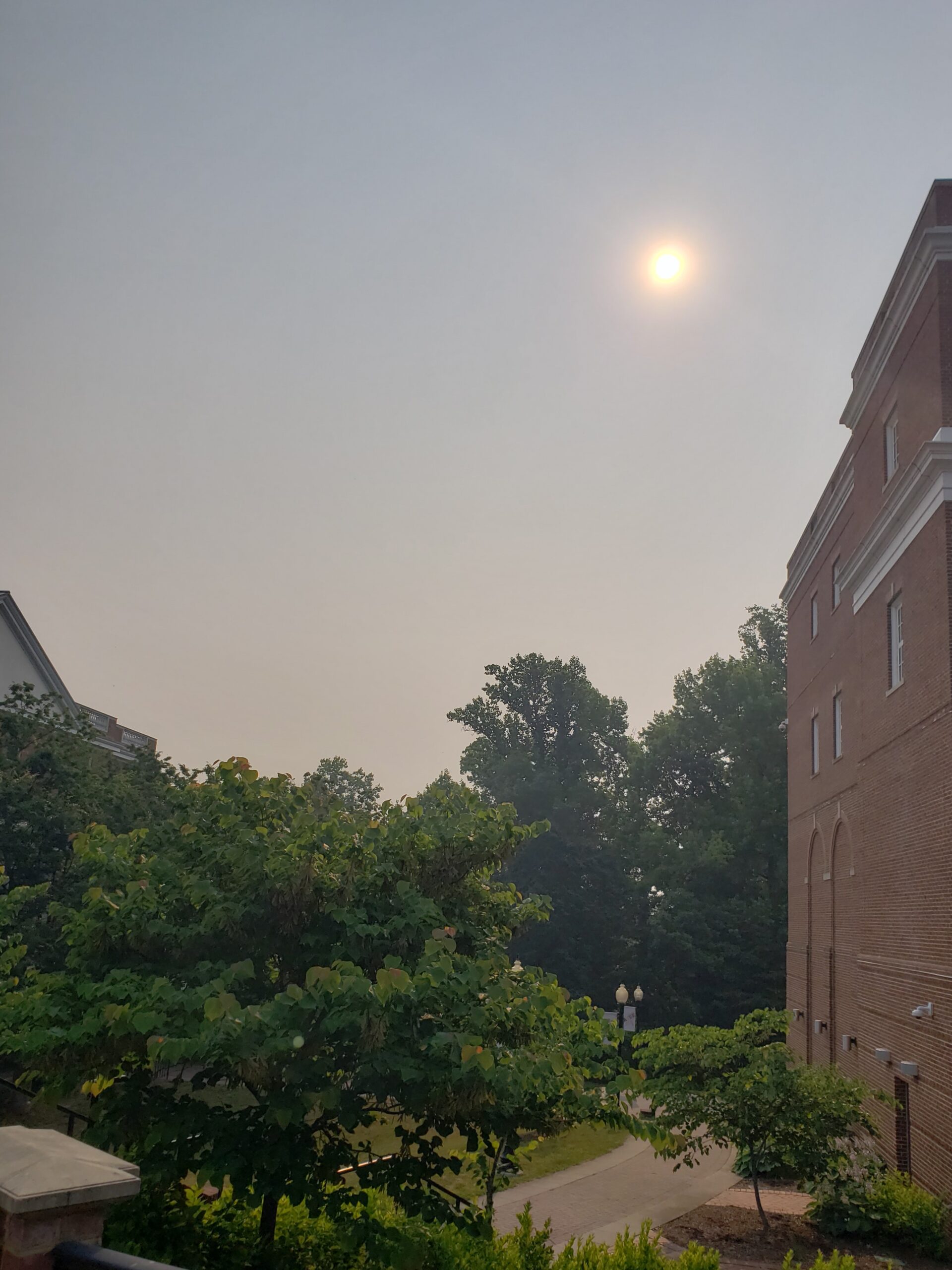
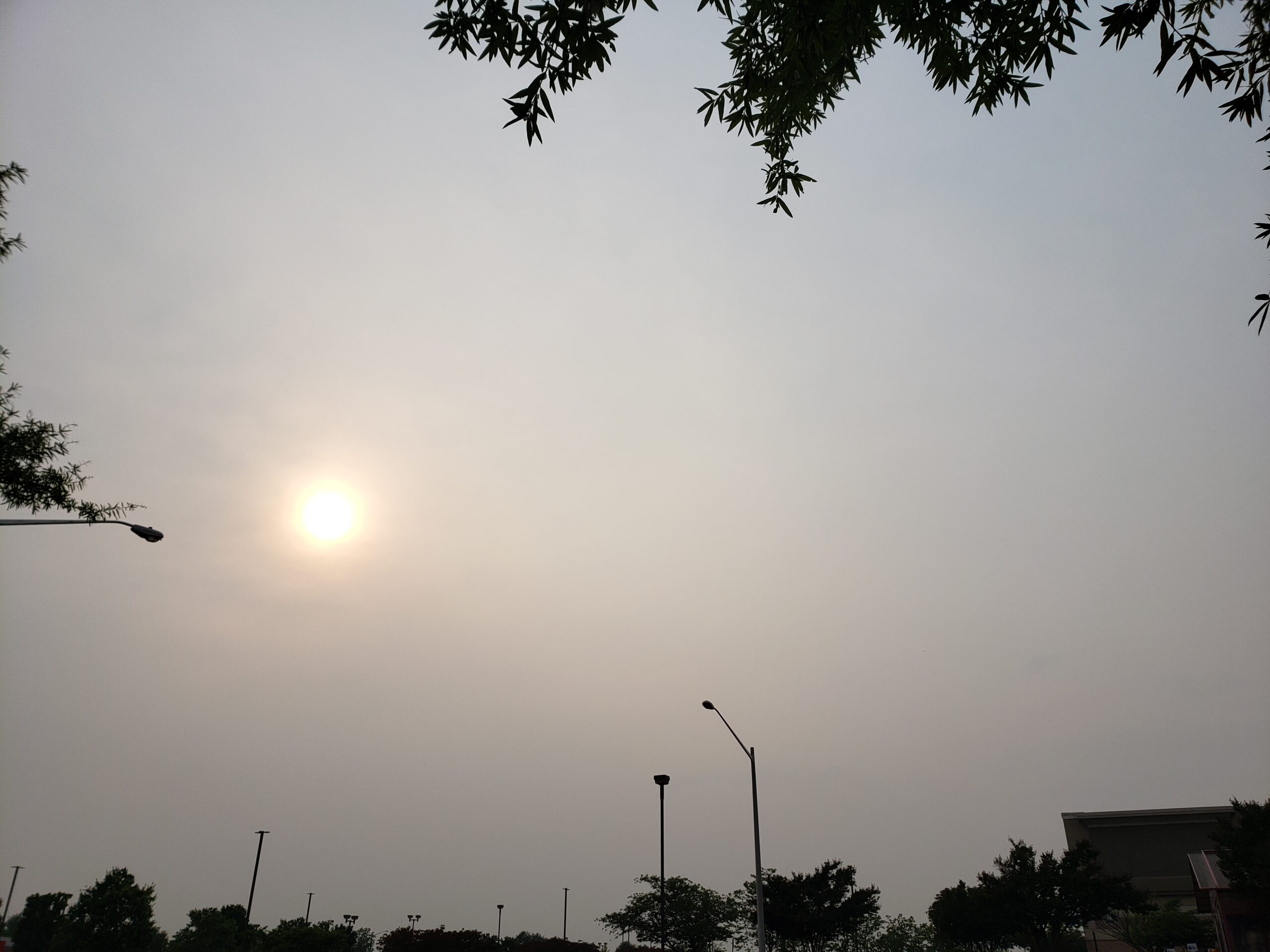
On Wednesday Ceredwyn and I were in Fredericksburg, Virginia to address the Reclaim Open conference (my blog post with all slides; full recording). That morning as we walked across campus the skies looked… wrong: extremely hazy, the sun dimmed as if behind layers of gauze.
When Reclaim ended, Ceredwyn and I headed out. We drove to the edge of town to eat a delicious meal at an Indian restaurant, then checked the skies. A kind of mist seemed to have enveloped us. You could stare at the sun, directly, for several seconds at a time.
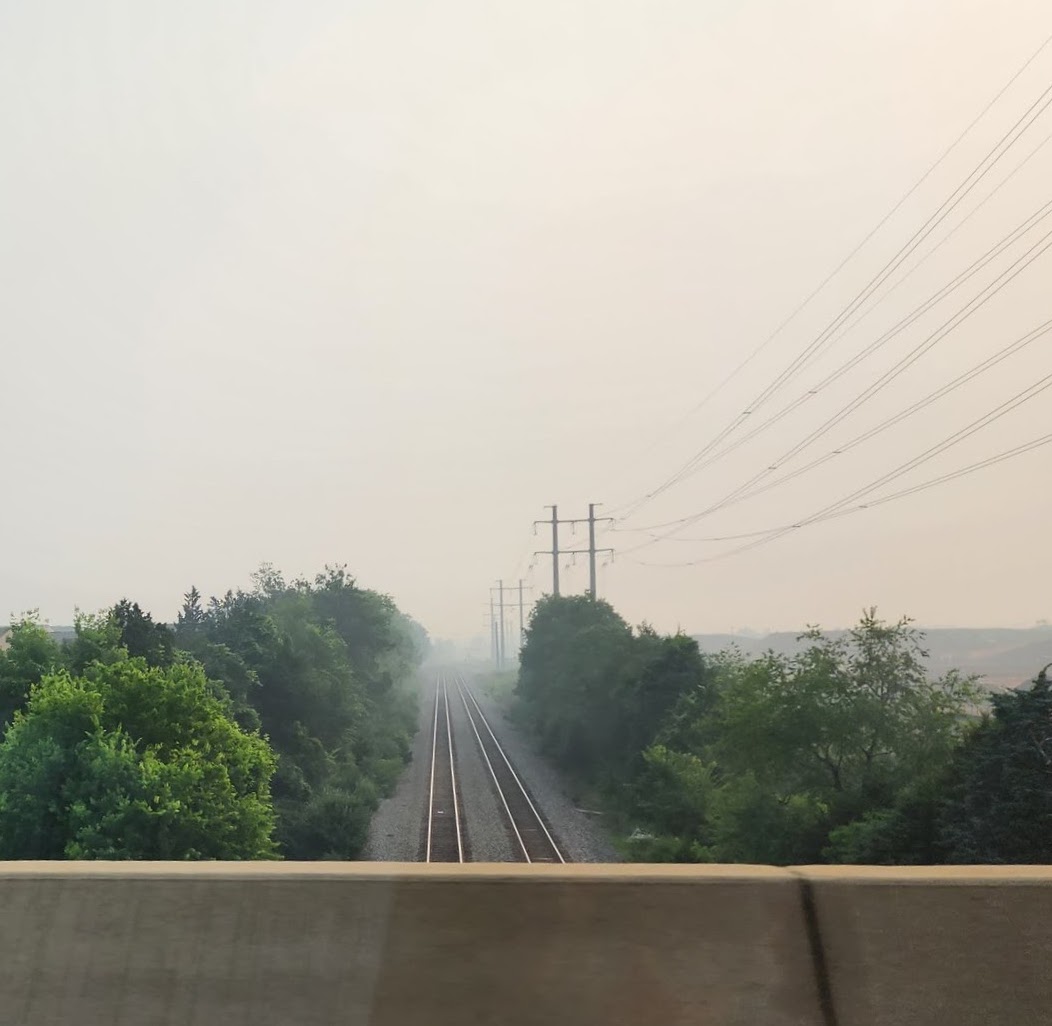
My son took this photo Thursday morning, and if I zoom in a little you can see the haze right on the ground, blotting out the train tracks and sprawling across the horizon to the right:
Today blue has started returning to the cottony skies. AirNow.gov dropped the air quality status down to “Moderate.” I was able to eat lunch on our front porch, although an unusual headache has appeared in my skull since.
So much for the personal experience of myself and my family. Let me step back and consider what this might mean.
First, will this strange (to people east of the Mississippi) event get people thinking more ambitiously and seriously about air quality and public health? In a New York Times editorial Lindsey Marr offers this forecast:
If the pandemic was whispering to us about air quality, the wildfires are screaming to us about it. Add to that concerns about gas stoves and longer allergy seasons, and it’s clear we should be on the precipice of a new public health movement to improve the air we breathe.
Air pollution is bad for us, and we’ve known that for a long time…
Second, is this a story about climate change? There’s some debate about causality here, as a stretch of Canada reliably burns each spring, apparently. Michael Mann sees climate change worsening that pattern. Yet perhaps there’s a pedagogical benefit here, as Bill McKibben argues:
[W]e’re all lucky [in most of America]. Because this is what a huge percentage of the world’s people breathe every single day of their lives. In fact, we should probably—in our hearts if not our lungs—be grateful for a few days like this. They bring us much much closer to the lived experience of billions of our brothers and sisters.
Bill continues:
Today in Vermont feels like a hundred days I’ve spent in New Delhi, in Shanghai, in Beijing, in Ahmedabad. Many of those were much worse: I’ve stood on Connaught Place and not been able to see the giant Indian flag flapping in Delhi’s Central Park, even though I knew if was a few hundred feet away at most.
That smoke doesn’t come from forest fires. It comes mostly from burning fossil fuels. But it’s all combustion, and it all does the same thing to your lungs. There are four and a half million children in New Delhi, and the estimate is that half of them have irreversible lung damage from breathing the air. Around the world, nine million deaths a year—one death in five—comes from breathing the combustion byproducts of fossil fuel. About a third of all deaths in Asia come from breathing fossil fuel pollution.
If the climate crisis is the great existential crisis on our earth, then smoke is the great daily crisis.
Elsewhere, David Wallace-Wells finds a similar pedagogical moment, based on comparing eastern and western American experiences:
Until now, if people in the green and leafy Northeast looked at arid Western cities covered in smoke from wildfires, they could say, that can’t happen here, thank God. On Tuesday, it did: For a moment, New York’s air quality was worse than it was in Delhi, the infamous pollution capital where average life spans are reduced more than nine years by particulates in the air. By evening, New York had registered the worst air quality in the world among major cities. And staying indoors may not provide perfect protection.
In such comparisons, Bill McKibben turns to hope:
Happily, they’re both [climate and smoke] caused by the same thing: burning coal and gas and oil. And even more happily, we know how to end it. We just stop burning stuff, and rely instead on the fact that there’s a large ball of burning gas at a safe 93-million-mile distance. We get all the fire we could ever want, and none of the smoke. Call it “external combustion.”
External combustion: what a good phrase.
I hope all of you reading this are safe. Besides fine particles, what reflections are you experiencing on the topic?
Today I’m giving a speech to the Reclaim conference in Virginia, and was asked by the mad Jim Groom to help them envision futures of the world wide web.
Naturally I asked SlidesGPT to create a slidestack. WordPress won’t let me embed it, so you can click on that link for the whole thing or savor this sample slide:
It’s an interesting mix, actually. As per usual for generative text AI, it represents popular or consensus views. Most of what is there in that stack is not what I’m going to say.
Here’s my own slide deck, full of images and cryptic bullet points:
I’m sharing this just before my show, so that people at Reclaim can follow here and respond in comments. Also, so that anyone not in Fredericksburg, Virginia can join us and also comment.
I’m writing this post in between a series of projects in various stages of deadlines. Publishing the June FTTE report, getting ready to head out to the Reclaim conference, organizing a stack of in-person and virtual speaking engagements into next March, getting Future Trends Forum sessions set up through September, more interviews and book talks for Universities on Fire, preparing fall classes, advancing the next book projects … there’s a lot in the air here. So this post may be shorter than usual.
Today’s topic: simply that the climate crisis is continuing to ratchet up.
ITEM: the state of Arizona called a halt to new housing in suburban Phoenix and its unincorporated areas. Why? Because water scarcity in that very arid land keeps growing as a problem and research indicates the situation will become more difficult.
ITEM: major insurer State Farm announced it would not offer many new policies (“including all business and personal lines property and casualty insurance”) in the state of California. Why it is cutting back? Several reasons: “historic increases in construction costs outpacing inflation, rapidly growing catastrophe exposure, and a challenging reinsurance market.” Rapidly growing catastrophe exposure indeed. For one of the largest and most sophisticated economies in the world. And this is blue state, already committed to climate adaptation and mitigation.
ITEM: a new paper in Nature finds that humanity is – right now – overshooting most of our planetary boundaries.
[W]e use modelling and literature assessment to quantify safe and just Earth system boundaries (ESBs) for climate, the biosphere, water and nutrient cycles, and aerosols at global and subglobal scales. We propose ESBs for maintaining the resilience and stability of the Earth system (safe ESBs) and minimizing exposure to significant harm to humans from Earth system change (a necessary but not sufficient condition for justice)… Seven of eight globally quantified safe and just ESBs and at least two regional safe and just ESBs in over half of global land area are already exceeded.
ITEM: a massive fire has burned across two Canadian provinces for the past several weeks, and now another one is apparently uncontrolled in twomore.
In total, more than 3 million acres have burned in 1,981 fires in Canada so far this year. As of Friday, Canada has 165 wildfires burning out of control, according to the Canadian Interagency Forest Fire Centre, including dozens in Ontario, Quebec and Nova Scotia. Quebec alone has 116 active wildfires.
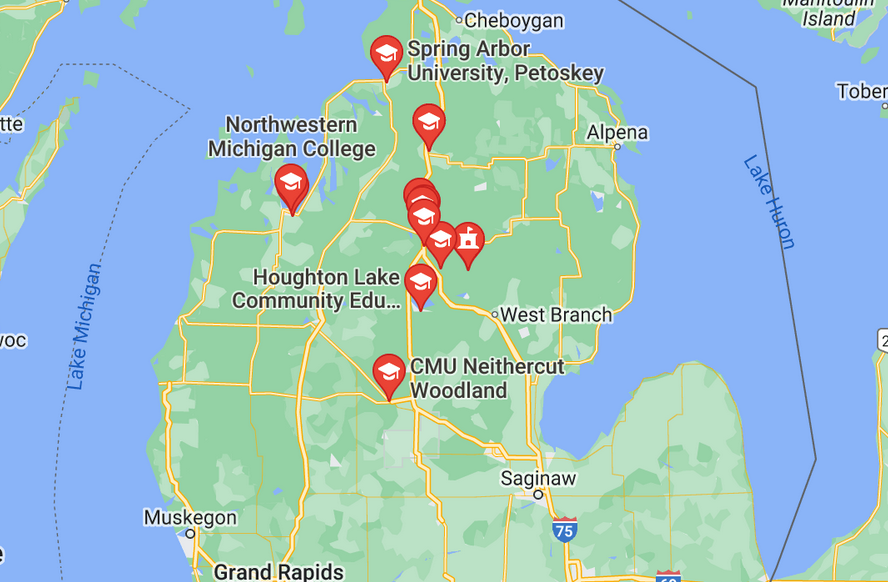
ITEM: a wildfire in northern Michigan has burned for a week, expanding to cover more than 3,000 acres.
These are data points on the global stage. Signals of the building crisis.
What do they mean for higher education?
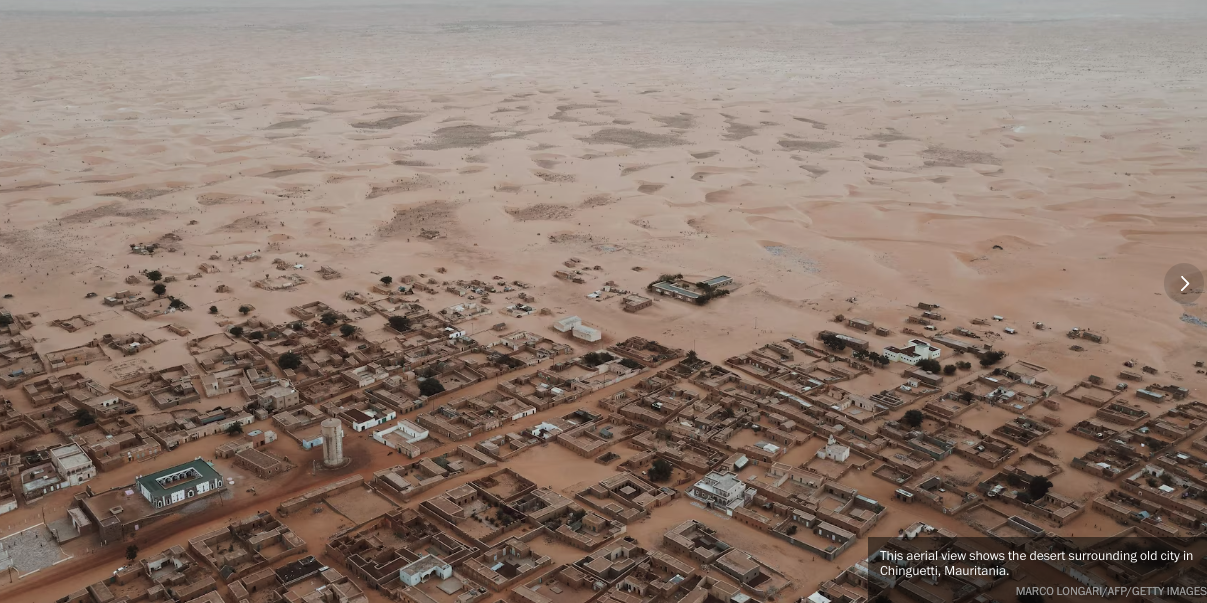
We can start with the threat – and reality – of physical damage to a campus and its community from fire, aridity, desertification. The Mauritanian libraries face item degradation. In Michigan alone, I count about a half-dozen colleges and universities in the Frayling area:
How do campuses react to these threats? How do they plan ahead?
Second, we can respond to them by addressing them from within our several domains, from teaching to research, campus operations to public outreach. Here’s my reliable schematic:
Possibly the weekly ratchet of disaster and danger provides material for this work. And maybe some inspiration.
Third, on the other wise of that question, we might reflect on academia’s role in exacerbating global warming. I don’t mean to assign to colleges and universities the decisive influence exercised by, say, Exxon. I mean instead to consider how we fulfilled those functions cited just above in ways which helped enable the crisis, or made it worse. How many faculty have published research and taught classes which enabled fossil fuel extraction and consumption, such as petroleum engineering? How many instructors taught or otherwise communicated elements of economics, politics, history, and philosophy (to name a few) which encouraged audiences to buy too much, to burn too much, to collectively create a vast, planetary heating machine in its many details?
Again, our academic actions may have only played minor roles in the climate crisis. Yet should we reflect on them now? Think of historical antecedents where academics contributed to developments we now (and perhaps then) deemed dangerous.
Fourth, it might get harder to protect academic institutions. The State Farm story really strikes me. Insurers have pulled out of Louisiana and Florida previously, but those are far more exposed to global warming, and Louisiana isn’t that big a market. But California! How many campuses should expect to see their insurance costs rise? How many will be hit if the federal government cuts back its flood insurance support?
Fifth – the crisis is going to get worse, overall. We’re still emitting greenhouse gases at scale. Decarbonization is starting to pick up, but is way behind where it should be now. The atmosphere holds enough CO2 and methane to keep us warming for a long time, even if we magically suspected greenhouse gas emission and left all fossil fuels in the ground. Where we now stand may look pretty good compared to what the rest of the century has in store.
What will humanity do next, after two centuries of extraordinary growth?
Last week I asked this futures question, starting off by introducing the incredible boom humanity experience after around 1800 and continuing through the present day. I then offered one answer to the question, looking ahead for the next 200 years in terms of retreat, repair, and redressing harms. It’s the opposite of growth, but not for purely retrograde reasons. If you haven’t read the post, please do so. It’s what explains this one.
Today I’d like to answer that future orientation question in a very different way. What if, unlike the Demodernists (HT Ed Webb) we instead decide to continue the two centuries of rapid growth for another 200 years? Instead of less growth, more of it. We might double down on the industrial revolutions. Where might that take us?
This school of thought views the past 200 years as an era of continuous innovation and rapid development, and one to celebrate and refine. It takes the industrial and postindustrial eras as a civilizational launch pad and wants to rocket away.
Think of this future model in terms of the metrics people used to understand the two-century boom time. From circa 1800 to now human lifespan extended, say from roughly 40 to the 70s. If we continue that into the future, lives lasting longer than a century become normal, and two century lives are unsurprising. The past boom saw massive improvements in human health and well being, so we continue to run those arcs upwards, with more diseases controlled or eradicated and more satisfactions in our lives. Education expanded immensely during the industrial and postindustrial eras, so the next two centuries see us learning ever more. We go much further with human flourishing, coming up with new cultures and ways of living. Humanity creates a zeroth world at scale, then races ahead to make civilization even more awesome.
Science and technologies obviously took off in the past two centuries, so the pro-growth futures school expects more such advances, some through new scientific and technical revolutions. For example, space exploration races ahead as machines, then humans spread through the solar system (think of The Expanse, either the books or the show), then reach out to nearby stars. AI progresses, maybe to the point of sentience or even the fabled Singularity, or into some new form. Robotics become commonplace. We might shove big chunks of our industrial base off the Earth and try re-greening the world.
In the life sciences, humans modify themselves into new forms, from cyborg attachments to machines to genetic engineering and other modifications. We develop new plant and animal species, resurrecting some extinct ones. There are more animals and people total, and also more “animals” and “people” in newly engineered, cyborg, or otherwise new forms. Humanity’s footprint is far larger than it was in the benighted 2020s. Our whole human enterprise controls and generates more energy and we advance to Kardashev’s Type II level, becoming capable of organizing the output of the sun itself.
There are fictions about this which might inspire such a future, and also give us insights into its ambitions and challenges. Star Trek’s positive vision lies ahead, especially in the first two programs, with its interstellar spread, advanced science, and, at times, a very progressive social order without money or physical want. Further ahead than Trek is Iain Banks’ Culture series, which describes worlds where technology is grand and humane, where humanity is much better off. There’s a utopian trope here. There’s also a kind of cosmic grandeur. As Liu Cixin put it in Death’s End (死神永生: 2010),
And now we know that this is the journey that must be made by every civilization: awakening inside a cramped cradle, toddling out of it, taking flight, flying faster and farther, and, finally, merging with the fate of the universe as one. (597)
Nonfiction futures work has also anticipated such an epoch. Alvin and Heidi Toffler expected orbiting factories above a green Earth. Aaron Bastani imagined “Fully Automated Luxury Communism,” where automation yields a much more egalitarian and excellent life for all. (There is also a fully automated gay space communism variant.)
The longtermist movement fits in this direction, but in a, well, longer term, appropriately. They look ahead not just a mere pair of centuries but millennia and more, to a time when humanity sprawls across the galaxy as something like gods. They apply that vision to my frame of the next two centuries and want us to devote them to realizing that goal. Think of this as reaching not just Kardashev’s Type II, but Type III.
Transhumanism plays a part in this vision of the future, with its emphasis not just on modifying the human frame, but improving it in a progressive direction and creating new forms. Uploading consciousness into computation easily constitutes one strange of such an evolving, technologically advancing civilization.
There’s more to this idea, of course, as we’re talking about two centuries of human history, and one that’s larger than ours in terms of population, wealth, complexity, and sheer physical expanse, but I think at least the basics of the idea are now in view. That view now offers so many questions. How would an expanding human race deal with the limits to growth we seem to be overshooting now? How does such a project resist reproducing present and past injustices and inequities – for example, by colonizing other worlds and echoing the history of European colonization? Would an extropian effort to redefine humanity backfire in horrible ways, or elicit a drive to return to some sense of an original human form?
I don’t have a name for this view of the future. In fact, “view” might be too mild a term. “Ideology” or “movement” perhaps fit the bill better, at least if this takes off. I’d love to hear any reader suggestions. And, of course, any questions.
If there’s interest, I will follow up with more posts on these two opposed views of the next two centuries. There’s a lot more to say and think through.
Greetings from a pleasant long May weekend in northeastern Virginia. There’s a holiday on Monday, which makes these three days a good time for reflection. (Also work, but that’s a different matter.).
I’ve been working on a project sub rosa for a couple of years, looking ahead two hundred years, and thinking through different futures we might realize in that period. I’d like to start sharing those thoughts today with a stark question:
How might civilization change if humanity contracts, starting now?
To explain, I’ll set the stage.
For the past roughly 200 years* humanity experienced an extraordinary transformation. By most measures civilization took off, breaking up and away from the lives and conditions we had known for millennia. Call it a series of industrial revolutions, the onset of modernity, the arrival of progress, the Enlightenment’s results, the scientific revolution, a new form of capitalism, colonialism’s apogee, a mix of these, or something else, but after around 1800 things changed drastically.
We can look at a lot of measurements, and that might be a good topic for another post, but let me offer a couple to set the stage. Here’s one looking at gross domestic production (GDP) per capita for several nations, from the CORE economics project:
You can see a flat line dating back to 1000 for some of these nations, then effectively no major changes until 1800 – then wham! Britain, Italy, Japan take right off. (China and India follow much later. We can discuss to what extent Britain depended on delaying India, and Japan China.) Obviously GDP per capita is not a total indicator of experience, as it covers some extensive inequality, poverty, and more; we’ll get to that shortly.
For another measurement, we can look at the total number of people throughout history. Here’s a quick graph from Wikipedia:
Again, the long sweep of history is largely flat, with population barely growing at all – until modernity, and then up we race.
We can broaden our measurement by including other fields and more people. Here’s one Vox put together from several research projects, adding life expectancy, poverty, energy, war, and democracy for all nations:
Again, a largely flat line for centuries and millennia, this time back to 1000 BCE, until around 1800 and LIFTOFF. Were there costs and downsides? Oh yes. I’m getting to those.
Historian Ian Morris has a similar series of measurements and charts, with more discussion, in his awkwardly titled but very useful book Why the West Rules – For Now (2010). I don’t have a copy handy, but recall the author arguing with his publisher about needing a foldout page to really display just how extreme the post-1800 takeoff was. (Instead he settled for a log chart.)
There is a ton to discuss in such visualizations and assessment. There are many research efforts exploring them. We can explore these measurements and their models another time. Today I want to introduce the idea as read, that human civilization experienced an unprecedented transformation over the past two centuries. I want to encapsulate all of that complexity in a single, far too simple word: growth. Humanity suddenly grew, a lot, in just seven or eight generations. Now, turn that historical gaze around. Where does that shocking growth curve take us?
Later this year I’ll explore what might happen if we keep the accelerator pressed to the metal for 200 more years. For today, though, I’d like you to imagine what happens if we take our foot off the gas. Indeed, we might slam on the brakes. What do the next two centuries look like if we reverse civilization’s course, and instead of growing, we plateau, then contract?
Asking that question might seem perverse, considering the immense boons I just described. Why would we want to stop growing lifespans, GDP, democracy, and all?
Bill McKibben offers one argument in his criminally underappreciated 2019 book Falter. He starts with climate change, as you might expect if you know his heroic work on that topic. The past 200 years have yielded progress, but also kicked off global warming, which is building into an existential threat to humanity. Now we need to address that crisis, and continuing to spew CO2 and methane is not the way. Instead, we need to focus our civilization’s energies on fixing this problem and repairing its damages.
McKibben goes further. Those 7-8 generations were also marked by a legion of crimes against humanity. Colonialism seized nearly the entire world in that period. Genocides scarred the species. Hideous inequities by gender, race, religion, and more occurred. We have made progress on many social fronts in this period, but so much remains to be done.
We can pause that epic growth, in other words. McKibben invites us the recognize our achievements and then divert those terrific energies to repairing the world. We can choose to do this, deliberately, and wisely.
It’s also possible that we won’t make that decision because the world is making it for us. In terms of population, modernity has put the kibosh on growing numbers wherever it touches. We should reach peak human in a couple of decades, if not sooner. Planetary overshoot models hold that we have massively overproduced and now a terrible recoil is setting in. Global warming is just one awful dimension of our excessive growth. If the oceans continue acidifying we could experience a global collapse of a big swath of our food systems. The mass extinction of so many species can – among other things – cut into human food and health. Running out of needed industrial and postindustrial supplies (think oil, minerals, fresh water, rare earths) can pull growth up short. Some of you might recall this is what the original (1972) Limits to Growth report concluded.
In addition, we might get lacerated by disasters that we fail to prevent or cope with. Public health experts confidently expect more pandemics. A new Carrington event could cripple our digital infrastructure. And some humans are quite capable of unleashing new horrors upon the rest of us. I’m a child of the Cold War and am intimately familiar with nuclear and biological threats; needless to say, these haven’t gone away.
Vanessa Machado de Oliveira argues in a powerful book that these crises are, as a whole, inevitable. Hospicing Modernity (2021) finds that this immense edifice of progress is starting to crumble and its collapse is inevitable. We cannot stop it, nor can we see what will succeed it, in her estimation. Instead, the task for the present and near future is to minimize the catastrophe’s worst damages. To see modernity off with a minimum of suffering, as the title implies. This will require extensive social transformation, from overturning vast political and cultural systems to doing lots of deep psychological work.
Dougald Hine makes a very similar argument in a recent book, At Work in the Ruins (2023). He advised our Future Trends Forum community that in many ways our present task is to leave the best ruins possible for the future. We must be kind to each other as humanity switches off growth and descends into something… else.
I can share more examples of this idea. No-growth and degrowth economics are current ways of rethinking civilization. Donna Haraway has written and imagined a future where people make kin, not babies, and focus on repairing industrial damages. Naomi Klein asks us to return to the Earth and reduce our footprint. Kim Stanley Robinson wants us to cease space expansion and instead address the ecological and social crises. Rupert Read sees a serious decline happening already; “bullets will have to be bitten,” he darkly advises. And behind all of this lies grim Malthus, back before the great takeoff.
What I want instead to do now is put this question before you all. What does the near future look like if we suspend growth? What might happen in our next two centuries if we shrink back population, GDP, industrial output? Do we also pause science and technology?
What happens to a human culture which has been immersed in go-go expansion for not just all living memory, but also our formative, recent history? How does such a faltering change our senses of identity by self, nation, profession? How might our religions respond, or new ones surface? If we retreat from consumerism, what takes its place: what non-economic rewards do we prefer?
Indeed, how do we make do with less… stuff of all kinds? Imagine a society which travels less than it learned to do in the 20th century. Some climate advocates urge this right now. How would we transition to a world with fewer services, from paid entertainment to health care and governmental offerings?
A quick answer would be “the global north would join the global south” or “the middle class might learn from the lower.” Perhaps that’s what occurs. How many people would voluntarily accept this? How many would resist, and in what ways express their outrage? Through what means would anti-growth proponents – governments, business leaders, nonprofits, cultural figures, “thought leaders” – persuade people to reverse course on growth? With what birth pangs would a reparative epoch struggle to be born?
I’d like to leave these questions open to you all now. Imagine how such a world might shudder into being. Think of the potential contours of this kind of 2020-2220 time period.
One small favor to request: what’s a good name for this future? I’ve been trying out terms for a year and have had nothing convincing appear.
If this is of interest, I’ll follow up with more.
*Brad DeLong argues that it wasn’t the past 200 years, but really the last 150 or so. For him 1870, not 1800 that saw the decisive break. The first industrial revolution didn’t sink deep roots into human society, but the second one is where ordinary life really started to change. I’m just 100 pages into DeLong’s book and will have more to say later. For now, it’s very interesting.
Just a short post today, sharing two positive stories about academic institutions taking concrete action about climate change.
ITEM: in Illinois, Loyola University Chicago is re-sourcing its electrical power to a renewable provider. Loyala will purchase power from a nascent solar installation in-state:
Developed by renewable energy developer, owner and operator Swift Current Energy, the project—named “Double Black Diamond”—will be the largest solar farm in Illinois and among the largest solar projects in the country, and provide enough electricity to completely power the University’s Lake Shore, Water Tower, and Health Sciences Campuses.
When does this start? “Double Black Diamond is expected to start producing renewable electricity in late 2024.”
Note that the university worked with a consulting firm, Coho, to make this deal. This is a budding industry that might welcome some college graduates.
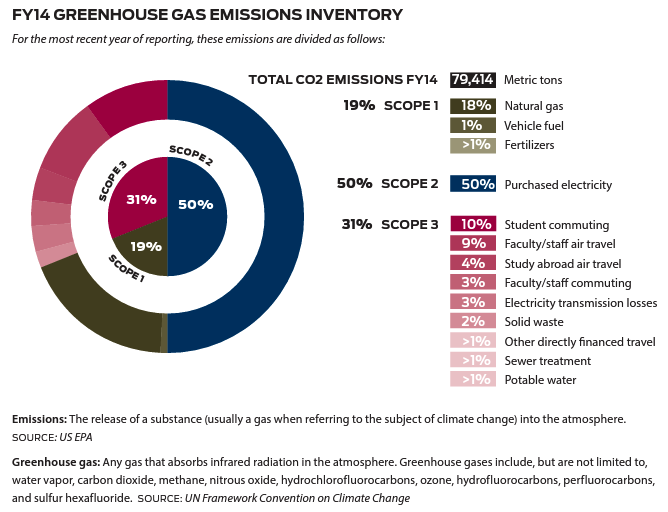
This electrical outsourcing switch is also part of Loyola’s broader climate strategic plan. There’s a lot going on there, from establishing a working group to polling the community, deciding which energy steps to take, supporting a student-run biodiesel facility, doing an inventory of campus trees sequestering carbon, and holding campus climate events. They publish a clear carbon footprint as well:
I appreciate the interdisciplinary charge here: “At Loyola, sustainability is an issue for every department and discipline.”
ITEM: In Maine, Bowdoin College is investing in renovating its buildings to reduce their carbon footprint. The campus has already made some major progress: “Ninety percent of its electricity already comes from solar power, through a 5000-megawatt array near campus and an agreement to buy another 5000 megawatts from a community solar array in Farmington.” The new actions include some serious material work:
Bringing Bowdoin’s older buildings into the 21st century means tearing down plaster walls to exposed brick, installing five inches of metal wool insulation in those walls and on the roof, replacing drafty windows, and installing electric boilers or heat pumps.
From my 2005 visit, a fine statue.
There is also an interesting plan for building out a future energy system, which includes:
preparing buildings for the installation of a new low-temperature hot water heating and cooling system that will begin in 2037, and take five years to complete.
It will replace the natural gas-fired power plant that uses high temperature hot water and steam and is responsible for 75% of the campus’s carbon emissions. Keisha Payson, Director of Sustainability, says the college isn’t committing to any particular technology at this point, believing that advances in geothermal, battery storage, nuclear fusion, green hydrogen and carbon recapture will emerge in the next 15 years.
The whole plan doesn’t come cheaply. “Bowdoin plans to spend more than $100 million dollars over the next 15 years on campus renovations.”
I’m fascinated by some of the details, like this switch to a new building material:
The newest structures on campus, an academic hall and the John and Lile Gibbons Center for Arctic Studies, are constructed of fabricated mass timber instead of steel and concrete. HGA, Bowdoin’s engineering firm, says these are the state’s first commercially scaled mass timber buildings. The material was sourced from Austria, as there are no manufacturers in the eastern U.S. HGA’S Lauren Piepho says the use of Mass Timber reduces the building’s embodied carbon by nearly 10%.
Or this financing issue:
[W]hile Bowdoin has a healthy endowment, and generous benefactors, it’s had to borrow to pay for all of these initiatives says Matt Orlando, the college’s senior vice president of finance.
“The reality is for energy projects like this, it’s hard to raise gifts. Most people don’t want to put their name on a steam line distribution that runs underground. So it’s typically debt-funded, so we’re using the college’s debt capacity to borrow money.”
I wonder how long it’ll be a problem to attract donors to supporting such projects.
Bowdoin is also attempting to replicate passivhaus design:
Director of Capital Projects John Simoneau says these continuous barriers of insulation can make buildings airtight, similar to the passive house design concept.
“One of the parts of passive house is to have these really tight buildings. But even buildings that are not passive house like these still have the same air barrier system, you’ve got it tied into the windows, the windows have to have a really low leakage rate and that is part of the energy efficiency of these structures.”
What can we learn from these brief accounts of two institutions’ climate actions?
To start with, taking climate seriously means changing the literal look of a campus. Bowdoin will not appear to be the same as this work progresses.
Second, such actions involve major investment and future-oriented planning.
Third, climate strategies are not simple, but instead involve many different pieces. Look through Loyola’s plan to get a sense of its complexity and ambition.
This week the invaluable National Student Clearinghouse Research Center published their latest data on American college and university enrollment.
Today I’ll summarize the findings, then point to implications for academia’s future.
tl;dr summary – the pandemic enrollment crisis is over, and now total enrollment has returned to its 2013-2019 level of gradual, albeit uneven decline.
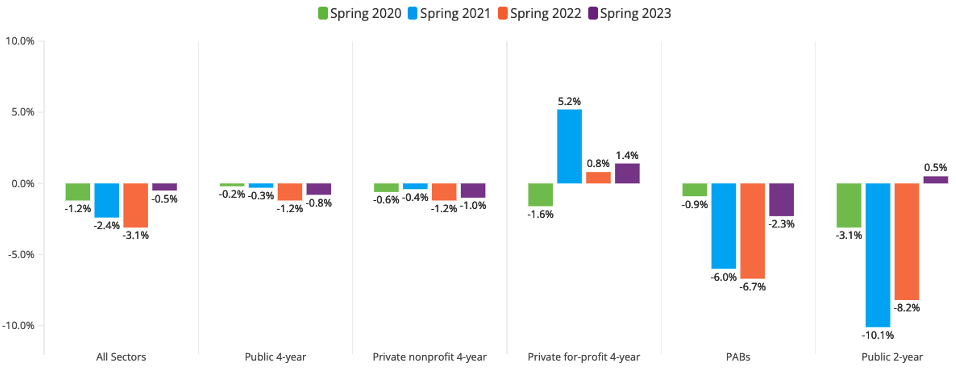
Starting with the big picture, total American post-secondary enrollment dropped by 0.5% from spring 2022 to spring 2023, from 16,963,053 to 16,878,602. (For historical context, spring enrollment stood at 18,154,038 in 2019, 17,944,635 in 2020, and 17,511,906 in 2021.)
Broken down by institutional type, for-profits and community colleges enjoyed an uptick this past semester. Community colleges’ good fortune depends mostly on the rise of dual enrollment (i.e., high school) students. In contrast, public and private four-year institutions saw declines:
Separating out data by degree level, the Clearinghouse assessed that “overall undergraduate enrollment remained stable for the spring term,” dipping down only by 0.2%, or 25,000 students. In contrast, graduate schools saw their student numbers dip down -2.2%, from 3,033,946 in spring 2022 to 2,965,729. This marks a shift away from COVID-era growth. As Doug Shapiro (the Clearinghouse Vice President for Research and Executive Director, Research Center) put it in a call yesterday, the pandemic-era “graduate student wave has passed.”
Slicing the data by demographics, starting with age, the report sees a reversal of the long adult education boom, as what growth the past year experienced came from students under 24 years old. Those under 18rose by 8.2% and the 18-24 group nudged upwards by a touch (0.3%), while those over 24 declined -3.3%. We can see this in first-year student numbers, which “grew 9.2 percent from spring 2022.”
The Chronicle of Higher Education created a nice visualization of this demographic change:
Shapiro put it this way: “older students continue to disappear from campuses, except for-profits.” Why is the adult population falling? It looks like a mix of losing interest to a booming labor market and a college failure to recapture “stopped out students.”
Switching to race, spring 2023 saw two continued trends. White and black student numbers kept declining, while Asian and Hispanic students rose. NB: this is according to yesterday’s media briefing. I can’t find race broken out in the linked report pdf nor the downloadable spreadsheet.
Turning to gender, the 21st-century trend of female students outpacing males in terms of enrollment might be reversing. In spring 2023 the number of men taking classes nudged upwards, while women’s numbers declined a bit. “Female enrollment declined by 1.2 percent (-118,000 students), while male enrollment grew slightly (+0.4% or +25,000 students).” Women do remain the clear majority of students, numbering 10,023,878 against 7,129,439 men, and also across all institutional types.
The story differs by state. The ones gaining the most students were Maine (5.7%), Kansas (5.4%), New Mexico (4.5%), and Tennessee (3.1%). States losing the most students were Mississippi (6.8%), Washington (5.3%), Missouri (4.3%), West Virginia (3.9%), and North Carolina (3.1%).
What degrees are these students pursuing? The Clearinghouse uses CIP codes, and under that rubric the leading degree family by far is Business, Management, Marketing, and Related Support. Following that, with about 2/3rds the numbers, is Health Professions and Related Clinical Sciences, followed by Liberal Arts and Sciences, General Studies and Humanities. The next highest degree set includes Computer and Information Sciences and Support Services, Biological and Biomedical Sciences, Engineering, and Psychology.
In terms of changing numbers, the major growing more rapidly than all others this spring was computer science, which boomed up by more than 11%. In contrast, while a large number of students studied Health Professions and Related Clinical fields, those numbers continued to fall, now below pandemic levels.
What kinds of degrees are students aiming for? Here some previous changes continue to occur. Undergrads are signed up for fewer associate’s and bachelor’s degrees, while trying to get more ” sub-baccalaureate credentials.” At the graduate level PhDs are stable, while the big change is “losses in master’s programs (-57,000 students).”
What does this data mean for higher education’s future? What are the strategic implications?
My first takeaway is that the post-2012, post-peak enrollment decline continues, albeit not at the fierce drop we saw during the pandemic. As Liam Knox put it in Inside Higher Ed, “head counts seem to be settling into a slow descent.” Depending on the institution, this has budgetary implications, as most American campuses depend on student fees for the majority of their income.
Further, it means that higher education continues to veer away from its late 20th century mission of increasing academic access. Indeed, Shapiro told me he saw overall enrollment as back to circa 2005 levels, which is bad in this context, and worse when we bear in mind that the nation’s total population has expanded in the past two decades. Total enrollment of 16,878,602 compares poorly to our peak of circa 21 million, down around 20%, or standing at about 80% of where things once reached.
Second, looking ahead to Nathan Grawe’s demographic cliff, I wonder about campuses recruiting traditional-age students at present. Is their goal to get as many teens as possible for the next 3-4 years, until their numbers drop? How will institutions pivot to attract older learners, which they seem to be failing at right now?
Perhaps my reading is too pessimistic and I’m too wedded to my peak higher ed model. Could the long enrollment decline turn around in the upcoming academic year, 2023-2024? It’s possible, simply put, if enough people decide to take American college and university classes. Yet this would be a sea change of attitudes, and a tricky transformation given the pressures continuing to depress enrollment: anxieties about student debt, increasingly hostile politics, increasing public skepticism, and low unemployment. If the economy sours, perhaps we’ll see a return of some adults from a darkening workforce. Otherwise, we have to expect major cultural shifts for enrollment to return to pre-peak levels.
Doug Shapiro offered another view during our conversation about the new publication. He used the word “stabilize,” suggesting that the decade of decline may have ended, and now we experience neither decline nor expansion, but an enrollment plateau. Spring 2023’s decline was, after all, fairly small, especially in comparison to previous years. I can imagine this playing out if enough of the “college for everyone” model survives its breakup, if community colleges continue to win their dual enrollment game, and if campuses continue to attract significant numbers of international students… until we hit the enrollment cliff’s edge.
What do you think? Should this data point to a new growth period, continued declined, or a stable time? Are you experiencing these changes in the higher education world you know?
In my current work on forecasting the intersection of AI and higher ed, I’ve been running into an interesting problem. Well, several, but today I’d like to share a structural one, caught between futures thinking and where AI is right now.
We’re on the verge of several major decision points about how we use and respond to artificial intelligence, particularly due to the explosion of large language models (LLMs). These occur at large-scale and also radical levels. We could easily head in different directions for each, which makes me think of branching paths or decision gates. As a result the possibilities have ramified.
To better think through this emerging garden of forking paths, I decided to identify the big ones, then tried to map different ways through them. I also mapped them out in a flow chart, which yielded some surprising results.
Dataset size. Right now LLMs train on enormous datasets. This is a problem for multiple reasons: a large carbon footprint, reducing access to the handful of people owning or working at capital-intensive enterprises (OpenAI, Google, etc). For some LLM applications, the bigger the training set, the better. On the other hand, there have been some developments with AI software which get good results from smaller sets, and OpenAI’s leader stated that big datasets are now a thing of the past. So in which direction will we take AI, towards building and using bigger or smaller source collections?
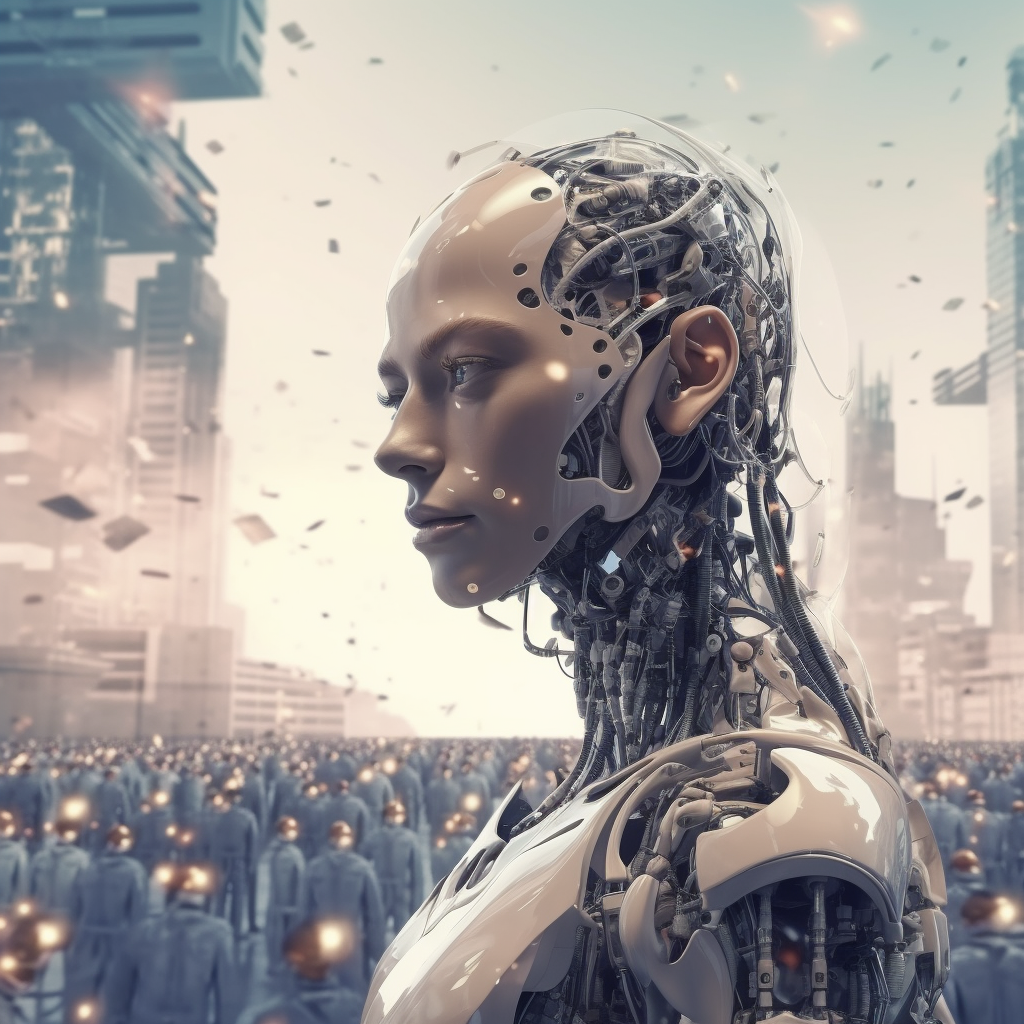
From Midjourney, prompted to depict “several futures for AI.”
Copyright and intellectual property (IP). Those big datasets include some problematic material in terms of ownership and rights. Usually the corpus curators did not solicit approval from all content owners. Some (probably most) or the content is under copyright, and these for-profit firms cannot reasonably expect to defend their use as fair use (especially after this week’s Prince/Warhol decision). (Check out this helpful Washington Post article, which lets you check what content is in one major dataset. My blog is in there, among many others.)
Moreover, some creators want to shield their work from being used by LLMs. Some are already suing. Will we see such lawsuits or allied regulations shut down these giant digital scraping projects and hence stall AI growth or use, or will LLM projects evade sanctions and continue?
Cultural attitudes. Right now AI is a hotly debated topic, going far beyond hype and kneejerk reactions. The controversy is not just a pro/con binary, but consists of arguments across numerous divides, axes, and topics. For example, in the previous point I mentioned the art topic, which turns on copyright and autonomy. Consider as well debates over job automation, which focus on labor markets and self-worth. Think of divides over machine creativity as creepy or interesting. And recall the deep anxiety about machines making decisions without humans in the loop.
Taken together, we could see an emergent cultural revulsion against AI, much as the 20th century saw build up over nuclear and biological weapons. This could lead to a hardened anti-AI attitude. Alternatively, many people enjoy or just find useful new AI tools for a range of reasons: convenience, boosted creativity, etc. Will we crystalize as a civilization into one stance or another? (This is where I keep reminding people of Frank Herbert’s Butlerian Jihad idea.)
Midjourney, same prompt as above.
Nonprofit/edu/culture heritage projects. Right now most AI projects have surfaced from giant companies (Google, Microsoft, Meta, Baidu) or from a nonprofit owned by same (OpenAI). So far they have succeeded in being able to assemble the necessary constellation of human talent, massive computing power, huge datasets, and the right software. Accordingly, we could imagine a short/medium-term future where LLMs are solely the property of giants. Yet the history of digital technology has reliably shown tools tend to become more accessible and cheaper over time. On a recent Future Trends Forum we discussed the possibility of small, low resourced groups making their own LLM applications. Indeed, this is an opportunity for nonprofits, educators, and cultural heritage organizations to make their own and with their own spin. I’ve thought of libraries or faculty and staff teams creating AI based on non-problematic datasets, such as Internet Archive or Hathitrust content.
The gate here is then: does AI continue to be the province of giant companies, or does it democratize and enter the non-profit realm?
OK, wrapping these together, I found that each had one option which led to maintaining the status quo in key ways. In contract, their alternatives pointed to new ways of structuring AI. In the flow chart I traced these together:
Here’s the flowchart. Colored boxes are the decision topics. Colored circles are two aggregate end points.
On reflection, the “New AI Pathways Emerge” looks fascinating, and worth teasing out in a different post.
I’ve used the gate metaphor here and spoken as if humanity is making a decision as a whole at each point, but that’s not historically sound. We contradict ourselves, normally, and especially spatially. Perhaps we should expect multiple branching points. Imagine a polity which decides that AI should be carefully controlled by the state, and only take the form of giant projects, well regulated, and only accessing licensed content, while a different nation prefers a wild west approach, with many types of AI projects using all kinds of content. How would such divergences impact geopolitics?
Additionally, these are just four gates. Several others are in my mind, like technical quality (perpetually flawed or artificial general intelligence?) and private status (nationalized or not?). Which ones do you see?
Back to higher education: should academics advocate for one path or another through these gates? How is enterprise IT preparing for the alternatives? What are the implications of each branch for research and teaching?
PS: I asked Midjourney to image some futures for AI as a flowchart:
In this post I’ll identify what I thought of as the most important or interesting details of the report. One caveat: I’m not a religion scholar, but am looking at the topic as a futurist.
tl;dr – religious belief continues to decline in many registers, although things vary by race and faith.
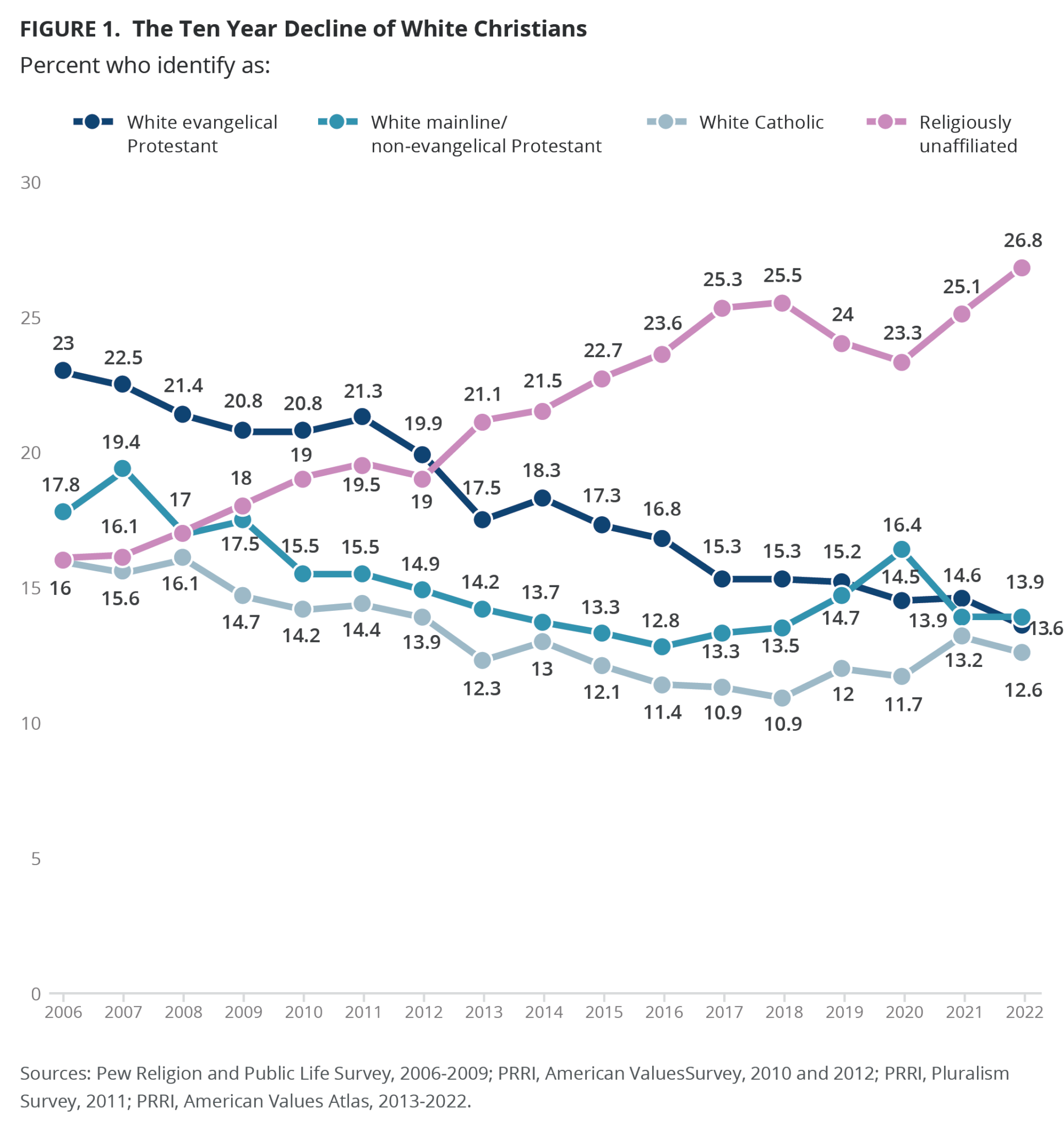
Continued shift away from religious affiliation While the majority of Americans identify as Christians, their overall numbers are declining. The number of people who do not claim any religious affiliation keeps rising. Among white Americans, the unaffiliated now constitute a bit more than one quarter of the population.
One aspect of religious affiliation involves physically attending religious services. Attendance has declined significantly across most religions over the past decade:
Another way of looking at religious belief is how often people change affiliations in the course of their lifetimes. Such switching is on the rise: “In 2022, about one in four Americans (24%) say they were previously a follower or practitioner of a different religious tradition or denomination than the one they belong to now, up from 16% in 2021.”
PRRI breaks down switching faiths by original faith:
People who are currently members of other non-Christian religions (38%) or religiously unaffiliated (37%) are the most likely to say that they were previously a follower or practitioner of a different religious tradition, followed by about one in four other Protestants of color (28%), white evangelical Protestants (25%), and Hispanic Protestants (24%). In addition, 22% each of other Christians, white mainline/non-evangelical Protestants, and Latter-day Saints also say they were previously a practitioner or follower of a different religious tradition or denomination.
In contrast, “Jewish Americans (15%), Black Protestants (15%), Hispanic Catholics (11%) and white Catholics (10%) are the least likely to say they were previously a follower or practitioner of a different religious tradition.”
From a different angle, the study identifies the religions losing the largest numbers of believers:
Among Americans who left a religious tradition, 37% say they were formerly Catholic, 24% were non-evangelical Christian or Protestant, 17% belonged to another Christian tradition, 13% were evangelical Christians, and 5% were members of non-Christian religions.
Why do people leave or switch? The reasons are various:
[A] majority of those who changed (56%) say they stopped believing in the religion’s teachings. Another 30% indicate they were turned off by the religion’s negative teachings about or treatment of LGBTQ people, 29% say their family was never that religious growing up, 27% say they were disillusioned by scandals involving leaders in their former religion, 18% point to a traumatic event in their lives, and 17% say their church became too focused on politics.
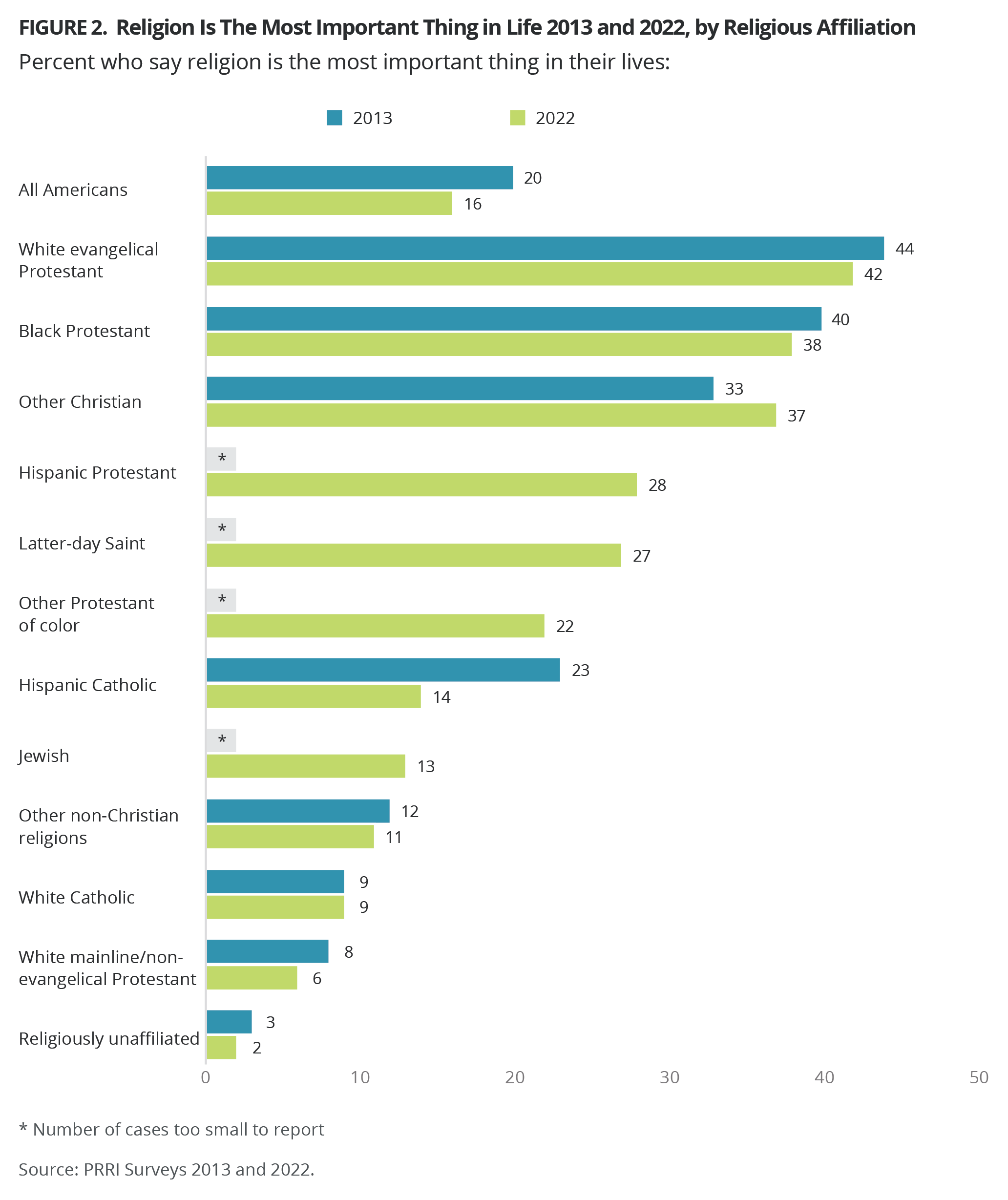
The importance of religion seems to be declining The PRRI team asked what respondents thought of the statement that “religion is the most important thing in their lives.” It’s an interesting way of getting at a sense of value, and that value here is declining – not sharply, but clearly, except for white Catholics and “other Christians”:
In contrast to these signs of weakening religious institutions, those who continue to believe or affiliate seem to be steady, as few current believers are considering an exit:
Only 16% of Americans say they are thinking about leaving their current religious tradition or denomination. About two in ten Latter-day Saints (24%), other Protestants of color (20%), white Catholics (20%), white mainline/non-evangelical Protestants (18%), and other Christians (17%) say they are thinking about leaving their religious tradition, compared with 15% of white evangelical Protestants, 14% of Hispanic Protestants, 13% of Hispanic Catholics, 11% of Black Protestants, and 10% of both Jewish Americans and members of other non-Christian religions.
Religious institutions tend to not be racially diverse Most churches have communities that consist of one race. “[T]he vast majority of churchgoers report that their congregations are mostly monoracial.”
At least three-quarters of white Christians say that their churches are mostly white, including 80% of white mainline/non-evangelical Protestants, 77% of white Catholics, and 75% of white evangelical Protestants.”
Overall, I find these results fascinating and useful. As always with good surveys, I wish for more data and more cuts through it. Gender, geography, age, and educational attainment come to my mind.
So what can we deduce from this data, and how might it impact higher education?
Whenever futurists see a series of datapoints in a timeline we are tempted to project them forwards. So a first extrapolation would obviously forecast a continued religious affiliation decline. Yet we also know that the historical record rarely shows such straight line arcs, and I have two thoughts on such complications here. First, I was struck by the supermajorities of believers who did not express a desire to exit or switch. It may be that those not too committed to each faith have now left, and what remains are the firm believers. PRRI finds those remainers tend to also be more optimistic about the future of their respective institutions. In which case we might expect the declines to level off.
Second, and this is more speculative, I’m constantly looking for signs of 21st century new religious movements (NRMs) to appear, as well as for major reformations and schisms to current institutions. For example, I expect the climate crisis to elicit new sects and belief patterns. Depending on what happens with artificial intelligence, we could see religious changes in response. Moreover, nearly every historical religion appeared as a contemporary black swan, so we should be ready for a new faith to appear out of the blue.
When it comes to academia, I’ve previously identified some impacts:
Enrollment and reputation challenges for religiously-affiliated private colleges and universities.
Potential challenges for religious studies as an academic discipline, notably in terms of student interest, and perhaps cultural support for research.
On the intersection of race and religion, we seem – broadly – to be seeing belief dwindle among white Americans, but not so much among other populations. Religious institutions primarily enrolling people of color might endure, while primarily white campuses dwindle.
Are you seeing signs of these religious trends in your academic environment?
 Ted Kaczynski has died.