Starting my new book project: Peak Higher Education

Greetings from somewhere over the United States.  I’m flying from DC to LA, and will take this lofty moment to announce my next book project.

I introduced the peak higher education concept way back in 2013.  It was a scenario describing one path for colleges and universities.  Since then I’ve developed the model in presentations, articles, a book chapter, and workshops.  Meanwhile, the past decade largely embodied what I projected, with enrollments declining along with a steady stream of institutional cuts, closures, and mergers.

Now I’d like to announce a full length, scholarly book project developing the model even further.  I just signed a contract with Johns Hopkins University Press to produce Peak Higher Ed: How to Survive the Emerging Academic Crisis.

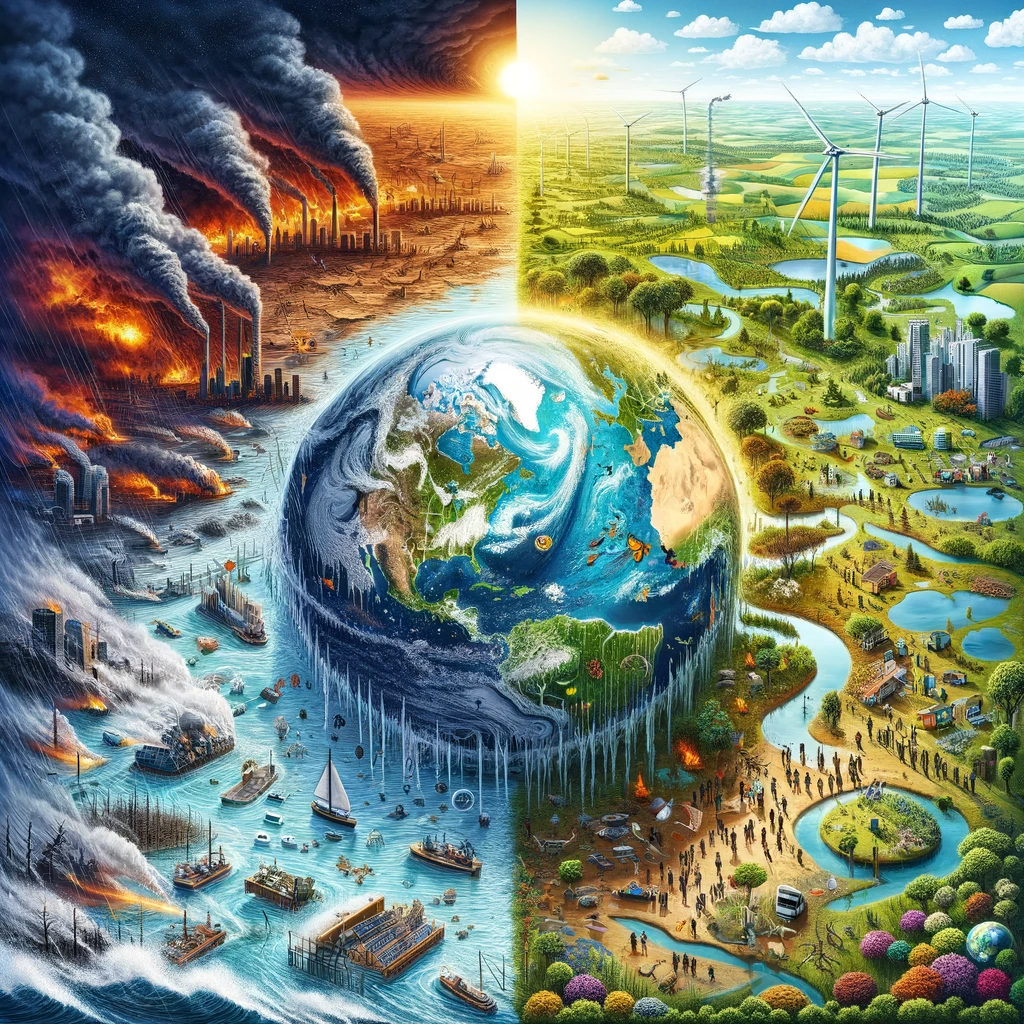
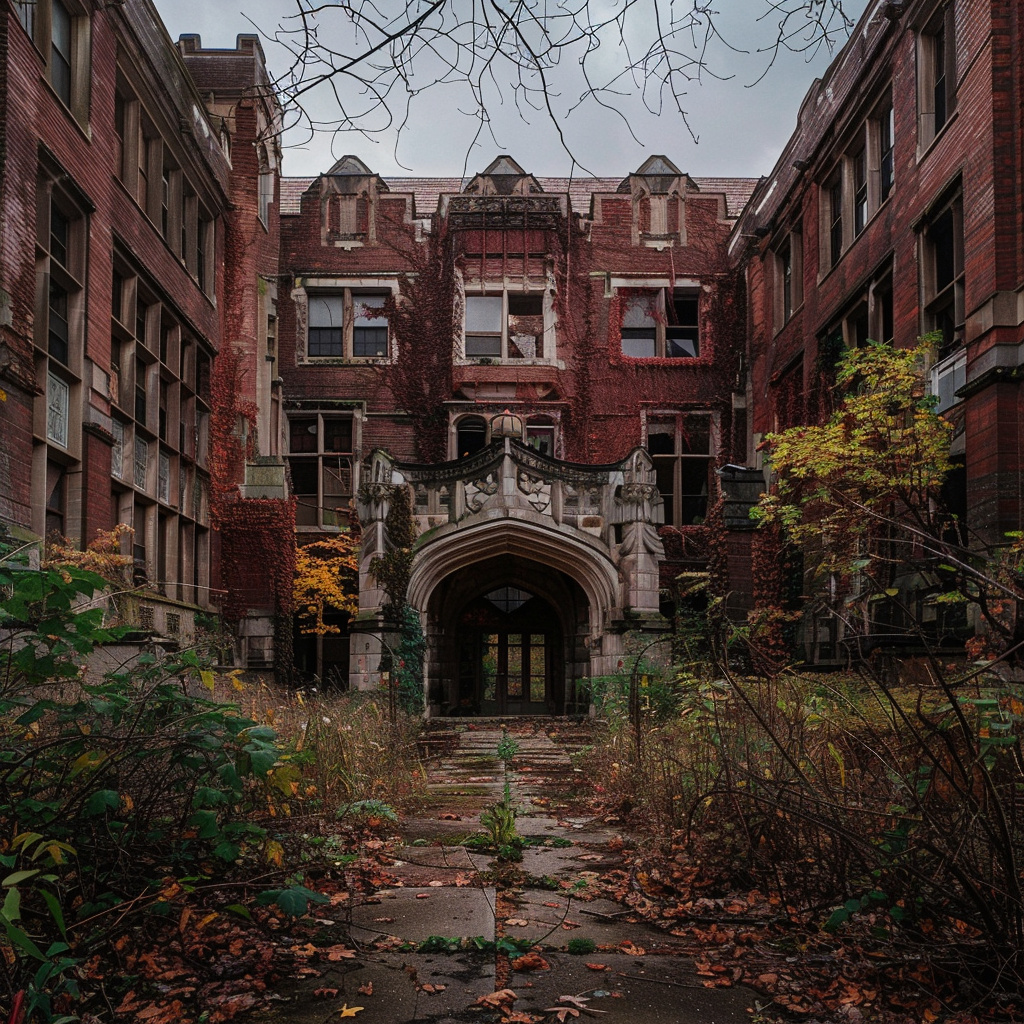
a_college_in_decline_after_its_glory_days_have_passed

One of Midjourney’s visualizations of the idea.

What I hope to do in this book is to trace out the peak model first as it played out historically, examining the causes and contours of how American academia reached, then passed a certain height.  Second, and to greater length, I plan to extend this model forward in time as a scenario.  I’ll do that by some trend analysis, identifying the forces which drove the post-secondary sector into and past peak, then extrapolating them forward. Next I broaden the picture to address three grand and emerging challenges to higher ed: automation, climate change, and a deep division about how we consider the future.  The book concludes by recommending some ways institutions and individuals can best survive and thrive through the scenario.  Readers will be familiar with my thoughts on some of these topics.

In some more detail, here’s the current table of contents, with some details attached to each chapter:

  1. Introduction – The story of how the peak model came to be. Methodology (scenario, trends analysis) and scope (to 2045, primarily the entirety of United States academia).  Relationship to two previous Hopkins books, Academia Next and Universities on Fire.  Hails the audience and what this book might do for them.
  2. Peak higher ed, the first decade – Analysis of enrollment changes in the late 20th and 21st centuries, with historical and demographic contexts. Program cuts, queen sacrifices, mergers, and closures. Broken down by disciplines, campus numbers, and institutional types. Rising financial stresses on many institutions, including state funding declines, rising discount rates, rising costs. The important shift to online classes. Potential early signs of peak scholarship.  Comparison to the bubble model.
  3. Forces pushing academia further downslope – How the forces which drove peak’s first decade may continue to operate. The stark demographic data and projections. After Nathan Grawe’s cliff.  Challenges to academic wage and wealth premiums.  COVID-19 effects.   Challenges to scholarship (productivity, discovery, citation struggling; replication crisis).
  4. After the consensus shattered – The rise and fall of college for all, looking back to the 1970s and ahead to 2045. Declining faith in higher education: partisan and bipartisan. Governments and businesses fighting the paper ceiling; attitudes against credentialism.  Do we believe  retraining works? Anxiety about education’s economics. The Turchin argument: higher education as contributor to political instability.
  5. Automation comes for the campus – Quick introduction to emerging AI. Colleges and universities use or compete with digital tutors.  Campuses respond with new career and life preparation curriculum and pedagogy to several ways AI might transform the labor market: a surge in new, post-AI jobs; “cyborg” jobs, where AI is intertwined with every position; a more competitive market thanks to AI-driven underemployment.  AI depresses higher education’s value or makes it more valuable. A possibility for the humanities to rebound.
  6. The Anthropocene is here, ready or not – The climate crisis increasingly impacts higher education across the multiple domains outlined in Universities on Fire. Some institutions fail to respond to global warming and suffer damages and costs, losing students and reputation.  Roiling social and political crises, involving and to some extent accentuated by the climate crisis, reduce support for higher education.  Academic responses to global warming can elicit off campus opposition; these responses can involve teaching, research, a campus physical grounds, and community relations.  Academics may perceive climate action as competing for scarce and shrinking resources.
  7. Academia and one giant argument over humanity’s future – Two competing models for the next 200 years which are now emerging around the world and how they can impact higher education. Model 1: we accept shrinkage, shifting institutional strategies from an emphasis on student quantity to quality of experience, reducing the number and size of campuses.  Academics contribute to the development of new political economy systems, such as donut economics and no-growth, as well as to projects of social healing and repair.  Model 2: we double down on accelerating innovation, emphasizing growth in knowledge, economy, civilization, technology.  Academic footprint does not grow but transforms towards the posthuman.
  8. The next colleges and universities – What might higher education look like after it adjusts to being overbuilt? Two decades after peak we may see a ratcheted-down sector with fewer campuses, students, faculty, and staff.  Major political possibilities: resurgence in the public good; expanded state support in some areas; rise or fall of international students as part of immigration. Declining rural towns and ghost campuses.
  9. Controlled descent – what can academics do to mitigate decline or try to reverse peak?  This chapter includes: expanded international student recruitment; launching new institutions; state universities increasing recruiting out of state students; growing online teaching; current events curricula; expanded recruitment of older students; cuts, closures, mergers; relocation. Economic strategies: new pricing forms, subsidized tuition and fees; differential prices; faculty, staff, student labor organizing; sharing services. Improving student experience.  And more.

I’ve started writing and hope to turn the whole thing into my long-suffering publisher a year from now.  I hope to share the process here.

A few caveats: yes, after writing one book about global higher ed I’m returning to focus on the US. That’s because American higher ed is not only globally important, but also very different from the rest of the world and benefits from distinct treatment.  Also, this book is about a scenario, which means one possible future.  I hope American academics and, well, Americans as a whole are able to respond in such a way that we avoid sliding further downslope.  It’s possible factors I haven’t foreseen will make that happen; I’ll try my best to anticipate them in this volume.

Any requests for topics I should address?  Any campus stories you’d like me to share, either openly or pseudonymously?

Here’s hoping the airplane’s WiFi will successfully transmit these bits.  <-the 21st century version of Chaucer’s “Go litel boke!”

Posted in writing | 7 Comments

Starting 2024 with all kinds of academic cuts

In this new year of 2024, which colleges and universities are cutting academic programs and jobs?

For a month I’ve been working on this post, accumulating information about different examples, but the instances have been coming in faster than I’ve been able to note them down. And my own schedule ramped up to a fever pitch again.  Finally I’m drawing a line under stories so far, just to get this out there.  So this is not an exhaustive list.

I’ll break this down into several categories, then offer some reflections about what the examples tranche might mean for higher education’s future.

1 Closing colleges and universities

We should start by discussing the maximum cut: closing institutions.   Ohio’s Eastern Gateway Community College, for example, is suspending registration for summer and fall classes. Jamestown Business College, a New York for profit, is closing.  The University of Wisconsin at Green Bay will end in-person instruction at its Marinette campus.  Texas A&M suddenly announced it would close its Qatar Education City branch campus.

In the pipeline of potential closures: a Mississippi legislator posted a bill to shut down three of that state’s public universities.

2 Campuses cutting programs and jobs

axNow we move on to institutions which are shutting down academic programs and/or getting rid of faculty and/or staff.  (Removing tenure-track faculty is what I’ve referred to as the queen sacrifice.  It’s a chess move, where a player gives up their most powerful piece, the queen.  In the analogy tenure-track faculty are queens, given tenure’s protections and the guarantees around long-term employment, plus campus governance.  I will also note endangered personnel who aren’t tenure-track.)

Marietta College (Ohio) is cutting 22 faculty and 14 administrators.  The problem is financial.  First, “net tuition and fee revenue has declined as Marietta has invested more in financial aid and employee compensation.”  Enrollment is a factor twice over, both the total numbers and how much each student brings in:

Enrollment at the college has hovered around roughly 1,200 students for the past several years, but it dropped roughly 26% from 2012 to 2022.

Marietta brought in $15.2 million in revenue from net tuition and fees in fiscal 2022, down from $22.7 million in fiscal 2017, according to publicly available financial records. Financial aid awards grew over that time.

The University of New Hampshire is cutting 75 staff members and closing its art museum.  The given reason was enrollment declines. I would also add the state chronically underfunds public higher education, as Robin DeRosa has documented over the years.

Concordia University is cutting staff and faculty at two campuses in Wisconsin and Michigan.  One of the campuses suffered declining enrollment, but both experienced seriously increasing costs, apparently.

The University of Nebraska at Kearney’s regents are considering cutting several academic programs and some associated faculty members to address a budget deficit. On the block are BAs in geography, recreation management, and theater.

Albion College will lay off several people. 

The University of Arizona announced a series of cuts, starting with 13 open and 4 occupied staff positions (as yet unidentified).  UoA also suspended a group of non-academic programs:

The university will suspend competitive grant programs in the Provost Investment fund, which allowed faculty and staff to seek funding from the office for special projects. The university will save $1.5 million per year from this cut.
Additionally, UA leaders have suspended the Strategic Priorities Faculty Initiative to save $475,000 per year, delayed the initiation of the President’s Postdoctoral Fellowship Program’s next cohort to save $400,000 over the next year, and has saved $300,000 per year by eliminating the eSports program.
The UA has also eliminated the fiscal year 2025 Salary Increase Program and “will reevaluate the program in future years.”
In December, UA President Robert C. Robbins told [the Arizona Board of Regents] that the university would “defer” several capital projects through the end of June.

Baldwin Wallace University will cut two dozen staff and non-tenured faculty members.

3 Cutting programs but not laying off people yet

The University of North Carolina at Greensboro will cut twenty academic programs. On the list:

BA, Anthropology
BA, Secondary Education in Geography
BS and BA, Physics
BS, Physical Education, Teacher Education (K-12)
BA, Religious Studies (will now be a concentration within the Liberal and Professional Studies Program)
Chinese minor
Russian minor
Korean language courses
Graduate Programs
Post-Baccalaureate Certificate in Nursing
Post-Baccalaureate Certificate in Advanced Practice Foundations (Nursing)
MA, Applied Geography
MFA, Drama Concentration in Directing (Concentrations in Musical Direction for Musical Theatre, Theatre for Youth, and Design will continue)
MFA, Interior Architecture
MA, Languages, Literatures, and Cultures
MAT, Languages, Literatures, and Cultures in Teaching
MA, Mathematics (all concentrations)
MEd, Special Education
Dual Masters in Nursing Science and Business Administration (The stand-alone MBA and standalone MSN are not affected)
PhD, Communication Sciences and Disorders
PhD, Computational Mathematics

The University of Toledo announced it would shut down a series of majors in order to save funds:

The bachelor degree programs targeted for elimination include French, German, media communication, urban studies, exercise science, pharmacy administration, pharmacology, and toxicology.
The master degree programs to be suspended include French, Spanish, German, art education, foundations in education, exercise science, and industrial engineering. Masters in public health epidemiology, public health policy and law, and health promotion and education also will be suspended.
Doctoral degrees in foundations of education psychology, and foundations of education are on the suspension list as well.

They didn’t announce any personnel cuts.

Penn State University is considering almost $100 million in cuts.

Wright State University is closing (“deactivating”) a series of low-enrolling associates, bachelors, and masters degree granting programs.  These fall across the curriculum, from the humanities to natural and social sciences, plus education.  No sign of cutting the faculty and staff working on those programs yet.

4 Budget crises, no program or people cuts announced yet

Delta State University (Mississippi) is cutting back expenses by closing open searches, reducing administrative and salaries, and coaxing people into early retirement. (Thanks to John Schaefer for the correction)

A massive University of Connecticut deficit may lead to cuts. (source)

Lake Erie College struggles to pay one major debt. 

The University of Montana is apparently considering cuts, but I can find information outside of paywalled articles.

5 Institutions merging

Cleveland State University is talking with nearby Notre Dame College about a merger.  The former is much larger than the latter, who is suffering from declining enrollment and ballooning costs.

The University of the Redlands is working on absorbing Woodbury University.   

The Vermont College of Fine Arts isn’t merging with anyone yet, but is now up for sale. 

6 …and so what?

Historically when I share such accounts the responses fall into a few camps.  Outside of academia, most people shrug or sigh, applying the experience of the business world to academic institutions.  Within academia, most people get sad or angry at the situations described. Some express sympathy with people losing jobs and seeing their careers hit.  Others will take a different tack, arguing that these stories do not constitute a broader pattern, as they depend on distinct, local circumstances.

Which leads me to address the so what? question.  Why bother tracking such data and assembling the evidence?

I think that while each college or university differs in various ways, the similarities and connections are important.  External forces press across the entire sector, from the demographic transition to shifting political and cultural views of academia.  Moreover, higher education’s senior leaders learn from each other, and so strategies and tactics leap across campus boundaries.  In other words, we should expect to see more of what I’ve noted here.

I also want to take the time to track and share these stories because it seems to me that many discussions leave out the human toll of such cuts.  Cuts blight careers. They cause emotional suffering.  This should be obvious, and yet the discourse around the topic tends to the abstract, the administrative, the more broadly political.

I was reminded of this topic when I received one tweet:


What does it mean for a human being to teach through the end of a job, a department, a program, a campus?  What is it like to be a student working through an academic termination? Why don’t we give more space to these experiences?

More notes:

What I’ve called the queen sacrifice is clearly an active strategic option for at least some of American higher education.  The usual pattern is to identify academic departments with comparatively low numbers of majors or total number of students in classes, then to shrink them in various ways: reducing the range of degrees offered, folding the unit into others, removing faculty and support staff.  The humanities stand out as leading victims in such moves, but are by no means the only victims.

Mergers: note their asymmetry. Typically they involve a relatively healthy and relatively large institution obtaining a comparatively weak one.  We need a better word than merger to express this structural reality – perhaps “acquisition” is worth borrowing from the business world.

Lastly, I have a new book project to announce.  These cuts are crucial evidence for the model I hope to offer.  Watch this space.

PS: are there other accounts you’ve seen and that need attention?  I mean the top-level news but also the human stories.  Please share in comments or, if you’d like to be private, through the contact link on this site.

(thanks to Lee Skallerup-Bessette, George Station, and more friends for stories and conversation; kudos to Inside Higher Ed for staying on these stories)

Posted in economics | Tagged | 17 Comments

Two futures events today

Greetings from the last day of an incredibly busy February.  Today’s post is about two futures events taking place or starting today, both of which I recommend.

First, today Arizona State University is hosting an exciting event.  It’s a design summit for the 100 Year EdTech project.  Lots of people are gathering to share stories about education, technology, and the future.  They are also working in groups to address some great futures ideas, like:

What will the world look like 50 years from now?
What conditions do we need to create across education for community empowerment?
What role should technology play?

From 2-3 pm EST I’m hosting a special Future Trends Forum session for the summit.  We’re going to bring on a bunch of people from Phoenix to describe what they’re learning, thinking, and building, connecting them in conversation with the online Forum community.  Join us!

100 years of ed tech design summit poster

Second, World Futures Day starts at noon New Zealand time, or 6 pm EST, where I am today.  This is an ambitious and fun event hosted by the Millennium Project, consisting of 24 continuous hours of live futures conversation and content.  The idea:

The public is invited to drop in anytime to listen, share ideas, and discuss how to create a better tomorrow with futurists, thought leaders, and engaged citizens worldwide.

“No matter your time zone, you can pull up a virtual chair and join the conversation on Zoom,” said Jerome C. Glenn, CEO of The Millennium Project. “People come and go as they please, sharing insights with global thought leaders on the future”. Each year, total strangers discuss ideas in a relaxed, open, no-agenda conversation making new collaborations and friendships.“

The whole thing takes place in this Zoom room.  There are around 70 people worldwide who will facilitate and support conversation.

I enjoyed the last time I joined the event, and look forward to this year’s.

Posted in Future Trends Forum, futures | Tagged | 1 Comment

Looking for a more ambitious writing experience in an app: an exploration

For years I’ve written articles, interviews, chapters, and books using a combination of software tools.  Now I’m looking for something more advanced.

Currently my main writing application is Microsoft Word, as it is for many people. I also use Google Docs for short writing (chapter/article length), for collaboration, and for other sharing purposes. Over the past few years I’ve taken to drafting almost everything in Google Docs, as I habitually move between around three devices every day, noodling or frantically typing here and there, before exporting to Word for more serious editing and finishing.  (Those devices include a desktop computer (Mac Mini with externals), one or two laptops, and phone, depending on if I’m home or not.)

This setup is quite sufficient for almost all of my needs.  They handle the formatting I require.  They are reliable.  Word gives me some special functions, as do Google Docs. And obviously I can churn out thousands and thousands of words therein.  I’ve used them to produce four books and a bunch of other stuff.

Yet I want more.

strange keyboard

For one, those are generally linear tools.  Word and Docs offer a single, focused, vertical file for us.  I’d like to explore using non- or multi-linear editing, as we have in audio and video editing, plus some gaming and presentation tools.

I’d like some visualizations to help me rethink ideas and connections between them.  For years I used The Brain to organize references and thoughts, until it became too expensive. I use concept mapping and flowcharts for various projects.  It would be great to have another way of seeing my texts as I develop them.

Additionally, I’d like to integrate my research process into the writing process by methods other than tossing text into a linear file or hopping between pdfs, browser tabs, and stacks of books.  I do this in an entirely ad hoc way and the results can be comical, like when snowdrifts of open books build up around me.

I also want the software to give me feedback. I get feedback from humans but that’s a scarce resource. It would be great to see what a well designed bit of software makes of my words.

Overall, I’d like more tools for thinking, as Howard Rheingold famously described the idea, since I see writing as a form of thinking. And in general I want to see what developers are up to as they explore taking writing beyond the 20th century.

Some of what I’m looking for is available in individual apps. There are, for example, plenty of word cloud generators, into which you can paste in copied writing, which are good for a quick rethink of text. There are also lots of mind mapping tools in browser and app form. For AI, I can upload a chapter into Gemini or ChatGPT and ask for feedback.  In fact, this is what Edward O’Neill recommends:

I tend to use different apps for different processes. So I use a text editor for ‘collecting’ scraps or capturing in a random order. Outliners are good for…outlining. But I will also outline in a text editor & then expand. Then document-creation tools for…that.

This does work.  And maybe the best way forward for my quest is to build more and separate tools to perform some of these functions. But today, in this post, I’m interested in a singular, synthetic app focused on writing.

I’ve been quietly researching this for a while, actually back to the 1990s when I did all kinds of experiments with writing and hypertext (StorySpace!), virtual worlds (AlphaWorlds, before Second Life), web page creation and linking, and a lot more. Last week I posted about the quest on Twitter/X and got a bunch of good feedback.  Here I’ll share some suggestions and ideas, partly to get your feedback, but also as a useful list for this moment.  Maybe we’re in the early days of writing technology transformation.

NB: I haven’t fully learned all of the following tools yet.

NB2: for this post I’m not going to delve into the decades of research, development, and experimentation along these lines. I’m not going to recap the history of hypertext, Hypercard, etc.  If I did that this post would become a book. For now I want to cut to the chase and get practical, while also looking ahead.


Google Apps now have Gemini built in.  Fire up Sheets, Docs, and Slides and you might see prompts appear to assist you. For example, just now I opened up a new Google Doc and immediately saw this appear in the text field:
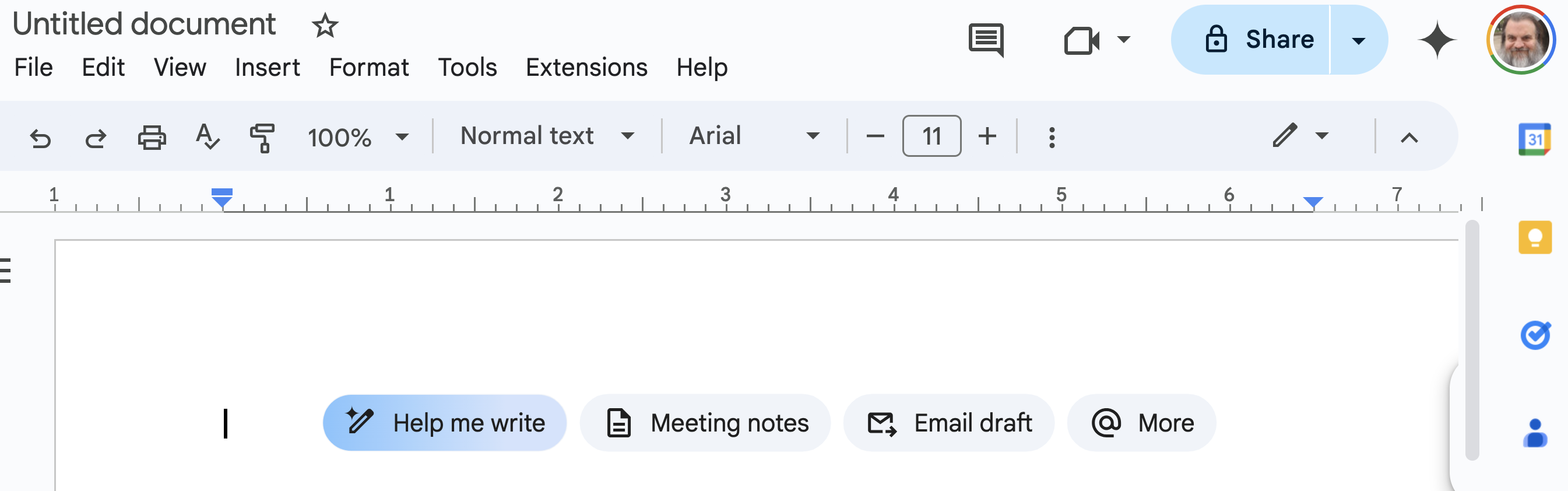
Google Doc blank page with AI helping tools

Mousing over the rightmost three options brought up more options.

I didn’t need help then, as I was writing this post, so I quickly wrote up some sentences about the topic. Then I clicked the Gemini icon glowing on the screen’s top right.  Gemini pounced:
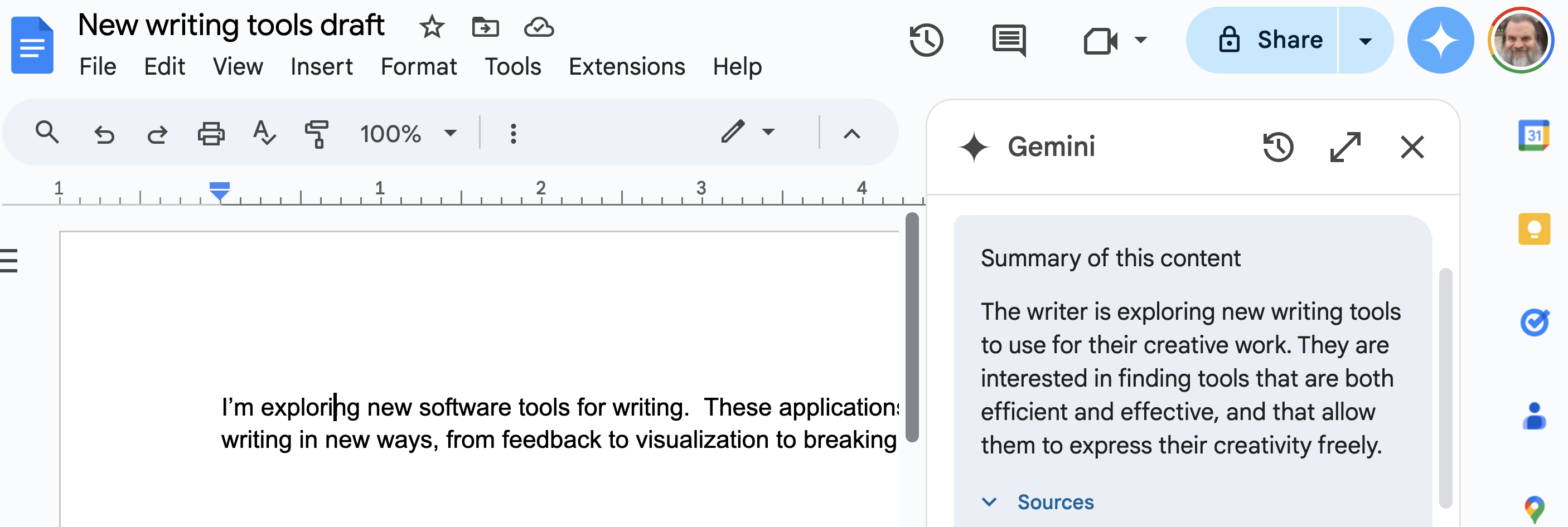
Google Doc Gemini summary

It popped up a dialog box on the right, summarizing what I wrote (accurately).  It also offered a prompt, into which I asked: “What are some features of these applications that make them helpful for expanding my writing ability?”  Gemini quickly replied:

There are a number of features that can make writing applications helpful for expanding your writing ability. Some of these features include:
Grammar and spell checking: These tools can help you identify and correct grammar, spelling, and punctuation errors. This can help you improve the accuracy and readability of your writing.
Style and clarity: These tools can help you identify areas where your writing can be improved for clarity and style. They may suggest ways to make your writing more concise, engaging, and persuasive.
Feedback and guidance: Some writing applications offer feedback and guidance on your writing. This can be helpful in identifying areas where you can improve your writing.
Examples and templates: Some writing applications provide examples and templates that you can use to get started with your writing. This can be helpful if you are stuck on a particular topic or idea.

It is important to note that no single writing application is perfect. The best application for you will depend on your individual needs and preferences. If you are looking for an application to help you expand your writing ability, I recommend doing some research to find a few different options and trying them out to see which one you like best.

Gemini also added some questions for me:

What are some specific features of these writing applications that you find most helpful?

What are some of the most popular writing applications?

What are some other ways to expand my writing ability besides using writing applications?

Clicking on each of those yielded AI-generated answers. The second one’s answer actually recapitulated some items on this post.

So this is interesting for today’s purposes.  The summary was right and the questions weren’t bad.  Perhaps I should stick to Google Apps.

And yet.  Gemini makes mistakes.  You’ve probably seen various stories about this.  I can add a small one. Over in Sheets I’ve recorded my diet for several years.  Gemini took a look at my 2024 entries and said this:
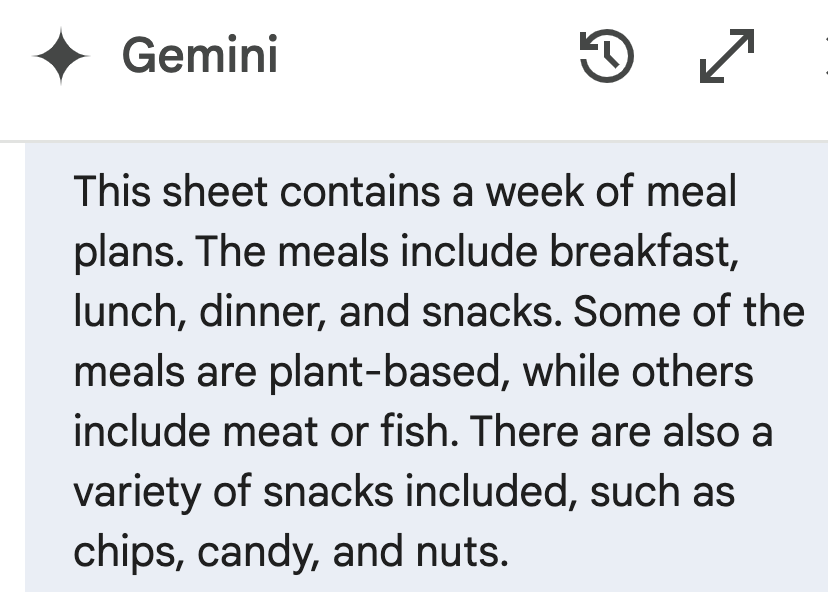
Gemini summarizes my eating Google Sheet

It’s correct, except none of the meals involve meat or fish, since I’m notoriously a vegan.

Besides that problem, Google Docs keeps me in linear mode. It doesn’t offer any visualizations.  In short, it’s traditional word processing plus AI.

Lex strikes me as another writing tool with an AI advisor built in. In my experiments so far it’s easy to pour out words, then have Lex give you feedback. (By the way, many thanks to Lex creator Nathan Baschez for kindly discussing this with me on Twitter/X and email!)

Lex starts by giving you a simple text field to write in.  To the right of your works appear several icons, each offering help: revising your text or answering a question.  To test it out, I summarized this post, then asked for the AI for assistance:
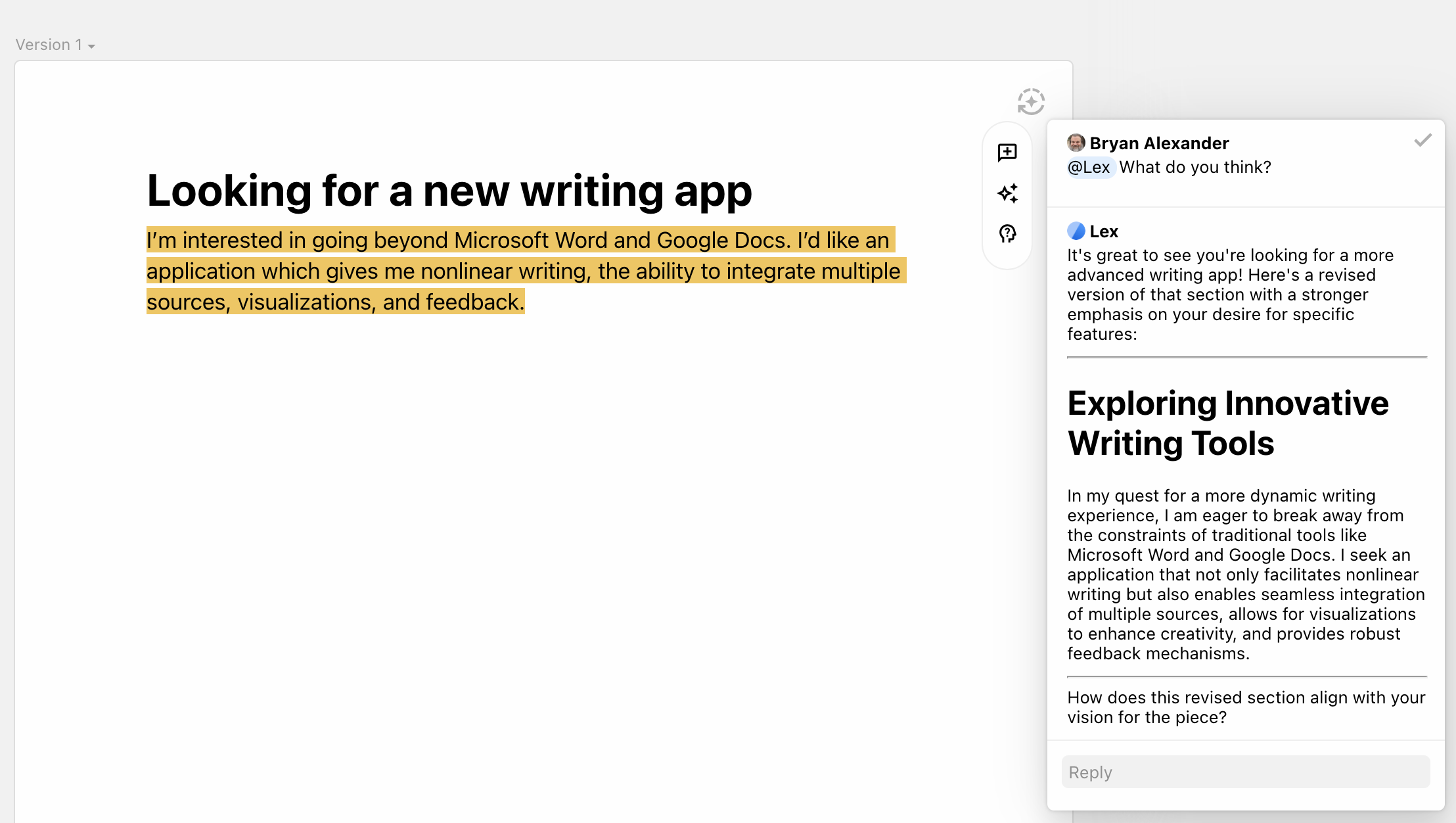
Lex revising my question

That was a revision of my question, which wasn’t what I was after.  Accordingly I revised the question, and got a very different reply:

Lex

Hi! I’d be happy to help you with your request for recommendations on writing applications that offer nonlinear writing, integration of multiple sources, visualizations, and feedback. Here are a few options you might find useful:

  1. Scrivener: Scrivener is a popular writing tool that allows for nonlinear writing, as it lets you organize your work into sections and easily rearrange them. It also supports integration of multiple sources, visualizations through its Corkboard feature, and you can gather feedback by sharing your work for comments.
  2. Ulysses: Ulysses is another great choice for writers looking for a clutter-free writing environment that supports nonlinear It offers seamless integration with external sources, Markdown support for visualizations, and allows for easy sharing and collaboration for feedback.
  3. Notion: Notion is a versatile tool that combines note-taking, project management, and writing capabilities. It supports nonlinear writing through its flexible layout options, allows for integrating multiple sources with databases and links, offers visualizations with tables and Kanban boards, and enables feedback through commenting and collaboration features.
  4. Manuskript: If you’re looking for a writing tool specifically designed for fiction writers, Manuskript could be a good fit. It supports nonlinear writing with its story outline and character tools, allows for integrating research sources, offers visualizations like story timelines, and you can receive feedback from beta readers using its collaboration features.

These are just a few suggestions to consider based on your specific needs. I recommend exploring these options further to see which one aligns best with your writing process and preferences. Let me know if you need more information or have any other questions!

That’s actually helpful.

So Lex reminds me of Google Docs as a traditional writing tool plus AI.  It’s web-based at least; not sure if they’re developing a desktop/phone app.  It uses Google’s AI – not sure which version of Gemini is involved.

Notebook.LM is Steven Johnson‘s project.  So far it looks more focused on sources than on one’s own writing.  It lets you upload a pdf, a document from Google Drive, or to copy and paste text straight in. Those sources appear on a left menu. On the right you type in notes about each source.  AI can respond to your comments and offer some questions, for example:
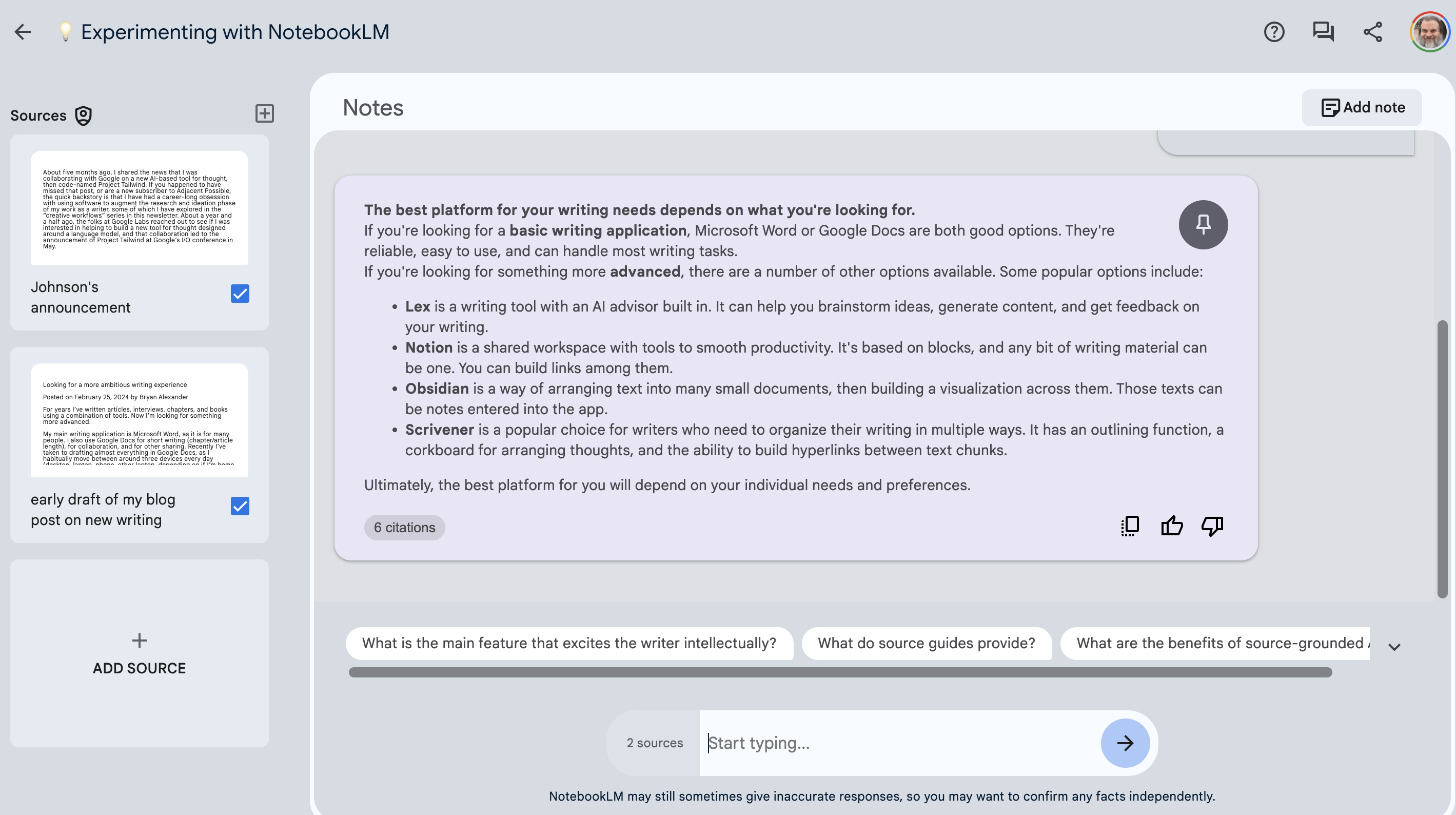
NotebookLM sample screenshot

Quick screenshot of trying out NotebookLM. I inputted a couple of texts and jotted notes about them. It treated those notes as questions and tried to answer them.

It can also summarize and extract topics from your sources:
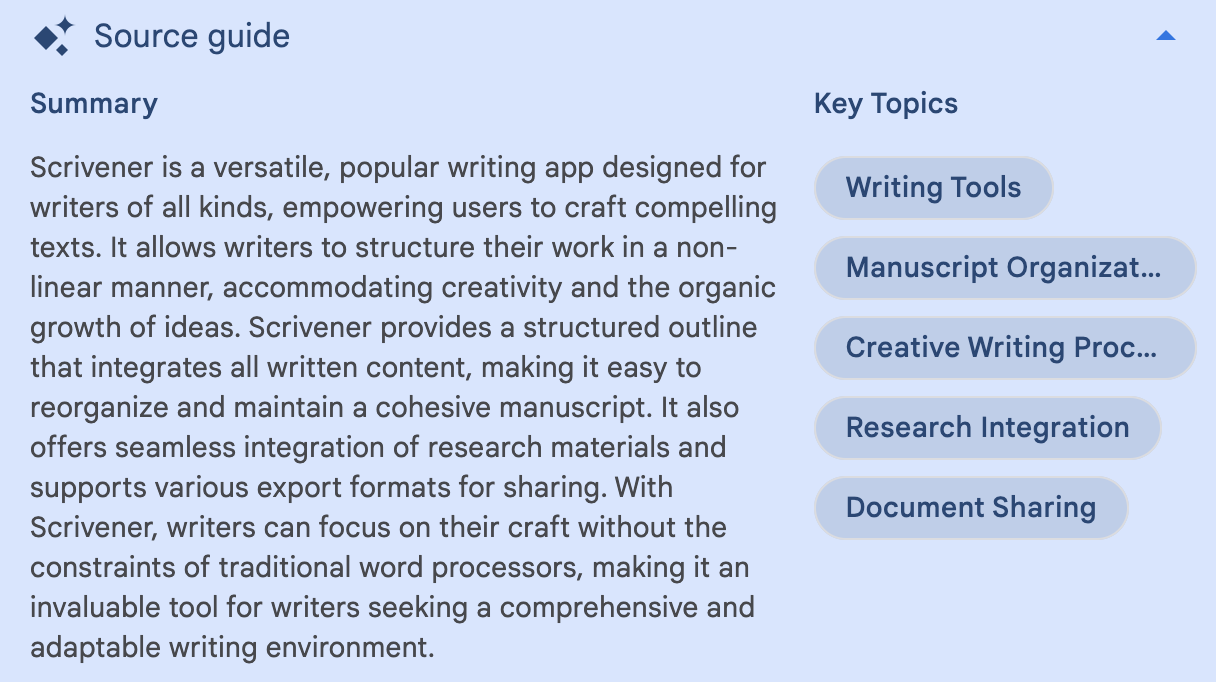
NotebookLM Scrivener on Scrivener

After I added a few sources, the notes field let me write independently of a document.  I typed in “I’d like to imagine a future writing application, one including visualization, nonlinear editing, and feedback.” Back came this reply:
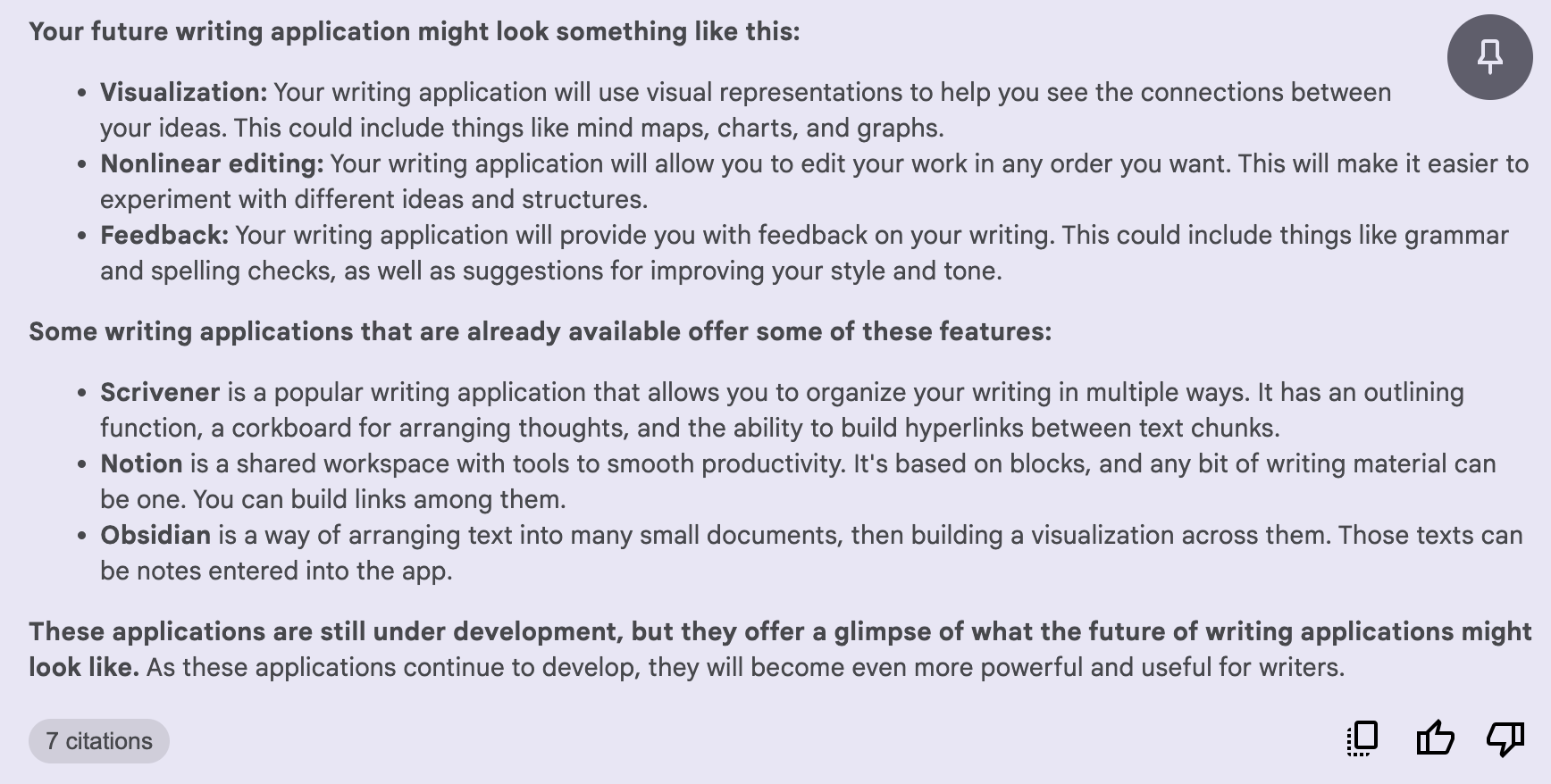
NotebookLM on future writing apps

Which is pretty good.  However, the 7 citations only pointed to the texts I’d uploaded, rather than to external materials. So it really is a notebook.

My tentative assessment: NoteBookLM is an interesting tool for handling and thinking about research materials.  I think it’s browser-based.

Notion looks like a shared workspace, with tools to smooth productivity.  I think it is based on blocks or pages, and any bit of writing material can be one or included in one. Apparently you can build links among them.

Here’s a screenshot of some early noodling around:
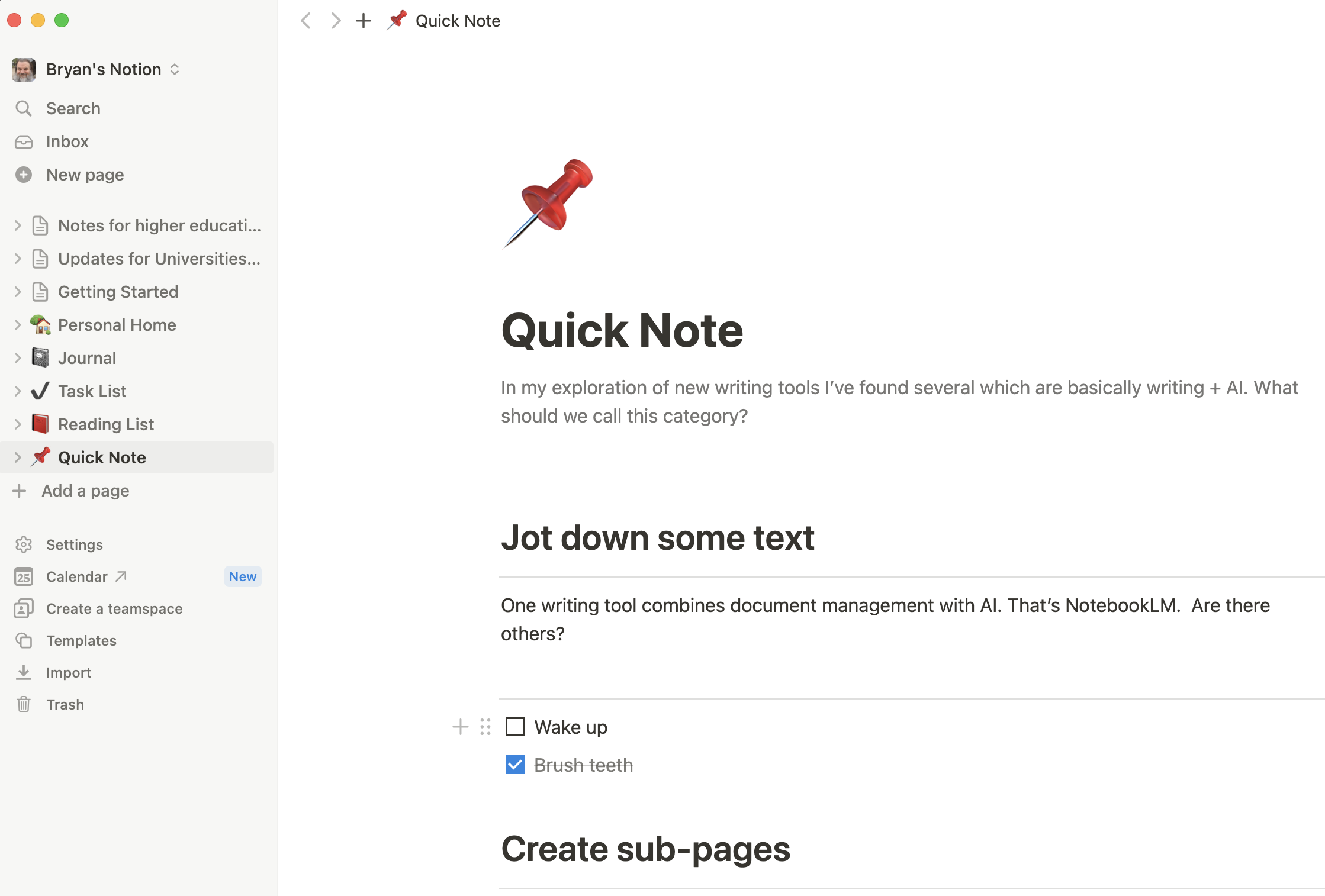
Notion sample

To be honest, I’m not sure I’d use this. I do write notes, but also books.  I don’t see how this can scale up to longer lengths.

Obsidian This looks like a way of arranging text into many small documents, then building a visualization across them.  Those texts can be notes entered into the app.
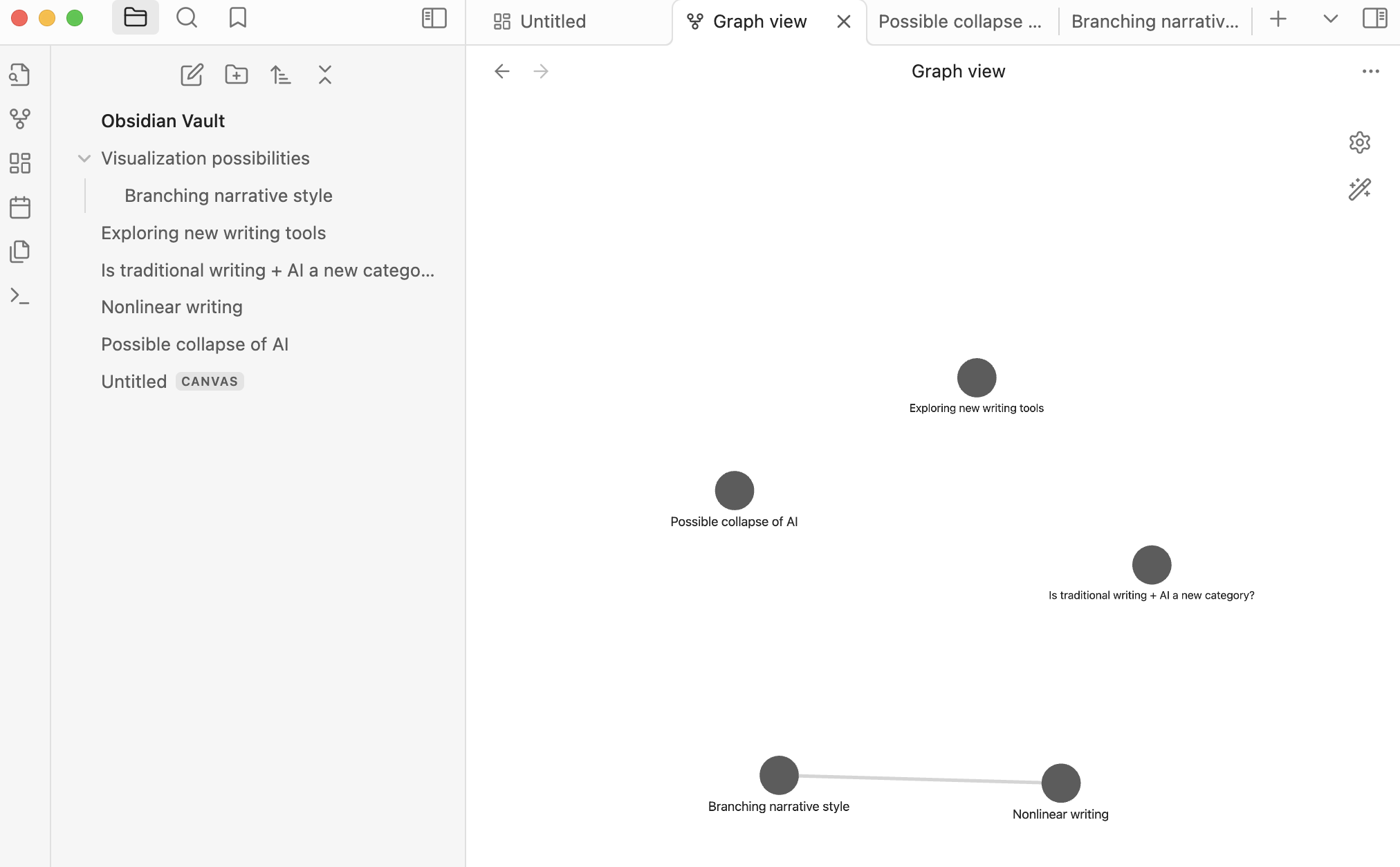
Obsidian graph view sample

This can also be animated, which is fun.

I think you can organize a swarm of content into a “vault.”

It reminds me of Notion as a note-taking and -arranging app.

Scrivener This looks like the best candidate for my purposes so far.  It offers interesting ways of displaying, editing, and organizing one’s writing. There’s an outlining function and a corkboard for arranging thoughts as mini-index cards. Wikipedia adds that Scrivener lets you build hyperlinks between text chunks plus “the ability to assign multiple keywords (and other metadata) to parts of a text and to sort the parts by keyword (such as characters, locations, themes, narrative lines, etc.).”

It’s an app with a full screen interface, three vertical windows (binder, editor, inspector) and many options and displays.
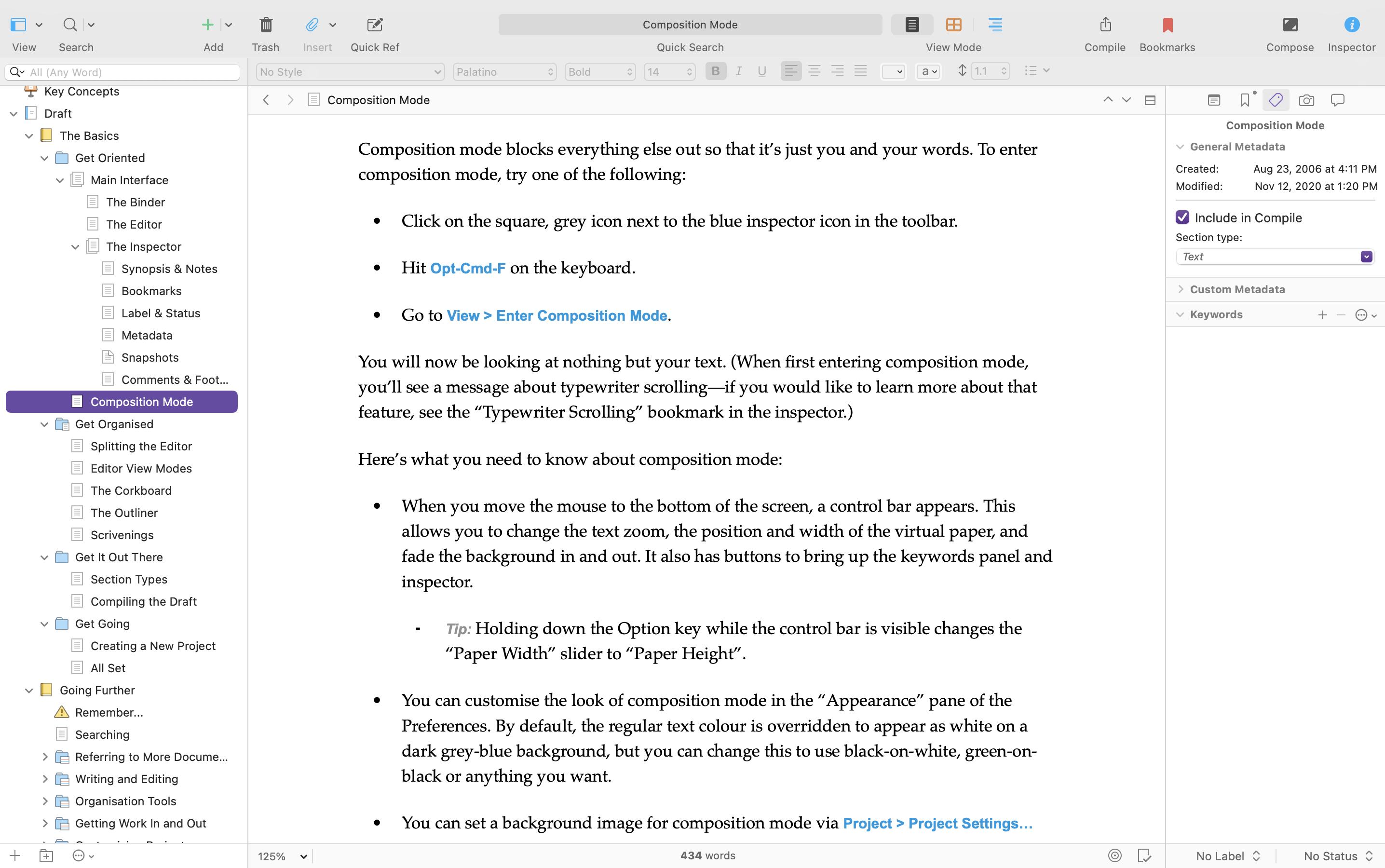
Scrivener screenshot tutorial

What stops me from throwing myself into Scrivener is that it doesn’t seem to have an easy way for me to access files across multiple devices.  On a given day I write with at least two machines, if not four (desktop, laptop, phone, another laptop), so I need to reach and update a single document or archive reliably. However, the Scrivener support page is filled with warnings against ways of doing this.

Scrivener also doesn’t have any AI built in.  So far. I expect that’s an advantage for some folks.

I’m going to give it a trial.

Trello Robert McGuire suggests using this tool in a certain way:

I’m envisioning a card for any possible claim, argument or hypothesis, however small. Attach relevant articles, charts and images. Add notes. Add Links to google docs with drafts. And maybe the lists represent levels of conviction.

Colin Madland cautions us, though, that this is a bit tricky:

I like this process, but it needs Trello to do something other than its specific design. All these things are what obsidian is designed to do AND Trello is web only AFAIK.

wikis Several folks suggested using a wiki, which has made sense to me for years.  Google Docs is, in many ways, the most widely used wiki platform in history, just lacking the formatting markup most wikis mandate.  I like being able to use multiple wikis as hypertext pieces and interlink them.

My biggest work along these lines is my vegan recipe collection in Google Docs: a series of pages (200 or so), each hyperlinked to sources, and all organized by a single menu Doc. This works really well for me.  To start preparing a dish I can keyword search from Google Drive or scroll through the menu page on any device. I can develop and refine each Doc from desktop and laptop as I research online and in books, and add results from kitchen experiments.  It’s easy to add images. There isn’t really much pressure for linearity here, besides the strict sequence an individual recipe’s directions impose.

But I haven’t found a wiki platform with the kinds of extra functions I’m thinking of yet: visualization, creative editing, AI assistance.  Is there one, or is Google Docs the best bet along these lines?


Let me pause the exploration here.  At this point readers might offer two arguments against the preceding exploration.

Some of you might say I should stop looking for such tools because all the results rely too much on computers, especially programs I can’t really control. They’d like me to focus more on human collaborators. Instead of turning to software for visualizations and feedback, I should ask folks what they think.

Others could deem the quest fruitless because the idea of a single app is flawed.  Writers have so many different needs, they could aver, that we are all best served by using multiple applications.  So I might write in Google Docs, say, then turn to apps.diagrams.net to sketch out some diagrams which influence the shape of the text, then fire up Miro to concept map the whole thing before dumping prose into ChatGPT for feedback.

To the first hypothetical objection, I’d reply that I do already exploit, er, turn to friends and colleagues for feedback for everything, from brainstorming to checking out drafts. There’s just a limit to how often I can do that without hiring professional editors. But I should be careful not to remove humans from the process entirely.  To the second, perhaps that’s correct, and no single app can do what I’m looking for.  Or not yet.

What do you all think, dear readers?  Is my quest doomed, or do you recommend one application based on your experience?  Is there another tool or practice we should consider?

(keyboard image by Guido Gloor Modjib; thanks to Nathan Baschez, Tom Green, Alexandria Lockett, Antonio Lopez, Robert McGuire, Greg McVerry, Colin Madland, Paul Martin, Anna Mills, Edward O’Neill, Tracy Pearson, Chris Rice, Mike Richwalsky, and Kevin P. Taylor for thoughts and feedback)
Posted in technology | 7 Comments

Turning 57 in the year 2024

Earlier this month I had a birthday, which I prefer to think of as “completing another solar orbit.” Today I’ll continue with this blog’s tradition of birthdayblogging: a bit of reflection, some memoir, and a touch of futuring. (previously: 2023, 2022, 2021, 2019, 2018, 2018, 2017)

This isn’t easy to write about.

Turning 57 is an odd milestone.  It feels like… nothing in many ways.  The number doesn’t trigger any events. There’s no symbolism around the non-event, nothing in the culture, nothing in policy nor law.  Instead, the non-milestone makes me look ahead to the major events, like 60 and 65.  Those dates loom large, but 57?  It’s a big shrug.

Maybe it’s better instead to consider the date as a time to look hard at myself.

Bryan at 57 in his office

At my office desk.

As a kid I didn’t imagine my 50s well.  Then, being 50 was just part of the general category of “old,” which meant “anyone over 30,” I think.  I supposed I would attain that age, among others. In my teen years I wasn’t sure I’d live that long, because I didn’t think most humans would, given the specter of thermonuclear annihilation.  Once I hit my 20s and nuclear war fell away with the USSR, I viewed being 50-odd as one more slot in a hopefully productive life to come.  Which it has turned out to be.

50s, 57: what did the last year mean, that foggy and numerically unremarkable solar tour?

It meant a lot of work, for starters.  My latest book, Universities on Fire, appeared in March 2023.  I’ve been doing in-person and virtual events in multiple nations to support it. I recently pitched another book proposal; with luck, you’ll hear about that soon. I taught four graduate classes, one in spring 2023, three in the fall.  I consulted, led workshops, gave talks, and facilitated meetings online and in person, again in several nations.  In fact, our consulting enterprise turned ten years old in 2023. Every week I led – well, produced, led, and did post-production for – the Future Trends Forum, which now has nearly 400 YouTube recordings and an audience just over 9,000 people.  Continuous research into higher education’s future appeared in the FTTE report, this blog, my presentations, consults, and across social media. I started up a Substack on AI and education’s future, and it’s going well, with 34 posts, 939 subscribers (some paying), and a decent amount of conversation attached.  Overall, I think I did some good work on higher education’s future.

Yet 2023 also meant death.  Too much death and near death.  My father died in June. My wife endured two heart attacks. (written about here and here) My friend John Lawler died. Another friend died after years of fighting cancer.

Every day it seems I think of a dead friend at different moments in the day. Tomak cheers me on when I lift weights, George (he sometimes preferred the spelling “geORge”) appears when I think about ebooks. Mike comes to mind when I’m teaching or designing games, Earle when I’m teaching or reading.  And my nearly-dead wife, well, I care for every day.  She’s doing much better, but the fundamental shock of two (2!) near-death experiences isn’t something you shed easily, and she’s doing a ton of work to keep herself away from another cardiac event.

There’s an online dimension to these deaths, too, which hits me harder every year.  I come across a blog post, YouTube video, podcast, article, etc. which I know would be perfect for a certain friend and prepare to share it via email, Gchat, Telegram… only to realize that they’ve died. This feels like networking mourning, in a way.

All of these mortalities make me think of my own death, obviously. Memento mori. I’ve spent some time rereading Heidegger on death, because apparently that’s how I roll (I read a lot of existentialism back in the day).  I’ve ramped up my death cleaning, in case I die suddenly: reducing some physical possessions, reorganizing my digital footprint to make it easier to manage.  In case I die suddenly: this thought occurs daily, as I bike, walk, write at a keyboard, ride a train, cram myself into an airplane seat.  What happens next, to my family, my friends, my professional network, my body?

I still feel no religious stirring on this score at all, although I appreciate some writers who were or are religious.  I wasn’t raised in a faith. Years of studying religion didn’t draw me into one.

I don’t talk to most people about this growing awareness of death.  I don’t feel I can – that I’m not sure if what I’ll say will be useful for anyone, or if my experience is worth anything.  And many Americans think death distasteful, morbid, too depressing. So I usually stay silent.

This specter of death drives me to care for my own body to a level I’ve never previously attained. My health is doing very well, overall, actually.  Looking at myself, I still have my head of hair and my beard is something of note, although the forehead is gradually expanding. I can’t shrink my belly any further, no matter what I do, but I’ve been working on making it more muscled.  I have worn reading glasses for several years and appreciate them.

There’s professional evidence of my health improvements. At the last checkup a clinician told me I was fine: lab results for blood pressure, cholesterols, etc. all checked well. He had nothing to recommend me to do. Actually, he wanted to know my secret to good health.  I told him the secret is, apparently, eating a vegan diet, biking every other day, and weightlifting every other day, not to mention walking a lot and continuing to avoid alcohol, caffeine, and tobacco. I’m straight edge, dear reader.  Which leads to a musical interlude:

Death goads me not just mentally and bodily, but professionally.  I feel like I’m running out of time to get things done, and feel so every day.  I condemn myself for wasting dwindling hours for doing certain things, or doing other things less efficiently than I could have.  I damn people for wasting my time with bad writing, useless meetings, or inserting stupid delays into my day.  Bad writing, popcorn fiction, long tv series with slight payoff, comfort fiction I try to avoid.

That concern for time is fierce.  It leads me to downplay what I’ve accomplished so far.  Achieving a terminal degree from a leading university, teaching at three institutions, creating and leading a successful business, publishing four books in various editions, winning awards, interviewed in leading venues, building an international audience – it’s not enough.  I don’t bask in what I’ve done so far. I want more life, like Roy Baty says, and in it I want to get more done. So I readily work 60, 65, 70 hour weeks.

I hear from other folks in their 50s that they look forward to ending work. Some are retiring. In contrast, I don’t feel like my life is slowing down, gliding serenely towards retirement, but speeding up to more and more activity.  Am I seriously supposed to be thinking of slack and rest? No.  It’s not in me now.

I also want more for my personal life. The chance of death makes me think of supporting my family, so I work more to provision them, but I also want to spend all the time in the universe with my amazing wife and children.  The same goes for my friends. I read that the very aged and people at death’s door tend to say what they value and miss the most is the company of loved ones, and I feel that intensely.

And there’s so much more to experience, too – books, games, food, travel. Once more, I don’t feel like slowing down here, but want to accelerate.

the number 57

I worry about the past and its potential to grab into my attention. In previous posts I’ve muttered about the lure of nostalgia, and that does leap up to catch me more often than I expected. I return with love to many books and movies of my youth, and do find myself disdaining present day efforts.  My dreams keep returning to my college days, to my teens, and even to my childhood, despite my trying to get them to look into the future.

So I try to push ahead. I discipline myself to listen to current music, watch new movies, read new books. I revise my syllabi to make sure they aren’t historical relics, but contain older material that’s especially resonant. As always, I keep working on emerging technology – lots of AI now, plus something I’ll write about soon.

Some people my age celebrate freeing themselves from the opinions of others. I think they see themselves as done, finished, incapable of amendment. Or they see themselves secure enough to not mind being negatively viewed. Or they’ve just grown tired of monitoring how others view them. I’m not there yet. As someone who makes stuff for others to consume, I’m always conscious of how I present. And as someone without institutional or other backing to rely on, I can’t afford to irk people unless it’s utterly necessary.

And I use that social environment to improve myself.  I’m always trying to develop, from teaching myself new languages (Spanish and Chinese now) to weight lifting, teaching and new technologies.

the number 57 on a street corner

Maybe it’s all too much, and this post comes across as the ranting of a workaholic.  I confess to trying to spend more time watching movies in theaters and reading some fiction which isn’t directly about my work. Maybe I should do more of that.  And try that un-American “vacation” thing.

Last note: I’ve heard some folks my age and older talk about the wisdom they’ve accumulated and how they should share it.  I’m not feeling that, myself.  Sure, I’ve seen some stuff.  I’ve read a lot and made a bunch of stuff, but I’m not sure what that means.  I try to make my books, presentations, facilitations, etc. as excellent as they can be, but it doesn’t feel like wisdom.

So what next?

More work.  I have a bunch of projects in various stages of inception, and will share if they emerge.  I think I’m teaching four classes this calendar year.  There are virtual and in-person events scheduled through November.  The Forum plunges into another year.  Memento mori.

I care for my family. I hope my wife keeps mending. Meanwhile, our children are adults, so we enjoy their flourishing and assist as we can. Memento mori.

More connections with friends, hopefully in person. Memento mori.

Continued care for my health. Hopefully I can boost my biking radius to 10 or 20 miles by December and crack limits on the local gym’s weight lifting machines. Memento mori.

What else should I be doing, as I ride along another solar orbit?  Besides thanking you all, dear readers, for following and writing back to me?

(57 in tiles photo by duncan cumming; 57 on a street corner by Rob Brewer)

Posted in personal | 12 Comments

Massachusetts removes college degree requirements from most state jobs

Over the past year at least a dozen American states have taken a very interesting step.  They have removed a college degree requirement for applicants to some or most state jobs.  It’s a way of helping people “break the paper ceiling,” of advancing without needing to have postsecondary education credentials.  Examples include Alaska, California, Maryland, Minnesota, New Jersey, North Carolina, Ohio, Pennsylvania (and Philadelphia), South Dakota, Utah, Virginia.

Now Massachusetts has joined them. (alternative link)

Governor Maura Healey filed an executive order on Thursday to ensure most state government job listings do not include degree requirements and hiring managers use a “skills-based” approach when picking candidates to fill open positions.

Skills-based instead of credential-driven: that’s an important shift.

Healey announced this decision during a speech to Associated Industries of Massachusetts on Thursday, in part to spur companies to rethink their approaches to hiring. She noted that career success shouldn’t be limited to the portion of the state’s population — nearly half, per a recent census count — with a bachelor’s degree.

Did you catch that last point, about almost 50% of the state having a degree? In fact, Walletbub just determined that Massachusetts was the most educated state in America. And that state now set aside those educational requirements at scale.

I don’t want to overstate this decision. After all, Massachusetts employs fewer than 50,000 people (source) so we’re not overhauling the state’s labor force.  At the same time, nothing in the governor’s decision prevents people with degrees for applying to state positions.  Moreover, the states which have taken such steps number not even one third of the lot; a majority of American states still require postsecondary sheepskin for public jobs.  A powerful reason for those decisions is the currently low unemployment level; when that rises, perhaps these states will reverse their positions.

And yet I think this is noteworthy.  It stands opposed to the inherited “college for all idea,” instead viewing non-academic achievement as on par with college or university degrees.  It may encourage other organizations to do the same – other states, businesses, nonprofits – to similarly downgrade reliance on postsecondary attainment.  As word of these shifts gets out it might depress college enrollment to a degree.

Note, too, that this isn’t a partisan move.  Republicans and Democrats alike seem equally fond of the idea so far, even in our hyperpolarized times.  It’s easy to find examples of this, starting with how the state leaders who have taken this step are members of both parties. A bipartisan pair of governors urged others to reduce college requirements.  While the conservative National Review praised the strategy, so did Barack Obama:

Here’s an example of a smart policy that gets rid of unnecessary college degree requirements and reduces barriers to good paying jobs. I hope other states follow suit!

Let’s keep an eye on this trend.  As 2024’s elections ratchet up, this could become a partisan issue.  Or it might just continue with more governors deciding to open up public jobs beyond academic achievement.  Is the college for all consensus shattering?


Posted in future of education | 4 Comments

Did the decade-long enrollment decline turn around?

Greetings from February, which somehow occurred just as I was getting adjusted to December.  Over the past month I’ve been frantically teaching, traveling (US, Qatar), pitching a new book idea, managing the Future Trends Forum into autumn, arranging professional engagements through summer, caring for my wife… and while I’ve started a dozen blog posts here, I haven’t published them.  It’s time to get back into the bloghouse and posting seriously again.

National Student Clearinghouse Research Center logoLet me begin with some important higher education data. The National Student Clearinghouse just issued the latest update on enrollments and I’d like to dig into it.

The big takeaway: for the first time in more than a decade enrollment didn’t decline.  It actually ticked up by 1.1% in fall 2023.

Let’s look at some details.

Undergraduate enrollment actually rose overall by 1.2% and across all institutional sectors, albeit unevenly.  Community colleges and for-profits saw the largest rises (2.6 and 3.8% respectively) while public and private 4-year institutions enjoyed a 0.6% increase.

enrollment undergrad 2019-2023 by sector_Clearinghouse 2024 Jan

Zoom in for details, as there’s a lot going on in this graph. “PAB” = Primarily Associate Degree Granting Baccalaureate Institution

Graduate school enrollment also rose by .6%, low enough to drag down the overall number.

Demographics: in terms of race, black, Latino, Asian populations enrolled in higher numbers, while white and Native American student numbers went down.  In terms of age there was some (0.8%) growth among teenagers, which seemed to be driven mostly by dual enrollments with high schools.

Geographically the south, midwest, and west saw increases.  The northeast differed by dipping down 0.4%.

The Clearinghouse also identified which courses of study enrolled how many students.  STEM fields and business led the pack, with computer science growing by 9.5% in four-year programs and more than 13% for graduate degrees.  Some allied health programs declined while others rose.

Some takeaways:

  • Community colleges and for-profits are the big winners here.  The Obama-Biden pressure on the latter group didn’t yield results this year, at least in terms of enrollment.  Quite the opposite. And dual enrollment (getting high school students into college classes) is the main reason community colleges pulled out of a long decline.  Dual enrollment seems to be a major driver for this overall enrollment change.
  • STEM and business majors continue to grow. That’s not a surprise, but constitutes a useful datapoint.
  • Some have said this reverses the pandemic decline, but that’s short-sighted.  The enrollment drop began in 2012.
  • For me, I’m intensely curious to see what this means for the past decade of enrollment decline. Does the new data mean that the shrinkage has ended, or is this a blip before classes dwindle again? Will the next years bring a growing population and a partial recovery of the academic population?  This Forbes piece celebrates the new enrollment numbers as “great news…. outstanding news.” That’s one view, upon which we could build a model. How long would it take for student numbers to build back up to 2012?  Remember that we’re deep in a hole – as Nathan Greenfield quotes Doug Shapiro, “there are still over a million empty seats on campuses today that were filled five years ago.”
  • Or do we see numbers return to the post-peak pattern of decline once more?  Demographics suggest yes.  Rising skepticism about higher education agrees, partially in response to as yet unreformed student debt. For-profits could suffer a collapse again, as they did starting with the Obama administration. My hunch is that if we see enrollment rise by 1+% each year we’ll still have an overbuilt ecosystem of colleges and universities for at least a couple of decades.

That’s all for now.  What do you make of this important data?


Posted in enrollment | 14 Comments

Losing faith in the value of college: an important Wall Street Journal article

(Greetings from a hectic month.  I’m writing this right after starting to teach a big class, participating in several professional events, and now traveling to Qatar.  Greetings from the Istanbul Airport.)

How are Americans turning away from higher education?

I’ve been writing about this for a decade, exploring enrollment declines, changing political attitudes, macroeconomic developments, and more. Recently I’ve offered the term “shattered consensus” to describe the end of popular belief on college for everyone.  Last week Doug Belkin (a fine Future Trends Forum guest) wrote a good Wall Street Journal article summing up explanations for that broken consensus.  I’d like to summarize it here and offer some reflections

Belkin starts off summarizing the consensus model neatly:

For three generations, the national aspiration to “college for all” shaped America’s economy and culture, as most high-school graduates took it for granted that they would earn a degree. That consensus is now collapsing in the face of massive student debt, underemployed degree-holders and political intolerance on campus.

What caused that collapse?

Belkin criticizes institutional governance as slow and conservative, not letting academics respond more quickly and effectively to a changing world.  He blames pre-college prep as insufficient and duns college teaching for not being up to the task.  Colleges and universities have hired larger proportions of undersupported adjuncts to do the teaching work; those temporary employees are also strongly incentivized to reduce instructional demands and inflate grades in order to win better evaluations.  On top of this, cheating seems to be widespread and growing.

The price paid to attend college has famously increased, due to familiar reasons: “state budget cuts, administrative bloat and runaway spending on campus amenities.”  Meanwhile, returns to degrees are not guaranteed:

Of 100 random freshmen enrolling in college today, 40 will not graduate. Of the remaining 60 that earn a degree in six years, 20 will end up chronically underemployed. In other words, for every five students who enroll in a four-year college, only two will graduate and find a job based on their degree.

And then there’s student loan debt.
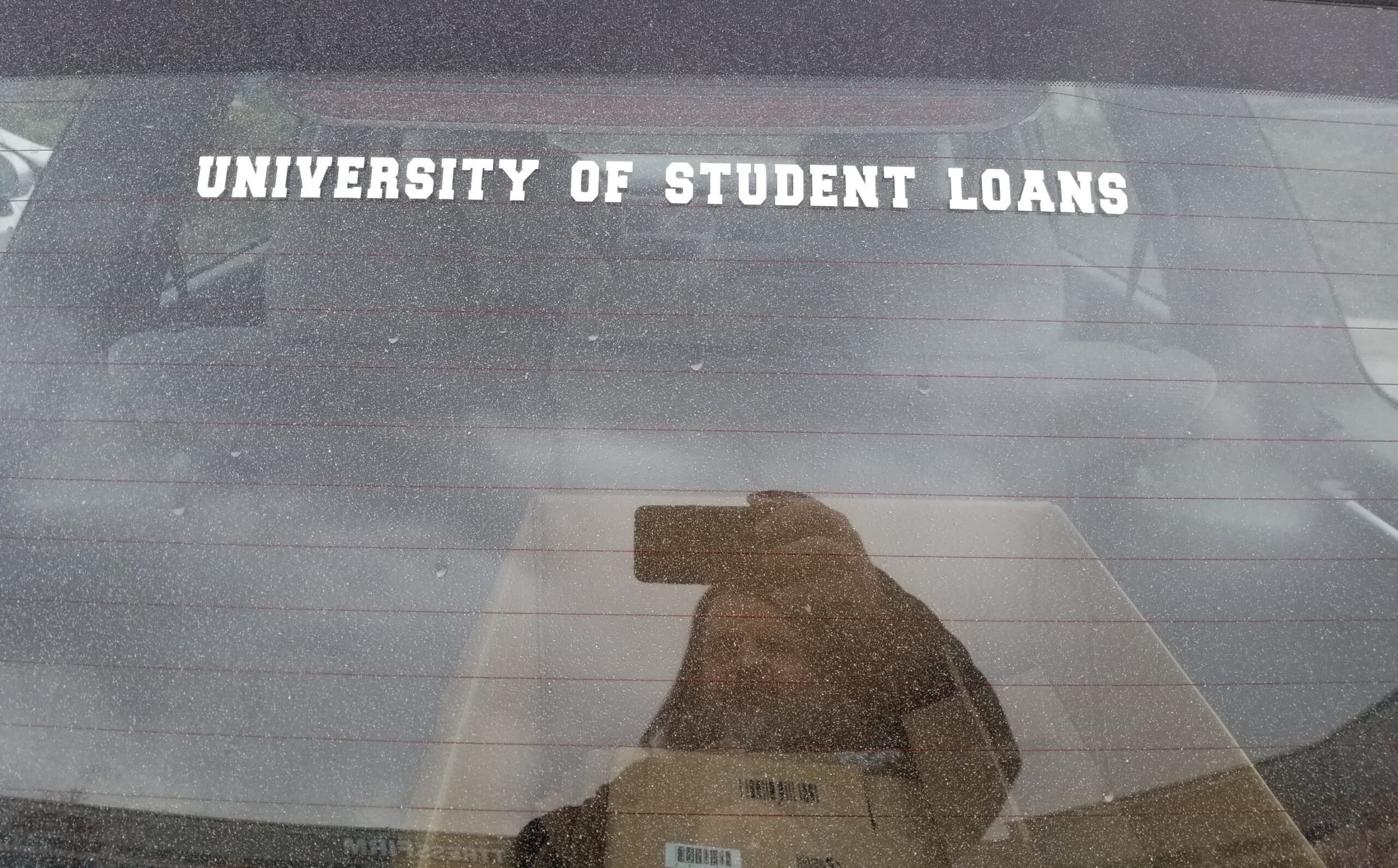
University of student loans

Belkin adds that polling shows declining faith in higher ed, and argues that there’s deep interest in alternatives, such as apprenticeships.

This all maps onto what I’ve been seeing pretty well.  Adjunctification, rising prices (and costs), declining polling, hunts for alternatives, etc. all fit the picture.

I do want to offer a gentle commentary on a few points.

First, while colleges and universities can be very slow to change, it’s not true of all.  Small institutions, like small ships, have a tighter turning radius and have the potential to implement new ideas faster than their giant colleagues.  Private institutions also have the benefit of independence from a layer of state policy and observation.  Further, community colleges are laser-focused on their local community needs (hence the name!) and frequently adjust their offerings to better suit demand.

Belkin argues about enrollment that “As students abandoned the humanities and flooded fields like computer science, big data and engineering, schools failed to respond.” Actually, enrollment in STEM, allied health, and business has soared for more than a decade. Many colleges and universities have managed to offer classes and degrees to power those rising enrollment numbers.   I’ve actually heard from more than a few deans that they fear overdoing it and pushing supply past demand.  (Naturally, much depends on the specific situation of a given campus and the people it serves.)

Second, I would caution readers that Belkin tends to focus on one part of higher ed for most of the article.  Higher ranked four-year colleges and graduate program-offering universities are the main target.  For example, when he writes “Professors compete for tenure on the basis of the quality of their research and publishing track record. Teaching is mostly an afterthought” that leaves off liberal arts colleges and community colleges, among others.  The criticism of amenities arms races boosting costs also sets aside institutions with low numbers of residential students.

Al Akhawayn University

Al Akhawayn University

Third, I remain skeptical of many commentaries based on “administrative bloat.” The term is a tricky one, usually accounting for all staff at an institution who aren’t faculty or students who aren’t working on campus.  That means presidents to custodians, IT staff and librarians, deanlets and grants officers. Their numbers have grown for plenty of solid reasons: increased regulatory burdens, the expansion of IT, greater demand for student services (think of mental health, student life), and more.  Decreasing state support for public institutions has led some of those schools to hire more people for fundraising, from development offices to people charged with nurturing business partnerships.  Sure, there is excess staffing in some fields and outright featherbedding, like in many aspects of American life – but also plenty of overworked, underpaid, marginalized, or just plain ignored staff who badly need better support.

Fourth, and this might have more to do with the Wall Street Journal’s politics*, Belkin touches on American politics too quickly.  It’s important to tease out some details, like the large upsurge of academic skepticism and outright fury from Republicans.  It’s also worth digging into surveys to see different levels of support vs skepticism broken down by age, gender, academic attainment, race, and geography. In other words, politics play a big role in breaking up the college for all consensus, and it’s worth at least a whole article just making sense of it.

Summing up: this is an important article, for all the extra themes I wanted it to sound.  The shattered consensus seems to be breaking into reality.  How will academics respond?

*I’m referring to the WSJ’s investigative journalism wing, not its opinion pages.  The former does solid work, like cracking the Theranos story. In contast, the latter can be,… extreme.

Posted in future of education | 2 Comments

Positive notes on which to start 2024

Greetings 2024!

I’d like to greet you with optimism and a story of gifts.  You see, I ended 2023 with some grim posts (1, 2) and would like to balance those out with some of what cheers me up.

2023 did actually give us some good news. There have been a spate of fairly unremarked-upon medical advances, from birth control to RSV, AIDS to Alzheimer’s and applied CRISPR. (Here’s a quick summary)

Humanity’s exploration of space continued to grow in what I think of as space race 2.0. The United States and China lead the way with human and uncrewed missions to Earth orbit, the moon, and Mars.  American probes also visited numerous locations across the solar system, while the two Voyager missions keep hurtling into the interstellar void.  Meanwhile, other nations have lofted missions into space: India, Israel, the United Arab Emirates, and more.

My pro-private enterprise readers will applaud how the private exploration of space has surged into a peer position alongside governmental work – indeed, leads the American effort by far. My pro-labor readers will appreciate a series of organization drives and successful strikes: UAW, Hollywood.

I continue to be impressed by the rapid decriminalization of cannabis. Added to this are signs of a similar reduction in the war on psychedelics.  I am delighted to see real improvements in people’s lives as a result of increased access to cannabis, such as pain and anxiety relief. I’m also hopeful for new research into these substances and their uses, such as for mental health treatments, now that simply doing science on the stuff is less likely to land a researcher in jail (one example).

Readers know my focus on climate change, and there were some positive steps there, despite what I outlined in my grim post from last week.  Renewables keep growing is use and efficiency. The COP meeting did show some progress.  People are using the courts on climate issues around the world and getting some traction.  Ecuador voted against fossil fuel extraction.  And maybe the record-breaking heat of 2023 nudged more people into climate action.

Now let me share a positive story about the digital world.

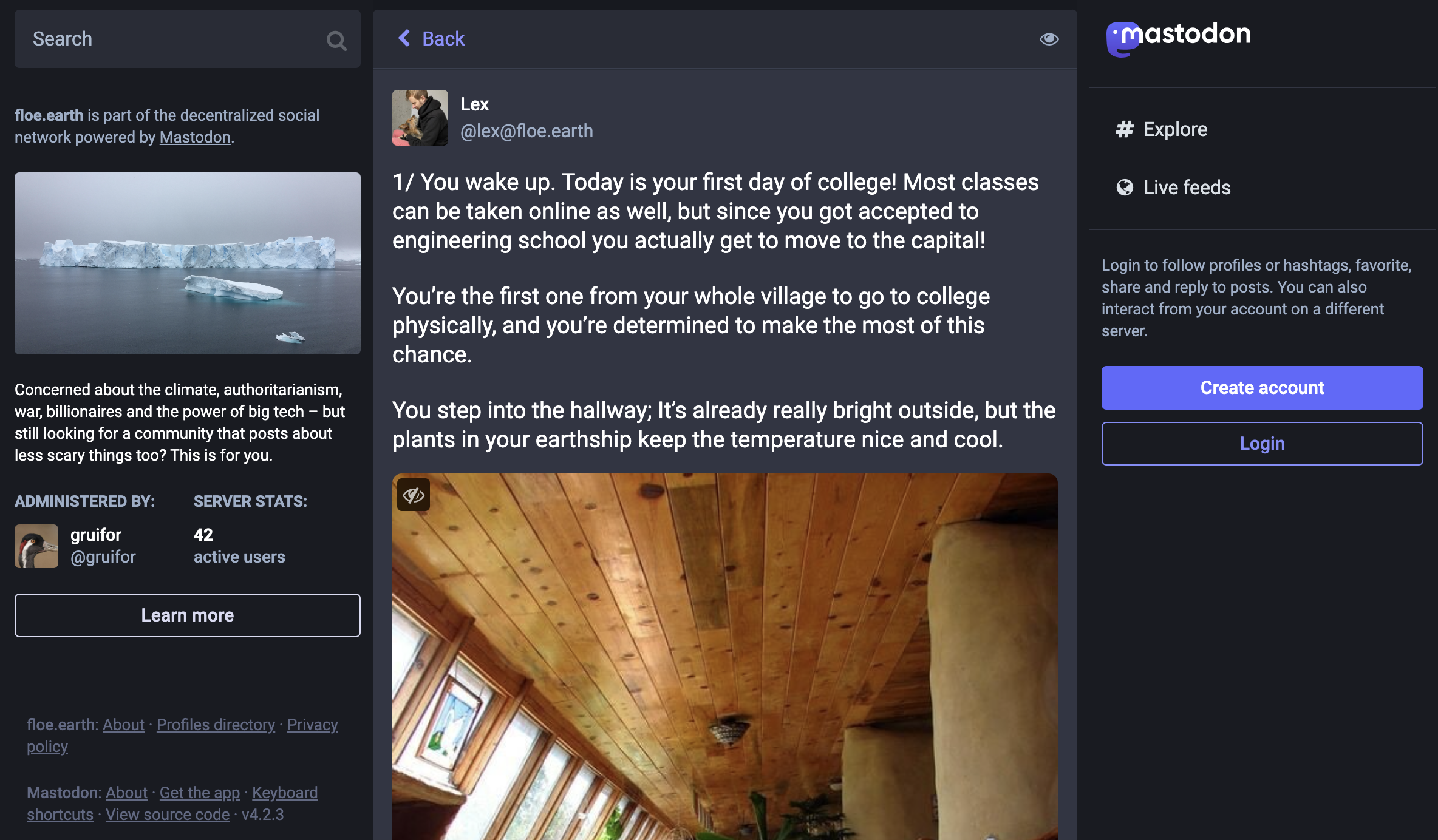
Last week I came across a series of Mastodon posts which intrigued me there. They were a digital story, and I’ve been teaching and researching digital storytelling for twenty years.  The plot concerned a young person going to a university for the first time, which hits my higher ed interest.  And it takes place in a solarpunk world; solarpunk as an optimistic climate crisis design approach is right in my wheelhouse.

Mastodon Lex solarpunk university thread start including the whole server interface

Big screen grab.

I read the story and wanted to share it here, but couldn’t find a way to embed the posts here. I couldn’t even figure out how to like, comment on, or share the posts, since they lived on a different server than the one I use for Mastodon (here’s my account).

So instead I prepared to make some screen captures and to share links to individual post, but then Alan Levine got to work.  Alan, a great educational technologist, brilliant photographer, grand spirit, and good friend, was the one who originally introduced me to Lex’s unfolding narrative. He does that kind of thing, both from native generosity, but also from our shared love of the open web.

Alan went off to work on the issue.  Then he posted about what he did on his blog.

That post begins with a description of the issue I just summarized, then offers a solution.  I didn’t know this, but Mastodon has an embed button for each post:

Mastodon embed screenshot

Useful!  But not for this blog.  See, the Mastodon embed generates a bit of HTML within iframe tags, which WordPress, the engine behind the site you’re reading, doesn’t support.

No problem.  Because Alan is brilliant, experienced, a devotee of the open web, and loves to make stuff, he quickly rewrote a WordPress plugin and uploaded it to Github.  In the blog post – and in notes at Github – he clearly explained what it was and how to use it. I followed directions:

  1. Downloaded the plugin as a zip file.
  2. Uploaded and installed it to this very WordPress blog.
  3. Copied the Mastodon link and pasted it here.  Behold:

Yes!

This made me so excited I tried the thing again, adding more Mastodon posts from that thread:

And one more:

There are 21 posts in the story so far, but I’ll stop sharing ’em here and let you look and enjoy.

Not content with this act of creative assistance, Alan adds this:

And as a bonus, my Embed Extras gives you this one link embed option for content from Padlet, the Internet Archive, Vocaroo (audio), Sodaphonic Boombox (ditto), and Pixelfed.

So let me wrap up with two observations.

First, Lex’s story so far is very interesting.  The thread outlines classic solarpunk features: appropriate technology, high (robots, aerial wind turbines) and low (boats); agriculture; refurbishing and repurposing old (our) buildings; combining biology and silicon-based technology; solar power, of course.  What we’ve seen of teaching so far is hands-on student work in biology and technology.  There’s also that classic narrative of a person going to campus for the first time.  Intriguing!  I’d like to see more, please, Lex.

Formally, each post includes both text and an illustration.  The images aren’t sourced, but seem to come from across the web.  A couple are solarpunk classics, like one from Imperial Boy and a screenshot from that wild Chobani video.  They usually complement the text.

Second, bravo to Alan for taking the time to whip up a solution.  Bravo once more for sharing it on the open web, not just for me but for anyone who can ping a web browser.

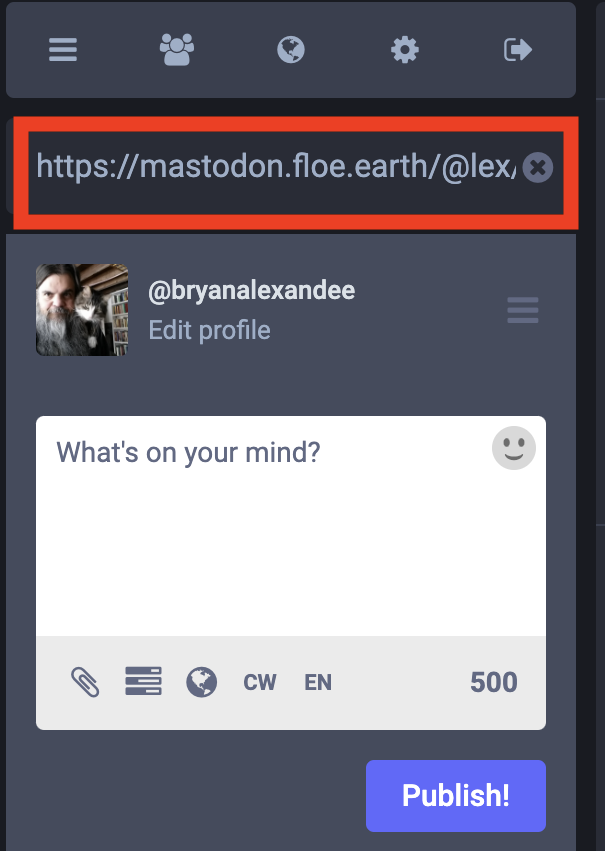
It was a good learning experience for me, figuring out how to make the embed work. (I also learned, or learned again, how to interact with a Mastodon post on another server. You take the URL and paste it into your server’s search box, which is strange but works:

Mastodon search box with a URL crammed into it

Search box lives on the top left of my Mastodon Deck interface.  Mastodonodeck? Mastodeck?)

This is one example of how we make the digital world work well in 2024. People sharing and working together, in the open, so anyone else can play.  Who knows?  Maybe someone else will write another plugin or document their use of Alan’s. Someone else will share comments about Lex’s story or another person will write their own. That’s how this stuff can work.

Thank you for the gifts, Alan.  And happy new year, all!


Posted in climatechange, digitalstorytelling, technology | Tagged | 2 Comments

From 2023 to 2024: academia and climate change

2023 is almost through and we prepare ourselves for 2024. Today I’ll continue my reflections on the two years with an emphasis on one topic.  (Here’s my previous post.)

The past year has been the hottest on record, which is pretty widely known around the world, as so many people experienced heat waves, not to mention fires and storms worsened by global warming. Climate change has become more real for a lot of people.  As Bill McKibben writes:

the most important thing that happened this year was the heat. By far. It was hotter than it has been in at least 125,000 years on this planet. Every month since May was the hottest ever recorded. Ocean temperatures set a new all-time mark, over 100 degrees. Canada burned, filling the air above our cities with smoke.

There are other climate developments we can point to, like the recent COP meeting in the United Arab Emirates.  This managed to conclude with some progressive language, although was arguably kneecapped by being dominated by the fossil fuel industry.  Leaders of the United States and China met and agreed to more climate collaboration.  Decarbonization proceeded around the world, albeit unevenly.  Leading climate scientist James Hansen co-authored a controversial paper arguing that the climate was more sensitive to stresses than expected, which might indicate global warming is accelerating.

As a 2023 state of the climate report put it:

Life on planet Earth is under siege. We are now in an uncharted territory. For several decades, scientists have consistently warned of a future marked by extreme climatic conditions because of escalating global temperatures caused by ongoing human activities that release harmful greenhouse gasses into the atmosphere. Unfortunately, time is up.

More:

We are seeing the manifestation of those predictions as an alarming and unprecedented succession of climate records are broken, causing profoundly distressing scenes of suffering to unfold. We are entering an unfamiliar domain regarding our climate crisis, a situation no one has ever witnessed firsthand in the history of humanity.

It’s not hard to find observations like this, pitched to varying degrees of intensity.

And yet the world has responded with what McKibben refers to as… an odd silence.  We’re experiencing a storytelling and mental mapping failure.

(In geological terms, we’re warming at hellish pace; but that’s not how the 24/7 news cycle works.) It’s been record-global-hot every day for months now: the first few of those days got some coverage, but at a certain point editors, and then readers, begin to tune out. We’re programmed—by evolution, doubtless, and in the case of journalism by counting clicks—to look for novelty and for conflict. Climate change seems inexorable, which is the opposite of how we think about news.

In higher education, the subject of my futures work, we’ve seen something similar. Overall, academia considered the climate crisis in 2023 and… blinked.

I traveled a good amount in 2023 after Universities on Fire appeared, visiting campuses and all kinds of academic meetings: for president, campus planners, societies, technologists, etc. I follow discussions amount faculty and staff through various social media platforms, scholarly publications, in-person conferences, and virtual academic meetings. Generally, climate change was not a priority for us this year.

Oh yes, there are climate activists dotted across the higher education landscape.  I follow, learn from, and work with these rare individuals who try energetically to educate and mobilize their peers.  At Society for College and University Planning (the delightfully acronymed “SCUP“) meetings I found campus architects, sustainability officers, planners, and maintenance staff soberly aware of global warming and building it into their plans.  A handful of colleges and universities have taken some steps, setting up new programs and initiatives – independent of financial resources. Cornell University has a campus-community climate group names after my climate book, Cornell on Fire.  Elsewhere in New York a climate campus was announced.  Two campuses changed their electrical power sources and altered buildings. They were all outliers in 2023.

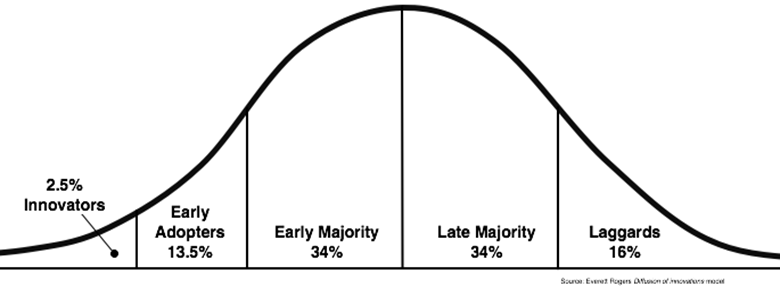
We can think of them according to Rogers’ classic scheme for innovation adoption.  A new idea, like actively responding to the climate crisis, at first only engages a small section of a population, the early adopters:

Rogers diffusion graph

It takes time and quite a few processes for the new thing to cross over into the majorities.

Right now climate is still in that first slice of the academic pie.

Why?  I’ve been asking myself this for years, once I started working on the future of climate change and higher education. I was shocked by how mentioning global warming would kill conversations stone dead most of the time, how rarely the topic appeared in academic discourse.  I’ve barely encountered academics openly resisting the idea – just a few deniers – but instead keep finding the silence Bill McKibben talks about.  Being an extrovert and also someone who learns by asking people stuff, I’ve made a pest of myself and asked academics why climate hasn’t set their hair on fire.

The answers are instructive.  At the top of the academic food chain most presidents assure me that while they are concerned about global warming, they see it as bad campus politics.  They see few upsides and plenty of risk, both to their administrations and also their institutions.  A good number have told me they’ve heard little to no climate interest from their faculty, as well, and don’t think they can push the topic forward without that support.

Faculty and staff usually tell me they don’t see what they could or should do. They feel burned out, for one, by the past decade, and various mixes of stresses: COVID-19, fears for their institution’s or department’s survival, dread about anti-academic attitudes in the population, anxiety about politics of all kinds. Some tell me they have very limited bandwidth for anything other than their immediate teaching, research, and service, and see other priorities for that limited resource.  Many have said they just don’t see what they can do, professionally, about the climate crisis.  Personally they might be a hybrid car, cut down on eating meat, etc., but they feel no traction in their teaching, research, and service.

There is also a sense of resignation.  Climate change is happening, the world will warm, the crisis will escalate, and I can’t do a thing about it as a grants officer/psychologist/assessment dean. (Related note: several professors told me to stop bothering higher ed, because it’s insignificant in the broader picture. Instead I should lobby governments and big corporations.) (Which is interesting, as the Indian government just told higher ed to teach more about climate while American and Chinese leaders assigned their respective academies one global warming task) I’ve heard this attitude from non-academics as well.  Global warming is just baked in now and we’ll deal with it as it comes.  It probably won’t impact us so much as some other people.  Maybe we should buy some insurance to be safe.

Again I say: this isn’t everyone, just most of the ones I’ve heard from and spoken to.

There are some unsurprising differences by age.  Traditional-age students are much more interested in climate.  I’ve had fascinating conversations with 18-24-year-olds about how they see their careers in terms of climate change.  They agonized over having children, dreading to send them into an overheated world. Some have come to me to think about the professions they seek, weighing climate impact and action.  The youngest staff members – again, in their 20s – tend to be climate interested.  Several times A/V workers have sought me out after I’ve given speeches in order to talk about global warming.  It’s young students, after all, who asked their states attorneys general to take action against fossil fuel companies.

On the flip side I’ve heard some odd or depressing comments from people in their 60s on up. One professional researcher told me she was retiring to the Florida coast anyway, even knowing what climate change was going to do to it.  Several have confessed – in private – that they thought climate was a problem for their successors, not for themselves.  The age differences among these academics map well onto polls and surveys of broader populations, which reliably show global warming interest spiking among people under 30.

Where does this leave us?  Possibly academics will gradually come to terms with the climate crisis along the lines I laid out in this blog and in my book on the topic.  The keyword there is “gradually,” as the Millennials and Zers age up through staff and faculty ranks into higher positions of authority.  This might be the work of a decade or two.

Or maybe the change will occur faster than that. For one, humanity as a whole appears to be taking the crisis more seriously every year.  While some climate activists tend to be younger (think of the students hurling paint at artwork, or of Greta Thunberg) their elders have turned the wheels of global power in their direction, albeit slowly.  Decarbonization is picking up speed. National climate goals are now in place for many countries. Climate fiction is starting to appear in print (for example), computer games, movies, and television (for example).

In Rogers’ framework the crucial step for widespread adoption is when those majorities change their minds and adopt the innovation.  They don’t do so for fun or intellectual excitement, like the early adopters.  Instead they come to see a new thing as giving them some enhancement to their lives, often an incremental one, or that the novelty will help them deal with some problems, also incrementally.  Most importantly, they don’t listen to early adopters, but to each other.  Mainstream adoption requires mainstream examples.

Perhaps that’s the route for higher education to grapple with the climate crisis.  It won’t be the Earth scientist or journalist ablaze with climate stories, but the biologist who realizes that the biomes they study are increasingly under threat, or the political scientist who thinks they can better connect with ever-younger students by including climate in their comparative politics classes.  The librarians who start planning how to protect their collections as wet bulb temperatures look to be dangerous in ten years link up with the technologists who fear deploying some new applications because of their carbon footprint. These majoritarians will hear stories like this and this and realize they strike people like themselves.

Or maybe colleges and universities will respond to their (traditional-age) students. Administrators and department chairs may bet that expanding climate-related classes and offering climate programs will find responsive and numerous audiences.  Some academics will want to meet the Greta Thunberg generation where they are and to start researching global warming in their disciplines, bringing that work to class. And maybe some want to get ahead of the political curve, to offer climate opportunities before student protests break out.

Sign on a window: "Eat the rich, not beef"

Sign on a university residence hall window.

…You’ll note that I started this post writing about 2023 and I’ve already become unmoored in time, drifting into the future.  It’s a professional habit, I fear, but one that I hope is useful.  As we peer together around the corner into 2024, I’m going to look for those signs of change, those rising generations, the mainstream mind changes.

Some developments I’ll monitor, based on 2023:

  • Governments at any scale taking actions aimed at higher education
  • Student protests
  • Campuses declaring climate emergencies (although the late 2023 story of campus reactions to the Gaza war suggest senior administrators might prefer silence)
  • Environmental disasters striking physical campuses
  • Vendors of all kinds, from food service to ed tech and publishing, changing or offering new goods and services along climate lines

I’m also looking for campus diversity, equity, and inclusion (DEI) activists to extend their reach to climate justice.

And meanwhile the early adopters will keep doing their outrageously underappreciated work of researching, teaching, planning, doing service, taking community action, performing public scholarship, organizing, and more.  Some leading campuses will launch or expand climate programs.  Bravo to you all.  May you inspire more.

Let me know what you see as your part of academic confronts the climate crisis.  Together we can make a difference in the face of this epochal challenge.


Posted in climatechange, future of education | 12 Comments