From 2023 to 2024: a growing academic civil war

2023 is nearly done, for which many people are no doubt thankful. In several blog posts I’d like to look back at the year before it’s over to identify some trends which look likely to shape 2024.

Today’s topic is what I’ve been quietly calling an academic civil war.   Political struggles within higher education loomed large and are likely to persist in 2024.  Academia is also an object for external political struggle.
DALL·E 2023-12-27 21.50.28 - A futuristic vision of the year 2024, with a bustling cityscape and advanced technology like flying cars and holographic displays. The architecture is

(By this term I mean to shock, appropriately, because we’ve seen some damage to academia over the past year, and we’d be wise to anticipate more in the next.  I also intend the term to indicate complex, messy conflict playing out differently across the sector and beyond.  Is the term too violent for the reality it seeks to describe?  Oh, I certainly hope so. As someone who’s actually spent time in a real civil war (Bosnia and Croatia, 1995) I don’t want to overstate the term’s meaning here, although we’ve already suffered some violent deaths in political clashes (for example).  But perhaps things will worsen. See below.)

To recap from 2023: struggles have occurred across numerous colleges and universities over diversity, equity, and inclusion (DEI) efforts. Off-campus, state and federal officials have played major roles in this fights, notably in legislative actions.   Donors have also played a role.  Some DEI advocates see themselves as doing badly overdue antiracist work, while their opponents view their actions as stopping a pernicious ideology.

Related struggles took place over gender identity, similarly involving multiple actors within and adjacent to campuses. Academic reactions to the Israel-Gaza war constitute another example of this trend, at times to a higher intensity.  The states which restricted abortion access following the Dobbs decision have seen some degree of protest on their campuses, along with some number of students withdrawing their interest and faculty and staff leaving.

Free speech and academic freedom (which are not identical) became leading sites of contestation, as we say.  Debates over the two concepts’ meaning and applications raged across and beyond academia, ranging from detailed discussions of legal and policy language to clumsy virtue signaling and media posturing. We held several Future Trends Forum sessions on the topic this year with a Chronicle of Higher Education reporter and the authors of PEN America’s guide to academic freedom, plus two events late in 2022, one with a FIRE researcher and the other with professors Michael Bérubé and Jennifer Ruth.

Interesting to me is how rarely climate change played such a role in campus politics, at least in the United States.

These struggles took place against a social background of declining faith in higher education. We’ve seen that measured by a series of 2023 polls, such as from Gallup or like this Wall Street Journal one:
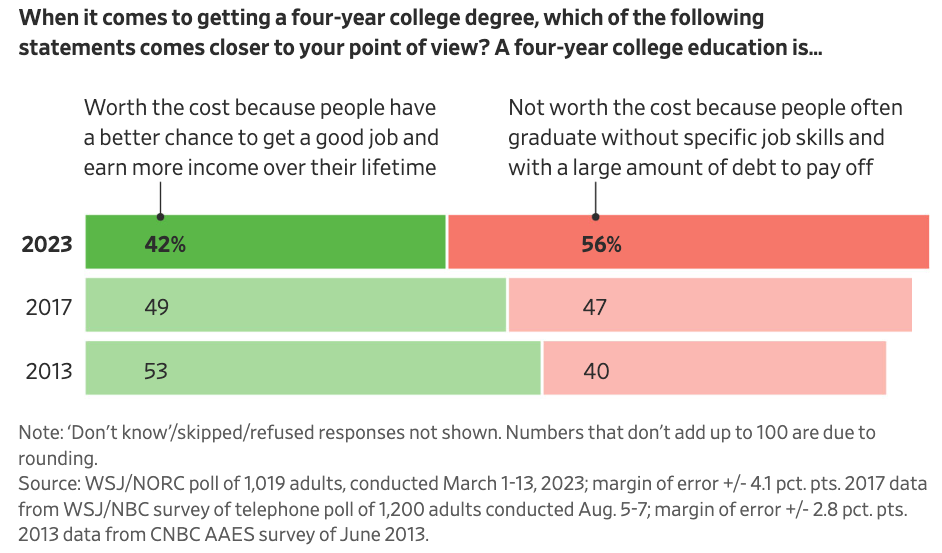
Political partisanship has played a role here, with Republicans especially likely to hold negative views of higher education.  We saw many incidents of GOP politicians from Trump on down hitting colleges and universities for the usual reasons: teaching outrageous ideologies, tenuring outrageous radicals, wasting money, suborning national security, etc.

Looking for 2024, it seems to me that all of these developments and attitudes will still be in play, at least for the next few months.  The Gaza war is still raging, as of this writing.  Trans people are not going away, nor are their opponents.  The desire to do DEI work on campuses, and its opposite, appear to be firmly in place in academic institutions and general politics.

I am concerned that we may see the intensity of such struggles escalate. The 2024 state and national elections are already revving up, since America made the idiotic decision to have presidential campaigns last two or more years. Given how leading Republicans have been acting towards academics, we should expect the rhetoric of criticizing colleges and universities to heat up.  Given how elected officials have sought to pass, or succeeded in implementing, laws about antiracism, Israel, gender identity, academic freedom, curricular content, and more over the past year, it seems likely we’ll see more of those interventions aired or successfully passed into law and policy.

Will things get worse?  Blog readers know I have been forecasting the possibility of American political violence for some time (for example).  Others have as well – coming up this spring is a movie about a titular civil war.

We have largely avoided such chaos so far, but the conditions for at least low-level violence remain: huge numbers of weapons held by citizens, some very angry activists, a significant number of people open to violence.  A bitter election season holds out many opportunities for armed conflict.  Hyperconnected devices make it easy to spread documentation (true or faked) and commentary on outrages.  Political polarization looks to be entrenched and intense.

Could political violence hit our campuses?  It’s not hard to imagine.  Historically, the 1960s saw plenty of cases, from riots to bombings.  In the present day students, faculty, and staff can access weapons, depending on their situation.  Those academics are also plugged into digital networks, which can bring non-academic incidents to campus life through personalized media.

I’m speaking in a kind of binary, violence/no-violence, but that’s only the start.  Should America or its campuses cross that divide into wounding and killing, a cycle of more of the same can begin.  Those who feel linked to the injured may seek revenge. People not physically connected to where an act occurred may feel moved to descend there to play a role.   Modern Ireland and Italy experienced examples of such chronic cycles, and the United States may not prove immune.

Let me emphasize the complexity of the problem.  All too often I see politicians, journalists, and – worse – academics pick one elite campus to stand for all of higher ed. They focus on a few people from that campus as voices for the whole.  Yet America has roughly 4,000 academic institutions. They take all kinds of shapes and forms, from community colleges to research universities, small liberal arts colleges to vast state schools and mostly online enterprises, for-profit, non-profit, and public. These campuses exist across the vast geographical range of the United States and enjoy some degree of autonomy from each other and governments. What inflames one may leave another cold, in other words.

Meanwhile, recall the different populations involved.  When I say “academic” I have a broad sense of the word. For me academics include faculty, students, and staff.  Each has very different places within the academic, with varying responsibilities, rights, powers, expectations. And there are wild differences within each.  Faculty, for example, include adjuncts and full professors holding endowed chairs.  Staff range from system chancellors to custodians.

Some hold different part time positions within academia, like board members, whose roles can be decisive or quiescent, as we have seen in many stories this year. And that’s just within the academy proper.  Other populations are what I call “academically adjacent,” people who work and think with and about academy, albeit in other social milieux. Think of state officials, who sometimes pay attention to higher ed, or those working within businesses providing campuses with goods and services, from scholarly publishing to food preparation.   Then there are donors, who can try to leverage their gifts to change academic structures and behavior.

Beyond them are employers. Businesses, nonprofits, and governments hire college graduates and they certainly have views about job applicants.  This year we’ve seen some law and investment firms threaten not to hire graduates from certain schools

My point is: that’s a huge amount of people plugged into academia in many different ways. The politics of 2023 activated various students, donors, presidents, legislators, professors, etc., each acting from their position within the academic world.  Hence the diversity of forms activism has taken, from demonstrations and petitions to laws, syllabi, and the naming of buildings.  Looking to a potentially even more fraught 2024, we should expect a similar range of actions across these multiple social configurations.  Some may take the form of violence.

We may also see the creation or reformation of institutions along partisan lines.  We’ve seen signs of this in 2023, with Florida’s governor remaking one small college along conservative lines, while other campuses celebrate their deeply progressive identity. There’s a long American tradition of energetic people setting up new colleges and universities to express their religious and political beliefs.  Perhaps the University of Austin is just the first of a series to come.

Such creation and reformation might more easily take place online, given that primarily online institutions not only lack pesky physical plants but also – usually – contain mostly adjunct faculty. Imagine a pro-Palestinian, pro-trans, pro-DEI progressive counter to Liberty University.

How far might such new academic projects go?  Would professional organizations schisms over members’ political stances? Would an accreditation agency take an openly political stance, validating or punishing campuses for their stances on numerous issues?  Imagine a group giving its imprimatur to a college or university for supporting (some certain values of) human rights.

Let me turn back to the 2024 elections (are you sick of them already?) to draw some of these threads together. The 2020 election saw then-president Trump and his allies openly trying to break the electoral system, from threatening state officials to sending “alternative” electors to staging the Capitol riot. It’s possible 2024 might not see anything so dramatic. For example, perhaps Trump’s star will flare out through prison, illness, or death. If not…

We might see something like a strategy of tension aimed at election mechanisms and staff across the country, especially in battleground states.  Legal challenges to Trump could lead to protests and clashes with opponents, which the Republicans could turn to their own account, dunning progressives as hooligans, portraying themselves as the party of law and order.  Counterprotests might not manage to maintain the discipline of nonviolence.  Moreover, if Trump sees himself falling behind in polls, would he consider dangerous stunts to boost his fortunes and secure the presidency?

There are other possibilities for the election, of course, and some turn to civil unrest. Imagine if president Biden is incapacitated or dies, leading vice president Harris to run for the presidency. How might that stoke activity among the white supremacist and sexist right?  Would the Democratic party united behind Harris?  Other factors could lead to a contested convention, which could turn ugly.

Technology may play various roles.  The combination of mobile devices and social media mean that stories and documents of all kinds are created and shared extremely quickly, as we’ve learned. AI may give disinformation and misinformation a big boost. We may also see political argument take place on gaming platforms to a higher degree; I’m thinking of the hybrid games/virtual worlds, like Minecraft and Roblox, as well as the use of game engines to produce visual content.  And if Apple’s April launch of VisualPro gives mixed reality a shot in the arm, we may anticipate political content appeared in mixed, augmented, and virtual realities.

All of these possibilities may intersect with academia. Imagine a donor threatening to withdraw a major gift if their university fails to denounce protestors on campus. A state government might decide to discipline its universities should it find links between some of their academics and political actions. A politician might decide to attack the richest institutions directly, as one commentator suggests, citing an interesting historical precedent. Conversely, politicians might work with donors to set up institutes within institutions, as we’ve seen with the University of Texas. Statements from academics will readily circulate, stirring up anger and support: a professor saying something objectionable to one population, a student government passing a resolution outraging another.

Faculty and administrators might urge accreditors to support peers at other institutions whom they view as threatened. Colleges might revisit speech codes in order to control what administrators and/or faculty deem to be harmful expressions in a flammable year.  Academic departments could scrutinize members’ statements for comments deemed contrary to their mission.  From off campus, how many individuals will seek to threaten or attack colleges which they see as bastions of Marxism, transgenderism, neoliberalism, globalism, capitalism, elitism, or just hatred?  Will “academics are the enemy of the people” become a phrase?

Thinking of other facets of the year 2023 in higher education, I wonder how academics will treat living in a contested state, like Pennsylvania or Georgia. Will some faculty and staff decide to leave?  Will incidents and chaos – again, circulating widely – depress job and student applications? More broadly, will students, faculty, and staff sort themselves politically by aiming their applications for red or blue colleges and universities?  If civil unrest breaks out, that seems likely to depress international enrollment.

At the same time American higher education has other ways to respond.  Certain disciplines will research the year’s events: political science, government, American studies, media studies, area studies, and so on. That research can appear in various forms: peer-reviewed scholarship, preprint articles, public scholarship.  Similarly, 2024 can provide fodder for teaching, either designed as such by faculty or supplied by students.  Faculty and administrators may respond programmatically, offering talks, convening discussions about the year’s events. Those interested in civil discourse may weigh in in many ways.

Let me close with one big caveat. It’s possible that American society will back away from chaos in the next year. I mentioned above one way it could happen, but there are others. GOP pressure on the election infrastructure might just fail, as it did in 2020. Republicans and Democrats alike could draw back from high octane rhetoric and politicking. The American public might tune out from the election to a higher degree than usual. A national threat or emergency might produce moments of unity.

I haven’t build these observations and extrapolations into a scenario, although perhaps I should.  Right now they are an inchoate set of ideas and questions.  What do you think?

(thanks to many people for conversations, including Dahn Shaulis, Mark DeFusco, Chris Rice)

Posted in future of education, politics | 6 Comments

Preparing my gaming and education class for spring 2024

Next month I’m starting one of my favorite classes, and I wanted to share the draft syllabus with you all.  It’s the gaming and higher education seminar for Georgetown University’s Learning, Design, and Technology program and I’m very excited about it.

The focus is, as you might expect, on the productive intersection of gaming with colleges and universities.  The semester explores this connection through a range of gaming types, including tabletop, role playing, and digital games.  I encourage each student to bring their individual and professional interests to the class, applying them to shape research and a final project.

Structurally, the seminar is a mix of discussion, mini-lectures, and hands-on work during sessions, plus scholarly readings, Canvas writing, and project work in between classes. Every week students play at least one game, read and discuss scholarly writing, and try their hand at making some gaming for education content.

Historical games, seen at the Strong National Museum of Play

An exhibit at the Strong National Museum of Play

Students play a major role in cocreating the seminar, as with most of my classes. Discussion is key, of course, since its a seminar. Their experience of playing games is important material for learning. They get to determine one week’s topic. And I’ll shape presentations and lead discussions with an eye towards their individual interests.

I have some questions about refining this class design over the next month:

  • Is the amount of reading too much?  I usually err on the side of too much reading.
  • Which tabletop game or games should we use? I’ve tried Terraforming Mars in the past, but it seemed a bit much for the class, either the science fiction theme or the complexity. I’d like something which shows some tabletop mechanics and also fits the educational theme.  Perhaps CO2?
  • Which version of Twine is best for taking the branching narrative game further than Storyboard: Chapbook, Harlowe, Snowman, or SugarCube?
  • I’m thinking of having each student present a game to the class, reflecting on its educational potential. Would this overload them?

SYLLABUS

Winter break reading: James Paul Gee, “Learning about learning from a video game: Rise of nations”. (Feel free to find a free demo of the game online or buy the full game on Steam.)

January 16, 2024 – Introductions and into the magic circle

  • The idea and practice of the class
  • Our individual experiences with gaming
  • History of gaming
  • Game: The Thing From the Future
  • Technology: download and install Steam
  • writing in Canvas:
    1. student self-description character sheets
    2. what is your game persona’s D&D alignment? (This quiz might help.)
    3. starting to explore our shared keywords document (Google Doc)

January 23, 2024 – Tabletop gaming

January 30, 2024 – Role Playing Games

  • Canvas discussion writing
  • Introductory presentation
  • Readings: Fuist, “The Agentic Imagination – Tabletop Role-playing Games as a Cultural Tool”; Garcia, “Privilege, Power, and D&D” 
  • Games: so1um or Year Zero (copy this character sheet)
  • Design exercise: RPG for a higher education class

February 6, 2024 – Computer Gaming, I

February 13, 2024 – Computer Gaming, II

(analysis of one game due February 20; no class )

February 27, 2024 – Education and Gaming, I

(Spring break March 5, 2024)

March 12, 2024- Education and Gaming, II

  • Canvas discussion writing
  • Reading: James Paul Gee, What Video Games Have to Teach Us About Learning and Literacy (71-219).
  • Games:
    1. Computer games, science and humanities: Bondbreaker; Waterworks!
    2. Role playing games: Reacting to the Past

March 19, 2024 – Gamification

March 26, 2024 – Design for gaming and education, I

March 29 – Plan for final project due

April 2, 2024 – Design for gaming and education, II

April 9, 2024 – Storytelling and games

  • Canvas discussion writing
  • Storytelling introduction (on Slideshare)
  • Readings:  Gordon Civic Creativity and Role-Playing Games in Deliberative Process; Alexander, “Gaming: Storytelling on a Small Scale” and “Gaming: Storytelling on a Large Scale”, from The New Digital Storytelling, pp 97-127
  • Games: The Thing From the Future ; September 7th, 2020
  • Quick survey: which generative AI tools have you used, and how?

April 16, 2024 – AI, gaming, and education

April 23, 2024 – students determine topic

  • Canvas discussion writing
  • Readings: TBA
  • Games: TBA

April 30, 2024 – final project presentations

  • Invite us to play and garner feedback
Posted in classes and teaching, gaming, teaching | 2 Comments

Leading DEI work on campus during a nationwide backlash

Last week we hosted University of Texas senior vice provost, dean, and professor Richard J. Reddick on the Future Trends Forum.  He’s the author of the recent book Restorative Resistance in Higher Education (Harvard Education Press).

We discussed how to do diversity, equity, and inclusion (DEI) work on campuses, especially amidst backlash. Our conversation went so well that participants and I wanted to share it here, complete with excerpts from an active chat.

To begin with, you can find the whole recording here, or embedded below:

The chat was energetic.  Rather than slap the whole thing here, I’ve drawn out the key parts of the discussion, anonymizing chatters and organizing it thematically.  Passages in quotes are directly from the transcript or lightly edited:

On what can be done “Things we can do to make a difference in the shape our world is taking: Mentoring, Critical thinking, Critical assessment, Listening across assumptions and borders, Storytelling & creation.”

On the Wisconsin DEI struggle A major university system board switch.  And “The UW has caved in and made a deal with the legislature to take “the first step in what will be our continuing efforts to eliminate these cancerous DEI practices on UW campuses”. “And Oklahoma just banned DEI in all publics in the state.”

On “The Eyes of Texas” story Here’s the full report website.  “This reminds me of current conversations in which some communities say ‘apartheid in Gaza’ and other communities push back and say ‘that’s not what apartheid means, here let me educate you.’ How do we turn these into conversations instead of divisions? The discussion around the song seemed particularly effective at building that sense of collaboration.”  “Inquiry, conversation and reflectivity in academia!”  “I love that. ‘It’s okay to walk away without closure.’ As long as you’re listening and thinking beyond where you started”

On race and change in higher ed “I struggle to explain my position: growing up in LA I learned to appreciate many cultures as a child. A very different experience from most people I meet.” “I agree that change is often limited to individual people. However, when change occurs at an individual level, departments follow suit”.

I attended a really white college that offered full tuition, room & board to diversity applicants. It ended up at that time being a very divided community. I am white, and I didn’t stay, but one of my best friends there was Black, and it was made clear to them that they were not to have white friends. It’s complicated. There’s good reasons on both sides for why. It’s still tough.

“Totally agree with that idea – industry partnerships, beyond that and/or related if that arguments is policy change like Promotion and Tenure”

More questions “I am curious about strategies for DEI organizational/institutional level change, from my research and experience successful change is often limited to programs/offices/individual people/groups.”

Wrapping up How to stay in touch with Dr. Reddick?  His podcast, Black Austin Matters, for one.  @thechroniclesofreddick on Instagram, for another.  And also on LinkedIn.   

A Forum program idea: “What Rich is saying reminds me of the Human Library. I’d love for a Human Library experience within this FF community. That would be so cool”

For those interested in thinking about the future of HE: “The 100 Year EdTech Project invites you to imagine the next 50 years of education at our 2024 Design Summit from February 28 – March 1, in Scottsdale, AZ.” 

Last silly note: I somehow managed to utter the phrase “behind the beard” and now that might become a t-shirt or a podcast title.

Question for readers: is this kind of thing useful, a combination of embedded video recording with chat transcript excerpts?


Posted in DEI, Future Trends Forum | 1 Comment

Some student loan holders begin payment, while others do not

Earlier this year the Biden administration ended a series of student loan repayment pauses and restarted the debt payment process.  How is it going so far?

Department of Education Home Room blog logo, a blue square with "Ed" written under a graduation hat.According to the Department of Education, 60% of debt holders have resumed or started paying down the amounts they owe.

This means 40%, or nearly 9 million people, have not resumed paying off the students loans they hold. Why not, and who are they?

The official DoE statement offers a first answer:

Millions more were not making payments prior to the payment pause because they were delinquent or obtained a deferment or forbearance….

Some are confused or overwhelmed about their options.

It doesn’t mention poverty, job stress, or political attitudes against student debt,  The article does go on to add relief programs which (it implies) might help that 40%.  There’s the SAVE program,Public Service Loan Forgiveness, and Fresh Start.*  Also, “We are working with outside groups like Civic Nation and the NAACP through the SAVE on Student Debt Campaign.”  In addition, there’s an “onramp” which doesn’t seem to be a named program, but is nonetheless important:

To give borrowers breathing room while they work student loan payments back into their monthly budgets, we created the 12-month on-ramp period. Until next September, borrowers will be protected from the harshest consequences of missed payments, such as delinquency, default, and mandatory collections.

That’s September 2024, I infer.  I’m not sure how the DoE will make that protection happen, but hope they do.

Yahoo Finance has a useful article which adds a key aspect to the problem.  Some loan servicers are screwing up, as “some borrowers are experiencing delays and seeing billing errors from student loan servicers.”  Also “some borrowers who were supposed to have their loans discharged were erroneously placed into repayment.”

“Common issues that occur with a change of servicer include errors in the loan balance and interest rate, incorrect payment status reported to credit bureaus, missing payments in the borrower’s payment history, and changes in due dates,” Mark Kantrowitz, student loans expert and author, previously told Yahoo Finance.

The New York Times agrees with Yahoo Finance, then adds one more reason:

Borrowers and consumer advocates say the reasons so many people aren’t paying run the gamut from administrative delays — typically caused by backlogs at the four loan servicers hired by the government to collect payments and guide borrowers through their repayment options — to an inability to afford the bill.

What might this snapshot of American student debt mean for higher education’s future?

It’s possible that we’re experiencing a snafu as the complicated machinery of debt payment staggers back to life. We might see some of these problems as procedural, and they’ll improve over time, especially as the federal government works at it.  And we might also see more incremental forgiveness make life easier for some holders.  Some of those who pay might be realizing a net financial gain in careers and/or achieving a desired career – i.e., some of the system working as it’s supposed to.

Is it possible that by this time in 2024 we’ll see the student loan system improved over where it was in 2019?  If so, how much more work remains?

And yet.  Let’s say energetic administrative work gets the non-paying population down below 40%.  Perhaps 30%, or 25%. That yields a serious problem for the system and an enormous amount of pain for several million people.

We should also be open to the possibility that the number doesn’t drop much below 40%. History shows that administrative excellent is not something we can rely upon. Economic problems may draw some payers into the non-paying camp.  And we might see tuition and fees rise for a substantial number of institutions as campuses (and states) deal with inflation plus lower enrollment.

Meanwhile, even if all of the beneficial actions succeed, the overarching problem of American student debt remains largely in place.  The Biden administration’s forgiveness effort failed and it seems unlikely this president will try it again, especially with the intense election ahead. Perhaps a second Biden-Harris team would try again, although this will take some years.  A second Trump administration seems, ah, unlikely to offer an alternative.  The financialization and privatization of one of the world’s greatest higher education systems looks likely to persist for the short- and medium-term futures, with all of its attendant costs and miseries.

That’s me as an analyst and futurist.  As a person, I wish the Department of Education well and hope they receive more resources.  Ditto for the nonprofits and good firms working in this space.

One last note: I was struck by the language in the DoE’s statement, “The Department has also worked tirelessly to fix broken loan forgiveness programs…” Broken is pretty strong word choice.  Personally, I agree, but haven’t seen many in authority use that term.

*I had to find and add those hyperlinks because the official Department of Education post didn’t have them.  Why do people still avoid URLs in 2023?

Posted in economics | 1 Comment

Naming our time: some new terms to try on

What should we call our time?

I’ve been looking at answers for this question for a while.  Beyond nullities like “the 2020s” no label has really emerged.  It’s been hard to settle on a handy word or phrase which summarizes some leading features of our moment, like “the Renaissance” or “the Era of Good Feelings.” No overdetermining political developments serve, as opposed to handy labels of revolution or war.

Maybe the problem is that we’re caught in an interstitial moment.  An old era ended, perhaos in 1990s (fall of the USSR) or 2001 (September 11th), and a new, agreed-upon one has yet to behin. Back in 2016-17, reflecting on Brexit and the Trump election, I explored some ways of thinking about our era as a transition state.  Paolo Freire’s remark fit well for that purpose:

It is a time of confrontation, this transition, the time of transition of the old society to a new one that does not exist yet, but it’s being created with the confrontation of the ghosts.

Four years later I still felt that interstitial vibe.  No phrase had seized the world’s developments, bringing together (say) climate change, COVID, a rising authoritarian right, wokeism (or whatever else you’d like to call this iteration of progressivism), a new space race, digital expansion and techlash, and the demographic transition.  There was consensus neither in labeling nor in politics, which led me to George Packer’s nice formulation:

This is the [American] election’s meaning. We are stuck with one another, seeing no way out and no apparent way through, sinking deeper into a state of mutual incomprehension and loathing.

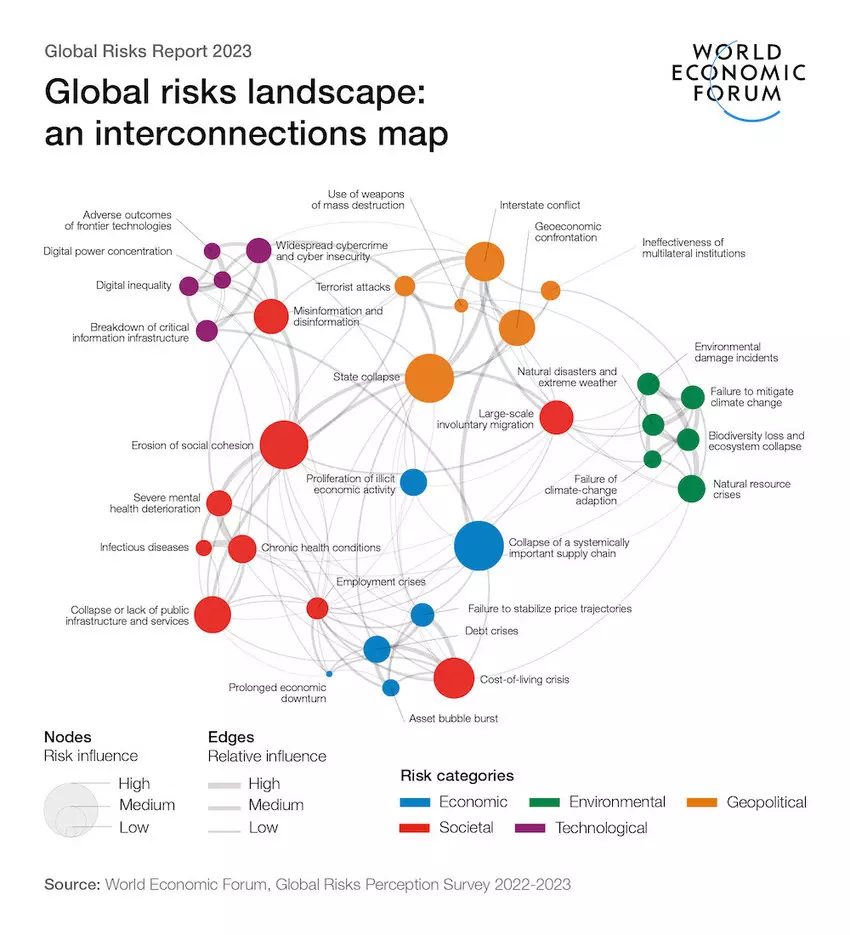
Lately I’ve been finding a term which might solve the labeling problem.  Adam Tooze has led the way in using polycrisis, which describes multiple, simultaneous crises which overlap with and exacerbate each other.  For example, the World Economic Forum offers this handy concept map:

polycrisis WEF Global Risks Report 2023

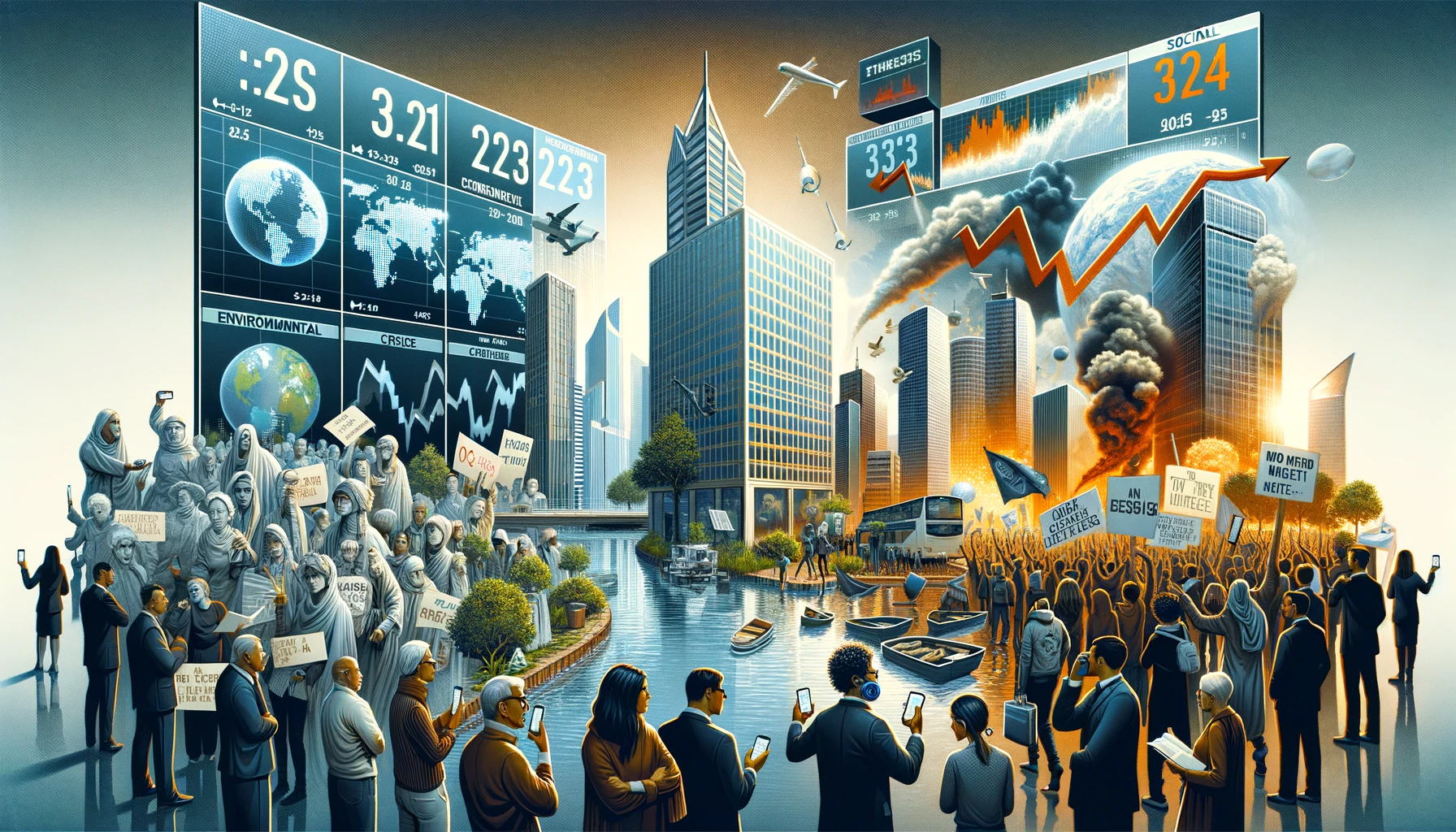
DALL-E offers this view in response to my simple prompt:

A polycrisis with a crowd, cityscape, and storms

One criticism of polycrisis is that it’s nonspecific in time.  Surely 1929-1945 was a polycrisis, as was 19th century colonialism or the French Revolution/Napoleonic wars. It might be a good placeholder for now, especially if this turns out to future historians to be an intermediary period after all.

(This is a good point to issue a caveat. Yes, there is a *lot* more to the question of historical naming and periodicity.  However, this is a quick blog post pointing towards some examples of names in a brisk way when I’m also writing on several deadlines.  If you’re interested, I can say a lot more later.)

A New Yorker staff writer, Kyle Chayka, recently assembled some alternatives and added a few of his own.  Here I’ll share some of the best, ranked alphabetically to dismiss my biases and for neatness:

The Age of Emergency A pretty good term when we want to identify individual crises or their polycrisis combination as emergencies, like the climate emergency.  As with polycrisis, though, it seems adrift in time.  Surely 1914-1920 was such an emergency, at least in Europe?  Or the Taiping Rebellion?  Maybe called it “Global Emergency” might be better.

Age of Unhingement Coined by Liz Lenkinski, who runs a Substack about it.  Interestingly, she describes this as a title for a transition time:

It’s wild in these streets and we’re at a pivotal moment, collectively. Do we get our shit together and try and fix something… everything… before it’s too late? Or do we just succumb under the weight of war, climate change, cultural chaos, and unhinged occurrence after unhinged occurrence, until we welcome our new AI overlords and enter the optimized reality they have created for us by ingesting old Pinterest boards?

The 2020s have allowed (forced) us all to reassess how we engage with the world and the community around us. Join me as I unpack what the fuck is going on in these unhinged times of great transition.

The newsletter is new to me, so I’ll check it out.  I like the way the word “unhingement” calls up images of dislocation and dismantling.

Chthulucene This one comes from the great Donna Haraway in her 2016 book Staying with the Trouble.  Gothically inclined folks like myself would guess the word referred to Lovecraft’s Cthulhu, but Haraway says she’s thinking of cthonic, of deep, ancient roots coming to life and flexing their power in our epoch.  Climate change, species collapse, and more are flagged by it.

Epoch of Disarray This is one Chayka came up with by asking ChatGPT: “I asked ChatGPT to offer its own snappy name for our times, the results were ineloquent…” I do like the phrase’s emphasis on entropy, of undoing rather than creation or positive reconfiguration.

The Jackpot The term comes from a Robert Heinlein short story about a polycrisis on steroids, which ends up in an apocalypse.  Galaxy magazine gave it a fine cover illustration:

Galaxy_magazine 195203

William Gibson then resurrected the term for a bad 21st century in his 2014 novel The Peripheral.  One character explains:

droughts, water shortages, crop failures, honeybees gone like they almost were now, collapse of other keystone species, every last alpha predator gone, antibiotics doing even less than they already did, diseases that were never quite the one big pandemic but just big enough to be historic events in themselves…

The Amazon tv adaptation offers a good visual summary here:

Note the wry, black humor of the phrase.

New Dark Age James Bridle repurposes the classic description of post-Roman empire Europe for our time in a book of the same name.  The author focuses on technology as a major driver of change.  As you might guess, Bridle sees this as mostly bad change.

off-modernism This one came from the philosopher Svetlana Boym and was new to me.  Wikipedia introduces it thusly:

It recovers unforeseen pasts and ventures into the side-alleys of modern history at the margins of error of major philosophical, economic and technological narratives of modernization and progress. Off-modern reflection involves exploration of the lateral potentialities of the project of critical modernity. In other words, it opens into the “modernity of what if” rather than simply modernization as it is. As such, the term can be understood as an intervention in the larger theoretical discussion surrounding modernity, postmodernity, hypermodernity, altermodernity, late modernity, and post-postmodernism.

I’m not sure what to make of that yet, so I’m checking out one of Boym’s books now.

The Omnishambles Some Brits use this to describe their recent government – quite accurately, I aver.  Applying it more broadly does a good service of identifying the present order’s inability to grapple with, well, the present.

Terrible Twenties Google search shows this to usually mean someone aged 20-29, and that’s a fun usage (for example).  Repurposing it for our shared decade sounds good, literally, with strong alliteration. It’s also nonspecific other than the negative, so maybe everyone could use it.  And I like the callback to a century past’s Roaring Twenties.

For a bonus, there’s also the Assholocene.  One Tadzio offered the word earlier this year and it’s already made, or was already in, the Urban Dictionary.  One sample:

The epoch in human history in which assholisation, i.e. the normalisation of group-specific misanthropy, is a dominant political dynamic, and the nationalist, patriarchal asshole replaces the neoliberal sociopath as the dominant subject: this is what I call the assholocene – the age of assholes.

That’s a good one, pungent and descriptive.  I don’t think it addresses efforts to reform discourse and action, like calls for civility or purging language of variously offensive baggage… unless we see such moves as part of a struggle against assholism, or if we view those activists as assholes.


And with that I’ll stop. Each of these terms points to a different aspect of our era, a different understanding of how our times are proceeding. They each speak from a kind of imagined future: “Oh yes, the ’20s certainly were terrible.” “What a time of unhingement indeed, before the [X] of the 2030s!”

See what you think of them. Or add your own.


Posted in futures | 13 Comments

America and China’s big ask for higher education: on the Sunnylands statement

Last month Chinese and United States leaders met in the San Francisco area. It was a major diplomatic meeting for the world’s largest geopolitical struggle. Many developments emerged from this event, yet I want to draw your attention to a single item.  It appeared from one of several communiques, the Sunnylands Statement (English language, Chinese language).  It has several implications for higher education, but also one clear demand of the academy, which I’d like to share here.

I don’t have time today to go into the broader geopolitical details and implications of the series of meetings: the hot line, different readouts, trade, etc. There are some good, basic commentaries out there.  There are also solid analyses of the Sunnylands statement, like this one.  Instead, I’m going to focus on this one document and what it could do for – and to – academia.

Why should educators care about international agreements?  Because when it comes to climate change these impact us directly and indirectly, on multiple fronts.  (Chapter 5 of my Universities On Fire addresses this in some detail.)

The Sunnylands Statement is a multi-point pledge for bilateral cooperation on the climate crisis.  John Kerry and Xie Zhenhua represented their respective nations in its crafting. It calls on both countries to triple renewable energy production in seven years.  Methane and other gas reduction is on the table, in addition to CO2  Both sides agreed to build five new “large-scale cooperative” carbon capture facilities.  China didn’t sign up for any details about reducing its immense coal production sector.  Both nations agreed to set up a shared climate working group (which restarts an older one, which China nixed after Pelosi’s visit to Taiwan) as well as a U.S.-China Energy Efficiency Forum.  They stuck to the 1.5 degree cap as a goal.

What about colleges and universities?  Why should we care?

First off, we can think about how Sunnylands might change the world we inhabit, if China and America follow its directions.  Let’s use my concept map for academia’s multileveled engagement with climate change:

How higher education engages with the climate crisis_overall

The communities around our physical campuses may change, sprouting wind and solar installations, perhaps with tidal and geothermal structures as well.  We might re-source campus electrical power thusly.  Carbon capture facilities may also appear.  Coal, oil, and gas sites may disappear.  So there are implications for community relations as well as our physical campus.  Beyond the local community, we might see academics comment on Sunnylands in public intellectual mode.

Some faculty, staff, and students may research this process, especially in fields like engineering, economics, politics, and energy.  Similarly, the topic could well appear in classes taught by those departments.

(Note that I wrote “if” above. Academics will also, mostly likely, wonder about the likelihood of China and America actually following the document’s directives.  All kinds of things could sap the document’s impact, notably domestic political shifts in either nation or changes in the international relationship.)

Second, Sunnylands calls out higher education explicitly at one point, and it’s a topic which might surprise many academics:

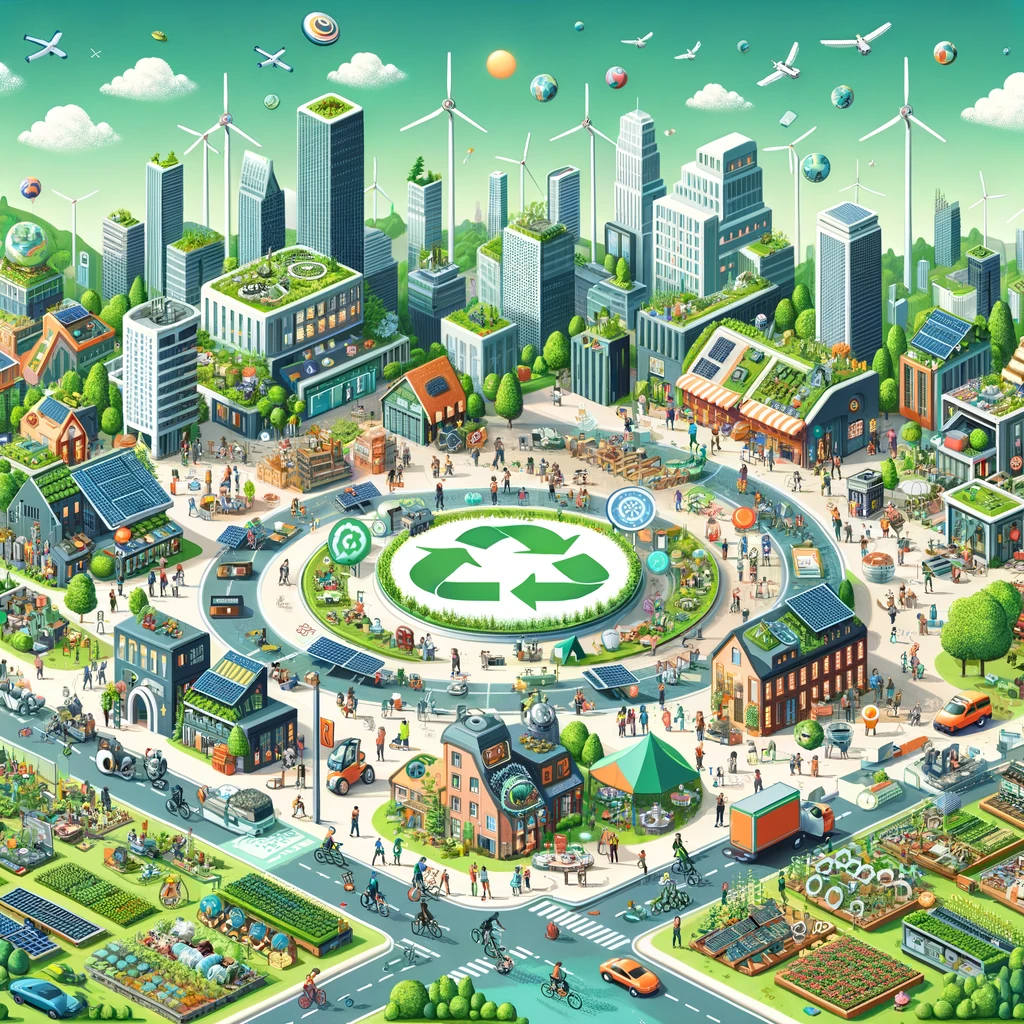
DALL-E circular economy society

DALL-E: “The illustration showcases a futuristic society living in harmony with circular economy principles. The cityscape and the activities of its inhabitants reflect a sustainable and ecologically responsible way of life.”

14. Recognizing the importance of developing circular economy and resource efficiency in addressing the climate crisis, relevant government agencies of the two countries intend to conduct a policy dialogue on these topics as soon as possible and support enterprises, universities, and research institutions of both sides to engage in discussions and collaborative projects. [emphases added]

I was impressed to see this – that the two leading powers of the world were gesturing towards the circular economy idea.

What is that idea about?  Briefly, a circular economy aims to to reduce waste to zero by  recycling goods throughout the economy.  Wikipedia has a nice summary:

It employs reuse, sharing, repair, refurbishment, remanufacturing and recycling to create a closed-loop system, reducing the use of resource inputs and the creation of waste, pollution and carbon emissions.[17] The circular economy aims to keep products, materials, equipment and infrastructure[18] in use for longer, thus improving the productivity of these resources. Waste materials and energy should become input for other processes through waste valorization: either as a component for another industrial process or as regenerative resources for nature (e.g., compost).

Which is a huge shift from the go-go state capitalism of China and America’s financialized neoliberalism!  This is an example of the kind of deep, bold thinking climate change calls forth.

And the shift to a circular economy needs universities to work, at least according to leading diplomats from the world’s leading nations.  Think about this.  The statement commits the two leading world powers to a major economic shift, and explicitly asks higher education to help make it happen.

How might this play out?

Scroll back up to my multi-level concept map of how academia can engage with the climate crisis. We can reuse it here.  First, the Sunnylands statement calls on universities (and others, with some academic overlap, as with think tanks) to “to engage in discussions and collaborative projects.”  I hear this as a request for research and development, functions right at academia’s core. Based on scholarship on the circular economy, we can see a range of disciplines ready to go: economics, of course, along with political science, sociology, history, architecture, engineering, business, and more.

Second, given American academia’s practice of linking research with teaching, we might expect more classes to include the circular economy in their subject matter.

To be sure, American and Chinese academics already do these things.  I’m talking about doing more of them, and with more of a public exposure.

Back to my concept map: academics might experiment with implementing circular economy principles in their operations and physical plant.  The easy first step is to expand recycling of materials, including food, but then to look to recycling and reusing building materials in renovation and construction. The same idea might apply to institutionally owned vehicles, grounds, and more.

More: we could see town-gown collaborations on circular economics. Think of a college or university engaging the community recycling center by adding and using more stuff, research it, staffing with students, and so on.  Beyond the immediate community, Sunnylands might encourage faculty, staff, and students to take up public intellectual roles on this matter, speaking to the broader world.

And yet. Once again, this document might fade away into the long list of ineffective diplomatic communications.  The present COP meeting might vitiate it. The Washington-Beijing tension could flare up. Either Xi or Biden might fall from power in a year. Or neither nation’s leaders will take the circular economy idea seriously.  Americans and Chinese, both marinaded in growth-at-all-costs capitalism, might reject the circular economy outright.

On the other hand, the opposite might occur.  Local, regional, or national leaders in either the United States or China could take Sunnylands seriously and issue policy accordingly. This might not happen right now – I haven’t seen any signs yet! – but the downstream possibility is there.  In which case colleges and universities, especially public ones, may well be impacted.

If we look some years out, up to a decade, there’s also a change that as generation Z rises in the workplace and into increasingly positions of authority that it might be more supportive of the circular economy than the rest of us. Already they are less enamored of neoliberalism, due no doubt in part to their different life experiences (no Cold War, the 2008 Great Recession hitting their youth).

So a geopolitically-driven drive for higher ed to take the circular economy seriously is… possibility.  It’s one sparked to life by a major geopolitical summit. Perhaps it nudges academia in one direction.  It’s something to watch – and maybe participate it.

PS: on a related note, I’ve been working on analogous political economy models, like no-growth and degrowth.  I will follow up on those as time (sigh) permits.

Posted in climatechange | 2 Comments

Come study with me at Georgetown University

It’s that time.  Yes, it’s the time of year when I invite people to study in the program where I teach.

Are you interested in education and technology?  Is the future of higher education a major focus for you?  Then consider taking classes with my colleagues and I at Georgetown University’s Learning, Design, and Technology program!

This is a graduate program where people study the intersection of higher education with technology, from a design thinking perspective.  The curriculum is rich. Required classes cover vital topics: technology, learning and design methods, learning analytics, the university as design problem, and educational research methods.  A foundations class introduces new students to graduate study, our topics, professional directions, and more.   An eportfolio class helps students build an online presence, with an emphasis on WordPress and students’ own web domains.  Then there are a host of electives, from social justice to gaming, educational technology to liberal education, data analytics to critical speculative design for antiracism.

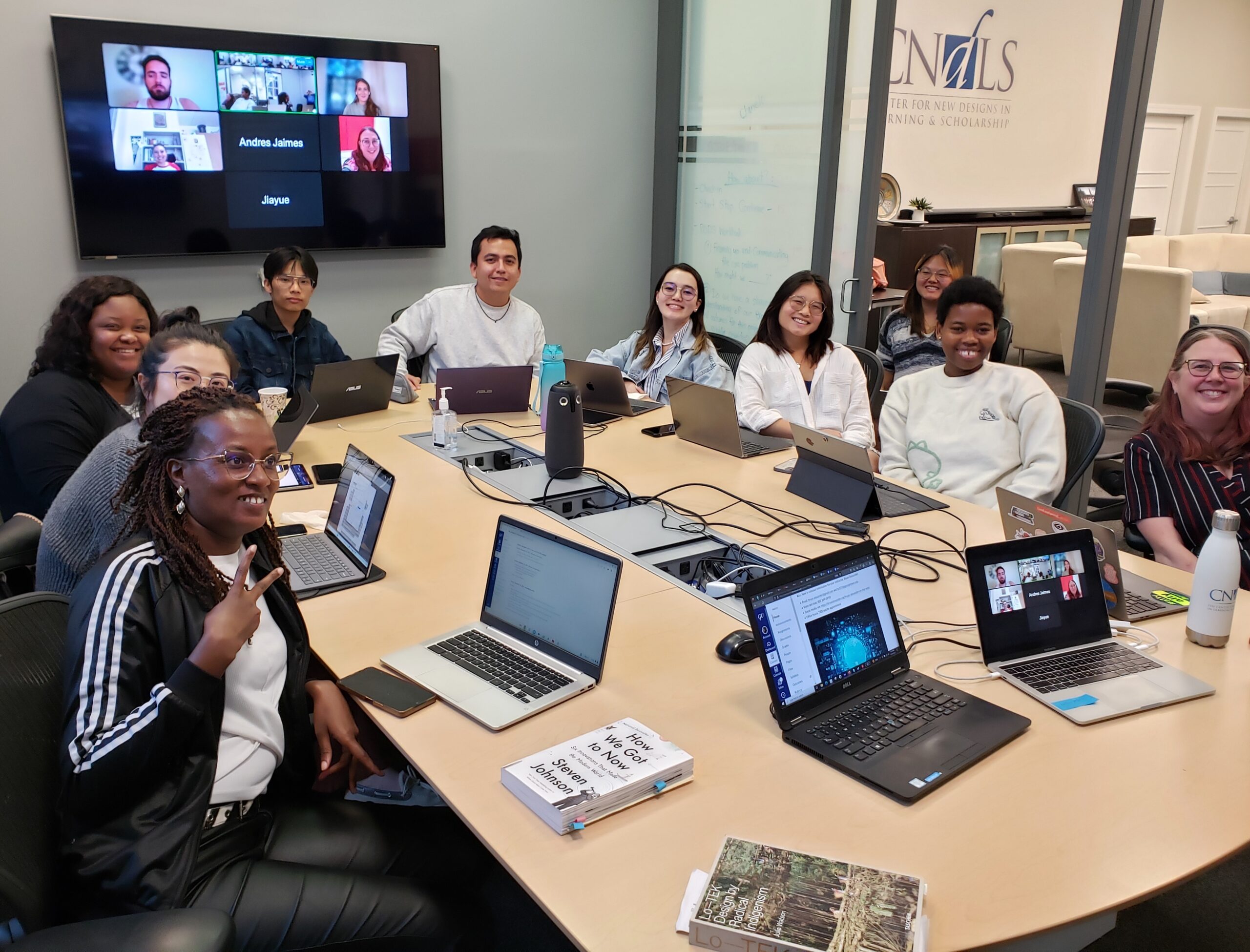
Technology and innovation class LDT 2023 fall

This year’s technology and innovation class.

(I teach the ones on technology, educational technology, gaming in education, and the future of higher ed, plus lead Foundations.)

Pedagogically, LDT is all about active learning. We keep lectures to a minimum and instead emphasize discussion, student inquiry, hands-on work, and constructivism.

The student body is brilliant. Students come from a wide range of backgrounds: higher ed, K-12, nonprofits, media, museums, and more.  They are thoughtful, creative, and ambitious.  And lately the LDT class has been more international than American, with students from around the world.

And my colleagues are great.  They include Eddie Maloney, Maggie Debelius, Yianna Vovides, Randy Bass, David Ebenbach, Lee Skallerup Bessette, and more.  I consistently learn from them as we design every semester’s offerings. I feel like I’m getting another MA by talking with them and, refracted, their thoughts through our students.

Naturally I love teaching in the program. It’s a joy to work with these students on these topics. Every day I’m excited to be in classes build around active learning and to see students flourish.  I bring in my latest research to see what folks make of it, which is both productive and fun.

emerging technology class printing exercise joyful June 2019

So much good stuff comes right out of the LDT world.  In classes students create great research and projects.  Faculty write books and make other media.  A bunch of, well, everyone collaborated on the powerful Big Rethink project.  After getting their MAs, students go on to great professional success: promotions, new jobs, PhD study, changing their organizations, rethinking education… which is the point of the whole thing.

Here’s a bonus: if you get your application in before January 15th, the program waives your fee.

Check out the LDT website.  Look into the classes I teach, if those interest you.  Fling questions at me or the program staff.  Then, if this engages you, apply!

Posted in classes and teaching, teaching | Leave a comment

Undergraduate completion rates stabilize; one third of students don’t finish college in under six years

How long does it take for a student to finish college?  How many students don’t complete a certificate or undergraduate degree?

Today the National Student Clearinghouse published a new study, looking at students who started post-secondary classes in 2016.

I’ll identify some key findings, then add my reflections.

The leading takeaway is that completion rates have continued at their previous levels, “essentially unchanged since 2015.”  62.2% of students who started in fall 2017 have completed a degree or certificate.  Note that’s within six years, not the two years we normally think of for an associate’s degree or the four for a bachelor’s.

Now, there are differences by institutional type.  Private four-year institutions offer the highest completion rates, followed by state universities. Community colleges for for-profit institutions have the lowest rates, below 50%:

enrollment completion by institutional type _Clearinghouse 2023 November

Overall, 8.5% were still pursuing their classes after 6 years, without completing yet.  And a larger number, 29% of students, stopped out of their education altogether.

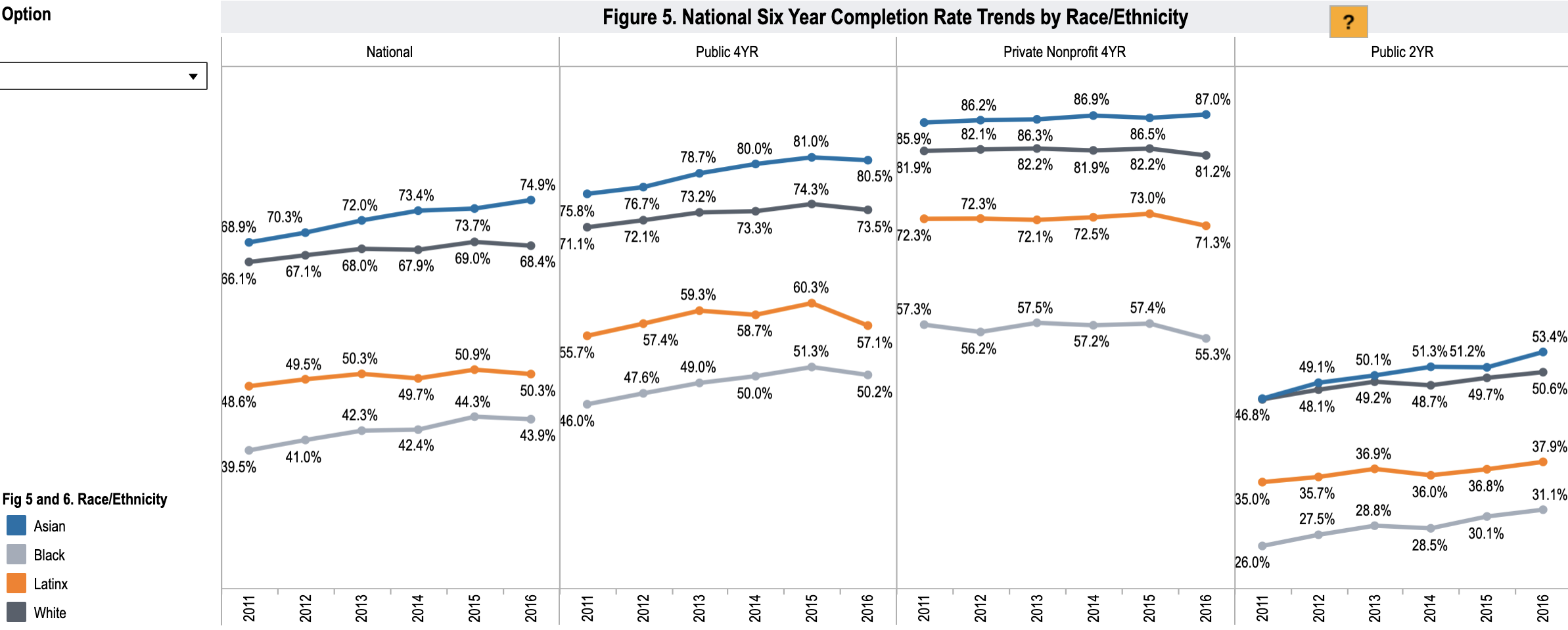
The Clearinghouse broke down these numbers by demographics.  In terms of gender women achieved degrees seven points higher than their peer males, the widest gap the Center tracked since 2008.  In terms of race, some groups completed at higher rates than others, with “Native American (-2.0 pp) and Black students (-0.4 pp) posting the largest decreases.”

enrollment completion by race _Clearinghouse 2023 November

There’s an important connection between race and institutional type:

Black students also lost ground, but these losses were concentrated at public four-year institutions, where they fell by 1.5 percentage points (from 50.2% in 2016 to 48.7% in 2017, see Appendix Table 4). Unlike at four-year institutions, Black students at community colleges saw completion rate growth, increasing by 0.5 pp over the previous cohort year. Hispanic students experienced a similar phenomenon, with losses concentrated at public four-year institutions (-1.1 pp; from 57.1% in 2016 to 56.1% in 2017). Like Black students, Hispanic students at community colleges saw slight growth (+0.2 pp).

In terms of age, “[o]lder students continue to make gains, but they still lag behind traditional aged students.”

There were also some differences by states:

While most gains seen at the state-level were small (less than 1 pp), nine states saw gains over 1 percentage point, with Idaho and New Mexico seeing gains over 2 pp (see Figure 4). Five states posted completion rate decreases of over 1 percentage point: Louisiana, Massachusetts, Oregon, Rhode Island, and Washington.

The national decline of 0.6 percentage points at public four-year institutions was driven by declines in 33 states, with the largest declines in Washington (-3.1 pp), New Hampshire (-2.8 pp), and Connecticut (-2.3 pp). Four states saw rates increase by over 1 percentage point (New Mexico, +2.2 pp; Utah, +1.6 pp; Montana, +1.3 pp; and Idaho, +1.2 pp; see Dashboard Figure 3).

The national growth of community college completion rates was driven by increases in 29 states, with nine states seeing gains of more than 2 percentage points. North Dakota and Idaho saw the largest increases (4.6pp and 3.7 pp respectively). Fifteen states saw community college completion rate declines, but only four states saw declines greater than 1 percentage point. Massachusetts and Oregon saw the largest declines (-2.8 pp and 3.7 pp respectively).

What can we make of all of this?

First, I’m struck by how the COVID pandemic didn’t adjust this cohort’s progress, at least compared to its predecessors.  Or perhaps completion rates would have been higher without the crisis?

Second, this plateau of completion rates marks a change from improving numbers.  As Liam Knox notes,

Before the pandemic, national completion rates had steadily increased for five years, from 53 percent in 2015 to 60 percent in 2020. That boost was spurred in large part by a new commitment to student success services, such as tailored advising for underrepresented student groups and wraparound services for those who are struggling financially.

Third, the number of people not completing degrees within six years (again, more than the expected two or four) is disturbingly high.  As the report concludes, we confront ” a single uncomfortable truth”:

[M]ore than 1 in 3 students today, and in some cases closer to one in two, do not complete a credential within six years of starting college. And with more than three times as many stopped out as there are still enrolled at that point, allowing the cohort an additional two years to complete barely moves the needle any higher. This is true even though, for part-time students pursuing a bachelor’s degree, eight years might be considered a normal time to completion.

I would like to know what proportion of that population holds student loans, and how much when they do.  Given how the labor market generally fails to reward classes without certification, and setting aside students who took classes purely for intellectual gain and who are capable of affording it, this is surely a massive failure for American higher education.

Fourth: I’ve been wondering for a decade about the impacts of peak higher education.  One potential implication is that if many campuses experience a decrease in enrollment quantity, would they decide to invest seriously in improving enrollment quality?  Degree completion could be a good proxy for that strategy, and we might look ahead to see if it improves.

Thanks to the Clearinghouse team for letting me see the study early on.


Posted in enrollment | 20 Comments

How to support an independent higher education futurist on Giving Tuesday

Today is Giving Tuesday, an American-invented day to encourage people to support good causes.

If you think what I do is such a cause, I’d like to encourage you to support this work.

To explain: my work concerns the future of higher education. I model how post-secondary education might develop, based in part on researching the history and present of academia.  To that end I conduct a continuous research campaign, scanning the horizon for signals, diving deeply into certain topics which look most likely to have a major impact, identifying and tracking trends over time, and building scenarios.  The results appear in articles, books, book chapters, presentations, workshops, seminars, and all kinds of digital content, from videos and podcasts to social media and this very blog.

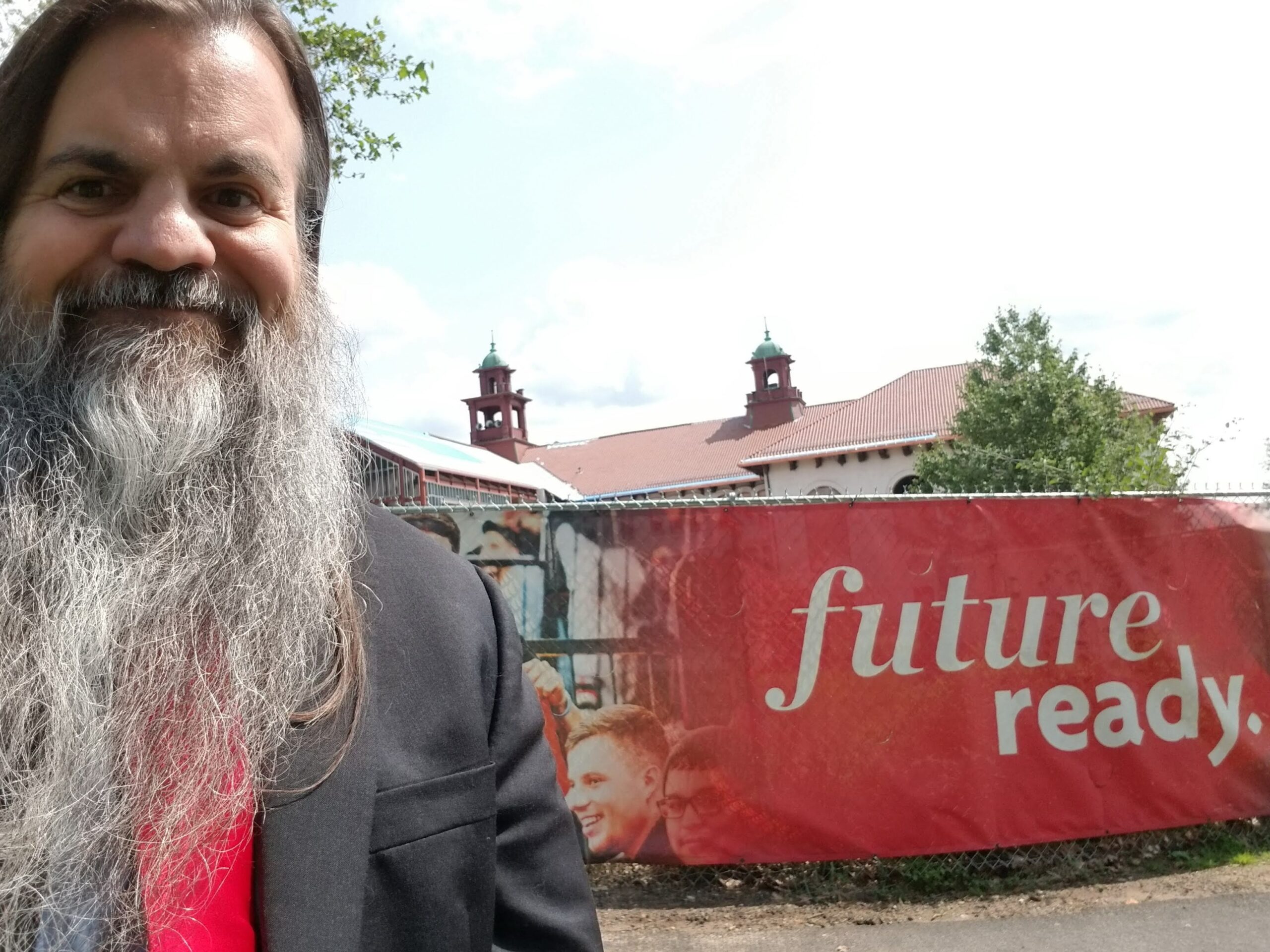
Bryan Alexander Future Ready

Along the way, I also try to share my work process.  For example, as I find materials I push them out via social media, email, this blog, Substack, and other venues – partly to get feedback and improve what I do, but also to add to the overall conversation.  I also report on projects under way, like books, which take several years, or redesigning classes and digital programs.  That’s because I’m committed to the spirit of open source, as far as I can go before hitting limits of sustainability.

And sustainability is key.  I’m an independent futurist, not backed up full time by any organization, campus, government, or company.  This gives me the freedom to do the work as I see fit, which is marvelous, but with the condition that I must continually support that work (and myself, and my family). Every day involves scrambling to cover operational costs and to settle the whole thing on a stable foundation. Additionally, not being tenured means I take serious risks when researching very controversial or unattractive topics which look like they might have a huge impact on colleges and universities, such as racism or climate change.  Being ahead of the curve is what a futurist is supposed to do, of course, and can be rewarding down the road when the world bears out my forecasts, but can be very challenging to keep alive in the meantime.

Giving Tuesday is largely about charities, which is excellent, but I propose something different today. If you’re interested in higher education’s future and want to support my work, I’d like to make sure you get something of value in response, in addition to contributing to this independent futures project.

For example, you could support me on Patreon.  That’s a reliable way to support someone working on something you approve of.  Also, I regularly host discussions there and share my research in its earliest stages.

Or if you’re concerned about AI, you could subscribe to my Substack about artificial intelligence and the future of education.  It began this summer and is where my research into AI appears.  It looks at a range of issues and dimensions of the topic, from practical pedagogy to macroeconomics. I rely on professional research into AI, journalism for cutting-edge events, a broad network of fine colleagues, my classroom and workshop experiments, as well as my own hands-on trials with the stuff.  You can follow for free, but a paid subscription helps make this particular line of inquiry sustainable.

Alternatively, if you are thinking about higher education more broadly, you can sign up for the monthly Future Trends in Technology and Education (FTTE) report.  It’s a long-running analysis of the trends reshaping higher ed, backed up throughout with evidence. And I’m just redesigning one aspect of it right now.

You can also buy one or more of my books.  That’s the classic, old school form of research manifestation. I love writing books more than almost anything else in the world and am working on three (yes) such projects right now.  Ordering copies of Academia Next, Universities on Fire, or The New Digital Storytelling in hardcover, paperback, ebook, or audiobook (depending on title) for yourself, your friends, colleagues, and libraries will hopefully give some insights into how higher education is changing while also helping me write more of them.

Now, if you’d like to support this future of higher education work at a larger scale, consider sponsoring the Future Trends Forum.  This is, as far as I can tell, a unique program.  It’s a weekly, live video discussion about higher education’s future.  Each session features one or several guests with a particular angle on academia in conversation with myself and the Forum community.  It’s not a boring PowerPoint recitation nor a series of canned talks.  Instead, every Forum is entirely interactive, driven by participants’ interests and curiosity.  We’re coming up on our eighth anniversary and would love to keep going.  New sponsorships would go a long way to covering our production costs and also let us try out some new ideas.

I hope one or more of these ideas appeals to you, dear reader, because I think this work is vital.  Thinking through the future of the academia matters to academics, of course, but also should matter to the rest of society, as the world badly needs what colleges and universities do.  This is true even when – perhaps especially when – parts of society turn away from or against the academy.

I appreciate anything you can do to help.

Bryan reflection Vienna Metro excellent

Posted in About | Leave a comment

Some critical readings on AI for my graduate students: an updated reading list

Earlier this month I blogged about finding good readings about AI for one of my graduate seminars.  I listed a few, then blegged for more.

In response, folks were very generous.  Suggestions flooded in through the comments, then also by social media and email.  So I wanted to corral all of them into one spot for my own use, and hopefully other people will find it helpful. If so, I can keep updated it over time, or migrate it to another platform.

About the list: I alphabetized it by author(s) but not into consistent subcategories.  I haven’t formatted it too rigorously, because I’m under the gun of several deadlines.

These are mostly articles, but also blog posts, short stories, Substack posts, a comic strip, and several books. I asked for readings, then violated that textual precondition by including a game. Respondents added items in other media, such as podcasts, web-based databases.  I asked for recent stuff, but people suggested older texts which were really useful, so I’ve included them as well.

university students working with an AI to create an annotated bibliography in a library setting

DALL-E: “university students working with an AI to create an annotated bibliography in a library setting”

Jiafu An, Wenzhi Ding, and Chen Lin, “ChatGPT: tackle the growing carbon footprint of generative AI,” Nature, March 21, 2023.

Brent Anders, The AI Literacy Imperative.  Sovorel Publishing: 2023.

The Artificial Intelligence Incident Database.

Emily M. Bender, Timnit Gebru, Angelina McMillan-Major, and “Shmargaret Shmitchell,” “On the Dangers of Stochastic Parrots: Can Language Models Be Too Big? 🦜”

“Blueprint for an A.I. Bill of Rights.”  White House, 2022.

Ian Bogost, “ChatGPT Is About to Dump More Work on Everyone” and “ChatGPT Is Dumber Than You Think”. The Atlantic, 2022 and 2023.

Nick Bostrom, Superintelligence: Paths, Dangers, Strategies.  Oxford University Press: 2014.

Nick Bostrom and Eliezer Yudkowsky. “The Ethics of Artificial Intelligence.” The Cambridge Handbook of Artificial Intelligence, Cambridge University Press, 2014. Free access: http://faculty.smcm.edu/acjamieson/s13/artificialintelligence.pdf

James Bridle, “The Stupidity of AI,” The Guardian, March 2023.

Vannevar Bush, “As We May Think,” The Atlantic, originally published 1945.

Ted Chiang, “ChatGPT is a Blurry JPEG of the Web” and “Will AI Become the New McKinsey?”  The New Yorker, 2023.

Seán Clarke, Dan Milmo and Garry Blight, “How AI chatbots like ChatGPT or Bard work – visual explainer”. The Guardian, November 1, 2023.

Kathryn Conrad, “Sneak Preview: Blueprint for an AI Bill of Rights for Education,” Critical AI 2.1., July 2023.

Eamon Costello, “ChatGPT and the Educational AI Chatter: Full of Bullshit or Trying to Tell Us Something?” Postdigital Science and Education, 1-6.(2023)

Tyler Cowen and Alex Tabarrok, “How to Learn and Teach Economics with Large Language Models, including GPT “  SSRN, last revised May 2023.

Kate Crawford, Atlas of AI: Power, Politics, and the Planetary Costs of Artificial Intelligence. Yale University Press: 2021.

Yun Dai, Ang Liu, and Cher Ping Lim, “Reconceptualizing ChatGPT and generative AI as a student-driven innovation in higher education,” Procedia CIRP Volume 119, 2023, Pages 84-90.  https://doi.org/10.1016/j.procir.2023.05.002.

Douglas Engelbart, “Augmenting Human Intellect: A Conceptual Framework | Doug Engelbart Institute.” Doug Engelbart Institute.  Originally published October 1962,

Jason Fagone, “The Jessica Simulation”. San Francisco Chronicle, July 2021.

Tirse Filibeli, “Big Data, Artificial Intelligence, and Machine Learning Algorithms: A Descriptive Analysis of the Digital Threats in the Post-truth Era,” Galatasaray University Journal of Communication, issue: 31, 91 – 110, December 28, 2019.

Harry G. Frankfurt, On Bullshit. Princeton University Press, 2005.

Jason Furman, “Is this time different? The opportunities and challenges of artificial intelligence.” Remarks at AI Now: The Social and Economic Implications of Artificial Intelligence Technologies in the Near Term, New York University, 2016.

Leon Furze, Teaching AI Ethics, blog post series, 2023.

Gartner Research, “What’s New in the 2023 Gartner Hype Cycle for Emerging Technologies.”

“GenAI Practical Use Cases,” CPA.com, 2023.

Chris Gilliard, “Friction-Free Racism.” Real Life, October 15, 2018.

Lauren Goodlad and Samuel Baker, “Now the Humanities Can Disrupt ‘AI,’” Public Books, 2023.

Sam Harris, “Can We Contain Artificial Intelligence?: A Conversation with Mustafa Suleyman” Making Sense podcast, episode #332, 2023.

_____, “Debating the Future of AI: A Conversation with Marc Andreessen” Making Sense podcast, episode #324, 2023.

Alex Heath, “Poe’s New Desktop App Lets You Use All the AI Chatbots in One Place.” The Verge, August 28, 2023.

Sheila Heti, “According to Alice,” The New Yorker, 2023.

Wayne Holmes and Ilkka Tuomi, “State of the art and practice in AI in education.”  European Journal of Education, volume 57, issue 4, December 2022, pp 542-570.  https://doi.org/10.1111/ejed.12533

Ayanna Howard & Jason Borenstein, “The Ugly Truth About Ourselves and Our Robot
Creations: The Problem of Bias and Social Inequity.”  Science and Engineering Ethics 24, 1521–1536 (2018). https://doi.org/10.1007/s11948-017-9975-2

Alex Langstaff, “The Bulgarian Computer’s Global Reach: On Victor Petrov’s ‘Balkan Cyberia,’” Los Angeles Review of Books, November 10, 2023.

A bearded college prof works with an AI.

DALL-E: “an AI helping a professor create a bibliography.”

Donella Meadows, “How to Dance with and Intervene in Systems.”  2001.

Anna Mills, Maha Bali, and Lance Eaton, “How do we respond to generative AI in education? Open educational practices give us a framework for an ongoing process,” Journal of Applied Learning and Teaching, vol. 6 No. 1 (2023). https://doi.org/10.37074/jalt.2023.6.1.34.

Melanie Mitchell and David C. Krakauer. “The Debate over Understanding in AI’s Large Language Models.” Proceedings of the National Academy of Sciences, vol. 120, no. 13, Mar. 2023, p. e2215907120, https://doi.org/10.1073/pnas.2215907120.

Melanie Mitchell, Alessandro B. Palmarini, Arseny Moskvichev, “Comparing Humans, GPT-4, and GPT-4V On Abstraction and Reasoning Tasks,” arXiv, November 14, 2023.

Ethan Mollick, “What people ask me most. Also, some answers. A FAQ of sorts.”  Substack, October 2023.

Frank Pasquale, The New Laws of Robotics.  Harvard University Press: 2020.

Billy Perrigo, “OpenAI Used Kenyan Workers on Less Than $2 Per Hour to Make ChatGPT Less Toxic,” Time Magazine, January 18, 2023.

“Prepare for truly useful large language models,” Nature Biomedical Engineering volume 7, pp 85–86 (2023).  https://doi.org/10.1038/s41551-023-01012-6.

Mitt Regan and Jovana Davidovic. “Just Preparation for War and AI-Enabled Weapons.” Frontiers in Big Data, vol. 6, May 2023, p. 1020107.  http://www.doi.org/10.3389/fdata.2023.1020107

Paola Ricaurte, “Artificial Intelligence and the Feminist Decolonial Imagination”. Bot Populi, March 4, 2022.

Alberto Romero, “Fear Wins: The US and the UK have decided what the future of AI looks like.”  Substack, Novermber 3, 2023.

Daniel Rosenberg, “Data before the fact.” In “Raw Data” Is an Oxymoron, edited by Lisa Gitelman Also available here.

Jane Rosenzweig, “What Happens When A Novice Writer Asks Chatgpt For Editing Advice?”, CriticalAI, 2023.

Tahereh Saheb, “Ethically Contentious Aspects of Artificial Intelligence Surveillance: A Social Science Perspective.” AI and Ethics, vol. 3, no. 2, May 2023, pp. 369–79. DOI.org (Crossref), http://www.doi.org/10.1007/s43681-022-00196-y.

Ilia Shumailov et al, “The Curse of Recursion: Training on Generated Data Makes Models Forget.” arXiv, May 2023.

George Siemens et al. “Human and Artificial Cognition.” Computers and Education: Artificial Intelligence, vol. 3, 2022, p. 100107.   https://doi.org/10.1016/j.caeai.2022.100107.

Sara Solarova et al. “Reconsidering the Regulation of Facial Recognition in Public Spaces.” AI and Ethics, vol. 3, no. 2, May 2023, pp. 625–35.   http://www.doi.org/10.1007/s43681-022-00194-0

Jane Southworth et al, “Developing a model for AI Across the curriculum: Transforming the higher education landscape via innovation in AI literacy,” Computers and Education: Artificial Intelligence, volume 4, 2023, 100127, https://doi.org/10.1016/j.caeai.2023.100127.

Lucy Suchman, “The uncontroversial ‘thingness’ of AI.”   Big Data and Society, November 2023. https://doi.org/10.1177/20539517231206794

Clive Thompson, “Warning Labels For AI-Generated Text: Maybe we should just start sticking icons on this stuff.”  Medium, October 31, 2023.

Krista Tippett,  “Reid Hoffman –  AI, and What It Means to Be (More) Human,” On Being with Krista Tippett, updated October 5, 2023.

Victoria Turk, “How AI reduces the world to stereotypes,” Rest of World, 2023.

United States Department of Education, Artificial Intelligence and the Future of Teaching and Learning, Office of Educational Technology, May 2023.

Universal Paperclips, computer game.

Vauhini Vara, “Ghosts,” The Believer, 2021.

Joana Varon and Paz Peña, “Artificial intelligence and consent: a feminist anti-colonial critique”. Internet Policy Review, volume 10, issue 4, December 7, 2021.  DOI: 10.14763/2021.4.1602

Angie Wang, “Is My Toddler a Stochastic Parrot?” The New Yorker, November 15, 2023.

Stephen Wolfram, “What Is ChatGPT Doing … and Why Does It Work?”  Stephen Wolfram Writings, February 14, 2023.

Shoshana Zuboff. The Age of Surveillance Capitalism: The Fight for a Human Future at the New Frontier of Power. New York, PublicAffairs, 2019. (Our online book club read it in 2019.)

There are also some treasure troves of resources from an Axim Collaborative workshop, Anna Mills. and Mark Corbett Wilson.

Remember, we can keep expanding this list.

(thanks to many people, including Jessie Cheng, Maha Bali, Anna Mills, Lance Eaton, people across social media, and everyone who contributed to that blog post)

Posted in automation | 10 Comments