This week I’ve been focusing on climate change, between my book and the new IPCC report. That was what I planned to work on, along with dealing with multiple family crises and fine-tuning my fall seminars. But COVID just won’t let me do it, and so now I fire up the blog engines to look ahead to what fall 2021 classes might look like.
I’ll summarize some recent pandemic developments here in some detail, then add forecasting notes. I hope readers feel comfortable sharing thoughts and stories in comments. You can use the contact page to reach me directly, if you don’t want to go public.
The reason for my sudden switch between catastrophes? Things… now seem to be getting out of hand. We started summer 2021 with high hopes, as the number of people getting amazing vaccines was growing towards herd immunity and president Biden spoke of July 4th as an independence from COVID day. Colleges and universities planned on finally returning to in-person education.
Then that happy image began to get more complicated.
In the United States vaccination rates fell and barely half the population was fully treated. Local and national politicians politicized public health to new heights. Around the world the Delta variant swept in and ignited fast new waves of infection. Then reports and research started questioning just how effective these vaccines are against the new strain. The Centers for Disease Control backtracked on its May masking recommendations. It all felt more than a little like very early 2020.
Then over the past week a whole series of COVID pandemics suggest a crisis out of control. To wit:
- Delta infections are soaring in parts of the world. The World Health Organization numbers 203,944,144 confirmed cases globally. This seems likely to worsen.
- It looks like Delta is able to defeat current vaccines more readily than its predecessors to some degree. Reports and research are all over the map here (here’s one sample article), so it’s hard to determine the precise degree of relative weakness, but we know that vaccinated people can be infected, get sick, and transmit Delta in significant numbers. Vaccines still protect us well from serious illness, injury, and death.
- Being in a highly vaccinated population is no longer a guarantee of COVID safety.
- There’s talk that herd immunity is impossible.
- Some American counties are hitting or overrunning hospital capacity.
- Various ideas about booster shots and the need for new vaccines are in the air.
- Delta is bad, but the virus keeps mutating, of course, so there are fears of post-Delta strains. (cf the SAGE report)
- Governors are fighting with local officials over mandates.
- Anti-vaxxers may be becoming more active. An anti-vax German nurse may have injected thousands with simple saline instead of the COVID vaccine. French vaccine centers were defaced, presumably by those opposed to vaccines.
- There is rising dissatisfaction with the CDC, and not just from partisan grounds. People are questioning their communication strategy.
And now? August 12, 2021, I pull down these visualizations from 91-DIVOC. Let’s start with global infections:
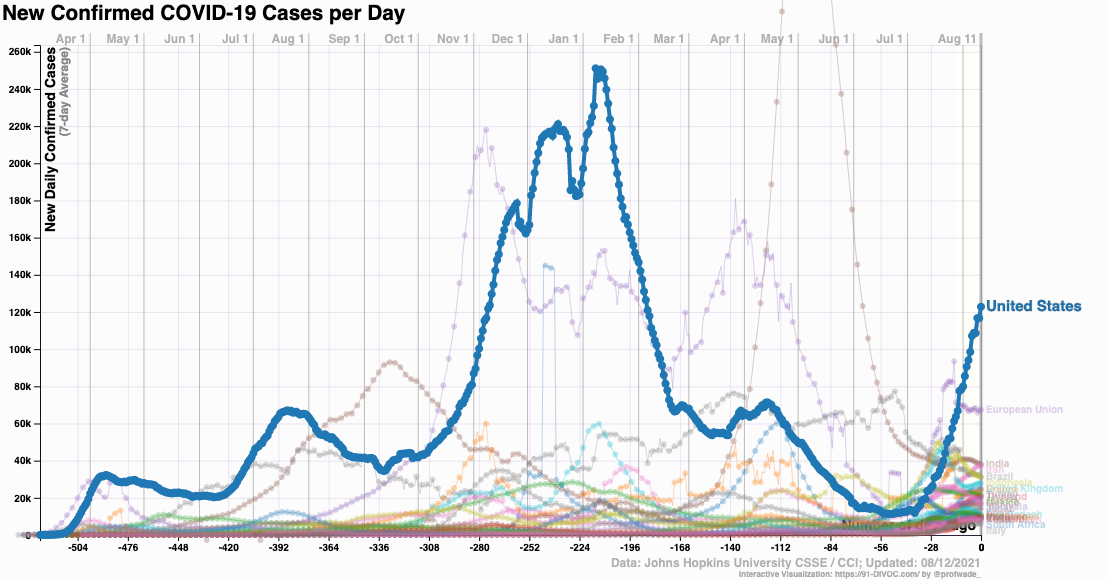
The United States, a world antivax leader, is now taking off with infections.
Let’s break it down by states:
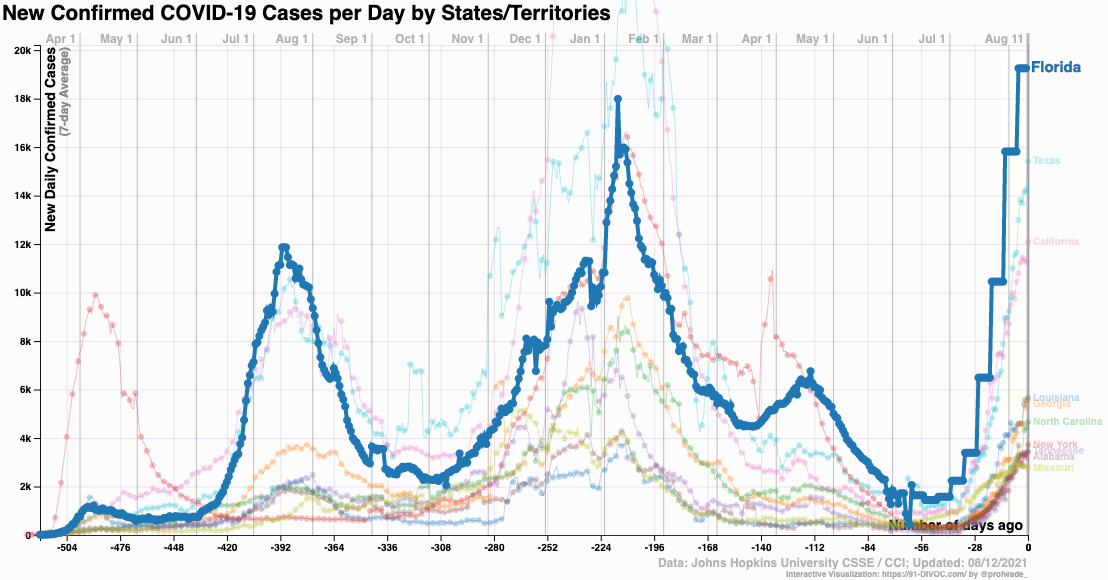
Florida, Texas, California and running away with infections. But those are populous states. Let’s normalize cases by state population and see how things look:
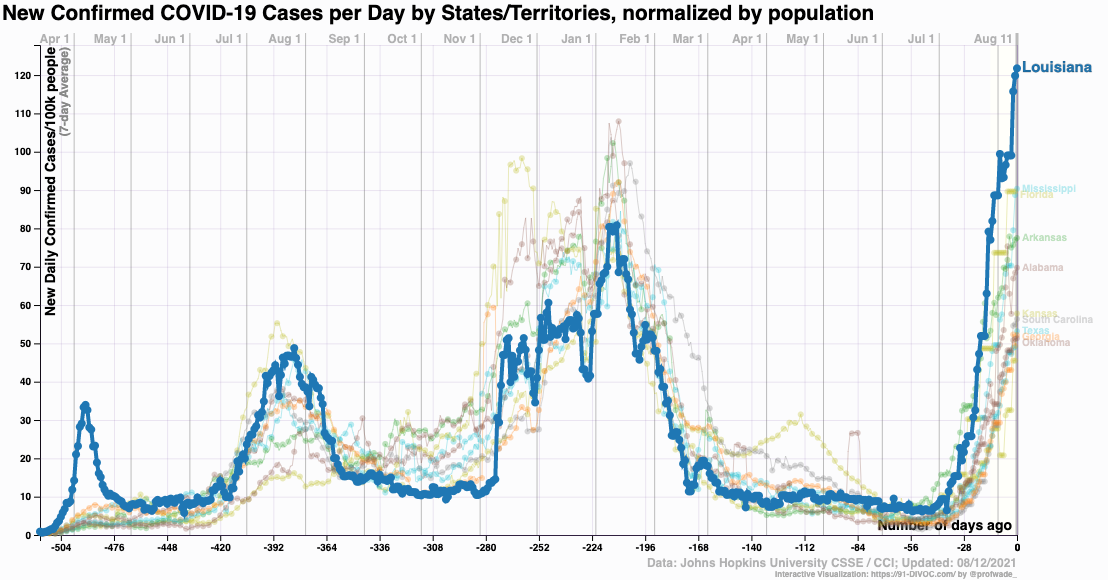
Now Louisiana is the leading disaster.
Those graphs describe infections. What about deaths? That’s a lagging indicator, but a couple of months with Delta might have an effect:
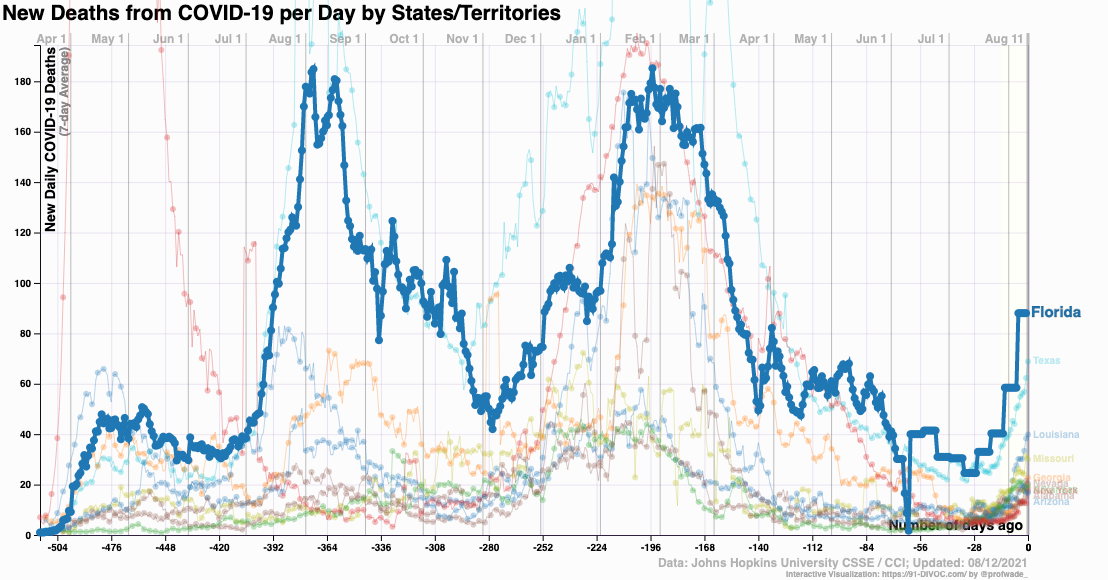
Deaths overall are rising, even with high numbers of people over 70 vaccinated. According to the CDC, COVID has so far killed 616,459. That’s an undercount, most likely. Total infections stand at 36,125,176, or a little over 10% of the population; definitely an undercount. In contrast, CDC counts 353,205,544 vaccine doses injected, more than one for each person living in the United States.
Anecdotally, I am hearing horror stories and resignation from people across America. A former student, now a medical doctor, describes many staff and physicians refusing to get vaccinated while local hospitals reach their breaking point. My wife worked as a contact tracer during an earlier pandemic wave; now she’s been hired by a county public health agency to encourage workers in small businesses to get vaccinated. Academics tell me of their dread and anxiety, as well as their sense of being betrayed by public officials and campus administrators.
In my field, higher education, responses are all over the map. Some campuses mandate vaccines while others do not. Some require masking; others no. Over the past 24 hours:
- The University of Mississippi set up space for patient overflow from nearby hospitals.
- The University of Wisconsin battled that state government about who has masking mandate/ban authority. Cleveland State defied the state of Ohio and required vaccinations for students living in residence halls.
- Stanford University is requiring vaccines *and* testing for its entire population.
- The University of Texas-San Antonio announced it would start fall classes online.
- There are many stories of students buying and selling fake vax cards. (one example)
- University of Iowa faculty request mandatory vaccination and masking.
- Texas A&M is holding a drawing for free tuition to students who show proof of vaccination.
- Louisiana State University requires masking but not vaccination.
- The University of Texas-Austin estimates around 200 students will hit campus in a few weeks already infected. As far as I can tell that campus has neither a vaccine nor a mask mandate. They are requiring students to show proof of negative COVID testing in order to get dorm room keys.
- A Chronicle of Higher Ed reporter notes that with campuses planning on full complements of students, it’ll be harder to have everyone socially distance.
- One tenured University of California-Davis professor vowed to take his classes online if the public health situation worsened:
https://twitter.com/SethLSanders/status/1426051403563159552
As of now, only 686 campuses require vaccines, according to the Chronicle of Higher Education’s tracker. That about 15% of the total. Put another way, a supermajority of American colleges and universities have deliberately chosen not to mandate vaccines.
So what might fall semester look like, starting in a few weeks?
There seem to be several conflicting tones out there. The rising worries I mentioned above are certainly within academia. The desire to return to fall 2019 is also present, a kind of determination mixed with stoic optimism.
A year and a half ago I generated three scenarios for fall 2020. They were:
- The Post-Pandemic Campus. Face to face learning, as if the pandemic had moved on.
- COVID Fall. Mostly or entirely online as a public health measure.
- Toggle Term. Switching between 1+2 as campus leaders assess infection numbers.

The Wall Street Journal did a great video on these scenarios.
The reality of fall 2020 bore them out pretty well. A chunk of colleges and universities opted for the Post-COVID Campus model. Another group ran with COVID Fall. And a good number flipped the toggle, even multiple times during the term.
I think each of these scenarios is now on the table. Quietly, most of the time, but in people’s minds.
I’m not sure what proportion of American academia will pick each scenario over the course of fall term. We know that our population generally prefers the Post-COVID Campus – i.e., most prefer in-person education. On the other hand, how many institutions will forego revenue, possibly outsource tech, and choose COVID Fall, even in the face of faculty and staff dislike? The Toggle Term: almost no campuses announce they are considering this openly until the crisis is upon them. But maybe administrations will think their communities are experienced enough to accept that maneuver.
In addition to those three scenarios from early 2020, campuses came up with options I didn’t forecast. One is hybridizing among the three scenarios, as with HyFlex classes (which combine in-person and online presence) or splitting a campus population evenly between Post-COVID Campus and COVID Fall. Kim and Maloney’s Low-Density University is a great account of these and other strategic choices from last year. The Openings, a Georgetown publication I helped with, is also a fine source. And now we have many contours for strategy which we didn’t have in August 2020, including vaccines and improved therapies.
What else might we expect?
Political tensions between academics and governments could escalate. We already see this in Wisconsin. Think of faculty and staff speaking out in public, people assembling petitions, student protests, governors calling on police to enforce policies, etc.
We could see pro- and anti-vax tensions escalate. Already a good number of people blame antivaxxers for Delta’s outbreak. Some enjoy schadenfreude when antivaxxers get sick or die. Meanwhile some of the Q-anon folk who survived the great disappointment of Trump’s loss have turned to vaccine conspiracies, which could lead to violence from or against them.
Many academics may just soldier on, exhausted and hardened by nearly two years of this horror. Historically we know pandemic survivors describe being increasingly inured to suffering and death; perhaps we will accept more human damages as the price of conducting academic work. On the flip side, faculty and staff resentment of senior administration could burst out into no-confidence votes, bad morale, quitting, protests, strikes, or even physical conflict.
We could also experience panics in various forms if long-suffering people feel betrayed by authorities and/or that the situation is spiraling out of control.
Alternatively, there are ways things could turn out less badly. Delta could burn through populations quickly, given its high R0 rate. Successor strains could be weaker. And this moment’s dread, combined with social pressure, could drive more vaccinations. We need to bear that possible path forward in mind. And get everyone who can vaccinated.
But this isn’t a balanced post, looking at multiple options. It’s focused on the present sense that the near future is getting out of hand, when it comes to COVID-19. I admit to writing this with a great deal of personal anxiety, worried about my family, students, and clients. I am increasingly suspicious that many leading authorities are fouling up Delta, and that many of us may pay the price.
Put another way: a year ago I asked readers to imagine what things would look like if the pandemic lasted three years. We’re heading towards the end of year two now and year three is looking darker. Now… here we come.
I’ll keep this post up for people to share their thoughts, reflections, stories, and expertise. Please be sure to get the vaccines because they are far better than the alternative. Mask up. Take care and be safe.
(thanks to my family for conversation and to Linda Burns for a link)



Bryan, as we have discussed at length, this Covid19 pandemic is just the beginning of “Universities on Fire” and Universities Underwater. Anti-intellectualism, in many forms, is on the rise, fueling policy that will undermine reasonable solutions.
https://higheredinquirer.blogspot.com/2021/07/academic-capitalism-and-next-phase-of.html
https://higheredinquirer.blogspot.com/2021/04/us-higher-education-and.html
Brilliant summary, Bryan. At Fenway Park in Boston, full attendance, no masks — yesterday. My daughter on vacation in South Carolina says no one is masking. I go to stores here in RI and I am the only one with a mask. As always, realization trails reality.
I read that the increase in case numbers in Missouri and Arkansas has leveled off. And in some vaccine-resistant states, the rate of vaccination has increased. As you point out, also, not all variations make the virus more, uh, virulent.
Still, with only weeks until the fall, how do we respond? We have a 9-year old grand daughter who is supposed to return to school and who is, of course, not yet vaccinated.
I am eager to hear what others say.
It is all about the tuition money and branding on my campus. We put on a good show but it is hollow. After having a student nearly die of Covid it got serious for my class. Masks are optional in the fall but I can require them in my class and I will. I will not eat in the dining hall and I will not conduct any in person office hours.
I will not sneer those who refuse vaccination—I pity them and do not wish to be anywhere around them. I feel sorry for children whose parents keep them from vaccinations when they are available to kids. For adults you won’t vaccinate? I just want them to stay away from me and be socially isolated until they get their senses back.
We should enact legal measures to keep them from going to community events, dining out, getting on a plane, or participating in group activities unless they show pol a vaccination card. Make them pariahs.
It’s only been a year and a half. It feels like two years, but no. It’s time this culture, this world, put “progress” in the back seat and focus on the multitude of problems that are keeping the most entitled country in the world from from dealing with this pandemic in a unified, adult way. This pandemic has exposed our naked craziness to the world.
Can’t speak first hand about fall 2021 scenarios but will share around adjunct groups and on the UCW Colorado Slack page with encouragement to share reactions.
“[T]he present sense that the near future is getting out of hand, when it comes to COVID-19” is not limited to higher education. Bear in mind that institutions are situated within communities that will have differing contexts — cultural, demographic, political, economic. In short, it’s a hot mess.
Nor would I decouple pandemic and climate change …
https://www.hsph.harvard.edu/c-change/subtopics/coronavirus-and-climate-change/
https://www.ccacoalition.org/en/news/scientists-probe-link-between-covid-19-and-deadly-air-pollution
I teased this info out b/c it is a striking & outrageous percentage…
” about 15% of the total… a supermajority of American colleges and universities have deliberately chosen not to mandate vaccines.”
This reads likely outbreaks could realistically occur due to 85% have opting out of mandates? Or does this suggest 85% have low rates of the virus in their respective communities?
Both…depending on vaccination and transmission rates for the particular area.
Friday the 13th, the local ICU doctor talks about “chaos” and “no one knows what’s going on” at the hospital here, pleading on TV; But NO, he did *not* tell everyone to wear masks, just build up your immunity system with sleep (ha! says Hurricane Fred and Freddie2 heading for the Florida Panhandle) and Vit D. Our governor is FIGHTING masks in schools — unbelievable.
Interesting approach he is taking — the governor finally gets a $1,000 bonus for teachers (and acts like it’s the Second Coming or something) BUT (maybe because they are part of the union, & vote Democrat) wants *unmasked* students in the classrooms (maybe to kill them off? Already some teachers have died of Covid in Broward County).
Or, maybe the governor’s plan is to wipe-out public education entirely. Homeschooling is seeing a massive upsurge in Florida. Charter schools are all over the place. Public school teachers have been leaving in droves, chased out by end-of-year testing, brutal working conditions, and under attack by homeschool narrative.
We need longitudinal studies of retention and longevity of the homeschooled after their transition to — to pivoted online instructional environments (i.e., post-Covid post-secondary education).
All this (it seems to me) is shifting the cultural narrative away from public schools and schooling; knock-on consequences for higher ed in the years to come will slowly become visible. What Cristina Groeger calls the “ideology of education” is a big part of the American narrative (aka “The American Dream”), but once that central narrative unravels (like the social institution of marriage, or slavery, or indentured apprenticeship; even Ilya Prigogine reminds us that no complex system lasts forever) we need to know “What Comes Next”.
Facing in the other direction is this massive push to allow students bankruptcy protections, to wipe out student loan debt, to offer free college (especially see Groeger on this and what happened in the 1920s re: free public high schools), to build in more access by dropping standardized testing. What next? What will happen next?
Groeger at Harvard Bookstore
https://www.youtube.com/watch?v=fRfuJ_LNY-g
The world a mixed society. There are people who get paranoid. There are people who do not care for some reason or other. The virus is still young and would undergo mutations. The stronger mutations would break out and dominate. Given the time constant for growth and decay, we press the control buttons too early or too late. Collectively we have not come to terms with any idea that life is never going to be back to the old ways. We seek to get back to the ‘normal’ and want to do it ‘as soon as possible’.
I think good old simulation will show how the end of a pandemic can be. I wonder if data analysts over simplify their model by assuming the descent from a peak would reach zero. Across the world relaxations begin the moment decent starts. In reality the decay slows down and then the infections rise again. The trough that can be reached seems to depend on the proportion of population who are in a hurry + disbelievers (for whatever reason – anti-vaxers / political vested interests). I think the flaw is in relaxing and rushing back to ‘normal’ too soon. I do not think we are even addressing what a ‘new normal’ behavior can be, over the next 2 years, that will let us go forward with economic activity, while practicing safety precautions.
Freedom comes with taking responsibility for oneself; it leaves us the freedom to take risks but also to bear the consequences of those risks. We cannot say”My body, my choice” and change our minds when the result doesn’t appeal to us or if we disagree with that choice because we believe the consequences extend beyond our own bodies. Everything and everyone is connected via a web of connections and relationships and nothing we choose has no effect on that web.
So reduce your risk. Be safe. Mask up. Sanitize. Encourage vaccination and find ways to reward it. The rest is in the hands of God and chance just like the rest of life.
Bryan, the coming school year is a blink of the eye. And Covid is one pandemic out of many that we should anticipate. As you well know, pandemics and climate change are related. Modeling of this climate chaos has been going on for decades and we all know about the collapse of civilizations due to environmental destruction. Human-caused climate change will be related to “Universities on Fire” and universities underwater, famine, and conflict–including wars related to water shortages. While this result will continue to hurt the poor, it will help enrich the rich and make the rich more powerful.
We may have thought we were, but it turns out we’re not even part way through this particular “new normal” just yet — or rather, it’s another hot on the heels of the last.
Don’t uncouple IPCC and pandemic either.