On Friday I posted about the ways COVID-19 was worsening, and how higher education might respond as fall classes are about to start. It was a rough post, one written in a mood of deep fear and anxiety. I wrote about a “situation… spiraling out of control,” that “[t]hings… now seem to be getting out of hand.”
After posting, I then drove 1,000 miles over the next two and a half days, depositing our son Owain in a new apartment on the University of Vermont’s campus. The trip gave us an interesting glimpse into how American culture is responding to the Delta variant. I was offline for much of the weekend, being the driver, and just starting catching up on what I missed when I returned home last night.
New toggle term stories are some of what I found.
To explain: a toggle term is when a college or university switches between in-person and online experience for a short period of time within a semester, in response to perceived pandemic dangers. A campus can enact one or more toggles within a single term, depending on circumstances. I first came up with the idea in April 2020. Since then there were many examples of this during 2020’s pandemic peaks. As the Delta variant soars through the American population, including some forms of breaking through vaccines, I anticipated we could see more toggle terms realized.
On Friday I shared one example of this. The University of Texas-San Antonio announced it would hold the first six weeks of classes online.
we must temporarily adjust our approach to opening our fall semester—balancing an evolving new normal around in-person learning with additional practical controls—until we see the Delta surge begin to diminish and return to less risky levels similar to what we experienced earlier this summer.
Over the subsequent weekend more toggle stories appeared.
California State University, Stanislaus announced it would hold the first six weeks of classes online.
ALL instruction will start on Aug. 23. However, courses that were planned for face-to-face or hybrid instruction will begin in virtual formats and will transition to in-person on-campus instruction on Oct. 1.
As CSU-S’s president explained, the cause was clearly epidemiological: “notable increases in COVID-19 cases locally due to the Delta variant of COVID-19, and the need to reduce potential exposures on campus…”
The toggle is flexible, so CSU-S could, in theory, move that October 1 date forward or backward, depending on perceived conditions.
Reading about this, I had all kinds of questions. What were the metrics for deciding this, and which ones will prompt a return to in-person edu – a certain infection rate in the county, or hospitalization rate? On the governance side, what role did faculty play in this decision? Were students involved? Operationally, how will this CSU handle the practical and pedagogical needs of sudden online edu? Will they outsource parts of it? How are they implementing lessons from 2020? What will they do differently this time?
Elsewhere in the United States, in another state experiencing a massive wave of Delta infections, the University of Florida seems to have considered a toggle term, then retreated. Inside Higher Ed tells the story, starting with an official email describing such a scenario:
D’Andra Mull, vice president for student life, sent an email to students Friday evening that said in part: “[T]he mode of delivery for your courses may be changed to a virtual environment for the first three weeks of class.”
Then UF retreated fast and hard:
[on] Saturday morning, the university released this statement: “In efforts to manage the pandemic’s effects on university life, there have been discussions about moving some courses online for the first three weeks of the semester. The decision was made today that UF will not pursue that option, nor will any other university in the State University System. UF will offer courses as indicated in the published Fall Schedule of Classes, with the majority of classes being offered in-person. Some face-to-face courses will be supplemented with additional HyFlex online sections so that students who are not able to attend the class in person may attend online.”
(Man, that’s a lot of passive voice.)
Also:
Mull sent students another email, which said in part: “In our efforts to manage the pandemic’s effects on university life, there have been discussions about moving some courses online for the first three weeks of the semester, and there have been notifications to that effect for some courses. Upon further review, the decision was made not to do that. … These are incredibly difficult times. Please know that I appreciate your flexibility as we continue to try to find the best way to serve your needs as students.”
Florida, California, Texas: not coincidentally, those are the three American states with the highest COVID-19 infection numbers. Here’s a ranking of the top 10 states from DIVOC-19:
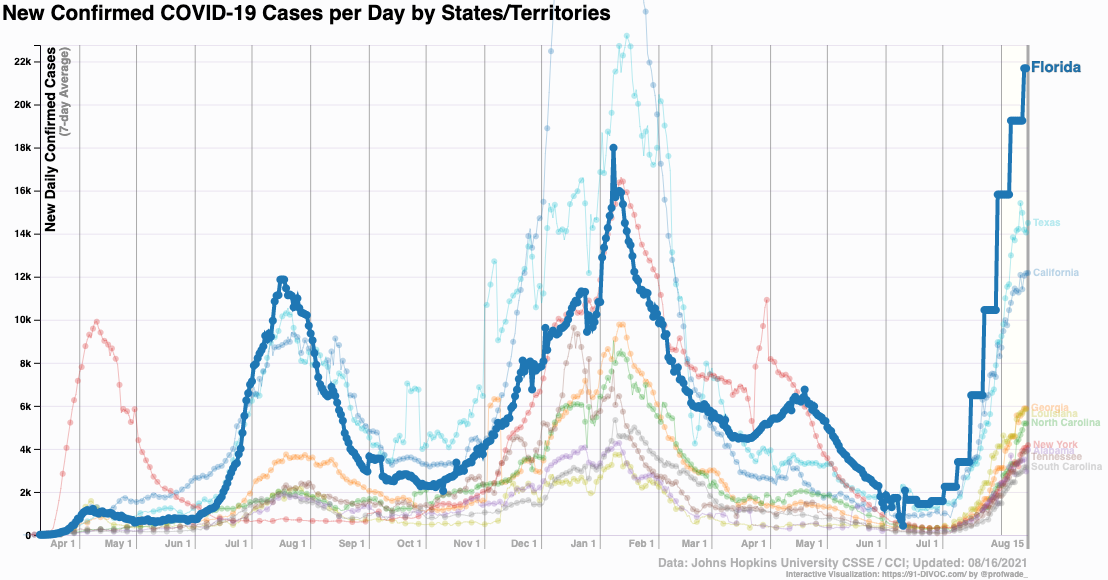
Might more toggle terms come? There are other states in that graph, mostly in the southeast. I wonder about the rest of the California State University system, which often acts in concert, and all of which are experiencing a Delta surge.
I wonder, too, about Penn State, whose faculty members just passed two measures of no confidence in their president’s pandemic plans. Would a switch online be a politically available action?
In the state suffering the worst from Delta on a per capita basis, Louisiana, Louisiana State University faculty are demanding a better plan, including remote work.
After calling for a vaccine mandate for students for months, faculty and staff members are now pushing for remote-work options, to keep them away from classrooms and offices full of people of uncertain vaccination status.
LSU’s situation includes this:
Classes begin in less than two weeks at Louisiana State University. Dorms and most classrooms will be filled to normal capacity. As of Monday, only 36 percent of students had reported being vaccinated against Covid-19, while 88 percent of employees had said the same. A vaccination requirement will not go into effect until at least one injection receives full approval from the U.S. Food & Drug Administration.
One third of students are vaccinated and most classes will be full.
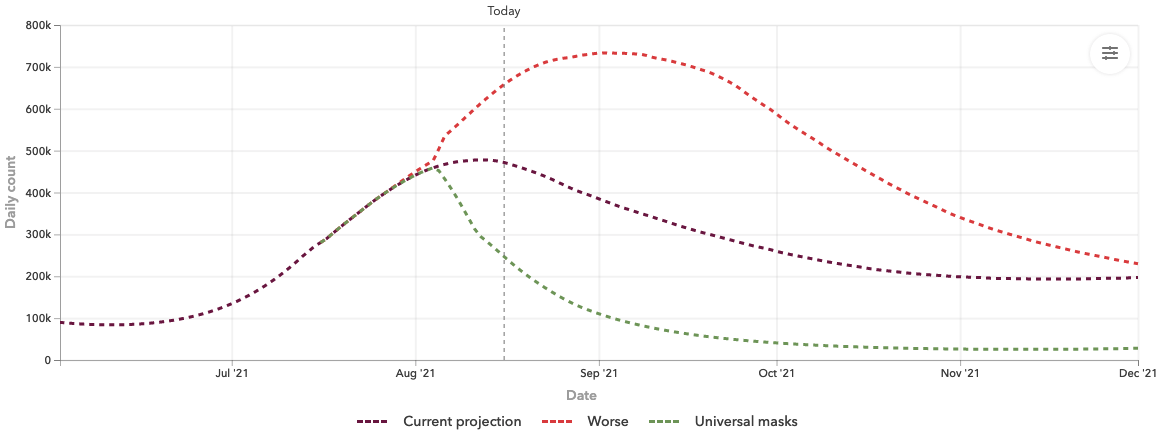
One more reason for a toggle term, rather than switching online through December, is projections that the Delta wave will crest and recede relatively quickly. Here, for example, is the University of Washington’s IHME projection:
There’s an improvisatory nature to such fast planning. As I said earlier, much of higher ed seemed to follow most of American society in spring, hoping for a post-COVID fall. But as Sarah Sangregorio observes:
What frustrates me the most is that we should all be preparing for a toggle term as a plan B. We’re going to be faced with the same scramble. Even though the faculty are in a slightly better place, it’s still going to be challenging for them and for those who support them.
— Sarah Sangregorio (@higheredsarah) August 16, 2021
Are there any signs of short-term toggle terms in your world?
(thanks to Lisa Hinchliffe and Inside Higher Ed)



We can think of “toggle terms” or “toggle semesters” as un-situating learning. Or re-situating learning. We can understand the logistical challenges at the same time as we see an incredible learning opportunity: when do students need the teacher voice and in what way? When do students need to expand the conversation to include peers? When do students do best in authentic, real-life learning experiences? Right now seems a golden time for learning theorists as we are forced to think about out-of-classroom learning experiences. Wow. Design learning carnival.
It’s defamiliarizing.
Have you seen anyone addressing what this means for faculty and staff outside the work context? Being at a small rural school with a student vaccine mandate and a high level of faculty/staff vaccination, I’m actually pretty hopeful about my campus being as safe as anywhere and safer than most. I cannot say the same for our school system, and it seems highly probable that we’ll have a K-12 “pivot” to remote at some point this year. I know even talking about that publicly opens a host of community relations issues, but if a large body of faculty is likely to have a sudden change in their caregiving responsibilities, it seems like it would be worth planning for.
I can imagine K-12 toggles.
Yes, but campuses can plan to be supportive or unsupportive of parents when they happen.
We went from 80% f2f/20% online to requesting faculty to voluntarily move sections online, hoping to reach 50/50. What makes this so awkward is that starting back in June the president and provost were pushing on how “we are a face to face campus” and therefore everyone needed to come back. Now we are booting people again. In the meantime staff is getting up every day, dressing up, commuting to campus, all to sit in the same webex meetings we were sitting in at home. This is causing some discontent.
I imagine. Lots of friction.
Perhaps this is good practice for climate pressures.
I wish that colleges and universities would accept the burden of being “truth-sayers” in the face of the noisy panic-mongers. In the 18 months since Covid hit the USA, 829 people aged 15-24 have died of Covid. Period. In the year 2019, the most recent year for which complete data is available, 19.5K people aged 20-24 years died of accidents and disease. I can only conclude that this concern about whether universities should have in-person classes or not is almost entirely a case of the TEACHING STAFF being concerned for their own health. I submit that the staff, therefore, should accept responsibility for their own health and safety, and take measures to protect themselves, rather than asking the student body to assume responsibility for protecting the staff. Staff could teach from plexiglass enclosures in the classroom, or could get vaccinated, or could prepare materials for student teachers to present, or could themselves present remotely by video, etc. I’m really not seeing the drivers for large-scale remote student learning. It is true that students with significant co-morbidities are at much higher risk of bad Covid outcomes than students without – but individual teaching plans for students with specific disabilities is already part of the University educational planning culture, and should not require a complete revamping of the campus experience for all students. [My data comes from the CDC website.]
Just one word (but it’s a game changer): Delta
Greetings, Sylvia, and welcome to my blog.
I think part of the fear is indeed fear of being infected while being of an advanced age, or having comorbidities, or both. I would add the same applies to staff as well.
Yet don’t forget infected students might not suffer (last stat I hear had 1% of infected teens needing hospitalization) but can also carry the virus to other populations. While on campus, this includes faculty, staff, and visitors. Off campus, that means, well, any humans they encounter at work, while being entertained, at home, etc.