What should our online book club read next?

It’s good to read with friends.
After reading two science fiction novels (Walkaway, New York 2140), we now turn to nonfiction about the future of education.
(If you’re new to the book club, know that since 2014 we’ve been reading titles that cover different ways of approaching education, technology, and the future. Books have included media history, near-future science fiction, education economics, anti-authoritarian schooling, changes in higher education, sociology of class, the emerging world of automation, and the 21st century’s most important work of economics so far.
Some authors have kindly interacted with us as we read their works. Several have engaged with us via Twitter, like Tressie Cottom and Malka Older. As our book club progressed, some of the authors have been guests on the Future Trends Forum, like science fiction writer and cyberactivist Cory Doctorow.)
Today’s poll is based on the latest one for nonfiction, back in fall 2017. I have cut several titles from previous lists that fail to win any votes, cut one title that we already picked and read, deleted one I read and really disliked, then also added a couple of new ones that look exciting. My Patreon supporters added a few more. You can see that there’s a mix of subjects, from pedagogy to technology, economics to online life, scholarly publishing and public policy. Most are pretty recent. Some will seem especially relevant to some of you based on current events.
Here’s the poll, if you’d like to jump right in. You get up to three (3) votes. If you want more information about the titles, just scroll down to the full list just below. (Note the holiday themed background)
NEW FEATURE: if you’d like to nominate a nonfiction book that isn’t on this list, and you want everyone to see your nominee, please use the comment box below. If you’re like to vote for someone else’s comment-nominated book, either say so in a reply, or email me if you’d like.
Below is the full list as a kind of annotated bibliography. I’ve linked to pages for each one, including those from publishers, Amazon, and the authors themselves, plus some relevant further readings (interviews, articles, etc.) and acknowledgements to the good folks who nominated several titles.
- Mark Carnes, Minds on Fire (publisher; Amazon) (2014). The co-creator of the Reacting to the Past education game movement explains it. Inside Higher Ed article. Professor Carnes was also a fine Future Trends Forum guest:
- Allan Collins, Richard Halverson, Rethinking Education in the Age of Technology: The Digital Revolution and Schooling in America (2009) A Columbia Teachers’ College Press book about how education can change to best respond to technology.
- Martin Ford, Rise of the Robots (2015). A popular and accessible consideration of where automation might take us. (thanks to Jeff Mehring)
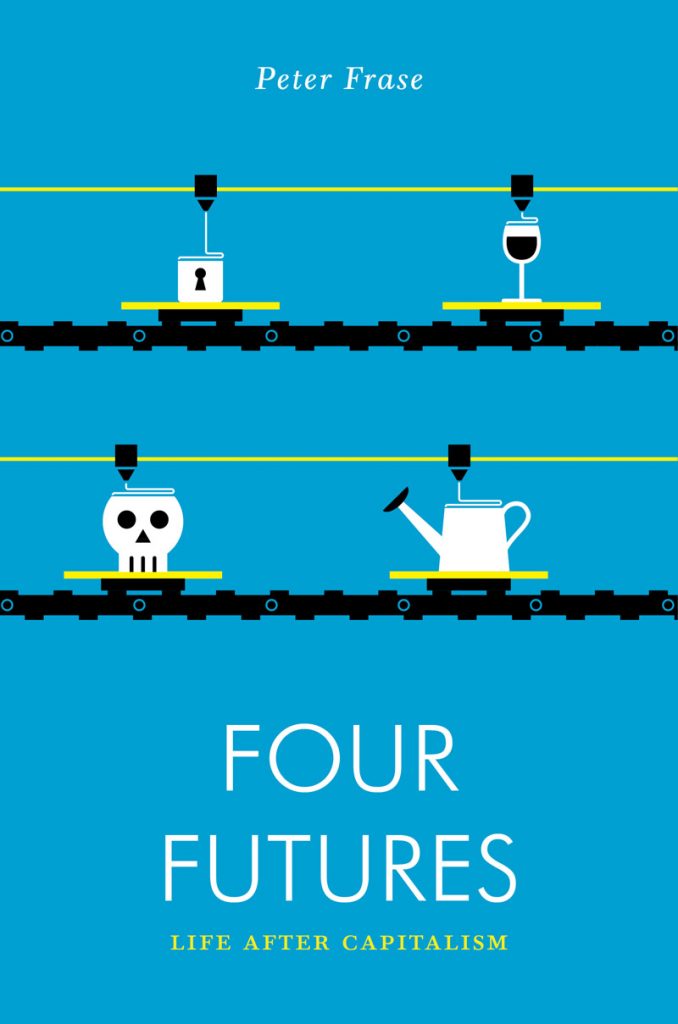 Peter Frase, Four Futures: Life After Capitalism (publisher; Amazon) (2016). A bold quartet of futures, each a world powerfully reshaped by technology in different ways. Based on this 2011 article.
- Claudia Goldin and Lawrence F. Katz, The Race between Education and Technology. (publisher; Amazon) (2010). Explores how education changes to prepare students for technological shifts. (I’m teaching the book this semester, too.)
- Joe Henrich, The Secret of Our Success: How Culture Is Driving Human Evolution, Domesticating Our Species, and Making Us Smarter (publisher, Amazon) (2017). A wide-ranging view of humanity, which finds at our very center nothing less than… teaching. (thanks to Howard Rheingold)
- Rajiv Jhangiani, Robert Biswas-Diener, Open: The Philosophy and Practices that are Revolutionizing Education and Science (2017). Explores open educational resources, open notebook science, and open access scholarship. Note that this book is available as a free download.
- John Markoff, Machines of Loving Grace (2015). A meditation on the future of automation based on examining human-computer interaction.
- Branko Milanovich, Global Inequality (2016). The most influential and up to date book on economic inequality worldwide.
 Angela Nagle, Kill All Normies (publisher; Amazon) (2017). A history and analysis of the lunatic fringe of online culture, from 4Chan on.
- Chris Newfield, The Great Mistake: How We Wrecked Public Universities and How We Can Fix Them. (publisher; Amazon). (2016) Focuses on the defunding of American public higher education. Professor Newfield was a guest on the Future Trends Forum this summer.
- Will Richardson and Rob Mancabelli, Personal Learning Networks: Using the Power of Connections to Transform Education. (publisher; Amazon) (2011) A serious look on connected learning, co-authored by a Future Trends Forum guest, and in its third edition.
- Hans Rosling, Factfulness (Amazon; Goodreads; Wikipedia) (2018). A look at positive trends in the world.
- Jeff Selingo, College Unbound: The Future of Higher Education and What it Means for Students. (author’s page; Amazon) (2013). A critical examination of higher ed in transformation by one of the field’s leading journalists. Selingo was a Future Trends Forum guest this summer.
- Richard Susskind and Daniel Susskind, The Future of the Professions How Technology Will Transform the Work of Human Experts (2016). (thanks to Joe Murphy for the suggestion)
 Peter Temin, The Vanishing Middle Class: Prejudice and Power in a Dual Economy (Amazon; publisher) (2017). A cutting-edge examination of economic inequality in the United States.
- Fred Turner, The Democratic Surround: Multimedia and American Liberalism from World War II to the Psychedelic Sixties (publisher; Amazon) (2013). A deep dive into the origins of multimedia technology as a democratic and psychological project.
- Walter Scheidel, The Great Leveler: Violence and the History of Inequality from the Stone Age to the Twenty-First Century (publisher; Amazon) (2017). A dark look at how economic inequality has ended throughout history.
- Zeynep Tufekci, Twitter and Teargas: The Power and Fragility of Networked Protest (MIT: 2017). (thanks to Kyle Johnson)
You can vote in this poll, and also add thoughts in comments below. Remember, you can support up to three titles.
I’m looking forward to your choices!



It’s a long list already, but some to consider for the future include:
Kevin Kelly (2016) The Inevitable: Understanding the 12 Tech Forces that Will Shape Our Future
Joseph Aoun (2017) Robot-Proof: Higher Education in the Age of Artificial Intelligence
Siva Vaidhyanathan (2018) Antisocial Media: How Facebook Disconnects Us and Undermines Democracy
Singer and Brooking (2018) LikeWar: The Weaponization of Social Media
Pingback: What nonfiction book should our online book club read next? – Skate Curated Best of the Web
I was here looking for some ideas, Kill All Normies looks interesting. we are currently finishing up Julie Heldman’s memoir called Driven. It’s been the most amazing read for our book club yet! So well done.
and 12 thousand Georgian manuscripts