Queen sacrifice in Pennsylvania

Another queen sacrifice appeared this week, this time in Pennsylvania.  Keystone College will end two academic programs and lay off both faculty and staff.

Keystone College logoThe programs are majors in geology and the visual arts.  According to one local report, 16 people will lose their jobs, including a dozen staff and four tenure-track professors.

The reasons for doing so seem not to be grounded in immediate crisis.

buy lexapro online buy lexapro no prescription generic

  According to Keystone president Tracy L.

buy doxycycline online buy doxycycline no prescription generic

Brundage, this is a strategic anticipation of enrollment and demographic trends likely to have an impact in the future:

educational institutions throughout the state and the nation are facing a more challenging environment than ever due to the decline in the numbers of available college students both now and projected into the future.

Keystone also went through something like an academic program prioritization exercise.  Again, president Brundage: “we spent several months engaging the campus community in conversations regarding how to best align our college to better serve our students and become even more relevant in the degrees and programs we offer.”  It looks like geology and the visual arts lost out, probably in terms of enrollment and/or majors.

Unusually, Keystone is also cutting some sports (men’s and women’s golf and tennis) as well.

buy antabuse online buy antabuse no prescription generic

This is an interesting case of the queen sacrifice strategy.  It’s apparently a future-oriented move, not a reaction to a current crisis, and therefore reminds me of Gordon’s cuts.  It’s a relatively small-scale move as well.  Based on Wikipedia‘s student enrollment number (1400) and the college’s posted 11:1 student:faculty ratio, I estimate around 125 faculty; cutting 4 is about a 3% loss.  That’s painful for all concerned, but not a huge proportion of Keystone’s total professoriate (please correct me if my numbers are off).

I can’t tell why geology and the visual arts were targeted.  The latter might have fallen prey to the ongoing humanities decline.

This story has received very little coverage so far.  That means I haven’t been able to learn about other queen sacrifice dimensions: faculty participation in the decisions; outcomes for students; etc.

buy lipitor online buy lipitor no prescription generic

My best wishes to the faculty, staff, and students impacted.

(thanks to Lee Skallerup Bessette)

Posted in research topics | Tagged | 9 Comments

Station identification, May 2019

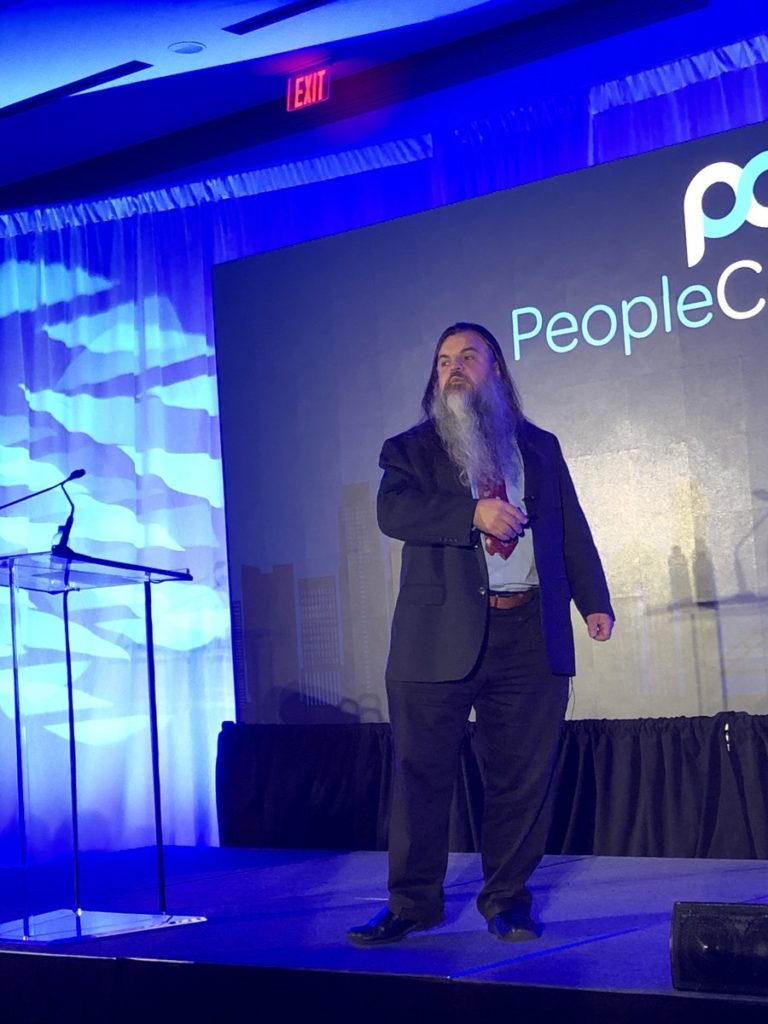
Bryan addressing Peopleconnect_peopleadminHello.  I’m Bryan Alexander, and this is my blog.

buy xifaxan online buy xifaxan no prescription generic

I am a futurist, specializing in the future of higher education and technology.

That means I speak, consult, lead workshops, and teach on that topic and parts thereof.  I also write books, most recently Academia Next: the Futures of Higher Education (pre-order).

Along the way I make digital stuff grouped under the Future of Education Observatory header:

I am also honored to be a senior scholar at Georgetown University’s Center for New Designs in Learning and Scholarship (CNDLS), where I teach classes in their Learning, Design, and Technology (LDT) graduate program.

Support for all of this activity comes from a range of kind sources, including clients, FTTE subscribers, sponsors, and the fine supporters on Patreon (join them!).

Posted in About | Leave a comment

Reading the Age of Surveillance Capitalism: chapters 13 and 14

Our online book club is reading Shoshana Zuboff’s The Age of Surveillance Capitalism. Today we’re covering chapter 13: Big Other and the Rise of Instrumentarian Power, along with chapter 14: A Utopia of Certainty.

Age Of Surveillance_coverIn this post I’ll summarize the chapters, then add some observations and questions.   I’ll also recap what readers have shared.

buy ventolin online buy ventolin no prescription generic

How can you respond?  You, dear reader, can respond through whichever technological means make the most sense to you.  You can comment on each blog post.  You can also write on Twitter, LinkedIn, your own blog, or elsewhere on the web.  (If that sounds strange, here are some examples of previous readings, complete with reader responses.)

One development to share: before the United States Senate programmer and Pinboard-creator Maciej Ceglowski delivered a powerful indictment of surveillance capitalism.

Summary

Chapter 13 (Big Other and the Rise of Instrumentarian Power) picks up right where chapter 12 left off, continuing to develop the instrumentarian idea.  Zuboff maintains the contrast with totalitarianism, even offering tables:

Zuboff Two Species of Power 1

This lets Zuboff explore links between the surveillance capitalism business model and governmental roles in encouraging or conducting surveillance.  The United States and China are the primary states here, and it is clear that each encouraged surveillance capitalism in their own ways.

Zuboff Two Species of Power 2

With Chapter 14, A Utopia of Certainty, Zuboff digs more deeply into SC’s ambitions.  She sees them as totalizing and also utopian, starting to apply the term “utopistics” to describe how they can be realized.

Much of [Larry] Page’s future vision turns out to be stock utopian fare, themes that have been repeated for millennia. Page anticipates machine intelligence that restores humankind to the Garden of Eden, lifting us from toil and struggle into a new realm of leisure and fulfillment. He foresees, for example, a future society graced by “abundance” in all things, where employment is but a “crazy” distant memory. (p. 401)

In this chapter Facebook and Google offer up vast ambitions to not only organize the world’s information and connect everybody, but to create new mechanisms for decision-making at enormous scale and to spark more human creativity.  Naturally to make this work human behavior must be corralled and constrained, driving humans to behave more like machines, and involving an “all-out war on accidents, mistakes, and randomness in general.” (409)

Chaplin caught in the machineIn this dystopia people will monitor each other closely in a way that reminds me of Foucault’s take on Bentham’s Panopticon:

humans [will] emulate the superior learning processes of the smart machines. This emulation is not intended as a throwback to mass production’s Taylorism or Chaplin’s hapless worker swallowed by the mechanical order. Instead, this prescription for symbiosis takes a different road on which human interaction mirrors the relations of the smart machines as individuals learn to think and act by emulating one another… (p. 414)

Questions

  1. If surveillance capitalism can deliver certain utopian goods (“a new realm of leisure and fulfillment. He foresees, for example, a future society graced by “abundance” in all things, where employment is but a “crazy” distant memory”), wouldn’t many people find the privacy rendition to be a worthy trade-off?
    buy zydena online buy zydena no prescription generic

  2. At the end of chapter 13 Zuboff calls on us to resist and organize, reawakening democracy.  How can we do this if that democracy is the same state that encouraged surveillance and performs its own snooping and analysis?
    buy nolvadex online buy nolvadex no prescription generic

  3. Chapter 14 describes the ominous possibility of using “the interface between the computer and the real world… [to enable you to] search the real world for people, objects and activities, and apply policies to them.…” (410; emphases in original).  Yet isn’t this what many human institutions already do, such as human resources departments?
  4. Zuboff describes a creepy-sounding Microsoft patent for a machine that “would alert ‘trusted individuals’ such as family members, doctors, and caregivers” in case of an anomaly.
    buy flagyl online buy flagyl no prescription generic

      The tech would also connect with “health care providers, insurance companies, and law-enforcement personnel.”( 412) . That sounds like the experience of being a patient in long-term or mental health care. Is surveillance capitalism inspired by health care’s less humane aspects?

  5. If surveillance capitalism is based on extensive individual details, how can it also flatten personal differences?

Next week, on May 27th, we will advance to chapters 15 (The Instrumentation Collective) and 16 (Of Life in the Hive).

Help yourself to our reading, with all content assembled under this header: https://bryanalexander.org/tag/zuboff/ .  You can find the reading schedule here.

(Chaplin screen grab via this Jacobin article)

Posted in book club | Tagged | 18 Comments

Business and health care up, the humanities sink: higher ed enrollment data

Which degrees are undergraduates pursuing?

buy silagra online buy silagra no prescription generic

We’ve been tracking enrollment patterns for a while, and a new Bloomberg article offers no surprises.  Justin Fox parses NCES data to find that while the humanities decline, business and health care are booming.

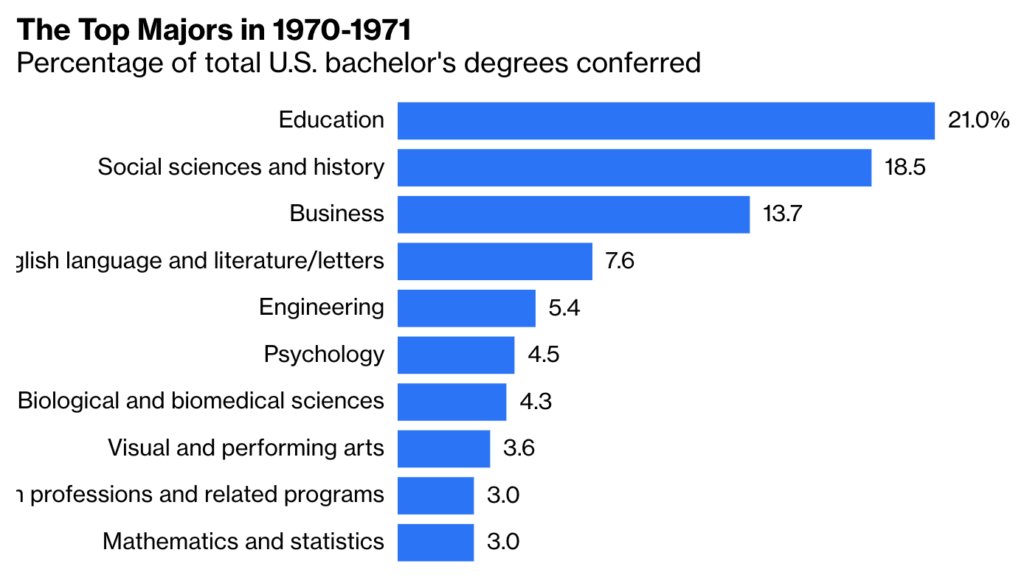
The time frame is “Selected years, 1970-71 through 2016-17,” and the pattern is a familiar one.  Fox offers the top 10 undergrad majors in two academic years for contrast, starting with 1970-1971:

majors_1970-1971_NCES by Justin Fox

That’s “Health professions and related programs,” second from last. The Bloomberg site was acting up.

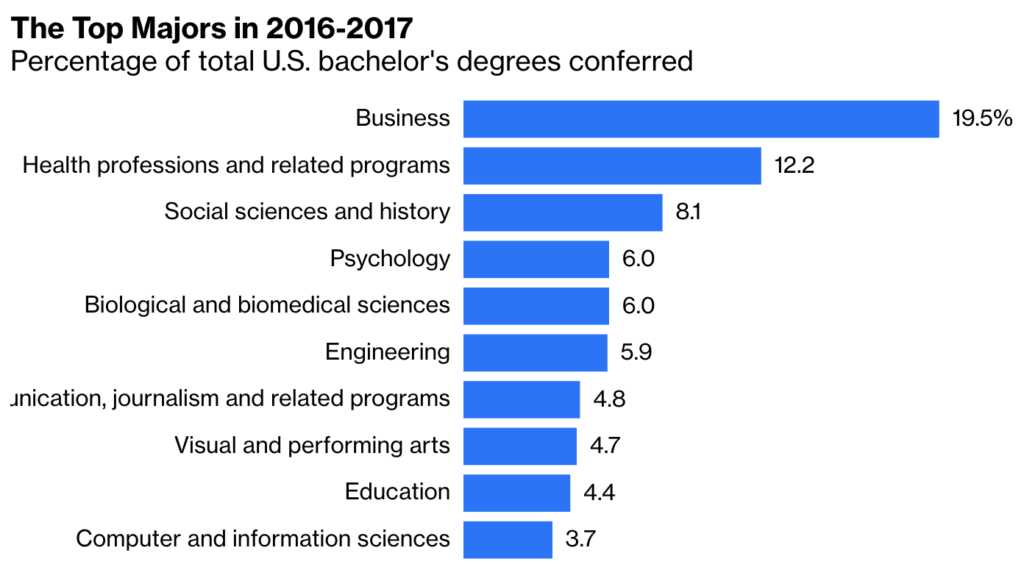
Compare with 2016-7:majors_2016-7_NCES by Justin Fox

Fox points out the continuity of business (funny, I thought Boomers only took classes to find meaning in life…), the decline of the humanities (English just vanishes from the second list), and the rise of health care. He observes that “[t]he most significant development of this century, meanwhile, has been the rise of the health professions…”  Note, too, that biological and biomedical majors are also in the health realm.

buy stromectol online buy stromectol no prescription generic

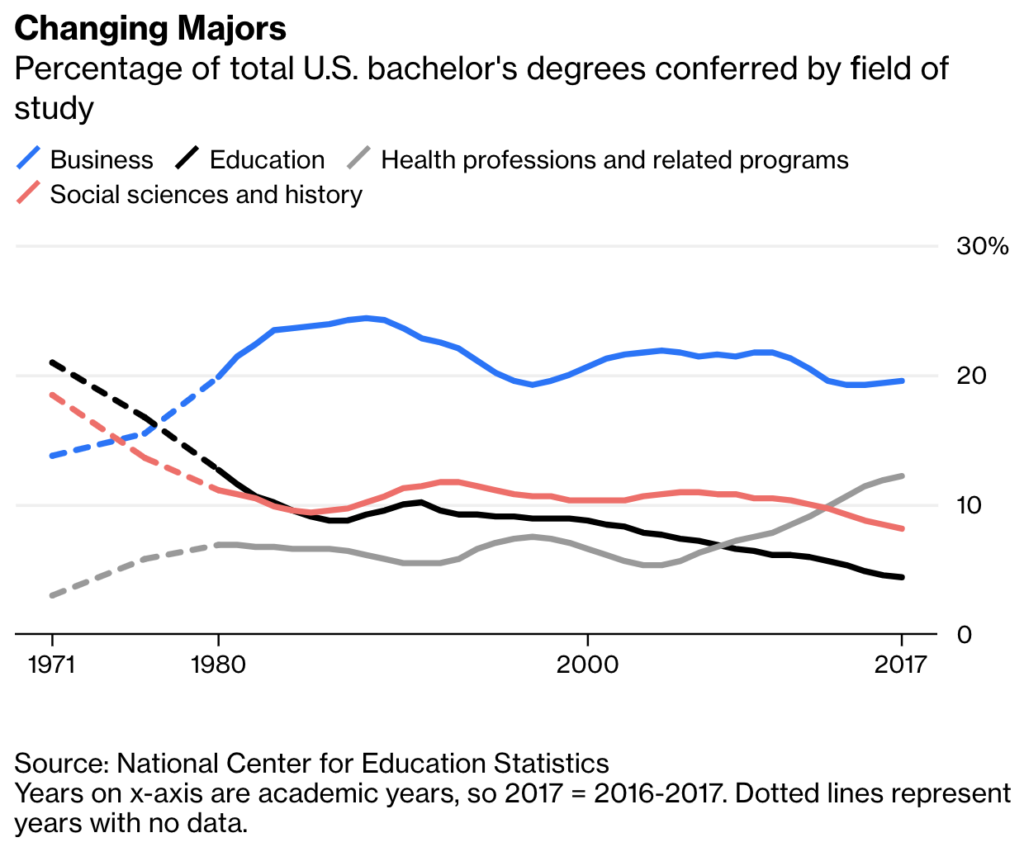
  I was also struck by the drop in education:

changing majors 1971-2017_NCES Justin Fox

I’d like to dig into that education decline at some point.  How much is due to women starting being able to choose majors other than education and the humanities in the 1970s and 80s?  Fox notes that some of these fields pay much better than teaching K-12, notably medicine (“Of the 238,014 bachelor’s degrees in health professions and related programs awarded in 2016-2017 (about half were in registered nursing), 84 percent went to women”).  How much is due to the stresses of waves of schooling reform?

buy wellbutrin online buy wellbutrin no prescription generic

  Have demographic changes – i.e., aging – already been felt in this way?

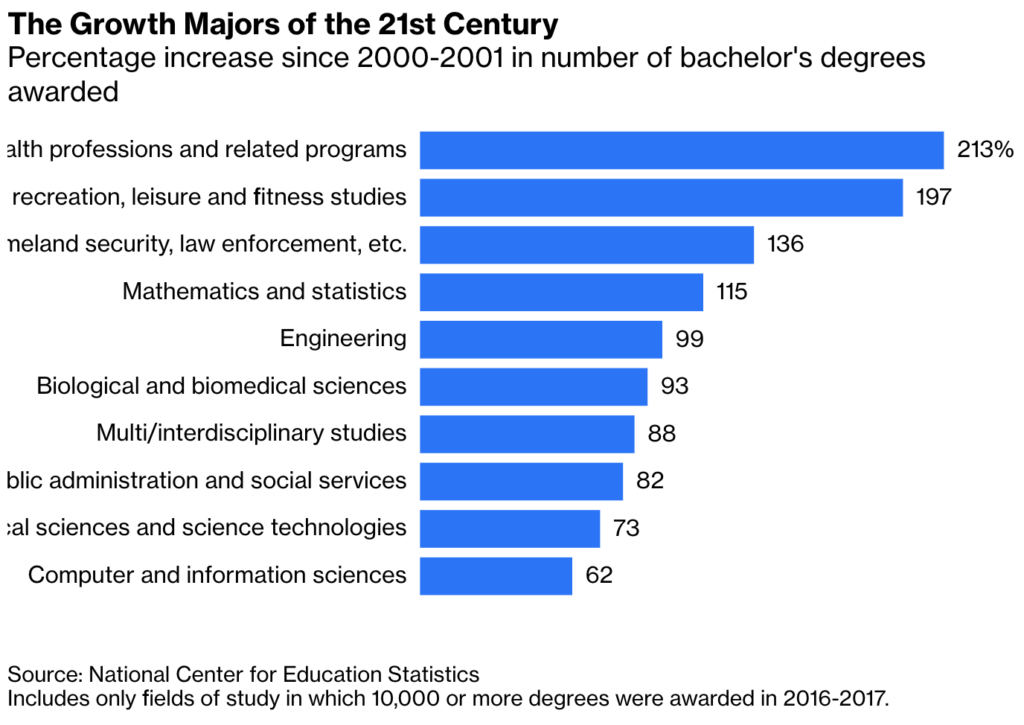
Fox’s article leaves us with a way for colleges and universities to think about departments, curriculum, and strategy.  He helpfully aids that quest with another chart:

majors that are growing_Justin Fox

Second one is “Parks, recreation, leisure and fitness studies”. #8 is “Public administration…” #9 is “Physical sciences…”

Again, no surprises here, but useful data.  STEM fields really stand out here, and not just in allied health.  Homeland security also appears in the top three; I note, although Fox does not, that the United States is approaching the 20th year of the war on terror, and this is clearly expressed in some students’ selection of majors.

What does American higher ed look like if we extrapolate these trends forward ten years?

buy albuterol online buy albuterol no prescription generic

  Twenty?

Posted in enrollment, trends | 2 Comments

Another college commits to a queen sacrifice

A certain strategy is increasingly available to financially stressed American colleges and universities.  It involves cutting selected majors and programs while removing tenure-track faculty.

The queen is down.I’ve dubbed this strategy the queen sacrifice, drawing on that desperate chess move whereby a player gives up their most powerful piece in a risky play for victory.  In the analogy tenure-track faculty are like the chess queen, since they have so much institutional clout, nominally and traditionally, if not universally in practice.  Cutting those professors is an analogically bold and difficult move.  (Declaring a formal state of financial exigency is one way)

I’ve been tracking college and university queen sacrifices for a while, as I see them playing a key role in shaping higher education’s future.  Today’s example comes from a Boston-area campus.  It’s a useful case study of a college making strategic cuts.

Gordon College, an evangelical liberal arts institution in Wenham, Massachusetts, announced it would cut programs and positions.  For professors and staff,

[e]leven faculty members are being laid off and two more retiring faculty will not be replaced. In addition, six staff members are being laid off and an additional 17 vacant staff positions will not be filled…

According to Gordon’s student paper, that means “14% of current full-time faculty” positions are cut, including some vacancies.

[E]leven faculty members will lose their jobs; an additional two faculty members are proceeding with their planned retirements and their vacant positions will not be filled. Two of the eleven faculty members were offered different positions within the school.

Program cuts and compressions:

Gordon is eliminating stand-alone majors in chemistry; French; physics; middle school and secondary education; recreation, sport and wellness; Spanish; and social work, and it is merging political science, history and philosophy into a single department.

At the same time there are several curricular expansions under way:

Gordon is also expanding its graduate and online offerings through a newly created School for Graduate, Professional and Extended Studies…

Gordon said it is creating new multidisciplinary or “integrated” majors: for example, in lieu of a chemistry major, future Gordon students can enroll in a new biochemistry and integrated science major. Students interested in physics can take a physics track within a new physics and applied science major. A new sociology and social practice major will combine sociology and social work. Within the combined history, philosophy and political science department, stand-alone majors in political science and international relations will continue to be offered, and potential dual majors such as history and philosophy and history and political science are under review.

A $10 million donation is helping power the curricular development.  So Gordon is cutting, expanding, and reorganizing at the same time, leading to a net curricular and employee reduction.  The total budget is being cut 7%. (“five percent which will be realized immediately in the 2019–20 academic year, and two percent which will be realized in the 2020–21 academic year”)

Why is this happening?  Unusually, Gordon doesn’t seem to be reacting to present threats, but anticipating upcoming ones:

Gordon is taking strategic steps to meet new market realities out of financial prudence and not out of financial distress. (In other words, we’re choosing to be proactive now rather than waiting to be reactive later, when financial pressures would be stronger.) [emphases in original]

As part of the official announcement the school posted an analysis of the overall higher education market, which reads like it was written by a team following this very blog.  It describes enrollment declines, rising discount rates, rising total cost of higher education, and greater pressure on tuition.  The page even echoes my overbuilt language: “Simply put, [total] higher education capacity exceeds demand.”

I’m not sure of Gordon’s current financial health.  A local paper reports that enrollment “had dipped about 6 percent in the last few years, from 2,105 undergraduate and graduate students in 2014 to 1,963 last year.”  That could constitute serious financial pressure, depending on other factors.  Their endowment is around $35 million, according to Wikipedia, which is too small to solve major problems.

On a related note, I detect a sense of the curriculum being overbuilt.  According to one official statement, “This [strategy of cuts] keeps Gordon’s academic resources from being spread too thin across too many individual majors…”

The student paper also offers a good, detailed account of other cuts and cost-saving measures.  This is a useful study in the many ways colleges can scramble to fix their finances:

the school is looking at counseling options for students outside of Gordon’s current offerings. Options on the table include partnerships with local Christian counselors and working with the counseling center at Gordon-Conwell Theological Seminary…

Gordon College is looking to increase investment in solar energy to reduce energy costs; the police department will also receive less funding for non-essential training and overall operations, but no full-time officers are being cut from the Gordon Police force; the Dexter house will be sold after this academic year, and the dorm is housing its last cohort of students this semester; the Center for Technology Services, the mailroom, and the development office will also see reductions in expenses and personnel.

They also seem to be pressing their summer youth (not undergraduate) programs.  That’s prominently positioned on their home page today.

Let me close with some observations.

Changes in religious belief may propel some of Gordon’s enrollment decline.  It is a religiously conservative institution.  In 2014 the college won attention by asking then-president Obama to exempt faith-based organizations from new regulations concerning discrimination based on sexual orientation and gender orientation.  If Gordon draws its students from New England and focuses on traditional-age learners, declining religious affiliation may be narrowing their enrollment pipeline.

On the majors being cut or compressed, the humanities are represented, unsurprisingly.  Languages being cut is typical, although I’m surprised at Spanish, since it remains the overwhelmingly most popular language taught in the US.  Squeezing political science, history and philosophy together certainly fits national enrollment trends (for example).  Cutting education (middle school and secondary education) makes sense, given the region’s aging demographics.  We can expect these curricular trends to continue.

I’m not sure what to make of axing recreation, social work, sport and wellness.  My sense is that those fields are in demand.  There may be local challenges I don’t grasp.  Cutting chemistry and physics: I suspect this is either a question of costs (these are relatively expensive to offer) or declining enrollment, perhaps because students would prefer studying those at a university or polytechnic, rather than at a religiously-focused liberal arts college, especially when New England offers to many alternatives.

There’s a story about the queen sacrifice process which is hard to make out from a distance.  On the one hand, in 2017 there was a major crisis when the entire faculty senate resigned, citing tensions over governance.  On the other, an official statement describes a large (26 person) committee spending a lot of time researching and wrestling with problems, which suggests at least some community process.

I am impressed both by Gordon’s market analysis and their intention to get ahead of trends before they hit.  It’s a good example of a future oriented strategy.

At the same time I’m saddened by the human losses, including those suffered by faculty, staff, and students.

Overall, the queen sacrifice seems to remain a viable strategy for some American colleges and universities.  I would expect to see more of these in at least the short and medium term future.

Posted in research topics | Tagged | 12 Comments

Totalitarianism and conditioning: reading the Age of Surveillance Capitalism, chapters 11 and 12

Our online book club continues our reading of Shoshana Zuboff’s The Age of Surveillance Capitalism. Today we’re covering chapters 11: The Right to the Future Tense and 12: Two Species of Power.

Age Of Surveillance_coverIn this post I’ll summarize the chapters, then add some observations and questions.   I’ll also recap what readers have shared.

How can you respond?  You, dear reader, can respond through whichever technological means make the most sense to you.  You can comment on each blog post.

buy caverta online buy caverta no prescription generic

  You can also write on Twitter, LinkedIn, your own blog, or elsewhere on the web.  (If that sounds strange, here are some examples of previous readings, complete with reader responses.)

Geoffrey Fowler reports that Amazon’s Alexa system records more audio than people might think, and it’s not the only device doing to (thanks to Scott Robison) Chris Gilliard (a fine Future Trends Forum guest) recommends better black and black women representation at a New York Times data privacy project.

Regulation of surveillance capitalism seems to be in the air. Kent Anderson called for the FDA to regulate social media for its health dangers.  Three members of Congress launched a bill to get the FCC regulating “certain businesses that use ‘high-risk automated decision systems’ (such as those that predict a person’s work performance, financial situation, or health)…”  And one critic fears TikTok’s potential exploitation of user data.

Summary

Chapter 11: The Right to the Future Tense shifts the book’s ground a bit, making a philosophical case for the individual’s sovereign right to think through and control their own future.  That right underpins many other rights.  Hannah Arendt and John Searle are cited as a major figure for this line of thought.  Naturally, surveillance capitalist enterprises would now foreclose that futuring right, based on their rising predictive powers.  Without that right we cannot project; instead, we become merely objects.

buy vardenafil online buy vardenafil no prescription generic

(337)

[T]he elemental right to the future tense is endangered by a panvasive digital architecture of behavior modification owned and operated by surveillance capital, necessitated by its economic imperatives, and driven by its laws of motion, all for the sake of its guaranteed outcomes. (332-333).

Zuboff concludes by calling for new laws to regulate these architectures (334), then asking us to think about how surveillance capitalism will reshape human society.

Chapter 12: Two Species of Power explores that reshaping by defining a new term: “instrumentarianism…

buy finasteride online buy finasteride no prescription generic

the instrumentation and instrumentalization of behavior for the purposes of modification, prediction, monetization, and control.” (352) Zuboff takes care to distinguish instrumentarianism from totalitarianism in the latter’s fascist and Stalinist forms, arguing that each reshaped society in unprecedented yet different ways.

The chapter then shifts disciplines from political science to psychology, while remaining within history, in order to further develop an earlier point about BF Skinner.  Zuboff describes Skinner’s model of behaviorism, laying out the Harvard professor’s vision of a society controlled from above, wherein human life is meticulously shaped by behavior modification.  The chapter ends by linking behaviorism with totalitarianism, comparing two contemporary books: Skinner’s Walden Two (1948) and George Orwell’s Nineteen Eighty-Four (1949). Zuboff finds a common concern with controlling people in each, but separates them at some length.

I was struck by how closely Zuboff’s investigation of Skinner and his influence echoes the work of Audrey Watters.

Questions

  1. Where have you experienced the predictive powers of companies conducting this kind of strategy?
  2. Which companies are conducting such a future foreclosing?
  3. During her discussion of totalitarianism Zuboff claims that contemporaries had a hard time understanding the nature of those nightmare regimes (for example, 357).
    buy zenegra online buy zenegra no prescription generic

      Is this true? I don’t have my library back yet, but do recall Franz Leopold Neumann’s Behemoth: The Structure and Practice of National Socialism 1933–1944 was published in the early 1940s.

  4. Is gamification an example of instrumentarianist control?
  5. What role do educational institutions play in this rising instrumentarianist order?

Next week, May 20th, we will move on to chapter 13: Big Other and the Rise of Instrumentarian Power, and chapter 14: A Utopia of Certainty.

Help yourself to our reading, with all content assembled under this header: https://bryanalexander.org/tag/zuboff/ .  You can find the reading schedule here.

Posted in book club | Tagged | 1 Comment

Race, sex, law, and drones: this week’s snapshots of the future

Today I’d like to share some current stories that suggest to me ways higher education might proceed.  I’ve picked them out of my horizon scanning work.

I’ve done this before, but now I’d like to link them clearly to FTTE report trends.

SEXUAL ASSAULT AND HARASSMENT: a Harvard investigation into a long-serving professor and administrator’s behavior concluded by banning him from campus.

One key detail: the university already found Jorge I. Domínguez guilty of harassing a colleague.  In 1983 Harvard sanctioned him, but also kept him on.  Afterwards the professor continued this behavior, according to the investigation.   Over the subsequent decades.

RACIAL INEQUALITY IN EDUCATION: Williams College’s student government refused to recognize a campus pro-Israel group.  This elicited opposing charges of racism, as defenders of the vote argued the group was racist against Palestinians, while critics deemed the body to be anti-semitic.

One trend to track: rising activism opposed to Israeli policies.

KU logoOPEN EDUCATION: Knowledge Unlatched announced a new funding round.  What this means is that KU is continuing to shift scholarly content into the open world, bit by bit.  Open access is continuing to advance.

(If you don’t know KU, what they do is raise money from libraries and other sources to buy rights to certain scholarly works.  Once each purchase is completed, the book or article or journal gets a Creative Commons license and is hosted on a public server.)

GRAD SCHOOL WOES: over the last two years Vermont Law School de-tenured and/or laid off faculty, as the school faced a serious financial crisis.  This week the American Association of University Professors (AAUP) issued a report condemning the VLS actions.

From the report, one acidic passage:

Put inelegantly, [the institution] laid off a majority of its most expensive faculty members and then outsourced the work they did to a much cheaper contingent labor force, with no intention, it seems, of looking back.

VLS responded.  The back and forth is, well, quite lawyerly.

This story brings together several trends, starting with the continued decline of law schools.  It also signals problems facing rural higher ed and challenges to faculty governance.

ONLINE LEARNING and FOR-PROFIT HIGHER ED: California’s legislature is considering several laws which would increase regulation of for-profit post-secondary education.  Two would also heighten scrutiny over online program management (OPM) companies.

AUTOMATION: the United States military has deployed a new kind of drone.  It doesn’t use missiles to strike targets, but instead a combination of shrapnel and knives.

Instead of exploding, it is designed to plunge more than 100 pounds of metal through the tops of cars and buildings to kill its target without harming individuals and property close by…

The R9X is known colloquially to the small community of individuals who are familiar with its use as “the flying Ginsu,” for the blades that can cut through buildings, car roofs or other targets.

drone with blades

Why this matters: it represents another step along the path to ever more precise weaponry.  It may also add another layer of dread to the fear many feel for drones and robots in general.

At the same time, the United States Army is preparing a “drone buster.”

The systems… use Electronic Warfare (EW) to interfere with the GPS signal or Command and Control technology of enemy drones, disabling them or throwing them off course.

So automation is progressing as warfighting robots develop. Will we see spinoffs of these in the civilian world?

(thanks to Roger Schonfeld)

Posted in research topics, technology | 2 Comments

Talking higher education on the Disruptors podcast

Disruptors logoA few weeks ago I was interviewed on the Disruptors podcast, and the show just went live.

Matt Ward took us on a whirlwind tour through administrative growth, adjunctification, why higher ed is expensive, the Bennet hypothesis, too many students, peak higher ed, skilled trades, Bryan Caplan and signaling, service jobs, the higher education bubble, demographics, lifelong learning, GDP, lifeboat ethics, Rebecca Solnit, suicides in the wake of automation, dystopia versus utopia, a dream of Bezos, the value of human beings, science fiction, HG Wells, mutating humanity, and Thomas Piketty.  And I invented a new crowdsourcing platform.

buy doxycycline online buy doxycycline no prescription generic

You can listen, and even watch, here.

Thank you, Matt, for the opportunity and conversation.

Posted in interviews, podcasts | Leave a comment

Reading the Age of Surveillance Capitalism: chapters 9 and 10

Our online book club is reading Shoshana Zuboff’s The Age of Surveillance Capitalism.

buy lipitor online buy lipitor no prescription generic

Today we’re covering chapter 9: Rendition from the Depths, and chapter 10: Make Them Dance.

Age Of Surveillance_coverIn this post I’ll summarize the chapters, then add some observations and questions.

buy ventolin online buy ventolin no prescription generic

   I’ll also recap what readers have shared.

How can you respond?  You, dear reader, can respond through whichever technological means make the most sense to you.  You can comment on each blog post.  You can also write on Twitter, LinkedIn, your own blog, or elsewhere on the web.  (If that sounds strange, here are some examples of previous readings, complete with reader responses.)

From the news: a Lancet editorial recommended we think of personal data not in terms of oil, but akin to human blood – i.e., something extensively safeguarded on multiple levels.

buy intagra online buy intagra no prescription generic

  Meanwhile, Facebook announced some feature changes, including a new emphasis on privacy and a look at people’s secret romantic longing.  Wired pithily responded with this tweet:

On Medium, Alexander Malkay Hayes offered this general observation in response to one of our ongoing questions:

Alexander Malkay Hayes's response

Now, on to this week’s reading.

Summary

With chapter 9: Rendition from the Depths, Zuboff focuses on personalization services.  Rather than seeing them as boons for customers, the author argues that they require extensive data-gathering from users in disempowering ways. Voice interfaces (Siri, Alexa, Cortana, etc.) carry this even further, since those devices can record a continuous stream of input, and our comfort with speech lets our guard down.  Smart tvs have a similar capacity, as do some digitally augmented toys.

Moreover, companies can build up such surveillance without the controls we normally attach to intimate professional relationships:

Doctors, accountants, and attorneys are held to account by mutual dependencies and reciprocities dictated by the extensive institutionalization of professional education, codes of conduct, and procedures for evaluation and review. Violation of these rules risks punishment in the form of professional sanction and public law. Google and its brethren in surveillance capitalism bear no such risks. (256)

Another side effect of the digitally mediated self on corporate platforms appears in the discussion of a company’s internal discussion forum.  DIALOG (269ff) apparently drove one firm’s employees into a nearly paranoid state.

Zuboff connects personalization to prediction, using a range of examples to show various companies trying to build predictive models out of user data, from IBM to Cambridge Analytica.

buy silvitra online buy silvitra no prescription generic

  One aspect of personalization is machine modeling of user emotion, also known as affective computing.  This leads to one very ambitious and possibly disturbing vision:

This is the commercial context in which Kaliouby came to feel that it is perfectly reasonable to assert that an “emotion chip” will become the base operational unit of a new “emotion economy.” She speaks to her audiences of a chip embedded in all things everywhere, running constantly in the background, producing an “emotion pulse” each time you check your phone: “I think in the future we’ll assume that every device just knows how to read your emotions.”(289)

With chapter 10, Make Them Dance, Surveillance Capitalism turns to move active behavior by surveillance capitalists, starting with the popular nudging idea and BF Skinner’s operant conditioning psychology.  Zuboff isn’t as critical of nudging as she is of its use by businesses, because while publicly minded choice architecture is putatively benign, surveillance capitalism’s “nudges are intended to encourage choices that accrue to the architect, not to the individual.” (295) Leading examples of this practice include Facebook’s various efforts (that we know of) to influence user voting and moods as well as Pokemon Go’s strategy of getting players interacting with the physical world.

These expansions of surveillance technology are often successful, but Zuboff points to a series of Congressional actions in the early 1970s that investigated and limited multiple government surveillance and behavior modification programs (for example).  The chapter praises the Belmont Report (1974) as a source of regulating behavior modification.

Pithy quote for this week:

There was a time when you searched Google, but now Google searches you. (262)

Questions

  1. This week’s chapters take us beyond Facebook and Google.  Just how widespread is surveillance capitalism?
  2. Does chapter 10’s historical review of 1970s-era governmental actions give us useful models for the present day?
  3. Are there benign uses of nudging?  For example, increasing voter turn out is surely something most people would support.
  4. Can we structure personalization services that are not terrible?

Next week we move on to chapters 11 (The Right to the Future Tense) and 12 (Two Species of Power).

Help yourself to our reading, with all content assembled under this header: https://bryanalexander.org/tag/zuboff/ .  You can find the reading schedule here.

Posted in book club | Tagged | 1 Comment

If billionaires take up geoengineering on their own

What if a group of billionaires decided to launch a geoengineering effort?

Scenarios are stories of hypothetical futures.  We build them with present-day trends, extrapolated into new forms through social impact.

buy flagyl online buy flagyl no prescription generic

  We use them to think more clearly, imaginatively, and strategically about the future, since we can imagine ourselves within a given story.

Today’s case in point posits a trio of billionaires who, fed up with governments’ inability to address climate change, take things into their own hands, seeding the upper atmosphere with sulfate aerosols.  The scenario is from Dave Levitan.  Read it; I’ll be here when you’re done.

Done?  OK.  Some thoughts.

This scenario depends on several current trends continuing: climate change; the ascent of the very rich; democratic governments’ inability to take effective steps on decarbonization; growing plutocracy.  That’s a pretty sturdy foundation, actually.

It wouldn’t be hard to draw paths from today to this hypothetical future.

buy prelone online buy prelone no prescription generic

  In 2012 Russ George seeded waters with iron sulphate, entirely on his own.  We can think of two billionaire-owned space programs (Musk’s and Bezos’) already in play.  The failure of the Paris accords – well, Trump withdrawing the US from them – adds to the political sclerosis.  And there are plenty of models showing climate change advancing along multiple fronts.  The American Green New Deal points in a different direction, but its current status (unacted, a conversation prompt) represents another step in Levitan’s path.

The identities of the scenario’s billionaires aren’t hard to discern.  They are unnamed, but neatly traced:

The Triumvirate, as the three billionaires came to be known, was used to having the world’s attention. One of them had led the charge to colonize Mars, landing two probes on the Red Planet and, almost as a sideshow, a crew on the moon in 2026. Another had cleverly engineered his way around the slowing of Moore’s law, and by 2029 owned 60 percent of the world’s server space. The third had started with a social media platform before selling high and expanding into cars in the Philippines and Indonesia, simplified mobile payment systems in Africa, and other projects.

The many potential downsides of this scenario aren’t hard to grasp.  There’s something terrifying in its basic premise – where I’ve seen it discussed, the majority of reactions have been horrified.  While we are living in an increasingly plutocratic society, we aren’t fully at ease with its implications.  Unintended consequences are another obvious problem for billionaires doing geoengineering on their own.  As one commentator put it pithily,

https://twitter.com/dylanmatt/status/1124293946602131456

“Elon Musk accidentally causes Snowpiercer” strikes me as an underrated possible endgame for global warming…

Levitan adds more problems:

SRM [Solar Radiation Management] would do nothing to combat ocean acidification. It could have dramatic regional variation in its effects on weather patterns, including the crucial monsoon seasons. It could reduce, or at least fail to improve, overall crop production. If effective at slowing warming, it might also slow human momentum toward emissions reductions. It is a global experiment rife with what could be termed “unknown unknowns.”

We could also imagine a rising authoritarianism in response to this, as people despair of democratic action.  On the other hand, the fine rain of sulfates could well inspire nations to get their collective act together, leading to climate change political mobilization of the kind Kim Stanley Robinson projected in New York 2140. Yet on the third hand the vision of something being done decisively and globally might sap public interest in decarbonization.

But let’s take a step back.  One function of scenarios is not so much to predict as to encourage behavioral change.  Think of the great 1970s’ predictions of overpopulation.  They scared many nations and populations into changing their demographic policies and practices.  Or consider the way many anti-nuclear campaigners used scenarios of atomic disaster to drive disarmament and block building of more nuclear plants.

buy antabuse online buy antabuse no prescription generic

  Levitan’s vision could serve a similar function.  The dismay I mentioned up above could lead some readers to push for democratic action.

Yet I find this scenario hard to shake.  I watch the majority of Americans acclimating to what looks ever more clearly like plutocracy, some quite enthusiastically.

buy levaquin online buy levaquin no prescription generic

  I track the global failure to take climate change seriously.  And I recall the fierce energy and awesome resources of the very rich.  Perhaps Levitan is onto something.

(link via MetaFilter; game cover from BoardGameGeek)

Posted in scenarios | 2 Comments