Greetings from November 2020.
This isn’t a post about politics – it’s about higher ed and COVID – but given recent events, let’s do first things first:
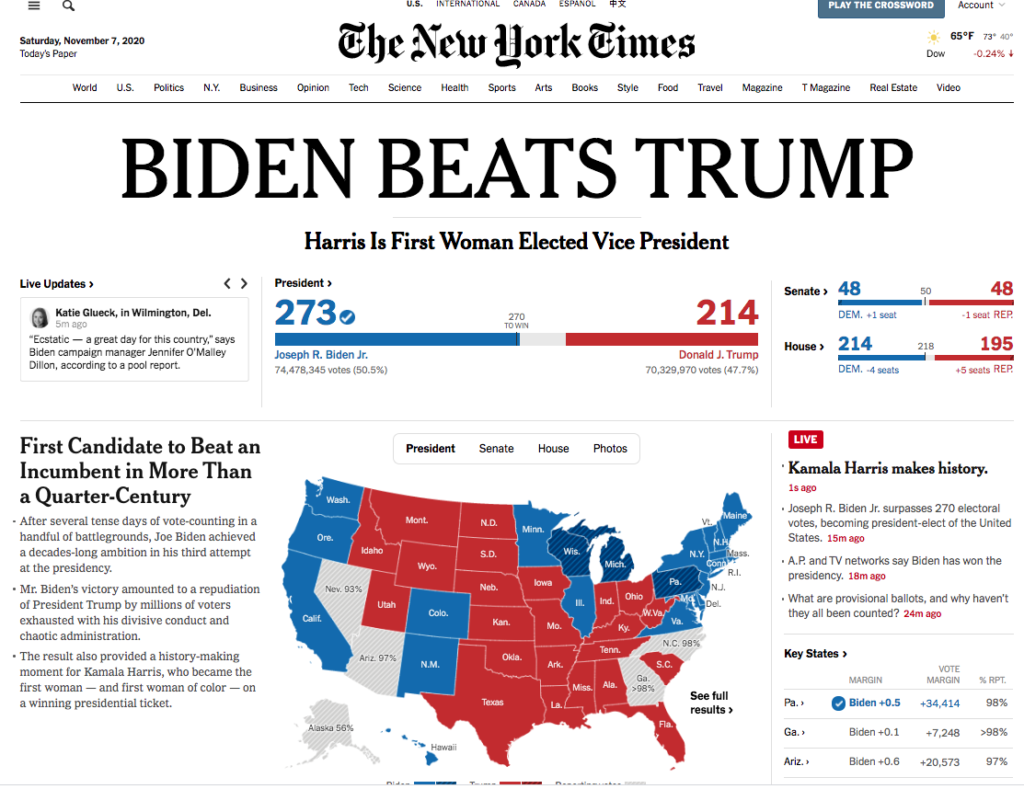 I hope to carve out time to say more about the election later.
For now, I want to continue scanning higher education’s response to the pandemic.
To begin, COVID-19 keeps expanding the number of people it infects and kills. WHO now counts 50,266,033 confirmed cases and 1,254,567 deaths worldwide. In the United States, the CDC published these numbers: infections, 9,913,553; deaths, 237,037.
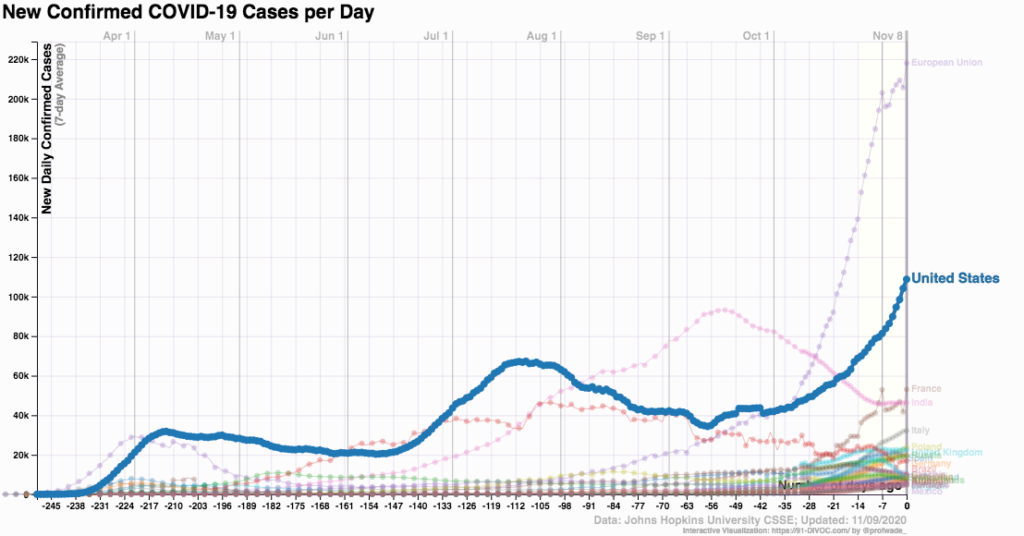
The US and the European Union continue to see infection numbers ascend at a horribly steep angle, according to 91-DIVOC graphs:
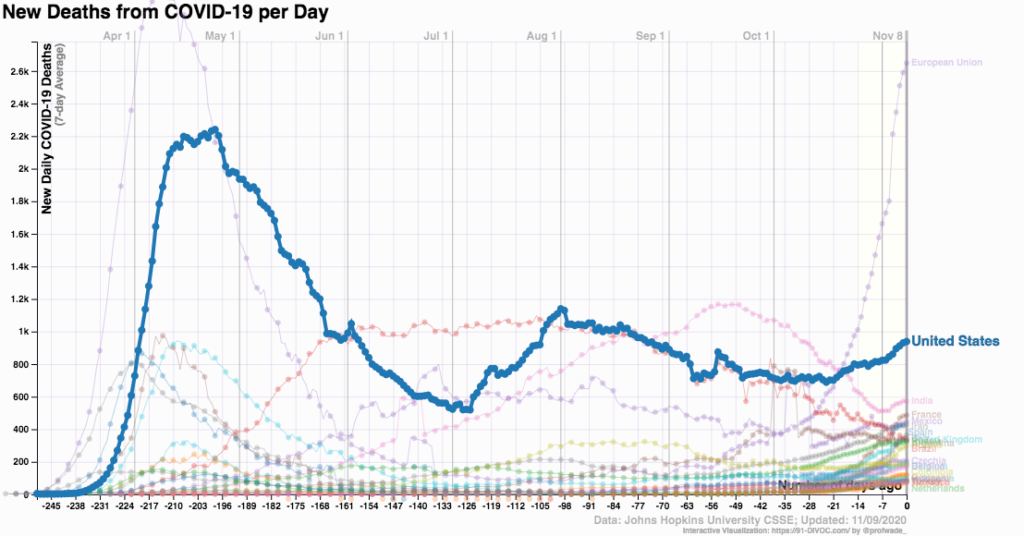
Worse, the EU is seeing COVID deaths rising as steeply, while American pandemic deaths are growing more slowly:
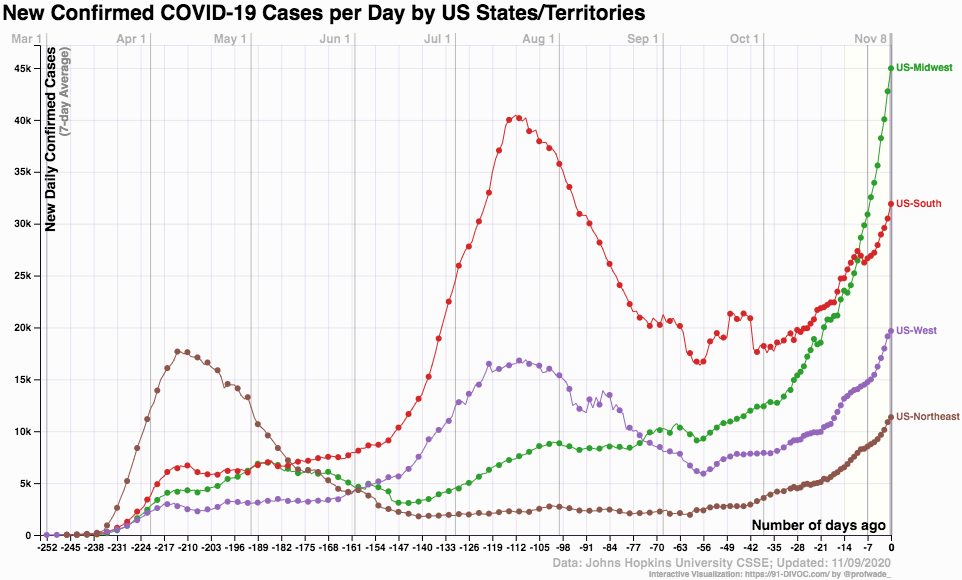
Infections rise across the United States, especially in the midwest and south:
Those two regions also lead the rest in viral deaths – but notice that deaths are rising in all regions:
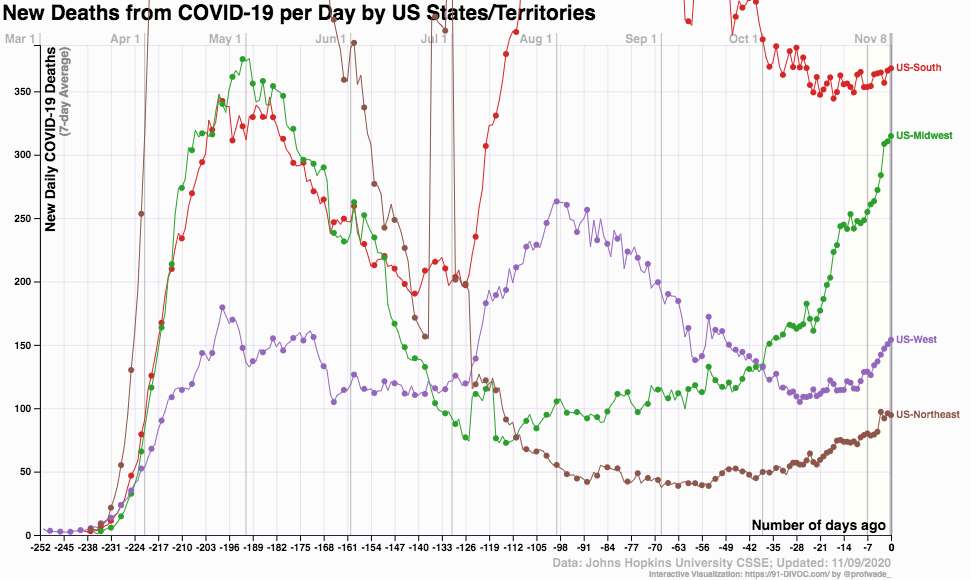
I would not be surprised to see these curves continue to rise in the United States. We’re entering winter, which means more people will spend more time indoors with other people amidst recirculating air. Seasonal flu may also interact with COVID-19. Hopefully Denmark will put down its new spread – “new” because they apparently have a mutant strain, one which infects another species (the mink) and might travel by bird.
One bright spot: two companies, Pfizer and BioNTech, announced a successful trial of a COVID-19 vaccine. It still needs more testing, authorization, production, and distribution – and then enough people need to take it (twice, apparently) to have an impact. I fervently wish them good luck. And also that they produce a generic version, or open up the vaccine.
In higher education: I have to begin by saying that there is still no good data about infections across colleges and universities. The best estimate comes from the New York Times, and that still has the problems I pointed out earlier: missing the majority of campus, not distinguishing fall term cases from the rest of the year. They claim “252,000+ Cases” since COVID first appeared. Some undisclosed proportion of that occurred during this term. Since their dataset is less than one half of American higher ed, we can only estimate that colleges and universities have suffered around… n00,000 infections in fall 2020.
We are in many ways still flying blind.
How many members of the academic community has the virus killed this semester? Again, there is no good data or tracker that I can find. When I last posted, I numbered five people: three students, one staff member, and one university president. Since then at least one other student has died: Bethany Nesbitt, 20, at Grace College.
After being released from a local hospital, she died in her dorm room. As far as I can tell, she died alone.

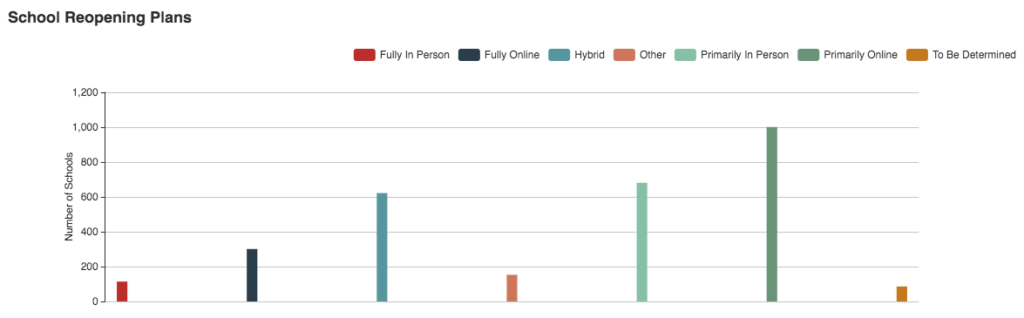
In response to this terrible pandemic, American colleges and universities continue to present a range of operating schemes, from fully in-person to wholly online. According to Davidson College’s tracker, no one strategy predominates:
Meanwhile, while much attention is paid to those semester-long strategies, there is less discussion of campuses interrupting these terms. In fact, toggle terms continue to occur across the country. (That’s when a campus switches from online to in-person, or vice versa, during a semester.) When I last wrote about this trend I counted at least 23 toggles. More keep coming:
- Assumption University flipped from in-person to online education last week.
- Keuka College switched from in-person to online for the rest of the semester.
- El Paso Community College is in the tail end of a two week online phase.
- Martin Luther College pivoted to online learning for the rest of 2020. The official announcement begins by invoking county and state authorities.
- The University of Albany announced a “PAUSE” of in-person education as cases spike there.
- Tompkins-Cortland Community College toggled to online-online for this week. So did Bucknell University.
- Mercyhurst University announced it would “finish out the semester virtually as COVID-19 cases continue to surge in Erie County.”
- Bethune-Cookman University will “begin reducing the on-campus density for the remainder of the fall semester.” In other words,
Because of spikes in COVID-19, the faculty will be pivoting to an on-line modality, utilizing Canvas and integrating Zoom and other platforms, for the remaining three weeks of the semester. The face to-face component of our blended courses will be eliminated effective Wednesday, October 28th…
For students who will remain on campus, the University has implemented an 11PM – 7AM (MondaySunday) curfew and a shelter in place order through the remainder of the semester…
At the same time other campuses undertook other anti-pandemic measures. Frostburg State University announced it was shutting down some key in-person social opportunities, but “[c]lasses will continue in their current blended or online formats.” Syracuse University announced something similar. Skidmore College suspended nearly 50 students for violating protocols. Duquesne University suspended all fraternity and sorority activity “because of ‘repeated and egregious’ violation of coronavirus procedures.”
A letter sent to members of Greek organizations signed by the vice president of student life says several members and organizations violated the university’s student code of conduct’s COVID-19 standards, so all activity will be suspended immediately.
The letter goes on to say member associations held gatherings over the 25-person indoor limit and threw parties that violated both coronavirus policies and “more typical conduct standards.” It also says members of sororities and fraternities were deliberately misleading in an attempt to limit contact tracing.
“At a time when the University and, indeed, our region needed you most to live the values you espouse, as a system you failed to do so. Furthermore, you deliberately persisted in behaviors known to endanger people…”
Inside Higher Ed has a nice visualization of these toggle terms:
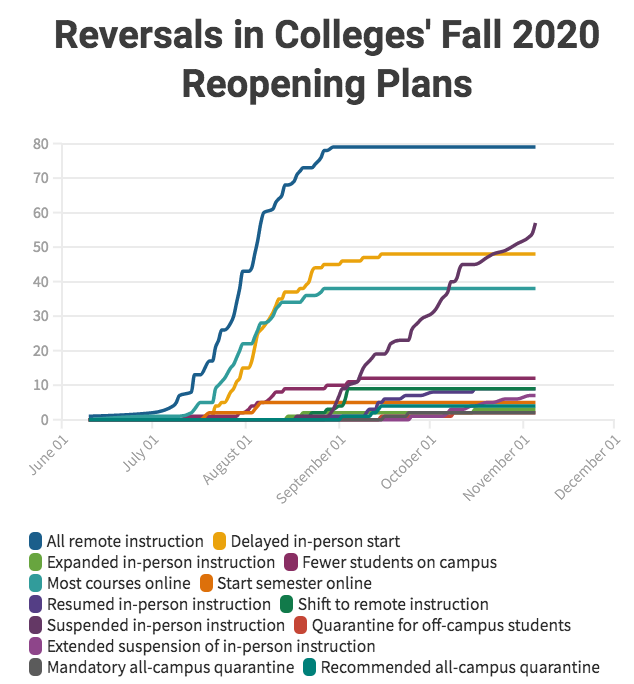
Undergraduate student Benjy Renton built a good database on “Reversals in Colleges’ Fall 2020 Reopening Plans for IHE.
Other campus responses: the State University of New York (SUNY) system announced it would test all students before sending them home for Thanksgiving break. Notre Dame’s president complained about students who stormed a football field in joyous and COVID-friendly crowds.
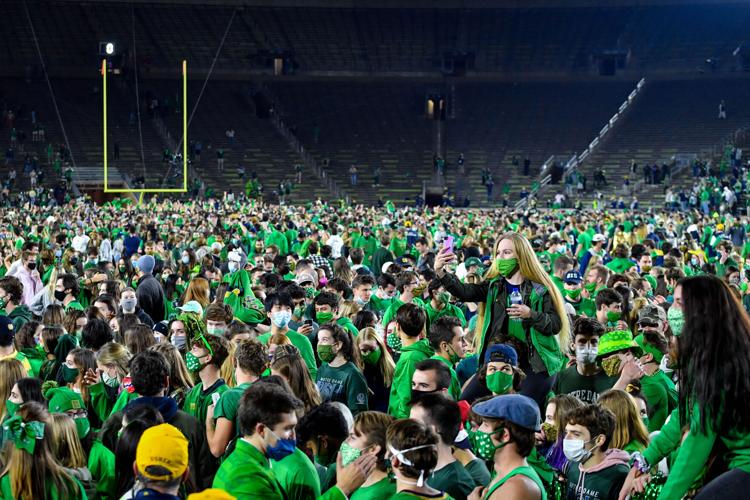
At about the same time a majority of Notre Dame’s Faculty Senate voted to “express… its disappointment in” their university’s president for participating in, and contracting COVID-19 from, a White House superspreader event.
In a very different vein, Clemson University is offering to share its testing services with other, nearby academic institutions. Good for them.
Sports: at least 49 football games were canceled due to COVID as of mid-October.
That’s where fall term 2020 stands now. But the semester is moving towards its conclusion, and spring 2021 is approaching. How are campuses planning for next year?
I’m hearing many campuses want to keep doing what they’re doing, in part because they’ve learned how to do better with whichever plan they chose. On the other hand, rising cases might drive more online teaching. Additionally, Ray Schroeder suggests changes in the business world might drive more digital learning:
As we enter the Fourth Industrial Revolution (4IR), it is clear that business and industry have moved to more deeply integrate virtual and remote work into their operations.
There is some resistance to administrations urging or requiring in-person teaching. The University of Florida plans to teach in person, but some students and faculty protest this decision.
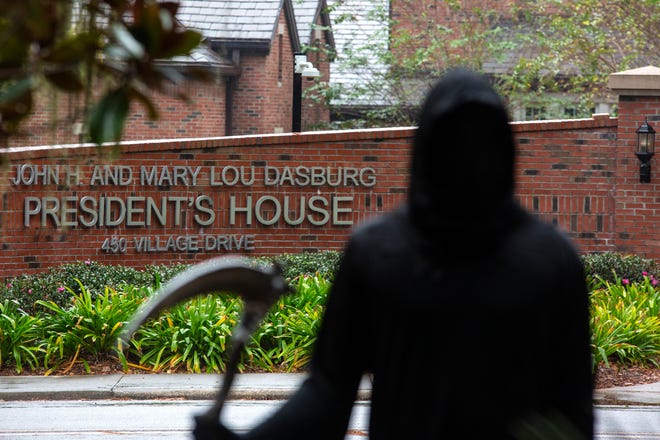
I want to end with that stark image of the Reaper confronting higher ed. It recognizes the real deaths we’ve suffered. It reminds us that the pandemic can get much worst over the next months. It’s also a mythic figure, rather than a data construct, illustrating starkly just how bad our data situation is.
Still, we move forward.
(thanks to Lisa Durff for linkage; thanks to Inside Higher Ed and the Chronicle for their ongoing coverage)



The examples here are skewed. There certainly is plenty of bad news to report including examples where a college re-opening almost certainly has caused an uptick in local cases (there was an article just yesterday about how Pullman WA experienced a huge increase after students returned to Washington State Univ).
Moreover the 6 known deaths of college students or employees are almost certainly an underestimate, there have probably been others that simply have not been widely reported.
But.
Even if the true number of deaths is ten times the known figure, 60 deaths out of over 16 million students in fall 2020 (plus literally millions of faculty and staff) is an excellent outcome, even taking into account the fact that most students are young and can be expected to have low mortality due to Covid-19.
A seat of the pants calculation: 60 deaths out of 18M students and employees is 0.3 deaths per 100,000, a figure lower than that of countries with excellent performances such as Japan and Cuba who’ve had 1.4 and 1.1 deaths per 100K.
Admittedly this is not an apples-to-apples comparison because those countries’ figures cover the entire pandemic and include their elderly population.
But compared to figures for the US, it’s not clear to me that colleges are under-performing, even after taking into account debacles such as at Pullman WA and Notre Dame. Especially with regard to mortality: even with the true figure being unknown, it’s looking like a tiny number of deaths compared to the 18M+ people enrolled or working at colleges right now.
Here’s an article that is also skewed, but in the other direction: NationalGeographic.com reporting on “The Colleges with No Coronavirus”:
https://www.nationalgeographic.com/science/2020/11/the-colleges-with-no-coronavirus/
Thank you, mkt42. That is really excellent context.
I do wish we had better data, so we could see this more clearly.
There are other ways Covid is impacting higher education.
No mention of job losses in higher education due to Covid.
Barron’s had this nugget this week on Page 7:
[Factors dampening] the labor market’s recovery … continued to be evident in the October employment data released Friday. … The net decline in government payrolls in part reflected the loss of 147,000 temporary jobs held by U.S. census workers. More important[ly], 159,000 state and local education jobs were lost. In the past 12 months, non-census government positions have slid by 1.2 million, mostly state and local education jobs, Joshua Shapiro, MFR’s chief U.S. economist, writes in a client note.
That’s a huge loss for colleagues and friends. Anyone we know?
https://www.pewtrusts.org/en/research-and-analysis/articles/2020/11/10/nearly-all-states-suffer-declines-in-education-jobs
Hey, let’s move to North Dakota, shall we?
https://www.axios.com/school-education-job-loss-pandemic-15d876fe-5d5a-47fe-8ace-3aac16d7f1fe.html
Higher education employment plummets at Pew Trust
Meanwhile, public colleges and universities have sustained an even sharper 13.7% drop in employment when October national estimates are compared with pre-pandemic February totals, although the number of jobs lost represents only about half the reduction to K-12 education (which employs far more people).
Preliminary Labor Department estimates for state education were down 10.6% in September from a year ago. Five states experienced losses exceeding 20%: Colorado, Maine, New Hampshire, Ohio, and Wyoming. Many of these furloughs or layoffs reflect colleges delaying reopening or canceling classes on campuses. An initiative by Davidson College tracking reopening plans shows only about 28% of public and private institutions are holding classes either fully or primarily in person.
Higher education employment fell as the pandemic has triggered state funding cutbacks, new expenses such as for testing and contact tracing, and enrollment declines. In a Sept. 25 letter to congressional leaders, higher education associations reported revenue losses, and new costs, had already greatly exceeded the groups’ prior estimates. The National Student Clearinghouse Research Center published data showing a 9.4% drop in undergraduate enrollment for public two-year colleges and a slight decline for public four-year institutions.
Many local school districts and public colleges have not needed to issue many pink slips to trim their payrolls. Instead, with the pandemic causing some teachers and staff to either retire or leave their jobs, they’ve just not filled vacant positions. About 82% of college and university presidents anticipated hiring freezes in a July Association of American Colleges and Universities survey.
Given the magnitude of employment declines so far, public K-12 and higher education could effectively act as a drag on broader economic growth. Education, in fact, has experienced noticeably steeper declines than most other areas of the economy. As of October, local government jobs excluding education are down by a smaller but still significant 4.8% since before the pandemic hit the United States in February, while state government workforces have remained relatively flat nationally. Overall, public sector jobs have experienced more severe losses than at any point during the Great Recession and subsequent recovery.
Yes, the academic job cuts – staff, faculty – have been coming in since summer. More on deck.