
This week I tried out a new exercise in one of my seminars, and wanted to share it with you all.
The class is a graduate seminar on technology, innovation, and design in Georgetown’s great LDT program. There’s a lot of tech history and theory involved, and I’m always looking for ways to make that material live for the students.
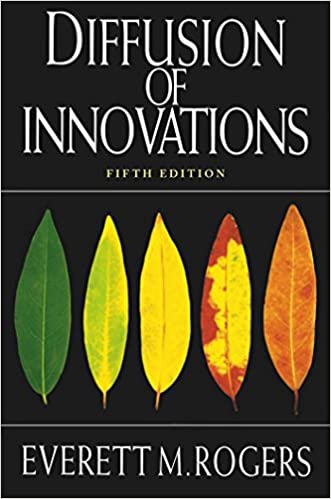 During the past two weeks the class worked through Everett Rogers‘ Diffusion of Innovations textbook (5th edition). This is the great work on early adoptions, change agents, opinion leaders, homophily vs heterophilia, etc. Rich, deep stuff, clearly organized and studded with neat stories.
I admired how the students reflected on the material, thinking through its different concepts and exploring examples. Yet I still wanted more.
In one class session we were scheduled to finish Rogers, then start into Clayton M. Christensen’s disruption theory with one short yet pungent reading.* I was concerned that they were starting from a vague sense of disruption as chaos. Besides discussing the texts, what else could the students do to deepen their understanding?
Hence the exercise:
First, I asked the class (all students masked up, as well as myself) to come up with a hypothetical product, one which didn’t exist now. Fearing that might be too broad or daunting, I narrowed down the charge to imagining a holographic projector. They thought about this. I mentioned the Star Wars chess game as one example. They thought some more, then started developing an idea.
The thing included an overhead projector, below which a 3d scene would take place. This would be true 3d, a vision which would display differently as you walked around it, much like a vase shows different sides from different viewpoints. Users could interact with it with their hands on a very basic level, reaching into the displayed scene. It didn’t require user tech at all – i.e., no 3d glasses or headsets.
I encouraged them to reach back in the syllabus and bring up previous readings and topics for inspiration. They started fleshing it out in terms of use, business model, and limitations. Then over to Rogers – who would use it? How would uptake spread, or how wouldn’t it? Now they dove into early adopters, skeptics, laggards. Picking out opinion leaders and change agents became very practical.
We toyed with names for it. The nerdiest member suggested EMH. That’s what I’ll call it for now.
Then I switched things up. Set aside the EMH for now, I told them, and let’s dive into disruption. We quickly assembled Christensen’s theory, along the way setting aside less nuanced senses of disruption. They considered different examples which might or might not fit.
Then back to the EMH. “OK,” I told them, “the EMH company is now the big incumbent in the holographic display market. What does a disruptive competitor look like?”
Ah. Now the exercise and the readings came together. Small, was the first idea, smaller than the EMH, like a handheld or arm-mounted display. Cheaper. Lower quality. They realized that EMH customers tended to be institutions or groups: schools, theaters, the military. The competitor would be cheap enough for less well resourced groups – and individuals! – to purchase. As it spread the EMH firm could easily scoff at the lower quality and smaller size… until the competitor’s product evolved past that low-market end and started competing with it. Now we were talking disruption. Students started imagining ways the competition would proceed, including through further innovations.
At that point we hit the last minute of class, and I had to switch over to prepping them for next week.
I think it went well. I’d like to try it again with a bit more time and perhaps some more props. Perhaps create a digital or physical sketch of the first product. Or have the whole class built the first innovation, then split them into two, with one group stewarding that product while the other sneakily builds the down-market disruptor.
*If you’re critical of Christensen, don’t worry. Check the linked syllabus. In a few weeks we read Jill Lepore’s critique.



Fabulous! An engaging and memorable exercise for your students!
A digital or physical sketch would be totally appropriate :).
Excellent episode in your continuing saga, Bob
Clayton Christensen’s crackpot “theory” of disruptive innovation represents some of the worst thoughts in businesses administration–especially when it’s applied to the privatization of higher education. How was Christensen and the HBS perspective different in mindset from Frederick Winslow Taylor, who systematized the oppression of workers? #collegemania #robocollege #robostudent #collegemeltdown #studentloandeath #sciencenotsophistry
https://www.highereducationinquirer.org/2021/07/the-growth-of-robot-colleges.html
https://www.highereducationinquirer.org/2021/07/academic-capitalism-and-next-phase-of.html
An interesting exercise, but it might be more fruitful from a student-discovery perspective, to give them the chance next time you open the discussion, is not to characterize Christiansen’s theory in advance as “crackpot,” but to give them the chance to explore it in connection with readings that praise it and others that critique it, so that they can come away with their own conclusions. Otherwise, glad you cover Christiansen, Taylor, and others in the context of labor. Excellent contextualization, Bob
We need to look under the hood, and this article by Geiger gives context to the ways that Silicon Valley start-ups have leveraged the “disruptive innovation” narrative for their benefit — with the help of the techno-press. Good example, Theranos, now widely understood to have been a fraud. Bogus eschatology, says the article.
https://researchrepository.ucd.ie/bitstream/10197/11250/4/Geiger%20JCE%202020.pdf
https://www.vanityfair.com/news/2016/05/theranos-silicon-valley-media
Okay, so I’m jumping ahead to Jill Lepore, and how Christensen’s Disruptive Innovation is NOT a law of nature. He “…argued that, very often, it isn’t because their executives made bad decisions but because they made good decisions, the same kind of good decisions that had made those companies successful for decades. (The “innovator’s dilemma” is that “doing the right thing is the wrong thing.”) As Christensen saw it, the problem was the velocity of history, and it wasn’t so much a problem as a missed opportunity….” Exactly right!
This is the better approach for dealing with complex systems that are tightly coupled, because, like in the Bucyrus example, it’s the macro-environment that matters. Like, “the velocity of history” as context.
Innovator’s dilemma comes into play when complex systems reach critical points — up until that point, all decisions are GOOD decisions — decisions improve efficiencies, squeeze out waste, cut-back on redundancy, so much so that we end up with systems on the verge of collapse. Like hospitals unable to handle Covid-surges due to budget-controls, and the lack of spare beds, and an AMA controlled system of medical education.
The irony, of course, is that all the *right* decisions push organizations to the brink of collapse even as they are being made “resilient”. Catch the irony there? Improvements are locally valid, but not on a global scale because they result in self-organized criticality (SOC).
I remember when I was meeting with DEP-Air Quality in Boston to go over the FEIR for a new incinerator, and I was shocked to learn air quality modeling was limited to single-source emissions, unable to determine the net effect of all pollution sources. Aggregation of stationary sources was beyond the planners, at the time.
We need to think of innovation along the lines of the net effect, not just one novel product displacing another. Look at Lebanon, and the California power grid. All are slipping over the edge, past their critical points. Same for global warming. Covid.
So, yeah — chaos is relevant, but only in the context of complex systems pushed past their critical points. This, after all, is a law of nature. And you can’t fool mother nature.
https://en.wikipedia.org/wiki/Self-organized_criticality
Bryan, I’m not sure where my comment went is, hope that it’s just waiting to be approved.
Glen, thanks for your comment and your outstanding analysis. My comment waiting moderation was also critical of Christensen but it wasn’t as polite. As you point out–with a great real world example–Christensen’s Harvard Business School perspective was not just stupid, it was dangerous.
Christensen’s so-called “theory” stems from centuries of poorly thought out conceptions about humans–by seriously flawed thinkers and doers: from Adam Smith, Thomas Malthus, and Herbert Spencer to Frederick Winslow Taylor, to the Chicago mob, including Milton Friedman and Theodore Schultz, and to industry officials, including former Treasury Secretary and Harvard President Larry Summers.
Christensen’s ideas have been tested in higher education, so to speak, by for-profit colleges and actually to US higher education in general. And what has resulted? A “racket” of efficiency: starving adjuncts, billions of dollars spent on advertising and marketing, “robocolleges,” “robostudents,” “student loan death,” and a growing army of the “educated underclass.”
Bryan,
This is a long video but it’s well worth it. Clayton Christensen is one speaker, but there are several other people who explain the limitations of disruptive innovation theory in higher ed. #collegemania #collegemeltdown #robocollege #robostudent #studentloandeath #sciencenotsophistry
https://blog.extensionengine.com/50-of-universities-will-be-bankrupt-in-10-15-years/
That was in 2014, so I guess Christensen was wrong — I think Prof Galloway believed Covid would accelerate the crumble, but again, he was wrong too. Why????? What is everyone missing?
https://www.profgalloway.com/higher-ed-2-0-what-we-got-right-wrong/
https://www.profgalloway.com/post-corona-higher-ed/
Bryan, you and your students may want to check out Guild Education, because one of its senior strategists is Michael Horn, co-founder of the Clayton Christensen Institute for Disruptive Innovation. I have been investigating Guild Education and this report provides more information than what can be found in the any PR articles about Guild. #collegemania #collegemeltdown #robocollege #robostudent #sciencenotsophistry
https://www.highereducationinquirer.org/2021/04/guild-education.html
There is a Gestalt-shift here that we should note — adding to my comments — that simply says “disruptive innovation” (like punctuated equilibrium) is the norm whereas equilibria are not (I was going to say, outliers, but that’s too strong a statement to make).
We are always at or near critical points of one kind or another, but cognitively we are unable to maintain that level of chaos for very long; and so, we construct heuristics that assume stability and biased hermeneutic frameworks that favor ignorance. A good example is the long series of financial panics in US history. Economic life, perforce, points in the other direction.
What a great way to help students learn this material! And I appreciated the LePore reference!
There are two sociological aspects of the diffusion of innovation that should not go unmentioned.
Rodrigo Canales, with Yale SOM, has pointed out that change always involves a cognitive dimension. I find this to be especially true for the adoption of innovation. Adopters must understand what the innovation is for, what it does, and how to adopt it. There is no Zoom for those that don’t know how to turn on a computer and access the internet — leaving aside dependencies on prior innovations.
Whether cognitive changes occur prior to or simultaneously with adoption is a chicken-and-egg question, I think. What’s important is that adoption is not the result of mere belief in newness for its own sake, but rather something like a new orientation, a new intentionality, that converges and shifts consciousness rather than shatters (or disrupts) it. In effect, changes in the cognitive footprint of adopters is a necessary condition for successful diffusion.
In his book, The Structure of Scientific Revolutions (1962), Thomas Kuhn is quite blunt that changes in scientific paradigm occur when the older generation dies out, taking their outmoded ideas with them. Cognitive footprints are mostly generational, as the sociology of knowledge holds.
The second, and more important point, is that innovations are not adopted without a collective emotional component, such as enthusiasm, confidence, or some other positive emotion.
A good example of this in the pure state are social movements of all kinds, which are not successful without high levels of emotional commitment, strong feelings of solidarity, and what Durkheim described as moral righteousness. Without positive emotional energy, good feelings associated with adoption, no one would buy it. People have to feel that this is the right thing to do. Perhaps this is what “branding” is all about, as Apple has shown.
This is the big problem with online instruction, because most people feel that Zoom learning is exhausting, burdensome, inferior to face-to-face, and the only reason for it is that the authorities are making them do it, and there are no alternatives.
These sociological aspects enable us, I think, to side-step draining disruptive innovation debates, or at least, to avoid getting bogged down in them. Charisma in Max Weber, solidarity in Emile Durkheim, and Randall Collins’ IRCs are all sociologically important for successful adoption, in conjunction with the cognitive changes that I mentioned.
And this is also especially true at the corporate level, because engineers and researchers themselves have to experience BOTH of these to keep logging in the hours and hours needed, to keep fighting for years for the resources to perfect their innovations; and corporate management — as well as the boards themselves — must be equally committed to the development of specific innovative products. Not an easy thing to achieve.
None of Christensen’s “disruptive innovations” are deus machina, because they are deeply embedded in social networks that are either charged up with enthusiasm, or they are not. This is why myriad clever inventions are never successfully adopted, and those sponsored by emotional wizards like Steve Jobs that create “reality distortions,” often are.