COVID-19 finally gets me, days 1 and 2

So this happened, as they say:

2 COVID tests positive

That was yesterday morning.

To back up and explain: I’ve avoided COVID since the start.  I’ve masked, social distanced, vaccinated, shunned people, the works.  But lately clients have been wanting more in-person experience, especially since (as the president said) “the pandemic is over.”

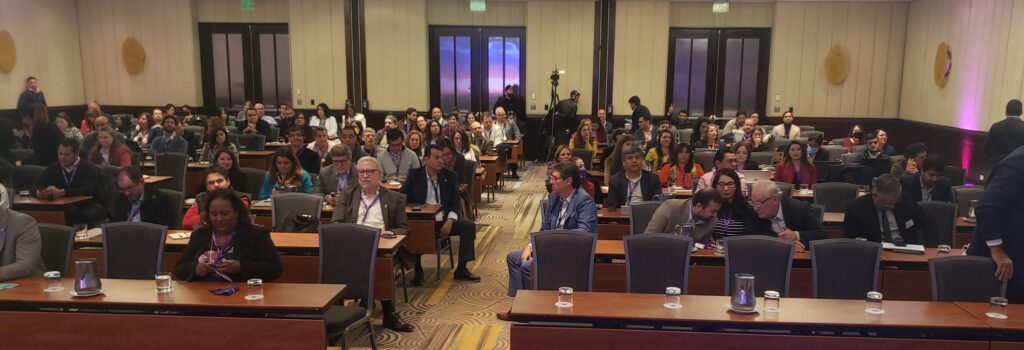
Earlier last week I participated in an international conference (live blogs 1, 2, 3). Two days ago (Thursday) I started feeling poorly.  Symptoms were classic cold stuff: coughs, sore throat, soreness, head pain, some hot flashes. I took a COVID test and it came up negative.  So I went to Georgetown for class – socially distanced, masked – along with a video meeting and the Forum.

buy xenical online buy xenical no prescription generic

  As usual work energizes me.  I didn’t feel tired until I got home, and that just made sense after a long day and a long week without enough sleep.

On Friday the symptoms persisted, so I medicated with allergy pills, sudafed, herbal tea.  Hot showers did wonders.  I didn’t take time off, but worked my usual schedule.

Saturday morning I woke up several times with coughing. Throat soreness was still going on, so I took the COVID test.  That means the whole deal: poking myself in the nose, squirting fluid into a tube, squeezing the thing, dripping onto a cartridge, then waiting 15 minutes.

That second line appeared and hit me like a hammer.  If you look at the photo you can see it wasn’t a faint line, but a solid and clear one.  Still, I reasoned that these kits sometimes give false results, so I took a second.  *Immediately* the second line appeared, clear as could be.  My wife told me it was certainly positive.  I insisted on waiting the full 15 minutes to be sure.  Positive it was.

I’m writing about this because I’ve been studying COVID since the start, so it’s appropriate to report my first personal experience with the bastard.  Perhaps this will be useful to some people, especially in the future.

After the results appeared I relocated to my bed and set up shop: laptop and power supply, phone and ditto, a tack of handkerchiefs.

buy zydena online buy zydena no prescription generic

My wife opened a window to improve ventilation then closed the door on my confinement. She and my daughter have been taking turns bringing me hot water and herbal tea.

I immediately reached out to my medical care providers.  Now that means Kaiser Permanente, so I clicked to their website, logged in, and found a live chat with a nurse.  She shared a lot of information, including a recommendation to make an evisit to set up Paxlovid.  I figured out the “evisit,” which turned out to be a questionnaire.  It also portrayed a scary view of Paxlovid:

Paxlovid warning KP website

“Please don’t sue us.”

When I completed the form I waited for some reply on the Kaiser site.  An hour or so later it came as an email-like message there. A medical doctor approved the drug, but wanted me to get a kidney test first. I asked him for details, and the KP site ate my reply. I asked again and the doc pointed me to a facility half an hour away.  I drove myself there – alone, so as not to condemn any passengers.

buy vardenafil online buy vardenafil no prescription generic

Half an hour away was a huge, brand new medical facility.  I parked and tried to check in at a bank of machines, but the interface told me not to, as I was getting a lab done. I couldn’t figure out what to do next. No Kaiser staff were nearby, so I started wandering around the place, looking for help. A kind security guard led me to the lab space, which had its own check in machine.  I checked in and waited.  A grumpy fellow patient told me only one lab tech was working.

Time passed.

Kaiser Permanente Caton Hill lab entrance

It turned out the grumpy patient was right.  One poor guy was working by himself, and drew my blood with astonishing skill.  Then he sent me off to urgent care.

Urgent care was elsewhere in the building. There I was processed and waited, seen, waited again. Really kind docs and nurses patiently took my vitals, answered my questions, and nudged me to the next station. One doc walked me through the blood test, which was actually fairly comprehensive (things were good, except creatinine was a smidge high). Eventually I was sent to the pharmacy, which eventually produced the paxlovid.  I drove home, tired and sometimes coughing myself into blurry vision.

Home and masked, I ran to the quarantine bedroom. I ordered out for dinner, since I couldn’t make anything (quarantine violation) and didn’t want to put my family out. They did bring the bags of hot and sour soup plus black bean tofu up to me.  I ate some of them. After doing emails and Forum work I fell asleep.

Sunday – today – I ended up sleeping twelve hours.  That’s twice what I have been normally getting in a single night.  It wasn’t great sleep. I woke up several times with fever or the frightening sensation that my throat had closed.  Once I leaped out of bed, clawing the CPAP machine off.  I kept falling back asleep. Unsettling dreams came with great clarity.

Paxlovid in blister packs

I’ve spent the afternoon in bed, resting and working. I watched a movie I’d always wanted to see from start to finish (Seven Faces of Dr. Lao, 1957), wrote emails, worked on the new FTTE report, added to the the book index. I gobbled paxlovid like manna and basked in a long, hot shower, which truly improved things.

I’ve been recording my data on a Google Doc.  Temperature has swung from 96 to 99. Pulse/ox is ok. Weight is down (to 215).

So what is this like?

Right now my body’s not doing too badly, thanks to my assiduous vaccinations and possibly my good health. My throat’s still sore and I manage to exude some very Halloween-appropriate amounts of mucus.  The hot flashes are intense.

My mental state… is torn. On the one hand I’m filled with dread. I don’t expect any physical damage to my body, thanks to the good things I’ve done, but long COVID can laugh at any of us. I’m most terrified of mental degradation.

On the other hand I’m fascinated by the processes involved, from the infection to the insurance company’s.  I’m also struck by the feeling of participating in the history that I’ve been forecasting and studying.

I am not someone who knows how to stop working. I am frustrated at working less and not being able to do any housework.  Partly this is an American thing. I know at a gut level that every day off is a potential blow. There isn’t much of a safety net.

buy valif online buy valif no prescription generic

  But I also have so much to do!

Back to writing and guiltily watching more Criterion. I’ll blog more if there’s interest.  Happy to answer questions.

Posted in coronavirus, personal | 35 Comments

Live-blogging the Dickinson College International Climate Symposium, day 3

Dickinson International Climate Symposium_Logo_FINAL_OL_1This week I’m participating in an exciting conference, the Science-Based Choices for Climate Action, Insights from the IPCC 6th Assessment Report.  I look forward to soaking up presentations, and also to feedback from my presentation about higher education’s future.

I‘m tweeting the event (hashtag #DsonICS22) and live-blogging it here.  (Here’s the post for day 1. And here’s the one for day 2.) I’ll update this post during the day.

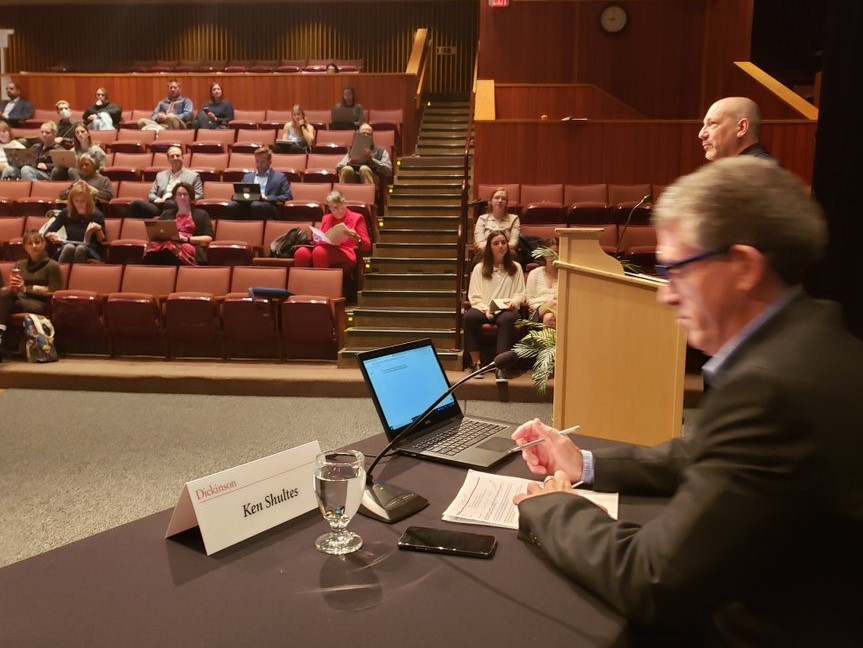
Today we began with a panel about higher education and climate change.  I was on it, alongside  Tim Carter, President, Second Nature, and Debra Rowe, President, U.S. Partnership for Education for Sustainable Development.  Our moderator: Ken Shultes, Dickinson College, started things by asking us to describe positive developments we see.  Rowe mentioned her model of change via nudging and nurturing. Carter described higher education as a climate accelerant; changing higher ed requires catalysts (which can involve present and former students) and champions (who can be anyone).

In a darker mood, I recommended the growth of teaching about climate change across the curricula.  I also argued that faculty governance might have taken a hit during COVID, suggesting greater administrative power might be in the offing for institutions facing the climate crisis. Further, I noted that student mental health issues will require institutional support, including for faculty teaching students with traumatic histories. Rowe recommended practical, positive assignments t0 boost student mental health, as well as undergraduate research and more climate-oriented career options. I chimed in with the last, noting rising climate jobs.  Carter advised us that climate competes with dozens of other issues for primary in college mission statements, but recommended we pursue such a position aimed at the grandest challenges.

Dickinson climate symposium_day 3 my panel looking at Ken and Neil from the side

Shultes asked me to speak to what colleges and universities could do in the future, and I spoke rapidly to a range of points: improving or conflicted town-gown relations; academic organizations seeking to influence the world; instability of politics; the impact of climate migration and potential campus responses; challenges of improving our physical plant. In response Carter thought academia would not inspire society on climate issues, given that corporations were doing more impressive work.  Rowe listed a series of projects she facilitates; I wasn’t able to capture their names.  Shultes observed that while campuses have done some good work in decarbonizing, they haven’t done as well in getting that story known.

Rowe describes a group of academic climate projects she works with, including collaborating with textbook companies to get new materials out. She advised against class modules on climate, finding them underused.  She recommended universities work with community colleges and that people mobilize alumni associations on climate.

One question appeared – how can we (students, I think) influence faculty to do more on climate? Rowe advised researching peer institutions to instill competition, while addressing a chief academic officer (dean, provost, academic VP) to encourage professors.  Carter recommended setting up incentives to work on climate. I pointed to scholarship and publishing, with a side note supporting open access for monographs and especially articles.

Another question asked, what should we teach?  There was a shared sense of students having to learn skills for activism, climate change mitigation and adaptation, and community development.  Rowe posed two future humanities, one barbaric and the other caring, advising us to teach students to encourage that second world. I liked this, and asked people to think of long-term personal engagement with higher ed, a la the 60 year curriculum.

After this panel concluded I worked my way back to the audience for conversations.

Then the next panel, Teaching Climate Change in the Liberal Arts Curriculum, started up. All participants were from Dickinson College.  One professor (I missed the name) teaches Earth science, emphasizing the concept of the Earth system as a complex system. Tony Underwood, Dickinson College, economics, approaches the climate crisis through a social science lens.  His two classes on this subject examines the circular economy, externalities, how to frame the growth-sustainability dynamic. Moderator Emily Pawley is also an environmental historian, and her challenges include scale (a vast topic!) and convincing people that the past matters for climate change.  Kristin Strock teaches environmental studies and focuses on water, yet has to deal with policy changes (definitions of navigable water) and wants to turn students into turbulent problem-solvers.

Question: how do you deal with despair?  One professor describes current, traditional-age students are the climate generation, concerned about social justice, digitally connected, isolated, and stressed. Identifying community is one way to help that population deal: teaching “connecting before content.”  It’s unfair to ask students to generate solutions and to blame their elders. Many climate solutions have a history which we can draw on.  Faculty are able to share resources on trauma-informed teaching.

We broke for lunch.

Returning, the afternoon began with a virtual panel on Social, Economic and Technological Transformations:

What social, economic, and technological transformations are needed and feasible for creating a low or zero carbon future? What policies and actions can help drive these changes?

Rachel Cleetus, Union of Concerned Scientists, described working in climate change as interdisciplinary space. Sivan Kartha, Stockholm Environment Institute – USA and IPCC Working Group 3 author, researches equitable transitions, based on his physics training.  Gabriel Blanco, National University of the Center of the Buenos Aires Province and IPCC Working Group 3 author, develops energy scenarios for different goals and purposes.

The panel’s moderator, Forrest Watson, Dickinson College, asked for which technological innovation people were most interested in.  Panelists instead described ways they think about technologies, from people-centric frameworks to bearing in mind social justice.  Conversation turned to trade-offs, starting with bioenergy.

Watson asked participants about fracking.  One observed the speed of technological change.  Another noted that the fossil fuel industry has blocked alternatives from rising.

I asked the panelists what they thought about blockchain. One speaker was skeptical of proof of stake for being a problem if scaled up. At a different level, he also thought it more important to build trust between people and institutions, rather than to go around that issue with tech.

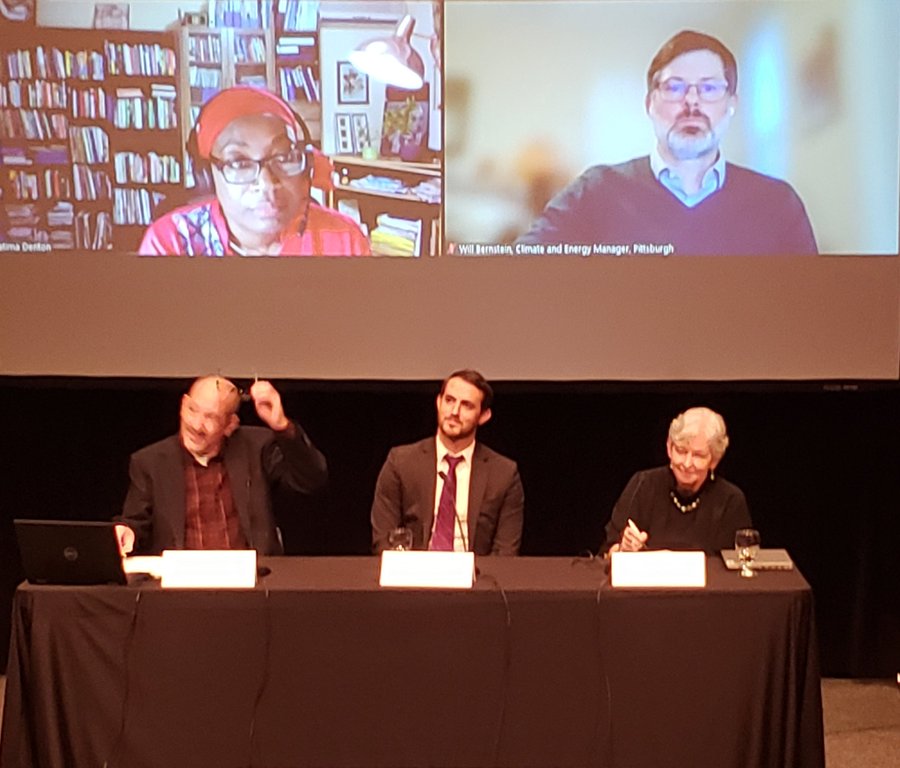
The next session dedicated itself to Just Transitions.  Benjamin Preston, RAND and IPCC Working Group 2 author, described the climate movement catching up to social justice. Lisa Schipper, Environmental Change Institute and IPCC Working Group 2 author, mentioned her background in feminism. Fatima Denton, United Nations University Institute for Natural Resources in Africa and IPCC Working Group 3 author, spoke of observing male sexist behavior in her development work.

Preston spoke to the importance of social justice as something climate action shouldn’t lose sight of.  Schipper describes a gender perspective which examines power and multi-dimensional inequalities.  Climate change multiplies these inequities.  Women bear the brunt of difficult times, including climate stresses, but offer smaller carbon footprints than men.  Denton notes challenges for African women relying on natural gas for cooking.  Women could take a leadership role in climate action, helping shape a just transition.

One question asked about women and the informal economy.  Denton saw alternative energy not making much progress in the latter.  She went on to mention the Fourth Industrial Revolution idea, and how it depends on extracting minerals from Africa.  I ask about the role of the arts and humanities, including future visions from solarpunk, Afrofuturism, climate fiction, etc.  Schipper approves, citing Ghosh’s The Nutmeg’s Curse and celebrating music as a way of thinking ahead.  Preston finds the humanities useful at imagining futures, and points to the next climate assessment hosting an art contest.

Dickinson climate symposium_day 3 Ko Barrett closing keynote

The day and conference concluded with a keynote and panel. Ko Barrett, National Oceanic and Atmospheric Administration and Vice Chair of IPCC, described a groundswell of popular demand for climate action.  She supports subnational action and celebrated the local actions this conference described.

A panel formed and general discussion followed.  A New York Times headline article appeared, which led Barrett to remind us that international climate agreements are voluntary.  Denton mentioned regressive movements, like turning back to coal and maintaining demand for other fossil fuels, and problems like supply chain issues.  Yet she thinks some developing nations are rethinking extractive industries. They are also suspicious around other nations’ discourse (“doublespeak”) on their own use of fossil fuels and sovereignty.   “We are off track now.”

How do local governments grapple with the crisis? Sam Robinson, Deputy Chief of Staff, Office of the Governor of Pennsylvania, described an oscillation between state and federal actions and resources on climate change.  Will Bernstein, Climate & Energy Manager, City of Pittsburgh, said that international and national decisions influence urban policy work.  Barrett asked about corporate pressure.  Robinson said some exists, but trails, rather than leads.  Bernstein mentions the state’s huge natural gas deposits.  Bond markets are key to city finances.  Debra Roberts joined the discussion to describe upcoming COP meeting themes: the global South’s frustration; details of implementation, especially quantified finance and loss and damage; connections between local governments and science.  Multilateralism is at risk, as the global South might disengage.

One question asked about clarifying climate timelines. Are we always n years from catastrophe?  One answer: the science isn’t precise enough yet, but is improving.  Denton argues for balancing threat and opportunity language.  “Global average temperature” is locally meaningless, place dependent.

One student (I think) asked about people valuing fossil fuels more highly than renewables.   Leary recommended pointing out premature deaths due to fossil fuel burning.  Preston thought pointing out emerging jobs is useful.

A question pondered massive migration into Pennsylvania from the American southwest.  One official answered that there isn’t a lot of migration planning under way.

Robinson mentioned that environmental issues are dropping in polls.  The trick is to make climate real in people’s lives while also identifying opportunities.

Dickinson climate symposium_day 3 final panel

Roberts posed a question to applause: how many Americans are prepared to give up stuff – freedom of choice – so that Africans may live?

A faculty member asks us to think about, ah, non-polite means of political influence.  A student responds that civil disobedience movements succeed when anchored on a concrete goal or clear identity.

Closing thoughts: outsiders can push government to do new things.  Multiple means of political pressure are needed.  Civil disobedience works… but only in some places.  Too much mining has made it difficult for some area to recover agriculture.  Climate fatigue is a serious problem – 27th COP meeting!  The mitigation burden for one part of the world (1 billion, Global North) can’t be transferred to another, (Global South, 7 billion) and then the other required to run a race.  Local politics: every decision can impact the climate crisis.

Final note: we have to be brave, to stay in the room, to find purpose.


Posted in climatechange | 2 Comments

Live-blogging the Dickinson College International Climate Symposium, day 2

Dickinson International Climate Symposium_Logo_FINAL_OL_1This week I’m participating in an exciting conference, the Science-Based Choices for Climate Action, Insights from the IPCC 6th Assessment Report.  I look forward to soaking up presentations, and also to feedback from my presentation about higher education’s future.

I‘m tweeting the event (hashtag #DsonICS22) and live-blogging it here.  (Here’s the post for day 1.) I’ll update this post during the day.


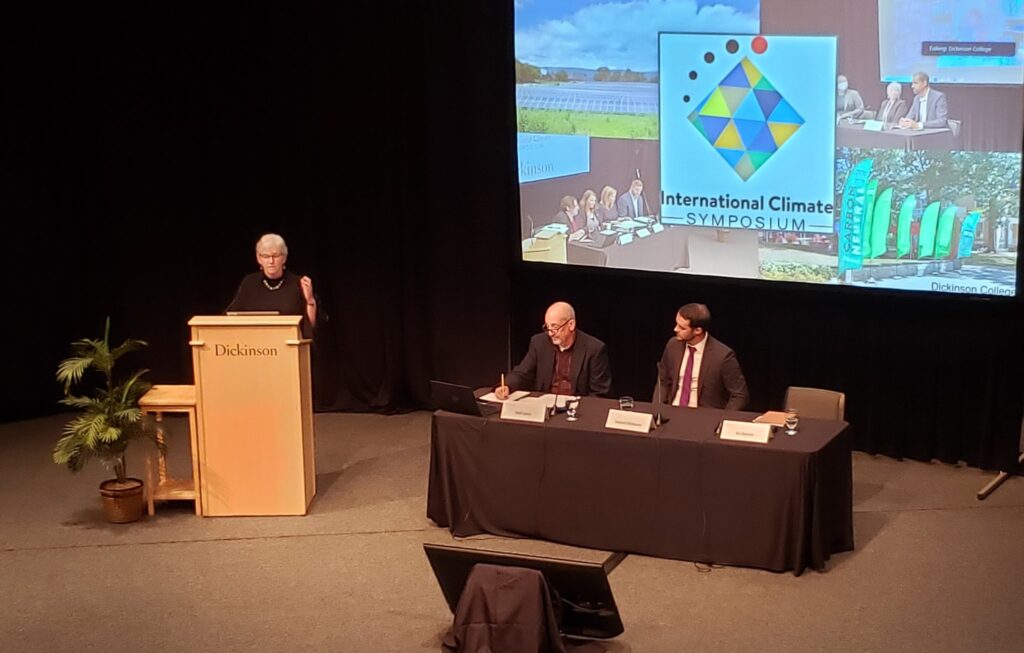
Neil Leary, Dickinson College, organizer of the event, welcomed in-person and online audiences.

Then we proceeded to the first panel, with the theme of rising to climate change’s challenges.  It included: Ko Barrett, Senior Advisor for Climate, National Oceanic and Atmospheric Administration, and IPCC Vice Chair; Fatima Denton, United Nations University Institute for Natural Resources in Africa and IPCC Working Group 3 author; Benjamin Preston, RAND and IPCC Working Group 2 author.  Rachel Jacobs, Dickinson College, moderated.

Its opening discussion looked at the unique nature of the IPCC, as a “handshake between science and policy,” for its rigor, and for its diverse population.  One point: the IPCC report generation process is very contested, yet ultimately policy neutral.  This last point elicits the desire among some writers to write more special reports.

Jacobs asked how politics impact the IPCC report creation process.  One response: the scientific literature is biased towards scientific literature from the global North, and towards the English language.  Another: the process should be more democratized.  A question about how the process works in practice yielded an answer: a writer handed a stack of bullet points, told to translate them into a chapter. This involves working with a huge amount of reading, as well as fellow writers who can be very skeptical.  One additional point: the IPCC produces a lot of grey literature.

We returned to the theme of diversity and reputation. The IPCC should encourage more people from the global South, more women, more graduate students to participate, and pushing governments to support this.

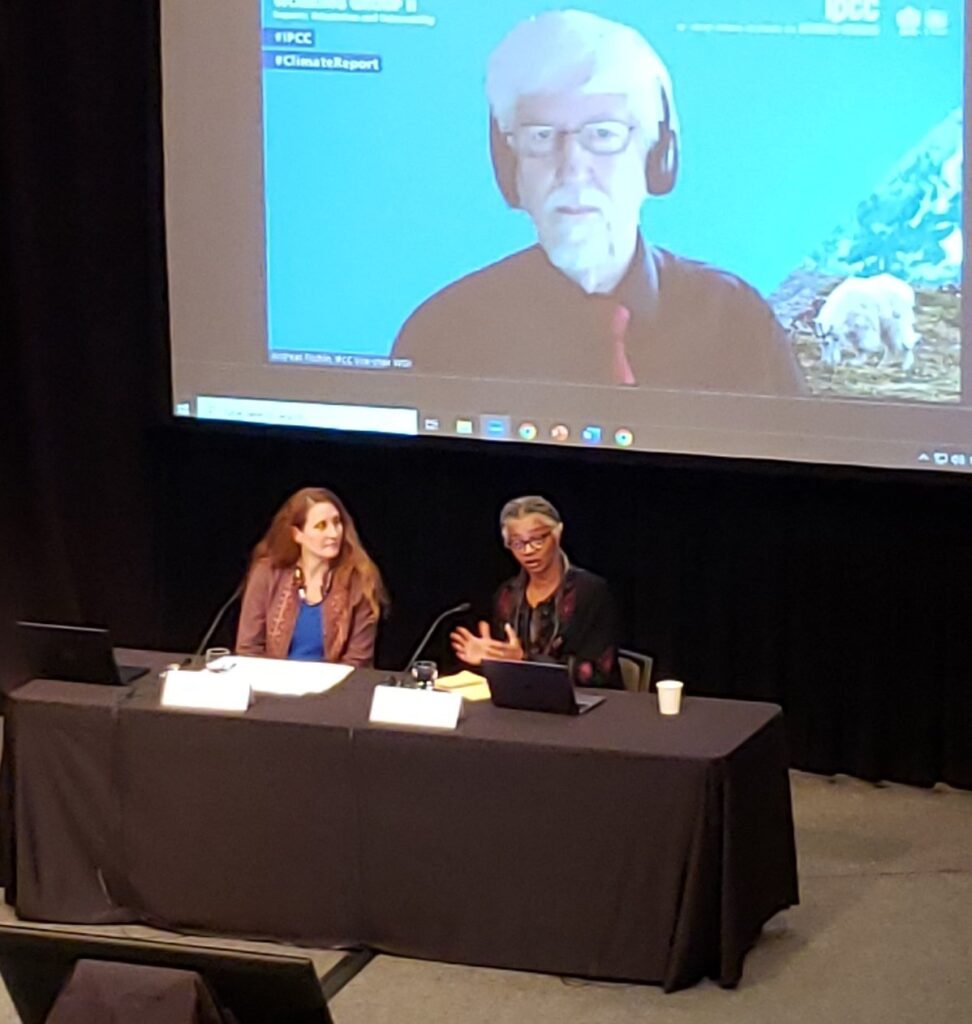
The second panel concerned Land, Ecosystems and Climate Change.  Heather Bedi, Dickinson College, asked panelists to explain the interface between those domains.  Andreas Fischlin, ETH Zurich and IPCC Vice-Chair, answered by describing how ecosystems provide various services for humanity, themselves powered by biodiversity.  There are many ways to value these services, including financial ($16-54 trillion, by one estimate).  Biodiversity loss rises with global warming.

Dickinson climate symposium_day 2 ecosystem panel

Gillian Bowser, Colorado State University, COP, described a historical arc of increasing political development.  She began with the Glasgow meeting last year, which hosted a people’s summit, which in turn represents political – national – engagement in the process.  Yet ecosystems tend to appear within financial discussions in political discussions.  Better representation for humans appeared in a succession of meetings, from greater numbers of women participating to more global equity.

Question: how can science address social problems?  Bowser asks us to think of water ownership, starting with the American West, deeming it inequitable because so few Native Americans own water. She then asked us to consider land tenure.  Fischlin points out inequalities built into agriculture.

How can we improve climate justice?  Fischlin points to the need for international equity. Panelists disagree on the importance of COP using the phrase “mother Earth.”  Bowser argues that including youth is vital for equity, especially as they are very concerned about justice. Also, representation needs to include ways of knowing: “It’s not enough to say the scientific body looks like society, if it keeps asking the same old questions.”

Bowser offers ten things individual students can do:

  1. Pay attention to ecosystems.
  2. Explore the linkages between things.
  3. Learn the role of small things (like insects) and use innovative ways to communicate their roles.
  4. Small things tell big stories.
  5. Use phones to measure the world and share results.
  6. Watch insects as they respond to climate change.
  7. Improve science communication.
  8. Go to a park and learn what an intact ecosystem looks like.
  9. Be part of the conversation, including policymakers.
  10. Remember that every landscape has a culture, and every culture a landscape.

Fischlin points out that not everyone has a phone, and adds that the youth has a right to a decent future.  Every action can help.

Dr. Leary asks the audience for citizen work. People here do watershed monitoring, greenspace analysis, beekeeping, and farming.

Here we broke for lunch. I’ll post these notes so far, then update over the afternoon.

Afternoon sessions began with a panel on Food, Agriculture, Water and Climate Change.  Aditi Mukherji, International Water Management Institute and IPCC Working Group 2 author, argued that climate change negotiations understate the importance of the multi-dimensional water crisis. This includes extreme water amounts, from drought to heavy precipitation and flooding.   Non-climate factors make things worse, such as the heritage of colonialism.

Toshihiro Hasegawa, National Agricultural and Food Research Organization and IPCC Working Group 2 author, spoke to climate impacts on food and fiber.  Climate change is hitting agriculture, forestry, fishing, especially in low and mid-latitudes, driving increased risk of acute food insecurity.  Increasing temperatures will worsen that situation, while challenging food safety, dietary health, and the livelihood of people working in food systems.

Rachel Bezner Kerr, Cornell University and IPCC Working Group 2 author, spoke to inequities in food systems.  Marginalized groups (women, minorities, migrants) are at greater risk from climate change.  As a result, inclusive governance needs to include these groups, and we should recall that technical responses can worsen impacts.  We should also recognize and integrate indigenous and local knowledge in adaptation thinking.

Maladaptation is starting to swim into view, when adaptation results in worsening social inequities or increasing greenhouse gases.  One example is irrigation sited badly, which can weaken soil or worsening water access.  Instead, integrated adaptation can include social protection programs (cash transfers, asset building) for marginalized populations, forecast-based financing, capacity building for farmer co-ops, regional grain banks, and public purchasing of regional and local good production.

Panelists discussed positive adaptations, including reducing methane.

The next panel focused on Cities and Climate Change. Debra Roberts returned to celebrate cities as a great location of climate action, from production to consumption.  Cities are continuing to grow, including smaller (1 million people) ones. Karen Seto returned to argue that cities are crucial, especially in a world with more nations.  Timon McPhearson, The New School and IPCC Working Group 2 author, told us we cannot design cities for cars any longer.  Planning needs to change, to become more inclusive.  20th-century city development created vulnerabilities and inequities; 21st-century climate change worsens those.  The next few decades already have temperature rises baked in.  And nature-based solutions are terribly underresourced.  We have to take mitigation and adaptation steps now.

Wei Ren, Dickinson College, led discussion on these topics.  Panelists approved of urban gardening.  Decarbonization should increase social interaction. Energy needs to switch, both in supply and demand.  Cities can use materials to store carbon, such as massed timber.

A cluster of audience questions followed, centered around “what should we do next?” then the panelists answered.  One calls for the US to cut its BTU/capita usage, while still maintaining a high standard of living.  There’s a call for sufficiency, for focusing more on needs than wants (I think).  Another wants to couple urban development with policies of rent control and building sustainable housing – i.e., cities need to undertake multiple efforts at the same time.  A different panelist notes that the global South often lacks the kind of planning and governance needed to implement such policies.

Example of nature-based development: rebuilding a forest around a city, serving as water catchment, recreating a diminished ecosystem, providing socio-economic opportunities for the locals.  Example of development problems: taxi drivers resisting public transit; people voting against stores near their homes.  Interesting: people say they hate being stuck in traffic and mowing their lawns, but will resist changing these.  Solution: building smaller homes closer to stores.

The day’s final panel was about Dickinson College’s drive to carbon neutrality.  Circa 2005 conversations started, towards a climate commitment. A key detail: plowing efficiency saving into a green fund. In 2020 Dickinson took many steps to advance this.  Overall, the college’s energy use intensity (EUI) declined steadily.  A college farm grew in popularity and usage.  A study found major greenhouse gas emissions coming from farm animals (methane) and campus transportation.  In response the farm composts food waste.

Coming up: using biogas to generate electricity.

And that’s all for day 2.  Now to teach class, then get some sleep.  Another post, tomorrow!

Posted in climatechange | Tagged | Leave a comment

Live-blogging the Dickinson College International Climate Symposium, day 1

Dickinson International Climate Symposium_Logo_FINAL_OL_1This week I’m participating in an exciting conference, the Science-Based Choices for Climate Action, Insights from the IPCC 6th Assessment Report.  I look forward to soaking up presentations, and also to feedback from my presentation about higher education’s future.

I‘m tweeting the event (hashtag #DsonICS22) and hope to live blog it here.  I’ll update this during the day.

The morning crowd is an interesting mix of college students, graduates, faculty, and staff, with visiting scholars, activists, and leaders. Bonus points: getting to see the excellent Ed Webb and other fine Dickinson friends.

A student, then the college president, quickly launched the program.

Hoesung Lee, Chair, IPCC, gave the opening talk. HE started by outline civilizational constraints, arguing that humanity simply has to live within the carbon budget, within a closed system.  Which is “a very tough mandate.”  Yet within those constraints, we can and should do many things: reducing greenhouse gas emissions, changing our behavior, increasing carbon pricing, and taking advantage of increasing urbanization.  If we do things the right way, reaching net zero by 2050 will launch a new stage in human history.

Webb offered this summary:

https://twitter.com/edwebb/status/1584542352739139584

Key terms from opening address: compounding risks; cascading risks; hard limits to adaptation; path dependence; behavioral & socio-cultural change; urbanization; upgrading infrastructure; conservation of ecosystem services; governance; closed system
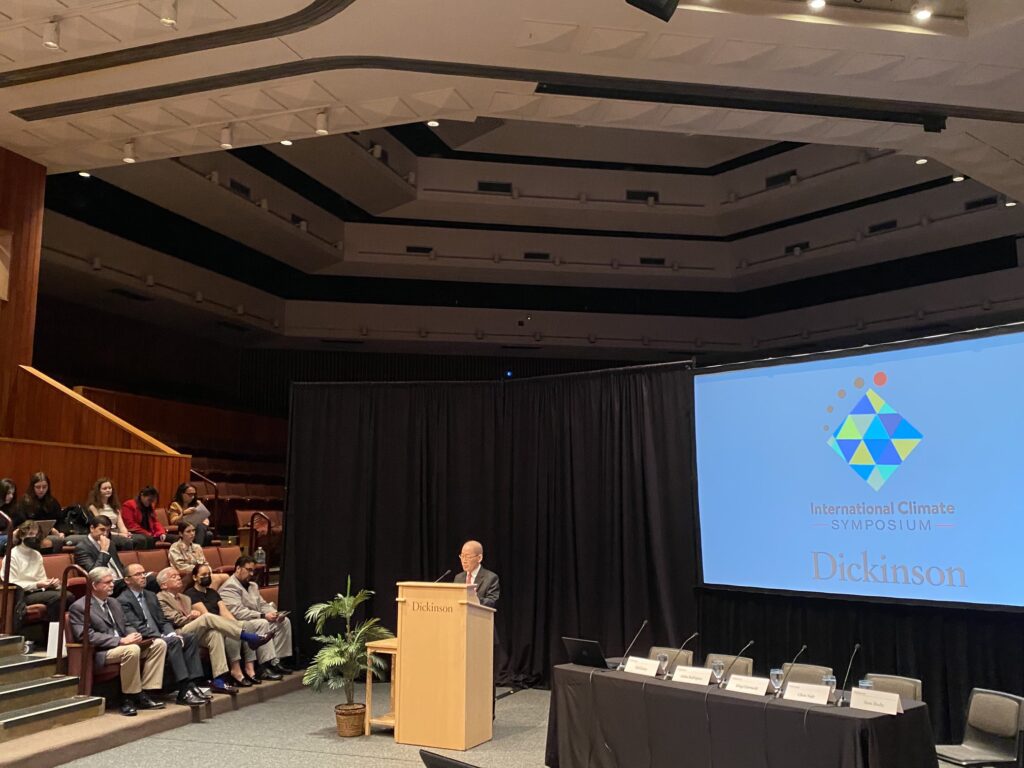
Dickinson climate symposium_Lee opening address_photo by SabrinaPrius

Dr. Neil Leary, Director, Center for Sustainability Education, Dickinson College, then introduced the program and its first panel.  Leary emphasized the combination of global and local perspectives.

Sean Shultz, Mayor of Carlisle, Pennsylvania spoke  to growing local awareness of climate issues, while also describing the contours of the local community.  “Residents are coming to realize the impacts of climate change.” Shultz mentions conflicts between state and local authority.  Carlisle did a greenhouse gas inventory, working with Dickinson, then passed a plan to reduce emissions over the next three decades.  Key points: lots of warehousing, so use those buildings’ roofs to host solar; improve energy efficiency for older housing stock; increased electrification of heating and cooling; getting the word out about PA Power Switch.

Christopher Nafe, Pennsylvania Department of Environmental Protection, spoke about the programs that DEP offers. Projects and services include benchmarking, feasibility studies, helping transition vehicles away from fossil fuels, helping local governments identify greenhouse gas emissions.  DEP also works with students, giving them the chance to work with local and state governments.  One challenge: convincing political authorities to do very long term planning.  Yet flood plains are flooding more often (redefine what a 100-year flood means).  “Climate change is a costly new reality for townships and boroughs.”

Greg Czarnecki, Pennsylvania Department of Conservation and Natural Resources, describes changes to local flora and fauna, including the state tree, the eastern hemlock. Season schedules are changing. New mosquito-born diseases (West Nile) are appearing.  A pest on the hemlock is expanding, killing those trees; this reduces shade on water, which then reduces brook trout populations. So the department identifies hemlock which are pest-resistant, as well as tree species which can supplement the hemlock’s functions.  They are also redesigning culverts (pipes under roads) to change their output.

Aisha Rodriguez, a recent Dickinson graduate, and member of the Rose Walters Prize Committee, spoke to environmental justice at the local level.  Legacies of redlining shape how communities experience climate change unequally.  She also describes how Puerto Rico grapples with the crisis as a US territory.

After a short break a second panel then began, on Demystifying the Work of the IPCC.  One panelist, Saleemul Huq, Independent University Bangladesh, couldn’t join remotely, as a tropical cyclone was crippling local internet access.  Karen Seto, Yale School of the Environment and IPCC Working Group 3 author, introduced the IPCC report, its history, and how it was developed.  Seto broke down group functions into science, impact, and mitigation.  Alexander Ruane, NASA Goddard Institute for Space Studies and IPCC Working Group 1 author, described the wide range of authors involved.

Neil Leary asked panelists to describe assessments.  Seto described a key: report policy recommendations are “policy relevant, but not policy prescriptive.”  Next, discussions of IPCC people learning how to better work with news media.  One challenge is bringing together literature and contexts from many national backgrounds, while making the results universally accessible. Another challenge is making sure that the global South/developed countries are fairly represented.  Seto described the logistics of having a global group work through the summary for policymakers report language, live, line by line… then how they shifted the process entirely online during the height of the COVID-19 pandemic.

Leary asked about the role of politics in the report creation. Ruane described political details, such as settling on contested geographical names and pushing some content to footnotes.  Seto mentioned authors seeing certain findings as not relevant to their local issues, then hearing arguments about messaging details, rather than the science they express.

An audience question asks if the IPCC should be more frank, and “less politically correct.”  Ruane distinguishes between scientists and the IPCC, emphasizing the latter’s carefully established reputation for objectivity.  Another question asked about language use, and the authors described using the United Nations’ five official languages.  Question: what is the IPCC doing to make the science more accessible?  Seto notes that deciding where to live is crucial, and commends us to focus on young people (a local high school group is there). Ruane describes new infographics and interactive tools, along with fact sheets in more languages.  There’s also a report just for actuaries in the insurance world.

After a pleasant vegan lunch, we reconvened.

The first afternoon session updated us on the latest science.  Linda Mearns, National Center for Atmospheric Research and IPCC Working Group 1 author, pointed out increasing confidence in anthropogenic warming over the report’s lifespan. Alexander Ruane returned to introduce climatic impact-drivers (CID), “a climate condition that directly affects elements of society or ecosystems,” such as mean surface temperature.

Jesse Abrams, University of Exeter, described “tipping point elements,” physical sites and systemic problems which could have an enormous impact on the Earth system.  Examples include the AMOC, Greenland ice sheet reduction, and Arctic area permafrost thawing. Abrams co-authored this recent Science paper, “Exceeding 1.5°C global warming could trigger multiple climate tipping points,” a key finding of which is that these points might be likely to happen more quickly than previously thought.

In discussion, further points arose. Ruane described wargaming social responses to climate developments.  Mearns emphasized that the science and communication about it are coproduced. Questions about representation among IPCC staff led to a discussion of international climate justice – for example, should developed nations pay for storm damages in the developing world?  One audience member expressed concern that IPCC’s fact-based approach is failing to win over many people.

The next panel explored different pathways to net zero.  Roberto Schaeffer, Federal University of Rio de Janeiro and IPCC Working Group III author, read the IPCC report to see multiple paths.  Anand Patwardhan, Professor, School of Public Policy, University of Maryland, College Park, spoke to the creation of different carbon budgets based on different global temperature goals, and observed that current trends mean we’ll overshoot a 1.5 C rise.  Steve Rose, EPRI and IPCC Working Group II author, noted that emissions are still on the rise, but we also still have openings, and the possibility to turn uncertainties into benefits.

Discussions considered uneven climate pathways internationally.   Some solutions arose, like massive a/reforestation and biomass + carbon capture, but we must shift to renewables now.  “Negative emission technologies” should be in play, because it’s too late not to.  Technology transfer is also required to help developing nations.  The panel also considered morale, and saw itself as fairly optimistic, especially given recent history.  Education is especially important. One question asked the panel to dwell on urbanization, which led to discussions about development and leapfrogging.
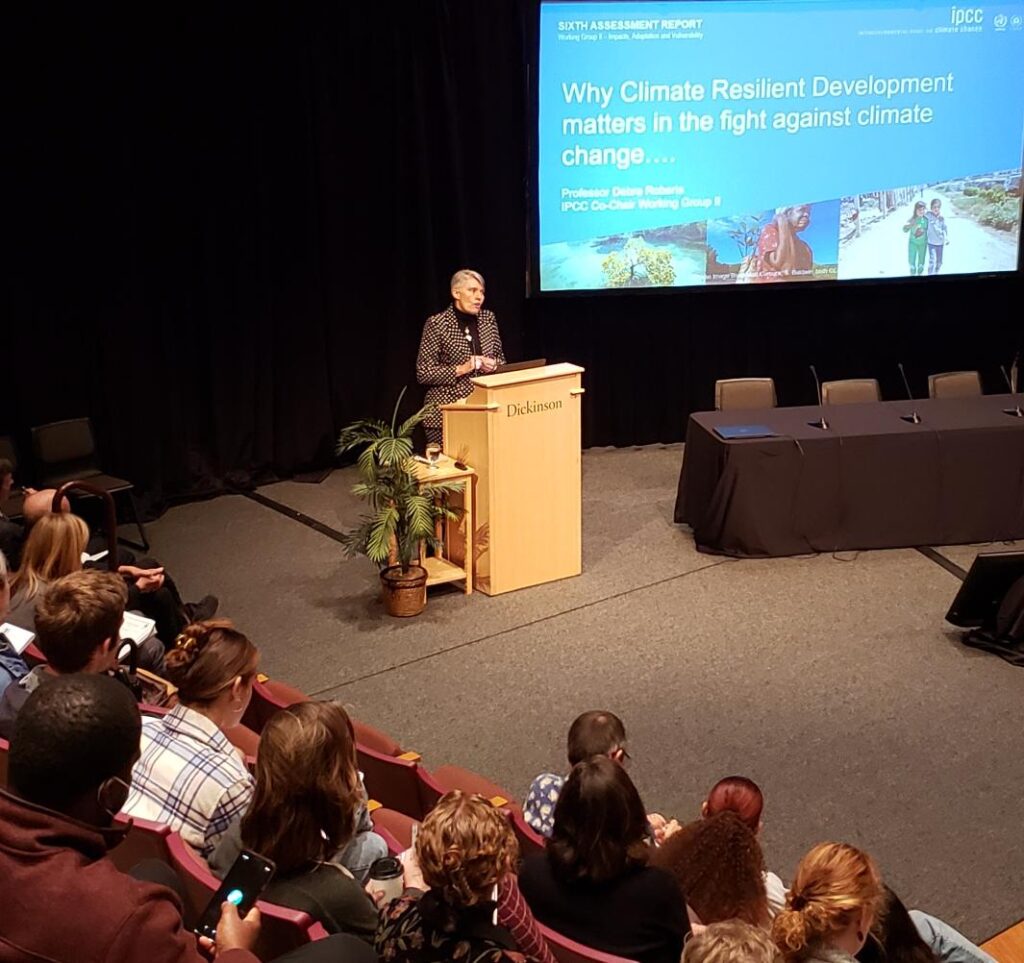
Dickinson climate symposium_keynote Roberts

The day’s keynote was from Dr. Debra Roberts, Head of Sustainable and Resilient City Initiatives Unit, eThekwini Municipality, South Africa, and IPCC Working Group II Co-Chair, and titled “Why Climate Resilient Development Matters in the Fight Against Climate Change.”  She immediately struck a note of realism, as opposed to optimism, anchored in her IPCC work. She noted the scientific consensus around climate change and urged us to think in terms of climate justice.  She echoes the day’s theme of the importance of urbanization, forecasting nearly 2/3rds of the human race living in cities.  Extreme events can interact, compounding damage and suffering.  Around half of the world’s population live in the most dangerous climate zones.

Roberts focused on damage to natural ecosystems, connecting them to humanity through our mutual dependency.  Water management, food security are vital.

Realism: there are limits to adaptation. Losses and damages will occur.  Some natural solutions might fail, past a 1.5 C temperature increase.  Financial limitations can be powerful restraints.  So we need a social mobilization around adaptation *and* take mitigation actions, namely deep cuts to emissions.   These require political commitments, institutional frameworks, continuing knowledge about climate impacts, monitoring adaptation measures, and doing all of this equitably.
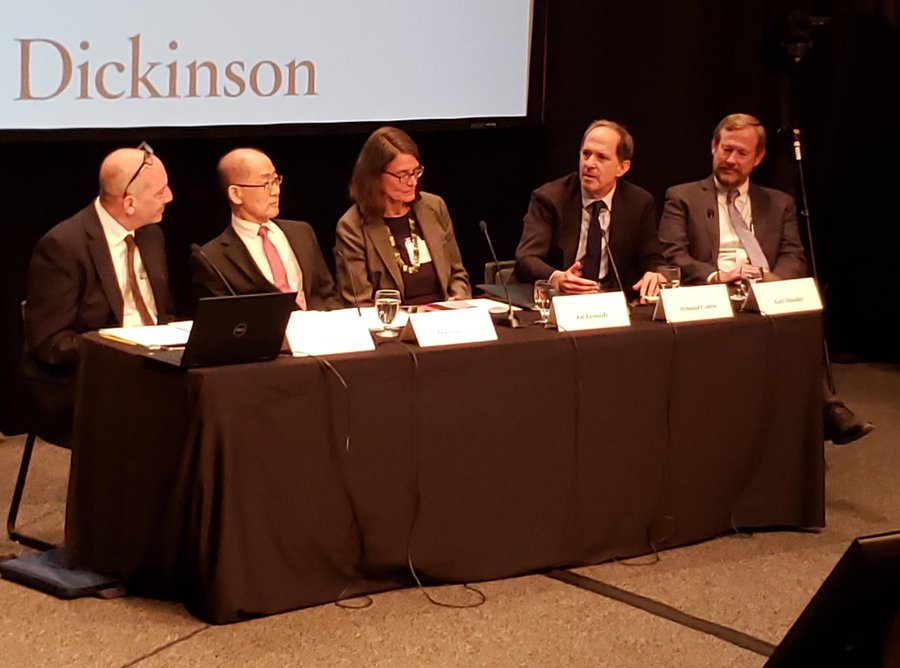
Dickinson climate symposium_day 1 closing panel

The day concluded with a final panel reflecting on the day.  Hoesung Lee returned to speak to the IPCC’s work, touching on the quality of the report’s science and the importance of integrating the developing world into the process.  Lee praised Dickinson College and higher education in general. Kit Kennedy (Natural Resources Defense Council) was impressed by the day’s focus on local matters, which then built to the global level.  Armond Cohen, Clean Air Task Force, was struck by the sheer complexity of the climate crisis, noting its embeddedness in “everything else.”

Karl Hausker of the World Resources Institute outlined five themes for getting to net zero, described during the day:

  1. Lower personal demand by changing behavior.
  2. Substitute electrical power for other sources.
  3. Produce a lot of power from renewable, clean, zero carbon sources.
  4. Reduce non-CO2 greenhouse gases, notably methane.
  5. Develop cheaper ways to remove greenhouse gases from the atmosphere

Conversation then became general, and I’ll try to note themes and points, if I can’t identify speakers.  Areas once known as non-flood risks are now flood risks.  Question: what happens to property values of threatened areas?  Question: is adaptation a gateway drug for mitigation? Richer societies are better able to cope; does that mean development is part of climate adaptation?  Improved energy efficiency seems to grow energy consumption.  We should emphasize the overlap between adaptation and mitigation.

Continued: great concern about the potential of mass migration. Concern about climate action competing with an energy, food, or health crisis.  Three interconnected crises: climate change, biodiversity crisis, and social justice – to address these requires a big tent, convincing people that all will benefit.

Optimism?  Emissions still grow, but at a slower rate.  The Inflation Reduction Act passed.  Changes in corporate boards, even with greenwashing, actually implementing commitments.   Carbon energy intensity declined.  Ten countries sustained greenhouse gas declines, including CO2.  India has made a lot of progress.

What needs to be done?  Improving siting permitting in the United States, to speed building processes.  Developed countries need to make good on pledges to the global south, both on mitigation and adaptation.  One possible inspiration: the huge telecommunication revolution of the past generation.  Building more stuff drives prices down; industrial policy would help.

Audience questions: the developed world aiding itself is like a plane passenger snapping an oxygen mask to their face before helping anyone else.  What should the government do? Perhaps a stronger federal role.   The United States does energy innovation well.

Question: is carbon capture greenwashing?  Hausker thinks not. We have some things which we need, which we can’t yet replace (ex: concrete manufacture). We should try enhanced weathering, capturing carbon at the source, and direct air capture. Carbon capture doesn’t mean moral hazard; we’re smarter than that.  Cohen: the world is 80% powered by fossil fuels now. Kennedy: we need safeguards.

Closing note from Lee: he feels more optimistic now.

That’s it for today. I’ll start blogging tomorrow morning.
Posted in climatechange | Tagged | 4 Comments

Higher education enrollments declined again in fall 2022, according to new data: some observations

How is American higher education enrollment doing now, in fall 2022?

National Student Clearinghouse Research Center logoA few hours ago the National Student Clearinghouse Research Center published the first account of its enrollment data for this term.  For some, perhaps many people, this is the first post-pandemic semester, and that gives rise to the question: did enrollment rebound after its COVID-19 drops?  That had been a brutal period, overall, as colleges and universities suffered a more than 7% decline after 2019.

Here I’ll offer a summary of the new findings along with some reflections.  For sources, I’m working from this web publication, in addition to a press release and news briefing.

tl;dr version – enrollment declined overall, again, this time by 1.1%.  The good news: the rate of decline is less steep than it has been during the two prior COVID years.

Let’s break it down in detail.

Note: this is the Clearinghouse’s first release for fall data. They will add and refine data over the next two months.  I’ll host their research lead on the Future Trends Forum to discuss it later this year.

Onward:

Undergraduate and graduate schools both saw declines.  Grad schools experienced a 1% dip while undergraduates declined by 1.1%.  While negative, these numbers are not so bad as the 2.1 and 3.4% drops during pandemic fall terms (2020 and 2021, respectively).

Every sector of higher ed saw student numbers shrink: “a drop of 1.6% at public four-years; 0.9% at private nonprofits; and 2.5% at private for-profits.”  But notice this very interesting detail about community colleges: “Declines at community colleges have slowed, with only a 0.4% enrollment loss compared to fall 2021, driven by an 11.5% jump in dual-enrolled high school students.”  That means declines for 4-year schools are steeper than at 2-years.

Broken down by service sector, Hispanic-Serving Institutions (HSIs) saw a decline of “-1.2% this fall versus -4.8% last fall, for total two-year losses of 6%.”  However, HBCUs did unusually well with undergrads:

Historically Black Colleges and Universities’ undergraduate enrollment grew 2.5% this fall, which reversed declines of 1.7% in fall 2021. This growth was driven by a 6.6% increase in freshmen enrolling at HBCUs.

Mostly online institutions continued to do well, enjoying a 3.2% rise compared to fall 2021. One key detail: “This was largely driven by younger students aged 18-20, for whom enrollment growth totaled 23.4% over two years since fall 2020.”  (The Clearinghouse cautions us that those numbers are small and early.)

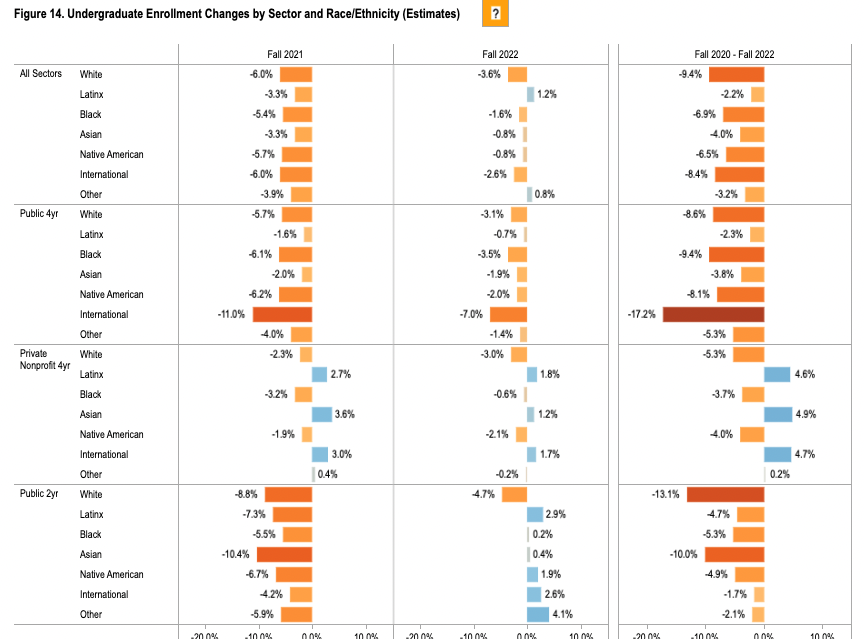
By population, many groups’ enrollment declined, but not all.  Traditional-age undergraduates and Latino students rose by 0.5% and 1.2%, respectively.  Asians and international students grew at private, nonprofit schools.  Community colleges saw rises from every population except whites:

undergrad enrollment by sector gender race Clearinghouse 2022 October

% change is compared with previous years.

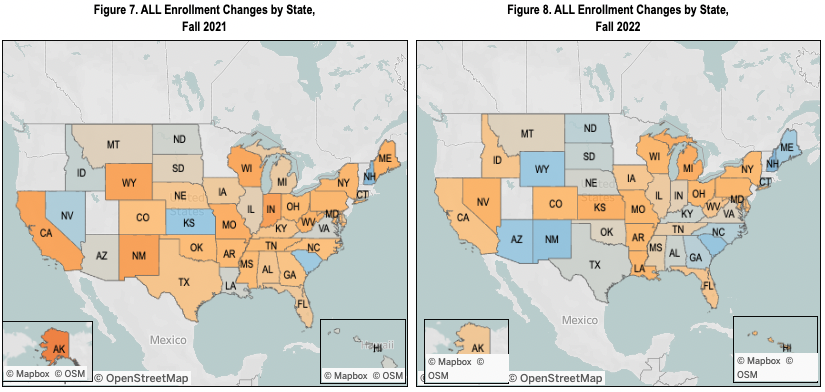
Geographically, the numbers are uneven, as usual.  The midwest and northeast saw steeper declines than in the south and west.

enrollment by state Clearinghouse 2022 October

Blue-green represents increases; white, not enough data; oranges, declines. Click to the report so you can mouse over individual states for their respective data.

“The steepest declines (-4.3% to -5.2%) were in Alaska, Michigan, Kansas, Missouri, and Nevada, while New Hampshire, New Mexico, and South Carolina gained (+3.7% to +6.8%).”  I suspect that NH gain was due to Southern New Hampshire’s online work.

Further, some states suffered especially in grad school numbers:

Graduate enrollment is down in 26 states, with Alaska, Maine, Montana, Mississippi, Nebraska, California, Louisiana, Maryland, and Arkansas all experiencing declines of more than 4% this fall compared to the previous year.

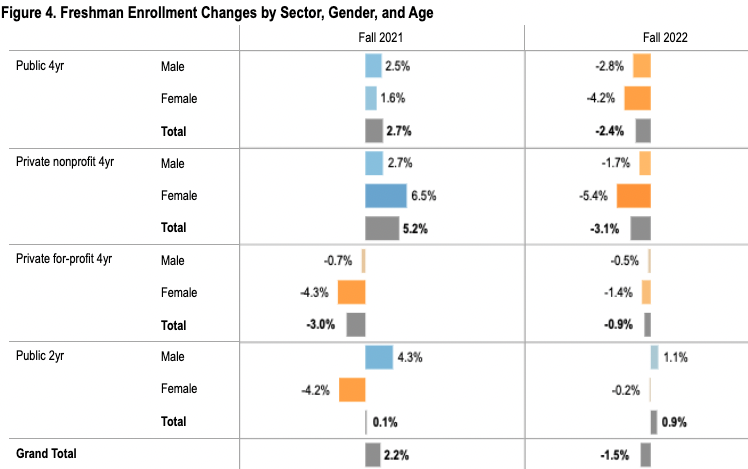
First-year student numbers dropped in general, which has implications for the next half-decade of classes:

first-year freshmen enrollment_Clearinghouse 2022 October

freshmen enrollment declined by 1.5% overall. Freshmen numbers declined in all four-year sectors, led by private nonprofits dropping 3.1%, publics declining 2.4%, and private for-profits losing 0.9%. Highly selective institutions saw the largest freshmen declines this fall of 5.6% compared to a 10.7% gain in fall 2021.

Again, community colleges stood out, as they “saw a 0.9% increase this fall, driving an upward trend of 1% freshmen growth at community colleges since fall 2020.”

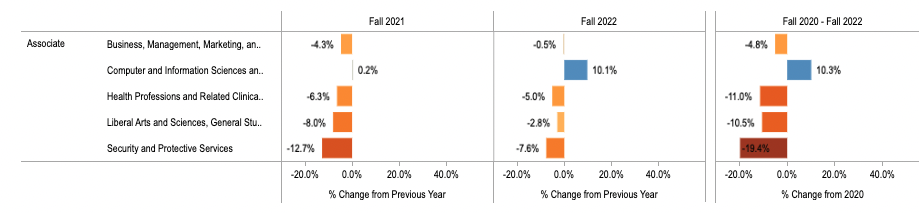
In terms of course of study, the report only showed some majors aggregated together by popularity, but the findings are still noteworthy. Everything dropped – except computer science, which continued to boom:

enrollment changes in top ten majors by credential type Clearinghouse 2022 October

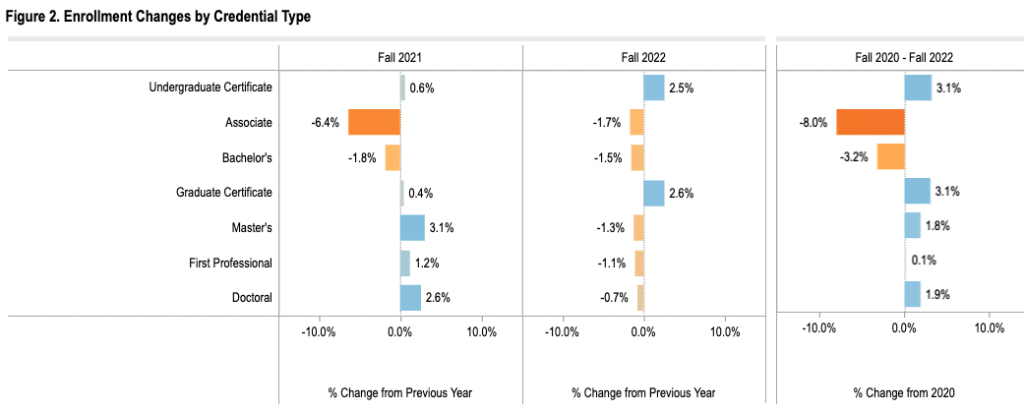
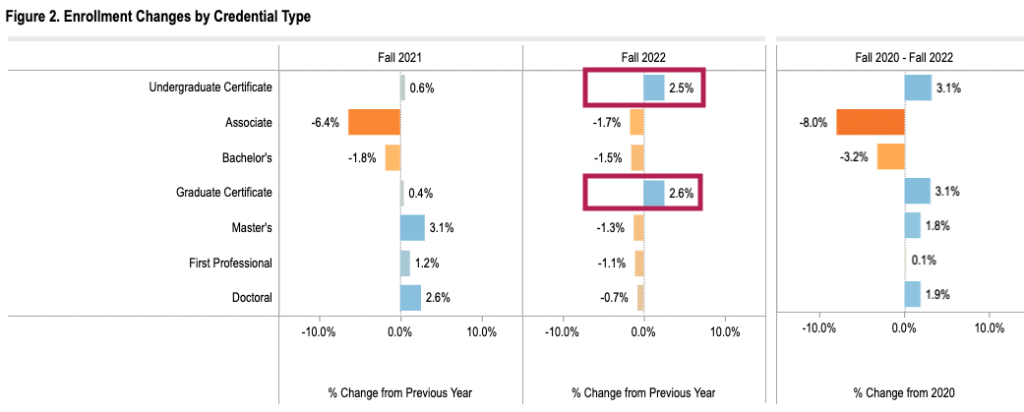
Degrees offered or sought showed an interesting emergence of certificates (undergrad and graduate) as growing concerns, while all other degree forms declined, in comparison with last fall semester:

enrollment by degree type_Clearinghouse 2022 October

What does this mean for the future of education?

First, to state what should be obvious: the supermajority of colleges and universities depend on student fees (tuition most of all, plus fees, room and board, etc.) for their financial existence.  To the extent a given campus sees dwindling student numbers, it can suffer economically.  That can lead to all kinds of changes, from increased fund-raising and entrepreneurial activity to budget and job cuts.

Second, the slight decline in grad school numbers may point to another pandemic shift.  From the press release: “[the drop] reverses last year’s 2.7% gain. This may signal the
end of the pandemic-related influxes of post-baccalaureate students.”  In other words, we enjoyed some grad school boosts over the past two years, presumably as people either sought grad school to improve their labor market standing or to study medicine/public health to fight the pandemic.  That positive bump may now be over.   One qualification: “However, graduate enrollment is still above pre-pandemic levels, with a total two-year change of 1.6% from fall 2020.”

Third, a 1% decline is shallower than the pandemic years, which may lead us to conclude the COVID shrinkage is done. But is closer to what higher education experienced from 2013 on. If this data holds, especially into spring 2023, we might see the end of the COVID drop and a return to what I’ve called the Peak Higher Education scenario (first published in 2013).  In the press briefing director Shapiro said that enrollment’s failure to rebound after the first two pandemic years was surprising, and not a good signL

I certainly wouldn’t call this a recovery.  I think we’re seeing smaller declines. But when you’re in a deep hole and you’re only digging a tiny bit further… it is not really good news.

An Inside Higher Ed article avers that “enrollment fell for the fifth semester in a row, dampening those hopes.”  The Washington Post claims “College enrollment declines for third straight year since pandemic.” In reality, enrollment has fallen for nearly a decade.

Fourth, the Clearinghouse report only shows comparative, not absolute data.  I’d like to see those stats to run comparisons to previous years.

Fifth, if the midwest and northeast continue to see numbers decline, that could reveal the impacts of their demographic transitions – i.e., fewer children.

Sixth, Douglas Shapiro noted in a press conference that undergraduate numbers show the past two years’ depression in first-year students is continuing to have an impact.  To make a real enrollment recovery we would have needed “a massive upsurge” in first-year students… and even then we’d have years of smaller classes.

Seventh, the decline in international numbers is interesting.  Mikyung Ryu, the Clearinghouse director of research publications, pointed out a huge gap between graduate enrollment (increasing) and undergrad (sinking).

Eighth, the persistent growth in online class-taking is very worth noting. Perhaps more students learned about online learning during the pandemic.

That continued growth in online enrollments may have strategic effects on college and university strategy. We could see some campuses expanding their distance learning programs to capture these students. We could also see some institutions where online offerings become profit centers, supporting their in-person wings.

Ninth, community colleges’ enrollment gains this term are great, but nowhere near enough to make up for that sector’s enormous losses over the past few years.

Tenth, that decline in allied health majors is a concern, not least because it reveals horrible working conditions. It’s also a problem as American health care needs will just increase due to long COVID and the population aging.

Eleventh: certificate programs continue to do well, doing better than all other degree types compared with fall 2021. Will we see campuses directing more resources in this direction?

enrollment by degree type_Clearinghouse 2022 October annotated

Annotations are mine.

I have more questions.  What impact did Biden’s student loan forgiveness initiative have? How did absolute numbers fare? Can we break things down more finely by academic majors?  Minus high school dual enrollment, how do community college numbers look?

Over to you for your thoughts.  And I look forward to the next release.  Thanks to the Clearinghouse for doing this important work.

Posted in coronavirus, enrollment | 5 Comments

One university’s climate change plan

How might higher education grapple with the climate crisis?

One example recently appeared from Harvard University.* A campus group there issued recommendations for how that institution could approach the problem. I’d like to summarize, then analyze, that document here.

1: SUMMARY

Harvard climate education report cover 2022At the top level “The Future of Climate Education at Harvard University” concerns itself with teaching and learning. The tl;dr version: there should be a lot more climate crisis teaching.

The report calls specifically for four institutional changes within their university:

  1. Hiring more faculty to fully support rising student interests.
  2. Setting up a standing committee on climate education.  This might advocate for new climate programs, recommend changes to general education, and support cross-disciplinary collaboration.
  3. Creating an internal investment group, or “a climate education accelerator program.”  That could fund a lot of work, such as bringing in external speakers, supporting internal collaboration and connections, building a clearinghouse for university climate information, supporting residential learning changes, assessing and supporting new technologies, researching new degree possibilities, and connecting alumni to current students.
  4. Installing “an external climate education advisory committee.”  This would be good for garnering information and funding.

Given those four steps, the proposal calls for a series of themes, practices, and projects.

At a quantitative level, the basic idea is to have more teaching about the climate crisis: more classes, more programs, more certification options.  This entails hiring more faculty for the purpose.

Some of that education should occur within departments, but other parts of climate teaching should cross disciplinary boundaries:

the challenges posed by climate change are multifaceted and they span and embrace all disciplines. This means that the climate education tent must be large: no one area or discipline owns this space, rather contributions across the board are needed.

(“no one area or discipline owns this space” is a good phrase.  That’s something I’ve been arguing for a while, and is a theme in Universities on Fire.)   Wrangling multi- and interdisciplinary work for a large university involves some complexity. Accordingly, structurally, the document calls for more university-wide climate education cohesion and coordination.  It describes a pretty difficult terrain to work through:

At the level of new degree programs, a cross-School masters in climate and sustainability, for example, could draw on expertise housed in multiple schools including Harvard Business School, Harvard Kennedy School, and the Graduate School of Design as well as the experience of the Division of Continuing Education (the Extension School). Establishing pathways from undergraduate studies to Masters, Ph.D., and other programs (e.g., specialized certificates) is another substantial opportunity…

It cites one interdisciplinary center approvingly.

“The Future of Climate Education at Harvard University” addresses changes to student life as well as to faculty operations.  It applauds student peer learning:

The efficacy of peer learning is well documented, extends across disciplines, and has an important intellectual and institutional history at Harvard. The importance of involving students directly in climate education is amplified by the multifaceted nature of the climate challenge ahead. Our students come from diverse backgrounds and communities and therefore experience climate related issues in different ways. Furthermore, students who come to Harvard study in different programs and enroll at different career stages. The opportunity for business school students to learn from engineering students or for Harvard College students to learn from public policy students, for example, yields tangible benefits for everyone. Importantly, these exchanges might happen in classes, as part of research projects, or as part of joining a club or attending a public event. Bringing together these student experiences and perspectives will enhance the learning experience.

Former students – alumni – play a role in this vision, too.  Plenty are willing, it seems: “In our survey, 80% of alumni respondents expressed interest in playing a role in climate education opportunities for current Harvard students.”  Alumni could act “as a guest speaker in courses, suggesting project ideas, partnering on class projects, and mentoring.”  There is, apparently, planning for an “alumni-focused Climate Boot Camp.” The report wants such alumni work done systematically and in a structured way.

The report makes a point of not limiting this expanded teaching mission to faculty and students. It hails staff as well:

The Harvard community is rich with scholars who, in many cases, have real-world expertise relevant to climate challenges but who do not hold teaching appointments. Included in this group are postdoctoral and research fellows, research staff, museum curators, librarians, and other qualified employees who work in programs such as the Office of Sustainability or the residential Houses. These individuals represent an important resource for our students and community.

Involving staff more actively in teaching will take funding:

Yet in many cases their time is fully committed to job-specific projects, and thus they are unable to devote significant time to other educational endeavors. Finding ways to support the engagement of relevant staff in climate education will enhance the breadth of hands-on and experiential learning opportunities available to students.

The report goes further still, calling on the campus to integrate co-curricular and extracurricular events into this new climate education system.  This will, of course, require “increase[d] coordination between class content and external experience and interests.”

Such out of class work includes residential learning, through the school’s “House” system.  That means more coordination, I expect.  It may involve students experimenting with climate-related lifestyle changes:

residential Houses could provide a testbed for students to grapple with their own willingness to make the changes necessary to reduce their climate impact as well as how to be part of a diverse community in which others make different choices.

Further, the report calls for making more use of the campus as a resource beyond classrooms and dorms: “Harvard is home to an amazing array of natural history collections and research sites that include the Museum of Comparative Zoology, the Harvard University Herbaria, the Arnold Arboretum, and the Harvard Forest.”

Making an upgraded climate education available will require improved advising and curricular structures.  First, the report calls on the university to “build out clearer pathways for students across the University who seek some level of specialization around climate but who might not want to join a concentration specifically dedicated to this.”

Second, there’s a digital component:

Every student-facing advisor, program officer, etc, could be equipped every semester with an up-to-date digital playbook of opportunities for students who express an interest in climate. Further, members of the Harvard community and beyond should have access to a portal representing climate related events and news from Harvard.

The report doesn’t expand on the technological side, although it does recommend the institution offer “interactives and even simulations/games [which] can be created and reused across a range of courses.”

The report would like such expanded learning to be certified in expanded ways.  It asks not only for more degree options in climate change, but also for smaller credentials: “certificate programs that would enable these students to add a year and take courses in the climate domain that would complement their core masters degree.”

The report also would like to see climate impacts on the career level.  Climate internships and summer work options need to increase. Students need better information about them.  Then career services can connect more students to climate-related jobs.

All of this work would occur within the higher education accreditation system. Here the report doesn’t express any concerns about being evaluated, but instead thinks they might influence other institutions through accrediting agencies and processes:

Harvard also sits within various accreditation institutions that could be encouraged to work with us to develop systematic approaches to articulating climate related competencies that we want our students to have as they enter the world. Can Harvard along with other organizations help to codify the importance of certain competencies and skills as they relate to climate?


2: REFLECTIONS

As a call to expand climate teaching there’s a lot to appreciate in “The Future of Climate Education at Harvard University” for the rest of us not affiliated with that institution.  The very fact of calling for more such teaching and learning is badly needed and will hopefully inspire others.

The model the report outlines looks very sound, albeit grounded in an extraordinarily wealthy institution. Offering new credentials, creating climate curricular pathways, improving advising, expanding internships, boosting climate career support, connecting with staff, mobilizing willing alumni – other institutions may see ways to follow some or most of these in the near term future. Growing climate programming in dorms and student life just makes sense for colleges and universities with significant residential components, even without the Hogwarts level of hall structure.  That all such growth requires financial support should be obvious, but it’s useful to see a document stating this very clearly.  That this would also require some coordination should also be clear, yet realizing this will depend greatly on individual campus cultures.

The report is primarily an intrapreneurial document, as far as I understand it.  While it is publicly accessible, it is clearly aimed at winning internal Harvard funds to set up three internal bodies with the power to expand climate education.  I don’t know that school’s politics well enough to forecast the likelihood of success.  The document could also serve as a more generally entrepreneurial purpose in helping raise external funds for purpose from companies, foundations, high net worth individuals, etc.

In terms of climate change and higher education the report has a very narrow focus.  In my research I’ve laid out multiple ways for campuses to grapple with the crisis, visualized roughly here:

How higher education engages with the climate crisis_overall

“The Future of Climate Education at Harvard University” is largely focused in the teaching box, which makes sense for scoping reasons.  It does touch on campus grounds through its call to use certain non-classroom buildings. It connects with research early on, but only insofar as faculty conduct research and teach. There are several nods to the nation and world through mobilizing off-campus alumni, setting up internships and jobs, and working with the accreditation system. Otherwise, the bulk of the report is about teaching.

It’s a bit unfair to criticize the document for what it deems out of scope (“here’s what I think they should have also said”) but I think it’s worth thinking beyond the pdf given the scale and urgency of the climate crisis, especially to the extent that this document influences academics in the rest of the world.

To begin with, there isn’t much room for addressing anyone else’s agency. Students appear in the report with a single demand – more climate education! – but we don’t see them doing anything else.  In those pages students don’t demand that the university endowment divest from fossil fuel stocks, although they certainly do, and that’s a very hard-fought struggle.  The report doesn’t see students protesting, say, faculty research which they deem worsens global warming, or pursues controversial geoengineering, or serving too much meat and too many animals products for meals.

Beyond campus students, the report doesn’t envision Harvard being impacted by the outside world on climate issues.  We could easily imagine, say, a state mandate to increase green power production and Harvard setting up solar arrays, wind turbines, etc., and how student learning could benefit from that.

At a different level, the report doesn’t see Harvard as making the crisis worse, either historically or at present. To what extent do its graduates go on to work in – or run – fossil fuel companies, or financial firms which gladly support such extractive industries?  Does Harvard’s approach to the economy, seen in its business school and placing students along Wall Street, contribute to the neoliberal political economy which clearly accelerates greenhouse gas emissions?  How many Harvard graduates and allies actively deny the crisis?

At a ground level, the report doesn’t speak to climate threats to those campus buildings or to the local community’s. To what extent will the Harvard community have to confront the rising Atlantic, increasing wet bulb temperatures in half the year, and worsening winter storms in the other half?  Practically, these are vital questions. Yet the report could have touched on them as precisely located within its call for climate education.  As I’ve said before, think of the internship, career, and research opportunities for a campus community and a nearby seawall, or creating cooling and warming shelters.

Perhaps Harvard instructors will instill in students the combination of knowledge, skills, self-reflection, and urgency needed to go out into the world and fight like demons to reform civilization in this enormous crisis. Maybe grads will become known as 350.org-style activists who work hard for adaptation and mitigation.  I don’t get that sense from the report, but perhaps I’m not charitable enough. Further, maybe expanding climate teaching will encourage Harvard faculty and staff to use their status and resources to intervene in local and global debates, becoming activists and public intellectuals to help humanity redesign civilization in the worsening Anthropocene.  Again, I don’t get that sense from the document, but maybe I missed it.

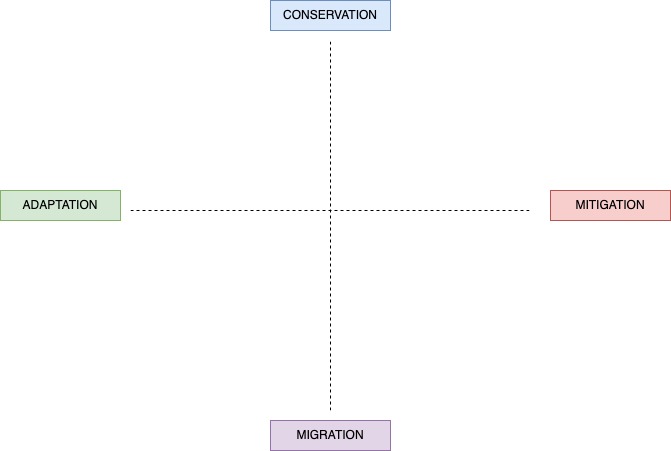
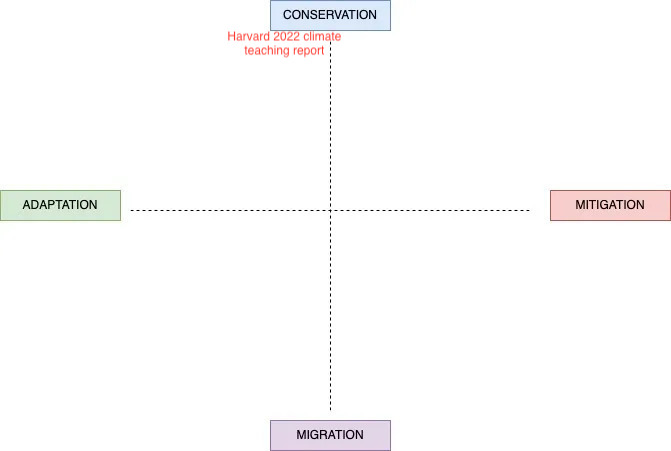
Earlier I’ve shared this “compass” visualization of how campuses might plan their climate course:

Campus climate change compass

Given the very limited scope of this report, I’d place this very close to the Conservation pole, since it doesn’t ask for fundamental university changes in the climate crisis. It does respond to the crisis in a basic way, but without asking for any substantial mitigative actions, so we can locate it slightly towards the Adaptation pole.  i.e., it recognizes the building crisis and asks for some actions in response:

Campus climate change compass visualization Harvard report 2022

I would love to hear what others make of the report.  I would also be delighted to host the report’s authors for conversation on this blog or on the Future Trends Forum.

(thanks to the Last Humans group for thinking through this report with me)

*I recognize the problems in paying attention to Harvard University as one institution among the world’s 20,000 or so.  Harvard is an exceptional campus in many ways with a talent for grabbing publicity about anything it does, and I hesitate before adding to that tendency. Some of you know I would rather discuss less media-centric institutions, notably community colleges and non-flagship state universities.

And yet I think this is worth our consideration, for several reasons.  First, perhaps Harvard’s reputation can work to the good if this report inspires more such work from other universities. Second, institutions without Harvard’s riches and cultural clout – i.e., just about every single one of them – might benefit if that university uses some of its extraordinary resources to innovate.

Posted in climatechange, education and technology | Leave a comment

Talking about higher education, the future, and climate change at Culture Study

Culture Study logoThis week an interview with me appears in Anne Helen Peterson‘s Culture Study newsletter.  The excellent Colleen Murphy asked me good questions about higher education, climate change, Universities on Fire, and the future.

Peterson’s introduction includes this passage, which offered some good perspective on how people think skeptically about higher education:

…when I first read some of the ideas here, I balked. Not because they aren’t good, but because I’m so used to thinking of what academia has *not* been able to accomplish and how precarity disincentivizes change. There are reasons why I’m inclined to think that, based both in my experience but also my peers’ and my parents’ experience in public higher ed, particularly in a state whose legislature would gladly eliminate it altogether.

Note the range of reasons she offers for being disinclined to see colleges and universities acting boldly.

In contrast, she then offered this passage about futures thinking and imagination:

But I also have to remember that you can’t create change if you can’t think it, can’t imagine it, can’t articulate it. I realized: I have to allow myself to imagine what this hopeful futurism would look like. I hope you allow yourself, too.

That’s a great way of describing what futures work can do.

Murphy’s questions are great, and I want to draw attention to one in particular.

buy antabuse online buy antabuse no prescription generic

  I don’t think people treat this one often enough:

As is often the case in higher education, some of this seems easier for the richest universities. For example, you write about how colleges could design new buildings or relocate campuses entirely to avoid rising sea levels.

buy finasteride online buy finasteride no prescription generic

But, climate change aside, there are also many institutions struggling financially, and many colleges already have a backlog of campus construction projects.

How will climate change further exacerbate the “haves and have nots” in the higher education system?

buy nolvadex online buy nolvadex no prescription generic

And, how is that playing out already?

I started off with the Matthew effect and went on from there. But I’d like to hear reader’s thoughts on this topic as well, as well as on the other points we addressed.

buy vibramycin online buy vibramycin no prescription generic

Many thanks to both Anne Helen and Colleen for the discussion and the venue!

Posted in climatechange, interviews | 1 Comment

Imagining future universities with Midjourney images

What might future campuses look like?

I’ve been using AI art programs for a while, getting to generate images for classes, presentations, social media, and entertainment.  The nexus of automation and creativity is something I’ve been brooding about for years.  But today, as the weekend draws night, I wanted to share some recent results in imagining campuses to be.

For this post I’m using Midjourney. I’ve been playing with others as well.

We started off with a very generic “imagine the future of higher education”:

The_future_of_higher_education__Midjourney 2

Interesting to see the results.  Books (top left) are a classic association.  Greek columns (top right), too, for a certain way of imagining higher ed.  The triangle or pyramid… not sure what to do with that.

The clouds seen from above also mystified me, until SFF Audio wrangler Jessie offered this analysis:

Jessie then added:


But that didn’t stop our AI explorations!  I asked the program to rethink itself, and it offered another set of visualizations:

The_future_of_higher_education_Midjourney

Again with the sky (top right). Now we add medieval-ish spires (bottom right), which does fit another view of higher ed. The bottom left went abstract hard, while I think the to left offered a stylized book.

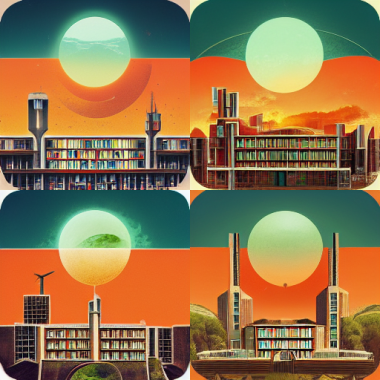
Then I added a stack of basic academic keywords: research, education, service, community, campus, faculty, students. The results frustrated me with their restriction, the abstraction:

the_future_of_higher_education_university_colleg_Midjourney

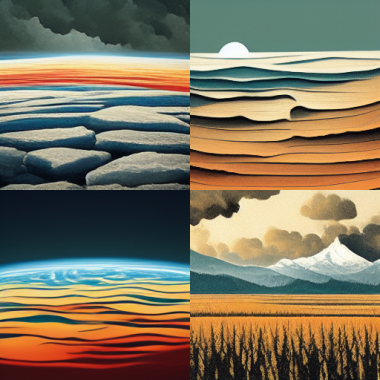
Creating AI art is all about prompts and revising them, so I tried another tack, bringing in my current research agenda: “higher education after climate change.”

higher_education_after_climate_change_2 _Midjourney

On the one hand those are soothing natural images, especially (for me) the bottom two.  On the other – no signs of universities or colleges!  Midjourney has an apparently bleak view of the subject.

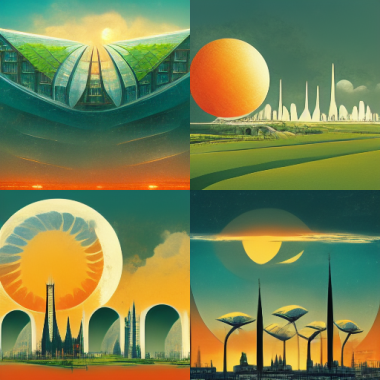
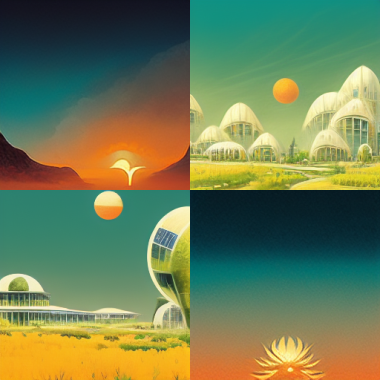
I decided to force the bot into optimism by asking it to imagine a “solarpunk university.”  Now the thing got creative. At least one other Midjourney user joined my impromptu project and also bid the machine to think along these lines.

The first result was heavy on nature and light on the built academic environment:

Solarpunk_university__Midjourney

Is that a dandelion motif on the top two and bottom left?  But the bottom right offers a very different view, something like Cambridge University with wind turbines.  Very concise.

Solarpunk_university_4 pix very green_JohMag23__Midjourney

The round object motif persists, but now with more green.  Each of those offers some more buildings.

Solarpunk_university_4 pix JohMag23__Midjourney

Are those books or windows on the bottom right?  Another round emphasized that theme:

Solarpunk_university_4 pix books motif_JohMag23_Midjourney

Another round saw a kind of building-bulb idea:

Solarpunk_university_4 pix bulb motif_JohMag23_ Midjourney

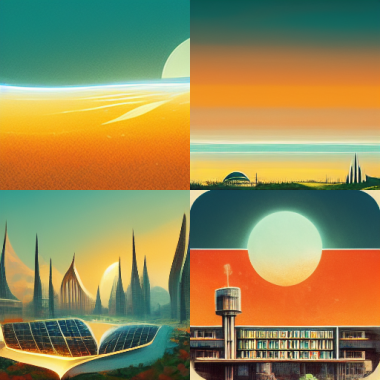
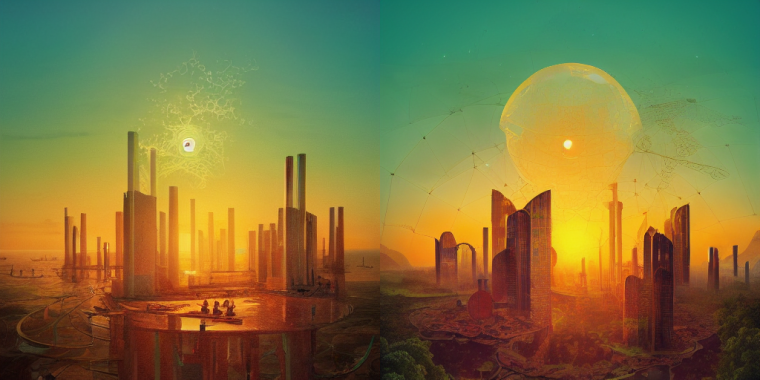
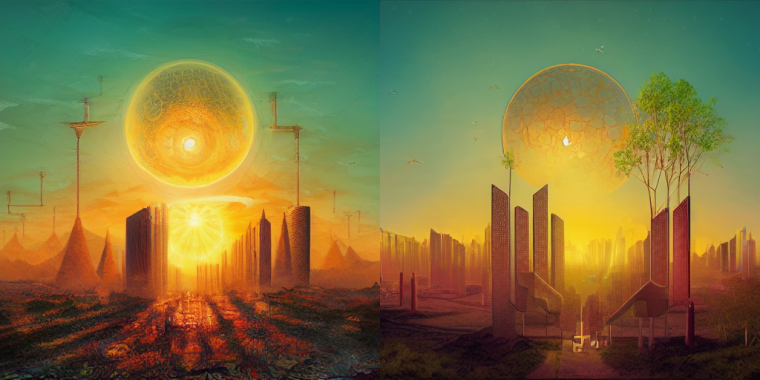
Next up, Midjourney offered pairs of images, and some struck me as beautiful, even entrancing:

BryanAlexander_Solarpunk_university_2 pix big sky and buildings _MidjourneyJohMag23_Solarpunk_university_2 pix sky orb _MidjourneySolarpunk_university_2 pix _lovely_JohMag23_ MidjourneyI do wonder what that giant sphere is in the sky, and might dread it.
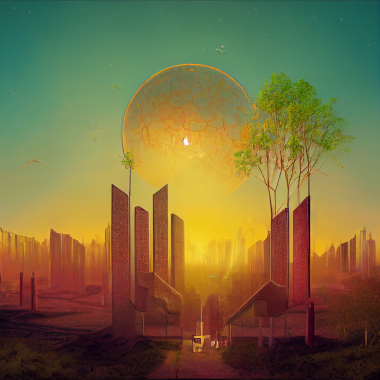
Those images are variations on a similar idea: a large sky orb, buildings clustered underneath.  I liked these enough to get just one more like it.

JohMag23_Solarpunk_university_lovely with tree Midjourney

As a late night coda, I asked Midjourney for an ancient academic library, with shadows:

ancient_academic_library_with_shadows_Midjourney

To my eye these images feel like others, historical ones. Some remind me of Richard Powers‘ science fiction book covers.  More recall prog rock album covers.

There’s a lot more to say about this topic.  Since art AIs work with preexisting digital images, what do they reveal about our cultural attitudes towards higher ed and its future?  What about the ethical problems involved, from using said preexisting images to deflating the market for human-generated art?

Those are topics for another post or two.  For now I’d like to post these images for your viewing and reflection.

PS: if other people want to make their own images, I could fire up another post to host yours.

Posted in climatechange, future of education, futures, higher education, libraries | Tagged | 3 Comments

Another day in the life of a futurist

I wanted to offer another “day in the life of a futurist” installment.  I did a couple in 2017 and 2018, so this is overdue.

To make up for the delay, I chose an extreme day:

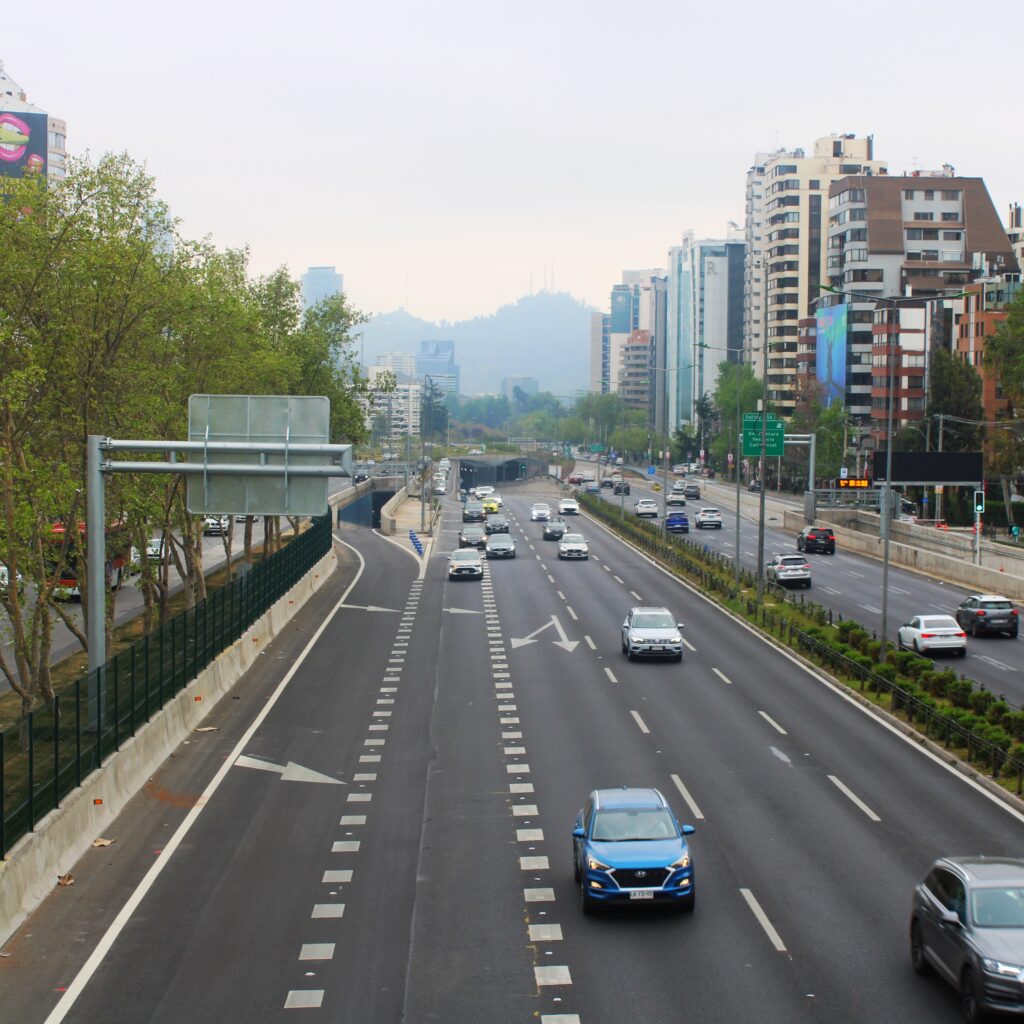
October 6, 2022, 12:01 am EST – I am somewhere over the Pacific Ocean or Central America, as the United Airlines flight carries me north from Santiago, Chile, where I’d addressed and met with staff and users of a big ed tech company.  It went well, I think.  Good conversations, a chance to tour a local university, networking.  I’m fascinated by similarities and differences between Latin American universities and those elsewhere.

Spanish-speakers were very kind with my fumbling language practice.  I repeat: “Estudio espagnol, pero comprendo muy mal!”  I tried to improve by listening to presentations in both Spanish and English, thanks to hard-working simultaneous translators and little earpieces.

On the plane I sleep fitfully, turning to Richard Powers’ superb Overstory (2018) when I could.

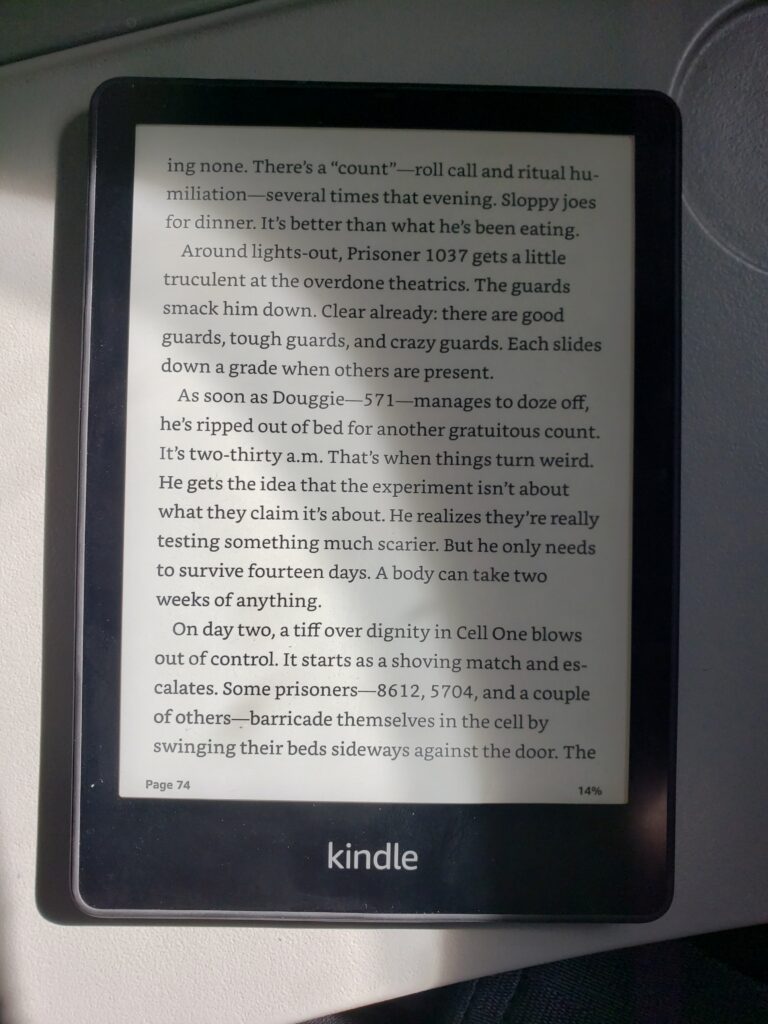
Kindle ereader_reading Richard Powers Overstory_light and shadow both

I am pleased by how this newer Kindle handles both dark and light settings.

At one point lightning ripples through the dark clouds underneath the plane. I try to capture the spectacle with my beaten-up Android phone, but keep flubbing the timing.  I try to remember passages from Edmund Burke on the sublime (1757) but fatigue and travel scramble my brain.

At another point, I muse about the psychological insulation of air travel. How distant I feel from the countries we scud over, from the physical environment.  This is obviously not an original insight, and it’s an older one, given the history of air travel. I think about incremental innovation in aeronautics, wanting to get back online so I can check out the latest ideas in improved jet fuel, engines, and fuselages.

I also feel my frustration at not being able to decarbonize my professional travel effectively.

Also: I am one of a handful of people on the plane wearing a mask.

5:30 am, CST – reach the United States, deplaning groggily at Houston’s airport.  Homeland Security is much more interested in my Chilean activities than Chilean security was.  I stagger through IAH as it gradually opens up, hunting vegan food and resorting to trail mix.

Most importantly, in an anonymous tunnel/hallway, I find seats and power outlets, then get on the airport’s WiFi. This gives me some time to work on emails while catching up on news.  Specifically, I fire up Inoreader and Google News on my phone, then a set of tabs on the laptop (little Windows box): Gmail, Twitter, Facebook, WordPress, Google Docs, Google Calendar, Shindig.

(Much as a I use my phone, I *need* a keyboard to work.  I can only peck out so many words on the Android.)

Time runs out. I pack up and saunter to the gate, where I enjoy talking with a real estate lawyer about federally-backed flood insurance.

11:30 am, EST – I deplane still groggily at National Airport (am old and political enough to never say “Reagan”).  Now it’s time to hike to the happily adjacent Metro station and train north, tweeting along the way and relishing this very kind note from Joshua Kim at Inside Higher Ed via mega-editor Greg Britton:


Noon – exit Metro at the Rosslyn station and get a decent salad at a nearby Chopt.  Then walk the chilly Key Bridge over the Potomac towards Georgetown University, luggage in tow, thinking about how to organize several events coming up.  To wit:

2 pm – based in a campus conference room, I launch this week’s Future Trends Forum, where we host the authors of a fascinating proposal to redesign higher ed, high school, and the labor market all together.  The writers are great, thoughtful and deeply engaged with discussion. The Forum audience is, of course, amazing.  I’m not sure if I think the Blur will work, but I’m still considering it and admire its vision, plus the authors’ commitment.

3 pm – a climate fiction book club meeting takes place in Zoom. The book is a collection of solarpunk short stories, and I enjoy some of the writers’ comments and readers’ reactions. I’m interested by many themes: an insistence on nonviolence, the problem of thinking through such a vast hyperobject.

4 pm – I relocate down the hall to a fine classroom for my future of higher education seminar.  Tonight’s futures method is the Delphi. Our example: the 2022 EDUCAUSE Horizon Report.  Discussion nicely ranged between how Delphi works (I give examples from my own experience with the New Media Consortium’s Horizon Reports) to some of ways technology shapes the future of higher education. The students are excellent.  I owe them readings for next week.

6:30 pm – I skip dinner to walk back over the river to the Metro again, this time to ride north into Maryland, to Silver Springs. Along the way I notice the first significant numbers of people wearing masks; not sure why that’s so. We arrive and I climb out of the train station, still hauling my luggage and wearing a suit, to meet my friends at the Kiss-and-Ride (yes). They have brought me clothes, which I change into sneakily, then we walk to a music venue. That’s because the last event of the day is my first Sabaton concert, the first time I’ve been to a live show since February 2020.

Sabaton concert Silver Springs 2022

I was standing in the back off to one side and it was all good.

The history-obsessed metal rockers do not disappoint.

1 am, roughly? – finally make it home by car for the first time in a week. My mind’s racing, but the much-abused body sabotages thought and drags me to sleep.


One thought: I’m happy to work on the road, but so much depends on local conditions.  Santiago was good to work in – great when my hosts were in charge – but not all locales are so supportive. Airport wifi remains variable and not reliable for high end work, while power outlets can be scarce or difficult to use. Working on planes remains agony for me outside of first class, due to no or bad wifi, sometimes no power, and too often no room for me to crack open a laptop and write.

Posted in Future Trends Forum, personal | 2 Comments

More on changing American religion and higher education

Greetings from Santiago, Chile.  I am here to give a talk to, and meet with people at, an Ellucian users’ conference.

Santiago Chile street with foggy horizon

It’s lovely to be in person for an educational technology event.  I’m masked, but can still bask in human presence. Plus I get to try out my childlike Spanish language “skills.” Everyone here – Chilean, plus people from other Latin American nations – are most kind to me as I fumble and strain.

And my hosts have been splendid.

Ellucian audience after my talk 2022

Audience recovering from my presentation.

Now, to this post’s topic, which doesn’t have much to do with Chile, although it touches on travel. Last week I shared notes on a new Pew study about changes to American religion.  Today I’d like to follow up with a few additional thoughts based on conversations with readers and a webinar.  This is a short post and these three points are not in any particular order:

In response to that post, over on LinkedIn Tonya Amankwatia offered two provocative ideas.  First, if Christianity declines sharply, will some institutions make a point of remaining affiliated to the level of mission and operations?  Tonya suggests the possibility of Historically Christian Colleges and Universities as an institutional category.

Second, thinking of campuses supporting students, “How will schools engage Christian students in the future?”  Especially if that set of religions becomes marginal or stigmatized?  I wonder how attractive the (presumably) dwindling number of very Christian institutions will be to such students.  Alternatively, will other campuses try to direct certain staff to support such students, like staff with clear religious identifications of interests?

Several days after Tonya’s comments I participated in a Greenfaith global webinar about religion in the climate crisis.  Its presentations and, to a lesser extent, discussions covered a lot of topics. One religious theme particularly stood out for me: rethinking parts of current or potential economic development as luxuries in the Anthropocene.  That’s luxury in a religious sense, a sin, something to be shunned and condemned.  Speakers didn’t embed that line of thought in a particular religion; indeed, the event was replete with a range of faiths, from Judaism and Islam (Sunni, I think) to New Age and various Christianities.

I’m not sure a carbon luxury view requires a religion. There have been plenty of anti-consumerist, even austere ideas in play of late without the backing of a faith: Buy Nothing Day, voluntary simplicity, even slow food.  Of course, plenty of religions and religious practices have offered divine backing for opposition to luxury. And perhaps criticizing consumerism or leading stages of development could become part of an emerging, new religious movement (which I keep looking for).

I think that this view, if people adopt it, might connect to higher education in several ways, especially following the analytic framework I develop in Universities on Fire.  First, a society could embrace such an attitude and then suffer economic stagnation or decline, as consumer purchases drop.  If that occurs, local academic institutions can see public financial support decline – or enrollment rise, assuming the population follows the COVID-tarnished theme of linking economic woe to college attendance.

Second, a new conception of luxury can lead to campus-community divides. A town whose population inclines towards this belief might view their non-believing academic neighbors with suspicion, as dangerous decadents.  The reverse could also occur, if a campus population turns to a kind of climate austerity (again, in the religious sense) and deems its neighbors to be committing a moral error.

Third, the presence of such a belief on campus could lead to institutional friction. For example, some activist students might deem their faculty (for example) to advocate or practice sinful luxuries, such as flying too much, eating plenty of beef, urging GDP growth via consumerism, etc.

Fourth, a greenhouse-gas-emitting-behavior-is-luxury idea will be worth researching for some faculty, from religion to history of ideas. Similarly, it may be teachable.


That’s it for now. I have to set up to teach tonight’s seminar from my hotel room, then sleep before a breakfast meeting.

Posted in climatechange, higher education, politics | 4 Comments