What should my grad students read about emerging AI?

I have a seminar meeting coming up for my technology and innovation class, and I’m not sure what readings I should assign. The subject is AI, and I have many thoughts but no conclusions.  So today I’m asking for readers’ suggestions.  Yes, I’m firing up a good, old fashioned bleg post.

To explain: I teach in Georgetown University’s Learning, Design, and Technology (LDT) program.  This class, Technology and Innovation by Design, is required for all LDT students. It takes them through a range of ways of understanding tech, from historical accounts to imaginative writing, economics to critical theory, sociology to feminism, antiracism to area studies.  I love teaching it and am always looking for ways to make it better and more exciting. (see latest syllabus at end of this post)

This year I’ve expanded the unit on AI because of the current large language model (LLM) revolution. We’ve done some AI exercises during the semester, and now we’re going to devote hours to the topic.

A_university_seminar_discussing_AI.

Midjourney’s best attempt.

For the class session (and maybe two) I have some plans. First, an informal and quick series of go-rounds where I ask students to share what they know about generative AI, what they think about it, then what they’ve done with the stuff.  Second, students will do hands-on work with various tools, including chatbots, image creators, and others.  That will include discussions and lots of peer learning. Third, I’m going to break habit and lecture for a bit, based on my AI work.  That’s to give them a sense of what I see as rapidly emerging things happening, along with a grounding in the technologies.

Besides all of that, and before all of it, I’d like the students to read mind-expanding and interesting material which should challenge them, which is where you come in.  Readings should be scholarly, preferably, as one goal of the program is to acculturate students to reading academic research.

Some parameters:

  • The students are brilliant.  They are mostly international.  Age is mostly in the 20s. Gender is balanced.
  • They don’t have a lot of coding background, generally, being more grounded in media work.
  • So far they have expressed interest in AI, but have not revealed a great deal of experience or enthusiasm for the tech.
  • They come from a variety of disciplinary backgrounds, with an emphasis on the social sciences and humanities.
  • While the class is focused on technology, the end point is its use in higher education.
  • I love historical documents, but want to make sure we include current writing which addresses emerging AI.

I’ve been considering some items with a diversity of approaches and themes, tending to be from the past couple of years:

Brent Anders, The AI Literacy Imperative.

Emily M. Bender, Timnit Gebru, Angelina McMillan-Major, and “Shmargaret Shmitchell,” “On the Dangers of Stochastic Parrots: Can Language Models Be Too Big? 🦜”

Ian Bogost, “ChatGPT Is About to Dump More Work on Everyone” and “ChatGPT Is Dumber Than You Think”

James Bridle, “The Stupidity of AI”

Ted Chiang, “ChatGPT is a Blurry JPEG of the Web” and “Will AI Become the New McKinsey?”

Tyler Cowen and Alex Tabarrok, “How to Learn and Teach Economics with Large Language Models, including GPT “

Jason Fagone, “The Jessica Simulation”

Paola Ricaurte, “Artificial Intelligence and the Feminist Decolonial Imagination”

Joana Varon and Paz Peña, “Artificial intelligence and consent: a feminist anti-colonial critique”

Also, using this game for the paperclip problem.

What would you recommend, o readers?  Some of these, or others?  Thank you for any suggestions.

DALL-E envisions the class.

DALL-E envisions the class.


PS: Here’s the class syllabus so far, for context.  I’ve removed some things which don’t seem relevant and anonymized students, as I haven’t asked permission to use their names:

Tuesday, August 29, 2023 – introductions

Readings:

Tuesday, September 12, 2023 – Histories of technology, I

Tuesday, September 19, 2023 – Histories of technology, II

Tuesday, September 26, 2023 – Imagining innovation

Readings:

Student tech presentations: the toilet

Tuesday, October 3, 2023 – How innovations spread, I

  • Readings: Everett M. Rogers, Diffusion of Innovations, 5th Edition: 1-52; 72-3; 87-218  (chapter 1; chapter 2 through the Miracle Rice story, the STOP AIDS story, and from “Opinion Leaders” on; chapters 3-5)
  • Referenced: Moore, Crossing the Chasm

Student tech presentation: vaccines

Friday, October 6 – analysis of one innovation due

Tuesday, October 10, 2023 –  – How innovations spread, II

Student tech presentations:   GPS

Tuesday, October 17, 2023 – How to nurture innovation

Readings:

  • Jon Gernter, The Idea Factory: Bell Labs and the Great Age of American Innovation (part one, chapters 1-11)
  • Rosen, “Prologue and Changes in the Atmosphere”

Student tech presentations: birth control pill

Tuesday, October 24, 2023– Justice and innovation, 1

Readings:

Student tech presentations:  cement

Tuesday, October 31, 2023 – Justice and innovation, 2

Reading:

  • Benjamin, Race After Technology: Abolitionist Tools for the New Jim Code, 97-end.
  • Walter Benjamin, “The Work of Art in the Age of Mechanical Reproduction” (one copy)

Student tech presentations:  antibiotics

Tuesday, November 7, 2023 – Beyond America and Europe

Reading: Digital Middle East, selections:

    1. Zayani, “Mapping the Digital Middle East: Trends and Disjunctions”, 1-32
    2. Any four (4) chapters of your choosing, based on your interests  

Student tech presentation:  eyeglasses

Three technologies to think about

Friday, November 10 – annotated bibliography due

Tuesday, November 14, 2023 – Critiquing technology

Student tech presentations: WiFi

Posted in automation, classes and teaching | Tagged | 33 Comments

Academic cuts and queen sacrifices across the country

Greetings from a dark November.   The past few days have been rainy and chill, the perfect atmosphere for this post.

(It’s November?  I’m not sure how that happened.  I’ve been on overdrive mode for months now and calendars have become… blurs. On a given day I only know what to do based on what my calendar and to-do lists tell me.)

Today’s topic is cuts to higher education.  Some readers know I’ve been tracking what I’ve called “queen sacrifices” for years.  The term comes from chess, and describes the move of giving up one’s most powerful piece – the queen – in a gambit to win the game. It’s usually seen as a desperate move. I applied the term to higher education, where tenured faculty play the role of the queen, given their tenure protection and institutional governance roles; colleges and universities can cut them in various ways, often as an attempt to get out of a financial crisis.

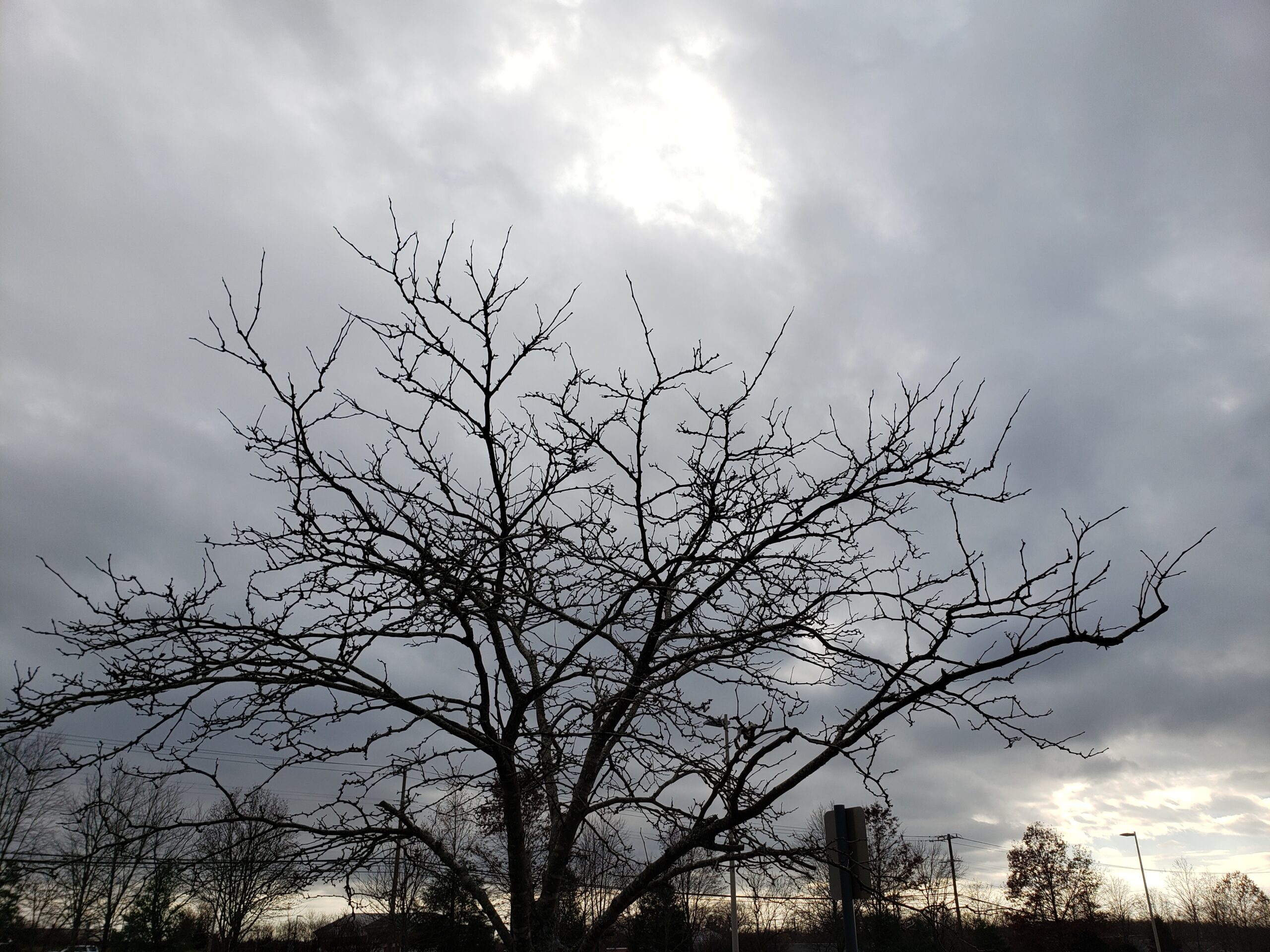
cloudy skies over a bare tree

A gloomy sky from a winter month

Usually I write about a single instance, typically in the American northeast or midwest.  Oftentimes the institution’s leaders cite declining enrollment and ballooning budget deficits as motivating forces.  Sometimes a reduction in state funding plays a role for public institutions.  Occasionally there are stories of financial mismanagement ranging from bad strategies to actual crimes. Typically – but not always – programs with low enrollment (either majors or total students) face the ax; the humanities stand out among others on the chopping block.

Now it seems that the queen sacrifice appeals to a lot of campuses this season.  In addition, other colleges and universities are making or preparing to make other kinds of cuts, which fall upon other populations: staff, non-tenure-track faculty.

Let me offer some evidence, broken down by states.

ILLINOIS Bradley University announced a series of cuts, called for by “[t]he university’s provost and deans, and a faculty review committee,” which can “potentially eliminate over 20 academic programs and cut 68 faculty positions.”

Which programs and people face the ax?

The announcement unveiled plans for cutting math programs like statistics and actuarial science, as well as programs in the arts, such as printmaking and ceramics. For five programs — economics, French, mathematics, philosophy and physics — the plan calls for continuing classes but dropping majors and concentrations.

The reason for the cuts?  The appearance of “a $13 million [budget] shortfall, which amounts to about 10% of the college’s operating budget.”   One reason for that gap is declining student numbers: “[t]he university recently counted 5,217 students enrolled for fall 2023, down from 5,552 students the year before.”

MISSOURI Columbia College will end 122 jobs and close nearly 20 sites.

The reasons given are interesting.  The first, “a declining number of high school graduates,” is to be expected, as my readers know.  Two others, though, are a bit narrower: “an increasingly competitive online education environment and ‘evolving student instructional preference’ as reasons driving the changes at the nonprofit Christian college.”  I’m not sure if that second point refers to decreasing religious affiliation among Americans, but that is plausible.

VERMONT In October Vermont State University announced it would end 33 faculty and staff positions across its four sites, in addition to “cuts to the schools’ health insurance and retirement plans.”  Reasons include a reduction in state support, as well as realizing staff efficiencies through merging multiple campuses.  Indeed, a report described the institution as “about 20 percent overstaffed, based on the ratio of students to full-time staff.”  Most of the positions targeted are administrative, from assistants to a budget director.

This month VTSU scaled back its original cuts, firing only one professor, after more than a dozen accepted buyouts for early retirement.  The school increased the number of  programs to be merged and closed.

WEST VIRGINIA West Virginia University has gotten a lot of publicity and criticism over the past few months for the cuts president Gordon Gee has directed.  What the leadership ended:

28 of its majors, or about 8% [of the whole catalog], and cut 143 of the faculty positions, or around 5% [of the whole instructional staff]. Among the cuts are one-third of education department faculty and the entire world language department, although there will still be seven language teaching positions and students can take some language courses as electives.

Here’s a rare thing: a sympathetic portrait of five of those professors.

The reason for the cuts: Gee launched a massive effort to grow WVU enrollment and it failed, with student numbers actually reversing, and so driving a major budget crisis.

WISCONSIN Several public universities are planning cuts, in part in response to Republican anti-DEI pressure:

The University of Wisconsin-Oshkosh cut 140 jobs.  In addition, 76 took early retirement offers.   34 full time positions will be unfilled.  The composition of these jobs is a mix: “The layoffs affect UWO administrative employees and staff while no faculty members were laid off. Of the 76 who accepted voluntary retirement, 49 are staff, 21 are faculty and six are instructional academic staff,”

The rationale?  To save nearly $15 million.

The University of Wisconsin-Parkside is cutting 55 jobs, or “about 9.5% of its workforce positions.”  These cuts are in addition to furloughs.

The University of Wisconsin-Platteville announced major cuts, costing 111 people their jobs, or “12.2% of its workforce.”  The goal is to save $9 million, which represents a structural deficit. Which people? “there were 49 academic staff, 27 university staff, 20 limited appointments, 11 faculty retirements, and four positions from other categories that were included in the cuts.”

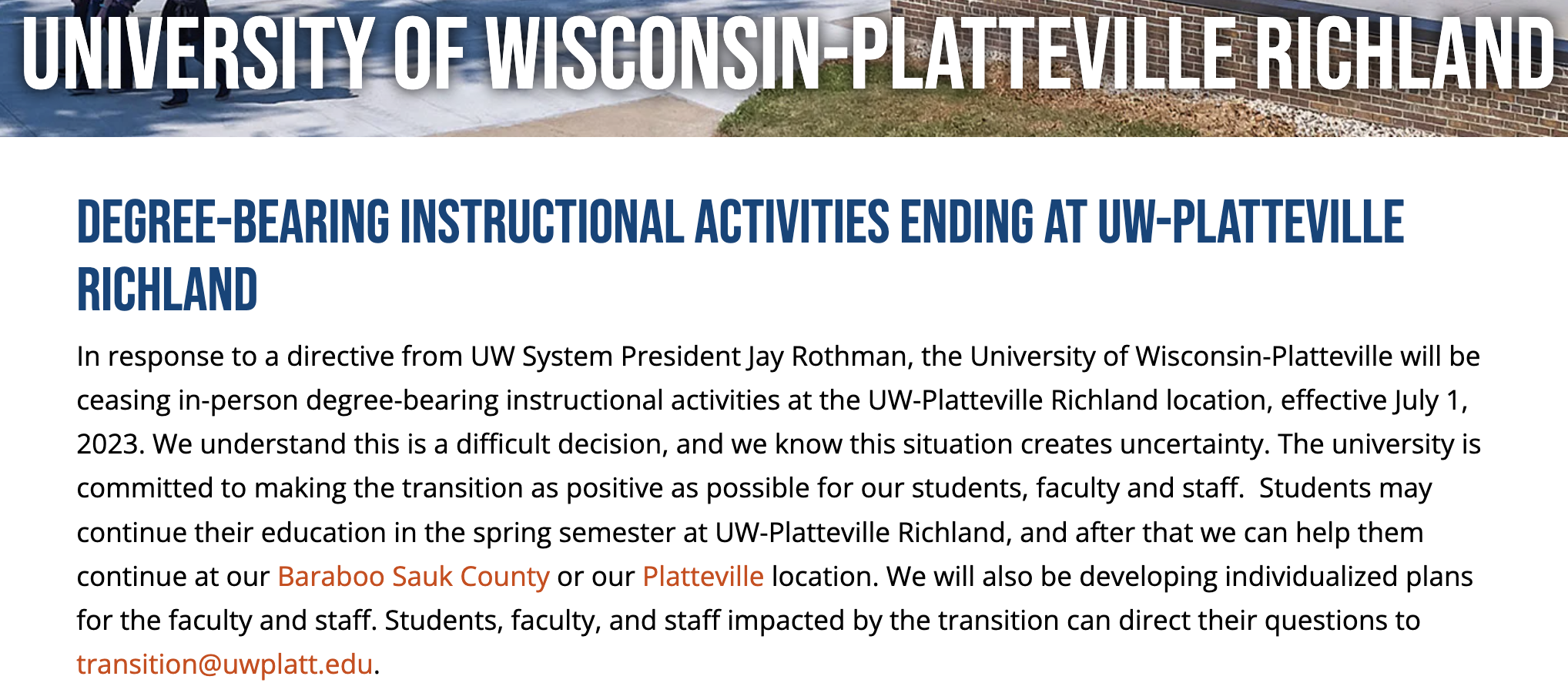
The University of Wisconsin system also shut down a two-year campus, UW Platteville Richland.  This is from its official webpage:

University of Wisconsin-Platteville closing

University of Wisconsin-Milwaukee at Washington County and UW-Oshkosh, Fond du Lac will no longer teach in-person classes, but only online ones.  Note the rationale for the latter move: “[system president Jay Rothman stated that]  online enrollment has been trending up.”

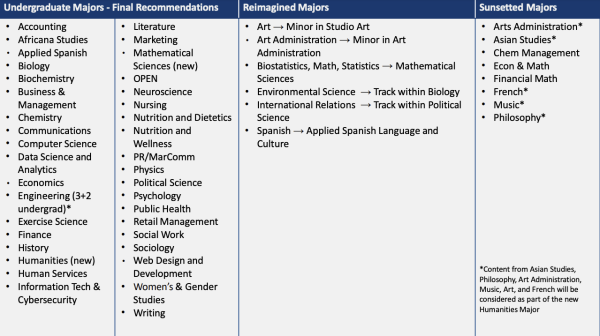
Beyond cuts to tenure-track faculty, other faculty, staff, and program cuts are in the air.  San Francisco State University announced plans to cut 40% of its adjunct population, which is now organizing in response.  Simmons University in Massachusetts will end (“sunset”) eight majors: “Art, Art Administration, Asian Studies, Chemistry Management, Economics and Math, Financial Math, French, Music, and Philosophy.”  Other programs will be folded into other majors:

 .

Biostatistics, Math, and Statistics will be absorbed into a Mathematical Sciences major, Environmental Science will become a track in the Biology major, and International Relations will become a track in the Political Science major. The Spanish major will become an Applied Spanish Language and Culture major.

Simmons University majors changes 2023

I would not be surprised to see the administration encourage some faculty in those fields to retire, or to remove them directly, in the near future.

Similarly, the University of Wisconsin-Green Bay is openly discussing a series of program cuts.

UWGB is considering cutting majors in economics, environmental policy and theater and dance, according to an email sent to faculty and staff Tuesday. It’s also looking to discontinue minors in international environmental studies, geography and physics.

I haven’t found Green Bay officially airing personnel cuts yet.

Also along these lines are cuts from Newman University in Kansas: “english [sic], finance, history, marketing, math, philosophy, social work and theater.”  Newman isn’t just cutting, but adding new programs  “[i]n a strategic effort to realign educational offerings with changing student trends, market forces and emerging industry demands.”

Despite cutting some programs, the university said it implemented new undergraduate majors in the 2023-24 academic year, including agribusiness, computer science, digital design and adult and professional studies. Additionally, graduate degrees were added in biomedical science, business administration, data science, online social work and education.

Once more we can see the humanities overrepresented in the cuts and invisible in the additions.

Meanwhile, other institutions have been signaling the possibility of cuts to come:

ITEM: the University of North Carolina-Greensboro is undergoing a financial planning exercise, and it’s not one based on plenitude.    The Chancellor charged participants thusly:

All divisions are asked to engage in a budget reduction exercise at 1%, 2% and 3%. The table below provides amounts per division. All divisions should plan for submission of the 1-3% scenarios by Thursday, January 18, 2024.

There’s no call for staff or program cuts so far.

ITEM: Nevada’s state higher education system is trying to figure out how to close a big deficit.  They don’t have to share their deliberations in public, so their plans are thus far unknown.

ITEM: The University of Arizona announced it was in a financial crisis, with only 97 days of cash on hand.

ITEM: the state of Alabama decided not to financially assist Birmingham-Southern College in its economic crisis.  BSC has position this as an existential crisis.

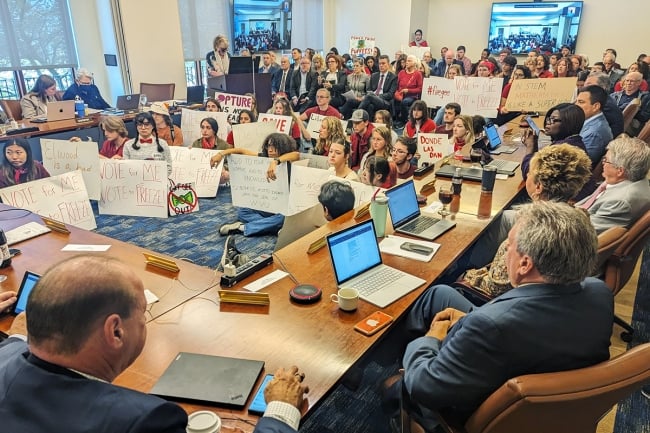
Now, news of these proposed and actual cuts has elicited commentary and protests from within and beyond those institutions.  A Bradley University graduate and current French teacher wrote this moving appeal.  Vermont faculty criticized the layoff plan and students protested.  University of Wisconsin system faculty are open about the new pressures they face.  West Virginia University faculty voted no confidence in their president and some students, organized by their union, protested.  An accounting adjunct organized an alternative plan to save the same amount of money by cutting some administrators and staff compensation instead.

WVU_protest_Ryan_Quinn_IHE_2023 Sept

A critique of these cuts as a whole, especially queen sacrifices, has been rising.  This New Republic piece offers a useful example, arguing that cut programs can actually be profitable and that administrators ax faculty before staff.  Indeed, in the West Virginia case the president was actually completing a scheme to  “manufacture a fiscal crisis as a pretext to reengineer the academic core of WVU.”  Labor historian Myya Helm argues that the WVU showed a preference for physical buildings and administrative salaries over faculty and student support, tied to a lack of state support and refusal to seek more public funding.

Where does this leave us?  What do these stories suggest for higher education’s future?  Let me offer a few quick thoughts for a post which has already gone on too long:

  1. Some of these stories share elements, notably enrollment pressures and cuts to the humanities.  We should watch for this to keep appearing and in other locations.  Perhaps there’s a through line, a commonality to be identified.
  2. At the same time each cut story is specific, with particular or even unique details.  It’s vital to not lose sight of them and their individual salience.
  3. The critique that appeared around WVU might grow in popularity, especially as cuts and queen sacrifices grow.  I’d very much like to see more of it.
  4. American higher education often behaves in herds, with multiple members seeking to follow what looks like an established direction.  If this post’s summary of cases holds up, then we should expect other colleges and universities to follow along.

Over to you, readers.  What do you think?  Are you seeing any signs of cuts elsewhere?  Is this picture too gloomy?  The comments box stands ready for your thoughts.

Posted in higher education | Tagged | 14 Comments

More academic climate action occurring

Greetings from COVID containment. My wife and I remain sequestered. We spent Halloween night watching costumed visitors from our bedroom window and watching horror movies.

But COVID can’t stop my work!  Today I’d like to share several stories about global warming and academia.  I think they might be evidence of rising climate action within higher education.

First, students from six campuses – Pennsylvania State University, Tufts University, the University of Chicago, the University of Pennsylvania,  Pomona College, and Washington University in St Louis –  filed legal complaints with their respective states atttorneys general.  The charge: “by investing in coal, oil and gas, the schools are violating their obligations as non-profit organizations to prioritize the public interest.”

I found several interesting details in this story.  For one, it wasn’t just students: “Each filing elicited signatures of support from dozens of faculty and staff members, alumni and local, national and international climate-focused groups.”

For another, they charged campus fiscal support of fossil fuel firms to be contrary to institutions’ intellectual missions:

“Fossil fuel companies have long engaged in a well-documented campaign to undermine climate science and distort public debate about how to deal with the climate crisis – including through efforts targeting Penn scientists and researchers,” University of Pennsylvania students wrote in their filing. “The industry’s spread of scientific misinformation undermines the work of Penn faculty and students who are researching and designing solutions for a sustainable future.”

Students also raised this point about consistency:

“If universities say, ‘We’re climate leaders, we stand for justice,’ but then on the other hand financially contribute to the climate crisis, we just see that as unacceptable,” said Moli Ma, an undergraduate student at Tufts, who helped lead the complaint against her university. “There’s an incongruence there. It doesn’t match up.”

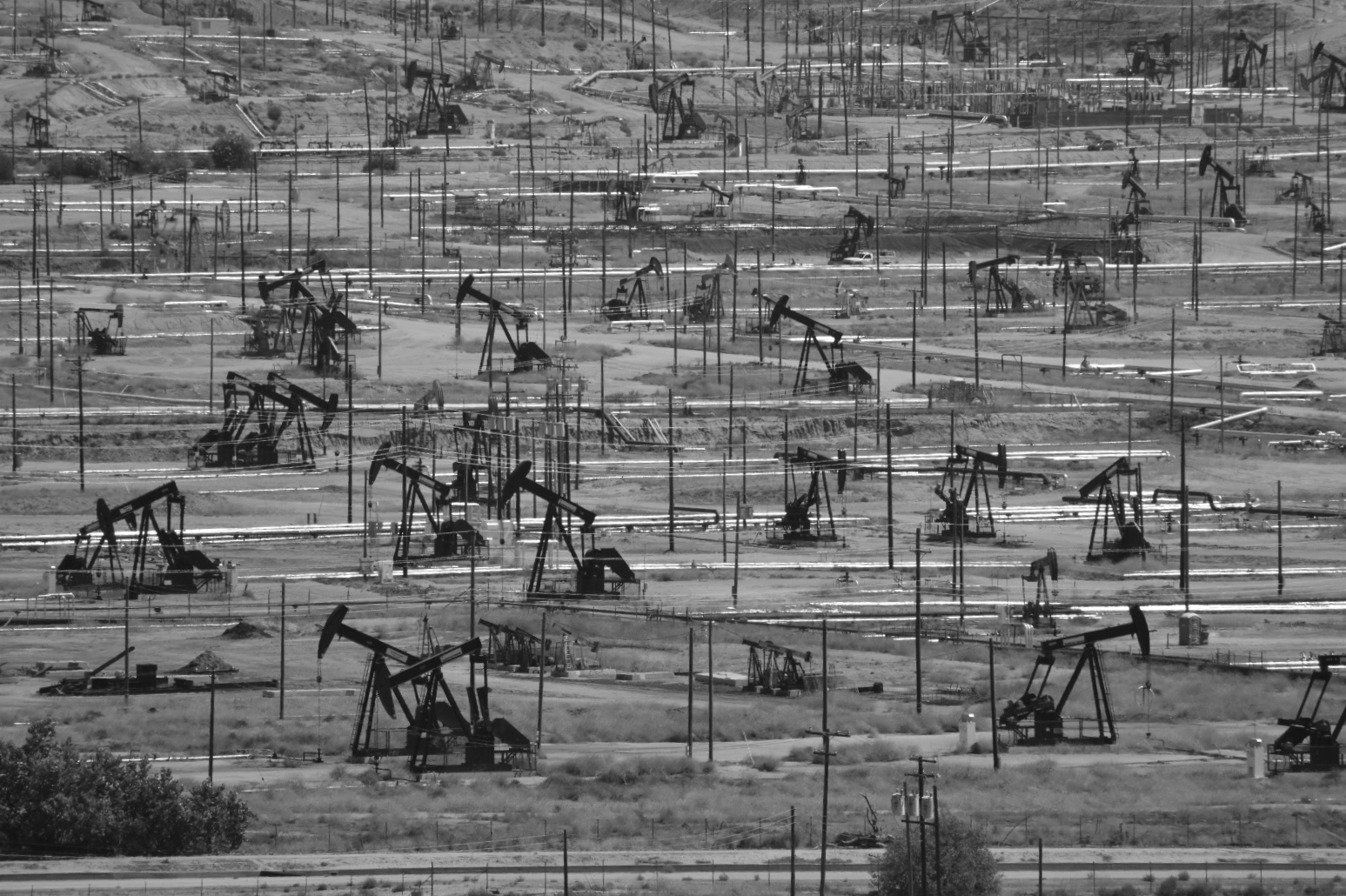
"A view of the oil fields from the bluff on Panorama in Northeast Bakersfield, CA - USA"

“A view of the oil fields from the bluff on Panorama in Northeast Bakersfield, CA – USA”

Not being a lawyer, I can’t offer authoritative comments, but was struck by two legal strategies which look to be nearly universally applicable.  One concerns a specific law, which paying petroleum companies might violate:

Four of Monday’s filings allege that schools breached the Uniform Prudent Management of Institutional Funds Act, a law adopted by 49 states requiring non-profit institutions to consider their “charitable purposes” in their investments and to do so with “prudence” and “loyalty”.

Pennsylvania apparently stands alone on this score:

Pennsylvania has not passed such a law, so students’ legal complaints against the University of Pennsylvania and the Pennsylvania State University are based on similar regulations that fall under the state’s Decedents, Estates, and Fiduciary Code.

Then there’s this very pragmatic point:

Another key argument in each complaint: investing in fossil fuel stocks not only harms the climate and threatens human health, but also creates financial risk.

“We make the case that fossil fuels from a purely financial point of view are a very bad investment,” said Ted Hamilton, a lawyer with the Climate Defense Project who has worked on each of the legal filings. “This sector is very volatile. It’s been underperforming lately, and especially for long-term institutional investors like universities, it has a very bad value thesis [for] the coming decades.”

The next two stories aren’t purely academic, but include a bunch of faculty and staff.

Several health care groups with large memberships are about to post a joint letter calling for urgent climate action.  Apparently the text is all about the impact of global warming on public health:

“We the family doctors, doctors and health professionals of the world call on world leaders to take urgent action to safeguard the health of global populations from the climate crisis,” the open letter reads.

And the urgency is clear:

The signatories include health bodies from Canada, India, Europe, Pacific nations and the UK, who are demanding all governments end the expansion of any new fossil fuel infrastructure and production, phase out existing fuels, remove subsidies and invest in renewable energy.

“If we are to have any chance of limiting warming to 1.5C and halting the escalation of the climate health emergency, we must end the proliferation of fossil fuels,” the letter says.

Now these are health care practitioners, not all academics, but some of them surely are academics: full time faculty members, medical professionals working as adjuncts, and so on.


Matt Hrkac Farewell Party for Fossil Fuels Extinction Rebellion put on a 'farewell party' for fossil fuels outside of a fuel terminal in Yarraville, Melbourne.Third story: the Washington Post reports on what it finds to be a growing sense of climate emergency among scientists.

References to “climate emergency” and “climate crisis,” once used primarily by activist groups like the British-based Extinction Rebellion or the U.S.-based Sunrise Movement, are spiking in the academic literature…

Tim Lenton,… professor of earth system science at the University of Exeter… said he isn’t afraid to use terms like “emergency” or “climate and ecological crisis.”

Shannon Osaka notes an increasing desperation among scientists to get political leaders to pay attention and take action.

As with the medical associations story, not all climate scientists are academics, but some are, either full- or part-time.

What do these stories signal about academia and the climate crisis?

Overall, I think they point to incrementally rising climate concern among the higher education community. It’s not a radical break, but an advance along a growth curve.

Note the students taking that bold legal and political step. I wonder how many campus presidents and (for private institutions) trustees feel outflanked and irked.  Personally, I admire the combination of student research and practice.

Note, too, the overlap with non-academic professional societies.  They may become a soure of climate energy.

Watch for more stories like this.  See if the students, faculty, and staff around you are following suit.  And hey, you could join them.

(two links via Bill McKibben’s excellent newsletter; crowded oil field photo by Babette Plana; “Just Stop It” photo by Matt Hrkac)

Posted in climatechange | Leave a comment

2023 can stop doing this stuff right now

This past week saw me doing a whirlwind of work. I taught three classes, flew across the country to meet with one client, led a Future Trends Forum session, worked up the next FTTE report, held several virtual meetings, started redesigning FTTE, honed my next book proposal, prepped my spring class, and tried in vain to stem the email tide.

I hate leaving town when my wife is still recovering from heart attacks (first, second). I only do it for professional purposes – and those trips are extra needed now, given medical bills, as we decided to handle health care in America. I actually turned down some trips which took me away too long. Meanwhile, we set up care at home (our two adult children coming in handy).

Then to make things worse, last week Ceredwyn came down with COVID.  You all know the drill: she tested positive, re-tested to make sure, then we confined her to our bedroom. We brought her food and other supplies, leaving them outside the door. I slept in the living room.  She very all too symptomatic: joint pain, headaches, throat pain, fevers, chills.  It was like a bad flu for several days.

This made things worse for her in all kinds of ways.  Being sequestered isolated her from human contact. Ibuprofen interacts badly with some cardio meds, so my wife can’t use “vitamin I” to address pain. Acetaminophen has no effect on her now, so the suffering is wretched.  Plus she can’t do cardio rehab sessions while being infected.  And there’s the general psychological stress piled onto genuine dread.

Several days into this vileness, I left for a work trip.  From the road, I kept checking on her by phone and text.  She was gradually getting better, but was exhausted and in pain. I felt frustrated and sad and could only listen, plus tell her stories and read her poetry.

On Friday I started traveling back east and began feeling poorly myself: coughing, fevers, chills, sore throat. I slept unusually badly on a redeye from Seattles to Dulles. When I arrived home I at once fired up a COVID test for me and sure enough:

COVID test reading positive

The usual time for a COVID test to complete is 15 minutes, but that hard red line appeared in only about 2 minutes.

I don’t know the infection’s source.  Did someone give me COVID from an airport? Did the virus leap from a stranger’s nose and into mine at a restaurant?  Did my wife give it to me before she tested positive and it just lurked in my body, struggling with my full battery of vaccines and boosts, until emerging triumphant a few days later?

This test result occurred right when I got home, before I unpacked, before I said hi to anyone, so I immediately just hauled all my stuff into the bedroom and joined my wife.  I am goofily romantic enough to love that I could hug and kiss my wife again for the first time in a week, even if for a disgusting reason. And I could care for her in person.

So here we are, husband and wife, down with COVID. We occasionally order food and folks bring it to out plague-barrier door.

My symptoms are currently uneven.  Some hours I only feel tired and cranky. Other times my throat tightens up or itches.  Fever comes and goes.  I dropped about six pounds, due mostly to depressed appetite.

Disturbingly, my mental operations vary.  I can read something carefully, then feel very tired and disengage. One minute I’ll be thinking through complex problems or multiple ideas, then the next those thoughts fade and I have to start again.  This scares me worse than the physical aspects.

Based on my previous COVID experience, symptoms should start fading soon.  I’ll take virtual meetings from home and test daily. Classes this week will probably be online, as will one in-person trip.  Hopefully I can maintain concentration enough to keep doing my asynchronous work: research, writing, planning.

Looking back over the past five months, 2023 seems determined to have a dark side.  It can stop now.

Posted in coronavirus, personal | 8 Comments

Pummeling campuses and research

(A short post today. I apologize for the low level of blogging.  That’s due to an explosion of overwork plus the family challenges I’ve shared.)

One feature of the professional futurist’s work is monitoring the present to check how it bears out one’s forecasts, or how it doesn’t.  Either way the futurist has to recalibrate their work, using evidence to inform models.

Today I wanted to share two pieces of evidence from the world having to do with what I’ve been futuring about in terms of academia and the climate crisis. I think each confirms what I anticipated, but am certainly open to other views.

To back up: I started publicly research how higher education and climate might intersect four years ago. Universities on Fire appeared this past March.  In those blog posts and that book, not to mention presentations and social media notes, I’ve warned about two possible impacts we need to plan for: increasing physical damage to campuses and challenges to research materials.

ITEM: the New York Times reports on scholars who are seeing their research materials and subjects dwindle as a result of global warming.  (gift link) They discuss glaciers, coral reefs, Arctic mammals, tropical birds, Pacific Northwest salmon, subsaharan trees, and Argentine penguins.  Read the article carefully, as each researcher offers a different take, as well as varied levels of emotional response.

For example,

The people consistently told me how much they missed a more verdant past. The death of trees has, by their own account, reduced people’s well-being both materially and emotionally.

Seeing those dead trees in Africa and the hardships of the local people motivates me to work even harder to take action on climate change, to cut my own emissions, to encourage others to live more sustainably.

I live a car-free life. I eat a plant-rich, meat-free diet, specifically to keep my carbon pollution low. Every kilogram of carbon you avoid helps.

How does this impact researchers?  How can they preserve their subjects or find a way to modify their agenda?  At an institutional level, how can a university of college best support faculty, staff, and students confronting such challenges?

ITEM: Hurricane Otis struck Mexico, wrecking swathes of Acapulco, Guerrero, killing at least 27.

How did this impact higher education?   Physical damage is the obvious answer. It’s hard to get good information so far, yet we can note that that state has one major public university, Universidad Autónoma de Guerrero (Autonomous University of Guerrero) with multiple campuses, including one in Acapulco. Wikipedia estimates it has nearly 26,000 students plus faculty and staff.

Universidad Autónoma de guerrero, photo by Francisco Mena

Guerrero also has significant archaeological sites, some of which might have been damaged.  I haven’t been able to find reports of damage or injuries; hopefully that’s because Otis spared academia.

One datapoint: weather forecasters initially saw Otis as a mild storm, but it underwent rapid intensification a/k/a “explosive intensification,” becoming much more dangerous in a hurry.  As Zoë Schlanger put it,

gaining more than 100 miles per hour of wind speed in 24 hours. Suddenly, the tropical storm became a Category 5 hurricane just before reaching Acapulco—home to 1 million people—at 12:25 a.m. local time. And no one saw it coming.

More:

A short 16 hours before Otis made landfall, the National Hurricane Center predicted that it would come ashore as a Category 1 storm. Jeff Masters and Bob Henson, both veteran hurricane specialists, called that “one of the biggest and most consequential forecast-model misses of recent years.”

We might anticipate that weather forecasts might become less reliable as what I prefer to call global weirding messes with Earth systems and our expectations.

Last note: in my work on climate change it seems that every week offers such stories, along with projections like mine and those whose work I rely on. As a species humanity is wading ever more deeply into the Anthropocene.  Higher ed is unavoidably caught up in the process.  The question I leave you with is: what do we do about it now?

(Universidad Autónoma de guerrero photo by Francisco Mena)

Posted in climatechange | 4 Comments

Higher education trends: live-blogging a Gartner update

This morning I’m live-blogging a conference panel on higher education’s future.  The session is titled “Higher Education Trends, Predictions, Themes, and Future Scenarios” and the venue is the 2023 EDUCAUSE conference in Chicago.

I’m live-blogging it, old school.  So there might be typos and cryptic phrasing.  The session room is very dark, so I can’t get a good photo to share; the panel also didn’t use any slides, so I can’t post any of that.

The panel includes Paul Riley, Terri-Lunn Thayer, Mariana Brown, Tony Sheehan, Robert Yanckello.

Opening statement looks at two challenges facing higher ed.  First, financial challenges: enrollment, cost.  Second, reputational challenges: are students getting the right skills?  Pressure on changing credentials, remaking higher ed’s communications of its value.

How should a CIO respond?  Focus on campus strategic plan.  Understand the institution. Growth is often called for, but IT leaders will have to determine what to cut.  Focus on a student’s experience, making it smoother.

The next segment explored improving data and analytics.  Texas is requiring an upgrade from its campuses (public or all?).  Speaker wants academics to think of student data as a strategic asset.

Another theme: campuses need to identify what makes them distinctive from others.

Over to AI.  Introductory remarks about huge, rapid uptake of ChatGPT, concern about higher ed use. Some Gartner clients wanted to block generative AI.  Sea change: academic leadership now recognizes that the tools won’t go away, that the workplace will use them, so the question is how to best prepare students.

Over to enterprise systems (ERP): how to handle aging applications? How to handle modernization of ERP and student experience – change management.  How to keep staff current?

How is the CIO role changing?  First, as change manager across the institution – and that position across the institution is special.  Second, as educational leader (I think this means as champion of campus research, but am not sure).

What about vendors?  Now they are being more flexible, more configurable to appeal to wider audiences.

Some trends for the rest of the 2020s:

  • AI – how to make campuses more efficient
  • credentials – will the current set endure, or see new forms take hold?
  • personalization – in terms of content
  • polarization of sector (?) – how higher education institution competes?

CIOs managing student experience – the idea is wraparound support.  Slogan: “the last experience you had is the experience you expect everywhere.”  Also need to think of different levels: student, staff, general user experiences.  Question: what metrics do we use to assess student experience?

I ask what the panel thinks about the potential impact of climate change.  Gartner has received few queries on this. G has a sustainabioliyy team. Most queries are from Europe about power.  Early days. Some campuses call themselves sustainable, but they won’t stand up to stress tests.

Posted in futures, higher education | 2 Comments

Heading to Chicago for the 2023 EDUCAUSE conference

Who else is heading to Chicago for the 2023 EDUCAUSE conference?

I’m arriving Sunday night, assuming travel works out, and leading a preconference workshop titled “Generative AI as a Deep Agent of Chaos for Higher Education” Monday afternoon.  I think it’s sold out.  Then on Wednesday I’m hosting a live Future Trends Forum session there, blending the in-person conference with the online community.

EDUCAUSE 2016 preconference workshop audience

One of my preconference workshops, way back in 2016.

I’d be delighted to meet up with folks who are in town then.

Posted in Future Trends Forum, presentations and talks, speaking | 9 Comments

Social media platform numbers: how many people are using what today?

Greetings from an extremely busy day.  Today the Future Trends Forum is going to explore options for academic Twitter.  I’m very excited about this conversation. Where are folks going?  How many are staying on Twitter, and how many WILL head to Bluesky, Mastodon, etc?

One detail I’d like to touch on is just how large each platform is, as far as we can tell. For this post I’d like to offer some quick, back of the envelope, I’m-not-a-statistician estimates for conversational purposes. I don’t have time for trends extrapolation today, just a snapshot of where social media stand on this October 2023 day.

If any reader has better numbers, please let me know in comments.

Let’s start with the leading Fediverse platform. How many people now use Mastodon? The joinmastodon.org/servers page states 1.4 million monthly active users.

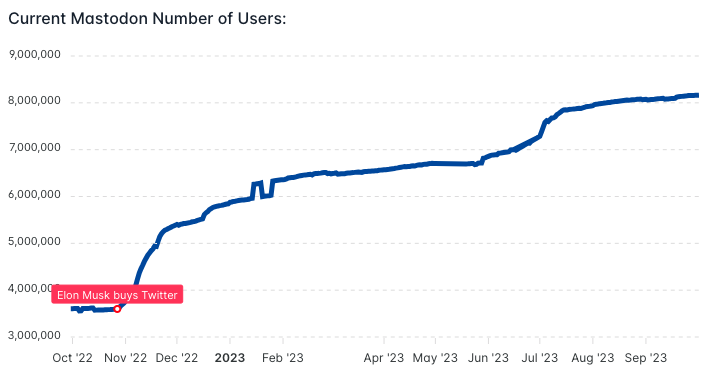
We can find more data on this score. According to Eric Khun’s tracker, the number of total (not just “active”) users is over 8 million:

Mastodon user numbers over time - growing.

Those numbers come from this Mastodon API, which offers a “user_count” of 8,073,406 today, along with a “server_count” of 9,138.

What proportion of those users are active?  One site considered numbers earlier this year and estimated 22%.  That would mean 1,776,149 actives today.  Techcrunch cited 2.1 million active users in July.  That’s when Khun had total users in the upper 7 millions, so perhaps 27% is a better figure, yielding 2,179,820 active users now.  That’s higher than the official number, and I’m not sure why.  Does the official site have a logic for excluding some users, or…?

Elsewhere, how is Bluesky doing?  Techcrunch estimates about 1 million users now.  This developer states 1,385,904 “Total Registered Users,” without breaking out active ones. A couple of weeks ago Bezinga reported on a “total membership” of “about 1.125 million,” with “daily active users reach[ing] 237,000 in mid-September.”  That gives me a proportion of roughly 21%, so 291,040 from VQV’s count.

How fares Threads, the Meta creation?  Summer 2023 saw a serious melt. Ars Technica estimated more than 100 million stopped using it by July.  Numbers dipped down to 1.1 million active users by late September, according to Marketwatch.  The Guardian noted only a half million in August. The *total* numbers of accounts is far higher, as lofty as 130 million or 132 million by another count, but that seems to just show anyone who ever made an account.  Meanwhile, The Verge projects more than 20 million active monthly users by the end of this year.

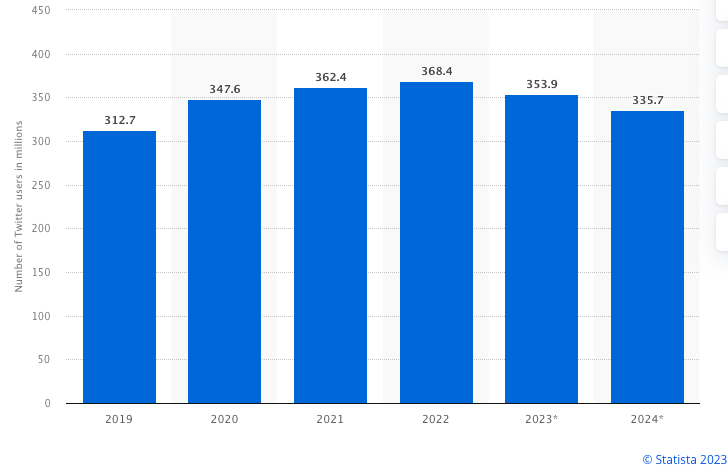
Back to Twitter, how goes the original microblogging platform?  How far has usage dropped during the reign of Musk? Last month DemandSage estimated there were “over 1.3 billion Twitter/X accounts, but only 237.8 million of them are monetizable daily active users,” plus 528.3 million monthly users.  Statista saw over “368 million monthly active users worldwide,” after some decline:

Twitter users 2019-2024 Statista 2023

Let’s add some of the other platforms, shall we?

Instagram now carries 1.3 billion active users, according to Statista. Insta has more than 2.3 billion active users now, according to DemandSage.  They add: “a quarter of the world’s active netizens use the platform every month!” (emphases in original)

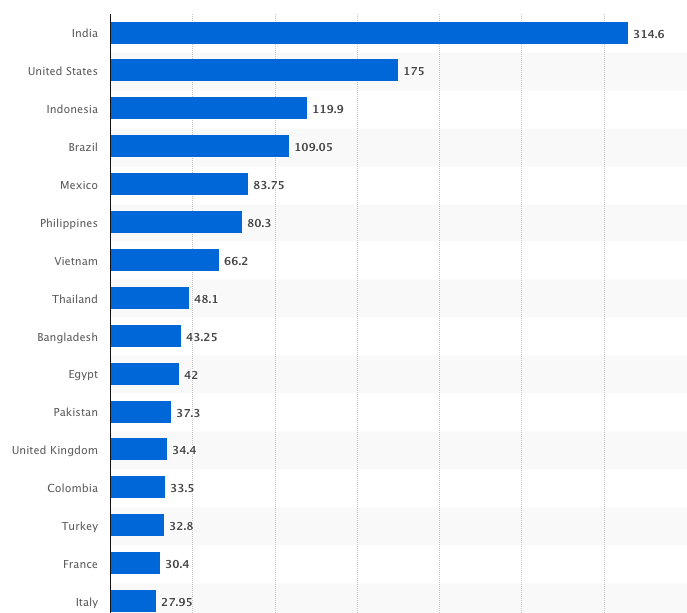
Facebook has 2.9 billion active users, as per Statista.  They deem it “the most popular social media worldwide.”  DataPortal concurs. Statista offers this fascinating breakdown by nation:

Number of Facebook users by nation, Statista 2023

Oberlo puts things a bit higher, just over 3 billion.

I’ll stop there, before looking into message platforms (Whatsapp) and video. What do you make of these numbers?  How might this data shape our approach to social media within academia?

Once again, please don’t hesitate to offer corrections and better data.

Posted in Future Trends Forum, technology | 4 Comments

A new campus climate change group appears: Cornell on Fire

How can academics respond to the unfolding climate crisis?

One was is to organize your campus to think hard and to take serious steps about global warming.  Today’s example comes from upstate New York, with the launch of a faculty and local community group calling itself Cornell on Fire.  (I am personally honored by the namecheck to my Universities on Fire book)

The group’s focus now is getting the university to declare an institutional climate emergency:

We, the members of Cornell and the local community, call on Cornell to publicly declare a CLIMATE EMERGENCY and take immediate action commensurate with the planet-wide severity of the ecological crisis. Declaring a climate emergency will amplify existing campaigns while catalyzing new initiatives. This declaration, when backed up by concrete changes in ALL aspects of the university’s functioning, will restore Cornell to its intended role as a hub of public service, focused on intensive and equitable solutions in the face of accelerating climate challenges.

Cornell University footbridge Barbara Friedman

I’m impressed by their call to transform campus operations, one of the key domains for academic climate action. I’m also struck by their emphasis on the university’s public role (“as a hub of public service”).

Cornell on Fire emphasizes its institutional capacity to drive major change: “When fully mobilized, Cornell University’s vast reserves of resources, knowledge, and power can spark a change in our collective approach to the climate crisis, from inertia and incrementalism to transformation.”

They also emphasize social justice, including the rights of indigenous people: “By foregrounding calls for climate justice put forth by underrepresented groups, we can restore right relationship with Earth and with one another, upon these Gayogo̱hó:nǫɁ lands.”

Cornell on Fire’s signup sheet adds another point, that the campus has a lot of capacity on the climate front:

We have everything we need. Cornell houses countless strands of climate action, research, outreach, and teaching. Local governance and activists are poised to enact transformative climate justice locally. Blueprints are in place for a bold, unified push toward rapid change. [emphases in original]

The same page sees higher education playing a significant role in civilizational transformation: “University action could be an inflection point in our society’s transition to climate resilience.” [again, emphases in original]

That’s a signup sheet.  Cornell on Fire is seeking to grow.

Cornell University dramatic

I’m so excited to see a major university community start organizing themselves for the climate crisis.  I’m impressed by their focus (climate emergency declaration) and seriousness (calling for major change, wanting to impact the broader world).

Let’s see more campuses follow suit!

(Cornell photos by Barbara Friedman)

Posted in climatechange | 1 Comment

America’s higher education consensus is breaking up: responding to Paul Tough

What happens to academia and society if we stop thinking higher education is for everyone?

A new entry into this emerging line of thought comes from Paul Tough, who recently published a powerful article in the New York Times.  “Americans Are Losing Faith in the Value of College.  Whose Fault is That?” covers a lot of ground, and I’d like to engage with it here.  He also spoke to the topic on a New York Times podcast.

Tough gets a lot of things right in this article, chiming in with my own work.  He identifies the swerve away from “college for everyone,” a move that I’ve previously called the shattered consensus.  He points to polls showing American support for higher education going down (here’s another example).  He notes the decade-long enrollment decline.  He catches how grad school can backfire economically (for students in some fields and/or schools).

Tough addresses the awful amount of student debt.  He hits on rising tuition and fees, nicely including some variations on that often oversimplified topic.  He correctly identifies the combination of taking college classes, getting into debt, and not graduating as one of the worst academic experiences a person can undertake.  He also pays attention to the importance of major for lifetime earnings, the widening partisan divide over academia, and how college can play a role as a finishing school for the elite.

I was especially impressed by his evocation of the wealth premium, in contrast to the wage premium,  as a good way of capturing college costs beyond opportunity costs:

Unlike the college wage premium, the college wealth premium looks at all your assets and all your debts: what you’ve got in the bank, whether you own a house, your student-loan balance. It addresses a simple but important question: How much net wealth does a typical college graduate accumulate over their life span, compared with that of a typical high school graduate?

You could think of the wealth premium as taking student debt and its impact more seriously than the wage premium does.  Read into Tough’s article as he teases out the serious problems.  Black and Hispanic students are most at risk of not earning a college bonus, once debt figures in.   And grad school is suffering from decreasing returns, badly:

When the researchers looked at young Americans who had gone on to get a postgraduate degree, the situation was even more dire. “Among families whose head is of any race or ethnicity born in the 1980s and holding a postgraduate degree, the wealth premium is … indistinguishable from zero,” the authors concluded. “Our results suggest that college and postgraduate education may be failing some recent graduates as a financial investment.”

At the same time I have some issues with the article, and would like to raise them here in the collegial spirit of continuing the conversation. Some of these points are in the positive attitude of “I like this very much and want more.” Some are quibbles, but I think the conclusion is where we can open up debate.

First, demographics don’t appear in Tough’s account, and that’s an essential dimension to the shattered consensus model – heck, for any discussion of higher education, period. Briefly, we know that the K-12 population is falling in big chunks of the United States (northeast, midwest, south) due to reliable effects of modernization, and that’s going to be hard for campuses to deal with. Nathan Grawe’s “demographic cliff”, scheduled to start hitting in 2-3 years, is an accentuation of this.

Second, there’s an awkward overfocus on public higher education, which I’ve seen elsewhere for years. Usually it takes the form of “the obvious solution to academic problems is for government to spend more money on state schools.”  Tough comes close to that line with this passage: “A few decades ago, the same thing was true in the United States; government funding covered much of the cost of public college.” I feel pedantic in saying this, but it’s odd phrasing, as it doesn’t make clear which government is involved. The reality is that public higher ed depends on state governments, rather than the federal.  More seriously, a focus on state universities leaves off private colleges and universities, which count for about 1/3rd of the American total. Moreover, and typically for nearly all academic conversations, it misses the for-profit sector.  That boomed circa 1990-2010, and it’s Obama-era collapse, followed by oscillating growth and failure since, is an important story, especially as that sector targets and enrolls high numbers of people of color, especially women. (Tressie McMillan Cottom’s Lower-Ed is brilliant on this).  It’s important to keep in mind the full reality of American higher ed’s nature: for-profits, privates, publics.

Third – well, here is where I’m less certain but think the point is by far the most important.  The article concludes by arguing that despite everything, America needs more people to get more college degrees.  Too many jobs which don’t require sheepskins don’t pay much, and there are too many jobs needing BA/BSes which seeking too few applicants.  Yet the “college for everyone!” consensus has broken.  What to do?

Craiyon more college students

Craiyon images “more college students”

Tough seems to leave the question open, at least in the Times article.  In the Daily interview, he recommends a bipartisan cultural and political movement to expand access to higher ed, along the lines of the early 20th century high school movement.  He wants us to double down, in other words, on college for everyone.  The undergrad degree (BA/BS; not sure if Tough thinks an associates or certificate counts here) should be like the high school diploma: free to all, with some support in getting it.

I think such a development is unlikely now.  To begin with, there’s little political appetite fr the political and economic investment needed.  State governments have many other priorities which have stronger clout, from public safety (watch for more crime panics) to supporting growing numbers of seniors (pensions, Medicare, senior services, public health, etc). It looks worse at the federal level. Biden failed to get tuition support for community college through Congress, and his student debt forgiveness package is stuck in courts, fierce political opposition, and usually poor polling.

Further, I’m not sure how we take care of the financial problems Tough outlines.  If we somehow hail Mary the politics and pour dollars into public higher ed, that leaves for-profits and privates out. But it also leaves the preexisting structures which helped drive this crisis intact: rising campus operation costs, decreasing student numbers in particular.

Additionally, the shattered consensus is looking pretty clearly shattered.  There are all kinds of signs.  Tough and I have mentioned the partisan political divide, but let’s add more:

  • We have states trying to break “the paper ceiling” by removing degree requirements for government jobs.  And note that these are both Republican- and Democrat-led administrations doing this.
  • There have been repeated stories of tech firms dispensing with diplomas and hiring, and while these haven’t really taken off, I note that popular dislike of increasing credential requirements is growing.  I expect to see K-12 schools sidestep degree demands in particular as that sector’s teacher crisis grows.
  • America’s population keeps growing, thanks to immigration… which means as the total of Americans enrolled declines, the proportion of us taking classes is declining a bit more steeply still.
  • While Tough rightly criticizes a range of service jobs for paying little, the fact remains that our economy and society generate those positions at scale.  For example, again with demographics: as Americans age, there’s more demand for a range of elder care services. People will fill these jobs, modulo the so-called “Great Resignation,” and the very problems Tough identifies with higher ed in 2023 will continue to drive people to that labor market instead of college campuses.
  • Democrats are not entirely delighted with higher ed.   That’s worth investigating.
  • The physical and human infrastructure of American colleges and universities is now overbuilt, overall.  We have constructed campus footprints and staffing for the boom years, and now we are in an overhang situation. This is one reason for administrations cutting programs and tenured faculty (of course they cut adjuncts, but somehow that gets zero press). Those investments are still on the books, meaning costs of operation will continue to rise, unless campuses brutally cut staff and physical plant.

Let me add two more points.  It’s not clear how the current AI wave will impact the job market, and what that will mean for colleges and universities.  It’s possible that AIs will devour some white color jobs, which will probably change how academia prepares students for those vanishing careers.  Alternatively, we might see those jobs persist, but with deep AI engagement, in which case higher ed should help students learn how to do that work.  The former might mean fewer graduates needed, the latter not so much.

Yet at the same time there’s a crying need for people to work on and around AI, from electrical engineers and computer scientists to managers, labor organizers, and sociologists studying the phenomenon. That should mean an increased call for bachelor’s, master’s, etc. degrees… unless firms, nonprofits, and governments hire people without the requisite credentials, because they choose them through other means (portfolio of work) and in hype-fuelled desperation.  Like I said, AI’s impact here is difficult to forecast without a flowchart.

The other point concerns international students, who seem to be absent from Tough’s otherwise wide-ranging account.  American colleges and universities have eagerly enrolled students from elsewhere in numbers which grew until Trump and COVID.  (In fact, if you consider America’s “college for everyone” to be a national goal, then we’re doing even worse than it seems, as the total number of students is inflated by international students.) This is a classic American strength, as our academic sector draws learners from around the world.

Some of those students get degrees and then stay in the United States to live and work. They can then fill the credential-demanding jobs Tough is concerned about.  I’m not sure of the numbers here, as international student data tends to lag, and foreign graduates are overrepresented in some fields (STEM, allied health), but I think it’s important to recognize that aspect of the situation.  Speaking of wild cards, I also think it’s not clear what’s going to happen with this population over the next five years, given the vast spectacle of a national election featuring criticism of immigrants, not to mention the chance of a second Trump presidency.

In short, I view American higher ed as overbuilt, while Tough sees the sector in need of more expansion. As far as I understand his argument, he sees the current academic crisis as one public sector investment needs to overcome, while I deem the overbuilt issue to be a driver of that crisis.  Tough calls for a new enrollment boom and I just don’t see that happening.

It’s an impressive article, well researched.  I recommend it and am glad to continue to conversation.


Posted in future of education | 12 Comments
Best online pharmacy with fast delivery https://galenapharm.com/buy-fildena.html https://royalcitydrugs.com/flexeril.html https://galenapharm.com/med/amitriptyline.html https://gaetzpharmacy.com/lasix.html New online drugstore with no prescription