Reading Project 2025, part 7: rethinking government and the economy

How might a likely second Trump administration impact higher education?  How can academics plan for and anticipate that major event, should it occur?

This week we continue our reading of Project 2025, a key document in understanding the near- and medium-term future of American politics.  This is an online, open, and distributed reading and anyone can participate. Here’s a post explaining how it works.  You can find all of our Project 2025 posts here.

In today’s post I’ll summarize this week’s reading, concluding the big “The General Welfare” section at last, then diving into “The Economy,” all found on pages 619-715.    I’ll draw out the bits which bear directly on higher education. Next I’ll add some reflections and then several discussion questions.  At the end I’ll add some more resources.

Please join in with comments below. In last week’s blog post comments Glen McGee offers a detailed, AI-assisted critique of one chapter’s labor regulations.  sibyledu observes that a returned president Trump wouldn’t have to authorize each item on the Project 2025 agenda; instead, the plan has so much detail that newly appointed subordinates can put their respective parts of the manifesto into action on their own, without Trump’s involvement.

There was more commentary on last week’s reading on Facebook.  Joey Lusk calls the drive to end anti-misinformation work as “telling on yourself.”  Ian Rowcliffe notes that Project 2025 might influence or inspire European Union legislation and policy. Jeff DeMarco and Earl Miller cautioned us to not take Project 2025 so seriously, as Trump has repeatedly disowned any connection with it.  Also on Facebook, I loved this comment from Olgy Aleu Gary:

How do you eat an elephant? One bite at a time. How do you analyze Project 2025? One section at a time, especially with the help of Bryan Alexander of The Futures Trends Forum.

Thank you.  Onward!

Summary overview

Project 2025 coverDiana Furchtgott-Roth begins this section by analyzing the Department of Transportation (DoT), where she was Deputy Assistant Secretary for Research and Technology during the Trump administration. She considers the DoT to have become too large and, interestingly, too focused on grant making. Furchtgott-Roth wants the DoT to expand its public-private partnership work. Along those lines she wants to reduce governmental scrutiny of new technologies for transportation and roll back Biden and Obama administration aviation controls.

Other topics addressed in this chapter include climate change, a cause for which the author finds the Biden administration to have overreached, leading her to call for relaxing car mileage regulations.  As per many other chapters in the book, this one calls for the department to support and make more use of new technologies. It also wants to reduce support for mass transit, especially rail. (635-6)

Our second chapter is by Brooks D. Tucker and it covers the Department of Veterans Affairs (VA).  Tucker sees the Trump administration as having returned the VA to veteran-centric posture, but that the Obama and Biden teams veered away from that direction.  He additionally charges the Biden administration with pursuing equity and inclusion issues which “will affect only a small minority of the veterans who use the VA.” (642). Tucker calls for the VA to cut back on “abortion services and gender reassignment surgery” (644) as well as to increase its use of new technologies.  The DefeatProject2025 website sees Tucker as calling overall for benefit reductions.

The next chapters deal with the economically-focused parts of the federal government. Thomas F. Gilman begins by analyzing the Department of Commerce and urging the “consolidation, elimination, or privatization that examines the efficiency, effectiveness, and underlying philosophy of each individual component.”  Beyond cutting back, Gilman has two other themes, to “reverse the precipitous economic decline sparked by the Biden Administration and to counter Communist China.” To support these efforts Gilman calls for strengthening enforcement of trade agreements, supporting allies in trade deals, “strategic decoupling from China,” cutting back a range of environmental regulations, and more aggressively enforcing intellectual property rules.

Next, William L. Walton, Stephen Moore, and David R. Burton tackle the U.S. Treasury Department, beginning by calling for a slimmer staff and support for smaller government.  They urge Congress to change federal taxes, both for individuals (“a simple two-rate individual tax system of 15 percent and 30 percent that eliminates most deductions, credits and exclusions”) and businesses (“[t]he corporate income tax rate should be reduced to 18 percent”).  The authors would like a national sales tax or something close to it.  The website 25andme considers this as likely to result in “[m]illions of low- and middle-class households would likely face significantly higher taxes.”  They also want changes to the Internal Revenue Service (IRS), including adding more presidential appointments and undoing the Biden administration’s push to double the number of agents.  They would privatize Fannie Mae and Freddie Mac.

On the global stage, this chapter calls for the US to withdraw from the World Bank and the International Monetary Fund. Authors want Treasury to scrutinize Chinese investments within the United States, as well as American investments which might strengthen China’s ability to compete with the US.

Walton et al follow previous chapters’ critique of the Biden administration’s equity focus. They deem Treasury support for racial minorities to be “racist policymaking” and want to end all such measures, wanting to fire any employee who “participat[ed] in any critical race theory or DEI initiative.”  Similarly, the authors abhor Biden-era climate action, calling for “[t]he next Administration [to] eliminate the Climate Hub Office and withdraw from climate change agreements that are inimical to the prosperity of the United States.”

What do these chapters mean for higher education?

Academic work on climate change would take a hit.  Furchtgott-Roth calls for a major climate science cut: “The National Oceanographic and Atmospheric Administration (NOAA) should be dismantled and many of its functions eliminated, sent to other agencies, privatized, or placed under the control of states and territories.” (664, also 674) Why?  NOAA is “one of the main drivers of the climate change alarm industry and, as such, is harmful to future U.S. prosperity.” (675) Faculty, staff, and students who rely on NOAA would lose out.

International collaboration and study would also suffer in one way. Gilman blames academia for improving one strategic adversary’s technology capacities: “technology transfer on a massive scale has occurred because of adversaries’ exploitation of the U.S.’s open economy and education system through both commercial transactions and university and government research programs” (671).  In response, a new administration should “[t]ighten… the definition of ‘fundamental research’ to address exploitation of the open U.S. university system by authoritarian governments through funding, students and researchers, and recruitment” (673). In other words, academic research and teaching would fall under closer government scrutiny and, presumably, the threat of sanctions.

Moreover, the Treasury discussion calls for the creation of a new academic unit:

Treasury should examine creating a school of financial warfare jointly with DOD. If the U.S. is to rely on financial weapons, tools, and strategies to prosecute international defensive and offensive objectives, it must create a specially trained group of experts dedicated to the study, training, testing, and preparedness of these deterrents. (704)

There are no further details about such a financial war school. I can imagine some academics engaging with it in various ways: university professors becoming faculty or administration, undergraduates heading to FinWar.edu for graduate school, research partnerships, internships, etc.  Business and economics departments would be foremost here.

Reflections

As we’ve seen in our reading so far, Project 2025 is well edited to maintain consistent themes. This week’s chapters continue such persistent lines of thought as reducing federal spending, leaning into new technologies, undoing Biden-era equity measures, ditto for climate change, opposing China on multiple levels, and having loyal people ready to put into leadership roles (for example, “identifying a fully vetted roster of candidates to assume all key positions at VA well ahead of formal nominations”, 652).

Leaning into new tech is partly to improve governmental operations as well as to increase American technological capacities, as when Gilman asks for a new administration to do more with commercial space work. (677) The Treasury authors celebrate technology in one area: “history shows that economic growth and technological/scientific advance through human ingenuity are by far the best ways to prevent and mitigate extreme weather events.” (709)

On a personal level, I find reaching 700+ pages of this to be… draining and depressing. I can see so much human and natural wreckage occurring should a second Trump administration implement these recommendations.  Some of that hits my family, friends, and close colleagues. I try to write these posts with a sense of dispassionate analysis and inquiry, but at times it’s hard to do so.

Questions

  1. How would the policy changes expressed in this week’s chapters impact your professional and personal lives?
  2. Do you see Trump as likely to attempt what this week’s reading describes?
  3. How might the world change if these global policies take effect?
  4. If you oppose what these three chapters call for, what opposition strategy and tactics would best resist it?
  5. Having read this far, what do you anticipate from the rest of the book?

Resources

  • Defeat Project 2025 has some good resources, including biographies of contributors and quick summaries of issues.

…and that’s it for this week’s reading.  For next Monday, September 9, we’ll read further into “The Economy,” pages 717-823.

Please do comment in the boxes below this post.  If you’d prefer to share your reactions on other platforms, tag me or otherwise let me know about those comments so I can include them in our next post.  If you want to respond but are worried about what people could make of your reactions, feel free to contact me here without the web knowing.

Comment away!  And on to the next tranche of Project 2025.  A hearty thanks to all readers and commentators.

Posted in book club, politics | Tagged , | Leave a comment

Starting my technology and innovation seminar at Georgetown

Greetings from the start of fall 2024, when the academic year lurches into high gear.  I’m teaching two classes this term, and recently posted about one.  Today I’d like to describe the other, my technology and innovation seminar, which just kicked off on Thursday.

In this required class, Learning, Design, and Technology students immerse themselves in multiple ways of thinking about and doing both technology and innovation.  We explore those topics through history, imagination, sociology, economics, social justice, critical theory, philosophy, gender studies, and business.

It’s a class I know well, having first taught it in 2019.  I love almost everything about it: the topics, the approaches we take, students’ questioning and learning. I like tweaking it each time.

The mechanics of the class are much the same as they have been.  Each live session is a mix of discussion, my presentations (brief), and student presentations (each on a technology of interest to them).  Students write a short analysis of one tech or innovation early on, framed by Roger’s innovation theory, then start working on a major project analyzing one tech or innovation for education, which they can present as a scholarly paper, a podcast, a video, a game, a Miro board, or other format if I approve of it.  They have to assemble and annotate a scholarly sources bibliography as well.

This time we’re not playing a game, mostly because the logistics are daunting with a larger class.  I’ve also cut out end-of-term presentations, which look a lot of time and which students seemed to great with much dread and little benefit. I’m expanding our use of a keywords wiki Google Doc, with the students having access to it from the start, adding to it as we go, and hopefully having the whole list of terms filled out and familiar to all in December.   I continue to use discussion board threads, and have once again revised the questions I pose there.

I’m emphasizing two themes this term: AI and climate change. Students will read about AI, use various forms of it in and beyond class, then discuss its implications for their work. I’ll bring climate change in at opportune times; still considering some potential readings.

I do have some open spots on the syllabus, as you’ll see below.  For non-US and non-European perspectives I’m not sure what to focus on. I’d love for a good Chinese reading or sources for Africa. For AI I have a set of readings, but need more.  And for the future of technology I have all kinds of ideas, and am now torn between the Weinersmiths’ Soonish (which our online book club read in 2018) and Ray Kurzweil’s new book, The Singularity is Nearer.  Happy to hear your thoughts, and yes, one option is to get students doing the finding and selecting.

Here’s the syllabus as it stands now:
Thursday, August 29, 2024 – Introductions

Readings:

Exercises:

  • Introducing ourselves by technologies
  • Exploration of technology keywords  
  • Signing up for tech presentations
  • Questions to consider about a technology:

Untitled Diagram.jpg


Thursday, September 5, 2024 – Histories of technology, I

  • Reading: How We Got To Now, part 1: to p. 124
  • Introduction to printing press as transformative technology

Thursday, September 12, 2024 – Histories of technology, II

  • Reading: How We Got To Now, part 2: to the end.

Student tech presentations:

Thursday, September 19, 2024 – Imagining Innovation

Readings:

Student tech presentations:

Thursday, September 26, 2024 – How innovations spread, I

  • Readings: Everett M. Rogers, Diffusion of Innovations, 5th Edition: 1-52; 72-3; 87-218  (chapter 1; chapter 2 through the Miracle Rice story, the STOP AIDS story, and from “Opinion Leaders” on; chapters 3-5)

Student tech presentation

Monday, September 30 – analysis of one innovation due

Thursday, October 3, 2024 – How innovations spread, II

Readings:

Student tech presentations

Thursday, October 10, 2024 – Justice and innovation, I

Readings:

Student tech presentations

Thursday, October 17, 2024 – Justice and innovation, II

Reading:

  • Benjamin, Race After Technology: Abolitionist Tools for the New Jim Code, 97-end.
  • Walter Benjamin, “The Work of Art in the Age of Mechanical Reproduction” (one copy)

Student tech presentations

Thursday, October 24, 2024 – Beyond America and Europe

Reading: TBA

Student tech presentation

Thursday, October 31, 2024 – Critiquing technology

Student tech presentations 

Monday, November 4– annotated bibliography due

Thursday, November 7, 2024 – AI, I

Readings and exercises

Student presentations

Thursday, November 14, 2024 – AI, II

Readings: TBA

exercises

Student tech presentation

Thursday, November 21, 2024 – technology and innovation futures, I

Readings: TBA

Student tech presentation

Thursday, November 28, 2024 – fall recess

Thursday, December 5, 2024 – technology and innovation futures, II

Readings: TBA

Review our keywords

Friday, December 13 – final project due

Posted in classes and teaching | Leave a comment

Reading Project 2025, part 6: the interior, justice, and labor

How might a likely second Trump administration impact higher education?  How can academics plan for and anticipate that major event, should it occur?

This week we continue our reading of Project 2025, a key document in understanding the near- and medium-term future of American politics.  This is an online, open, and distributed reading and anyone can participate. Here’s a post explaining how it works.  You can find all of our Project 2025 posts here.

In today’s post I’ll summarize this week’s reading, which continues under the header we’ve been working through for three weeks, “The General Welfare,” found on pages 517-617.    I’ll draw out the bits which bear directly on higher education. Next I’ll add some reflections and then several discussion questions.  At the end I’ll add some more resources.  Please join in with comments below – for examples of that, you can see good comments at the end of our first post.

Summary overview

With this section the book turns to the Departments of the Interior (DOI), Justice (DOJ), and Labor (DOL).

Project 2025 coverWilliam Perry Pendley, who ran the DOI’s Bureau of Land Management for the Trump administration, fiercely criticizes the department for being openly partisan (“A department that has twice engaged in covert domestic election interference and propaganda operations—the Russian collusion hoax in 2016 and the Hunter Biden laptop suppression in 2020—is a threat to the Republic”). To undo that alleged damage, Pendley would cut back the Endangered Species Act, remove Biden’s 30×30 conservation plan, give some Alaskan lands to development, reduce judicial reviews of some regulations, and turn over publicly held land for logging and other commercial uses.

Next, Gene Hamilton tackles the Department of Justice, urging it to redouble efforts against violent crime.  This can lead to DOJ intervening in local and state jurisdictions:

Where warranted and proper under federal law, [DOJ should] initiate legal action against local officials—including District Attorneys—who deny American citizens the “equal protection of the laws” by refusing to prosecute criminal offenses in their jurisdictions. This holds true particularly for jurisdictions that refuse to enforce the law against criminals based on the Left’s favored defining characteristics of the would-be offender (race, so-called gender identity, sexual orientation, etc.) or other political considerations (e.g., immigration status).

He wants the FBI to focus more on international crime and immigration, ending any work on misinformation, and to launched an overall assessment of just about everything the FBI does.  International topics include strengthening the Mexico border and ramping up efforts against China, including relaunching the first Trump administration’s China Initiative. On more domestic matters, Hamilton wants the DOJ to step back from scrutinizing abortion protestors, to devote more resources to going after protestors opposing anti-abortion projects, and to block abortion pills sent through the mail. He also wants the department to do more about voter fraud and illegal immigrants.

The third chapter in this week’s reading, written by Jonathan Berry, covers not only the Department of Labor, but also “the Equal Employment Opportunity Commission (EEOC), the National Labor Relations Board (NLRB), the National Mediation Board (NMB), the Federal Mediation and Conciliation Service (FMCS), and the Pension Benefit Guaranty Corporation (PBGC).”  It is also perhaps the most religiously themed section of Project 2025, starting off with this in its first paragraph: “The Judeo-Christian tradition, stretching back to Genesis, has always recognized fruitful work as integral to human dignity, as service to God, neighbor, and family.”  The chapter includes a call to firm up overtime pay for work on the Sabbath: “God ordained the Sabbath as a day of rest, and until very recently the Judeo-Christian tradition sought to honor that mandate by moral and legal regulation of work on that day.”

At the same time, the texts wants to make it easier for employers to pay less overtime otherwise, especially “in lower-cost regions (e.g., the southeast United States”. (592). As 25andme summarizes this last point:

Project 2025 on overtimeAs with other chapters we’ve read, this one would end DEI training, practice, and data gathering for these agencies, including by “[e]liminat[ing] disparate impact as a valid theory of discrimination for race and other bases under Title VII and other laws”. Similarly, it would roll back Biden-era gender regulations, asking for a new president to ” [r]escind regulations prohibiting discrimination on the basis of sexual orientation, gender identity, transgender status, and sex characteristics.”  It would also seek to restrict employers’ support for employees’ abortion access.  Berry wants to expand religious belief protections in the commercial sphere.  He would also give states the ability to sidestep federal labor rulings.

What does this mean for higher education?

The DOJ section asks for colleges and universities to play a role in the anti-China push:

key goals for the China Initiative that included development of an enforcement strategy concerning researchers in labs and universities who were being coopted into stealing critical U.S. technologies, identification of opportunities to address supply-chain threats more effectively, and education of colleges and universities about potential threats from Chinese influence efforts on campus.

Further, there’s a research angle for the DOJ, an anti-academic one: “The National Institute of Justice… should fund high-quality, unbiased research on the topics of greatest interest to everyday Americans and policymakers rather than agenda-driven research desired by advocates or academics.”

The Department of Labor section might apply to higher education by reducing overtime regulations. At a broader level Berry’s chapter wants to boost apprenticeships, mostly likely in competition with college and university study. (594-5) This section also calls on Congress to end college degree requirements for federal positions. (597)

Reflections

These chapters carry on some consistent themes from the rest of the book, namely undoing Biden-era DEI measures, opposing China, and stopping illegal immigration.

Once more there’s the contradiction between devolving federal authority to states and localities, while at the same time calling for more federal power – most notably in asking for the DOJ to intervene in local authorities’ actions.

Again I’m struck by the civics of Project 2025, the sheer detail and ambition of its efforts to revise government. This week includes an extensive amount of agency, policy, and legal wonkery.

Questions

  1. How would the policy changes expressed in this week’s chapters impact your professional and personal lives?
  2. Do you see Trump as likely to attempt what this week’s reading describes?
  3. How might the world change if these global policies take effect?
  4. If you oppose what these three chapters call for, what opposition strategy and tactics would best resist it?
  5. Having read this far, what do you anticipate from the rest of the book?

Resources

…and that’s it for this week’s reading.  For next Monday, September 2nd, we’ll finally conclude “The General Welfare” then dive into “The Economy,” all found on pages 619-715.

Please do comment in the boxes below this post.  If you’d prefer to share your reactions on other platforms, tag me or otherwise let me know about those comments so I can include them in our next post.  If you want to respond but are worried about what people could make of your reactions, feel free to contact me here without the web knowing.

Comment away!  And on to the next tranche of Project 2025.

Posted in book club, politics | Tagged , | 2 Comments

Imagining some upcoming solar power possibilities

Greetings from an outrageously busy month. I continue my work travel regimen, having recently visiting Indiana and heading to Minnesota this weekend. My Georgetown University intensive class is running this week, and I’m prepping my other class which starts in a few days (blog post on the way).

So this post will be fast:

One of the great signs of progress in our time has been the massive growth in solar power.  Prices have fallen, with solar becoming cheaper than fossil fuels, and deployment has soared.  Finally solar power is beginning to play a serious role in supplying humanity’s electrical needs.  We should expect more solar panels spreading wherever there’s light, if sometimes in the face of opposition.

Along these lines, I’ve been wondering what comes next. How far could solar go?  After all, there’s a great virtue in drawing power from the solar system’s generous center.

One possible development concerns even thinner and more flexible solar surfaces.  Beyond stiff panels, can we use something lighter, capable of installation throughout humanity’s built environment?  Sprayable solar research and development has been progressing for years, often relying on nanomaterials and/or perovskite.  Recently an Oxford University team described a very thin solar material: “At just over one micron thick, it is almost 150 times thinner than a silicon wafer. Unlike existing photovoltaics, generally applied to silicon panels, this can be applied to almost any surface.”  It involves tiny stacks of solar receptors, absorbing more light than single-layered systems do.

To almost any surface… this phrase caught my futurist’s eye. Imagine taking this Oxford tech or a similar material a few years forward to the point where it’s consumer grade.  You and I can purchase some in rolls or strips, which can be stuck onto most surfaces. Perhaps the next iteration is sprayable.  How might we use such stuff?

Let’s assume, for the sake of bloggery, that new solar gradually becomes cheaper, following most technological patterns, and also lighter and more flexible. Imagine that governments don’t regulate it out of existence and that some business models appear to bring the material to market. Let’s leave open how power storage might develop; I’ll return to that.

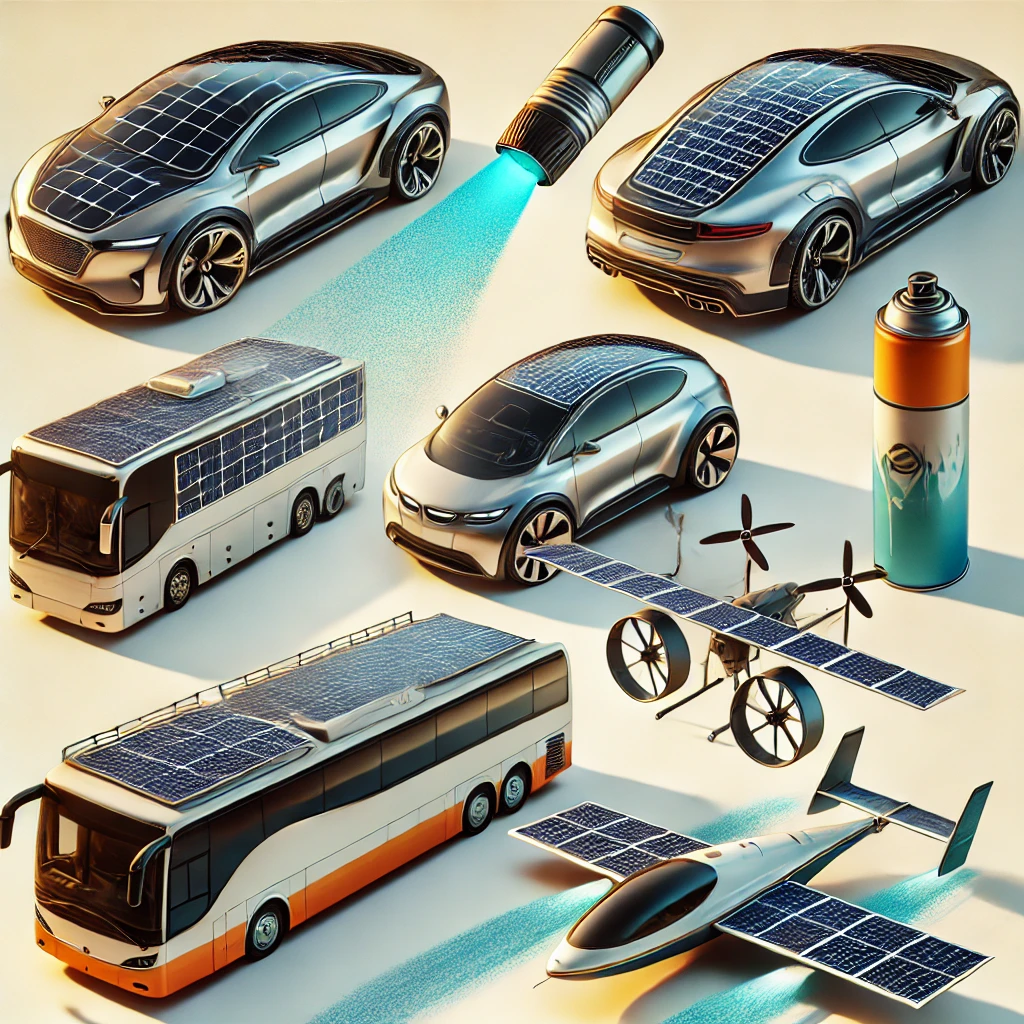
DALL-E imagines sprayable solar on vehicles

DALL-E imagines sprayable solar on vehicles

Let’s start with buildings.  I walked between the cities of Washington, DC and Rosslyn today, and imagined all kinds of rooftops covered in rolled-out solar surfaces.  Rooftops wouldn’t be the only carriers, as the sides of building present themselves to sun for hours each day, depending on season and weather, so I mentally rolled more solarstuff down their sides, right to the street.  Such a covering could generate operational power for lights, air conditioning/heat, elevators and escalators, and so on.  If a given building generates more electricity than it uses, it can save the surplus in on-site batteries or feed  it into a local or utility’s grid.

If we can make rollable or sprayable solar transparent, then we can paste it into windows. Imagine how much more power a glassy, gleaming office building could generate like this.  Or think of a greenhouse using its passive solar surfaces to actively power its water sprayers.

Other fixtures in the built environment could carry solar paint. Lampposts, for example, might become self powered without attached and extended panels, depending on their location and time of year.  Park benches, the sides of bridges, traffic signals, park benches, various utility boxes could hold or share power. Temporary structures could serve a similar function, if the material is light and durable enough.  For example, people and organizations might prop up solar-coated tents to power whatever is inside.  Imagine an outdoor wedding where the canopy powers food warmers and lights, plus guests’ phones.

As I walked into Rosslyn, thinking about this, I wondered about vehicles.  We could cover a car’s roof and sides, providing enough power to recharge an EV’s battery, or at least to add energy to it, and maybe some extra to power inhabitants’ devices.  Larger vehicles – trucks – might similarly power their own EV engines. I wonder if they’d be efficient enough to charge extra batteries which they could rent to people along the way, or to folks at their destination.  Could an 18-wheeler with its tall sides and elevated top become a net solar generator?

At a smaller scale I can imagine a bicyclist adding solar to his or her helmet and bike surfaces (such as side panels or panniers) to charge lights and perhaps portable devices.  Hikers could add solar to backpacks and hats, powering camping devices.  It depends on how efficient the solar gear is.

Maybe other types of vehicle would benefit. Could ships at sea cover decks, sides, and structures with rollable solar enough to power their engines and all systems? Perhaps large or efficient enough ships could, once they supplied their own needs, fill up batteries on long routes, carrying them, charged, for sale at destinations.  I also wonder how much solar aircraft could soak up with collectors on wings and fuselage.

This kind of light solar might be very useful for emergency services.  I mentioned tents before, and it’s easy to envision FEMA or the Red Cross/Crescent quickly setting up solar-enabled tents for disasters and refugees, along with similarly generating shacks and other temporary housing.

I wonder about the aesthetics of rollable or sprayable solar. Would the initially available color and texture irritate some people?  I can imagine competing products rapidly offering different appearances, competing on appearance.   Or would the difference be noteworthy, especially as the tech becomes widespread and accepted as a climate necessity? I can also see some people celebrating solar-less, pre-solar walls, roofs, and other surfaces.  Or what would it take for new solar surfaces to become desirable and chic?

There might be a public/private split on uses of such sprayable solar.  A private company, for example, could easily charge people for charging devices from their trucks or business centers, while a government building might prefer to make such services freely available (think of charging your laptop at a public library nowadays). Alternatively, a business could offer free trickles as a marketing tactic.  Also on the marketing side, we can expect pitches for goods with attached solar – buy our car/tent/condo and receive a solar power bonus!

I expect we’d see rapid developments in batteries as consumer goods, along with quick and easy transmission setups to connect solar sources to outlets.

Now, one way of describing a futurist’s job is that of forecasting cars.  It’s easy, goes the adage, to imagine cars.  What’s harder is to foresee traffic jams.  In other words, what are some ways this kind of solar could go wrong?

For one, there’s a supply issue.  Would the consumer product depend on scarce materials, triggering a brutal sourcing competition? Would churning out the materials clobber various parts of the global ecosystem?  Assuming research and develop continues, will successive waves of light solar build up an increasing pile of older models? In other words, we could see a boom in solar waste.

For another, given the recent generation of technology, we should expect some bad business practices. I can imagine companies trying to turn customers into solar farmers, perhaps by offering company-store-like plans to drivers, hikers, tenants, and workers. It would be easy for surveillance to ride in on solar surfaces, checking for one’s geolocation when soaking up solar (or not doing so), monitoring usage at micro-levels.  We can also see governments doing this as well.

I’m curious about business models and backlash. Given the lifecycle of products, would we have to peel off old solar rolls and replace them with new? Would this involve hiring specialized workers to do this cleanly? I could see misuse, like running a solar surface beyond its lifespan or people trying to sell used rolls which don’t work any longer.  Would solar refurbishment and update costs become part of the economics of a range of household expenditures?  Perhaps governments would issue policies to keep the cycle humming, like adding requirements to car inspections and home sales.

I can imagine resistance and dislike, such as a used clothing store refusing to accept chargeable clothes, or a used car purchaser wanting unclad vehicles. The same folks who today roll coal might proudly proclaim their, ah, naked surfaces.

Would this kind of solar encourage some people to use fossil fuels? That is, someone could drive a petroleum-burning car with a solar roof, reasoning that they’re doing their bit for climate adaptation. Airlines might hold back on using new fuels if they can claim to be generating electricity from solar wings.  A government might cite a wide solar rollout as meeting climate goals, using it to offset coal burning.

That’s all for now.  Time for me to get off the train and walk from Rosslyn to Georgetown for the start of class, imagining every other thing I see coated in solar.

PS: we could consider popularly used sprayable/rollable solar as an example of  the hypermodern ideology I’ve described.  It’s pro-growth, pro-science, driving more economic activity, relying on technological advancement.

Posted in futures | Leave a comment

Reading Project 2025, part 5: changing energy, health, human services, and HUD

How might a likely second Trump administration impact higher education?  How can academics plan for and anticipate that major event, should it occur?

This week we continue our reading of Project 2025, a key document in understanding the near- and medium-term future of American politics.  This is an online, open, and distributed reading and anyone can participate. Here’s a post explaining how it works.  You can find all of our Project 2025 posts here.

In today’s post I’ll summarize this week’s reading, which continues under the header we’ve been working through for two weeks, “The General Welfare,” found on pages 417-516.    I’ll draw out the bits which bear directly on higher education. Next I’ll add some reflections and then several discussion questions.  At the end I’ll add some more resources.  Please join in with comments below – for examples of that, you can see good comments at the end of our first post.

Last week’s post, focused on Department of Education policy recommendations, elicited good conversation.  On Medium, Rob Vanwey argued that Project 2025’s education plan would reduce American research and teaching.

Summary overview

With this section the book turns to the Environmental Protection Agency (EPA),  the Department of Health and Human Services (HHS), and the Department of Housing and Urban Development (HUD).

Project 2025 coverMandy M. Gunasekara begins her chapter on the EPA she once led by emphasizing what she sees as “the agency’s true function: protecting public health and the environment in cooperation with states.”
To this end, she would push some federal functions to states and local governments (“the primary role in making choices about the environment belongs to the people who live in it”) while adding political appointees to federal offices.

Gunasekara is strongly against climate action and the decarbonization agenda.  Here’s one sample passage:

Mischaracterizing the state of our environment generally and the actual harms reasonably attributable to climate change specifically is a favored tool that the Left uses to scare the American public into accepting their ineffective, liberty-crushing regulations, diminished private property rights, and exorbitant costs.

Along those lines she would reduce support for electric vehicles and cut many climate regulations.  She also targets climate justice, calling for “eliminating the stand-alone Office of Environmental Justice and External Civil Rights.”

There is some of Project 2025’s dislike of nonprofits in this chapter. For example, the text recommends this push away from both the federal government and nonprofits: “To the extent that the Inflation Reduction Act (IRA)18 remains in place, ensure to the maximum extent possible that grants and funding are provided to state regulatory entities and not to nonprofits.”

The next chapter addresses the Department of Health and Human Services. Roger Severino, who once led its Office of Civil Rights, begins by drawing our attention to that division’s scope: “For good or ill, HHS activities personally impact the lives of more Americans than do those of any other federal agency.”  He later observes that “Medicare and Medicaid touch more American lives than does any other federal program.”

Severino charges HHS with being too concerned with social justice (in terms of race and gender), which he sees as leading to a life expectancy drop,

This chapter repeatedly makes clearly pro life, anti-LGBTQ+, and pro-nuclear family observations and recommendations.  For example, “From the moment of conception, every human being possesses inherent dignity and worth…Abortion and euthanasia are not health care.”  And “The Office of the Secretary should eliminate the HHS Reproductive Healthcare Access Task Force and install a pro-life task force to ensure that all of the department’s divisions seek to use their authority to promote the life and health of women and their unborn children.” (489) The Centers for Disease Control plays a role here, as Severino would split CDC in two, then have one of the new entities gather detailed, national data about abortions.(455) He would withdraw federal approval for mifepristone and instruct the National Institutes of Health (NIH) to end fetal tissue work, while cutting Medicaid funding to Planned Parenthood. (459-460; 471-2) A conservative administration should end regulations supporting same-sex couples from adopting children. (477)

On gender fluidity this chapter recalls the book’s introduction:

Radical actors inside and outside government are promoting harmful identity politics that replaces biological sex with subjective notions of “gender identity” and bases a person’s worth on his or her race, sex, or other identities. This destructive dogma, under the guise of “equity,” threatens American’s fundamental liberties as well as the health and well-being of children and adults alike.

Accordingly, Severino urges the Centers for Medicare & Medicaid Services to undo pro-trans coverage support. (474) Interestingly, he backs more support for doulas. (486-7)

Severino specifically criticizes the Biden administration along these lines:

family policies and programs under President Biden’s HHS are fraught with agenda items focusing on “LGBTQ+ equity,” subsidizing single-motherhood, disincentivizing work, and penalizing marriage. These policies should be repealed and replaced by policies that support the formation of stable, married, nuclear families.

And “NIH has been at the forefront in pushing junk gender science.”

The chapter is openly for government support of religion: “how much risk mitigation is worth the price of shutting down churches on the holiest day of the Christian calendar and far beyond as happened in 2020? What is the proper balance of lives saved versus souls saved?”  Later, it asks for an HHS unit to “Protect faith-based grant recipients from religious liberty violations and maintain a biblically based, social science–reinforced definition of marriage and family.”

Severino is very skeptical of drug companies, calling for more generics, yet also urging relaxation of some FDA rules.  He wants to reduce pharma influence on government work – for example,

The CDC and NIH Foundations, whose boards are populated with pharmaceutical company executives, need to be decommissioned. Private donations to these foundations—a majority of them from pharmaceutical companies—should not be permitted to influence government decisions about research funding or public health policy.

He wants to reform Medicare and Medicaid in great detail.  It looks to me that the plan is to make it harder for people to enroll for Medicaid,  easier for state governments to deny care, and for both services to reflect private insurance more closely, but I’m not sure, not having a good grasp on the regulations here. (cf 465-7)

Severino would flat out end Head Start.(482)

The third chapter is much, much shorter than the other two.  In it Ben Carson, Jr. very quickly takes on the department of Housing and Urban Development (HUD). Many of the points echo themes we’ve seen through Project 2025, just situated in the HUD context.  There’s a characterization of China as leading global opponent, which means HUD should watch for”foreign ownership of real estate in both rental and ownership markets of single-family and multifamily housing, with trillions worth of real estate secured across HUD’s portfolio.”  Anti-anti-racism means ending Biden-era housing equity work, as opposition to climate change entails “[r]epeal[ing] climate change initiatives,” which are unspecified.

Carson keeps going.  Immigration?  “The Office of the Secretary should recommence proposed regulation put forward under the Trump Administration that would prohibit noncitizens, including all mixed-status families, from living in all federally assisted housing.” Devolving federal power?  “Local welfare organizations, not the federal government, should step up to provide welfare for the housing of noncitizens.”  Supporting the nuclear family?  “Where admissible in regulatory action, HUD should implement reforms reducing the implicit anti-marriage bias in housing assistance programs.”  More political appointees in charge?  Of course.

What might these three chapters’ contents mean for higher education?

Reducing EPA research will impact some academic researchers, including faculty, stufents, and staff.  Cutting EPA grants would do more, with calls to “[r]epeal Inflation Reduction Act programs providing grants for environmental science activities” or this assertion: “grant funds produce little to no meaningful improvements in the environment and public health and instead fund questionably relevant projects at elite, private academic institutions that invariably produce radical environmental research.” As part of this crack down on EPA research we see the request for “a Science Adviser reporting directly to the Administrator in addition to a substantial investment (no fewer than six senior political appointees) charged with overseeing and reforming EPA research and science activities.”   Assuming that’s a political appointee, which should see further negative effects on academic work.

A push for transparency might make more federal data accessible to academic uses.  One passage actually uses the language of open source: “True transparency will be a defining characteristic of a conservative EPA. This will be reflected in all agency work, including the establishment of opensource [sic] science, to build not only transparency and awareness among the public, but also trust.”

On the HHS side, Severino issues a range of research restrictions, particularly along lines of gender and race.  Additionally, his chapter wants to shift some research support from the federal to state governments: “Congress should consider block granting NIH’s grants budget to states to fund their own scientific research.” (462)

The proposed HHS and HUD changes might increase the amount of human needs colleges and universities may be called upon to assist.  Faculty, staff, and students with less medical care, being more likely to be housing insecure, losing access to abortion and gender-affirming care, and more, may turn to our campuses for assistance.

Reflections

Project 2025’s culture war theme really comes through in these chapters. The authors critique and seek to undo Biden administration policies about race, gender, sexuality, climate change, and abortion. It’s noteworthy to see one chapter openly call for the government to express religious points of view.

We continue to see a mixed approached to federal power, wanting to reduce it through shifting functions to the states or localities, while at the same time seeking to increase federal authority and actions.  For example, Severino wants to devolve federal medical oversight (“States should be the primary regulators of the medical profession”) while also arguing for the federal government to extensively surveill abortion practices.

We also see the book’s preference for some science and technology.  The HHS chapter, for instance, wants to “[r]educe [Medicare and Medicaid] waste, fraud, and abuse, including through the use of artificial intelligence for their detection.” (463). The same section also hopes for this: “Each state should be induced to implement a high-tech, easy-to-use application to centralize child support payments.” (479)

Questions

  1. How might academic institutions – and individual academics – respond to the humanitarian fallout from this section?
  2. How would the policy changes expressed in this week’s chapters impact your professional and personal lives?
  3. Do you see Trump as likely to attempt what this week’s reading describes?
  4. How might the world change if these global policies take effect?
  5. If you oppose what these three chapters call for, what opposition strategy and tactics would best resist it?
  6. Having read this far, what do you anticipate from the rest of the book?

Resources

None to add this time.

…and that’s it for this week’s reading.  For next Monday, August 26, we’ll steadfastly continue with “The General Welfare,” advancing to pages 517-617.

Please do comment in the boxes below this post.  If you’d prefer to share your reactions on other platforms, tag me or otherwise let me know about those comments so I can include them in our next post.  If you want to respond but are worried about what people could make of your reactions, feel free to contact me here without the web knowing.

Comment away!  And on to the next tranche of Project 2025.

PS: my apologies if this week’s installment is sketchy, but I’ve had an extremely busy week.  Hope to catch up with the next one.

Posted in book club, politics | Tagged , | Leave a comment

Getting ready to teach our Georgetown Foundations seminar

Tomorrow I start teaching a class.  It’s one I’ve taught before, but now with some major changes, and I haven’t ever blogged about it, so I thought I could share it now.

It’s for Georgetown University’s Learning, Design, and Technology (LDT) program, and is called the Integrated Introduction to Learning, Design, and Technology seminar, which we usually just refer to as Foundations.  The class is the official introduction to the program for new students.  Foundations introduces them to the faculty and staff who lead it, each of whom presents on their relevant work. The seminar also brings up the major topics we study, to the details of how LDT works, and to Georgetown as well.

Foundations 2022_whole group cropped unmasked and smiling

Students in our Foundations 2022 class.

There’s still more going on.  LDT has a small cohort, so we really want to help the students get to know each other, to socialize, to connect.  To that end we emphasize belonging, both as a practical matter as well as scholarly topic. It’s also the first grad school experience for most, so we have all kinds of things we’d like them to learn, from bureaucracy to reading hard scholarly literature. And it’s about design thinking, so they get to work together on a design project from the first day… and present it on Friday.

I have several jobs in Foundations.  I have been redesigning it for a couple of years now. I organize the faculty, staff, and grad student involvement. I’ve arranged for outside speakers (a fantastic crew this time). I’m the class leader: instructor of record, as well as the person who guides each day. And I present on the topic of technology.

All of the faculty and staff will provide a mix of discussion facilitation, short presentations, and informal meeting.

Students will do all kinds of work.  On the learning management system (Canvas) they post introductions and responses to our readings and topics.  They will participate in live conversation. They will also build a projected learning experience early on (in one week), then devise a new university by the seminar’s end.

Most of the students are in person, but not all, as we have remote uses.  My job is to blend the two in a solid HyFlex experience.

Foundations has an unusual timeline.  Half of the class takes place in a single, intensive week in August (starting tomorrow!), while the other half occurs in seven weekly sessions running from September into October.

Here’s how the intensive week is going to go:

MONDAY, August 19 | 1:00-4:30pm

  • Welcome and introductions; Introduction to LDT
  • Syllabus, Course Overview, & Tech Tools
  • How LDT works: Program Administration
  • Being in Grad School (one reading: Paul Edwards, “How to Read a Book, V5.0”)
  • Conclusion and Looking Ahead

TUESDAY, August 20 | 9:30am-2:00pm

  • Welcome & Agenda
  • Technologies for Portfolio: (with Lee Skallerrup-Bessette)
  • Introduction to the American higher education ecosystem (Randy Bass)
  • Creativity and design
  • Design thinking and design challenge group work
  • Lingering questions

WEDNESDAY, August 21 | 9:30am-2:00pm

  • Welcome & Agenda
  • Belonging Exercise
  • Introduction to Learning Design
  • Being an International Student
  • Working Lunch
  • Design challenge group work
  • Lingering Questions

THURSDAY, August 22 | 9:30am-2:00pm

  • Welcome & Agenda
  • Introduction to Thinking About Technology
  • Statistics, Research Methodology, and Analytics
  • Reading: David Staley, Alternative Universities
  • Working Lunch
  • Design Challenge Group Work
  • Lingering Questions

FRIDAY, August 23 | 10:00am-12:00pm

  • Welcome & Agenda
  • Group presentations
  • Conclusion & Looking Ahead to the rest of the semester

After that week, here’s the second half of the seminar:

TUESDAY, September 10 | 7:00-9:30pm

  • Education and technology topics
  • Introduction to ed tech in higher ed
  • LDT graduates visit

TUESDAY, September 17 | 7:00-9:30pm

  • Design thinking (with Dawan Stanford)
  • Technologies: audio and video production

TUESDAY, September 24 | 7:00-9:30pm (Lauinger Library entrance)

TUESDAY, October 1 | 7:00-9:30pm

TUESDAY, October 8 | 7:00-9:30pm

  • The world of educational technology (with EDUCAUSE president John O’Brien)
  • Technologies for the web: Lee Skallerrup-Bessette

TUESDAY, October 15 | 7:00-9:30pm

  • Learning space design, starting with FLEXSpace (Lisa Stephens and Phil Long)
  • Work on final projects

TUESDAY, October 22 | 7:00-9:30pm

  • Presenting campus design projects
  • Conclusion: on to the rest of your degree and career

That’s the plan.  I’m excited to see how it goes, and especially to meet students.

I’m also teaching another class, and will post about it as soon as I can.

Posted in classes and teaching, teaching | Tagged | Leave a comment

Reading Project 2025, part 4: overthrowing the Department of Education

How might a likely second Trump administration impact higher education?  How can academics plan for and anticipate that major event, should it occur?

This week we continue our reading of Project 2025, a key document in understanding the near- and medium-term future of American politics.  This is an online, open, and distributed reading and anyone can participate. Here’s a post explaining how it works.  You can find all of our Project 2025 posts here.

In today’s post I’ll summarize this week’s reading, pages 319-416, which continues under last week’s header of “The General Welfare.”  Then I’ll draw out the bits which bear directly on higher education. Next I’ll add some reflections followed by several discussion questions.  At the end I’ll add some more resources.  Please join in with comments below – for examples of that, you can see good comments at the end of our first post.

Reactions and discussion keep coming in.  Paul and Matthew shared some thoughts about last week’s reading.  Ed, Laura, and sibyledu discussed the week before. One blogger fed Project2025 texts into an AI music generator to create death metal tracks.  Consider that a soundtrack.

Summary overview

With this section the book continues to explore non-military government operations, and starts with one unit crucial to educators: the Department of Education.

Project 2025 coverLindsey M. Burke criticizes the Department of Education for having too much red tape, for being too ideological, for having too much power, and not having a positive educational impact She prefers a DoE which devolves power to states and cities, which doesn’t forgive student loan borrowers, and which avoids pursuing certain causes (“rejecting gender ideology and critical race theory”).

Burke would also rather see the department closed up and its functions distributed to other agencies, like Health and Human Services.  For example, the work the Office for Postsecondary Education (OPE) does would move to the Department of Labor, while “programs deemed important to our national security interests to the Department of State.” (327).  The Department of Justice would take over the Office for Civil Rights (OCR)’s functions. (330)

Student loans loom large in this chapter, which would set up a new entity to organize student loans. “The next Administration should… work with Congress to spin off FSA and its student loan obligations to a new government corporation with professional governance and management.”  Further,

this new entity would be (1) professionally governed by an agency head and board of trustees appointed by the President with the advice and consent of the Senate; (2) funded with annual appropriations from Congress; and (3) operated by professional managers… The new federal student loan authority would manage the loan portfolio, handle borrower relations, administer loan applications and disbursements, monitor institutional participation and accountability issues, and issue regulations.  (327)

As part of the new arrangement, “Federal loans would be assigned directly to the Treasury Department, which would manage collections and defaults.” (327-330) Income-based repayment schemes can continue, but with restrictions. (337-8) Burke would end the Biden team’s Public Service Loan Forgiveness program, along with “time-based and occupation-based student loan forgiveness” plans. (361) More ambitiously, the new government could just privatize loans. (353)

On the K-12 side, Burke’s chapter wants the new administration to encourage charter schools and to undo the Obama administration’s disparate impact regulations concerning student discipline and race.  It would end the National Education Association’s federal charter, while holding hearings on NEA members’ activities. (342) It would require schools to use students’ birth names. (346).  The federal government would offer more support to school choice while allowing states to opt out of some federal education directives and policies. (351)

After Burke on education, Project 2025 continues as Bernard L. McNamee addresses another DoE, the Department of Energy, along with the Federal Energy Regulatory Commission (FERC) and the Nuclear Regulatory Commission (NRC).  He calls for “energy and science dominance,” several times, notably for lower prices and plenty of domestic energy provision.  “The next Administration must commit itself to ensuring that the U.S. continues to dominate scientific discovery and technological advancement.” (394) McNamee is also very focused on beefing up energy infrastructure’s defenses from cyber and other attacks.   He would have the DoE and other agencies expand American energy work in Alaska and the Arctic Ocean, while supporting “[d]eveloping new nuclear weapons and naval nuclear reactors.”

The enemy in this chapter is climate change policies.  The author would repeal the Inflation Reduction Act (IRA).  The chapter offers many ways of ending energy agencies’ climate work, such as cutting carbon sequestration programs, erasing Biden-era appliance standards,  closing the Office of Clean Energy Demonstrations (OCED), and ending any talk of climate reparations. (376-390)

What does this week’s reading mean for higher education, beyond what we’ve said so far?

There’s a lot going on in Burke’s chapter.  The document wants a new administration to undo the Biden administration’s Title IX regulations, completely, returning to those promulgated by Betsy Devos.  Beyond that, a hypothetical administration would:

[w]ork with Congress to amend Title IX to include due process requirements; define “sex” under Title IX to mean only biological sex recognized at birth; and strengthen protections for faith-based educational institutions, programs, and activities. (333)

Related is a call to amend FERPA in order to make it easier for college students to sue the government for privacy violations, in response to school support of transgender and nonbinary students. (344-346). The new government would also launch a series of investigations into how the DoE has supported DEI. (359)

Burke also wants the next administration to change its relationship with accreditors.  She supports Florida’s new policy of requiring public universities to cycle through accrediting agencies. (332) Burke also wants to encourage new accreditors to start up. (355) Her chapter targets higher education accreditation agencies, calling for a new administration to prevent them from advocating for diversity, equity, and inclusion (DEI) work on campuses. (352)

This chapter wants a new agency to “[r]equire… ‘skin in the game’ from colleges to help hold them accountable for loan repayment.” (341) It’s not clear what this means.

The new federal administration would also reduce funding to academic research by cutting reimbursement for indirect costs. (355) It would reduce funding to “area studies” programs.  Instead, “the next Administration should promulgate a new regulation to require the Secretary of Education to allocate at least 40 percent of funding to international business programs that teach about free markets and economics.”  Additionally, the government would “require institutions, faculty, and fellowship recipients to certify that they intend to further the stated statutory goals of serving American interests,” although it’s unclear what that would mean in practice. (356)

Project 2025 would have the federal government support competency-based education by offering new definitions. (356). It would also shatter the “paper ceiling” for federal jobs, preferring that “[t]he President should issue an executive order stating that a college degree shall not be required for any federal job unless the requirements of the job specifically demand it.” (357; here’s one example of that already occurring at the state level)

On the Department of Energy side, Project 2025 enthusiastically promotes scientific research and development.  That chapter tends to pair research with security, so we might infer increased security requirements for academic energy work.  Alternative energy and decarbonization research would likely not receive federal support from McNamee’s departments, as he might see them as a “threat to the grid.” (373)

Reflections

This section of Project 2025 represents an ambitious call to overhaul the Department of Education. It targets the Biden administration’s policies, from gender and race to loan forgiveness. It also echoes pre-Biden Republican ideas, starting with just shutting down the department.

I note that the Departments of Energy and Education sections include strong notes about geopolitics.  Consistent with the rest of Project 2025, they turn these departments against immigration and China.  As I’ve written before, this can have many implications for colleges and universities,.

Questions

Let me start with my usual questions:

  1. How would the policy changes expressed in this week’s chapters impact your professional and personal lives?
  2. Do you see Trump as likely to attempt what this week’s reading describes?
  3. How might the world change if these global policies take effect?
  4. If you oppose what these three chapters call for, what opposition strategy and tactics would best resist it?
  5. Having read this far, what do you anticipate from the rest of the book?

Then add:

  • How would the sprawling, complex, not too organized ecosystem of American higher education respond to such a transformed Department of Education?
  • What might a transformed accreditation landscape look like?

Resources

…and that’s it for this week’s reading.  For next Monday, August 19, we’ll continue with “The General Welfare,” advancing to pages 417-516.

Please do comment in the boxes below this post.  If you’d prefer to share your reactions on other platforms, tag me or otherwise let me know about those comments so I can include them in our next post.  If you want to respond but are worried about what people could make of your reactions, feel free to contact me here without the web knowing.

Comment away!  And on to the next tranche of Project 2025.

(thanks to many people, like Vanessa Vaile, who made this possible)

Posted in book club, climatechange, politics | Tagged , | 7 Comments

Peak higher education: seeing what AI makes of recent enrollment data

(This is an experimental crossover post for both my blog and Substack, since the topic applied to each of them.)

As I write my new book, Peak Higher Education, I research a good amount of statistics.  Enrollment data, publication numbers, number of colleges and universities over time – all of these feed into the hopper for analysis, reflection, and representation.  I thought it would be interesting to see what generative AI made of it.

So I came up with a simple experiment and applied it to a range of AI tools.  I used the same  basic prompt on each one: “Find American higher education enrollment from 2000-2024 and visualize it as a graph.” I didn’t upload or link to data because I wanted to see how generative AI applications are doing with search and retrieval.

TL;DR – response were generally disappointing, but ChatGPT came out on top.

ChatGPT gave me this graph, followed by a text explanation:


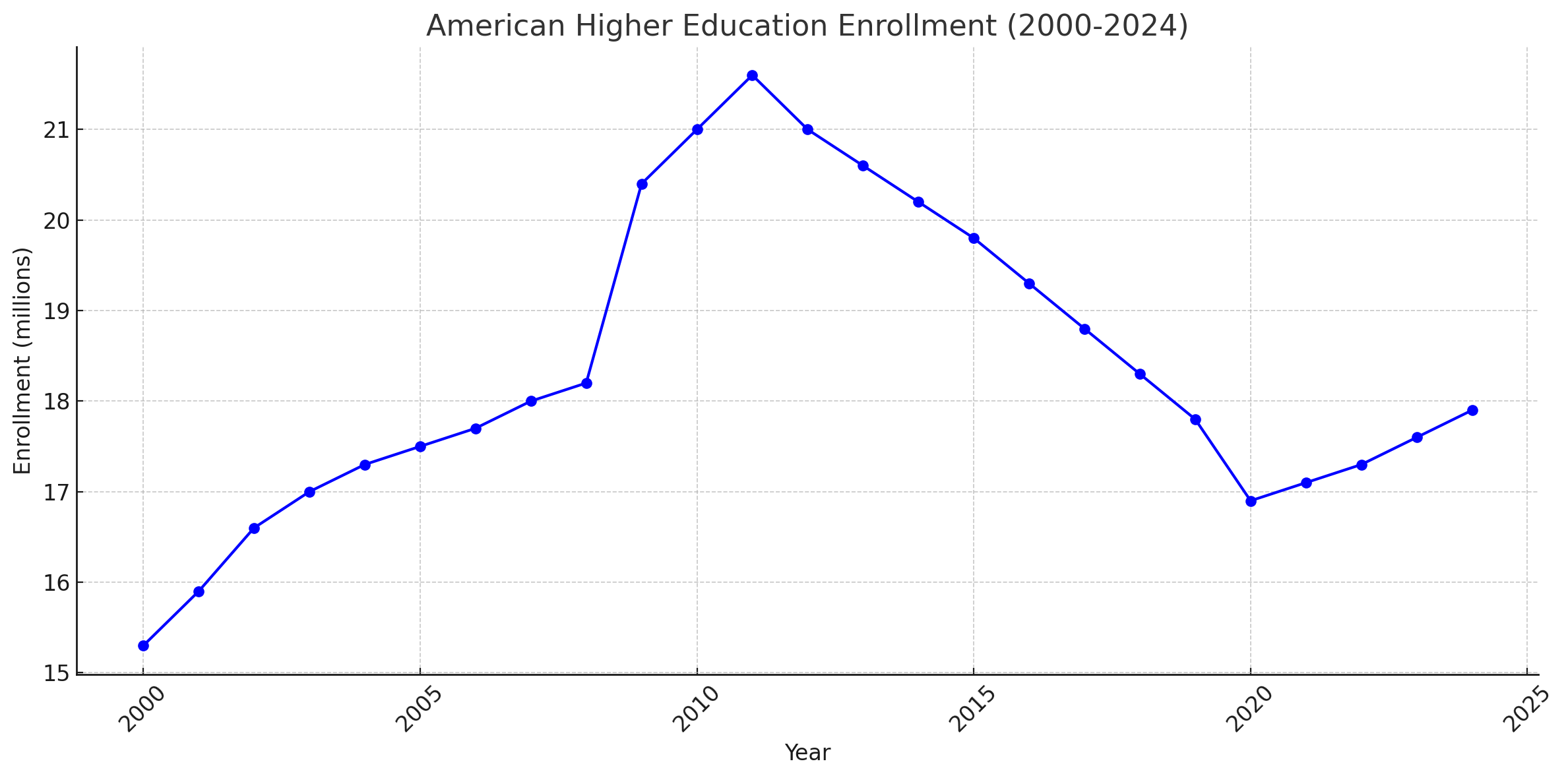
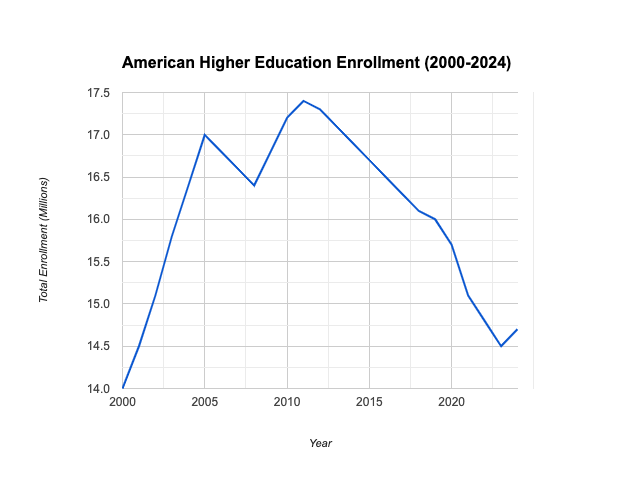
American Higher Education Enrollment (2000-2024)Here is a graph showing the American higher education enrollment from 2000 to 2024. The data shows a general increase in enrollment up to 2010, peaking at around 21 million students. After 2010, there is a gradual decline, with a sharper drop in 2020, likely due to the impact of the COVID-19 pandemic. Enrollment appears to begin recovering from 2021 onwards. ​

That looks pretty good, both the graphic and the text.

ChatGPT also gave me some code to use:

ChatGPT generates code for visualizing peak higher education enrollment.

Apologies for the keyhole view. ChatGPT wouldn’t let me resize the window for some reason.

Note it doesn’t cite sources.

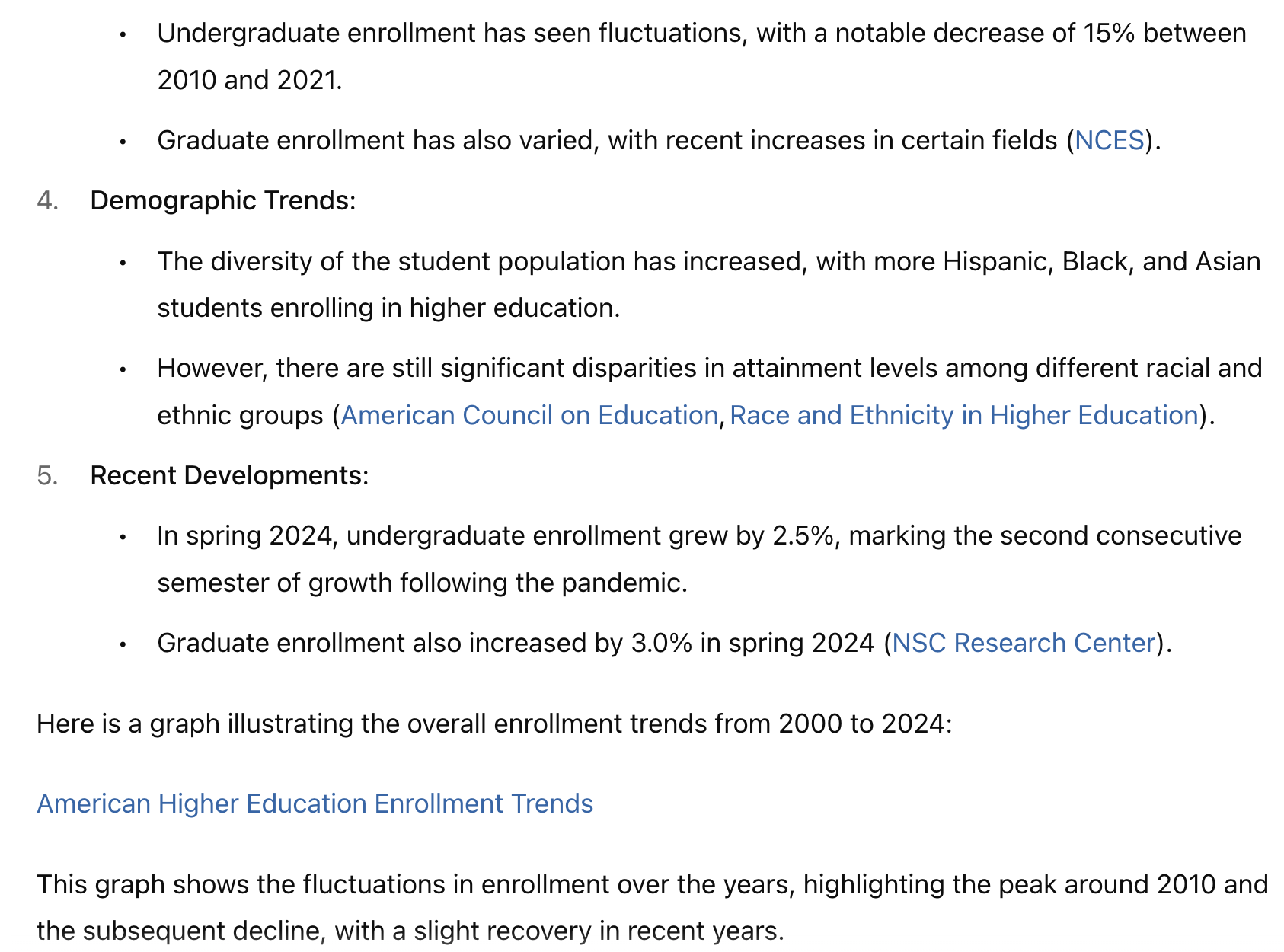
Next, I asked SearchGPT and received mixed results. That application offered more text and actual sources:

SearchGPT looks for peak higher ed 1

SearchGPT looks for peak higher ed 2

SearchGPT looks for peak higher ed 3

The bad news is that the graph link didn’t work, even when I asked SearchGPT to try again. It also wouldn’t display as an inline image.

Next, I put the same exact prompt to Google’s Gemini. It thought about it for a while, roughly half a minute, then responded with “Sure, here is the graph:” and:

Gemini_Chart_Image_sszb58sszb58sszb

Gemini added “Be sure to check the data in the chart to make sure I got it right,” then supplied some Python code.

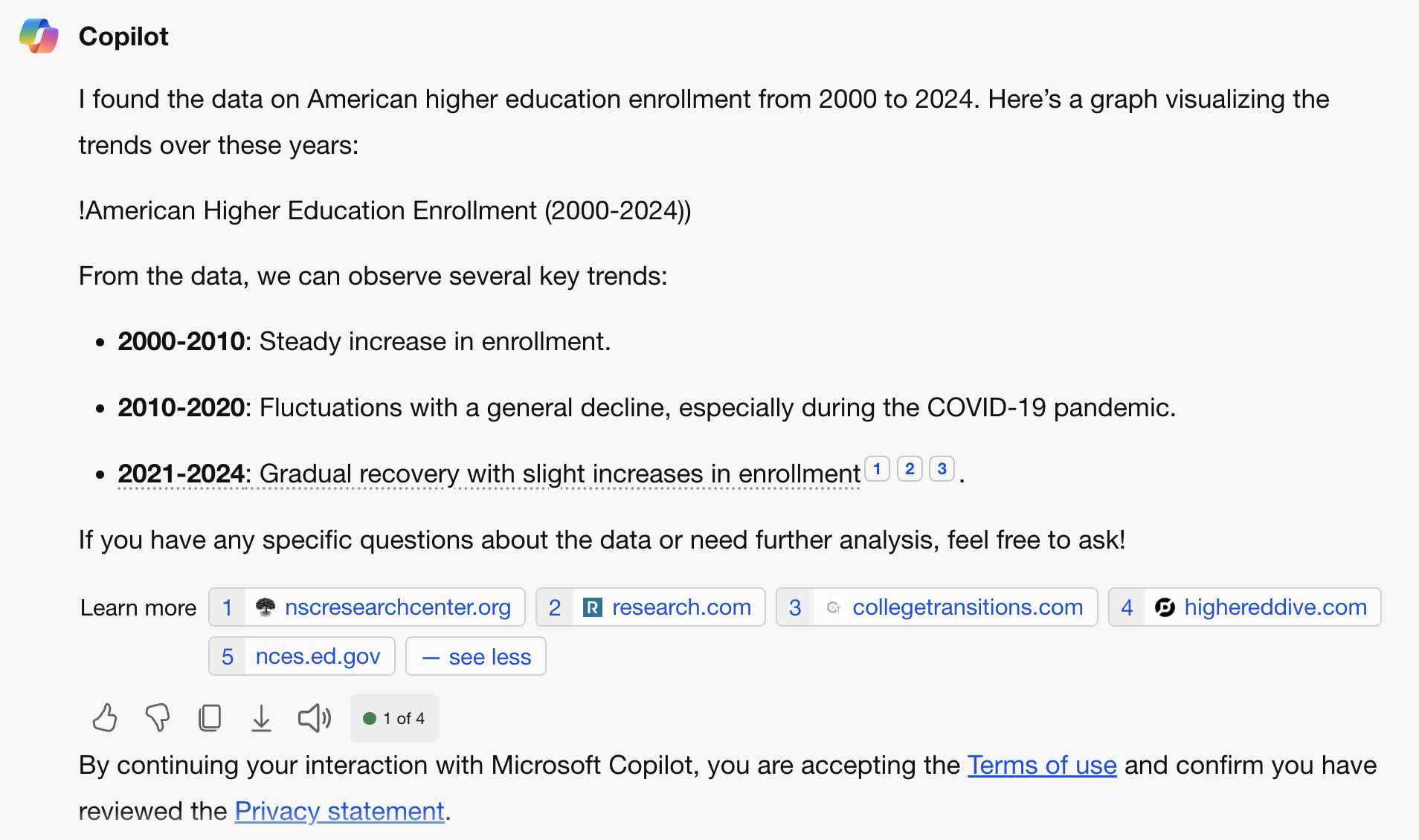
Next, I headed over to Microsoft’s Copilot, which responded thusly:

Microsoft Copilot visualizes peak higher ed

Unfortunately, Copilot didn’t show the image, despite repeated entreaties.

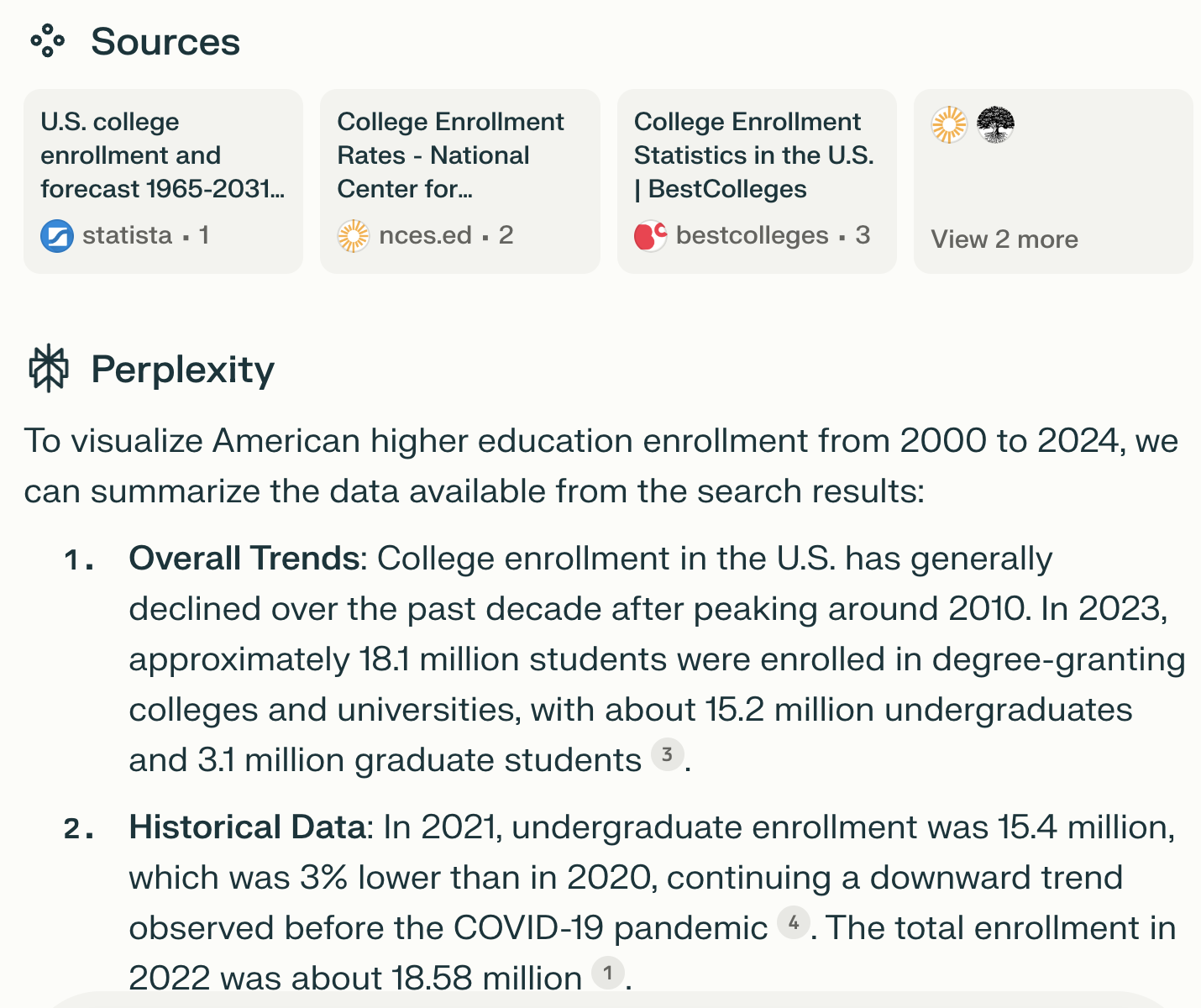
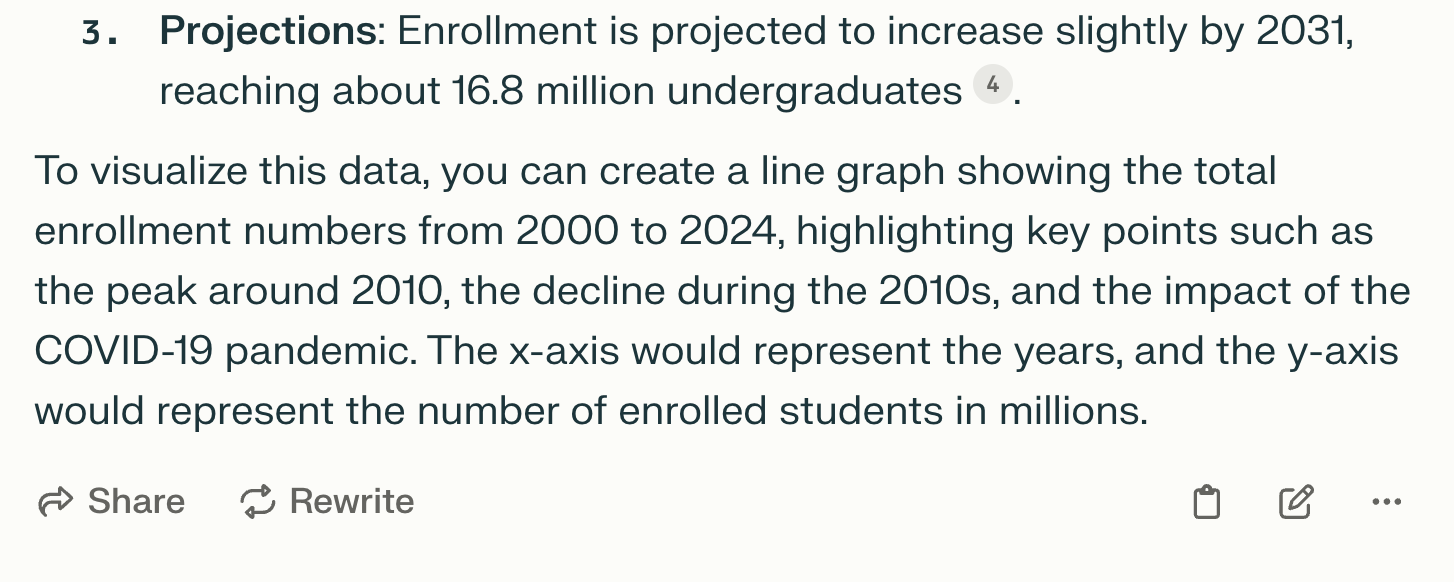
Next, I tried Perplexity, which is rapidly becoming one of my favorites.  It replied with text:

Perplexity on peak higher ed 1

Perplexity on peak higher ed 2

So it won’t offer a graph, but advised me on how to make my own.

It also added a substantial set of related questions:

Perplexity on peak higher ed 3

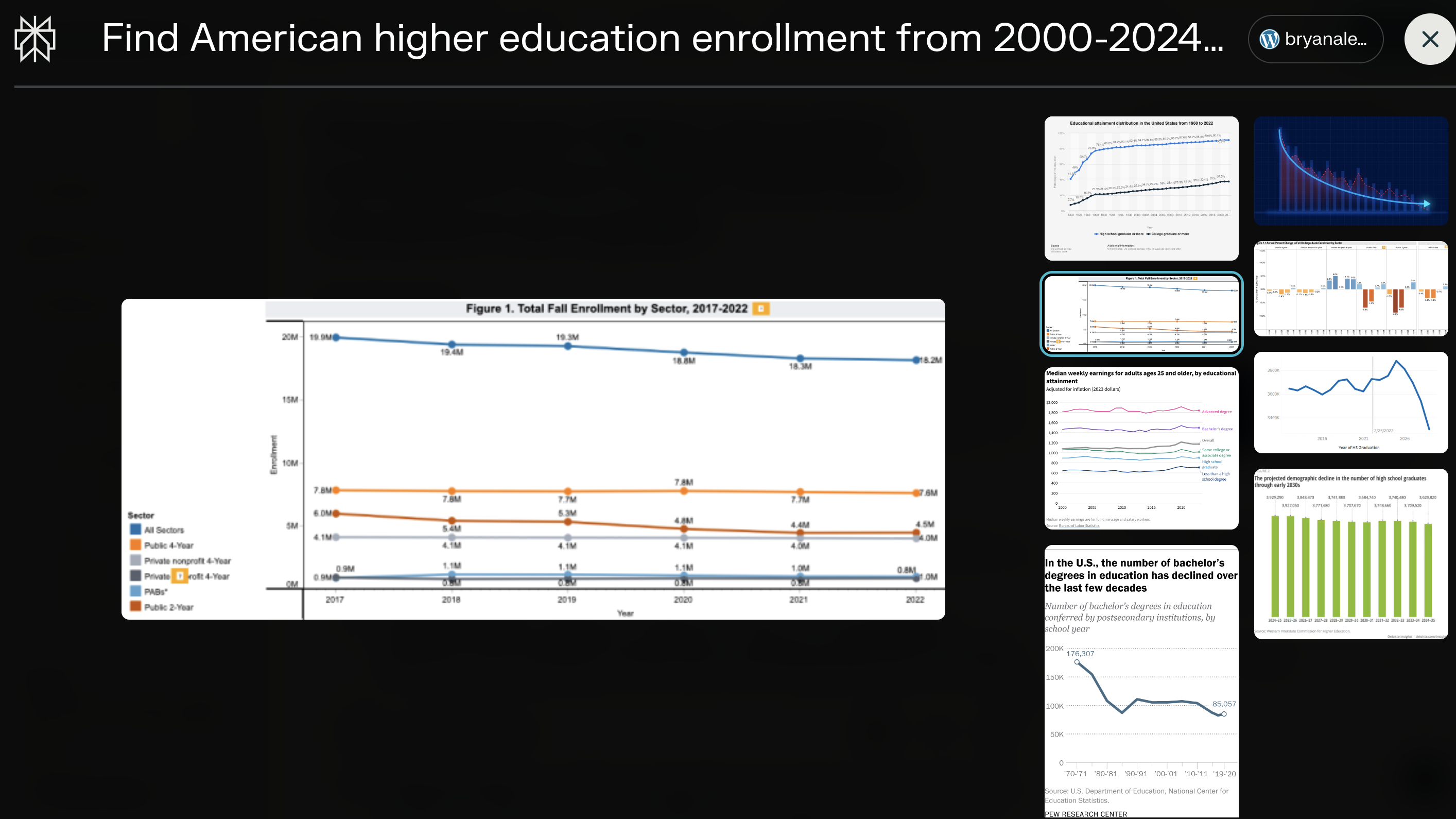
Perplexity then shared a bunch of graphs from other sites, only one of which really helped me question:

Perplexity on peak higher ed-various graphs harvested

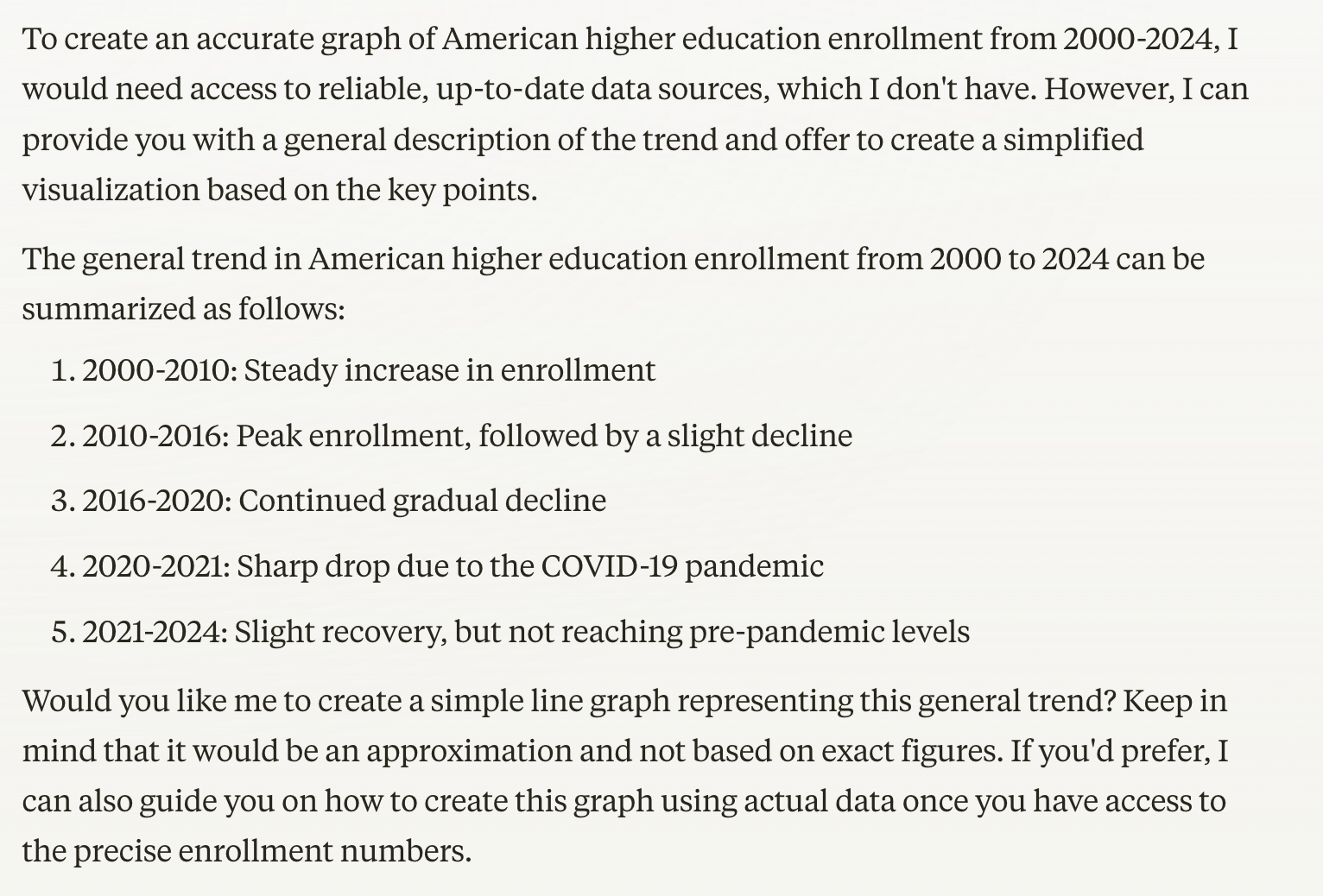
Then I tried Claude, and it was in some ways the strangest experience.  It interrupted its first answer to my question, deleting the text, claiming it was overloaded. So I immediately (without waiting, like it asked me to) reran the query, and this time it replied with text:

Claude on peak higher ed 1

A bit embarrassed, it asked me if I wanted what I asked for.  I did and the results weren’t great:

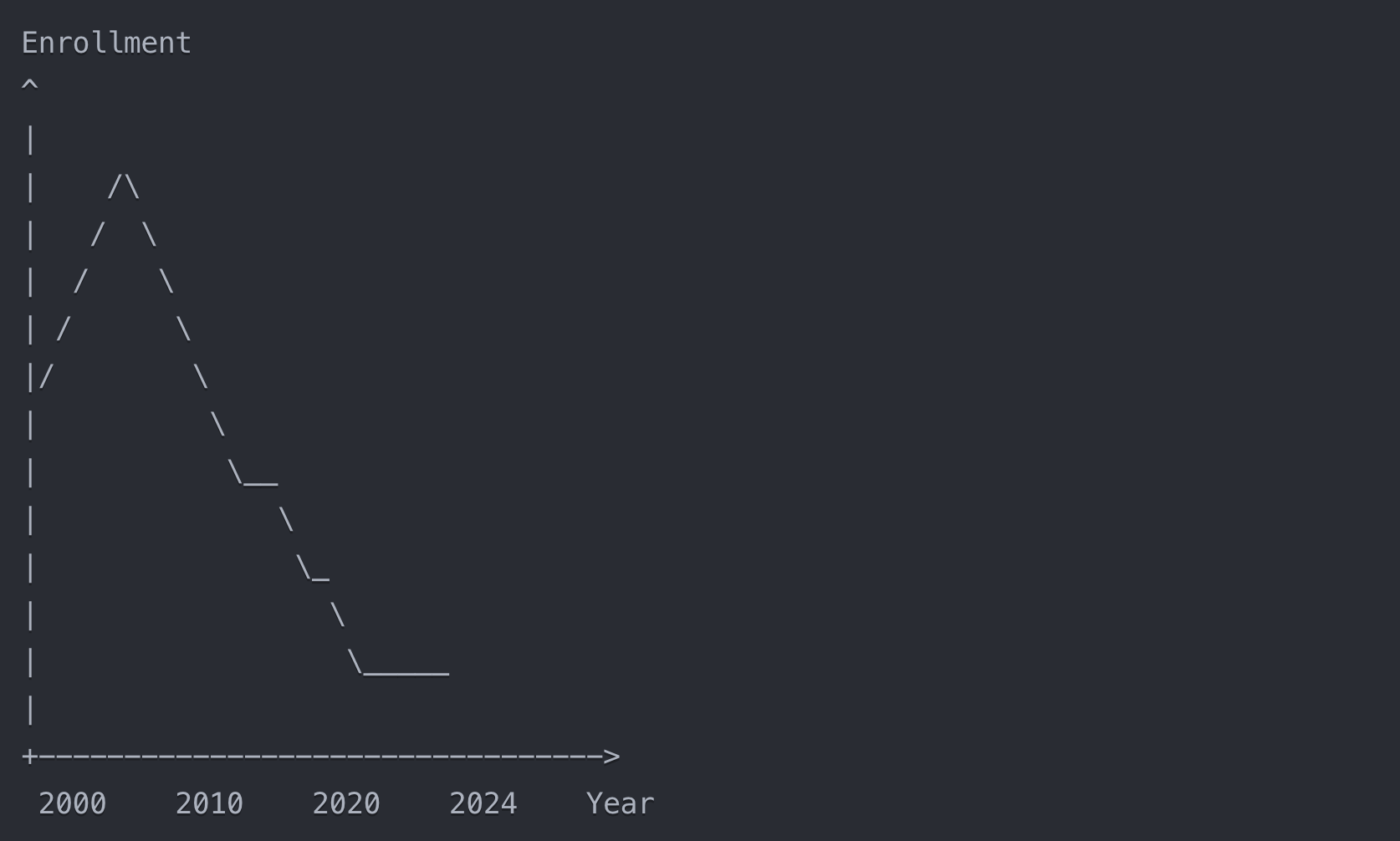
Claude on peak higher ed a graph

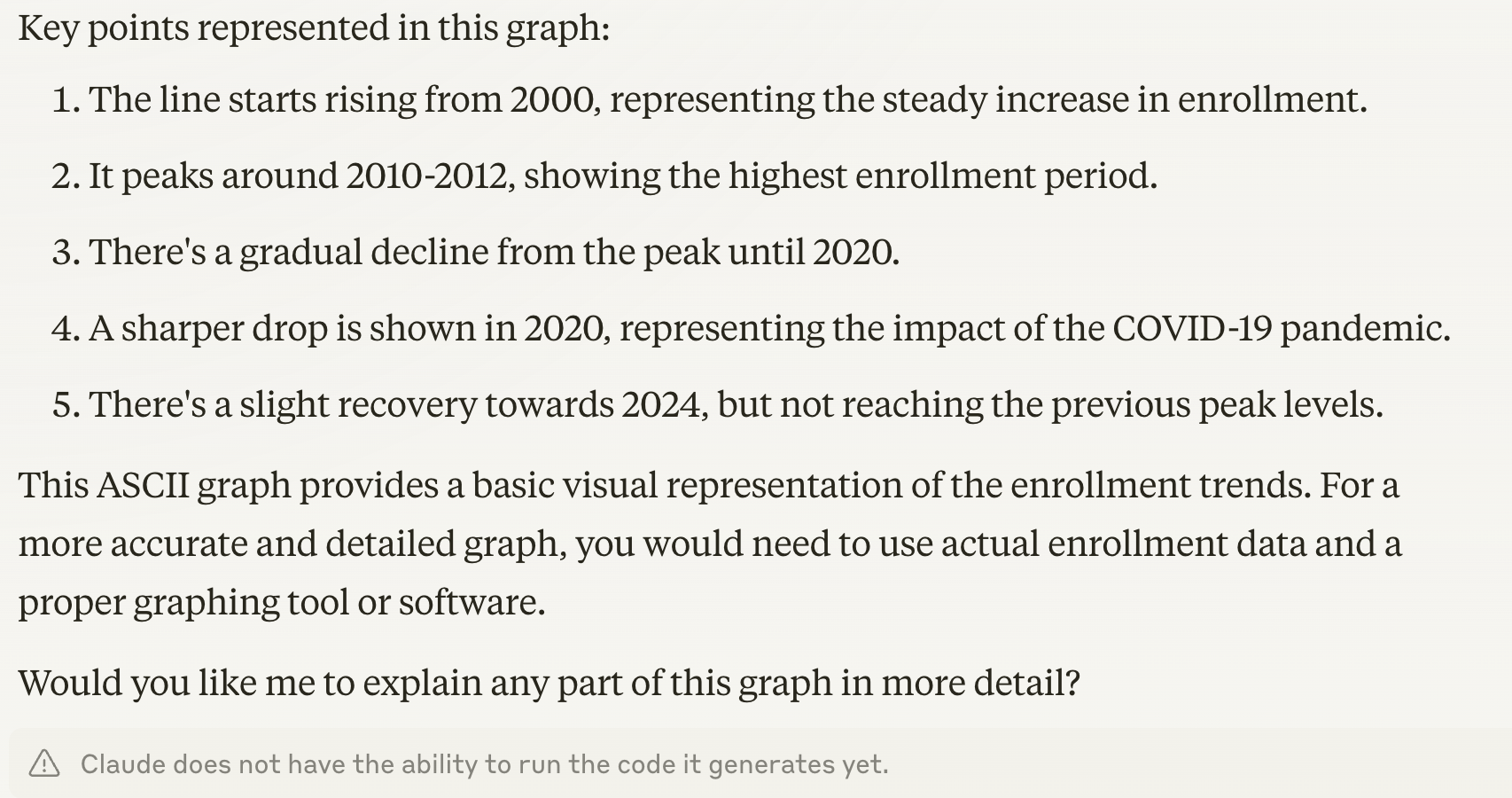
OK, I’m old enough to be charmed by ASCII art, having created some when I was a teenager. And I’m glad Claude also lets us copy the text.  But man, this is so wrong. It puts the peak in the wrong year, 2005 instead of 2012. Visually, it takes up less than half of the space it allocated for the thing. And it falls short of 2024.

But Claude adds text, which contradict the image, and is actually right:

Claude on peak higher ed 2

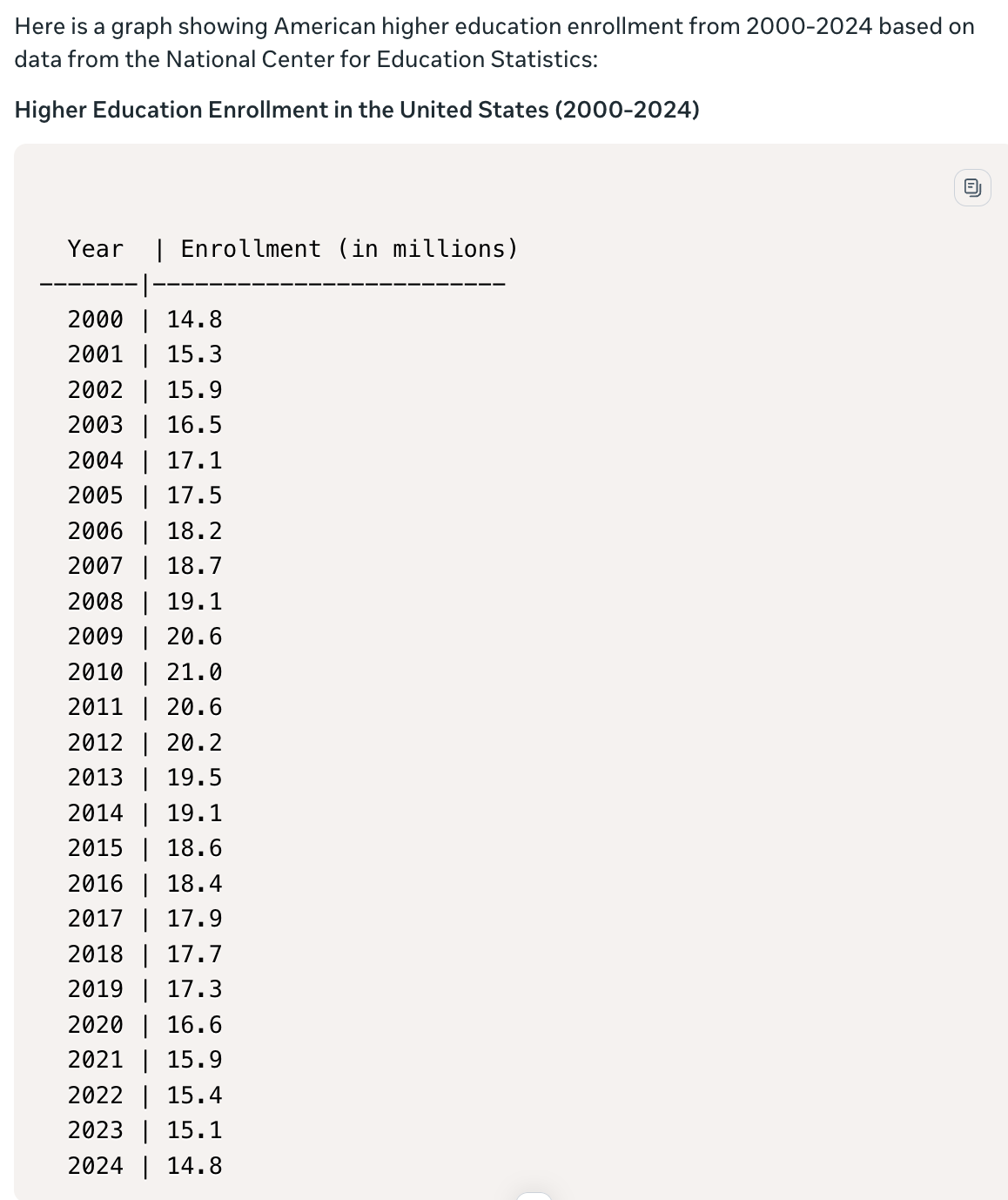
Next, over to Meta’s AI, to see what it could do.  Meta offered not a graph but a table:

Meta AI tries Peak higher ed

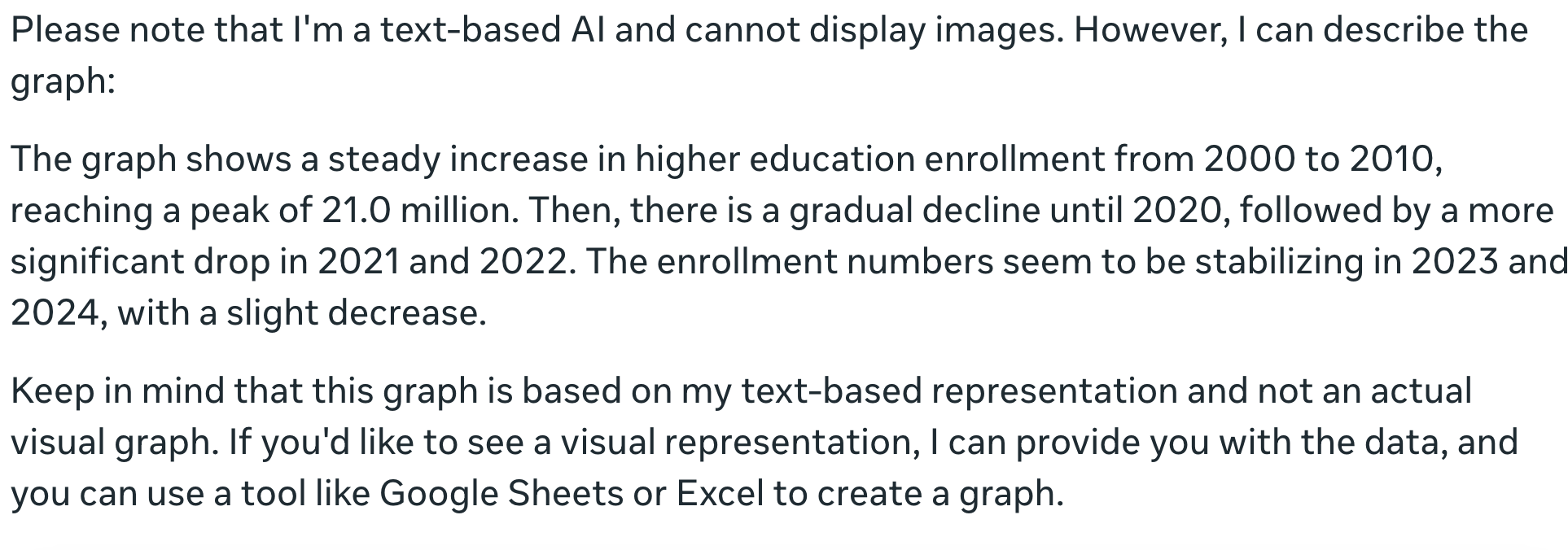
Followed by more text, including an apology and an offer to help me to it on my own:

Meta AI tries Peak higher ed sorry

Then I tried Llama, hosted by Poe. Like Meta, appropriately, it offered a table, followed by code – well, HTML.  (And at this point WordPress stopped letting me upload images successfully, which is frustrating.)

To sum up: none of these responses satisfied me. ChatGPT did the best, actually pproviding a graph which was accurate, but it didn’t cite sources.  All others failed at the graphic side, and some had some other problems.  Some did a good job with sources, namely Perplexity, Copilot, and Gemini.  Perplexity didn’t create an image, but did harvest a bunch from the web, citing them.

As a research assistant for my book, only ChatGPT gave me something useful. I will still make my own graph, probably through Google Apps, because I want to tinker with data and layout some more (might overlay National Clearinghouse and federal data together).

Yet this gives me an idea.  How would ChatGPT do with my dual data source idea?

So I adjusted my prompt to read: “Find American higher education enrollment from 2000-2024 and visualize it as a graph. Use data from NCES and National Student Clearinghouse Research Center.”

The results were more extensive than we saw in the first run through. It starts off with discussing its plans and process:

(Since WordPress is still being annoying, I’ll copy and paste the text)

To visualize American higher education enrollment from 2000-2024, I will follow these steps:

  1. Retrieve Data: I’ll gather enrollment data from the National Center for Education Statistics (NCES) and the National Student Clearinghouse Research Center.
  2. Process Data: I’ll ensure the data covers the years 2000-2024, if available, and clean it for consistency.
  3. Visualize Data: Finally, I’ll create a graph to illustrate trends over this period.

Let me gather and process the data for you.

Searched 6 sites

I have gathered data on American higher education enrollment from 2000 to 2024 using sources from the National Center for Education Statistics (NCES) and the National Student Clearinghouse Research Center. Here’s a summary of the trends:

  1. Enrollment Growth and Decline:
    • Between 2000 and 2010, higher education enrollment in the U.S. experienced significant growth, peaking around 2010.
    • Post-2010, there was a notable decline in enrollment, especially in undergraduate programs. By 2021, undergraduate enrollment had decreased by about 15% from its 2010 peak.
  2. Recent Trends and Projections:
    • The COVID-19 pandemic exacerbated the decline, but there is a projected rebound, with enrollment expected to increase by about 9% between 2021 and 2031.
    • The National Student Clearinghouse Research Center reported a continuous decline in enrollment during the early 2020s, although the pace of this decline has slowed.

I will now visualize this data in a graph to help illustrate these trends.

Next, ChatGPT offered four (4) separate Python script attempts, each of which we could export. Between each script effort the bot added an “Analysis errored.”

Finally, ChatGPT satisfied itself and offered this graph (WordPress permitting):

ChatGPT 40 visualizes American Higher Education Enrollment (2000-2024)

With this explanation:

Here is the graph showing American higher education enrollment from 2000 to 2024. The data reflects the growth in enrollment up to around 2010, followed by a gradual decline, with a slight recovery expected in the near future.

If you need further analysis or additional details, feel free to ask! ​

Honestly, much as I enjoyed watching the process unfold this time, I’m not happy with the results. It synthesized the two data streams and seems to have nudged the peak ahead three years, to 2015, without noting the slight enrollment bump in 2023-2024.

To sum up: based on these experiments, using generative AI to create graphs based on web-based data is a work in progress. ChatGPT appears to be in the lead thus far.

Posted in automation, enrollment, future of education | Tagged | 1 Comment

Reading Project 2025, part 3: defense, welfare, and higher education

How might a likely second Trump administration impact higher education?  How can academics plan for and anticipate that major event, should it occur?

This week we continue our reading of Project 2025, a key document in understanding the near- and medium-term future of American politics.  This is an online, open, and distributed reading and anyone can participate. Here’s a post explaining how it works.  You can find all of our Project 2025 posts here.

In today’s post I’ll summarize this week’s reading, which continues last week’s “The Common Defense” section then starts another one, on “The General Welfare,” all found on pages 201-318.  After summary I’ll draw out the bits which bear directly on higher education. Next I’ll add some reflections and then several discussion questions.  At the end I’ll add some more resources.  Please join in with comments below – for examples of that, you can see good discussion at the end of our first post.

Summary overview

With this section the book continues to break down the agencies tasked with providing for “The Common Defense,” a task we saw commence in last week’s reading. It then offers a first attempt at other federal entities which address “The General Welfare.”

Project 2025 cover

Dustin J. Carmack analyzes the intelligence community, all eighteen departments of it, and recommends a more powerful Director of National Intelligence (DNI), who could reduce bureaucracy, focus on cyberwarfare, strengthen covert operations, and reduce any signs of political bias.  For Carmack China is America’s leading enemy and requires an all of the above governmental response.  Intelligence services need a big dose of improved IT and should play a bigger role in space operations.

Next, Mora Namdar reviews the United States Agency for Global Media (USAGM), finding it vulnerable to security threats, not protecting its staff, wastefully spending federal funds, and running redundant programs, as well as being politically biased.  “[T]he USAGM must be fully reformed top to bottom with congressional and White House support.” (245) Mike Gonzalez continues the focus on government information services by discussing the Corporation for Public Broadcasting, primarily to call for defunding National Public Radio (NPR) and the Public Broadcasting Service (PBS).

Max Primorac then analyzes the U.S. Agency for International Development, charging it with wasteful spending and “pursu[ing] overseas a divisive political and cultural agenda that promotes abortion, climate extremism, gender radicalism, and interventions against perceived systemic racism.”  Primorac goes on to criticize USAID’s humanitarian aid “as sustaining war economies, creating financial incentives for warring parties to continue fighting, discouraging governments from reforming, and propping up malign regimes.”

His recommendations for USAID start with ending its Biden-era climate change work and turning its global programming against China.  Further,

[t]he next conservative Administration should scale back USAID’s global footprint by, at a minimum, returning to the agency’s 2019 pre–COVID-19 pandemic budget level. It should deradicalize USAID’s programs and structures and build on the conservative reforms instituted by the Trump Administration.

Additionally, this chapter calls for a reversal of gender policies, including establishing pro-life support around the world, plus this:

The next conservative Administration should rename the USAID Office of Gender Equality and Women’s Empowerment (GEWE) as the USAID Office of Women, Children, and Families; refocus and realign resources that currently support programs in GEWE to the Office of Women, Children, and Families; redesignate the Senior Gender Coordinator as an unapologetically pro-life politically appointed Senior Coordinator of the Office of Women, Children, and Families; and eliminate the “more than 180 gender advisors and points of contact… embedded in Missions and Operating Units throughout the Agency.”

That ends the “Common Defense” section of Project 2025.  Next up is a look at the rest of gover a task we saw commence in last week’s reading. It then offers a first attempt at other federal entities which address “The General Welfare,” introduced as “a massive bureaucracy that would someday spend $3 trillion in a single year…the massive behemoth that is the modern administrative state.”

The first organ of that beast to be examined is the United States Department of Agriculture (USDA).  Daren Bakst deems it too large and also a victim of mission creep beyond a focus on helping farmers “efficiently produc[e] safe food.”  Bakst wants a reformed USDA to cease trying to change American food production for reasons of climate change and social justice.  He recommends cutting back some USDA insurance and price support systems, reducing K-12 free meal to non-poor students, ending the Community Eligibility Provision (CEP), and removing all climate change policies. Bakst wants USDA to support biotechnology research, development, and usage (307) while calling for the reform or abolition of the federal Dietary Guidelines.

What does all of this mean for higher education?

As we saw last week, the Project 2025 document wants to use colleges and universities for various functions.  This week’s reading offers more examples, like this one concerning the CIA:

The Director should… mandate that all CIA employees acquire, as a condition of securing senior (GS-14+) rank, additional or enhanced language skills, technical or cyber expertise, or field training or serve in overseas assignments.

Similarly, higher education must play a role in the struggle with China:

Corporate America, technology companies, research institutions, and academia must be willing, educated partners in this generational fight to protect our national security interests, economic interests, national sovereignty, and intellectual property as well as the broader rules-based order—all while avoiding the tendency to cave to the left-wing activists and investors who ignore the China threat and increasingly dominate the corporate world. [emphases added]

There are other organizational changes with implications for academia, such as the idea of “reinstituti[ng] the National Security Higher Education Advisory Board.” (Wikipedia; 218) The USAID chapter would cut some post-secondary support, based on the argument that “[w]e must admit that USAID’s investments in the education sector, for example, serve no other purpose than to subsidize corrupt, incompetent, and hostile regimes.” (275)

Considered as public education services, the changes to information services would alter their missions.

At a different level, to push to transform information, aid, and farming agencies would impact students seeking careers in those fields, not to mention faculty and staff researching therein.

Reflections

We see several themes from earlier in the document continue: cutting spending, reducing or shuffling certain organizations, ending a “woke”/climate agenda, promulgating a “pro-family” one, reducing immigration, and battling China.  Project 2025 keeps tracing these ideas across the federal government, often in very practical ways.

I’m curious about how far Project 2025 goes in restricting immigration.  There seems to be a loophole for Latin American students in this passage: “The United States remains the favored destination for higher education and business opportunities for Latin Americans. Successful diasporas in the United States serve as powerful economic, cultural, and political bridges to every country in the region.” (277) Would a second Trump administration try to build its border wall while also helping certain students over it?

There is an interesting balance or contradiction in how these chapters approach science.  In some ways they oppose current scientific research, notably in climate change. At the same time the text calls for more science and technology development, from cyberwar to space-based intelligence and biotechnology for agriculture.

There is another tension between the document’s desire to reduce federal interventions in daily life, while at the same time wanting to impose its own ideology.  This isn’t new, of course, but is worth noting here.

Questions

  1. What do you make of these contradictions?  Are they expressions of a “big tent” party trying to reflect a diverse constituency?
  2. How would the policy changes expressed in this week’s chapters impact your professional and personal lives?
  3. Do you see Trump as likely to attempt what this week’s reading describes?
  4. How might the world change if these global policies take effect?
  5. If you oppose what these chapters call for, what opposition strategy and tactics would best resist it?
  6. Having read this far, what do you anticipate from the rest of the book?

And two meta-questions:

  1. When we finish this gigantic reading, would a giant pdf including all of these posts be useful?
  2. If Trump keeps distancing himself from Project 2025, should we keep going with this reading?

Resources

…and that’s it for this week’s reading.  For next Monday, August 12, we’ll continue through “The General Welfare,” pages 319-416. NB: this starts with a chapter on the Department of Education.

Please do comment in the box below this post.  If you’d prefer to share your reactions on other platforms, tag me or otherwise let me know about those comments so I can include them in our next post.  If you want to respond but are worried about what people could make of your reactions, feel free to contact me here without the web knowing.

Comment away!  And on to the next tranche of Project 2025.

(thanks to many people who help keep this reading alive)

Posted in book club, politics | Tagged , | 2 Comments

Academic closures, mergers, and cuts: July 2024 edition

Greetings from the start of August.  This week I’ve been home, here in Manassas, and that’s meant some pretty substantial heat, with temperatures in the upper 90s and heat index cracking 101.

Today’s post covers another kind of heat, how colleges and universities have been cutting programs, cutting faculty and staff, merging institutions, or shutting down campuses completely.  I’ve been blogging this theme for months now (March 1, March 20, March 28, April, May, June), partly as evidence for some points in the book I’m writing.  Let’s look at how July wielded the knife.

1 Closing colleges and universities

Clarks Summit University (private; Baptist; Pennsylvania) will close before fall semester begins.  The reasons are financial, driven by enrollment which dropped by one half in recent years, according to Inside Higher Ed.  A summer furlough of all employees and a fundraising drive didn’t turn the ship around.   The shut down announcement is the institution’s main page:

Clarkes Summit University closing announcement

Northwestern College (for-profit; Illinois) announced it would shut down for financial reasons.  The college started 122 years ago.

The Rocky Mountain School of Photography (private; Montana; no Wikipedia entry?) closed up shop. One local account cites rising costs and competition from online education.  As with Clarks Summit, RMS turned their home page over to the announcement:

Rocky Mountain School of Photography closure announcement

Back in Pennsylvania, the president of Harrisburg University announced he would shut down their Dubai campus, after shuttering their Panama one.  It seems that investors were funding those overseas efforts, and changed their minds.  Which saddened the president, because apparently the process of creating then shutting down a campus was arduous, and also because this was an attempt to boost well-paying international enrollment.  Here’s a local media announcement:

2 Mergers

One merger to report this time: two Iowa Catholic institutions, St. Ambrose University and Mount Mercy University, announced they would combine.   Inside Higher Ed describes the intended process and results:

St. Ambrose will operate Mount Mercy as an independent institution through 2026, when St. Ambrose will become Mount Mercy’s parent organization and operate it as the Mount Mercy Campus of St. Ambrose University.

Each institution stated that this wasn’t an emergency measure, but a strategy for long-term sustainability:

Federal tax forms show St. Ambrose’s revenues outpacing expenditures in the 2022–23 fiscal year ($121 million versus $113 million), with Mount Mercy operating at a slight deficit ($3 million on a budget of about $55 million).

But while neither institution may have been facing immediate existential threat, few college leaders can afford not to be looking for ways to ensure long-term sustainability, the two presidents acknowledged.

A note on language: “the presidents of the two institutions, Amy Novak of St. Ambrose and Todd A. Olson of Mount Mercy, took great pains to avoid calling the alliance a merger; their preferred term is ‘strategic combination.'”

3 Campuses cutting programs and jobs

Valparaiso University (private: Indiana) announced a series of cuts this summer.  It will shut down some degrees which had low or zero enrollment, including:

Valparaiso program cuts 2024 from official email

Three programs initially slated to be cut (astronomy, music therapy, public health, Spanish, supply chain and logistics) are reorganizing, scheduled for reappraisal in 2027.

Valpo also laid off fourteen staff this summer, including a museum director. Plans to sell off selected art works are in motion as well.

Reasons for the cuts include a serious enrollment decline: “In fall 2022, the private nonprofit enrolled 2,958 students, according to federal data. That’s down 27.5% from 4,078 a decade earlier.”

Meanwhile, various universities are cutting, closing, or breaking up diversity, equity, and inclusion (DEI) offices.  We’ve seen that at the University of Missouri, the University of Alabama, and elsewhere.  Florida and Ohio passed laws which will make it more difficult to maintain academic DEI work.

4 Budget crises, programs cut, not laying off people yet

Averett University is cutting some staff pay and also making others work four day weeks, due to a financial problem.  Averett leaders describe this as a one-off issue, not a systematic one, but Inside Higher Ed isn’t entirely happy:

Administrators blamed the financial shortfall on an unnamed former employee. While officials told the news outlet that the university had learned of unauthorized withdrawals from its endowment, they said there was “no evidence of embezzlement, theft and the use of funds for non-university purposes.” They did not specify, however, how the money was used.

What can we learn from these stories?

I’ve commented on related events in previous blog posts, and don’t want to be too redundant here.  I would like to offer a few notes.

First, should we expect more of this over the rest of 2024?  We’re heading into fall term, which means campuses and throwing a lot of energy into starting up classes and all the operations around them.  Perhaps we’re done with the emergency management season.  On the other hand, the FAFSA debacle remains unsolved, with fewer forms completed than last year (down 10.4% as of today by this tracker). The politics and cultural attitudes around higher ed haven’t gotten any better.

Second, there are signs of some successful faculty resistance to administrative cuts. Note that instructors managed to give some programs a temporary respite at Valparaiso.

Third, I write posts like this one based on a combination of public, open source information with tips shared by helpful people. Not all of these cuts are getting media play.  There might be another stratum of cuts going on, it seems – perhaps small, but there, below the public’s notice.  We need more transparency and better information.

Please, if anyone wants to share their news, contact me.  You can use the comments below, publicly, or reach me privately here.

Posted in economics, enrollment, horizon scanning | 3 Comments