-
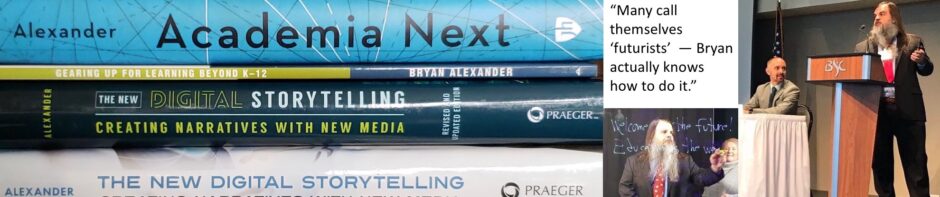
Many call themselves “futurists” — Bryan actually knows how to do it.
Bryan Alexander is perhaps higher education’s most prominent intellectual provocateur.
–The Chronicle of Higher Education
One of the most creative and perceptive people in higher education today!
Is @BryanAlexander a wizard because he wrote about the possibility of a pandemic in 2018? He says he has a beard like one.
“Hardest working man in edtech!”
Gotta love @BryanAlexander‘s ability to catalyze a conversation without leaning on hyperbole or triggers.
This is so well-structured and thoughtful that it almost made me forget I was terrified while reading it.
When @BryanAlexander is futuring about you, you’d better start futuring yer own dang self!
Your prescience is wild.
[F]uturist and higher-ed guru Bryan Alexander…
Best online pharmacy with fast delivery buy fildena
buy flexeril
buy amitriptyline
buy lasix New online drugstore with no prescription Flickr Photos
Recent Comments
- MD Viewer on The Inflation Reduction Act and higher education: open thread
- sibyledu on American views of higher ed decline, once again
- sibyledu on Health Care Nation, a 2026 update
- Brent Anders on Health Care Nation, a 2026 update
- Hearts Game on Undergraduate completion rates stabilize; one third of students don’t finish college in under six years
Subscribe via RSS
Categories
- About
- automation
- blogging
- book club
- bookstore
- Bryan Alexander Consulting
- cheer
- classes and teaching
- climatechange
- copyright
- coronavirus
- DEI
- demographics
- digital literacy
- digitalstorytelling
- discussions
- economics
- education and technology
- enrollment
- FTTE report
- future of education
- Future Trends Forum
- futures
- gaming
- higher education
- horizon scanning
- humor
- interviews
- K-12
- liberal education
- libraries
- literature
- movies
- personal
- podcasts
- politics
- presentations and talks
- professional development
- readings
- research topics
- reviews
- scenarios
- services
- sf
- speaking
- storytelling
- strategies
- teaching
- technology
- travel
- trends
- Uncategorized
- videoconferencing
- visualization
- web3
- writing
Meta
Tag Archives: peakhigheducation
Launching my new book, Peak Higher Ed
Greetings from the darkest week of the year in the northern hemisphere. As winter solstice draws nigh I’m preparing some end-of-year posts. But first, this month Johns Hopkins University Press is publishing my new book, Peak Higher Ed: How to … Continue reading
Peak higher education: seeing what AI makes of recent enrollment data
(This is an experimental crossover post for both my blog and Substack, since the topic applied to each of them.) As I write my new book, Peak Higher Education, I research a good amount of statistics. Enrollment data, publication numbers, … Continue reading
Higher education is ailing. It hasn’t been destroyed – yet.
Over the past week a discussion about the future of American higher education has unfolded across the web. Things began with the publication of new enrollment data. I commented on this, and Josh Kim responded, as did commentators on his column. … Continue reading
“Here’s How Higher Education Dies”: I am interviewed in the Atlantic
This week I returned to the Atlantic Monthly, courtesy of an interview with the staggeringly metal headline: Here’s How Higher Education Dies Many thanks to Adam Harris for good questions and much patience. Adam focused on the question of peak … Continue reading
Pushing back on peak higher ed: a discussion with Joshua Kim
Last week I reviewed the peak higher education idea twice. First there was an update on the now six-year-running enrollment decline. Next I reflected on my peak hypothesis in light of recent history and emerging factors. Around the same time … Continue reading
American higher education enrollment declines again
The number of students enrolled in American colleges and universities declined this spring. Recent data from the National Student Clearinghouse Research Center (NSCRC) depicts a gradually changing student body, with serious implications for post-secondary education. In spring 2015 American campuses … Continue reading


