How would educators respond in case of one black swan event: the internet going down?
I don’t mean when a local provider has issues, or if one’s institution is based in a rural area, or when a campus goes offline for a half day. I’m referring to the possibility of the internet itself crashing at a regional or national level, and for more than a few hours.
Remember, black swans are, by definition, unlikely events that, when they occur, have enormous impact.
Why am I thinking of this particular swan? Leading security guru Bruce Schneier just scared the hell out of many of us with this post. “Someone is extensively testing the core defensive capabilities of the companies that provide critical Internet services… [T]his is happening. And people should know. ”
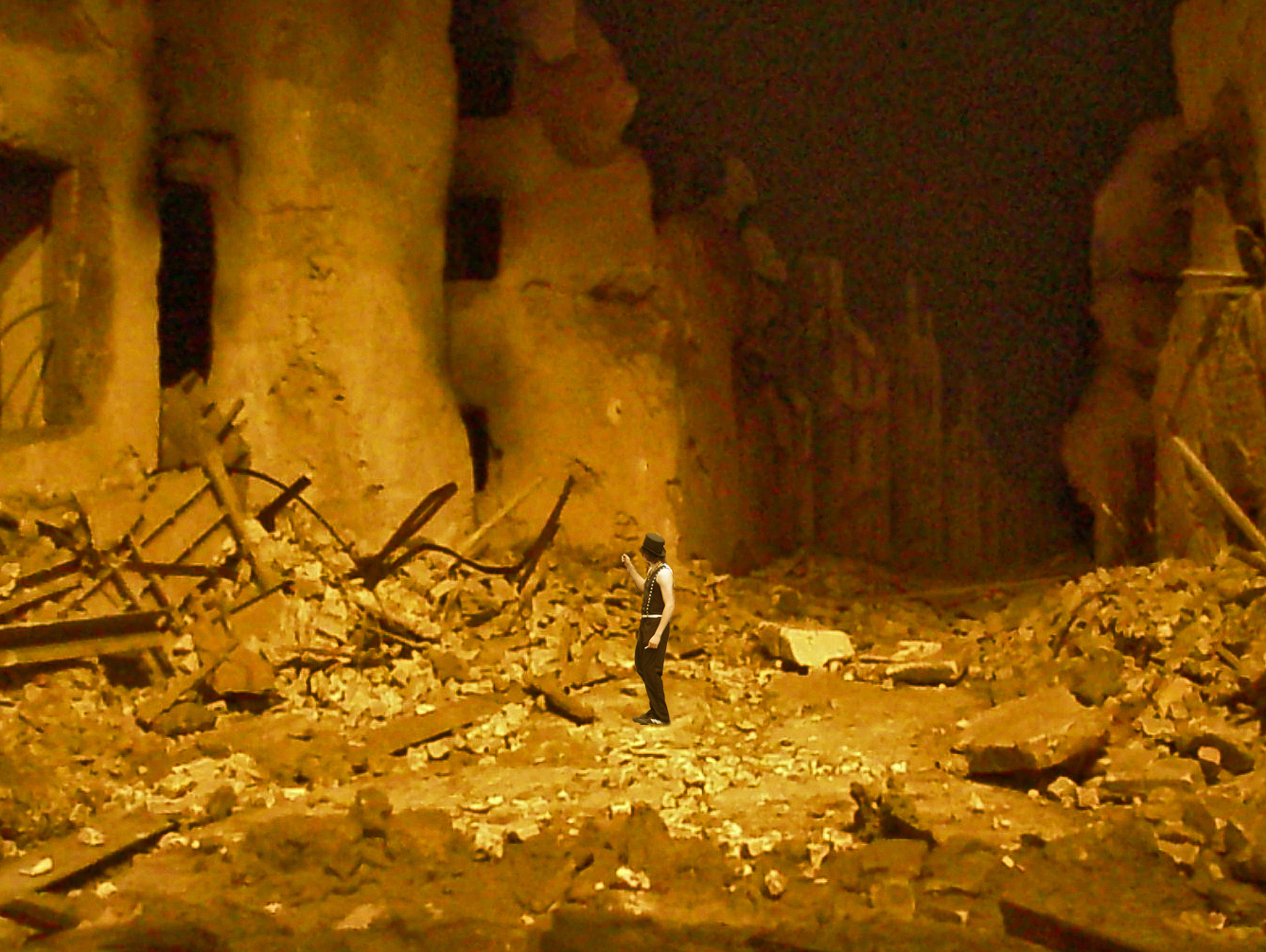
Schneier’s article is obscure and lacking in details for several reasons (protecting clients and vulnerabilities), but the idea is there. Some actor is pressing hard on the internet’s roots. Read more for speculations.
Let me apply this to education. What would happen in schools if suddenly, say, North America could no longer access the Web?
Assume this is a broad attack, so people can’t rely on cell phone coverage, or move to nearby locations (coffee shop, home, public library) for fallback access.
I’m only thinking of the web here, not the internet as a whole, as if DNS servers went down.
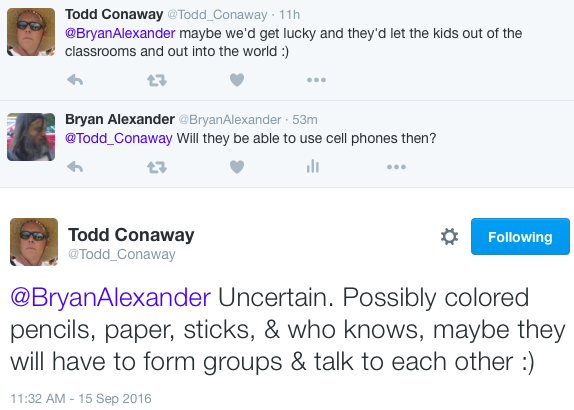
What is life like in colleges, universities, libraries, and museums? I asked Twitter, and responses were pretty basic:
If students, faculty, and staff can’t access their learning management system, or enterprise data, or scholarly articles through JSTOR, or social media, or YouTube, how does an institution react?
Imagine if the problem is a little bigger. The attack could take out the internet as well as the web, knocking off email. Or perhaps the attack also hits electrical power supply, either by cyberwar or electromagnetic pulse (EMP). If the attack was launched by a state actor (i.
e., China), it could well be accompanied by other technological, economic, or geopolitical stresses.
What contingencies do we now have in place?
NB: remember that this is a black swan, an unlikely event.
Don’t get too spooked. Yet.



These events already are happening to people outside of north America. Millions of Syrian refugee kids. Most of the kids across Sub-Saharan Africa. We live in such priveledge, we have little conception that MOST kids don’t have the things you write about. So what does THAT mean to us?
Actually, some of us have knowledge of that, Nancy. For example, back in the 1990s I was lightly involved in the Balkan internet. Now I track global access to digital networks.
But I agree, few in the US discuss this.
To answer your question, it means the US is pretty parochial.
Now, for my question. What does the global experience tell us about my post’s question?
It seems to me like we would not even be thinking of education, given the multiple-disaster scenario that would or could ensue. Would it be possible to do banking transactions, credit card, would the power grid be down? Would cash registers at supermarkets stop working? How about broadcast radio and TV, GPS, transportation, medical equipment? I have no idea about which of these systems depend at some point on the public Internet (though that information is probably out there), or whether the imagined event would take down non-public nets too. What would happen to the stock market once the impact of this vulnerability becomes known – assuming the stock market could even operate. No doubt that many people in the world already live without reliable networks, but we are more dependent on them.
Great question, Peter. It would definitely be a major crisis, impinging on an existential threat.
I agree that students would be staying home and trying to cope. If this lasted long term, people would be starting over at the most basic levels–neighborhood gatherings in garages.
But the real damage would be done at more critical levels of university research labs, the places where technical innovation is moving civilization as we know it along its fragile spider web silk toward one version of an improved future.
Has anyone written a science fiction novel on this November we could read together, as long as we still have Internet?
Has anyone written a science fiction novel on this novum (thanks but no thanks for November, Mr. Spellcheck!) we could read together, as long as we still have Internet?
Great points, Sandy, especially about research.
EMP and similar threats have become a staple in fiction: https://en.wikipedia.org/wiki/Electromagnetic_pulse_in_fiction_and_popular_culture .
Taiyo Fuji’s Gene Mapper has a search engine seize computers in 2017, wiping out data on PCs, phones, servers. A replacement, TrueNet, is much more locked down, both in terms of programs that can access it and data allowed to be added. So companies hire ‘salvagers’ to go into the old Internet for data that hasn’t been added.
Steve, that’s fascinating, and not unlikely.
Should we consider that book for this reading series?
Sounds like satellite internet and most major business systems ok (banks)?
Post internet apocalypse scenario. chuckle. USB Killer V2.0 – Available now – buy online! – USB Killer https://www.*usb*kill.com/
1.
The USB Killer V2.0 is a device that tests your USB port against ESD or electro-spiking. Available now.
Interesting that this got posted the day after you proposed your scenario: “No Internet, No Power, No Problem: Solar Library Empowers Schools Abroad” http://www.infodocket.com/2016/09/17/arizona-state-university-no-internet-no-power-no-problem-solar-library-empowers-schools-abroad/ – with a reminder to see Jason Griffey’s LibraryBox http://librarybox.us/ Posted on InfoDocket September 17, 2016.
Sounds like a nice way to get some cached content. Maybe every university should plan for something like it?
Pingback: The great October DDoS attack: first thoughts, implications for education | Bryan Alexander