-
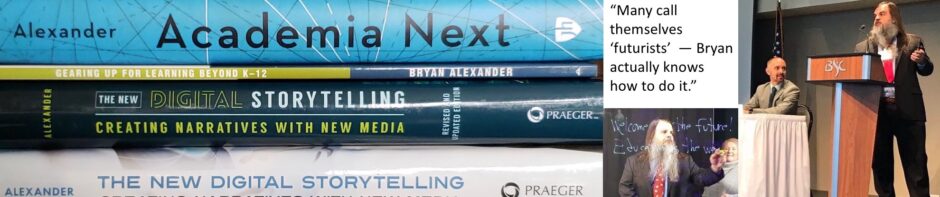
Many call themselves “futurists” — Bryan actually knows how to do it.
Bryan Alexander is perhaps higher education’s most prominent intellectual provocateur.
–The Chronicle of Higher Education
One of the most creative and perceptive people in higher education today!
Is @BryanAlexander a wizard because he wrote about the possibility of a pandemic in 2018? He says he has a beard like one.
“Hardest working man in edtech!”
Gotta love @BryanAlexander‘s ability to catalyze a conversation without leaning on hyperbole or triggers.
This is so well-structured and thoughtful that it almost made me forget I was terrified while reading it.
When @BryanAlexander is futuring about you, you’d better start futuring yer own dang self!
Your prescience is wild.
[F]uturist and higher-ed guru Bryan Alexander…
Flickr Photos
Recent Comments
- MD Viewer on The Inflation Reduction Act and higher education: open thread
- sibyledu on American views of higher ed decline, once again
- sibyledu on Health Care Nation, a 2026 update
- Brent Anders on Health Care Nation, a 2026 update
- Hearts Game on Undergraduate completion rates stabilize; one third of students don’t finish college in under six years
Subscribe via RSS
Categories
- About
- automation
- blogging
- book club
- bookstore
- Bryan Alexander Consulting
- cheer
- classes and teaching
- climatechange
- copyright
- coronavirus
- DEI
- demographics
- digital literacy
- digitalstorytelling
- discussions
- economics
- education and technology
- enrollment
- FTTE report
- future of education
- Future Trends Forum
- futures
- gaming
- higher education
- horizon scanning
- humor
- interviews
- K-12
- liberal education
- libraries
- literature
- movies
- personal
- podcasts
- politics
- presentations and talks
- professional development
- readings
- research topics
- reviews
- scenarios
- services
- sf
- speaking
- storytelling
- strategies
- teaching
- technology
- travel
- trends
- Uncategorized
- videoconferencing
- visualization
- web3
- writing
Meta
Category Archives: readings
What should the online book club read next?
As 2017 dawns, our thoughts naturally turn to… our book club, and reading together! During the end of 2016 we read We Make the Road by Walking, a major and inspiring work on education. Readers commented in response to blog posts … Continue reading
Reading Horton and Freire into 2017
Our reading of We Make the Road By Walking continues in the new year. Different people have been posting about their progress at their own pace, sharing reflections for the general conversation. (You can read previous blog posts and comments discussing … Continue reading
A look back along the _Road_: people's work and Bryan's antiauthoritarianism
Over the past month we’ve been reading We Make the Road By Walking. A bunch of us have been discussing it through blog posts here, on other folks’ blogs, on Twitter, through Google Docs, hacked images, data visualizations, and a … Continue reading
We Make the Road by Walking: chapters 5 and 6
Welcome to our book club’s ongoing reading of We Make the Road by Walking. In this post we can discuss chapters 5 (“Education and Social Change”) and 6 (“Reflections”). Here I’ll offer a summary of the reading, followed by links to … Continue reading
We Make the Road by Walking: chapter 4, “Educational Practice”
Welcome to our book club’s ongoing reading of We Make the Road by Walking. In this post we can discuss chapter 4, “Educational Practice”. Here I’ll offer a summary of the reading, followed by some reflections and discussion questions. I’m also … Continue reading
When an online book club takes off
One of the great pleasures of teaching, parenting, or politicking is seeing the people involved cut loose on their own, being productive and creative on their own initiative. I have always taught with this in mind, considering that’s how people learn … Continue reading
We Make the Road by Walking: chapter 3
Welcome to our book club’s ongoing reading of We Make the Road by Walking. In this post we can discuss chapter 3, “Ideas”. In this post I’ll offer a summary of the reading, followed by some reflections and discussion questions. To … Continue reading


