How teenagers used technology in 2024: the latest from Pew Research

Pew Research has a new report on how American teenagers use social media and related technologies.  I’ve long admired and drawn on their research.  Today I’ll share highlights and some reflections on this publication, especially aimed at educators.

Much of what follows will be unsurprising to people paying attention to the topic, but there are details media coverage tends to downplay.  And it’s useful data to consider instead of anecdotes.

tl;dr – overall use is up, led by video and image apps.

To begin with, teen social media habits fall into three groups.  At the top, far above the rest, stands YouTube, which is nearly universal.  Next are three platforms clustered together: Snapchat, Instagram, and, of course, TikTok.  Below them in use is another group including Facebook, Whatsapp, X/Twitter, Threads, and Reddit:

teens-using social-media-tech_Pew_0-01-2014-2014

Note some of the long-term trends: the steady decline of Facebook and X, Instagram’s relative stability.  Note, too, how little used is Whatsapp, which is popular beyond the United States.  I’m curious about the slight downward trend for both YouTube and TikTok and wonder about the potential for a Whatsapp takeoff, based on its rise over the past two years.

The preceding covers experience at a basic level. Next, Pew considered time on platforms, and the results follow a similar yet slightly different pattern.  YouTube leads again, followed by a mix of Tiktok, Instagram, and Snapchat.  Facebook trails:

teens-social-media-tech_by time 2024

Note the 12-16% who use the top platforms “almost constantly.”

The report then breaks usage down by demographics.  There are some slight yet clear differences between the genders in terms of TikTok and YouTube use (girls preferring the former, men the latter) when it comes to frequent visiting.  In contrast Snapchat, Facebook, and Instagram enjoyed teen gender parity:

teens-social-media-tech_Pew by gender 2024

Similar gender differences appeared among those using the tech less intensively:

Instagram and TikTok are used more widely by teen girls than teen boys. For example, 66% of girls say they use TikTok, compared with 59% of boys. Instagram use follows a similar pattern (66% vs. 56%).

On the other hand, boys are more likely than girls to say they use YouTube (93% vs. 87%).

Breaking down the data by race and ethnicity yields some striking differences.  Hispanic and black teens are much more likely to frequently use TikTok, YouTube, and Instagram than whites (Asians don’t appear in the report, not do Native Americans or Pacific Islanders, curiously). Snapchat and Facebook use was more even:

teens-social-media-tech_by race_Pew_2024

General use showed similar racial patterns:

Among teens, a larger share of those who are Black (79%) or Hispanic (74%) than White (54%) say they use TikTok. Black and Hispanic teens also stand out compared with White teens in their use of Instagram and X.

When it comes to the messaging platform WhatsApp, Hispanic teens are more likely than Black or White teens to say they use it.

Sliced another way, the data shows interesting differences along class lines:

As was true in prior studies, Facebook remains more commonly used among teens in lower-income households. For example, 45% of teens in households earning less than $30,000 a year say they use Facebook. This drops to 35% among teens in households earning $30,000 to $74,999 a year and 29% among teens with household incomes of $75,000 or more.

Teens in lower-income households are more likely than those in the highest-income households to say they use TikTok (73% vs. 59%).

Stepping back from individual platforms, the report asked teens about how much time they spent online total.  To nobody’s surprise that amount has increased in recent years, with 46% stating they were online “almost constantly”:

teens-social-media-tech_by time Pew 2024

What might we take away from this?

If you are seeking to reach American teens in general, Pew offers a useful map.  Obviously using social media as a whole is a good idea, given audience engagement. Segmentation might be worth addressing. For example, if a college or university is looking to engage with underrepresented minorities, TikTok and YouTube, then Instagram, might have advantages.  Targeting the economically marginal would benefit from using Facebook and TikTok.  Otherwise, X/Twitter, Reddit, and Threads look to be relatively marginal.

Obviously, some external factors can change these usage patterns in the new year.  The United States is ready to ban TikTok in about one month, unless someone local buys the thing.  There is also a global move to cut minors’ social media use, which would reduce impact (assuming it worked, which is by no means guaranteed).

One note to repeat: Whatsapp has global reach. US teens are starting to use it more.  Watch for it to grow over the next few years.

So how does this Pew report comport with what you’re seeing, dear readers?

Posted in technology | 1 Comment

Podcasts I’m listening to in late 2024

After a series of heavy posts I thought I’d offer a gentler, more entertaining one for the weekend.

podcast microphone_benrogerswpgHere I’ll introduce the podcasts I’m currently listening to. (taps mic). Wow, I haven’t done one of these posts since 2021.

In terms of habits, I listen to podcasts pretty frequently. Mostly it’s in multitasking situations where my hands are busy and I can’t read or watch a video: biking, doing dishes, lifting weights, making food, walking, doing housework.  I’ll pause to forward a noteworthy program by email to a friend or, for later citation, to myself.

Software and hardware: most of the time I listen via the Podcast Addict podcatcher on my Android Fold, which serves my purposes well. Sometimes I’ll listen to a news program on my desktop or laptops, if I’m not writing about something else.

One more note: all of these are current programs or ones I’m currently listening to. There’s a big backlog of completed programs I’ve enjoyed but which aren’t going on right now; those won’t appear here.  Conversely, I’ll mention some programs which are done, but I’ve only now gotten to them.

Now let me break down what follows into categories.  I’ll link to websites if I can find them.

News

BBC – I listen to several programs.  Their Global News offers frequent, very short takes on emerging events.  Newshour covers multiple topics, often in depth.

NPR News Now Very short survey of headline stories, updated every hour or so.

Reuters – Reuters World News summarizes current events in around 10 minutes. I also enjoy Reuters Econ World for business and economics news.

The World Next Week Two researchers break down emerging global news.  Excellent and thoughtful.

The Daily A New York Times program, each episode looking into one current event, often stemming from Times reporting.

What’s News The Wall Street Journal surveys leading stories with an eye on the business world.  Sometimes twice per day.

The Foreign Desk Skeptical updates on global news.

Slate Money Several regulars and the occasional guest explore current economic events.

This Week in Space A friendly conversation about space news.  Part of the TWiT empire.

Analysis

Ones and Tooze Prolific economic historian Adam Tooze discusses current events with his usual combination of data, political economy, and elegantly explaining complex problems.

Intelligence Squared Conversations with luminaries about current events, recent history, culture, politics, economics, and more.

Plain English with Derek Thompson The titular journalist investigates current events.

538 Politics The poll-focused team analyzes current events. As you might expect the discussions are fast and data-heavy. (The link is to their YouTube channel; ABC doesn’t have a good page that I can find.)

Behind the News Doug Henwood interviews people about current events from a left wing perspective.  Always thoughtful and useful.  Henwood is a fine person.

The Great Simplification A wide ranging, humane, and sobering discussion of the present, including both humanity and the natural world.

The Munk Debates A series of debates (as you might expect) and interviews about current and recent events.  There’s a paywall, but a lot is available for free.

The Lawfare Daily Podcast Analyses of current events with a focus on law and policy.

Economic Update A look into major economic issues from current affairs from a left perspective.  Richard Wolff is very engaging.

On the Media Formerly a look at developments in news coverage, the program now offers more straightforward and liberal analysis of current events.

School of War Each episode explores one aspect of military activities, usually with an expert guest.

podcast cat listening to earbuds_by Cogdog

Higher education

College Matters The Chronicle of Higher Ed’s program, consisting of interviews with interesting people, illuminating academic news.

The New Books Network Academics interview other academics about their recently published scholarly titles.  Helpfully divided into categories like history, religion, science and technology, architecture, art, folklore, museum studies, literary studies, etc.

FutureU Jeff Selingo and Michael Horn interview leading academic figures.

Teaching in Higher Ed Bonni Stachowiak interviews a wide range of guests involved in postsecondary instruction. (my first appearance)

EdUp Interviews with educational practitioners.

What We Are Learning About Learning My colleagues in Georgetown’s Center for New Designs in Learning and Scholarship (CNDLS) explore education.

Design Thinking 101 My colleague Dawan Stanford hosts discussions on the many ways design thinking can play out.

Futures thinking

Future Now The Institute for the Future (IFTF) podcast.

Foresight Institute Podcast Deep dives into emerging technologies.

The New Abnormal Sean Pillot de Chenecey interviews people about the future with a focus on the business world.  (Not The Daily Beast’s show)

Seeking Delphi Mark Sackler interviews guests about different aspects of the future.

The Future of Everything Another Wall Street Journal podcast, this one investigates unfolding developments, mostly in technology, science, and economics.

Jim Rutt Show The titular host interviews a wide range of people with thoughts pointing to possible futures.

Seminars about Long-term Thinking Presentations to the Long Now Foundation on a variety of topics (history, science, culture) through the lens of very long-term thinking.

Anglofuturism An entertaining discussion of possible British futures.

Climate change

Planet: Critical Rachel Donald examines various aspects of the climate crisis.

Culture

In Our Time Each episode Melvyn Bragg interviews several academic experts about a topic from history, literature, or science.  Very intense, high quality, and accessible conversations. One of my favorites.

Hardcore History The great Dan Carlin mesmerizes with narratives of history, especially war and politics.

History Extra podcast An audio program from the BBC’s History Magazine, each episode interviews an historian to discuss an interesting event, period, or person.

Lost Prophets Exploring mid-2oth-century writers and thinkers, centered around Ivan Illich.

Behind the Bastards This black comedy show examines historical and some present-day villains or acts of horror, combining some research with patter and jokes.  Very uneven, especially due to whomever is guest.

Conspirituality Two yoga/New Age guys explore the many ways gurus, alternative medicine, woo, wellness, and the like can go badly wrong.

Technology

Engines of Our Ingenuity Short accounts of and reflections about technology and science.  It’s been running an astonishing time, with more than 3,000 (!) episodes as of today.

Google Deepmind: The Podcast The official program for that Google AI initiative.

Foundering A Bloomberg show exploring OpenAI.

A Sense of Rebellion I’m a longtime Evgeny Morozov fan and am very happy to listen to this history of technology in the 1960s.

Fiction and storytelling

Modes of Thought in Anterran Literature A fun academic fiction about a professor who thinks he’s discovered the oldest human civilization, and that mysterious forces would aid or stop his studies.

The Department of Midnight A fun series about a mad scientist of sorts, very Quatermass-like, who investigates other mad scientists.  Very much Warren Ellis.

Ciatrix: Scars of Parchment A horror podcast consisting of mysterious seventeenth-century British stories read by a researcher.  Just started it.

Starship Sofa Science fiction stories short and long, plus poetry, science, discussion, and the awesome MC-ing of Tony C. Smith.  The first science fiction podcast to win a Hugo award, and the first denizen of the District of Wonders.  Tony hosted me a few times.

Creepy Short horror stories, some from the creepypasta world.


That’s all for now. Are you enjoying any of these?  Do you have more podcasts to recommend?

(microphone photo by Ben Rogers; catcast by Cogdog)

Posted in podcasts | 1 Comment

How might we do climate action in academia under a second Trump administration?

With the reelection of Donald Trump, a candidate who has flaunted his desire for autocracy—aided and abetted by a Republican-controlled Congress that will not constrain him with guardrails—the United States is now poised to become an authoritarian state ruled by plutocrats and fossil fuel interests. It is now, in short, a petrostate.

–professor Michael Mann, Bulletin of Atomic Scientists

How can we do climate crisis work within the higher education ecosystem under a second Trump administration?

With today’s post I’d like to explore strategic options in the present and near future.  This is for everyone, but I’ll conclude with some self-reflection. My focus here will be on the United States, yet not exclusively so.

(I’ve been tracking possibilities for a Trump return for a while.  Here’s the most recent post.)

Climate change under Trump: pressures on higher education

To begin with, the threat is that president Trump will undo federal support for climate action across the board (for evidence of this, see statements in Agenda 47, Project 2025, and elsewhere). Beyond the federal government, Trump can cause spillover effects at state and local levels. This should strengthen red states, counties, and cities in anti-climate policies and stances.

That governmental change will likely have direct impacts on higher education.  About two thirds of American colleges and universities are public, meaning state-owned and -directed and therefore quite exposed to political pressures. Academics working in those institutions will be vulnerable to those forces, depending on their situation (institutional type, what a government actually does, the structural supports for units and individuals).  How many academics – faculty, staff, students – will be less likely to undertake or support climate action? Will senior administrators be similarly disinclined to take strategic direction for climate purposes?

Beyond governments, how would the return of Trump to national power, complete with Republican control of Congress and the Supreme Court, shape private entities in their academic work? I’m thinking here of non-governmental funders, such as foundations, along with the many businesses which work with post-secondary education (publishers, ed tech companies, food service, etc.).  Researchers studying global warming might have a harder time getting grants. Some funders might back off of academics doing climate work of all kinds.  This can impact private as well as public academic institutions.

On the international side, Trump’s promised withdrawal from the Paris agreement and his repeated dismissal of climate change might make it harder for American academics to connect with global partners. Without simplifying too much, non-American academics might find Trump 2.0 an extra barrier to partnering with peers in the United States, especially if their national or local governments also took up anti-climate positions. International businesses developing decarbonization goods and services might step back from a newly Trumpified America (here’s one recent example).

Beyond those entities we should expect various forms of cultural resistance to climate work. Leaders from Trump and Vance on down can stir up popular attitudes and actions; the anti-immigrant focus on Springfield, Ohio gives one example.  Politically-engaged individuals can challenge, threaten, or attack academics whom they see as doing harmful actions along climate lines.

On the other hand, academics might draw support from governments, businesses, nonprofits, and individuals who resist MAGA and seek to pursue climate goals. We could see governmental climate energies devolve below the federal level to states and below.   Hypothetically, a professor in, say, California or Vermont might fare better than peers in Texas or South Carolina.

To be fair, political boundaries might not be cut and dried. Climate disasters might change minds. Republicans who benefit from the surviving pieces of Biden’s Inflation Reduction Act might decide not to oppose academics doing climate work.  The low costs of solar can trump (as it were) ideology. And insurance companies seem likely to continue their forceful actions of denying coverage and increasing fees in especially endangered areas.

I’ve been speaking of the academic population as a whole, but we should bear in mind the district experience of campus leaders (presidents, chancellors, system administrators, provosts, vice presidents, deans) in this situation. They play a decisive role in supporting climate action through setting strategic directions, developing programs, and, of course, providing funding. In my experience of researching academic climate action and thinking I’ve found this population to be, all too often, resistant to the idea for a variety of reasons: perceived lack of faculty interest; concerns about board/state government politics; anxieties about community response; fears of financial challenges.  Then the Gaza protests happened and campus leaders seem to me even more nervous about taking public stances. How will they act under a new Trump administration?

Recall that politicians can bypass those leaders.  The recent Texas A&M story is illustrative in this regard.  A state politician decided that the university should no longer offer a LGBTQ studies minor. Campus faculty and its president refused to end the program, but the institution’s board unilaterally terminated it. It’s easy to imagine parallel cases for climate activity, from offering a sustainability degree to overhauling buildings to reduce their carbon footprint, only to be met by a politician’s enmity.

Academic options and possibilities

So what can we do now?  

One option is for those doing climate work to just keep on doing it, damning the torpedoes. After all, climate action has historically elicited blowback and hostility, so Trump 2.0 is nothing new. Perhaps it’s a difference in kind, not degree.  Academics who see themselves having institutional or other backing (tenure, private funding, benefactors) may just continue. Some might relish the prospect of a public fight.

The public/private divide might be a powerful one.  Being employed by, or taking classes at, a state university makes climate politics potentially powerful, even dispositive. Blue states might double down on climate action, which could take the form of new regulations forcing campuses to decarbonize more rapidly or to include global warming in general education.  Red states, in contrast, can disincentivize faculty, staff, and students from the full range of climate action, making teaching, research, campus operational changes more difficult, even dangerous.

In contrast, academics affiliated with private colleges and universities might enjoy greater political latitude, at least in terms of direct governmental authority.  Some might find themselves constrained by their non-governmental institutional affiliations – i.e., by their churches, if they’re a religious school. Economic and cultural pressures can also hit academics in private institutions.  That said, we could see private campuses take a leading role compared with their public colleagues.

What new forms might academic climate action take?

We could well see new informal support networks appear, perhaps quietly, perhaps openly.  This could take place via a variety of technological frameworks, from Discord to email.  People involved will need others working on the same lines.  There are already some formal networks, like AASHE and Second Nature. They might serve as bulwarks against hostility. We could also see new nonprofits form to support academic climate action.

Another tactic might be to establish a for-profit company to do climate work. This might sound strange, but businesses often appeal to the famously business-friendly GOP.  An LLC or S-corp doing climate work in higher education could look less Green New Deal-y.

Will we see academics become more public in their climate research, perhaps participating in government lobbying, civic demonstrations, or more?  After all, four more years of Trump means we will see increased American greenhouse gas emissions.  The crisis is worsening, and that fact might engage more faculty, staff, and students to resist. Perhaps campuses will become centers or hubs of all kinds of climate action.

Furthermore, we might see more direct action. American colleges and universities have seen little of this so far, as opposed to European institutions.  There have been some initial, tentative signs of this outside of the academy, like Just Stop Oil spray painting an American embassy in the United Kingdom.

Just stop Oil spray paint US embassy 2024 Nov

Might we see American students, staff, faculty letting the air out of SUVs, damaging oil infrastructure, pie-ing fossil fuel company executives, or more?

A very different tactic for academics to consider is to be stealthy in order to avoid hostile attention.  Not talking about one’s new climate class on social media, not sharing global warming research on TikTok, not doing a public talk in the community might be appealing tactics. Similarly, scholars might avoid publishing in open access journals in favor of those behind high paywalls.  We could organize using private messaging apps, like Signal.  

We could also stop. We might judge the moment too dangerous to proceed.  Think about the largest population of faculty, adjuncts, who have so little workplace protections. They might deem it safer to go dark for a few years until things are less dangerous. Consider academics in various forms of marginalization – by race, religion, gender, professional position – as well as those with non-academic pressures (financial, familial).  How many of us will pause this work for the time being?

Those academics who are committed to climate work are thinking about such choices now. And some may be participating in conversations about these options.

Let me close on a moment of self-reflection. 

I’ve been doing climate research for years as part of my overall work on higher education’s future.  This has taken many forms, including a scholarly book, blog writing, teaching, and a lot of presentations, both in-person and virtual. I have been participating in several networks of like-minded folks. I’ve hosted and interviewed climate experts in various venues.  Overall, I work climate change into nearly everything I do professionally.

Yet I am an independent, as some of you know.  I do not have a tenured or full time academic position. I don’t have independent wealth backing me up.  Doing climate work is increasingly risky.  To the extent that people know my commitment, I might quietly lose work, allies, colleagues, supporters.  I have seen some signs of this already. Similarly, the public nature of what I do opens me up to the possibility of public attacks.  I have not yet experienced this.

My philosophy of work – heck, of life – is that it’s better when shared with other people, hence my longtime preference for sharing so much of what I do online. This makes my work better, I think. Yet now, with a new and energetic conservative administration in the country where I live and do most of my work, perhaps this is too risky.  I’ve already received advice to run dark, to do climate and other work underground.

Or maybe this is me overthinking things, starting at shadows. These are possibilities, each contingent on many factors and developments in a sprawling and complex academic ecosystem. We could see versions of all of the above playing out at the same time. Some presidents may boldly lead their institutions into accelerated climate action, while others forbid faculty and staff from any such activity.  Some professors may launch new climate-focused classes while others delay teaching theirs for years. Staff members in a blue state might set up organic farms and push for fossil fuel vehicle parking fees, while others focus on other topics and keep their heads down. Some of us will make content for public view while others head underground.

Everything I know about climate change tells me this is a vast, civilization-wide crisis which humanity is struggling to apprehend, and that academia can play a significant role in addressing it if we choose to do so. Today I do not feel comfortable advising individuals on what each person should best do in this new political era. But I want to place the options before the public for discussion, to the extent people feel they should participate.

I hope I can keep doing this work. It needs to be done.

(thanks to the Hechinger Report and many friends including Karen Costa and Joe Murphy)

Posted in climatechange, personal, politics | 5 Comments

Academic closures, mergers, cuts: October-November 2024

How are colleges and universities responding to financial pressures?

I’ve been blogging about some answers to this question for nearly all of 2024 (sample posts: March 1, March 20, March 28, April, May, June, July, September), partly as evidence for some points in the book I’m writing.  I also think it’s important to document these institutional strategies and tactics, including for noting the human impact. Today I’ll share exemplary stories from the past two months since my last post on the topic.

I’ll follow the format I’ve been using this year: campus closures, followed by mergers, staff cuts, and looming financial problems. At the end are some brief observations.

On a personal note, I honestly often dread doing this cuts etc. posts. They frustrate and depress me for obvious reasons.  But I feel it’s important to document this part of the reality of higher education, especially if it’s little discussed.  It’s evidence for the future.  Let me know what you think in comments.

1 Closing colleges and universities

Bard College at Simon’s Rock (private liberal arts college, Massachusetts) will close its campus, relocating to a new site next to the mothership Bard College in New York.  The reasons are two: first, “many years of declining enrollment revenue.”  Second,  “the competitive market of early college offerings around the country.”  The institution was a rare one, enrolling high school age students to involve them in post-secondary learning.

Is this a closure or just a move?  The official statement sounds final for the Mass. campus and its staff, but other accounts (for example) emphasize relocation.

2 Mergers

Dakota County Technical College (public technical college; Minnesota) and Inver Hills Community College (public community college; Minnesota) are considering merging. Why merge?  At least one local authority (“Scott Olson, chancellor of Minnesota State”) cites declining enrollment.  Another goal is to save dollars: “the merger would likely save about $500,000 per year.”

Those savings would, most likely, come from job reductions, given that the majority of most academic institutions’ spending goes to people.  Inside Higher Ed cites one faculty member’s concerns: “Laura Funke, an English instructor at Inver Hills, told the Star Tribune [that] faculty are tense about issues such as potential layoffs, closing of programs and seniority.”

Minnesota Dakota County Technical College and Inver Hills Community College route

They seem to be 9-10 miles apart.

Interestingly, the two schools are already sharing some resources: “The two institutions, only nine miles apart, already jointly employ 64 employees and have shared a president since 2015.”  There are also local and recent examples of mergers:

In northeastern Minnesota, five small colleges — Hibbing Community College, Itasca Community College, Mesabi Range College, Rainy River Community College and Vermilion Community College — joined forces in 2022 to become Minnesota North College.

Its president, Michael Raich, said “unnecessary duplication” was happening before the merger, such as the creation of individual budgets and financial aid reports, and data collection.

The California State University Maritime Academy (“Cal Maritime”) (public university; California) and California Polytechnic State University (“Cal Poly”) (ditto) will merge, according to a vote of the CSU system. The reason is that Cal Maritime has suffered a major enrollment decline, with regular financial impacts, including “an operating fund deficit in four out of the past five years, including $82,903 in the 2023-24 year and $883,610 the year before.”

More:

Between 2017 and 2022, fall headcount at Cal Maritime dropped 22.1% to 849 students, according to federal data. Meanwhile, enrollment at Cal Poly — by far the larger of the two — has hovered around 22,000 students over the same period.

The “increasingly urgent” financial and operational problems at Cal Maritime created a “dire, binary choice,” the officials noted in their report. That choice being: “integrate the two institutions or initiate immediate steps for the closure of the Maritime Academy.

If and when this succeeds, the total number of campuses in the CSU system drops by one, from 23 to 22.

3 Campuses cutting programs and jobs

Elizabethtown College (private; Pennsylvania) will cut several programs and with them 13 full-time faculty members.  The programs include “fine arts major, sociology major and minor as well as the Spanish and Spanish education majors.”   The reason?  Financial distress: “In its June 2023 tax filings, Elizabethtown College reported $93.1 million in revenue and $107 million in expenses. Its losses nearly tripled in the 2022-23 fiscal year over the 2021-22 fiscal year from $5,494,743 to $14,169,094.”   The student paper interviewed cut instructors.  (This is another queen sacrifice, my term for when an institution cuts faculty in a bid to survive; the phrase is from chess.)

Saint Augustine’s University (historically black Christian; North Carolina) is cutting one half of its faculty and staff, along with some unnamed programs.  The reason?  Financial crisis:

Saint Augustine’s posted a $6.4 million total operating deficit for the fiscal year that ended this July and racked up a nearly $9.1 million deficit the year before, according to its latest financials.

Among its many fiscal challenges, net tuition and fee revenue fell by roughly half to $7.9 million between 2022 and 2024. Revenue declines have forced the university to grapple with multimillion-dollar deficits even as operating expenses fell from $42.1 million in 2022 to $27.3 million in 2024.

The university will also lease some of its land.  SAU has been struggling for years.  (This is an immense queen sacrifice.)

Western Washington University (public university; Washington) will end 55 positions, some of which are not currently occupied, over the next year.  WWU will also reorganize its administrative structure. Why these cuts?  According to the official statement, it’s about finances, enrollment, and inflation:

WWU’s budget challenges are due to lingering pandemic revenue shortfalls, as smaller class sizes work through the system, in addition to insufficient state funding, cost-of-living increases, and higher costs of goods and services.

St. Louis University (Jesuit research university; Missouri) is ending 130 positions; as most are not currently filled, this means 23 staff laid off.  The reason is, according to SLU, short term financial stresses and the resulting need to cut the budget.  Faculty, staff, and students protested.

Portland State University (public research university, Oregon) laid off more than 90 non-tenured faculty members.  The reason: a major budget deficit.

Texas A&M University (public land grand research university; Texas) is shutting down more than 50 low-enrolling programs.  One is an LGBTQ studies minor, targeted by a state representative.  Apparently A&M faculty were not involved in this decision, and the university’s board imposed it.

Metropolitan College of New York (private college; New York) is looking to sell or lease some of its real estate.   The reason: falling behind on debt payments. To be clear, this is not a staff cut, but a real estate one.

4 Budget crises, programs cut, not laying off people yet

Brandeis University (private research university; Massachusetts) is struggling with financial problems:

The financial pressure led to a mass layoff in the summer, hiring freezes and spending cuts, a halt in plans for a new science facility, an usually large drawdown from the endowment to subsidize operations, and, for the first time in a decade, a budget deficit and a cash loss at the end of the past academic year.

Tennessee State University (historically black land grant university, Tennessee) is in a very bad financial position, according to its new president.

In recent years, the historically Black institution has faced growing expenses, increased tuition discounting, and the end of federal emergency funds tied to the pandemic, according to a Thursday presentation to Tennessee’s State Building Commission.

On top of those issues, Interim President Ronald Johnson told the commission that poor decision-making by past leadership and a lack of checks and balances “put the institution in a crippled position.”

Connecticut higher education faces a cut across the sector as the state’s governor mandated an $8 million reduction across the institutions.  The institutions include Charter Oak State College, a set of community colleges, four regional universities, and the University of Connecticut. The reason has to do with the state’s budget:

The announcement is a reversal of Lamont’s previous pledge to spare public colleges and universities from efficiency cuts. State officials said the cuts were necessary given projections that government spending will shatter approved limits by nearly $400 million this fiscal year.

Boston University (private research university, Massachusetts) has suspended admissions to graduate programs in: “American and New England Studies Anthropology Classical Studies English History History of Art and Architecture Linguistics Philosophy Political Science Religion Romance Studies Sociology.”  According to Inside Higher Ed it sounds like the BU graduate school possibly overadmitted graduate students last year.

Reflections

I note that the California State merger is another very asymmetrical one, with Cal Maritime on the brink of disaster while Cal Poly – much, much larger – is doing fine.  Again, academic mergers are often closer to acquisitions.

The Texas A&M cause might foretell more such cuts to public universities, motivated by politicians and implemented by governing boards:

In an interview with Inside Higher Ed, Harrison—a Texas A&M graduate—said he was outraged to learn about the LGBTQ studies program at his alma mater and was “proud” to have ended it, arguing that it never should have been approved in the first place. Now he plans to go after the individual courses that are still being offered, including what he called an “alternative genders” class.

“If they’re going to keep that course, I want an official response from Texas A&M leadership,” Harrison said. “I want them to tell me exactly how many genders they believe exist, and I guarantee you, I’m going to formally request that they give me that answer in writing.”

He added that he plans to take aim at other LGBTQ+ programs at public universities across the state.

“I want to end all taxpayer-funded leftist propaganda in every single one of our public institutions of higher learning,” he said. “And if it takes extreme budget cuts to get their attention, so be it.”

Program cuts tend to hit the humanities.

Queen sacrifices are still in evidence.

The human costs are significant: professionals suffering incomes lost, health care cut, careers derailed, projects broken up.  Students see their studies knocked sideways. Again I emphasize this point, all too often lost when people turn away from such stories, or focus on the financial aspects.

Will we see more of these closures, mergers, cuts, and financial crises?  Certainly, as American higher education remains locked in a series of structural challenges.  And now a new Trump administration is getting ready for office with all kinds of impacts, as I’ve been writing.

Finally, I’d like to invite anyone with information on a college or university’s plans to close, merge, or cut to share them with me, either as comments on this post, as notes on social media, or by contacting me privately here.  I write these posts based largely on public, open intelligence (news reports, investigations, roundups) but also through tips, since higher education sometimes has issues with transparency.  We need better information on these events.

(thanks to Karen Bellnier, Karl Hakkarainen, and George Station, among others)

Posted in horizon scanning | Tagged | 2 Comments

International higher education study update

How is international higher education enrollment changing?

Today I’m blogging the release of new research into this subject.  This morning the new Open Doors report appeared, from the Institute of International Education (IIE) and the United States Departments of State and Education. I’ll share notes and a summary along with some reflections.

This post is done quickly, basically a live-blog of the announcement, so it might appear to be more telegraphic and hasty than usual.  I grabbed screen captures of especially useful charts, graphs, and maps.

Open Doors 2024 release screenshot

6.9 million students: that’s how many students crossed international boundaries for post-secondary education around the world, according to opening remarks from IIE’s CEO, Allan Goodman. He sees that number reaching 10 million by 2030.  Right off the bat Goodman says this is a big opportunity for American campuses, since our domestic enrollment is weakening and we have ample capacity.

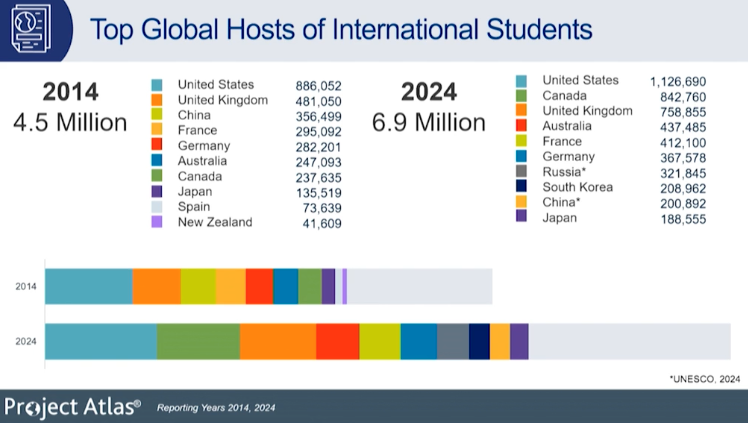
Later in the session, Leah Mason, Deputy Director of Research, Evaluation & Learning, IIE, shared more data on this score. She presented IIE’s Project Atlas‘ latest to indicate which nations were the leading destinations for international students. The United States leads with about 16% of the global total:

international student target destination nations Project Atlas

Don’t miss Canada’s spectacular rise!

I’ll note the top 5 are all anglophonic nations.

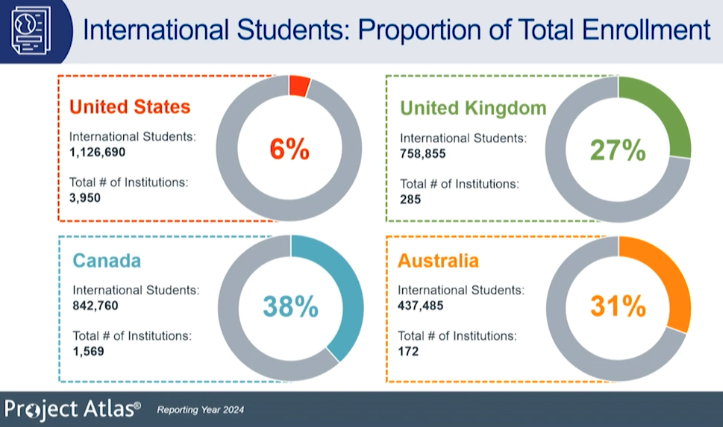
Mason then showed what proportion of some of these nations’ total postsecondary student body, and three nations host a mind-blowing number of international students:

international students as proportion of national total_Project Atlas 2024

Note that the Canadian government just decided to cut the heck out of that number.

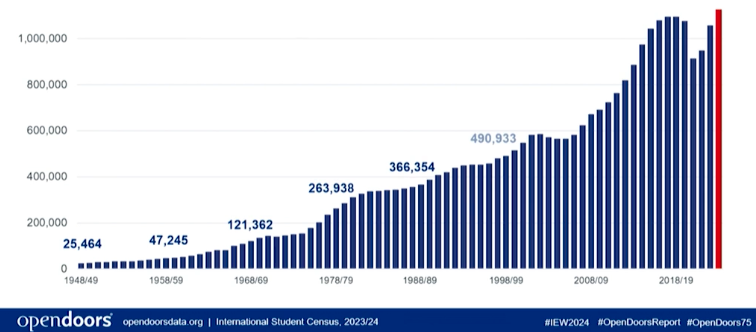
Next, Mirka Martel, Head of Research, Evaluation & Learning. IIE took the stage. She revealed that 1,126,690 international students studied at American institutions in academic year 2023-4, a 7% increase from 2022-3.  That’s the highest total IIE has ever found and a recovery from COVID-era drops.  Martel added that “the US remains the top host of international students worldwide.”  That represents a continuation of a very long term trend:

international enrollment in US 1948-2023 IIE

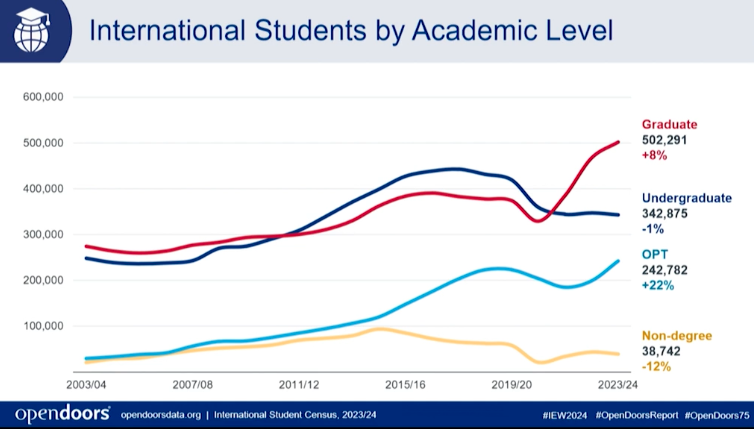
Very interesting differences in academic level appeared, with grad students the largest and growing number. Undergrads actually declined, apparently because of “COVID cycling.”  Note the rise of OPT, too:

international enrollment by academic level 2023 IIE

Where do international students come from?  Mostly east and central Asia. India is the new leading source, sending 331,602 students, a big increase since COVID, and mostly grad students and OPT. Next is China, with 277,398.  South Korea is in a distant third place with 43,149 students; interestingly, most of them are undergrads.  Overall, 6% of students at American campuses are international.  44 US states saw those numbers rise over the past year, led by California, New York, Texas, Massachusetts, and Illinois.

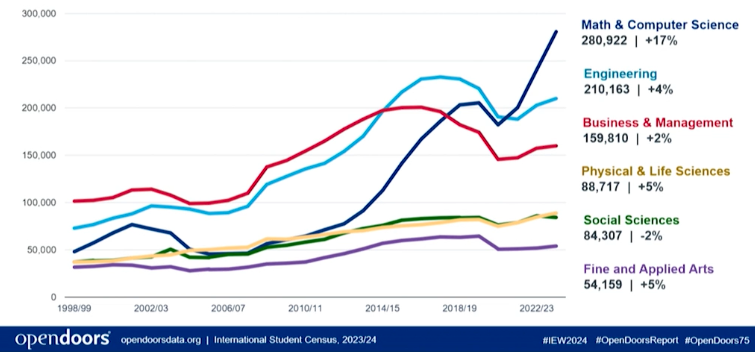
What are international students studying?  STEM fields are the most popular, with over half (56%) taking classes in those domains.  25% are studying math and computer science alone:

I don’t know where the humanities are here. Folded into fine and applied arts?

EDITED TO ADD: IIE kindly responded to my email query about the humanities and pointed me to their data explorer site, where I found this number: 15,937 students working on “English language and Literature/Letters; Foreign Languages, Literatures, and Linguistics; Philosophy and Religious Studies; Theology and Religious Vocations.”  That’s a 1% increase from the previous year.  My back of the proverbial envelope math says 1.4% of foreign students study the humanities in the United States.

There was a quick note about funding, but it wasn’t clear.  55% of students self-fund their study, but does that include loans?

Next, IIE shared early data from fall 2024. First figures show continued rise of international students, but only by 3% this time.  Undergrad numbers actually grew, as did OPT, while grad numbers dipped down.

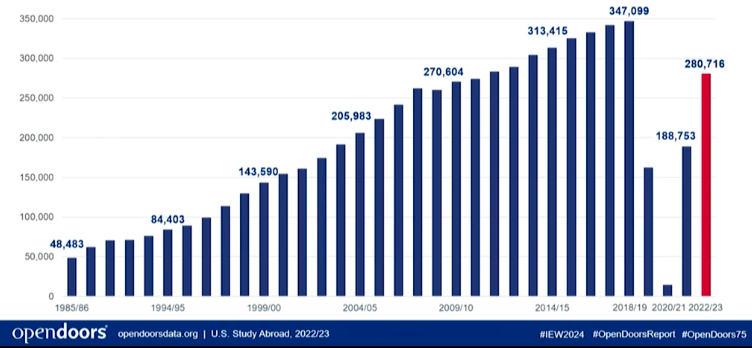
Then the presentation switched to American students studying abroad, with Julie Baer, IIE’s Research and Learning Lead.  The past two years have seen increases after study abroad nearly ceased during COVID, but numbers haven’t yet reached pre-pandemic levels:

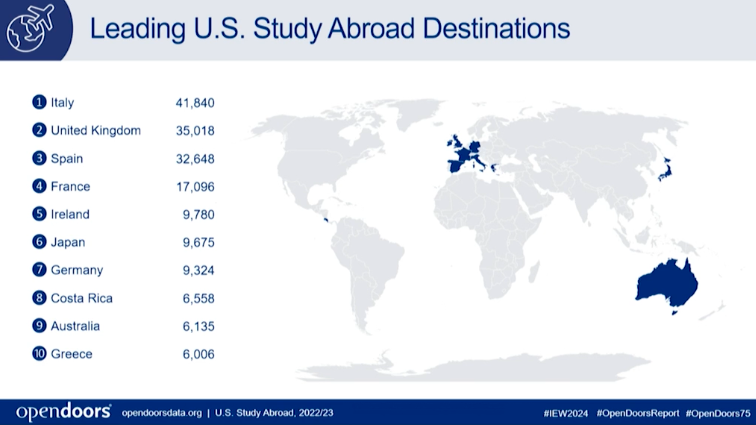
American students mostly go to Europe:

study abroad Americans destinations 2023_IIE

Two-thirds of Americans studying abroad go for 8 weeks or fewer.  Demographically, students heading abroad are fairly diverse along racial lines, but not so much as the overall populace.  IIE didn’t share data on student gender or other dimensions.

Summing up, some quick thoughts: this snapshot shows international study growing around the world, with some interesting sending and receiving patterns.  Anglophonic nations remain top destinations, while India and China lead the world in shipping students abroad.

Note the fields of study trends, which resemble American ones, just more so.  STEM, business, and allied health predominate.  (I do wonder how many international students study American culture in the US, British studies in the UK, and so on.)

Some countervailing themes: I note the proportional decline in Chinese numbers going to the US and elsewhere. Increased Cold War 2.0 tensions may depress that further. Canada and Australia are both cutting back international enrollment, which is an opportunity for British and American colleges and universities, as Allan Goodman said at the start.

The elephant which just stomped into the room is, of course, the impending Trump administration.  As I said in that linked post, we could see Trump 2.0 scaring off international students for various reasons. However, Trump was close to India’s government, so perhaps the rise of Indian students heading to the US will increase even further.

A bigger elephant is climate change.  There was no mention of international study’s carbon footprint in the IIE presentation, nor have I seen any in discussions so far.  That’s a significant amount of jet travel.

I’ll update this as more information comes in.  Thanks to the IIE for an open and data-rich presentation.

Posted in climatechange, enrollment, politics | Leave a comment

What the next Trump administration might mean for higher education

What might a second Trump administration mean for academia?

I’ve been exploring this question as a futurist for some time. Way back in 2016 I blogged about Trump’s higher education possibilities.  We read Project 2025 for months in our open, online bookclub.  I dug into JD Vance’s academic attitudes when Trump picked him as VP. In October we held a Future Trends Forum scenario exercise, exploring a Trump win (including his winning the popular vote).

Today I’ll summarize those findings and discussions in order to show possible directions and impacts, updated to include recent developments. First up are potential direct impacts, as when the new administration issues higher education policies.  Next we explore potential effects on academia of non-academic Trump actions.

I’m drawing on work done by observers, journalists, and commentators, usually linked to those sources. I hope to add my own thoughts to the discussion, including some points generally missed so far.

Please note that these are possibilities, options. That’s how I’ve done my futures work for years, extrapolating and deriving what might happen next by examining the present and recent history.  I must strengthen this caveat by noting that it’s even more difficult to pin down precise outcomes with Trump, who is so wildly uneven and changeable.  Much depends on whom he appoints to key positions, what he hears from postulants, and what he sees on television.

Today my focus will be narrow, on what a Trump administration might do to higher education. I’m excluding K-12, how academics might respond, and learning apart from post-secondary institutions, all for reasons of time.

Last note: I’ve tried to use an analytical tone throughout. This takes some effort, given the dread and outrage I feel.

1 Direct impact

The new administration might choose to eliminate the Department of Education or otherwise cut it back significantly, distributing its functions to the private sector, the states, and/or other federal agencies.  This was a major point in Project 2025, as well as a long-running Republican party goal.  Such a move would force college and university staff to change some administrative work, including regulatory compliance operations.  This would also change the vast student loan ecosystem, at least by altering which offices supervise it, if not by privatizing loans, not to mention ending the Biden administration’s loan forgiveness efforts.

Should Trump maintain the DoE in some form, he would likely order it to end support for DEI and other “woke” initiatives, notable for race and gender discrimination, while undoing any climate change research assistance.  Along those lines the new administration might go after trans athletes playing college sports:

“Jon Fansmith, the assistant vice-president of government relations at ACE… drew attention to what he suspects will be one of the Trump administration’s first actions: reversing the Biden administration’s rules under Title 9 of the Higher Education Act that allow the participation of trans athletes in sports.”

Biden-era protections for LGBTQ+ students will likely vanish.

A Trump administration could seek to require all colleges and universities (at least those receiving federal dollars) to cycle through different accreditors, as Florida now does.  We might also see a revised Department of Education offer grants and other rewards to campuses conducting “international business programs that teach about free markets and economics.”  Further, the new department could “require institutions, faculty, and fellowship recipients to certify that they intend to further the stated statutory goals of serving American interests,” although it’s unclear what that would mean in practice. (Project 2025, p. 356) Additionally, a second Trump DoE might follow the first one in supporting for-profit higher education.  Already one for-profit’s CEO has expressed hopes for the next four years, as did the head of a for-profit trade group.  And a new department might weaken Biden-era rules concerning sexual assault, as Trinity Washington’s president observes.

A new Trump administration can use other agencies beyond the Department of Education to change higher education.  For example, Project 2025 has the Department of Labor working with Congress to end college degree requirements for federal positions. A DoL could also encourage apprenticeships in competition with college and university study.  The DoE’s statistics gathering unit could move to the Bureau of Labor Statistics, as one American Enterprise Institute writer recommends.  Further, the new government could create new educational units.  For example, one conservative futurist calls for a DARPA (Defense Advanced Research Projects Agency) for education, a cutting-edge R&D unit.

Going after higher education’s finances We’ve already mentioned possible changes to existing students loans, but a Trump 2.0 team could go after academics economically in other ways. In an interview vice-president-elect Vance praised Viktor Orbán’s attack on Hungarian academia, targeting curricula with a financial threat: “I think his way has to be the model for us: not to eliminate universities, but to give the a choice between survival or taking a much less biased approach to teaching…” This could play out in numerous ways, such as imposing new costs (cf the accreditation rotation mentioned above) to cutting federal financial support.  As Vance continued: “[W]hether it’s the incentives that you put into place, funding decisions that are made, and the curricula that are developed, you really can use politics to influence culture.”

Going after academic protesters A new Trump administration could pursue multiple courses of action against campus protesters.  Title IX investigations are one such path, as are blunter instruments, like pressuring state governors to call out their National Guards.  Academic resistance to this will surely enrage Trump, leading him to expand oppressive measures.

Changes to international higher education: the new administration could also mobilize Immigration and Customs Enforcement  (ICE) to remove certain international students, as well as faculty and staff, from academia.  The Agenda 47 platform puts it this way: “DEPORT PRO-HAMAS RADICALS AND MAKE OUR COLLEGE CAMPUSES SAFE AND PATRIOTIC AGAIN” (caps in original).  Project 2025 offers this:

ICE should end its current cozy deference to educational institutions and remove security risks from the program. This requires working with the Department of State to eliminate or significantly reduce the number of visas issued to foreign students from enemy nations. (141)

The Department of Defense, the Department of State, the Department of Justice, the Department of Commerce, and the various intelligence agencies might pressure and/or work with academia to reduce connections with China as part the broader strategy of intensifying US-China competition. This could take the form of trying to cut the number of Chinese students studying in America, especially in areas deemed strategic, as well as forbidding collaboration between the two nations’ academics.  (Trump tried something like this in his first term.)

Changes to academic research It’s clear from all evidence that the Trump-led Republican party opposes academic work on certain topics, including racism, gender studies (often referred to as “gender ideology”), and climate change.  We should expect various federal actions against such work, such as rebooting or closing the National Oceanographic and Atmospheric Administration (NOAA) and trying to reduce anti-racist studies. At the same time we might anticipate the opposite, as a new administration seeks to encourage research in other areas.  Project 2025 contains a series of cheers for research and development in technology and energy. We could therefore forecast federal support for such work in terms of grants, guidance, and more.

Changes to enrollment Black, Latino, Native American students numbers might decline. Trump clearly opposes anti-racist affirmative action. The combination of federal policies, supporting state policies, and aligned college and university policies/pronouncements could depress the numbers of underrepresented racial minorities.  Moreover, if new Trump policies gut federal support for black K-12 students (see this article), we might see fewer black high school grads in years to come.  Of course, a major federal deportation program should reduce the numbers of undocumented students, especially if campuses don’t manage to resist successfully.

A returned Trump might create new academic institutions.  Agenda 47 clearly calls for one or more such: “To reduce the cost of Higher Education, Republicans will support the creation of additional, drastically more affordable alternatives to a traditional four-year College degree.”  Project 2025 calls for launching other higher education entities, including a Space Force Academy to parallel West Point etc. and “a school of financial warfare” built by the Departments of Commerce and Defense.

One more angle: Trump historically loves fulminating, including naming and shaming all kinds of perceived enemies or weak people and organization. He could easily call out higher education from his bully pulpit, encouraging other people to go after higher education.  Such people might be local (state, city, county) officials or politicians, along with ordinary folks.  See the Springfield, Ohio story for one example (a good Chronicle podcast interview with a campus president).

A 2023 Trump video about higher education, which Elon Musk recently shared on Twitter/X. covers a lot of ground in just a couple of minutes:

  • going after accreditors: firing them and “accepting applications for new accreditors” who would change curriculum and cut administrators, cutting DEI staff, allowing shortened and/or cheaper degrees, setting up “college entrance and exit exams” (Trump calls this his “secret weapon”)
  • the Department of Justice filing cases “against schools that continue to engage in racial discrimination.” I think this is about various forms of affirmative action.
  • slashing (?) endowments (not clear how)
  • using Congressional budget reconciliation process to fine universities for reverse discrimination

Trump speaking on higher education, November 2024

2 Secondary impacts

Perhaps the signature campaign issue for Trump this year was cracking down on illegal immigration, and all signs since his election triumph point to making this happen.  Setting aside for a moment the immense human, political, and financial costs, we should consider the effect on international students.  Would-be students in nations which Trump directly targets with policies, like a return to his Muslim ban or the imposition of high tariffs, might find the United States less congenial a place to pursue post-secondary education. Would-be students in other nations might not be directly subject to such policies, but find them to have a similar effect on their attitudes.

Or maybe not. It’s important to recognize that international study decisions are complex and include many factors other than national policy.  Some would-be students might not care about Trump, and some might support him.  One initial study found small numbers of students concerned about the Republican.

Dahn Shaulis points out other potential impacts of Trump’s anti-immigration drive.  We could see federal agents or troops on campuses, as I pondered in 2016.  Campus finances will take hits if international student numbers fall, as would diversity.  Actually, Dahn does a heroic job of tracing out more implications, from local community economics to staff shortages.  You all should read him and his Higher Education Inquirer.

I’ve been speaking primarily about Trump actions, rather than academic responses, which I hope to get to in another post. But some academic responses might elicit further administrative responses.  For example, if a campus refuses to comply with deportations, as Wesleyan University’s president recently vowed, I would bet on Trump doubling down: increasing rhetoric, engaging lawfare, sending more troops. This could swiftly escalate.

A second Trump theme is growing America’s economy through aggressive tariffs. Most of the economics I’ve read think this is likely to cost the United States in multiple ways, notably by businesses passing tariff prices to consumers – i.e., as inflation. (Here’s a recent Paul Krugman column on this.) A worsening economy exacts many costs for colleges and universities, such as making state support more challenging, possibly weakening endowments, and more.  One potential bright spot might be if unemployment rises and enrollment builds as a result.

Also in the economic realm are changes to labor. We should count on Trump being anti-union. He will likely put anti-union people on the National Labor Relations Board. What impact might that have on academic unions and organizing?

We might also see American public health degraded if Trump fulfills his pledge to install Robert Kennedy Jr. as some kind of health tsar.  If that leads to rising diseases, weakened immune systems, etc., our colleges and universities will face that directly.

A Trump administration hostile to experts might encourage such attitudes in states and among the populace at large. This could take the form of more challenges to academics from state legislatures and governors, cyberactivism against certain academics, and increased surveillance, among others.

Trump’s habit of verbally and textually attacking minorities might inspire state governments to increase discriminatory policies, which then impacts academic populations. Similarly, Trump’s statements could encourage individuals to threaten and attack underrepresented minorities and women on campuses.

Along those lines, if Republicans expand abortion restrictions through a federal law, court rulings, or other measures, academia will lose some women to unwanted pregnancies, as well as to injury and death.


Summing up, a second Trump administration has many options for dealing with higher education. Its other actions might also impact colleges and universities.  I describe these as possibilities because Trump is a chaotic actor, because higher ed might not be a priority for his team, and because changes in both academia and the world could drive developments.  Think, for example, how the Gaza war triggered a high profile campus protest movement, which in turn elicited Congressional investigations and several major presidential resignations.

I’ve been working on this topic for years because I thought colleges and universities needed to prepare for Trump. Now it’s not a futuristic thing, but an unfolding reality. I hope we’re ready. The question I leave you with now is: what do academics do now?

(thanks to Steven Kaye, Alex Usher, and other friends for contributions)
Posted in future of education, higher education, politics | 2 Comments

When an airport gate is a different kind of gate: a much needed delight in Austin, Texas

(Greetings from a darkening November. I have several substantial posts in the pipeline concerning the election.  I’ve been sharing thoughts across social media and my Patreon. Yet for today, on a weekend, I wanted to share something lighter and perhaps inspiring, while it is still fresh in mind.  This is a true story about a delightful thing with no politics.  If you’re in the mood, enjoy.  Then look to my next posts.)

Sometimes public art surprises and delights me.  I needed some of that this week,  without knowing it, and maybe you do, too.  I will tell you about one such experience I had the other night.

I was walking through the Austin, Texas airport after a conference where I’d presented three times. I was tired, the hour was late, and my flight was delayed, possibly breaking a connection, so I was in a dour mood.  After the customary pains of the security line, I was looking for my gate.  Stomping along, I scanned the gate signs hung on terminal walls: 16, 15, 14, infinity sign, 13, 12…. hang on, was that an infinity sign?

Austin airport art gate_from the hallway infinity symbol

I did a double take and circled back. Yes it was an infinity sign. Surely that was a cute emblem for an airport restaurant, right?  No, the sign was precisely the same size and format as the others, situated right in the terminal’s sequence.  Was Rod Serling standing nearby, about to narrate? Confused and curious, I stepped back in the corridor to study the gate behind the sign.

The gate area at first glance looked like other gates – signs, seats, people resting – but differed in other ways:

Austin airport art gate_total view from corner

Now my curiosity took over and I had to figure out what was going on.  I plunked down my bags and investigated, starting with the big itinerary display on the left.

At first glance it looked like any other such board, listing departures or arrivals, with airlines, gates, times, and status for each flight.  And yet, on closer inspection, Nashville and Dallas weren’t shown:

Austin airport art gate_interimaginary departures sign

(If that’s hard to read, here’s a closeup of one chunk of the board:)

Austin airport art gate_interimaginary departures sign -detail

Ah. Realization dawned on my worn-out mind. These were imaginary locations from fiction and folklore.  A Wrinkle in Time, Arthurian legend, Dune, Terry Pratchett, The Little Prince, Nineteen Eighty-Four… this gate was a kind of elaborate, physical fanfiction, an art installation!

I couldn’t help grinning and decided to document the experience.  I looked up and saw the ceiling was an active part of the installation, with panels set askew, plus a big object hanging overhead:

Austin airport art gate_oveehead cube

Infinity signs stood for the sheer expansiveness and invention of the human mind, plus our endless sense of escape. Do you see the black grill under that box? It’s a speaker.  Every so often a voice would speak from it, updating the crowd on various flights, their requirements, their status.

Shifting to the gate’s external wall, I found this panel showing the status of the currently served flight:

Austin airport art gate_Utopia destination sign

I liked the added details for the destination.  I also wondered if there was a database behind this whole project, or if these were flat text/HTML files.

To the left of that panel was… well, a flier would have expected a door to a jetbridge or corridor leading to the actual plane. Instead, there was a much more fanciful gate:

Austin airport art gate_portal gate

The light behind the doors was bright indeed.  And no, the doors didn’t open – I tested them, pulling on the doorknobs.

On one door panel was this sign, possibly installed for safety and/or legal purposes:

Austin airport art gate_portal not an exit sign

To the door’s left, mounted on the wall, was another artifact. It looked like something from the late nineteenth century and offered to print you a ticket, or to create a digital one:

Austin airport art gate_ticket dispenser on wall

Alas, the interface was frozen when I got there. The printer wasn’t printing and the virtual ticket’s QR code took me to a broken image.  But I could still see the last virtual ticket it had created:

Austin airport art gate_virtual ticket

(By the way, from a design perspective, that is much, much better layout than the tickets printed by United et al.)

I stepped back from the walls to consider the gate’s center. This was filled with actual gate furniture, seats which a good number of people were using very practically.  I couldn’t tell how many were enjoying the art or just plunked themselves down to rest.

There were also some nice ottomans and small wooden tables, some of which was set into chairs at unusual angles:

Austin airport art gate_red ottomans and table

The red material (pleather?) contained text worked into its surface, but the uncolored writing was both hard to make out and difficult to photograph.

Austin airport art gate_red ottoman from above

More furniture appeared against the back wall, and this time it was even more creative:

Austin airport art gate_diag chairs

Yes, that rack of seats gradually and literally fades into the wall.

Curious, I walked out of the gate to see if there was something on the other side of that wall, and sure enough there was:

Austin airport art gate_hidden space

The human legs to the right were not part of the installation.  The half-trashcan was.

You can see the other half of that disappearing row of seats appear, although the window didn’t include a door for use to enter.

Mounted on the wall of that hidden space, that kind of alleyway, was a gesture towards bibliography:

Austin airport art gate_hidden space books

Returning to the gate itself I found something I’d missed, a small stand with an explanatory note:

Austin airport art gate_what is this place sign with QR code

(The warning about food and drink didn’t stop some folks.) The QR code takes you to this simple, clear WordPress web page. I found more information on Zweig’s website.

My friend Alan Levine pointed out a video by the designer which helpfully includes some of the audio I failed to capture, along with other people interacting with the installation:

I doff my virtual hat to Janet Zweig. This is an impressive and delightful project which gives travelers in grueling airports a blissful escape.

I hope you enjoyed this.  Coming up: posts on other subjects.

Posted in digitalstorytelling, personal, travel | 1 Comment

Voting on election day

[T]t’s not so hard to adjust our imaginations… we can take a moment to picture a labyrinthine, sometimes obscure process in action—people and machines working together, perhaps under unpleasant circumstances, to obey our command… we might imagine a forest of gears turning, intricately enmeshed, and wonder if they’re the right gears, and if they fit as they should, and if they’ve been inspected.

–Joshua Rothman

This morning I got up early to bike to the polls, here in northern Virginia. Last night I arrived home very late, flying back from a midwestern gig, but today wanted to get ahead of any lines.  I was the only one in the house to vote today, as everyone else already did mail-in or early voting.  For me, the voting day experience is fascinating, and I wanted to see how it went in this fraught election.

(Why biking? For exercise and to reduce my carbon footprint.)

Ripton Vermont election scene 2016

A Vermont small town election in 2016. Note the paper ballot going into the huge wooden box, like the 1800s.

I’ve been to this voting location before, but only by car, so after pumping up my tires I asked Google Maps for a route, checked it out, then hit the road.  The app and my legs soon took me along the edge of town, where I pedaled a long, uneven road which quickly changed from suburban to rural.  Next up was a complicated set of backswitches along lovely, wide sidewalks before a new pedestrian bridge cut across a highway.

Right off that highway, just past a good flower nursery, nestled between small houses was the polling site, a volunteer fire department. Its parking lot was largely empty of cars, but there were thickets of Democrat and GOP yard signs stuck into grass and dirt. The Trump/Vance signs were much better designs, featuring sharp, one- or two-word messages, while the Harris/Walz signs just had their names.

election day 2024 Manassas_Trump signs

An exception was a tall, expensive-looking, vertical sign showing faces and names of Democrat candidates, all on a deep blue background:

election day 2024 Manassas_Democrats stack

A few people and families walked to and from vehicles in that lot, not talking to anyone else. A Harris table sat just outside the limit and featured a “veterans for Harris” poster.  Two volunteered staffed it, cheerily greeting people and handing out sample ballots.  I took one, thanked them. locked up my bike, and went inside.

election day 2024 Manassas_my bike

Inside there wasn’t a line. Instead, volunteer staffers outnumbered voters, some standing next to six-foot-tall information boards. I identified myself easily (drivers license, stating my address), got my paper ballot, and hit my choice of carrel. The ballot was one page. I filled in its squares, then fed the paper into a scanner until it beeped approval. I took stickers and a selfie on the way out.

The volunteers told me there was a steady flow of voters and no incidents.

election day 2024 Manassas_me with helmet sticker

On the way home Google Maps sent my bike and I on a different route which turned out to be much longer. I passed some Trump signs, crossed the highway (thankfully with a light, although it was fast) and started along a rural route with long stretches of countryside alternating with a few houses.  One surprised-looking deer watched me from just a few feet away as I pedaled past.  Traffic picked up, which was challenging as the road’s shoulders disappeared.  Several times I dismounted to walk among trees, protecting myself and the bike from cars and trucks.

Back across another major road the route turned into a mix of commercial and residential blocks.  Sidewalks were plentiful and fine to bike along. I passed another voting site, a middle school where a voters’ line had formed up. Then it was subdivisions and so to home. All told the trip amounted to almost ten miles of biking.

election day 2024 Manassas_vote aqui

Nearly all text at the site was bilingual, in English and Spanish.

I began this post with a quote about humans, technology, and complex interactions because that’s what occupied my mind on the ride back. I exercised my right to vote in a minute, but doing so involved an astonishing amount of systems: printing the paper ballot, scanning it in, the database behind that; securing the ballot site, staffing it, monitoring for rule violations; the whole political apparatus pouring into this event. As I panted through traffic I was conscious of the vast industrial complexity shuttling us to and fro. We often proceed through that complexity at speed, focused on our tasks, yet my slower, lower tech route brought home the multiple levels of embedded systems, within which we made the elections happen.

I hope all readers are well.  If you’re in the United States, I hope you voted. Be safe and sound.

Posted in personal, politics | Leave a comment

Short-term thoughts for the American election: possibilities for unrest

Greetings from Sunday, November 3rd.  I’m writing this from the travel zone of airports, airplanes, Ubers, and hotels, as I head off to a presentation.  I’m writing in some haste.

This week is the American election day, obviously.  I’ve been writing a post about long-term trends embodied in the event, but wanted first to share thoughts on the short term.

There is a great deal of anxiety about civil unrest around the election.  We modeled something similar in our two election scenarios on the Future Trends Forum (Trump win; Harris victory). I’ve been writing about it here for a while, as some readers might remember: historical models, possibilities after Trump’s 2016 election, some pushback against Trump in 2018, that movie, opposition to DEI, those mysterious power station attacks (1, 2), the polycrisis, and American attitudes.  I’ve also brooded up possibilities of climate activism taking direct action in various ways.

Talk of unrest and violence is in the air.  A recent poll found many Americans worried about election dangers.

Possibilities_for_civil_unrest_around_the_2024_b83ec56f-aa8e-4b8b-a51a-dd77cf8b516f_0

The reality of violence is scant so far, but present. Someone set fire to ballot boxes.  Arizona police arrested a man for shooting at election offices and amassing weapons. Philadelphia police arrested another man for threatening Republicans.  Police arrested a Florida man (oh yes) for waving a machete at voters.  A fight broke out between a South Carolina election worker and a would-be voter.  There is some number of threats being made, but it’s not clear how many and how serious each one is.

People are making plans in anticipation.   Homeland Security warned us about domestic violent extremists (DVEs). Some cities and states are hardening voting sites. Porland, Oregon’s police are ready for more brawling. Washington state’s governor has already activated part of their National Guard units; Nevada’s governor took a similar step. Additional security fencing appeared around major DC buildings, including the vice president’s residence. And insurance companies have been quietly sending business customers warnings of civil unrest.  Here’s one from The Hartford:

Hartford Civil Unrest warning

And here’s one from Allianz (whose products I’m using this week as I travel).  They issue a general warning:

We anticipate further challenges to come as we move through 2024 and beyond, particularly around election related SRCC [strikes, riots, and civil commotion] events. So many elections in one year raise concerns about the fueling of populism and polarization, with tensions potentially playing out in heightened civil unrest. Analysis from Allianz Research indicates that countries with a recent increase in social unrest will be at heightened risk of this around election time, although some countries with decreasing unrest might nonetheless have hidden vulnerabilities in the run-up to often disputed elections.

Then they zero in on the United States, drawing attention to Republican denials of election outcomes, violent incidents over the past few years, and rising disinformation.  The report cites an in-house staffer with a specific take on elections: “Any unrest around the November election is likely to be focused on the battleground states as well as the capital Washington DC.”

We could imagine violence playing out in various ways, depending on how the election proceeds and how we respond.  A Harris win might inspire MAGA people to trash Democrats or their locations, while a Trump win could inspire the same people to go after immigrants, or anti-Trumpers to protest in ways which end up violent.

Recent history provides many examples of potential violent actions: crowds storming a building, protesters fighting counter-protesters, groups targeting civilians, snipers taking out individuals, lone actors adding more violence to chaotic situations,

Violence could take place in battleground states, of course.  We might see a surprise when a non-battleground state shows a surprise outcome. And someone feeling themselves a political minority might act out from sheer extremity.

Meanwhile, governmental authorities could commit or encourage violence, either accidentally or deliberately.  It’s not hard to imagine a trigger-happy National Guard soldier shooting a protester, or a police officer, struck by a crowd-flung projectile, clouting a peaceful person with a club.  The Gaza protests have shown the friction around occupying spaces and buildings.  We could imagine Harris supporters, for example, demonstrating in a state building they accuse of hosting ballot destruction.  It might end peacefully.

That’s assuming the election concludes within a day.  It might not, as we’ve seen most recently in 2020 and 2000. An attenuated process expands the opportunities for violence, both by offering more time and new targets while emitting new justifications.  And we know from the January 6th riots that the election timeline really extends through late January, including all the arcane operations of the Electoral College process.

Candidate Trump has, naturally, increased the chances of violence by trash-talking the possibility of his defeat.  He has already called out fraud and theft; imagine what happens, should he not clearly win outright, when he names politicians, election officials, and locations.  Some of his supporters are proclaiming their readiness to fight.  Militias might act out, or gangs like the Proud Boys.

Civil_unrest_around_the_2024_American_elections._052bc5ea-8a9f-4537-857a-a5b6751cbcf1

Of course, calls for action to different levels of explicitness could circulate on social media, tv news, and all forms of rumor mongering.  Remember how much we can capture, edit, and share through networked mobile devices.  Think, too, of how some foreign actors would try to accelerate chaos.

So far I’ve been thinking of individual scenes, localized fights, but history shows how small events can inspire others, building up ripples, growing in scale.  Think of, say, a riot in Phoenix, which participants livestream. People from neighboring states drive there to participate, while ardent activists in, say, Detroit, inspired by the outrage, trash property or their opponents. And so it grows.

We might experience intersections with other causes.  I doubt American climate activists will do anything this time, but could well be wrong.  After all, Trump presents a hideous threat to climate mitigation and adaptation, both at the national and global level. Gaza protests could strike out against a victorious Harris in order to hold her feet to the fire.

We could see extreme partisans seek each other out to fight, as we’ve seen in Portland for years.  This could lead to escalating tit for tat violence as each side seeks revenge. Or actors might attack civilians and/or government buildings. Cyberattacks are possible, of course. At worst violence and responses spiral into wide-ranging battles across the nation.

What might stop this?  A clear and swift election result might take the wind out of everyone’s sails.  People working to deescalate conflict will be doing their best.  The presence of additional troops, police, and material defenses might deter some would-be destroyers. And enough Americans might just be weary of this interminable election to shrug and move on.  Meanwhile, violent crime has declined since COVID, despite popular anxieties; perhaps fewer criminals will join in street battles.  Moreover, if we compare to a previous national election struck with violence, 2024 lacks some of 2020’s accelerants, such as the COVID-19 pandemic and the wave of George Floyd protests.

On a personal note, I live with my family in the Washington, DC area. My wife had a close encounter in 2021 with some January 6 rioters or their associates. We might be up close and personal with unrest occurring here.  Meanwhile, I’m traveling this week to two red states, Ohio and Texas, and might encounter people acting out along the way.  I plan to be back home to bike to the polls to vote in person on Election Day. Hopefully without incident.

For everyone, please be peaceful. Stay safe.

Posted in politics | Leave a comment

Climate change, the future, and higher education: two warnings from fall 2024

What might the climate crisis mean for the world?  What impacts could it have on higher education, and how might academics respond?

As part of my continued exploration of these questions, today I’d like to draw your attention to two major reports from this month.  They are each packed with scholarship. Both call for action from the world – right now.

The first is “The 2024 state of the climate report: Perilous times on planet Earth” (Ripple and Wolf et al, BioScience, 08 October 2024, https://doi.org/10.1093/biosci/biae087). As the title indicates, this paper offers a top level summation of where the climate crisis now stands, backed up by research at every point.

(Research: note that this is largely scholarship produced by university faculty.  The author’s bios include home institutions such as Oregon State University, University of Potsdam, University of Pennsylvania, Harvard University, University of Exeter, University of Sydney, Nanjing University, Aarhus University, Universidade Federal de Minas Gerais, and the Swiss Federal Institute of Technology.  As I keep saying, academia’s research function is one major way we contribute to learning about and responding to the crisis.)

How do things stand in the climate crisis, then?

Despite six IPCC reports, 28 COP meetings, hundreds of other reports, and tens of thousands of scientific papers, the world has made only very minor headway on climate change, in part because of stiff resistance from those benefiting financially from the current fossil-fuel based system. We are currently going in the wrong direction, and our increasing fossil fuel consumption and rising greenhouse gas emissions are driving us toward a climate catastrophe. We fear the danger of climate breakdown…

This worsening occurs on many dimensions: storms, surface temperatures, ocean acidification, unjust impact on marginalized populations, degradation of natural features, etc.  Above all humanity keeps emitting greenhouse gases, more than ever.

BioScience article showing 12 metrics for worsening climate change

Worse, there are all kinds of feedback loops which are progressing dangerously, such as decreasing albedo due to ice loss which increases warming which then melts more ice… And a set of major tipping points loom ever closer, from the decay of the Thwaites glacier to the possible slowdown of the vast AMOC system.

What should be done?  The authors are clear. Humans must stop emitting greenhouse gases:

Rapidly phasing down fossil fuel use should be a top priority… Drastically cutting methane emissions can slow the near-term rate of global warming, helping to avoid tipping points and extreme climate impacts.

One way to get those human actions going is by communicating the problem and solutions.  The authors get meta towards the end of the paper, reflecting on how they should best communicate the science in that document and elsewhere:

With the increasingly undeniable effects of climate change, a dire assessment is an honest assessment. Denying the existential threat posed by climate change is becoming increasingly less plausible. The fact is that avoiding every tenth of a degree of warming is critically important.

What does this mean for higher education?  The paper is clear and direct, starting with our teaching mission:

Climate change instruction should be integrated into secondary and higher education core curriculums worldwide to raise awareness, improve climate literacy, and empower learners to take action. [emphases added]

Next, the authors request academic research into many climate fields, including geoengineering:

Research into solar geoengineering needs to focus on understanding the potential environmental, social, and geopolitical impacts, as well as assessing effectiveness and safety on both regional and global scales (Sovacool et al. 2022). In addition, interdisciplinary research is required to explore ethical, legal, and governance frameworks, along with public perception and acceptance, while emphasizing the critical importance of drastically reducing greenhouse gas emissions.

Note the interdisciplinary dimension, which goes against the specialist nature of much of academic research.

In addition to those curricular and research charges, the authors provide a list of topics which academia (and everyone else) can work on through research, teaching, and community outreach:

In a world with finite resources, unlimited growth is a perilous illusion. We need bold, transformative change: drastically reducing overconsumption and waste, especially by the affluent, stabilizing and gradually reducing the human population through empowering education and rights for girls and women, reforming food production systems to support more plant-based eating, and adopting an ecological and post-growth economics framework that ensures social justice… We also need more immediate efforts to protect, restore, or rewild ecosystems.

(Note that emphasis on educating girls and women. This is an underappreciated aspect to how higher education can help with the crisis.)

A second major report appeared this month, from the United Nations. “Emissions Gap Report 2024: No more hot air … please!” is a furious warning from the title on.  (And yes, the authors and peer reviewers are also largely academic researchers, as with the previous report.) Right out of the gate it admonishes us: “To get on a least-cost pathway for 1.5°C, emissions must fall 42 per cent by 2030, compared with 2019 levels. For 2°C, emissions must fall 28 per cent by 2030.”  Recall that limiting global warming to 1.5°C was a major international goal. And yet:

Current promises are nowhere near these levels, putting us on track for best-case global warming of 2.6°C this century and necessitating future costly and large-scale removal of carbon dioxide from the atmosphere to bring down the overshoot. [emphases added]

Best case of 2.6: think about that.  And it could get worse. The same report gives us a spread of temperature ranges, based on different choices we could make now:

UN projections of global temperatures 2024 October

See the 3.1 degrees at a 66% chance, if we don’t change?  And just below that, a spread from 2.3 to 4.5 degrees with a 90% probability?  All of that is under the header of we keep doing what we’re doing now.  Which is increasing emissions:

Global greenhouse gas emissions set a new record of 57.1 GtCO2e in 2023, a 1.3 per cent increase from 2022 levels ▶ The increase in total greenhouse gas (GHG) emissions of 1.3 per cent from 2022 levels is above the average rate in the decade preceding the COVID-19 pandemic (2010–2019), when GHG emissions growth averaged 0.8 per cent per year.

What are the sources of those emissions?  Here’s the latest breakdown:

greenhouse gas emissions 2023_UN report 2024 October

So despite decades of climate action, repeated international agreements, repeated national promises and corporate announcements, many demonstrations and protests, the rise of climate fiction, popular awareness… we’re still heating the planet.  We’re not just still heating the planet, but doing it even more.  With full awareness of our actions.

Now, the “we” is unevenly distributed.  The report offers this breakdown by nations and organizations:

Greenhouse gas emissions in 2023, broken down by nations and associations

There’s a lot to glean from this ranking, like the huge importance of Chinese actions, the excellent decrease in EU emissions, the rise of India’s, and just how little the least developed nations contribute to the crisis (while being deeply exposed to its dangers). Further, while many of these nations have pledged to change, those pledges look increasingly weak if not worthless:

Collectively, the G20 members are also still assessed to miss their NDC targets for 2030, with current policy projections exceeding NDC projections by 1 GtCO2e in 2030. Eleven G20 members are assessed to be off track to achieve their NDC targets with existing policies, and the G20 members projected to meet their NDC target based on current policies currently are those that did not strengthen, or only moderately strengthened, their target levels in their most recent NDCs. Further, collectively the NDC targets of the G20 are far from the average global percentage reductions required to align with 2°C and 1.5°C scenarios…

Those G20 nations account for about 77% of all emissions.  (If you’d like to dive into the national dimensions, check out the report’s chapter 3, which goes into detail.  Look to the countries which seem to have passed their CO2 emissions peak, for one.)

Naturally a Trump victory will knock the United States off of participation for four years, which matters given the scale of American emissions as well as our global influence.

Our slow responses as a species have several crucial short-term results. First, there is the “continued lock-in of carbon-intensive infrastructure” – i.e., we generally practice our fossil fuel habits as a civilization, making them harder to break.  Second, we have “less time available to realize the emission reductions required.”  This, we now face increased  “risks of temperature overshoot and compounds increasingly severe climate impacts, some of which are irreversible.”

What does this UN report want us to do?  One group of nations must take aggressive actions right now: “G20 members excluding the African Union must go further and faster…”  These cannot be isolated actions: “stronger international cooperation and support, including through enhanced climate finance, will be essential…”  The nature of those actions is well known, but needs repeating, it seems:

[switching power generation to] solar photovoltaic and wind energy… In forestry, reduced deforestation, increased reforestation and improved forest management present readily available low-cost options with large emission reduction potentials of about 19 and 20 per cent of the total potential in 2030 and 2035, respectively. Other important and readily available mitigation options include demand-side measures, efficiency measures, and electrification and fuel switching in the buildings, transport and industry sectors.

Chapter 6 breaks things down into categories ranging from rolling out more solar to mangrove restoration, providing interesting benchmarks.

What does the UN report have to say about higher education?  Surprisingly little, which suggests to me academia has failed to make much of an impression on this world of climate action.  There is one very precise call for professional development in a certain area: “To activate the potential for material efficiency and circularity/recycling, building codes, public procurement and regulation should all be employed, with education for architects, structural engineers and designers of all kinds.” I think we can generalize from this to other fields, from medicine to public service.

I’ll leave the last words today to those BioScience paper authors:

We must urgently reduce ecological overshoot and pursue immediate large-scale climate change mitigation and adaptation to limit near-term damage. Only through decisive action can we safeguard the natural world, avert profound human suffering, and ensure that future generations inherit the livable world they deserve. The future of humanity hangs in the balance.

Posted in climatechange | 1 Comment