50 years after Apollo 11: what will we do in space for the next 50 years?

This week is the 50th anniversary of the first human landing on the moon.  My son and I visited Washington, DC’s National Mall to see some of the commemorations.

A brilliant team projected a video of the entire Saturn V rocket on one side of the Washington monument.  It was extraordinary to see, visible from great distances:

Other festivities including information about prospective lunar flights.  Which brings me to ask you all: what’s next for space?

Let’s look ahead 50 years this weekend, while we revisit the past.

As a futurist I always start with present trends.  We can identity a bunch of them:

  • Exploration of the solar system via robotic probes
  • Earth-orbit and lunar interest from multiple nations
  • Rising private space efforts
  • Calls for a Mars expedition
  • Hints of expanding the preexisting militarization of space (Trump and Macron each called for their nations to offer a space force, in addition to their respective air forces)
  • Commercial interest in asteroid mining

How are these likely to play out over the next 50 years?  Robotic exploration seems likely to continue, since missions are relatively low-cost or even cheap, as well as offering little risk.  There aren’t many countervailing forces; anti-science cultural developments aren’t hitting Jupiter missions.

Private space efforts: I’m not sure.  Bezos has a long-term vision for human space settlement, and Musk is hardly lacking in that department.  But assuming they won’t change their minds (and they could), these are two individuals with limited lifespans.  When they die or become incapacitated, will those efforts continue?  I can imagine boards and managers preferring to focus on more familiar operations.  Asteroid mining may be similarly restricted to a handful of wealthy individuals.  Unless a commercial sector opens up, this Heinleinian moment could be a historical blip.

Militarizing space is something that’s been happening since WWII.  Geopolitics aren’t showing signs of heading towards an era of perpetual peace, so we should expect something like this to persist (but see below).

A Mars expedition is very exciting, but interest is quite low.  Consider this recent Pew Research poll:
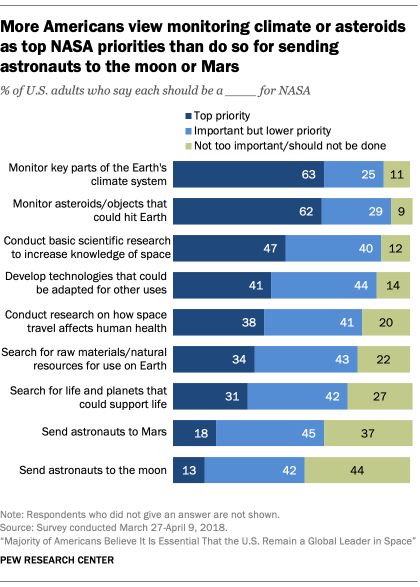
That’s actually consistent with the 1960s and 1970s, when the majority of Americans opposed lunar missions most of the time. Apollo succeeded in part due to the Cold War.  Without that framing, it would take some serious and sustained heavy lifting in the political sector to get NASA to Mars.  What conditions would have to be in place for that to occur?

So one quick scenario for 2069: humanity flings robots across the solar system, building our scientific knowledge, while a mix of public and private enterprises haul humans to Earth orbit and back.

Let’s develop this a little further, adding additional trends to the mix.

Politics To pick one leading space nation, American politics is deeply partisan.  Space could either become a party issue or a bipartisan/nonpartisan one.  I can’t shake my sense that the GOP, while capable of opposing some science (i.e., climate change and evolution) will remain space-happy.  Much of the space sector is based in deep red states, like Texas and Alabama, or reddish ones like Florida (just today a Florida senator and 2016 presidential candidate published a pro-Apollo, pro-NASA column).  Many recent Republican presidents have been keen on space, from Reagan (Star Wars) to the Bushes (Mars) and Trump (space force).  Republicans also admire private sector space efforts, of course.

I’m not sure the Democrats have the same level of interest, despite the heritage of Apollo, called into being by JFK.  I’ve seen few pro-space expressions from candidates.  Instead, many progressives are calling for domestic moonshot efforts, such as Medicare for all, reparations for slavery, and free college tuition.  It feels like the old anti-space line: “Why spend money in space, when we can use it to address Earthly problems?”  Gil-Scott Heron’s classic performance comes to mind, as does the tendency of space boosters to be white.

A gender breakdown might occur as well.  Some surveys find men somewhat more interested in human spaceflight then women.  For example, a 2015 Pew poll found that “[m]en are more likely than women to say human astronauts are essential for the future of the U.S. space program (66% vs. 52%, respectively).”
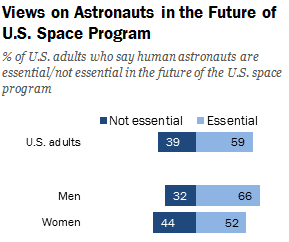
That was pre-Trump.  Since then both political parties have become more gender-focused, with women increasingly likely to vote Democratic and men Republican.

In short, it might make more sense for Democrats to focus their major program political capital on non-space issues.  As one writer wrote into the New York Times this week,

Through increased wildfires, storm damage, flooding, rising sea levels, increasing desertification contributing to the world’s refugee crisis and a thousand other cuts, climate change is already costing us lives and conflict and billions of dollars. We need a moonshot, all right — a moonshot effort to stop and reverse climate change. We cannot afford both [lunar missions and addressing climate change].

Especially if the GOP presses hard on space, which incentivizes progressives to push back.  So we could see space becoming a partisan issue over the next generation.

Alternatively, Democrats could articulate a competing space vision.  For example, if climate change becomes an organizing principle for that party, it would make sense to advocate for extensive orbital support for continued Earth science.  If Democrats turn more to the left, they might oppose private space efforts in favor of public ones.  We can see hints of this now in liberal critiques of Musk and Bezos for multiple business practices.  At the same time Democrats and Republicans could follow historical practice and align together in bipartisanship on the military use of space.

Technology The Space Race drove an extraordinary period in technological development.  As we currently experience non-space-related tech innovation, could some of that shape our future in space?

To pick some technologies in development, consider orbiting 3d printers to jumpstart the construction of vehicles and facilities in vacuum.  A sprawling series of space stations, asteroid mining operations, and a lunar town might become more feasible. Alternatively, think of the role of AI.  If AI continues to improve in quality – not a sudden Skynet breakthrough, just steady growth – we could witness a boom in autonomous spacecraft, extending robotic exploration.  As humans exit drivers seats in cars, we could decide that AI pilots are better than human ones and turn the universe over to bots.  Alternatively, if we pursue a cyborg future with humans working closely with AIs, human spaceflight may continue with software companions.

Other tech may make space exploration less difficult.  Sufficiently advanced quantum computing could lead to realtime communication with craft light minutes and hours away.  Improved medical care could mitigate some of the stresses spaceflight places on the human body.

The development of space-specific technologies may speed space exploration. In particular, getting out of Earth’s gravity well is a major roadblock to spaceflight. In 2018 we read Soonish, which offered this view of new tech that might help things:

reusable rockets, like the SpaceX Falcon 9; spaceplanes, like ramjets and scramjets; superguns, including the wild and tragic Gerald Bull story (45ff); rocket sleds; the awesomely named Slingatron; firing lasers at rockets; the space elevator.

To these we could add the space catapult, space fountain, and the sky ramp.  Technological development and space exploration could feed each other in a reinforcing loop.  The classic NASA spinoff pattern could heat up to our general benefit.

Demographics (Yes, you knew I would go there.)  I’ve noted several works on population trends which contend that older populations are less likely to boldly go.  Paul Morland thinks such societies are less likely to take risks.  Bricker and Ibbotson concur.  Will aging nations then back away from space?  Moreover, if older societies are less prone to war (remember this phrase: geriatric peace), they might spend less on military space capacity.

Perhaps the next two generations of space travel will stem from nations still producing young people at scale.  Subsaharan Africa may become the home of the next Baikonur and Cape Kennedy.

Geopolitics We could take the planet in the direction of international peace.  I just mentioned aging societies’ tendencies away from war.  We could add general unease at war in a society demonstrably intertwined and fragile.  Nonlethal weapons may proliferate and tamp down our revenge cycles.  Nonviolent movements may grow.

On the other hand, there are many reasons we can expect a violent 50 years ahead.  Islamicist terror is still active on multiple continents.  Right-wing extremism is building up now, and that’s unlikely to establish a global Ghandian peace.  Various types of nationalism are heating up, which historically can add fuel to international tensions.  And so on.

This could drive another wave of space development.  Military use of space can expand as nations seek orbital and interplanetary advantages.  International rivalries can elicit resources to compete with astronomical achievements.  International cooperation could occur, but in the service of dueling power blocs.  Imagine a One Belt, One Road multinational crew aboard a Chinese Martian expedition.

Culture Forecasting cultural changes is very difficult, so I’ll start by turning back to history.  We know that fictional visions and future imaginations of spaceflight have inspired research, development, and exploration since the 19th century.  That pattern seems to still be going on now.  It could well persist in the near and medium term future, as sf creators offer us stories of aliens, new worlds, etc.

It’s possible that sf could pull back from this focus.  Some writers have spoken of the difficulty in imagining the future as our present becomes ever more chaotic and innovative.  There are many paths for sf writers to tread other than the short- or medium-term future: alternate history, fantasy, and the far-future.  The genre could mutate in this direction, but I don’t see it as all that likely.

Wild cards and black swans Most of the preceding is based on present-day realities and current trends.  I tried to stick to what seems most likely.  But what about the impact of very unlikely events?

An asteroid near miss could spur growth in space.  An actual strike could drive us into Cold War levels of outreach and investment.  New religious movements that gain actual cultural and political traction could push space in all kinds of directions (this is a science fiction staple, actually).  A sudden Singularity event: ditto.  Discovering life in an interesting way (beyond single-celled organisms or algae) could inspire a major effort.

Many awful and surprising things could shock humanity and injure us badly enough to retreat from the universe.  A massive pandemic – beyond the 1917 flu, more like the Black Death, but broader in impact – that overwhelms our public health systems could force us to retrench rather than reach out.  An international economic depression could easily have the same impact (“Why are we spending money on Lunar orbit when people are starving on Earth?”).

Let me conclude with two scenarios.  They’re based on mashing up a bunch of the preceding, and tuning them to extremes.  I’m leaving off black swans for the moment.


Scenario I: Entrenched

In 2069 human civilization is under a great deal of stress.  Population growth has tapered off, but many nations grapple with how to manage this new state, either trying to support a large population of elders, or dealing with a mass exodus of young people.  Geopolitics are dicey, as tensions run high across numerous borders.  Short mid-century wars (India and Pakistan, Russia and Germany, China and the US) caused damage and human suffering, but also kept military forces well-supplied and on edge.  Climate change’s many impacts have started to be felt, as some coastal cities experience populations leaving (“dry flight”) while struggling to maintain sea defenses, and hyperstorms (coined by the old Weather Channel) clobber regions.  Food and water systems are under stress.  Their failures are well publicized.

Humanity’s space presence is divided.  On the one hand, AI-guided robots busily explore the solar system from the sun to the Oort Cloud, sending back scientific information and material samples.  Many automatic craft participate in Gaianet, the planetary warning system aimed primarily at tracking solar weather (some of which could injure Earthly infrastructure).  Robots draw on installations built upon the Earth’s moon, Martian moons, and several large asteroids.

On the other (fleshly) hand, human spaceflight focuses on Earth orbit.  Human crews inhabit multiple stations lofted by various nations.  They combine scientific research – again, often keyed into Gaianet – with fairly obvious military posturing.  Several nations, combines, and corporations maintain their own orbital ecosystems as a matter of power and prestige, each with its own mapping systems (GPS to personal implants), weather sats (the best ones), and multi-tiered communication infrastructure, along with extensive surveillance tools and strike capacity.  Earth launching systems are varied and gradually developed.

Every spacefaring nation and combine experiences fitful planning, as political waves come and go.  Military incidents and weather disasters spark more space investment, while their absence and various populisms compel reductions.  Corporations face a similar dynamic, as some leaders seek to realize lucrative space opportunities, while opponents cite the long history of these falling short.

In academia pro-space research and teaching can be controversial.  Some oppose it as too military or corporate.  Anti-space academics of all stripes have followings.  Gaianet work is quietly respected.

Scenario II: Expanding

In 2069 human civilization is deep in VUCA territory.  In most of the world national elites cling to power with a mix of desperation, surveillance, terror, and finely tuned marketing, trying to fend off restless populations.  Older nations seek to maintain their elaborate support mechanisms (immigrant labor and advanced automation) while younger ones seek global leadership.  Climate change gnaws at coastal regions and thwacks many areas with bad weather; food systems are transforming, but the process is fitful and costly.  Religious, cultural, and political movements sweep through populations more rapidly than ever.

In space automated craft extend throughout the solar area, as with scenario I.  Many participate in Gaianet, with its twin missions of defending humanity against solar weather and asteroid impacts.  Others work as parts of mining operations, extracting minerals, ice, and entire (small) asteroids for use around Earth.

Humans sometimes work with these automated deep space denizens.  While AI has progressed well since the 2030s winter, we like to have humans in the loop for extraordinary situations and, of course, insurance purposes.  Small teams wrangle probes from nearby in solar terms – i.e., from bases on Ceres or Luna, using quantum entanglement to monitor and manage bots from hundreds of millions of miles away.

Nations, combines, and businesses compete to send humans into space, aiming for new destinations and strategies.  Space Race 3.0 is followed unevenly, as humans sometimes get excited by firsts (the Indian Jovian moons mission!) and bored by others (how many Venus trans-atmospheric stations do we really need?).

Earthspace is where human space effort is grounded.  As with scenario I there are scientific and military missions in orbit, as well as around and on Luna, maintained by competing interests.  They also support deep space missions in various ways: communications, launches, capture.  The night sky is strung with bright dots of self-assembled platforms of all kinds.  Earth launching systems are varied, with startups trying out around the world, especially in Africa.  China is testing out a new sled launching facility in Pakistan, taking One Belt, One Road into space. Stations occupy Lagrange points, partly as way stations for asteroid work.

Space tourism is popular among oligarchs and celebrities.  Paparazzi-bots share AI-generated VR documentaries of fashion stars embarrassing themselves in Lunar gravity, while the business media follows CEOs closely when they meet in orbital stations.

Support for space expansion comes and goes.  There are cultural divides, as some back space for nationalistic or brand identity reasons, while others celebrate entrepreneurship.  Opposition occurs for similar reasons, urging a redirection of resources to Earthly needs.  Cultural movements also connect with space, from new forms of interplanetary mysticism to various styles of Earth worship (“we are the real Gaianet!”). Virtual relationships between space workers and terrestrial folk – truly long distance relationships – are the subject of humor and academic study.

In academia, space-related STEM fields grow steadily, if unevenly.  Space Humanities remains a controversial movement.

…and that’s a brisk tour through some trends and possibilities.  What do you think?

PS: I’ve written about this previously.

(photos by Goddard, and Goddard again, Marshall Space Center, and also Kordite)

Posted in technology, trends | 4 Comments

How to shrink a university and how to talk about it: one campus begins the process

For years I’ve told people about the possibility that American higher education is overbuilt.  After more than thirty years of steady growth, around 2012 we reached peak student enrollment, and have seen that population decline every year since.  A series of forces may further shrink this nation’s colleges and universities: demographics, domestic attitudes, international geopolitics, new or renewed competition, and so on.  My readers know all about this.

I’ve also published information about the ways American higher ed has responded in reality.  This has included positive steps, like innovation and collaboration.  It’s also involved negative developments, from colleges closing to campuses cutting staff, faculty, and programs.

Now comes the story of a university deciding to shrink its footprint.  George Washington University‘s president announced that they will deliberately reduce the size of its student body.  According to the Chronicle of Higher Education (paywall), “George Washington will cut its undergraduate student body by 20 percent over the next five years.”  It’s an unusual move to do this preemptively rather than reactively, as Nathan Grawe observes.
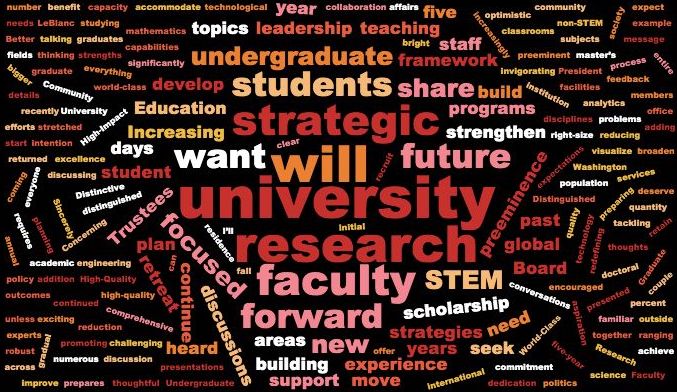
The Chronicle article doesn’t offer much detail on exactly how this would progress, beyond this datapoint: “Measured by total enrollment, the proposed drop would mean enrolling about 2,400 fewer undergraduates, or a decrease of 480 students per year.”  (Wikipedia says 11,244 undergrads enrolled in 2016) Apparently GWU leaders are either keeping plans to themselves or are still developing them.

We can learn something from the language LeBlanc uses to explain this move.

Better, not bigger.

Our intention is to continue to improve everything we do at GW by being even more focused on quality and less focused on quantity…

[W]e need to right-size the undergraduate student population…

Quality over quantity, right-sizing (from corporate America): key words for describing this strategy.

There is also a quiet thought that GWU is overbuilt, or overexerted itself in its growth phase:

During the past five years, we have grown our undergraduate student body significantly. We have stretched our facilities, our services, our staff and our faculty to accommodate that growth.

“stretched… to accommodate”: that’s not the language of pride but of difficulty and fatigue.  It points to a path now deemed mistaken.

In addition, president LeBlanc offers a certain curricular focus going forward:

[W]e cannot be a preeminent global research institution unless we expand our commitment to science, technology, engineering and mathematics (STEM), building on and adding to our core strengths in politics, policy, law and international affairs. I want to be clear: I am talking about and, not or. Increasing the number of students studying STEM subjects will broaden the conversations in our classrooms, our labs and our residence halls. Increasing our capacity for teaching and research in STEM also will strengthen our students’ experience in non-STEM fields, preparing all GW graduates for an increasingly technological society.

How many times does that paragraph repeat “STEM”?  And if GWU grows the number of STEM majors while reducing total enrollment, what happens to the numbers of majors in other fields?  Should we expect some humanities and social science queen sacrifices ahead, or will those become service departments?  “politics, policy, law and international affairs” seem to be protected.

The Chronicle piece also interviewed some consultants, and their thoughts are useful here.  For example, this argument that GWU aims to improve not just its institutional quality, but also the students it admits:

George Washington was hardly the kind of college to pursue high enrollments at any cost, said Lawrence R. Ladd, director of the higher-education practice at Grant Thornton, a consulting and accounting firm. “They could admit thousands more students if they wanted to.

buy cytotec online buy cytotec no prescription generic

”

But doing so could harm the student experience and decrease the college’s selectivity, which has slipped in the past five years.

That’s another sense of quality over quantity.

Will those be students from wealthier families?  LeBlanc’s statement doesn’t mention this, and neither does the Chronicle.  But this lone sentence caught my eye, concerning GWU’s recent growth era: “the university offered financial aid to more students and added an office to manage enrollment and retention.”  Perhaps many of the larger number of students required a higher discount rate, and LeBlanc aims for a student body that’s not only smaller, but less costly.

To sum up: this is just the first signal of one university leadership’s new direction.

buy tadalafil online buy tadalafil no prescription generic

  It can unfold in many different ways.  But it’s a useful datapoint about where American higher education can be heading.  It’s a strategic recognition that the boom years are over, and that a kind of correction is coming into view.

Watch for echoes and iterations of that language to appear elsewhere.

buy vidalista online buy vidalista no prescription generic

Posted in horizon scanning | 36 Comments

The changing geography of work: a new report

How will a changing economy redistribute jobs and economic growth in the United States?

McKinsey just published a new report, “The future of work in America: People and places, today and tomorrow” (summary; longer document), looking ahead to 2030 after new technologies have had some impact.  Its thesis is that we’ll probably see urban areas that are economically growing now continue to do well, while a large chunk of America will stagnate or fall behind.  The report isn’t happy with this, and asks us to make policy changes now.

I’m fascinated by this, and think the report offers a lot to chew on.  Let me identify what I see as the key bits for the future of higher education and technology.

To dive in, some recent historical context:

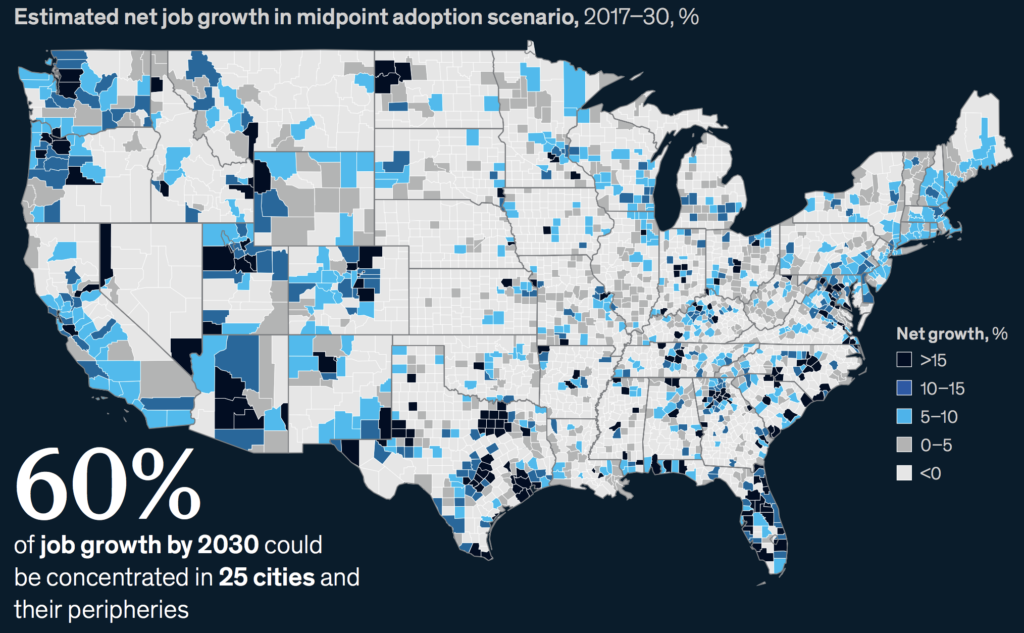
Twenty-five megacities and high-growth hubs, plus their peripheries, have generated the majority of job growth since the Great Recession. By contrast, 54 trailing cities and roughly 2,000 rural counties that are home to one-quarter of the US population have older and shrinking workforces, higher unemployment, and lower educational attainment. Automation technologies may widen these disparities at a time when workforce mobility is at historic lows.

Differences may be stark geographically.  Consider this map, projecting job growth and loss ahead 11 years:

Those black squares are McKinsey’s “megacities,” urban areas with the right mix of population and finance to take off.  The white and grey squares are the opposite, and aren’t there a lot of them?  We’ll return to that down below.

What about encouraging folks to move from white to black?  Not a good idea, it seems:

geographic mobility in the United States has eroded to historically low levels. While 6.1 percent of Americans moved between counties or states in 1990, only 3.6 percent did so in 2017. Furthermore, when people in rural segments and less vibrant cities do move, it is usually to places with a similar profile rather than to megacities or high-growth hubs…

Even as this may occur: “The 25 megacities and high-growth hubs, plus their peripheries, may account for about 60 percent of net job growth by 2030, although they have just 44 percent of the population. ”

Differences can also accelerate by education, race, and age:

The labor market could become even more polarized. Workers with a high school degree or less are four times as likely as those with a bachelor’s degree to be displaced by automation. Reflecting more limited access to education, Hispanic workers are most at risk of displacement, followed by African Americans. Jobs held by nearly 15 million workers ages 18–34 may be automated, so young people will need new career paths to gain an initial foothold in the working world. Roughly 11.5 million workers over age 50 could also be displaced and face the challenge of making late-career moves.

Let’s drill down into those age issues for a moment.  Surely young people will be in good shape because digital natives etc?  Not so fast:

Tens of millions of Americans can think back to their first jobs in retail or food service— roles that gave them valuable soft skills and experience that propelled them on their way. But these are the very roles that automation could phase out. Roughly 14.7 million workers under age 34 could be displaced by automation; almost half of them are in roles with high separation rates, so employers may not see a clear business case for retraining and redeploying them.

As for folks over 50:

On the opposite side of the generational divide, some 11.5 million US workers over the age of 50 could be displaced by automation. While some of these workers are close to retirement, others have years to go. One study looking at labor market recovery after recessions found that displaced workers ages 55 to 64 were 16 percentage points less likely to be re-employed at the time of follow-up surveys than workers ages 35 to 44.16 While some displaced older workers who have spent much of their career doing one thing may not be willing or able to make a drastic change, millions more might embrace the opportunity to train for different lines of work.

Plus employers don’t want to pay more for older folks when they can pay less for younger ones and robots.

Speaking of paying less, the gender breakdown over time is less clear, and varies by field, not to mention sexism:

Overall, women represent 47 percent of the displaced workers in our midpoint automation scenario, while men are 53 percent. Based on the current gender share of occupations, our modeling suggests that women could capture 58 percent of net job growth through 2030, although the gender balance in occupations can and does change over time. Much of this is due to women’s heavy representation in health professions and personal care work—and some of these roles are low-paying. Improving the representation of women in the tech sector is a priority; today they hold only 26 percent of computing jobs in the United States.

The longer report adds that gender diversity efforts seem to have stalled.

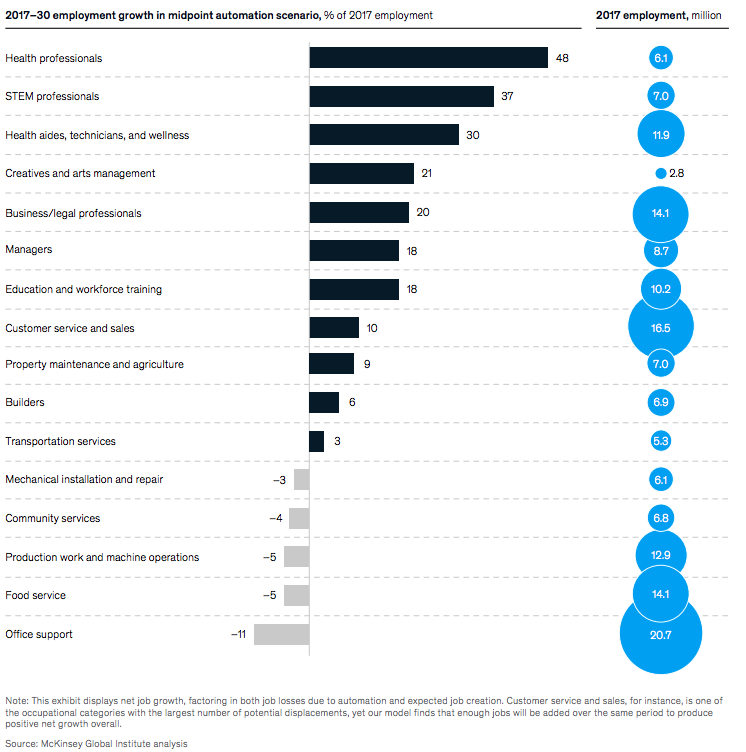
Differences also break out by profession:

What does all of this mean for education?

We can start with enrollment and fields of study.  Consider the job growth/decline chart above again.  My readers will be unsurprised to see STEM and business continuing to boom, which suggests even more students will enter those programs.  The drop in production work, machine operations, mechanical work, and office support suggests vocational tech schools and programs will not be so healthy.

We can also consider which colleges will be hit by their physical location.  Goldie Blumenstyk reflects:

I find myself imagining an overlay that shows the locations of colleges across the country. Many of the gray areas on the McKinsey map would be covered by dots, representing many of the same small, private and regional public institutions now facing enrollment and financial challenges. You get my drift here, right? The regions of the country likely to face the biggest economic challenges in the next decade because of automation are also the places filled with established educational organizations that may need a new agenda. Talk about an opportunity.

Here’s one such map, from NCES:

How many of those dots are in and around McKinsey’s megacities?  How many are located in those grey and white zones, and recruit students locally?  Think about how this vision will play into state legislatures as they consider merging or closing campuses, or how funders plan their investments, or how presidents consider their campus and its strategies.

Moreover, the digital divide – that perennially unpopular problem – can widen as a result of these changes.  As Tom Var put it on Twitter,

As I’ve said before, this is vital for higher ed to consider.  Do we invest scarce resources into helping our local communities improve their connections?  Do we shape our digital services to connect with students on the digital divide’s wrong side, reducing multimedia content?

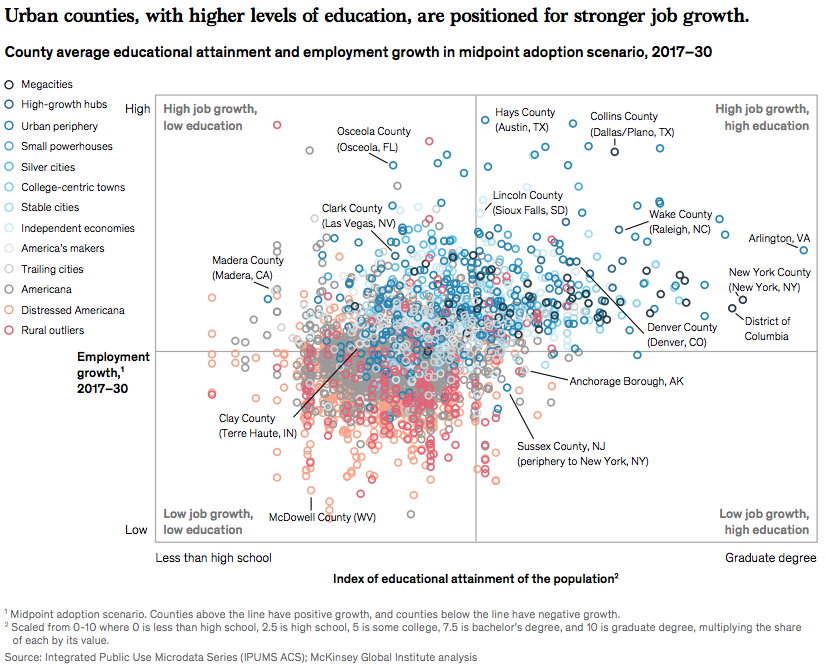
At the same time McKinsey sees education correlated with economic growth.  The report mashes up educational attainment and spatial location like so:

On the one hand, this is great news for higher ed, as it argues for getting more people more college and university degrees.  On the other, it’s awful news for low education areas, especially given our low geographical mobility (noted above).

One more detail: McKinsey is pro-apprenticeship.  “It will be important to create a wider variety of pathways from high school to work, perhaps through apprenticeship.”  Let’s see if trustees and legislators follow this idea.

And let’s see what you think.  The comments box stands open.

PS: Let me also say that some of the report’s conclusions could well be wrong.  Americans could rediscover the old desire to up stakes and move cross-country.  Rural counties could become high tech hubs in a national drive to build up a post-carbon, modernized electrical power grid.  Some megacities could decline thanks to crime, disease, natural disaster, or terror attack.  As always, we think about the future in the plural, in terms of possibilities.

(via Goldie Blumenstyk)

Posted in economics, education and technology, futures | 16 Comments

College and university financial health: one important view

InsideHigherEd logoInside Higher Ed does many fine things for the post-secondary world.  One of them is conducting repeated, careful surveys of key campus players.
This week they released a survey of chief financial and business officers, a crucial constituency with vital perspectives on campuses.  IHE ran a similar one in 2018 (my notes).

Let’s see what these CFOs/CBOs have to say.  Here I’ll identify what I think of us the most interesting and future-oriented findings, but I also recommend checking out the full report yourself.

Which institutions are represented?

buy valif online buy valif no prescription generic

  “Respondents represented 218 public institutions, 190 private nonprofit institutions and three institutions from the for-profit sector.”

Let’s start with the big picture, as the CFOs/CBOs assessed the broader landscape.

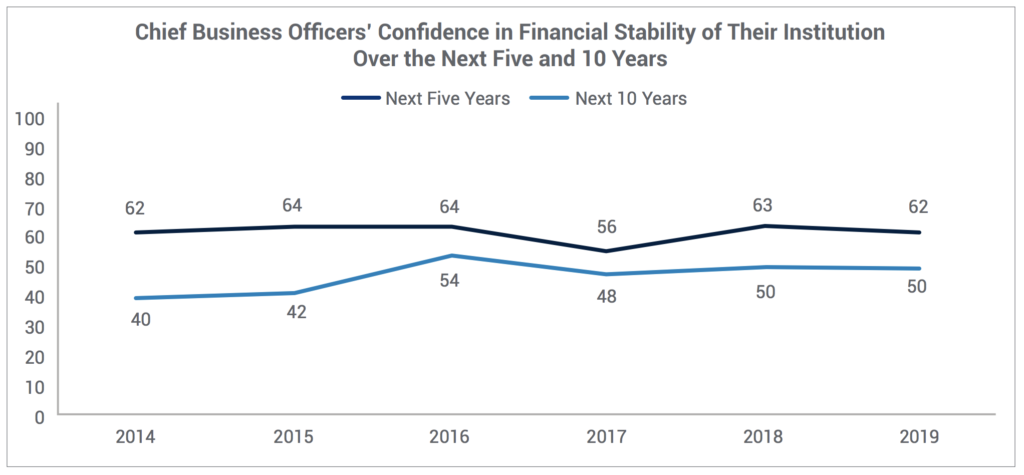
Confidence Nearly two-thirds of respondents had positive views of their institution over the next five years.  About one half extended that confidence a decade:

Recession to come soon? Asked about the broader economy and if a downturn was likely in the near future, these financial professionals “are more inclined to agree (45 percent) than to disagree (19 percent)…”

Defunding public higher ed Respondents offered a good glimpse of how far privatization has progressed.

On average, state appropriations account for about 35 percent of public institutions’ operating budgets, with community college CBOs reporting their college is more reliant on state funds (39 percent) than public master’s or baccalaureate (33 percent) and public doctoral CBOs (22 percent).

Just think about that.  In 2019 “public” institutions receive less than half of their funding from the state.  It’s down to one third or even nearly one fifth for some!

buy stendra online buy stendra no prescription generic

  (As I’ve noted previously.)

Closing campuses CFOs/CBOs expect a continuing trickle of colleges and universities shutting down.

The majority of business officers expect there will be between one and five (30 percent) or between six and 10 closures (33 percent) in the 2019-20 fiscal year. Another 36 percent of CBOs believe there will be more than 10 closures.

buy tadacip online buy tadacip no prescription generic

Drilling down a bit, let’s look more closely at the campus level.

Sharing services and programs with other campuses A minority of these financial officers are apparently talking about sharing academic programs and services with other colleges and universities.  And majority think they should be doing so:

Slightly more than one-fourth of CBOs (28 percent) say senior officials at their college have had serious discussions about consolidating programs or operations with another college or university. About six in 10 CBOs believe their college should share administrative functions with another college or combine academic programs.

Mergers What do they think about campuses feeling the urge to merge?  Some will occur, it seems:

Nearly all CBOs expect there to be additional private college mergers in the 2019-20 fiscal year, with 54 percent expecting between one and five mergers, 30 percent expecting between six and 10 mergers, and 15 percent more than 10 mergers.

There are differences between public and private colleges and universities:

CBOs are less likely to believe there will be additional public college mergers in the coming fiscal year with 28 percent predicting no such mergers. But 53 percent of CBOs believe between one and five public colleges will merge, 14 percent think between six and 10 public colleges will do so, and 5 percent believe more than 10 public colleges will merge.

What about their own institutions?

Twelve percent of CBOs say senior officials at their colleges have had serious talks about merging with another college or university, down from 17 percent in 2018 but the same as in 2017.

Also:

Eighteen percent of CBOs believe their college should merge with another institution, including 40 percent of those who say their college has had serious discussions about merging or consolidating.

Now, why wouldn’t a campus merge?  This is a fascinating view:

CBOs are most likely to see faculty opposition (54 percent), a desire to maintain the status quo (52 percent) and lack of mission compatibility (48 percent) as significant impediments. Less than four in 10 believe geography, governing board opposition, lack of financial necessity, and program overlap or incompatibility are significant impediments. Twenty-two percent believe alumni opposition is.

buy silvitra online buy silvitra no prescription generic

Discount rates This refers to how much less an average or median student pays than published sticker price.  About one third thought their campus discount rate was fine; one third deemed theirs unsustainable.

Financial stress More than half of respondents thought their institutions were in good financial health.

Yet of those that weren’t, note this key detail about endowments:

Thirty percent of private nonprofit institutions (and nearly half of private baccalaureate colleges) took funds from their endowment over and above their normal distribution policies — often a sign of financial distress.

Credentialing What do they see happening with alternative credentials?  “Seven in 10 business officers see promise in establishing alternative credential programs (such as certificates) as a source of new revenue for their institution. ”

Responses to demographics I’m delighted that CFOs/CBOs join me in thinking about programs aimed at how America’s population is changing: “About half say the same about creating programs for new audiences, such as senior citizens.”  I’m interested to see which model a CFO/CBO would like to pursue.

About public universities Beyond the elite, this subsector sees itself in particular straits.  Doug Lederman sums it up powerfully:

CBOs at regional public colleges — which a precently published Inside Higher Ed special report calls the “vast middle” of public higher education, positioned between research universities and community colleges — are more pessimistic than their peers on multiple fronts.

They are less confident in the financial stability of their institutions over a decade than their counterparts in any other sector (28 percent express confidence, none strongly, compared to an average for all institutions of 62 percent); more likely than those at other types of colleges to expect their institution to share academic programs or administrative functions with another college in the next five years, and to say their institution should share administrative functions or merge in that time; and less likely to believe their colleges are well prepared to withstand the economic downturn that many economists predict is on the way.

Summing up: one half to two thirds of campus financial officers see their institutions as financially stable.  They tend towards the possibilities of inter-campus collaboration and shared services.  However, they also expect a small number of closures and mergers, possibly less in the short term and more in the medium term.

As data for higher ed’s future, I think this survey points out some useful trends.  American higher ed is uneven, with areas of financial strength and weakness.  Some will escape financial stresses, if their financial leaders are correct, while others will respond with program sharing, service sharing, and even mergers and closures.

Personally, this feels right at home for my peak higher ed model, as America’s post-secondary sectors shrinks past overshoot.  We are overbuilt, and corrections are under way.

Posted in economics, research topics | Leave a comment

Histories of technological innovation: a reading list

What’s a fine book on a technological innovation from history?

I asked this question because I’m preparing to teach a couple of classes this fall.  One’s a seminar on innovation and technology.  The focus will be on the digital world, so our readings (and other media) will address that, and I’ll share the syllabus for those interested next month.  But I’d also like to add some predigital, historical examples of invention for perspective, as well as to test out students’ thinking and theory.  I have in mind stories of technological innovations from their inception, development, usage, and unto naturalization or decline.

To start the selection process I began assembling some books on railroads, the car, and radio, and asked some historians for their suggestions.  Then I asked friends on Facebook for their recommendations.  Over several days they offered such a fine list I wanted to share it here.

The titles don’t have a uniform approach.

buy forzest online buy forzest no prescription generic

  Some are business histories, while others are biographies or cultural studies.  Some focus on a short period of time, while others stretch out over generations or even centuries.  A couple have media connections (ahem).

buy valtrex online buy valtrex no prescription generic

Most of the books are stories of specific inventions, from the telephone to the birth control pill to a glass-making technique.  I admitted some exceptions to that principle.  For example, one history of the early internet, another on the PC, and one on AI.  Several are a bit broader, incorporating several innovations together.

buy flagyl online buy flagyl no prescription generic

  A few are more general still, but the spirit of the list is dedicated to specific creations.

buy valif online buy valif no prescription generic

Amir Alexander, Infinitesimal: How a Dangerous Mathematical Theory Shaped the Modern World (2014).

W. Brian Arthur, The Nature of Technology: What It Is and How It Evolves (2009).

Tim Berners-Lee, Weaving the Web: The Original Design and Ultimate Destiny of the World Wide Web Paperback (2000).

David Bricknell, Float: Pilkington’s Glass Revolution (2010).

Fred Brooks, The Mythical Man-Month (1975).

James Burke, Connections (1995).

Gene Carter, Wow! What a Ride!: A quick trip through early semiconductor and personal computer development (2012).

Arthur C. Clarke, How the World Was One (1992).

Ruth Schwartz Cowan, More Work for Mother: The Ironies of. Household Technology from the Open Hearth to the Microwave (1983).

Carl Djerassi, The Pill, Pygmy Chimps, And Degas’ Horse: The Remarkable Autobiography Of The Award-winning Scientist Who Synthesized The Birth-control Pill (1992). 

Susan J. Douglas, Listening In: Radio And The American Imagination Paperback (2004).

Paul du Gay et al, Doing Cultural Studies The Story of the Sony Walkman (2013).

George Dyson, Turing’s Cathedral: The Origins of the Digital Universe (2012).

David Edgerton, The Shock of the Old (2007).

Claude S. Fischer, America Calling A Social History of the Telephone to 1940 (1994).

Charles Fishman, One Giant Leap: The Impossible Mission That Flew Us to the Moon (2019).

James Gleick, The Information: A History, A Theory, A Flood (2012).

John Steele Gordon, Thread Across the Ocean: The Heroic Story of the Transatlantic Cable by  (2016).

Katie Hafner, Where Wizards Stay Up Late: The Origins Of The Internet (1996).

Steven Johnson, How We Got to Now: Six Innovations That Made the Modern World (2014).

____, Wonderland : How Play Made the Modern World (2016).

Sam Kean, The Tale of the Dueling Neurosurgeons: The History of The Human Brain as Revealed by True Stories of Trauma, Madness, and Recovery (2014).

Elmer Keith, Six Guns (1961).

Julia Keller, Mr. Gatling’s Terrible Marvel: The Gun That Changed Everything and the Misunderstood Genius Who Invented It (2008).

Tracy Kidder, The Soul of a New Machine (1981).

Ross King, Brunelleschi’s Dome: How a Renaissance Genius Reinvented Architecture (2013).

Mark Kurlansky, Paper: Paging Through History (2016).

David S. Landes, Revolution in Time: Clocks and the Making of the Modern World (2000).

Jill Lepore, What the Gospel of Innovation Gets Wrong (2014).

Marc Levinson, The Box: How the Shipping Container Made the World Smaller and the World Economy Bigger (2008).

Steven Levy, The Perfect Thing: How the iPod Shuffles Commerce, Culture, and Coolness (2007).

Wendy Moore, The Knife Man: Blood, Body Snatching, and the Birth of Modern Surgery (2005).

Carolyn Marvin, When Old Technologies Were New: Thinking About Electric Communication in the Late Nineteenth Century (1988).

Robert O’Connell, Of Arms and Men: A History of War, Weapons, and Aggression (1989).

Henry Petroski, The Pencil, A History of Design and Circumstance (1992).

Richard Rhodes, The Making of the Atomic Bomb (1997).

William Rosen, The Most Powerful Idea in the World: A Story of Steam, Industry, and Invention (2012).

Witold Rybczynski, One Good Turn: A Natural History of the Screwdriver and the Screw (2001).

Dava Sobel, Longitude: The True Story of a Lone Genius Who Solved the Greatest Scientific Problem of His Time (1995).

Cliff Stoll, The Cuckoo’s Egg: Tracking a Spy Through the Maze of Computer Espionage (2005).

Max Tegmark, Life 3.0: Being Human in the Age of Artificial Intelligence (2017).

Cecelia Tichi, Electronic Hearth: Creating an American Television Culture (1992).

Simon Winchester, The Map That Changed the World (2001).

_____, The Perfectionists: How Precision Engineers Created the Modern World (2018).

Stephen Witt, How Music Got Free: A Story of Obsession and Invention (2016).

Tim Wu, The Master Switch: The Rise and Fall of Information Empires (2011).

Tom Zoellner, Uranium: War, Energy, and the Rock That Shaped the World Kindle Edition (2009).

What other titles would you suggest?

If people find this list useful, I’ll gladly maintain it.  I can also add Amazon links.

(light bulb photo by Tiago Daniel)

Posted in research topics | 16 Comments

Living in the 21st century: drones versus autonomous cars

Sometimes the 21st century actually sounds like the 21st century of futurism and science fiction.  Sometimes it appears that way through a certain story or the development of a given trend.

And sometimes trends coincide, then produce something new.

Case in point: an Israeli research team just published a paper describing a very creative hack combining trends in drones and autonomous cars.   They used a drone-mounted projector to mess with a car’s advanced driver assistance systems.

Let me break this down, then explore implications.  I’ll engage in some good, old-fashioned futurist speculation.  And I’d love to hear everyone’s thoughts.

First, what’s the story?

From the paper’s abstract:

We injected spoofed traffic signs into Mobileye to assess the influence of environmental changes (e.g., changes in color, shape, projection speed, diameter and ambient light) on the outcome of an attack. To conduct this experiment in a realistic scenario, we used a drone to carry a portable projector which projected the spoofed traffic sign on a driving car. Our experiments show that it is possible to fool Mobileye so that it interprets the drone carried spoofed traffic sign as a real traffic sign.

“Attacking a car while driving (a) the drone with the projector used in our experiments, (b) visualization of the threat model implementation, (c) the moment of the attack (the projected sign is boxed in blue, the attacker’s drone is boxed in purple, and the victim’s car is boxed in red).”

In other words, they used a drone to fool a car’s autonomous systems, convincing it of a false speed limit.  Not in a simulation, not in a lab, but on a street, using a real car (Renault Captur), real software, and real drone.

This isn’t *exactly* hacking a self-driving car with a drone.  It does involve a drone.  It is a hack, but advanced driver assistance systems aren’t full autonomous car drivers.  A human controls an ADAS-equipped vehicle, relying on the software for information and, in some cases, driving assistance, so it’s a level 0 (of 5) car, in the SAE rankings.   Read the paper for more details, like the color of projected light, size and shape of projection, etc.  And check their short video:

(Note that three of the five authors are interns.  One’s a grad student.)

But you can see where this might be headed in the near future: drones versus autonomous cars.  As self-driving car tech gets better and more widely deployed, these drone attack tactics could keep pace, evolving new capabilities and dimensions. It’s a 21st century arms race.  For the sake of argument, let’s bank on certain present-day forces continuing to exert themselves: the ingenuity of hackers; the creativity of the emerging autonomous car world; our social love of gadgets.

Now, if this is one possible way those forces and technologies are interacting, where could it all go?  What does this metatrend portend?

Since the idea is out there now, it’s likely that people will try implementing and iterating variations of the attack.  Based on what we’ve seen of drones, imagine: human-operated versus automated attacks; multiple drones, building up to swarms; multiple attack vectors (imagine one shining lights within the car to distract the driver, while another targets the LIDAR, a third projects images on other surfaces including other cars, etc.).  Autonomous cars have to deal with the classic trolley problem; how about drones convincing them that there’s a small child darting into the road, forcing the car to stop or skew suddenly?  Or several children, one after the other?  That’s all short of doing physical attacks, like sacrificing a drone under a tire or against a windshield, printing and pasting down AI-confusing stickers, or directly delivering an explosive charge.

Remember that drones have far greater freedom of movement than cars do.  They are also much cheaper, and getting more so.  Imagine spamming an autonomous car with dozens or hundreds of drones, each with a different attack vector and mission.  You could be driving down a highway, or being driven in your new autonomous car, when the car alongside you is engulfed in a blizzard of buzzing, flashing confusion.

Such attacks could be launched from a nearby site or directed from around the world, as the American global drone war has proven.  If it’s from nearby, a van stuffed full of equipment and personnel could follow the target at a safe distance, disgorging drones in swarms.  Or drones could be launched by hand from pedestrians walking nearby, equipped only with duffel bags or carrying cases.

If people actually deploy this kind of hack or attack significantly, or if the idea scares us enough, countermeasures are inevitable.  Based on recent history and technological practices, we could imagine watermarking traffic signs and requiring car software to only acknowledge those.  Nassi et al suggest using QR codes

contain[ing] a signed message to the approaching car, informing the car of the traffic sign ahead, and its type, coordinates, and digital signature for authentication during the recognition process.

The report also suggests using updated digital information, a la Waze, shared between cars.  Or perhaps we could make signs into IoT devices, networked and smart, so need to make a handshake exchange with each car for the car’s software to work with it.  Naturally the attackers can try spoofing or otherwise outflanking such countermeasures, so we could expect a car-sign-drone arms race.  And the short history of IoT provides all kinds of ways this can go wrong.  Imagine a distributed, denial of service attack mounted through smart traffic signs or, less grandiosely, car collisions piling up because a smartsign’s been compromised or just failed.

How else could cars and their passengers defend themselves?  The aforementioned Waze-like system could also carry information on the latest drone attacks, updated as each iteration occurs.  Perhaps cars can fire off drones of their own, leading to aerial combat.  There’s precedent for this in the design world, as Box Clever has already proposed car-launched drones for traffic guidance and Blade Runner 2049 portrayed aerial cars sending off little drones.  Meanwhile, some drivers, especially in America, might feel impelled to shoot down enemies with weapons of all sorts, which might make things awkward for other drivers at shots ricochet and tumbling drone parts rain down.

In a crowded urban environment such countermeasures might not work, given rapidly changing conditions and the dense congestion of many non-hostile drones, cars, and buildings.

Surely this provides better cover for an attack.  In fact, a proliferation of drones could make cities much more crowded, even dangerously so.

Such an attack could easily be invisible to the human eye.  In the report linked above is one quiet, fascinating detail:

We discovered that a projection speed of 100 ms is sufficient for fooling the system. We were unable to fool the system with faster projection speeds probably due to the frame per second rate of the optical sensor of the Mobileye.

Did you catch that?  The projection only needed to last for 100 milliseconds to work.  It’s just a flash, not a drive-in (drive-by!) movie.  Can attackers in a crowded area command drones to rapidly flicker images, indistinguishable to humans from the ambient lighting of ads, streetlights, etc?  Or could such hack-flashes be embedded in otherwise benign projections, the autonomous car’s equivalent of a subliminal ad?

Perhaps the threat would be enough to influence behavior.  Consider, for example, a driver receiving a message (through text, or a drone-projected image, or a phone call) informing them that unless they take certain steps (drive to a certain location, cough up some bitcoins, host drones for another attack) they’ll be subject to a drone hack.  It would be ransomware for the 4th Industrial Revolution.

Let’s scale up from the question of an individual car and think in terms of groups and cultures.  Imagine a malign actor herding cars in certain vectors through projector-wielding drones.  Multiple, simultaneous attacks on multiple vehicles could wreck havoc in a given area.  This could take the form of a large, sudden crash, or several different hits across an urban area.  They could, for example, collide with key infrastructure points, seize up traffic chokepoints, block emergency vehicles. How much would it take for drone-car attacks to paralyze a city?

How would we react, once such attacks are known to occur?  We might not change our behavior, of course; as every IT professional knows, we have a long history of happily ignoring security recommendations.  We could also become irrationally afraid, shunning all self-driving cars and/or drones, or at least avoiding certain areas of town because of rumors about attacks there.  “It’s a bad area, all right.  My sister’s cousin knew someone whose car was swarmed with trolley problems!  He couldn’t get to work for hours!”  “I saw hundreds of drones coming off of that building on CNN.com!  You couldn’t catch me anywhere near it.”

If cities are easier areas for such drone hacks, perhaps we’ll see more open spaces as safer.  This could darken our imagination of cities and add a bit of allure to rural areas.

Business opportunities would ramify.  Armored car firms would have to prove their security against such attacks.  Autonomous car providers would face pressure to provide defenses, perhaps drawn from new third party companies.  Imagine a defensive drone deployment service which nervous car passengers could summon from a mobile device.  Data-fueled digital giants could see opportunities to deploy their strengths and expand markets.  Illicit businesses would obviously appear as well.

Imagine the regulatory challenges.  Would car defense drones have to be licensed, or all drones carefully monitored to make sure they aren’t up to no good? I could see local and national governments requiring drones to not be able to carry projectors, somehow, or mandating geofencing or certain sonic signatures to keep them away from roads.  Does a chauffeur’s license start requiring familiarity with anti-drone skills?  If congestion is a fear, cities could start charging drone (owners) congestion pricing to keep space clear. Would drone overcrowding cause cities to try to reduce aerial congestion?  Could police forces use drone-projectors to safely stop suspects in high-speed pursuits, such as by convincing cars to pull right over?  Or would some local police forces whitelist approved drones and promise to down all others?  A well publicized drone-car attack could stampede politicians into short-sighted and ill-informed regulations, not for the first time.

The politics could become quite tricky.  Industries that depend on stable transport would lobby the heck out of government officials for protection. There’s always the chance of politically motivated drone-car hacking, of course, with one group (revolutionary cell, nation state) using projections to cause spectacular crashes, or immobilizing part of a city with carefully misdirected traffic. As Ars Technica observes, a drone projector attack doesn’t leave much of a trail, so it’s good for anonymous attacks.

No physical alteration of the scenery is required; this means no chain of physical evidence, and no human needs to be on the scene. It also means setup and teardown time amounts to “how fast does your drone fly?” which may even make targeted attacks possible—a drone might acquire and shadow a target car, then wait for an optimal time to spoof a sign in a place and at an angle most likely to affect the target with minimal “collateral damage” in the form of other nearby cars also reading the fake sign.

Autonomous car policies and politics could separate by ideology, party, region, or even religion.  “My opponent is weak on car defense – typical of a Democrat!”  “Drone defense is a right, not a privilege!”  “Our state doesn’t suffer from projections, unlike our southern neighbors.  Coincidence?”  “Drones swarming cars are a sign of divine displeasure.”   Anti-technology groups would see this as further evidence of society ignoring Kaczynski’s warnings, and maybe win some adherents.  Today’s critics of digital giants would scrutinize Waze-like operations most carefully.

All of this is just within a few years of today.  I haven’t started connecting this dual-trend story with other trends, but you can.  Think of developments in technology and how they could be involved: AI, 3d printing, augmented/virtual/mixed reality, for starters.  Consider non-tech trends and how they might impact and be impacted: demographics, identity politics, globalization and its opponents, just for starters.

Then imagine what happens once this wave rolls through civilization.  Say we have a running arms race between increasingly smart cars and ever more capable drones, and some of the basic political, cultural, social, and technological implications I’ve speculated upon here have come to pass.  That’s when the harder question becomes: what’s next?

(drone in case photo by Cola Richmond; drones in front of crowd by Ars Electronica; ditto drones on grass; drone on red background by Michael Coughlan; America’s Watch by Jeff Gates)

Posted in technology, trends | 1 Comment

Outsourcing campus IT: what next?

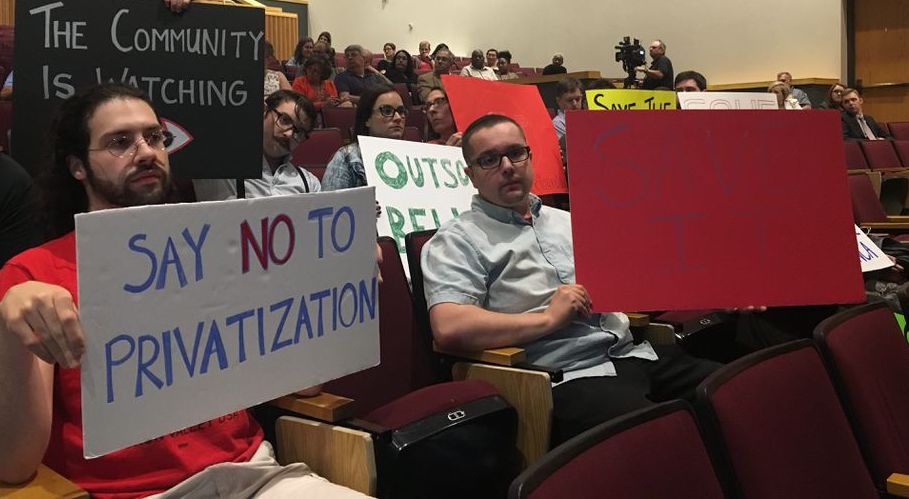
This week we learned that one Michigan campus will outsource its entire IT department.   I’d like to explore the story, as well as reflect on this as a way of thinking about the future of outsourcing in higher ed.

1. The story

Washtenaw Community College decided to drastically redesign campus IT after a major network outage.  WCC’s board and president, Rose B. Bellanca, worked with consultants to identify what they saw as serious IT problems:

Even with increased support for its IT staff, the review suggested, technical challenges facing the college continued to outpace its resources. Cybersecurity threats, aging IT systems, increased demand for online learning and classroom technology, and difficulty attracting and retaining IT talent are putting pressure on many colleges, not just WCC.

In response, they decided to outsource technology operations to Ellucian.  Ellucian commits to not only solving those problems, but also saving WCC $600,000 annually.

Campus IT staff are outraged, unsurprisingly.  Inside Higher Ed adds that some faculty members protested the move as well.

“Please don’t do this to us,” [Nicholas Hunt, who has worked within the department for 12 years] said. “Please do not put 31 families in disarray. Please, do invest in us, because we have invested in WCC as students and as staff.”

2.What else do we know about this story?

There are conflicting views and accounts of what happened to WCC IT over the past few years.  Some blame problems on very high turnover for the CIO position, with one anti-outsourcing board member stating: “I take personal responsibility as a member of the board, that we have failed in our mission by allowing our IT department to wallow without strong visionary leadership…”

Others argue that IT costs have shot up: “The college also noted demand for technological services continues to grow, with a projected IT budget of $8.2 million for 2020 – a 25-percent increase from four years ago.”

According to MLive, WCC’s president says she wants to bring back in as many of the current staff as possible:

WCC President Rose Bellanca said she anticipated blowback for the decision to outsource IT services, but ultimately believes it will help the college streamline and expand its IT capabilities. She noted all 31 full-time employees will not only have the opportunity to join Ellucian’s staff, but be guaranteed positions within the WCC.

“I know it sounds like we don’t value our employees, but we do, or we wouldn’t have given them a transition plan that is probably one of the most generous out there,” Bellanca said. “We tried to show our employees that are here facing this challenge that ‘we do value you.’”

Those taking a buyout offer would get one year pay, based on the employee’s current wages, along with medical coverage for themselves and dependents for those who have more than 10 years of service.

Those with five to 10 years of service would get six months salary and medical benefits, while employees with less than five years of experience would receive three months salary and medical benefits.

Saving money doesn’t seem to be a major factor in this story.  WCC’s chief financial officer told one local paper that “The outsourcing recommendation isn’t financially motivated.”  Which makes sense, comparing $600,000 to the campus annual budget of $110 million.  It seems to be about improving service.

(I can imagine that’s a terrible thing to hear if you work in WCC IT. )

One problem with outsourcing is that campuses view personal relationships very highly.  In higher education we like to see ourselves as facilitating communities in ways the for-profit world often fails to accomplish.  In this view, outsourced staff might not make those personal connections.  As Harold Hale observed on Twitter,

https://twitter.com/hhale63/status/1148328231864537089

Or as one WCC professor stated,

Breege Concannon, a chemistry professor at Washtenaw, also had questions about how the transition would work. “Is Ellucian going to be here? Will I be able to call them up on the day before my lab and say, ‘Can you come and update 24 laptops before tomorrow?'” she asked, adding, “I seriously doubt it.”

(One commentator tartly replied to this: “If you behave this way, you are in sore need of organizational change.”)

Why Ellucian, as opposed to any other provider?  WCC already uses Banner, an Ellucian product.  But one IHE commentator alleges the decision to go with Ellucian didn’t involve competitive bidding; I can’t determine the truth of this.

3.What does this story tell us about the future of education?

Outsourcing is a well established and fairly popular tool for corporate management.  It’s also an established tool for American academic leadership, as Rob Gibson observes. As higher education draws closer to the business world in certain ways, perhaps this idea will become more available to nonprofit leaders.  We’ve already seen American higher ed turn the majority of faculty into part-timers; post-Fordist labor relations are already baked in.

Some may also view outsourcing as a more practical way to manage campus tech needs.  In May WCC’s president said this to MLive:

“The advances in technology have far outpaced what realistically could be expected from any college IT staff,” Bellanca said. “While technology enables the college’s core mission of teaching and training, our mission is not to be an elite provider of technology resources.”

I’ve heard similar thoughts from multiple campus leaders.  They can dread IT’s role as a growing cost center, and want to step away from that, seeking to realize cost control or savings from businesses they deem more devoted to that cause.  They might view their staff as incapable of competing with those of Google or Amazon (this is one argument for outsourcing certain services, such as email or storage). Bellanca’s statement is a fascinating one as well for futures purposes.  I can imagine senior admin, boards, or state legislators arguing that VR, AI, etc. are steps too far for their campus staff to take… which means campus IT has to fight that much harder, make that much stronger a case, for support.

Susan Scranton went further, asking colleges and universities to collaboratively outsource:

On the other hand, one expert (and great Future Trends Forum guest) doesn’t see a rising trend in IT outsourcing:

“There is a long history of colleges working with companies like CampusWorks to find temporary IT leadership. But it’s not clear that colleges are outsourcing IT management more now than they did a decade ago, said [Kenneth C. Green, founding director of the Campus Computing Project]. “These things ebb and flow. There’s not a lot of consistency to it.”

Reasons not to outsource are plentiful and known.  Besides what we’ve already discussed (human suffering, cultural disconnections) there are concerns that vaunted quality might fail, that outsourced workers might suffer from low morale and/or poor skills.  In addition, Teresa Hartman points to one process problem:

And Art Fridrich identifies another problem.  What happens if the business ceases to exist?

All of this discussion is about outsourcing one aspect of contemporary American higher ed, information technology services.  What can we learn from questions around outsourcing others?  How far will academia unbundle itself?

(thanks to Anne Elias for sharing links and answering my questions; thanks to Andrew Peterson for requesting the topic; protest photo via MLive; graduation photo by the official WCC account)

Posted in economics, education and technology | 25 Comments

Another glimpse of the rest of the 21st century

What will the rest of the 2000s look like?

This is where I spend most of my time these days, and I’m glad to see Pew adding their research might to the question.  Specifically, they just released a good analysis of United Nations population data.  Anthony Cilluffo and Neil G. Ruiz offer a useful model of demographic (yes, yes, demography again) change that’s useful for anyone looking ahead, and especially for those interested in what comes next in education.

Let me pull out the bits that seem especially useful.

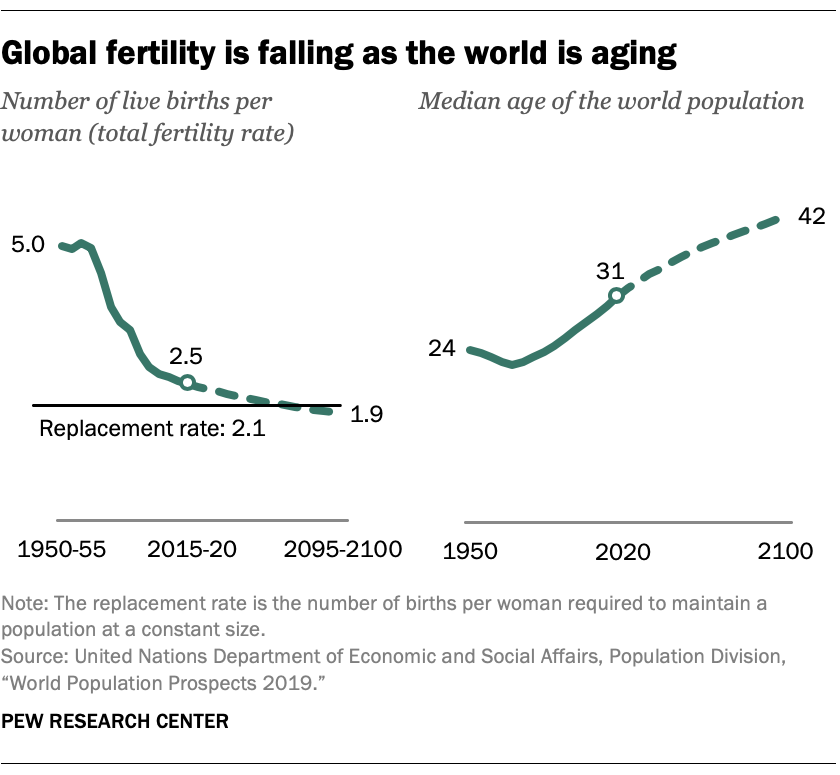
Big picture: they see humanity’s total population nearly maxed out at nearly 11 billion in 2100.  Our median age will keep rising, and the number of children born to each woman will drop to 1.9 (below 2.1, which is “replacement level”: keeps the population at the same total number).  Total growth will be under 0.1%.

“Starting in 2073, there are projected to be more people ages 65 and older than under age 15 – the first time this will be the case.”

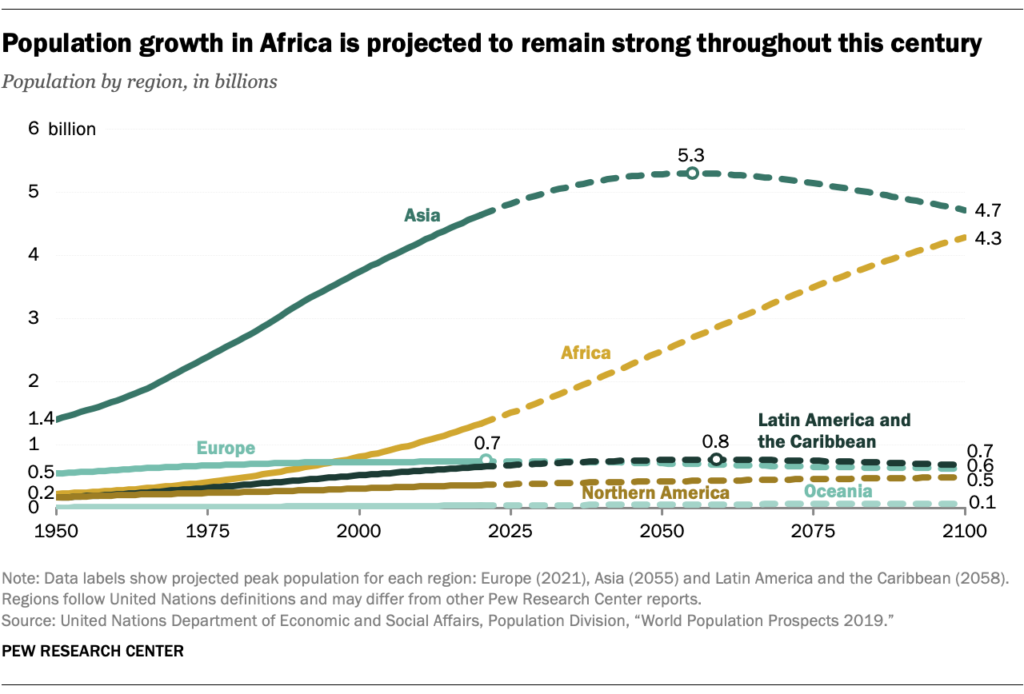
Regional differences: Africa – well, subSaharan Africa – will be humanity’s demographic powerhouse, tripling in population by 2100.  Total Asian population will peak, then start shrinking around 2055, falling behind Africa’s.  Europe and the Americas – already far smaller in numbers – will peak, stabilize, then, sometimes, shrink, depending on the nation.

buy acyclovir online buy acyclovir online

National differences: The US and Canada will grow pretty much because of immigration.  Absent that, Canada’s population will decline.

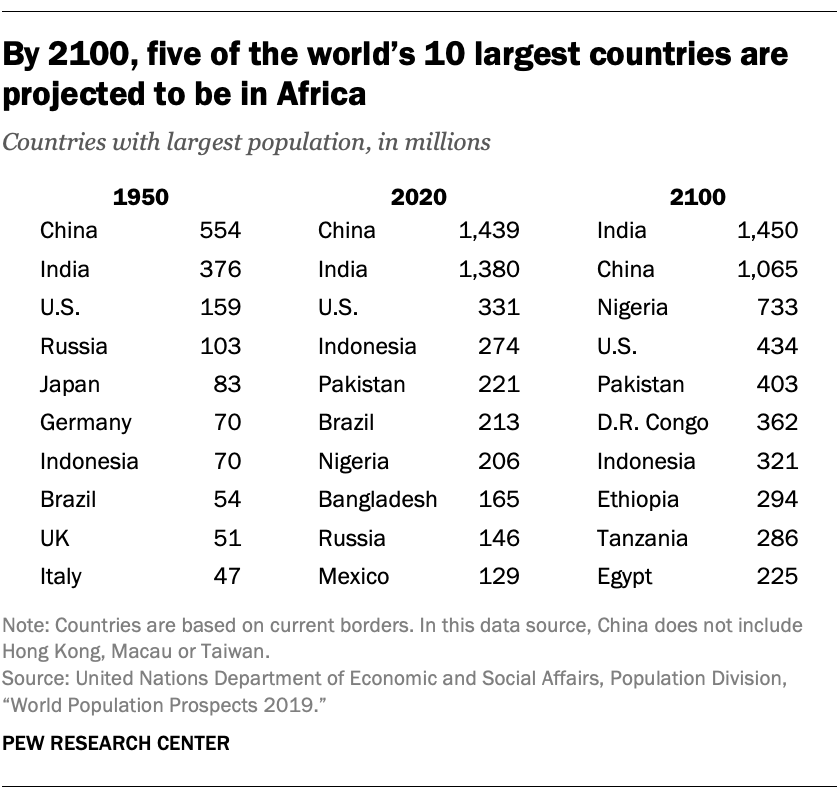
India will race past China for the title of most populous nation only a few years from now, by 2027.  It will maintain that crown through 2100.

A group of African nations will swell into joining the ranks of the world’s largest: “Nigeria, the Democratic Republic of the Congo, Tanzania, Ethiopia and Angola.”  Pakistan will join them:

There’s much to ponder here.  How will geopolitics reorient itself as nations and regions shrink or swell up?  Think about tensions between India and Pakistan, growing into two of the largest countries on Earth, and both armed with nuclear weapons.  Or consider the path of China’s One Belt, One Road, which runs right through the growth areas.  Conversely, how will Europe or Russia respond to being edged down the table?  How will aging change national cultures and projects?

Think of America and immigration, and how dependent the former is on the latter for demographic growth.  Crying, wonderment, and/or laughing are appropriate responses for the short term.  I would add: some numbers depend on if we keep killing ourselves through deaths of despair.

How many of these nations will see political and/or cultural movements to breed more babies?  Some analysts think this is most unlikely, deeming women’s advances over the past century to be too persistent.  I’ve been looking for signs of pro-natal movements in the developed world, but haven’t found many.  Hungary’s right-wing government is interested.  I’ll keep looking.

Compared to other analyses, this Pew/UN model comes close to Morland’s in finding decreasing fertility and regional/national transformation.  It assumes more persistent growth than do Bricker and Ibbitson, who foresee fertility dropping more rapidly.  All three defy the 20th-century’s population bomb idea of rampant overpopulation.

buy neurontin online buy neurontin online

For education, why does this matter?

My readers know I’ve been investigating this for a while; the rest of you can look back through these posts for samples.  Let me now offer a few notes based specifically on this Pew/UN document:

  1. How much of higher education is orienting towards subSaharan Africa?  Think of research programs, satellite campuses, curricula, study abroad, sister universities, development projects, student recruiting, inter-institutional research teams.  Think, too, of open access in scholarly publication as a way to better develop African scholars, who now often lack access to too much of the scholarly world.
    buy metformin online buy metformin online

      Should campuses energetically embrace open as a global good?

  2. As above, for India, the world’s largest nation in about the number of years from now that it takes a typical American humanities grad student to finish their degree.
  3. How prepared are colleges and universities to support older students?  On the one hand, the 18-year-old population isn’t exactly a growth industry, outside of a few nations (and who’s recruiting there?).  On the other, adult learners keep aging up.  Are we serious about educating seniors in large numbers?
  4. It seems logical for institutions in nations with declining populations to reach out internationally.  How is the global infrastructure for this?  Consider the public enterprises colleges and universities might lobby for: open borders; globalization; transnational organizations and authorities; improving internet access.
  5. If a nation’s university system fails to adapt to the reality of changing demographics, are they prepared to shrink?
  6. How might a significantly older populace change its attitudes and policies towards post-secondary education?
  7. If pro-natalist political and cultural movements appear and if they gain actual traction, how should higher education respond?  We know that education plays a vital role in reducing childbirth numbers; perhaps such movements will target colleges and universities.  This could represent another way for higher ed to be politicized.

As we wade more deeply into the rest of the 21st century, our species keeps changing.

buy silagra online buy silagra online

  One great task for higher ed is to respond wisely.

(Perhaps my next book should concern the year 2100, and the different futures we may experience getting there.)

Posted in demographics | 6 Comments

Alaska gears up to clobber its universities

The University of Alaska system just learned it will experience a 41% budget cut.

This goes far beyond my queen sacrifice chess analogy and into “sweeping whole ranks of pieces off the board” terrain.

Here’s the story, from what I can discover through one day’s research.  Please add more in the comments, especially if you’re from Alaska.

The state budget has been running deficits for several years, since its revenue comes largely from oil taxes, and the price of oil has stayed low.  Governor Mike Dunleavy (Republican) has pressed for budget cuts, and just vetoed a more generous budget from the state legislature.*  The 2019-2020 fiscal year starts Monday, and it looks like UA will begin with a 41% cut.

It doesn’t sound like a one-time cut.  Listen to the governor’s explanation:

Dunleavy… told reporters he has faith in university leaders but said he doesn’t think the university system “can be all things to all people. And I think that’s, generally speaking, the state of Alaska. We can’t continue to be all things for all people.”

Can’t be all things… so we’ll only do some things, as opposed to the broad spectrum of services provided by a university (hence the name).  To my ears that sounds like a strategic retreat in public higher ed, lopping off key functions.

There’s another hint of this direction in another statement:

“I do believe the University of Alaska is resilient. I do believe they have good leadership, and I’d say give them a chance,” Dunleavy said. “ I believe that they can turn the university into a smaller, leaner, but still very, very positive and productive university here in the northern hemisphere.”

This isn’t belt-tightening or even austerity.  It’s a strategic redirection, a historic transformation.

As one commentator observes,

the university cannot absorb an additional, substantial reduction in state general funds without abruptly halting numerous student career pathways mid-stream, eliminating services, or shutting down community campuses or universities. An additional reduction of even $10 million — on top of the $51 million in cuts we’ve already taken — will mean the discontinuation of programs and services with little or no notice, and that in turn will have ripple effects, damaging UA’s ability to generate revenue and causing even greater harm across the state.

So what happens now? The UA president, James Johnsen, announced plans, in case the legislature can’t overpower the governor’s decision.

First, “[f]urlough notices will be distributed immediately to all university staff.”  That’s all university staff, for a period of six weeks starting now. Plus, unsurprisingly, “an immediate freeze on hiring, travel and new contracts.”

Second, “[i]n the event an override is not secured, the Regents also directed me to prepare a plan for declaring financial exigency by July 15th.”  If you’re not familiar with the term, it’s a very meaningful one:

This declaration permits the university to more rapidly discontinue programs and academic units, and to start the unprecedented process of removing tenured faculty…

the board will be asked… for our plan for what programs, what units, what campuses across the University of Alaska system will need to be reduced or discontinued or closed.

Johnsen is quite clear on the reality of this: “we simply can’t meet these budget targets without laying off a large number of people.”  So a series of queen sacrifices will occur, at scale.

Meanwhile, the United States attorney general declared Alaska crime dangerous and numerous enough to constitute a state of emergency.

What do we make of this?

In immediate terms, Alaska is going to be hit with human costs.  Staff and faculty will suffer loss of compensation or jobs.  Students may not be able to complete their degrees, according to this UA FAQ. (“The university will make reasonable efforts to ensure completion of programs. However, that may not always be possible.”)

Certain programs are unusual and precious.  As one correspondent noted on Twitter,

Beyond the immediate pain, does this indicate anything for the rest of higher education?

On the one hand, the case is anomalous.  Alaska has an unusual funding situation, collecting neither sales nor income tax.  The university system must serve a small population spread over a very large and often challenging land.

Yet on the other, it’s a useful, if extreme, example of states slashing support to public higher education.  In this way, it points to one Republican strategy which might occur elsewhere, if not to this degree.  As Chuck Pearson notes in a short Twitter thread,

The governor’s action may also point to a political maneuver: cut higher ed and push some savings to voters through other ways.  Paul Fain sees this:

No other state has this particular line item, but we can imagine other such tradeoffs in other areas.  Cut public higher ed and spend more on pensions, or health care, or the penal system.  Readers may recall my story about state budget priorities, and how higher ed can easily lose out.

The still-unfolding Alaska story also shows – concretely – how a university can respond to this pressure.

One last point: I’m still struck by Dunleavy’s line about the university system no longer being “all things to all people.”  This sounds like a major effort to downgrade universities – not just by budget, but in their very structure.  Universities are no longer universal in scope, but narrowed to certain particulars. We’ve seen echoes of this elsewhere, as when Wisconsin’s governor Walker sought to restrict that state’s post-secondary services to job training alone.  It could be an emerging model of higher ed, somewhat unbundled and suited to new demographics.  It could also fit a society that retreats from a commitment to universal post-secondary experience.

Meanwhile, my best wishes to Alaskans.  And please share your information and reflections, those of you in or close to that state.

(thanks to numerous friends for sharing this one)

*Meanwhile, the governor also increased payouts to individuals through the Permanent Fund Dividend program (thanks to Don Moynihan).

Posted in economics, research topics | Tagged | 19 Comments

Opposing ways for universities to support senior citizens as students: the case of Minnesota

How should colleges and universities address learners over 65?

This strategic question have been cropping up quietly in some higher ed discussions lately, given current demographic and financial trends (aging population, rising economic stress on campuses).  It was thrown into sharp relief two weeks ago, thanks to a tv news story and its social media response.

NBC did a short story about elders taking classes at the University of Minnesota.  It was a feel-good piece, portraying happy older folks (62 on up) describing how pleased they were to return to the classroom.  Specifically, these learners took advantage of a state law guaranteeing a price of $10 per credit hour.  Seniors can audit classes, or take them for full credit.

NBC shared it on Twitter, emphasizing the baby boomer generational swath of the senior population…


…and then the feel-good vibe became something else, as criticism mounted on Twitter.  The most prominent social media user in the House of Representatives viewed this program as a good start for revising the business model for most of American higher ed:

Others slammed the Minnesota fee structure as hypocritical.  For example,

https://twitter.com/EJGibney/status/1138459029037027331

Or:

This pushback is based in part on the historical difference between 1960s-70s tuition (lower, much stronger state support) and costs now (higher, states defunding, financialization).  It’s also based on the story’s visual and voice-over integration of younger and senior students within the same classes.  This drove the inter-generational comparison home.

The Minnesota story describes one way universities can engage with elders: generously, in recognition of their lives.  It’s the opposite of Arizona State University’s strategy, which charges very high rates to bring some seniors on campus.   Both approaches seek to broaden higher education access to our oldest people, just through very different business models.  Both connect learners across generational divides:

Other [student]s said they appreciate the fresh points of view an older peer might bring to class…

Catalina Anampa Castro, a rising senior at the U, took an education course with a retired teacher who had 30 years of experience in the classroom.

“Having his perspective in the class was really helpful for my learning because whenever we talked about policies in education, he actually talked about how they worked in practice,” said Anampa Castro, who is studying sociology and pays in-state tuition.

Politically and culturally, Minnesota’s program is in the classic blue state vein with a dash of New Deal/Great Society progressivism.  Arizona’s is, in contrast, entrepreneurial and aligned more with a red state growing its retiree population.

We can view each effort skeptically.  Minnesota’s program is unfair to younger people, while Arizona’s is unfair to everyone who can’t afford expensive housing.  The former loses money, or at least runs into opportunity cost issues, while the latter excludes the majority of non-wealthy retirees.

What does this mean for the future of education?

Minnesota’s plan points to three different paths forward for public campuses as they seek to engage seniors while trying to be financially sustainable.  They could:

  1. Keep supporting elders at these nominal fees (Minnesota).  That’s a social good, especially for older folks remaining in the workforce.
  2. Boost prices for people over 62 (Arizona).  Demographics guarantee a rising number of that population.  The cultural insistence on everyone getting more post-secondary learning should keep demand high.  Concerns about cognitive disorders may drive more to school to keep their brains learning.  This should boost institutional revenue.
  3. Combine 1+2 for different populations, not unlike the current financial model of steeply discounting certain students while charing others full freight.
  4. Cut all tuition and fees to that basically free level.

#4 is a fantasy for now.  #s 1 and 2 are real choices facing American higher ed.  Which colleges and universities will hew to the Minnesota model, and which will follow ASU?  Who will combine them?

(thanks to Linda Burns)

Posted in demographics, future of education, research topics | 6 Comments