Campus COVID dashboards: a list and what we can learn from them

How do we track the coronavirus as it hits higher education?

As fall semesters begin across the United States, some colleges and universities have taken to publishing their internal COVID-19 data.  This often takes the form of dashboards hosted on webpages.

UPDATED October 23, 2020

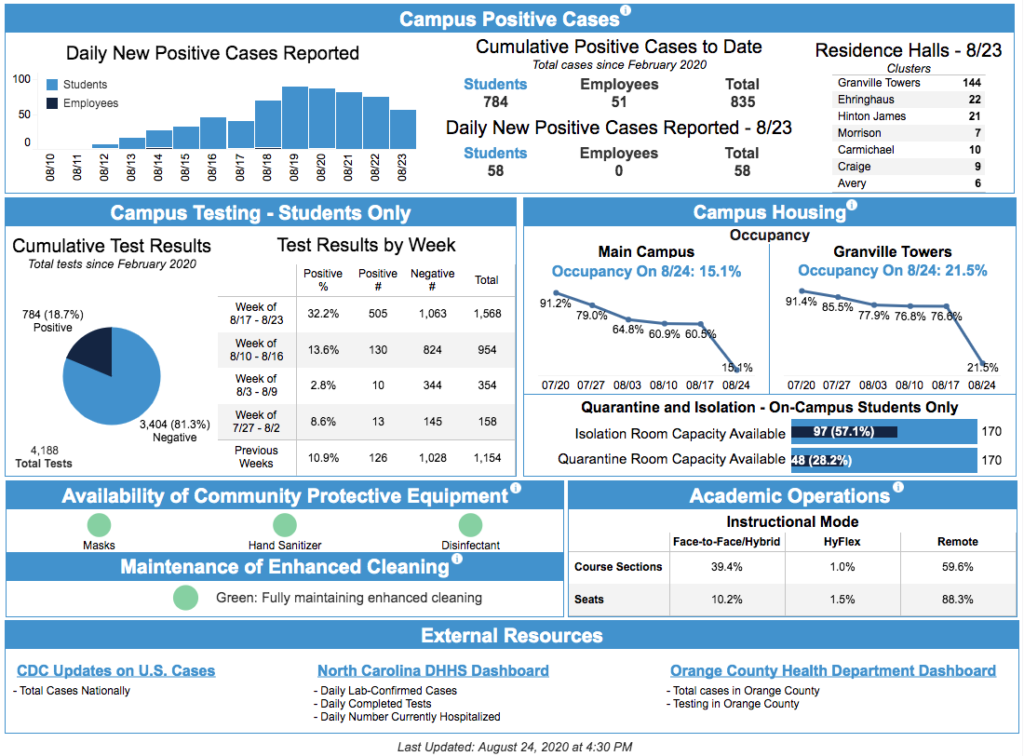
coronavirus UNC Chapel Hill dashboard 2020 Aug 25

UNC Chapel Hill

This is an interesting development.  The dashboards carry a range of data, differing by individual campus.  They are an effort to reassure various populations about the pandemic, as well as to document its development.

I wrangled a group of these to explore (see end of post for credits to helpers).  It seemed useful to have them in one spot:

Some features are widespread, such as posting the number of tests and infections on a given campus.  Infections can appear as a total number accumulated over time, or set apart by weeks.  Some offer a time series showing data separated by weeks or other periods:

Clemson dashboard

Test results appear in positive and negative outcomes.  Among tests, some distinguish between symptomatic and surveillance tests.  Others break out tests applied to students before they hit campus or by where on campus they get tested.  At least one divides students based on if they are from near the campus.  One separates cases by “Active COVID-19 Cases with DIRECT Campus Impact” versus “Active COVID-19 Cases with INDIRECT Campus Impact.” (caps in original) Several (for example) include local or regional testing data within the same webpage.

Campus populations are usually broken down by status: staff, students, faculty, subcontractors.  Campus responses to the pandemic appear, often in the form of the number of people placed in isolation or quarantine.

All dashboards include links to campus policies: reopening, how to get tested, how to find health resources, privacy, etc.

Other dashboard details are less common.  Not all use graphics while some deploy a range of visual designs. Jeremy Anderson approvingly sees some of those as minimalist.  Maryland has a nice two-window approach, letting users switch between overview and detail views.

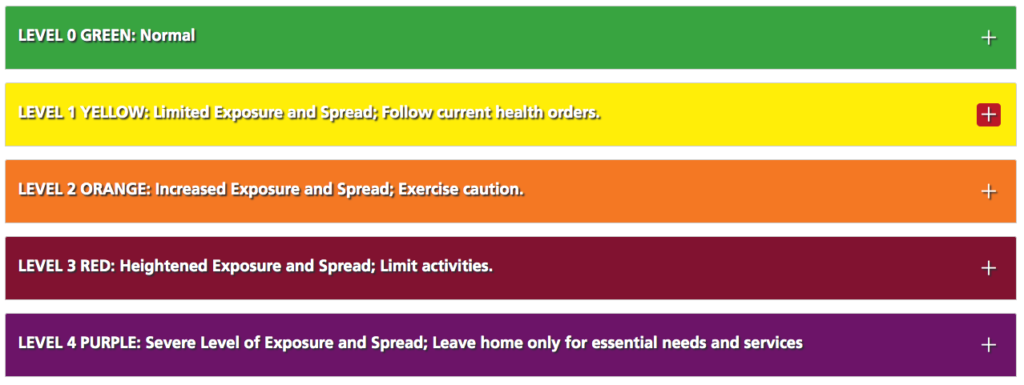
Some share medical resource (PPE, rooms, etc) data.  Several add a multi-tier alert designation:

coronavirus Hiram dashboardcoronavirus Hiram dashboard

Several dashboards offer short descriptions of events, like this one from Lewis and Clark College:

08/15/2020

student

College of Arts and Sciences

Student moving onto campus tested positive and is in isolation. One exposed staff member in quarantine. No other known exposures.

A few distinguish between on- and off-campus students.

A range of software powers these dashboards.  I’ve seen a bunch in Tableau, along with PowerBI. At least one is a pdf hosted on Google Docs. There must be some homebrew work going on as well. A few host mobile-oriented versions.

Update timing varies widely: weekly, daily, ad hoc.

I have some questions.  Has anyone aggregated these dashboards somehow, forming a synthetic picture of COVID on American campuses?  How widespread will these data projects become? Most of my samples come from research universities.  Are institutions that don’t emphasize research as highly as these also publishing dashboards, and I’ve just missed them?

At another level, what do these dashboards say about American higher ed in fall 2020?  In one light they represent an effort to be transparent to the world, sharing updated data for all to see.  In another view they are defensive statements, arguments that each campus is on top of the crisis, and that things are under control. The visual rhetoric emphasizing data draws on the powerful status of data, indicating for many people a mix of intelligence and objectivity.  The textual rhetoric describing individual cases aims for a similar objectivity, drawing on the prose styles of medicine and policing.  These are calming, soothing, cold dashboards, designed to assure users as much as to inform them.

This is by no means a full account of campus COVID dashboards.  It’s a first attempt to pin down a fast-moving target.  I’d love to hear from developers and administrators about their dashboard planning ideas.  And if this is useful I can update the page to include additional boards.

(thanks to Jeremy Anderson, Brian Basgen, Mark Kozitka, Eric Stoller, Rick Moore, Bill Allison, Todd Bryant, Joe Murphy, Charley Kline, Matthew Boedy, DRo, Sarah Prescott, Brian Rejack, Andy Morton, Joel Bloom, Mass Union Faculty, Jessica McQuain, Mark Greenfield, and Peter Shea for links; this Andy Thomason thread was amazing; this page has a great list and I wish I knew more about it)

Posted in coronavirus | 12 Comments

Today’s COVID-19 anecdote: an encounter with the maskless

We just had an intense experience.  Consider it a small narrative of the pandemic, a tiny COVID-19 socialization datapoint.

Earlier this afternoon my wife and I walked to the nearest drugstore to buy meds.  Also, I really needed a walk.

buy ventolin online buy ventolin no prescription generic

  (Not Ceredwyn.  She easily does 6-10 miles/day.)

Ceredwyn and Bryan magic masksCeredwyn and Bryan magic masks

It was a good walk, if hot in the August sun of Virginia.

We got to the Walgreen’s, found the meds, and brought them up to the counter.  The cashier rang them up and I started paying.  Ceredwyn stood nearby, socially distanced. Both of us were masked, as was the lone cashier.

A person came up behind me, forming a line. I didn’t pay attention to them.

buy zithromax online buy zithromax no prescription generic

  I didn’t turn around and couldn’t have told you how far away they were at that moment.

buy premarin online buy premarin no prescription generic

At the counter I made a payment error (somehow put the card in backwards) and had to re-enter it. No problem, easily done.

The person behind me sighed theatrically.  Then they started complaining loudly – shouting, really – about there not being enough cashiers in the store.  I ignored this and focused on the credit card machine.  In a moment the device successfully ingested my funds and I turned around.

Behind me was a younger woman, maybe 25 years old. She stood two feet behind me.  She was not wearing a mask.

Normally when I find myself in stores I’m pretty quiet or genial.  I like to observe, do my business, and get out.  But this situation shocked me into a different attitude.  Her being unmasked surprised me, since I thought masking up was a state and business requirement.  Her standing so close raised the hairs on the back of my neck.  I said to her, “No cashiers – how about no mask?”

She shrugged elaborately, adding energetically: “Oh well!”

I was horrified.  In response, I actually snarled, “In a plague?”

She fell silent.

At that moment… I decided to leave. I was keyed up, pissed off, anxious, and not in a good mood for a polite conversation. I didn’t think that person was, either.  I feared nothing positive would come out of a further exchange and didn’t like the combination of anger and dread boiling up within me.

buy furosemide online buy furosemide no prescription generic

  I realized Ceredwyn had already sidled away, towards the drugstore’s exit.

So I grabbed my purchases and stomped off to follow my wise wife, fast.

Coda: when we returned home I told this story to my son.  He was horrified, and concerned I’d been infected.

(thanks to keen eyed Noni Korf for one edit)

Posted in coronavirus, personal | 16 Comments

Will higher education crack down on fraternities and sororities as COVID-19 dangers?

As some American colleges and universities welcome back students on campus, COVID-19 infections are rising.  This has already triggered responses, from moving classes back online preemptively to several Toggle Term events.

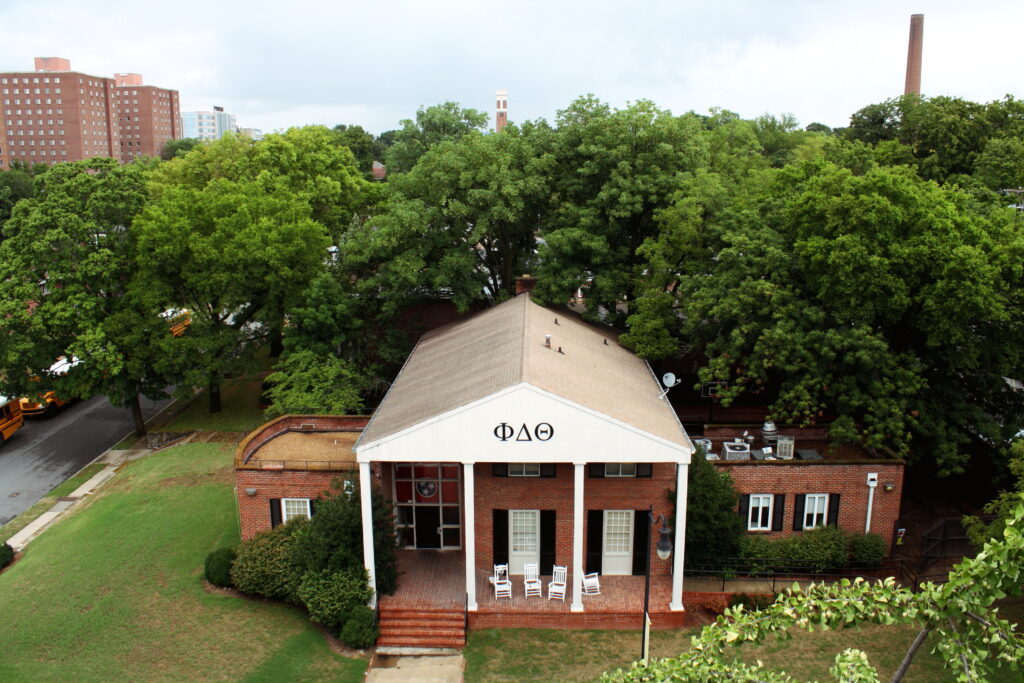
What about fraternities and sororities?  Do they represent a particular danger to their members and the surrounding community during this pandemic, one meriting attention from campus leaders?  Is the Greek system itself a COVID hazard, requiring tailored policy responses?

(For my non-US readers, the Wikipedia page to this peculiarly American academic feature is a good intro.)

Evidence for this possible course of action is easy to find.  Throughout stories of student coronavirus infections, Greek life plays a leading role.  At the University of Kansas, “[a] large majority of the 87 overall student positives have come from our fraternity and sorority community.”  We’ve seen similar stories across the country, at Texas A&M, the University of North Carolina-Chapel Hill, the University of North Dakota, the University of Southern California, Penn State, the University of Missouri, the University of Pittsburgh, and Auburn University. There were actually Greek-centered infections back in June at the University of Washington-Seattle and in July at University of California-Berkeley.

frat party by Darren WoodWe can draw on the history of Greek systems as well as their present activities for reasons why they might be singled out for pandemic attention.  To begin with, these are social organizations at root, deeply committed to forming and supporting interpersonal relationships.  Therefore they have a strong compulsion to bring people together.  Second, many fraternities and sororities have a track record of encouraging behavior that challenges student compliance with public health measures: excessive drinking, in particular, along with hazing rituals.

Third, these houses have an established past of running counter to campus authorities and policies, from the notorious file cabinets full of term papers to ignoring regulations on their behavior.  Indeed, a century ago they were deemed to be secret societies with some accuracy.  Fourth, to some degree fraternity and sorority business models depend on intensive and sustained socialization.  Partying and building membership are not only essential to their culture but also to their sustainability.

I’m not sure how other critiques of the Greek system will fit into the COVID-19 picture.  Fraternities and sororities are often charged with elitism; perhaps we might see some houses accruing PPE or tests?  They are also charged as racist.  Will this key into the established pattern of blacks and hispanics suffering more infections and deaths than the rest of the American population?

frat house photo by Cory Doctorow

These critiques are not my creations.  If we consider any campus strategies to address Greek systems as infection contributors, we resurrect a long-standing debate in American higher ed.  There have long been critics and scholars who cite frats and sororities as sites of depravity, alcohol abuse, risky sexual behavior that spreads diseases at higher rates than seen in the non-Greek population, sexual harassment, sexual assault, violence, and deaths.  There have been a range of campus policies aimed at corralling the Greeks.  The system’s size has ebbed and flowed, its configurations changing over time and according to negotiations with host institutions.

And naturally fraternity and sorority members have defended themselves.  In response to to portrayals of their spaces as danger zones, one response is to point to exceptional houses, such as honor or service groups, or ones that don’t live up to the Animal House vision.  There is also the cultural and institutional variety within the Greek system, including black houses, those connected to professional programs and honor societies, and those that just don’t behave as badly as some.  Moreover, in the current crisis Greeks can indicate their actions against COVID, as evidenced by this Panhellenic page or one sorority organization’s helpful resource list.

What kinds of policy actions could colleges and universities take if they consider some or all of their local Greek system to pose a pandemic danger?

  1. Maintaining the status quo.  This may be because leadership views fraternities and sororities to be effectively the same as the rest of campus life.
  2. Increasing data gathering and surveillance of frat and sorority communities.
  3. Restrictions on timing of Greek social activities, who can be on site.
  4. Increasing regulations of alcohol consumption and distribution.
  5. Suspending various social activities (rush, parties).
  6. Target fraternities more than sororities.
  7. Suspending houses deemed to be noncompliant with public health measures (for example).
  8. Shutting down Greek houses for a period of time, or permanently.

What actions could other entities take?

  • State government: California passed a law making it easier to sue fraternities and sororities for injuries and deaths.
  • Nonprofit: at least one nonprofit educates and advocates for reducing hazing.

What might fraternities and sororities do?

sorority house by Derek BRuff

  1. They can always reform themselves, of course, and have done so historically.
  2. They can disband on their own initiative.
  3. Members may quit the organizations in protest of attitudes they oppose.

Let me step back from these options and look ahead more broadly.

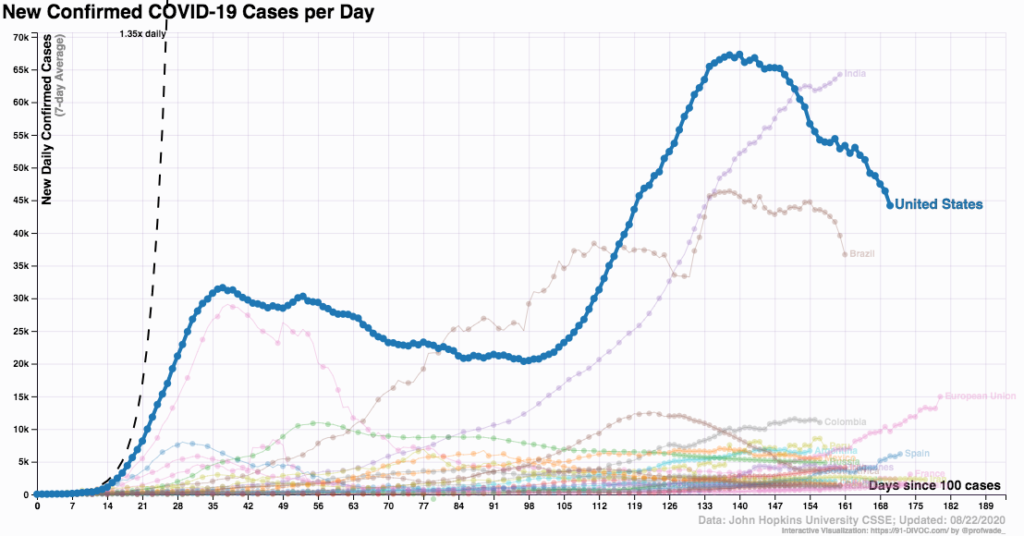
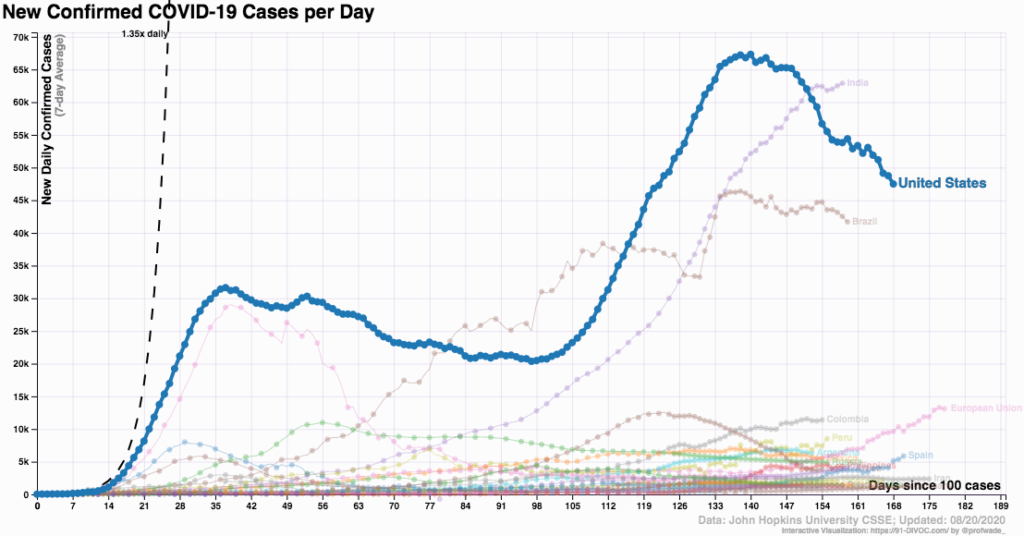
As with the rest of higher ed, much depends on how the pandemic itself plays out.  Back in March I proposed three scenarios: a single wave; repeated waves; a continuous plague. Right now the United States seems to be in the third scenario, although the latest data (citing 91-DIVOC) suggests we could be heading downslope at last:

coronavirus spread worldwide_US focus_2020 August 22_91-DIVOC

If COVID continues to roar through significant swathes of American society, colleges and universities will tend to shape policies to minimize infections overall*.  This can lead to significant pressure on Greek houses to clean up their collective act and try preventing viral spread.  If they succeed they may preserve their system for a generation.

If they fail – or, perhaps more importantly, if enough people perceive frats and sororities to be pandemic hot zones – then they could shrink.  Membership can decline.  Campuses can clamp down or ban individual houses or entire systems.

That’s a pretty large choice.  Given the nature of American higher ed (see footnote below) it’s likely we’ll see a mix of choices.  On some campuses sororities and fraternities will survive or prosper, either by successful negotiation and marketing or by actively fighting COVID-19.  On others they could go extinct, remain the same, decline, or be transformed.  Fraternities could suffer more than sororities.  The open question is what happens to the aggregate as a response to this terrible pandemic.

What are you seeing in your academic institution?  What do you think is most likely, looking ahead?  And what do you think should happen?

*I wrote “tend” for a reason.  The United States has around 4,400 colleges and universities, each some a significant degree of autonomy.  There will be a variety of responses, as ever.

(frat lions photo by Cory Doctorow; creepy party pic by Darren Wood; sorority house by Derek Bruff; thanks to Facebook friends for talking this through with me)

Posted in coronavirus, higher education | 1 Comment

Another Toggle Term: North Carolina State University

Toggles Down and Up_CogdogThis week has seen two American universities choose what I’ve dubbed a Toggle Term.  That means they began the fall semester with in-person education but switched over to wholly online education once infections took off.

The first Toggle was the University of North Carolina-Chapel Hill on Tuesday.  The second came on the next day, as Notre Dame sent ongoing in-person classes online.

Today we have a third Toggle Term case.

buy bactroban online buy bactroban no prescription generic

North Carolina State University announced today that it would switch away from face-to-face instruction and campus life, moving operations online instead.

The timeline: classes began on August 10th.  The online paradigm starts August 24th and runs through 2020.  “[I]n-person and hybrid classes will move to online-only instruction for the remainder of the fall semester.”  Students are not automatically sent home; the campus is still open, just locked down and online.

NCSU’s Chancellor, Randy Woodson, was very clear about the reason: rising infections.

[W]e have more than 500 students in quarantine and isolation, mostly off campus, who have either tested positive or have been in contact with someone who has tested positive. We are also investigating other potential off-campus clusters…

buy cipro online buy cipro no prescription generic

What caused that? Student behavior, straight up:

We have also recently witnessed the negative impacts caused by those who did not take personal responsibility. We’ve had reports of large parties in off-campus apartments. In the last two days alone, we’ve identified three COVID-19 clusters in off-campus and Greek Village houses that can be traced to parties and behavior outside of our community standards and the governor’s mandates. We’re seeing significant infections in Greek life, and at this time there have been another seven Greek houses that have been quarantined due to a number of additional positive cases.

buy lasix online buy lasix no prescription generic

Note that emphasis on students.  Unlike other academic leaders explaining their late conversion to the online education path, Woodson does not reference local, regional, or national COVID-19 infection trends.  This announcement is focused on in-house, community behavior.

Note, too,  the role of fraternity and sorority houses.

buy ventolin online buy ventolin no prescription generic

  I may return to this as I get time.

Watch for more Toggles.  The fall is just beginning and infections are still going strong in the US:

91-DIVOC-countries-UnitedStates (11)91-DIVOC-countries-UnitedStates (11)

(thanks to one keen-eyed person on today’s Future Trends Forum and Rob Henderson on Twitter; photo via the irresistible Alan Levine)

Posted in coronavirus, higher education, scenarios | 3 Comments

More campuses head online, another Toggle Term situation, and debates over killing students: today in COVID-19 higher education

It is August 19th, 2020, and fall semester is rushing upon American higher education.  The past few weeks have seen a series of developments, from schools offering rebatesdiscounts to some campuses opening up and experiencing infection spikes to others wrestling with criteria for returning online.  A large number of colleges and universities changed their minds about fall plans, switching from face-to-face to online. Yesterday we had our first Toggle Term case in the wild.

Things are happening fast.

Everything that follows is drawn from the open web: journalism, press releases, campus dashboards, public emails.  I’m also hearing off the record stuff from dozens of people across the country, on background.  That influences me, but I won’t cite it.  (And some is awful.)

On a meta, personal note: normally I try to write calmly, analytically, without much of myself in the sentences.  It’s getting harder to do that now.  Potential harms are escalating and becoming more real every hour, and that’s hard to react to unemotionally.  I find my prose tending towards rage or sarcasm more than usual.  At the same time I’ve been in overwork mode for… months, really since the pandemic began, and I worry that accumulated fatigue will warp my writing.  Let me know what you think, dear reader.

So what development have hit in the past 20 hours or so?  Like Gaul, this post is divided into three parts.  Buckle in, because it’s a long ride:


I. TOGGLE TERM TIME

Several American colleges and universities have switched fall instruction from in-person to online.  Rising infections and the case of University of North Carolina-Chapel Hill seem to be the inspirations for these campuses to enter what I’ve called the Toggle Term scenario.

To explain: as COVID-19 infections rise, campuses that have re-opened for face to face education run the risk of hosting illness, injuries, and death.  They also risk further infections and human costs.  Thus the option of switching to wholly online education, as they did this past spring, becomes increasingly attractive.

On Monday I suggested that UNC’s decision might inspire other Toggles.

On Tuesday the University of Notre Dame announced that in-person classes would be “replaced by remote instruction only for the next two weeks” for the next two weeks.

Here is what their own dashboard displays.  Note the rising curve:
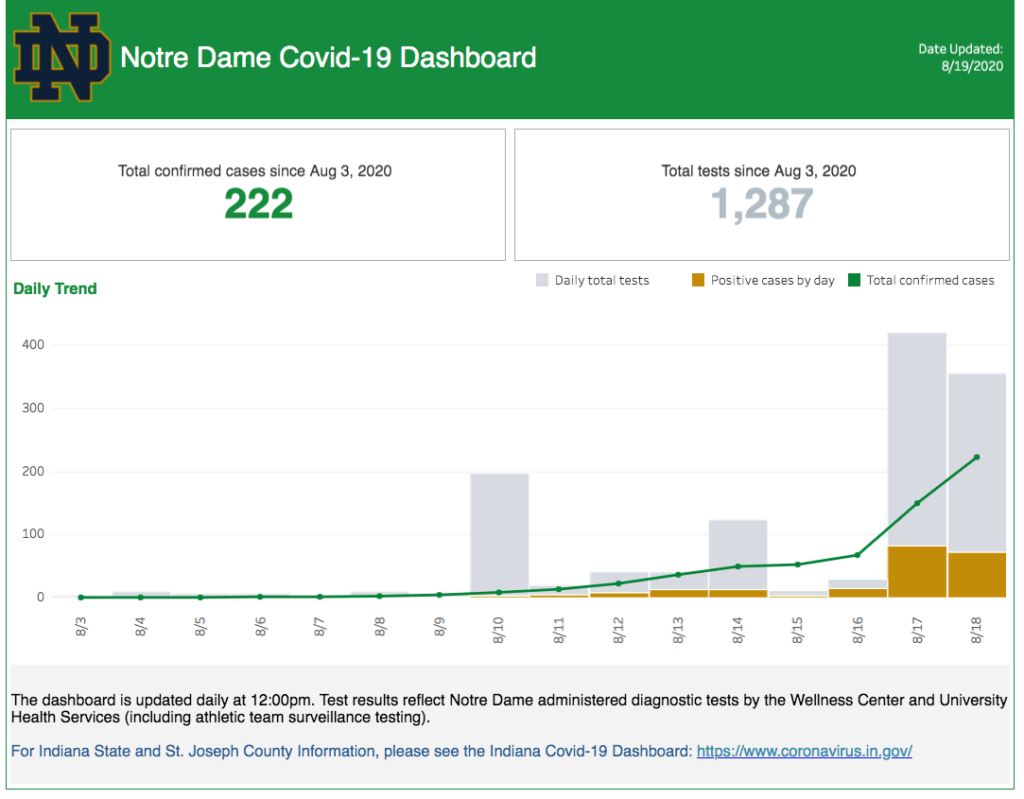
Notre Dame dashboard 2020 August 19

I wrote “rising” last night.  Here’s what the dashboard looked like then:
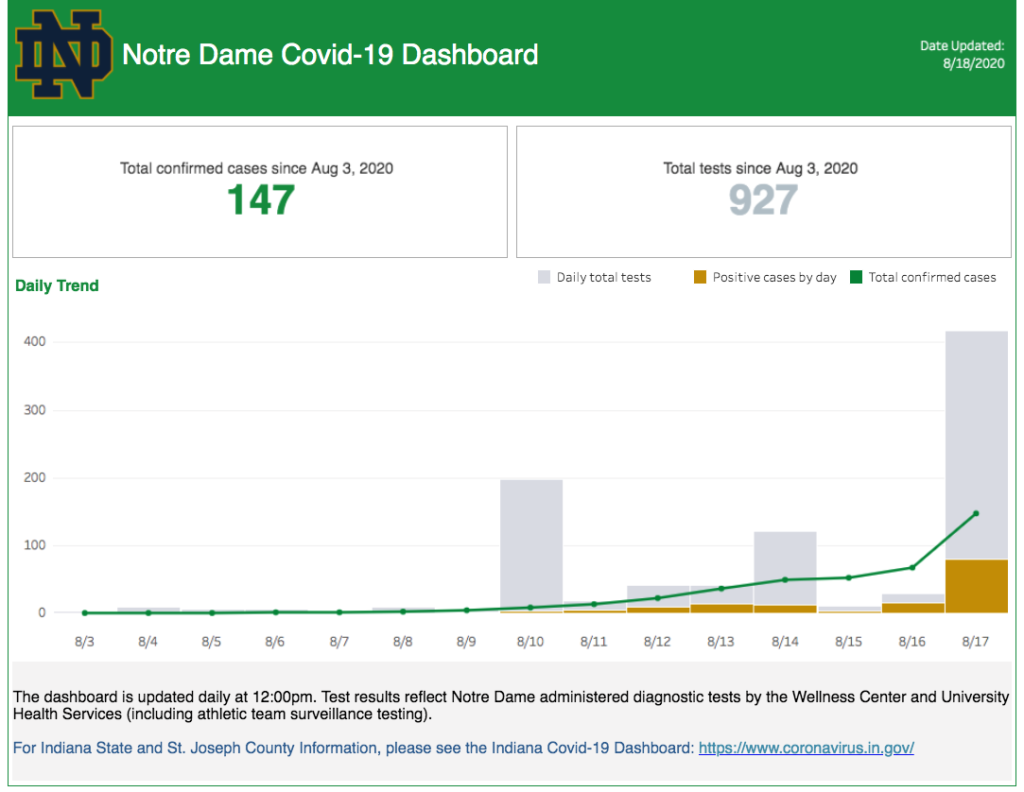
coronavirus Notre Dame dashboard 2020 August 18coronavirus Notre Dame dashboard 2020 August 18

147->222…

So Notre Dame will teach online for two weeks.  That means if they return to in-person in September, or a second throw of the Toggle.

ND will also do these things:

Until further notice, off-campus students should not visit campus. On-campus students should refrain from leaving campus except under emergency circumstances.

Student gatherings off or on campus are restricted to 10 people or fewer.

All research laboratories, core facilities and libraries remain open to graduate students, faculty and staff.

The COVID-19 Response Unit, the University Testing Center and Notre Dame’s quarantine and isolation facilities will remain fully operational.

All students, faculty and staff are reminded to complete their daily health checks.

Varsity athletic teams that are subject to routine surveillance testing may continue to gather for sanctioned activities according to established protocols and will be closely monitored.

Will Notre Dame return to in person after two weeks, or will that period extend?

I am watching for further Toggle instances.  Please let me know if you see signs of others.


II. SWITCHING TO COVID FALL

This week several colleges and universities came close to enacting Toggle Terms, but fell short.  They did switch out fall plans, but didn’t Toggle only because they hadn’t yet started classes.

Michigan State University, for example, announced it wouldn’t welcome people back to East Lansing.  Note the social logic in that announcement:

given the current status of the virus in our country — particularly what we are seeing at other institutions as they re-populate their campus communities — it has become evident to me that, despite our best efforts and strong planning, it is unlikely we can prevent widespread transmission of COVID-19 between students if our undergraduates return to campus.  (emphases added)

They are basing this decision on what’s going on at other campuses.  Call it academia’s herd mentality or the science of watching experiments.

In New York, Ithaca College is also taking a COVID fall.  Their statement emphasizes unpredictability: “we have learned from watching other communities how delicate this equilibrium is, and how quickly it can be disrupted.”  President Collado also warns against a Toggle Term:

it is easy to foresee the likelihood of a public health trajectory that would mandate the closure of the college due to circumstances beyond our control. Bringing students here, only to send them back home, would cause unnecessary disruption in the continuity of their academic experience.

(Matt Reed agrees.)

The University of Pittsburgh is staying online until September 14th.  Drexel University will be online for fall.

Others have this option available.  Here are infection rates from the University of Florida’s dashboard.  They don’t start classes for another 12 days:
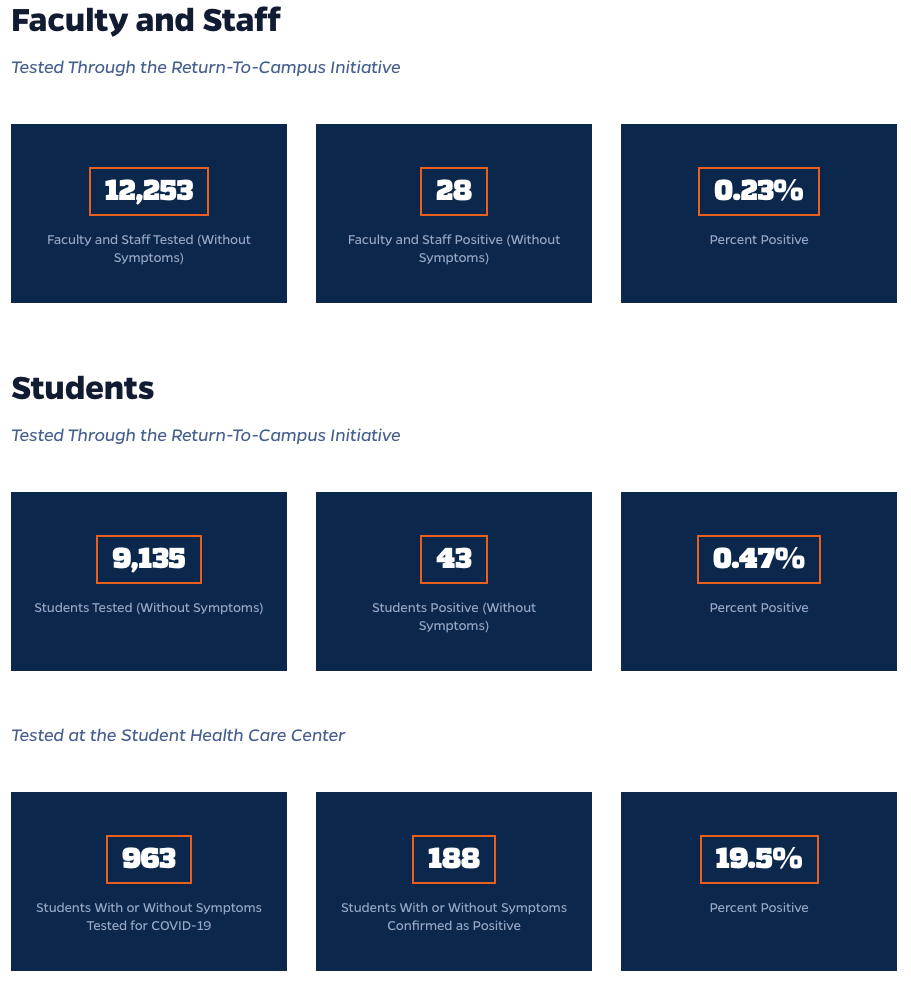
coronavirus University of Florida dashboard 2020 Aug 19

259.  231 are students.  That’s a tiny proportion out of 52,492 on-campus students (Wikipedia), barely 1/2 of 1%.  But if that number rises like we’re seeing elsewhere…


III. FACING STUDENT INFECTIONS AND DEATHS

Meanwhile, two universities are still planning on face-to-face education this fall, and are now wrestling openly, publicly, with the possibility – or likelihood – of killing people, including students.

Yesterday a Yale News article outlined that university’s plans to open up, starting by discussing some internal research finding that those plans should succeed, keeping infections under control.  It’s not a cheap strategy, as it involves”the University shelling out hundreds of thousands of dollars, potentially millions, to set up eight new testing sites within residential colleges and hire extra staff, Dean of the School of Public Health Sten Vermund said.”

Yet at the same time the world could upset those campus plans. “[W]hen it comes to COVID, there is no ‘Yale-only’ bubble. An outbreak anywhere in the region could place the University at risk, forcing a school shutdown before the virus comes to campus.”

That could be a local outbreak:

“Additionally, because the campus is intertwined with the city — even bisected by Elm Street — though undergraduates are tested every few days, there are large swaths of city residents and sophomores living off campus who the school won’t test and who could possibly be part of an outbreak…”

Or it could be regional:

“With the frequent testing I’m positive that we’re going to be able to detect outbreaks, hopefully we’re going to be able to control them, but what I’m really kind of concerned about is not just what’s going to happen here at Yale, but what’s going to happen in Connecticut, in the region,” [Albert Ko, department chair and professor of epidemiology] said. “If we have a big outbreak in New York, I think we’re going to have to make hard decisions and hard looks at what we’re going to do here in Connecticut.”

Perhaps anticipating this, one administrator/professor send a particularly dark email:

In a July 1 email to Silliman College residents when Yale first announced its plan to reopen on-campus housing, Head of College and psychology professor Laurie Santos warned Yale’s “community compact” was not to be taken lightly, treated like some course readings and skimmed for main ideas. She explained that some staff members are from sectors of society that are particularly vulnerable to COVID-19, and that they do not have the choice of whether to come to campus. At the time, Yale was planning to test returning students once per week — a plan that the University modified several weeks later, when it announced that it would instead test students twice weekly.

Here’s the bit that gets me, that flabbergasts me:

“We all should be emotionally prepared for widespread infections — and possibly deaths — in our community,” Santos’s email reads. “You should emotionally prepare for the fact that your residential college life will look more like a hospital unit than a residential college.”

On the one hand, this echoes Robert Kelchen’s brilliant tweet:

https://twitter.com/rkelchen/status/1280117375258542080

“For students who choose to live on campus in the fall, I’m increasingly thinking campus life will be a combination of a monastery and a minimum-security prison.”

On the other hand… we have a campus leader openly telling students to prepare for infections, injuries (implicitly), and death.  Deaths, plural.  This is the clearest sign I’ve seen of a university openly acknowledging that its pandemic plans admit the possibility of people dying, and still persisting in those plans.

A BoingBoing poster links this academic statement to a broader sense of American culture and politics:

We’re past the point where the people in charge have decided widespread death is necessary for the financial wellbeing of American institutions, and at the point where they’re calmly explaining to us the terms and conditions of our demise.

Is that right?  Is our tolerance for death ramping up, as we see in the history of plagues, but accelerated by politics?

That’s Yale.  Penn State comes close to offering another example of this open acceptance of avoidable death.

Recently a group of Penn State University faculty urged that institution to shift to remote learning.   That’s because their data and projections augur student deaths.  I’m not exaggerating:
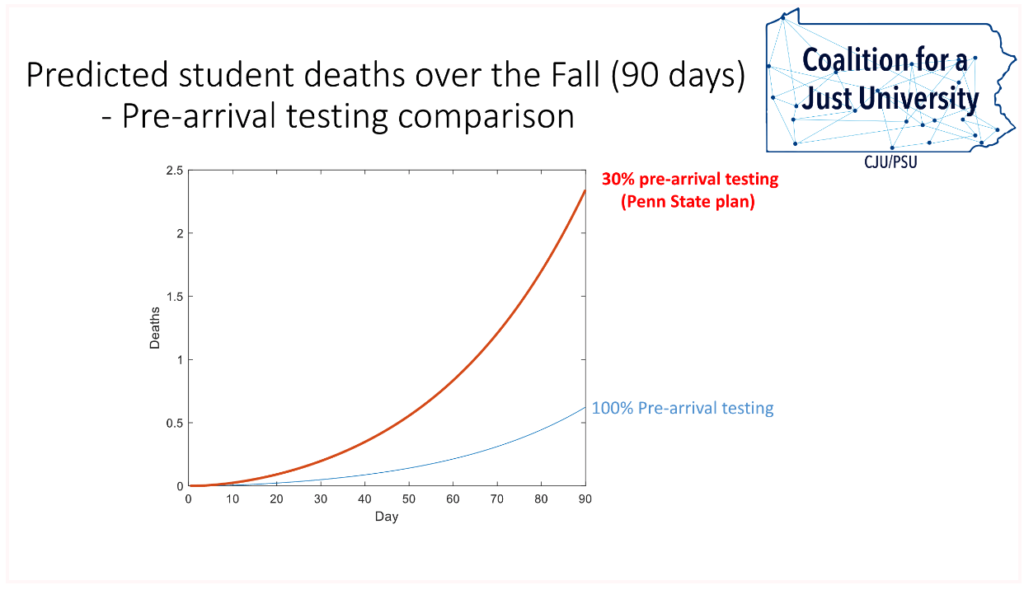
coronavirus_Penn State_faculty model for student deaths_2020 August 18

That report includes a scholarly paper, published by scientists.  I think this is a version of the paper, appearing in the Journal of the American Medical Association. A bit of background on them:

faculty in the College of Engineering and the Eberly College of Science have been studying testing plans and data modeling conducted at other universities. These models include work done at Yale, Harvard, Cornell, University of Illinois, and other institutions, made available by the authors and discussed and debated both within their local university communities and in the Epidemiology literature. Some of these models were used by universities in the Boston area to design their testing strategies.

So we’re not talking about people lacking experience or professional capacity in this topic.

I can’t think of the last time I’ve written about American university faculty calling for a university to shift classes online, because said university’s policy will kill students.

In response, the university’s official spokesperson at first disagreed with the coalition:

“This latest, anonymous communication in their advocacy effort fails to properly account for critical factors like contact tracing and adaptive surveillance approaches. The university has been transparent about its plans, which have been developed with faculty scientists who are health and supply chain experts to significantly exceed the Pennsylvania governor’s guidance for return to campuses. “The university’s plans include a layered approach to symptomatic and asymptomatic testing, partnerships with multiple testing partners, contact tracing, provision of quarantine and isolation space, continuous management through a COVID Operations Control Center led by a qualified and experienced director, and more.”

Did you catch the quick slam on the group for being anonymous? But read on:

After this story was published, Powers added: “The university has developed a model that allows us to dynamically predict, monitor and take necessary mitigation steps up to, and if needed, a return to remote instruction, as was stated in the town hall. This requires constant assimilation and review of the many data sources, which were described by Dr. Barron and Dr. Kevin Black.” (emphases added)

Did you catch that?  After this statement went live, Penn took pains to carefully open the door to a Toggle Term: “if needed, a return to remote instruction…”  For Penn State University a Toggle Term is officially on the table.  I do wonder what occurred after the article’s first version hit the streets.  Did enough howls of protest drive the second statement?

There is also a transparency issue here, along with a potential climate problem:

One Penn State professor, a co-author of the reports, spoke to the Centre Daily Times on the condition of anonymity because they feared retribution by the university….

They also took exception to Penn State’s claim of transparency, noting that the university has not publicly released its own simulations, which prompted CJU/PSU to run and release theirs.

Penn State declined to provide the results from its own models when asked by the CDT.

How do we respond to such statements and plans?

One university’s faculty took a step:

At Appalachian State University, the Faculty Senate voted in favor of a resolution to hold the UNC system Board of Governors and Appalachian State chancellor Sheri Everts responsible for any illness or death that occurs as a result of reopening.

I don’t know what that amounts to in practice.  I could imagine it leading to a no-confidence vote.  Beyond that I don’t know App State well enough to forecast.

I know from tracking the Yale and Penn State stories across social media that they elicit outrage and horror.  I don’t know how influential that is.  If campus leaders are making decisions based on financials and/or politics, bad press won’t impact them unless it yields financial and/or political results.

Summing up: American higher ed is approaching fall through multiple strategies.  My three April scenarios are in play, especially COVID Fall and Post-Pandemic, plus the blended fourth.  I’m watching for more Toggles.  COVID Fall is in the lead, with about one third of colleges and universities doing it, according to the Chronicle of Higher Ed’s tracker.
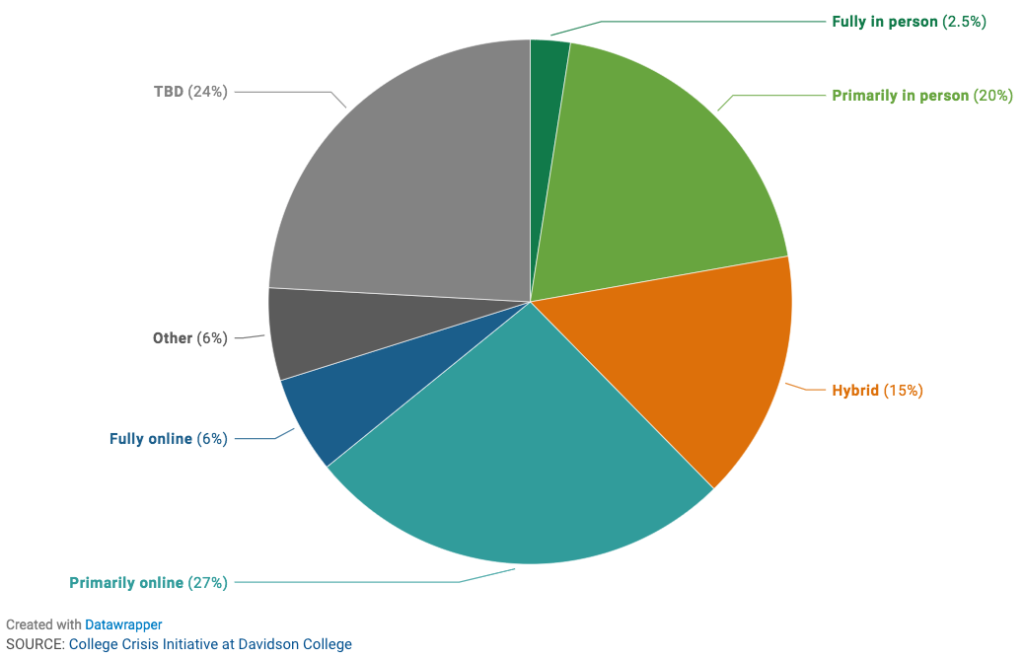
coronavirus campus fall 2020 choices 2020 Aug 19_Chronicle

Still, 24% have yet to make a decision.  One quarter of American higher ed hasn’t determined their choice.  Even now, as we hit August’s last week!

And the infections mount up.  How many campuses will carry that communal viral load into December?

Posted in coronavirus, higher education | 6 Comments

Campuses open and COVID-19 infections spread

Fall semester is upon us.  For roughly one quarter to one third of American higher education their students, faculty, and staff are heading to campus, even as COVID-19 infections and deaths keep rising.

As a result, some number of people spending time at those colleges and universities are getting sick.

What follows is a list of such events.  It’s not exhaustive.  It’s also a snapshot in time, what I’ve found by the night of August 18, 2020.  Tomorrow will doubtless add more.

  • Bethel College: 50 people have been infected, “including 43 students and seven faculty members.”  22 are athletes.  That’s almost 10% of the student body.
  • Boston University: 8 positive cases over the past three weeks.  Well, 12 now.
  • East Carolina University: 108 positive tests.
  • Emerson College: 1 person tested positive.
  • North Carolina State University admitted to some number of infections, either 8, 42, or 50, among fraternity and sorority houses.
  • Northeast Mississippi Community College: “‘around 300′” students are currently in quarantine… [T]he university has six or seven positive cases since school started last week and that ’25 to 28 employees’ are also under quarantine.”  That CNN article adds: “Northeast Mississippi Community College has around 3,200 students, which means around 10% of the student body is being quarantined.”
  • Oklahoma State University: 23 infections at a sorority.
  • University of Kentucky: 189 infections.
  • The University of Tennessee at Knoxville: an infection cluster created by “an off-campus party”  yielded numbers something like “at least five connected cases or 20 people in self-isolation.”
  • University of Wyoming: 38 cases “among… students and employees.”
  • Western Kentucky University: 19 infections for student and staff.

This is unsurprising, given events like this and this and this.

In Oklahoma:

Villanova University:

University of North Georgia:

University of Alabama:


(Before I get jumped on, I’m not sharing those stories to blame students nor to exculpate administrators, residence life, municipal authorities, parents, society, or anyone else.  That’s not the purpose of this post.  Instead I’m trying to understand what’s happening right now, and to use that understanding to better model what comes next.  Blame isn’t the theme here.)

This Washington Post article has a good roundup of such stories, as does the Chronicle.  This CNN piece is actually the most informative.

Another, related post to come tomorrow as time permits.

(thanks to Rob Gibson, Eric Stoller, Futurexhighered, Lisa Durff, Jan Potvin, and others for links)

Posted in coronavirus | 9 Comments

University of North Carolina at Chapel Hill jumps back online: our first Toggle Term case study

toggle switch by Alan LevineBack in April I first published three scenarios for fall 2020 classes.  One I named Toggle Term, which is when a campus switches from online to in-person education, or vice versa.  So far few colleges or universities have publicly committed to a Toggle.

Now one has actually done it.  We may have our first Toggle Term case in the wild.

The University of North Carolina-Chapel Hill started its semester with face to face education last week, but today decided to throw the online switch.  Everyone’s sent home over the next two days, except: “Residents who have hardships, such as lack of access to reliable internet access, international students or student-athletes will have the option to remain on campus.”

Let me offer some hasty information and quick reflections:

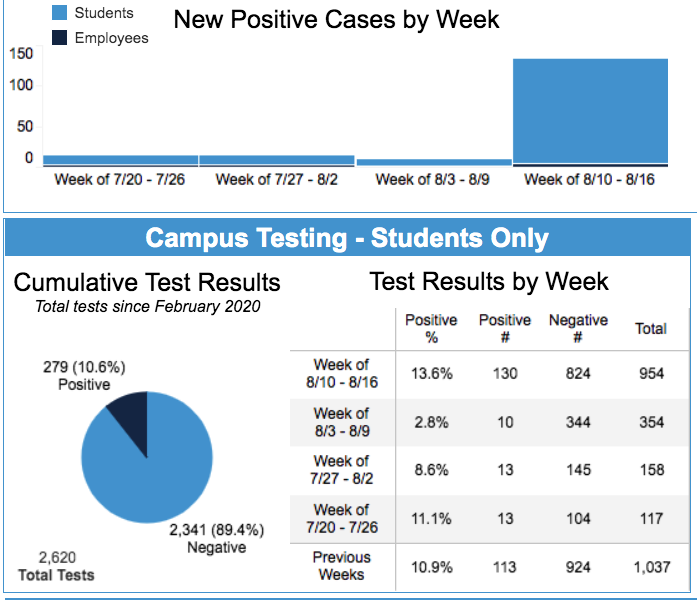
What triggered the switch? According to the official announcement, infections began right after classes resumed, then took off:

Campus Health Services reported a significant rise in positive COVID-19 tests over the past week (Aug. 10-16). Currently, 177 students are in isolation and 349 are in quarantine, both on and off campus.

According to the chancellor and provost,

In just the past week (Aug. 10-16), we have seen COVID-19 positivity rate rise from 2.8% to 13.6% at Campus Health. As of this morning, we have tested 954 students and have 177 in isolation and 349 in quarantine, both on and off campus.

That’s out of 30,000 students, or about 1.75% of the total student body, undergrad and graduate students combined (Wikipedia).  Or maybe that threshold is higher.  COVID-19 cases were centered on student housing: “four clusters of infection — three in residence halls, one in a fraternity” (Chronicle of Higher Education).  5,800 students live in campus housing (Washington Post). If we assume 526 likely infections (177+349) out of 5800 residential students, that yields around 9% of that population.

We can see those infections rise on the official UNC dashboard:

coronavirus UNC-Chapel Hill dashboard_new cases 2020 Augst 17

Those positive cases just took off in the past week.

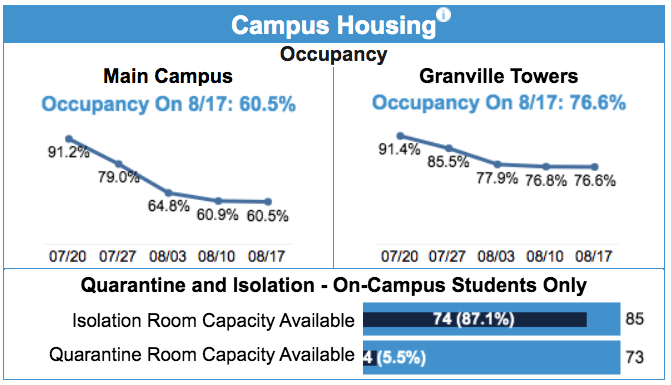
We could also understand this Toggle Term case in terms of housing capacity.  Again with the dashboard, note how on-campus occupancy declined:

coronavirus UNC-Chapel Hill dashboard_housing 2020 Augst 17

But then note how quarantine room capacity just about flatlined.  Four (4) rooms left?  5.5% of the pre-infection total?  As the brilliant Christine Wolff-Eisenberg summarized:

– Weekly positive cases: 10 (8/3-8/9) -> 130 (8/10-8/16)

-Weekly % positive cases: 2.8% -> 13.6%

– Rooms available for quarantine: 45 -> 4

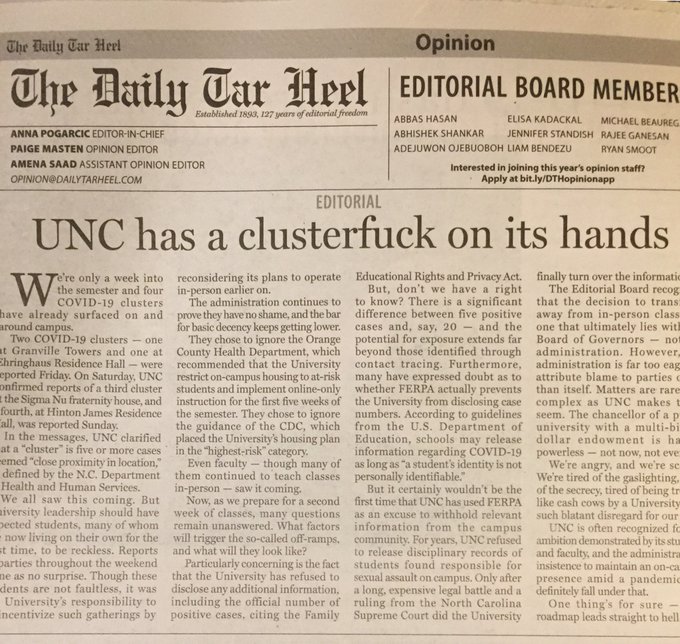
In response the student newspaper struck a very passionate tone.  Here‘s a screengrab from the print edition:

coronavirus UNC Chapel Hill_cluster

Read the whole editorial, but don’t miss the conclusion:

We’re angry — and we’re scared. We’re tired of the gaslighting, tired of the secrecy, tired of being treated like cash cows by a University with such blatant disregard for our lives.

UNC is often recognized for the ambition demonstrated by its students and faculty, and the administration’s insistence to maintain an on-campus presence amid a pandemic can definitely fall under that.

One thing’s for sure — this roadmap leads straight to hell.

Some observations in haste:

A 1.75% infection rate for the entire student body seems to have crossed UNC’s threshold for throwing the switch.  Or perhaps it’s higher if we assume 526 likely infections (177+349) out of 5800 residential students, which is around 9% of that total.  Early in August I asked about toggle thresholds.  Now we have more data.

Speaking of data, how many campuses publish coronavirus dashboards like UNC’s, where they publicly share their infection data?

Campus leadership will likely take a lot of heat for this (for example).  That could take the form of outrage, bad publicity, students withdrawing, and lawsuits.  I’m not sure how this plays out in terms of North Carolina state politics, especially as the November election draws nigh.

A sports-savvy friend tells me UNC is still playing football and other sports.  How much longer?  EDITED TO ADD: another person on Twitter says the game still is played.

One of the clusters took place in a frat house.  Greek houses have hosted infections elsewhere.  Will this lead to a new anti-Greek mentality in the public or among campus leaders?

What impacts this decision could have: it might inspire other open campuses to throw the Toggle.  The decision making process, including metrics, could apply to other institutions, especially those still calibrating their options.  Blowback may inspire others to avoid having Tarheel editorials written about them, as it were.

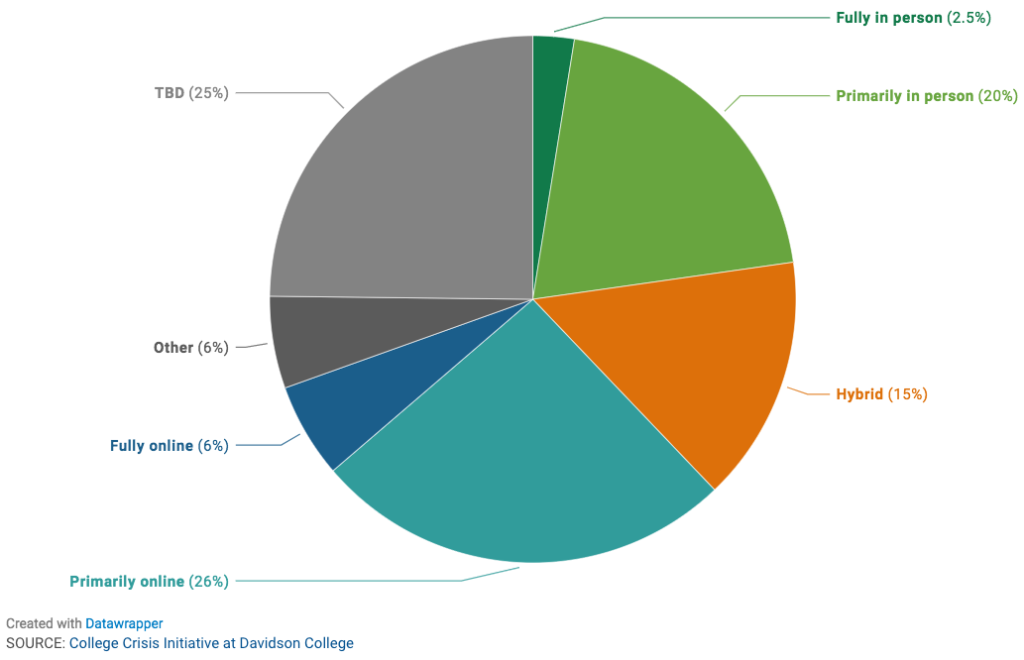
Many colleges and universities are still weighing those options.  Consider the Chronicle’s estimate of campus fall plans:

coronavirus_college opening plans_2020 August 17_Chronicle

That’s 22.5% (of the sample) still opening up.  That’s also 25% still (!) undecided.  Together it’s nearly 1/2 of American academia not committed to an online semester, or what I dubbed COVID fall.  There is a lot of room for choices, actions, and iterations.

Let me conclude with a note about those scenarios.  COVID fall, Post-Pandemic Campus, Toggle Term: thanks to UNC-Chapel Hill, each is now openly in play as fall semesters kick in.  I only offered the models; I did not estimate their proportion or persistence.  That’s my next task, if I can do it.

In the meantime, my thoughts are with the UNC population, and those connected with them.  I hope they quash the viral spread and avoid both injuries and deaths.

(toggle photo by Alan Levine; thanks to Linda Burns, Maggie Debelius, Christine Wolff-Eisenberg, and more friends for links and thoughts)

Posted in coronavirus | 2 Comments

Academia Next – it’s discount time for my book!

Academia Next coverThis past winter my most recent book, Academia Next, appeared in print and ebook formats.  Reactions have been fascinating and gratifying so far.

buy zovirax online buy zovirax no prescription generic

Now I’d like to share a way of getting the book for cheap!  This pleases me as someone who always looks for a sale, but it’s especially important as economies stagger and campuses slash their budgets.

This week Johns Hopkins University Press has put some of its higher education studies collection on sale.  Just use the code “HHED” (no quotation marks) during checkout and chop 30% off of each title. You can get my book that way.

I can recommend other titles as well, like Edward J. Maloney and Joshua Kim’s brand new The Low-Density University: 15 Scenarios for Higher Education.  I think that’s the first major scholarly book about the 2020 crisis.

buy intagra online buy intagra no prescription generic

  You can also grab Eddie and Josh’s previous book, Learning Innovation and the Future of Higher Education.

David Staley’s Alternative Universities: Speculative Design for Innovation in Higher Education is there and I can’t recommend it enough.  It’s an inspired imagining of multiple possibilities for higher education, each powered by different ideas.  I’ve taught it before and it’s superb.

Becoming Hispanic-Serving Institutions: Opportunities for Colleges and Universities is an essential guide to HSIs.  Author Gina Ann Garcia was also a terrific Future Trends Forum guest.

You can snag Kathleen Fitzpatrick’s Generous Thinking: A Radical Approach to Saving the University, one of the most provocative, humane, powerful – and accessible! – books written about higher education in the 21st century.  Kathleen was also a great Forum guest.

I also recommend How to Run a College A Practical Guide for Trustees, Faculty, Administrators, and Policymakers. Brian C. Mitchell and Joey King walk the reader through how a college actually works, and do so in clear prose, informed by decades of experience.  I’ve taught this book for years and students devour it.

buy strattera online buy strattera no prescription generic

John Warner’s Why They Can’t Write: Killing the Five-Paragraph Essay and Other Necessities is also there, a sharp, witty, thoughtful, and very useful guide to improving college writing.

The sale ends this Friday, so now’s the time to pounce.  Happy reading!

Posted in writing | 1 Comment

About the academic work/life balance: a discussion and resources

Last week the Future Trends Forum met with Rebecca Pope-Ruark, of Agile Faculty, to discuss how people in academia could best balance work and life.  It was a powerful session with intense discussions, and you can see the whole thing here:

Many opinions and ideas flowed.  A great deal of advice impressed us.  We also shared a great deal of resources, so many that I wanted to make sure they were available beyond YouTube and Twitter.

In this post I’ll list as many as I could capture, with quick introductions for context.  I try to follow chronological order, but also to knit together some themes that stretched across the whole hour.

Rebecca led off by recommending as a high priority that we establish stronger barriers in our daily lives, including physical distance and/or rituals for separating work from the rest of life.  Following up, Raj Devasagayam asked us to consider how the emotions from work can echo or persist in non-work life:

David Drake offered two thoughts during a discussion of overwork:

There have been ample studies showing that if you actually try to do less, you end up producing more meaningful work. So rest! Take care of your physical and emotional state.

and

In academia, as professors, what we produce is most recognized, not that we work 80 hours a week. I tell my junior faculty that no one cares how hard you work; they care about what you produce.

Along those lines David also recommended Cal Newport‘s Deep Work.

On a related note, and also in terms of general stress, Roxann Riskin advised us:

To help with anxiety and stress for Mindfulness practices – like mindful breathing, meditation, Apps are fantastic resources often available at no cost.

Vanessa Vaile added to that theme advice for us to “catch a pulmonary rehab training video on breathing.”

The topic of academic capitalism came up as a way of explaining why so many faculty and staff were under stress even before COVID-19 struck.  One brilliant editor recommended Academic Capitalism and the New Economy Markets, State, and Higher Education by Sheila Slaughter and Gary Rhoades.

Our guest drew attention to the challenge facing faculty of the pressure to produce research during a pandemic.  Some recommended ratcheting down research expectations.  Greg Britton cited a quote by William Stafford: “Lower your standards and keep writing.”

How can faculty teach while helping students through this crisis?  One way to reduce student stress is to change assessments and assignments. Sarah Sangregorio asked us to consider offering “more formative assessments and less-high stakes testing.”  She also pointed to using assessments other than multiple choice, and assigning more project based learning.   David Houle added that he uses “formative testing though presentations, group projects, and written assignments.”

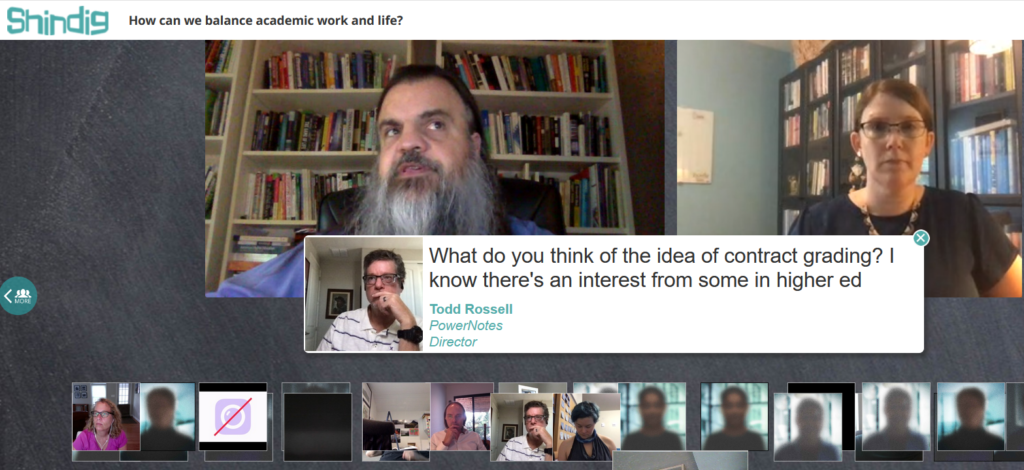
Forum_Ruark_Todd Rossell Question on contract grading

Contract grading rose as an option.  Others cited Dave Cormier as one authority on that topic.  Several recommended following Laura Gibbs on Twitter as an expert on online learning.

This teaching and learning practice topic scaled up to larger changes in teaching and learning.  Lisa Durff suggested we structure teaching in terms of mastery learning.

How can faculty help with students’ mental health when they aren’t trained as therapists?  Roxann pointed us to an introduction, a Psychological First Aid class from the National Child Traumatic Stress Network’s  Learning Center.  (Requires creating a free account if you don’t already have one.)

How can faculty and staff help students enduring trauma?  Karen Costa recommended Laura van Dernoot Lipsky, Trauma Stewardship.  However, several people warned us of the dangers of compassion fatigue, including Michael Arnzen on Twitter:

Discussing the stresses of how in-person education could transpire, I recommended a game by Cait S. Kirby, “October 1st, 2020.”

We touched on educational technology at several points.  When it comes to videoconferencing overload, a/k/a Zoom Fatigue, Roxann shared this article. Lisa reminded us that this isn’t just a technological issue, asking us to “compare that to lecture hall fatigue.”

Throughout our discussion the theme of people having difficulties processing and expressing their emotions came up.  Roxann suggested Marc Brackett‘s book Permission to Feel.  Several suggested a strong gender divide along these lines, and discussed the desirability of men’s and women’ support groups.  Rebecca tweeted this out as an open question, as did Karen Costa:

https://twitter.com/karenraycosta/status/1294041279760871426

Consultant and coach Keith Edwards tweeted out a reflective response:

Rebecca and others cited Brené Brown on vulnerability.

Overall, I and others approvingly noted our guest’s books.

My deepest thanks to our splendid guest Rebecca Pope-Ruark and to the awesome Forum community for a rich, meaningful, and very practical discussion.

(Mental health isn’t something I normally write about.  Would readers like more of this?)

Posted in Future Trends Forum | Leave a comment

Which colleges and universities are cutting prices or offering other deals for the upcoming academic year?

How will higher education make the upcoming academic year work?

discount_Mike Cohen credit score geekOne strategy is to offer new financial inducements to attract enrollment.  This is especially important for campuses concerned about losing students.

Such inducements can take several forms.  One is as a discount*, price cut, rebate, or scholarship.  Another is to offer free classes or even semesters.  More creative options may appear.

In this post I’d like to track some of these inducements.  If this is useful for people, I’ll update it as things develop.  Please feel free to add more information in comments.

UPDATED August 15 2020

  • American University offers a tuition discount, “an AU Community Care Fall Discount equivalent to 10 percent of fall tuition.”
  • Beloit College offers free tuition for undergraduates’ ninth and tenth semesters.
  • Champlain College cut tuition by 17% – for adult learners in the local (Burlington) area.
  • Clark Atlanta University cut tuition by 10%.
  • The College of New Jersey offered cuts “of 3.5% for in-state undergraduates and 2.5% for out-of-state undergrads…”
  • Georgetown University offers a 10% tuition cut for “students who are not invited back to campus.”
  • Hampton University cut tuition and fees by 15% for fall 2020.
  • Johns Hopkins University will discount tuition 10%.
  • Lafayette College discounts tuition by 10% for off-campus students.
  • Pacific Lutheran University revealed a tuition-free fifth year program.
  • Paul Quinn College cut tuition down from “$8,321 to $5,996,” about 28%.
  • Princeton University announced a 10% tuition cut.
  • Rollins College now offers “a grant” of $2500 to students taking classes entirely online.
  • Rowan University discounts 2020-2021 tuition by 10%.
  • Rutgers University cut campus fees by 15% (see below for their tuition).
  • St. Mary’s University (San Antonio) offered a 50% tuition break early in summer.
  • St. Norbert College launched Norbert’s Ninth, a tuition-free semester for undergrads who meet certain conditions after four years.
  • Southern New Hampshire University offered a range of cuts, including “a one-time ‘Innovation Scholarship‘ to all incoming campus freshmen which will cover 100% of first-year tuition” and an effort to “bring campus tuition down to $10,000 per year by 2021, a 61% reduction from its current rate.”
  • Spelman College cut tuition by 10%.
  • Thomas University offered a 30% break in May.  I’m not sure if it’s still on; their Level Up program promises a discount, but doesn’t specify the amount.
  • The University of Cincinnati cut residence life fees by 15%.
  • The University of Mary Washington will refund some residential fees for on-campus students, as the first three weeks of fall term will be online.
  • West Chester University cut tuition 11% for in-state, full time undergraduates.
  • Williams College will cut tuition by 15%.

There are related precedents that applied to spring 2020. For example, Occidental College gave students the chance to apply for up to $1500 in CARES-funded relief for “expenses related to the disruption of the spring semester by the pandemic…”

Other campuses have refrained from cutting tuition, but they also decides not to increase it:

  • The College of Charleston froze tuition.
  • Kansas City University froze 2020-2021 tuition in April (still appears to be on, according to this recent article)
  • Michigan State University will freeze tuition, according to local media.
  • “Massachusetts Institute of Technology, the University of Massachusetts and Pennsylvania State University have all announced a tuition freeze for the fall” (Daily Northwestern)
  • Rutgers University froze tuition.
  • Trinity College (Hartford) froze theirs.
  • William & Mary University will “roll back a previously adopted tuition increase for incoming in-state undergraduates and keep tuition and mandatory fees flat for all students”

In contrast, some institutions have made a point of not discounting tuition:

  • Louisiana State University, not for online classes.
  • Northwestern University will increase tuition 3.5%.
  • The University of North Carolina system campuses won’t offer any cuts.
  • “the University of Pennsylvania, Villanova University, and Drexel… are sticking to previously planned tuition increases” (Philadelphia Inquirer)

So why does all of this matter?

This burst of freezing and discounting suggests a higher education sector that’s competing for students more aggressively.  Which is not a surprise to anyone following stories of potential enrollment declines due to COVID-19.

Students may organize to put pressure on administrations for further cuts. Additionally, Lilah Burke notes that there was substantial downward pressure on tuition before the pandemic broke out.  COVID accelerates this.

Tuition discounts, freezes, and other ways of reducing student payments are on the table now.  How many campuses will enact them?

*Here I mean “discount” in addition to the normal tuition discounting American colleges and universities tend to do.  That’s when they publish a certain tuition amount (sticker price), then use a variety of tools to cut down the actual price charged in order to attract certain students.  Last year the average discount rate was around 50%.

(with help from Inside Higher Ed, Jason Jones; discount picture by Mike Cohen)

Posted in economics, higher education | 19 Comments