Election Day in the United States: what are you seeing in and around academia?

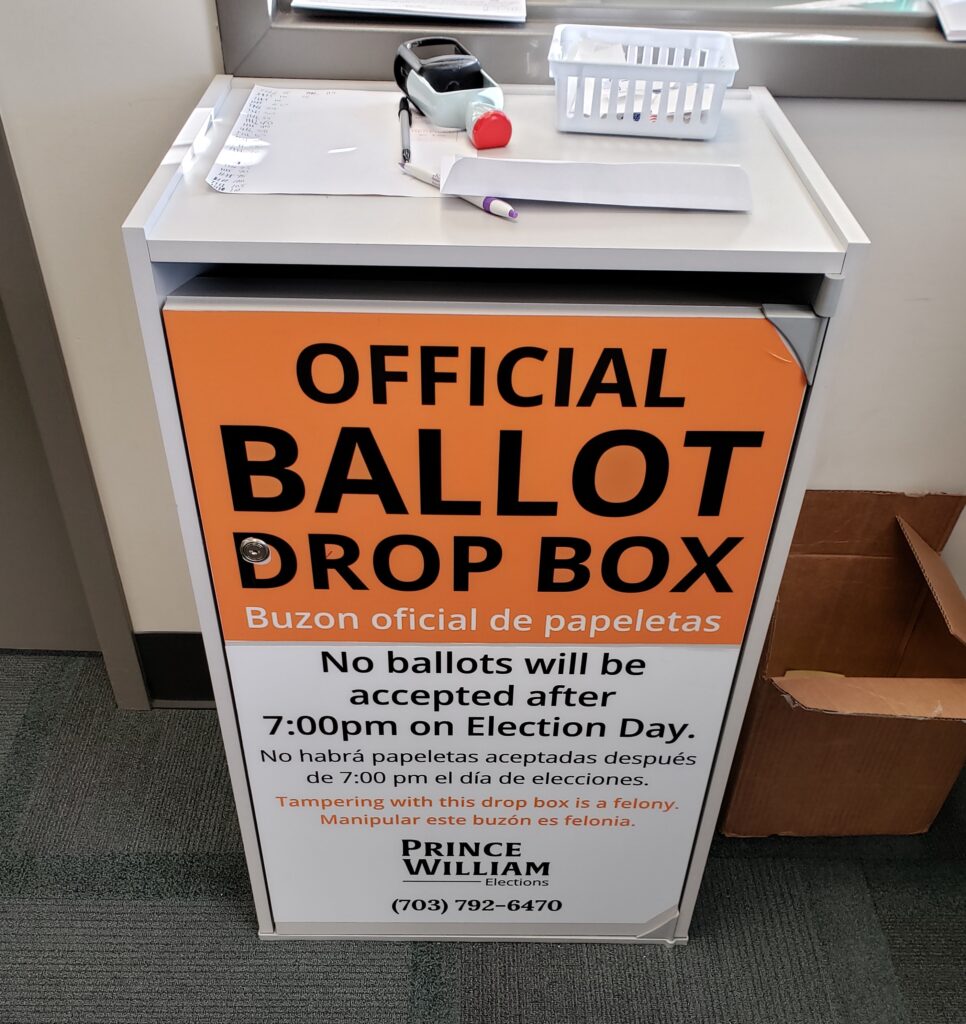
voting box 2020

Dropped my ballot off yesterday.

Today, as Google Calendar and every human being on Earth apparently tell me, is Election Day in America.

I have a post coming up from a futurist’s perspective, offering some thoughts, but this post is for you all.  The comment box stands open, so that you can share your thoughts and observations:

What are you seeing today in and around higher education?

From my side, a few things.

First, my Georgetown seminar on technology normally takes place Tuesday nights.

buy elavil online buy elavil no prescription generic

  The students persuaded me and each other to reschedule tonight’s session for later in the week.

buy zydena online buy zydena no prescription generic

  They were concerned about possible chaos – quite reasonably, since many of them live in the Washington, DC area, which is a fine candidate for unrest and madness of all kinds.  In fact, we’re not the only ones battening down the hatches.

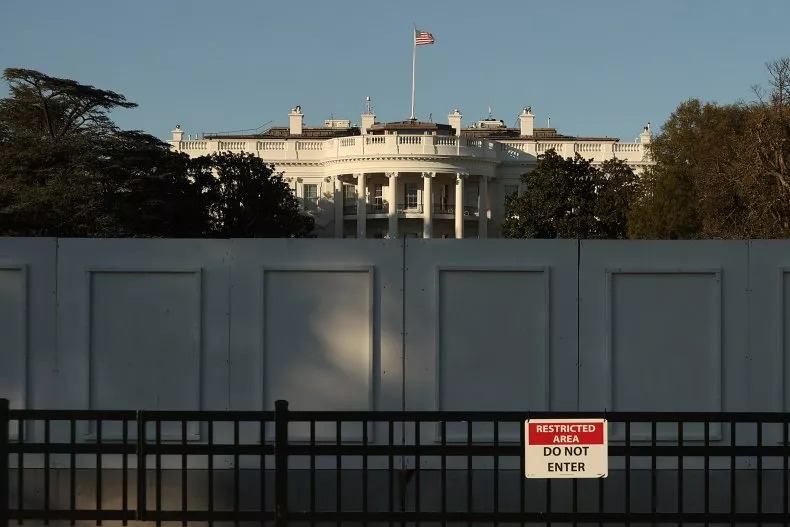
White House election day 2020 wallSecond, the Chronicle of Higher Education and Inside Higher Ed each have front page readings about academia and this election, if you’re looking for last-minute voting fodder or just general information and reflection.

Third, from my neighborhood: Manassas, Virginia is pretty quiet so far.  There haven’t been many indications of the national election here since the Democratic primary.  There are very few yard signs for either presidential candidate and we haven’t gotten a mailer for a long time.  In our Congressional race, Republican Rob Wittman has been shipping us fliers perfectly designed to get us to support his opponent, Qasim Rashid.

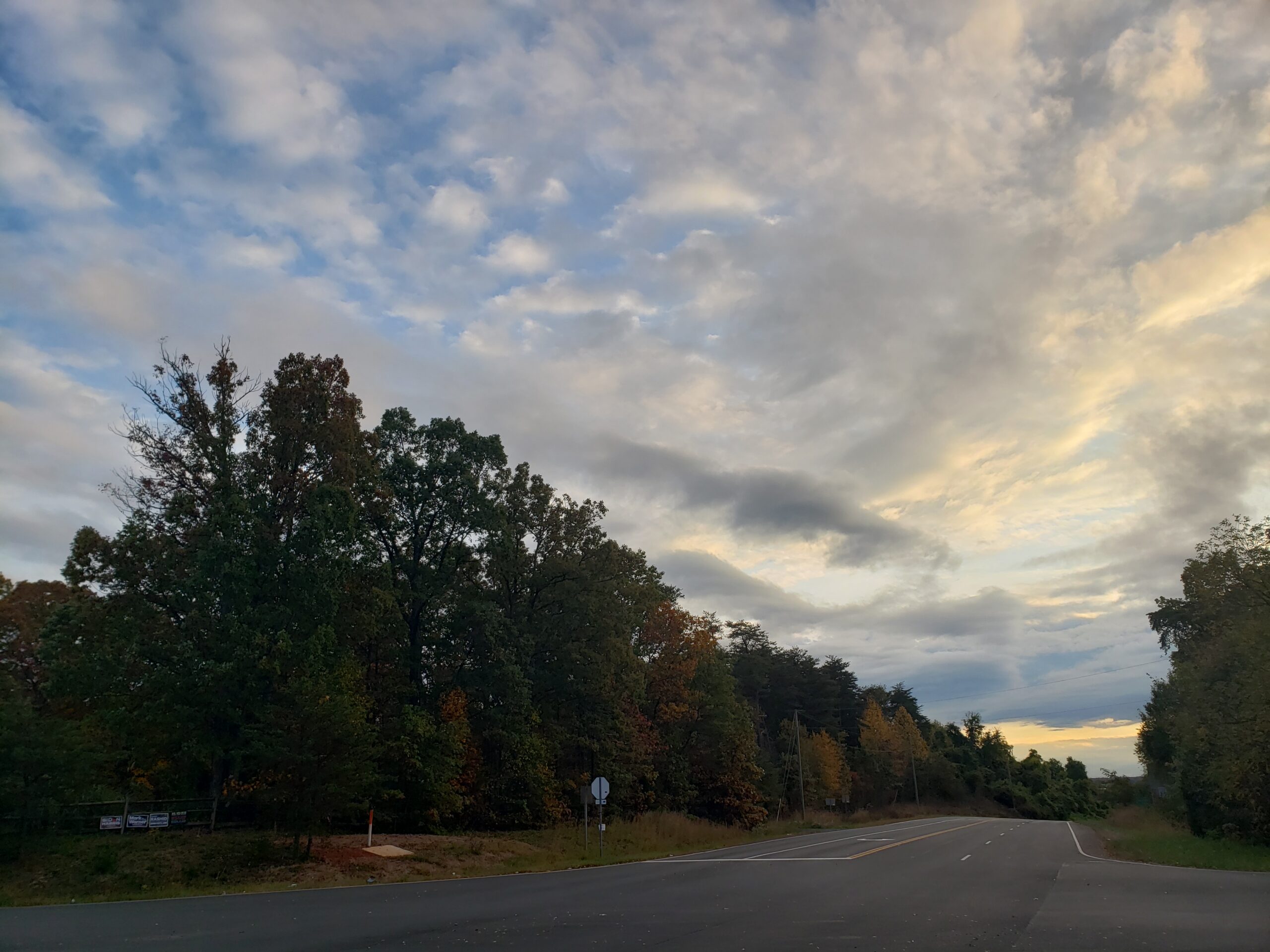
I’ve already voted (see photograph above) but may drive around today to see how things go – and never ever leave the car.

Fourth… ah, back to the next blog post.

Now, over to you.  What are you seeing, dear academics and academically-adjacent folks?

EDITED TO ADD: Thank you for sharing, friends.

buy intagra online buy intagra no prescription generic

Some stories and observations from Twitter:

From Grinnell College:

https://twitter.com/KBeeHall/status/1323679560882364428

From Manhattanville College:

Posted in politics | 2 Comments

Halloween 2020: America’s Great Fear

Greetings from the United States.  Happy Halloween to all.

I was going to write about the holiday, recommending some stories, and reading one out loud.  I’m still planning on the latter, but it seems awkward if not outrageous to focus on imagined terrors when the nation is really in the grip of others.  Here I’d like to look into the fears criss-crossing our culture and polity, with a look ahead to where they might take us.

What is America afraid of now?

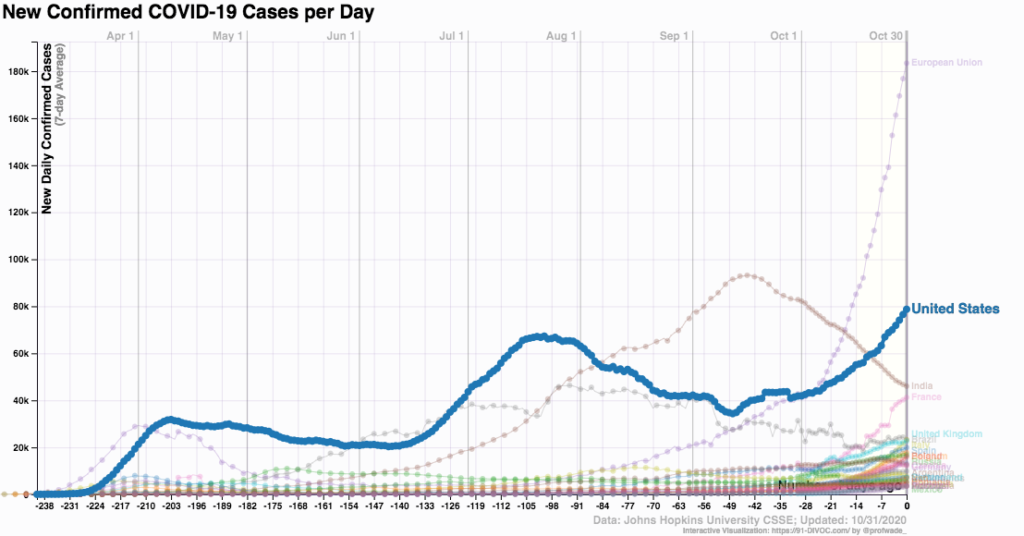
Dread of the pandemic is perhaps the leader.  Infections are soaring:

coronavirus world spread US_91-DIVOC_2020 Oct 31coronavirus world spread US_91-DIVOC_2020 Oct 31

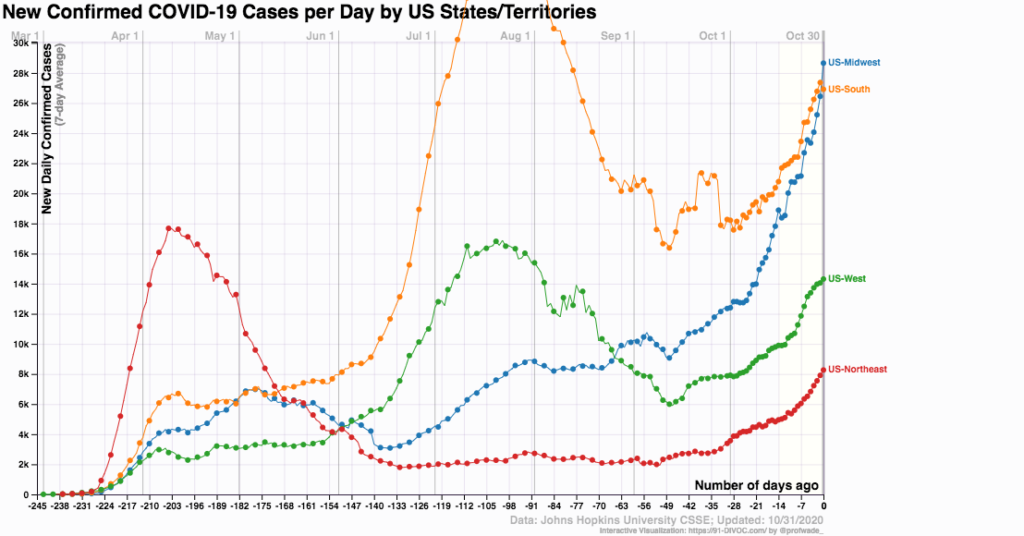
This rise is happening across the country, which represents a change from more localized breakouts earlier in 2020:

coronavirus US by region_2020 October 31 91-DIVOC

Deaths are also rising, although not at so steep a rate, thankfully.  As I write this the CDC claims 9,024,298 American infections, or cases amounting to close to 3% of the total population.  They also cite 229,109 deaths, which is likely an undercount by a significant amount.

(World numbers are much higher.  WHO cites 45,428,731 confirmed cases and 1,185,721 deaths, but non-US virus news doesn’t engage most Americans from what I’ve seen.)

Obviously this gives rise to fears for most of us who follow the viral course.  Such fears are more present to those who have experienced infection in their friends, family, and communities.  Non-medical sources amplify the dread, including news media and anti-Trump political actors.

buy vibramycin online buy vibramycin no prescription generic

Personally, I’m a full-throated extrovert.

buy prednisone online buy prednisone no prescription generic

  I love being with people.  Crowds charge me up.  And now, after nine months of COVID-19, the sight of a single person makes me twitch.  I even find myself getting anxious at times just watching movies with people in close proximity.

Back to those media and political actors.  Tv news is in full throated fear mode, from what I can make out.  Pro-Trump Fox News and anti-Trump everyone else zero in on any clashes, chaos, or danger that fits their respective Gothic programming styles – which isn’t new, as I and others have pointed out for a while.  The election carnival mentality, which tv news stokes, just heightens the horror.

And the election!  Both campaigns are passionately detailing the horrors that will come to pass if the other old man wins.

buy suhagra online buy suhagra no prescription generic

  Trump paints a Biden portrait complete with savaged suburbs, rampaging immigrants, cities on fire, corruption, and an economy in ruins.  Biden portrays a second Trump term as saturated with racism, sexism, corruption, escalating inequalities, and a world shambling towards climatological disaster.

buy cipro online buy cipro no prescription generic

  Additionally, each party dreads fringes of the other to varying degrees of realism or fantasy: antifa, Proud Boys, Black Lives Matter marchers, white supremacist militias.

Behind these immediate and short terms fears lurks the vast specter of climate change.  In many ways the events of 2020 have crowded the planetary crisis off the collective radar, but that concern remains for a good number of Americans – a majority in this poll, a growing minority in this one.  Beyond the level of survey responses, there might be deeper psychological effects of climate change, from mourning to a sense of rootlessness, as Bruno Latour argues.

To shift to a personal angle again, when I raise climate change as a topic to various audiences, academic and otherwise, they tend to be receptive, yet thoughtfully quiet.  Few others have brought up the issue in the various fora and venues I’ve attended since COVID-19 burst out.   It lurks.

I called this post “the Great Fear” to reference French events in 1789. This was a rolling combination of rumor, panic, and local uprisings, which combined to help drive things to a revolutionary boil.  Will this mix of fears haunting America also yield social transformation?

So much depends on the presidential election, just a few days away.  Yet these fears can shape how we go through the voting process, especially how we respond to its results as the hours, then days proceed.  Others have gamed out options, based on polling data and the reactions of political leaders.

It seems reasonable to presume that increasingly scared people are likely to act erratically and/or violently.  Militias, for example, fearing a Biden presidency would destroy the America they envision, might be more likely to open fire if they feel themselves under threat. Antiracist protestors could be more apt to chuck a rock at opponents they see as driving us towards fascism (i.e., it’s ok to punch Nazis).  Once this kicks off it can trigger a round of intensifying followup actions, as extremists can harden in their positions and justify violence, since the others guys did it.  Media representations, both through professional sources and social media, would then egg things on.  Moderates, in turn, could be radicalized by these events and become more likely to accept, support, or at least turn a blind eye towards violence.

On the other hand, humans can accept large charges of fear without acting out.  We do this in entertainment, from roller coasters to action movies to… Halloween. We can respond to televised horror news with the networks’ favorites responses: continued watching and buying stuff. We can also become numb to certain horrors, bored even, and so much less likely to storm a police station or drive over a protestor.

So much depends on how the election plays out.  A clear victory by either party could reduce changes of people contesting the vote. Either winner would have the option to try soothing the nation – something Trump is demonstrably disinterested in.

Back in 2016, again in 2018, and also in 2019 I asked how likely America was to fall into civil unrest.  Each post raised various flashpoints and configurations, from native American opposition to pipelines to anti-ICE actions.  Commentators added more, including personal violence (individual shooters), reactions to presidential impeachment, and minorities already experiencing violent oppression.  2020 has seen the closest realization of these possibilities, between nationalwide protests and strikes, public demonstrations by armed groups, and some individual acts of violence.

Looking ahead to the next few months, 2020’s intensity could be ratcheted up as our fears encourage us to act, buttressed by various degrees of real world evidence, projections, and fantasy.  Our own Great Fear might lead to an American tumult.  The view from Halloween can be a dark one indeed.

Posted in coronavirus, politics | 2 Comments

Another seminar gaming experiment: Future University, a little role playing, a little tabletop

Today one of my classes is going to be the first to play an educational game I’ve been working on.  It’s an experiment, and I’m very excited to see how it goes.

The class is my future of higher education seminar in Georgetown’s Learning, Design, and Technology graduate program.  (Here’s a description of last year’s instance.) Students have been reading, thinking, and writing about how colleges and universities work, how they change, present day trends shaping them, and numerous future scenarios for where they might go. Several took my summer gaming in education seminar, so they should be ready to share thoughts from that experience.

The game they’ll play is called Future University, and it’s a matrix game.  These are unusual hybrids of role-playing and tabletop games, where players have a great deal of freedom to act and rules are relatively minimal. A key feature is that play largely consists of player describing actions they would like to undertake, followed by a supporting argument, then all players hashing out the likelihood of the thing actually occurring.

A facilitator or referees adjudicate each action, at times setting up a resolution structure, and recording the resulting changes on a shared game map.  All of these action attempts and their outcomes build up into a collaborative narrative.  Historically, matrix games emerged out of the wargaming and defense worlds originally, but are open for general use.  (For more background, try this or this.)

Why would anyone use this framework for a game?  Partly it’s to free up player imaginations by avoiding elaborate rules.  It’s also designed for mental exploration.  I like Paul Vebber’s description:

Rather than explore what happens when we are told: “here is a set of tools, go solve this problem”, Matrix Games provide a means to “explore what problems there might be, how to characterize them, and how to devise a set of tools that you think might solve them.” *

Furthermore, I’ve been working on a solitaire tabletop version of this game for months – and it’ll appear eventually.  Here I wanted to emphasis the social aspect of gaming, which is important for the topic as well as for the pandemic.

How Future University works:

Exemplum from Yale Law Library

Exemplum draws on a fine tradition.

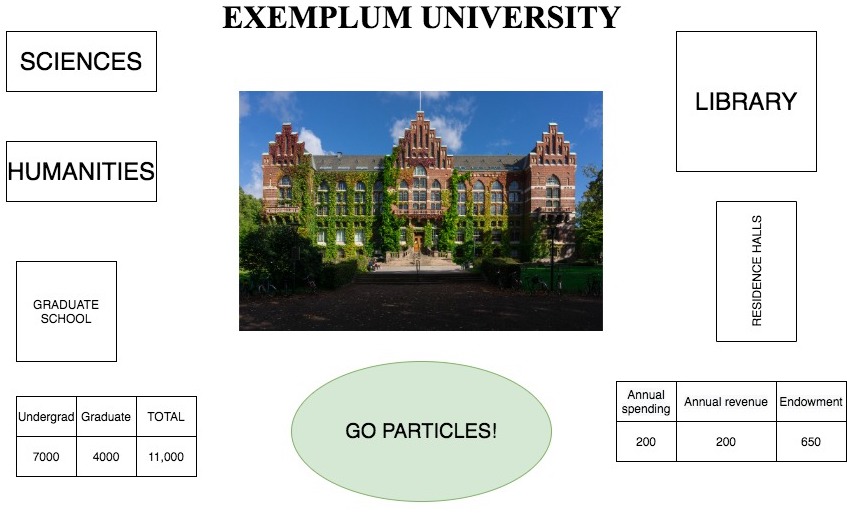
I’ve created a hypothetical campus, Exemplum University.  It’s a research-2 institution located vaguely in the mid-Atlantic area.  Students will receive a short briefing sketching out its history and present-day details.  They also receive a very short rulebook.

Students then volunteer/are assigned to play various roles at Exemplum.  They include:

  • University president
  • Provost
  • Chair of board of trustees
  • Humanities faculty members
  • Science faculty members
  • Head of student athletics
  • Non-faculty staff, including the VP for information services (IT + library)
  • Students, including both undergraduates and graduates

We have ten students in the seminar, so some will pair up on roles, while others represent individually.  Each receives a very short description of their character or group’s background, interests, and challenges, along with some notes about campus relationships.

Each game turn represents one full academic year, starting in autumn and ending the next calendar year’s summer. On each turn we take the following steps:

  1. Update on university status
  2. Player Actions stated and resolved
  3. Update on university and world events.  Random events will pop up here.

They can all see the game board, which looks like this:

Exemplum University board

Remember, this is a draft! Very DIY. No professional designers were involved or harmed in the making of this board.

Here’s a sample action and resolution:

For their Action, the provost team announces they will attempt to launch a new center for interdisciplinary studies. For their Argument, the provost describes having won financial commitments from the trustees and interested professors from the faculty.  Their goal is to produce spectacular research and attract more students.

Other players weigh in.  The athletics player thinks this might lead to cost overruns if there’s a new building involved.  The trustees confirm their support.  Students think this could be attractive. The humanities player argues that this should help build up a better sense of campus community, while the scientists respond that this will fail due to a lack of that community. The president remains silent.  

The facilitators rule that there is no consensus and set up a dice roll. They assign +1 for the trustees’ monetary support and -1 for faculty dissensus.  The roll comes up 9 and remains so as the modifiers cancel out.  Facilitators congratulate the provost on their success, but warn them that a cost overrun is a possibility on the following turn.  They add a Center for Interdisciplinary Studies marker to the campus map.

How will we make this work, in practical terms?

My current plan is to introduce the game in today’s class.  Students will pick up roles and receive documents. I’ll talk them through the ideas and give them a chance for basic questions.  This will also give me a sense of how to facilitate play.

Over the next week they’ll play an asynchronous, first turn on in our discussion forum (in the Canvas learning management system). They’ll issue actions by early next week, then respond to each other’s proposed actions with supporting or opposing arguments. I’ll adjudicate it all and share results online, including an updated game board.  Throughout the week they’ll have plenty of chances to work with each other, comparing notes, planning actions, scheming, etc.  They can also ask questions about the game’s world, which we’ll flesh out together.

Then in next Thursday’s class we’ll go further, playing three turns on live video (Zoom).  Depending on how this goes, we’ll attempt another asynchronous turn over the following week.  The next Thursday is a debrief, where we compare reactions to what we learned.

Assessment: I’m considering playing Future University to be a week of class discussion.  That means I can check on how students are applying their learning through play, both during asynchronous writing and synchronous sessions.

Since this game offering is an experiment, I have some latitude in how it’ll unfold.  For example, I’ve produced some game turn worksheets, which I might or might not use.  I’m still thinking about how to show actions on the map – what kind of counters to add, or changes to the displayed data.  (If we were in person, I’d bring a box of counters and wouldn’t alter the printed board. I might have to add tracks for metrics, too.) I’ll have to figure out how much world building I need to add, and how much players should contribute.  They’ll also have a lot of room to explore.

Where this goes next: it depends on how play transpires.  There should be a hefty amount of playtest feedback to hurl me back to the drawing board.  I’ll revise the design on multiple levels.  Then… offer it for next year’s class, maybe.  I could also offer it for other groups or settings.  I can also set up different scenarios, such as for a liberal arts or community college. Eventually I’ll have to put a bow on it and see it into the world, perhaps as an ebook.

What do you think?  Any recommendations, howls of outrage, thoughts of intrigue?

(Thanks to many folks for feedback, including Todd Bryant, Michael Haggans, Tom Haymes, Ruben Puentedura, Vanessa Vaile, and Justin Vasselli.  Special thanks to Stephen Aguilar-Millan and the summer 2020 Dragon, Bear, Steppe game players.  Thanks, too, to the LDT program for hosting my mad experiments. Lund University building photo by barnyz.  Exemplum exemplum photo from Yale Law Library.)

*In Curry, John, ed. The Matrix Games Handbook: Professional Applications from Education to Analysis and Wargaming, p. 221.


Posted in future of education, gaming, teaching | 10 Comments

Higher education and climate change, a view from late 2020

This week I gave a short talk on climate change and higher education.  The venue was the EDUCAUSE annual conference, online entirely for the first time.

This was a new talk.  I haven’t spoken solely to climate change and academia since… perhaps ever.  I’ve touched on it in many presentations, but never exclusively, so I had a good opportunity to dig into the ideas I’ve been blogging and book-writing about.

Here are the slides:

[slideshare id=239006839&doc=climatechangeandhighered-201028211244]

And here’s my outline.

  1. Impacts on campus operations and environment.
  2. Possibly relocation due to water, prairie, desert expansion.
  3. Changes to campus IT: funding, operations, assessing new technologies.  Example of open.
  4. Impact on research.
  5. ” ” teaching: curriculum, culture.
  6. Role of academics in the crisis.
  7. Lessons from 2020: innovation, stress, social justice.
  8. COVID-19 as dry run for climate change.
  9. Potential impact on national/international higher ed.
  10. How all of this interacts with trends before 2020? (Shameless book plug)
  11. Positive thoughts and inspiration.

I wasn’t sure how folks would respond.  This is a very heavy, very deep topic, and one that might not fit in mind during the crises of 2020.  But participants found themselves deep in thought:

The audience then offered plenty of questions, happily.  I answered some before out time was up, but wanted to share them all with you to give a sense of the topic’s depth and complexity:

remote work – a long term viable option versus returning to campus work. A lot of resistance – what to do? Any suggestions how to frame the conversation?

What are colleges currently doing related to Sustainable IT? Is there a report on this?

What is the future of instructional design? What skills and resources are needed for engaging online learning?

How do enrollment trends factor in? ie, how can universities tackle climate problems in the face of declining enrollments/budgets?

Should we renew the academic pool of lecturers? When the same ones taught business as usual for so many years? How can we expect them to change their mind (thinking about all those Business schools with their MBA for instance). We knew about the planet resources limit since the 70s

How would you propose we gather together the right campus folks to start brainstorming these problems?

how do you see climate change and COVID impacting both physical and digital accessibility for those with disabilities?

will 2020 be the big switch or just a major pandemic with every one running as fast as possible (once over) to life and business as usual?

What do you think of the desalination extraction of seawater?

You mentioned climate refugees. How do we as academics advocate for and facilitate the relocation of climate refugees?

We also have the most wind power in the world centralized in the United States. Have you considered this as a source of carbon free energy for power in the future?

How do you feel for profit education who has demonstrated innovation will impact not for profit higher education institutions?

I was struck by how practical most discussion was.  How do we plan for this?  Who should take the lead?  What is the role of faculty?

After my macro view, the audience did manage some big picture questions.  Connecting 2020 to climate change was difficult and rarely attempted.  Folks were interested in this year for its own sake, which makes sense.

From my side, I think I successfully communicated a few things: that climate change is a huge and sustained challenge to colleges and universities; that is hits across the academic ecosystem; that we need to plan out the complexities sooner rather than later.

My thanks to Christopher Brooks for moderating the session.  Thanks, too, to a very thoughtful audience, and to EDUCAUSE for providing the venue.

Posted in climatechange, coronavirus | 2 Comments

Snapshots of COVID on campus: evidence from late October 2020

I’m writing this in haste, as I’ve been spending hours in meetings, interviews, and class preparation.  I have an experimental teaching game to share shortly, among other news.

Yet at full speed I wanted to share some datapoints from today concerning COVID-19 and higher education.

ITEM: Another student died of the pandemic.

A University of Dayton student has died, apparently from complications due to COVID-19, the school reported today.

Michael Lang, 18, a first-year student in the College of Arts and Sciences from LaGrange, Illinois, died Thursday, Oct. 22, following a lengthy hospitalization, UD says.

That makes five coronavirus campus deaths this fall, according to my count: three students, one security officer, and a university president.

(I don’t know any other trackers on this score.  And I fear that these stories will vanish as they make us uncomfortable, occur in rural or flyover areas, and don’t take place on elite/media-friendly campuses.)

ITEM: another campus declared a Toggle Term.* This time it’s HBCU Florida Memorial University, and they will spend the rest of the semester online.  That’s about 24 cases for the current semester.

ITEM: Lilah Burke reports on how infection rates spiked early this term for some universities, but have dropped steadily since.  Negative reactions have also dropped: “As colleges have continued to rack up cases, the outrage and concern that once met them has become quieter.”

ITEM: some campuses are pushing for more faculty and grad students to return to the in-person classroom.  Northeastern University is making such a push for spring term.  This is a change from fall:

For the fall semester, Northeastern is offering a mix of online and in-person learning, and the university has allowed wide latitude for both professors and students uncomfortable returning to campus.

But in the spring, faculty requesting to work from home will be approved on a case-by-case basis, [David Madigan, the university’s provost and senior vice president for academic affairs] said. Those eligible include people with disabilities, those with pregnancy-related conditions, anyone with a medical condition that puts them at greater risk of becoming severely ill if they contract COVID-19, and those living with someone who has such a condition.

The University of Florida is making a push for faculty to teach in person this term.  And their president explicitly linked that drive to layoffs and cuts:

ITEM: a university chancellor told his community to avoid large scale gatherings, then went to a Trump rally.

ITEM: American tuition and fees rose more slowly this year than at any time since the 1990s.

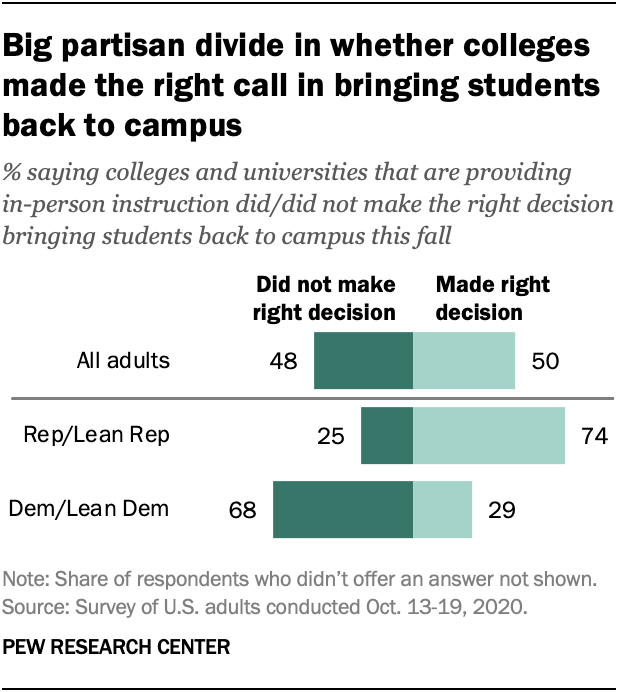
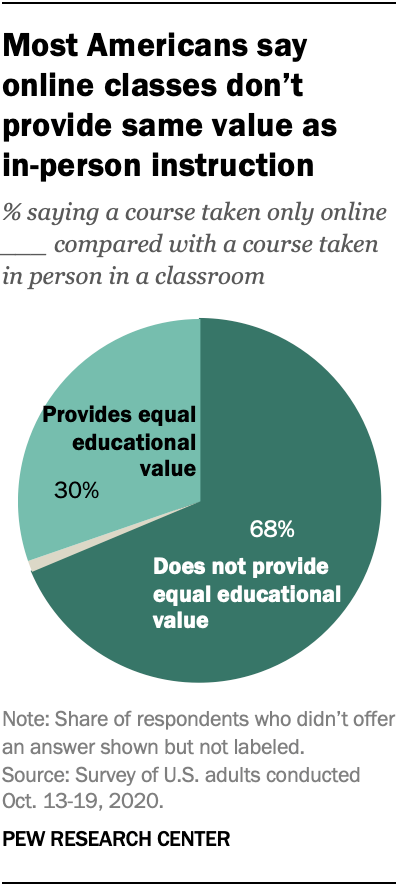
ITEM: Pew Research surveyed Americans about their attitudes towards higher education this semester.  I’d like to share two findings from it.

First, political party affiliation is closely linked with assessing how colleges and universities opened up for in-person education.  Republicans tended to see opening up as a good thing, while Democrats oppose this view.  Taken together, we Americans are split right down the middle:

Pew Americans on coronavirus highered by party 2020 Octobe

Second, a clear majority think online learning is inferior to face-to-face education:

Pew Americans on online learning highered by party 2020 Octobe

ITEM: COVID-19 infections are rising not only in number, but also in age, according to the CDC.  Bloomberg summarizes thusly:

Cases generally rise first among highly social young people, including recently returning college students. Then, they slowly bubble up among older demographics, in part through multigenerational housing and other interactions.

“including recently returning college students”: again with campuses causing infections, and deaths, to spread. Which does bring us back to the question I asked yesterday.

ITEM: The New York Times published a good summary of some recent developments.  I’d like to share the ones that struck me as most significant.  It may also be behind a paywall.

  • “By one estimate, the pandemic has cost colleges at least $120 billion” – my readers might not be surprised by this, since I’ve been forecasting and making other observations along these lines.  Still, it’s bracing.  To put it in crude perspective, imagine that’s around $27 million per individual campus.  Or think of it this way: what if $120 billion is too low?
  • Mergers are being accelerated.  For example, “the Pennsylvania State System of Higher Education… board of governors… voted to forge ahead with a proposal to merge a half-dozen small schools into two academic entities.”
  • Poor and working class student enrollment is declining: “A survey of 292 private, nonprofit schools released this month by the National Association of Independent Colleges and Universities reported a nearly 8 percent decrease in enrollment among students who receive federal Pell Grants.”
  • That class-based enrollment drop is also hitting graduate schools: “Suzanne T. Ortega, president of the Council of Graduate Schools, noted that interrupting that [grad school] pipeline could also have a lingering impact on the higher education work force, diverting promising students from low-income households, for example, or discouraging candidates who might bring much needed diversity to faculty rosters.”
  • Faculty cuts are looming.
  • Plus other topics you all heard here already.

Where does all of this leave us?  I have many thoughts and no time to share them tonight.  More from me later – but I’d be delighted to read yours in the comment boxes below.

*Toggle Term: this is when a campus changes its COVID-19 response during a semester in a big way.  Typically it means switching between in-person and on-line education.

(thanks to this Inside Higher Ed roundup and this Chronicle of Higher Education one)

Posted in coronavirus | Leave a comment

Is higher ed’s response to COVID hurting academia’s reputation?

Yesterday my wife and I took another long walk.  It’s become a Saturday routine for us, doing a four mile loop from our house and through the surrounding area.  We mask up and rigorously maintain social distancing, quickly shunning anyone who walks, stands, or bicycles anywhere near Ceredwyn and I.

At the farthest distance from our house we visited a refurbished furniture store, checking on bookshelves, tools, and creepy kitchenware.

buy metformin online buy metformin no prescription generic

  The shop is excellent about pandemic measures, with everyone masked up and keeping the heck away from each other.  Appropriately for an establishment emphasizing repair and DIY, they built their own plexiglas shielding at the counter.  This time, however, we struck out, finding nothing good.

Walking back home, we discussed where COVID-19 was headed and pondered how the election might play out (because that’s how we roll). The temperature dropped and skies tended towards gray, despite the sun’s best efforts.

We talked about higher education and what was happening to it now.  I couldn’t shake the feeling that academia just took several very bad hits.  Obviously these are financial and biological, as my readers know well.  But I wondered, and wonder now, if in addition our reputation just dropped a notch.

Godwin and Clover Hill skies

I’m not thinking of any individual campus, but of higher ed as a whole.

Let’s start with the sense that some people have, that higher ed is spreading COVID-19.  Not that colleges and universities started the thing, of course, but that we are making it worse.  For example, the Washington Post introduced one article with this stark headline:

After a college town’s coronavirus outbreak, deaths at nursing homes mount

Can you read that in any way that isn’t awful?  Try paraphrasing it: “Colleges kill old people.”  Or try a milder translation: “Campuses actively threaten senior citizens.”

If you think the editor just slapped a scary headline on a gentler article to get eyeballs, read the actual story.  Here’s the start:

Mayor Tim Kabat was already on edge as thousands of students returned to La Crosse, Wis., to resume classes this fall at the city’s three colleges. When he saw young people packing downtown bars and restaurants in September, crowded closely and often unmasked, the longtime mayor’s worry turned to dread.

Now, more than a month later, La Crosse has endured a devastating spike in coronavirus cases — a wildfire of infection that first appeared predominantly in the student-age population, spread throughout the community and ultimately ravaged elderly residents who had previously managed to avoid the worst of the pandemic.

Two sentences in and already we have a community figure viewing colleges with dread. Third sentence and campuses are typhoid Maries, “ravag[ing] elders.”

The article doesn’t let up.  It goes on:

For most of 2020, La Crosse’s nursing homes had lost no one to covid-19. In recent weeks, the county has recorded 19 deaths, most of them in long-term care facilities. Everyone who died was over 60. Fifteen of the victims were 80 or older. The spike offers a vivid illustration of the perils of pushing a herd-immunity strategy, as infections among younger people can fuel broader community outbreaks that ultimately kill some of the most vulnerable residents.

Try paraphrasing or generalizing from that passage.  Wisconsin colleges kill old people. Campuses kill grandparents.  This is not, as they say, a good look.

We can go further.  Linked from the article is an academic study, a preprint examining viral spread in La Crosse.  From the abstract:

Genomic sequencing of SARS-CoV-2 cases in La Crosse during that period found rapid expansion of two viral substrains. Although the majority of cases were among college-age individuals, from a total of 111 genomes sequenced we identified rapid transmission of the virus into more vulnerable populations. Eight sampled genomes represented two independent transmission events into two skilled nursing facilities, resulting in two fatalities.

In other words, there’s a causal vector between college operations and off-campus seniors sickening and dying.

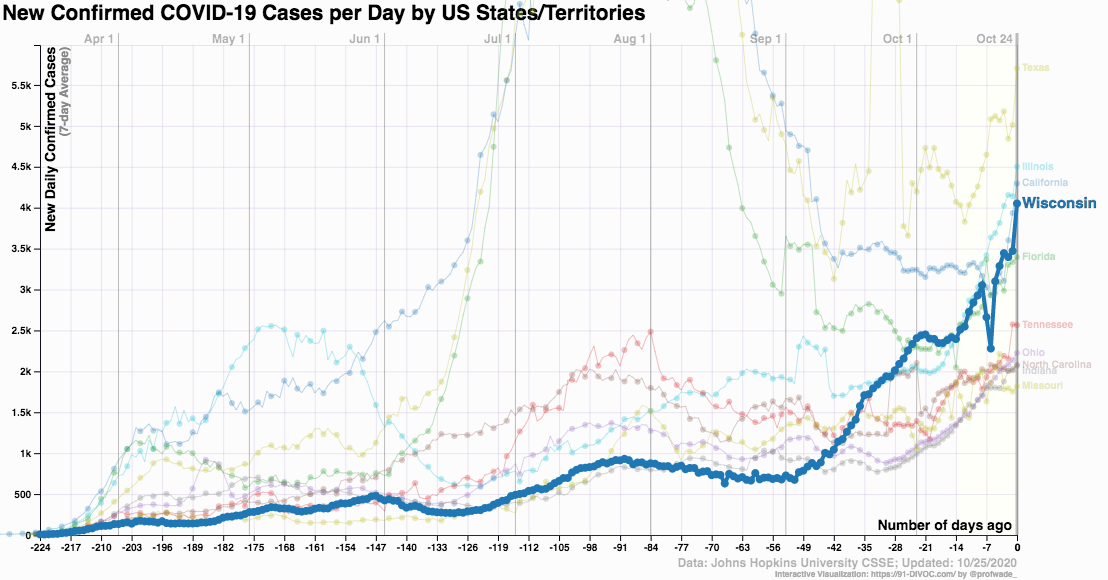
A skeptical reader at this point could observe that Wisconsin is an unusually bad case.  COVID-19 is really growing there, apparently aided by a Republican legislature.  Here’s today’s 91-DIVOC visualization:

coronavirus US by state_Wisconsin_2020 October 25_91-DIVOC

Wisconsin soared even past Florida!

But other states are also seeing this pattern of rising academic infections leading to off-campus illness and death.  Texas, leading the nation in infections, also has examples of town-goal virulence.  In Lubbock, for example:

As football fans tailgated without masks outside Texas Tech University’s 60,000-seat stadium in West Texas this weekend ahead of the Red Raiders’ homecoming game, it was easy to forget that Lubbock — a rural county of 310,000 — has one of the highest coronavirus infection rates in the country.

The outbreak at Texas Tech, which has infected at least 2,200 students, comes as the U.S. reported a national single-day record of new infections — 83,757 — Friday. Part of what’s driving the national increase in infections has been a surge in college towns where restrictions have eased since students returned this fall. And nowhere is it more prevalent than in Texas — which has more infected college students than any other state in the country, 17,133, according to a New York Times database — and at Texas Tech itself, with more infected students than any other school statewide.

If I read the Texas Tech dashboard correctly, only 206 people at that institution are presently infected.  Their trends page shows an alarming spike in August and September, with things down to a simmer now:

coronavirus Texas Tech trend data 2020 OCt 25

Yet, as the LA Times observes, “[b]ecause student testing is voluntary, the number of infections could actually be significantly higher.”

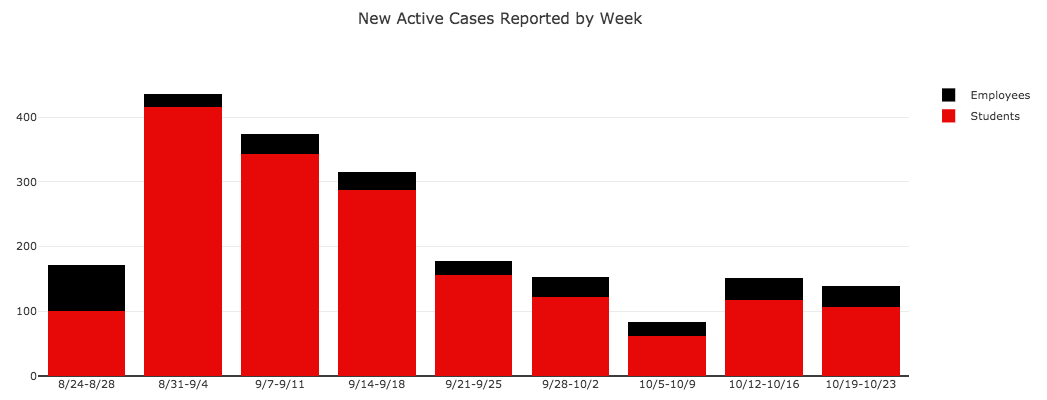
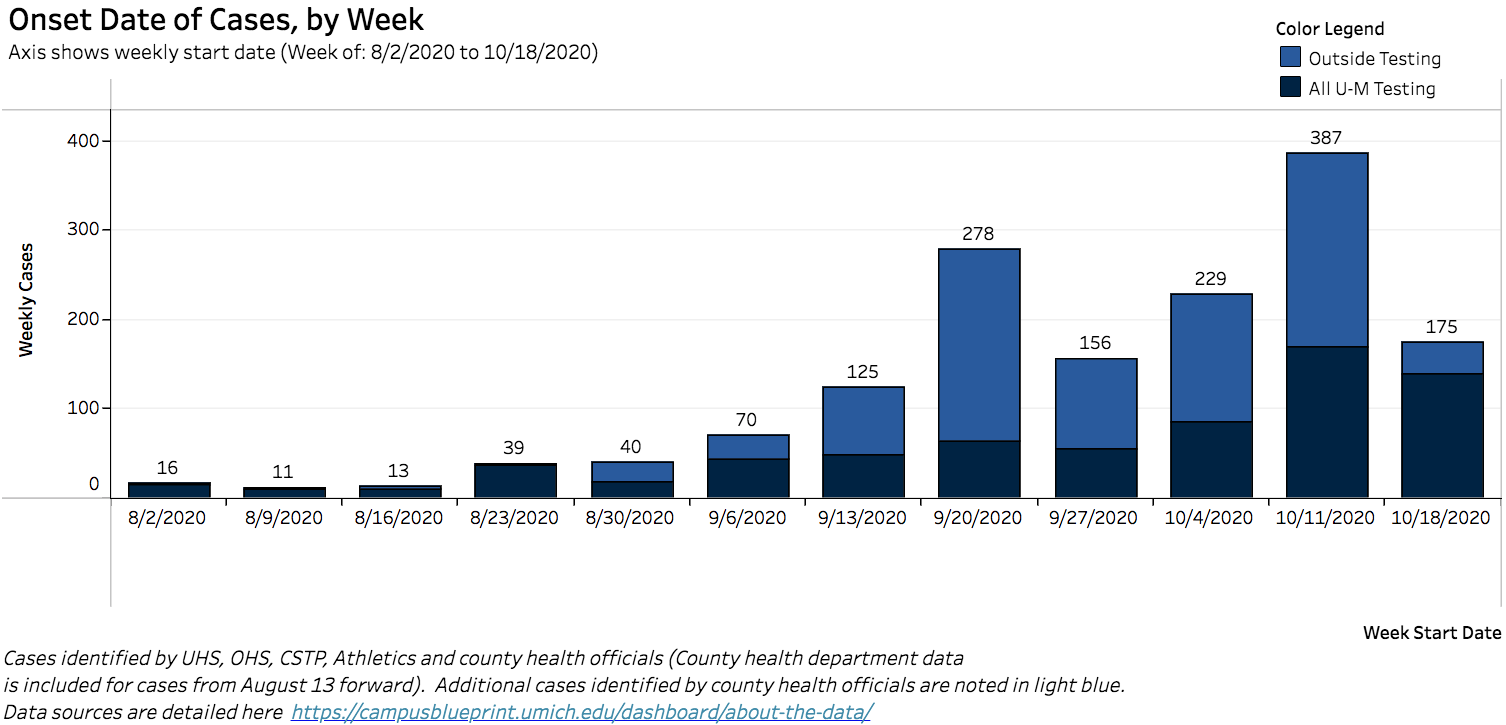
Last week I pointed to the case of the University of Michigan, whose rising infections prompted the county medical authorities – not, note, the university’s – to order undergrads to shelter in place.  UM’s dashboard shows rising cases over the past few weeks, both among academics and those living in the immediate area:

coronavirus UMichigan dashboard 2020 Oct 25coronavirus UMichigan dashboard 2020 Oct 25

We can think about this data and these events in several ways.  First, campuses that welcome back students are all too often experiencing infections.  Second, they can then infect – and sicken, injure, and kill – people in the surrounding areas.  Third, campus leaders are willing to risk such illness, injury, and death for financial reasons: to keep their institutions going.

Surely these thoughts must make American colleges and universities look like monsters or incompetent, dangerous, bumblers.

And yet.

I’m not a marketer.  I know I can have a difficult time sussing out popular attitudes (for example).  So take this with a grain of salt, but there are some ways Americans might look more favorably upon our COVID-spreading campuses.

Our love of college sports Some broad tranche of American culture deeply loves our athletics, football and basketball in particular.  Football obviously causes a spectacular range of injuries in its normal course of operations, but we accept them as part of the game.  Perhaps this population will similarly accept coronavirus spread as a necessary cost of doing a much valued business.

Our love of the physical campus and disdain for online schooling The physical college or university environment holds a special place in our national consciousness.  It hosts a residential experience for some, which we clearly value very highly (cf Ian Bogost’s recent column).  Apparently that valuation is high enough that we’ll pay a special fee this year.  Back to the LA Times piece:

Joyce Zachman, executive director of the nonprofit Texas Tech Parents Assn., said she hears more concern from parents about students being forced to take classes online than about them catching COVID-19.

“It’s not the college experience that parents had hoped for their kids,” said Zachman, who’s asthmatic but still attended Saturday’s game, where fans sang the school fight song with its chorus of “Wreck ’Em!” and pointed their trigger fingers in the Texas Tech “guns up” victory sign.

Did you catch that first bit?  Zachman is more worried that students will take classes online than that they might catch COVID-19.   While some of us might find this an astonishing view, it is, apparently, a view held by enough people to matter.

COVID-19 is less dangerous than it was I have heard from some conservative friends and commentators that while coronavirus infections might be rising, hospitalizations and deaths are not following suit.

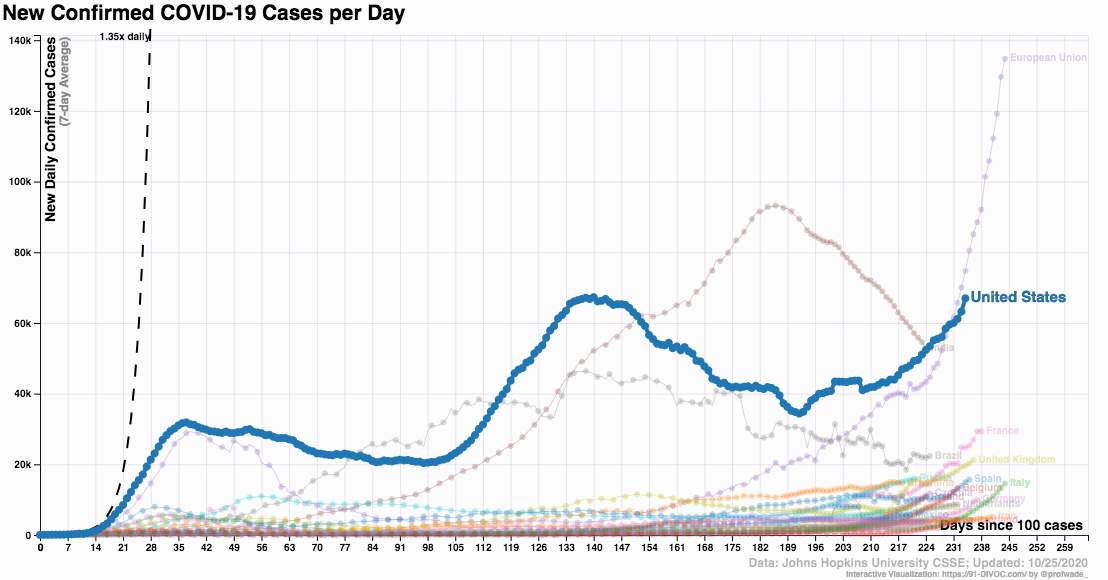
Consider 91-DIVOC data.  Infections are definitely rising, now on par with the worst levels America has yet experienced:

coronavirus world spread-US_2020 October 25_91-DIVOC

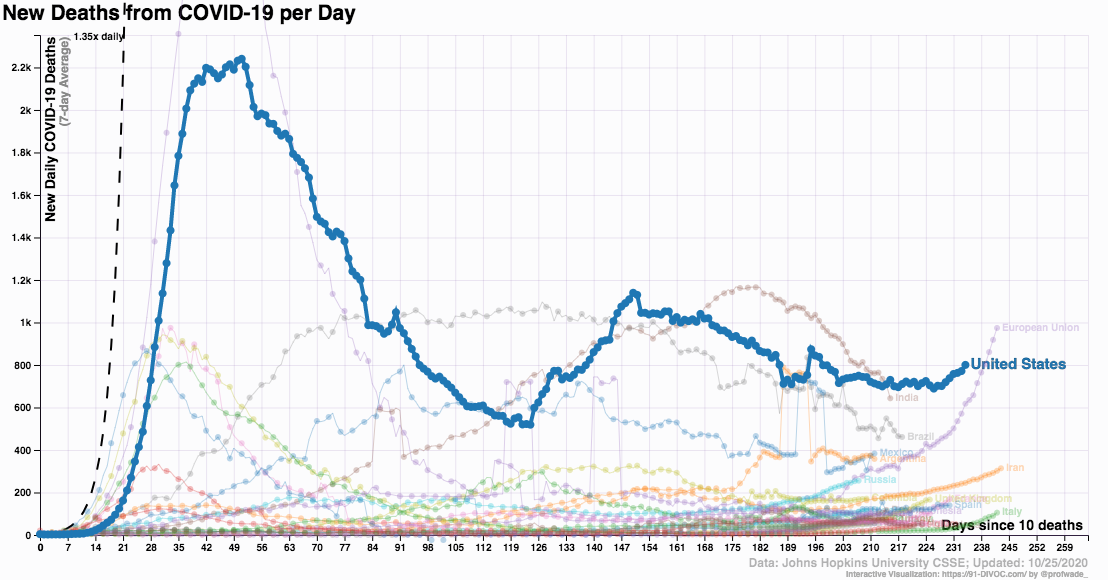
Yet deaths are not rising to that degree.  Instead, they are growing slightly, still below recent months’ tolls, and far below the terrible spring outbreak:

91-DIVOC-countries_deaths-UnitedStates (13)

Hospitals have improved their ability to treat infected people. So perhaps some see colleges spreading the virus, but that it’s less of a problem than it once was.

Political partisanship Obviously American culture is increasingly divided by party, and the onrushing election is heightening that split.  We know that Republicans are much more critical of higher education than are Democrats.  Perhaps the latter will maintain their academic support, especially as many fear the GOP is avoiding the science necessary to save the country.

Academic research Universities are, among other things, institutions that conduct vital research for the pandemic.  American society might cut us some slack for this, especially if any campus plays a role in offering a successful vaccine.

Geographical displacement Stories of bad outbreaks might occur elsewhere, far beyond our local institutions.  If we don’t see horrors nearby, we might set them aside.

Taken together, these views – in favor of campus life and sports, political partisanship, attitudes towards the pandemic, the power of research, localis – might protect academia’s reputation.  Or the sentiment that campuses are plague zones, active contributors in making the crisis worse could take hold.

We can test out my theories by checking the next polls of American attitudes towards higher ed.

(thanks to my wife and Jean Potvin)

Posted in coronavirus | 6 Comments

Did a county slap a toggle term onto a major university?

How are colleges and universities handling COVID-19 infections this semester?

Of all the many strategies in play now, the Toggle Term has been catching some media attention, probably because it’s more dramatic than an academic year decision.  I’m tracking more than twenty instances so far.  (If the phrase is new to you, it describes a scenario where a campus switches strategies in mid-term, such as switching between online and in-person instruction, one or more times.)

Yesterday my alma mater conducted a Toggle Term.  And it looks like it wasn’t their choice.

Bryan at the UM cubeSome background: I went to the University of Michigan in the 1980s and 1990s.  UM gave me three degrees for this.  My wife and I were married in sight of campus.  Our first child was born while I did my PhD.  Some friends of mine still work there or adjacent to the university. So I have a deep emotional connection to the place.

So what happened?  Basically, COVID-19 infections rose in Ann Arbor.  The county where the campus is, Washtenaw, just ordered Michigan students to shelter in place.  Specifically, it’s a “Public Health Emergency Stay in Place Order for U-M Students COVID.”

Washtenaw County Health Department is issuing a public health emergency stay in place order for University of Michigan undergraduate students effective immediately and continuing through November 3, 2020 at 7:00 a.m.

Why do this?

“The situation locally has become critical, and this order is necessary to reverse the current increase in cases,” says Jimena Loveluck, MSW, health officer for Washtenaw County. “We must continue to do what we can to minimize the impact on the broader community and to ensure we have the public health capacity to fully investigate cases and prevent additional spread of illness.”

More detail:

The number of COVID-19 cases among U-M students is increasing and represents over 60% of local cases. Stay in place orders are intended to limit socializing among students, slow down new cases, and allow for effective case investigation and contact tracing. Most infections are the result of social events and gatherings.

From the UM dashboard:

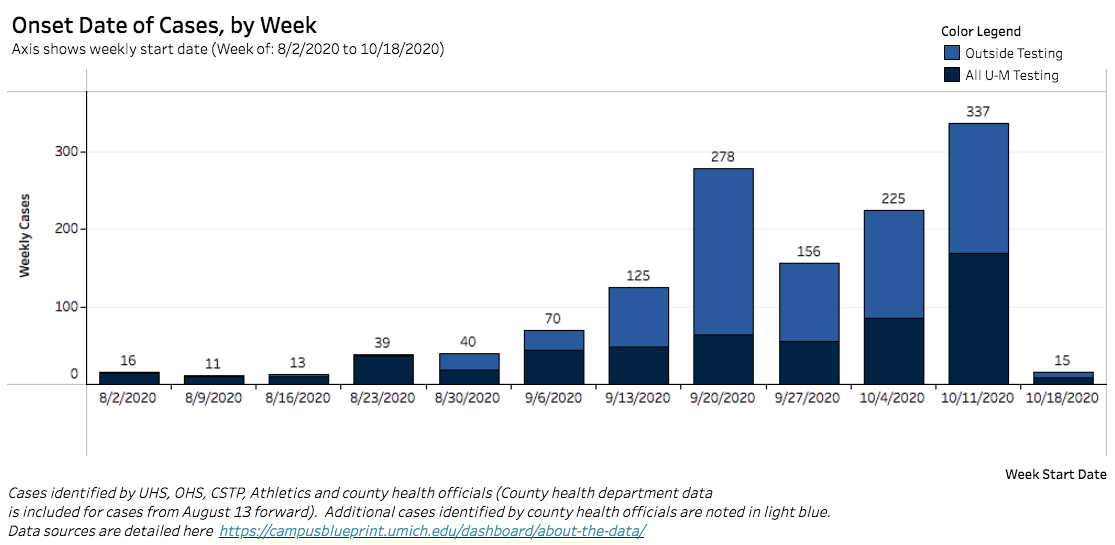
coronavirus in Washtenaw county 2020 August-October

You can see UM infections rising significantly during the first two weeks of October.

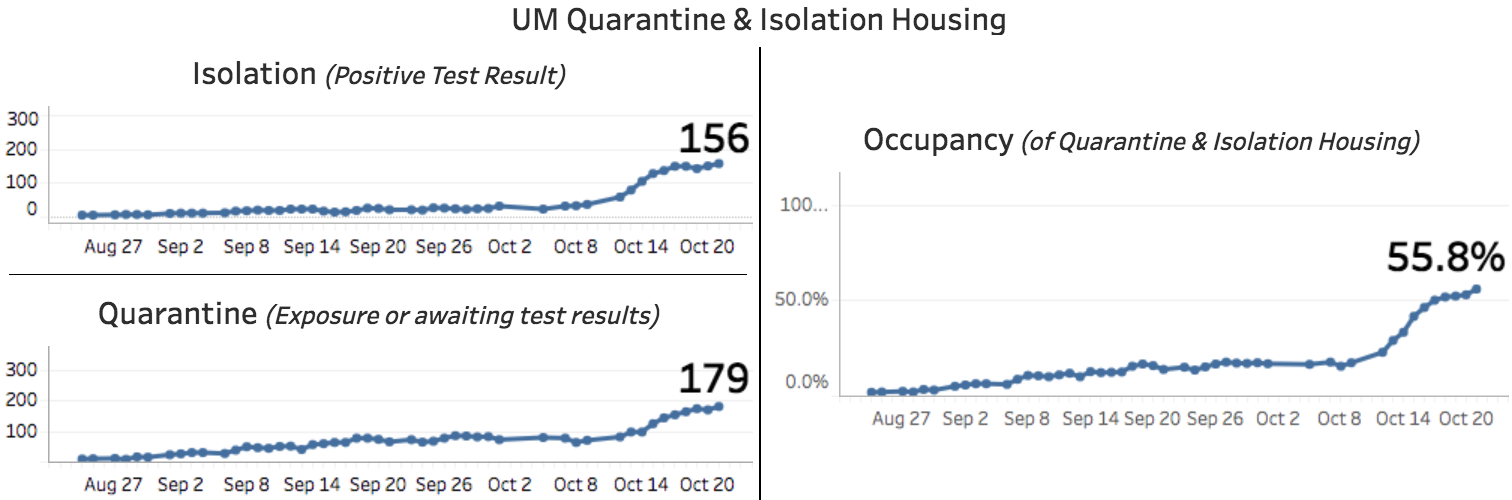
Similar rises appear on the dashboard’s quarantine and isolation housing panel:

coronavirus U Michigan quarantine and isolation 2020 Oct 21 dashboard

That occupancy rate is noteworthy.  Will UM need to set aside more rooms?

Speaking of which, it seems that student housing, not classes, seem to be the primary site of infections. From an MLive account:

The majority of cases are among students in residence halls and students living in congregate settings, such as fraternities, sororities and cooperative housing, health officials said.

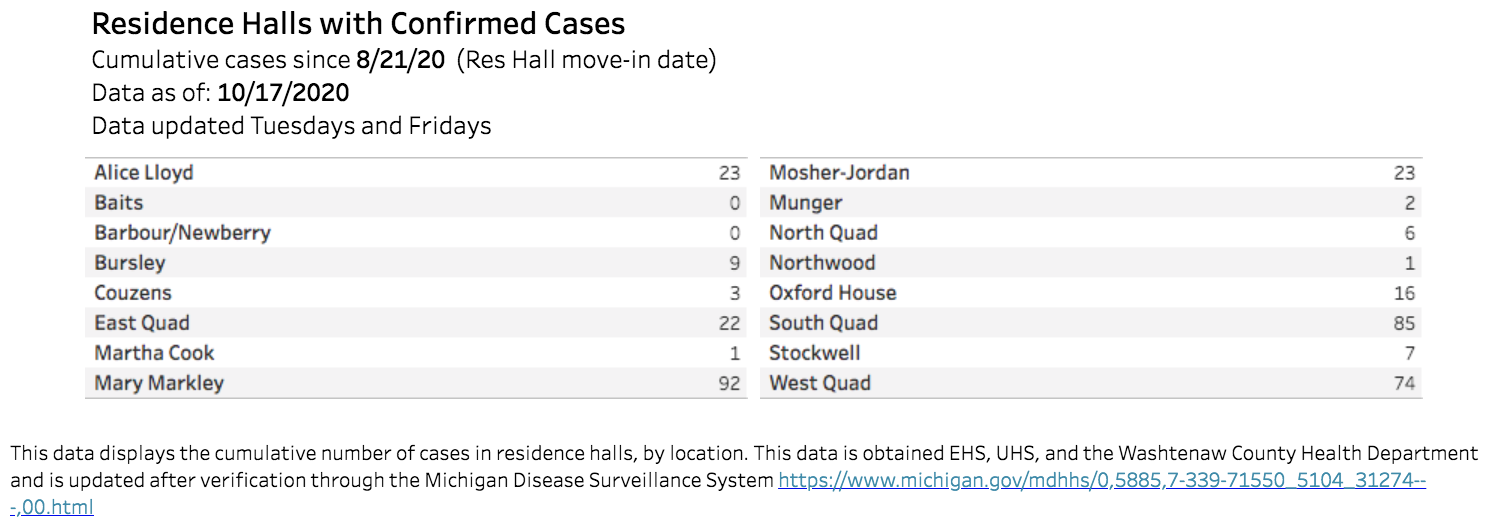
The Michigan dashboard shows us individual residence halls:

coroanavirus U Michigan dorms 2020 Oct 21

Mary Markley is the leader, followed by South and West Quads.  (I lived in East Quad for two years, and was even president of its student government, back in the past.  Now it’s on the low end of infections.)

The rise may be overriding some local health care capacity:

The word “overwhelm” appears in the county’s statement, too, in this context:

The U-M-associated surge in cases is overwhelming the ability of WCHD, including U-M Environmental Health Safety (UM-EHS) who conducts on-campus COVID-19 case investigation, to adequately address the COVID-19 pandemic and other critical public health mandates that are in place to protect the health and well-being of Washtenaw County residents… [emphasis added]

Another possible driver is football game time and associated partying, according to James Baker:

Maybe the most concerning issue was that the first football game is this coming Saturday with the next game on Halloween the following Saturday. These are traditional party opportunities and posed fears of larger outbreaks.

Football itself will go on.

I’m having a hard time figuring out the decision process behind this event.  Did the university approach the county for help, or did Washtenaw County Health Department take the lead on this?  The tone of reporting and official statements suggests the latter, with the county, not the university, making the announcement and appearing as the prime mover.

For example, the presidential statement hints that the county health authority wasn’t a junior partner.  For example, consider the word order here: “Today, the Washtenaw County Health Department, in collaboration with the university, issued a 14-day Stay in Place order…” “The university” literally comes second, while the county is the sentence’s main subject.  Later on in the document, it’s all about the county:

Under the Washtenaw County order, U-M undergraduate students living in on-campus, near-campus or off-campus housing in Ann Arbor will be required to stay in place and remain in their current designated residence. The full set of restrictions is spelled out by the county here.

The UM Record phrases things to suggest the county made the call.  “With county order, university also giving students option to return home” sets up a clear sequence.  And this sounds like a reactive campus:

The shift [to more online teaching for undergrads] comes as the Washtenaw County Health Department issued a 14-day stay-in-place order Oct. 20 for undergraduate students amid rising cases of COVID-19 in the community. The order will expire at 7 a.m. Nov. 3, Election Day, but could be extended. The university supports the order.

“The university supports the order”: I think if the university came up with the idea that sentence would look different.

Moreover, the county’s official statement reads like a complaint about the university, or at least some in the UM community.  For example,

Despite the efforts of Washtenaw County Health Department (WCHD), and many in the U-M community, there have been more than 1,000 confirmed COVID-19 cases among students at the U-M Ann Arbor campus since the start of the fall semester…

There is current evidence that activity at or near the Ann Arbor campus is driven by social gatherings that do not adhere to the MDHHS epidemic orders and WCHD public health orders…

If that’s correct – and it might not be; I look forward to hearing more from readers – this would be a major story of town-gown relations in the age of COVID-19.  It’s also the largest scale Toggle Term I’ve heard of, and on top of that a rare one forced by government, not an academic administration.

I’m curious about decision-making within the county.  Were they pressured by members of the local community beyond the university?  Did they want to take the powerful campus down a peg, or was this a reluctant choice?  Behind the scenes, what kind of negotiations went on?  Is this something UM resisted, but was persuaded to go along with?

One more detail: why is the county doing this, rather than the state of Michigan?  Jason Siko notes that Lansing has been hobbled recently:

https://twitter.com/jasonsiko/status/1318851711797166082

What can we derive from this story so far?

It’s an interesting case of a major, world-class research university with a magnificent medical establishment being overruled by a county for whom that university is the largest employer.

For months I’ve been writing about how COVID-19 exacerbates town-gown relations; “town” authorities may become bolder, especially as the virus keeps raging.

Given the many criticisms of UM’s administration in this story, it’s another datapoint for hits to American academia’s reputation.

I just hope the toggle term quashes the infection right away, and that nobody else in the Ann Arbor area gets hurt, off campus or on.

(thanks to Todd Bryant; booklover, Edward Vielmetti, and Ally Cara on Twitter;  Jeannie Lvrich on Facebook)

Posted in coronavirus, personal | 4 Comments

COVID-19 and higher education in mid-October: infections, deaths, plans, seasons, toggle terms, and a data disaster

To forecast the future, it’s crucial to understand the present.

I’ve followed that principle for years.  It informs my work on many levels.  That’s why today I’d like to give you all a sense of where higher education stands in the middle of October, 2020, as it grapples with COVID-19.  We need to do this in order to think more effectively about where we’re headed next.

I’ve been meaning to update you all for several weeks.  But this season I’m brain-deep in climate change work, plus engaged with teaching two seminars and immersed in several other projects.  Still, I want to catch us all up on where things stand with the pandemic, especially as it’s proving decisive for the American election, and as we grope towards what the thing could do over the next few years.

Let’s start with the virus, move on to what colleges and universities are doing, then offer some thoughts about what this all tells us about possible 2021s.

Fair warning: this is a heavy post, long, carrying lots of data, and addressing a horrific subject.  I’ve included visualizations and photos which might break up the stress.

I: THE PANDEMIC GROWS

On October 16th, 2020, COVID-19 continues to spread across the world, sickening, injuring, and killing.

Data vary depending on one’s source, but the overall picture is fairly clear.  Global infection numbers range from 38,789,204 to 39,126,112 and 39,474,896 people. Deaths are now clearly over one million: 1,095,097 to 1,106,870 to 1,100,877.

In the United States between 7,958,254 and 8,267,053 people are infected, amounting to around 2.4% of the population. American deaths are in a range of nearly a quarter million, 216,917 to 218,137 and 223,359. Those numbers are likely an undercount, as tens of thousands of “excess deaths” (deaths above recent history, yet not assigned to COVID) have been occurring for months; at least one paper sees actual deaths being up to 20% higher, or around 260-267,000. (sources: Centers for Disease Control, Johns Hopkins University, the World Health Organization, Worldometers)

There are no good national or global numbers about people injured by infections, suffering damages that may last them for some time, whom some call long haulers.

Here’s the iconic Johns Hopkins dashboard for today:
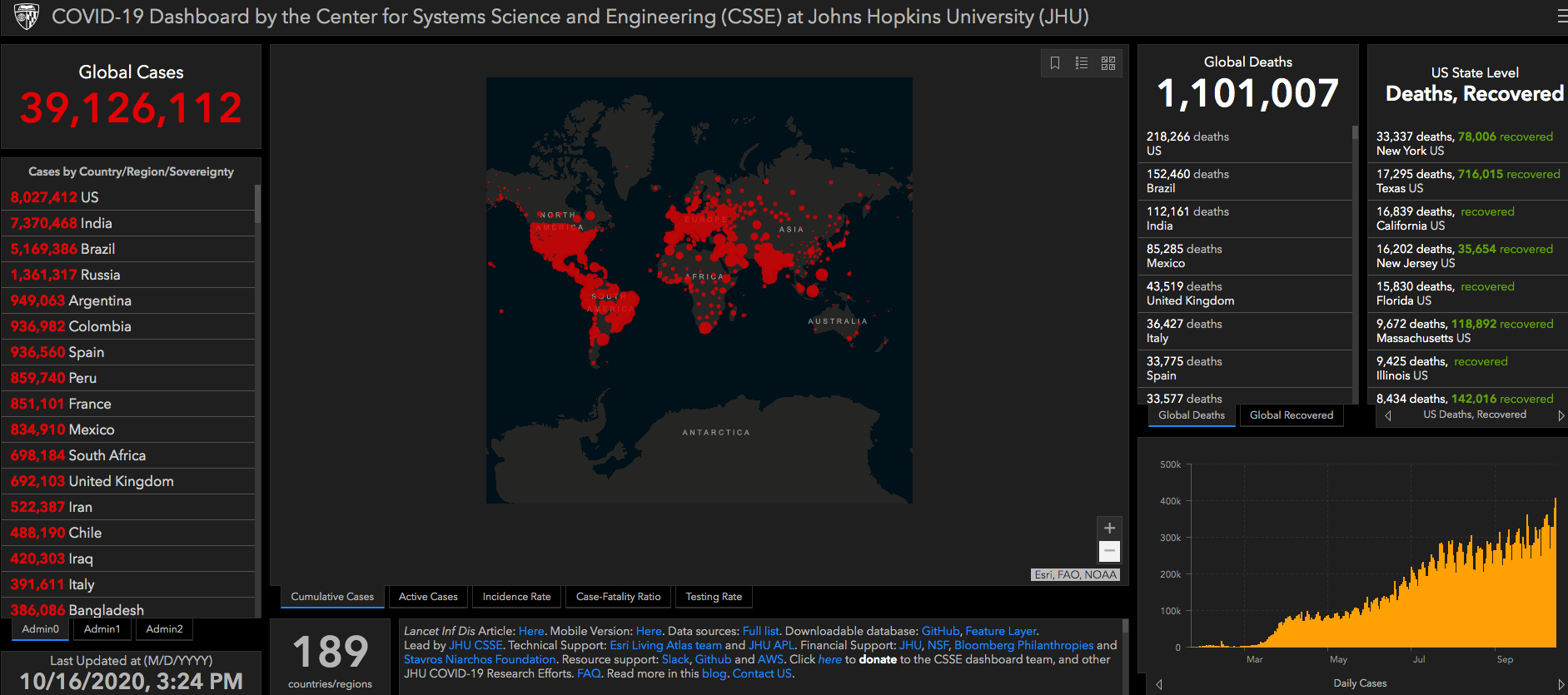
coronavirus global spread 2020 Oct 16 JHUcoronavirus global spread 2020 Oct 16 JHU

To give you a sense of perspective, of how quickly human horror and wastage have swollen, here’s where things stood six months ago, on the same dashboard, but for April 14th:
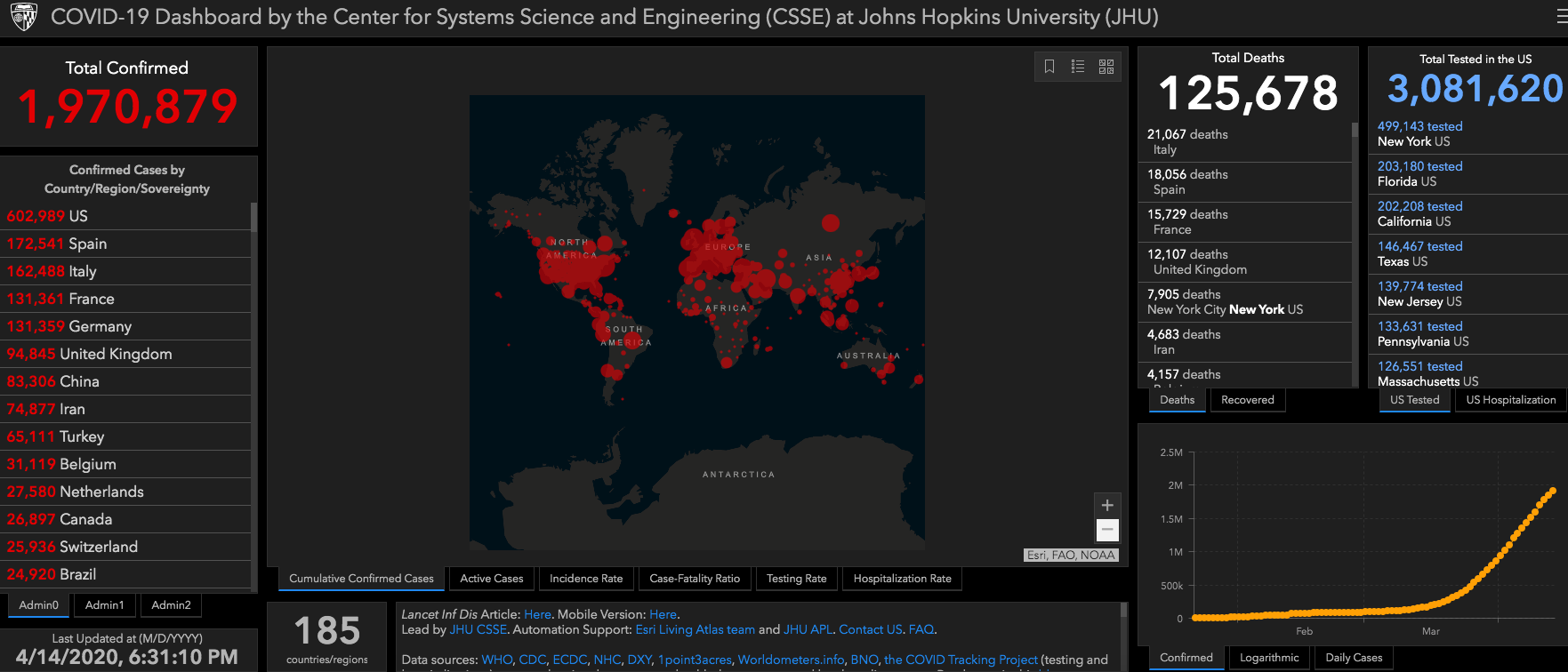
coronavirus global spread 2020 April 14 JHU

The virus is unevenly distributed by nations, and that distribution has changed over the past year.  91-DIVOC‘s visualization shows this clearly in terms of infections:
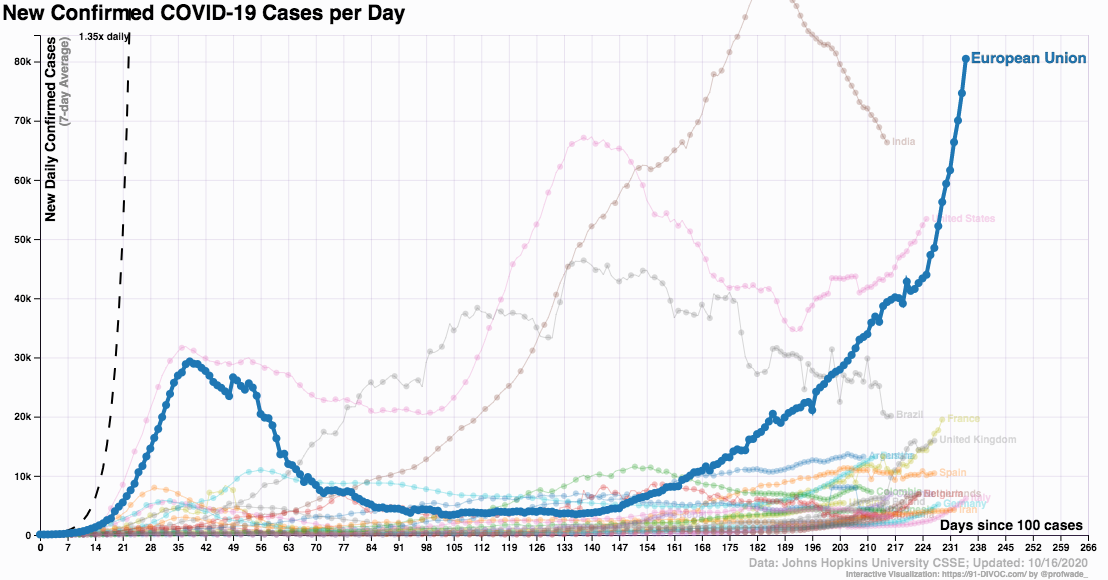
coronavirus by nation EU_2020 Oct 16-91-DIVOC

Based on that data, the European Union, the United States, and Britain, are now experiencing massive infection rises, while the huge waves which attacked Brazil and India are now subsiding.

The unfortunately named Information is Beautiful site presents infections and deaths in absolute terms:
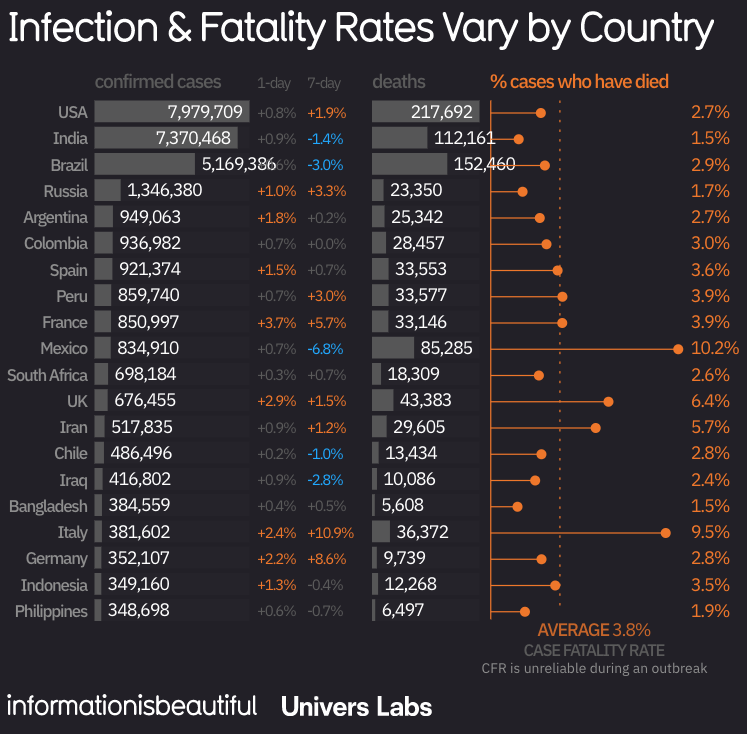
coronavirus by nation 2020 Oct 16_Information is Beautiful

In the United States, every region is now experiencing rising infections:
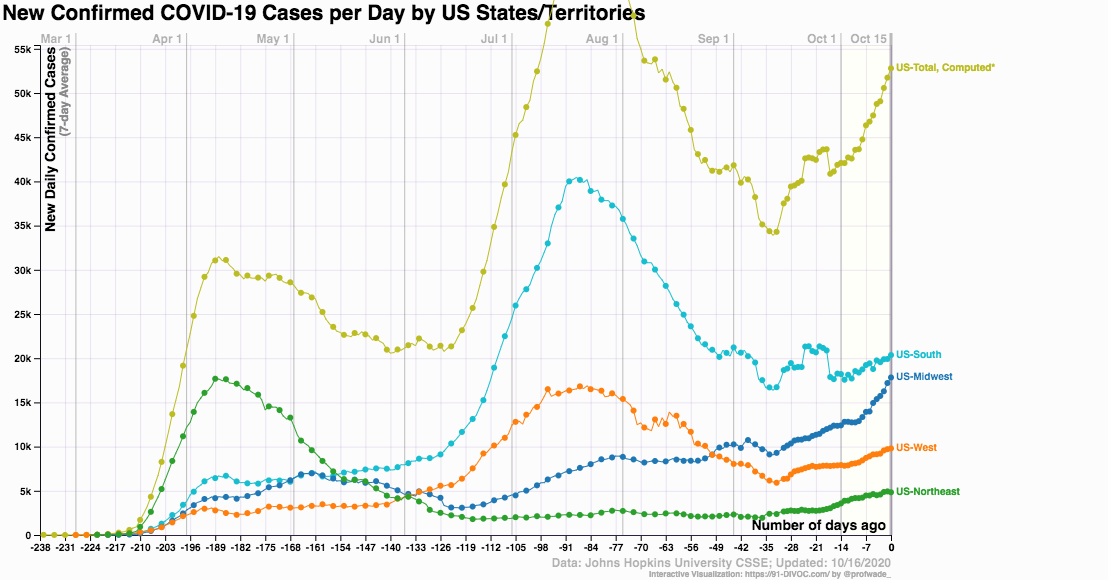
coronavirus US by regions_2020 Oct 16_91-DIVOC

The butcher’s bill presents differently, as the west and especially south are on downhill trajectories, thankfully.  But the number of deaths in the northeast and midwest are rising:
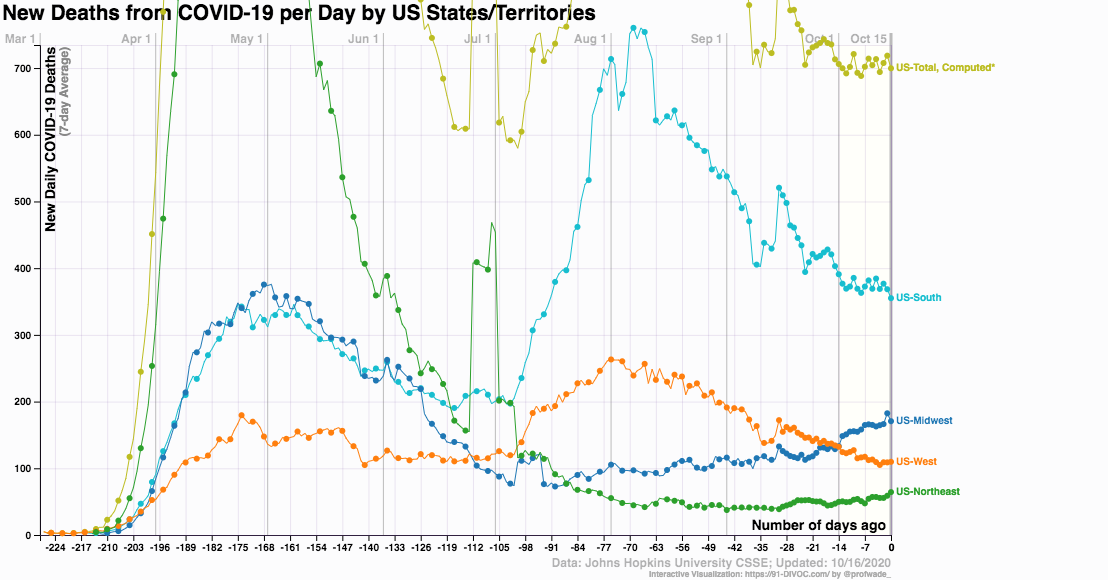
coronavirus deaths US by regions_2020 Oct 16_91-DIVOC

The COVID Tracking Project says the United States is now in a third pandemic wave.

The third surge of the COVID-19 pandemic in the United States is under way. Outbreaks have been worsening in many states for more than a month, and new COVID-19 cases jumped 18 percent this week, bringing the seven-day average to more than 51,000 cases a day. Though testing rose by 8 percent nationally, that’s not enough of an increase to explain the steep rise in cases. Meanwhile, COVID-19 hospitalizations, which had previously been creeping upward slowly, jumped more than 14 percent from a week earlier.

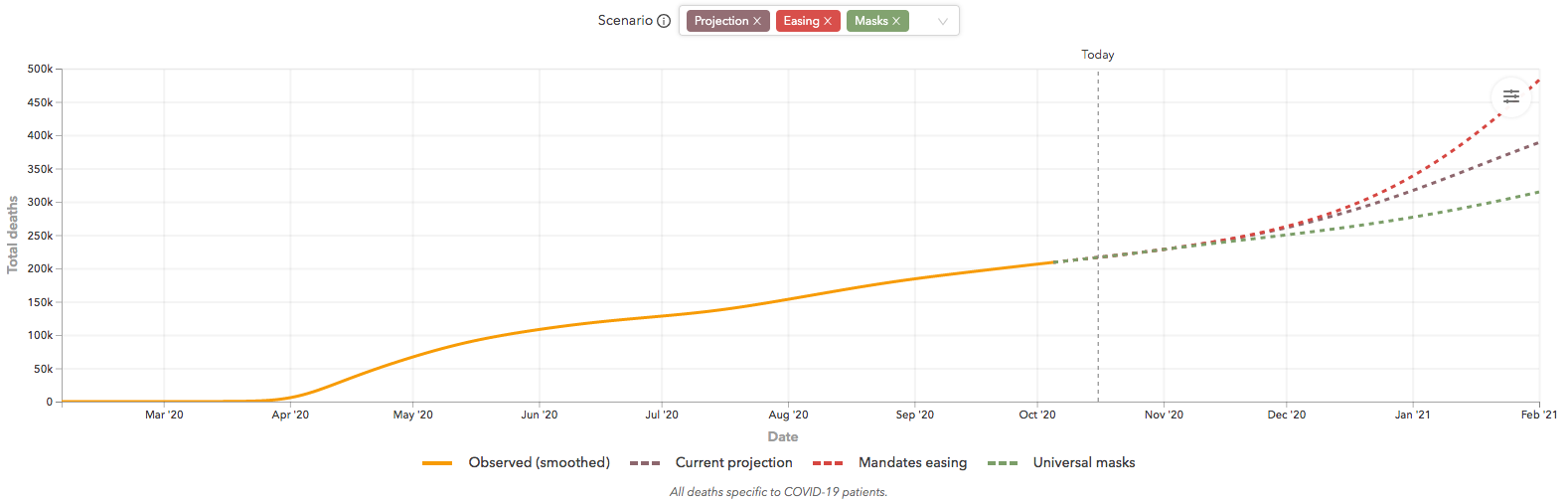
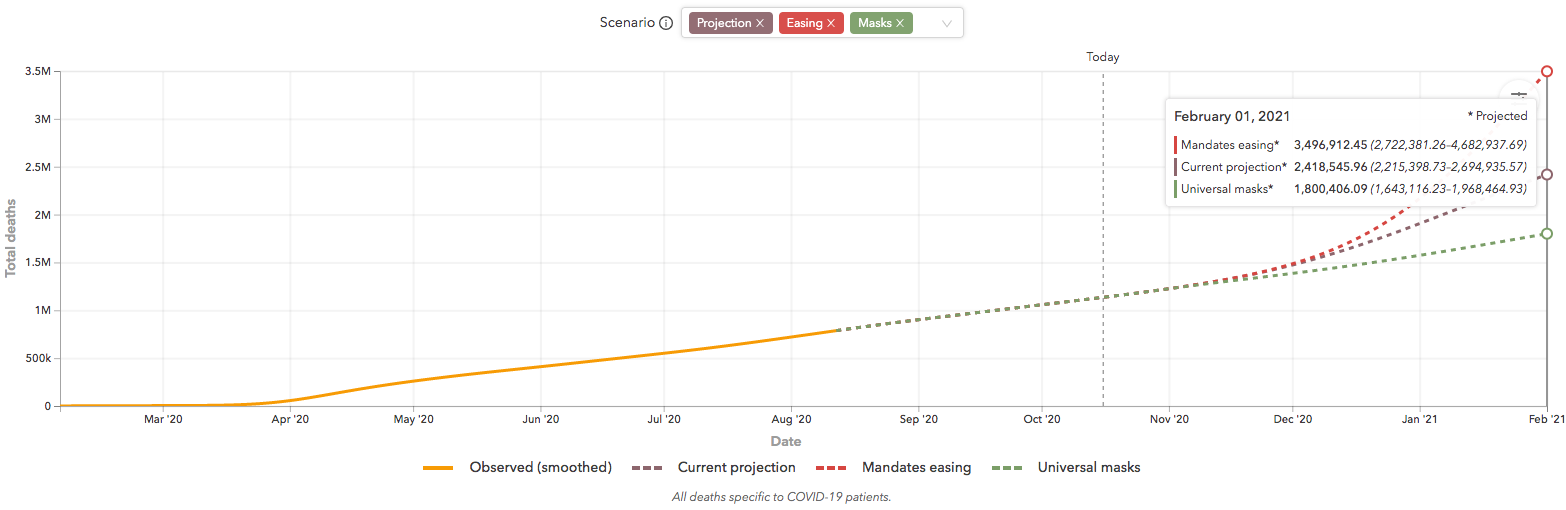
Looking ahead, projections uniformly indicate more infections and deaths, unsurprisingly.  The University of Washington’s IHME project forecasts three possible global death toll outcomes by February 2021, from 1.8 to nearly 3.5 million:
coronavirus_projection to 2021 Feb_2020 Oc 16_IHME

For the United States:

coronavirus US death projections to 2021 Feb_2020 Oct 15_IHME

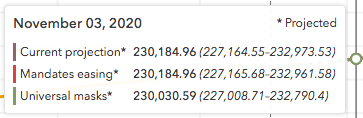
In the short term, IHME sees around 230,000 dead by America’s election day:
coronavirus US deaths projected to 2020 Nov 3_2020 Oc 15_IHME

Many in the US anticipate a vaccine to staunch the bleeding.  Some look forward to herd immunity.

In the meantime, American public health and medicare care are very unevenly distributed.

II. HIGHER EDUCATION STRUGGLES WITH COVID

So how is higher education grappling with this terrible pandemic?

(For reasons of time I’m going to focus on the United States.) It’s actually difficult to answer this question.  We have to take several different approaches.

We can start by checking on national data about colleges, universities, and COVID-19.  Unfortunately, shamefully, disastrously for present and future, we don’t have any data we can use. The CDC offers some guidance but is not tracking the viral spread across higher education.  The United States Department of Education publishes no such data.  The White House Coronavirus Task Force, which manages to issue recommendations to individual states while having no official website that I can discover, also fails to share anything on this score. Neither leading journal of academia publishes a national dashboard or even total stats. No nonprofit has done this, nor any business that I can find.

The best we have right now, as best I can determine, is a single New York Times web page. Back in August the Times tried to aggregate as much collegiate information as they could.  As I wrote then, the results were poor: only a fraction of the higher education ecosystem was touched, the data incompatible, and all of it spread across uneven timelines.  And this took dozens of reports some undisclosed amount of time to eke out.

Since then that tracker has improved somewhat.  It now claims 1,700 campuses, or nearly 40% of the whole: better, if not sufficient.  The problems I identified are otherwise still there.  At least the page is quite honest about its limitations, once you scroll down a bit:

With no national tracking system, and statewide data available only sporadically, colleges are making their own rules for how to tally infections. While The Times’s survey is believed to be the most comprehensive account available, it is also a near-certain undercount… [A]t least 140 other [campuses] ignored inquiries or refused to answer questions…

And:

Because colleges report data differently, and because cases continued to emerge even in the months when most campuses were closed, The Times is counting all reported cases since the start of the pandemic.

It’s been eight days since the last update to the page.  Sigh.

Given those caveats, what does the Times tracker tell us?  Their headline claim is “more than 178,000 cases and at least 70 deaths” infections… since the virus hit American shores.  What about fall semester?

The Times has counted more than 171,000 additional cases at colleges since late July; of those, more than 48,000 cases came since late September.

So… it’s hard to say what this tells us, since “since late July” includes both summer and fall terms, and “since late September” leaves out the first weeks of the semester, depending on campus schedules.  We can reasonably guess some tens of thousands of academics, probably? over one hundred thousand, have been infected this term.  But the number should be much higher, given the Times’ admitted undercount.  For example, if the tracker only catches 40% of colleges and universities, and we estimate 100,000 infections in that sample, we could project a reality closer to 240,000.

What about deaths?  How many members of the academic world have perished due to COVID-19?  Again, there is no national record of this.  I have tracked four so far, each of which I’ve shared via Twitter:

  1. Chad Dorrill, a student at Appalachian State University
  2. Jamain Stephens Jr., a student at California University of Pennsylvania
  3. James Hamilton, a police officer at the University of North Carolina- Asheville
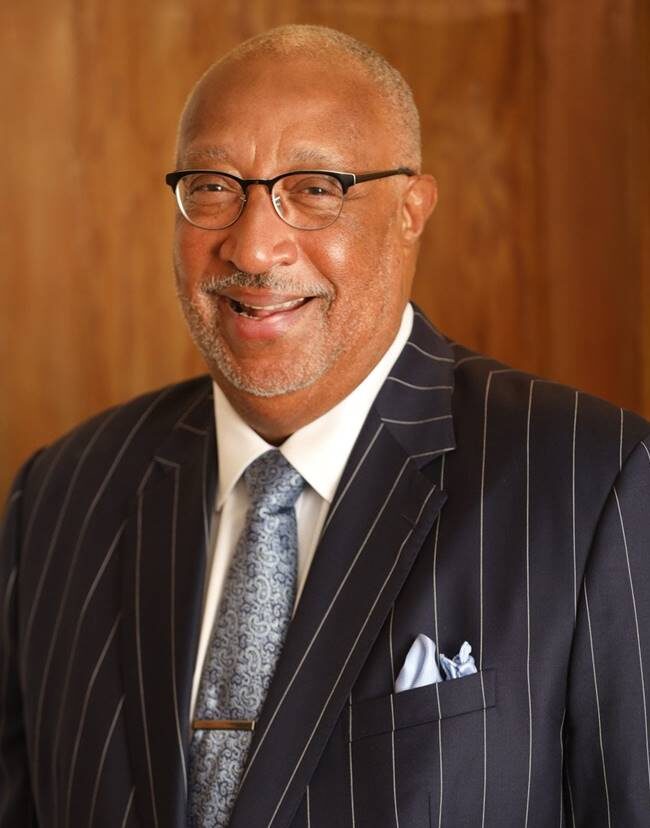
  4. Irving Pressley McPhail, president of St. Augustine’s University
McPhail

Prior to fall term, Osanette Hernandez died in August.  She was a nursing student; I can’t determine where she was studying.

How many others have died?  What are their stories, their very names?  Is anyone even bothering to record them?

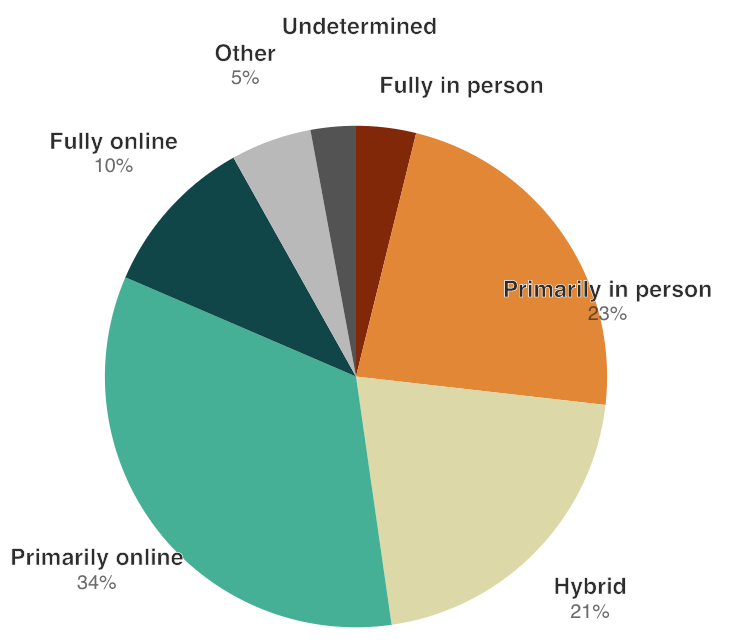
If we can’t get good data for how COVID hits academic populations, we could instead examine the macro picture by looking to campus operational strategies for fall 2020.  According to the Chronicle of Higher Ed’s tracker (last updated more than two weeks ago), itself based on Davidson College’s College Crisis Dashboard, American colleges and universities have adopted a wide variety of educational configurations:
coronavirus college fall 2020 plans_2020 Oct 1_Chronicle

Entirely online, mostly online, mostly face-to-face, some hybrid – it’s clear that no one approach has won a majority of adherents.  We really shouldn’t speak of campuses opening up, heading online, etc. without qualifying such statements with “the fraction of colleges and universities doing so.”

One such operational strategy requires testing students and at times others on campus for infections.  It seems that this is another approach taken only by a fraction of institutions.  Again, the data is bad, but “more than 2 out of 3 colleges with in-person classes either have no clear testing plan or are testing only students who are at risk,” according to NPR.

Of colleges with in-person classes and more than 5,000 undergraduates, only 25% are conducting mass screening or random “surveillance” testing of students. Only 6% are routinely testing all of their students. Most, instead, are relying on only diagnostic testing of symptomatic students, which many experts say comes too late to control outbreaks and understates the true number of cases.

Another such operational strategy is what I called “the toggle term,” when a college or university switches between online (all or mostly) and in-person (all or mostly) education in mid-semester.  I forecast the strategy back in April. When I last blogged about it I had found seventeen Toggle Term cases this fall.

New examples include:

Meanwhile, 1,000 Kutztown University students toggled themselves, as it were, leaving campus to study remotely on their own volition.

We could also approach the question by looking at individual stories.  For example, SUNY Oneonta has suffered a serious COVID-19 surge.  Their president has stepped down as a result.  Hazmat-equipped authorities (local? state?) have removed students and student property from campus.
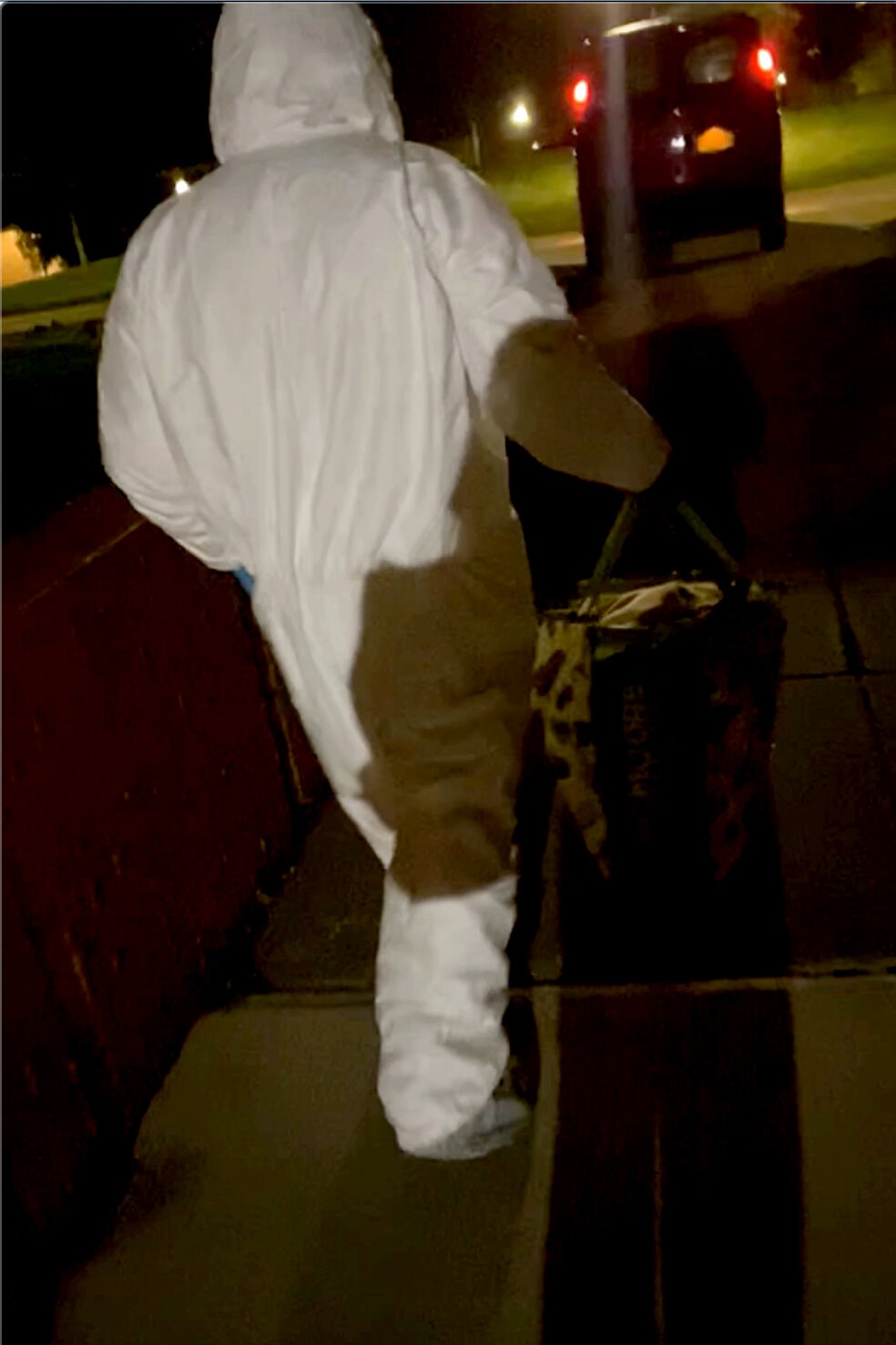
coronavirus-oneonta-hazmat

There are many, many stories.

But overall, we run smack into one key problem: we are experiencing a serious data void as we try to see what COVID is doing to higher education.

III. WHAT’S NEXT?

What does the preceding suggest about the next year?  What does fall 2020 tell us about spring, summer, and fall 2021?

We should expect infections and deaths to continue growing.  There is no sign of the virus suddenly and massively mutating into a benign form.  I’m not seeing any evidence that a working vaccine exists, much less working through the long, arduous route of testing->production->distribution->enough people actually taking the thing to matter over the next few months, if not longer. Therefore COVID seems likely to continue cutting a swathe through the human race.  That necessitates not only hospitalizations, suffering, long-term injuries, and deaths, but also emotional tolls taken on families and communities, stresses on already strained medical and public health care, and continued economic recession. The unevenness of public health and medical care’s availability could worsen an already bitter national mood, even helping accelerate civil instability, especially as a potentially chaotic election occurs.

All of those damages hit academia, from infections and long-haul injuries to more deaths.  All of the attending effects also play across higher ed on multiple levels: enrollment, finance, educational operations, building renovations, mental health, etc.  To pick one example, the pandemic’s enormous stress might drive some students to reduce the number of classes they take, or simply to withdraw altogether.  To pick another, we could expect COVID-related research to surge, as it already has, while non-epidemic research declines.

Additionally, academia plays some role in spreading the pandemic, to the extent that we do our work in person and fail to rigorously follow sufficient public health measures.  At least one study finds campuses conducting face-to-face activities to increase infection rates in surrounding counties by a statistically significant measure.  This will take some toll on town-gown relations, not to mention academia’s broader reputation.

The global nature of the pandemic, and America’s international standing thereof, have hit international study hard.  We should expect a continued drop in the number of overseas students taking classes.  This has financial and campus cultural effects, of course.

How will higher ed respond? If we follow fall 2020 practices, colleges and universities will adopt a variety of plans, with no one system being used by a majority.  i.e., some campuses will teach entirely online, others all face-to-face, some blending the two, and so on.  We could expect around forty toggle term instances, if my fall 2020 count holds up.

Now, many campuses changed their fall schedule to end in-person classes early, typically by Thanksgiving break.  On the calendrical flip side, some could also start spring term later.  For example, Bowdoin College will commence classes several weeks late.  There are other cases as well.  One effect is a much longer winter break, lasting one to two months.  Historically this is interesting, as that winter gap starts to resemble summer sessions in size.  Perhaps we’re heading to a four season structure for American colleges and universities: fall classes on, winter off, spring on, summer off. Alternatively, schools can offer fully online winter programs.

Not present in the preceding, but present in how I imagine many readers react as they work through this post, is growing pandemic fatigue.  The virus has been attacking the world for nearly one year.  Many are tired of coping with it.  This is one driver behind lax compliance with public health measures. We may also be normalizing the thing, weaving it into the quiddity of daily and national life, so that we cease to single it out for attention, but gradually include it within the battery of threats we all face.  It’s possible that such acculturation and normalization will involve our no longer thinking about new habits, from masking up to expecting more open social spaces than we once did.  Already I, an energetic extrovert, flinch at the sight of other people in the same building as myself.  It might take extra effort to identify COVID effects in 2021, or even to draw attention to it.

One last note: we still badly need good data about what COVID-19 is doing to higher education.  We can’t assess this problem on anything other than a case by case basic without it.  The lack hurts our decision-making.  History will struggle to understand what happened in 2020, and will not look kindly at our fumbling to record it.

(thanks to Laurie Garrett, Eric Feigl-Ding, this Inside Higher Ed roundup, this bigger IHE roundup, this Chronicle resource, my old college friend Sheldon Robertson, and others)
Posted in coronavirus | 2 Comments

College and university enrollment fell even more steeply this fall, continuing a long term trend

How is college and university enrollment currently changing as a result of fall conditions?  Have the pandemic and recession sent more people to campus?

National Student Clearinghouse Research Center logoIn late September the National Student Clearinghouse Research Center offered its first pass at presenting fall 2020 enrollment data.  It showed an increase in graduate students attending American higher ed and a larger decrease in undergrads, together yielding a 1.9% overall downturn.

Today the Clearinghouse released a new presentation, with more and updated data, and it paints a darker picture.

Here I’ll summarize what I see as key findings, then offer some of my own thoughts.

tl;dr version – in fall 2020 American higher ed enrollment declined more steeply than it appeared last month.

I: THE REPORT

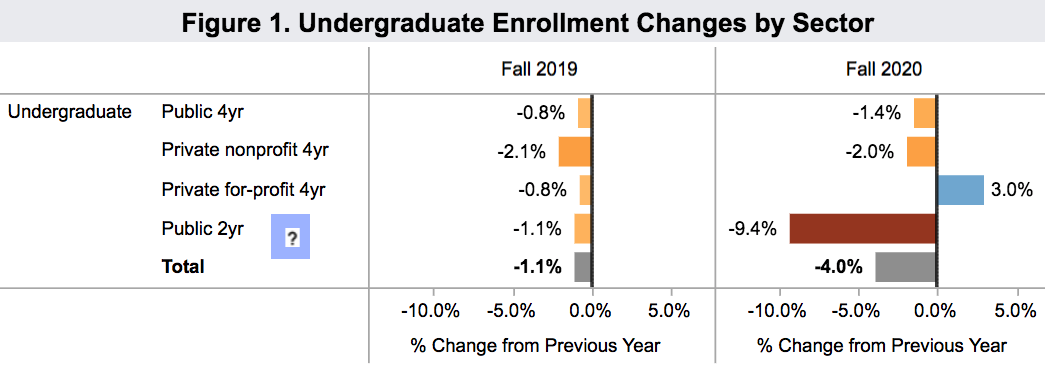
Across the entire postsecondary sector, total student enrollment “is down 3.0 percent as of September 24.”  Grad enrollment rose 2.7%, a bright spot, while undergraduate dropped 4%.  (The September report had total enrollment down 1.8%, with undergrads down 2.5%.)

enrollment undergrad 2020 fall_Clearinghouse 2020 Oct 15

Note the for-profit gain. Recall that 2019 was also a term in decline.

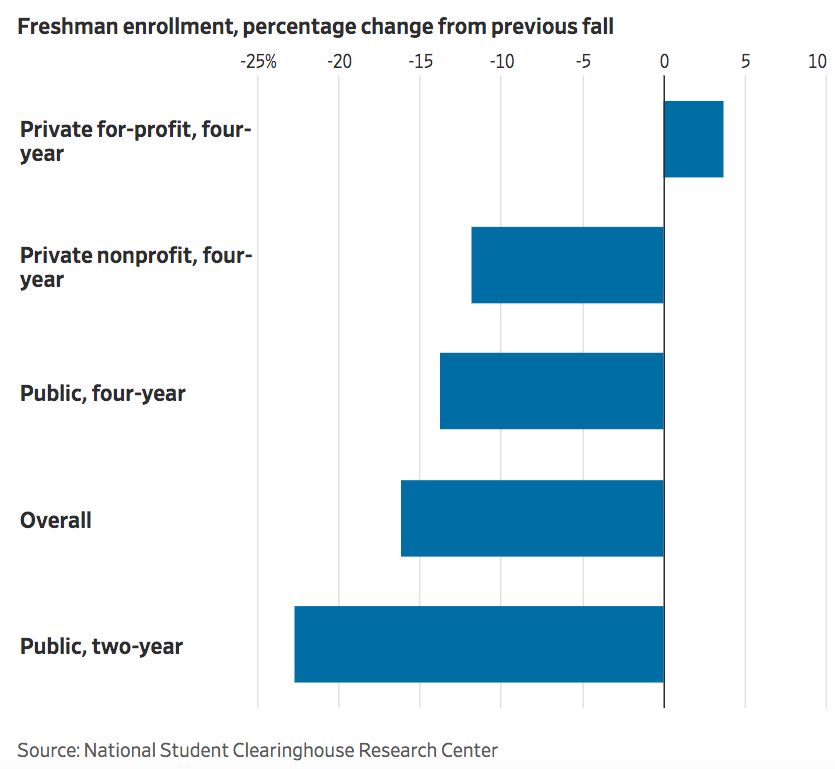
The number of first-year students in particular saw a very significant decline:

[F]irst-time students are by far the biggest decline of any student group from last year (-16.1% nationwide and -22.7% at community colleges).

That first-year drop cut deeply into every sector of American higher ed, but one.  Here’s a nice chart from the Wall Street Journal:

enrollment by institutional type fall 2020_WSJ

As that chart shows, community colleges are being hit much harder than anyone else, overall:

Community colleges continue to suffer the most with a decrease of 9.4% percent. Community colleges’ enrollment decline is now nearly nine times their pre-pandemic loss rate (-1.1% for fall 2019 compared to fall 2018). Even more concerning, the number of freshmen also dropped most drastically at community colleges (-22.7%).

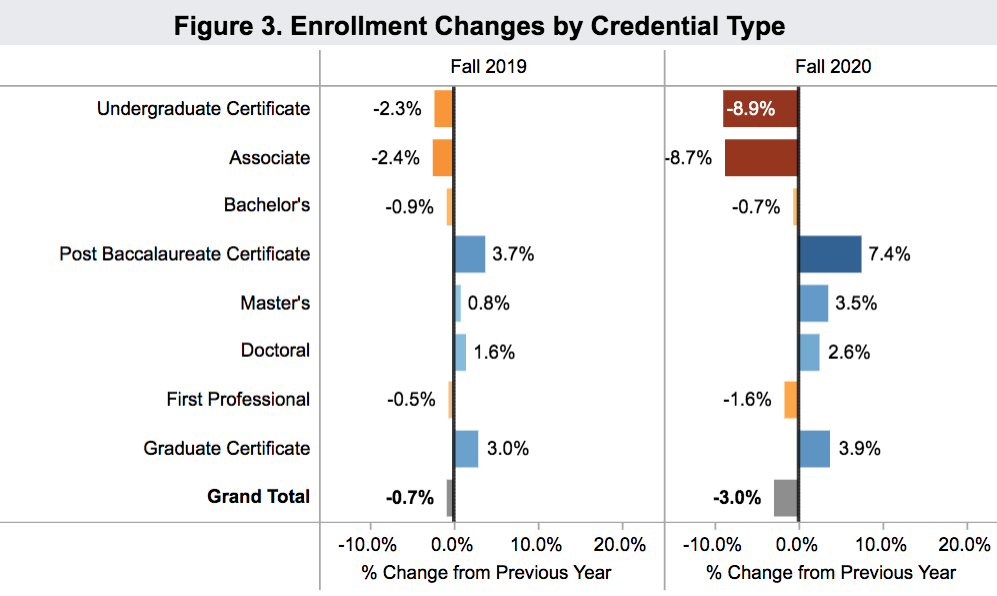
You can see signs of the community college crisis in which undergrad degrees are being taken, with certifications and associates’ falling steeply, while bachelors’ are almost stable:

enrollment by degree 2020 fall_Clearinghouse 2020 Oct 15

Recall that community colleges often enroll more students in recessions.  That’s because we identify them most closely with job skills, and recessions, like the one we’re in now, mean higher unemployment.  But this isn’t happening now.

In Insider Higher Ed Doug Shapiro – the Clearinghouse’s executive director and very fine Future Trends Forum guest – observes:

But it’s possible [that decline will continue], Shapiro said, because the students that community colleges serve are most likely to face challenges with access to technology, making online learning difficult. It’s also hard to translate vocational programs to remote formats.

In contrast, “[p]ublic four-year and private nonprofit four-year colleges show a much smaller drop (-1.4% and – 2.0%, respectively).”  And for-profits have actually turned a corner, after years of disaster: “As the only exception, for-profit four-year colleges are running 3% higher than last fall.”

International student numbers are seriously low: “A double-digit drop continued for international undergraduates (-13.7%)… International graduate enrollment declined 7.6%.”

Institutions that normally teach entirely or almost entirely online are doing just fine:

enrollment online schools_ 2020 fall_Clearinghouse 2020 Oct 15

Demographically, certain patterns are clear by race and gender.  Every race and ethnicity saw a decline, without exception:

American Indian and Native Alaskan students suffered the sharpest decline of all racial/ethnic undergraduate students (-10.7%), followed by Black students (-7.9%), White students (-7.6%), Hispanic students (-6.1%), and Asian students (-4.0%)…

Preliminary data shows that Historically Black Colleges and Universities (HBCUs) track closely the national trends for undergraduates overall, with somewhat more larger declines among private nonprofit four-year HBCUs and smaller drops among public two-year HBCUs.

Doug Shapiro notes: “We expected to see steeper declines among Black, Native American and Hispanic students.”

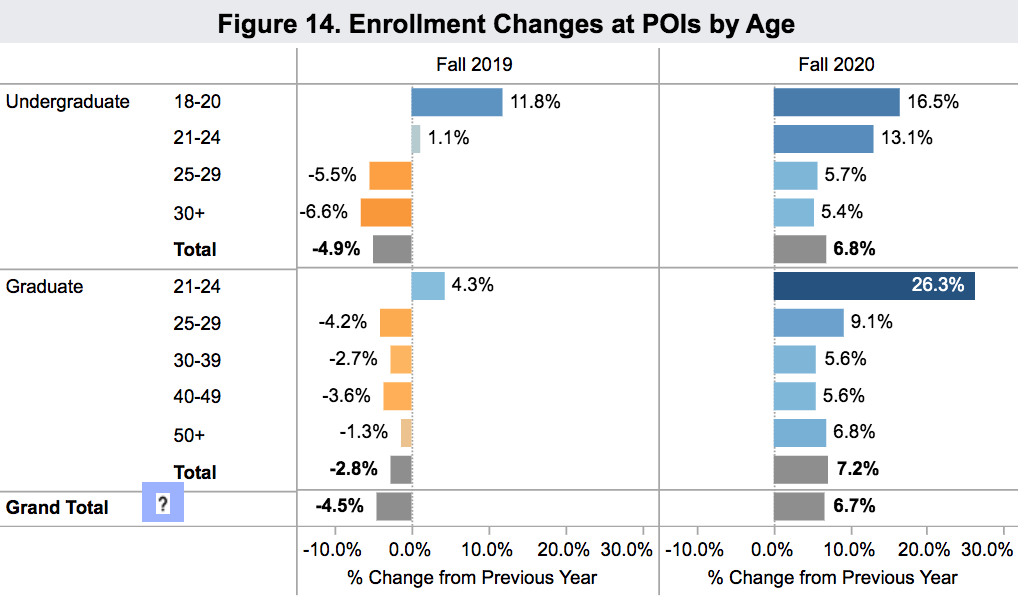
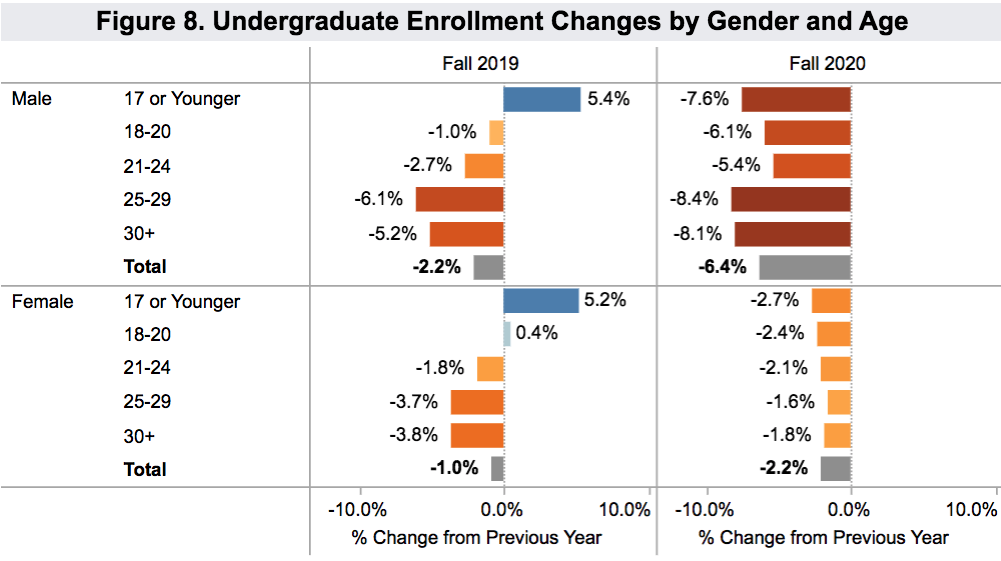
And male enrollment dropped by much more than female:

enrollment by age and gender 2020 fall_Clearinghouse 2020 Oct 15

Male undergraduate enrollment fell by three times the rate of female enrollment (-6.4% vs. -2.2%)…

One bright spot is the demographics of grad schools: “Graduate enrollment grew across all racial/ethnic groups, particularly Hispanic and Black students (14.2% and 9.3%, respectively).”

Geographically, one part of the United States saw a steeper enrollment decline than the rest: “the Midwest suffered the most (-5.7%) followed by the West (-3.9%), South (-3.6%) and Northeast (-3.4%).”

II: SOME REFLECTIONS

As any good piece of research does, this report causes me to ask more questions.  What are the total absolute numbers?  Any sense of changes by academic subject?

That first-year student drop is dismaying.  Think about the ripple effects on next year’s class, and the next, and the next.  Doug Shapiro again:

​”These declines are so large and so fast, and they’re so concentrated on first-year students who may never make it back,” he said. “​If there’s not a sudden rebound where they all come back in the spring — I don’t see that happening — I think many of these students will never make it back.”

How much of this decline is due to COVID-19, and how much to the relentless enrollment decline lasting nearly a decade?  I’m willing to bet the community college drop owes much to the pandemic, given how shockingly that goes against the usual economic pattern of increased attendance. Beyond CCs, the decline in non-profits looks close to the historical decline trajectory I’ve been tracking.

The international student number is a serious hit to the many schools depending on overseas enrollment.  I’d really like to see breakdowns by nation.  How much is due to the worsening US-China relationship?  Is India, normally the second-highest contributor of students to the US, now the leader?

The gender divide indicates a strengthened majority status for women as college and university students.

For-profits are enjoying a rebirth, it seems.  At the undergrad level they alone saw growth.  And at the grad level, a roaring 9.3% rise.  This is enormously important.  First, it shows the Obama-era collapse of that sector has clearly ended.  A second for-profit growth period may now be starting up.  Further, it means that for-profits are eating community colleges’ lunch.  I base this view on the community college plummet, and also on Tressie McMillan Cottom’s research identifying that for-profits’ main competitor is community colleges.

I worry that this latest report won’t get much traction, due to American culture in general and around higher ed in particular.  First, the geographical focus of loss is in the Midwest, an area the rest of the country tries to forget.  Second, while community colleges are the biggest segment within the higher ed ecosystem, they are scarcely talked about within the rest of academia.  So it’ll be easy for many to dismiss this report.

Today’s data report is bad news for colleges and universities that depend primarily on tuition for revenue – i.e., the supermajority of them.  Remember that big endowments are quite rare, and that state governments have been cutting public higher ed support since the 20th century. So American higher ed will be even more financially stressed.

For those reading here who are new to my work, hello!  I view this data as another iteration of a long-running decline in both higher ed enrollment and sustainability.  I’ve tracked the story of declining enrollment on this blog for almost a decade. I’ve also written about it in my most recent book, Academia Next: The Futures of Higher Education, (Johns Hopkins University Press) (Amazon). This trend is vital for understanding American higher ed, especially its strategic choices.  The historical fact is that America grew higher education enrollment for a generation, from around 1980 to 2012.  That was a great achievement.  But 2012 was the peak, and we’ve fallen away from it every year – every semester, in fact.

The blow to community colleges is very hard.  I don’t think this will garner much attention, but CCs are the biggest sector within American higher ed.  The drop could push some to merge and/or close programs or even shut down entirely.

Final point: if the United States is serious about expanding higher education access, we are not only failing, but continuing to fail.  We are now locked in a solid, established failure trend of enrollment decline. We’ve been failing at this for nearly a decade, despite a combination of policies, lots of money, administrative actions, technologies, pedagogical and curricular offerings.

Further, if we are serious about wanting to give underrepresented populations that post-secondary experience, we are seriously failing at that goal.

Posted in enrollment, trends | 3 Comments

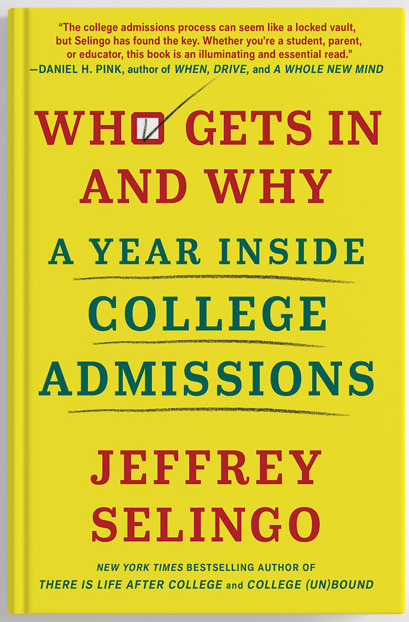
Tomorrow: inside college admissions, with Jeff Selingo

How do colleges and universities decide whom to admit in 2020?  Which aspects of an applicant’s background matter the most?  What are the controversies within admissions?  And where is that crucial part of higher education headed?

Selingo_Who Gets In and WhyWe’ll dive into these questions tomorrow, with the help of a brilliant guest.  I’m delighted to welcome Jeff Selingo back to the Future Trends Forum.  Jeff just published Who Gets In and Why (our bookstore; Jeff’s page), a new book on college admissions.  It’s based on his embedding with three different campuses (Davidson College, Emory University, and the University of Washington), looking closely at how each one composed their incoming classes.  Who Gets In is also based on Selingo’s lifetime of thoughtful reporting on higher education.

A quick bio sketch for those who don’t know him: Jeff has published several books including New York Times bestsellers. Named one of LinkedIn’s “must-know influencers” of 2016, Jeff is a regular contributor to the Washington Post and a visiting scholar at Georgia Tech’s Center for 21st Century Universities.  Jeff is a special advisor for innovation to the president at Arizona State University, where he is the founding director of the Academy for Innovative Higher Education Leadership.  He is the former top editor of the Chronicle of Higher Education, where he worked for 16 years in a variety of reporting and editing roles.

Jeff is not new to the Forum.  Not only have I been recommending him to the community for years, but he was also a great guest back in 2017.

Our session starts at 1:30 pm EDT, a little earlier than usual.  Click here to register ahead of time – for free, of course, as always – or click to join us during the appointed hour.

And if you’re new to the Future Trends Forum, the best discussions about higher education’s future, click here to learn more about it!

Posted in Future Trends Forum | 2 Comments